Objective and SignificanceMarine ecological observation has become one of the essential approaches to supporting ocean exploration, ecological protection and restoration, disaster prevention and reduction, and early warning of ecological hazards. With the intensification of human activities and the accelerating impacts of global climate change, typical marine ecosystems are increasingly facing severe degradation and fragility. These threats include frequent red tides, eutrophication, and biodiversity loss in coastal waters, all of which impose significant economic and ecological costs. Against this backdrop, there is an urgent demand to establish advanced real-time, automated, and intelligent ecological observing systems. Such systems are expected to capture dynamic variations of marine environmental parameters and provide a scientific basis for sustainable marine management and the construction of ecological civilization.
Analysis, Discussion and ProgressThis paper provides an overview of international progress in marine ecological observation technologies, focusing on nearshore, deep-sea, and seafloor monitoring systems. Developed marine countries have built integrated observation networks composed of buoys, coastal stations, underwater platforms, and satellite remote sensing, which together achieve long-term, continuous, and real-time monitoring of multiple environmental and ecological parameters. Typical examples include the United States Integrated Ocean Observing System (IOOS), the Ocean Observatories Initiative (OOI), Canada's NEPTUNE seafloor network, and Europe's EMSO project. These networks have demonstrated the capability to monitor not only hydrological and meteorological variables but also ecological indicators critical for predicting and preventing ecological disasters. By comparison, China's ocean ecological observation systems started relatively late and have mainly relied on coastal eco-buoys since the reform and opening-up period. Although more than 100 buoy-based monitoring stations have been deployed across major coastal provinces, these systems are still limited in scope, parameter diversity, and integration capacity. Current observation remains dominated by localized, single-point monitoring, with insufficient network connectivity and poor spatial resolution. Moreover, the existing systems are constrained by limited endurance, high maintenance costs, and weak data-sharing mechanisms, making it difficult to fully meet the requirements of ecological disaster early warning and ecosystem protection in the new era.
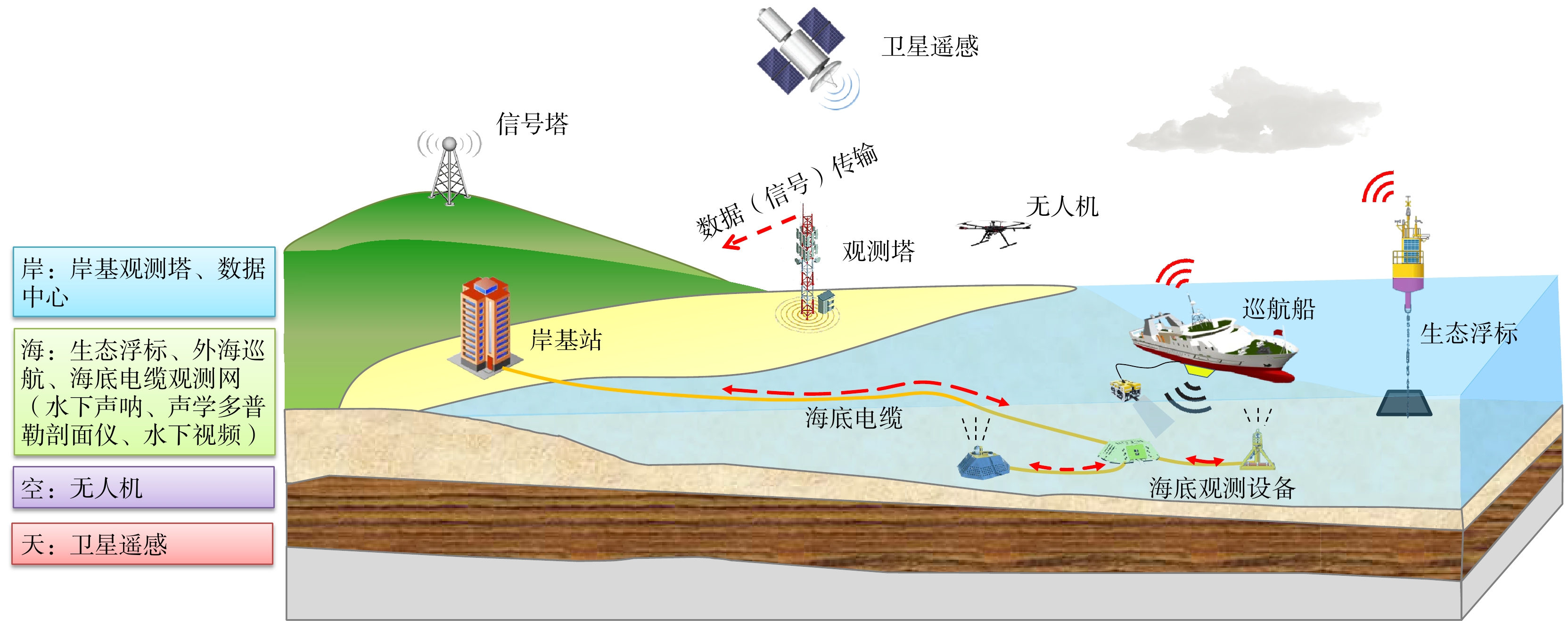
Conclusions and ProspectsTo overcome these limitations, this paper proposes that China's ecological observation should shift from simple buoy-based approaches toward the construction of collaborative, stereoscopic observation networks. Such networks should integrate multiple platforms: Shore-based towers, eco-buoys, underwater cabled observatories, shipborne systems, unmanned aerial vehicles, and satellite remote sensing: Forming a comprehensive "shore-sea-air-space" observation framework. With enhanced accuracy, extended parameters, and improved spatial and temporal coverage, these networks would enable dynamic, multi-dimensional monitoring of marine ecological processes. The establishment of such integrated networks is expected to play a crucial role in early warning of ecological disasters such as harmful algal blooms, coral bleaching, and ecosystem degradation. Furthermore, the accumulation of long-term, continuous datasets will provide essential support for assessing ecosystem health, guiding ecological restoration projects, and improving the resilience of coastal socio-economic systems. On a broader scale, advancing China's marine ecological observation capacity will also contribute to international collaboration in global ocean observing, strengthen data-sharing, and enhance China's role in addressing global marine environmental challenges. In summary, the paper highlights both the progress and the limitations of China's current ecological observation efforts and argues for a transformation toward advanced, stereoscopic, and multi-platform ecological observing systems. This transition is vital for improving marine ecological protection, supporting disaster prevention and mitigation, and achieving the long-term goal of sustainable ocean development under ecological civilization.


 Submission System