| Citation: | HE Xin,LI Shuai,WANG Jia,et al. Research progress and trend analysis of geological disaster chains based on bibliometrics[J]. Bulletin of Geological Science and Technology,2026,45(3):43-58 doi: 10.19509/j.cnki.dzkq.tb20250488

|
In the context of intensifying global climate change, the escalating threat posed by geological disaster chains has become increasingly severe. However, there remains a lack of a comprehensive and systematic quantitative review of the development of this research field. Therefore, a thorough synthesis of existing literature is imperative to elucidate the current state of knowledge and to clarify the research landscape surrounding these emerging and complex challenges under the new circumstances.
Utilizing bibliometric methodologies, this study analyzes 784 relevant publications indexed in the Web of Science core collection from 1989 to 2024. It constructs a four-dimensional analytical framework that systematically examines publication trends, collaborative networks among countries and institutions, the influence of academic journals, and the evolution of research themes.
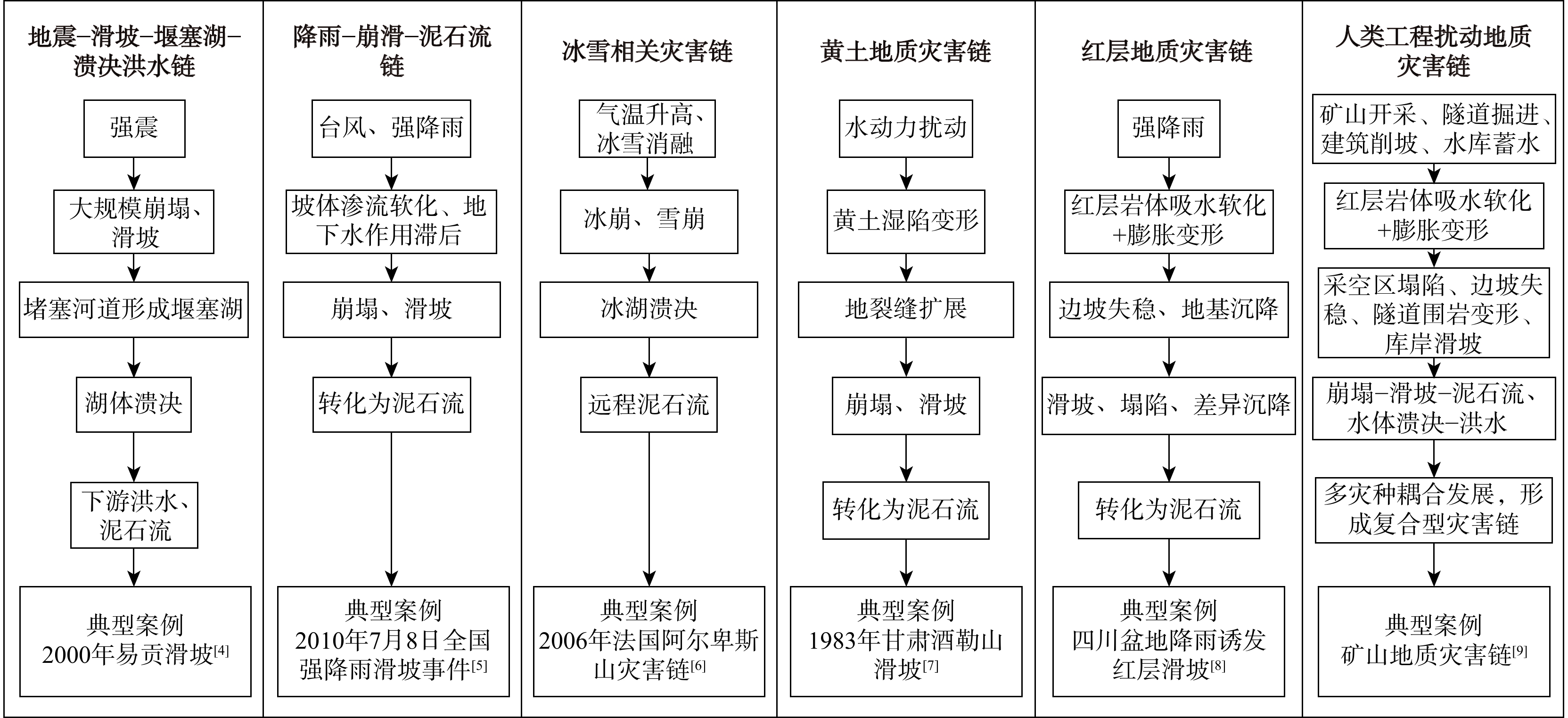
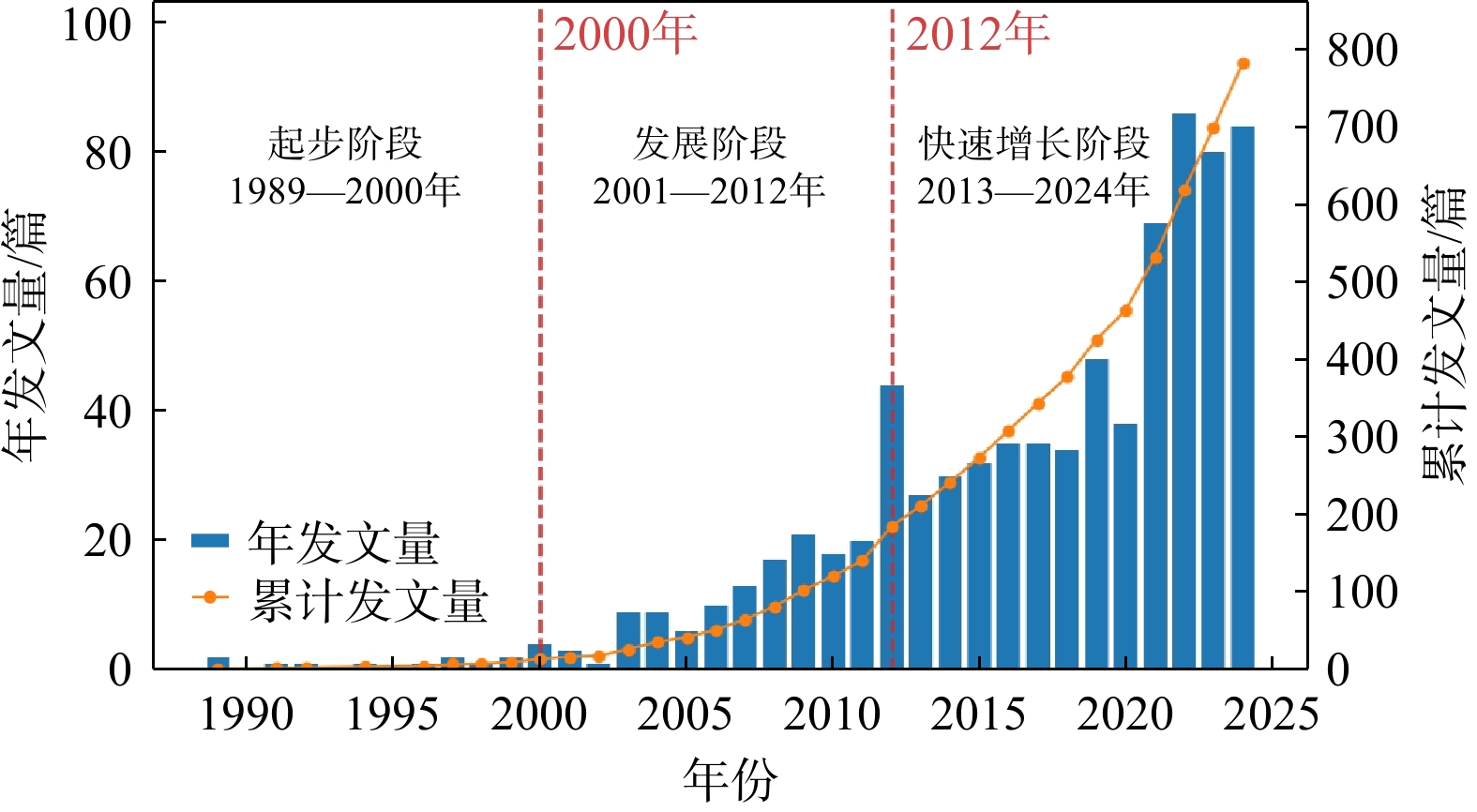
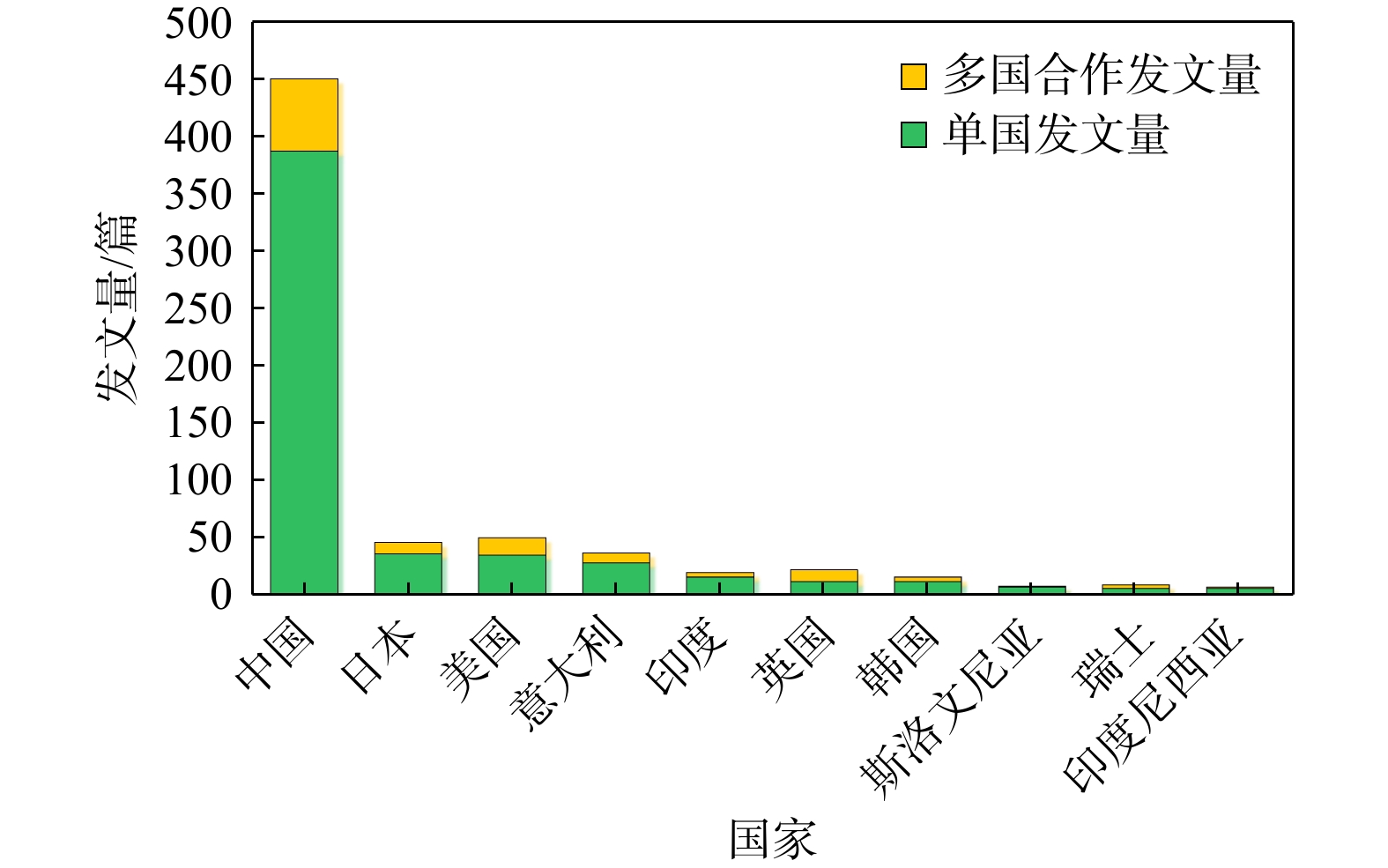
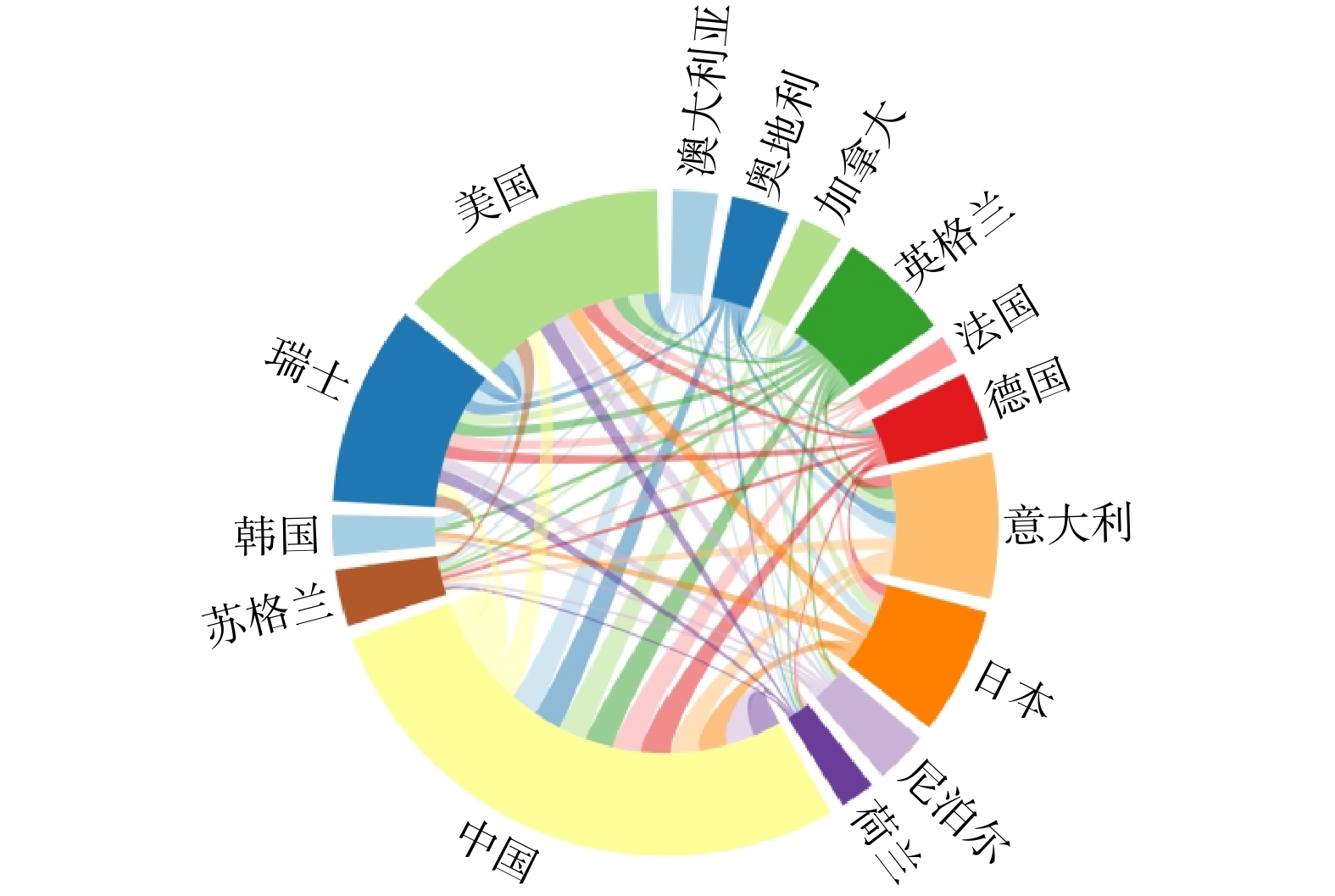
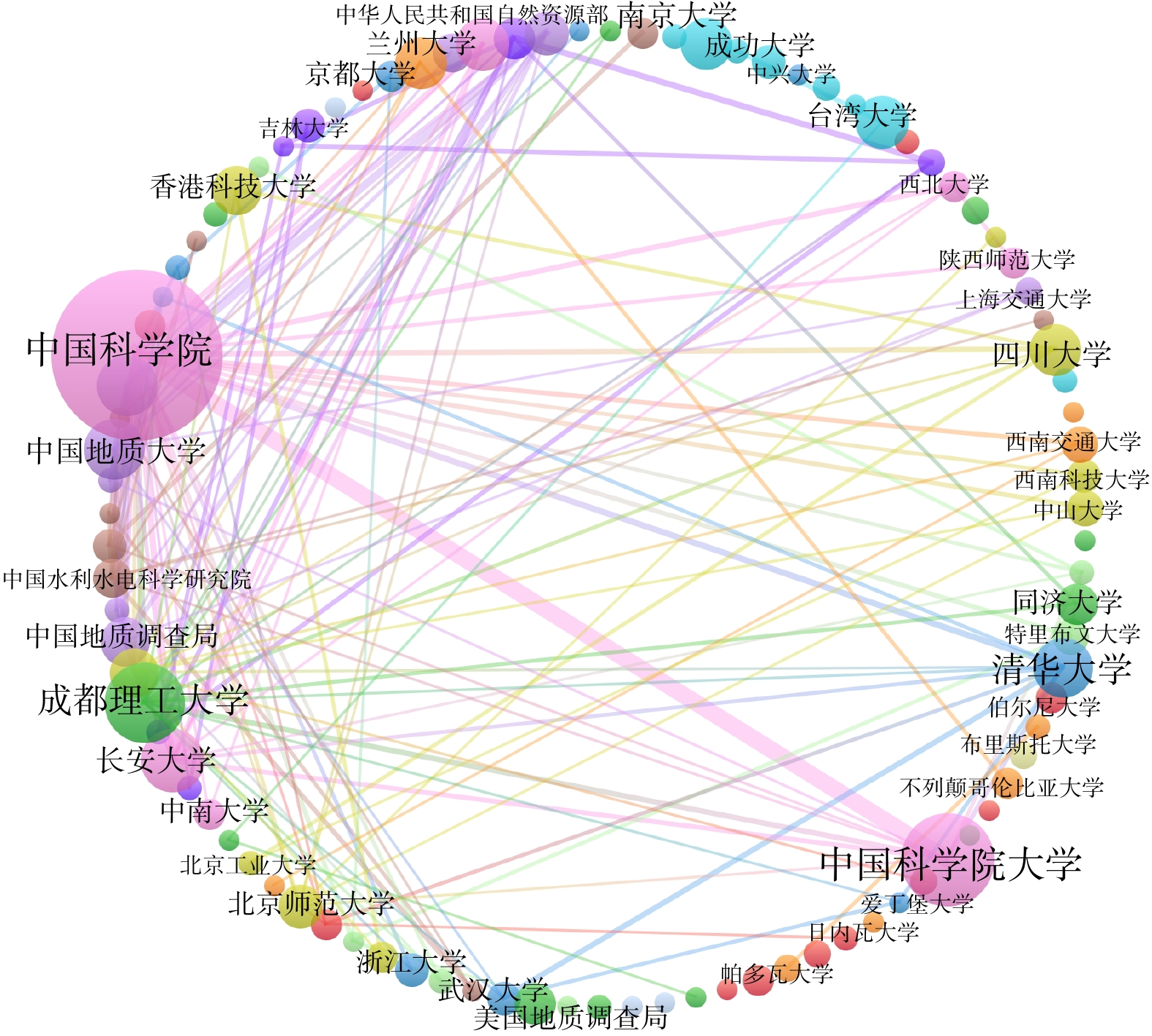
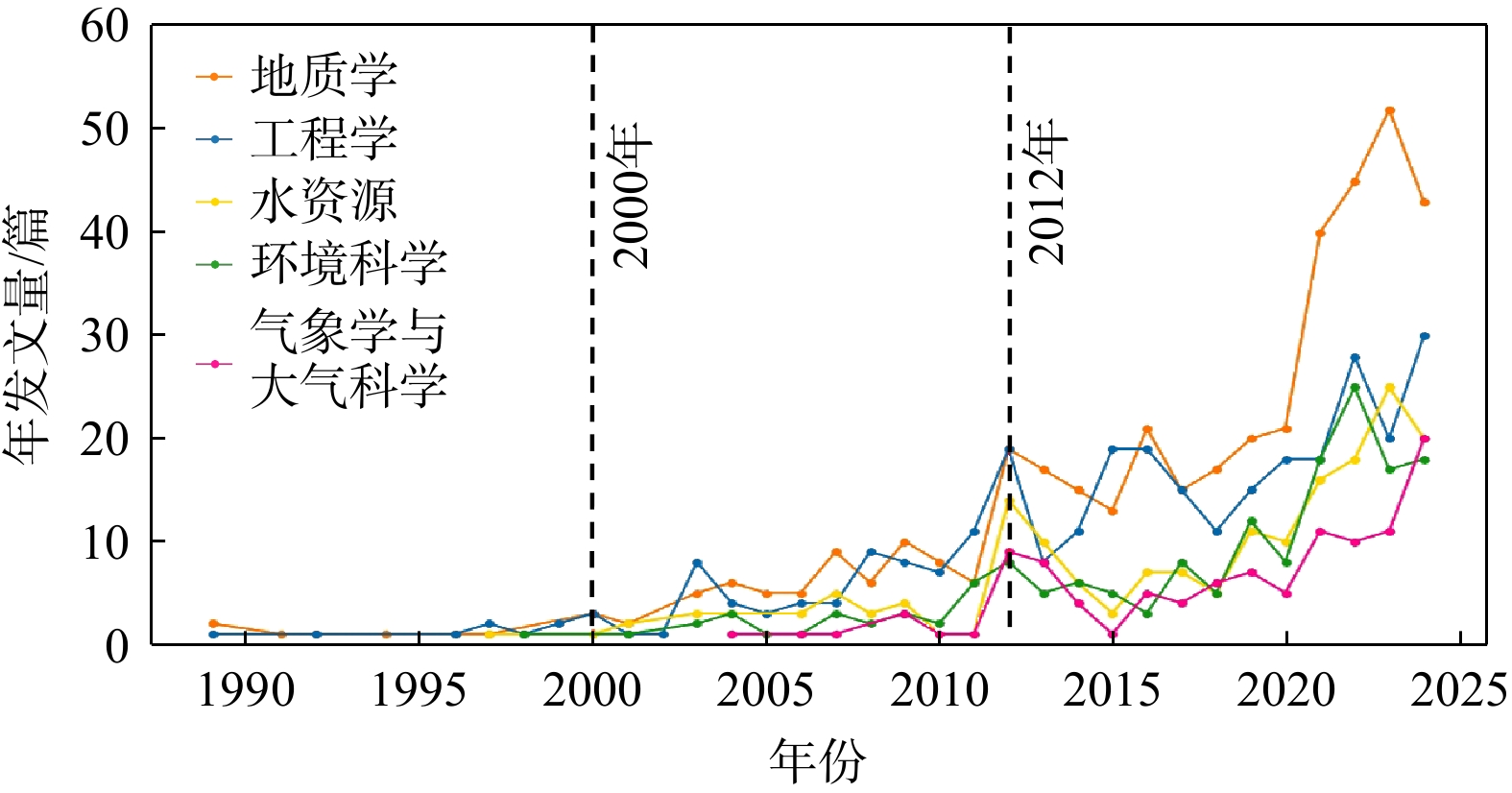
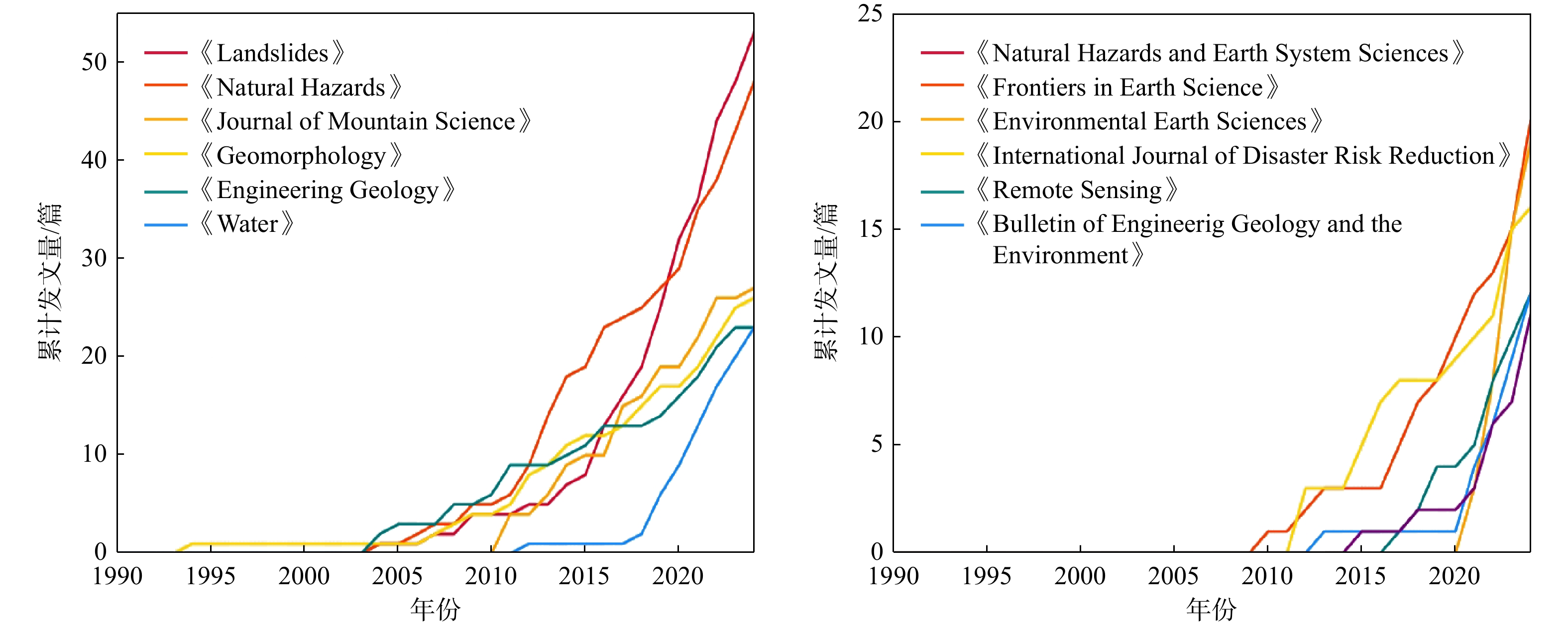
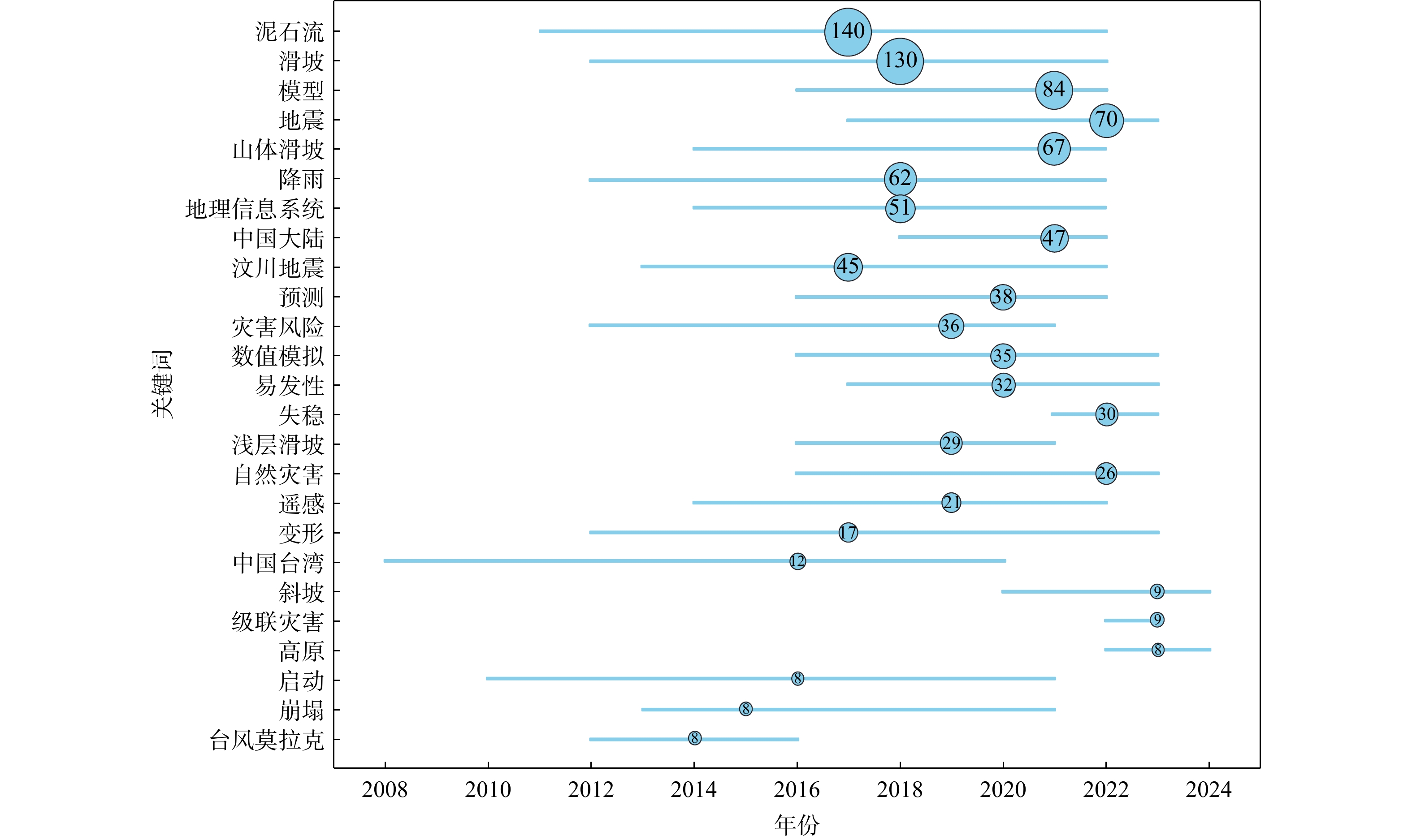
The principal findings are summarized as follows. ① The evolution of research exhibits a distinct three-phase trajectory: an initial phase (1989–2000), a development phase (2001–2012), and a rapid growth phase (2013–2024). This progression is driven by a combination of technology empowerment and case-based validation. Major disaster events provide critical empirical scenarios, while breakthroughs in observational and predictive technologies, such as light detection and ranging (LiDAR), interferometric synthetic aperture radar (InSAR), and artificial intelligence (AI), fundamentally shape the depth, scope, and timing of research development. ② China leads the field with 449 publications, which is approximately nine times the output of the second-ranked United States. The Chinese Academy of Sciences serves as the core and most productive institution. International collaboration has formed a multi-centered network, mainly involving China, the United States, and the United Kingdom. ③ Landslides, Natural Hazards, and Engineering Geology are the most influential core journals in this field, as evidenced by metrics such as the h-index and citation impact. ④ A profound paradigm shift is observed: from single-hazard analysis to multi-hazard couplings, from static susceptibility assessments to dynamic process simulations of chain evolution, and from empirical description to integrated “data-driven+physics-constrained” intelligent prediction modelling. Looking forward, future research endeavors should prioritize two key directions. First, methodological and technological innovations are needed, including the development of hybrid intelligent systems that integrate data-driven approaches with physical mechanisms, integrated “full-chain” observation systems combining remote sensing and ground-based sensors, and digital twin platforms for scenario simulation and risk projection. Second, increased attention should be directed towards the mechanisms and risk assessment of region-specific typical disaster chains under different triggering contexts, such as long-term post-seismic chains (earthquake-landslide clusters-river damming-outburst floods-debris flows), disaster chains in alpine/permafrost regions (freeze-thaw cycles-thaw settlement/thermal erosion slumps-debris flows/outburst floods), interactions between wildfires and subsequent geological hazards (forest fire-soil hydrophobicity-erosion-shallow landslides-debris flows), chains in karst and dissolution-prone areas (collapse-ground fissures-landslides/subsidence-water contamination), and chains induced by reservoir operations or engineering activities (water level fluctuation-bank slope instability-surge waves-secondary disasters). This study systematically reveals the developmental trajectory and paradigm shift in geological disaster chains. The insights derived from this study provide a robust empirical basis for better understanding the development of the field and offer strategic guidance for future research priorities and international collaborative initiatives.

| [1] |
HELBING D. Globally networked risks and how to respond[J]. Nature, 2013, 497(7447): 51-59. doi: 10.1038/nature12047
|
| [2] |
GILL J C, MALAMUD B D. Reviewing and visualizing the interactions of natural hazards[J]. Reviews of Geophysics, 2014, 52(4): 680-722. doi: 10.1002/2013RG000445
|
| [3] |
CUI P, ZHU Y Y, HAN Y S, et al. The 12 May Wenchuan earthquake-induced landslide lakes: Distribution and preliminary risk evaluation[J]. Landslides, 2009, 6(3): 209-223. doi: 10.1007/s10346-009-0160-9
|
| [4] |
戴兴建, 殷跃平, 邢爱国. 易贡滑坡−碎屑流−堰塞坝溃坝链生灾害全过程模拟与动态特征分析[J]. 中国地质灾害与防治学报, 2019, 30(5): 1-8.
DAI X J, YIN Y P, XING A G. Simulation and dynamic analysis of Yigong rockslide-debris avalanche-dam breaking disaster chain[J]. The Chinese Journal of Geological Hazard and Control, 2019, 30(5): 1-8.
|
| [5] |
崔云, 孔纪名, 田述军, 等. 强降雨在山地灾害链成灾演化中的关键控制作用[J]. 山地学报, 2011, 29(1): 87-94.
CUI Y, KONG J M, TIAN S J, et al. The critical role for heavy rainfall in the evolution of the mountain hazards chains[J]. Mountain Research, 2011, 29(1): 87-94. (in Chinese with English abstract
|
| [6] |
BODIN X, KRYSIECKI J M, SCHOENEICH P, et al. The 2006 collapse of the Bérard rock glacier (southern French Alps)[J]. Permafrost and Periglacial Processes, 2017, 28(1): 209-223.
|
| [7] |
马鹏辉, 彭建兵. 论黄土地质灾害链(一)[J]. 自然灾害学报, 2022, 31(2): 1-11.
MA P H, PENG J B. On loess geohazards chain (Ⅰ)[J]. Journal of Natural Disasters, 2022, 31(2): 1-11. (in Chinese with English abstract
|
| [8] |
许强, 唐然. 红层及其地质灾害研究[J]. 岩石力学与工程学报, 2023, 42(1): 28-50.
XU Q, TANG R. Study on red beds and its geological hazards[J]. Chinese Journal of Rock Mechanics and Engineering, 2023, 42(1): 28-50. (in Chinese with English abstract
|
| [9] |
王卓理, 耿鹏旭, 王海荣. 矿山地质灾害链及其断链减灾实践研究[J]. 地域研究与开发, 2011, 30(5): 156-160.
WANG Z L, GENG P X, WANG H R. Mine geological hazard chains and practice of chain-breaking disaster mitigation[J]. Areal Research and Development, 2011, 30(5): 156-160. (in Chinese with English abstract
|
| [10] |
MENONI S. Chains of damages and failures in a metropolitan environment: Some observations on the Kobe earthquake in 1995[J]. Journal of Hazardous Materials, 2001, 86(1/2/3): 101-119. doi: 10.1016/s0304-3894(01)00257-6
|
| [11] |
DOMBROWSKY W R. Again and again: Is a disaster what we call "disaster"? some conceptual notes on conceptualizing the object of disaster sociology[J]. International Journal of Mass Emergencies & Disasters, 1995, 13(3): 241-254. doi: 10.1177/028072709501300303
|
| [12] |
郭增建, 秦保燕. 灾害物理学简论[J]. 灾害学, 1987, 2(2): 25-33.
GUO Z J, QIN B Y. Brief discussion on disaster physics[J]. Journal of Catastrophology, 1987, 2(2): 25-33. (in Chinese with English abstract
|
| [13] |
郭安宁, 任栋, 白雪见, 等. 郭增建主要学术贡献与成就[J]. 地震工程学报, 2018, 40(增刊1): 242-250.
GUO A N, REN D, BAI X J, et al. Guo Zengjian's main academic contributions and achievements[J]. China Earthquake Engineering Journal, 2018, 40(S1): 242-250. (in Chinese with English abstract
|
| [14] |
肖盛燮. 生态环境灾变链式理论原创结构梗概[J]. 岩石力学与工程学报, 2006, 25(增刊1): 2593-2602. doi: 10.3321/j.issn:1000-6915.2006.z1.001
XIAO S X. Originality structure sketch on chain-styled theory of disaster in eco-environment[J]. Chinese Journal of Rock Mechanics and Engineering, 2006, 25(S1): 2593-2602. (in Chinese with English abstract doi: 10.3321/j.issn:1000-6915.2006.z1.001
|
| [15] |
王文俊, 唐晓春, 王建力. 灾害地貌链及其临界过程初探[J]. 灾害学, 2000, 15(1): 41-46.
WANG W J, TANG X C, WANG J L. A preliminary study on disaster chain of geomorphology and its critical process[J]. Journal of Catastrophology, 2000, 15(1): 41-46. (in Chinese with English abstract
|
| [16] |
郭增建, 韩延本, 郭安宁. 从灾害链角度讨论2005年九江5.7级地震的预测[J]. 地震, 2006, 26(4): 129-132. doi: 10.3969/j.issn.1000-3274.2006.04.017
GUO Z J, HAN Y B, GUO A N. Discussion on the prediction of Jiujiang earthquake(Ms 5.7) on November 26, 2005 from the view point of disaster chain[J]. Earthquake, 2006, 26(4): 129-132. (in Chinese with English abstract doi: 10.3969/j.issn.1000-3274.2006.04.017
|
| [17] |
韩金良, 吴树仁, 汪华斌. 地质灾害链[J]. 地学前缘, 2007, 14(6): 11-23. doi: 10.1016/S1872-5791(08)60001-9
HAN J L, WU S R, WANG H B. Preliminary study on geological hazard chains[J]. Earth Science Frontiers, 2007, 14(6): 11-23. (in Chinese with English abstract doi: 10.1016/S1872-5791(08)60001-9
|
| [18] |
VAN ECK N J, WALTMAN L. Software survey: VOSviewer, a computer program for bibliometric mapping[J]. Scientometrics, 2010, 84(2): 523-538. doi: 10.1007/s11192-009-0146-3
|
| [19] |
WEISSEL J K, STARK C P. Landslides triggered by the 1999 Mw7.6 Chi Chi earthquake in Taiwan and their relationship to topography[C]//Anon. IGARSS 2001: Scanning the Present and Resolving the Future, Proceedings of IEEE 2001 International Geoscience and Remote Sensing Symposium. Sydney: IEEE, 2001: 759-761.
|
| [20] |
CHEN C Y. Landslide and debris flow initiated characteristics after typhoon Morakot in Taiwan[J]. Landslides, 2016, 13: 153-164.
|
| [21] |
郭海湘, 区歌阳, 杨钰莹. 1987—2022年中国自然灾害链研究进展与趋势: 基于CiteSpace的计量分析[J]. 安全与环境工程, 2024, 31(6): 118-133.
GUO H X, OU G Y, YANG Y Y. Research progress and trends of natural disaster chain in China(1987—2022): Visual analysis based on CiteSpace[J]. Safety and Environmental Engineering, 2024, 31(6): 118-133. (in Chinese with English abstract
|
| [22] |
郭增建, 秦保燕. 灾害物理学的方法论(一)[J]. 灾害学, 1988(2): 9-17.
GUO Z J, QIN B Y. The methodology of disaster physics (I)[J]. Journal of Catastrophology, 1988(2): 9-17. (in Chinese with English abstract
|
| [23] |
SHAKESBY R A, DOERR S H. Wildfire as a hydrological and geomorphological agent[J]. Earth-Science Reviews, 2006, 74(3/4): 269-307. doi: 10.1016/j.earscirev.2005.10.006
|
| [24] |
TANG C, ZHU J, DING J, et al. Catastrophic debris flows triggered by a 14 August 2010 rainfall at the epicenter of the Wenchuan earthquake[J]. Landslides, 2011, 8(4): 485-497. doi: 10.1007/s10346-011-0269-5
|
| [25] |
COLESANTI C, WASOWSKI J. Investigating landslides with space-borne synthetic aperture radar (SAR) interferometry[J]. Engineering Geology, 2006, 88(3/4): 173-199. doi: 10.1016/j.enggeo.2006.09.013
|
| [26] |
GARIANO S L, GUZZETTI F. Landslides in a changing climate[J]. Earth-Science Reviews, 2016, 162: 227-252. doi: 10.1016/j.earscirev.2016.08.011
|
| [27] |
CASAGLI N, INTRIERI E, TOFANI V, et al. Landslide detection, monitoring and prediction with remote-sensing techniques[J]. Nature Reviews Earth & Environment, 2023, 4(1): 51-64. doi: 10.1038/s43017-022-00373-x
|
| [28] |
KAPPES M S, KEILER M, VON ELVERFELDT K, et al. Challenges of analyzing multi-hazard risk: A review[J]. Natural Hazards, 2012, 64(2): 1925-1958. doi: 10.1007/s11069-012-0294-2
|
| [29] |
DENG L, WANG W, YU Y. State-of-the-art review on the causes and mechanisms of bridge collapse[J]. Journal of Performance of Constructed Facilities, 2016, 30(2): 04015005. doi: 10.1061/(ASCE)CF.1943-5509.0000731
|
| [30] |
GILL J C, MALAMUD B D. Anthropogenic processes, natural hazards, and interactions in a multi-hazard framework[J]. Earth-Science Reviews, 2017, 166: 246-269.
|
| [31] |
DIKSHIT A, PRADHAN B, ALAMRI A M. Pathways and challenges of the application of artificial intelligence to geohazards modelling[J]. Gondwana Research, 2021, 100: 290-301. doi: 10.1016/j.gr.2020.08.007
|
| [32] |
KING J, LOVEDAY I, SCHUSTER R L. The 1985 Bairaman landslide dam and resulting debris flow, Papua New Guinea[J]. Quarterly Journal of Engineering Geology, 1989, 22(4): 257-270. doi: 10.1144/GSL.QJEG.1989.022.04.02
|
| [33] |
彭建兵, 林鸿州, 王启耀, 等. 黄土地质灾害研究中的关键问题与创新思路[J]. 工程地质学报, 2014, 22(4): 684-691.
PENG J B, LIN H Z, WANG Q Y, et al. The critical issues and creative concepts in mitigation research of loess geological hazards[J]. Journal of Engineering Geology, 2014, 22(4): 684-691. (in Chinese with English abstract
|
| [34] |
吕文茜, 王雁林, 陈新建, 等. 2001—2022年陕北黄土地区地质灾害时空分布及引发因素分析[J]. 灾害学, 2024, 39(4): 207-212. doi: 10.3969/j.issn.1000-811X.2024.04.030
LYU W X, WANG Y L, CHEN X J, et al. Spatial and temporal distribution and analysis of triggering factors of geologic hazards in the loess area of northern Shaanxi from 2001 to 2022[J]. Journal of Catastrophology, 2024, 39(4): 207-212. (in Chinese with English abstract doi: 10.3969/j.issn.1000-811X.2024.04.030
|
| [35] |
LU Y M, QIAO S T, YAO Y R. Risk assessment of typhoon disaster chain based on knowledge graph and Bayesian network[J]. Sustainability, 2025, 17(1): 331.
|
| [36] |
RONG G Z, LI K W, HAN L N, et al. Hazard mapping of the rainfall-landslides disaster chain based on GeoDetector and Bayesian network models in Shuicheng County, China[J]. Water, 2020, 12(9): 2572.
|
| [37] |
CHANG W B, XING A G. Experimental investigation of dry rock-ice avalanches depositional behavior using granular materials: Initial ice-overlying case[J]. Landslides, 2026, 23(3): 787-805.
|
| [38] |
王益鹏, 张雪英, 党玉龙, 等. 顾及时空过程的台风灾害事件知识图谱表示方法[J]. 地球信息科学学报, 2023, 25(6): 1228-1239.
WANG Y P, ZHANG X Y, DANG Y L, et al. Knowledge graph representation of typhoon disaster events based on spatiotemporal processes[J]. Journal of Geo-Information Science, 2023, 25(6): 1228-1239. (in Chinese with English abstract
|
| [39] |
胡卸文, 黄润秋, 施裕兵, 等. 唐家山滑坡堵江机制及堰塞坝溃坝模式分析[J]. 岩石力学与工程学报, 2009, 28(1): 181-189.
HU X W, HUANG R Q, SHI Y B, et al. Analysis of blocking river mechanism of Tangjiashan landslide and dam-breaking mode of its barrier dam[J]. Chinese Journal of Rock Mechanics and Engineering, 2009, 28(1): 181-189. (in Chinese with English abstract
|
| [40] |
KEEFER D K. Landslides caused by earthquakes[J]. Geological Society of America Bulletin, 1984, 95(4): 406.
|
| [41] |
李明, 唐红梅, 叶四桥. 典型地质灾害链式机理研究[J]. 灾害学, 2008, 23(1): 1-5.
LI M, TANG H M, YE S Q. Research on chain rule of typical geological disaster[J]. Journal of Catastrophology, 2008, 23(1): 1-5. (in Chinese with English abstract
|
| [42] |
朱兴华, 崔鹏, 陈华勇, 等. 串珠状堰塞湖级联溃决对汶川震区河流演化的影响[J]. 四川大学学报(工程科学版), 2012, 44(4): 64-69.
ZHU X H, CUI P, CHEN H Y, et al. Effects of cascade failure of dammed lakes on the evolution of rivers in Wenchuan earthquake region[J]. Journal of Sichuan University (Engineering Science Edition), 2012, 44(4): 64-69. (in Chinese with English abstract
|
| [43] |
朱兴华, 彭建兵, 同霄, 等. 黄土地区地质灾害链研究初探[J]. 工程地质学报, 2017, 25(1): 117-122.
ZHU X H, PENG J B, TONG X, et al. Preliminary research on geological disaster chains in loess area[J]. Journal of Engineering Geology, 2017, 25(1): 117-122. (in Chinese with English abstract
|
| [44] |
马鹏辉, 彭建兵. 论黄土地质灾害链(二)[J]. 自然灾害学报, 2022, 31(3): 15-24.
MA P H, PENG J B. On loess geohazards chain(Ⅱ)[J]. Journal of Natural Disasters, 2022, 31(3): 15-24. (in Chinese with English abstract
|
| [45] |
谭成轩, 雷伟志, 孙炜锋, 等. 中国典型黏黄土区地质灾害风险评估危险性影响因素分析[J]. 地质通报, 2008, 27(11): 1771-1781.
TAN C X, LEI W Z, SUN W F, et al. An analysis of the danger influence factors of geohazard risk assessments in typical stick loess regions in China[J]. Geological Bulletin of China, 2008, 27(11): 1771-1781. (in Chinese with English abstract
|
| [46] |
刘传正, 王建新. 崩塌滑坡泥石流灾害链分类研究[J]. 工程地质学报, 2024, 32(5): 1573-1596.
LIU C Z, WANG J X. Research on classification of collapse, landslide and debris flow disaster chains[J]. Journal of Engineering Geology, 2024, 32(5): 1573-1596. (in Chinese with English abstract
|
| [47] |
郭剑, 崔一飞. 滑坡−泥石流转化研究进展[J]. 工程地质学报, 2023, 31(3): 762-779.
GUO J, CUI Y F. An overview of landslide-induced debris flow[J]. Journal of Engineering Geology, 2023, 31(3): 762-779. (in Chinese with English abstract
|
| [48] |
铁永波, 张宪政, 龚凌枫, 等. 西南山区典型地质灾害链成灾模式研究[J]. 地质力学学报, 2022, 28(6): 1071-1080.
TIE Y B, ZHANG X Z, GONG L F, et al. Research on the pattern of typical geohazard chains in the southwest mountainous region, China[J]. Journal of Geomechanics, 2022, 28(6): 1071-1080. (in Chinese with English abstract
|
| [49] |
XU Q, LIU H X, RAN J X, et al. Field monitoring of groundwater responses to heavy rainfalls and the early warning of the Kualiangzi landslide in Sichuan Basin, southwestern China[J]. Landslides, 2016, 13(6): 1555-1570.
|
| [50] |
李江, 许强, 王森, 等. 川东红层地区降雨入渗模式与岩质滑坡成因机制研究[J]. 岩石力学与工程学报, 2016, 35(增刊2): 4053-4062.
LI J, XU Q, WANG S, et al. Research on rainfall infiltration models of slopes and formation mechanism of rock landslides in red stratum in the east of Sichuan Province[J]. Chinese Journal of Rock Mechanics and Engineering, 2016, 35(S2): 4053-4062. (in Chinese with English abstract
|
| [51] |
戴张俊, 郭建华, 周哲, 等. 川中红层高铁路基长时上拱变形反演与预测[J]. 岩石力学与工程学报, 2020, 39(增刊2): 3538-3548.
DAI Z J, GUO J H, ZHOU Z, et al. Inversion and prediction of long-term uplift deformation of high-speed railway subgrade in central Sichuan red-bed[J]. Chinese Journal of Rock Mechanics and Engineering, 2020, 39(S2): 3538-3548. (in Chinese with English abstract
|
| [52] |
钟志彬, 李安洪, 邓荣贵, 等. 高速铁路红层软岩路基时效上拱变形机制研究[J]. 岩石力学与工程学报, 2020, 39(2): 327-340.
ZHONG Z B, LI A H, DENG R G, et al. Study on time-dependent upheaval deformation mechanisms of red-bed soft rock subgrade of high-speed railways[J]. Chinese Journal of Rock Mechanics and Engineering, 2020, 39(2): 327-340. (in Chinese with English abstract
|
| [53] |
孙立军, 冯文凯, 吴刚. 四川盆地红层区机场建设中的主要工程地质问题分析[J]. 工程勘察, 2015, 43(1): 11-15.
SUN L J, FENG W K, WU G. Analysis on main engineering geological problems in airport construction in the red beds of Sichuan Basin[J]. Geotechnical Investigation & Surveying, 2015, 43(1): 11-15. (in Chinese with English abstract
|
| [54] |
钟志彬, 李安洪, 邓荣贵, 等. 川中红层泥岩时效膨胀变形特性试验研究[J]. 岩石力学与工程学报, 2019, 38(1): 76-86.
ZHONG Z B, LI A H, DENG R G, et al. Experimental study on the time-dependent swelling characteristics of red-bed mudstone in central Sichuan[J]. Chinese Journal of Rock Mechanics and Engineering, 2019, 38(1): 76-86. (in Chinese with English abstract
|
| [55] |
韩浩东, 王春山, 王东辉, 等. 成都市白垩系灌口组富膏盐红层溶蚀特征与机理[J]. 中国岩溶, 2021, 40(5): 768-782.
HAN H D, WANG C S, WANG D H, et al. Dissolution characteristics and mechanism on red bed enriched gypsum salt of Guankou Formation, Cretaceous in Chengdu[J]. Carsologica Sinica, 2021, 40(5): 768-782. (in Chinese with English abstract
|
| [56] |
肖攀, 彭轲, 李雪平, 等. 红层岩溶发育特征与地面塌陷形成机理: 以咸宁地区为例[J]. 科学技术与工程, 2019, 19(33): 86-93.
XIAO P, PENG K, LI X P, et al. Development characteristics of redbed karst and formation mechanism of ground collapse: Taking Xianning for example[J]. Science Technology and Engineering, 2019, 19(33): 86-93. (in Chinese with English abstract
|
| [57] |
王崇艮, 王茂靖, 赵文, 等. 兰渝铁路梅岭关隧道底鼓段病害成因分析[J]. 高速铁路技术, 2020, 11(6): 63-68.
WANG C G, WANG M J, ZHAO W, et al. Cause analysis of diseases in the floor heave section of Meilingguan tunnel in Lanzhou-Chongqing Railway[J]. High Speed Railway Technology, 2020, 11(6): 63-68. (in Chinese with English abstract
|
| [58] |
郭高峰, 文和鹏. 龙泉山红层区瓦斯隧道灾害特征分析[J]. 灾害学, 2019, 34(增刊1): 193-195.
GUO G F, WEN H P. Longquan mountain red layer analysis of gas tunnel disaster characteristics[J]. Journal of Catastrophology, 2019, 34(S1): 193-195. (in Chinese with English abstract
|
| [59] |
肖尚德, 唐辉明, 唐睿旋, 等. 恩施盆地红层边坡变形破坏模式研究[J]. 工程地质学报, 2016, 24(6): 1080-1087.
XIAO S D, TANG H M, TANG R X, et al. Study on deformation and failure modes of red layer slope in Enshi Basin[J]. Journal of Engineering Geology, 2016, 24(6): 1080-1087. (in Chinese with English abstract
|
| [60] |
蒋正, 倪化勇, 宋志. 重庆丰都县城区红层边坡变形破坏模式与稳定性评价[J]. 中国地质灾害与防治学报, 2018, 29(6): 23-32.
JIANG Z, NI H Y, SONG Z. Deformation and failure modes and stability assessment of red bed slope in the urban area of Fengdu, Chongqing[J]. The Chinese Journal of Geological Hazard and Control, 2018, 29(6): 23-32. (in Chinese with English abstract
|
| [61] |
徐张建, 林在贯, 张茂省. 中国黄土与黄土滑坡[J]. 岩石力学与工程学报, 2007, 26(7): 1297-1312.
XU Z J, LIN Z G, ZHANG M S. Loess in China and loess landslides[J]. Chinese Journal of Rock Mechanics and Engineering, 2007, 26(7): 1297-1312. (in Chinese with English abstract
|
| [62] |
DRAKE T G. Structural features in granular flows[J]. Journal of Geophysical Research: Solid Earth, 1990, 95(B6): 8681-8696.
|
| [63] |
杨锟, 叶永, 谢旋. 基于离散元模型的聚合型滑坡碎屑流聚合角度影响研究[J]. 地质科技通报, 2025, 44(2): 116-129.
YANG K, YE Y, XIE X. Influence of aggregation angle of aggregated landslide debris flows based on discrete element model[J]. Bulletin of Geological Science and Technology, 2025, 44(2): 116-129. (in Chinese with English abstract
|
| [64] |
朱颖, 甘建军, 鹿淇瑞, 等. 降雨型花岗岩残积土滑坡碎屑流运动过程分析: 以湖北黄梅县袁山村为例[J]. 地质科技通报, 2025, 44(3): 268-279.
ZHU Y, GAN J J, LU Q R, et al. Analysis of rainfall induced-movement of landslide debris flows in granite residual soil: A case study of Yuanshan Village, Huangmei County, Hubei Province[J]. Bulletin of Geological Science and Technology, 2025, 44(3): 268-279. (in Chinese with English abstract
|
| [65] |
CAGNOLI B, ROMANO G P. Vertical segregations in flows of angular rock fragments: Experimental simulations of the agitation gradient within dense geophysical flows[J]. Journal of Volcanology and Geothermal Research, 2013, 265: 52-59.
|
| [66] |
王乐成, 王文沛, 刘俊辰, 等. 超高位远程滑坡动力侵蚀研究: 回顾与展望[J]. 中国地质灾害与防治学报, 2026, 37(1): 1-15.
WANG L C, WANG W P, LIU J C, et al. Dynamic erosion mechanisms in ultra-high-level long-runout landslides: A review and prospect[J]. The Chinese Journal of Geological Hazard and Control, 2026, 37(1): 1-15. (in Chinese with English abstract
|
| [67] |
IVERSON R M, REID M E, IVERSON N R, et al. Acute sensitivity of landslide rates to initial soil porosity[J]. Science, 2000, 290(5491): 513-516.
|
| [68] |
LI H J, ZHU H H, LI Y H, et al. Fiber Bragg grating-based flume test to study the initiation of landslide-debris flows induced by concentrated runoff[J]. Geotechnical Testing Journal, 2021, 44(4): 986-999.
|
| [69] |
HASLER A, GRUBER S, BEUTEL J. Kinematics of steep bedrock permafrost[J]. Journal of Geophysical Research: Earth Surface, 2012, 117(F1): 2011JF001981.
|
| [70] |
DRAEBING D, HABERKORN A, KRAUTBLATTER M, et al. Thermal and mechanical responses resulting from spatial and temporal snow cover variability in permafrost rock slopes, Steintaelli, Swiss Alps[J]. Permafrost and Periglacial Processes, 2017, 28(1): 140-157.
|
| [71] |
HUGENTOBLER M, LOEW S, AARON J, et al. Borehole monitoring of thermo-hydro-mechanical rock slope processes adjacent to an actively retreating glacier[J]. Geomorphology, 2020, 362: 107190.
|
| [72] |
王志俭, 殷坤龙, 简文星, 等. 三峡库区万州红层砂岩流变特性试验研究[J]. 岩石力学与工程学报, 2008, 27(4): 840-847.
WANG Z J, YIN K L, JIAN W X, et al. Experimental study on rheological behaviors of Wanzhou red sandstone in Three Gorges Reservoir area[J]. Chinese Journal of Rock Mechanics and Engineering, 2008, 27(4): 840-847. (in Chinese with English abstract
|
| [73] |
谌文武, 原鹏博, 刘小伟. 分级加载条件下红层软岩蠕变特性试验研究[J]. 岩石力学与工程学报, 2009, 28(增刊1): 3076-3081.
CHEN W W, YUAN P B, LIU X W. Study on creep properties of red-bed soft rock under step load[J]. Chinese Journal of Rock Mechanics and Engineering, 2009, 28(S1): 3076-3081. (in Chinese with English abstract
|
| [74] |
胡文静, 丁瑜, 夏振尧, 等. 重庆地区红层泥岩侧限膨胀性能试验研究[J]. 防灾减灾工程学报, 2015, 35(5): 607-611.
HU W J, DING Y, XIA Z Y, et al. Experimental study on confined swelling characteristic of redbed mudstone in Chongqing[J]. Journal of Disaster Prevention and Mitigation Engineering, 2015, 35(5): 607-611. (in Chinese with English abstract
|
| [75] |
杨兴国, 曹志翔, 邢会歌, 等. 冰碛土滑坡−泥石流-堰塞湖灾害链发展过程机理与模拟技术研究构想[J]. 工程科学与技术, 2022, 54(3): 1-13.
YANG X G, CAO Z X, XING H G, et al. Research framework of the program: Dynamic evolution mechanism and simulation of moraine landslide-debris flow-dammed lake disaster chain[J]. Advanced Engineering Sciences, 2022, 54(3): 1-13. (in Chinese with English abstract
|
| [76] |
GILBERT A, GAGLIARDINI O, VINCENT C, et al. A 3D thermal regime model suitable for cold accumulation zones of polythermal mountain glaciers[J]. Journal of Geophysical Research: Earth Surface, 2014, 119(9): 1876-1893.
|
| [77] |
CUI Y L, HU J H, XU C, et al. A catastrophic natural disaster chain of typhoon-rainstorm-landslide-barrier lake-flooding in Zhejiang Province, China[J]. Journal of Mountain Science, 2021, 18(8): 2108-2119.
|
| [78] |
祁超, 罗澜峻. 基于事件链及广义随机Petri网的洪涝灾害案例分析[J]. 武汉理工大学学报(信息与管理工程版), 2017, 39(2): 130-134.
QI C, LUO L J. Analysis of flood disaster case based on event chain and generalized stochastic Petri nets[J]. Journal of Wuhan University of Technology(Information & Management Engineering), 2017, 39(2): 130-134. (in Chinese with English abstract
|
| [79] |
YU H T, LIU Z B, TANG Y S, et al. Discrete element simulation of shallow soil landslides with weak interlayer due to the mechanism of unsaturated seepage[J]. Bulletin of Engineering Geology and the Environment, 2025, 84(3): 129.
|
| [80] |
张鹏, 张云霞, 汪洋, 等. 1978—2020年中国台风灾害灾情时空分布格局及影响因素分析[J]. 热带地理, 2024, 44(6): 1047-1063.
ZHANG P, ZHANG Y X, WANG Y, et al. Analysis of temporal-spatial patterns and impact factors of typhoon disaster losses in China from 1978 to 2020[J]. Tropical Geography, 2024, 44(6): 1047-1063. (in Chinese with English abstract
|
| [81] |
WANG J, GARG A, SATYAM N, et al. DFOS technology in geoengineering monitoring in the past 35 years: A bibliometric analysis[J]. Sensors, 2024, 24(15): 5051.
|
| [82] |
黄发明, 陈杰, 杨阳, 等. 滑坡易发性相关致灾环境因子研究的综述与展望[J]. 地质科技通报, 2025, 44(2): 14-37.
HUANG F M, CHEN J, YANG Y, et al. A review and prospect of disaster-causing environmental factors related to landslide susceptibility prediction[J]. Bulletin of Geological Science and Technology, 2025, 44(2): 14-37. (in Chinese with English abstract
|
| [83] |
CAO Y F, ZHAO Z F, WEN M C, et al. Identification and susceptibility assessment of landslide disasters in the red bed formation along the Nanjian-Jingdong Expressway[J]. Ecological Indicators, 2025, 170: 113002.
|
| [84] |
李雪峰, 孔纪名, 崔云, 等. 汶川地震滑坡与地震参数及地质地貌因子的统计关系[J]. 工程地质学报, 2010, 18(1): 8-14.
LI X F, KONG J M, CUI Y, et al. Statistical relations between landslides induced by Wenchuan earthquake and earthquake parameters, geological as well as geomorphological factors[J]. Journal of Engineering Geology, 2010, 18(1): 8-14. (in Chinese with English abstract
|
| [85] |
程刚, 吴勇飞, 曹德胜, 等. 人工智能算法在滑坡监测与预测技术中的研究与应用[J]. 地质科技通报, 2025, 44(5): 302-316.
CHENG G, WU Y F, CAO D S, et al. Research and application of artificial intelligence algorithms in landslide monitoring and prediction technology[J]. Bulletin of Geological Science and Technology, 2025, 44(5): 302-316. (in Chinese with English abstract
|
| [86] |
MA Z J, MEI G. Deep learning for geological hazards analysis: Data, models, applications, and opportunities[J]. Earth-Science Reviews, 2021, 223: 103858.
|
| [87] |
张群, 许强, 易靖松, 等. 南江红层地区缓倾角浅层土质滑坡降雨入渗深度与成因机理研究[J]. 岩土工程学报, 2016, 38(8): 1447-1455.
ZHANG Q, XU Q, YI J S, et al. Rainfall infiltration depth and formation mechanism of slow-inclination soil landslides in Nanjiang[J]. Chinese Journal of Geotechnical Engineering, 2016, 38(8): 1447-1455. (in Chinese with English abstract
|
Supported by:
Beijing Renhe Information Technology Co., Ltd.


 Submission System


 DownLoad: