| Citation: | GUO Ling,XUE Ye,SUN Pengxiang. Susceptibility assessment of debris flow in Gansu Province based on LA-GraphCAN[J]. Bulletin of Geological Science and Technology,2026,45(1):212-224 doi: 10.19509/j.cnki.dzkq.tb20240324

|
In the current studies related to the susceptibility of debris flow disasters, the geographical location relationship and spatial dependence of debris flow disasters have hitherto not been taken into account.
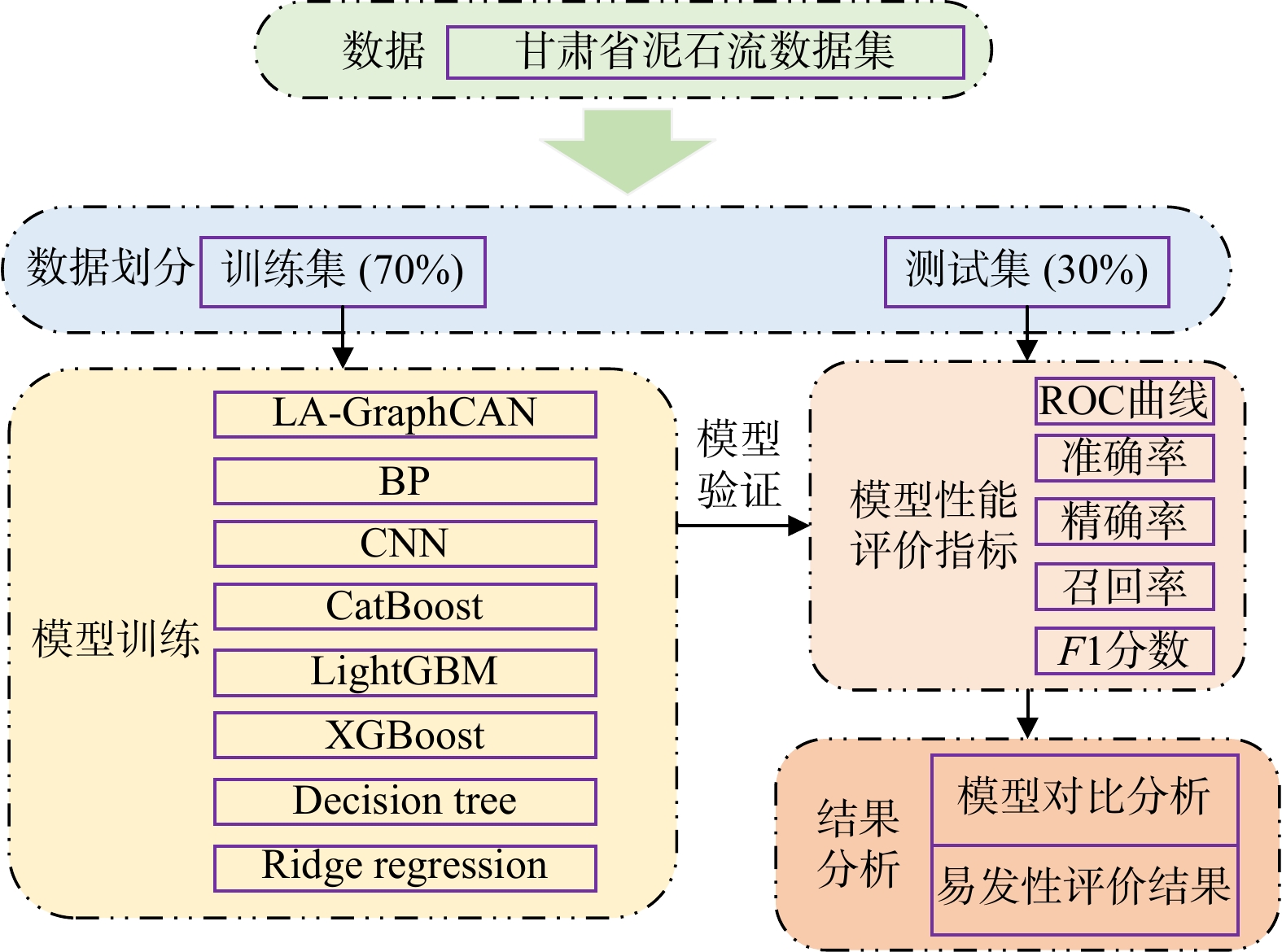
In response to this problem, this article presents a debris flow susceptibility assessment approach based on LA-GraphCAN (local augmentation graph convolutional and attention network). Firstly, a debris flow dataset for Gansu Province was constructed, encompassing
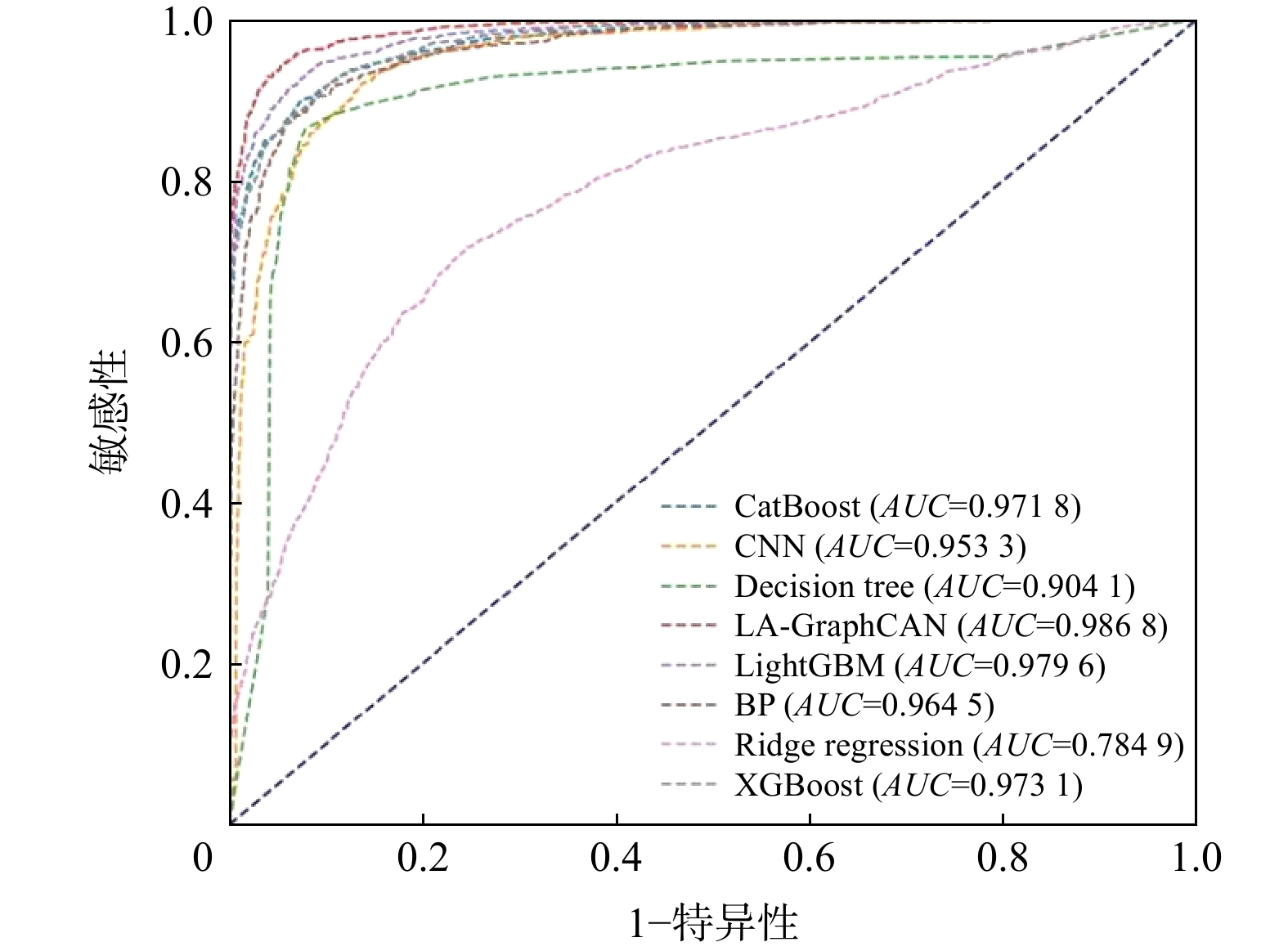
The results demonstrate that the area under the ROC curve, the accuracy rate, the precision rate, the recall rate, and the
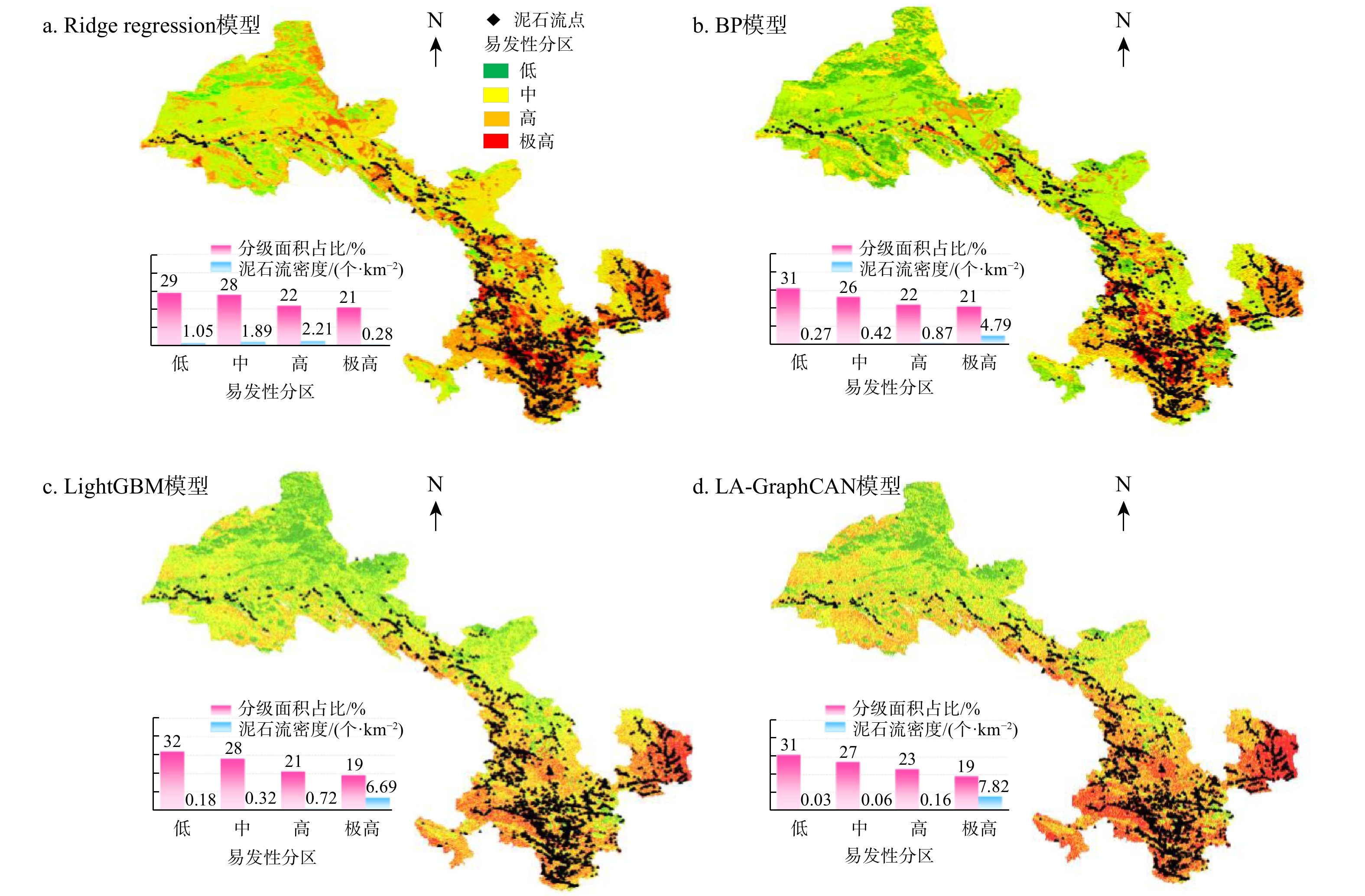
Both the performance evaluations and the assessment results of debris flow susceptibility in Gansu Province indicate that the LA-GraphCAN method, which takes into account the spatial dependence of debris flow disasters, yields superior assessment results and exhibits excellent applicability.

| [1] |
史培军, 刘连友. 北京师范大学灾害风险科学研究回顾与展望[J]. 北京师范大学学报(自然科学版), 2022, 58(3): 458-464. doi: 10.12202/j.0476-0301.2022112
SHI P J, LIU L Y. Disaster risk science at Beijing Normal University[J]. Journal of Beijing Normal University (Natural Science), 2022, 58(3): 458-464. (in Chinese with English abstract doi: 10.12202/j.0476-0301.2022112
|
| [2] |
陈丹璐, 孙德亮, 文海家, 等. 基于不同因子筛选方法的LightGBM-SHAP滑坡易发性研究[J]. 北京师范大学学报(自然科学版), 2024, 60(1): 148-158. doi: 10.12202/j.0476-0301.2023098
CHEN D L, SUN D L, WEN H J, et al. LightGBM-SHAP landslide susceptibility by different factor screening methods[J]. Journal of Beijing Normal University (Natural Science), 2024, 60(1): 148-158. (in Chinese with English abstract doi: 10.12202/j.0476-0301.2023098
|
| [3] |
解明礼, 巨能攀, 赵建军, 等. 区域地质灾害易发性分级方法对比分析研究[J]. 武汉大学学报(信息科学版), 2021, 46(7): 1003-1014.
XIE M L, JU N P, ZHAO J J, et al. Comparative analysis on classification methods of geological disaster susceptibility assessment[J]. Geomatics and Information Science of Wuhan University, 2021, 46(7): 1003-1014. (in Chinese with English abstract
|
| [4] |
赵晓燕, 谈树成, 李永平. 基于斜坡单元与组合赋权法的东川区地质灾害危险性评价[J]. 云南大学学报(自然科学版), 2021, 43(2): 299-305.
ZHAO X Y, TAN S C, LI Y P. Risk assessment of geological hazards in Dongchuan District based on the methods of slope unit and combination weighting[J]. Journal of Yunnan University (Natural Sciences Edition), 2021, 43(2): 299-305. (in Chinese with English abstract
|
| [5] |
郭瑞, 马富存, 郭一兵, 等. 基于层次分析法的泥石流易发性评价[J]. 东华理工大学学报(自然科学版), 2016, 39(4): 347-351. doi: 10.3969/j.issn.1674-3504.2016.04.007
GUO R, MA F C, GUO Y B, et al. Debris flow evaluation of occurrence easiness based on AHP[J]. Journal of East China University of Technology (Natural Science), 2016, 39(4): 347-351. (in Chinese with English abstract doi: 10.3969/j.issn.1674-3504.2016.04.007
|
| [6] |
TSAPARAS I, RAHARDJO H, TOLL D G, et al. Controlling parameters for rainfall-induced landslides[J]. Computers and Geotechnics, 2002, 29(1): 1-27. doi: 10.1016/S0266-352X(01)00019-2
|
| [7] |
甘建军, 罗昌泰. 中低山冲沟型泥石流运动参数及过程模拟[J]. 自然灾害学报, 2020, 29(2): 97-110.
GAN J J, LUO C T. Runout and process simulation of gully debris flow in middle and low mountains[J]. Journal of Natural Disasters, 2020, 29(2): 97-110. (in Chinese with English abstract
|
| [8] |
郭天颂, 张菊清, 韩煜, 等. 基于粒子群优化支持向量机的延长县滑坡易发性评价[J]. 地质科技情报, 2019, 38(3): 236-243.
GUO T S, ZHANG J Q, HAN Y, et al. Evaluation of landslide susceptibility in Yanchang County based on particle swarm optimization-based support vector machine[J]. Geological Science and Technology Information, 2019, 38(3): 236-243.(in Chinese with English abstract
|
| [9] |
李益敏, 杨蕾, 魏苏杭. 基于小流域单元的怒江州泥石流易发性评价[J]. 长江流域资源与环境, 2019, 28(10): 2419-2428.
LI Y M, YANG L, WEI S H. Susceptibility assessment of debris flow in Nujiang Prefecture based on the catchment[J]. Resources and Environment in the Yangtze Basin, 2019, 28(10): 2419-2428. (in Chinese with English abstract
|
| [10] |
DOU Q, QIN S W, ZHANG Y C, et al. A method for improving controlling factors based on information fusion for debris flow susceptibility mapping: A case study in Jilin Province, China[J]. Entropy, 2019, 21(7): 695. doi: 10.3390/e21070695
|
| [11] |
田春山, 刘希林, 汪佳. 基于CF和Logistic回归模型的广东省地质灾害易发性评价[J]. 水文地质工程地质, 2016, 43(6): 154-161.
TIAN C S, LIU X L, WANG J. Geohazard susceptibility assessment based on CF model and Logistic regression models in Guangdong[J]. Hydrogeology & Engineering Geology, 2016, 43(6): 154-161. (in Chinese with English abstract
|
| [12] |
黄发明, 陈杰, 杨阳, 等. 滑坡易发性相关致灾环境因子研究的综述与展望[J]. 地质科技通报, 2025, 44(2): 14-37.
HUANG F M, CHEN J, YANG Y, et al. A review and prospect of disaster-causing environmental factors related to landslide susceptibility prediction[J]. Bulletin of Geological Science and Technology, 2025, 44(2): 14-37. (in Chinese with English abstract
|
| [13] |
MFONDOUM A H N, NGUET P W, SEUWUI D T, et al. Stepwise integration of analytical hierarchy process with machine learning algorithms for landslide, gully erosion and flash flood susceptibility mapping over the North-Moungo perimeter, Cameroon[J]. Geoenvironmental Disasters, 2023, 10(1): 22. doi: 10.1186/s40677-023-00254-5
|
| [14] |
李坤, 赵俊三, 林伊琳, 等. 基于SMOTE和多粒度级联森林的泥石流易发性评价[J]. 农业工程学报, 2022, 38(6): 113-121. doi: 10.11975/j.issn.1002-6819.2022.06.013
LI K, ZHAO J S, LIN Y L, et al. Assessment of debris flow susceptibility based on SMOTE and multi-grained cascade forest[J]. Transactions of the Chinese Society of Agricultural Engineering, 2022, 38(6): 113-121. (in Chinese with English abstract doi: 10.11975/j.issn.1002-6819.2022.06.013
|
| [15] |
饶姗姗, 冷小鹏. 基于RSIV-RF模型的凉山州泥石流易发性评价[J]. 地质科技通报, 2024, 43(1): 275-287.
RAO S S, LENG X P. Debris flow susceptibility evaluation of Liangshan Prefecture based on the RSIV-RF model[J]. Bulletin of Geological Science and Technology, 2024, 43(1): 275-287. (in Chinese with English abstract
|
| [16] |
CHEN Z L, QUAN H C, JIN R, et al. Debris flow susceptibility assessment based on boosting ensemble learning techniques: A case study in the Tumen River Basin, China[J]. Stochastic Environmental Research and Risk Assessment, 2024, 38(6): 2359-2382. doi: 10.1007/s00477-024-02683-6
|
| [17] |
谭林, 张璐璐, 魏鑫, 等. 基于U-Net语义分割网络的区域滑坡易发性评价方法和跨地区泛化能力研究[J]. 土木工程学报, 2025, 58(6): 103-116.
TAN L, ZHANG L L, WEI X, et al. Study on regional landslide susceptibility assessment method based on U-Net semantic segmentation network and its cross-generalization ability[J]. China Civil Engineering Journal, 2025, 58(6): 103-116. (in Chinese with English abstract
|
| [18] |
黄发明, 陈彬, 毛达雄, 等. 基于自筛选深度学习的滑坡易发性预测建模及其可解释性[J]. 地球科学, 2023, 48(5): 1696-1710.
HUANG F M, CHEN B, MAO D X, et al. Landslide susceptibility prediction modeling and interpretability based on self-screening deep learning model[J]. Earth Science, 2023, 48(5): 1696-1710. (in Chinese with English abstract
|
| [19] |
LI Y, MING D P, ZHANG L, et al. Seismic landslide susceptibility assessment using newmark displacement based on a dual-channel convolutional neural network[J]. Remote Sensing, 2024, 16(3): 566. doi: 10.3390/rs16030566
|
| [20] |
王毅, 方志策, 牛瑞卿, 等. 基于深度学习的滑坡灾害易发性分析[J]. 地球信息科学学报, 2021, 23(12): 2244-2260. doi: 10.12082/dqxxkx.2021.210057
WANG Y, FANG Z C, NIU R Q, et al. Landslide susceptibility analysis based on deep learning[J]. Journal of Geo-information Science, 2021, 23(12): 2244-2260. (in Chinese with English abstract doi: 10.12082/dqxxkx.2021.210057
|
| [21] |
YUAN R H, LUO Y M, XU F S, et al. Mudslide susceptibility assessment based on a two-channel residual network[J]. Geomatics, Natural Hazards and Risk, 2024, 15(1): 2300804. doi: 10.1080/19475705.2023.2300804
|
| [22] |
孔嘉旭, 庄建琦, 彭建兵, 等. 基于信息量和卷积神经网络的黄土高原滑坡易发性评价[J]. 地球科学, 2023, 48(5): 1711-1729.
KONG J X, ZHUANG J Q, PENG J B, et al. Evaluation of landslide susceptibility in Chinese Loess Plateau based on IV-RF and IV-CNN coupling models[J]. Earth Science, 2023, 48(5): 1711-1729. (in Chinese with English abstract
|
| [23] |
邓日朗, 张庆华, 刘伟, 等. 基于改进两步法采样策略和卷积神经网络的崩塌易发性评价[J]. 地质科技通报, 2024, 43(2): 186-200.
DENG R L, ZHANG Q H, LIU W, et al. Collapse susceptibility evaluation based on an improved two-step sampling strategy and a convolutional neural network[J]. Bulletin of Geological Science and Technology, 2024, 43(2): 186-200. (in Chinese with English abstract
|
| [24] |
ADITIAN A, KUBOTA T, SHINOHARA Y. Comparison of GIS-based landslide susceptibility models using frequency ratio, logistic regression, and artificial neural network in a tertiary region of Ambon, Indonesia[J]. Geomorphology, 2018, 318: 101-111. doi: 10.1016/j.geomorph.2018.06.006
|
| [25] |
杨延晨, 周超, 施佳湄. 基于卷积神经网络的区域滑坡易发性评价: 以三峡库区万州区为例[J]. 测绘通报, 2023(11): 1-6.
YANG Y C, ZHOU C, SHI J M. Evaluation of regional landslide susceptibility based on convolutional neural network: A case study of Wanzhou District of Three Gorges Reservoir area[J]. Bulletin of Surveying and Mapping, 2023(11): 1-6. (in Chinese with English abstract
|
| [26] |
LIU P, WEI Y M, WANG Q J, et al. Research on post-earthquake landslide extraction algorithm based on improved U-net model[J]. Remote Sensing, 2020, 12(5): 894. doi: 10.3390/rs12050894
|
| [27] |
REBETEZ J, SATIZÁBAL H, MOTA M, et al. Augmenting a convolutional neural network with local histograms: A case study in crop classification from high-resolution UAV imagery[C]//Anon. The European symposium on artificial neural networks. Ciaco: Louvain-la-Neuve, 2016: 27-29.
|
| [28] |
TANG J X, ERICSON L, FOLKESSON J, et al. GCNv2: Efficient correspondence prediction for real-time SLAM[J]. IEEE Robotics and Automation Letters, 2019, 4(4): 3505-3512.
|
| [29] |
BRODY S, ALON U, YAHAV E. How attentive are graph attention networks?[J]. ArXiv e-Prints, 2021, arXiv: 2105.14491.
|
| [30] |
闫满存, 王光谦. 基于GIS的澜沧江下游区滑坡灾害危险性分析[J]. 地理科学, 2007, 27(3): 365-370. doi: 10.3969/j.issn.1000-0690.2007.03.013
YAN M C, WANG G Q. Landslide risk assessment in the lower Lancang River watershed using GIS approach[J]. Scientia Geographica Sinica, 2007, 27(3): 365-370. (in Chinese with English abstract doi: 10.3969/j.issn.1000-0690.2007.03.013
|
| [31] |
刘晋文, 杨亚兵, 张磊, 等. 甘肃省1∶5万地质灾害风险调查成果集成[R]. 兰州: 甘肃省地质环境监测院, 2022.
LIU J W, YANG Y B, ZHANG L, et al. Integration of 1: 50 000 geological hazard risk survey results in Gansu Province[R]. Lanzhou: Geological Environment Monitoring Institute of Gansu Province, 2022. (in Chinese)
|
| [32] |
贾强, 窦晓东, 何斌, 等. 自然灾害综合风险普查历史地质灾害调查技术报告[R]. 兰州: 甘肃省地质环境监测院, 2021.
JIA Q, DOU X D, HE B, et al. A technical report on the survey of historical geological hazards in the general survey of the comprehensive risk of natural disasters[R]. Lanzhou: Geological Environment Monitoring Institute of Gansu Province, 2021. (in Chinese)
|
| [33] |
陈秀清, 白福, 于燕燕. 甘肃省泥石流发育特征、成因分析及其危害[J]. 西北地质, 2014, 47(3): 205-210. doi: 10.3969/j.issn.1009-6248.2014.03.027
CHEN X Q, BAI F, YU Y Y. Development characteristics, causes and hazard analysis of debris flow in Gansu Province[J]. Northwestern Geology, 2014, 47(3): 205-210. (in Chinese with English abstract doi: 10.3969/j.issn.1009-6248.2014.03.027
|
| [34] |
窦杰, 向子林, 许强, 等. 机器学习在滑坡智能防灾减灾中的应用与发展趋势[J]. 地球科学, 2023, 48(5): 1657-1674.
DOU J, XIANG Z L, XU Q, et al. Application and development trend of machine learning in landslide intelligent disaster prevention and mitigation[J]. Earth Science, 2023, 48(5)1657-1674. (in Chinese with English abstract
|
| [35] |
DENG H, WU X T, ZHANG W J, et al. Slope-unit scale landslide susceptibility mapping based on the random forest model in deep valley areas[J]. Remote Sensing, 2022, 14(17): 4245. doi: 10.3390/rs14174245
|
| [36] |
刘国栋, 秦胜伍, 孟凡奇, 等. 基于地理信息相似度的负样本采样策略在泥石流易发性评价中的应用[J]. 工程地质学报, 2023, 31(2): 526-537.
LIU G D, QIN S W, MENG F Q, et al. Application of geographic information similarity based absence sampling method to debris flow susceptibility mapping[J]. Journal of Engineering Geology, 2023, 31(2): 526-537. (in Chinese with English abstract
|
| [37] |
皋子琪, 吕立群, 马超, 等. 基于MaxEnt模型的怒江大峡谷泥石流易发性评价和成因[J]. 水土保持学报, 2023, 37(6): 34-41.
GAO Z Q, LYU L Q, MA C, et al. Assessment and causes of debris flow susceptibility in the Nvjiang grand canyon based on MaxEnt Model[J]. Journal of Soil and Water Conservation, 2023, 37(6): 34-41. (in Chinese with English abstract
|
| [38] |
SWETS J A. Measuring the accuracy of diagnostic systems[J]. Science, 1988, 240: 1285-1293. doi: 10.1126/science.3287615
|
| [39] |
MULUMBA D M, LIU J K, HAO J, et al. Application of an optimized PSO-BP neural network to the assessment and prediction of underground coal mine safety risk factors[J]. Applied Sciences, 2023, 13(9): 5317. doi: 10.3390/app13095317
|
| [40] |
SALEHI A W, KHAN S, GUPTA G, et al. A study of CNN and transfer learning in medical imaging: Advantages, challenges, future scope[J]. Sustainability, 2023, 15(7): 5930. doi: 10.3390/su15075930
|
| [41] |
LIANG W Z, LUO S Z, ZHAO G Y, et al. Predicting hard rock pillar stability using GBDT, XGBoost, and LightGBM algorithms[J]. Mathematics, 2020, 8(5): 765. doi: 10.3390/math8050765
|
| [42] |
EL BILALI A, ABDESLAM T, AYOUB N, et al. An interpretable machine learning approach based on DNN, SVR, Extra Tree, and XGBoost models for predicting daily pan evaporation[J]. Journal of Environmental Management, 2023, 327: 116890. doi: 10.1016/j.jenvman.2022.116890
|
| [43] |
DAI X H, ANDANI H T, ALIZADEH A, et al. Using Gaussian Process Regression (GPR) models with the Matérn covariance function to predict the dynamic viscosity and torque of SiO2/Ethylene glycol nanofluid: A machine learning approach[J]. Engineering Applications of Artificial Intelligence, 2023, 122: 106107. doi: 10.1016/j.engappai.2023.106107
|
| [44] |
HARLOW L L. The essence of multivariate thinking: Basic themes and methods[M]. New York: Routledge, 2023.
|
Supported by:
Beijing Renhe Information Technology Co., Ltd.


 Submission System


 DownLoad: