| Citation: | QI Lining,GUO Chaoxu,MENG Huajun,et al. Recognition of rainfall-induced landslide in high vegetation coverage area based on machine learning[J]. Bulletin of Geological Science and Technology,2026,45(1):185-198 doi: 10.19509/j.cnki.dzkq.tb20240298

|
In recent years, influenced by global warming, the southeast coastal provinces of China have frequently experienced super typhoons, heavy rainfall, and prolonged monsoon rains, triggering numerous shallow landslides the pose serious threats to local lives and property.
To rapidly obtain more accurate disaster information for support emergency response and scientific decision-making,
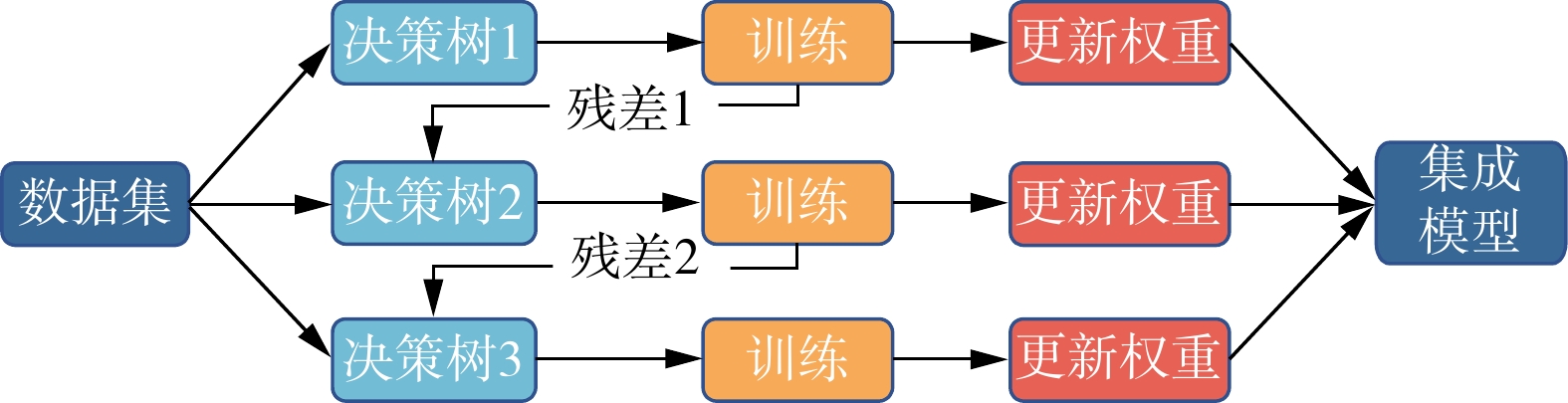
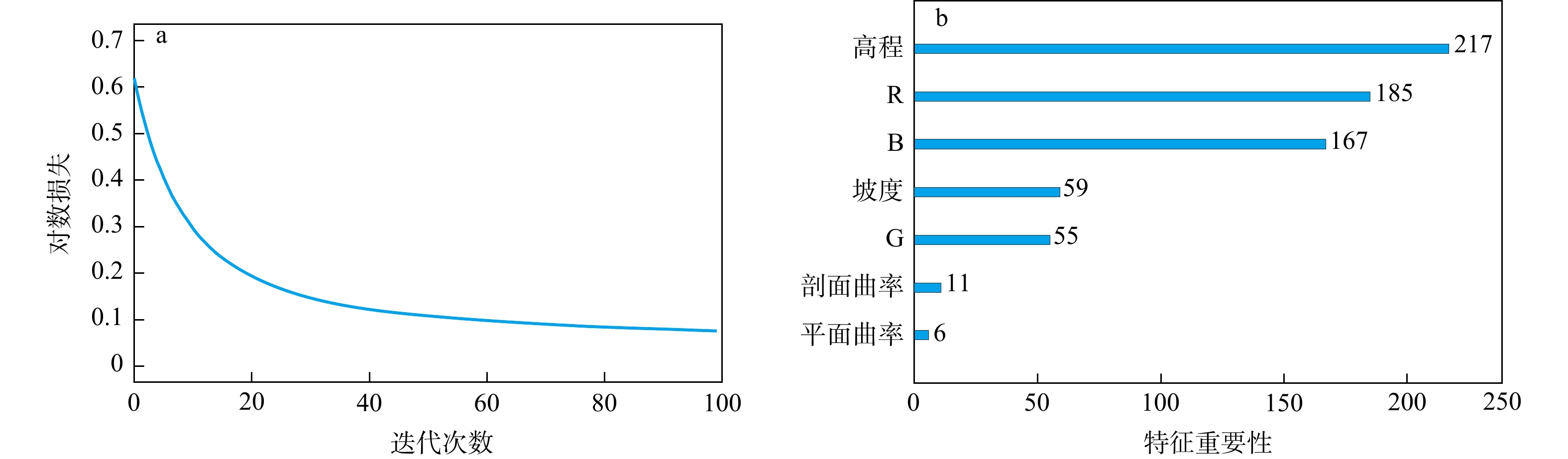
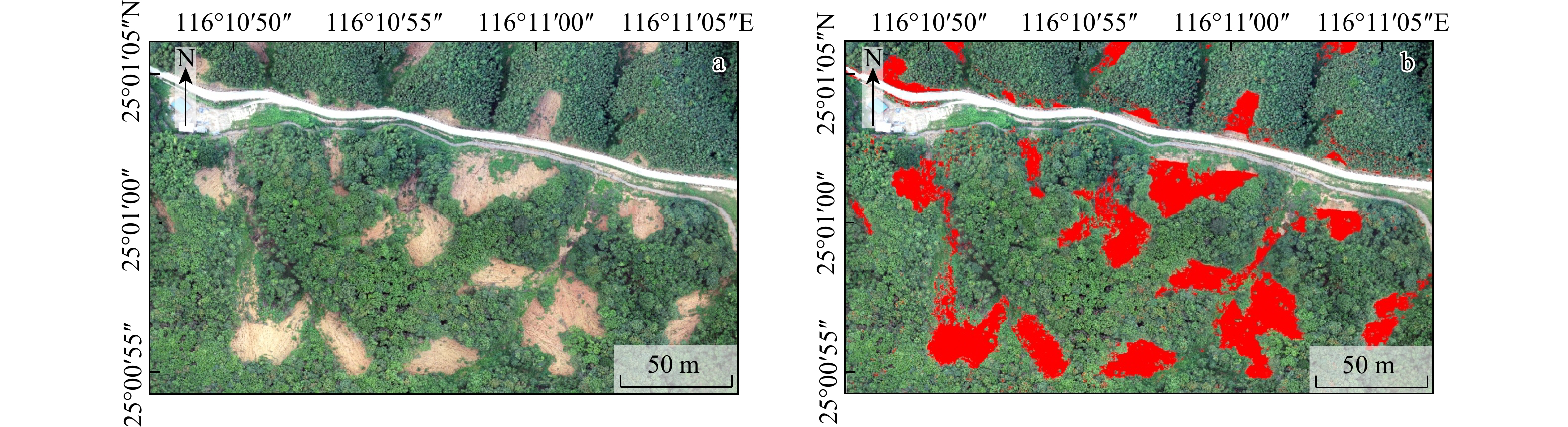
this study developed an automatic recognition model for shallow landslides using a machine learning approach, the LightGBM decision tree algorithm. The model targets clustered shallow landslides developed in highly weathered granite layers induced by heavy rainfall in high vegetation coverage area. High-resolution aerial images and DOM data from Wuping County, Fujian Province, were used, with feature parameters including slope, elevation, plane curvature (
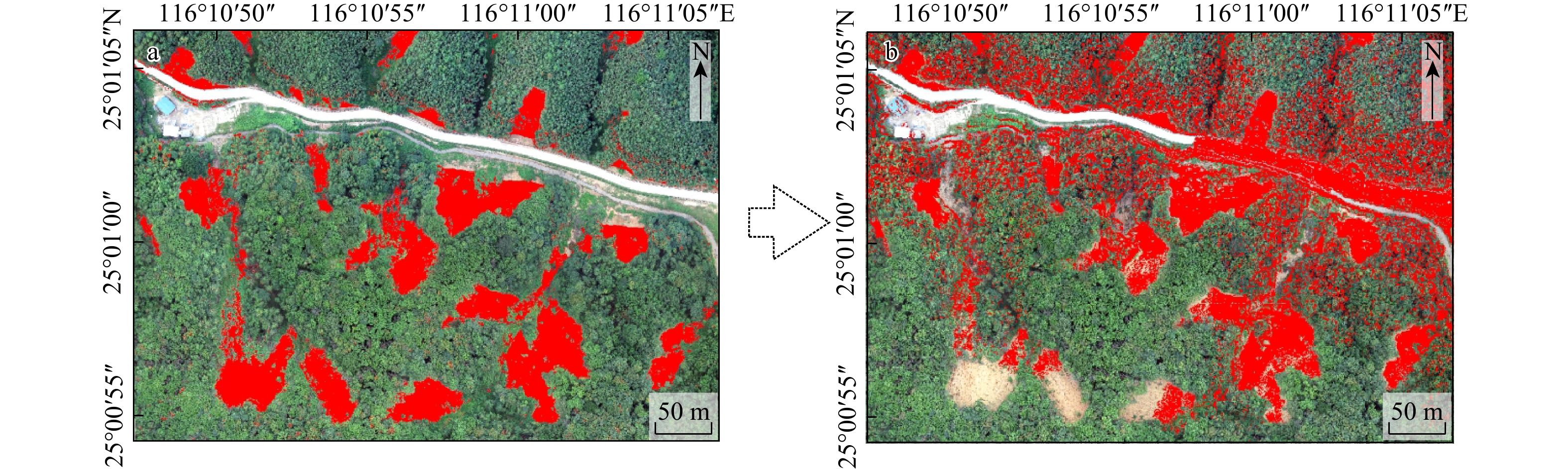
The results indicate that: ①The multi-feature combination model achieves higher accuracy in landslide recognition compared to single-feature models; ②The rapid recognition model incorporating slope, elevation, plane curvature, profile curvature, and R, G, and B bands accurately identifies existing landslides, with both
This research provides a novel approach for early recognition of rainfall-induced landslides in high vegetation coverage area and offers scientific and technological support for risk prevention and disaster response decision-making in typhoon-related and rainstorm-affected areas such as Haixi.

| [1] |
ZHOU D Y, ZHANG Z, LI J C, et al. Seepage-stress coupled modeling for rainfall induced loess landslide[J]. Theoretical and Applied Mechanics Letters, 2019, 9(1): 7-13. doi: 10.1016/j.taml.2019.02.006
|
| [2] |
LI Z, HE Y J, LI H E, et al. Antecedent rainfall induced shallow landslide: A case study of Yunnan landslide, China[J]. Scientia Iranica, Transactions A: Civil Engineering, 2019, 26(1): 202-212.
|
| [3] |
佚名. 河南郑州“7·20”特大暴雨灾害调查报告公布[J]. 中国应急管理, 2022(2): 4.
Anon. The release of the investigation report on the severe rainstorm disaster in Zhengzhou, Henan on July 20[J]. China Emergency Management, 2022(2): 4. (in Chinese with English abstract
|
| [4] |
吴伟伟, 胥涛, 高志强, 等. 山西晋中地区“2021.10”暴雨特征与洪灾分析[J]. 中国防汛抗旱, 2022, 32(12): 82-88. doi: 10.16867/j.issn.1673-9264.2022083
WU W W, XU T, GAO Z Q, et al. Rainstorm characteristics and flood disaster analysis of “2021.10” in Jinzhong area, Shanxi Province[J]. China Flood & Drought Management, 2022, 32(12): 82-88. (in Chinese with English abstract doi: 10.16867/j.issn.1673-9264.2022083
|
| [5] |
李天毅, 戴宁, 丛佩娟, 等. “23·7” 京津冀暴雨洪水特性分析: 以河北省临城县为例[J/OL]. 水土保持通报: 1-13 [2026-01-14]. https://link.cnki.net/doi/10.13961/j.cnki.stbctb.2024.02.017.
LI T Y, DAI N, CONG P J, et al. Analysis of rainstorm flood characteristics in “23·7” Beijing-Tianjin-Hebei: A case study of Lincheng County, Hebei Province[J/OL]. Bulletin of Soil and Water Conservation: 1-13 [2026-01-14]. https://link.cnki.net/doi/10.13961/j.cnki.stbctb.2024.02.017.(in Chinese with English abstract
|
| [6] |
LI G E, HU B, LI H, et al. Early identifying and monitoring landslides in Guizhou Province with InSAR and optical remote sensing[J]. Journal of Sensors, 2021, 2021(1): 6616745. doi: 10.1155/2021/6616745
|
| [7] |
WANG Y A, LIU D L, DONG J, et al. On the applicability of satellite SAR interferometry to landslide hazards detection in hilly areas: A case study of Shuicheng, Guizhou in Southwest China[J]. Landslides, 2021, 18(7): 2609-2619.
|
| [8] |
DAI K R, FENG Y, ZHUO G C, et al. Applicability analysis of potential landslide identification by InSAR in Alpine-canyon terrain: Case study on Yalong River[J]. IEEE Journal of Selected Topics in Applied Earth Observations and Remote Sensing, 2018, 15: 2110-2118.
|
| [9] |
LIANG J T, DONG J H, ZHANG S, et al. Discussion on InSAR identification effectivity of potential landslides and factors that influence the effectivity[J]. Remote Sensing, 2022, 14(8): 1952.
|
| [10] |
许强, 陆会燕, 李为乐, 等. 滑坡隐患类型与对应识别方法[J]. 武汉大学学报(信息科学版), 2022, 47(3): 377-387.
XU Q, LU H Y, LI W L, et al. Types of potential landslide and corresponding identification technologies[J]. Geomatics and Information Science of Wuhan University, 2022, 47(3): 377-387. (in Chinese with English abstract
|
| [11] |
LIU Y, WU L Z. Geological disaster recognition on optical remote sensing images using deep learning[J]. Procedia Computer Science, 2016, 91: 566-575.
|
| [12] |
SAMEEN M I, PRADHAN B, LEE S. Application of convolutional neural networks featuring Bayesian optimization for landslide susceptibility assessment[J]. Catena, 2020, 186: 104249.
|
| [13] |
GUARNIERI A, MASIERO A, VETTORE A, et al. Evaluation of the dynamic processes of a landslide with laser scanners and Bayesian methods[J]. Geomatics, Natural Hazards and Risk, 2015, 6(5/6/7): 614-634.
|
| [14] |
邬礼扬, 殷坤龙, 曾韬睿, 等. 不同栅格尺寸下输电线路地质灾害易发性评价[J]. 地质科技通报, 2024, 43(1): 241-252.
WU L Y, YIN K L, ZENG T R, et al. Evaluation of geological disaster susceptibility of transmission lines under different grid resolutions[J]. Bulletin of Geological Science and Technology, 2024, 43(1): 241-252. (in Chinese with English abstract
|
| [15] |
NHU V H, MOHAMMADI A, SHAHABI H, et al. Landslide detection and susceptibility modeling on Cameron Highlands (Malaysia): A comparison between random forest, logistic regression and logistic model tree algorithms[J]. Forests, 2020, 11(8): 830.
|
| [16] |
DOU J, YUNUS A P, BUI D T, et al. Improved landslide assessment using support vector machine with bagging, boosting, and stacking ensemble machine learning framework in a mountainous watershed, Japan[J]. Landslides, 2020, 17(3): 641-658.
|
| [17] |
吴季寰, 张春山, 孟华君, 等. 抚顺西露天矿区滑坡易发性评价与时空特征分析[J]. 地质力学学报, 2021, 27(3): 409-417.
WU J H, ZHANG C S, MENG H J, et al. Temporal and spatial characteristics of landslide susceptibility in the west open-pit mining area, Fushun, China[J]. Journal of Geomechanics, 2021, 27(3): 409-417. (in Chinese with English abstract
|
| [18] |
CHEN F, YU B, LI B. A practical trial of landslide detection from single-temporal Landsat8 images using contour-based proposals and random forest: A case study of national Nepal[J]. Landslides, 2018, 15(3): 453-464.
|
| [19] |
BUI D T, TSANGARATOS P, NGUYEN V T, et al. Comparing the prediction performance of a deep learning neural network model with conventional machine learning models in landslide susceptibility assessment[J]. Catena, 2020, 188: 104426.
|
| [20] |
PANG D D, LIU G, HE J, et al. Automatic remote sensing identification of co-seismic landslides using deep learning methods[J]. Forests, 2022, 13(8): 1213.
|
| [21] |
WANG Y, WANG X F, JIAN J F. Remote sensing landslide recognition based on convolutional neural network[J]. Mathematical Problems in Engineering, 2019, 2019(1): 8389368.
|
| [22] |
高瑞源. 基于机器学习方法的区域泥石流易发性评价研究[D]. 长春: 吉林大学, 2023.
GAO R Y. Study on regional debris flow susceptibility evaluation based on machine learning methods[D]. Changchun: Jilin University, 2023. (in Chinese with English abstract
|
| [23] |
冀全伟, 王文磊, 刘治博, 等. 一种基于机器学习算法的岩性填图方法[J]. 地质力学学报, 2021, 27(3): 339-349.
JI Q W, WANG W L, LIU Z B, et al. A machine learning-based lithologic mapping method[J]. Journal of Geomechanics, 2021, 27(3): 339-349. (in Chinese with English abstract
|
| [24] |
DING A, ZHANG Q, ZHOU X, et al. Automatic identification of landslide based on CNN and texture change detection[C]//Anon. Proceedings of the Chinese Association of Automation (YAC), Youth Academic Annual Conference. [S. l. ], IEEE, 2016: 444-448.
|
| [25] |
WANG H J, ZHANG L M, YIN K S, et al. Landslide identification using machine learning[J]. Geoscience Frontiers, 2021, 12(1): 351-364.
|
| [26] |
KEYPORT R N, OOMMEN T, MARTHA T R, et al. A comparative analysis of pixel- and object-based detection of landslides from very high-resolution images[J]. International Journal of Applied Earth Observation and Geoinformation, 2018, 64: 1-11.
|
| [27] |
GHORBANZADEH O, BLASCHKE T, GHOLAMNIA K, et al. Evaluation of different machine learning methods and deep-learning convolutional neural networks for landslide detection[J]. Remote Sensing, 2019, 11(2): 196.
|
| [28] |
福建省煤田地质局, 福建省121地质大队. 武平县1∶5万地质灾害调查与风险评价成果报告[R]. 福州: 福建省煤田地质局, 福建省121地质大队, 2021.
Fujian 121 Geological Brigade, Fujian Provincial Coal Geology Bureau. Report on the results of 1∶50 000 geological hazard investigation and risk assessment in Wuping County[R]. Fujian 121 Geological Brigade, Fujian Provincial Coal Geology Bureau, 2021. (in Chinese)
|
| [29] |
LIU Y H, HUANG J B, XIAO R H, et al. Research on a regional landslide early-warning model based on machine learning: A case study of Fujian Province, China[J]. Forests, 2022, 13(12): 2182.
|
| [30] |
WANG T, LI R, CHEN C, et al. Kinetic analysis of rainfall-induced landslides in May 2022 in Wuping, Fujian, SE China[J]. Water, 2024, 16(21): 3018.
|
| [31] |
罗常伟, 王双双, 尹峻松, 等. 集成学习研究现状及展望[J]. 指挥与控制学报, 2023, 9(1): 1-8.
LUO C W, WANG S S, YIN J S, et al. Research status and prospect of ensemble learning[J]. Journal of Command and Control, 2023, 9(1): 1-8. (in Chinese with English abstract
|
| [32] |
LEO B. Bagging predictors[J]. Machine Learning, 1996, 24(2): 123-140.
|
| [33] |
徐继伟, 杨云. 集成学习方法: 研究综述[J]. 云南大学学报(自然科学版), 2018, 40(6): 1082-1092. doi: 10.7540/j.ynu.20180455
XU J W, YANG Y. A survey of ensemble learning approaches[J]. Journal of Yunnan University (Natural Sciences Edition), 2018, 40(6): 1082-1092. (in Chinese with English abstract doi: 10.7540/j.ynu.20180455
|
| [34] |
李航. 统计学习方法[M]. 北京: 清华大学出版社, 2012.
LI H. Statistical learning method[M]. Beijing: Tsinghua University Press, 2012. (in Chinese)
|
| [35] |
XIE M W, HUANG J X, WANG L W, et al. Early landslide detection based on D-InSAR technique at the Wudongde hydropower reservoir[J]. Environmental Earth Sciences, 2016, 75(8): 717.
|
| [36] |
REN T H, GONG W P, GAO L, et al. An interpretation approach of ascending-descending SAR data for landslide identification[J]. Remote Sensing, 2022, 14(5): 1299.
|
| [37] |
VAN NATIJNE A L, BOGAARD T A, VAN LEIJEN F J, et al. World-wide InSAR sensitivity index for landslide deformation tracking[J]. International Journal of Applied Earth Observation and Geoinformation, 2022, 111: 102829.
|
| [38] |
NIU C, YIN W P, XUE W, et al. Multi-window identification of landslide hazards based on InSAR technology and factors predisposing to disasters[J]. Land, 2023, 12(1): 173.
|
| [39] |
王灿星, 朱杰勇, 喻聪骏, 等. 基于皮尔逊Ⅲ型曲线的不同降雨工况下的崩滑地质灾害危险性评价[J]. 地质科技通报, 2025, 44(1): 194-204.
WANG C X, ZHU J Y, YU C J, et al. Risk assessment of landslide geological hazards under different rainfall conditions based on the Pearson Ⅲ curves[J]. Bulletin of Geological Science and Technology, 2025, 44(1): 194-204. (in Chinese with English abstract
|
| [40] |
李星, 杨赛, 李远耀, 等. 面向区域滑坡易发性精细化评价的改进斜坡单元法[J]. 地质科技通报, 2023, 42(3): 81-92.
LI X, YANG S, LI Y Y, et al. Improved slope unit method for fine evaluation of regional landslide susceptibility[J]. Bulletin of Geological Science and Technology, 2023, 42(3): 81-92. (in Chinese with English abstract
|
| [41] |
CHEN B, LI Z H, SONG C, et al. Automatic detection of active geohazards with millimeter-to-meter-scale deformation and quantitative analysis of factors influencing spatial distribution: A case study in the Hexi Corridor, China[J]. International Journal of Applied Earth Observation and Geoinformation, 2024, 131: 103995.
|
Supported by:
Beijing Renhe Information Technology Co., Ltd.


 Submission System


 DownLoad: