| Citation: | WU Yuwei,ZHAO Jiele,LI Jiawei,et al. Local-global collaborative multi-scale feature augmentation for hyperspectral and multispectral image fusion[J]. Bulletin of Geological Science and Technology,2026,45(4):1-10 doi: 10.19509/j.cnki.dzkq.tb20250436

|
Images acquired by a single remote sensing sensor are inherently constrained by hardware and physical limitations, making it difficult to simultaneously achieve high spatial resolution and high spectral resolution. Hyperspectral images provide rich spectral information but typically suffer from low spatial resolution, whereas multispectral images contain finer spatial details at the cost of reduced spectral fidelity. To address this trade-off, this study proposes a local-global collaborative multi-scale feature augmentation method for hyperspectral and multispectral image fusion. The objective is to fully exploit the complementary spatial and spectral characteristics of heterogeneous data sources, thereby generating fused images that preserve spectral consistency while significantly enhancing spatial detail expression.
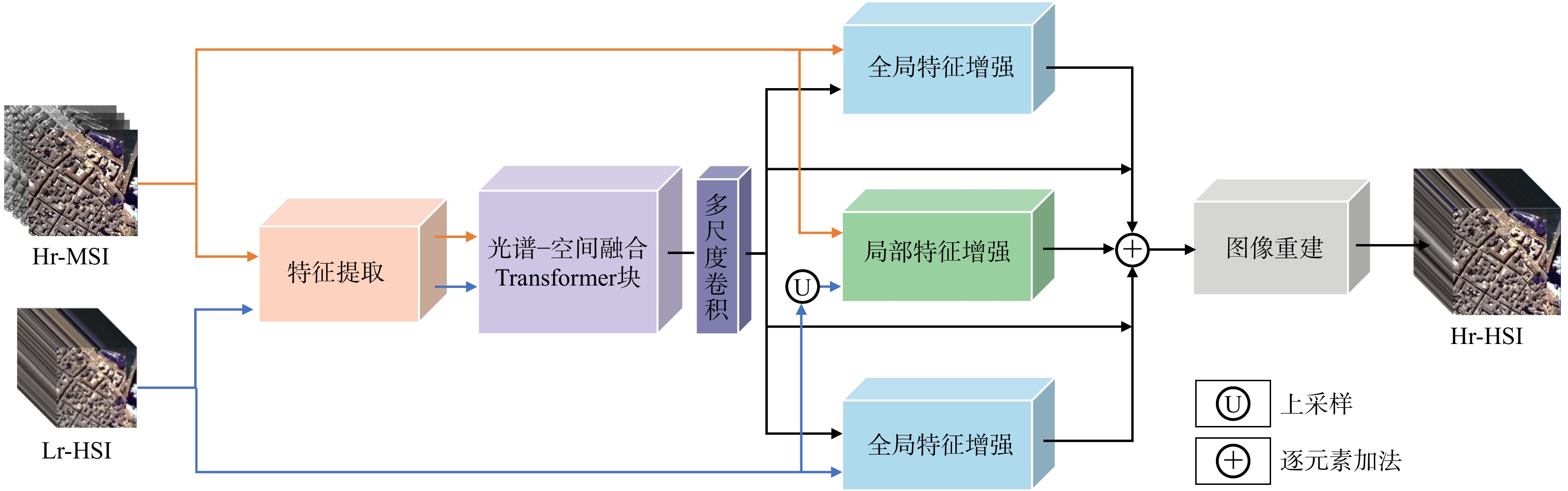
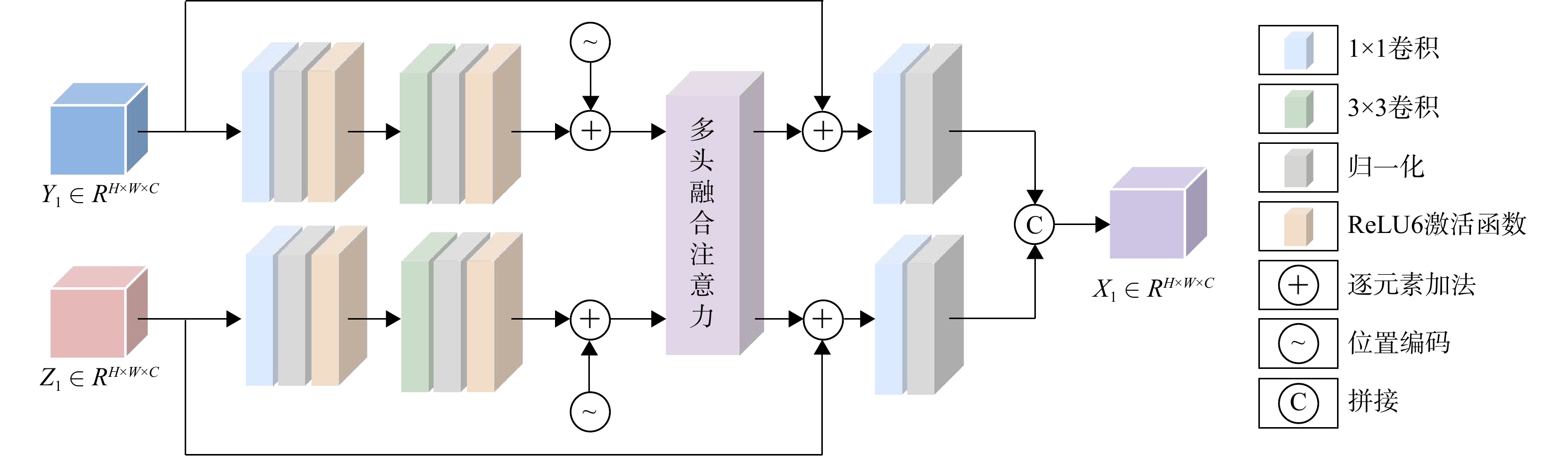
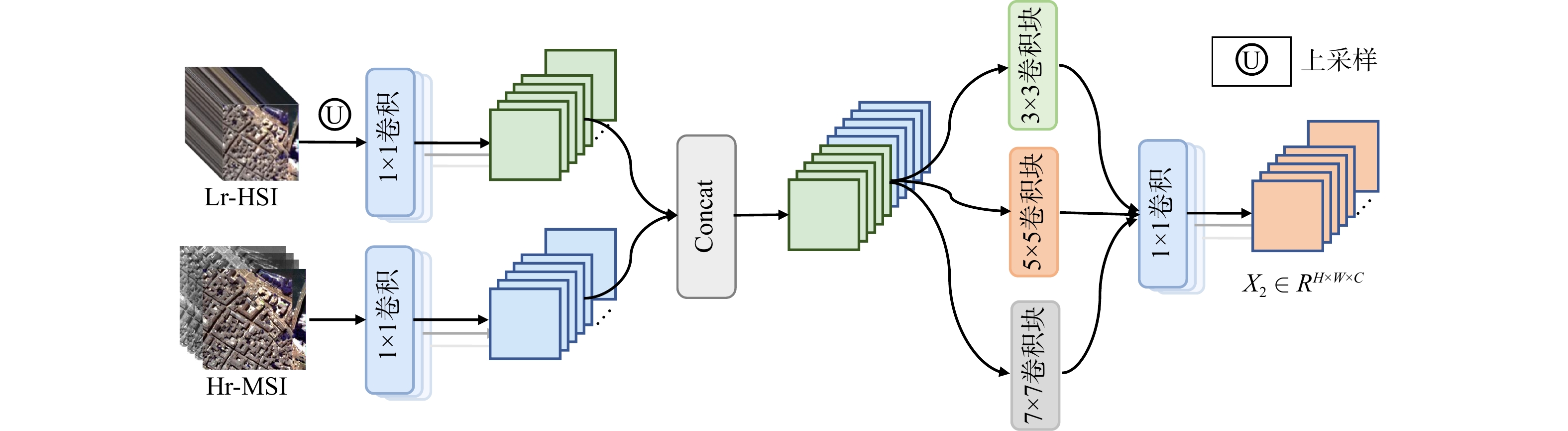
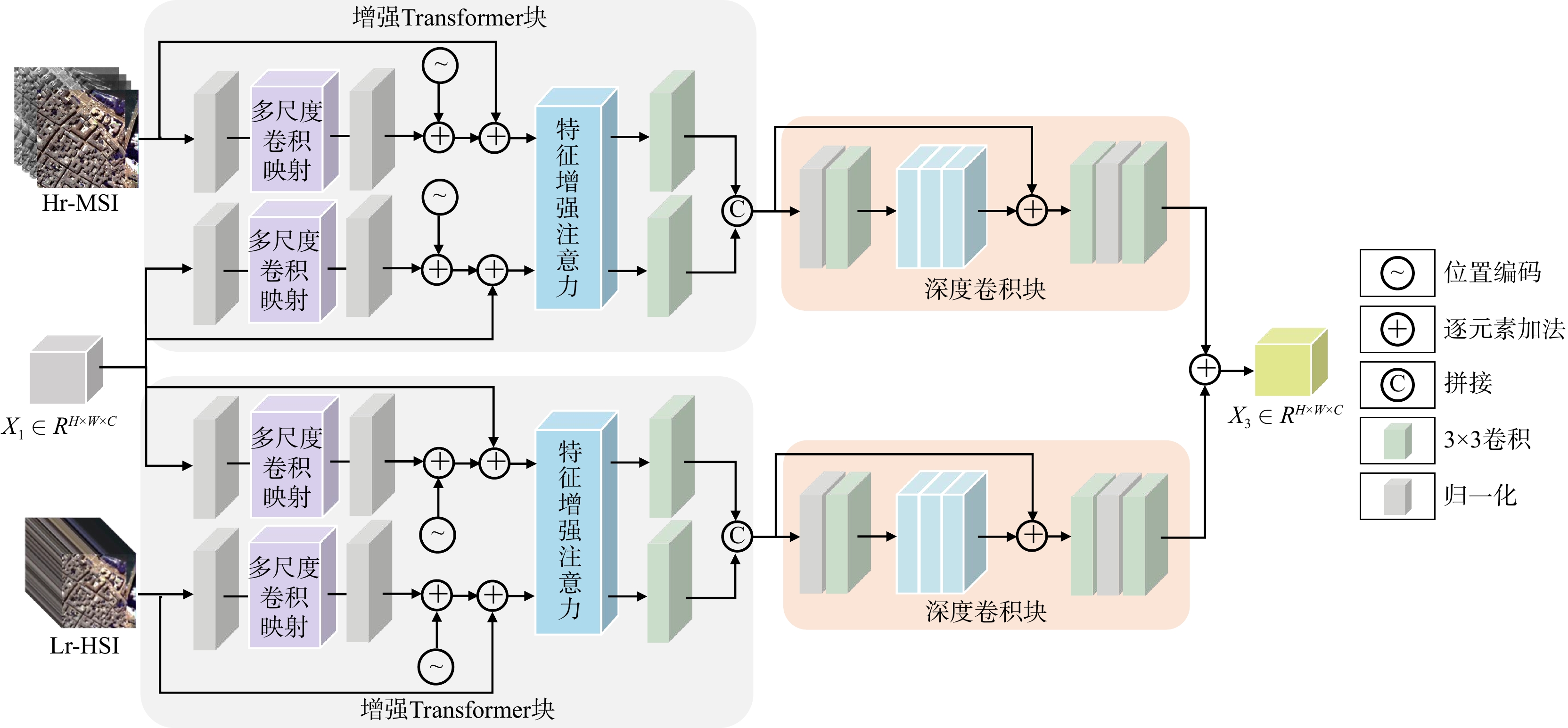
The proposed fusion framework consisted of four cooperative modules: Feature extraction, feature fusion, feature augmentation, and image reconstruction. First, the feature extraction module independently encoded the hyperspectral and multispectral inputs using dedicated convolutional layers to obtain hierarchical spectral and spatial feature representations. Second, the feature fusion module integrated the extracted features into a shared latent space, enabling cross-modal interaction and alignment. The core component was the feature augmentation module, which was divided into local and global sub-modules. The local feature augmentation sub-module employed multiple convolutional blocks with different receptive fields to strengthen fine-grained spatial details such as edges, textures, and local structures. The global feature augmentation sub-module introduced a spectral-spatial fusion Transformer architecture combined with multi-scale convolutions to model long-range dependencies and enhance global contextual information as well as spectral consistency. Finally, the image reconstruction module mapped the augmented fusion features back to the image domain to produce the final high-resolution hyperspectral image.
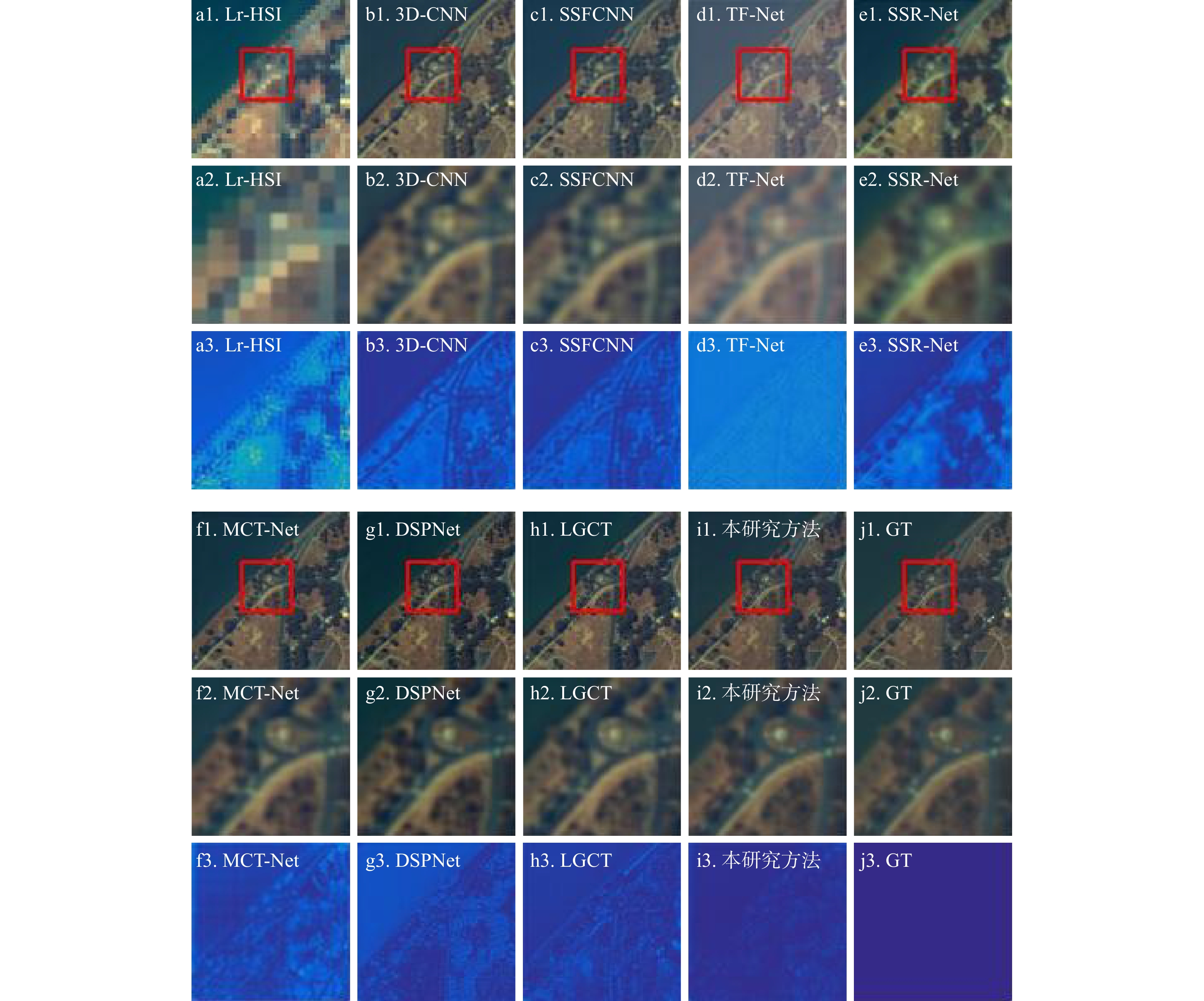
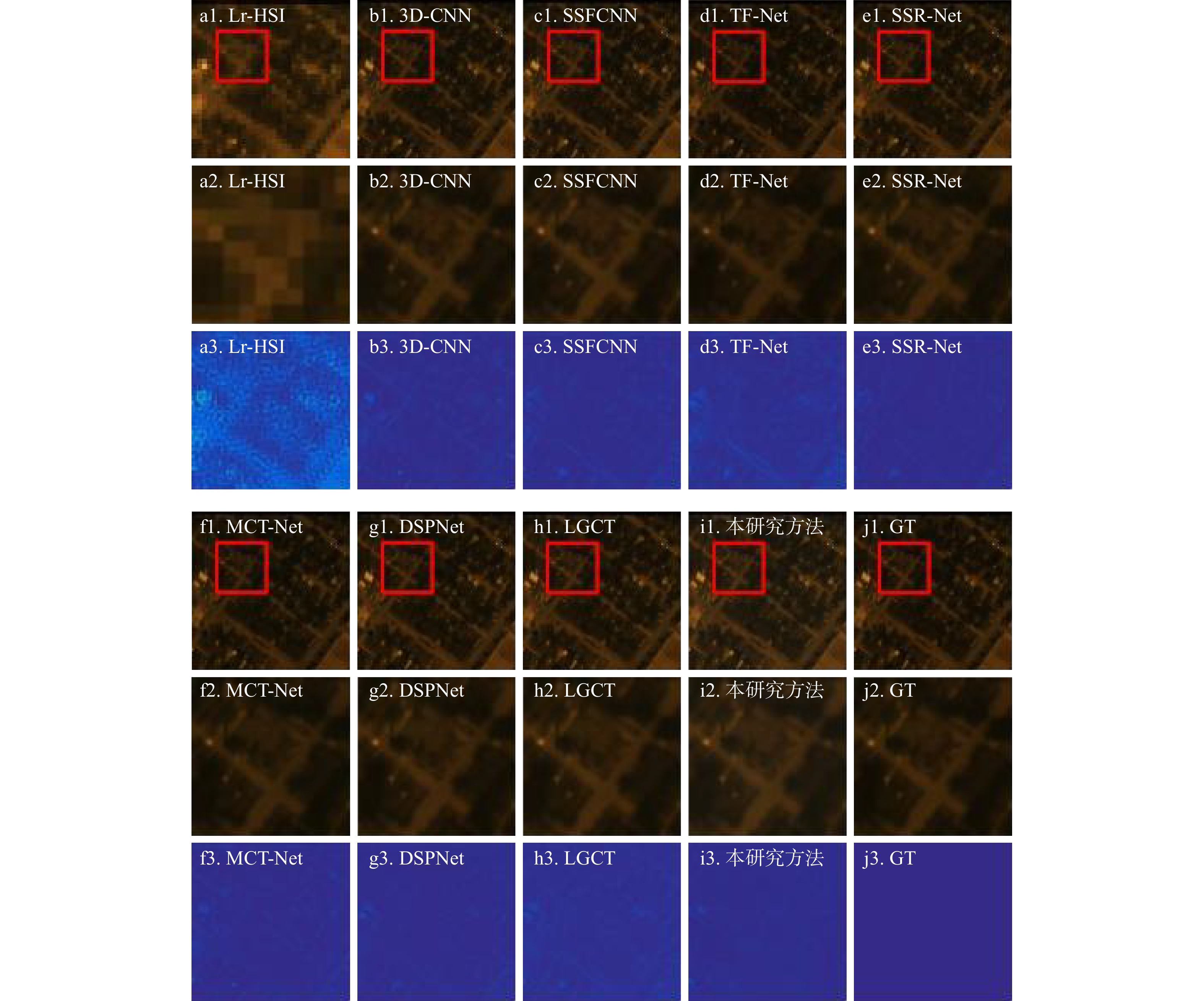
Extensive experiments were conducted on several benchmark hyperspectral and multispectral datasets, including both quantitative evaluations and qualitative visual comparisons. The proposed method consistently outperformed state-of-the-art fusion methods across multiple evaluation indicators. In terms of spatial detail preservation, the fused images exhibited sharper edges and clearer textures with significantly improved spatial resolution. Regarding spectral fidelity, the proposed method achieved low spectral distortion, with SAM (spectral angle mapper) values comparable to those of the best-performing competitors. Comprehensive evaluation indicators such as PSNR, SSIM, and ERGAS also demonstrated superior performance. For example, on the widely used CAVE and Harvard datasets, the proposed method achieved average PSNR improvements of 1.5-2.5 dB over the best baseline methods. Visual comparisons further confirmed that the proposed method effectively avoided common artifacts such as blurring and spectral aliasing. Moreover, the method showed robust performance across different scenes and varying degradation conditions.
The proposed local-global collaborative multi-scale feature augmentation method effectively mitigates the inherent spatial-spectral trade-off in single-sensor imaging systems. By jointly enhancing local fine-grained details and global contextual dependencies, the method generates fused images with both high spatial resolution and high spectral fidelity. Experimental results demonstrate its superiority over existing approaches in terms of accuracy, robustness, and visual quality. The proposed framework provides a powerful and versatile solution for hyperspectral and multispectral image fusion, with strong potential for practical applications in remote sensing, environmental monitoring, and beyond.

| [1] |
李虹江, 于昕左, 马佳, 等. 多源遥感数据融合的高陡边坡危岩体信息提取[J]. 地质科技通报, 2025, 44(6): 306-316. doi: 10.19509/j.cnki.dzkq.tb20230695
LI H J, YU X Z, MA J, et al. Information extraction of dangerous rock masses on high and steep slopes using multi-source remote sensing data fusion[J]. Bulletin of Geological Science and Technology, 2025, 44(6): 306-316. (in Chinese with English abstract) doi: 10.19509/j.cnki.dzkq.tb20230695
|
| [2] |
许伟, 杨德芳, 陈李昊, 等. 多源遥感影像融合处理提取格拉丹东雪山区域特征信息[J]. 地质科技通报, 2024, 43(2): 370-385. doi: 10.19509/j.cnki.dzkq.tb20220545
XU W, YANG D F, CHEN L H, et al. Fusion processing of multisource remote sensing images for extracting characteristic information from the Geladandong Snow Mountain area[J]. Bulletin of Geological Science and Technology, 2024, 43(2): 370-385. (in Chinese with English abstract) doi: 10.19509/j.cnki.dzkq.tb20220545
|
| [3] |
尹政, 陈庆祥, 何剑波, 等. 基于多源融合建模和热−流耦合模拟的张掖盆地地热资源分布特征及成因机制[J]. 地质科技通报, 2025, 44(5): 3-12.
YIN Z, CHEN Q X, HE J B, et al. Spatial characteristics and genetic mechanisms of geothermal resources in the Zhangye Basin based on multi-source fusion modeling and heat-flow coupling simulations[J]. Bulletin of Geological Science and Technology, 2025, 44(5): 3-12. (in Chinese with English abstract)
|
| [4] |
李树涛, 李聪妤, 康旭东. 多源遥感图像融合发展现状与未来展望[J]. 遥感学报, 2021, 25(1): 148-166.
LI S T, LI C Y, KANG X D. Development status and future prospects of multi-source remote sensing image fusion[J]. National Remote Sensing Bulletin, 2021, 25(1): 148-166. (in Chinese with English abstract)
|
| [5] |
VIVONE G. Multispectral and hyperspectral image fusion in remote sensing: A survey[J]. Information Fusion, 2023, 89: 405-417. doi: 10.1016/j.inffus.2022.08.032
|
| [6] |
DIAN R W, LI S T, SUN B, et al. Recent advances and new guidelines on hyperspectral and multispectral image fusion[J]. Information Fusion, 2021, 69: 40-51. doi: 10.1016/j.inffus.2020.11.001
|
| [7] |
DIAN R W, LI S T, FANG L Y, et al. Multispectral and hyperspectral image fusion with spatial-spectral sparse representation[J]. Information Fusion, 2019, 49: 262-270. doi: 10.1016/j.inffus.2018.11.012
|
| [8] |
WU H J, WU S Q, ZHANG K F, et al. Unsupervised blind spectral-spatial cross-super-resolution network for HSI and MSI fusion[J]. IEEE Transactions on Geoscience and Remote Sensing, 2024, 62: 5511914.
|
| [9] |
YOKOYA N, YAIRI T, IWASAKI A. Coupled nonnegative matrix factorization unmixing for hyperspectral and multispectral data fusion[J]. IEEE Transactions on Geoscience and Remote Sensing, 2012, 50(2): 528-537. doi: 10.1109/TGRS.2011.2161320
|
| [10] |
ZHANG Y F, DE BACKER S, SCHEUNDERS P. Noise-resistant wavelet-based Bayesian fusion of multispectral and hyperspectral images[J]. IEEE Transactions on Geoscience and Remote Sensing, 2009, 47(11): 3834-3843. doi: 10.1109/TGRS.2009.2017737
|
| [11] |
DIAN R W, LI S T, FANG L Y. Learning a low tensor-train rank representation for hyperspectral image super-resolution[J]. IEEE Transactions on Neural Networks and Learning Systems, 2019, 30(9): 2672-2683. doi: 10.1109/TNNLS.2018.2885616
|
| [12] |
REN C, HE X H, TENG Q Z, et al. Single image super-resolution using local geometric duality and non-local similarity[J]. IEEE Transactions on Image Processing, 2016, 25(5): 2168-2183. doi: 10.1109/TIP.2016.2542442
|
| [13] |
YE F, WU Z B, XU Y, et al. Bayesian hyperspectral image super-resolution in the presence of spectral variability[J]. IEEE Transactions on Geoscience and Remote Sensing, 2022, 60: 5545613.
|
| [14] |
WANG W Q, ZHANG J Q, LIU H, et al. Joint low-rank and sparse decomposition for infrared and visible image sequence fusion[J]. Infrared Physics & Technology, 2023, 133: 104828. doi: 10.1016/j.infrared.2023.104828
|
| [15] |
MASI G, COZZOLINO D, VERDOLIVA L, et al. Pansharpening by convolutional neural networks[J]. Remote Sensing, 2016, 8(7): 594. doi: 10.3390/rs8070594
|
| [16] |
PALSSON F, SVEINSSON J R, ULFARSSON M O. Multispectral and hyperspectral image fusion using a 3-D-convolutional neural network[J]. IEEE Geoscience and Remote Sensing Letters, 2017, 14(5): 639-643. doi: 10.1109/LGRS.2017.2668299
|
| [17] |
ALAKWAA W, NASSEF M, BADR A. Lung cancer detection and classification with 3D convolutional neural network (3D-CNN)[J]. International Journal of Advanced Computer Science and Applications, 2017, 8(8).
|
| [18] |
LIU X Y, WANG Y H, LIU Q J. Remote sensing image fusion based on Two-stream fusion network[C]//MultiMedia Modeling. Cham: Springer, 2018: 428-439.
|
| [19] |
HAN X H, SHI B X, ZHENG Y Q. SSF-CNN: Spatial and spectral fusion with CNN for hyperspectral image super-resolution[C]//2018 25th IEEE International Conference on Image Processing (ICIP). Athens, Greece: IEEE, 2018: 2506-2510.
|
| [20] |
BANDARA W G C, PATEL V M. HyperTransformer: A textural and spectral feature fusion transformer for pansharpening[C]//2022 IEEE/CVF Conference on Computer Vision and Pattern Recognition (CVPR). New Orleans, LA, USA: IEEE, 2022: 1757-1767.
|
| [21] |
ZHANG X T, HUANG W, WANG Q, et al. SSR-NET: Spatial-spectral reconstruction network for hyperspectral and multispectral image fusion[J]. IEEE Transactions on Geoscience and Remote Sensing, 2021, 59(7): 5953-5965. doi: 10.1109/TGRS.2020.3018732
|
| [22] |
VASWANI A, SHAZEER N, PARMAR N, et al. Attention is all you need[C]//Advances in Neural Information Processing Systems 30 (NeurIPS 2017). Long Beach, CA, USA: Curran Associates Inc. , 2017: 6000-6010.
|
| [23] |
LIU Z, LIN Y T, CAO Y, et al. Swin transformer: Hierarchical vision transformer using shifted windows[C]//2021 IEEE/CVF International Conference on Computer Vision (ICCV). Montreal, QC, Canada: IEEE, 2021: 9992-10002.
|
| [24] |
Dosovitskiy A, Beyer L, Kolesnikov A, et al. An image is worth 16x16 words: Transformers for image recognition at scale[C]//Proceedings of the 9th International Conference on Learning Representations (ICLR). Virtual Event: OpenReview, 2021.
|
| [25] |
WANG X H, WANG X Y, SONG R X, et al. MCT-Net: Multi-hierarchical cross transformer for hyperspectral and multispectral image fusion[J]. Knowledge-Based Systems, 2023, 264: 110362. doi: 10.1016/j.knosys.2023.110362
|
| [26] |
SUN Y C, XU H, MA Y, et al. Dual spatial-spectral pyramid network with transformer for hyperspectral image fusion[J]. IEEE Transactions on Geoscience and Remote Sensing, 2023, 61: 5526016.
|
| [27] |
LIN T Y, DOLLÁR P, GIRSHICK R, et al. Feature pyramid networks for object detection[C]//2017 IEEE Conference on Computer Vision and Pattern Recognition (CVPR). Honolulu, HI, USA: IEEE, 2017: 936-944.
|
| [28] |
HE W Q, FU X Y, LI N Y, et al. LGCT: Local-global collaborative transformer for fusion of hyperspectral and multispectral images[J]. IEEE Transactions on Geoscience and Remote Sensing, 2024, 62: 5537114.
|
| [29] |
SARA D, MANDAVA A K, KUMAR A, et al. Hyperspectral and multispectral image fusion techniques for high resolution applications: A review[J]. Earth Science Informatics, 2021, 14(4): 1685-1705. doi: 10.1007/s12145-021-00621-6
|
| [30] |
YU H Y, LING Z X, ZHENG K, et al. Unsupervised hyperspectral and multispectral image fusion with deep spectral-spatial collaborative constraint[J]. IEEE Transactions on Geoscience and Remote Sensing, 2024, 62: 5534114. doi: 10.1109/tgrs.2024.3472226
|
| [31] |
LI J X, ZHENG K, YAO J, et al. Deep unsupervised blind hyperspectral and multispectral data fusion[J]. IEEE Geoscience and Remote Sensing Letters, 2022, 19: 6007305.
|
| [32] |
WOO S, PARK J, LEE J Y, et al. CBAM: Convolutional block attention module[C]//Computer Vision-ECCV 2018. Munich, Germany: Springer, 2018: 3-19.
|
| [33] |
ZHANG Y H, YAN J C. Crossformer: Transformer utilizing cross-dimension dependency for multivariate time series forecasting[C]//International Conference on Learning Representations (ICLR 2023). Kigali, Rwanda: OpenReview, 2023.
|
| [34] |
AUDEBERT N, LE SAUX B, LEFEVRE S. Deep learning for classification of hyperspectral data: A comparative review[J]. IEEE Geoscience and Remote Sensing Magazine, 2019, 7(2): 159-173. doi: 10.1109/MGRS.2019.2912563
|
| [35] |
DADRASS JAVAN F, SAMADZADEGAN F, MEHRAVAR S, et al. A review of image fusion techniques for pan-sharpening of high-resolution satellite imagery[J]. ISPRS Journal of Photogrammetry and Remote Sensing, 2021, 171: 101-117. doi: 10.1016/j.isprsjprs.2020.11.001
|
| [36] |
YOKOYA N, GROHNFELDT C, CHANUSSOT J. Hyperspectral and multispectral data fusion: A comparative review of the recent literature[J]. IEEE Geoscience and Remote Sensing Magazine, 2017, 5(2): 29-56. doi: 10.1109/MGRS.2016.2637824
|
| [37] |
HUYNH-THU Q, GHANBARI M. Scope of validity of PSNR in image/video quality assessment[J]. Electronics Letters, 2008, 44(13): 800-801. doi: 10.1049/el:20080522
|
| [38] |
WALD L. Quality of high resolution synthesised images: Is there a simple criterion[C]//Proceedings of the Third International Conference Fusion of Earth Data: Merging Point Measurements, Raster Maps and Remotely Sensed Images. Nice, France: SEE/URISCA, 2000: 99-103.
|
| [39] |
CHANG Y, YAN L X, ZHONG S. Hyper-Laplacian regularized unidirectional low-rank tensor recovery for multispectral image denoising[C]//2017 IEEE Conference on Computer Vision and Pattern Recognition (CVPR). Honolulu, HI, USA: IEEE Computer Society, 2017: 5901-5909.
|
| [40] |
WANG Z, BOVIK A C, SHEIKH H R, et al. Image quality assessment: From error visibility to structural similarity[J]. IEEE Transactions on Image Processing, 2004, 13(4): 600-612. doi: 10.1109/TIP.2003.819861
|
Supported by:
Beijing Renhe Information Technology Co., Ltd.


 Submission System

 DownLoad: