| Citation: | WANG Keqiang,LI Ming,LI Lianglong,et al. Research on displacement prediction model of colluvial landslides in Qinghai Province based on multiple influencing factors[J]. Bulletin of Geological Science and Technology,2026,45(4):1-18 doi: 10.19509/j.cnki.dzkq.tb20250339

|
Landslides, as one of the most prevalent geological hazards in China, are widely distributed and have also extended into the western regions. The Qinghai region is characterized by complex geomorphic units and clustered mountain systems, which provide favorable geological conditions for the initiation and development of landslides. A comprehensive investigation into the formation mechanisms and influencing factors of representative landslides in this region can provide essential theoretical support for landslide prevention, mitigation, and hazard forecasting, thereby reducing casualties and economic losses.
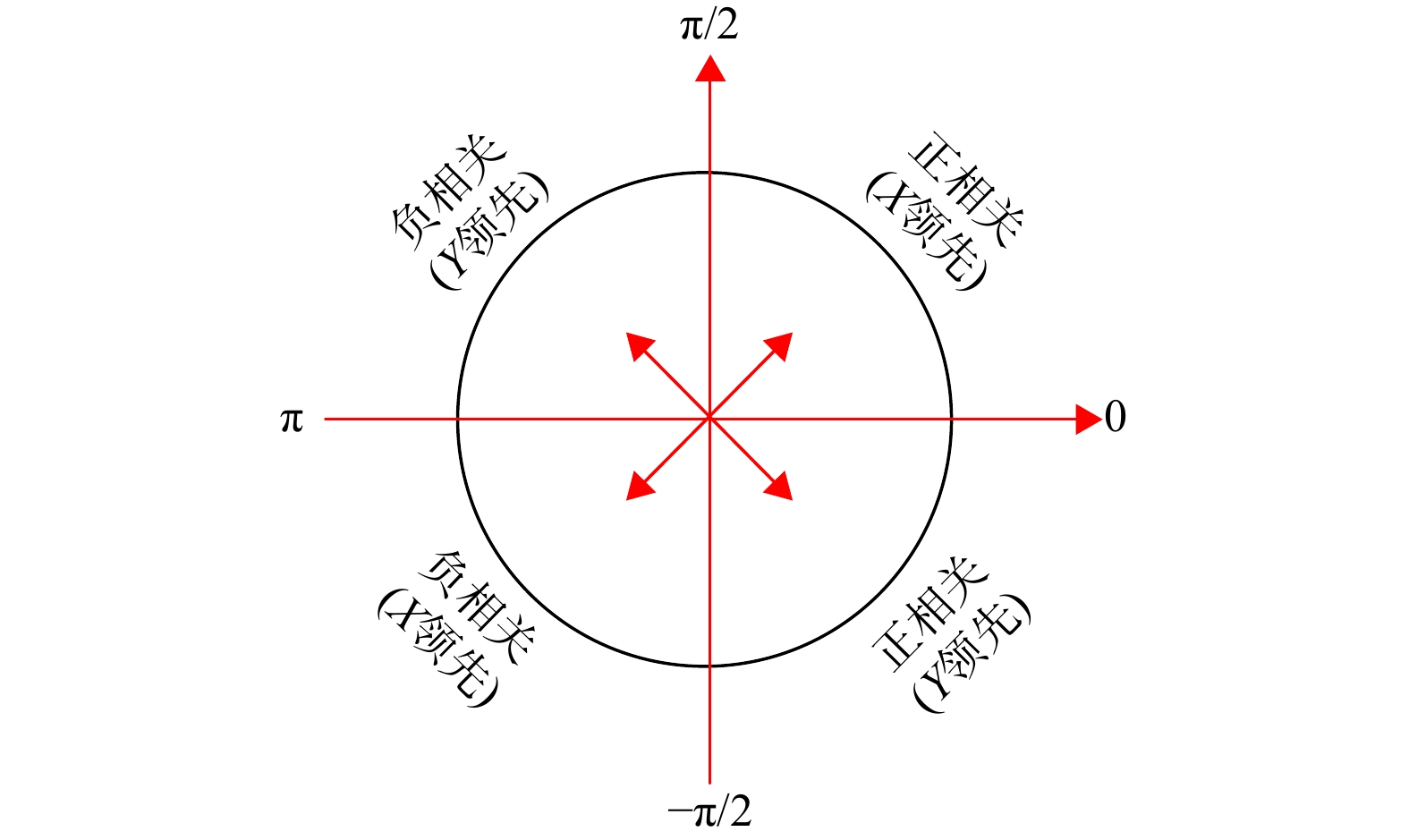
This study focused on the accumulation landslide group of Hanjiacun, Qutan Town, Ledu District, Qinghai Province. Based on field investigations and monitoring data, the macroscopic deformation characteristics and formation mechanisms of the landslide group were systematically analyzed. Furthermore, the correlation between rainfall, temperature, and the deformation time series was examined using wavelet coherence analysis. Temperature and rainfall were selected as the principal external variables. A linear regression ensemble model was employed, in which the predicted displacements from individual models were combined through a weighted summation approach to estimate the displacement at the GNSS2 monitoring point of the landslide.
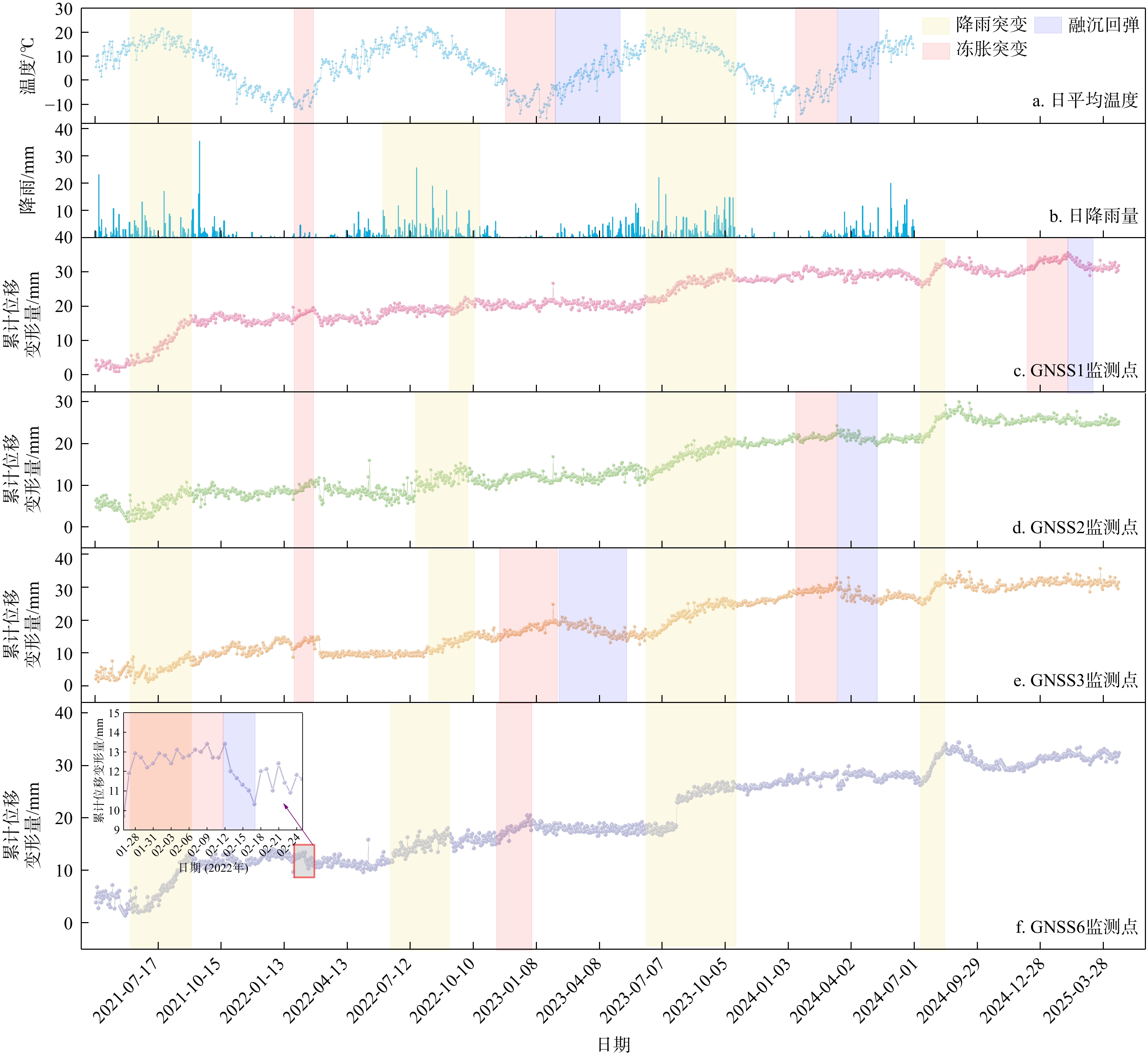
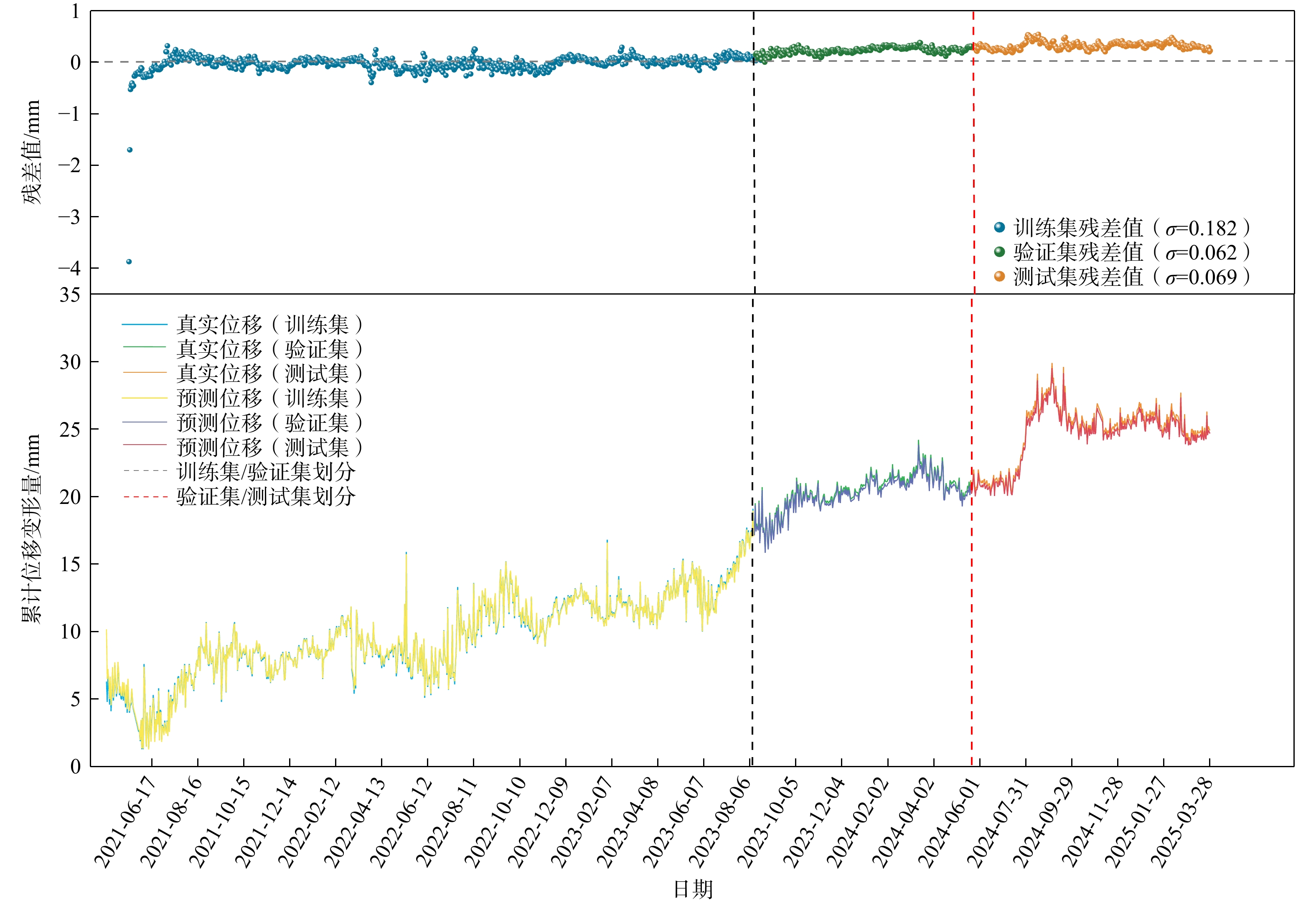
The results indicated that the Hanjiacun landslide group exhibited an average annual deformation rate of approximately 8.5 mm, classifying it as a typical creep-type landslide. Its displacement demonstrated a step-like deformation pattern under the influence of both rainfall and temperature. Specifically, rainfall showed a positive correlation with cumulative displacement, with abrupt increases observed during periods of concentrated summer rainfall, followed by stabilization after the rainy season, while a lag effect was also evident. Temperature, in contrast, was negatively correlated with cumulative displacement. As temperatures decreased in winter, frost heave was induced by the freezing and volumetric expansion of pore water within the soil matrix of the slope, resulting in an increase in landslide deformation. With the onset of spring, thaw settlement caused a rebound phenomenon in the accumulation layer. The ensemble model achieved a goodness-of-fit of 0.990 for displacement prediction at the GNSS2 monitoring point and can accurately predict the landslide deformation of the landslide group.
The established multiple linear regression ensemble model shows excellent prediction accuracy and can be applied to short-term displacement forecasting of similar creep-type colluvial landslides in alpine cold regions.

| [1] |
AU S W C. Rain-induced slope instability in Hong Kong[J]. Engineering Geology, 1998, 51(1): 1-36. doi: 10.1016/s0013-7952(98)00038-6
|
| [2] |
殷坤龙, 韩再生, 李志中. 国际滑坡研究的新进展[J]. 水文地质工程地质, 2000, 27(5): 1-4.
YIN K L, HAN Z S, LI Z Z. Progress of landslide researches in the world[J]. Hydrogeology and Engineering Geology, 2000, 27(5): 1-4. (in Chinese with English abstract)
|
| [3] |
黄润秋. 20世纪以来中国的大型滑坡及其发生机制[J]. 岩石力学与工程学报, 2007, 26(3): 433-454. doi: 10.3321/j.issn:1000-6915.2007.03.001
HUANG R Q. Large-scale landslides and their sliding mechanisms in China since the 20th century[J]. Chinese Journal of Rock Mechanics and Engineering, 2007, 26(3): 433-454. (in Chinese with English abstract) doi: 10.3321/j.issn:1000-6915.2007.03.001
|
| [4] |
王思敬, 黄鼎成. 中国工程地质世纪成就[M]. 北京: 地质出版社, 2004.
WANG S J, HUANG D C. The century achievements of engineering geology in China[M]. Beijing: Geological Publishing House, 2004. (in Chinese)
|
| [5] |
曹鹏. 甘肃岷县典型堆积层滑坡复活机理与失稳模式预测[D]. 北京: 中国地质大学(北京), 2021.
CAO P. Stability prediction and instability criterion of typical accumulation landslide in Minxian County, Gansu Province[D]. Beijing: China University of Geosciences (Beijing), 2021. (in Chinese with English abstract)
|
| [6] |
肖维伟, 邓天鑫, 张湉. 三峡库区卧沙溪滑坡变形特征与机制[J]. 水运工程, 2017(7): 155-159. doi: 10.3969/j.issn.1002-4972.2017.07.031
XIAO W W, DENG T X, ZHANG T. Deformation and failure mechanism of Woshaxi landslide in Three Gorges Reservoir area[J]. Port & Waterway Engineering, 2017(7): 155-159. (in Chinese with English abstract) doi: 10.3969/j.issn.1002-4972.2017.07.031
|
| [7] |
邓茂林, 易庆林, 卢书强, 等. 三峡库区靠椅状土质滑坡变形规律及机理: 以秭归八字门滑坡为例[J]. 南水北调与水利科技(中英文), 2020, 18(2): 135-143.
DENG M L, YI Q L, LU S Q, et al. Study on the deformation law and mechanism of chair-shaped soil landslide in Three Gorges Reservoir area: Taking the landslide of Baguamen in Zigui as an example[J]. South-to-North Water Transfers and Water Science & Technology, 2020, 18(2): 135-143. (in Chinese with English abstract)
|
| [8] |
闫国强, 易武, 童时岸, 等. 三峡库区白家包滑坡变形机理及稳定性分析预测[J]. 科技通报, 2018, 34(5): 29-34.
YAN G Q, YI W, TONG S A, et al. Stability analysis prediction and deformation mechanism of Baijiabao landslide in Three Gorges Reservoirs area[J]. Bulletin of Science and Technology, 2018, 34(5): 29-34. (in Chinese with English abstract)
|
| [9] |
WU L Z, ZHOU Y, SUN P, et al. Laboratory characterization of rainfall-induced loess slope failure[J]. Catena, 2017, 150: 1-8.
|
| [10] |
WU L Z, HE B, PENG J B. Analysis of rainfall-caused seepage into underlying bedrock slope based on seepage deformation coupling[J]. International Journal of Geomechanics, 2024, 24(5): 04024076. doi: 10.1061/IJGNAI.GMENG-9175
|
| [11] |
LI T Z, ZHANG L M, GONG W P, et al. Initiation mechanism of landslides in cold regions: Role of freeze-thaw cycles[J]. International Journal of Rock Mechanics and Mining Sciences, 2024, 183: 105906. doi: 10.1016/j.ijrmms.2024.105906
|
| [12] |
唐皓, 赵法锁, 宋飞. 陕西地震灾区滑坡类型及其时空分布特征: 以略阳县为例[J]. 中国地质灾害与防治学报, 2015, 26(1): 9-15.
TANG H, ZHAO F S, SONG F. Types and spatio-temporal distribution of landslides in the area effected by "5·12" Wenchuan earthquake in Shaanxi Province: A case study in Lüeyang Country[J]. The Chinese Journal of Geological Hazard and Control, 2015, 26(1): 9-15. (in Chinese with English abstract)
|
| [13] |
于一帆, 王平, 王会娟, 等. 堆积层滑坡地震动力响应的物理模型试验[J]. 岩土力学, 2019, 40(增刊1): 172-180.
YU Y F, WANG P, WANG H J, et al. Physical model test of seismic dynamic response to accumulative landslide[J]. Rock and Soil Mechanics, 2019, 40(S1): 172-180. (in Chinese with English abstract)
|
| [14] |
MARTELLONI G, SEGONI S, LAGOMARSINO D, et al. Snow accumulation/melting model (SAMM) for integrated use in regional scale landslide early warning systems[J]. Hydrology and Earth System Sciences, 2013, 17(3): 1229-1240. doi: 10.5194/hess-17-1229-2013
|
| [15] |
ZHOU K, WANG H, LIAO J X, et al. Deformation and failure mechanism of colluvial landslide under sustained rainfall: A case study of Xinzhan landslide in Tongzi County, China[J]. Alexandria Engineering Journal, 2023, 71: 89-103. doi: 10.1016/j.aej.2023.03.044
|
| [16] |
WANG L, CHEN Y S, WANG S M, et al. Response of landslide deformation to rainfall based on multi-index monitoring: A case of the Tanjiawan landslide in the Three Gorges Reservoir[J]. Bulletin of Engineering Geology and the Environment, 2022, 81(6): 231. doi: 10.1007/s10064-022-02732-w
|
| [17] |
刘艺梁, 樊西丰, 申高伟, 等. 基于时序InSAR技术的木鱼包滑坡时空变形特征分析[J]. 地质科技通报, 2025, 44(2): 78-93. doi: 10.19509/j.cnki.dzkq.tb20240489
LIU Y L, FAN X F, SHEN G W, et al. Analysis of spatio-temporal deformation characteristics of the Muyubao landslide via time series InSAR technology[J]. Bulletin of Geological Science and Technology, 2025, 44(2): 78-93. (in Chinese with English abstract) doi: 10.19509/j.cnki.dzkq.tb20240489
|
| [18] |
YANG X Y, CHEN Y. Characteristics and mechanism of landslides on highway landfill along Xiaolangdi Reservoir of the Yellow River: A case study[J]. Natural Hazards, 2024, 120(11): 10321-10343. doi: 10.1007/s11069-024-06607-z
|
| [19] |
HE C C, HU X L, XU C, et al. Model test of the influence of cyclic water level fluctuations on a landslide[J]. Journal of Mountain Science, 2020, 17(1): 191-202. doi: 10.1007/s11629-019-5713-9
|
| [20] |
WANG Y K, HUANG J S, TANG H M. Global sensitivity analysis of the hydraulic parameters of the reservoir colluvial landslides in the Three Gorges Reservoir area, China[J]. Landslides, 2020, 17(2): 483-494. doi: 10.1007/s10346-019-01290-9
|
| [21] |
CHEN M L, QI S C, LV P F, et al. Hydraulic response and stability of a reservoir slope with landslide potential under the combined effect of rainfall and water level fluctuation[J]. Environmental Earth Sciences, 2021, 80(1): 25. doi: 10.1007/s12665-020-09279-7
|
| [22] |
DENG M L, HUANG X H, YI Q L, et al. Fifteen-year professional monitoring and deformation mechanism analysis of a large ancient landslide in the Three Gorges Reservoir area, China[J]. Bulletin of Engineering Geology and the Environment, 2023, 82(7): 243. doi: 10.1007/s10064-023-03262-9
|
| [23] |
DU J T, LI Z H, SONG C, et al. Coupling effect of impoundment and irrigation on landslide movement in Maoergai Reservoir area revealed by multi-platform InSAR observations[J]. International Journal of Applied Earth Observation and Geoinformation, 2024, 129: 103802. doi: 10.1016/j.jag.2024.103802
|
| [24] |
HOU T S, XU G L, ZHANG D Q, et al. Stability analysis of Gongjiacun landslide in the Three Gorges Reservoir area under the action of reservoir water level fluctuation and rainfall[J]. Natural Hazards, 2022, 114(2): 1647-1683. doi: 10.1007/s11069-022-05441-5
|
| [25] |
XIONG T Q, LI J L, WANG L H, et al. Landslide accumulation ice-snow melting for thermo-hydromechanical coupling and numerical simulation[J]. Advances in Civil Engineering, 2021, 2021(1): 6664213. doi: 10.1155/2021/6664213
|
| [26] |
GARIANO S L, GUZZETTI F. Landslides in a changing climate[J]. Earth-Science Reviews, 2016, 162: 227-252. doi: 10.1016/j.earscirev.2016.08.011
|
| [27] |
龚泉冰, 殷坤龙, 肖常贵, 等. 基于I-D阈值的滑坡气象预警双指标模型[J]. 地质科技通报, 2024, 43(1): 262-274. doi: 10.19509/j.cnki.dzkq.tb20220254
GONG Q B, YIN K L, XIAO C G, et al. Double-index model of landslide meteorological warning based on the I-D threshold[J]. Bulletin of Geological Science and Technology, 2024, 43(1): 262-274. (in Chinese with English abstract) doi: 10.19509/j.cnki.dzkq.tb20220254
|
| [28] |
卢操, 晏鄂川, 陈侠廷, 等. 区域滑坡灾害降雨预警的I-D-M阈值模型研究[J]. 地质科技通报, 2025, 44(6): 157-165. doi: 10.19509/j.cnki.dzkq.tb20250216
LU C, YAN E C, CHEN X T, et al. Research on the I-D-M threshold model for regional rainfall-induced landslide hazard early warning at a regional scale[J]. Bulletin of Geological Science and Technology, 2025, 44(6): 157-165. (in Chinese with English abstract) doi: 10.19509/j.cnki.dzkq.tb20250216
|
| [29] |
李钰, 陈明亮, 黄会宝, 等. 新华滑坡变形演化规律与预警判据[J]. 地质科技通报, 2024, 43(3): 227-239. doi: 10.19509/j.cnki.dzkq.tb20230306
LI Y, CHEN M L, HUANG H B, et al. Deformation evolution law and early warning criterion of Xinhua landslide[J]. Bulletin of Geological Science and Technology, 2024, 43(3): 227-239. (in Chinese with English abstract) doi: 10.19509/j.cnki.dzkq.tb20230306
|
| [30] |
RODRÍGUEZ B G, MENESES J S, GARCIA-RODRIGUEZ J. Improving landslides prediction: Meteorological data preprocessing using random forest-based feature selection[C]//16th International Conference on Soft Computing Models in Industrial and Environmental Applications (SOCO 2021). Cham: Springer, 2022: 379-387.
|
| [31] |
WANG X P, WANG K P, LIN F Q, et al. Preliminary report on the landslide early warning on August 20, 2021, in Nangqian County, Qinghai Province, China[J]. Scientific Reports, 2022, 12: 9795. doi: 10.1038/s41598-022-13353-4
|
| [32] |
WU Y Z, DONG Y D, WEI Z X, et al. Genetic mechanisms and a stability evaluation of large landslides in Zhangjiawan, Qinghai Province[J]. Frontiers in Earth Science, 2023, 11: 1140030. doi: 10.3389/feart.2023.1140030
|
| [33] |
LIU X, DONG J H, TANG C Q, et al. Instability mechanism of loess-mudstone landslides under rainfall infiltration conditions[J]. Scientific Reports, 2025, 15: 17591. doi: 10.1038/s41598-025-01887-2
|
| [34] |
赵国蓉, 李万志, 刘冰, 等. 青海东部降雨型滑坡灾害特征及其致灾雨量分析[J]. 干旱区地理, 2025, 48(4): 632-639. doi: 10.12118/j.issn.1000-6060.2024.382
ZHAO G R, LI W Z, LIU B, et al. Characteristics of rainfall-type landslide disasters in eastern Qinghai and analysis of their causing rainfalls[J]. Arid Land Geography, 2025, 48(4): 632-639. (in Chinese with English abstract) doi: 10.12118/j.issn.1000-6060.2024.382
|
| [35] |
HU T F, LIU J K, ZHU B Z, et al. Study on sliding characteristics and controlling measures of colluvial landslides in Qinghai-Tibet Plateau[J]. Procedia Engineering, 2016, 143: 1477-1484. doi: 10.1016/j.proeng.2016.06.174
|
| [36] |
YU S L, HUANG S B, LIU F, et al. Quantification of pore structure evolution and its correlation with the macroscopic properties of sandstones under freeze-thaw action[J]. Bulletin of Engineering Geology and the Environment, 2023, 83(1): 3.
|
| [37] |
SAITO M. Research on forecasting the time of occurrence of slope failure[J]. Quarterly Report of Rtri, 1969, 17(2): 29-38.
|
| [38] |
高雅萍, 陈曦, 涂锐. 顾及降雨影响的动态优化时滞时序GM(1, 2)模型在滑坡位移预测中的应用[J]. 测绘学报, 2022, 51(10): 2183-2195.
GAO Y P, CHEN X, TU R. Application of dynamic optimization time-delay GM(1, 2)model in landslide displacement prediction considering the influence of rainfall[J]. Acta Geodaetica et Cartographica Sinica, 2022, 51(10): 2183-2195. (in Chinese with English abstract)
|
| [39] |
YANG B B, YIN K L, LACASSE S, et al. Time series analysis and long short-term memory neural network to predict landslide displacement[J]. Landslides, 2019, 16(4): 677-694. doi: 10.1007/s10346-018-01127-x
|
| [40] |
李麟玮, 吴益平, 苗发盛, 等. 基于变分模态分解与GWO-MIC-SVR模型的滑坡位移预测研究[J]. 岩石力学与工程学报, 2018, 37(6): 1395-1406.
LI L W, WU Y P, MIAO F S, et al. Displacement prediction of landslides based on variational mode decomposition and GWO-MIC-SVR model[J]. Chinese Journal of Rock Mechanics and Engineering, 2018, 37(6): 1395-1406. (in Chinese with English abstract)
|
| [41] |
汪标, 易庆林, 邓茂林, 等. 基于累积位移特征与时间序列组合模型的滑坡位移预测[J]. 工程地质学报, 2024, 32(5): 1629-1639.
WANG B, YI Q L, DENG M L, et al. Landslide displacement prediction based on cumulative displacement features and time series combination model[J]. Journal of Engineering Geology, 2024, 32(5): 1629-1639. (in Chinese with English abstract)
|
| [42] |
邢保印, 张炜怡, 章广成, 等. 基于变形速率分解的阶跃型滑坡预测: 以呷爬滑坡为例[J]. 岩石力学与工程学报, 2023, 42(3): 685-697. doi: 10.13722/j.cnki.jrme.2022.0424
XING B Y, ZHANG W Y, ZHANG G C, et al. Prediction of step-type landslides based on deformation rate decomposition: A case study of Gapa landslide[J]. Chinese Journal of Rock Mechanics and Engineering, 2023, 42(3): 685-697. (in Chinese with English abstract) doi: 10.13722/j.cnki.jrme.2022.0424
|
| [43] |
ZHANG J R, TANG H M, TAN Q W, et al. A generalized early warning criterion for the landslide risk assessment: Deformation probability index (DPI)[J]. Acta Geotechnica, 2024, 19(5): 2607-2627. doi: 10.1007/s11440-023-02199-3
|
| [44] |
LU X S, MIAO F S, XIE X X, et al. A new method for displacement prediction of "step-like" landslides based on VMD-FOA-SVR model[J]. Environmental Earth Sciences, 2021, 80(17): 542. doi: 10.1007/s12665-021-09825-x
|
| [45] |
LI D Y, SUN Y Q, YIN K L, et al. Displacement characteristics and prediction of Baishuihe landslide in the Three Gorges Reservoir[J]. Journal of Mountain Science, 2019, 16(9): 2203-2214. doi: 10.1007/s11629-019-5470-3
|
| [46] |
饶炜博, 陈刚, 邹崇尧, 等. 基于历史样本增强的滑坡智能识别改进算法[J]. 地质科技通报, 2025, 44(4): 48-61.
RAO W B, CHEN G, ZOU C Y, et al. An improved algorithm for intelligent landslide identification based on historical sample enhancement[J]. Bulletin of Geological Science and Technology, 2025, 44(4): 48-61. (in Chinese with English abstract)
|
| [47] |
MIAO F S, WU Y P, XIE Y H, et al. Prediction of landslide displacement with step-like behavior based on multialgorithm optimization and a support vector regression model[J]. Landslides, 2018, 15(3): 475-488. doi: 10.1007/s10346-017-0883-y
|
| [48] |
LI H J, XU Q, HE Y S, et al. Prediction of landslide displacement with an ensemble-based extreme learning machine and copula models[J]. Landslides, 2018, 15(10): 2047-2059. doi: 10.1007/s10346-018-1020-2
|
| [49] |
HU X L, WU S S, ZHANG G C, et al. Landslide displacement prediction using kinematics-based random forests method: A case study in Jinping Reservoir area, China[J]. Engineering Geology, 2021, 283: 105975. doi: 10.1016/j.enggeo.2020.105975
|
| [50] |
王艳昆. 基于机器学习的滑坡位移区间预测与稳定性分析[D]. 武汉: 中国地质大学(武汉), 2020.
WANG Y K. Landslide displacement interval prediction and stability analysis based on machine learning[D]. Wuhan: China University of Geosciences (Wuhan), 2020. (in Chinese with English abstract)
|
| [51] |
唐辉明. 重大滑坡预测预报研究进展与展望[J]. 地质科技通报, 2022, 41(6): 1-13. doi: 10.19509/j.cnki.dzkq.2022.0203
TANG H M. Advance and prospects of major landslides prediction and forecasting[J]. Bulletin of Geological Science and Technology, 2022, 41(6): 1-13. (in Chinese with English abstract) doi: 10.19509/j.cnki.dzkq.2022.0203
|
| [52] |
朱亚茹. 基于雷达遥感的乐都区滑坡早期识别与形变监测研究[D]. 西安: 西北大学, 2022.
ZHU Y R. Study on early identification and deformation monitoring of landslide in Ledu district based on radar remote sensing[D]. Xi'an: Northwest University, 2022. (in Chinese with English abstract)
|
| [53] |
张茂省, 李同录. 黄土滑坡诱发因素及其形成机理研究[J]. 工程地质学报, 2011, 19(4): 530-540.
ZHANG M S, LI T L. Triggering factors and forming mechanism of loess landslides[J]. Journal of Engineering Geology, 2011, 19(4): 530-540. (in Chinese with English abstract)
|
| [54] |
吴玮江. 季节性冻结滞水促滑效应: 滑坡发育的一种新因素[J]. 冰川冻土, 1997, 19(4): 359-365.
WU W J. Slide accelerated by water entrapment due to seasonal freezing[J]. Journal of Glaciology and Geocryology, 1997, 19(4): 359-365. (in Chinese with English abstract)
|
| [55] |
TOMÁS R, LI Z, LOPEZ-SANCHEZ J M, et al. Using wavelet tools to analyse seasonal variations from InSAR time-series data: A case study of the Huangtupo landslide[J]. Landslides, 2016, 13(3): 437-450. doi: 10.1007/s10346-015-0589-y
|
| [56] |
文鸿雁. 基于小波理论的变形分析模型研究[D]. 武汉: 武汉大学, 2004.
WEN H Y. Research on deformation analysis model based on wavelet transform theory[D]. Wuhan: Wuhan University, 2004. (in Chinese with English abstract)
|
| [57] |
LIU Y, QIU H J, YANG D D, et al. Deformation responses of landslides to seasonal rainfall based on InSAR and wavelet analysis[J]. Landslides, 2022, 19(1): 199-210. doi: 10.1007/s10346-021-01785-4
|
| [58] |
WEN N L, DAI K R, DENG J, et al. Periodic displacement accurate extraction of reservoir active slopes through InSAR observation and independent component analysis-based wavelet transform[J]. International Journal of Applied Earth Observation and Geoinformation, 2024, 130: 103919. doi: 10.1016/j.jag.2024.103919
|
| [59] |
郭冠淼, 包含, 兰恒星, 等. 基于交叉小波与小波相干的黄土高填方体浅表层水分相关关系研究[J]. 工程地质学报, 2022, 30(5): 1389-1402. doi: 10.13544/j.cnki.jeg.2022-0336
GUO G M, BAO H, LAN H X, et al. Correlationship of surface moisture in loess high-filling body based on cross wavelet and wavelet coherence[J]. Journal of Engineering Geology, 2022, 30(5): 1389-1402. (in Chinese with English abstract) doi: 10.13544/j.cnki.jeg.2022-0336
|
| [60] |
BAO L L, ZHANG G C, HU X L, et al. Stage division of landslide deformation and prediction of critical sliding based on inverse logistic function[J]. Energies, 2021, 14(4): 1091. doi: 10.3390/en14041091
|
| [61] |
刘晓杰. 星载雷达遥感广域滑坡早期识别与监测预测关键技术研究[D]. 西安: 长安大学, 2022.
LIU X J. Research on key technologies for early identification, monitoring and forecasting of wide-area landslides with spaceborne radar remote sensing[D]. Xi'an: Changan University, 2022. (in Chinese with English abstract)
|
| [62] |
龙建辉. 高速远程黄土滑坡预测预报方法研究[D]. 西安: 长安大学, 2008.
LONG J H. Research on forecasting methods of the loess landslide with high speed and long-run distance[D]. Xi'an: Changan University, 2008. (in Chinese with English abstract)
|
| [63] |
ZHANG W Y, ZHANG G C, SUN J Y, et al. Research on the deformation characteristics of Sanmendong landslide and the correlation of hydrodynamic action[J]. Landslides, 2024, 21(11): 2811-2825. doi: 10.1007/s10346-024-02301-0
|
| [64] |
何秀丽. 多元线性模型与岭回归分析[D]. 武汉: 华中科技大学, 2005.
HE X L. Research on multivariate lineaar model and ridge regression[D]. Wuhan: Huazhong University of Science and Technology, 2005. (in Chinese with English abstract)
|
| [65] |
KRKAČ M, BERNAT GAZIBARA S, ARBANAS Ž, et al. A comparative study of random forests and multiple linear regression in the prediction of landslide velocity[J]. Landslides, 2020, 17(11): 2515-2531. doi: 10.1007/s10346-020-01476-6
|
| [66] |
LIU H Y, BAI M Z, LI Y J, et al. Landslide displacement prediction model based on multisource monitoring data fusion[J]. Measurement, 2024, 236: 115055.
|
| [67] |
CAMILO D C, LOMBARDO L, MAI P M, et al. Handling high predictor dimensionality in slope-unit-based landslide susceptibility models through LASSO-penalized Generalized Linear Model[J]. Environmental Modelling & Software, 2017, 97: 145-156. doi: 10.1016/j.envsoft.2017.08.003
|
Supported by:
Beijing Renhe Information Technology Co., Ltd.


 Submission System

 DownLoad: