| Citation: | WANG Jiangbo,HUANG Xin,SONG Qian,et al. Source and evolutionary characteristics of ore-forming fluids in Fuludi gold deposit, Jiaodong Peninsula: Evidence from fluid inclusions and H-O isotopes[J]. Bulletin of Geological Science and Technology,2026,45(4):1-13 doi: 10.19509/j.cnki.dzkq.tb20250167

|
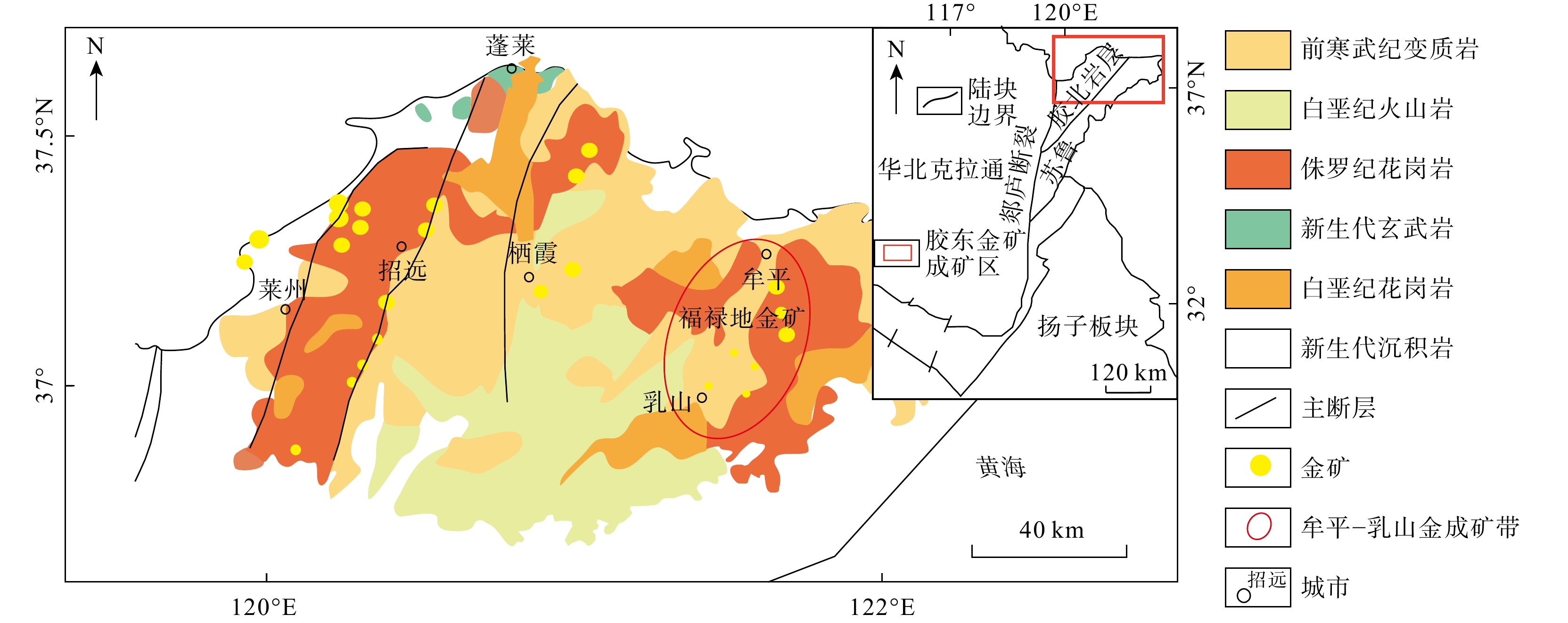
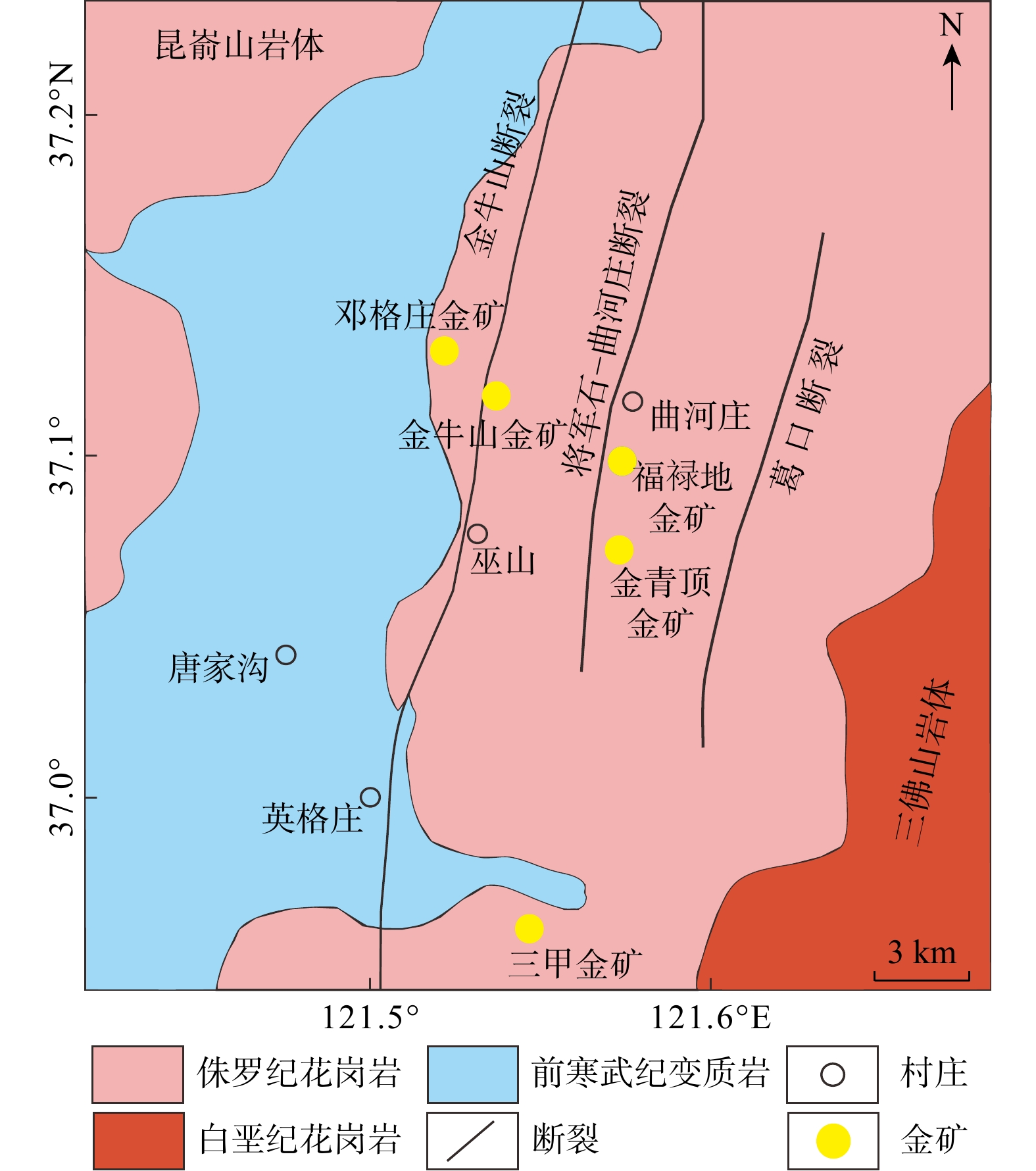
The Fuludi gold deposit is located in the middle segment of the Muping-Rushan gold metallogenic belt, Jiaodong Peninsula, a world-class gold concentration area with substantial gold resources. Previous geological studies on deposits in this belt have mainly focused on gold deposits in its southern and northern sections, while the origin and ore-forming fluid evolution of Fuludi gold deposit have long remained poorly understood. Controversies still exist over the source of ore-forming fluids in the Muping-Rushan belt, with three mainstream viewpoints: mantle-derived fluid, mixed magmatic fluid and meteoric water, and mixed magmatic water and metamorphic water. Geographically, the Fuludi gold deposit acts as a key link connecting the northern and southern parts of the metallogenic belt. However, previous studies have only carried out basic geological surveys and divided its mineralization stages, and systematic studies on ore-forming fluids have long been lacking. This study aims to clarify the source, spatiotemporal evolution of ore-forming fluids, and gold precipitation mechanism of the Fuludi gold deposit.
Combined with detailed field and microscopic geological characteristics, this study selected quartz samples from four different mineralization stages to conduct a comprehensive analysis, including fluid inclusion microthermometry, laser Raman spectroscopy, and hydrogen-oxygen (H-O) isotope testing. It systematically analyzed the petrographic characteristics of fluid inclusions, physicochemical parameters of ore-forming fluids, fluid compositions, and isotopic compositions, so as to constrain the fluid source and gold metallogenesis.
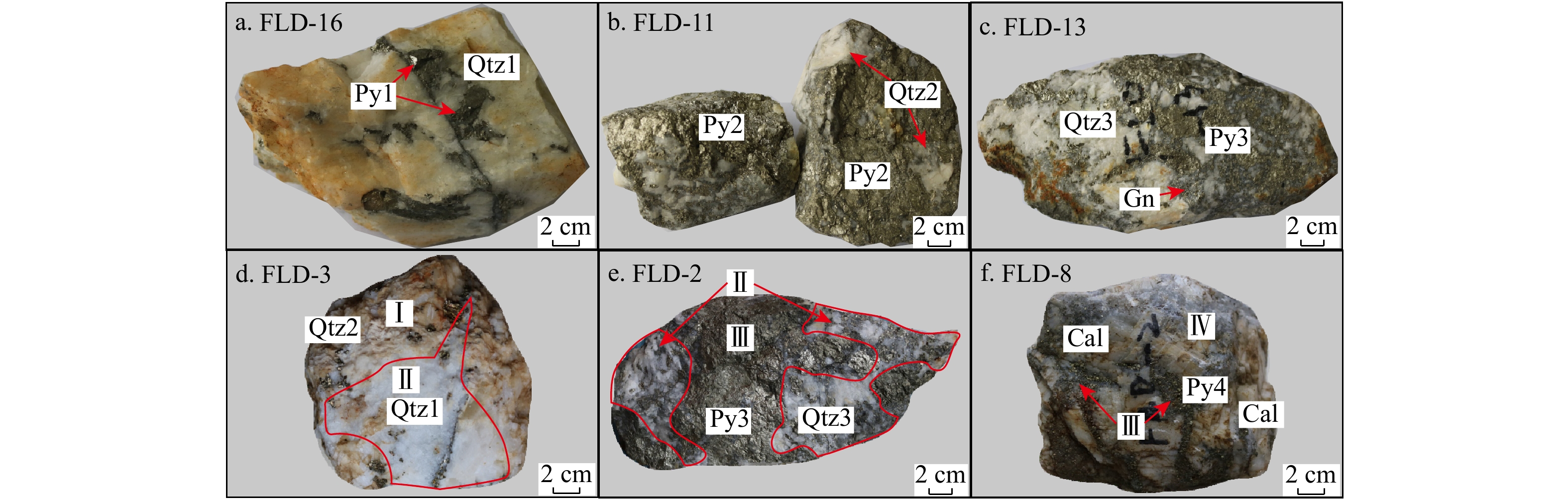
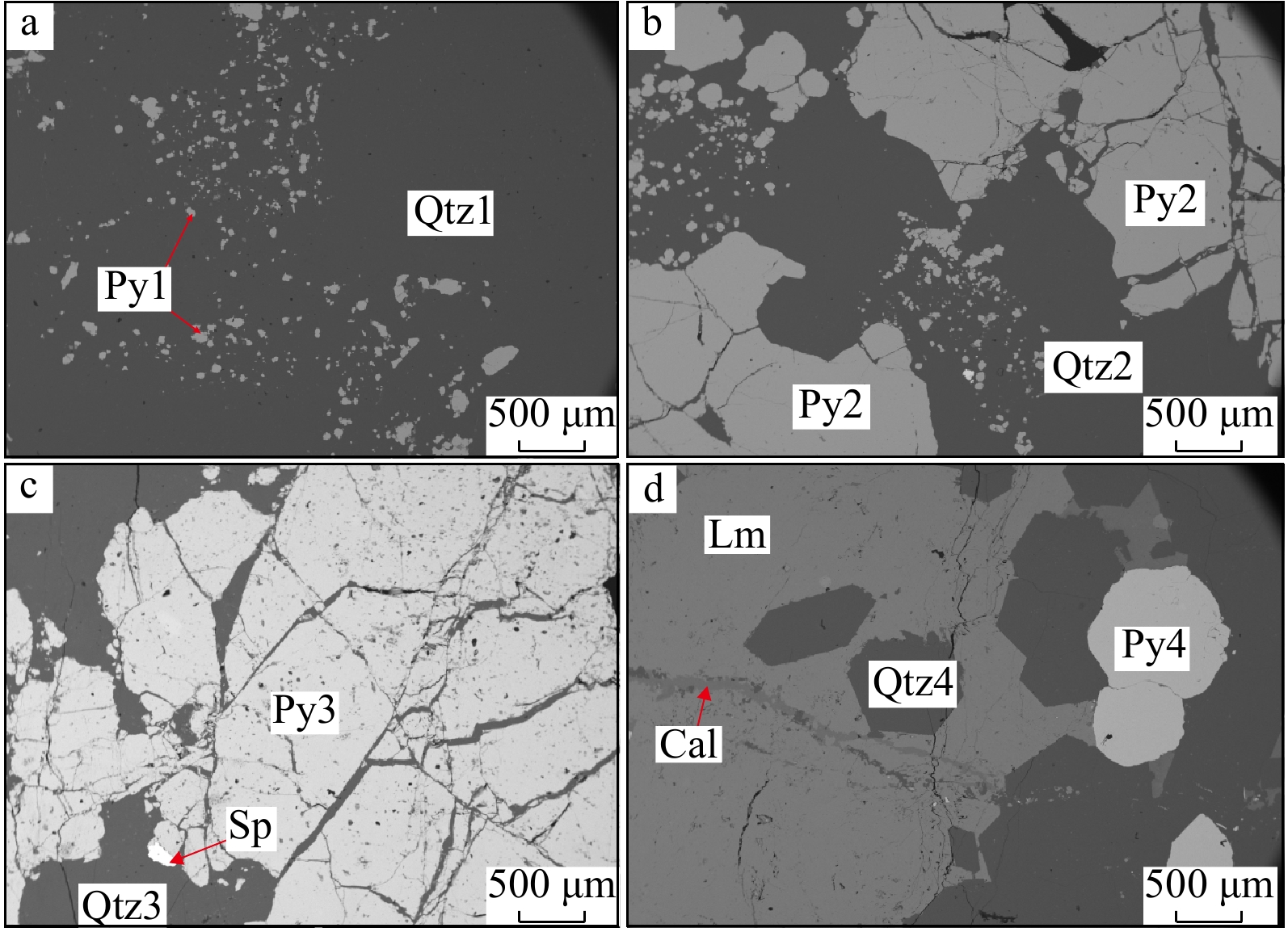
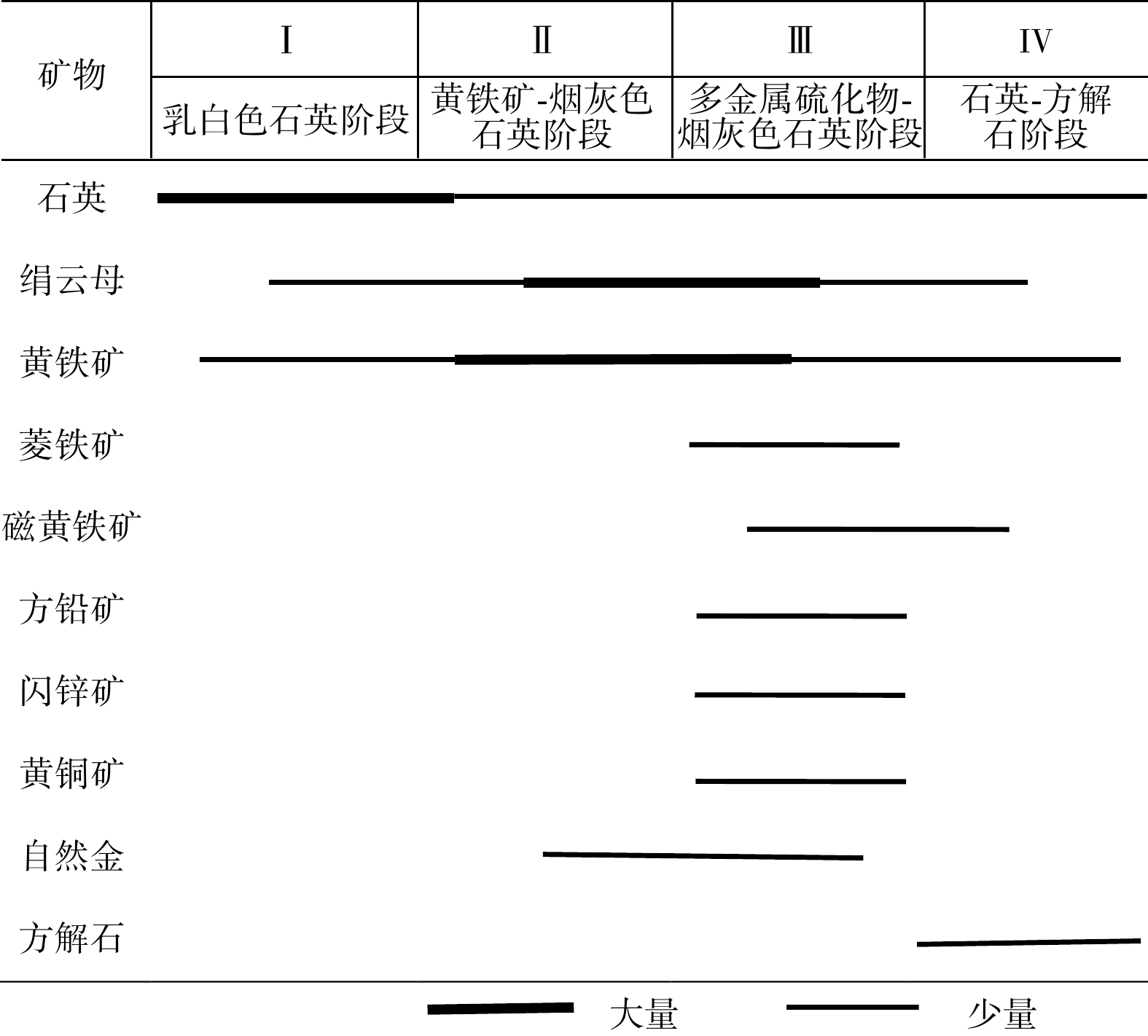
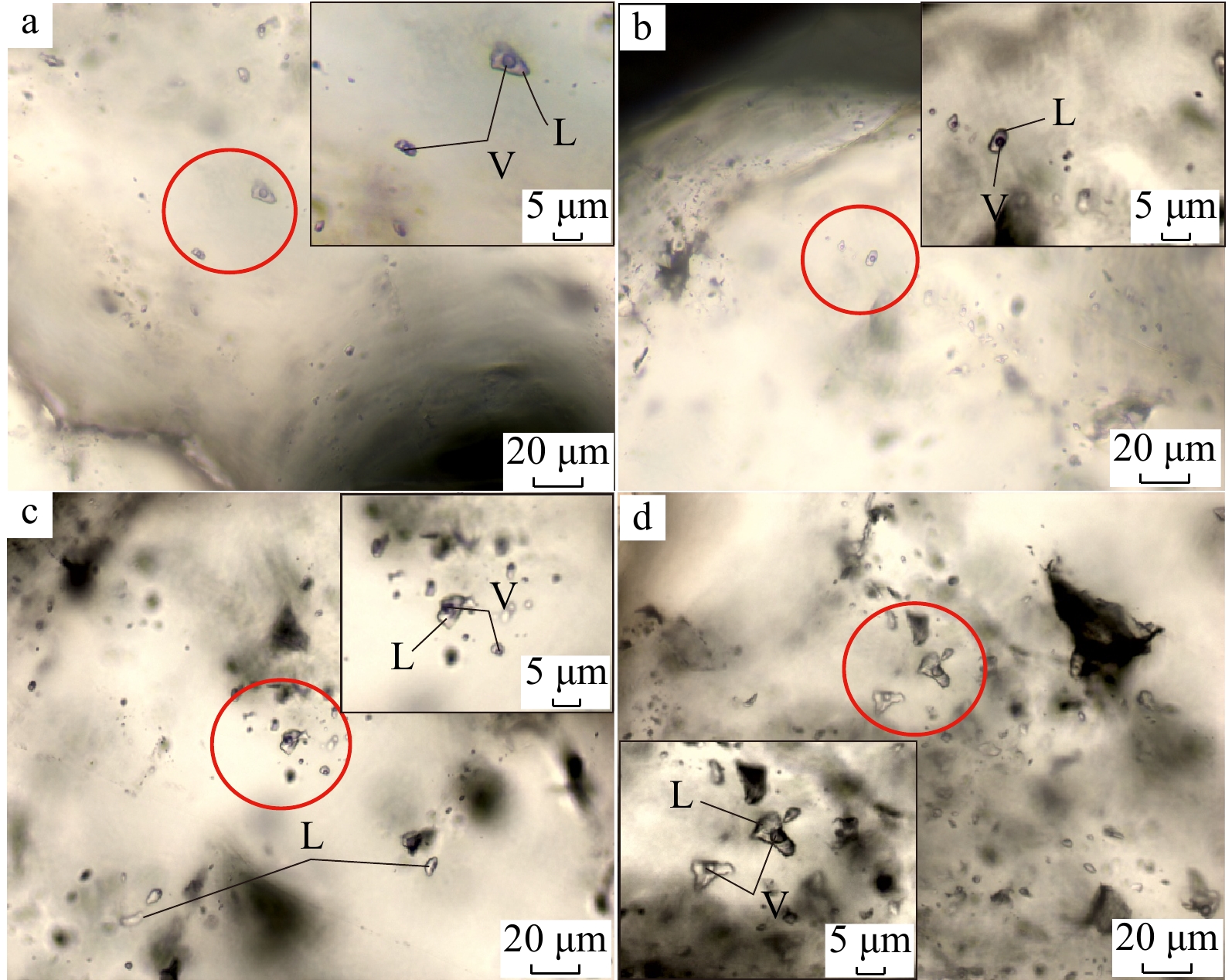
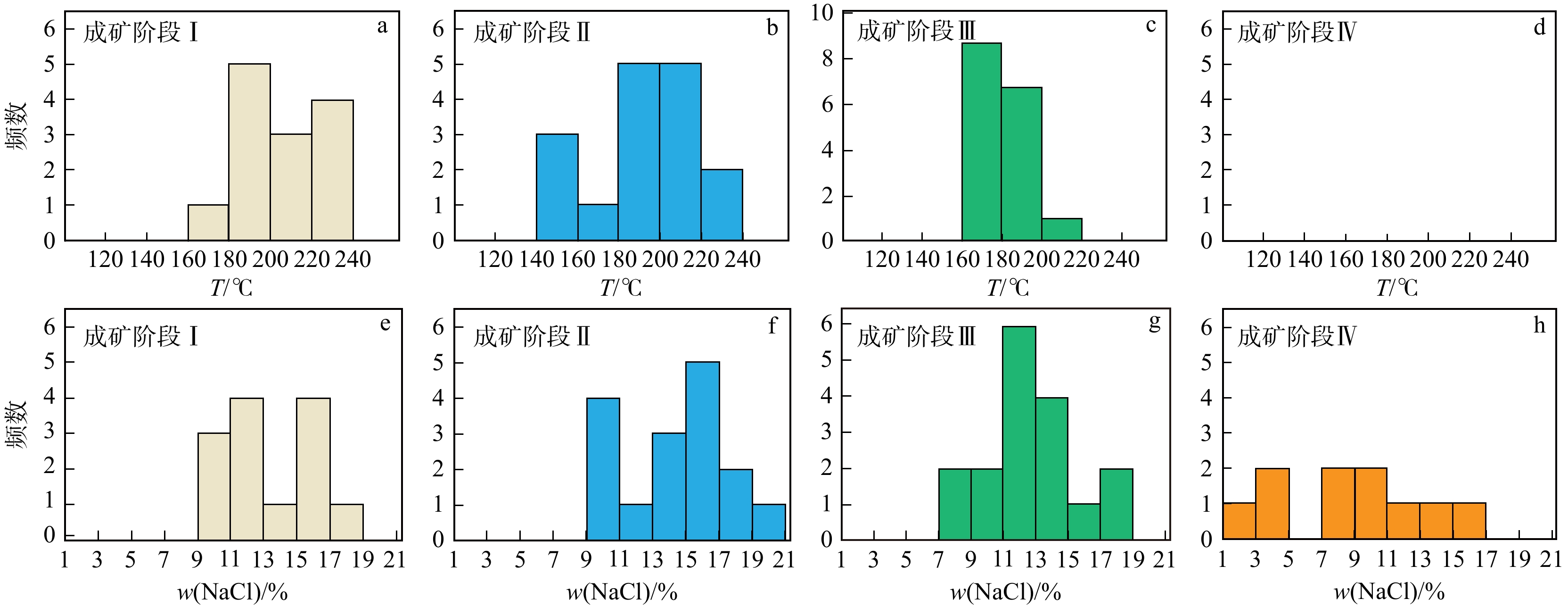
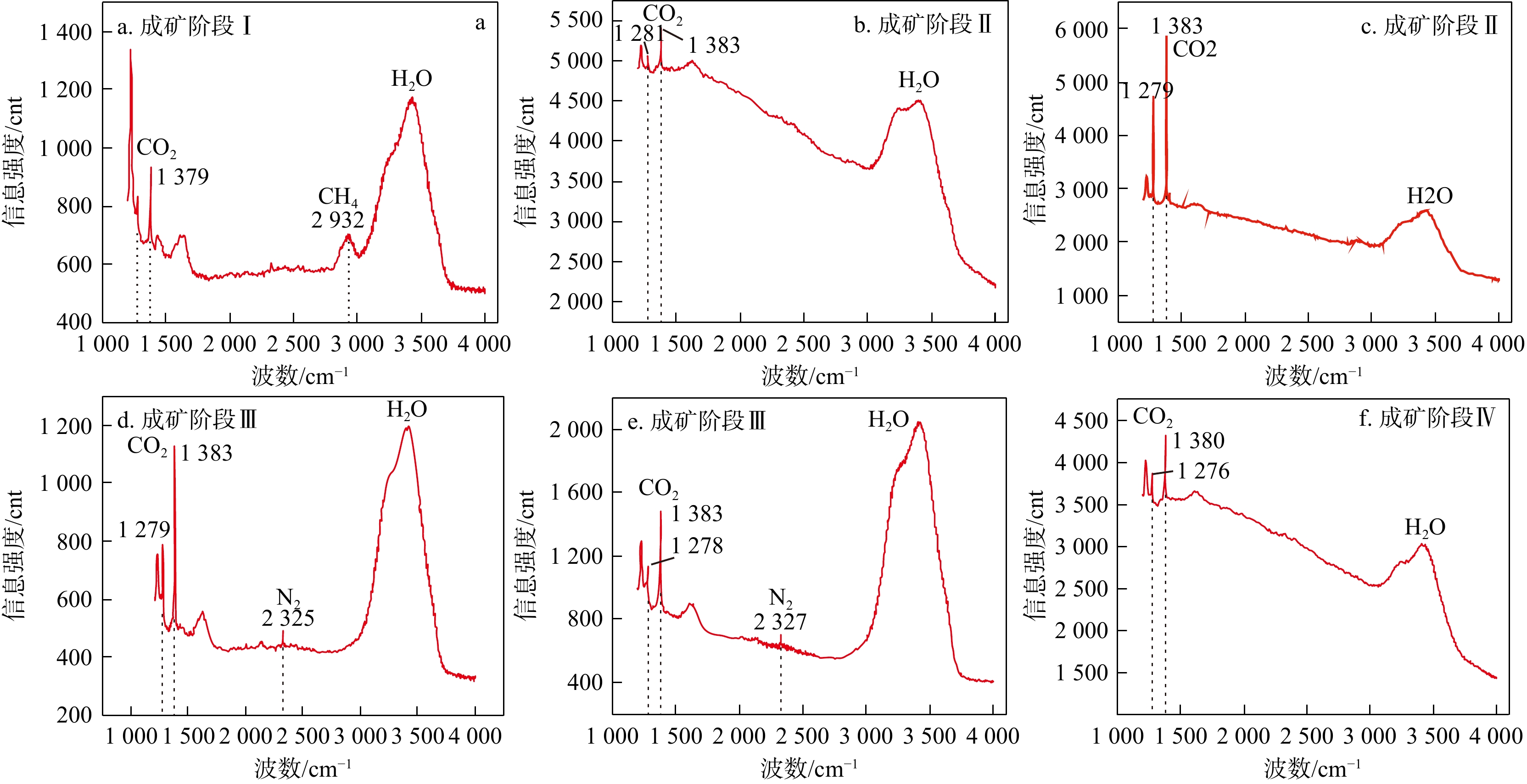
According to the cross-cutting relationships of quartz veins and paragenetic mineral assemblages, four mineralization stages were divided: milky quartz stage (Stage Ⅰ), smoky quartz+pyrite early mineralization stage (Stage Ⅱ), smoky quartz+polymetallic sulfide main mineralization stage (Stage Ⅲ), and quartz+calcite late mineralization stage (Stage Ⅳ). Two types of fluid inclusions were identified in quartz: pure liquid (L-type) aqueous fluid inclusions and gas-liquid two-phase (L+V-type) fluid inclusions. The L+V-type inclusions occurred throughout all four stages, with particle sizes of 3−10 μm and showing elongated, oval, and irregular shapes. Their liquid-phase proportion gradually increased from Stage Ⅰ to Stage Ⅳ, ultimately reaching approximately 80%. The L-type inclusions only developed in Stage Ⅲ, with a particle size of 5−15 μm and mostly oval shapes. Laser Raman analyses revealed that the ore-forming fluid belonged to the CO2-H2O-NaCl system, and its components varied significantly at different stages. CH4 was detected in Stage Ⅰ, no CH4 existed in Stage Ⅱ, N2 appeared in Stage Ⅲ, and only CO2 and H2O were found in Stage Ⅳ. Microthermometric results showed that the early Stage Ⅰ and Stage Ⅱ had stable physicochemical conditions, with homogenization temperatures ranging from 180.0 °C to 240.0 °C and salinity peaks of 9.0%−17.0%. Fluid boiling occurred at the main Stage Ⅲ, accompanied by obvious decreases in temperature (160.0-200.0 °C) and salinity (11.0%−15.0%). At the late Stage Ⅳ, temperature (120.0-180.0 °C) and salinity (3.0%−11.0%) decreased further. H-O isotope results showed that
The ore-forming fluids are dominated by mixed magmatic water and metamorphic water, and are also accompanied by mantle-derived components originating from volatile degassing of enriched mantle. Meteoric water continuously mixed into the fluid system during mineralization. With the gradual decrease of temperature and pressure, combined with fluid boiling and escape of volatile CO2, the physicochemical properties of fluids change significantly. These processes broke the stability of ${\mathrm{Au}}({\mathrm{HS}})_2^- $ complexes, which are the main transport carrier of gold, and led to the rapid precipitation of gold and polymetallic minerals. Comprehensive geological and geochemical evidence indicates that the Fuludi gold deposit is a typical medium- to low-temperature, low-salinity quartz vein-type hydrothermal gold deposit controlled by NNE-trending faults. This study fills the research gap on ore-forming fluids in Fuludi gold deposit, and provides reliable geological evidence for regional metallogenic theory and further prospecting work.

| [1] |
DENG J, LIU X F, WANG Q F, et al. Origin of the Jiaodong-type Xinli gold deposit, Jiaodong Peninsula, China: Constraints from fluid inclusion and C-D-O-S-Sr isotope compositions[J]. Ore Geology Reviews, 2015, 65: 674-686. doi: 10.1016/j.oregeorev.2014.04.018
|
| [2] |
薛建玲, 庞振山, 李胜荣, 等. 胶东邓格庄金矿床成因: 地质年代学和同位素体系制约[J]. 岩石学报, 2019, 35(5): 1532-1550.
XUE J L, PANG Z S, LI S R, et al. The genesis of Denggezhuang gold deposit in Jiaodong: Constraints from multigeological chronology and isotope system[J]. Acta Petrologica Sinica, 2019, 35(5): 1532-1550. (in Chinese with English abstract)
|
| [3] |
刘晓敏, 于森, 李金涛, 等. 胶东石家金矿床成矿流体特征及矿床成因[J]. 黄金, 2024, 45(9): 74-80.
LIU X M, YU S, LI J T, et al. Characteristics of ore-forming fluids and genesis of Shijia gold deposit in Jiaodong[J]. Gold, 2024, 45(9): 74-80. (in Chinese with English abstract)
|
| [4] |
DENG J, YANG L Q, GROVES D I, et al. An integrated mineral system model for the gold deposits of the giant Jiaodong province, eastern China[J]. Earth-Science Reviews, 2020, 208: 103274. doi: 10.1016/j.earscirev.2020.103274
|
| [5] |
迟乃杰, 韩作振, 单伟, 等. 胶东郭家岭序列北截杂岩体SHRIMP锆石U-Pb年代学、岩石学、地球化学特征及构造意义[J]. 山东科技大学学报(自然科学版), 2021, 40(5): 30-42.
CHI N J, HAN Z Z, SHAN W, et al. SHRIMP U-Pb zircon geochronology, petrology, geochemical characteristics and tectonic significance of Beijie complex of Guojialing sequence in Jiaodong Peninsula[J]. Journal of Shandong University of Science and Technology (Natural Science), 2021, 40(5): 30-42. (in Chinese with English abstract)
|
| [6] |
冯乔, 徐子苏, 张耀, 等. 青岛胶南隆起带小珠山早白垩世花岗岩锆石U-Pb年代学及胶东半岛中生代花岗岩成因初探[J]. 山东科技大学学报(自然科学版), 2019, 38(2): 1-13. doi: 10.16452/j.cnki.sdkjzk.2019.02.001
FENG Q, XU Z S, ZHANG Y, et al. Zircon U-Pb geochronology of the Early Cretaceous Xiaozhushan granite in Qingdao Jiaonan uplift and tectonic evolution of Mesozoic granite in Jiaodong Peninsula[J]. Journal of Shandong University of Science and Technology (Natural Science), 2019, 38(2): 1-13. (in Chinese with English abstract) doi: 10.16452/j.cnki.sdkjzk.2019.02.001
|
| [7] |
江书龙, 张侠, 李敬波, 等. 山东省汶上县石头墩金矿黄铁矿微区元素组成及对矿床成因的指示[J]. 山东科技大学学报(自然科学版), 2022, 41(4): 1-9.
JIANG S L, ZHANG X, LI J B, et al. Ore genesis of Shitoudun gold deposit in Wenshang County, Shandong Province, indicated by in-situ element contents in pyrites[J]. Journal of Shandong University of Science and Technology (Natural Science), 2022, 41(4): 1-9. (in Chinese with English abstract)
|
| [8] |
XUE J L, LI S R, SUN W Y, et al. Characteristics of the genetic mineralogy of pyrite and its significance for prospecting in the Denggezhuang gold deposit, Jiaodong Peninsula, China[J]. Science China Earth Sciences, 2014, 57(4): 644-661. doi: 10.1007/s11430-013-4706-2
|
| [9] |
吴小雷, 周守余. 胶东金牛山金矿床构造控矿规律研究[J]. 矿床地质, 2014, 33(增刊1): 1093-1094.
WU X L, ZHOU S Y. Study on structural ore control rule of Jinniushan gold deposit in Jiaodong[J]. Deposit geology, 2014, 33(S1): 1093-1094. (in Chinese with English abstract)
|
| [10] |
李旭芬. 胶东牟平−乳山金矿带金青顶金矿矿床成因与找矿方向研究[D]. 西安: 长安大学, 2011.
LI X F. The ore genesis and prospecting direction of Jinqingding gold deposit of the Muping-Rushan gold ore belt in eastern Shandong[D]. Xi'an: Changan University, 2011. (in Chinese with English abstract)
|
| [11] |
薛建玲, 李胜荣, 孙文燕, 等. 胶东邓格庄金矿床流体包裹体氦、氩同位素组成及其成矿物质来源示踪[J]. 吉林大学学报(地球科学版), 2013, 43(2): 400-414.
XUE J L, LI S R, SUN W Y, et al. Helium and argon isotopic composition in fluid inclusions and the source of ore-forming materials of Denggezhuang gold deposit in Jiaodong Peninsula[J]. Journal of Jilin University (Earth Science Edition), 2013, 43(2): 400-414. (in Chinese with English abstract)
|
| [12] |
徐国良, 孙超. 胶东地区牟乳成矿带金青顶金矿床地质特征与成因分析[J]. 资源信息与工程, 2023, 38(3): 1-6.
XU G L, SUN C. Geological characteristics and genetic analysis of Jinqingding gold deposits in Muping-Rushan metallogenic belt of Jiaodong area[J]. Resource Information and Engineering, 2023, 38(3): 1-6. (in Chinese with English abstract)
|
| [13] |
薛建玲, 李胜荣, 庞振山, 等. 胶东邓格庄金矿成矿流体、成矿物质来源与矿床成因[J]. 岩石学报, 2018, 34(5): 1453-1468.
XUE J L, LI S R, PANG Z S, et al. Ore-forming fluids, sources of materials in the Denggezhuang gold deposit, Jiaodong Penisula and implications for ore genesis[J]. Acta Petrologica Sinica, 2018, 34(5): 1453-1468. (in Chinese with English abstract)
|
| [14] |
HU F F, FAN H R, ZHAI M G, et al. Fluid evolution in the Rushan lode gold deposit of Jiaodong Peninsula, eastern China[J]. Journal of Geochemical Exploration, 2006, 89(1/2/3): 161-164. doi: 10.1007/3-540-27946-6_248
|
| [15] |
毛景文, 李厚民, 王义天, 等. 地幔流体参与胶东金矿成矿作用的氢氧碳硫同位素证据[J]. 地质学报, 2005, 79(6): 839-857.
MAO J W, LI H M, WANG Y T, et al. The relationship between mantle-derived fluid and gold ore-formation in the eastern Shandong Peninsula: Evidences from D-O-C-S isotopes[J]. Acta Geologica Sinica, 2005, 79(6): 839-857. (in Chinese with English abstract)
|
| [16] |
宋倩, 黄鑫, 王勇军, 等. 胶东牟乳成矿带金青顶金矿床成矿流体特征及成矿作用探讨[J]. 矿产综合利用, 2025, 46(1): 30-45.
SONG Q, HUANG X, WANG Y J, et al. Characteristics of ore-forming fluid and mineralization of Jinqingding gold deposit in Mouru metallogenic belt, Jiaodong[J]. Multipurpose Utilization of Mineral Resources, 2025, 46(1): 30-45. (in Chinese with English abstract)
|
| [17] |
王建宁, 曲弘范. 福禄地金矿地质特征及找矿方向[J]. 现代矿业, 2016, 32(11): 129-132.
WANG J N, QU H F. Geological characteristics and prospecting direction of Fuludi gold deposit[J]. Modern Mining, 2016, 32(11): 129-132. (in Chinese with English abstract)
|
| [18] |
万鹏, 丁正江, 胡弘, 等. 胶东邓格庄金矿床深部成矿特征及找矿方法组合[J]. 黄金科学技术, 2017, 25(3): 46-53.
WAN P, DING Z J, HU H, et al. Deep metallogenic characteristics of Denggezhuang gold deposit in Jiaodong and its prospecting method combinations[J]. Gold Science and Technology, 2017, 25(3): 46-53. (in Chinese with English abstract)
|
| [19] |
HUANG X, SUN D Y, YU S, et al. The sources of ore-forming materials and fluids for the Jinqingding gold deposit in the Mouping-Rushan metallogenic belt, Jiaodong Peninsula: Evidence from S-H-O isotopes and trace elements in pyrite[J]. Minerals, 2024, 14(11): 1064. doi: 10.3390/min14111064
|
| [20] |
CAI W Y, SONG M C, SANTOSH M, et al. The gold-telluride connection: Evidence for multiple fluid pulses in the Jinqingding telluride-rich gold deposit of Jiaodong Peninsula, eastern China[J]. Geoscience Frontiers, 2024, 15(3): 101795. doi: 10.1016/j.gsf.2024.101795
|
| [21] |
胡芳芳. 胶东昆嵛山地区中生代构造体制转折期岩浆活动、成矿流体演化与金矿床成因[D]. 北京: 中国科学院地质与地球物理研究所, 2006.
HU F F. Magmatic activity, ore-forming fluid evolution, and gold deposit genesis during the Mesozoic tectonic system transition period in the Kunyushan area of Jiaodong[D]. Beijing: Institute of Geology and Geophysics, Chinese Academy of Sciences, 2006. (in Chinese with English abstract)
|
| [22] |
DENG J, LIU X F, WANG Q F, et al. Isotopic characterization and petrogenetic modeling of Early Cretaceous mafic diking: Lithospheric extension in the North China Craton, eastern Asia[J]. GSA Bulletin, 2017, 129(11/12): 1379-1407. doi: 10.1130/b31609.1
|
| [23] |
LI L, LI S R, SANTOSH M, et al. Dyke swarms and their role in the genesis of world-class gold deposits: Insights from the Jiaodong Peninsula, China[J]. Journal of Asian Earth Sciences, 2016, 130: 2-22. doi: 10.1016/j.jseaes.2016.06.015
|
| [24] |
CHEN B H, DENG J, WEI H T, et al. Trace element geochemistry in quartz in the Jinqingding gold deposit, Jiaodong Peninsula, China: Implications for the gold precipitation mechanism[J]. Minerals, 2019, 9(5): 326. doi: 10.3390/min9050326
|
| [25] |
李健, 宋明春, 于建涛, 等. 胶东东部金青顶金矿床成因: 硫化物矿石与围岩微量元素的制约[J]. 地质通报, 2022, 41(6): 1010-1022.
LI J, SONG M C, YU J T, et al. Genesis of Jinqingding gold deposit in eastern Jiaodong Peninsula: Constrain from trace elements of sulfide ore and wall-rock[J]. Geological Bulletin of China, 2022, 41(6): 1010-1022. (in Chinese with English abstract)
|
| [26] |
QIU K F, YU H C, WU M Q, et al. Discrete Zr and REE mineralization of the Baerzhe rare-metal deposit, China[J]. American Mineralogist, 2019, 104(10): 1487-1502.
|
| [27] |
GOLDFARB R J, GROVES D I, GARDOLL S. Orogenic gold and geologic time: A global synthesis[J]. Ore Geology Reviews, 2001, 18(1/2): 1-75.
|
| [28] |
CHENG N N, HOU Q L, SHI M Y, et al. New insight into the genetic mechanism of shear zone type gold deposits from Muping-Rushan metallogenic belt (Jiaodong Peninsula of eastern China)[J]. Minerals, 2019, 9(12): 775.
|
| [29] |
薛建玲, 李胜荣, 孙文燕, 等. 胶东邓格庄金矿地质特征与深部预测[J]. 中国地质, 2012, 39(1): 183-194.
XUE J L, LI S R, SUN W Y, et al. Geological characteristics and metallogenic prognosis of the Denggezhuang gold deposit in Jiaodong Peninsula[J]. Geology in China, 2012, 39(1): 183-194. (in Chinese with English abstract)
|
| [30] |
POTTER R W, CLYNNE M A, BROWN D L. Freezing point depression of aqueous sodium chloride solutions[J]. Economic Geology, 1978, 73(2): 284-285.
|
| [31] |
CLAYTON R N, O'NEIL J R, MAYEDA T K. Oxygen isotope exchange between quartz and water[J]. Journal of Geophysical Research (1896-1977), 1972, 77(17): 3057-3067.
|
| [32] |
何江涛. 胶东牟乳成矿带金矿成矿作用及改造保存[D]. 北京: 中国地质大学(北京), 2021.
HE J T. Gold mineralization and post-ore denudation in the Muping-Rushan gold belt, Jiaodong Peninsula, eastern China[D]. Beijing: China University of Geosciences(Beijing), 2021. (in Chinese with English abstract)
|
| [33] |
于晓卫, 王来明, 刘汉栋, 等. 胶东中生代花岗岩与金矿关系及成矿期划分[J]. 地质学报, 2023, 97(6): 1848-1873.
YU X W, WANG L M, LIU H D, et al. The relationship between Mesozoic granite, gold deposits and the division of metallogenic period in eastern Shandong[J]. Acta Geologica Sinica, 2023, 97(6): 1848-1873. (in Chinese with English abstract)
|
| [34] |
严子清, 石文杰, 张鹏涛, 等. 胶东大尹格庄金矿成矿流体时空演化及矿床成因: 来自流体包裹体、成矿元素和H-O-S-Pb同位素证据[J]. 地质科技通报, 2024, 43(2): 156-174.
YAN Z Q, SHI W J, ZHANG P T, et al. Ore genesis and vertical variations of ore-forming fluids in the Dayingezhuang gold deposit, Jiaodong Peninsula: Constraints from fluid inclusions, ore forming elements, and H-O-S-Pb isotopes[J]. Bulletin of Geological Science and Technology, 2024, 43(2): 156-174. (in Chinese with English abstract)
|
| [35] |
王勇军, 刘颜, 黄鑫, 等. 胶东牟乳成矿带范家庄金矿床成矿流体特征及其地质意义[J]. 吉林大学学报(地球科学版), 2020, 50(4): 1012-1028.
WANG Y J, LIU Y, HUANG X, et al. Characteristics of ore-forming fluids and geological significance of Fanjiazhuang gold deposit in Muping-Rushan metallogenic belt, Jiaodong Peninsula[J]. Journal of Jilin University (Earth Science Edition), 2020, 50(4): 1012-1028. (in Chinese with English abstract)
|
| [36] |
蓝廷广, 范宏瑞, 胡芳芳, 等. 胶东石城金矿床成矿流体特征及成矿作用[J]. 岩石学报, 2010, 26(5): 1512-1522.
LAN T G, FAN H R, HU F F, et al. Characteristics of ore-forming fluids and ore genesis in the Shicheng gold deposit, Jiaodong Peninsula of eastern China[J]. Acta Petrologica Sinica, 2010, 26(5): 1512-1522. (in Chinese with English abstract)
|
| [37] |
朱日祥, 范宏瑞, 李建威, 等. 克拉通破坏型金矿床[J]. 中国科学(地球科学), 2015, 45(8): 1153-1168.
ZHU R X, FAN H R, LI J W, et al. Decratonic gold deposits[J]. Scientia Sinica (Terrae), 2015, 45(8): 1153-1168. (in Chinese with English abstract)
|
| [38] |
田瑞聪, 李大鹏, 张文, 等. 胶北隆起中生代壳幔岩浆的混合反应是巨量金质来源的关键[J]. 岩石学报, 2022, 38(1): 23-40.
TIAN R C, LI D P, ZHANG W, et al. The mixing reaction of Mesozoic crust-mantle magma in Jiaobei uplift is the key to the huge amount of gold source[J]. Acta Petrologica Sinica, 2022, 38(1): 23-40. (in Chinese with English abstract)
|
| [39] |
胡芳芳, 范宏瑞, 杨进辉, 等. 胶东乳山含金石英脉型金矿的成矿年龄: 热液锆石SHRIMP法U-Pb测定[J]. 科学通报, 2004, 49(12): 1191-1198.
HU F F, FAN H R, YANG J H, et al. Metallogenic age of gold-bearing quartz vein type gold deposit in Rushan, Jiaodong: U-Pb determination by hydrothermal zircon SHRIMP method[J]. Chinese Science Bulletin, 2004, 49(12): 1191-1198. (in Chinese with English abstract)
|
| [40] |
朱日祥, 孙卫东. 大地幔楔与克拉通破坏型金矿[J]. 中国科学: 地球科学, 2021, 51(9): 1444-1456.
ZHU R X, SUN W D. The big mantle wedge and decratonic gold deposits[J]. Scientia Sinica (Terrae), 2021, 51(9): 1444-1456. (in Chinese with English abstract)
|
Supported by:
Beijing Renhe Information Technology Co., Ltd.


 Submission System

 DownLoad: