| Citation: | WU Guopeng,CHEN Guoxiong,CHAI Jianzhou,et al. A comparative numerical simulation study on influence of groundwater flow on geothermal field: A case study of Yuncheng Basin in Shanxi Graben[J]. Bulletin of Geological Science and Technology,2026,45(4):1-12 doi: 10.19509/j.cnki.dzkq.tb20250108

|
Groundwater flow exchanges heat with the surrounding rock and alters geothermal field distribution, playing a key controlling role in the occurrence and exploration of geothermal resources. This study aims to reveal the influence mechanism of groundwater flow on geothermal field in the Yuncheng Basin, Shanxi Graben.
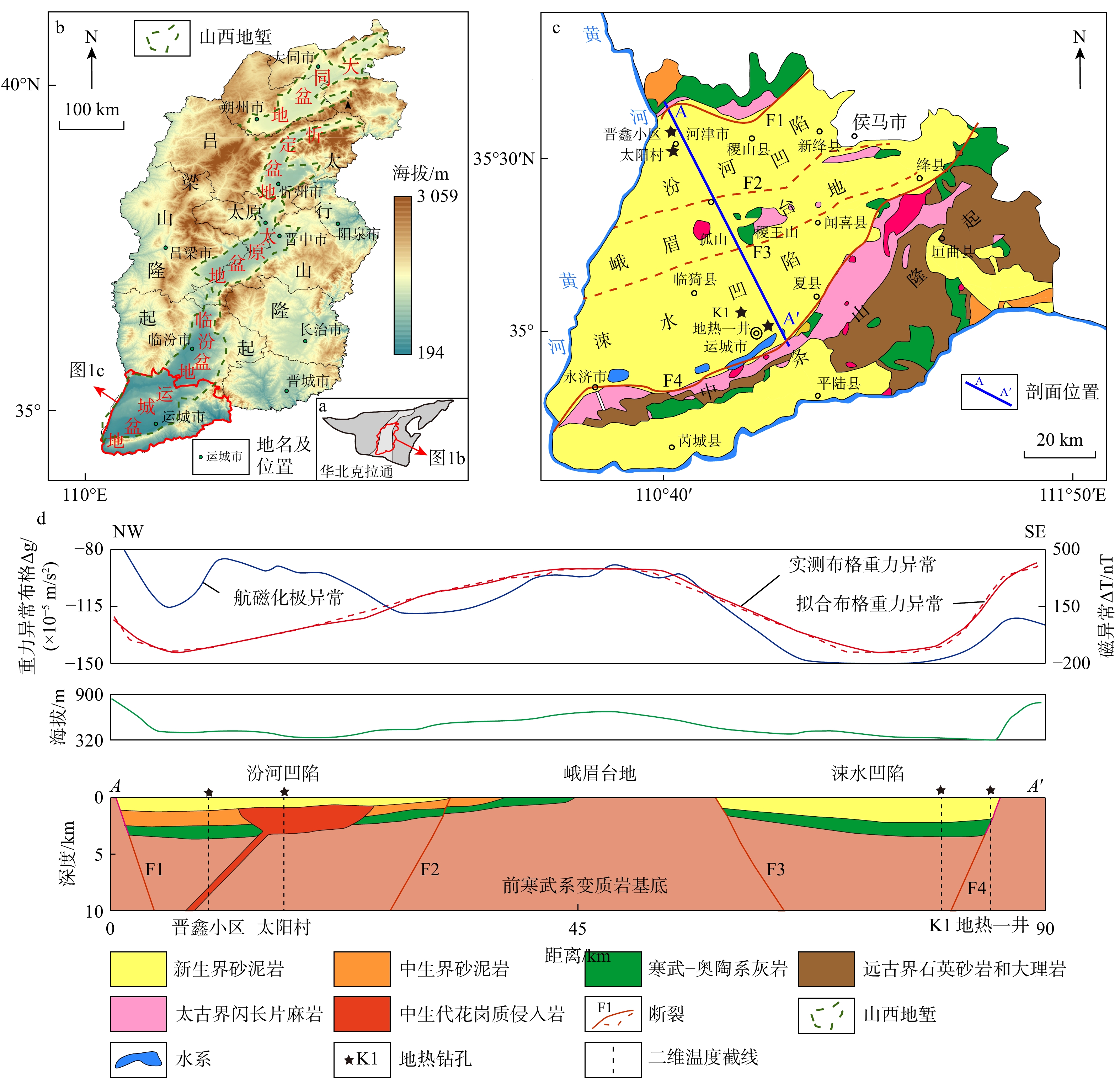
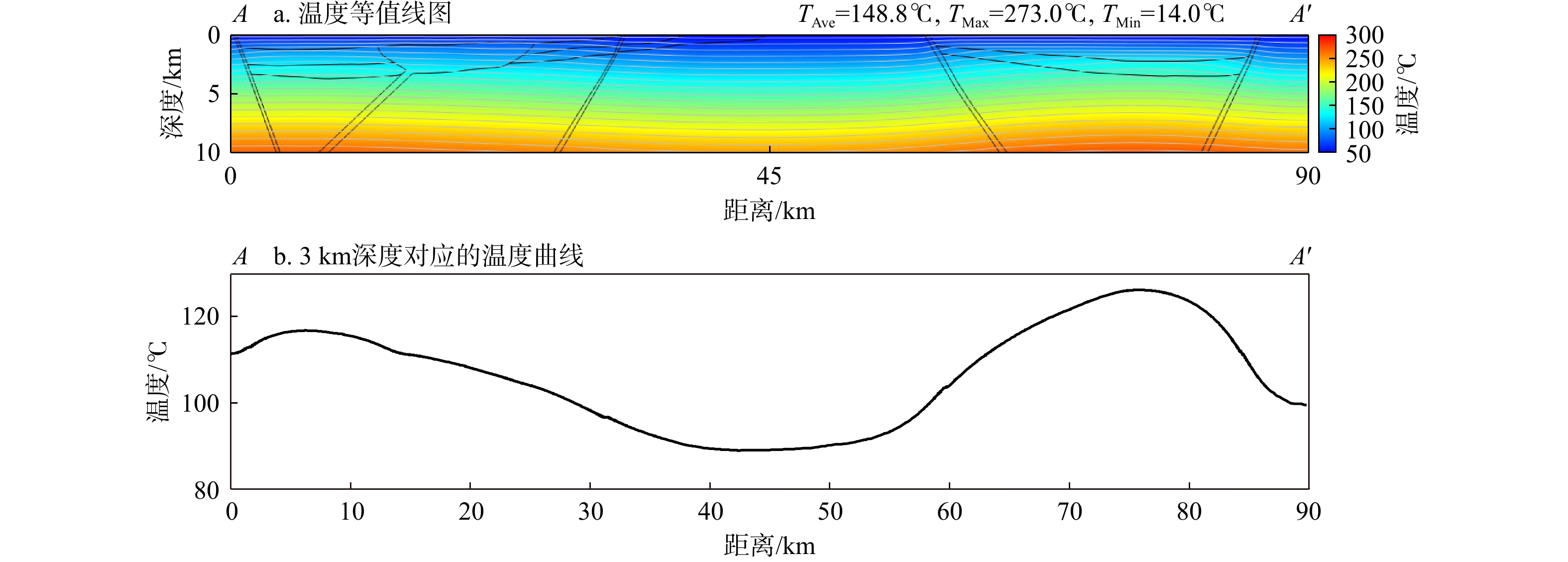
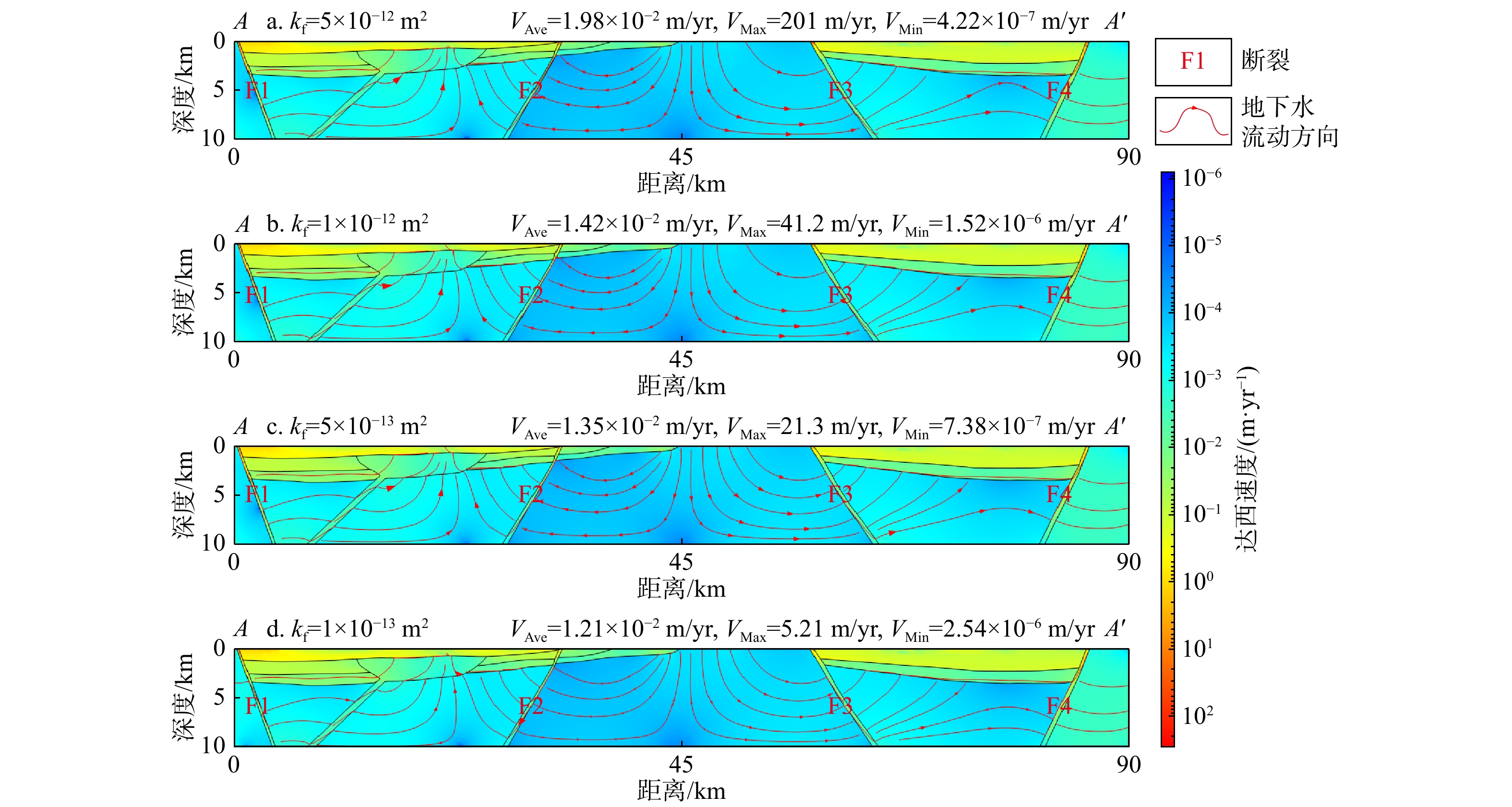
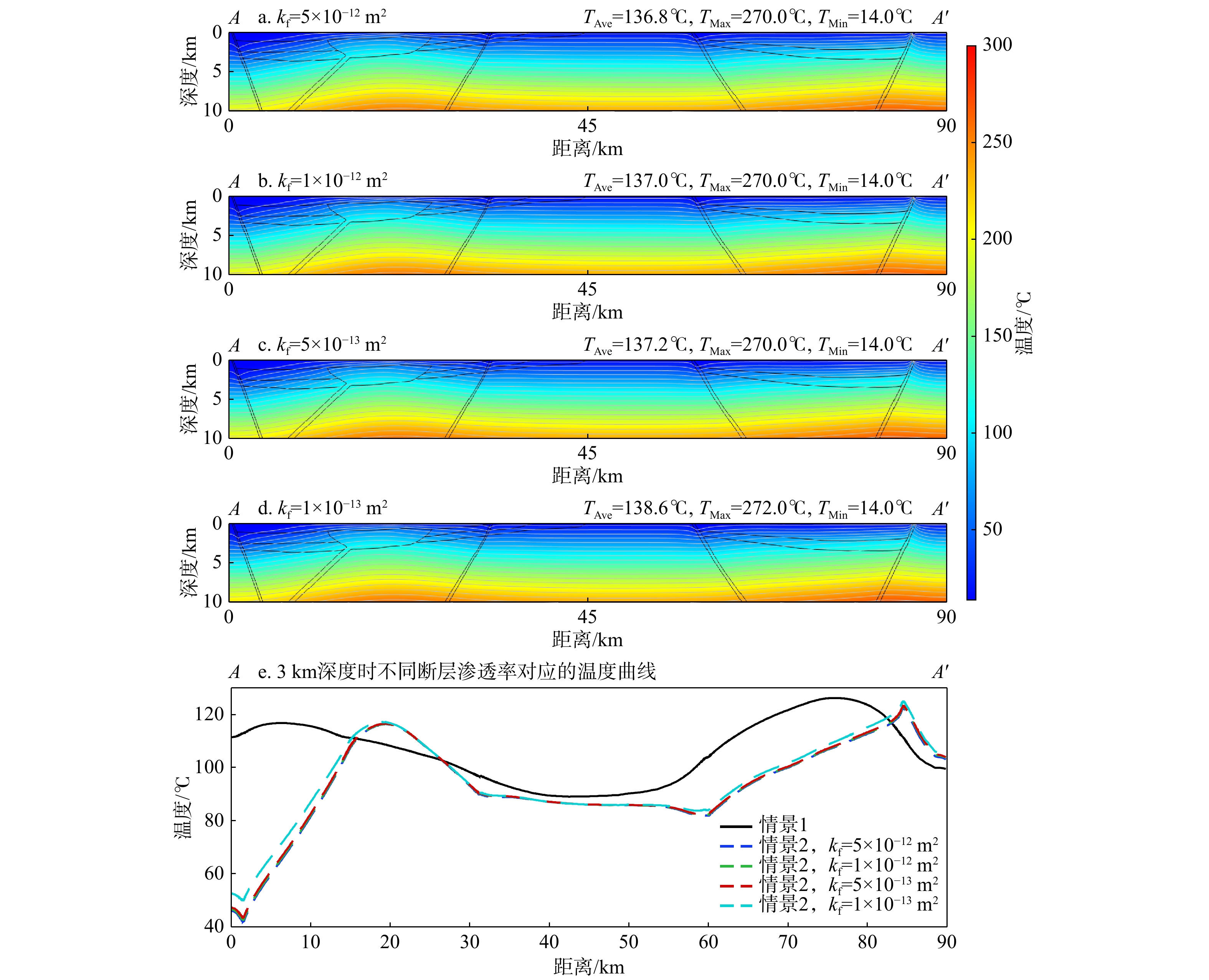
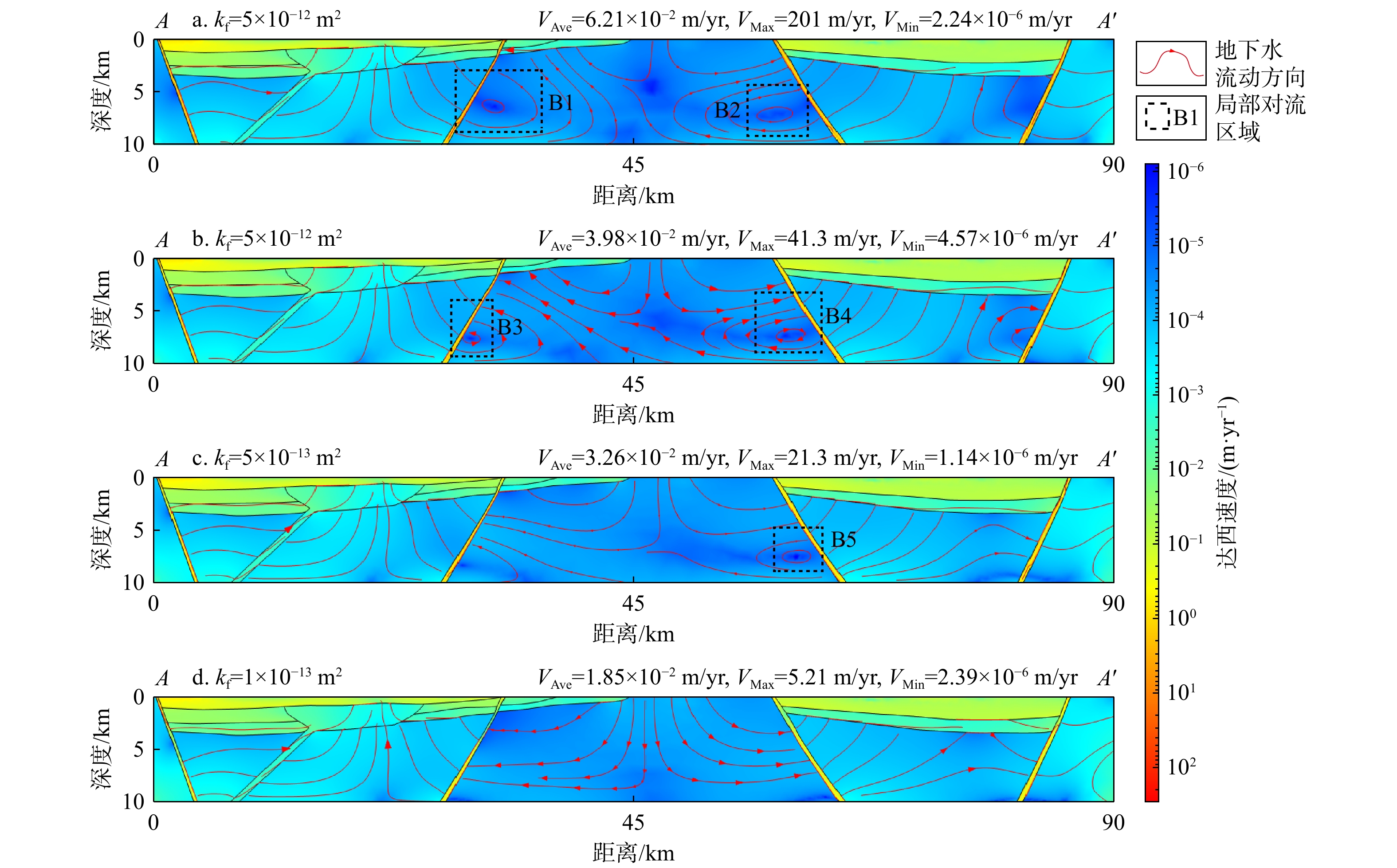
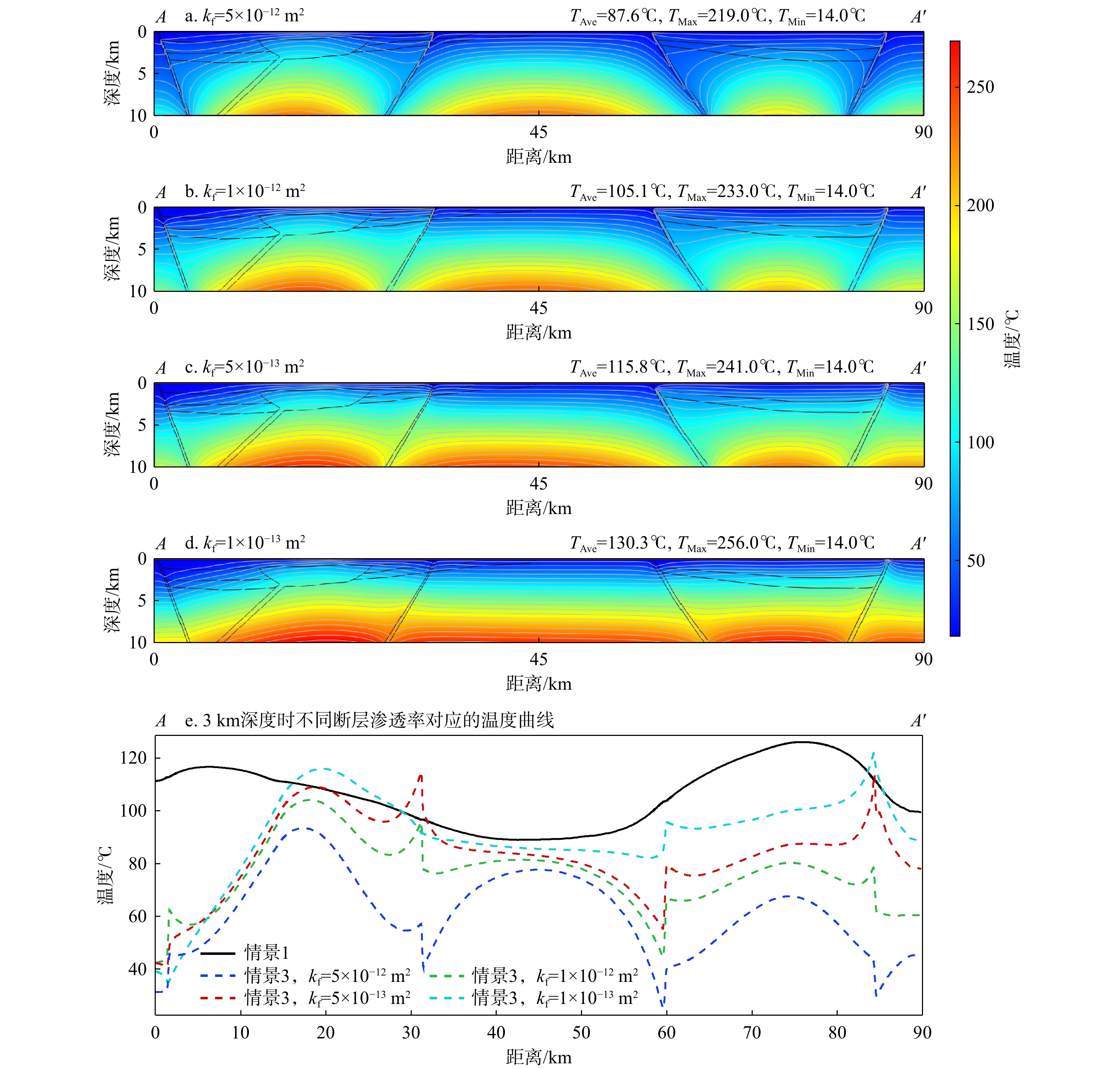
Taking the Yuncheng fault basin as the study area, a two-dimensional geological profile model was constructed. Finite element numerical simulations were conducted under three scenarios: Pure heat conduction; gravity-driven heat conduction-convection; Gravity and buoyancy-driven heat conduction-convection. The controlling effects of groundwater flow on deep geothermal field were comparatively analyzed.
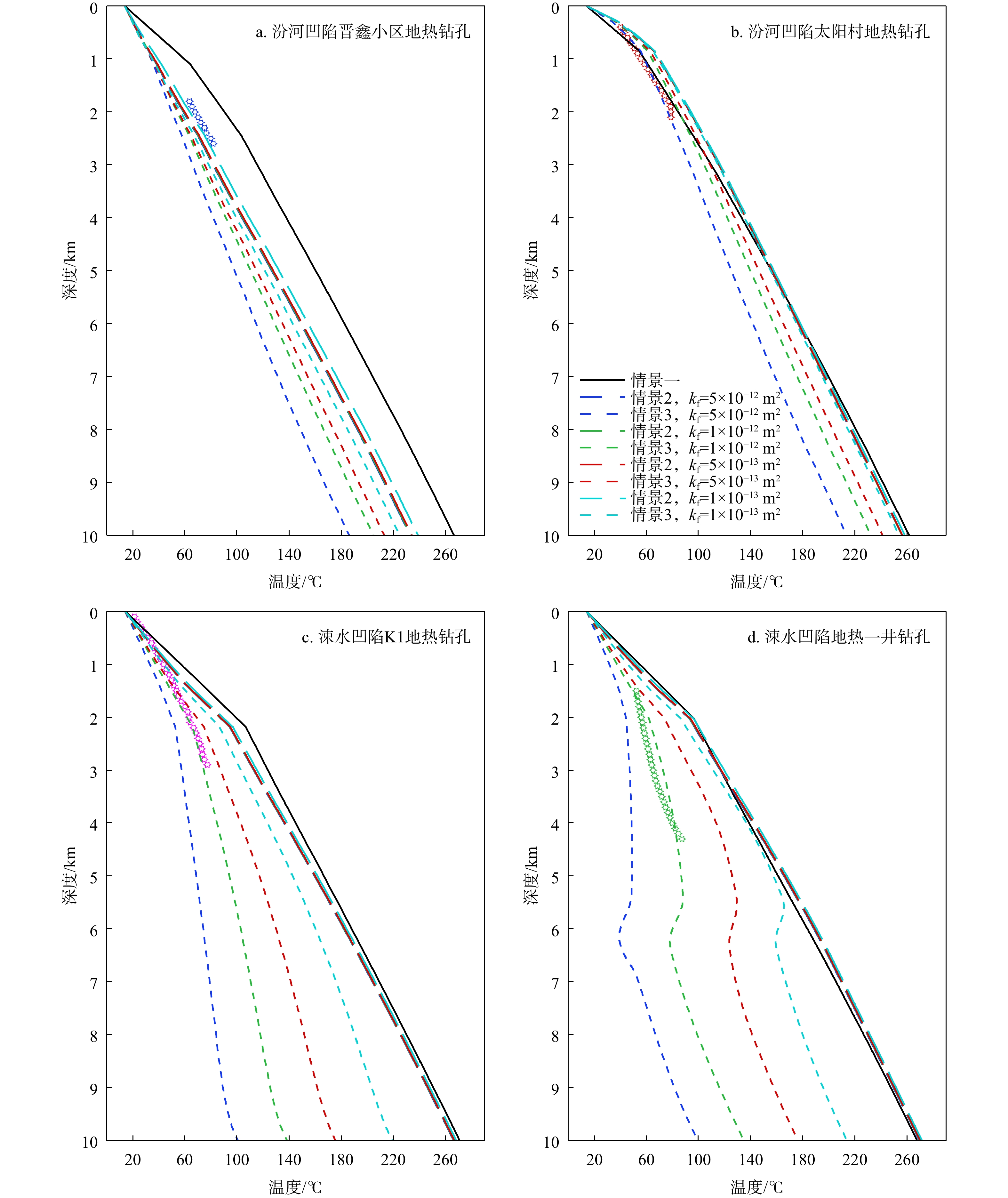
Under the pure heat conduction model, the geothermal field exhibited a North-South symmetrical distribution with alternating high and low temperatures. High temperature zones were concentrated in the Fenhe and Sushui depressions, controlled by basement undulation and caprock thickness. Under gravity-driven conditions, groundwater flowed along high-permeability strata and fault zones, causing cooling in recharge areas and heating in discharge areas. When buoyancy effects caused by temperature differences was superimposed, the flow velocity and direction were changed within deep major fault zones, resulting in local positive temperature anomalies at the northern and southern marginal faults of the Emei Platform and in the deep part of the Zhongtiaoshan Fault. Borehole temperature comparisons indicated that the heat transfer in the Yuncheng Basin was dominated by a combined heat conduction-convection mode, with the permeability of deep major faults being approximately 1.0×10⁻¹² m2.
Groundwater flow significantly controls the geothermal field distribution and heat redistribution in the Yuncheng Basin. The coupled heat transfer mode is the dominant mechanism of the geothermal system in this area. The results provide a scientific basis for the exploration and prediction of geothermal resources in the Yuncheng Basin and similar areas within the Shanxi Graben.

| [1] |
WANG Y, GUO C H, ZHUANG S R, et al. Major contribution to carbon neutrality by China's geosciences and geological technologies[J]. China Geology, 2021, 4(2): 329-352. doi: 10.31035/cg2021037
|
| [2] |
HU Y A, CHENG H F, TAO S. Opportunity and challenges in large-scale geothermal energy exploitation in China[J]. Critical Reviews in Environmental Science and Technology, 2022, 52(21): 3813-3834. doi: 10.1080/10643389.2021.1971004
|
| [3] |
王贵玲, 蔺文静. 我国主要水热型地热系统形成机制与成因模式[J]. 地质学报, 2020, 94(7): 1923-1937. doi: 10.19762/j.cnki.dizhixuebao.2020224
WANG G L, LIN W J. Main hydro-geothermal systems and their genetic models in China[J]. Acta Geologica Sinica, 2020, 94(7): 1923-1937. (in Chinese with English abstract) doi: 10.19762/j.cnki.dizhixuebao.2020224
|
| [4] |
庞忠和, 胡圣标, 汪集旸. 中国地热能发展路线图[J]. 科技导报, 2012, 30(32): 18-24. doi: 10.3981/j.issn.1000-7857.2012.32.002
PANG Z H, HU S B, WANG J Y. A roadmap to geothermal energy development in China[J]. Science & Technology Review, 2012, 30(32): 18-24. (in Chinese with English abstract) doi: 10.3981/j.issn.1000-7857.2012.32.002
|
| [5] |
王贵玲, 张薇, 梁继运, 等. 中国地热资源潜力评价[J]. 地球学报, 2017, 38(4): 449-450.
WANG G L, ZHANG W, LIANG J Y, et al. Evaluation of geothermal resources potential in China[J]. Acta Geoscientica Sinica, 2017, 38(4): 449-450. (in Chinese with English abstract)
|
| [6] |
韩颖, 白雪峰, 张欣. 山西省地热资源及其开发利用模式探讨[J]. 中国地质调查, 2018, 5(5): 13-20.
HAN Y, BAI X F, ZHANG X. Discussion on geothermal resources and its exploitation and utilization model in Shanxi Province[J]. Geological Survey of China, 2018, 5(5): 13-20. (in Chinese with English abstract)
|
| [7] |
李壮, 冯志强, 侯建斌, 等. 山西省地热资源规律及其地质背景研究[J]. 地质与勘探, 2023, 59(2): 353-376.
LI Z, FENG Z Q, HOU J B, et al. The law of geothermal resources in Shanxi Province and its geological background[J]. Geology and Exploration, 2023, 59(2): 353-376. (in Chinese with English abstract)
|
| [8] |
ZHOU W L, HU X Y, GUO H D, et al. Three-dimensional magnetotelluric inversion reveals the typical geothermal structure of Yanggao geothermal field in Datong Basin, northern China[J]. Geothermics, 2022, 105: 102505. doi: 10.1016/j.geothermics.2022.102505
|
| [9] |
姜光政, 王亚奇, 胡杰, 等. 中国中−高温地热资源勘探方向与优选靶区[J]. 科技导报, 2022, 40(20): 76-82.
JIANG G Z, WANG Y Q, HU J, et al. Medium-high temperature geothermal resources in China: Exploration directions and optimizing prospecting targets[J]. Science & Technology Review, 2022, 40(20): 76-82. (in Chinese with English abstract)
|
| [10] |
汪集暘. 地热学及其应用[M]. 北京: 科学出版社, 2015.
WANG J Y. Geothermics and its applications[M]. Beijing: Science Press, 2015. (in Chinese)
|
| [11] |
庞忠和, 孔彦龙, 庞菊梅, 等. 雄安新区地热资源与开发利用研究[J]. 中国科学院院刊, 2017, 32(11): 1224-1230. doi: 10.16418/j.issn.1000-3045.2017.11.007
PANG Z H, KONG Y L, PANG J M, et al. Geothermal resources and development in Xiongan New Area[J]. China Academic Journa, 2017, 32(11): 1224-1230. (in Chinese with English abstract) doi: 10.16418/j.issn.1000-3045.2017.11.007
|
| [12] |
MÁDL-SZŐNYI J, TÓTH Á. Basin-scale conceptual groundwater flow model for an unconfined and confined thick carbonate region[J]. Hydrogeology Journal, 2015, 23(7): 1359-1380. doi: 10.1007/s10040-015-1274-x
|
| [13] |
杨建文, 冯佐海, 罗先熔, 等. 数值模拟定量探索地形起伏及浮力在驱动地下水流中的相对重要性[J]. 中国科学: 地球科学, 2010, 40(4): 503-510.
YANG J W, FENG Z H, LUO X R, et al. Numerically quantifying the relative importance of topography and buoyancy in driving groundwater flow[J]. Scientia Sinica (Terrae), 2010, 40(4): 503-510. (in Chinese with English abstract)
|
| [14] |
郝奇琛, 崔伟哲, 黄林显. 盆地地下水密度变化对水流驱动力的影响[J]. 济南大学学报(自然科学版), 2020, 34(6): 595-602. doi: 10.13349/j.cnki.jdxbn.20201010.002
HAO Q C, CUI W Z, HUANG L X. Effect of groundwater density variation on driving forceof water flow in inland basin[J]. Journal of University of Jinan (Science and Technology), 2020, 34(6): 595-602. (in Chinese with English abstract) doi: 10.13349/j.cnki.jdxbn.20201010.002
|
| [15] |
肖巍, 孙蓉琳, 陈明霞, 等. 不同地下水流系统模式渗流场和温度场的互相影响[J]. 地质科技通报, 2022, 41(1): 251-259.
XIAO W, SUN R L, CHEN M X, et al. Interaction between seepage and temperature fields in different groundwater flow systems[J]. Bulletin of Geological Science and Technology, 2022, 41(1): 251-259. (in Chinese with English abstract)
|
| [16] |
饶松, 罗洋, 黄顺德, 等. 冀中坳陷岩溶热储地下水对流活动的聚热效应[J]. 地球物理学报, 2024, 67(8): 3075-3088.
RAO S, LUO Y, HUANG S D, et al. Heat accumulation effect of groundwater convective activity in karst geothermal reservoir in Jizhong Depression, Bohai Bay Basin[J]. Chinese Journal of Geophysics, 2024, 67(8): 3075-3088. (in Chinese with English abstract)
|
| [17] |
ZHAO G C, SUN M, WILDE S A, et al. Late Archean to Paleoproterozoic evolution of the North China Craton: Key issues revisited[J]. Precambrian Research, 2005, 136(2): 177-202. doi: 10.1016/j.precamres.2004.10.002
|
| [18] |
孙建英. 运城盆地及邻区重磁力异常成因研究[D]. 西安: 西安石油大学, 2016.
SUN J Y. The causes of gravity and magnetic anomaly in Yunyheng Basin and its adjacent area[D]. Xi'an: Xi'an Shiyou University, 2016. (in Chinese with English abstract)
|
| [19] |
吴奇, 许立青, 李三忠, 等. 华北地块中部活动构造特征及汾渭地堑成因探讨[J]. 地学前缘, 2013, 20(4): 104-114.
WU Q, XU L Q, LI S Z, et al. Active tectonics in the Central North China Block and the cause of the formation of the Fenwei Graben[J]. Earth Science Frontiers, 2013, 20(4): 104-114. (in Chinese with English abstract)
|
| [20] |
XU X W, MA X Y. Geodynamics of the Shanxi Rift system, China[J]. Tectonophysics, 1992, 208(1/2/3): 325-340. doi: 10.1016/b978-0-444-89912-5.50024-7
|
| [21] |
齐玥, 罗金海, 巫嘉德, 等. 华北中南部蚕坊和孤峰山花岗闪长岩体的地球化学特征和Sr-Nd-Pb同位素组成[J]. 岩石学报, 2016, 32(7): 2015-2028.
QI Y, LUO J H, WU J D, et al. Geochemical and Sr-Nd-Pb isotopic composition of the Canfang and Gufengshan granodiorite plutons in central-southern North China[J]. Acta Petrologica Sinica, 2016, 32(7): 2015-2028. (in Chinese with English abstract)
|
| [22] |
CURRELL M, 韩冬梅, CARTWRIGHT I, 等. 运城盆地地下水同位素年龄特征及其演化过程和可持续利用[J]. 水文地质工程地质, 2012, 39(6): 1-5.
CURRELL M, HAN D M, CARTWRIGHT I, et al. Distribution of isotopic ages of groundwater and its evolution and sustainable utilization in the Yuncheng Basin[J]. Hydrogeology & Engineering Geology, 2012, 39(6): 1-5. (in Chinese with English abstract)
|
| [23] |
CHEN Y F, CHEN J H, LI S C, et al. Variations of crustal thickness and average Vp/Vs ratio beneath the Shanxi Rift, North China, from receiver functions[J]. Earth, Planets and Space, 2021, 73(1): 200.
|
| [24] |
邢作云, 赵斌, 涂美义, 等. 汾渭裂谷系与造山带耦合关系及其形成机制研究[J]. 地学前缘, 2005, 12(2): 247-262.
XING Z Y, ZHAO B, TU M Y, et al. The formation of the Fenwei Rift valley[J]. Earth Science Frontiers, 2005, 12(2): 247-262. (in Chinese with English abstract)
|
| [25] |
王一波, 刘绍文, 陈超强, 等. 中国陆域大地热流数据汇编(第五版)[J]. 地球物理学报, 2024, 67(11): 4233-4265.
WANG Y B, LIU S W, CHEN C Q, et al. Compilation of terrestrial heat flow data in continental China(5th edition)[J]. Chinese Journal of Geophysics, 2024, 67(11): 4233-4265. (in Chinese with English abstract)
|
| [26] |
任战利, 刘润川, 任文波, 等. 渭河盆地地温场分布规律及其控制因素[J]. 地质学报, 2020, 94(7): 1938-1949.
REN Z L, LIU R C, REN W B, et al. Distribution of geothermal field and its controlling factors in the Weihe Basin[J]. Acta Geologica Sinica, 2020, 94(7): 1938-1949. (in Chinese with English abstract)
|
| [27] |
WU G P, CHEN G X, CHAI J Z, et al. Study on the spatial characteristics and controlling factors of subsurface temperature field in concealed Salt Lake geothermal reservoir, Yuncheng City, Shanxi Province, China[J]. Geothermics, 2025, 131: 103378.
|
| [28] |
刑集善. 山西省西南部断陷盆地地热综合物探成果研究报告[R]. 山西 运城: 山西省地质矿产局物理探矿队, 1988.
XING J S. Research report on comprehensive geothermal exploration results in the Southwest fault basin of Shanxi Province[R]. Yuncheng Shanxi: Geophysical Exploration Team of Shanxi Provincial Bureau of Geology and Mineral Resources, 1988. (in Chinese)
|
| [29] |
薛超, 柴宏有, 葛毓, 等. 韩城地区中深层岩溶地热资源热储特征及潜力评价[J]. 陕西煤炭, 2021, 40(1): 18-21.
XUE C, CHAI H Y, GE Y, et al. Thermal reservoir characteristics and potential evaluation of karst geothermal resources in Hancheng area[J]. Shaanxi Meitan, 2021, 40(1): 18-21. (in Chinese with English abstract)
|
| [30] |
李强. 运城市地热水水化学特征及评价研究[J]. 水利与建筑工程学报, 2015, 13(5): 127-130.
LI Q. Hydrochemistry and evaluation of geothermal water in Yuncheng[J]. Journal of Water Resources and Architectural Engineering, 2015, 13(5): 127-130. (in Chinese with English abstract)
|
| [31] |
GUILLOU-FROTTIER L, DUWIQUET H, LAUNAY G, et al. On the morphology and amplitude of 2D and 3D thermal anomalies induced by buoyancy-driven flow within and around fault zones[J]. Solid Earth, 2020, 11(4): 1571-1595.
|
| [32] |
张亮, 姚磊华, 王迎东. 基于COMSOL Multiphysics的三维地质建模方法[J]. 煤田地质与勘探, 2014, 42(6): 14-19.
ZHANG L, YAO L H, WANG Y D. 3D geological modeling method based on COMSOL Multiphysics[J]. Coal Geology & Exploration, 2014, 42(6): 14-19. (in Chinese with English abstract)
|
| [33] |
周丹坤, 李晓昭, 常晓军. COMSOL平台在城市地下多种资源相互影响分析中的应用[J]. 吉林大学学报(地球科学版), 2021, 51(2): 526-532.
ZHOU D K, LI X Z, CHANG X J. Application of COMSOL platform in analysis of interaction of urban underground multiple resources[J]. Journal of Jilin University (Earth Science Edition), 2021, 51(2): 526-532. (in Chinese with English abstract)
|
| [34] |
ANDERSEN C, WEIS P. Heat transfer from convecting magma reservoirs to hydrothermal fluid flow systems constrained by coupled numerical modeling[J]. Geophysical Research Letters, 2020, 47(23): e2020GL089463.
|
| [35] |
许勇. 西安三桥地区孔隙型地热尾水回灌模拟及前景展望[D]. 西安: 长安大学, 2018.
XU Y. Simulation and prospect of pore type geothermal tail water reinjection in Sanqiao district of Xi'an[D]. Xi'an: Changan University, 2018. (in Chinese with English abstract)
|
| [36] |
吴陈冰洁, 罗璐, 高楠安, 等. 关中盆地西安凹陷新近系砂岩热储特征研究[J]. 现代地质, 2024, 38(6): 1571-1584.
WU C B J, LUO L, GAO N A, et al. Study on characteristics of Neogene sandstone geothermal reservoir in Xi'an Sag, Guanzhong Basin[J]. Geoscience, 2024, 38(6): 1571-1584. (in Chinese with English abstract)
|
| [37] |
饶松, 姜光政, 高雅洁, 等. 渭河盆地岩石圈热结构与地热田热源机理[J]. 地球物理学报, 2016, 59(6): 2176-2190.
RAO S, JIANG G Z, GAO Y J, et al. The thermal structure of the lithosphere and heat source mechanism of geothermal field in Weihe Basin[J]. Chinese Journal of Geophysics, 2016, 59(6): 2176-2190. (in Chinese with English abstract)
|
| [38] |
JI M L, WEI S C, ZHANG W, et al. Characterization of rock thermophysical properties and factors affecting thermal conductivity: A case study of Datong Basin, China[J]. Journal of Groundwater Science and Engineering, 2024, 12(1): 4-15.
|
| [39] |
WAPLES D W, WAPLES J S. A review and evaluation of specific heat capacities of rocks, minerals, and subsurface fluids. Part 1: Minerals and nonporous rocks[J]. Natural Resources Research, 2004, 13(2): 97-122.
|
| [40] |
靳月灿. 山西省运城市稷山县地热资源预可行性勘查报告[R]. 太原: 山西省煤炭地质148勘查院, 2021.
JIN Y C. Prefeasibility survey report on geothermal resources in Jishan County, Yuncheng City, Shanxi Province[R]. Taiyuan: Shanxi Provincial Coal Geological 148 Exploration Institute, 2021. (in Chinese)
|
| [41] |
MAGRI F, MÖLLER S, INBAR N, et al. 2D and 3D coexisting modes of thermal convection in fractured hydrothermal systems: Implications for transboundary flow in the Lower Yarmouk Gorge[J]. Marine and Petroleum Geology, 2016, 78: 750-758.
|
| [42] |
TANAKA H, CHEN W M, KAWABATA K, et al. Thermal properties across the Chelungpu fault zone and evaluations of positive thermal anomaly on the slip zones: Are these residuals of heat from faulting?[J]. Geophysical Research Letters, 2007, 34(1): 2006GL028153.
|
| [43] |
RABINOWICZ M, BOULÈGUE J, GENTHON P. Two- and three-dimensional modeling of hydrothermal convection in the sedimented Middle Valley segment, Juan De Fuca Ridge[J]. Journal of Geophysical Research: Solid Earth, 1998, 103(B10): 24045-24065.
|
| [44] |
胡圣标, 何丽娟, 汪集. 中国大陆地区大地热流数据汇编(第三版)[J]. 地球物理学报, 2001, 44(5): 611-626.
HU S B, HE L J, WANG J. Compilation of heat flow data in the China continental area (3rd edition)[J]. Chinese Journal of Geophysics, 2001, 44(5): 611-626. (in Chinese with English abstract)
|
| [45] |
高一攀, 孙蓉琳, 何世伟, 等. 均质砂箱含水层多级水流系统溶质运移的非费克现象[J]. 地质科技通报, 2026, 45(3): 303-313.
GAO Y P, SUN R L, HE S W, et al. Non-Fickian phenomenon of solute transport in hierarchical groundwater flow systems of homogeneous sandbox aquifer[J]. Bulletin of Geological Science and Technology, 2026, 45(3): 303-313. (in Chinese with English abstract)
|
| [46] |
曹园园, 虎新军, 倪萍, 等. 银川盆地地热水成因机制: 来自水化学和同位素的约束[J]. 地质科技通报, 2026, 45(3): 287-302.
CAO Y Y, HU X J, NI P, et al. Genesis mechanism of geothermal water in Yinchuan Basin: Constraints from hydrochemistry and isotopes[J]. Bulletin of Geological Science and Technology, 2026, 45(3): 287-302. (in Chinese with English abstract)
|
| [47] |
GARIBALDI C, GUILLOU-FROTTIER L, LARDEAUX J M, et al. In Combination of numerical tools to link deep temperatures, geological structures and fluid flow in sedimentary basins: Application to the thermal anomalies of the provence basin (South-East France)[C]//World Geothermal Congress 2010. Bali: International Geothermal Association, 2010: 7p.
|
| [48] |
张俊, 侯荣哲, 尹立河, 等. 盆地地下水流系统形成与影响因素分析[J]. 水文地质工程地质, 2017, 44(4): 8-14.
ZHANG J, HOU R Z, YIN L H, et al. Formation and influencing factors of regional groundwater flow systems[J]. Hydrogeology & Engineering Geology, 2017, 44(4): 8-14. (in Chinese with English abstract)
|
Supported by:
Beijing Renhe Information Technology Co., Ltd.


 Submission System

 DownLoad: