| Citation: | DOU Hongqiang,LIU Yin,WANG Hao,et al. Susceptibility assessment and zoning of coastal landslides based on heterogeneous ensemble machine learning models[J]. Bulletin of Geological Science and Technology,2026,45(2):338-350 doi: 10.19509/j.cnki.dzkq.tb20240567

|
With the rapid development of marine engineering and the increasing frequency of extreme weather events, the risk of coastal landslides has risen significantly. However, existing studies on landslide susceptibility and zoning mainly focus on inland mountainous landslides, and systematic research on coastal landslide susceptibility remains insufficient.
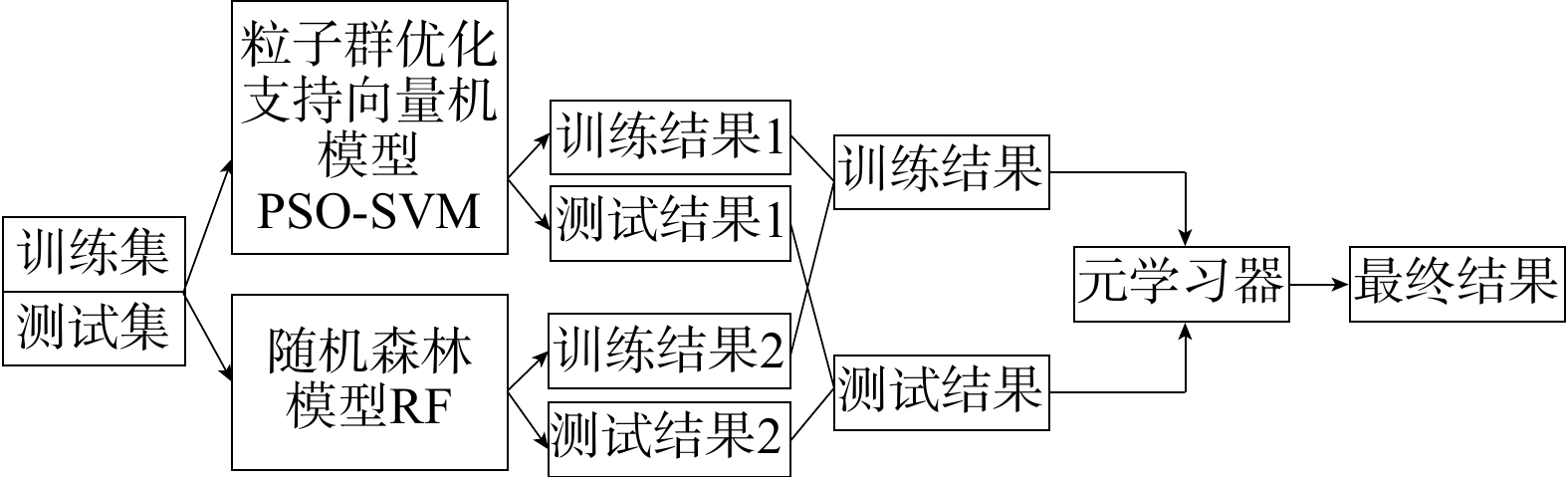
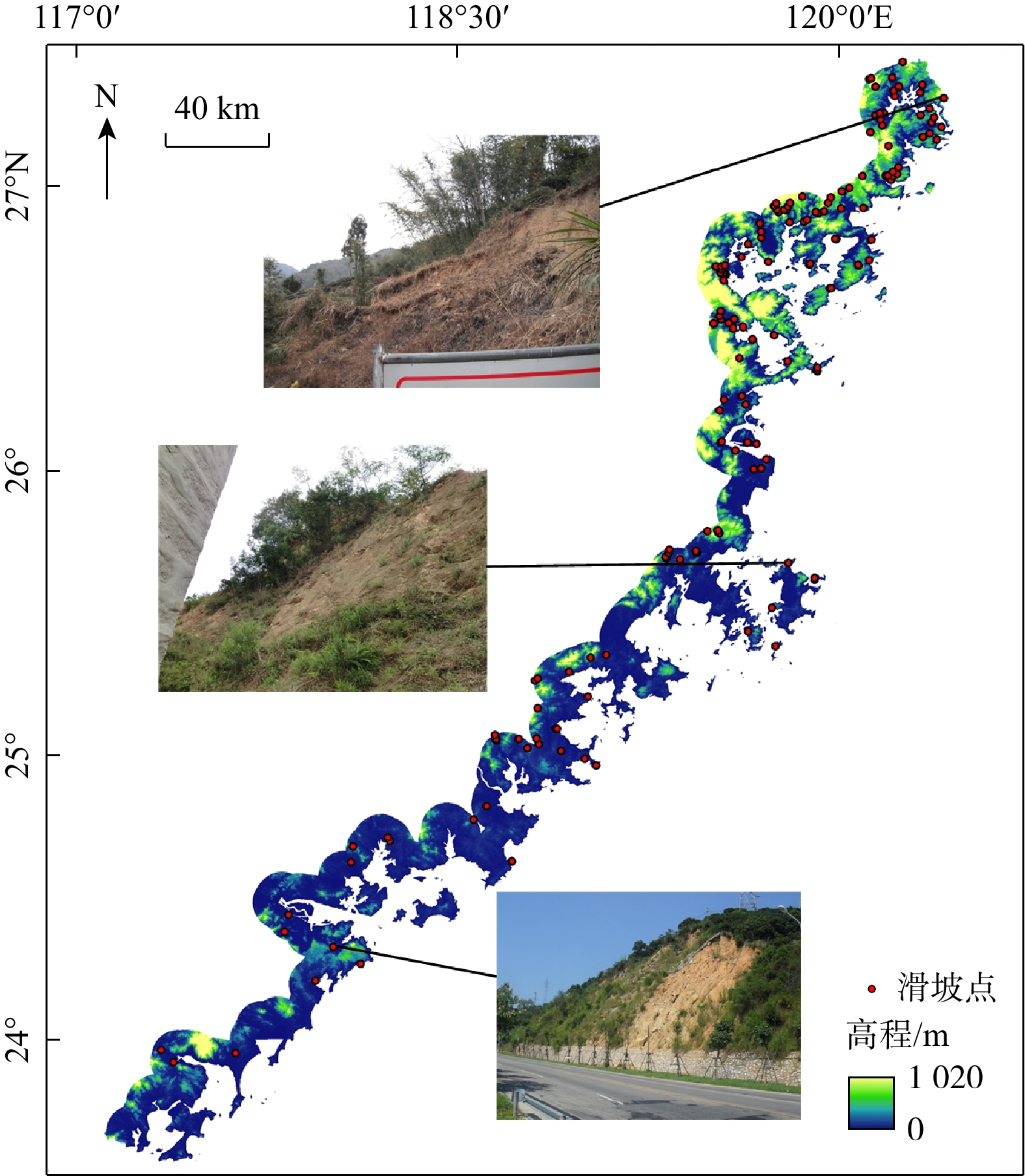
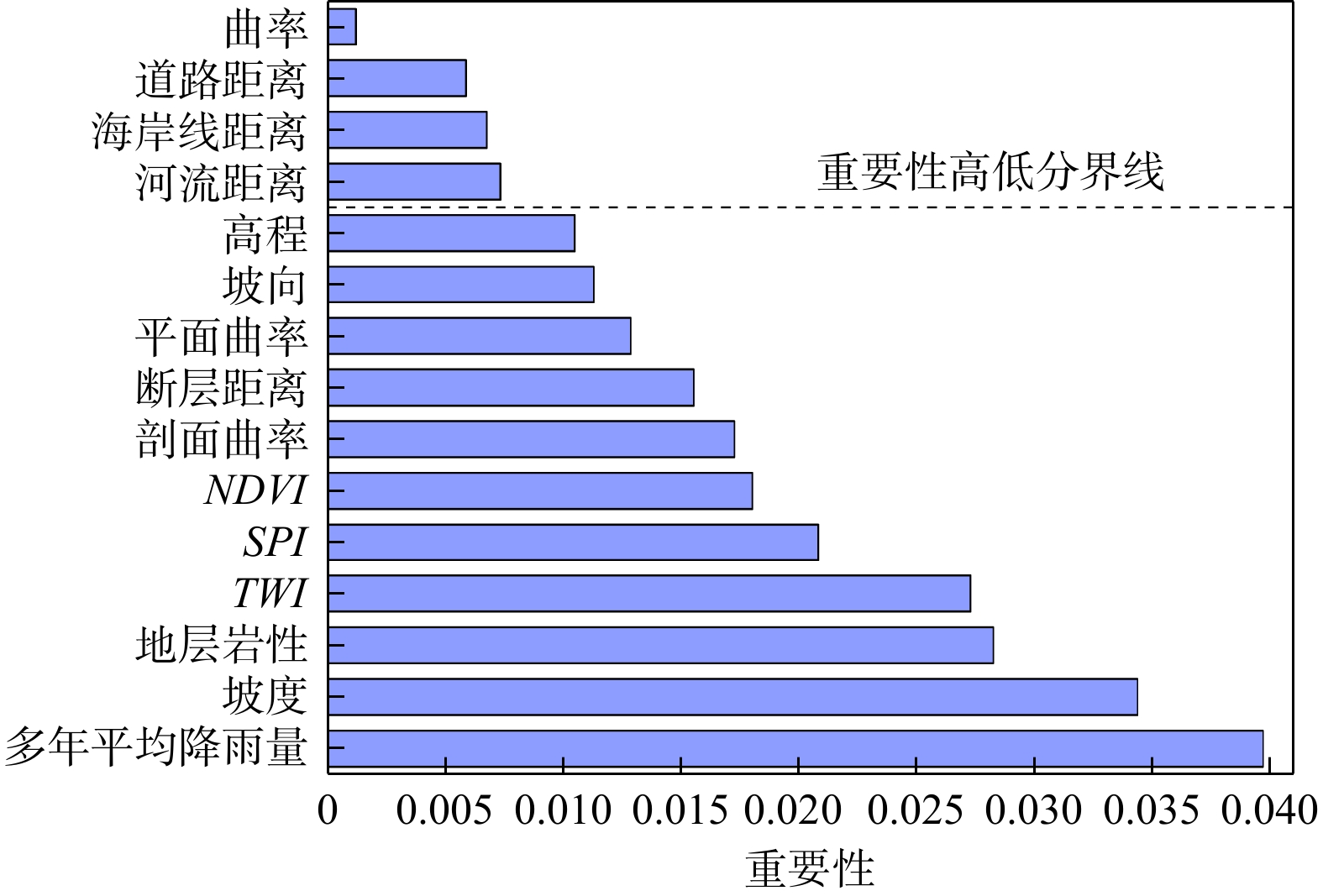
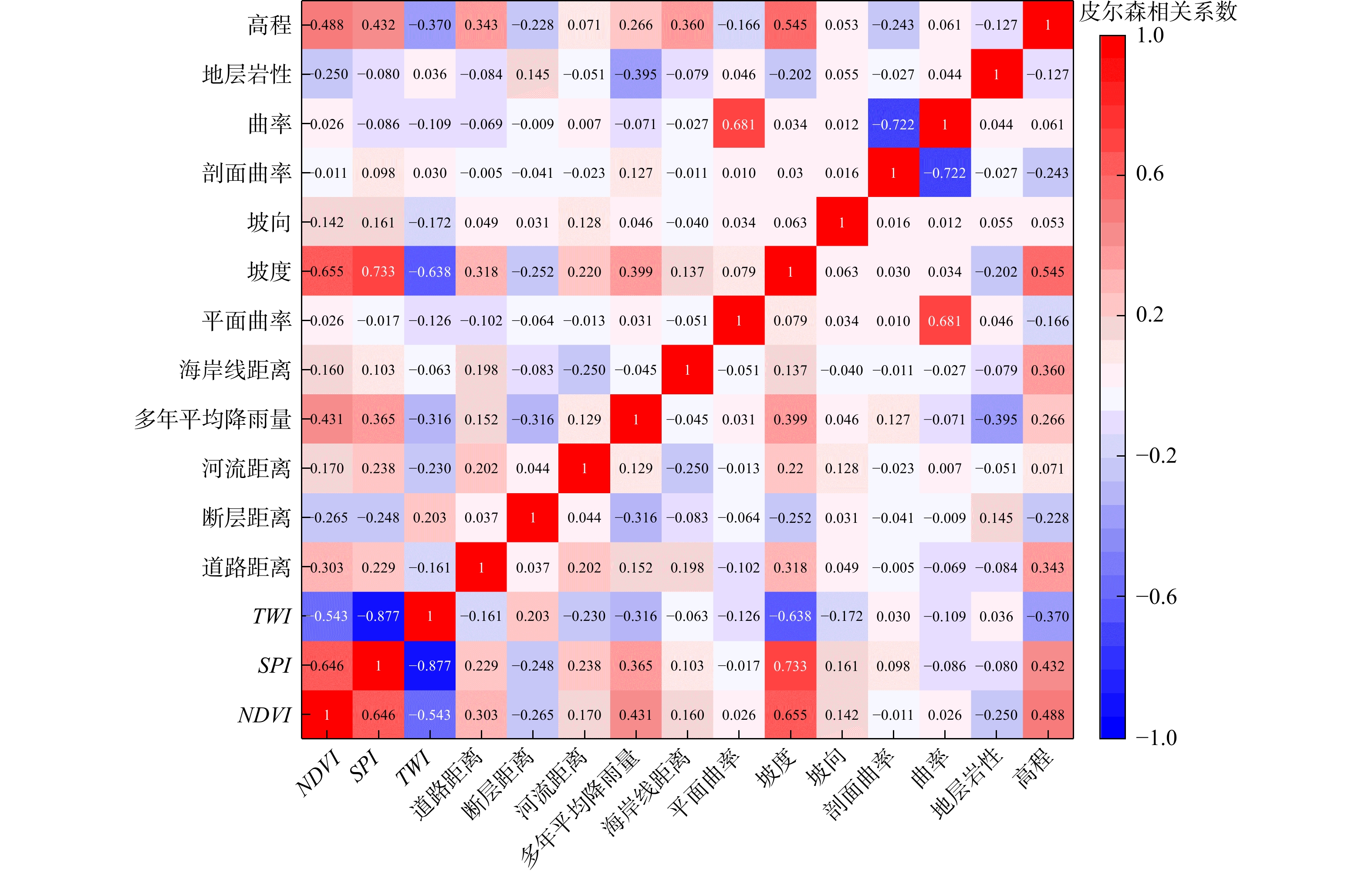
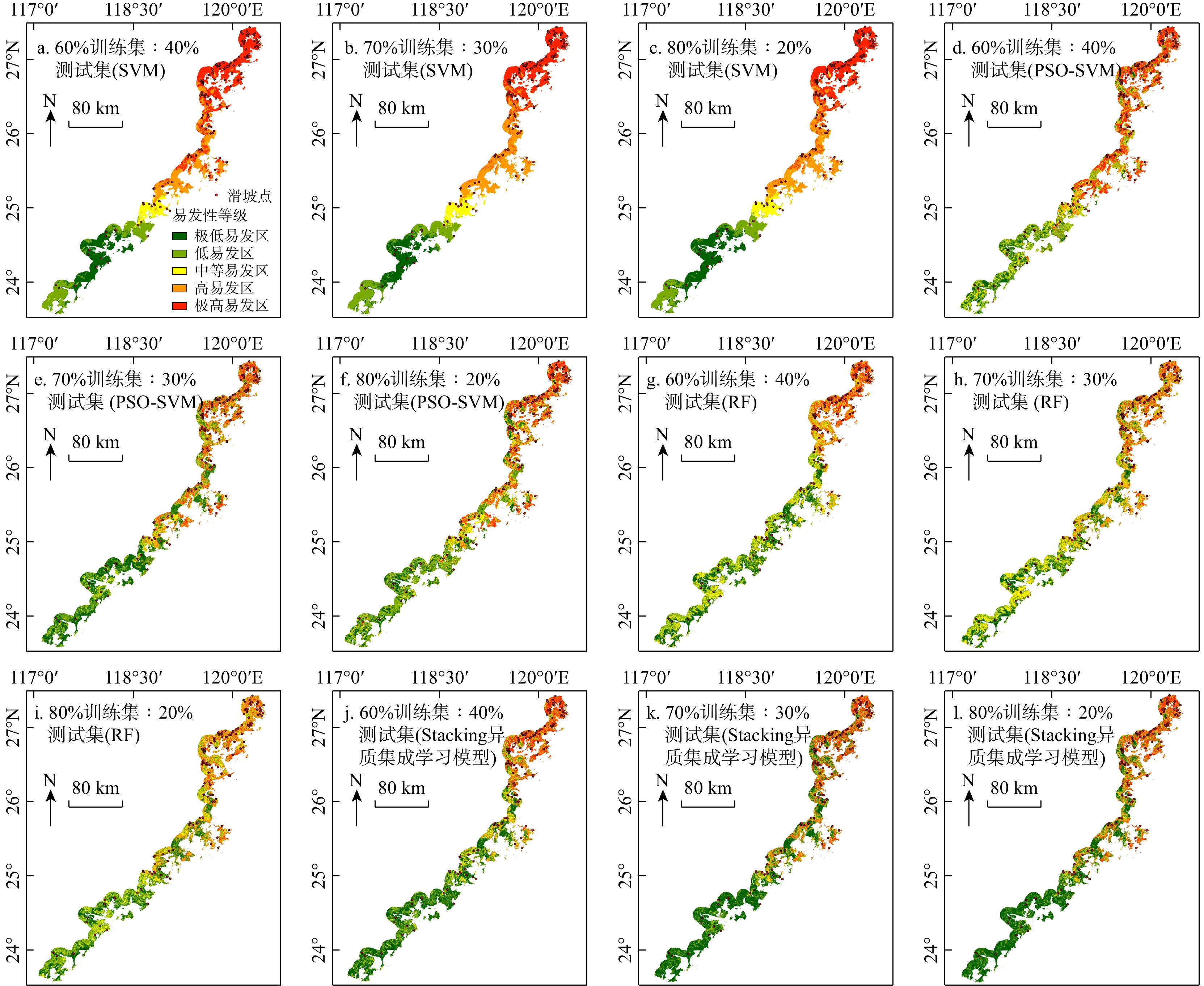
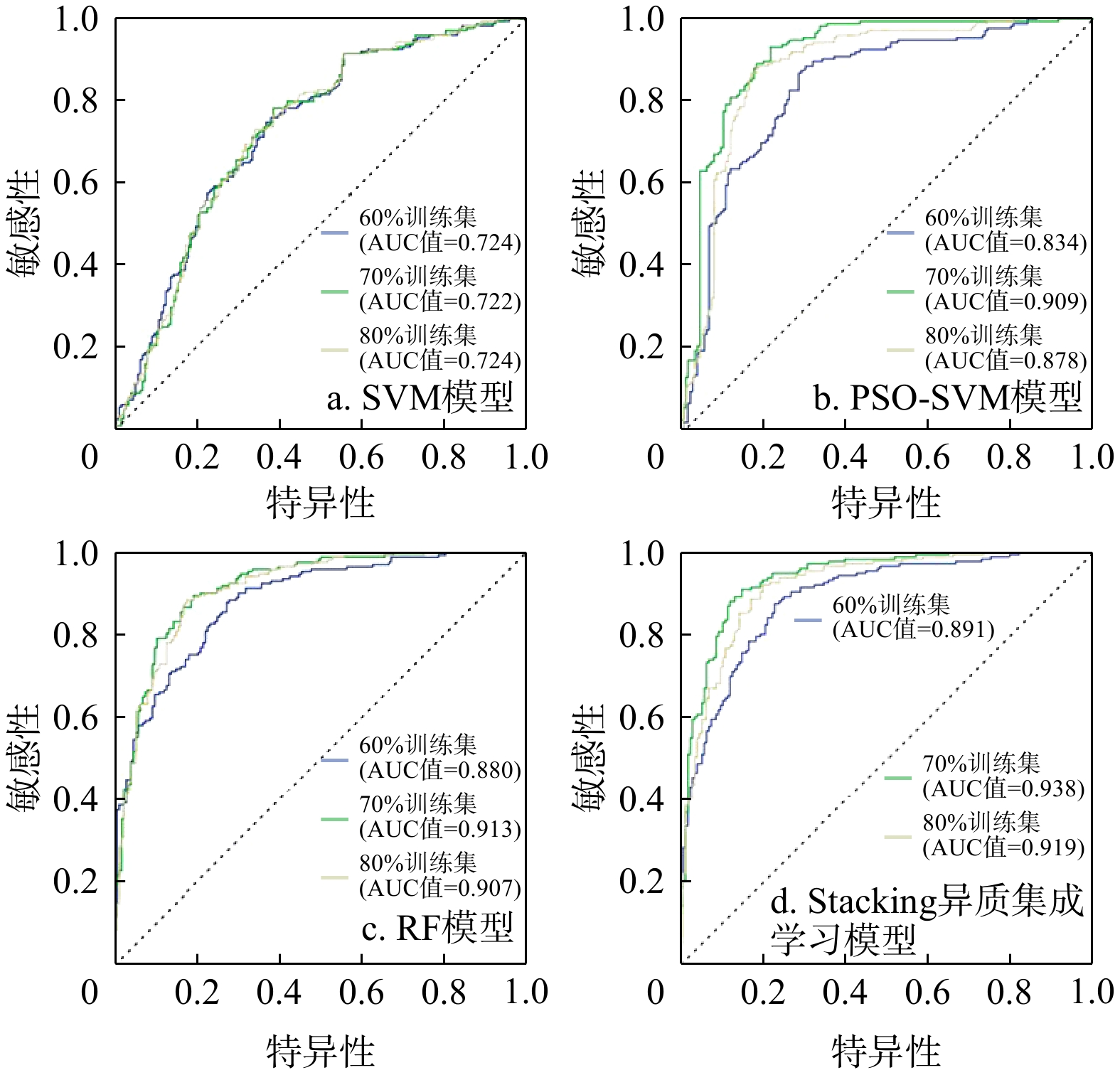
In this study, the coastal zone of Fujian Province was selected as the study area. Historical data on coastal landslides were collected, and a susceptibility assessment index system suitable for coastal landslides was established using the information gain ratio method and Pearson correlation coefficient method. Particle swarm optimization support vector machine (PSO-SVM) and random forest (RF) were used as base learners to construct a stacking heterogeneous ensemble learning model. This model was adopted to perform the susceptibility assessment and zoning of coastal landslides in Fujian Province, and the influence of different training-to-testing data splitting ratios on the prediction accuracy of the heterogeneous ensemble model was also analyzed.
The comparison results demonstrated that the Stacking model performed optimally when the training-to-testing ratio was 70:30, achieving
The findings indicate that the Stacking heterogeneous ensemble model exhibits strong applicability and excellent performance in susceptibility assessment of coastal landslides.

| [1] |
冯砚青, 牛佳. 中国海岸带环境问题的研究综述[J]. 海洋地质动态, 2004(10): 1-5.
FENG Y Q, NIU J. Some problems about the coastal environment of China[J]. Marine Geology Letters, 2004(10): 1-5. (in Chinese with English abstract
|
| [2] |
孙启良, 解习农, 吴时国. 南海北部海底滑坡的特征、灾害评估和研究展望[J]. 地学前缘, 2021, 28(2): 258-270. doi: 10.13745/j.esf.sf.2020.9.3
SUN Q L, XIE X N, WU S G. Submarine landslides in the northern South China Sea: Characteristics, geohazard evaluation and perspectives[J]. Earth Science Frontiers, 2021, 28(2): 258-270. (in Chinese with English abstract doi: 10.13745/j.esf.sf.2020.9.3
|
| [3] |
BEVAN D, BERESFORD J, ARTHURS J, et al. Ohuka landslide, New Zealand: A low angle bedding-controlled coastal landslide at Port Waikato, North Island, New Zealand[J]. New Zealand Journal of Geology and Geophysics, 2022, 65(2): 299-314.
|
| [4] |
BROMHEAD E N, IBSEN M L. Bedding-controlled coastal landslides in Southeast Britain between Axmouth and the Thames Estuary[J]. Landslides, 2004, 1(2): 131-141. doi: 10.1007/s10346-004-0015-3
|
| [5] |
杜星, 孙永福, 宋玉鹏, 等. 基于谱聚类算法的海底滑坡危险性评价[J]. 海洋学报, 2021, 43(1): 93-101.
DU X, SUN Y F, SONG Y P, et al. Risk assessment of submarine landslide based on spectral clustering[J]. Haiyang Xuebao, 2021, 43(1): 93-101. (in Chinese with English abstract
|
| [6] |
MIRUS B B, JONES E S, BAUM R L, et al. Landslides across the USA: Occurrence, susceptibility, and data limitations[J]. Landslides, 2020, 17(10): 2271-2285.
|
| [7] |
VAN DEN EECKHAUT M, HERVÁS J. State of the art of national landslide databases in Europe and their potential for assessing landslide susceptibility, hazard and risk[J]. Geomorphology, 2012, 139: 545-558. doi: 10.1016/j.geomorph.2011.12.006
|
| [8] |
ZHUANG Y, XING A G, SUN Q, et al. Insights into initiation of typhoon-induced deep-seated landslides in Southeast coastal China[J]. Natural Hazards, 2023, 119(1): 721-749. doi: 10.1007/s11069-023-06138-z
|
| [9] |
韩帅, 刘明军, 伍剑波, 等. 东南沿海台风暴雨型单体斜坡灾害风险评价: 以泰顺仕阳北坡为例[J]. 地质力学学报, 2022, 28(4): 583-595.
HAN S, LIU M J, WU J B, et al. Risk assessment of slope disasters induced by typhoon-rainfall in the Southeast coastal area, China: A case study of the Shiyang north slope[J]. Journal of Geomechanics, 2022, 28(4): 583-595. (in Chinese with English abstract
|
| [10] |
曹文庚, 潘登, 徐郅杰, 等. 河南省滑坡灾害易发性制图研究: 多种机器学习模型的对比[J]. 地质科技通报, 2025, 44(1): 101-111. doi: 10.19509/j.cnki.dzkq.tb20230338
CAO W G, PAN D, XU Z J, et al. Landslide disaster vulnerability mapping study in Henan Province: Comparison of different machine learning models[J]. Bulletin of Geological Science and Technology, 2025, 44(1): 101-111. (in Chinese with English abstract doi: 10.19509/j.cnki.dzkq.tb20230338
|
| [11] |
王启盛, 熊俊楠, 程维明, 等. 耦合统计方法、机器学习模型和聚类算法的滑坡易发性评价方法[J]. 地球信息科学学报, 2024, 26(3): 620-637. doi: 10.12082/dqxxkx.2024.230427
WANG Q S, XIONG J N, CHENG W M, et al. Landslide susceptibility mapping methods coupling with statistical methods, machine learning models and clustering algorithms[J]. Journal of Geo-Information Science, 2024, 26(3): 620-637. (in Chinese with English abstract doi: 10.12082/dqxxkx.2024.230427
|
| [12] |
潘网生, 赵恬茵, 蔚秀莲, 等. 基于PR-SVM模型的黄陵县滑坡易发性评价[J]. 自然灾害学报, 2024, 33(4): 48-59. doi: 10.13577/j.jnd.2024.0405
PAN W S, ZHAO T Y, YU X L, et al. Landslide susceptibility assessment in Huangling County based on probability ratio and support vector machine model[J]. Journal of Natural Disasters, 2024, 33(4): 48-59. (in Chinese with English abstract doi: 10.13577/j.jnd.2024.0405
|
| [13] |
崔玉龙, 朱路路, 徐敏, 等. 基于环境因子优化TSES法选择负样本及其在滑坡易发性评价中的应用[J]. 地质科技通报, 2024, 43(3): 192-199. doi: 10.19509/j.cnki.dzkq.tb20230400
CUI Y L, ZHU L L, XU M, et al. Optimizing TSES method based on the environmental factors to select negative samples and its application in landslide susceptibility evaluation[J]. Bulletin of Geological Science and Technology, 2024, 43(3): 192-199. (in Chinese with English abstract doi: 10.19509/j.cnki.dzkq.tb20230400
|
| [14] |
ZHANG R Q, ZHANG L L, FANG Z C, et al. Interferometric synthetic aperture radar (InSAR)-based absence sampling for machine-learning-based landslide susceptibility mapping: The Three Gorges Reservoir area, China[J]. Remote Sensing, 2024, 16(13): 2394. doi: 10.3390/rs16132394
|
| [15] |
窦杰, 向子林, 许强, 等. 机器学习在滑坡智能防灾减灾中的应用与发展趋势[J]. 地球科学, 2023, 48(5): 1657-1674.
DOU J, XIANG Z L, XU Q, et al. Application and development trend of machine learning in landslide intelligent disaster prevention and mitigation[J]. Earth Science, 2023, 48(5): 1657-1674. (in Chinese with English abstract
|
| [16] |
DOU J, YUNUS A P, MERGHADI A, et al. Different sampling strategies for predicting landslide susceptibilities are deemed less consequential with deep learning[J]. Science of the Total Environment, 2020, 720: 137320. doi: 10.1016/j.scitotenv.2020.137320
|
| [17] |
周超, 甘露露, 王悦, 等. 综合非滑坡样本选取指数与异质集成机器学习的区域滑坡易发性建模[J]. 地球信息科学学报, 2023, 25(8): 1570-1585. doi: 10.12082/dqxxkx.2023.220934
ZHOU C, GAN L L, WANG Y, et al. Landslide susceptibility prediction based on non-landslide samples selection and heterogeneous ensemble machine learning[J]. Journal of Geo-Information Science, 2023, 25(8): 1570-1585. (in Chinese with English abstract doi: 10.12082/dqxxkx.2023.220934
|
| [18] |
江宝得, 李秀春, 罗海燕, 等. 异质集成学习在滑坡易发性评价中的对比研究[J]. 土木工程学报, 2023, 56(10): 170-179. doi: 10.15951/j.tmgcxb.22060553
JIANG B D, LI X C, LUO H Y, et al. A comparative analysis of heterogeneous ensemble learning methods for landslide susceptibility assessment[J]. China Civil Engineering Journal, 2023, 56(10): 170-179. (in Chinese with English abstract doi: 10.15951/j.tmgcxb.22060553
|
| [19] |
HASTIE T, TIBSHIRANI R, FRIEDMAN J H. The elements of statistical learning[M]. New York: Springer, 2009.
|
| [20] |
CERVANTES J, GARCIA-LAMONT F, RODRÍGUEZ-MAZAHUA L, et al. A comprehensive survey on support vector machine classification: Applications, challenges and trends[J]. Neurocomputing, 2020, 408: 189-215. doi: 10.1016/j.neucom.2019.10.118
|
| [21] |
CORTES C, VAPNIK V. Support-vector networks[J]. Machine Learning, 1995, 20(3): 273-297. doi: 10.1023/A:1022627411411
|
| [22] |
张学工. 关于统计学习理论与支持向量机[J]. 自动化学报, 2000, 26(1): 32-42.
ZHANG X G. Introduction to statistical learning theory and support vector machines[J]. Acta Automatica Sinica, 2000, 26(1): 32-42.(in Chinese with English abstract
|
| [23] |
任佳昊. 基于特征提取优化的滑坡易发性评价方法研究[D]. 南京: 南京信息工程大学, 2023.
REN J H. Research on the evaluation method of landslide susceptibility based on feature extraction optimization[D]. Nanjing: Nanjing University of Information Science and Technology, 2023. (in Chinese with English abstract
|
| [24] |
EBERHART R, KENNEDY J. A new optimizer using particle swarm theory[C]// Proceedings of the Sixth International Symposium on Micro Machine and Human Science. Nagoya, Japan. IEEE, 2002: 39-43.
|
| [25] |
郭天颂. 基于粒子群优化支持向量机的滑坡易发性评价与滑坡位移预测[D]. 西安: 长安大学, 2019.
GUO T S. Landslide susceptibility evaluation and landslide displacement prediction based on particle swarm optimization-based support vector machine[D]. Xi'an: Chang'an University, 2019. (in Chinese with English abstract
|
| [26] |
BREIMAN L. Random forests[J]. Machine Learning, 2001, 45(1): 5-32. doi: 10.1023/A:1010933404324
|
| [27] |
郭衍昊, 窦杰, 向子林, 等. 基于优化负样本采样策略的梯度提升决策树与随机森林的汶川同震滑坡易发性评价[J]. 地质科技通报, 2024, 43(3): 251-265. doi: 10.19509/j.cnki.dzkq.tb20230037
GUO Y H, DOU J, XIANG Z L, et al. Susceptibility evaluation of Wenchuan coseismic landslides by gradient boosting decision tree and random forest based on optimal negative sample sampling strategies[J]. Bulletin of Geological Science and Technology, 2024, 43(3): 251-265. (in Chinese with English abstract doi: 10.19509/j.cnki.dzkq.tb20230037
|
| [28] |
TING K M, WITTEN I H. Issues in stacked generalization[J]. Journal of Artificial Intelligence Research, 1999, 10: 271-289. doi: 10.1613/jair.594
|
| [29] |
DOU J, YUNUS A P, BUI D T, et al. Improved landslide assessment using support vector machine with bagging, boosting, and stacking ensemble machine learning framework in a mountainous watershed, Japan[J]. Landslides, 2020, 17(3): 641-658. doi: 10.1007/s10346-019-01286-5
|
| [30] |
蔡学湛. 福建省海岸带气候基本特征[J]. 热带地理, 1986, 6(4): 337-345. doi: 10.13284/j.cnki.rddl.001882
CAI X Z. The essential features of climate in the coast zone of Fujian[J]. Tropical Geography, 1986, 6(4): 337-345. (in Chinese with English abstract doi: 10.13284/j.cnki.rddl.001882
|
| [31] |
GUZZETTI F, CARRARA A, CARDINALI M, et al. Landslide hazard evaluation: A review of current techniques and their application in a multi-scale study, Central Italy[J]. Geomorphology, 1999, 31(1/2/3/4): 181-216. doi: 10.1016/s0169-555x(99)00078-1
|
| [32] |
王凯, 张少杰, 韦方强. 斜坡单元提取方法研究进展和展望[J]. 长江科学院院报, 2020, 37(6): 85-93.
WANG K, ZHANG S J, WEI F Q. Slope unit extraction methods: Advances and prospects[J]. Journal of Yangtze River Scientific Research Institute, 2020, 37(6): 85-93. (in Chinese with English abstract
|
| [33] |
张曦, 陈丽霞, 徐勇, 等. 两种斜坡单元划分方法对滑坡灾害易发性评价的对比研究[J]. 安全与环境工程, 2018, 25(1): 12-17. doi: 10.13578/j.cnki.issn.1671-1556.2018.01.003
ZHANG X, CHEN L X, XU Y, et al. Comparison of two methods for slope unit division in landslide susceptibility evaluation[J]. Safety and Environmental Engineering, 2018, 25(1): 12-17. (in Chinese with English abstract doi: 10.13578/j.cnki.issn.1671-1556.2018.01.003
|
| [34] |
颜阁, 梁收运, 赵红亮. 基于GIS的斜坡单元划分方法改进与实现[J]. 地理科学, 2017, 37(11): 1764-1770.
YAN G, LIANG S Y, ZHAO H L. An approach to improving slope unit division using GIS technique[J]. Scientia Geographica Sinica, 2017, 37(11): 1764-1770. (in Chinese with English abstract
|
| [35] |
刘纪平, 梁恩婕, 徐胜华, 等. 顾及样本优化选择的多核支持向量机滑坡灾害易发性分析评价[J]. 测绘学报, 2022, 51(10): 2034-2045.
LIU J P, LIANG E J, XU S H, et al. Multi-kernel support vector machine considering sample optimization selection for analysis and evaluation of landslide disaster susceptibility[J]. Acta Geodaetica et Cartographica Sinica, 2022, 51(10): 2034-2045. (in Chinese with English abstract
|
| [36] |
REICHENBACH P, ROSSI M, MALAMUD B D, et al. A review of statistically-based landslide susceptibility models[J]. Earth-Science Reviews, 2018, 180: 60-91. doi: 10.1016/j.earscirev.2018.03.001
|
| [37] |
徐元芹, 刘乐军, 李培英, 等. 我国典型海岛地质灾害类型特征及成因分析[J]. 海洋学报, 2015, 37(9): 71-83. doi: 10.3969/j.issn.0253-4193.2015.09.008
XU Y Q, LIU L J, LI P Y, et al. Geology disaster feature and genetic analysis of typical islands, China[J]. Haiyang Xuebao, 2015, 37(9): 71-83. (in Chinese with English abstract doi: 10.3969/j.issn.0253-4193.2015.09.008
|
| [38] |
QUINLAN J R. C4.5: Programs for machine leaning[M]. San Mateo, US: Morgan Kaufmann Publishers, 1993.
|
| [39] |
张浩驰. 基于RS和机器学习的陕南地区地质灾害风险性评价研究[D]. 西安: 长安大学, 2022.
ZHANG H C. Risk assessment of geological hazards in southern Shaanxi based on RS and machine learning[D]. Xi'an: Chang'an University, 2022. (in Chinese with English abstract
|
| [40] |
BOOTH G D, NICCOLUCCI M J, SCHUSTER E G. Identifying proxy sets in multiple linear regression: An aid to better coefficient interpretation[M]. Ogden, US: US Dept of Agriculture Forest Service, 1994.
|
| [41] |
DOU H Q, HE J B, HUANG S Y, et al. Influences of non-landslide sample selection strategies on landslide susceptibility mapping by machine learning[J]. Geomatics, Natural Hazards and Risk, 2023, 14(1): 2285719. doi: 10.1080/19475705.2023.2285719
|
| [42] |
SU Q M, ZHANG J, ZHAO S M, et al. Comparative assessment of three nonlinear approaches for landslide susceptibility mapping in a coal mine area[J]. ISPRS International Journal of Geo-Information, 2017, 6(7): 228. doi: 10.3390/ijgi6070228
|
| [43] |
GAROSI Y, SHEKLABADI M, POURGHASEMI H R, et al. Comparison of differences in resolution and sources of controlling factors for gully erosion susceptibility mapping[J]. Geoderma, 2018, 330: 65-78. doi: 10.1016/j.geoderma.2018.05.027
|
| [44] |
杨灿. 基于机器学习的滑坡灾害易发性评价[D]. 长沙: 中南大学, 2022.
YANG C. Machine learning-based landslide susceptibility assessment[D]. Changsha: Central South University, 2022. (in Chinese with English abstract
|
| [45] |
ZHAO Z Y, CHEN T, DOU J, et al. Landslide susceptibility mapping considering landslide local-global features based on CNN and transformer[J]. IEEE Journal of Selected Topics in Applied Earth Observations and Remote Sensing, 2024, 17: 7475-7489.
|
Supported by:
Beijing Renhe Information Technology Co., Ltd.


 Submission System


 DownLoad: