| Citation: | WU Qirui,TIAN Miao,XIE Zhong,et al. Construction and application of earthquake disaster knowledge graph fusing with multimodal data[J]. Bulletin of Geological Science and Technology,2025,44(4):90-106 doi: 10.19509/j.cnki.dzkq.tb20240334

|
Earthquake disaster observation data are multi-source and heterogeneous, with scattered knowledge and poor correlation, making it difficult to efficiently utilize the data for information integration and efficient querying, thereby limiting its effectiveness in supporting risk assessment and emergency decision-making.
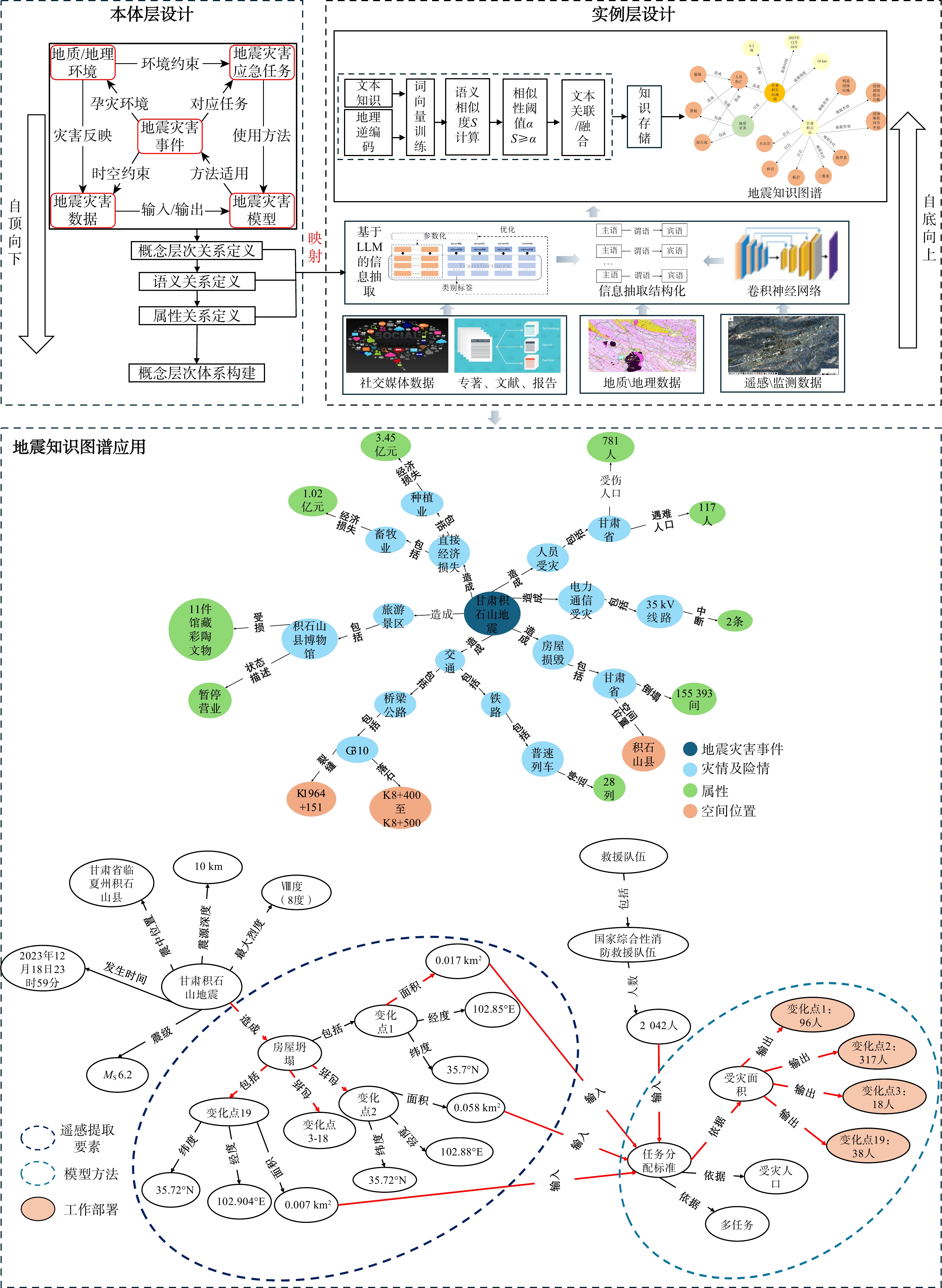
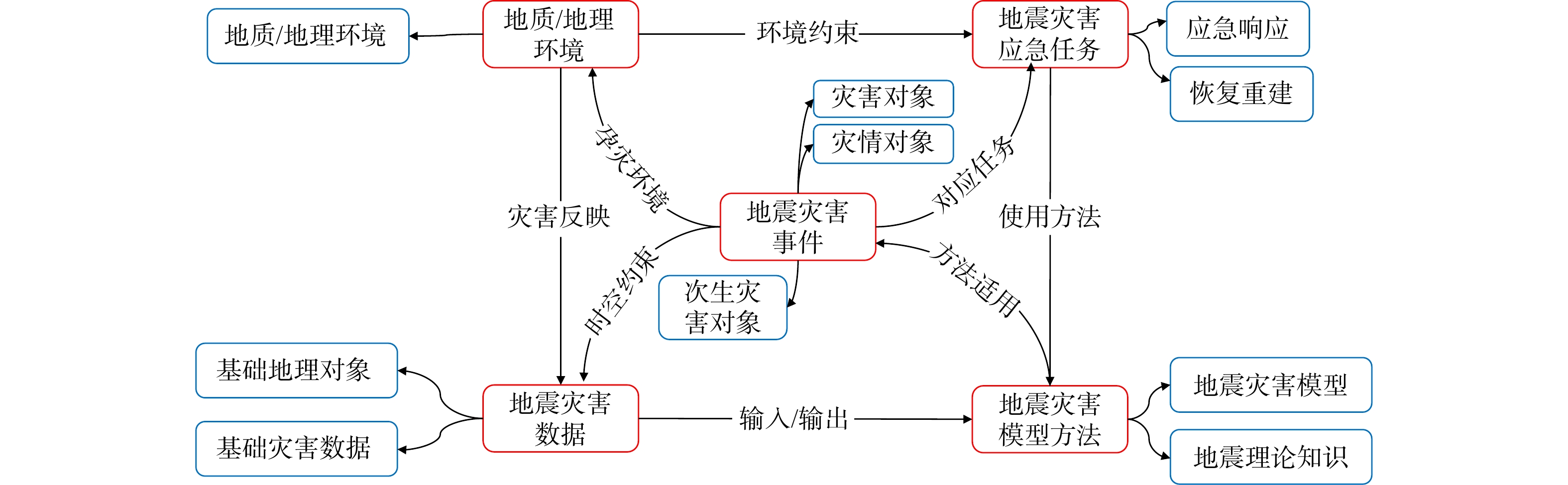
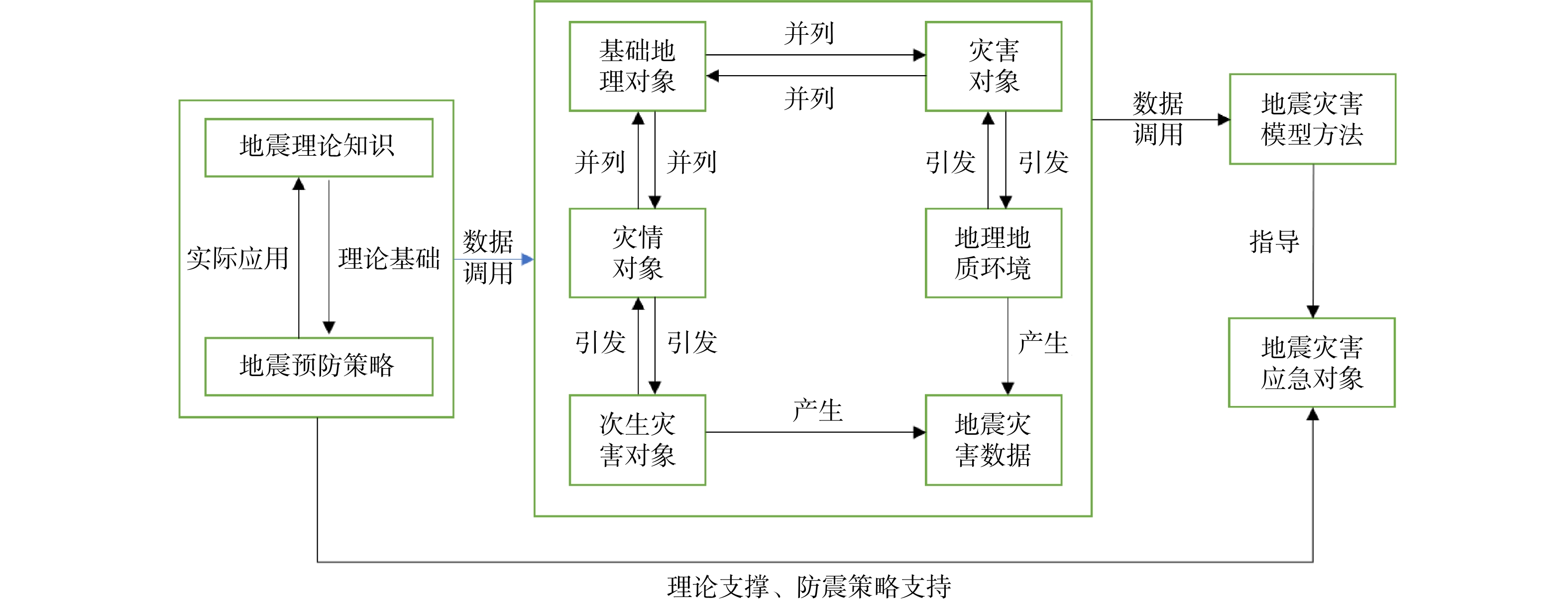
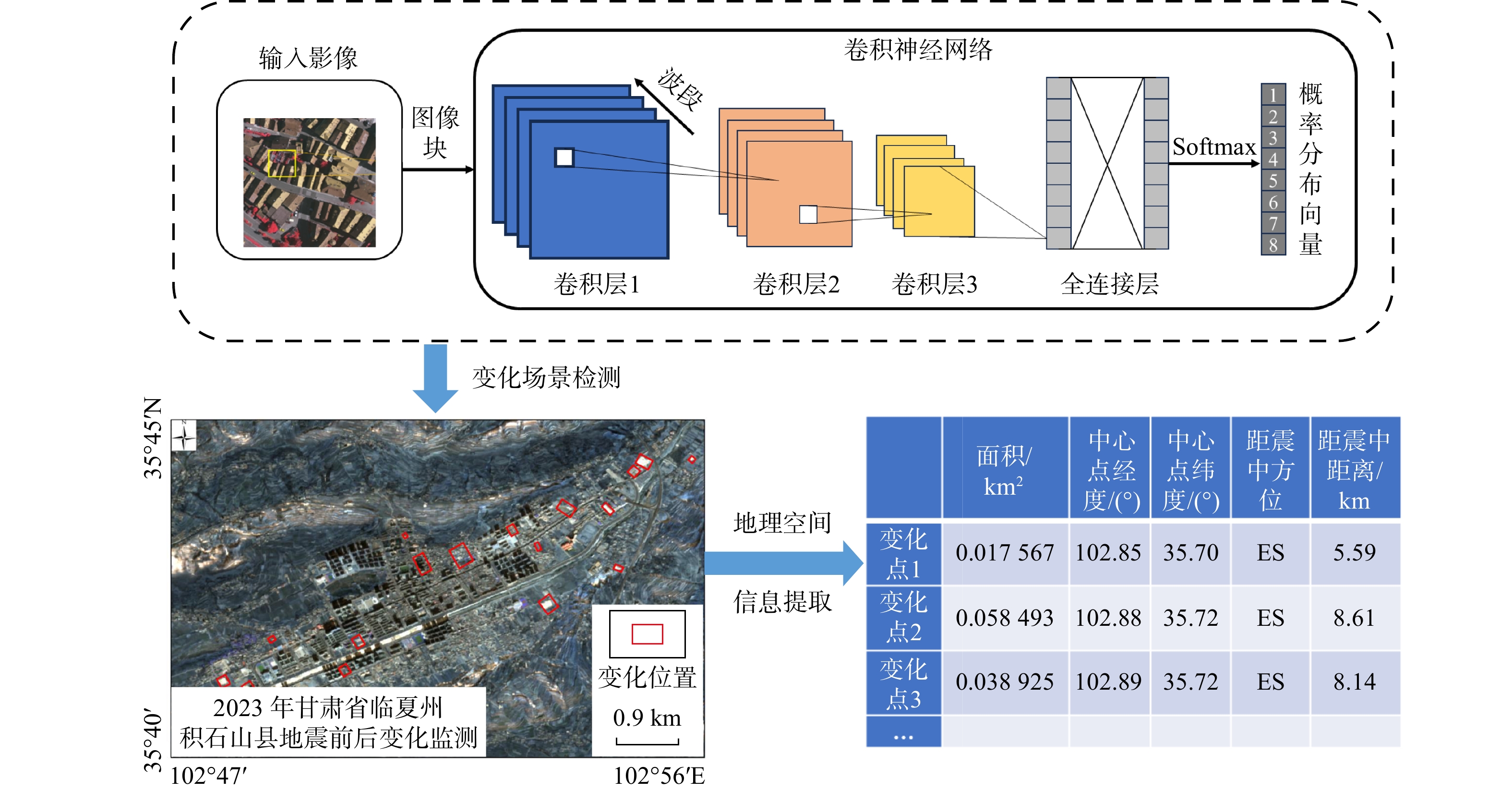
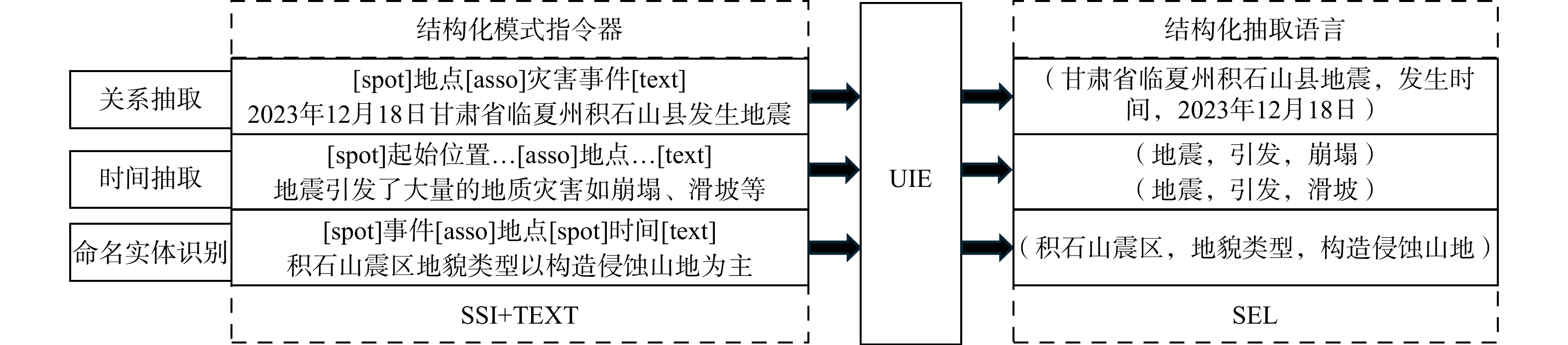
Knowledge graphs are an effective means of data association and fusion. Firstly, based on a top-down approach, the concepts in the earthquake disaster domain were sorted out, and the ontologies of earthquake disaster data, geological/geographical environment, earthquake disaster events, earthquake disaster emergency tasks, and earthquake disaster models were constructed to form the earthquake disaster ontology layer. Combined with a bottom-up approach, a high-quality data layer was built. Through convolutional neural networks, changes in remote sensing images before and after disasters were identified, achieving intelligent structured conversion from image information to textual knowledge. The fine-tuned UIE (universal information extraction) pre-training model was used to extract named entities and relationship attribute knowledge from text data, with precision rates of 82.04% and 70.66%, respectively. Data fusion and unified expression were achieved by calculating the semantic similarity of word vectors.
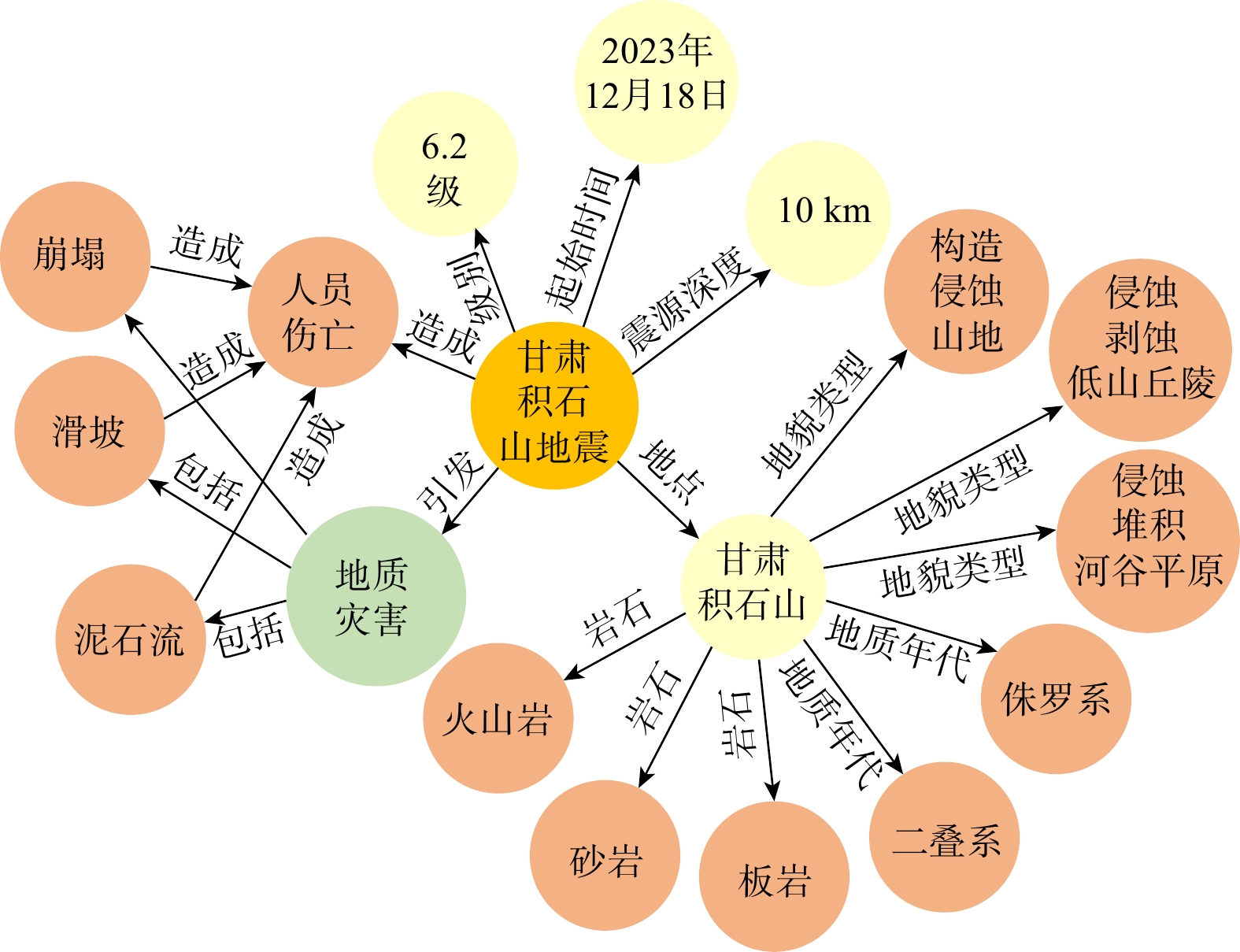
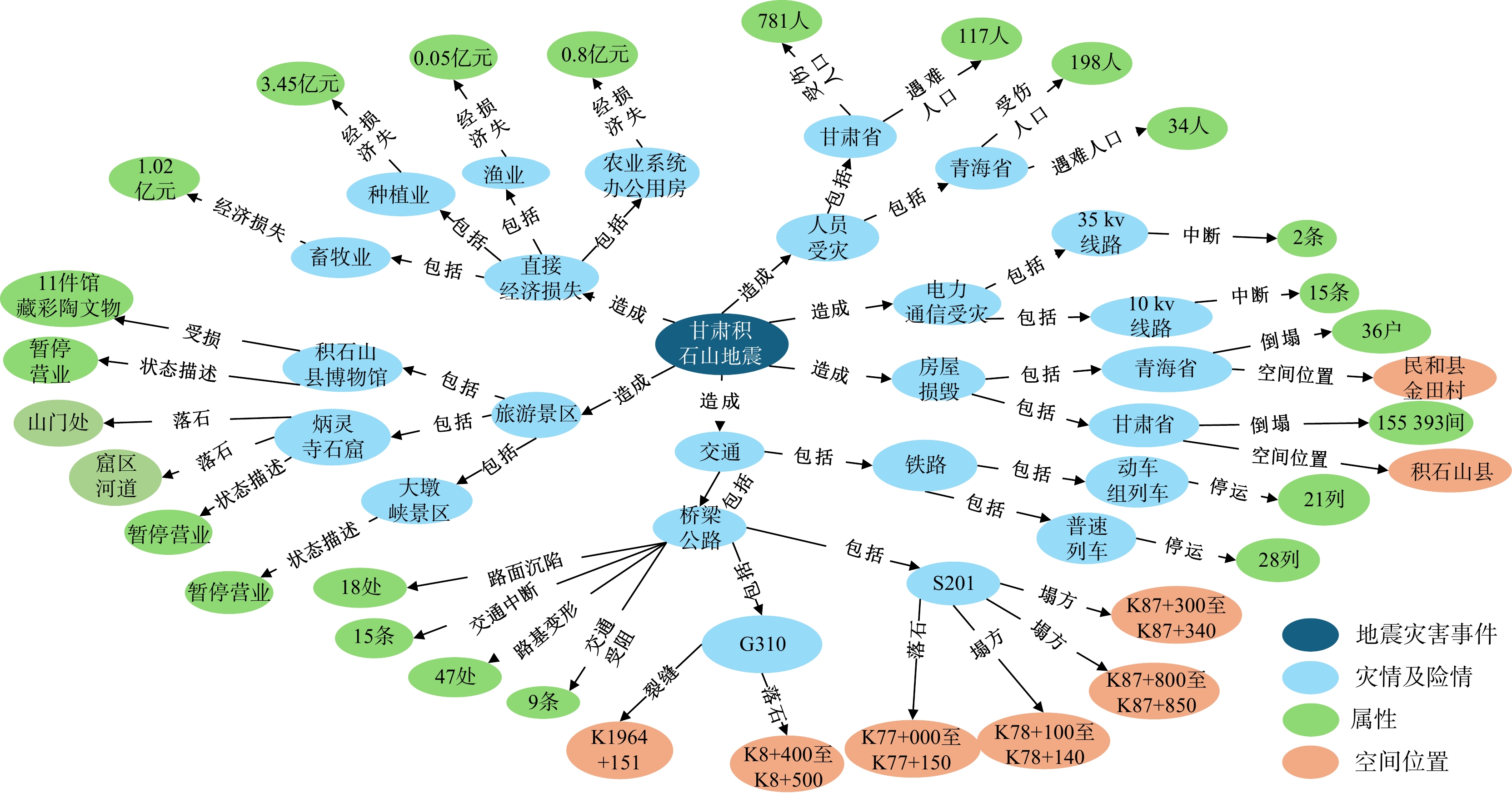
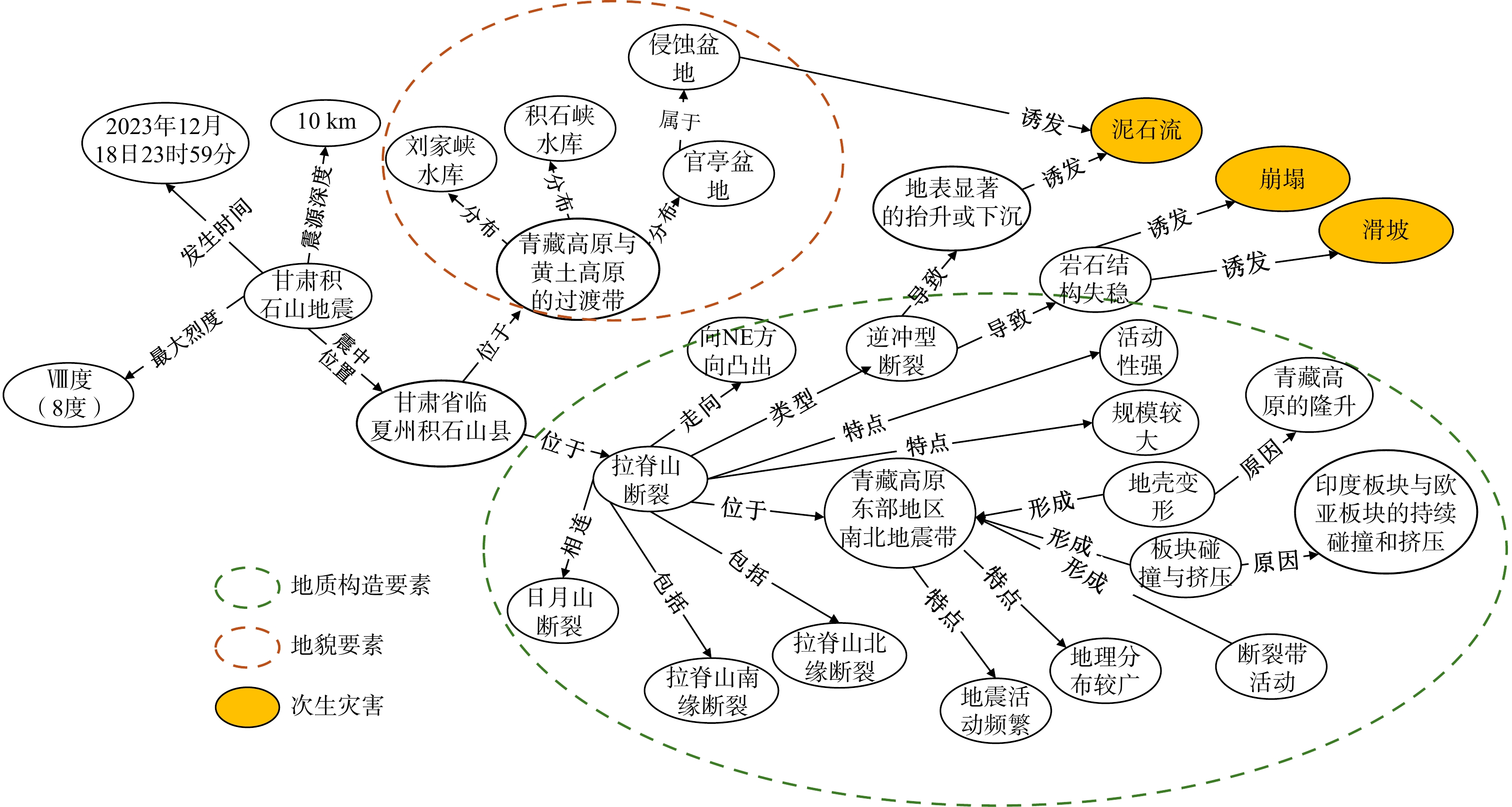
Taking the earthquake in Jishishan County, Linxia Prefecture, Gansu Province on December 18, 2023 as an example, a high-quality earthquake disaster knowledge graph was established through ontology construction, data extraction, and unified expression, achieving the transformation from multi-source heterogeneous earthquake data to unified knowledge representation.
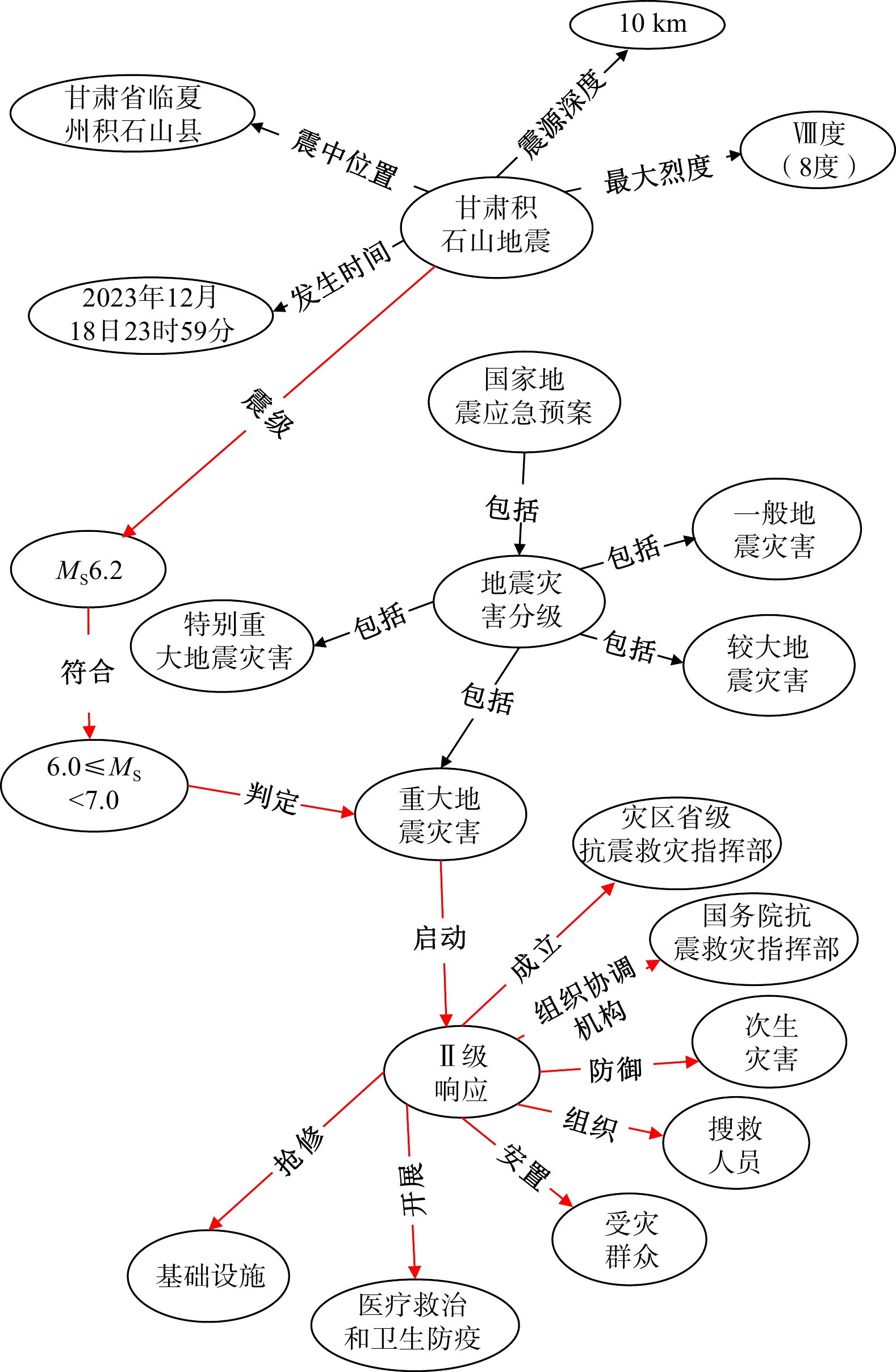
Based on the constructed earthquake disaster knowledge graph, queries and displays of disaster losses and emergency chain decision support are realized. Additionally, potential secondary disasters can be inferred and queried by integrating relevant geological data. This method combines deep learning and pre-training techniques with multi-modal data to construct an earthquake disaster knowledge graph, providing auxiliary support for rapid and accurate earthquake disaster information queries and the prediction of secondary disasters.

| [1] |
HUSSAIN E, KALAYCıOĞLU S, MILLINER C W D, et al. Preconditioning the 2023 Kahramanmaraş (Türkiye) earthquake disaster[J]. Nature Reviews Earth & Environment, 2023, 4(5): 287-289.
|
| [2] |
LIN B C, LEE C H. Constructing an adaptability evaluation framework for community-based disaster management using an earthquake event[J]. International Journal of Disaster Risk Reduction, 2023, 93: 103774. doi: 10.1016/j.ijdrr.2023.103774
|
| [3] |
ZHOU H X, CHE A L, SHUAI X H, et al. A spatial evaluation method for earthquake disaster using optimized BP neural network model[J]. Geomatics, Natural Hazards and Risk, 2023, 14(1): 1-26.
|
| [4] |
陈博, 宋闯, 陈毅, 等. 2023年甘肃积石山Ms 6.2地震同震滑坡和建筑物损毁情况应急识别与影响因素研究[J]. 武汉大学学报(信息科学版), 2025, 50(2): 322-332.
CHEN B, SONG C, CHEN Y, et al. Emergency identification and influencing factor analysis of coseismic landslides and building damages induced by the 2023 Ms 6.2 Jishishan(Gansu, China) earthquake[J]. Geomatics and Information Science of Wuhan University, 2025, 50(2): 322-332. (in Chinese with English abstract
|
| [5] |
黄观文, 景策, 李东旭, 等. 甘肃积石山Ms 6.2地震对滑坡易发区的变形影响分析[J]. 武汉大学学报(信息科学版), 2025, 50(2): 223-235.
HUANG G W, JING C, LI D X, et al. Deformation analysis of the Ms 6.2 Jishishan(Gansu, China) earthquake on the landslide hazard areas[J]. Geomatics and Information Science of Wuhan University, 2025, 50(2): 223-235. (in Chinese with English abstract
|
| [6] |
刘振江, 韩炳权, 能懿菡, 等. InSAR观测约束下的2023年甘肃积石山地震震源参数及其滑动分布[J]. 武汉大学学报(信息科学版), 2025, 50(2): 344-355.
LIU Z J, HAN B Q, NENG Y H , et al. Source parameters and slip distribution of the 2023 MW 6.0 Jishishan(Gansu, China) earthquake constrained by InSAR observations[J]. Geomatics and Information Science of Wuhan University, 2025, 50(2): 344-355. (in Chinese with English abstract
|
| [7] |
杨九元, 温扬茂, 许才军. InSAR观测揭示的2023年甘肃积石山Ms 6.2地震发震构造[J]. 武汉大学学报(信息科学版), 2025, 50(2): 313-321.
YANG J Y, WEN Y M, XU C J. Seismogenic fault structure of the 2023 Ms 6.2 Jishishan(Gansu, China)earthquake revealed by InSAR observations[J]. Geomatics and Information Science of Wuhan University, 2025, 50(2): 313-321. (in Chinese with English abstract
|
| [8] |
XU J H, NYERGES T L, NIE G Z. Modeling and representation for earthquake emergency response knowledge: Perspective for working with geo-ontology[J]. International Journal of Geographical Information Science, 2014, 28(1): 185-205. doi: 10.1080/13658816.2013.845893
|
| [9] |
ZHANG Y H, ZHU J, ZHU Q, et al. The construction of personalized virtual landslide disaster environments based on knowledge graphs and deep neural networks[J]. International Journal of Digital Earth, 2020, 13(12): 1637-1655. doi: 10.1080/17538947.2020.1773950
|
| [10] |
宋静园, 刘洋, 董秀军, 等. “9·5” 泸定地震人口密集区域同震滑坡空间分布规律[J/OL]. 地质科技通报: 1-12. [2023-12-13]. https://link.cnki.net/doi/10.19509/j.cnki.dzkq.tb20230619.
SONG J Y, LIU Y, DONG X J, et al. Spatial distribution of earthquake-induced landslide in densely populated area of the Luding 9·5 earthquake[J/OL]. Bulletin of Geological Science and Technology: 1-12. [2023-12-13]. https://link.cnki.net/doi/10.19509/j.cnki.dzkq.tb20230619. (in Chinese with English abstract
|
| [11] |
魏旭, 彭志忠, 刘兴臣, 等. 泸石高速公路沿线历史地震诱发滑坡遥感调查及发育分布规律[J]. 地质科技通报, 2024, 43(2): 386-396.
WEI X, PENG Z Z, LIU X C, et al. Remote sensing investigation and development distribution of historical earthquake-induced landslides along Lushi Expressway[J]. Bulletin of Geological Science and Technology, 2024, 43(2): 386-396. (in Chinese with English abstract
|
| [12] |
陶坤旺, 赵阳阳, 朱鹏, 等. 面向一体化综合减灾的知识图谱构建方法[J]. 武汉大学学报(信息科学版), 2020, 45(8): 1296-1302.
TAO K W, ZHAO Y Y, ZHU P, et al. Knowledge graph construction for integrated disaster reduction[J]. Geomatics and Information Science of Wuhan University, 2020, 45(8): 1296-1302. (in Chinese with English abstract
|
| [13] |
谢炎宏, 王亮, 董春, 等. 面向地震灾害防治的知识图谱构建方法研究[J]. 测绘科学, 2021, 46(10): 219-226.
XIE Y H, WANG L, DONG C, et al. Research on the construction method of earthquake disaster prevention knowledge graph[J]. Science of Surveying and Mapping, 2021, 46(10): 219-226. (in Chinese with English abstract
|
| [14] |
张雪英, 张春菊, 吴明光, 等. 顾及时空特征的地理知识图谱构建方法[J]. 中国科学(信息科学), 2020, 50(7): 1019-1032. doi: 10.1360/SSI-2019-0269
ZHANG X Y, ZHANG C J, WU M G, et al. Spatiotemporal features based geographical knowledge graph construction[J]. Scientia Sinica (Informationis), 2020, 50(7): 1019-1032. (in Chinese with English abstract doi: 10.1360/SSI-2019-0269
|
| [15] |
WANG B, WU L, XIE Z, et al. Understanding geological reports based on knowledge graphs using a deep learning approach[J]. Computers & Geosciences, 2022, 168: 105229.
|
| [16] |
QIU Q J, XIE Z, ZHANG D, et al. Knowledge graph for identifying geological disasters by integrating computer vision with ontology[J]. Journal of Earth Science, 2023, 34(5): 1418-1432. doi: 10.1007/s12583-022-1641-1
|
| [17] |
周成虎, 王华, 王成善, 等. 大数据时代的地学知识图谱研究[J]. 中国科学(地球科学), 2021, 51(7): 1070-1079. doi: 10.1360/SSTe-2020-0337
ZHOU C H, WANG H, WANG C S, et al. Research on geo-knowledge map in the age of big data[J]. Scientia Sinica (Terrae), 2021, 51(7): 1070-1079. (in Chinese with English abstract doi: 10.1360/SSTe-2020-0337
|
| [18] |
诸云强, 孙凯, 王曙, 等. 顾及复杂时空特征及关系的地球科学知识图谱自适应表达模型[J]. 中国科学(地球科学), 2023, 53(11): 2609-2622.
ZHU Y Q, SUN K, WANG S, et al. An adaptive representation model for geoscience knowledge graphs considering complex spatiotemporal features and relationships[J]. Scientia Sinica (Terrae), 2023, 53(11): 2609-2622. (in Chinese with English abstract
|
| [19] |
许强, 崔圣华, 黄维, 等. 面向工程地质领域的滑坡知识图谱构建方法研究[J]. 武汉大学学报(信息科学版), 2023, 48(10): 1601-1615.
XU Q, CUI S H, HUANG W, et al. Construction of a landslide knowledge graph in the field of engineering geology[J]. Geomatics and Information Science of Wuhan University, 2023, 48(10): 1601-1615. (in Chinese with English abstract
|
| [20] |
QIU Q J, HUANG Z, XU D X, et al. Integrating NLP and ontology matching into a unified system for automated information extraction from geological hazard reports[J]. Journal of Earth Science, 2023, 34(5): 1433-1446. doi: 10.1007/s12583-022-1716-z
|
| [21] |
田佳, 李萌, 罗浩. 基于U-Net神经网络的微地震有效事件自动拾取方法[J/OL]. 地质科技通报: 1-13. [2024-04-29]. https://link. cnki. net/doi/10.19509/j. cnki. dzkq. tb20230689.
TIAN J, LI M, LUO H. Automatic pickup of effective microseismic events based on U-Net neural network[J/OL]. Bulletin of Geological Science and Technology: 1-13. [2024-04-29]. https://link.cnki.net/doi/10.19509/j.cnki.dzkq.tb20230689.(in Chinese with English abstract
|
| [22] |
沈伟豪, 钟燕飞, 王俊珏, 等. 多模态数据的洪涝灾害知识图谱构建与应用[J]. 武汉大学学报(信息科学版), 2023, 48(12): 2009-2018.
SHEN W H, ZHONG Y F, WANG J J, et al. Construction and application of flood disaster knowledge graph based on multi-modal data[J]. Geomatics and Information Science of Wuhan University, 2023, 48(12): 2009-2018. (in Chinese with English abstract
|
| [23] |
刘晓. 基于文本挖掘的灾害多级联动分析与预测研究[D]. 武汉: 中国地质大学(武汉), 2021.
LIU X. Research on prediction and analysis of cascading disasters based on text mining[D]. Wuhan: China University of Geosciences(Wuhan), 2021. (in Chinese with English abstract
|
| [24] |
RILOFF E. Automatically constructing a dictionary for information extraction tasks[C]//Anon. AAAI'93: Proceedings of the eleventh national conference on Artificial intelligence. [S. 1.]: [s. n.], 1993: 811-816.
|
| [25] |
KRUPKA G R, ISOQUEST K. Description of the nerowl extractor system as used for muc-7[C]//Anon. Proc. 7th Message Understanding Conf. [S. 1. ]: [s. n. ], 2005: 21-28.
|
| [26] |
DOAN S, XU H. Recognizing medication related entities in hospital discharge summaries using support vector machine[J]. Proceedings of COLING International Conference on Computational Linguistics, 2010, 2010: 259-266.
|
| [27] |
ASHKTORAB Z, BROWN C, NANDI M, et al. Tweedr: Mining twitter to inform disaster response[C]//Anon. Information Systems for Crisis Response and Management Association. [S. 1.]: [s. n.], 2014: 269-272.
|
| [28] |
IMRAN M, MITRA P, CASTILLO C. Twitter as a lifeline: Human-annotated twitter corpora for NLP of crisis-related messages[EB/OL]. (2016-05-31) [2025-06-24]. https://arxiv.org/abs/1605.05894v2.
|
| [29] |
杜志强, 李钰, 张叶廷, 等. 自然灾害应急知识图谱构建方法研究[J]. 武汉大学学报(信息科学版), 2020, 45(9): 1344-1355.
DU Z Q, LI Y, ZHANG Y T, et al. Knowledge graph construction method on natural disaster emergency[J]. Geomatics and Information Science of Wuhan University, 2020, 45(9): 1344-1355. (in Chinese with English abstract
|
| [30] |
QIU Q J, XIE Z, WU L, et al. BiLSTM-CRF for geological named entity recognition from the geoscience literature[J]. Earth Science Informatics, 2019, 12(4): 565-579. doi: 10.1007/s12145-019-00390-3
|
| [31] |
QIU Q J, TIAN M, HUANG Z, et al. Chinese engineering geological named entity recognition by fusing multi-features and data enhancement using deep learning[J]. Expert Systems with Applications, 2024, 238: 121925. doi: 10.1016/j.eswa.2023.121925
|
| [32] |
谢雪景, 谢忠, 马凯, 等. 结合BERT与BiGRU-Attention-CRF模型的地质命名实体识别[J]. 地质通报, 2023, 42(5): 846-855.
XIE X J, XIE Z, MA K, et al. Geological named entity recognition combined BERT and BiGRU-Attention-CRF model[J]. Geological Bulletin of China, 2023, 42(5): 846-855. (in Chinese with English abstract
|
| [33] |
王刘坤, 李功权. 基于GeoERNIE-BiLSTM-Attention-CRF模型的地质命名实体识别[J]. 地质科学, 2023, 58(3): 1164-1177.
WANG L K, LI G Q. Geological named entity recognition based on GeoERNIE-BiLSTM-Attention-CRF model[J]. Chinese Journal of Geology (Scientia Geologica Sinica), 2023, 58(3): 1164-1177. (in Chinese with English abstract
|
| [34] |
LEE S, AN J, KWAK B, et al. Learning korean named entity by bootstrapping with web resources[J]. IEICE Transactions on Information and Systems, 2004, 87(12): 2872-2882.
|
| [35] |
KEKLIK O, TUGLULAR T, TEKIR S. Rule-based automatic question generation using semantic role labeling[J]. IEICE Transactions on Information and Systems, 2019, E102. D(7): 1362-1373.
|
| [36] |
LI J, SUN A X, HAN J L, et al. A survey on deep learning for named entity recognition[J]. IEEE Transactions on Knowledge and Data Engineering, 2022, 34(1): 50-70. doi: 10.1109/TKDE.2020.2981314
|
| [37] |
ZHANG J, SHEN D, ZHOU G D, et al. Enhancing HMM-based biomedical named entity recognition by studying special phenomena[J]. Journal of Biomedical Informatics, 2004, 37(6): 411-422. doi: 10.1016/j.jbi.2004.08.005
|
| [38] |
ZHAO J, LIU F F. Product named entity recognition in Chinese text[J]. Language Resources and Evaluation, 2008, 42(2): 197-217. doi: 10.1007/s10579-008-9066-8
|
| [39] |
SAHA S K, SARKAR S, MITRA P. Feature selection techniques for maximum entropy based biomedical named entity recognition[J]. Journal of Biomedical Informatics, 2009, 42(5): 905-911. doi: 10.1016/j.jbi.2008.12.012
|
| [40] |
HAO Z F, WANG H F, CAI R C, et al. Product named entity recognition for Chinese query questions based on a skip-chain CRF model[J]. Neural Computing and Applications, 2013, 23(2): 371-379. doi: 10.1007/s00521-012-0922-5
|
| [41] |
LI Z N, LI Q, ZOU X T, et al. Causality extraction based on self-attentive BiLSTM-CRF with transferred embeddings[J]. Neurocomputing, 2021, 423: 207-219. doi: 10.1016/j.neucom.2020.08.078
|
| [42] |
谢腾, 杨俊安, 刘辉. 融合多特征BERT模型的中文实体关系抽取[J]. 计算机系统应用, 2021, 30(5): 253-261.
XIE T, YANG J A, LIU H. Chinese entity relation extraction based on multi-feature BERT model[J]. Computer Systems & Applications, 2021, 30(5): 253-261. (in Chinese with English abstract
|
| [43] |
陆亮, 孔芳. 面向对话的融入交互信息的实体关系抽取[J]. 中文信息学报, 2021, 35(8): 82-88.
LU L, KONG F. Interactive information enhanced relation extraction from dialogue[J]. Journal of Chinese Information Processing, 2021, 35(8): 82-88. (in Chinese with English abstract
|
| [44] |
马建红, 魏字默, 陈亚萌. 基于信息融合标注的实体及关系联合抽取方法[J]. 计算机应用与软件, 2021, 38(7): 159-166.
MA J H, WEI Z M, CHEN Y M. Entity and relationship joint extraction method based on information fusion tagging[J]. Computer Applications and Software, 2021, 38(7): 159-166. (in Chinese with English abstract
|
| [45] |
HOU J, XU S S. Near-real-time seismic human fatality information retrieval from social media with few-shot large-language models[C]//Anon. Proceedings of the 20th ACM Conference on Embedded Networked Sensor Systems. Boston Massachusetts: ACM, 2022: 1141-1147.
|
| [46] |
MA K, TIAN M, TAN Y J, et al. Ontology-based BERT model for automated information extraction from geological hazard reports[J]. Journal of Earth Science, 2023, 34(5): 1390-1405. doi: 10.1007/s12583-022-1724-z
|
| [47] |
杜志强, 王叁, 张叶廷. 接入实时降雨数据的暴雨型洪涝灾害临灾预警方法[J]. 地理信息世界, 2017, 24(1): 97-102.
DU Z Q, WANG S, ZHANG Y T. Temporary precaution method for rainstorm-type flood disaster with real-time rainfall data[J]. Geomatics World, 2017, 24(1): 97-102. (in Chinese with English abstract
|
| [48] |
张航. 泥石流灾害领域知识图谱的构建与应用[D]. 昆明: 云南师范大学, 2021.
ZHANG H. Construction and application of knowledge graph in the field of debris flow disaster[D]. Kunming: Yunnan Normal University, 2021. (in Chinese with English abstract
|
| [49] |
邱芹军, 吴亮, 马凯, 等. 面向灾害应急响应的地质灾害链知识图谱构建方法[J]. 地球科学, 2023, 48(5): 1875-1891.
QIU Q J, WU L, MA K, et al. A knowledge graph construction method for geohazard chain for disaster emergency response[J]. Earth Science, 2023, 48(5): 1875-1891. (in Chinese with English abstract
|
| [50] |
宁慧涵, 眭海刚, 王金地, 等. 顾及时空关系的事故灾难事理图谱构建方法研究[J]. 武汉大学学报(信息科学版), 2024, 49(5): 831-843.
NING H H, SUI H G, WANG J D, et al. Construction of disaster event evolutionary graph based on spatiotemporal relationship[J]. Geomatics and Information Science of Wuhan University, 2024, 49(5): 831-843. (in Chinese with English abstract
|
| [51] |
SINGHAL A. Introducing the knowledge graph: Things, notstrings[EB/OL]. (2012-05-16) [2022-05-02]. https://www.blog.google/products/search/introducing-knowledge-graph-thi-ngs-not/.
|
| [52] |
林森, 刘蓓蓓, 李建文, 等. 基于BERT迁移学习模型的地震灾害社交媒体信息分类研究[J]. 武汉大学学报(信息科学版), 2024, 49(9): 1661-1671.
LIN S, LIU B B, LI J W, et al. Social media information classification of earthquake disasters based on BERT transfer learning model[J]. Geomatics and Information Science of Wuhan University, 2024, 49(9): 1661-1671. (in Chinese with English abstract
|
| [53] |
谭剪梅. 顾及多类型用户需求的地震灾害场景知识图谱构建及应用[D]. 成都: 西南交通大学, 2019.
TAN J M. The construction and application of earthquake disaster scene knowledge graph concerned on the demands of multy-type users[D]. Chengdu: Southwest Jiaotong University, 2019. (in Chinese with English abstract
|
| [54] |
贺海霞, 刘涛, 杜萍. 地震灾害应急管理知识图谱构建研究[J]. 兰州交通大学学报, 2023, 42(3): 113-123.
HE H X, LIU T, DU P. Study on the construction of knowledge graph of earthquake disaster emergency management[J]. Journal of Lanzhou Jiaotong University, 2023, 42(3): 113-123. (in Chinese with English abstract
|
| [55] |
中华人民共和国应急管理部. 中华人民共和国防震减灾法[Z]. 北京: 中华人民共和国第十一届全国人民代表大会常务委员会, 2008.
Ministry of Emergency Management of the People's Republic of China. Law of the People's Republic of China on seismic disaster prevention and mitigation[Z]. Beijing: Standing Committee of the Eleventh National People's Congress of the People's Republic of China, 2008. (in Chinese)
|
| [56] |
中华人民共和国国务院办公厅. 国家地震应急预案[Z]. 北京: 国务院地震工作主管部门, 2012.
General Office of the State Council of the People's Republic of China. National Earthquake Emergency Plan[Z]. Beijing: Competent Department of the State Council for Earthquake Work, 2012. (in Chinese)
|
| [57] |
民政部国家减灾中心. 自然灾害承载体分类与代码: GB/T32572-2016[S]. 北京: 中国标准出版社, 2016.
National Disaster Reduction Center of the Ministry of Civil Affairs. Classification and coding of natural disaster exposure: GB/T32572-201 [S]. Beijing: China Standards Press, 2016. (in Chinese)
|
| [58] |
中华人民共和国民政部. 自然灾害灾情统计: GB/T24438.1-2009[S]. 北京: 中国标准出版社, 2009.
Ministry of Civil Affairs of the People's Republic of China. Natural disaster information statistic: GB/T24438.1-2009[S]. Beijing: China Standards Press, 2009. (in Chinese)
|
| [59] |
中华人民共和国自然资源部. 地质灾害风险调查评价规范: DZ/T0438-2023[S]. 北京: 中国标准出版社, 2023.
Ministry of Natural Resources of the People's Republic of China. Specification of geological hazard risk survey and assessment: DZ/T0438-2023[S]. Beijing: China Standards Press, 2023. (in Chinese)
|
Supported by:
Beijing Renhe Information Technology Co., Ltd.


 Submission System


 DownLoad: