投审稿入口


Dynamic accumulation and differential enrichment mechanism of deep coalbed methane in No. 8 coal seam of Benxi Formation, Daji Block, eastern margin of Ordos Basin
-
摘要:目的
鄂尔多斯盆地东缘大吉区块本溪组8号煤埋深差异显著,不同埋藏区现今含气性分异明显。查明不同埋藏−保存背景下煤层气生气与保存过程的差异,分析历史生气和晚期保存调整对现今含气性分异的影响。
方法综合工业分析、显微组分、有机地球化学、储层物性、等温吸附及现场含气性资料,在34口井一维盆地模拟的基础上,分别选取深埋深藏、深埋浅藏和浅埋浅藏3类区的典型井,结合二维剖面模拟,对比恢复8号煤埋藏、热演化、生气和压力演化过程。
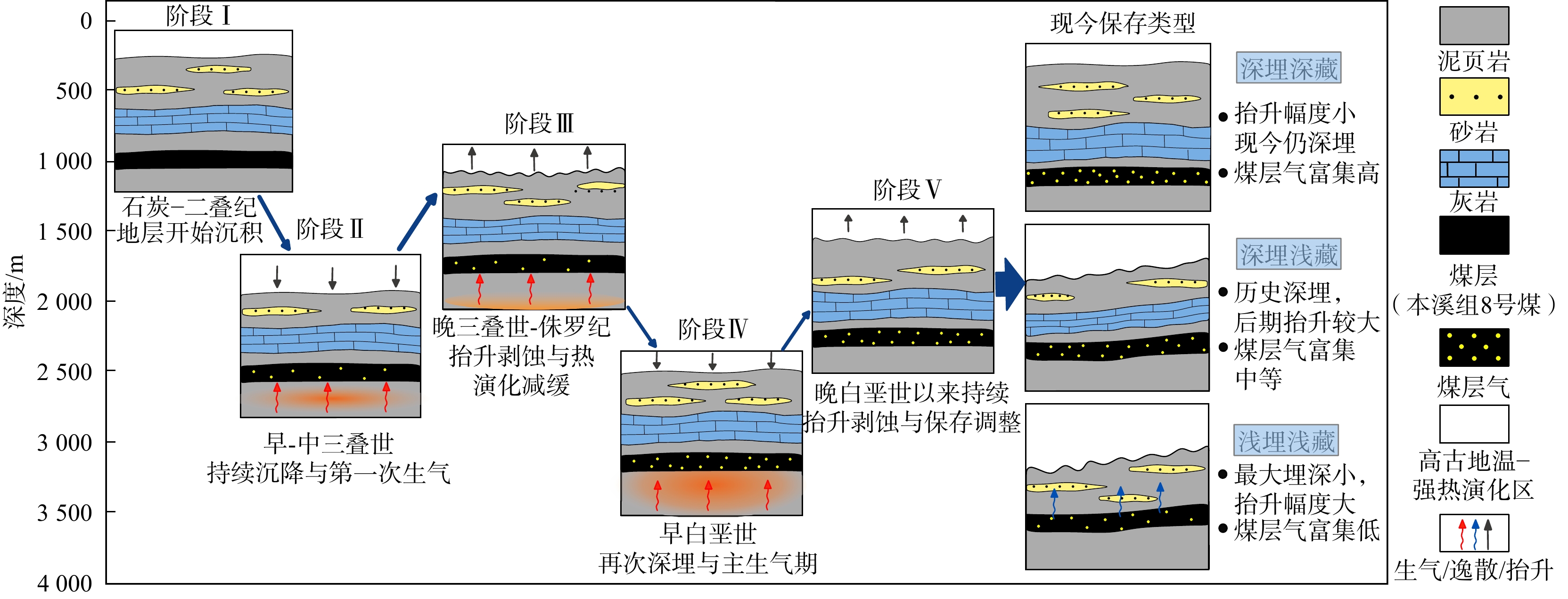
结果3类区煤岩显微组分均以镜质组为主,平均孔隙度由深埋深藏区的3.26%增至浅埋浅藏区的4.06%,而平均含气量由25.31 m3/t降至9.42 m3/t,孔隙度与含气性呈相反变化趋势。8号煤成藏演化经历初始埋藏、持续沉降与第一次生气、沉降减缓与阶段性抬升、再次深埋与主要生气、抬升泄压与保存调整5个阶段。3类区的生气积累差异在前期埋藏过程中已开始形成;早白垩世二次深埋为主要生气阶段,代表井历史最大埋深分别约
4300 ,3842 ,3400 m,深埋深藏区和深埋浅藏区生气作用较强,过剩压力明显增大。晚白垩世以来,生气作用减弱,过剩压力逐渐降低,系统转入保存调整阶段,构造改造程度和储盖封闭条件进一步影响气体保存。据此归纳出“强生气−较好保存”“强生气−后期调整”和“较弱生气−较弱保存”3类差异成藏模式。结论3类区现今含气性是历史生气积累与晚期保存调整共同作用的结果。深层煤层气有利区评价除考虑现今埋深外,还应重视历史最大埋深、热演化程度以及晚期构造改造和压力保存条件。
Abstract:ObjectiveThe No. 8 coal seam of the Benxi Formation in the Daji Block, eastern margin of Ordos Basin, shows marked differences in burial depth and present-day gas-bearing characteristics among different burial zones. This study examines differences in gas generation and preservation under different burial–preservation settings and analyzes the effects of historical gas generation and late-stage preservation adjustment on present-day gas-bearing differentiation.
MethodsProximate analysis, maceral composition, organic geochemical data, reservoir physical properties, isothermal adsorption results, and field gas-bearing data were integrated. Based on one-dimensional basin modeling of 34 wells, one representative well was selected from each of the deep-burial–deep-preservation, deep-burial–shallow-preservation, and shallow-burial–shallow-preservation zones. Combined with two-dimensional cross-section modeling, these representative well models were used to reconstruct and compare the burial, thermal, gas-generation, and pressure histories of the No. 8 coal seam.
ResultsVitrinite was the dominant maceral in coal from all three zones. Average porosity increased from 3.26% in the deep-burial–deep-preservation zone to 4.06% in the shallow-burial–shallow-preservation zone, whereas average gas content decreased from 25.31 m3/t to 9.42 m3/t, indicating opposite trends in porosity and gas content. The accumulation evolution of the No. 8 coal seam comprised five stages: initial burial, continuous subsidence and the first episode of gas generation, reduced subsidence and episodic uplift, renewed deep burial and major gas generation, and uplift-related pressure release and preservation adjustment. Differences in cumulative gas generation among the three zones began to develop during the earlier burial stages. Secondary deep burial during the Early Cretaceous marked the main gas-generation stage, when the representative wells reached maximum burial depths of approximately 4 300, 3 842, and 3 400 m, respectively. The deep-burial–deep-preservation and deep-burial–shallow-preservation zones experienced stronger gas generation and marked increases in overpressure. From the Late Cretaceous onward, gas generation weakened and overpressure gradually declined, with the system entering a stage of gas preservation and adjustment. Differences in tectonic modification and reservoir–caprock sealing conditions further influenced gas preservation. Accordingly, three differential accumulation modes were identified: "strong gas generation–relatively favorable preservation," "strong gas generation–late-stage adjustment," and "relatively weak gas generation–relatively poor preservation."
ConclusionPresent-day gas-bearing characteristics among the three zones result from the combined effects of historical gas generation and late-stage preservation adjustment. Evaluation of favorable areas for deep coalbed methane should consider maximum historical burial depth, thermal maturity, late-stage tectonic modification, and pressure retention, alongside present-day burial depth.
-
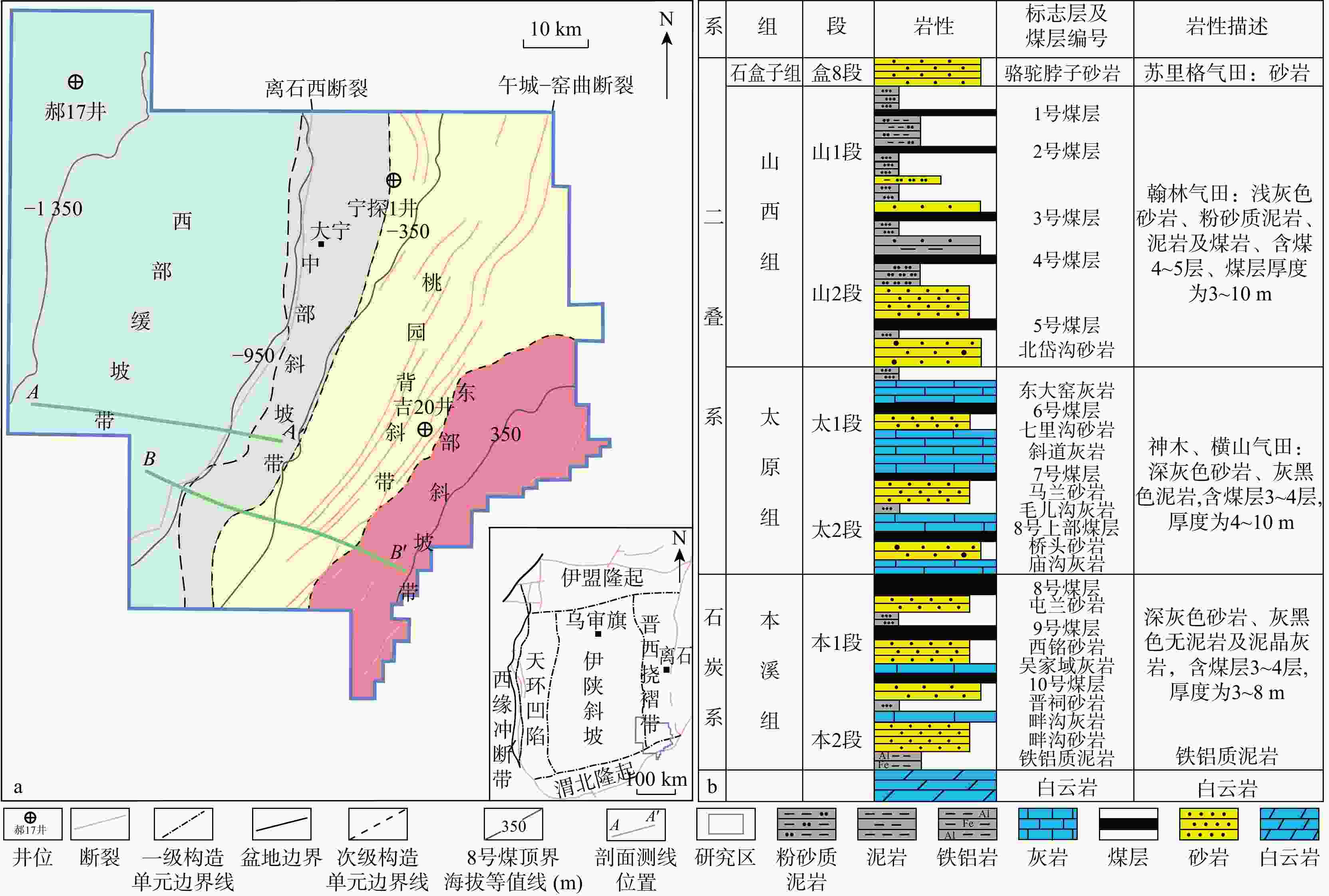
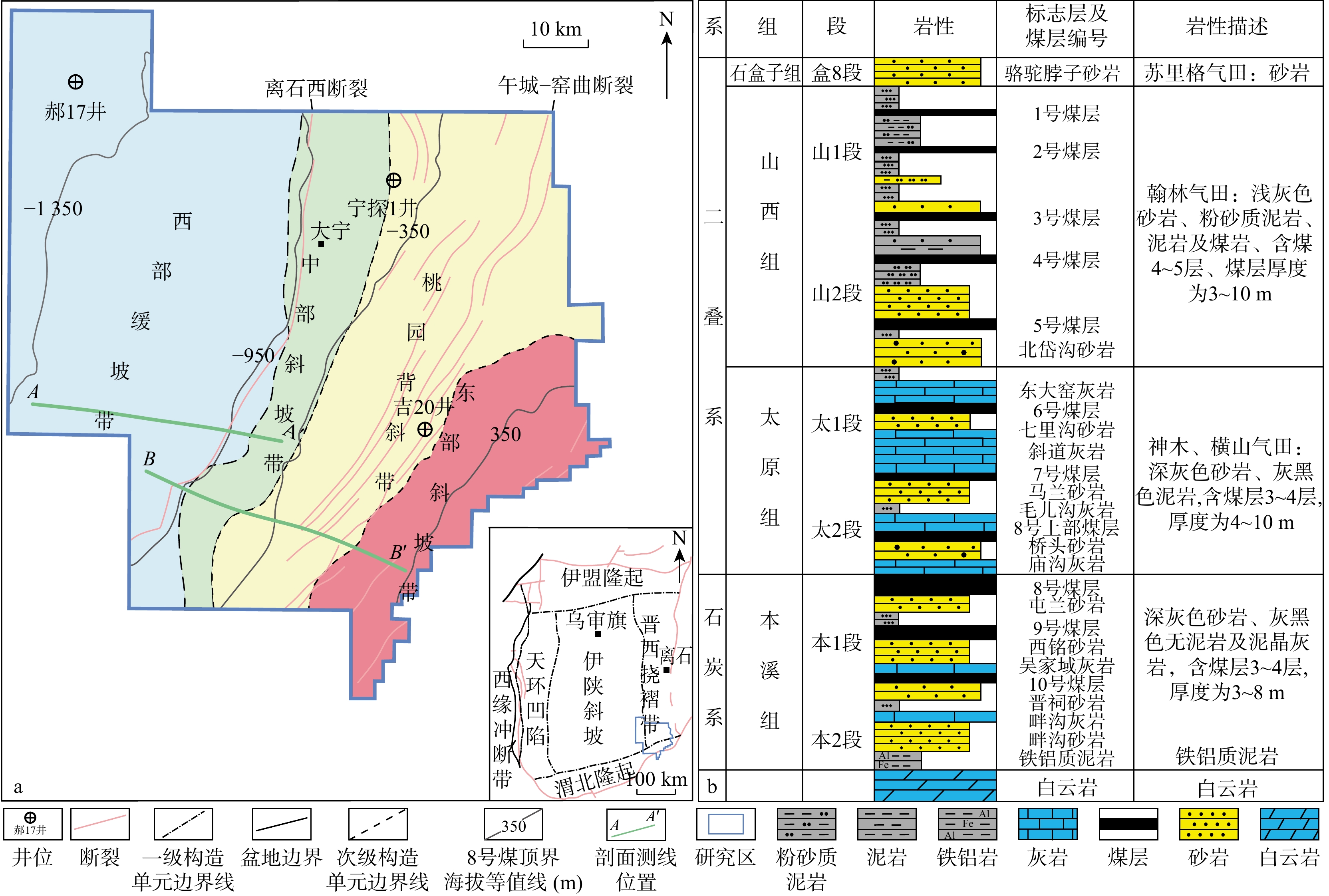
图 1 大吉区块构造位置、构造分区(a)及含煤地层柱状图(b)(据文献[6]修改)
Figure 1. Tectonic setting, structural divisions (a), and coal-bearing stratigraphic column (b) of Daji Block
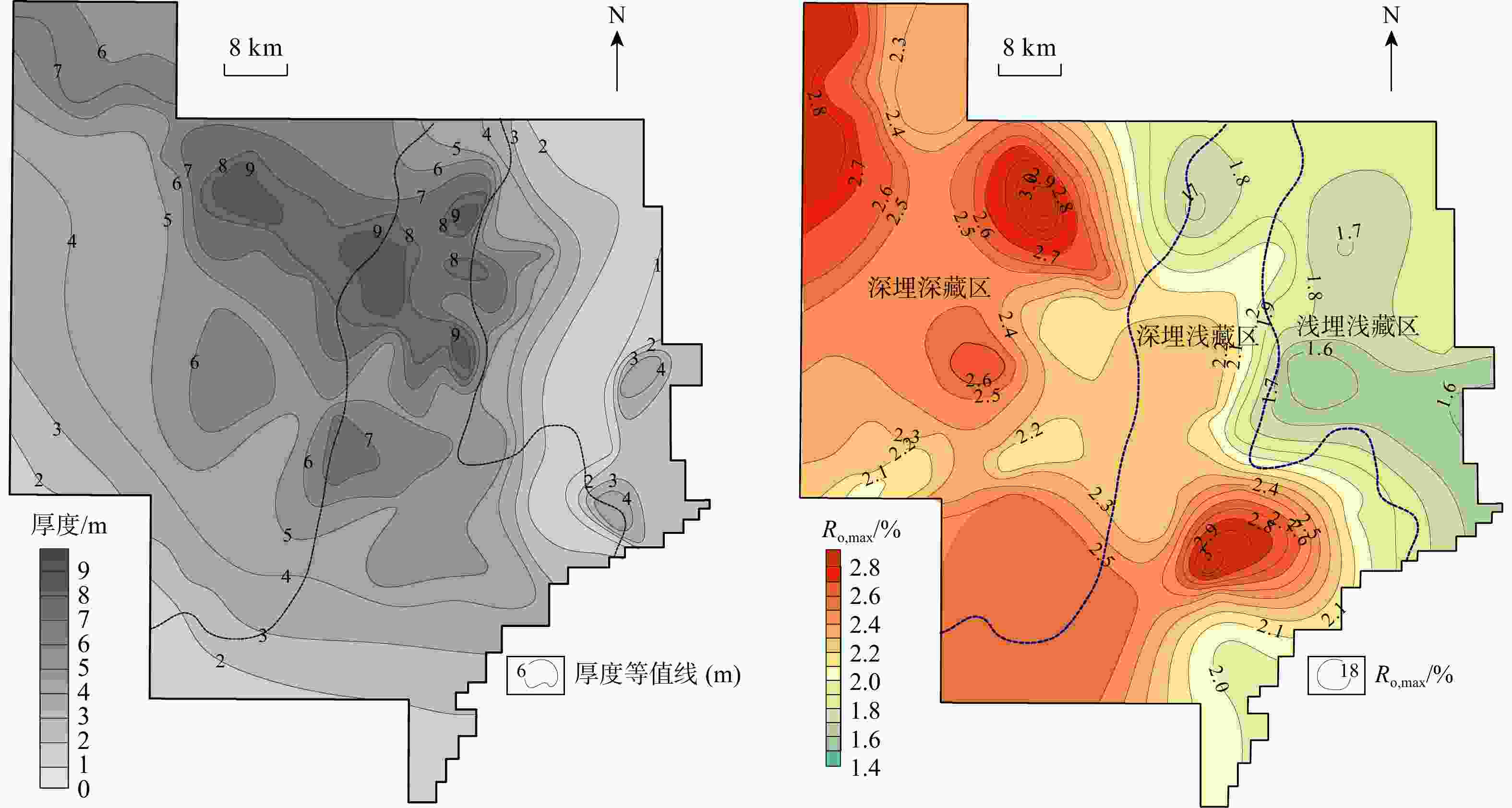
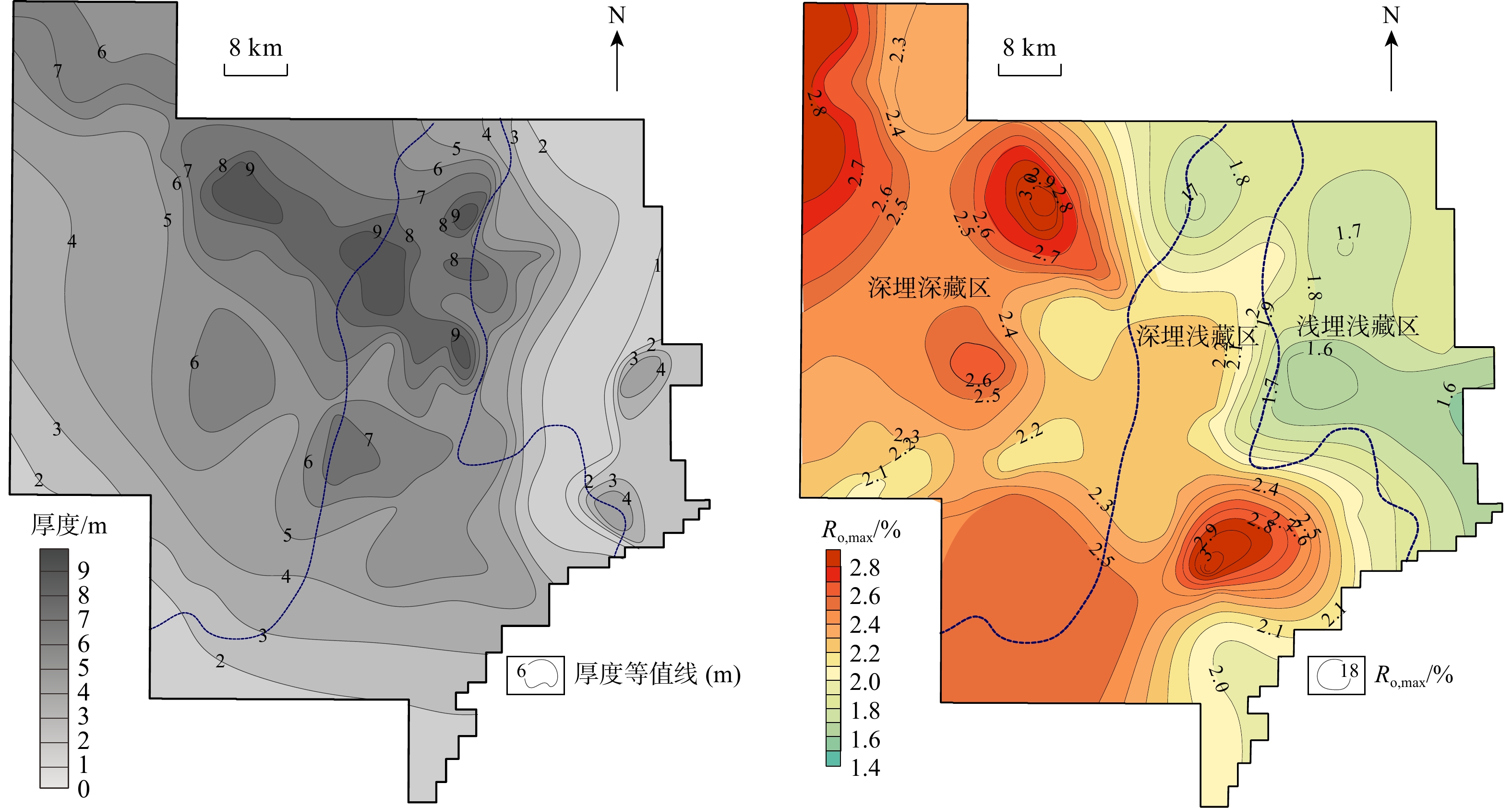
图 2 大吉区块本溪组8号煤厚度(a)及埋藏−保存类型分布(b)(埋藏−保存分区据文献[10];Ro, max为模拟最大镜质体反射率;下同)
Figure 2. Distribution of No. 8 coal seam thickness (a) and burial–preservation types (b) in Benxi Formation, Daji Block
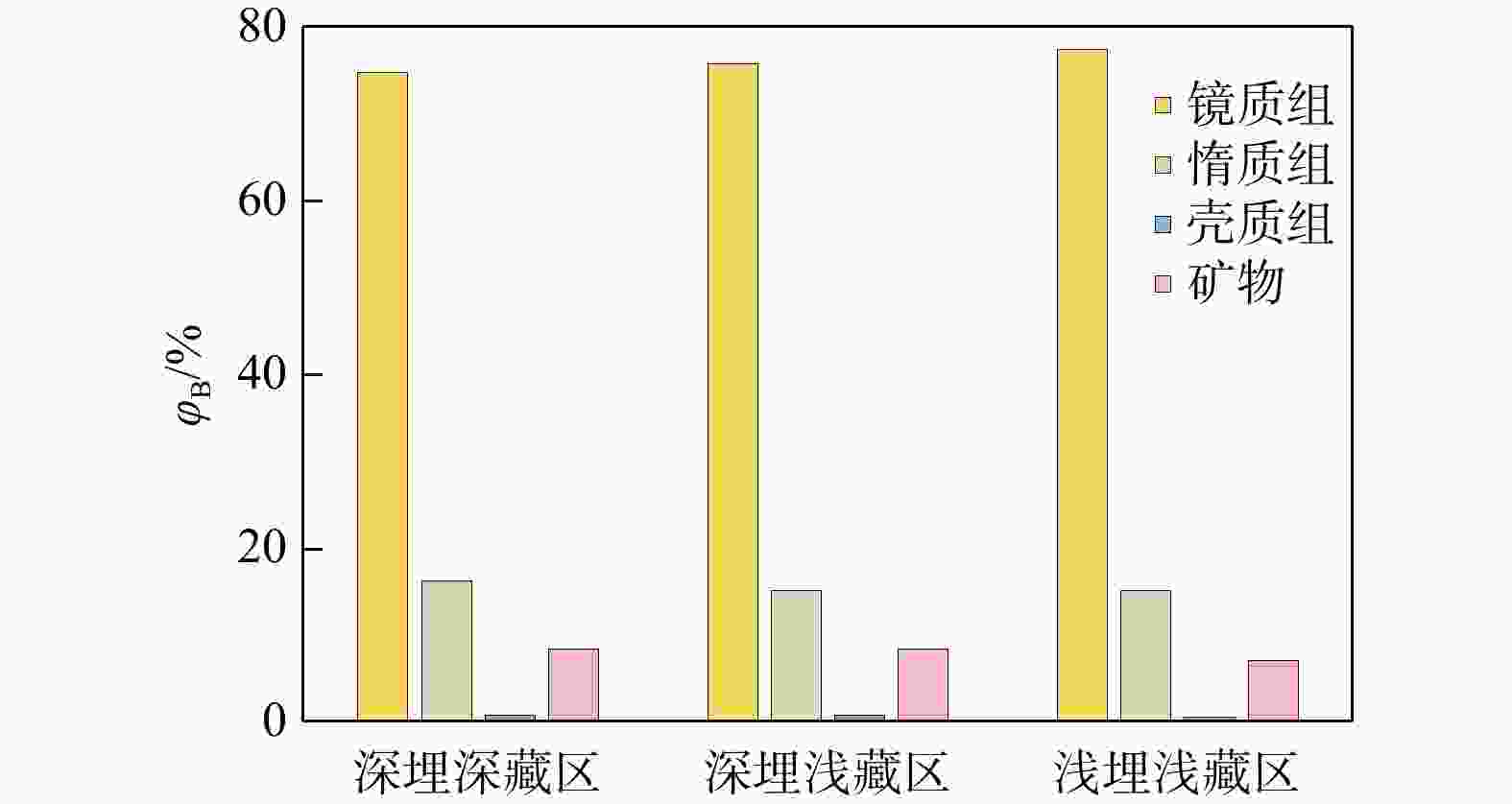
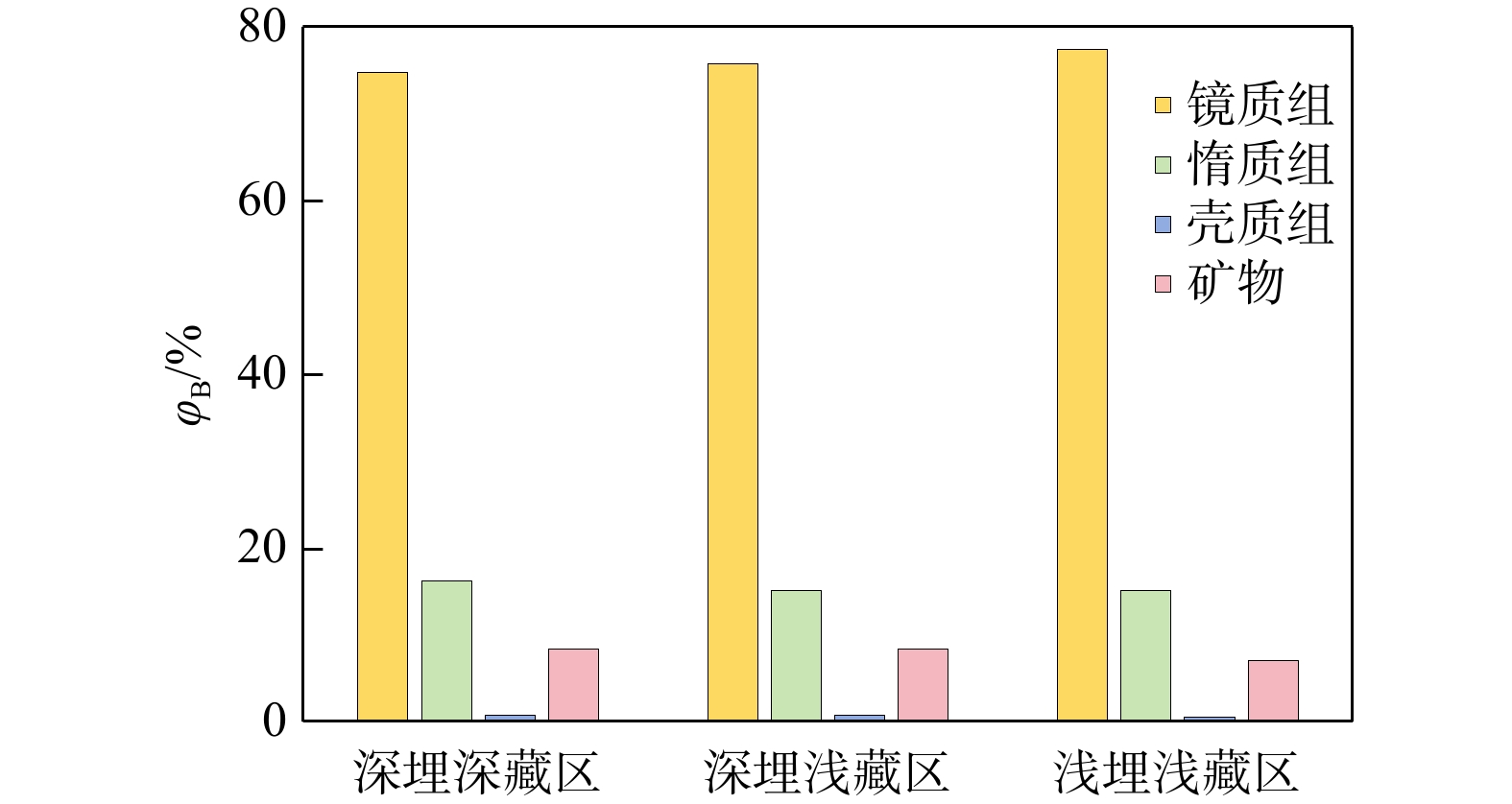
图 3 大吉区块本溪组8号煤3类埋藏−保存区显微组分平均含量
Figure 3. Average maceral contents of No. 8 coal seam of Benxi Formation in three burial–preservation zones of Daji Block
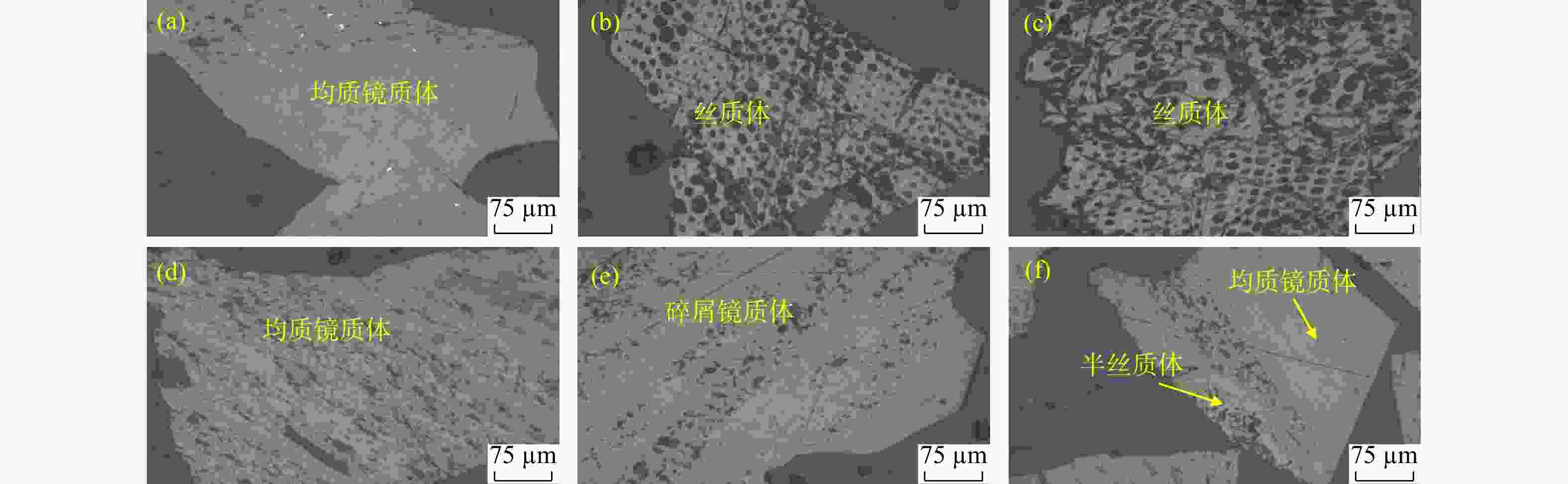
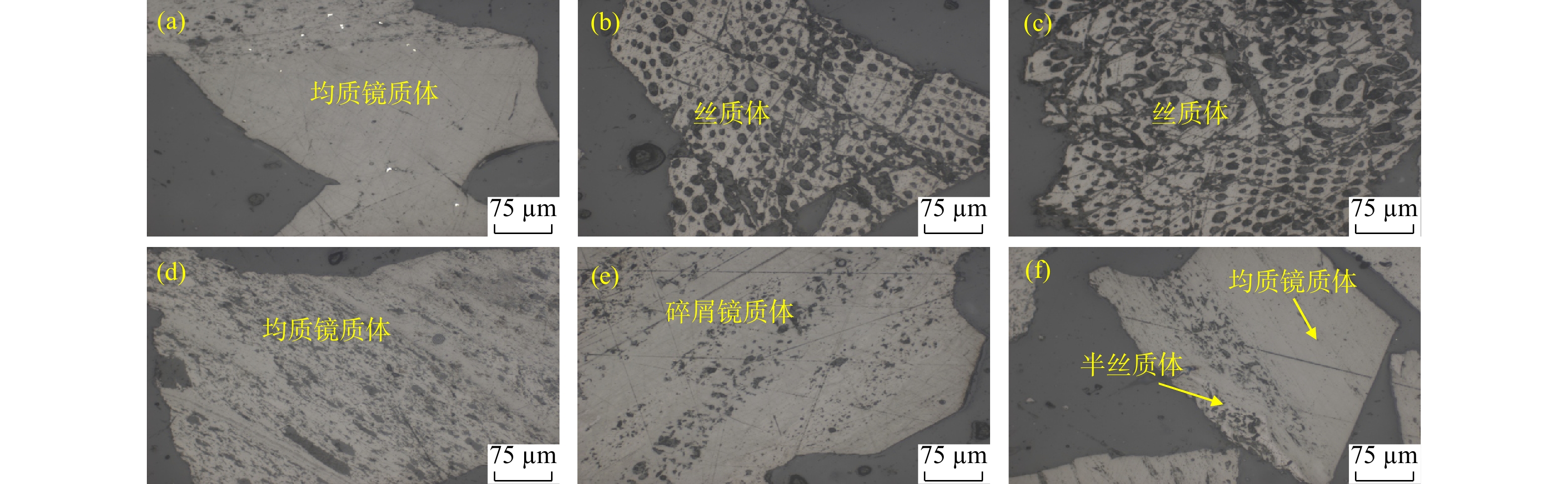
图 4 大吉区块本溪组8号煤典型显微组分镜下特征
Figure 4. Microscopic characteristics of typical macerals in No. 8 coal seam of Benxi Formation, Daji Block
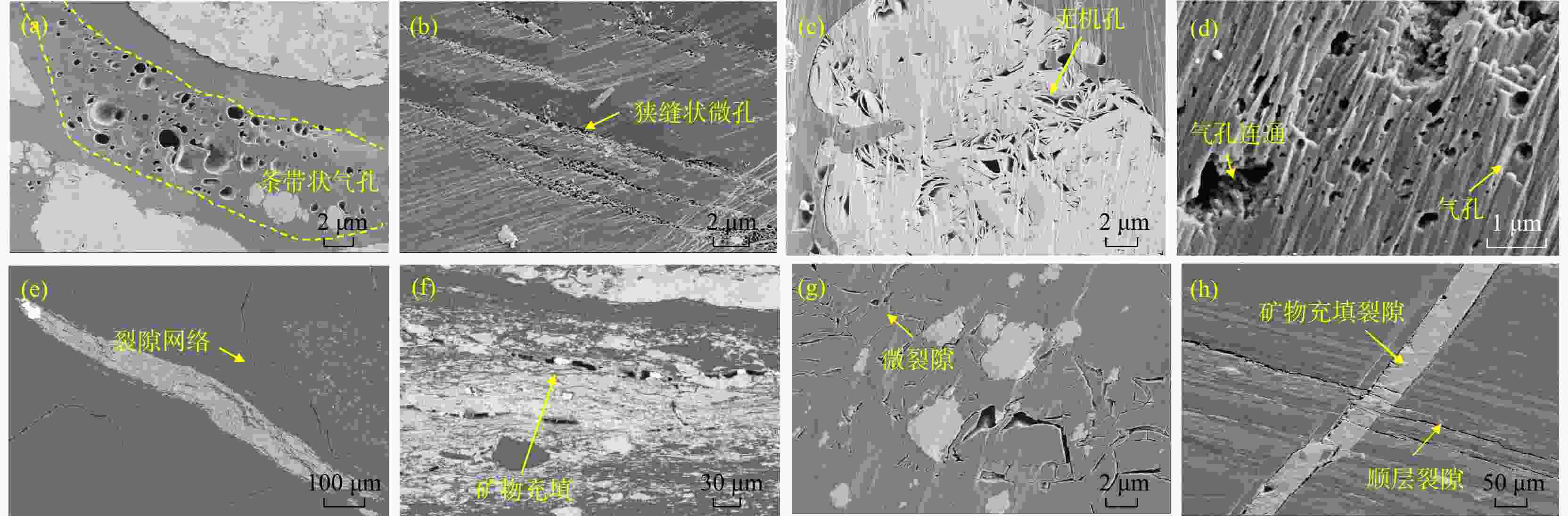
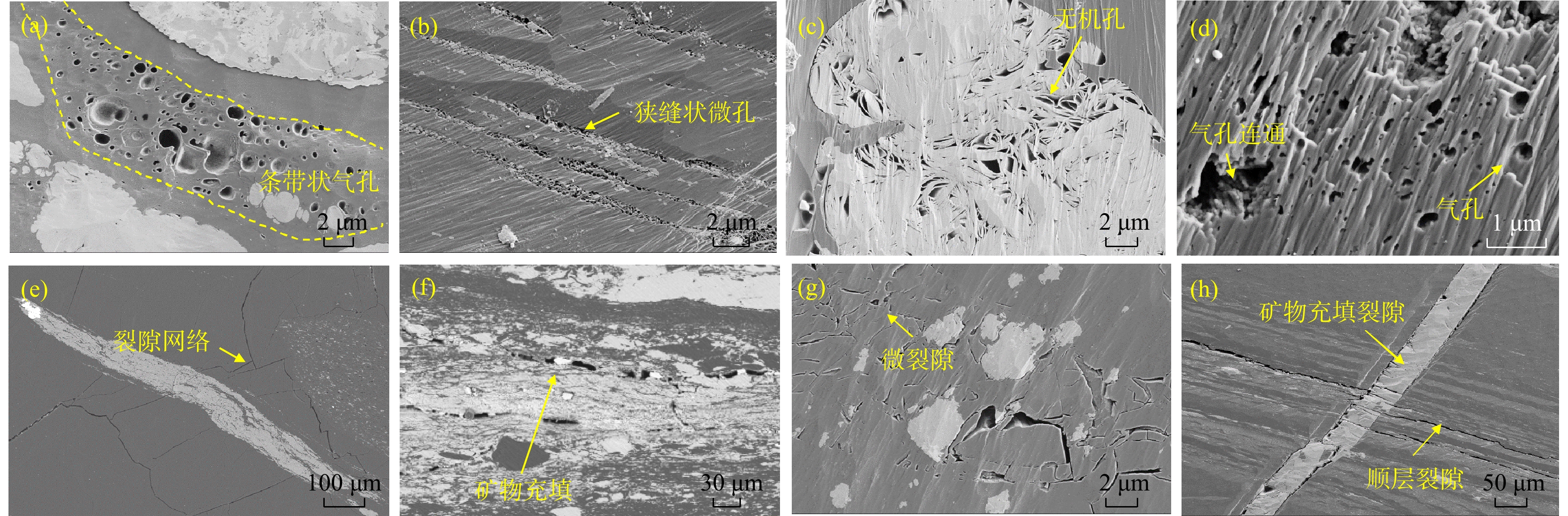
图 5 大吉区块本溪组8号煤储层孔隙(a~d)和裂隙(e~h)发育特征
Figure 5. Development characteristics of reservoir pores (a-d) and fractures (e-h) in No. 8 coal seam of Benxi Formation, Daji Block
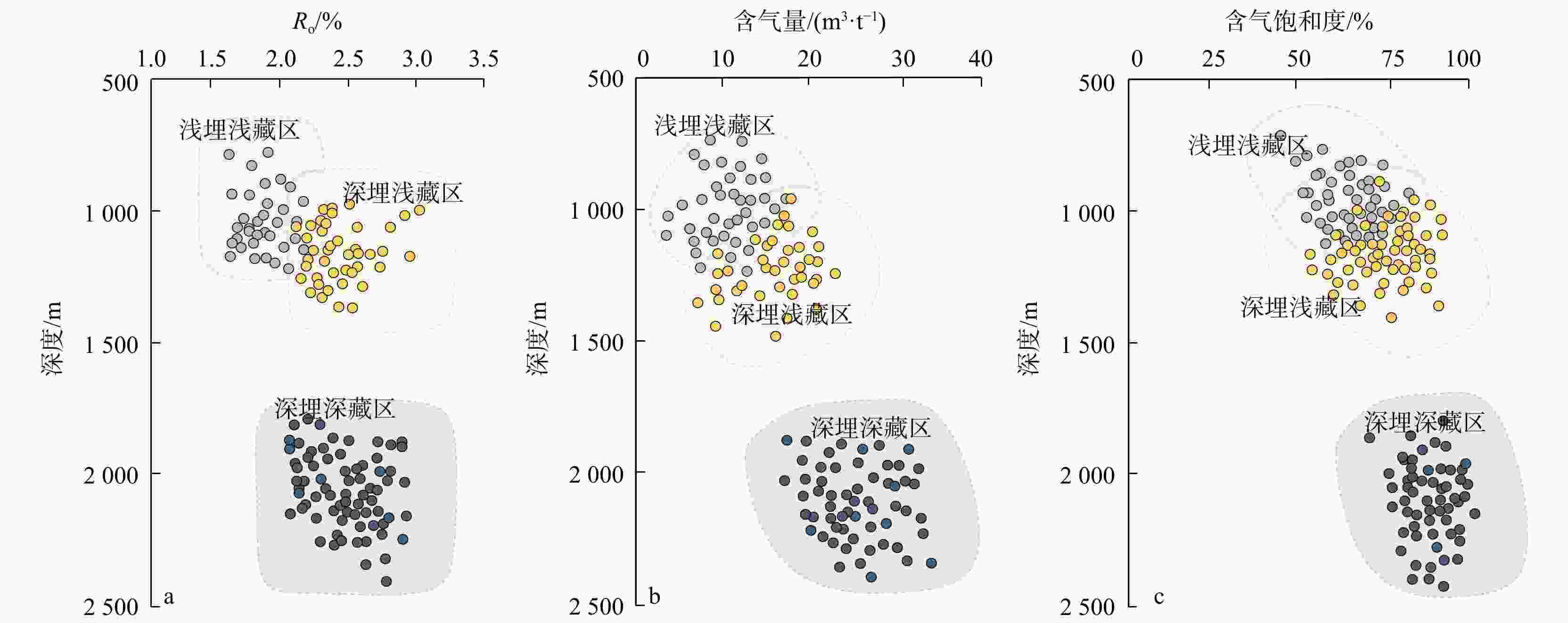
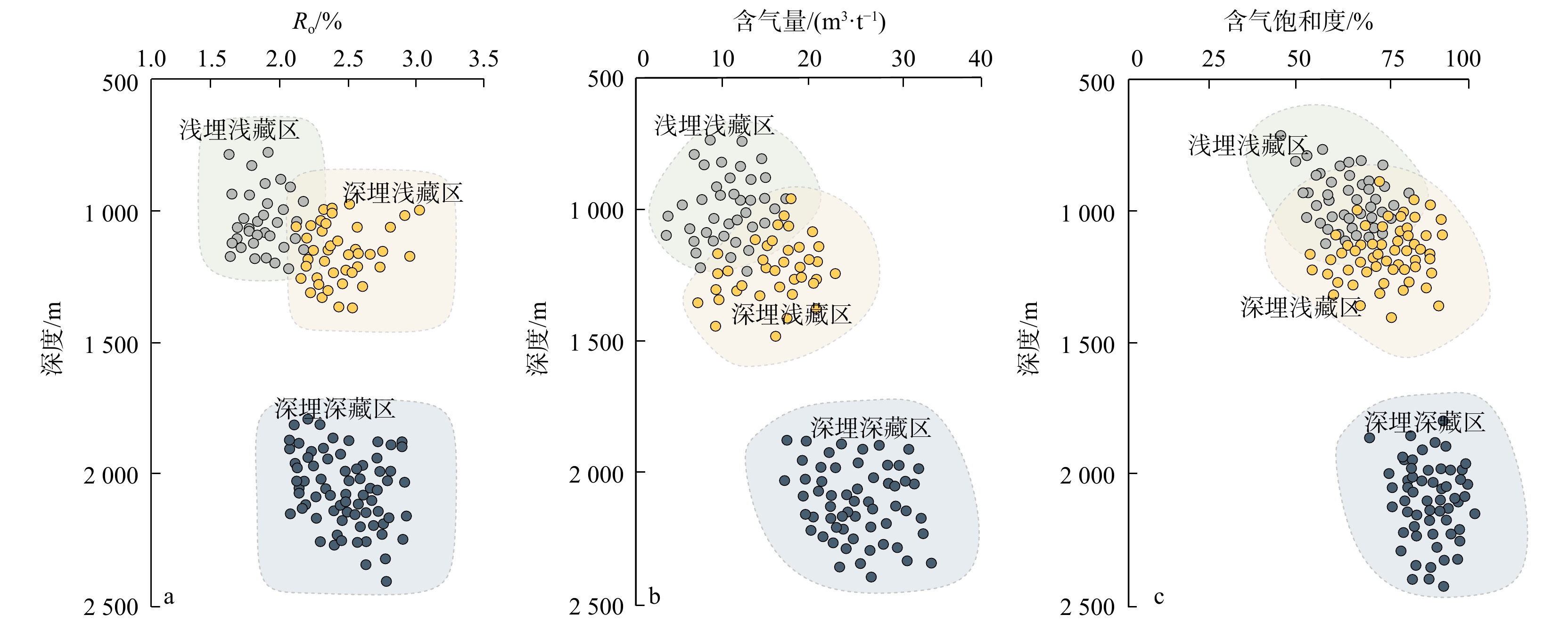
图 6 大吉区块不同埋藏−保存区本溪组8号煤实测镜质体反射率Ro(a)、含气量(b)及含气饱和度(c)对比
Figure 6. Comparison of measured vitrinite reflectance (Ro) (a), gas content (b), and gas saturation (c) of No. 8 coal seam of Benxi Formation among different burial–preservation zones in Daji Block
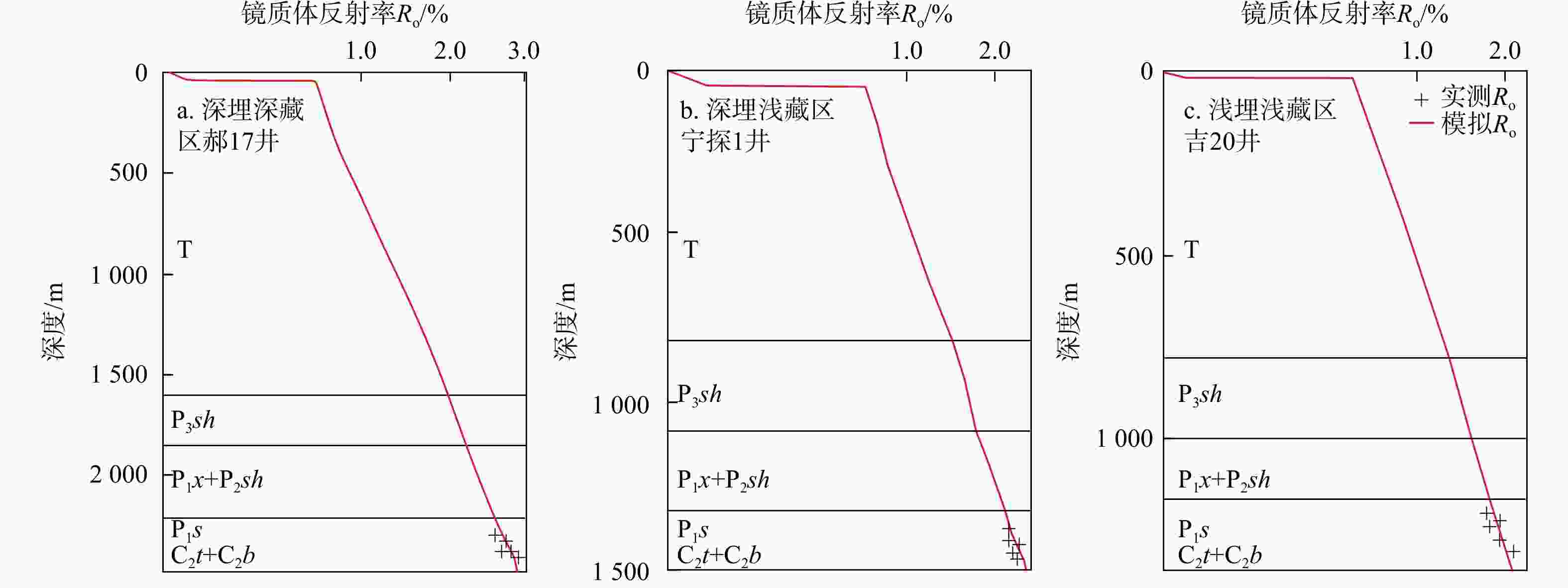
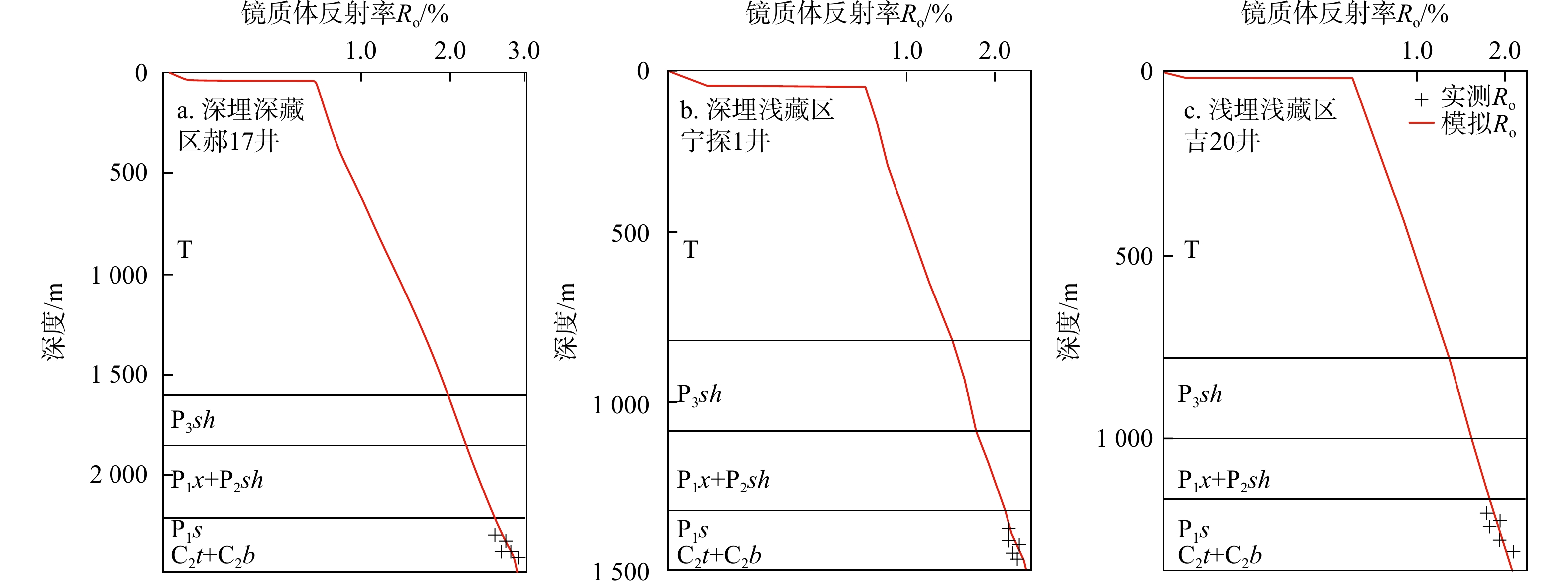
图 7 大吉区块不同埋藏−保存区典型井镜质体反射率实测值与模拟值对比
T为三叠系;P3sh为石千峰组;P1x+P2sh为下石盒子组和上石盒子组(合并层段);P1s为山西组;C2t+C2b为太原组和本溪组(合并层段);下同
Figure 7. Comparison between measured and simulated vitrinite reflectance values in representative wells from different burial-preservation zones in Daji Block
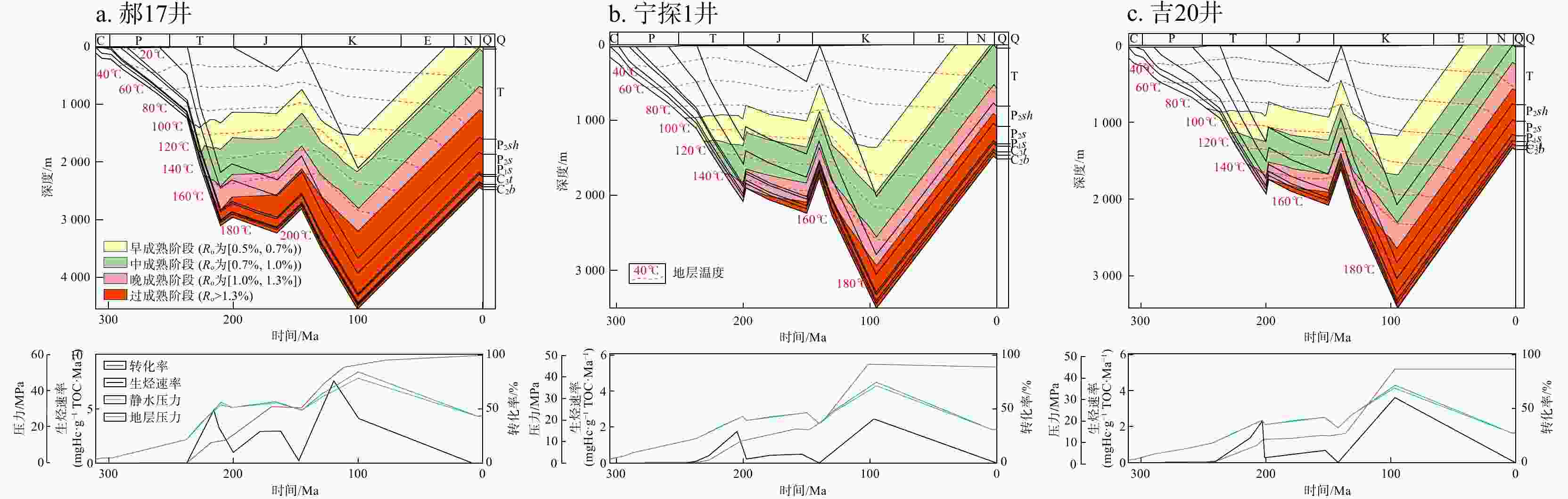
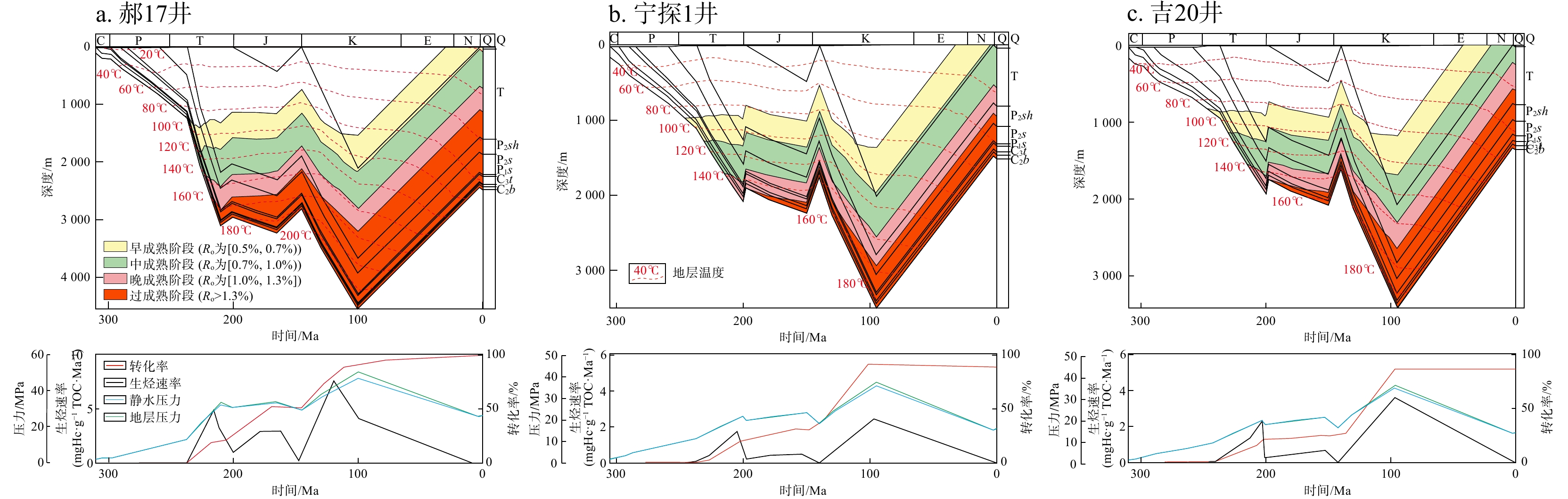
图 8 大吉区块本溪组8号煤三类埋藏−保存区典型井成藏演化综合图
C为石炭纪;P为二叠纪;T为三叠纪;J为侏罗纪;K为白垩纪;E为古近纪;N为新近纪;Q为第四纪(系);P2s为石盒子组;C2t为太原组;C2b为本溪组;下同
Figure 8. Integrated accumulation evolution of representative wells in three burial–preservation zones of No. 8 coal seam of Benxi Formation, Daji Block
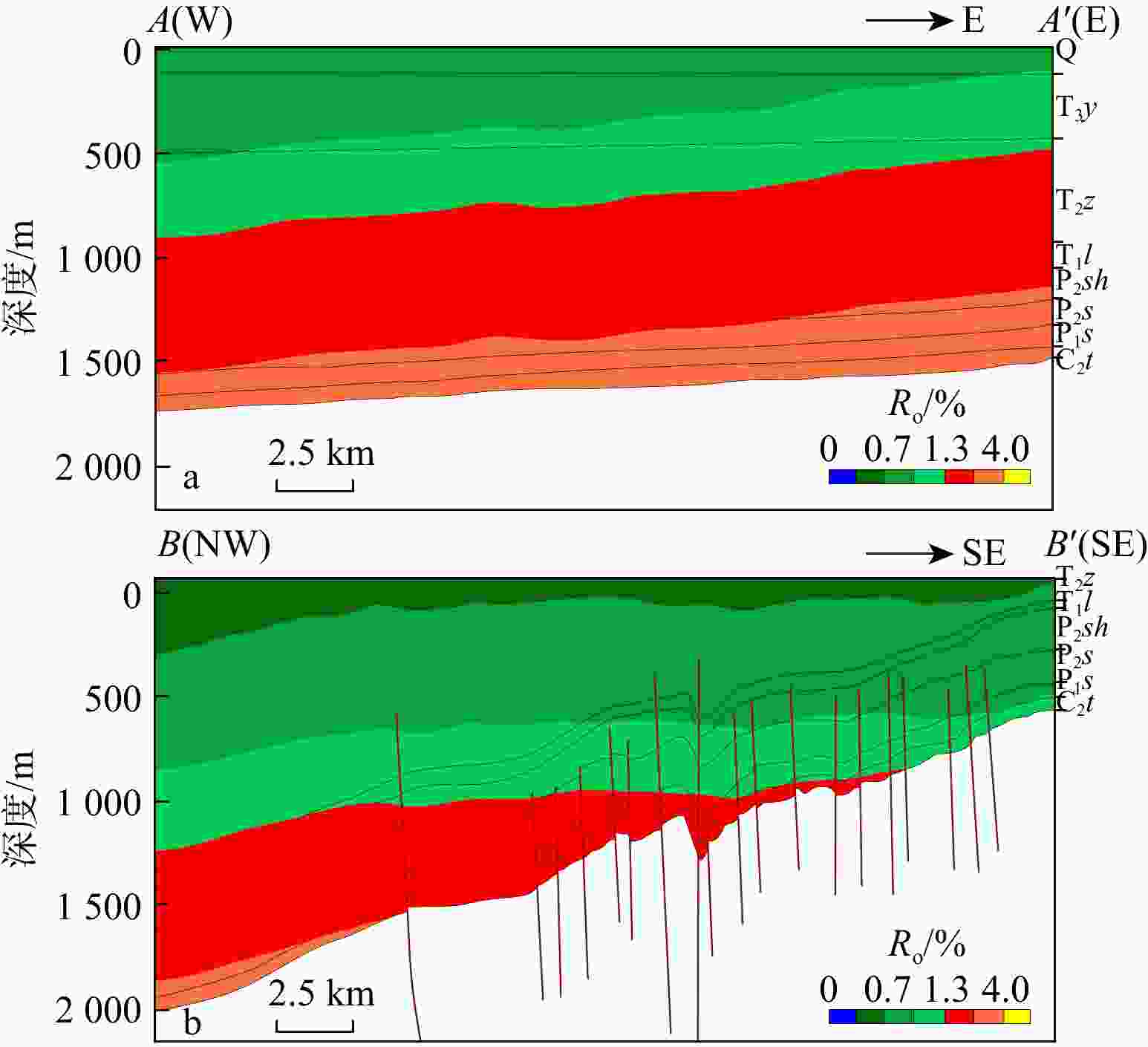
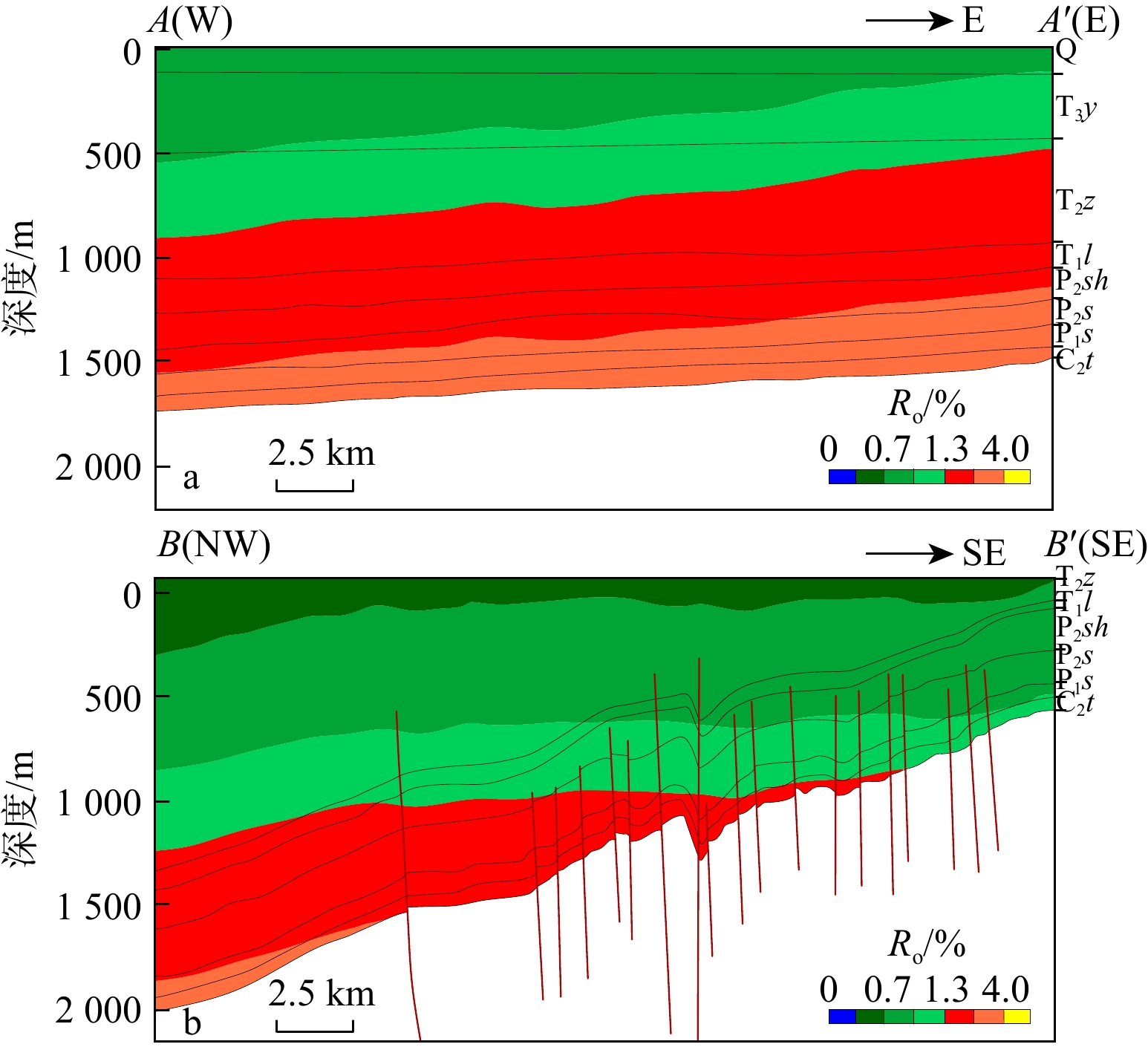
图 9 大吉区块本溪组8号煤模拟Ro剖面
T3y为延长组;T2z为纸坊组;T1l为刘家沟组;下同
Figure 9. Profiles of simulated vitrinite reflectance (Ro) of No. 8 coal seam of Benxi Formation, Daji Block
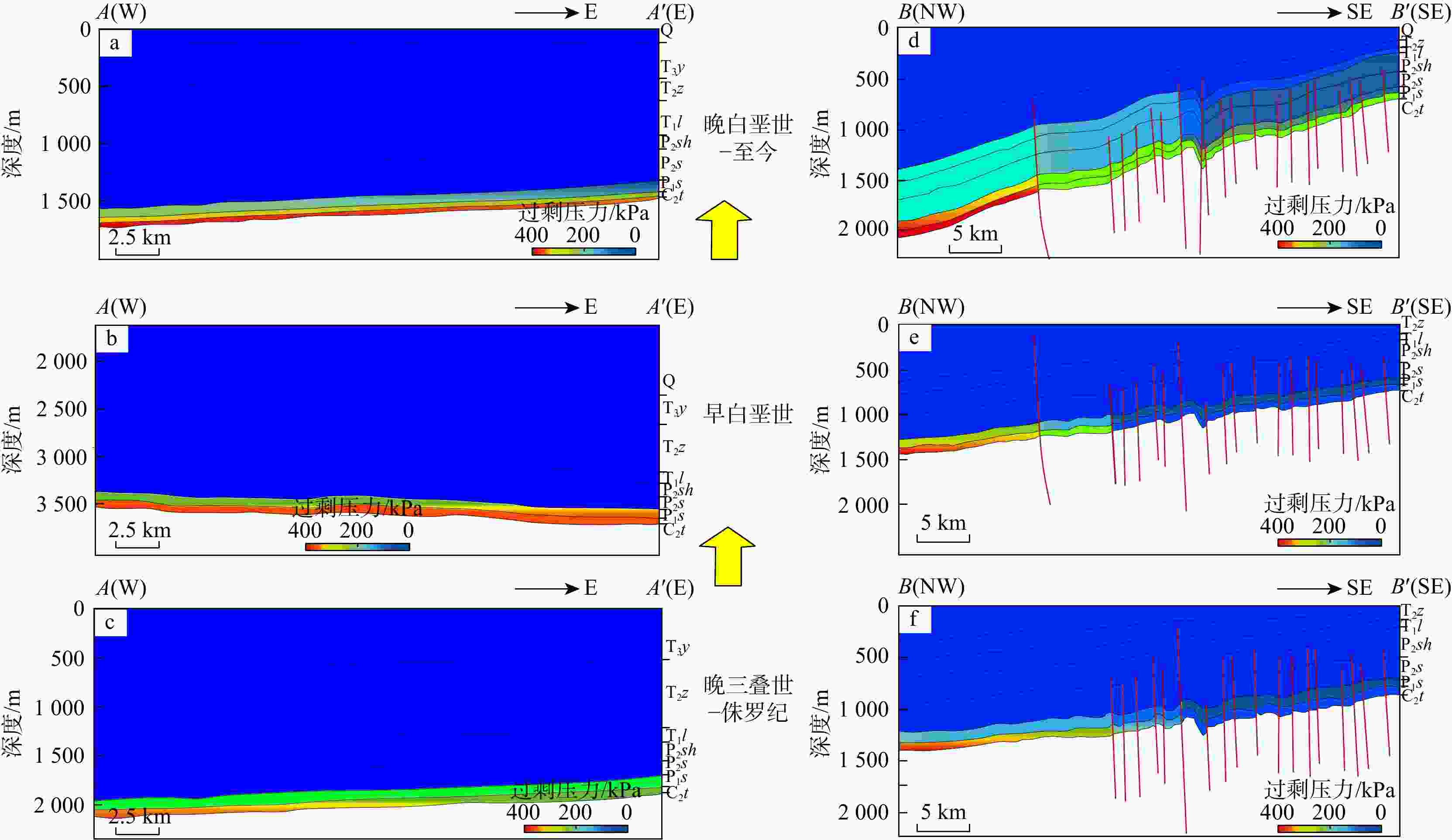
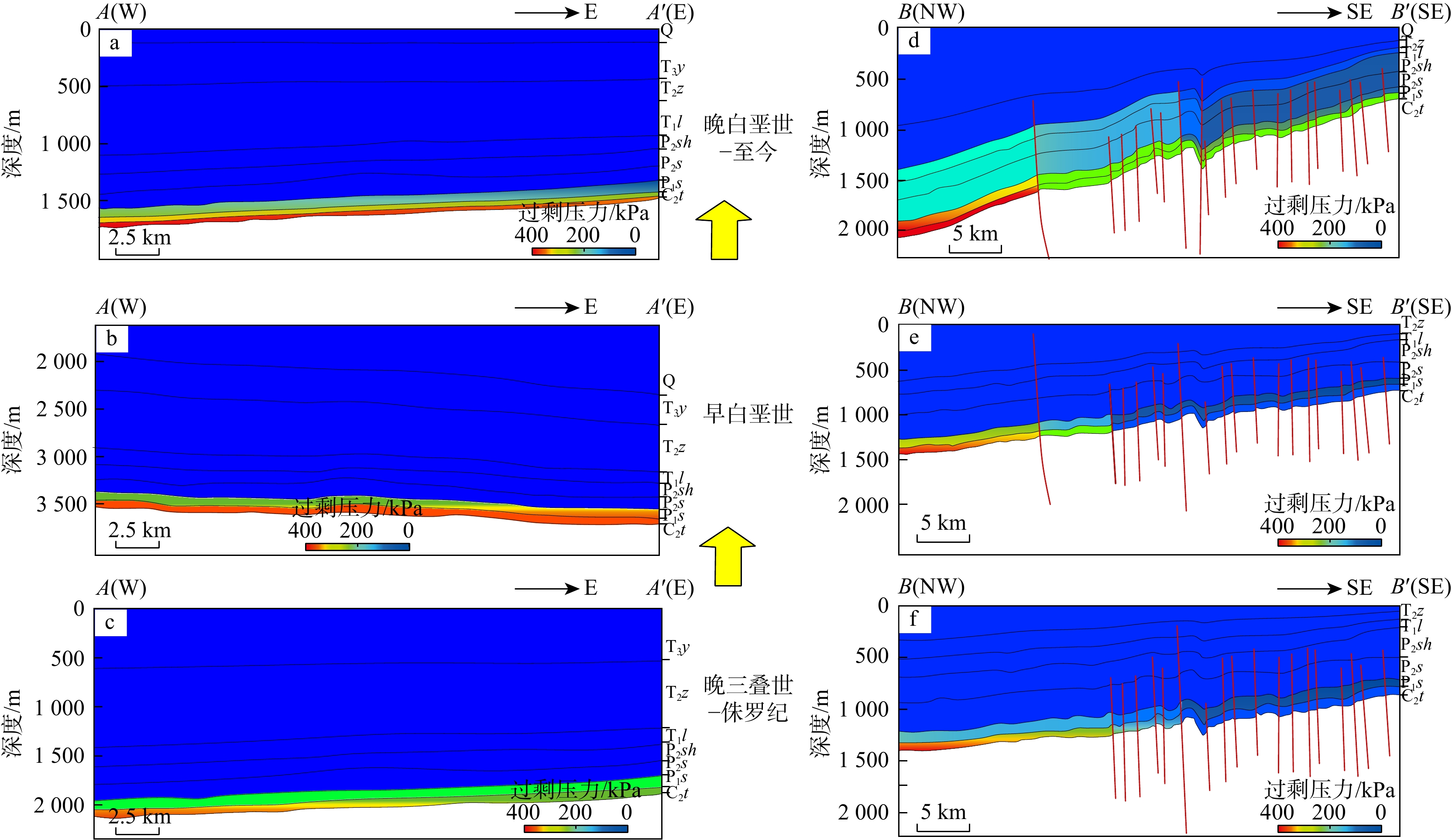
图 10 大吉区块A−A'与B−B'剖面过剩压力演化
Figure 10. Evolution of excess pressure along cross-sections A–A' and B–B' in Daji Block
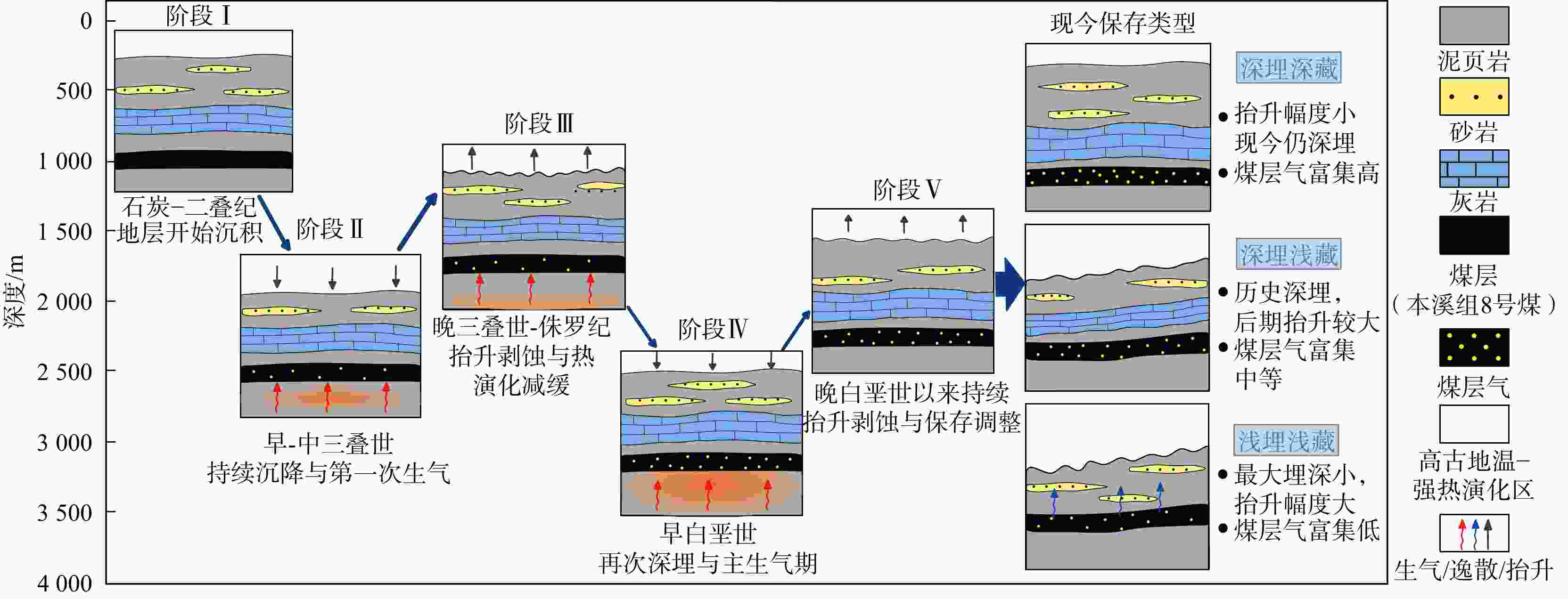
图 11 大吉区块本溪组8号煤深层煤层气动态成藏与差异成藏模式
Figure 11. Dynamic accumulation and differential accumulation models of deep coalbed methane in No. 8 coal seam of Benxi Formation, Daji Block
表 1 大吉区块本溪组8号煤3类埋藏−保存区成藏地质条件对比
Table 1. Comparison of geological conditions for coalbed methane accumulation among three burial–preservation zones of No. 8 coal seam of Benxi Formation, Daji Block
成藏地质条件 参数 深埋深藏区 深埋浅藏区 浅埋浅藏区 划分依据[10] 现今埋深/m > 1800 < 1800 < 1800 Ro,max/% ≥2 ≥2 <2 煤层及生气条件 煤层厚度/m 2.0~10.2/ 6.2 2.0~10.7/ 6.5 1.0~6.3/ 5.5 φB/% 74.75(镜质组为主) 75.82(镜质组为主) 77.38(镜质组为主) Ro,max/% 2.30~2.70/ 2.50 2.00~2.30/ 2.10 1.30~1.90/ 1.70 含气性 含气量/(m3·t−1) 12.35~35.05/ 25.31 4.23~20.79/ 12.55 1.36~16.17/ 9.42 含气饱和度/% 88.15~99.81/ 96.94 50.12~88.47/ 75.60 47.63~78.91/62.90 储集条件 孔隙度/% 1.83~4.09/ 3.26 1.42~5.12/ 3.68 1.30~5.93/ 4.06 渗透率/10−3 μm2 0.028~0.072 0.012~0.663 0.003~2.980 等温吸附特征$\dfrac{V_{\mathrm{L}}/({\mathrm{m}}^{3}\cdot {\mathrm{t}}^{-1})}{P_{\mathrm{L}}/{\mathrm{MPA}}} $ 26.37 21.86 22.75 3.19 2.18 2.29 一维模拟概况 模拟井数/口 15 10 9 典型井 郝17井 宁探1井 吉20井 历史最大埋深/m 4000 ~4600 3600 ~4000 2600 ~3600 注:12.35~35.05/ 25.31为最小值−最大值/平均值;VL为兰氏体积;PL为兰氏压力  下载: 导出CSV
表 2 大吉区块本溪组8号煤盆地模拟边界参数
Table 2. Boundary parameters for basin modeling of No. 8 coal seam of Benxi Formation, Daji Block
地质时间/Ma 古水深/m 沉积水界面温度/℃ 热流/(mW·m−2) 0 0 21.20 60.20 130 10 29.00 103.00 179 10 24.20 101.00 204 10 24.80 101.00 227 10 29.00 93.00 241 10 26.72 92.00 246 10 25.78 91.00 252 15 24.64 90.00 257 25 24.00 88.00 277 25 20.23 87.00 290 25 19.96 86.00 295 25 20.14 84.00
下载: 导出CSV
-
[1] 刘大锰, 刘正帅, 蔡益栋. 煤层气成藏机理及形成地质条件研究进展[J]. 煤炭科学技术, 2020, 48(10): 1-16. doi: 10.13199/j.cnki.cst.2020.10.001LIU D M, LIU Z S, CAI Y D. Research progress on accumulation mechanism and formation geological conditions of coalbed methane[J]. Coal Science and Technology, 2020, 48(10): 1-16. (in Chinese with English abstract) doi: 10.13199/j.cnki.cst.2020.10.001 [2] 秦勇. 中国深部煤层气地质研究进展[J]. 石油学报, 2023, 44(11): 1791-1811. doi: 10.7623/syxb202311004QIN Y. Progress on geological research of deep coalbed methane in China[J]. Acta Petrolei Sinica, 2023, 44(11): 1791-1811. (in Chinese with English abstract) doi: 10.7623/syxb202311004 [3] 徐凤银, 王成旺, 熊先钺, 等. 鄂尔多斯盆地东缘深部煤层气成藏演化规律与勘探开发实践[J]. 石油学报, 2023, 44(11): 1764-1780. doi: 10.7623/syxb202311002XU F Y, WANG C W, XIONG X Y, et al. Evolution law of deep coalbed methane reservoir formation and exploration and development practice in the eastern margin of Ordos Basin[J]. Acta Petrolei Sinica, 2023, 44(11): 1764-1780. (in Chinese with English abstract) doi: 10.7623/syxb202311002 [4] 熊先钺, 闫霞, 徐凤银, 等. 深部煤层气多要素耦合控制机理、解吸规律与开发效果剖析[J]. 石油学报, 2023, 44(11): 1812-1826. doi: 10.7623/syxb202311005XIONG X Y, YAN X, XU F Y, et al. Analysis of multi-factor coupling control mechanism, desorption law and development effect of deep coalbed methane[J]. Acta Petrolei Sinica, 2023, 44(11): 1812-1826. (in Chinese with English abstract) doi: 10.7623/syxb202311005 [5] 牛小兵, 范立勇, 闫小雄, 等. 鄂尔多斯盆地煤岩气富集条件及资源潜力[J]. 石油勘探与开发, 2024, 51(5): 972-985. doi: 10.1016/s1876-3804(25)60530-1NIU X B, FAN L Y, YAN X X, et al. Enrichment conditions and resource potential of coal-rock gas in Ordos Basin, NW China[J]. Petroleum Exploration and Development, 2024, 51(5): 972-985. (in Chinese with English abstract) doi: 10.1016/s1876-3804(25)60530-1 [6] 周立宏, 熊先钺, 丁蓉, 等. 煤岩气内涵、富集机理及实践意义[J]. 天然气工业, 2025, 45(3): 1-15. doi: 10.3787/j.issn.1000-0976.2025.03.001ZHOU L H, XIONG X Y, DING R, et al. Connotation, enrichment mechanism and practical significance of coal-rock gas[J]. Natural Gas Industry, 2025, 45(3): 1-15. (in Chinese with English abstract) doi: 10.3787/j.issn.1000-0976.2025.03.001 [7] 赵喆, 徐旺林, 赵振宇, 等. 鄂尔多斯盆地石炭系本溪组煤岩气地质特征与勘探突破[J]. 石油勘探与开发, 2024, 51(2): 234-247. doi: 10.11698/PED.20230679ZHAO Z, XU W L, ZHAO Z Y, et al. Geological characteristics and exploration breakthroughs of coal rock gas in Carboniferous Benxi Formation, Ordos Basin, NW China[J]. Petroleum Exploration and Development, 2024, 51(2): 234-247. (in Chinese with English abstract) doi: 10.11698/PED.20230679 [8] 李五忠, 陈刚, 孙斌, 等. 大宁−吉县地区煤层气成藏条件及富集规律[J]. 天然气地球科学, 2011, 22(2): 352-360.LI W Z, CHEN G, SUN B, et al. Geological controls of coalbed methane enrichment in Daning-Jixian area, southeastern Ordos Basin[J]. Natural Gas Geoscience, 2011, 22(2): 352-360. (in Chinese with English abstract) [9] 李曙光, 王成旺, 王红娜, 等. 大宁–吉县区块深层煤层气成藏特征及有利区评价[J]. 煤田地质与勘探, 2022, 50(9): 59-67. doi: 10.3969/j.issn.1001-1986.2022.09.008LI S G, WANG C W, WANG H N, et al. Reservoir forming characteristics and favorable area evaluation of deep coalbed methane in Daning-Jixian block[J]. Coal Geology & Exploration, 2022, 50(9): 59-67. (in Chinese with English abstract) doi: 10.3969/j.issn.1001-1986.2022.09.008 [10] 周立宏, 李勇, 丁蓉, 等. 煤层(岩)气“同生异构”控藏特征及开发实践——以鄂尔多斯盆地大吉区块石炭系本溪组8号煤为例[J]. 石油勘探与开发, 2025, 52(4): 772-781. doi: 10.11698/PED.20250175ZHOU L H, LI Y, DING R, et al. Differential accumulation characteristics and production of coalbed methane/coal-rock gas: A case study of the No. 8 coal seam of the Carboniferous Benxi Formation in the Daji block, Ordos Basin, NW China[J]. Petroleum Exploration and Development, 2025, 52(4): 772-781. (in Chinese with English abstract) doi: 10.11698/PED.20250175 [11] 闫霞, 熊先钺, 李曙光, 等. 深层煤岩气水平井各段产出贡献及其主控因素——以鄂尔多斯盆地东缘大宁-吉县区块为例[J]. 天然气工业, 2024, 44(10): 80-92. doi: 10.3787/j.issn.1000-0976.2024.10.006YAN X, XIONG X Y, LI S G, et al. Production contributions of deep CBM horizontal well sections and their controlling factors: A case study of Daning-Jixian area, eastern Ordos Basin[J]. Natural Gas Industry, 2024, 44(10): 80-92. (in Chinese with English abstract) doi: 10.3787/j.issn.1000-0976.2024.10.006 [12] 聂志宏, 时小松, 孙伟, 等. 大宁−吉县区块深层煤层气生产特征与开发技术对策[J]. 煤田地质与勘探, 2022, 50(3): 193-200. doi: 10.3969/j.issn.1001-1986.2022.03.020NIE Z H, SHI X S, SUN W, et al. Production characteristics of deep coalbed methane gas reservoirs in Daning-Jixian Block and its development technology countermeasures[J]. Coal Geology & Exploration, 2022, 50(3): 193-200. (in Chinese with English abstract) doi: 10.3969/j.issn.1001-1986.2022.03.020 [13] LI Z W, CHEN S D, TANG D Z, et al. Genesis and accumulation modes of coalbed methane at the eastern margin of Ordos Basin, China: Evidence from its geochemistry[J]. ACS Omega, 2024, 9(45): 45421-45436. doi: 10.1021/acsomega.4c07416 [14] 何登发. 中国多旋回叠合沉积盆地的形成演化、地质结构与油气分布规律[J]. 地学前缘, 2022, 29(6): 24-59. doi: 10.13745/j.esf.sf.2022.8.1HE D F. Multi-cycle superimposed sedimentary basins in China: Formation, evolution, geologic framework and hydro-carbon occurrence[J]. Earth Science Frontiers, 2022, 29(6): 24-59. (in Chinese with English abstract) doi: 10.13745/j.esf.sf.2022.8.1 [15] 姜福杰, 贾承造, 庞雄奇, 等. 鄂尔多斯盆地上古生界全油气系统成藏特征与天然气富集地质模式[J]. 石油勘探与开发, 2023, 50(2): 250-261. doi: 10.11698/PED.20220602JIANG F J, JIA C Z, PANG X Q, et al. Upper Paleozoic total petroleum system and geological model of natural gas enrichment in Ordos Basin, NW China[J]. Petroleum Exploration and Development, 2023, 50(2): 250-261. (in Chinese with English abstract) doi: 10.11698/PED.20220602 [16] 董淼, 王文. 鄂尔多斯盆地油气与煤资源重叠区协调开采研究[J]. 能源与环保, 2017, 39(2): 101-104. doi: 10.19389/j.cnki.1003-0506.2017.02.020DONG M, WANG W. Research on coordinated exploitation for resources overlap area of oil-gas and coal in Ordos Basin[J]. China Energy and Environmental Protection, 2017, 39(2): 101-104. (in Chinese with English abstract) doi: 10.19389/j.cnki.1003-0506.2017.02.020 [17] 邹才能, 杨智, 黄士鹏, 等. 煤系天然气的资源类型、形成分布与发展前景[J]. 石油勘探与开发, 2019, 46(3): 433-442. doi: 10.11698/ped.2019.03.02ZOU C N, YANG Z, HUANG S P, et al. Resource types, formation, distribution and prospects of coal-measure gas[J]. Petroleum Exploration and Development, 2019, 46(3): 433-442. (in Chinese with English abstract) doi: 10.11698/ped.2019.03.02 [18] 李明宅, 曹毅民, 丁蓉, 等. 大宁−吉县区块深层煤岩气赋存产气特征与储量估算方法指标探讨[J]. 中国石油勘探, 2024, 29(4): 142-155. doi: 10.3969/j.issn.1672-7703.2024.04.011LI M Z, CAO Y M, DING R, et al. Gas occurrence and production characteristics of deep coal measure gas and reserve estimation method and indicators in Daning-Jixian block[J]. China Petroleum Exploration, 2024, 29(4): 142-155. (in Chinese with English abstract) doi: 10.3969/j.issn.1672-7703.2024.04.011 [19] 李文华, 白向飞, 杨金和, 等. 烟煤镜质组平均最大反射率与煤种之间的关系[J]. 煤炭学报, 2006, 31(3): 342-345. doi: 10.3321/j.issn:0253-9993.2006.03.016LI W H, BAI X F, YANG J H, et al. Correspondence between mean maximum reflectance of vitrinite and classification of bituminous coals[J]. Journal of China Coal Society, 2006, 31(3): 342-345. (in Chinese with English abstract) doi: 10.3321/j.issn:0253-9993.2006.03.016 [20] 伊伟, 聂志宏, 邢雪杰, 等. 鄂尔多斯盆地宜川地区石炭系本溪组深层煤岩气储层特征[J]. 天然气地球科学, 2025, 36(9): 1618-1630. doi: 10.11764/j.issn.1672-1926.2025.04.016YI W, NIE Z H, XING X J, et al. Characteristics of deep coal-rock gas reservoirs in the Carboniferous Benxi Formation, Yichuan area, Ordos Basin[J]. Natural Gas Geoscience, 2025, 36(9): 1618-1630. (in Chinese with English abstract) doi: 10.11764/j.issn.1672-1926.2025.04.016 [21] TISSOT B P, WELTE D H. Petroleum formation and occurrence[M]. Berlin, Heidelberg: Springer, 1984. [22] CLARKSON C R, BUSTIN R M. Variation in permeability with lithotype and maceral composition of Cretaceous coals of the Canadian Cordillera[J]. International Journal of Coal Geology, 1997, 33(2): 135-151. doi: 10.1016/S0166-5162(96)00023-7 [23] PAN Z J, CONNELL L D. Modelling permeability for coal reservoirs: A review of analytical models and testing data[J]. International Journal of Coal Geology, 2012, 92: 1-44. doi: 10.1016/j.coal.2011.12.009 [24] 陈瑞银, 罗晓容, 陈占坤, 等. 鄂尔多斯盆地中生代地层剥蚀量估算及其地质意义[J]. 地质学报, 2006, 80(5): 685-693. doi: 10.3321/j.issn:0001-5717.2006.05.007CHEN R Y, LUO X R, CHEN Z K, et al. Estimation of denudation thickness of Mesozoic stata in the Ordos Basin and its geological significance[J]. Acta Geologica Sinica, 2006, 80(5): 685-693. (in Chinese with English abstract) doi: 10.3321/j.issn:0001-5717.2006.05.007 [25] WEI C T, QIN Y, WANG G G X, et al. Numerical simulation of coalbed methane generation, dissipation and retention in SE edge of Ordos Basin, China[J]. International Journal of Coal Geology, 2010, 82(3/4): 147-159. doi: 10.1016/j.coal.2009.12.005 [26] 任星民. 鄂尔多斯盆地东缘中−新生代构造−热演化研究[D]. 南京: 南京大学, 2015.REN X M. Mesozoic-Cenozoic tectonic-thermal geochronology of the eastern margin of the Ordos Basin[D]. Nanjing: Nanjing University, 2015. (in Chinese with English abstract) [27] BURNHAM A K. A simple kinetic model of petroleum formation and cracking: UCID-21665[R]. Livermore: Lawrence Livermore National Laboratory, 1989. [28] SWEENEY J J, BURNHAM A K. Evaluation of a simple model of vitrinite reflectance based on chemical kinetics[J]. AAPG Bulletin, 1990, 74(10): 1559-1570. doi: 10.1306/0c9b251f-1710-11d7-8645000102c1865d [29] 焦亚先, 邱楠生, 李文正, 等. 鄂尔多斯盆地中−新生代岩石圈厚度演化——来自地热学的证据[J]. 地球物理学报, 2013, 56(9): 3051-3060. doi: 10.6038/cjg20130918JIAO Y X, QIU N S, LI W Z, et al. The Mesozoic-Cenozoic evolution of lithospheric thickness in the Ordos Basin constrained by geothermal evidence[J]. Chinese Journal of Geophysics, 2013, 56(9): 3051-3060. (in Chinese with English abstract) doi: 10.6038/cjg20130918 [30] 王博文. 鄂尔多斯盆地东缘兴县地区中−新生代地层划分及构造沉积演化[D]. 太原: 太原理工大学, 2016.WANG B W. In the east margin of Ordos Basin Xingxian area-Cenozoic stratigraphic division and tectonic sedimentary evolution[D]. Taiyuan: Taiyuan University of Technology, 2016. (in Chinese with English abstract) [31] 郑帅. 大吉地区8号煤层煤层气成藏富集研究[D]. 太原: 太原理工大学, 2020.ZHENG S. Study on the formation and enrichment of coalbed methane in No. 8 coal seam in the Daji area[D]. Taiyuan: Taiyuan University of Technology, 2020. (in Chinese with English abstract) [32] 吴永平, 李仲东, 王允诚. 煤层气储层异常压力的成因机理及受控因素[J]. 煤炭学报, 2006, 31(4): 475-479. doi: 10.3321/j.issn:0253-9993.2006.04.015WU Y P, LI Z D, WANG Y C. The formation mechanisms of abnormal pressure and factor in control of the coalbed gas in Qinshui Basin[J]. Journal of China Coal Society, 2006, 31(4): 475-479. (in Chinese with English abstract) doi: 10.3321/j.issn:0253-9993.2006.04.015 -

 下载:

 点击查看大图
计量
- 文章访问数: 90
- PDF下载量: 14
- 被引次数: 0