投审稿入口


Source–reservoir assemblages and fine evaluation of four-property sweet spots of continental shale oil in Jurassic Lianggaoshan Formation, eastern Sichuan Basin
-
摘要:目的
四川盆地东部侏罗系凉高山组二段下亚段(凉二下亚段)陆相页岩油资源丰富,但砂泥频繁互层,源储配置纵向多变,四性(含油性、储集性、可动性、可压性)差异及其成因不清,制约甜点段优选。
方法基于2口取心井岩心与测井资料,按三级耦合方案划分岩相,并依据夹层岩性、规模及其与页岩的接触关系归并源储组合;以游离烃
S 1、孔隙度、含油饱和度指数(OSI)与脆性矿物含量分别表征四性,按组合分类投点对比;经改进层次分析法与熵权法主客观组合赋权构建四性综合甜度指数(SSI),逐小层定级并连续划分甜点层段。结果识别出8种岩相,归并为连续页岩型、砂岩夹层型、介壳夹层型与砂泥互层型4类源储组合;四性随源储配置此消彼长:连续页岩型
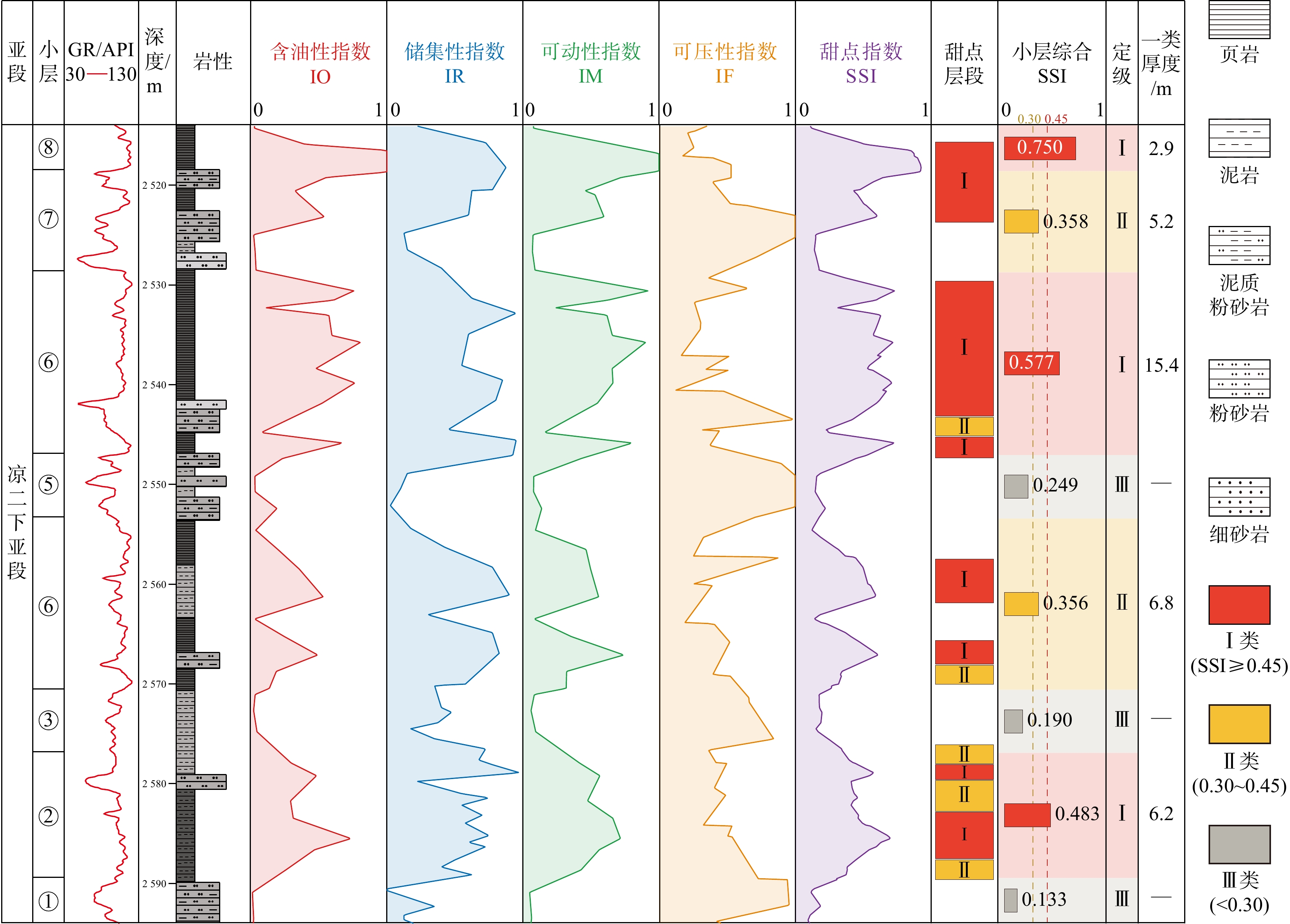
S 1(1.48 mg/g)、OSI(84 mg/g)与孔隙度(3.09%)最优而脆性矿物含量最低(39%);砂泥互层型孔隙度相近(3.04%),但薄砂界面频繁致游离油分散,S 1仅0.95 mg/g;砂岩夹层型脆性矿物含量最高(52%)、可压性最优;介壳夹层型含油性与可动性最差。⑧、⑥、②小层达一类,一类甜点段累计36.5 m,其中⑥~⑧小层集中23.5 m。结论四性受源储配置一级控制,连续页岩型一类样点占比77%,远高于其余3类组合(33%~40%),甜点边界应依源储配置而非地层界面厘定;甜点纵向归纳为⑥至⑧与②至④两套层系(跨度均33~36 m),其间⑤小层可作天然隔层,宜部署纵向交错井网并分层体积压裂。所建评价流程可为源储配置多变的陆相页岩油甜点评价与立体开发提供借鉴。
Abstract:ObjectiveThe lower submember of the second member of the Jurassic Lianggaoshan Formation (hereafter referred to as the lower Liang-2 submember) in the eastern Sichuan Basin is rich in continental shale oil resources. However, sandstone, mudstone, and shell limestone are frequently interbedded in this interval, which makes source–reservoir configuration change rapidly in the vertical direction. The differences in the four key properties of shale oil (oil-bearing capacity, reservoir quality, oil mobility, and fracability) and the factors controlling these differences remain unclear, hindering the accurate selection of sweet-spot intervals.
MethodsBased on core analyses and well-log data from two cored wells, lithofacies were classified using a three-level coupled scheme, and were then grouped into source–reservoir assemblages according to the lithology and scale of the interlayers and their contact relationships with the shale. Free hydrocarbon content (
S 1), porosity, the oil saturation index (OSI, defined asS 1/TOC×100, where TOC denotes total organic carbon content), and brittle-mineral content were selected to characterize oil-bearing capacity, reservoir quality, mobility, and fracability, respectively, and the measured data were plotted and compared by assemblage type. A four-property comprehensive sweet-spot index (SSI) was then constructed using combination weights obtained by coupling an improved analytic hierarchy process (AHP) with the entropy weight method, and was used to rank the sublayers and to delineate sweet-spot intervals continuously along the well profile.ResultsEight lithofacies were identified and grouped into four types of source-reservoir assemblages, namely the continuous-shale, sandstone-interbedded, shell-interbedded, and sandstone–mudstone interbedded types. The four properties varied systematically with the source–reservoir configuration. The continuous-shale type had the highest
S 1 (1.48 mg/g), OSI (84 mg/g), and porosity (3.09%) but the lowest brittle-mineral content (39%), and itsS 1 was strongly controlled by TOC. The sandstone–mudstone interbedded type had a porosity (3.04%) comparable to that of the continuous-shale type, but frequent thin-sand interfaces dispersed the free oil, resulting in anS 1 of only 0.95 mg/g. The sandstone-interbedded type had the highest brittle-mineral content (52%) and thus the best fracability, whereas the shell-interbedded type was the poorest in oil-bearing capacity and mobility. The combination weights of oil-bearing capacity, reservoir quality, mobility, and fracability were 0.477, 0.222, 0.203, and 0.098, respectively. With SSI thresholds of 0.45 for class I and 0.30 for class II, sublayers 8, 6, and 2 were ranked as class I, with SSI values of 0.750, 0.577, and 0.483, respectively. Class-I sweet-spot intervals totaled 36.5 m, of which 23.5 m was concentrated in sublayers 6 to 8.ConclusionThe four properties are controlled at the first order by the source–reservoir configuration. In the continuous profile, 77% of the sample points of the continuous-shale type are of class I, considerably higher than the 33%-40% in the other three assemblage types, and class-I intervals can extend across sublayer boundaries. Sweet-spot boundaries should therefore be defined by the source–reservoir configuration rather than by stratigraphic surfaces. Vertically, the sweet spots can be grouped into two sets of intervals, sublayers 6 to 8 and sublayers 2 to 4, each spanning 33-36 m, which is comparable to the hydraulic-fracture height commonly observed in the area. The tight sublayer 5 between them belongs to class III and can serve as a natural barrier for separate-layer stimulation. A vertically staggered well pattern combined with layered volumetric fracturing is therefore recommended. The proposed workflow, in which the four-property data are compared by source–reservoir assemblage and the sublayers and intervals are graded with the combination-weighted SSI, provides a reference for sweet-spot evaluation and three-dimensional development of continental shale oil plays with highly variable source–reservoir configurations.
-
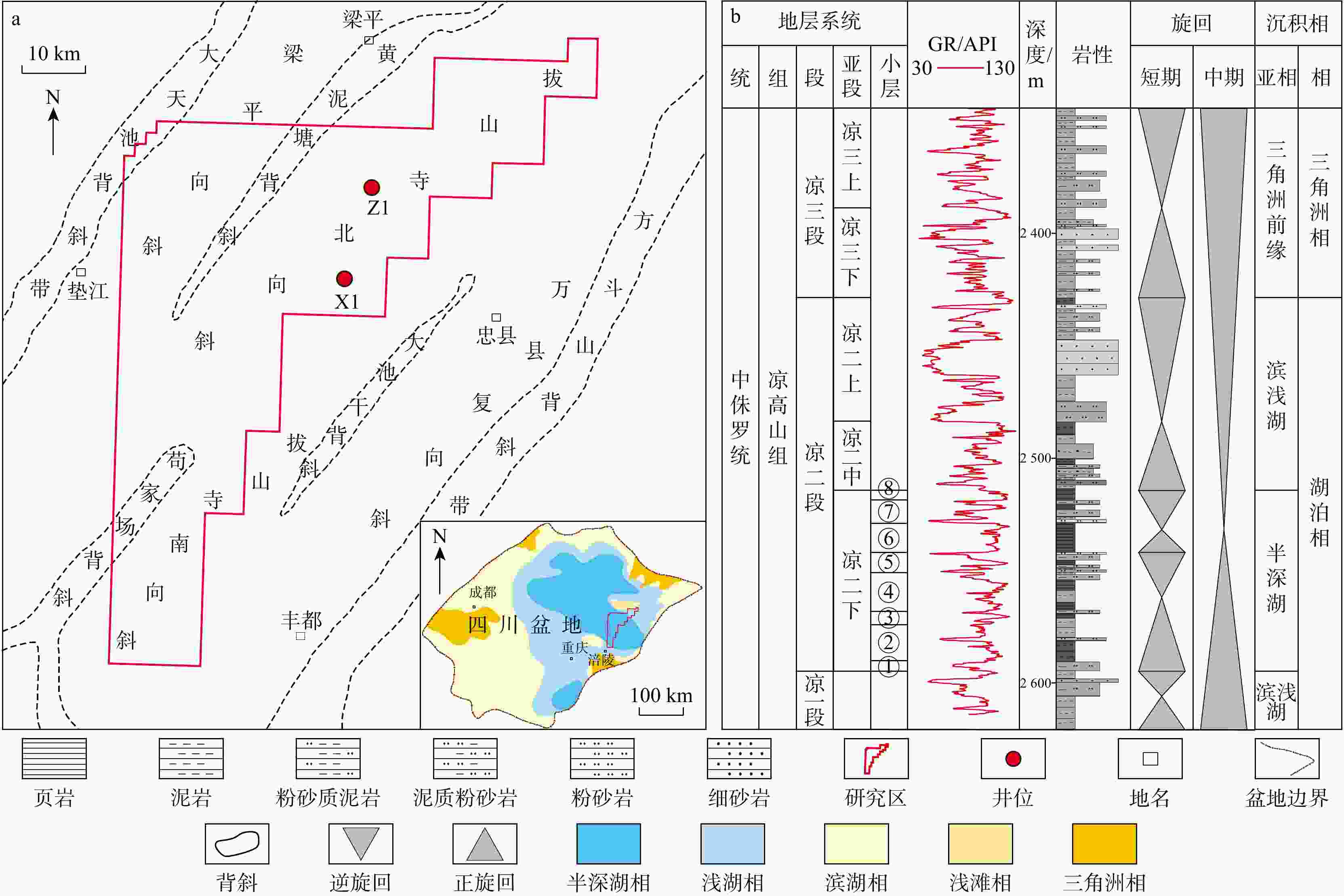
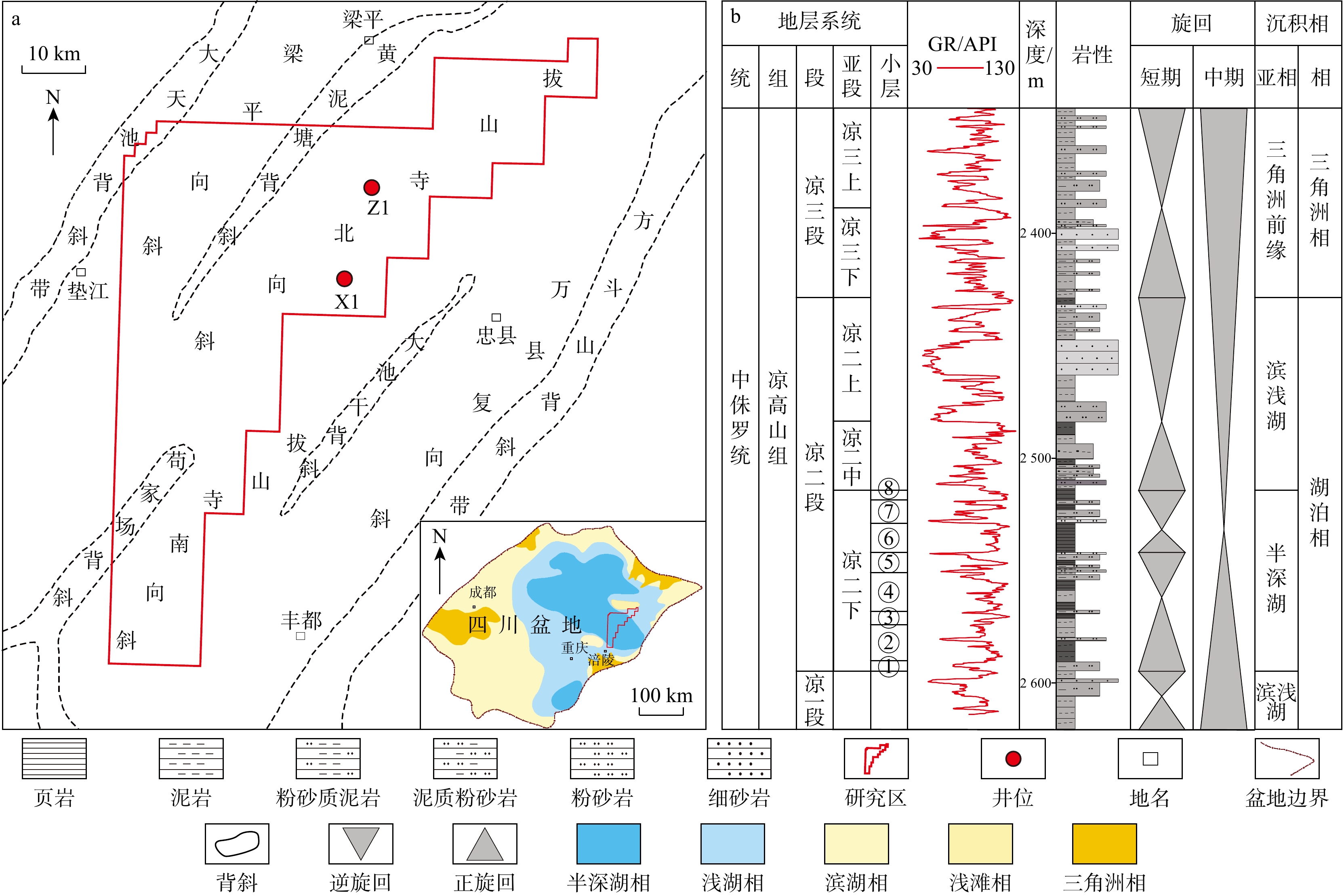
图 1 四川盆地东部构造位置(a)及侏罗系凉高山组地层柱状图(b)(GR为自然伽马,下同)
Figure 1. Structural location of eastern Sichuan Basin (a) and stratigraphic column of Jurassic Lianggaoshan Formation (b)
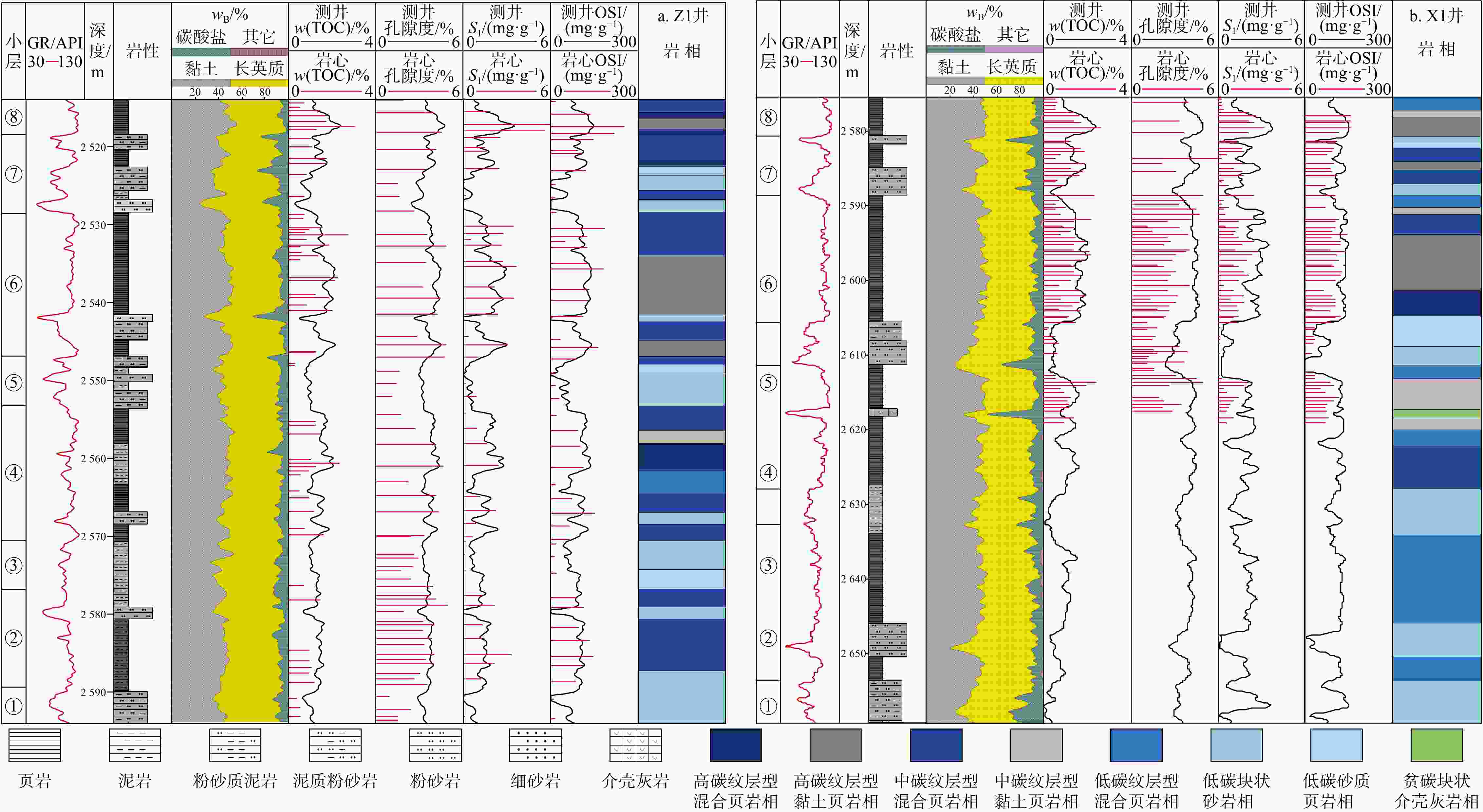
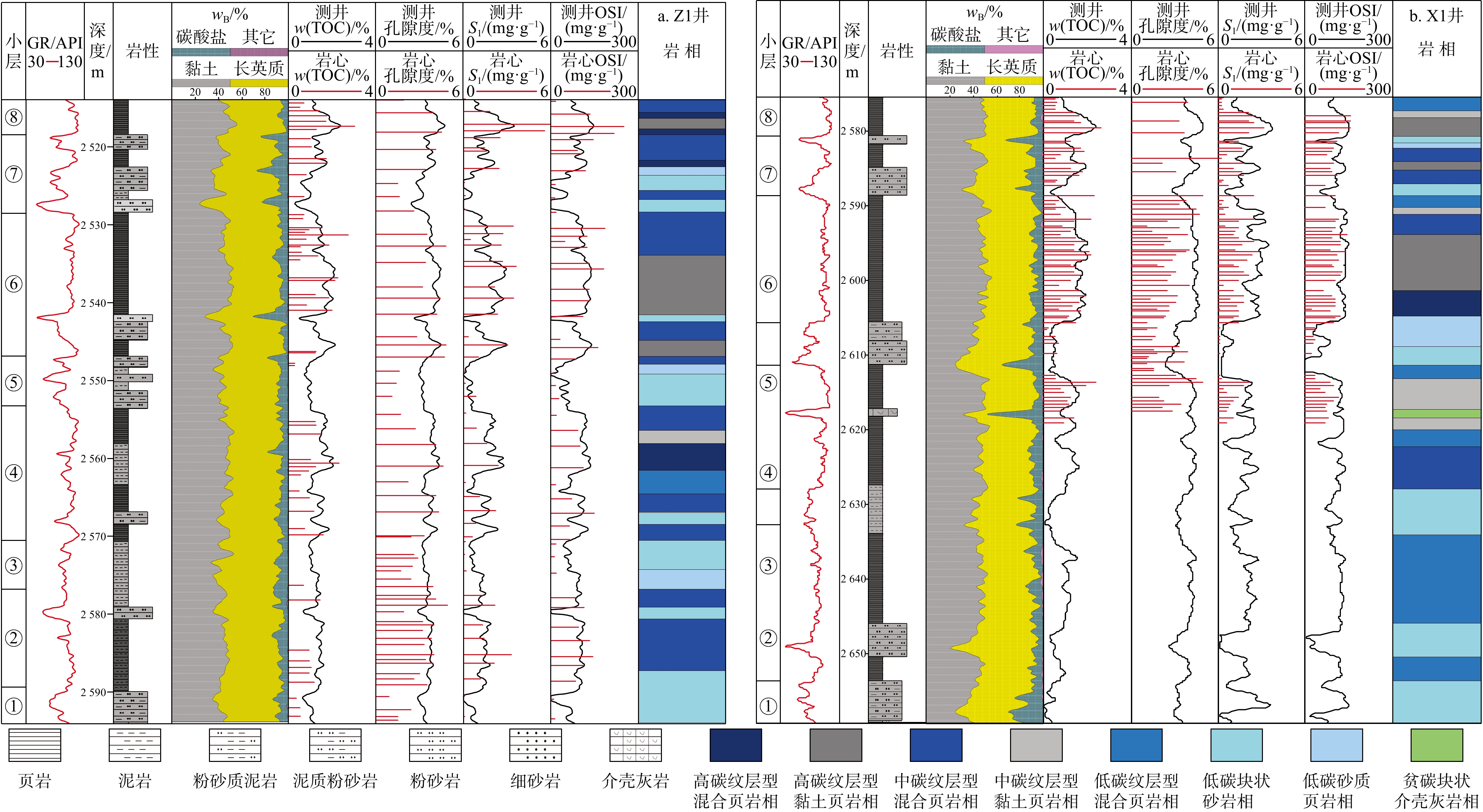
图 2 四川盆地东部凉二下亚段典型井综合柱状图
S1为游离烃质量分数;OSI为含油饱和度指数;下同
Figure 2. Comprehensive stratigraphic columns of typical wells of lower Liang-2 submember in eastern Sichuan Basin
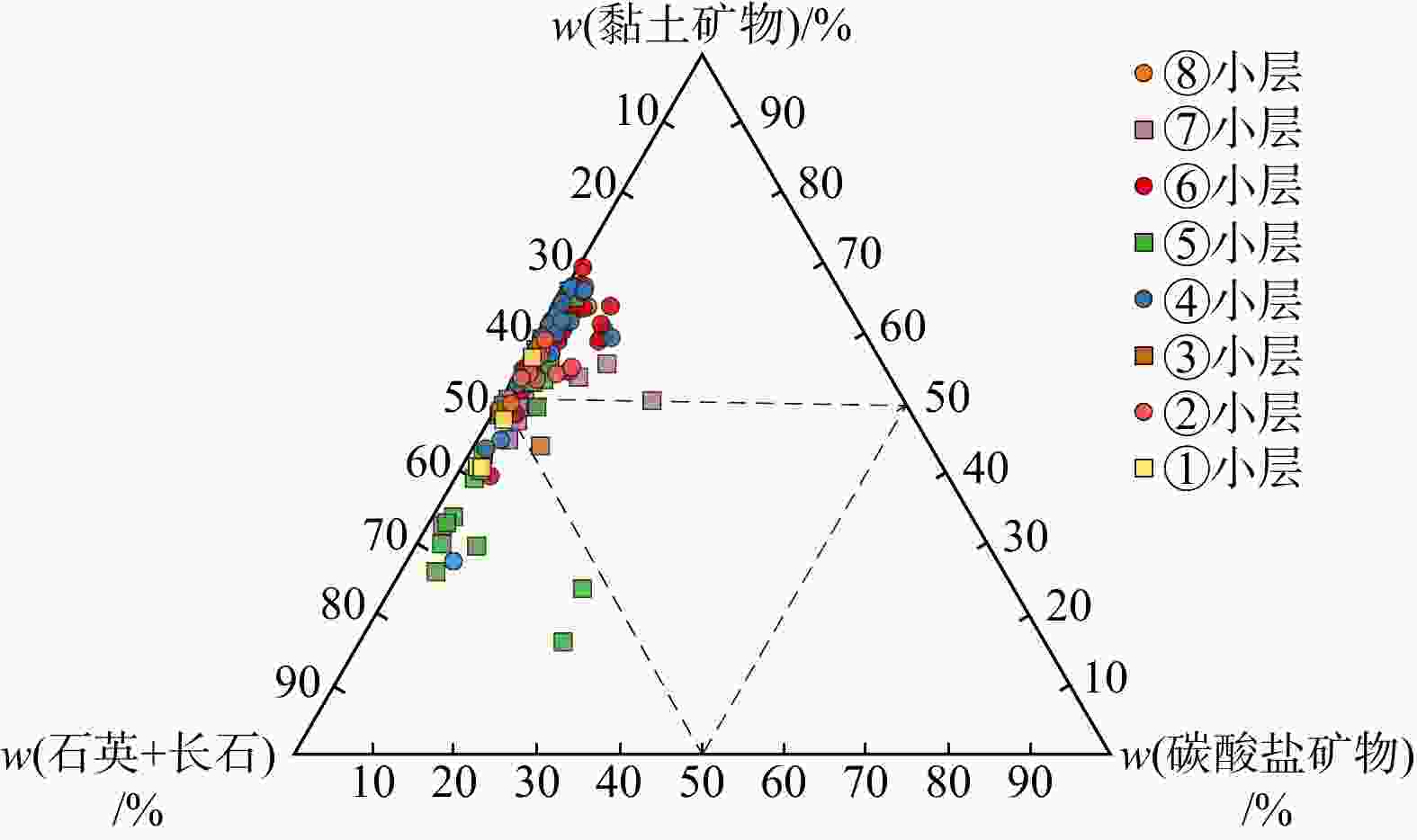
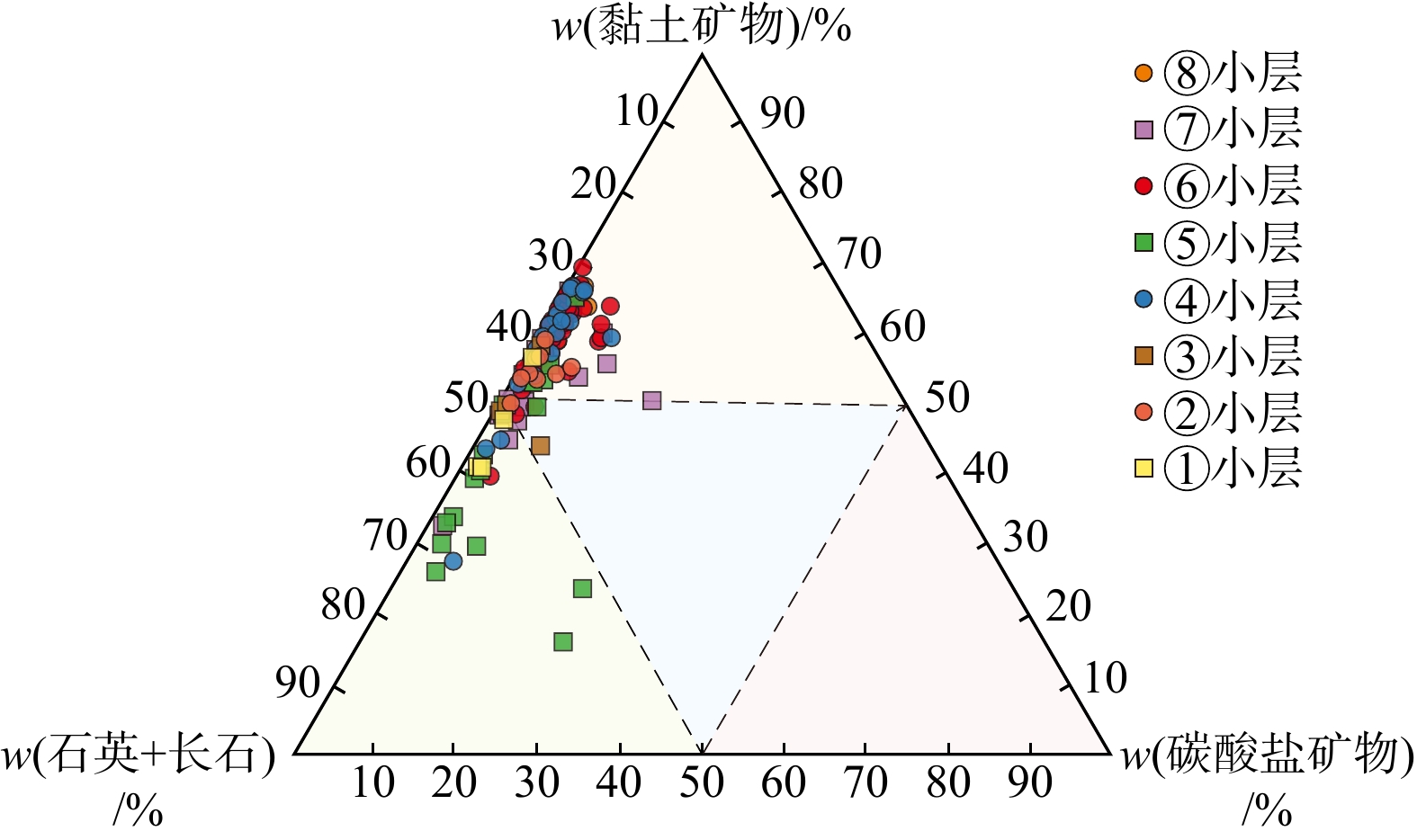
图 3 四川盆地东部凉二下亚段矿物组成三角图
Figure 3. Ternary diagram of mineral compositions of lower Liang-2 submember in eastern Sichuan Basin
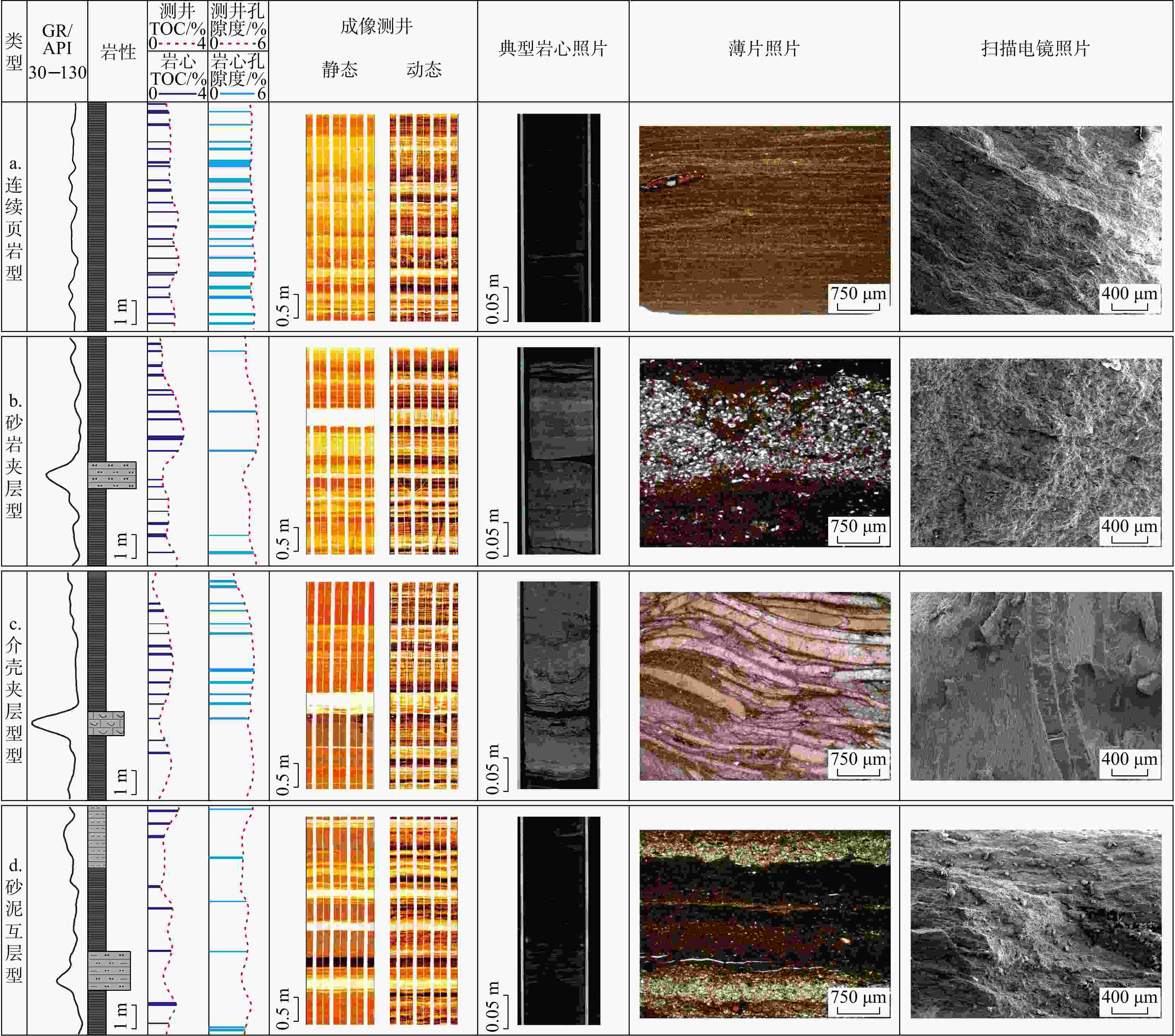
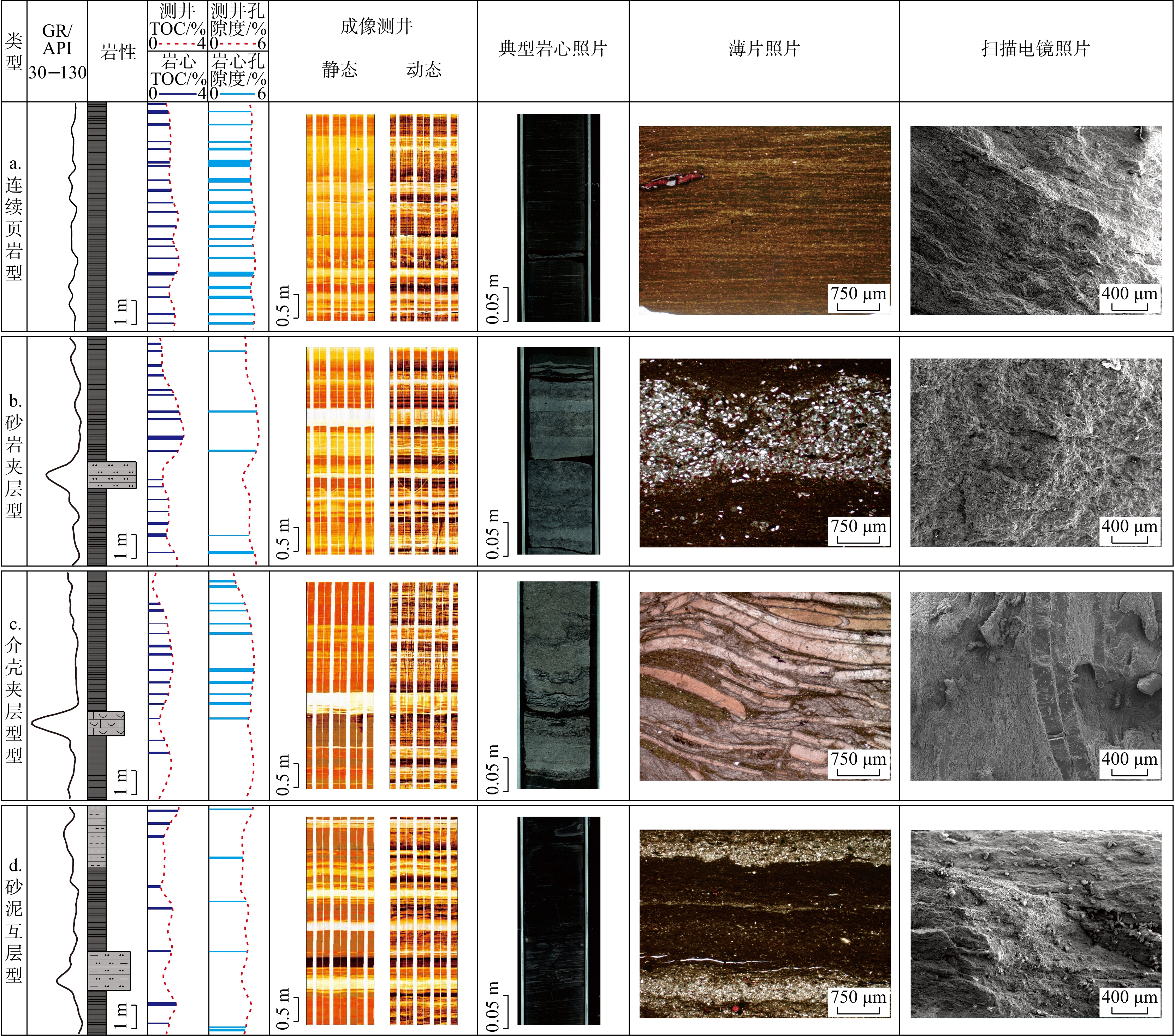
图 4 四川盆地东部凉二下亚段页岩源储组合特征
a. 连续页岩型;b. 砂岩夹层型;c. 介壳夹层型;d. 砂泥互层型
Figure 4. Characteristics of source–reservoir assemblages in shale of lower Liang-2 submember in eastern Sichuan Basin
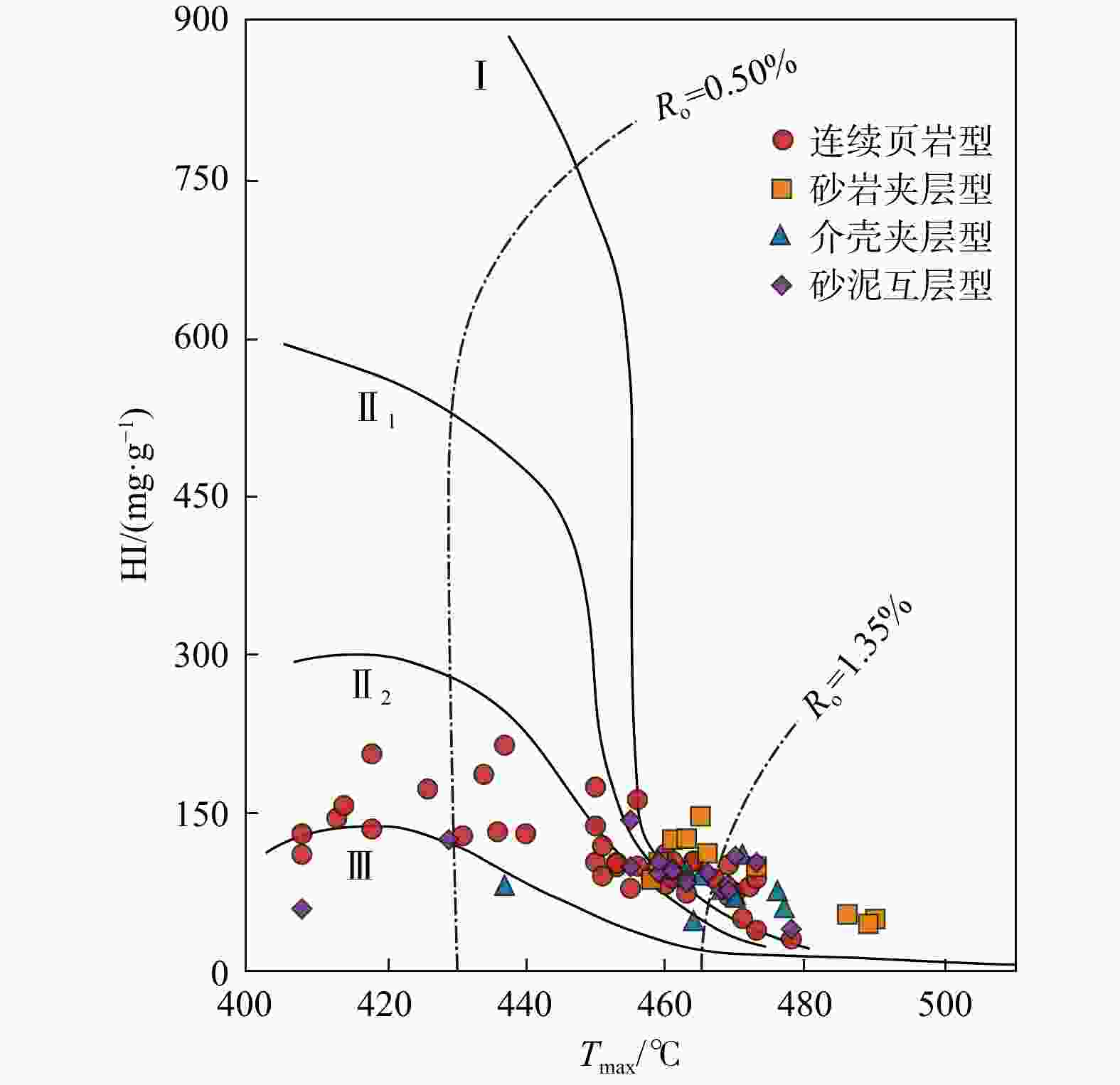
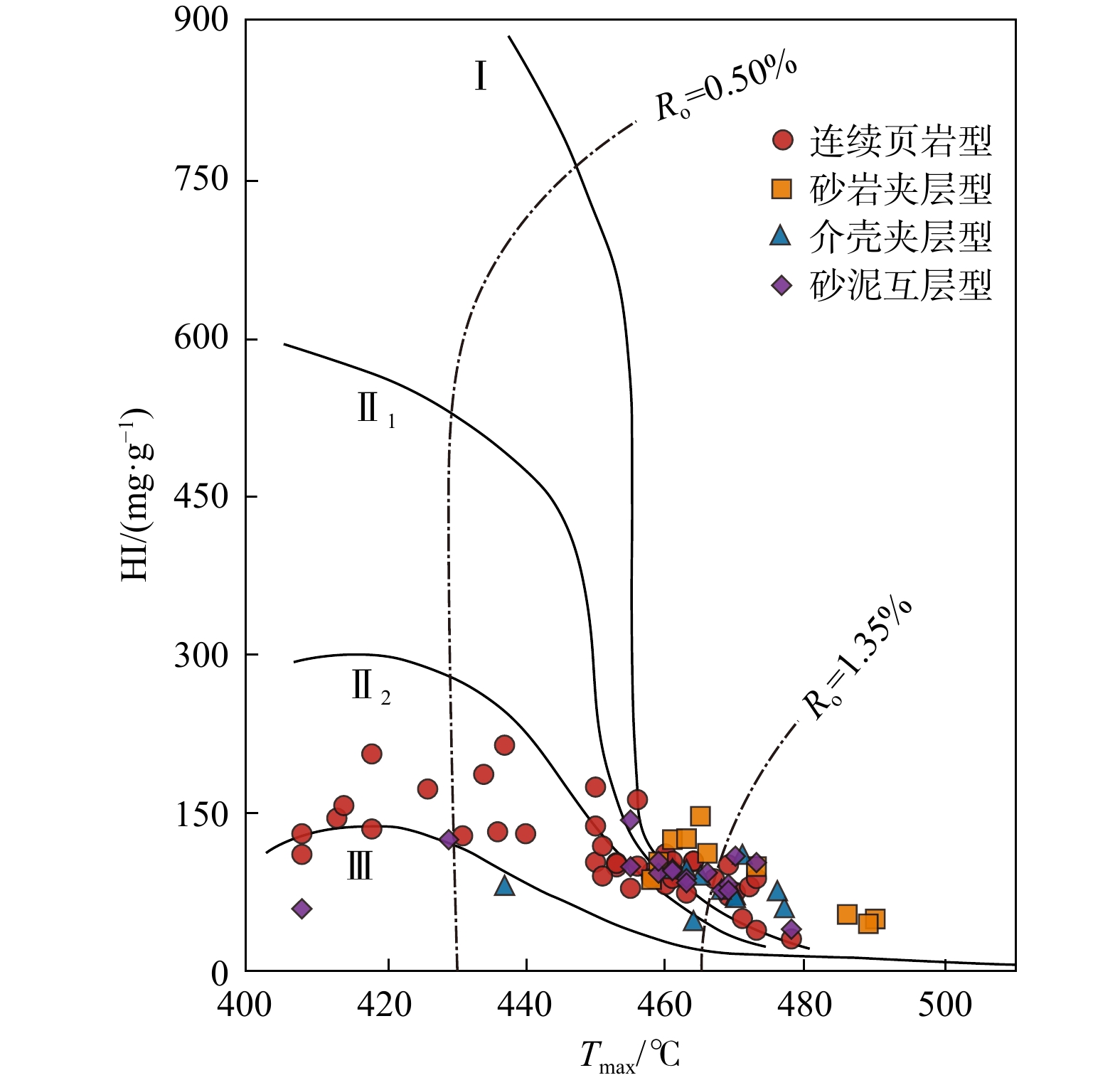
图 5 凉二下亚段页岩HI-Tmax有机质类型判识图
Ro为镜质体反射率。Ⅰ,Ⅱ1,Ⅱ2,Ⅲ均为有机质类型编号
Figure 5. Identification of organic matter types in shale of lower Liang-2 submember based on HI-Tmax diagram
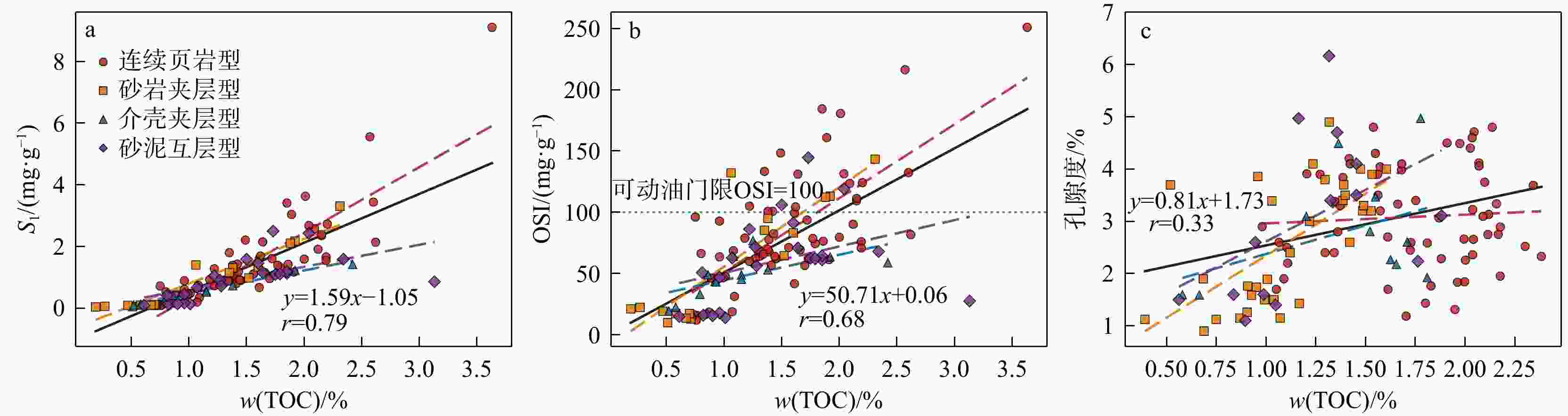
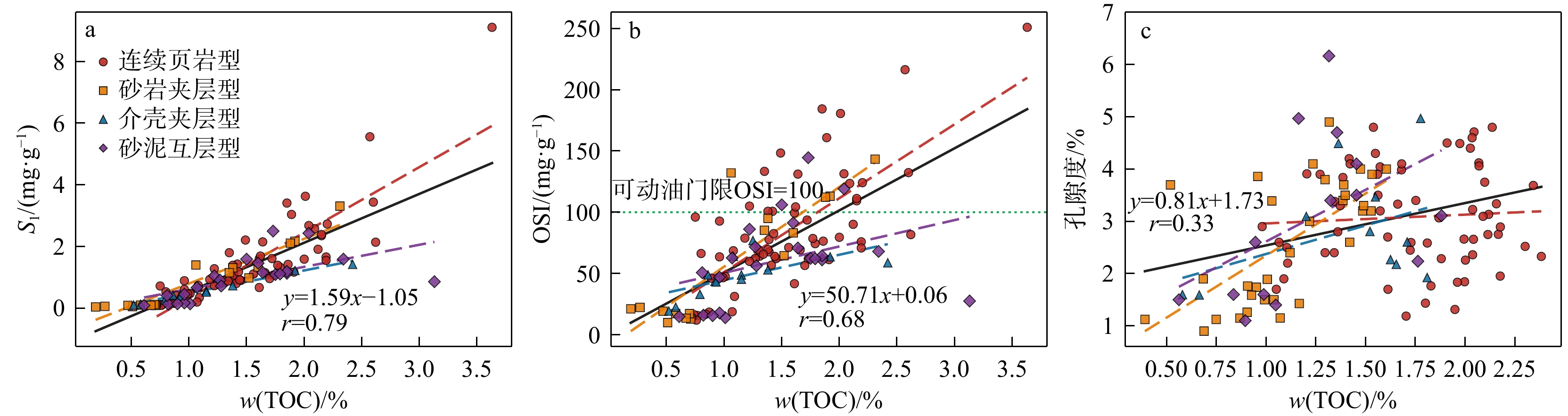
图 6 凉二下亚段含油性、可动性与储集性交会图(r. 相关系数,下同)
Figure 6. Crossplots of oil-bearing capacity, mobility, and reservoir quality of lower Liang-2 submember
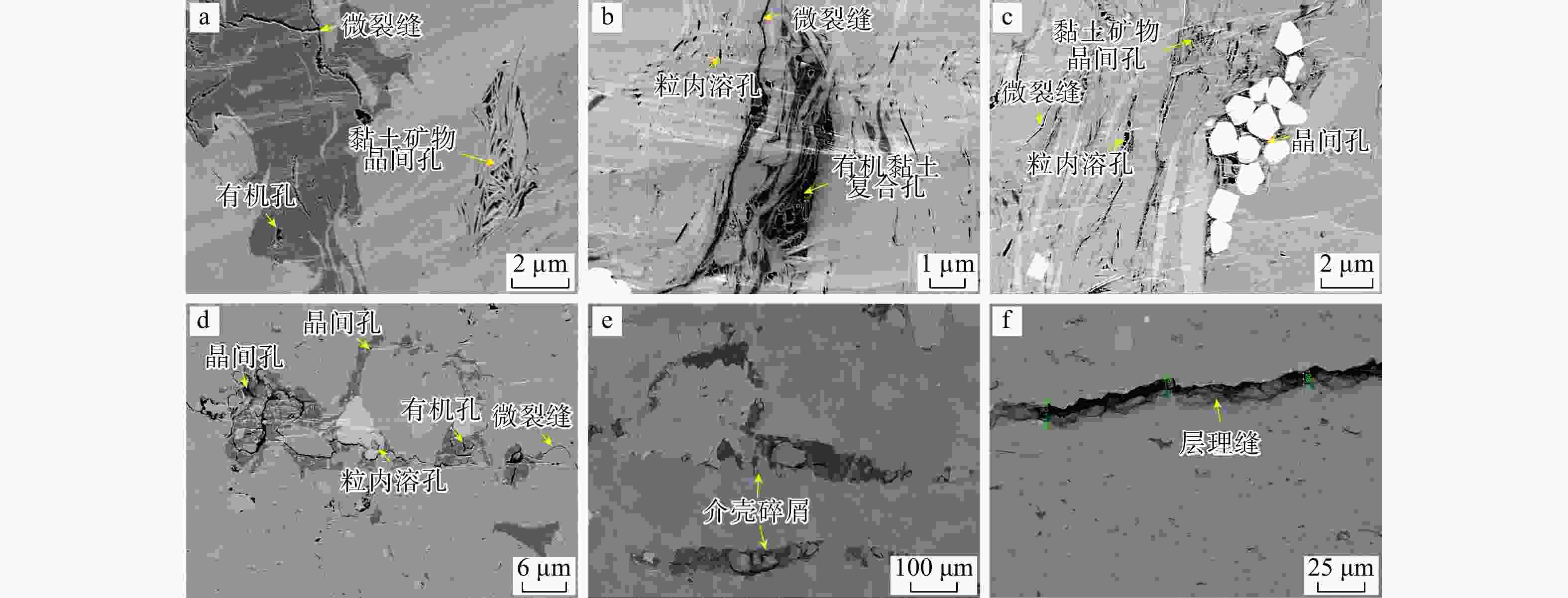
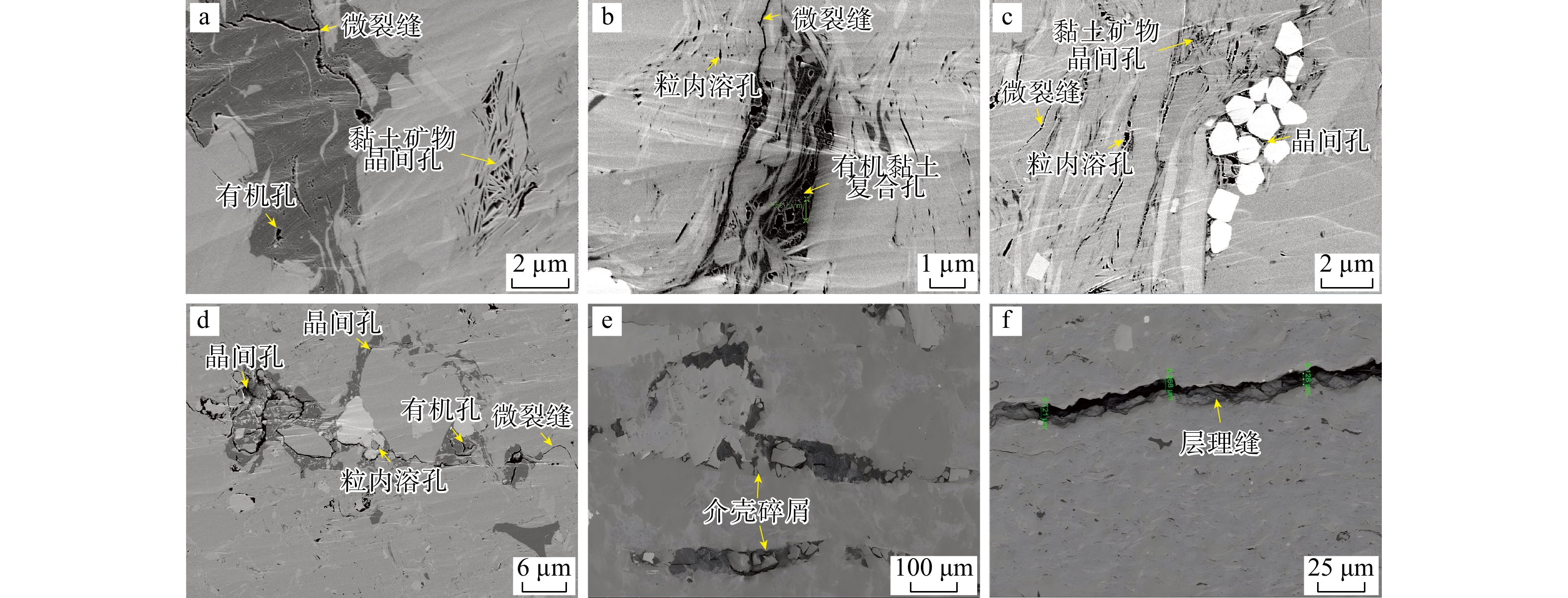
图 7 凉二下亚段页岩主要储集空间类型扫描电镜(SEM)特征
a. 连续页岩型,黏土矿物间发育晶间孔,部分有机质内有机孔及微裂缝较发育,Z1井,
2532.3 m;b. 连续页岩型,有机黏土复合孔较发育,孔径多在600 nm之内,粒内溶孔、微裂缝少量,X1井,2579.5 m;c. 砂岩夹层型,黏土及黄铁矿晶间孔较发育,粒内溶孔、微裂缝少量,X1井,2593.1 m;d. 砂泥互层型,晶间孔、粒内溶孔、有微裂缝,Z1井,2585.0 m;e. 介壳夹层型,钙质介壳碎屑,Z1井,埋深2557.12 m;f. 砂泥互层型,层理缝,Z1井,2577.83 mFigure 7. SEM images of main reservoir-space types in shale of lower Liang-2 submember
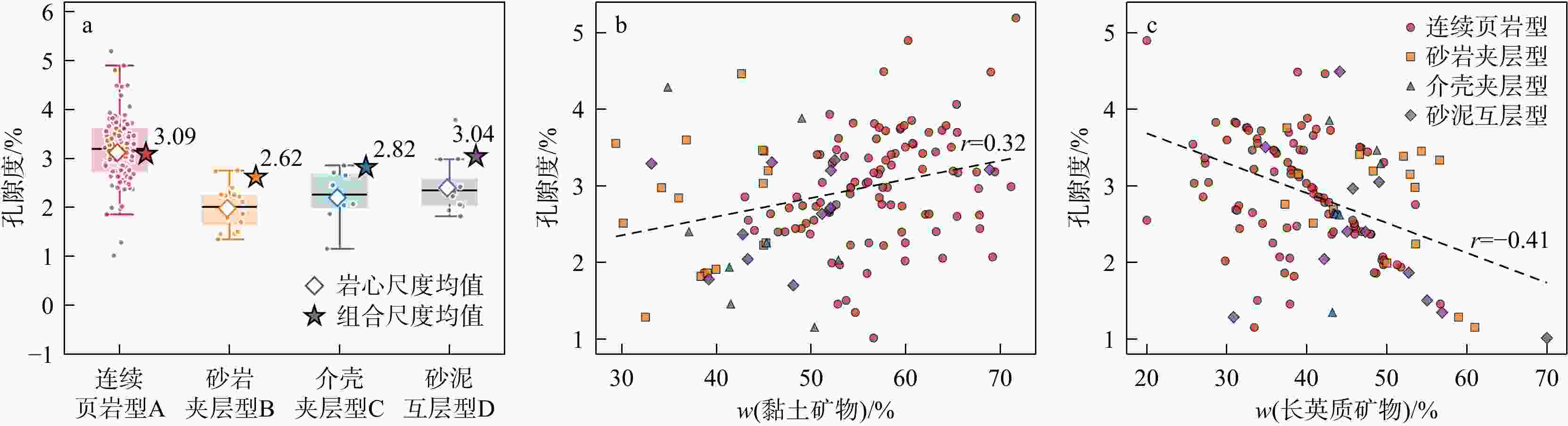
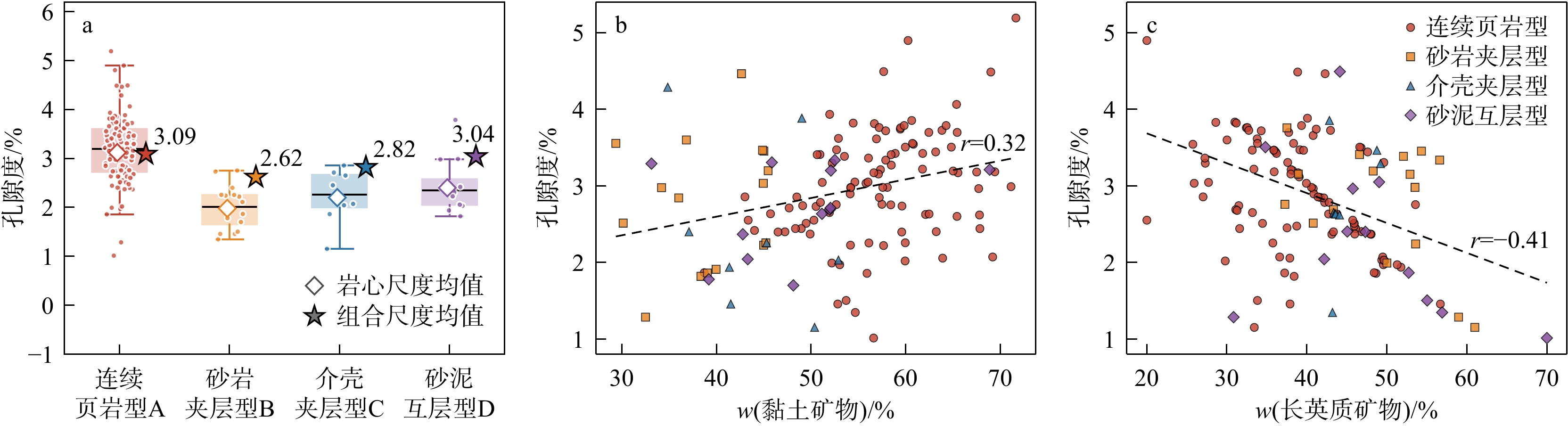
图 8 凉二下亚段孔隙度组合间对比及其岩相控制
Figure 8. Porosity comparison among source–reservoir assemblages and its lithofacies control in lower Liang-2 submember

图 9 凉二下亚段4类源储组合四性关键参数对比
Figure 9. Comparison of key four-property parameters among four types of source–reservoir assemblages of lower Liang-2 submember
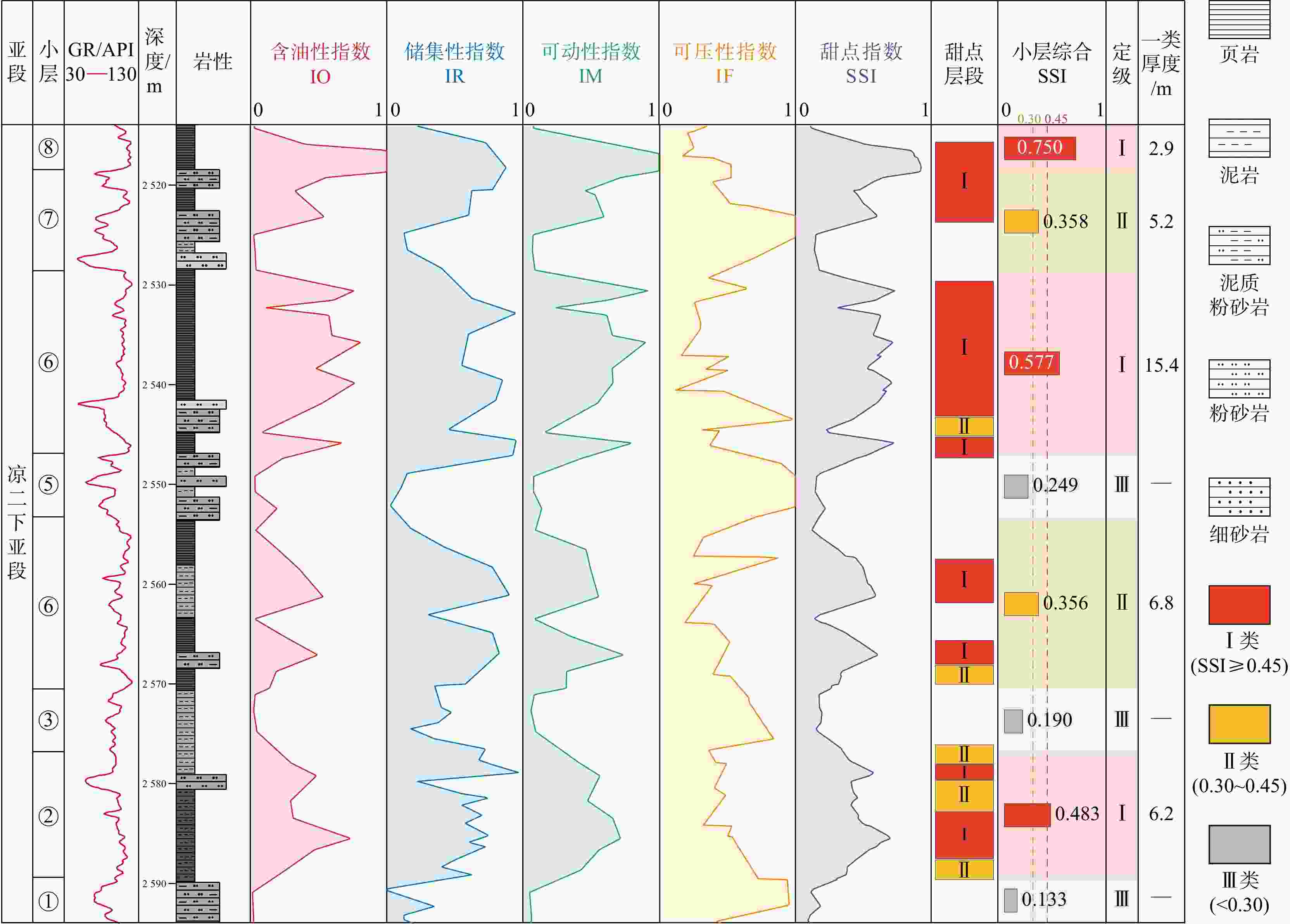
图 10 凉二下亚段甜点综合评价柱状图
IO,IR,IM,IF分别为S1、孔隙度、OSI与脆性矿物含量的极差归一化指数;SSI为四性综合甜度指数
Figure 10. Comprehensive stratigraphic column of sweet-spot evaluation of lower Liang-2 submember
表 1 凉二下亚段四性参数主客观组合赋权结果
Table 1. Subjective-objective combination weighting results of four-property parameters of lower Liang-2 submember
四性参数 评价指标 改进AHP主观权重α 熵权法客观权重β 组合权重W 含油性 S1 0.513 0.422 0.477 储集性 孔隙度 0.275 0.170 0.222 可动性 OSI 0.138 0.285 0.203 可压性 w(脆性矿物) 0.074 0.123 0.098 注:主观权重α由改进层次分析法求得,比较矩阵判断值取0、1、2三级,经对数反对称矩阵与最优传递矩阵转化得拟优一致矩阵,其特征向量归一化即为α,最大特征根为4、一致性比例为0,方法据文献[40];客观权重β由熵权法据Z1井0.1 m连续剖面归一化矩阵(样品数n=804)的信息熵计算[39];组合权重W与α、β乘积的平方根成正比再归一化;表中数值为3位小数舍入值  下载: 导出CSV
-
[1] ZHAO W Z, HU S Y, HOU L H, et al. Types and resource potential of continental shale oil in China and its boundary with tight oil[J]. Petroleum Exploration and Development, 2020, 47(1): 1-11. doi: 10.1016/S1876-3804(20)60001-5 [2] ZHAO X Z, LIU Y, WU Z Y, et al. Diversity of continental shale oil in China[J]. Earth-Science Reviews, 2026, 281: 105589. doi: 10.1016/j.earscirev.2026.105589 [3] ZHU R K, ZHANG Z Y, FENG C, et al. Research progress, challenges, and prospects of continental shale oil[J]. Petroleum Exploration and Development, 2026, 53(3): 708-722. doi: 10.1016/S1876-3804(26)60721-5 [4] JIN Z J, ZHU R K, LIANG X P, et al. Several issues worthy of attention in current lacustrine shale oil exploration and development[J]. Petroleum Exploration and Development, 2021, 48(6): 1471-1484. doi: 10.1016/s1876-3804(21)60303-8 [5] SANG Q, GUO X Q, DONG M Z. Occurrence mechanism of shale oil in laminated shale reservoirs: A review[J]. Petroleum Science, 2026, 23(4): 1773-1803. doi: 10.1016/j.petsci.2026.03.037 [6] WANG E Z, FENG Y, GUO T L, et al. Oil content and resource quality evaluation methods for lacustrine shale: A review and a novel three-dimensional quality evaluation model[J]. Earth-Science Reviews, 2022, 232: 104134. doi: 10.1016/j.earscirev.2022.104134 [7] PANG X Q, LI M, LI B Y, et al. Main controlling factors and movability evaluation of continental shale oil[J]. Earth-Science Reviews, 2023, 243: 104472. doi: 10.1016/j.earscirev.2023.104472 [8] 李志明, 刘雅慧, 何晋译, 等. 陆相页岩油“甜点”段评价关键参数界限探讨[J]. 石油与天然气地质, 2023, 44(6): 1453-1467. doi: 10.11743/ogg20230610LI Z M, LIU Y H, HE J Y, et al. Limits of critical parameters for sweet-spot interval evaluation of lacustrine shale oil[J]. Oil & Gas Geology, 2023, 44(6): 1453-1467. (in Chinese with English abstract) doi: 10.11743/ogg20230610 [9] 郭旭升, 赵培荣, 张宇, 等. 中国陆相页岩油分类分级评价的现状、挑战与发展趋势[J]. 石油与天然气地质, 2025, 46(6): 1745-1761. doi: 10.11743/ogg20250601GUO X S, ZHAO P R, ZHANG Y, et al. Current status, challenges, and future trends of the classification and grading evaluation of lacustrine shale oil in China[J]. Oil & Gas Geology, 2025, 46(6): 1745-1761. (in Chinese with English abstract) doi: 10.11743/ogg20250601 [10] ZHANG S Q, REN S X, YUE D L, et al. A shale oil 'sweet-spot' evaluation factor construction method based on quantitative analysis of the influence degree of geological controlling factors[J]. Unconventional Resources, 2026, 13: 100404. doi: 10.1016/j.uncres.2026.100404 [11] 郭旭升, 胡宗全, 申宝剑, 等. 中国页岩油气源−储耦合类型划分及勘探意义[J]. 石油学报, 2024, 45(11): 1565-1578. doi: 10.7623/syxb202411001GUO X S, HU Z Q, SHEN B J, et al. Classification and exploration significance of source-reservoir coupling types of shale oil and gas in China[J]. Acta Petrolei Sinica, 2024, 45(11): 1565-1578. (in Chinese with English abstract) doi: 10.7623/syxb202411001 [12] 郭旭升, 申宝剑, 王鹏威, 等. 基于源−储单元的页岩油气甜点段评价优选新思路[J]. 石油与天然气地质, 2025, 46(1): 1-14. doi: 10.11743/ogg20250101GUO X S, SHEN B J, WANG P W, et al. A new approach to the evaluation and optimal selection of shale oil and gas sweet spot intervals based on source rock-reservoir units[J]. Oil & Gas Geology, 2025, 46(1): 1-14. (in Chinese with English abstract) doi: 10.11743/ogg20250101 [13] ZHAO X Z, ZHOU L H, PU X G, et al. Theories, technologies and practices of lacustrine shale oil exploration and development: A case study of Paleogene Kongdian Formation in Cangdong Sag, Bohai Bay Basin, China[J]. Petroleum Exploration and Development, 2022, 49(3): 707-718. doi: 10.1016/S1876-3804(22)60059-4 [14] 庞小娇, 王贵文, 匡立春, 等. 沉积环境控制下的页岩岩相组合类型及测井表征—— 以松辽盆地古龙凹陷青山口组为例[J]. 古地理学报, 2023, 25(5): 1156-1175.PANG X J, WANG G W, KUANG L C, et al. Logging evaluation of lithofacies and their assemblage under control of sedimentary environment: A case study of the Qingshankou Formation in Gulong Sag, Songliao Basin[J]. Journal of Palaeogeography (Chinese Edition), 2023, 25(5): 1156-1175. (in Chinese with English abstract) [15] 冯家乐, 杨升宇, 胡钦红, 等. 沧东凹陷孔二段页岩生排烃效率及对含油性的影响[J]. 中国石油大学学报(自然科学版), 2024, 48(2): 45-56. doi: 10.3969/j.issn.1673-5005.2024.02.005FENG J L, YANG S Y, HU Q H, et al. Hydrocarbon generation and expulsion efficiency and influence on oil bearing property of shale in the Second Member of Paleogene Kongdian Formation in Cangdong Sag[J]. Journal of China University of Petroleum (Edition of Natural Science), 2024, 48(2): 45-56. (in Chinese with English abstract) doi: 10.3969/j.issn.1673-5005.2024.02.005 [16] 王恩泽, 黎茂稳, 唐勇, 等. 准噶尔盆地吉木萨尔凹陷二叠系芦草沟组陆相页岩油甜点评价与立体开发可行性分析[J]. 石油与天然气地质, 2025, 46(6): 1998-2011. doi: 10.11743/ogg20250616WANG E Z, LI M W, TANG Y, et al. Sweet spot evaluation and feasibility of cube development of continental shale oil in the Permian Lucaogou Formation, Jimusar Sag, Junggar Basin[J]. Oil & Gas Geology, 2025, 46(6): 1998-2011. (in Chinese with English abstract) doi: 10.11743/ogg20250616 [17] 曹剑, 秦志军, 魏超, 等. 陆相纹层型页岩油源储耦合与甜点形成机理——以准噶尔盆地风城组为例[J]. 新疆石油地质, 2025, 46(6): 668-683. doi: 10.7657/XJPG20250603CAO J, QIN Z J, WEI C, et al. Source-reservoir coupling and sweet spot formation mechanism of continental laminated shale oil: A case study of the Fengcheng Formation, Junggar Basin[J]. Xinjiang Petroleum Geology, 2025, 46(6): 668-683. (in Chinese with English abstract) doi: 10.7657/XJPG20250603 [18] 王鹏威, 刘忠宝, 张殿伟, 等. 四川盆地复兴地区中侏罗统凉高山组页岩油富集条件及勘探潜力[J]. 天然气地球科学, 2023, 34(7): 1237-1246. doi: 10.11764/j.issn.1672-1926.2023.01.012WANG P W, LIU Z B, ZHANG D W, et al. Shale oil enrichment conditions and exploration potential of Middle Jurassic Lianggaoshan Formation in Fuxing area, Sichuan Basin[J]. Natural Gas Geoscience, 2023, 34(7): 1237-1246. (in Chinese with English abstract) doi: 10.11764/j.issn.1672-1926.2023.01.012 [19] 胡宗全, 刘忠宝, 李倩文, 等. 基于变尺度岩相组合的陆相页岩源-储耦合机理探讨——以四川盆地侏罗系页岩层段为例[J]. 石油与天然气地质, 2024, 45(4): 893-909. doi: 10.11743/ogg20240402HU Z Q, LIU Z B, LI Q W, et al. Exploring source rock-reservoir coupling mechanisms in lacustrine shales based on varying-scale lithofacies assemblages: A case study of the Jurassic shale intervals in the Sichuan Basin[J]. Oil & Gas Geology, 2024, 45(4): 893-909. (in Chinese with English abstract) doi: 10.11743/ogg20240402 [20] 彭伟, 舒逸, 陈绵琨, 等. 四川盆地复兴地区侏罗系凉高山组致密砂岩储层特征及其主控因素[J]. 地质科技通报, 2023, 42(3): 102-113. doi: 10.19509/j.cnki.dzkq.tb20220282PENG W, SHU Y, CHEN M K, et al. Tight sandstone reservoir characteristics and main controlling factors of Jurassic Lianggaoshan Formation in Fuxing area, Sichuan Basin[J]. Bulletin of Geological Science and Technology, 2023, 42(3): 102-113. (in Chinese with English abstract) doi: 10.19509/j.cnki.dzkq.tb20220282 [21] 郭战峰, 舒逸, 陈绵琨, 等. 川东侏罗系凉高山组页岩沉积环境特征及有机质富集机理[J]. 地质科技通报, 2024, 43(4): 62-74. doi: 10.19509/j.cnki.dzkq.tb20230727GUO Z F, SHU Y, CHEN M K, et al. Characteristics of the shale sedimentary environment and organic matter enrichment mechanism in the Jurassic Lianggaoshan Formation in the East Sichuan Basin[J]. Bulletin of Geological Science and Technology, 2024, 43(4): 62-74. (in Chinese with English abstract) doi: 10.19509/j.cnki.dzkq.tb20230727 [22] 魏志红, 石文斌, 魏祥峰, 等. 四川盆地复兴地区侏罗系页岩源−储耦合特征及页岩油气甜点优选[J]. 天然气工业, 2025, 45(1): 37-52. doi: 10.3787/j.issn.1000-0976.2025.01.004WEI Z H, SHI W B, WEI X F, et al. Source-reservoir coupling characteristics of Jurassic shale and sweet spot selection of shale oil/gas in Fuxing area of the Sichuan Basin[J]. Natural Gas Industry, 2025, 45(1): 37-52. (in Chinese with English abstract) doi: 10.3787/j.issn.1000-0976.2025.01.004 [23] FANG R, JIANG Y Q, SUN S S, et al. Controlling factors of organic matter accumulation and lacustrine shale distribution in Lianggaoshan Formation, Sichuan Basin, SW China[J]. Frontiers in Earth Science, 2023, 11: 1218215. doi: 10.3389/feart.2023.1218215 [24] YAN W L, WANG C Y, YIN S J, et al. A log-based method for fine-scale evaluation of lithofacies and its applications to the Gulong shale in the Songliao Basin, Northeast China[J]. Energy Geoscience, 2024, 5(3): 100291. doi: 10.1016/j.engeos.2024.100291 [25] LIANG Q S, CHEN Q L, LU Y F, et al. Lithofacies characteristics and sedimentary evolution of the Lianggaoshan Formation in the southeastern Sichuan Basin[J]. Minerals, 2025, 15(9): 1003. doi: 10.3390/min15091003 [26] 国家市场监督管理总局, 国家标准化管理委员会. 页岩油地质评价方法: GB/T 38718—2020[S]. 北京: 中国标准出版社, 2020.State Administration for Market Regulation, Standardization Administration of the People's Republic of China. Geological evaluating methods for shale oil: GB/T 38718—2020[S]. Beijing: Standards Press of China, 2020. (in Chinese) [27] ZOU C N, QIU Z, ZHANG J Q, et al. Unconventional petroleum sedimentology: A key to understanding unconventional hydrocarbon accumulation[J]. Engineering, 2022, 18: 62-78. doi: 10.1016/j.eng.2022.06.016 [28] SHI H C, XIAN B Z, LIU Y C, et al. High-frequency sequence patterns in lacustrine basins: Insights from delta-hyperpycnal flow systems in the Middle Jurassic shale interval, Sichuan Basin, China[J]. Sedimentary Geology, 2025, 487: 106948. doi: 10.1016/j.sedgeo.2025.106948 [29] 曹强, 周可佳, 王昌丽, 等. 陆相断陷湖盆深层页岩沉积特征及勘探潜力评价——以板桥凹陷沙三段为例[J]. 地质科技通报, 2025, 44(5): 106-122. doi: 10.19509/j.cnki.dzkq.tb20250049CAO Q, ZHOU K J, WANG C L, et al. Sedimentary characteristics and exploration potential evaluation of deep shale in continental rift lake: A case study of the Third Member of the Shahejie Formation in the Banqiao Sag[J]. Bulletin of Geological Science and Technology, 2025, 44(5): 106-122. (in Chinese with English abstract) doi: 10.19509/j.cnki.dzkq.tb20250049 [30] HU T, JING Z H, ZHANG Q, et al. Shale oil micro-migration characterization: Key methods and outlook[J]. Advances in Geo-Energy Research, 2025, 15(1): 5-12. doi: 10.46690/ager.2025.01.02 [31] LIU F, HAN Y J, BAO H Y, et al. On the generation of light hydrocarbons from the closed pores of Jurassic strata, Sichuan Basin[J]. Marine and Petroleum Geology, 2025, 171: 107208. doi: 10.1016/j.marpetgeo.2024.107208 [32] 董景海, 张继伟, 王显东, 等. 四川盆地仪陇−平昌地区凉高山组页岩生烃特征及页岩油资源潜力[J]. 大庆石油地质与开发, 2026, 45(2): 1-10. doi: 10.19597/J.ISSN.1000-3754.202408041DONG J H, ZHANG J W, WANG X D, et al. Hydrocarbon generation characteristics and shale oil resource potential of Lianggaoshan Formation shale in Yilong-Pingchang area of Sichuan Basin[J]. Petroleum Geology & Oilfield Development in Daqing, 2026, 45(2): 1-10. (in Chinese with English abstract) doi: 10.19597/J.ISSN.1000-3754.202408041 [33] XIONG Z M, HU T, WU Y Q, et al. Oiliness gradation of hybrid sedimentary shale with low-moderate organic matter content: A case study of the Paleocene Shahejie Formation in Dongpu Depression, Bohai Bay Basin[J]. International Journal of Coal Science & Technology, 2025, 12(1): 74. doi: 10.1007/s40789-025-00805-1 [34] GUO Q L, YAO Y, HOU L H, et al. Oil migration, retention, and differential accumulation in "sandwiched" lacustrine shale oil systems from the Chang 7 Member of the Upper Triassic Yanchang Formation, Ordos Basin, China[J]. International Journal of Coal Geology, 2022, 261: 104077. doi: 10.1016/j.coal.2022.104077 [35] 高波, 郝芳, 张志垚. 渤海湾盆地东营凹陷沙四上亚段页岩储层特征及主控因素[J]. 地质科技通报, 2025, 44(3): 70-81. doi: 10.19509/j.cnki.dzkq.tb20240707GAO B, HAO F, ZHANG Z Y. Characteristics and controlling factors of shale reservoirs in the Upper Fourth Member of the Shahejie Formation in Dongying Sag, Bohai Bay Basin[J]. Bulletin of Geological Science and Technology, 2025, 44(3): 70-81. (in Chinese with English abstract) doi: 10.19509/j.cnki.dzkq.tb20240707 [36] FENG Y, XIAO X M, WANG E Z, et al. Oil mobility evaluation and light hydrocarbon restoration in shale reservoirs: A review[J]. Gondwana Research, 2026, 154: 122-154. doi: 10.1016/j.gr.2025.12.010 [37] JARVIE D M. Shale resource systems for oil and gas: Part 2—Shale-oil resource systems[M]//BREYER J A. Shale reservoirs—Giant resources for the 21st century: AAPG Memoir 97. Tulsa: American Association of Petroleum Geologists, 2012: 89-119. [38] XU S, WEN J, LIU K Q, et al. Brittle minerals, mechanical properties and fracability evaluation of shales[J]. Advances in Geo-Energy Research, 2024, 14(1): 8-11. doi: 10.46690/ager.2024.10.03 [39] 侯恩科, 纪卓辰, 车晓阳, 等. 基于改进AHP和熵权法耦合的风化基岩富水性预测方法[J]. 煤炭学报, 2019, 44(10): 3164-3173. doi: 10.13225/j.cnki.jccs.2018.1210HOU E K, JI Z C, CHE X Y, et al. Water abundance prediction method of weathered bedrock based on improved AHP and the entropy weight method[J]. Journal of China Coal Society, 2019, 44(10): 3164-3173. (in Chinese with English abstract) doi: 10.13225/j.cnki.jccs.2018.1210 [40] 白雪峰, 王民, 王鑫, 等. 四川盆地东北部侏罗系凉高山组页岩油甜点与富集区评价[J]. 地球科学, 2024, 49(12): 4483-4500. doi: 10.3799/dqkx.2024.075BAI X F, WANG M, WANG X, et al. Evaluation of shale oil sweet spot and rich area in Jurassic Lianggaoshan Formation, Northeast Sichuan Basin[J]. Earth Science, 2024, 49(12): 4483-4500. (in Chinese with English abstract) doi: 10.3799/dqkx.2024.075 [41] 肖佳林, 李保林, 游园, 等. 复兴区块陆相页岩压裂成缝特征与增产改造策略分析[J]. 断块油气田, 2024, 31(6): 1066-1075. doi: 10.6056/dkyqt202406016XIAO J L, LI B L, YOU Y, et al. Analysis of fracturing fracture characteristics and production increase and stimulation strategy of continental shale in Fuxing block[J]. Fault-Block Oil and Gas Field, 2024, 31(6): 1066-1075. (in Chinese with English abstract) doi: 10.6056/dkyqt202406016 [42] 李勇, 黄盟, 雷征东, 等. 中国陆相页岩油地质−工程一体化差异化开发对策[J]. 石油学报, 2026, 47(2): 437-454. doi: 10.7623/syxb202602010LI Y, HUANG M, LEI Z D, et al. Differentiated geoscience-engineering integrated development strategies for continental shale oil in China[J]. Acta Petrolei Sinica, 2026, 47(2): 437-454. (in Chinese with English abstract) doi: 10.7623/syxb202602010 [43] 魏兆胜, 齐洪岩, 赵建飞, 等. 准噶尔盆地页岩油开发进展及效益建产关键技术[J]. 新疆石油地质, 2025, 46(6): 703-711. doi: 10.7657/XJPG20250606WEI Z S, QI H Y, ZHAO J F, et al. Development progress and key technologies for cost-effective productivity of shale oil in Junggar Basin[J]. Xinjiang Petroleum Geology, 2025, 46(6): 703-711. (in Chinese with English abstract) doi: 10.7657/XJPG20250606 -

 下载:


 点击查看大图
计量
- 文章访问数: 83
- PDF下载量: 10
- 被引次数: 0