投审稿入口


Genetic mechanism of a high-fluoride and high-salinity geothermal system in Yingzhou-Xincun area, Lingshui, Hainan Province
-
摘要:
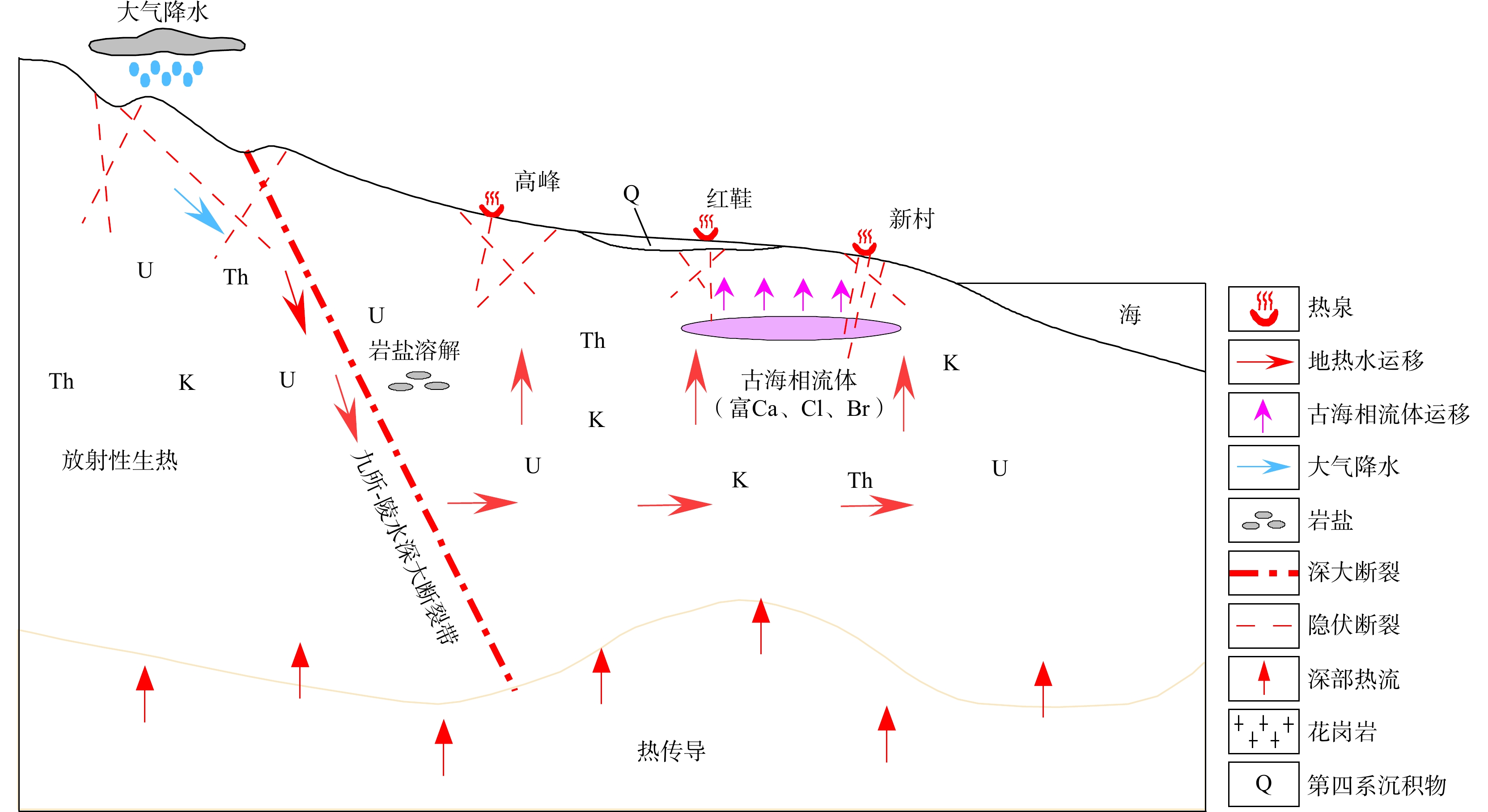
海南岛东南部陵水英州−新村地区广泛赋存中高温高氟地热系统,但氟组分与盐分负向耦合的机制尚不明确,制约了区域地热资源精细化开发。为揭示研究区 3 处地热田的地热水成因、空间分布规律及氟−盐负向耦合形成机理,以高峰、红鞋、新村 3 处地热田为研究对象,综合采用水化学组分测试、同位素示踪及水文地球化学模拟等方法开展多端元流体溯源与水−岩作用解析。结果表明:①受九所−陵水深大断裂分段控热控组分作用制约,研究区为中生代花岗岩裂隙型地热系统,地热流体源自北部低山丘陵区大气降水,补给高程 989~
1150 m,地下水年龄2844 ~13444 a,热储温度 125~165 ℃,呈内陆高、滨海低的空间分异;②地热水总溶解固体(TDS)最高可达2600 mg/L,高盐度特征与现代海水入侵无关,TDS自内陆向滨海呈递增;盐分来源受控于深部封存古海相流体与花岗岩硅酸盐矿物溶滤,阳离子交换进一步放大了地下水咸化的空间分异;③地热水 F−质量浓度为2.6~12.8 mg/L,由内陆向滨海递减;Ca2+活度是氟富集主控因素,HCO3−为辅助因子,温度起增效作用;古海相富钙流体混入诱发萤石沉淀是滨海低氟的关键诱因,最终形成全区 F−与 TDS,Cl−显著负耦合的分布规律。本研究厘清了滨海花岗岩地热系统氟、盐负耦合成因机理,填补海南滨海花岗岩地热系统氟−盐耦合演化机理的研究空白,可为华南滨海高氟高盐地热资源可持续开发提供理论依据。Abstract:ObjectiveMedium-to-high temperature fractured granite-hosted geothermal systems with elevated fluoride concentrations are widely developed in the Yingzhou-Xincun area of Lingshui, southeastern Hainan Island, representing a major occurrence of coastal geothermal resources in South China. Regional geothermal investigations have revealed a prominent negative coupling between fluoride and salinity in geothermal waters. Nevertheless, the genetic mechanism underlying this distinctive hydrogeochemical phenomenon remains poorly understood, which prevents an accurate characterization of hydrochemical evolution and greatly restricts the refined assessment, rational planning, and sustainable exploitation of regional geothermal resources. This study focuses on three representative geothermal fields, namely Gaofeng, Hongxie, and Xincun geothermal fields. It systematically investigates the recharge origin, formation genesis, and thermal reservoir evolution of geothermal water, characterizes the spatial variations in hydrochemical constituents, and elucidates the intrinsic mechanism governing the negative coupling between fluoride and salinity, thereby providing observational constraints and theoretical references for the scientific development and protection of regional geothermal resources.
MethodsBased on field surveys and systematic water sampling, multiple approaches including hydrochemical analysis, isotope tracers, and hydrogeochemical modelling were integrated. A multi-dimensional analysis of fluid provenance, water-rock interactions, ionic migration and transformation, and multi-end-member fluid mixing was performed to interpret the genesis and compositional evolution of the geothermal system.
Results① The geothermal system, constrained by the segmental heat-controlling and component-controlling effect of the Jiusuo-Lingshui deep major fault, was classified as a typical fractured geothermal reservoir hosted in Mesozoic granite. Geothermal fluids were recharged by infiltrating meteoric precipitation from low hilly terrain in the northern study area. Estimated recharge elevations ranged from 989 m to
1150 m, groundwater residence ages varied from2844 a to13444 a, and reservoir temperatures fell between 125 ℃ and 165 ℃, showing a spatial pattern with higher values inland and lower values toward the coast. ② The total dissolved solids (TDS) of geothermal water reached up to 2 600 mg/L, and the high salinity was unrelated to modern seawater intrusion. TDS generally increased progressively from inland to coastal zones. Salinity originated from mixing of deeply sequestered paleo-marine fluids and water-rock leaching of silicate minerals in granite. Cation exchange during groundwater circulation further amplified spatial contrasts in groundwater salinization. ③ Dissolved fluoride concentrations in geothermal water ranged from 2.6 mg/L to 12.8 mg/L and decreased gradually from inland to the coast. The activity of aqueous Ca2+ was the primary control on fluoride enrichment and mobilization. Bicarbonate (${\mathrm{HCO}}_3^- $) acted as an important secondary control, and elevated reservoir temperature substantially promoted fluoride release from mineral phases. Mixing of deeply sequestered Ca-rich paleo-marine fluids within coastal zones induced fluorite precipitation, the dominant driver of low fluoride concentrations in coastal geothermal water. This process ultimately yielded a pronounced negative coupling between F− and both TDS and Cl− across the entire study area.ConclusionThis study systematically clarifies the genetic mechanism for negative coupling between fluoride and salinity in coastal granite-hosted geothermal systems. It fills the knowledge gap of the fluoride-salinity coupling evolution mechanism for coastal granite-hosted geothermal systems on Hainan Island and provides an important theoretical foundation for detailed exploration, rational exploitation, and sustainable utilization of high-fluoride, high-salinity geothermal resources in coastal South China.
-
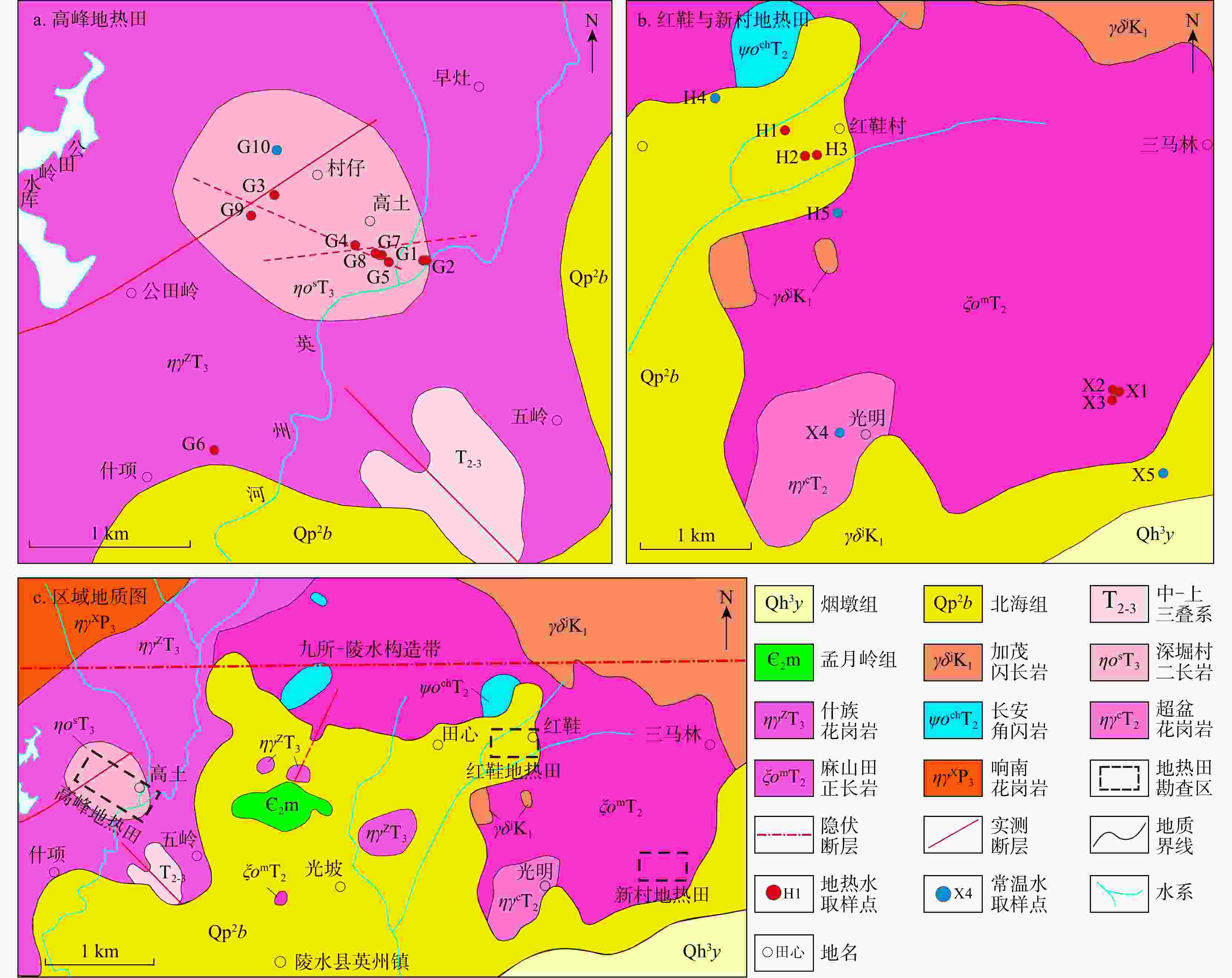
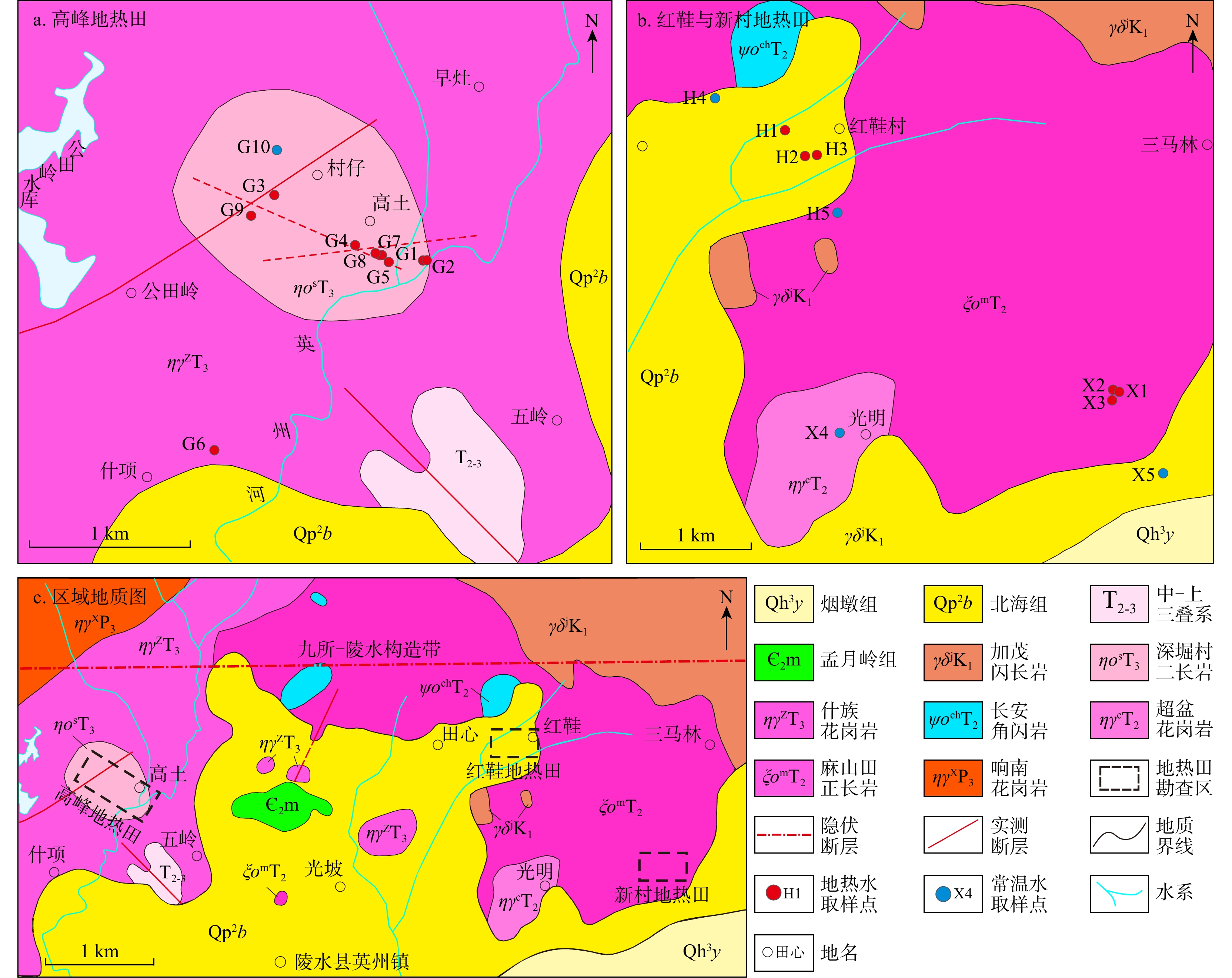
图 1 区域地质、地热田位置及采样点分布
Figure 1. Distribution map of regional geology, geothermal field locations, and sampling points
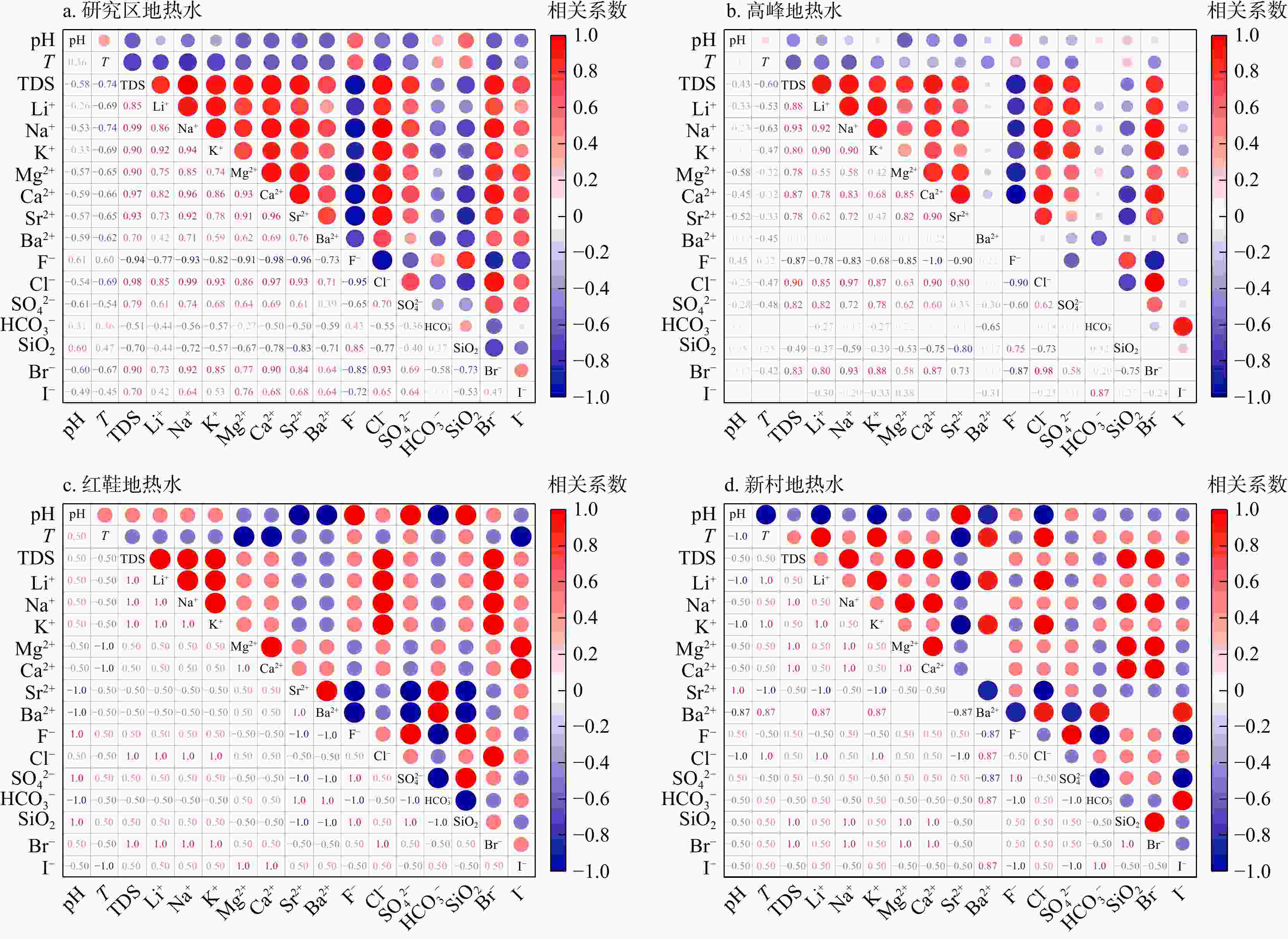
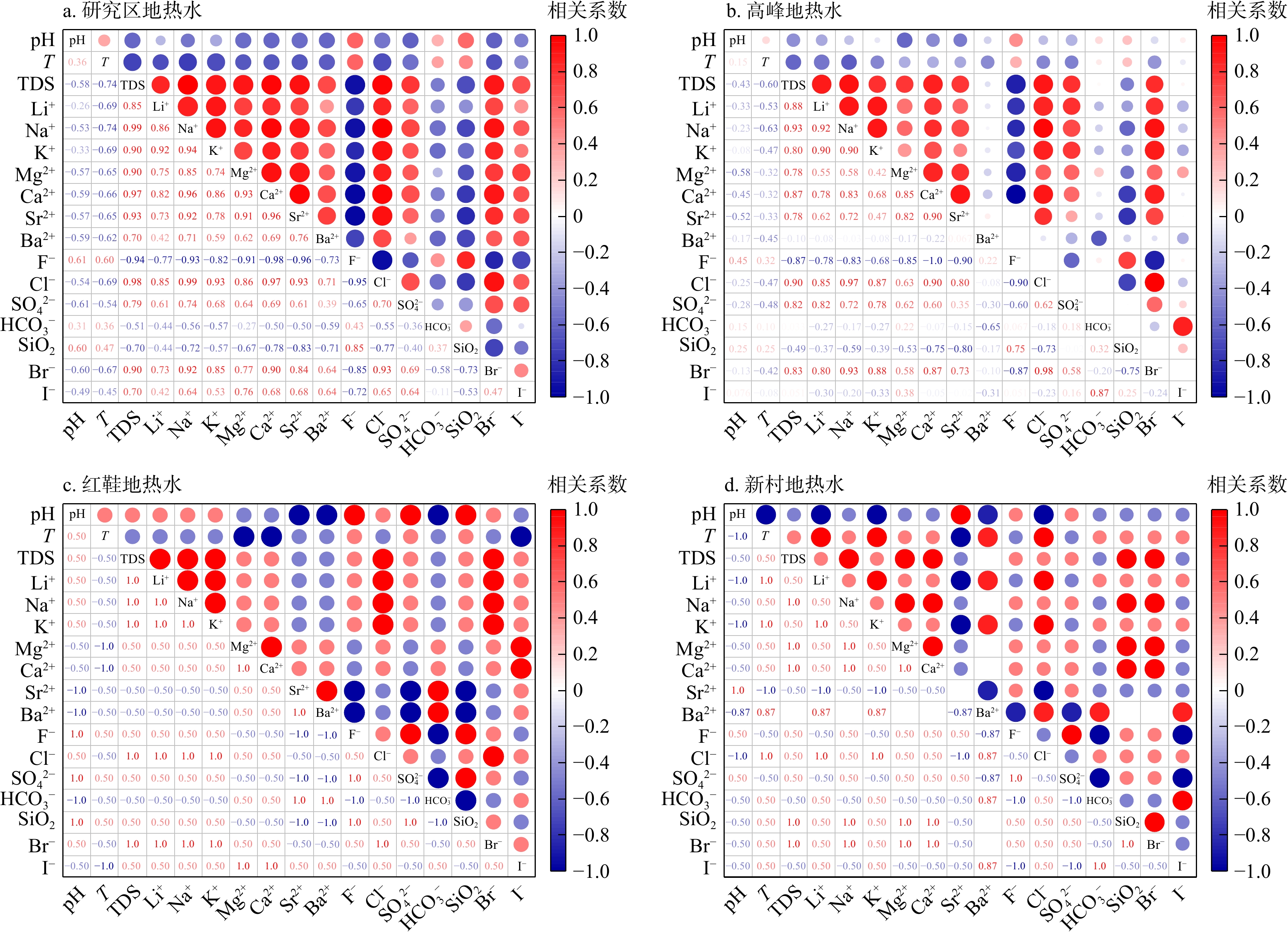
图 2 地热水水化学组分spearman相关性
Figure 2. Spearman correlation diagrams of hydrochemical components in geothermal water
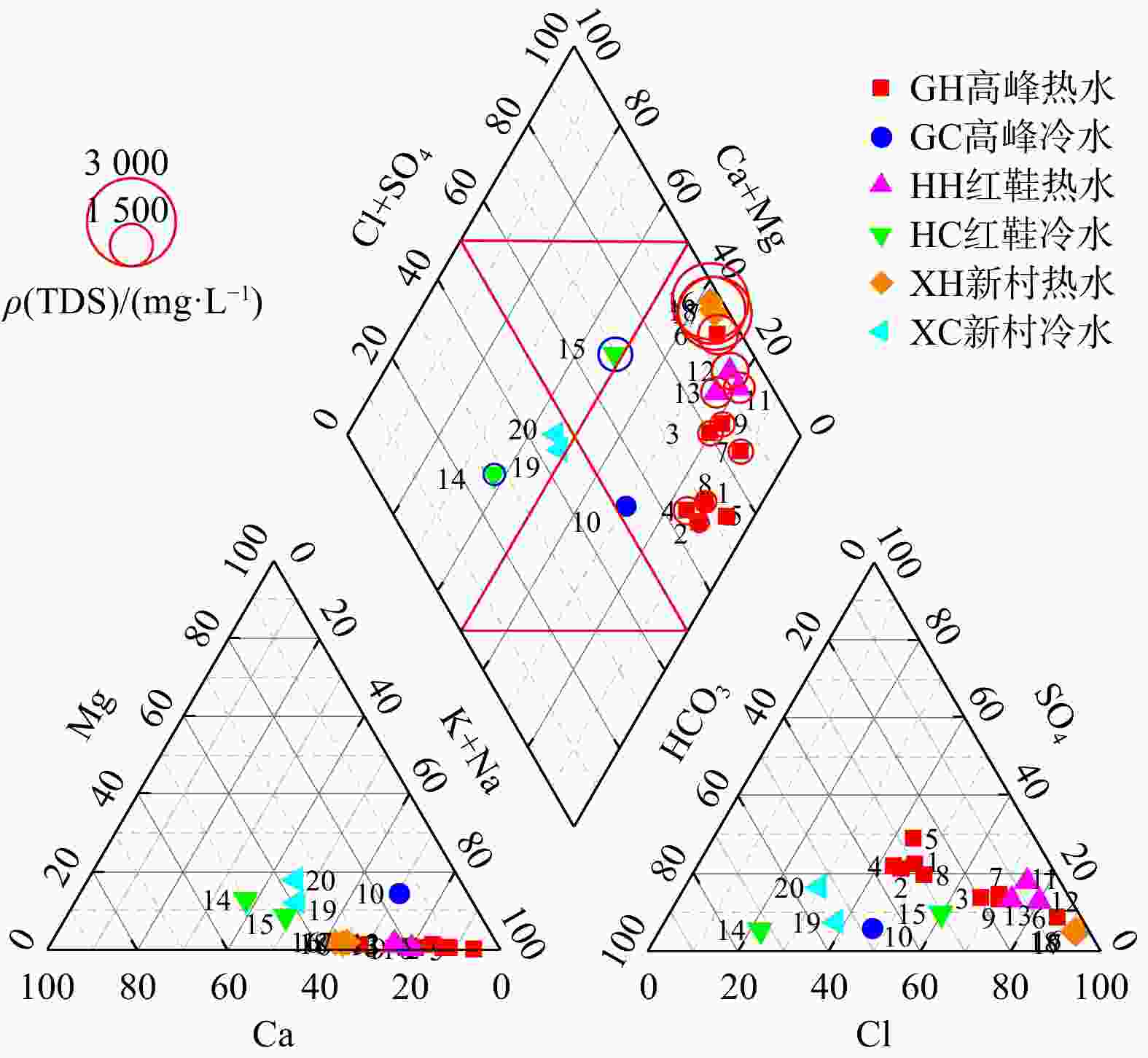
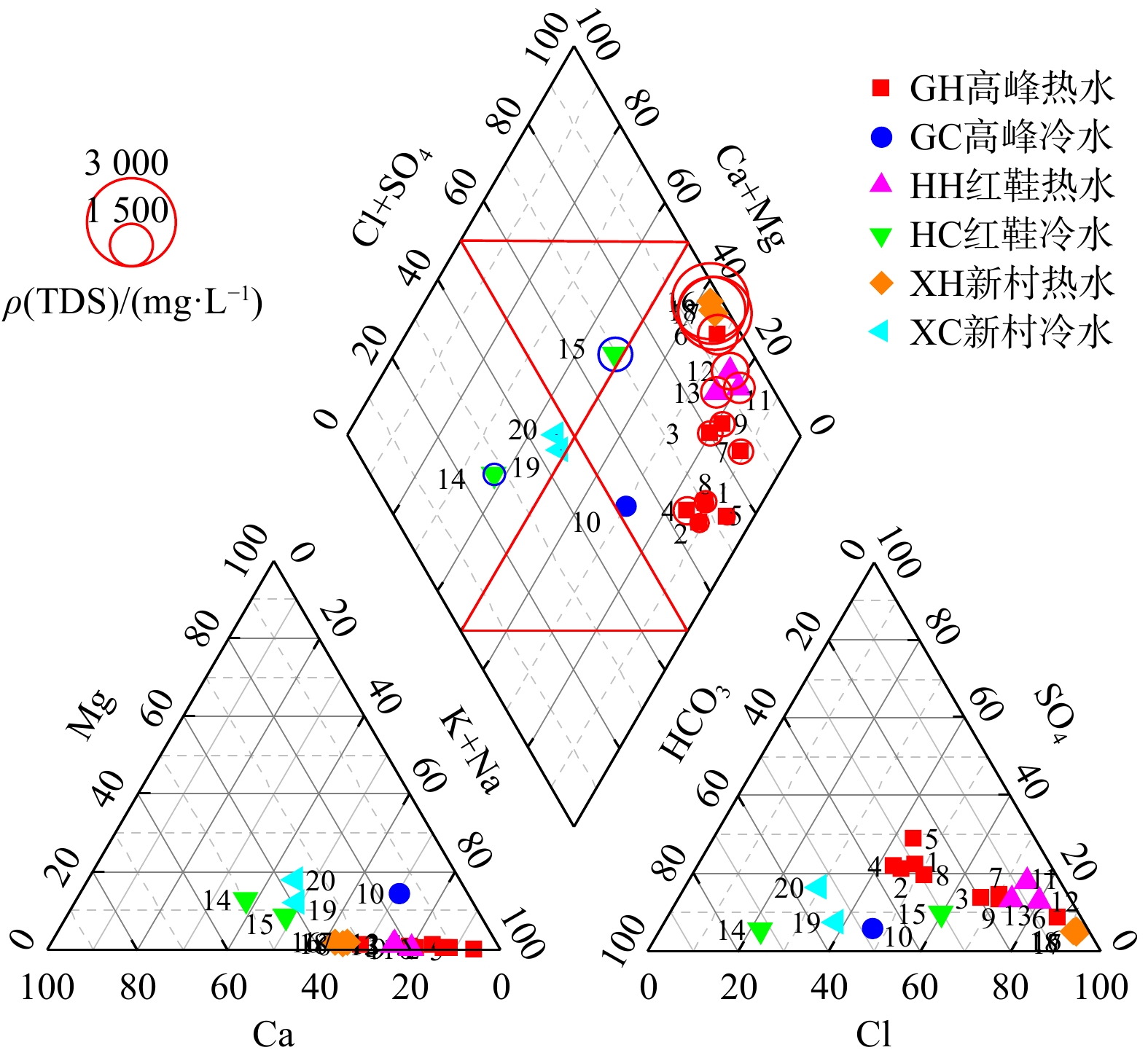
图 3 地热水水化学Piper三线图
Figure 3. Hydrochemical Piper trilinear diagrams of geothermal water in the study area
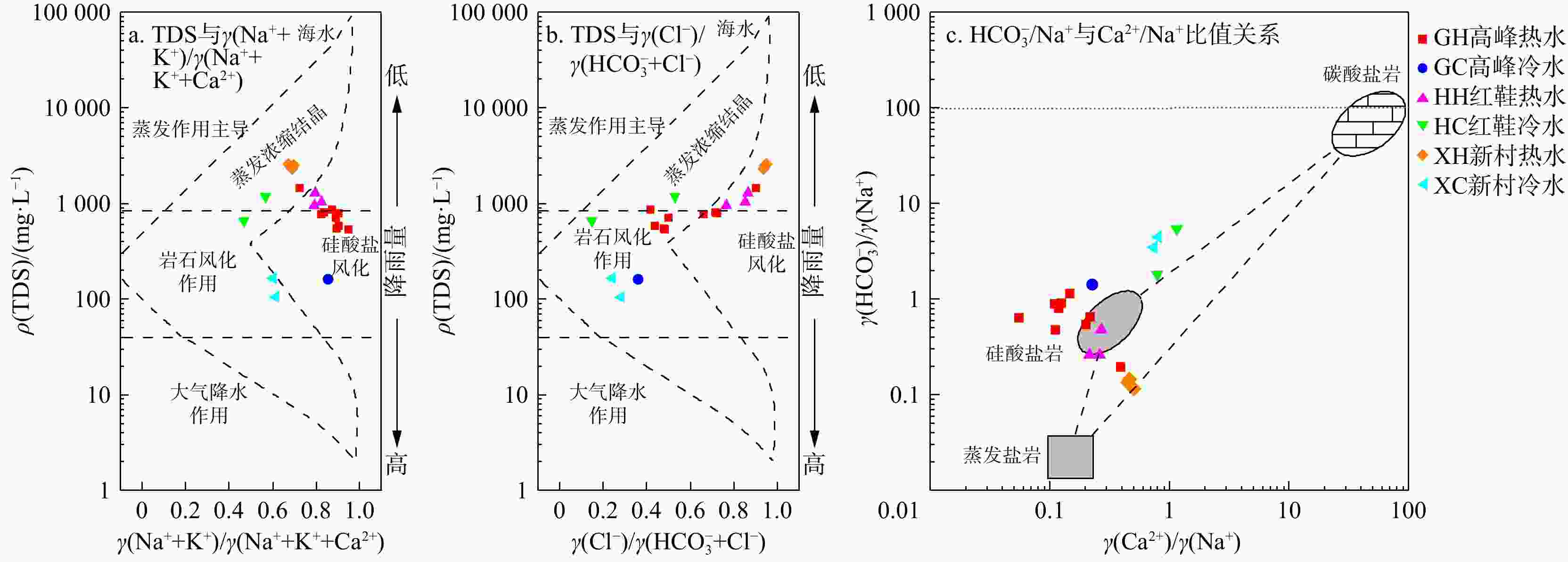
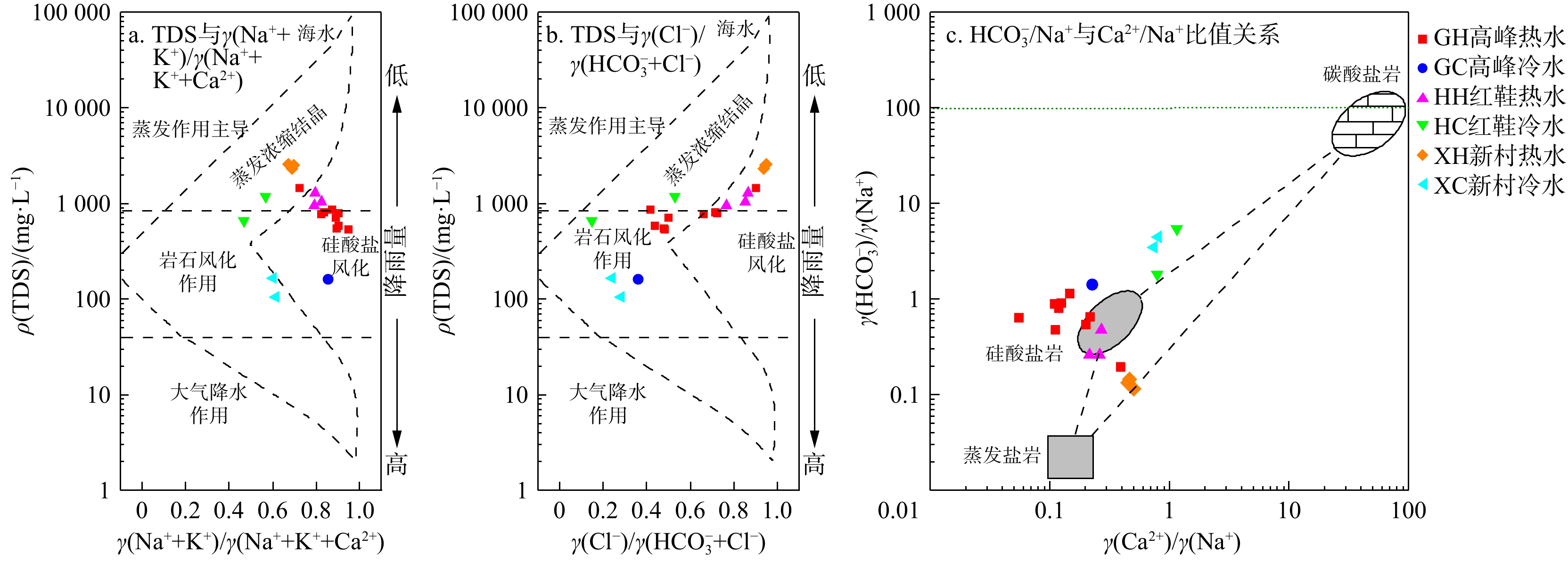
图 4 研究区地热水水文地球化学成因判别图(γ. 离子毫克当量浓度;下同)
Figure 4. Hydrogeochemical origin discrimination map of geothermal water in the study area
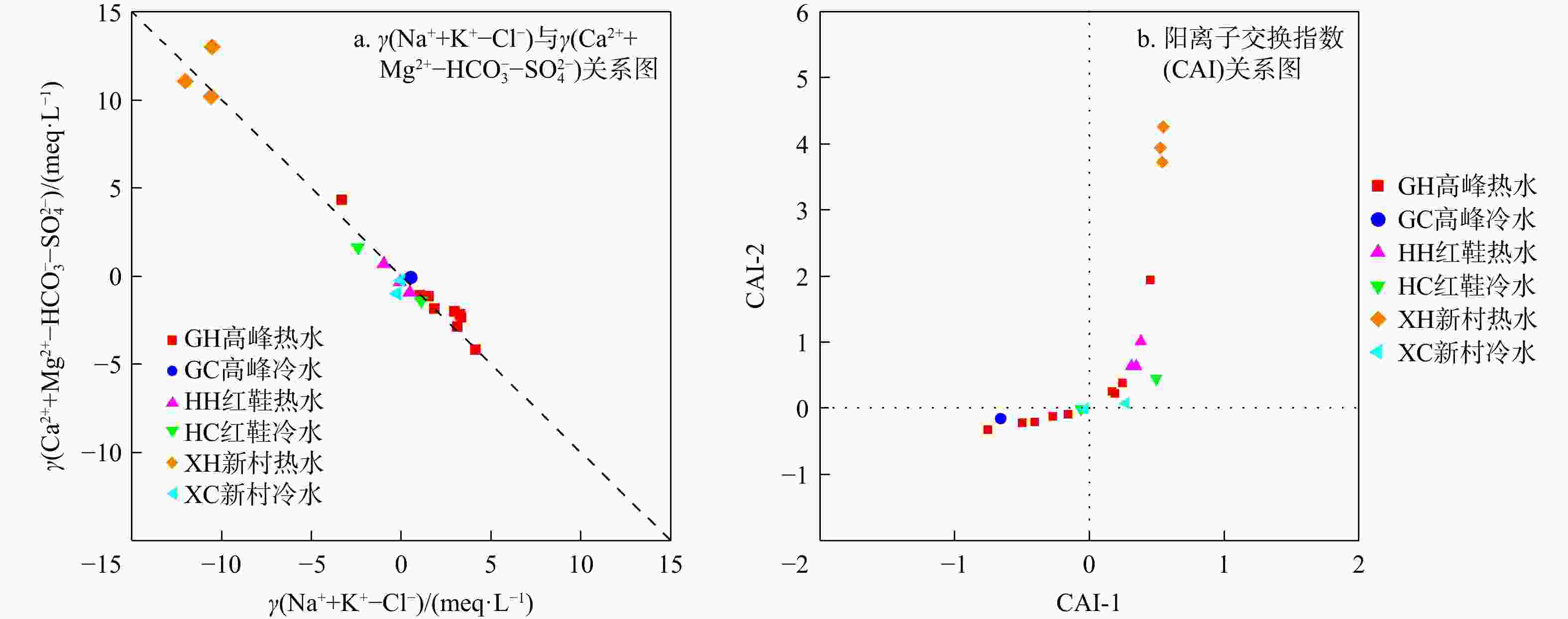
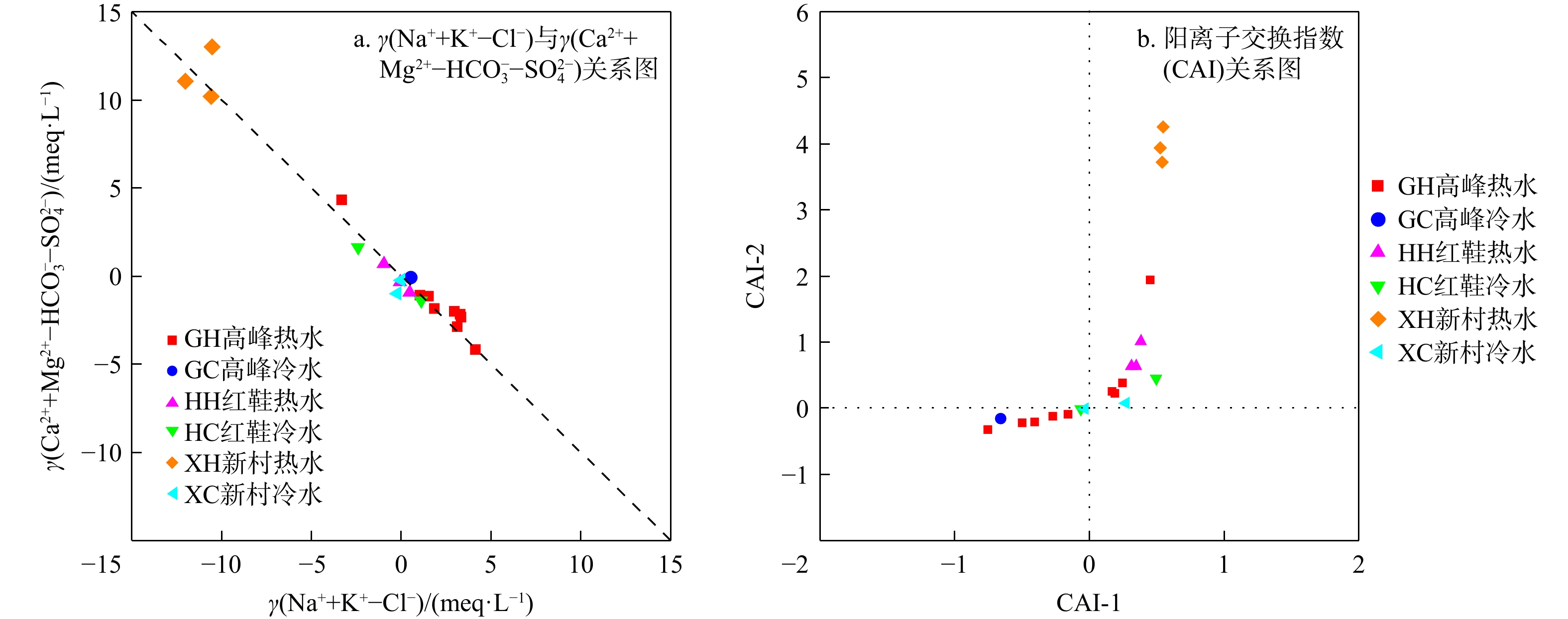
图 5 研究区地热水阳离子交换作用判别图
Figure 5. Cation exchange potential discrimination diagram for geothermal water in the study area
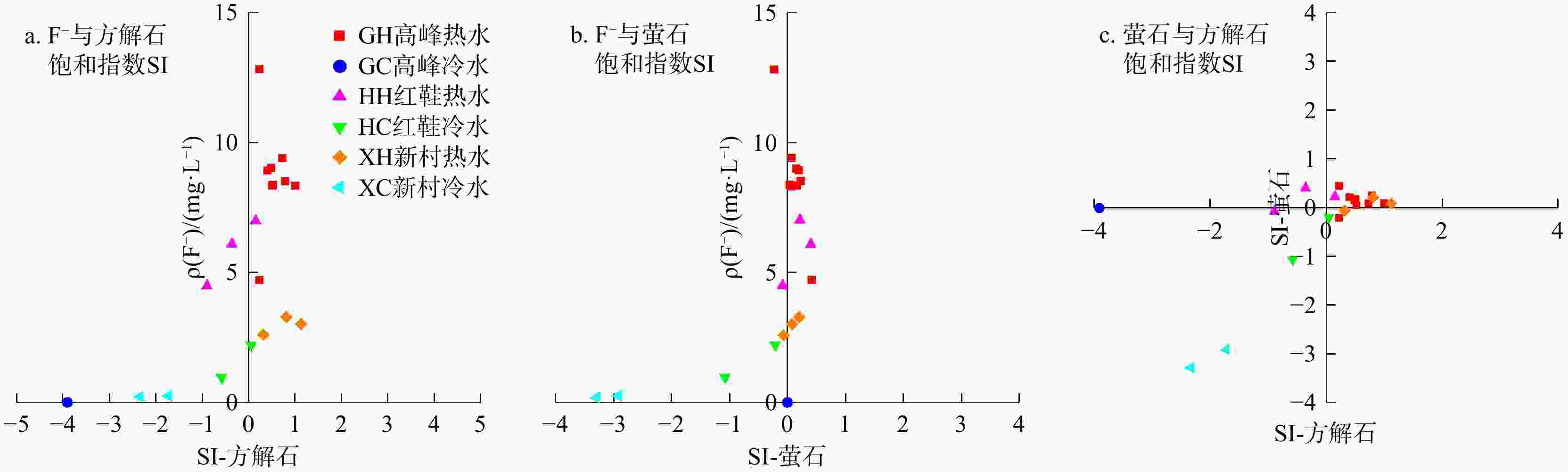
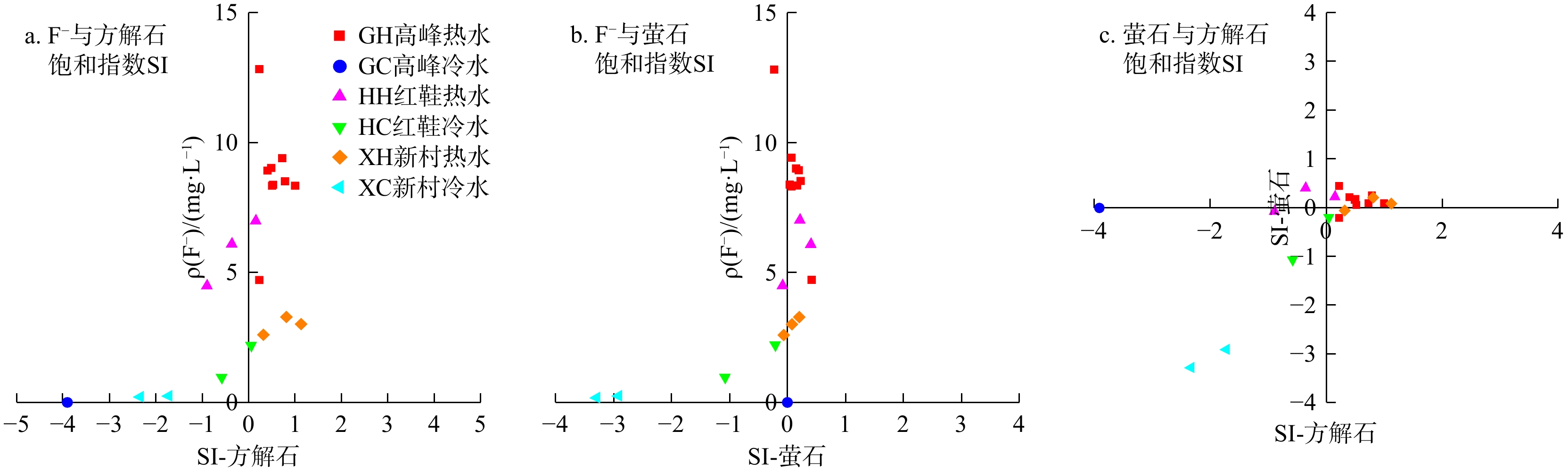
图 6 研究区热水样品F−离子饱和指数关系图
Figure 6. Relationship between F− and saturation index of geothermal water samples in the study area
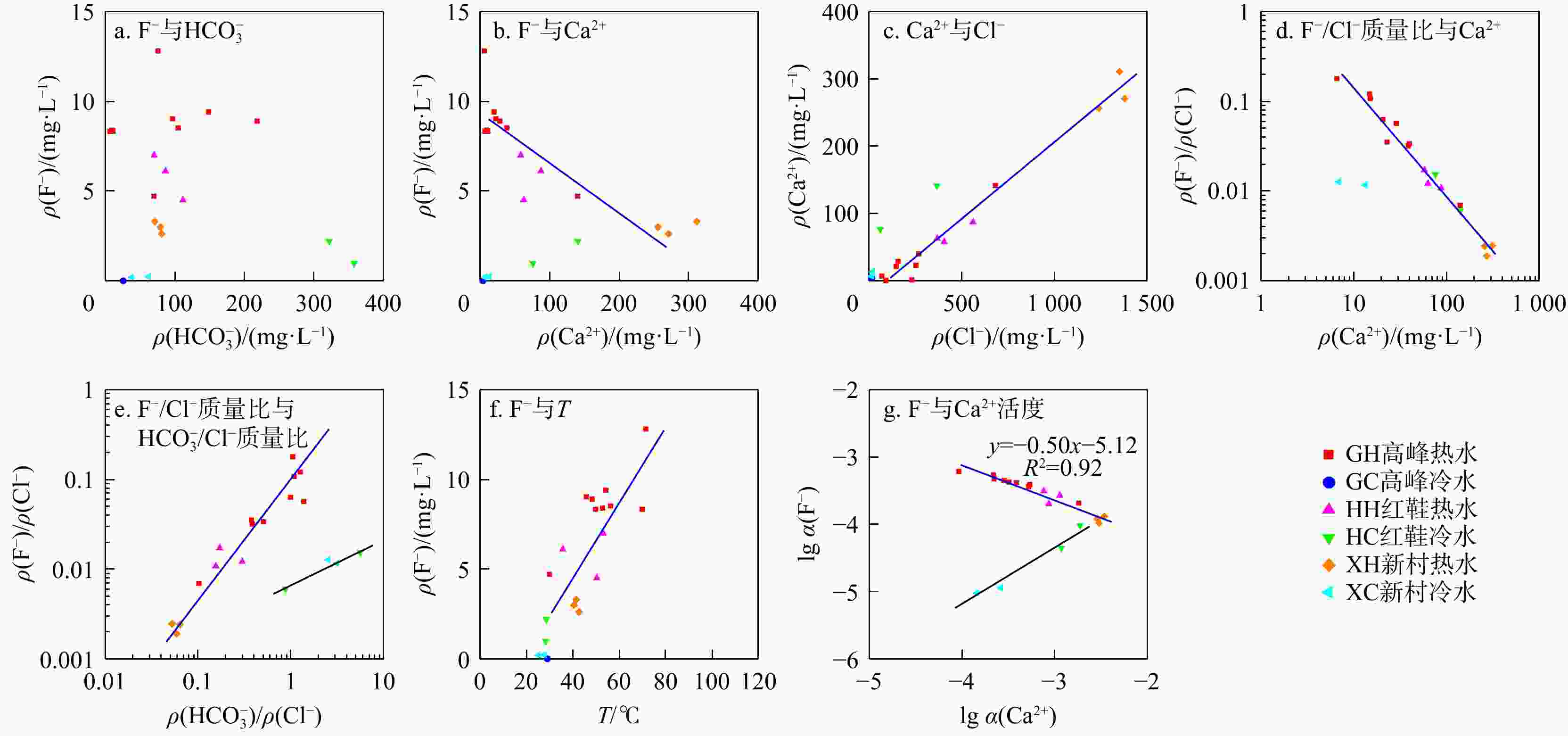
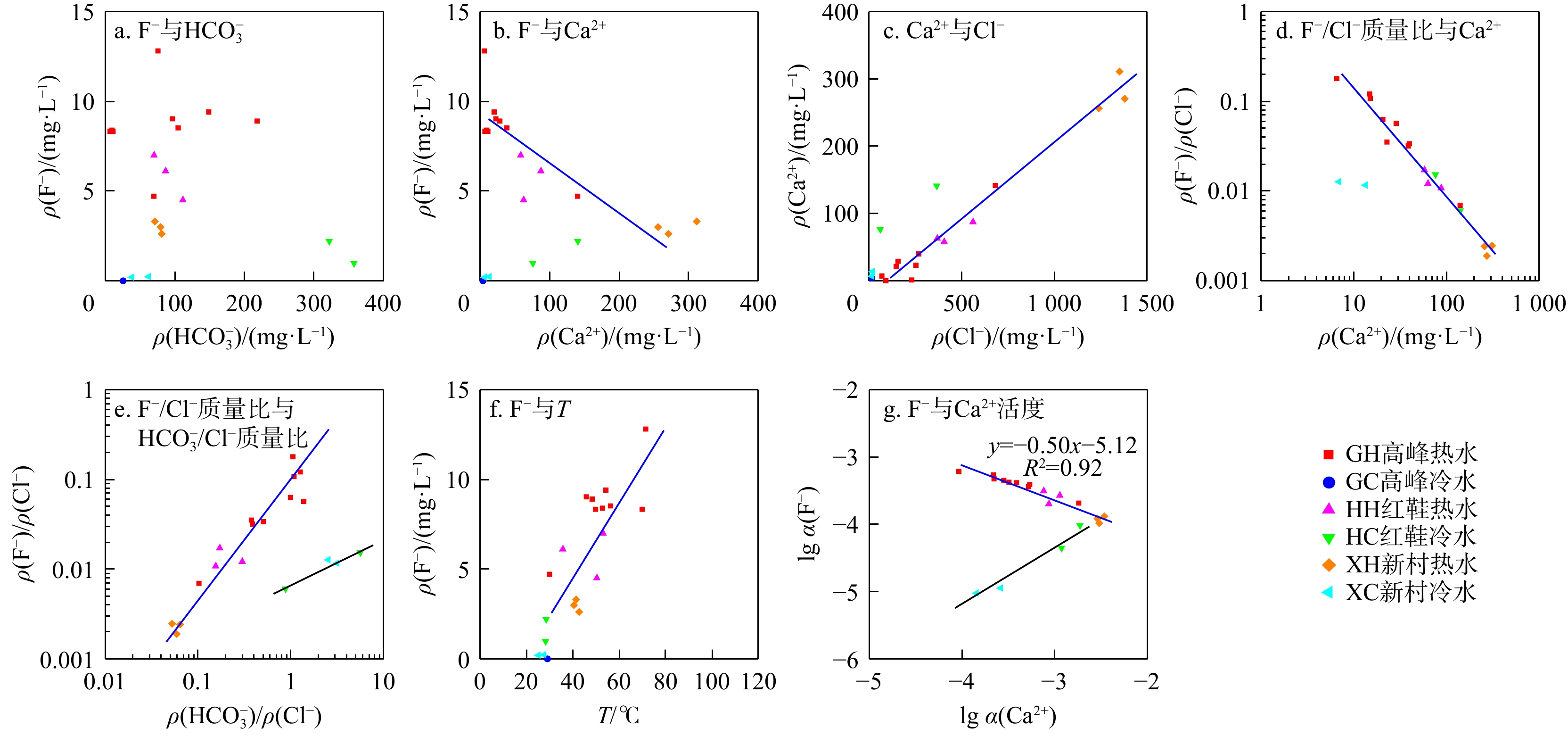
图 7 研究区地热流体氟离子与主要离子、温度相关关系图(T. 温度;α. 离子活度)
Figure 7. Correlations between fluoride ion, main ions, and temperature of geothermal fluids in study area
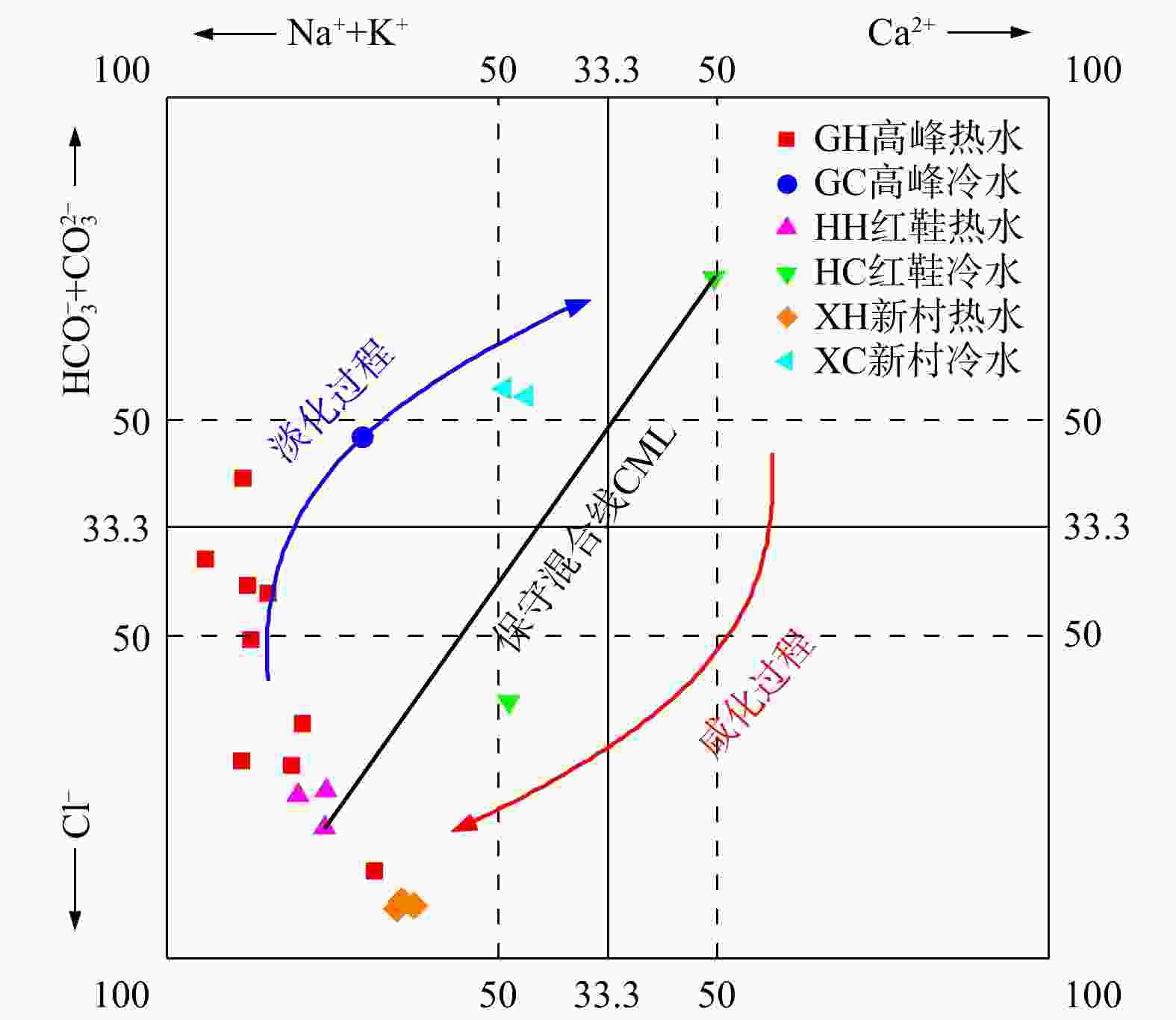
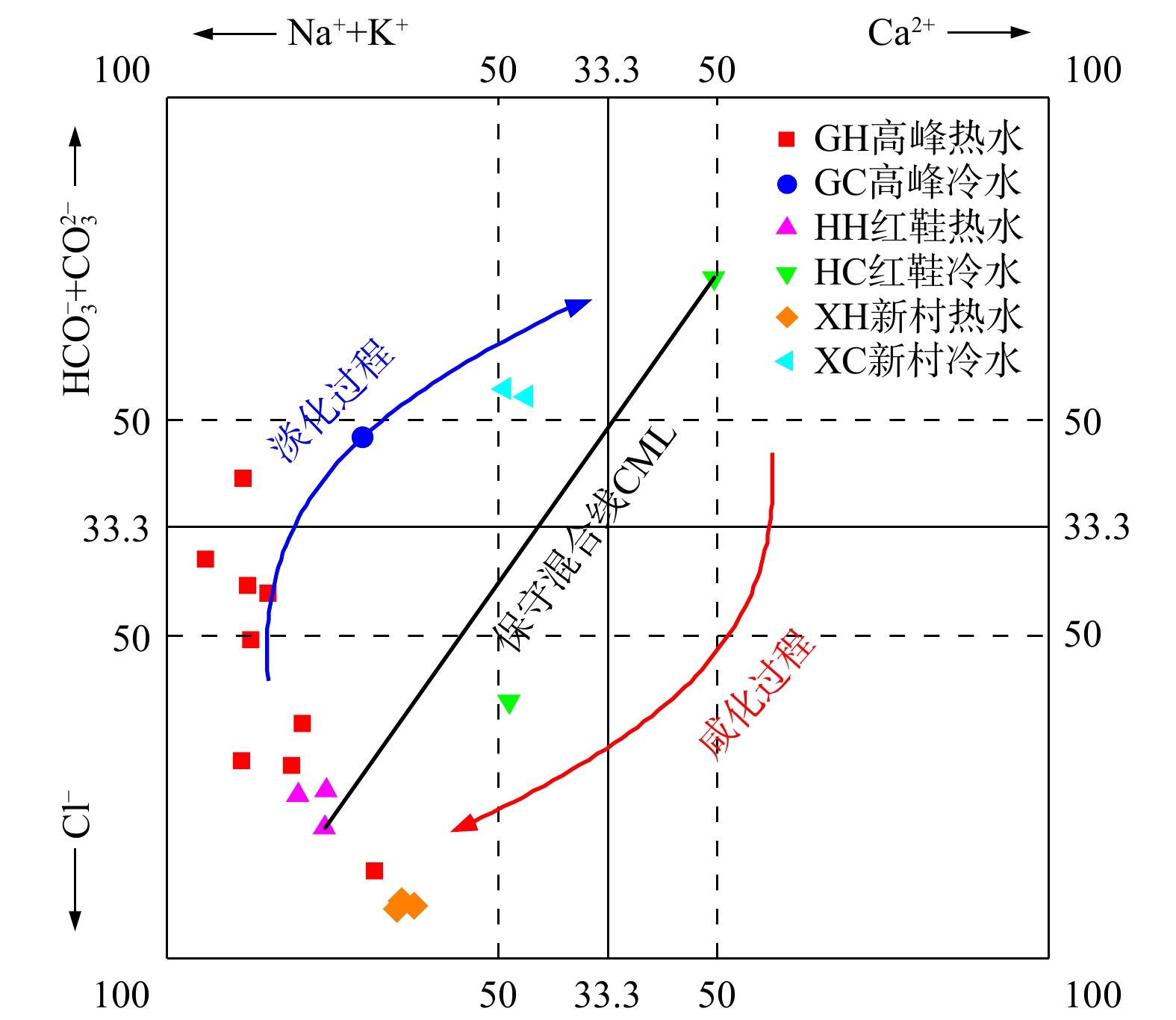
图 8 水文地球化学相演化图(HFE-D)(图中数值均为离子毫克当量百分比,%)
Figure 8. Hydrochemical facies evolution diagram (HFE-D)
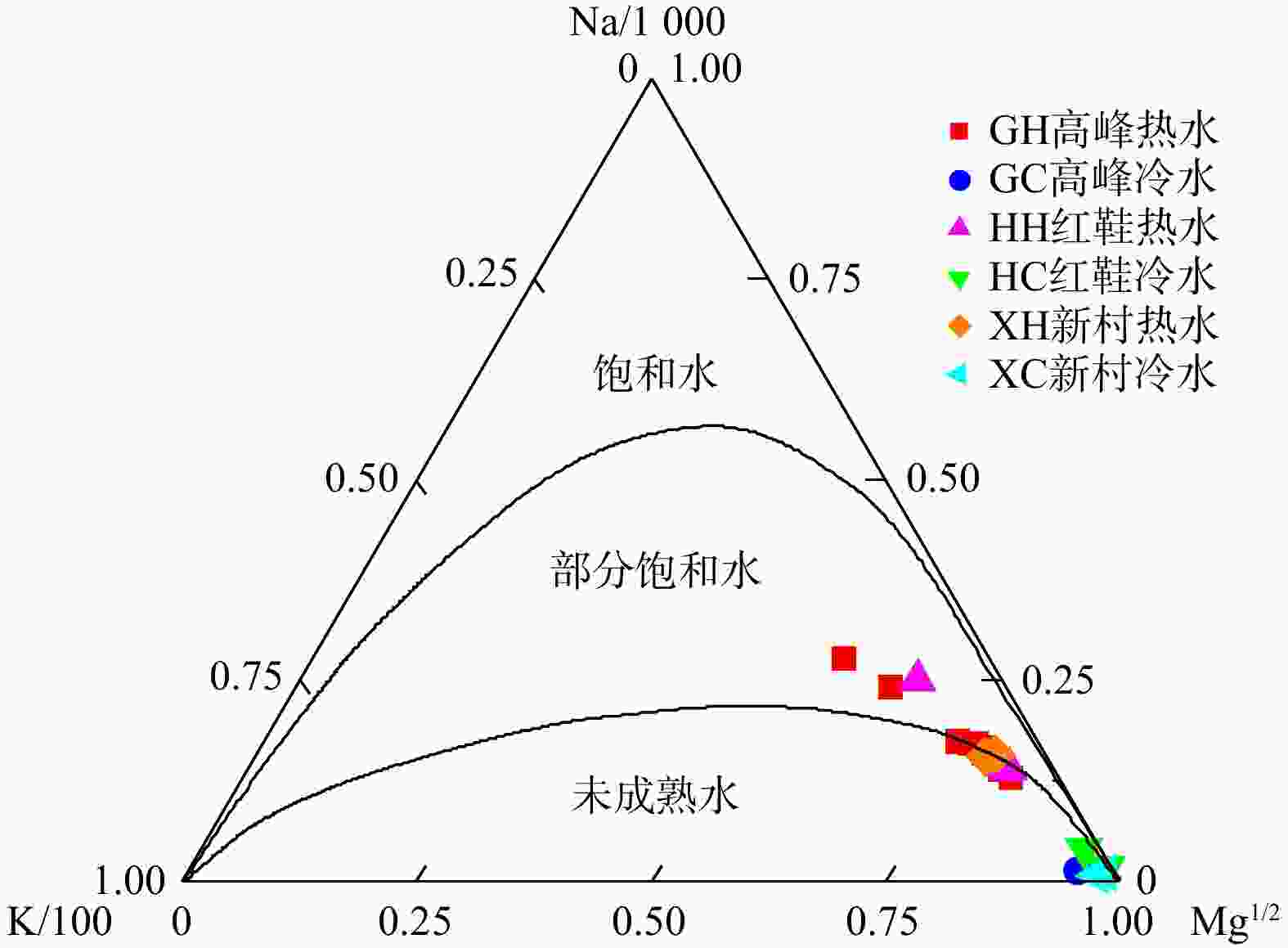
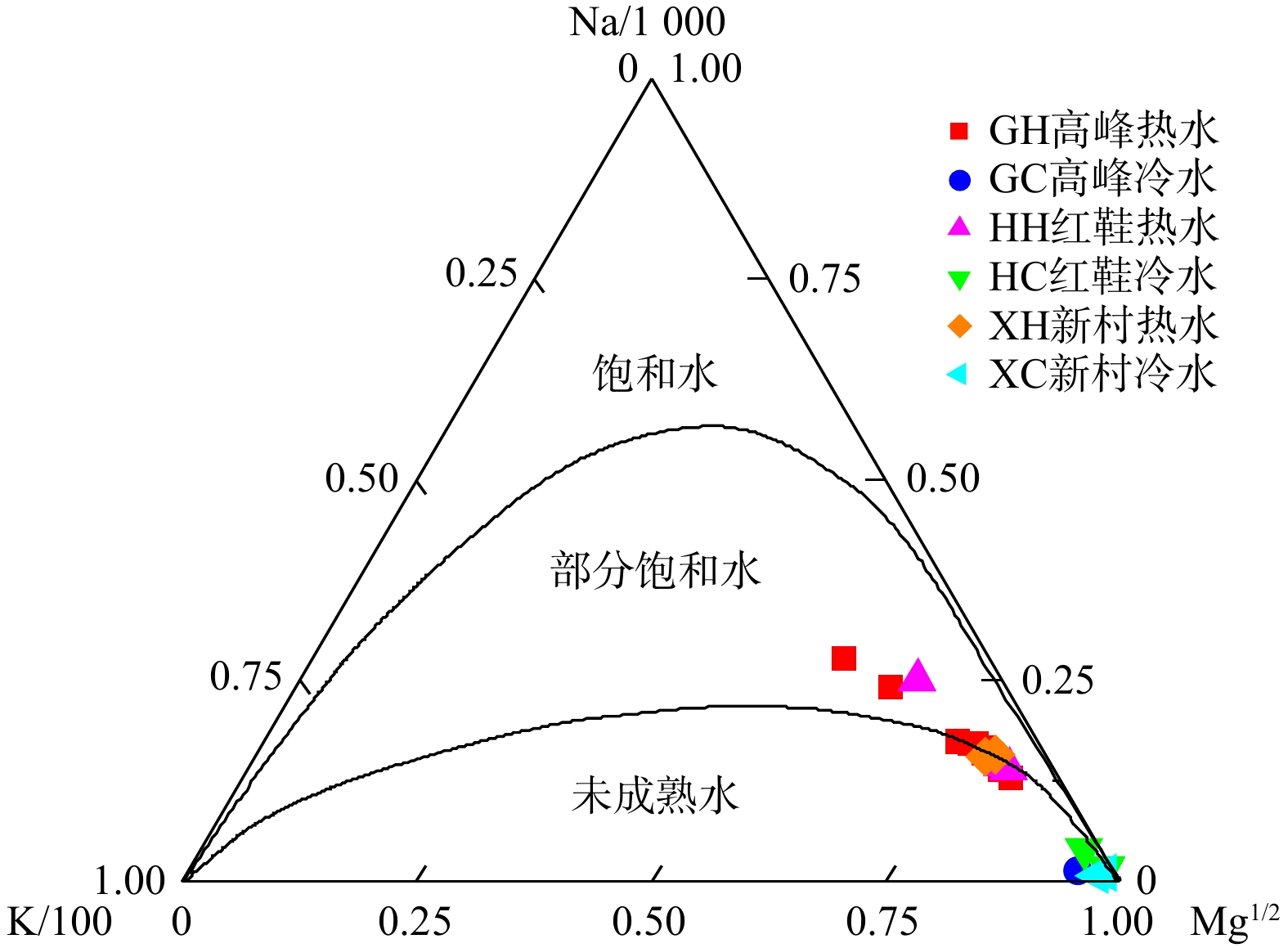
图 9 研究区地热水Na-K-Mg阳离子三线图
Figure 9. Na-K-Mg cation trilinear diagram of geothermal water in study area
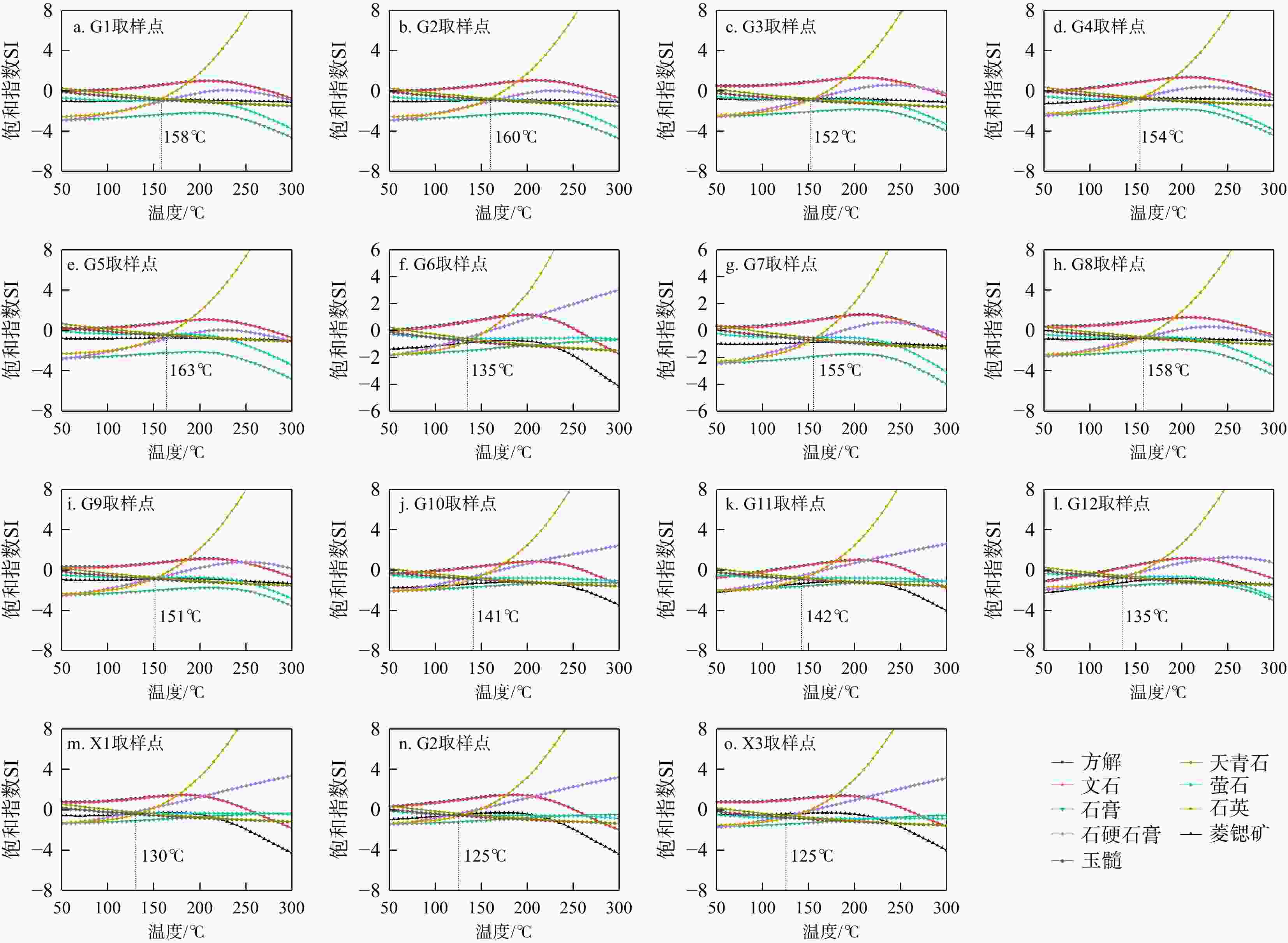
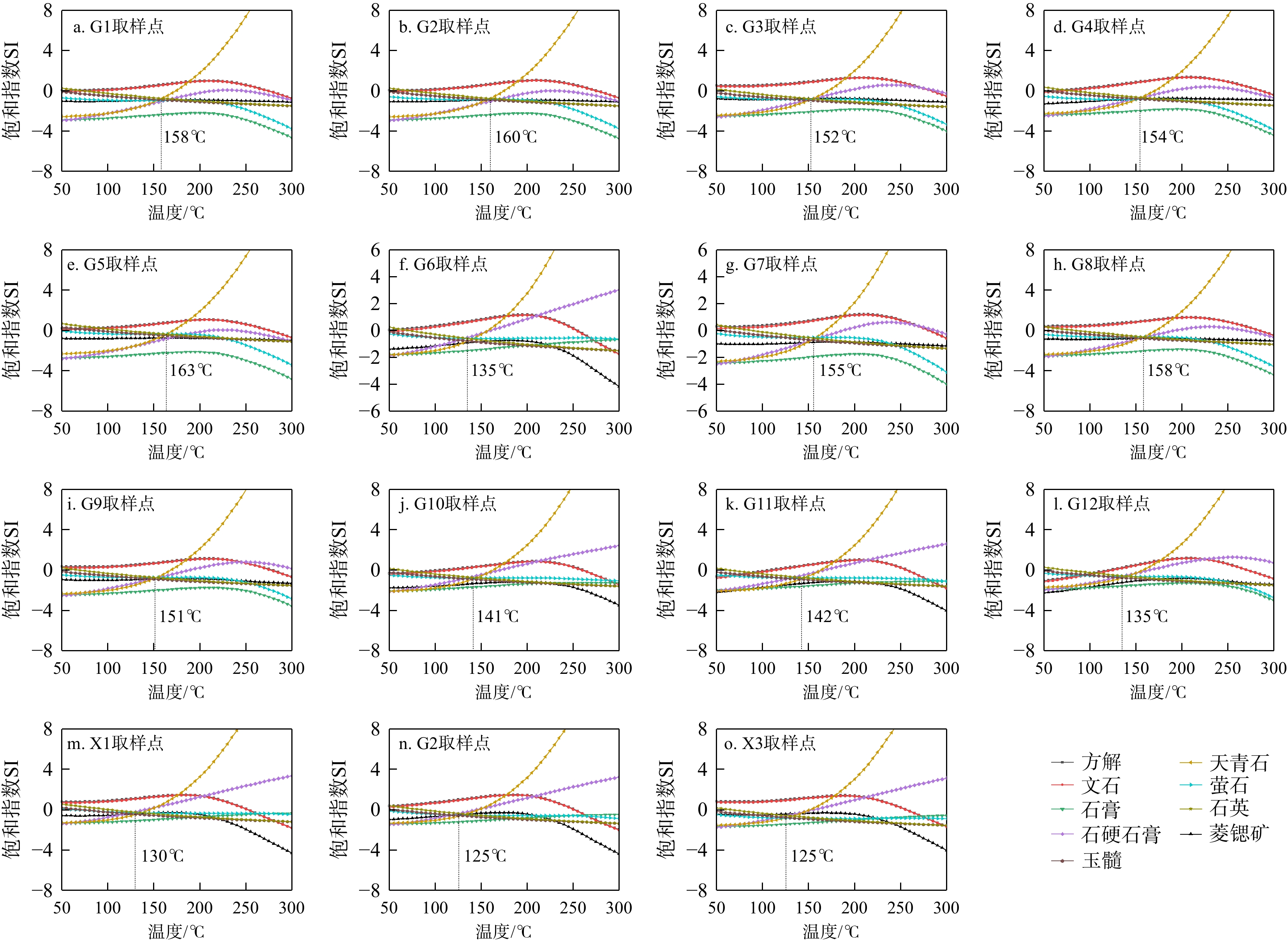
图 10 研究区热水井的多种矿物饱和指数(SI)与温度关系图
Figure 10. Relationship between saturation index (SI) and temperature of various minerals in thermal well water at the study area
表 1 海南陵水英州−新村地区水化学组分
Table 1. Hydrochemical components in Yingzhou–Xincun area, Lingshui, Hainan Province
序号 编号 pH值 温度/(℃) TDS Na+ K+ Mg2+ Ca2+ F− Cl− SO42− HCO3− Br−− SiO2 水化学类型 平衡差/% ρB/(mg·L−1) 1 G1 8.37 53.0 546 126 5.0 0.38 15.2 9.90 93.1 58.3 101.0 0.31 115.0 Cl.HCO3−Na 3.3 2 G2 8.33 50.0 576 135 5.3 0.36 15.0 11.30 93.6 58.6 120.0 0.31 115.0 Cl .HCO3-Na 3.0 3 G3 8.31 70.0 765 181 7.2 1.10 39.8 7.80 232.0 64.9 118.0 0.79 100.0 Cl-Na −0.4 4 G4 7.86 48.5 856 193 7.6 1.50 28.7 8.90 158.0 107.0 219.0 0.43 132.0 Cl.HCO3−Na −2.6 5 G5 8.32 71.6 535 119 6.6 0.06 6.6 12.80 71.8 63.4 75.8 0.23 157.0 Cl.SO4.HCO3-Na 4.0 6 G6 7.78 30.0 1446 359 13.3 2.80 141.0 4.70 683.0 90.2 70.2 2.44 82.0 Cl-Na.Ca 1.5 7 G7 8.44 46.0 788 203 10.3 0.29 22.9 9.00 256.0 71.7 96.6 0.81 115.0 Cl-Na −2.3 8 G8 8.45 54.5 703 165 8.0 0.50 20.8 9.40 150.0 76.5 149.0 0.45 121.0 Cl.HCO3−Na −1.5 9 G9 8.36 56.5 801 195 8.3 0.75 39.1 8.50 270.0 68.6 105.0 0.87 103.0 Cl-Na −2.2 10 G10 5.36 29.0 161 18.1 6.1 2.30 4.1 <0.02 14.6 2.5.0 26.0 <0.016 53.4 HCO3.Cl-Na 20.6 11 H1 7.77 53.2 1040 270 9.4 0.50 58.4 7.00 408.0 132.0 70.2 1.47 84.4 Cl-Na −2.7 12 H2 7.21 35.7 1304 335 11.9 3.40 87.6 6.10 562.0 124.0 87.0 1.92 84.1 Cl-Na −1.6 13 H3 6.48 50.5 955 234 7.8 1.80 63.1 4.50 370.0 89.4 112.0 1.37 70.7 Cl-Na −2.4 14 H4 6.44 28.2 663 65.6 1.6 12.10 76.5 0.97 63.0 21.5 358.0 <0.016 63.6 HCO3−Ca.Na −2.0 15 H5 6.93 28.5 1187 178 7.2 17.20 141.0 2.20 366.0 79.5 322.0 <0.016 70.7 Cl.HCO3−Na.Ca −2.6 16 X1 8.01 41.5 2600 620 21.0 9.50 311.0 3.30 1350.0 106.0 71.2 2.00 108.0 Cl -Na.Ca 2.6 17 X2 7.45 42.7 2540 603 25.2 9.00 271.0 2.60 1380.0 93.6 81.3 1.80 73.8 Cl -Na.Ca −1.4 18 X3 8.33 40.5 2330 549 19.2 7.60 256.0 3.00 1240.0 93.7 79.8 0.90 73.4 Cl -Na.Ca −0.7 19 X4 6.58 25 106 8.5 2.5 1.30 6.9 0.19 15.0 4.0 38.0 / 24.6 HCO3.Cl-Na.Ca −12.0 20 X5 6.69 27.6 164 18 2.4 4.00 13.4 0.23 19.7 14.8 62.2 / 22.5 HCO3.Cl-Na.Ca −0.8 注: G表示高峰地热田,H表示红鞋地热田,X表示新村地热田,“/”表示未检测,G10,H4,H5,X4,X5为常温地下水,其余为温泉或地热钻孔水。G9,H2,H5 为村民自建家用洗浴民井,采用机泵抽水开采,其余地热点保持自然状态,以自流出水为主,无机械开采活动。所有地热水电荷平衡均<5%,其中G10增加硝酸盐后平衡2.9%,X4电荷平衡误差较大可能受人为污染影响  下载: 导出CSV
表 2 特征离子比
Table 2. Characteristic ion ratios
编号 Na+/Cl− Br+/Cl− Ca2+/Sr+ Mg2+/Ca2+ 编号 Na+/Cl− Br+/Cl− Ca2+/Sr+ Mg2+/Ca2+ G1 2.09 1.47×10⁻³ 127.33 0.04 H1 1.02 1.60×10⁻³ 286.51 0.01 G2 2.23 1.4×10⁻³ 131.69 0.04 H2 0.92 1.52×10⁻³ 342.66 0.06 G3 1.20 1.51×10⁻³ 210.58 0.05 H3 0.98 1.65×10⁻³ 164.55 0.05 G4 1.89 1.20×10⁻³ 178.85 0.09 H4 1.61 0.00 578.84 0.26 G5 2.56 1.44×10⁻³ 101.45 0.02 H5 0.75 0.00 571.96 0.20 G6 0.81 1.59×10⁻³ 262.86 0.03 X1 0.71 6.58×10⁻⁴ 243.30 0.05 G7 1.22 1.41×10⁻³ 197.49 0.02 X2 0.67 5.80×10⁻⁴ 215.86 0.06 G8 1.70 1.34×10⁻³ 194.71 0.04 X3 0.68 3.22×10⁻⁴ 197.11 0.05 G9 1.11 1.42×10⁻³ 198.72 0.03 X4 0.87 0 / 0.31 G10 1.91 0 101.48 0.93 X5 0.54 0 / 0.25
下载: 导出CSV
表 3 研究区热储温度计算成果表
Table 3. Results of geothermal reservoir temperature calculation in study area
取样点编号 玉髓 石英 Na-K K-Mg Na-K-Ca 硅焓图解法 考虑最大蒸汽损失硅焓图解法 多矿物平衡法[43] G1 119 145 168 91 252 272 177 158 G2 119 145 167 94 253 283 183 160 G3 110 137 168 87 249 202 147 152 G4 128 153 167 84 254 319 199 154 G5 141 164 189 126 287 272 174 165 G6 99 126 164 91 245 335 / 135 G7 119 145 183 115 277 301 193 155 G8 123 148 180 100 270 276 178 158 G9 112 139 172 96 256 240 163 151 H1 100 128 160 105 244 207 / 141 H2 100 128 161 85 246 280 143 142 H3 90 119 158 83 237 183 183 135 X1 63 93 159 87 242 175 126 130 X2 64 95 171 92 259 250 / 125 X3 62 92 160 87 244 259 / 125 注:石英(无蒸汽损失)[44],T= 1309 /[5.19−lg(SiO2)]−273.15;玉髓(无蒸汽损失)[44],T=1032 /[4.69−lg(SiO2)]−273.15;Na-K[44],T=1390 /(1.75+lg([Na+]/[K+])−273.15;K-Mg[44],T=4410/13.95−\lg([K+]2/[Mg2+])}−273.15;Na-K-Ca[44-45],$ T=1\;647/[\lg ([{{\mathrm{Na}}}^{+}]/[{{\mathrm{K}}}^{+}])+\beta \lg ({[{{{\mathrm{Ca}}}^{2+}}]}^{0.5}/[{{\mathrm{Na}}}^{+}])+2.24]- 273.15 $,若T<100℃,β=4/3,T>100℃和$ \lg ({\left(\left[{{\mathrm{Ca}}}^{2+}\right]\right)}^{0.5}/[{{\mathrm{Na}}}^{+}] $<0,β=1/3;石英温标(最大蒸汽损失)[44],$ T=1\;522/[5.75-\lg ({{\mathrm{SiO}}}_{2})]-273.15 $
下载: 导出CSV
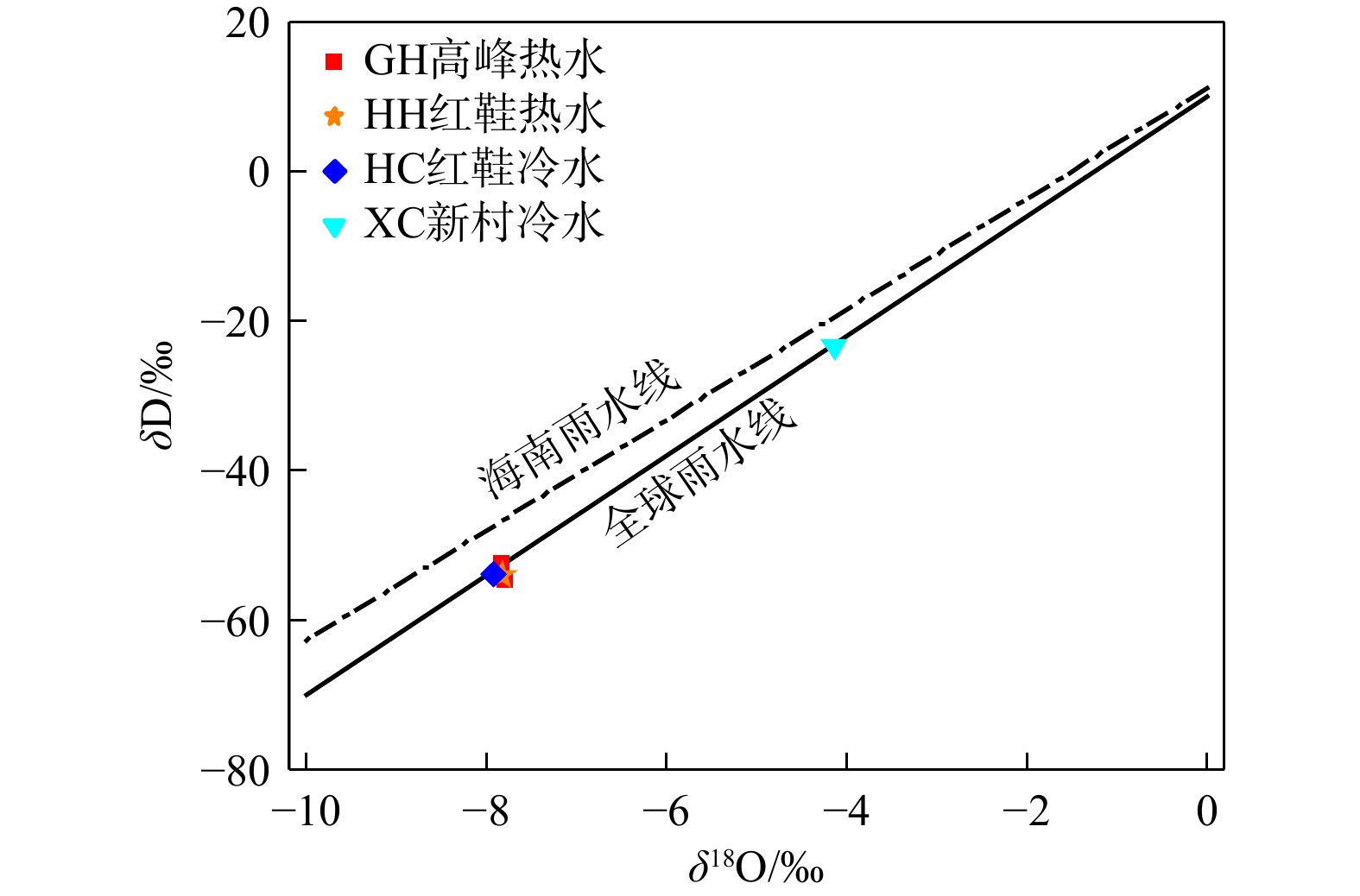
表 4 研究区氘氧同位数
Table 4. Hydrogen and oxygen isotopes in study area
取样点编号 18O D 取样点高程/m 补给高程/m G3 −7.61 −50.89 26 1150 G9 −7.94 −50.34 25 1128 H1 −7.8 −49.17 30 1086 H5 −7.49 −46.59 36 989 XC(雨水) −4.13 −23.5 29 /
下载: 导出CSV
表 5 研究区地热水14C年龄校正结果
Table 5. 14C age correction results of geothermal water in study area
取样点编号 14C活度/pMC δ13C/‰ Vogel模型校正/a Tamers模型校正/a Pearson模型校正/a Gonfiantinie模型校正/a Mook模型校正/a 热水年龄/a G3 58.37 −17.49 3580 − 1180 1497 2844 6871 2844 G5 15.92 −17.3 14320 9559 12148 13444 17444 13444 G8 53.71 −17.54 4268 −519 2209 4081 7629 4081 G9 34.97 −17.8 7815 3045 5878 7677 11385 7677 H1 20.37 −18.48 12283 7755 10656 12575 16194 12575 X1 41.00 未测试 6500 1836 / / / 6500 注:pMC. 现代碳百分比;“/”表示未测试13C的含量,无法计算地下水年龄
下载: 导出CSV
-
[1] 王贵玲, 刘彦广, 朱喜, 等. 中国地热资源现状及发展趋势[J]. 地学前缘, 2020, 27(1): 1-9. doi: 10.13745/j.esf.2020.1.1WANG G L, LIU Y G, ZHU X, et al. The status and development trend of geothermal resources in China[J]. Earth Science Frontiers, 2020, 27(1): 1-9. (in Chinese with English abstract) doi: 10.13745/j.esf.2020.1.1 [2] 曹锐, 多吉, 李玉彬, 等. 我国中深层地热资源赋存特征、发展现状及展望[J]. 工程科学学报, 2022, 44(10): 1623-1631. doi: 10.13374/j.issn2095-9389.2022.04.07.003CAO R, DUO J, LI Y B, et al. Occurrence characteristics, development status, and prospect of deep high-temperature geothermal resources in China[J]. Chinese Journal of Engineering, 2022, 44(10): 1623-1631. (in Chinese with English abstract) doi: 10.13374/j.issn2095-9389.2022.04.07.003 [3] 沈照理, 王焰新. 水−岩相互作用研究的回顾与展望[J]. 地球科学, 2002, 27(2): 127-133.SHEN Z L, WANG Y X. Review and outlook of water-rock interaction studies[J]. Earth Science, 2002, 27(2): 127-133. (in Chinese with English abstract) [4] GIGGENBACH W F. Geothermal solute equilibria. Derivation of Na-K-Mg-Ca geoindicators[J]. Geochimica et Cosmochimica Acta, 1988, 52(12): 2749-2765. doi: 10.1016/0016-7037(88)90143-3 [5] NICHOLSON K. Geothermal fluids: Chemistry and exploration techniques[M]. Berlin: Springer-Verlag, 1993. [6] ARNÓRSSON S, GUNNLAUGSSON E, SVAVARSSON H. The chemistry of geothermal waters in Iceland. II-Mineral equilibria and independent variables controlling water compositions[J]. Geochimica et Cosmochimica Acta, 1983, 47(3): 547-566. doi: 10.1016/0016-7037(83)90277-6 [7] 林弟, 郑勇, 胡在龙, 等. 海南岛滨海断裂的构造活动历史及其动力学机制: 来自磷灰石、锆石裂变径迹的证据[J]. 地质学报, 2025, 99(7): 2271-2283. doi: 10.19762/j.cnki.dizhixuebao.2024307LIN D, ZHENG Y, HU Z L, et al. Tectonic activity history and its dynamic mechanism of the Binhai fault, Hainan Island: New evidences from apatite and zircon fission track analyses[J]. Acta Geologica Sinica, 2025, 99(7): 2271-2283. (in Chinese with English abstract) doi: 10.19762/j.cnki.dizhixuebao.2024307 [8] LIU Y, FANG N Q, WANG Z B. The geochemical characteristics of Cretaceous volcanics in southern Hainan Island and implications for tectonic evolution in the South China Sea[J]. Frontiers in Earth Science, 2023, 11: 1251953. doi: 10.3389/feart.2023.1251953 [9] 柳长柱, 文健, 薛桂澄, 等. 海南岛地热资源研究[M]. 广州: 广东旅游出版社, 2022.LIU C Z, WEN J, XUE G C, et al. Study on geothermal resources of Hainan Island[M]. Guangzhou: Guangdong Tourism Publishing House, 2022. (in Chinese) [10] 李曼, 张薇, 廖煜钟, 等. 鲁中南典型地热区地热水氟分布特征及其驱动机制[J]. 地质科技通报, 2024, 43(3): 36-47. doi: 10.19509/j.cnki.dzkq.tb20230706LI M, ZHANG W, LIAO Y Z, et al. Characteristics and mechanisms of fluorine enrichment in the geothermal water of South Central Shandong Province[J]. Bulletin of Geological Science and Technology, 2024, 43(3): 36-47. (in Chinese with English abstract) doi: 10.19509/j.cnki.dzkq.tb20230706 [11] 胡虹羽, 卢国平, 李岩, 等. 琼北地区地热水中氟的富集规律[J]. 环境化学, 2023, 42(5): 1633-1641. doi: 10.7524/j.issn.0254-6108.2021113001HU H Y, LU G P, LI Y, et al. Study on enrichment of fluorine in geothermal water in Qiongbei area[J]. Environmental Chemistry, 2023, 42(5): 1633-1641. (in Chinese with English abstract) doi: 10.7524/j.issn.0254-6108.2021113001 [12] CHEN J Q, WANG Z, LI Y G, et al. Formation mechanism and health risk assessment of high fluoride geothermal water in Gonghe Basin, Northwest China[J]. Environmental Geochemistry & Health, 2025, 47(12): 572. doi: 10.1007/s10653-025-02891-1 [13] LIU J, REN Z L, YU Q, et al. Hydrochemical processes and fluoride enrichment patterns in high-fluoride geothermal water in the Weihe Basin, China[J]. Journal of hazardous materials, 2024, 480: 136468. doi: 10.1016/j.jhazmat.2024.136468 [14] 罗璐, 朱霞, 何春艳, 等. 陕西咸阳地热田地热流体成因研究[J]. 地质论评, 2019, 65(6): 1422-1430. doi: 10.16509/j.georeview.2019.06.009LUO L, ZHU X, HE C Y, et al. Study on the genesis of geothermal fluid in Xianyang geothermal field, Shaanxi Province[J]. Geological Review, 2019, 65(6): 1422-1430. (in Chinese with English abstract) doi: 10.16509/j.georeview.2019.06.009 [15] MAO X M, ZHU D B, NDIKUBWIMANA I, et al. The mechanism of high-salinity thermal groundwater in Xinzhou geothermal field, South China: Insight from water chemistry and stable isotopes[J]. Journal of Hydrology, 2021, 593: 125889. doi: 10.1016/j.jhydrol.2020.125889 [16] 雷云开, 王帅, 黄学莲, 等. 粤西沿海高盐度中低温地热系统水化学特征及形成演化[J]. 地球科学, 2025, 50(9): 3616-3630. doi: 10.3799/dqkx.2025.108LEI Y K, WANG S, HUANG X L, et al. Hydrochemical characteristics and formation-evolution analysis of medium-low temperature geothermal systems with high salinity in coastal western Guangdong[J]. Earth Science, 2025, 50(9): 3616-3630. (in Chinese with English abstract) doi: 10.3799/dqkx.2025.108 [17] 史自德, 毛绪美, 叶建桥, 等. 中低温地热系统低盐度地热水高含量钠的地球化学成因: 以广东惠州黄沙洞地热田为例[J]. 地球科学, 2024, 49(1): 271-287. doi: 10.3799/dqkx.2022.170SHI Z D, MAO X M, YE J Q, et al. Source analysis of sodium of low-salinity high-sodium geothermal water in Huangshadong geothermal field from East Guangdong[J]. Earth Science, 2024, 49(1): 271-287. (in Chinese with English abstract) doi: 10.3799/dqkx.2022.170 [18] 邵誉炜, 毛绪美, 查希茜, 等. 水化学和同位素揭示的广东儒洞地热咸水形成机制[J]. 地质通报, 2024, 43(5): 779-788. doi: 10.12097/gbc.2023.04.011SHAO Y W, MAO X M, ZHA X X, et al. The formation mechanism of geothermal salty water based on hydrochemistry and isotopes in Rudong geothermal field, Guangdong Province[J]. Geological Bulletin of China, 2024, 43(5): 779-788. (in Chinese with English abstract) doi: 10.12097/gbc.2023.04.011 [19] 朱东波, 史自德, 何耀烨, 等. 广东沿海新洲高盐度地热水的水文地球化学成因机制[J]. 地球化学, 2023, 52(4): 404-415. doi: 10.19700/j.0379-1726.2023.04.002ZHU D B, SHI Z D, HE Y Y, et al. Hydrogeochemical mechanism of high-salinity thermal groundwater in Xinzhou geothermal field from the coast of Guangdong[J]. Geochimica, 2023, 52(4): 404-415. (in Chinese with English abstract) doi: 10.19700/j.0379-1726.2023.04.002 [20] 谢浴根, 周志涛, 邱辉, 等. 广东珠海万山群岛地下水化学特征及高氟成因[J]. 地质科技通报, 2025, 44(6): 212-223. doi: 10.19509/j.cnki.dzkq.tb20250071XIE Y G, ZHOU Z T, QIU H, et al. Hydrochemical characteristics and genesis of high-fluoride groundwater in the Wanshan Archipelago, Zhuhai, Guangdong Province[J]. Bulletin of Geological Science and Technology, 2025, 44(6): 212-223. (in Chinese with English abstract) doi: 10.19509/j.cnki.dzkq.tb20250071 [21] LU C, LI Y, ZHOU X C, et al. Fluoride enrichment in geothermal waters based on H, O, Sr, and Li isotopes of the Taiyuan Basin, North China[J]. Journal of Asian Earth Sciences, 2025, 287: 106574. doi: 10.1016/j.jseaes.2025.106574 [22] WANG X, LU G, HU B X. Hydrogeochemical characteristics and geothermometry applications of thermal waters in coastal Xinzhou and Shenzao geothermal fields, Guangdong, China. Geofluids, 2018, 1: 8715080. [23] DÜRRAST H, NGANSOM W. Integrated geophysical and geochemical investigations on the high-salinity geothermal waters of the Khlong Thom Hot Spring tourist attraction in Krabi, southern Thailand[J]. Geosciences Journal, 2022, 26(5): 621-635. doi: 10.1007/s12303-022-0007-0 [24] NORDSTROM D K. Fluoride in thermal and non-thermal groundwater: Insights from geochemical modeling[J]. Science of the Total Environment, 2022, 824: 153606. doi: 10.1016/j.scitotenv.2022.153606 [25] ABDELALI A, NEZLI I E, KECHICHED R, et al. Geothermometry and geochemistry of groundwater in the continental intercalaire aquifer, southeastern Algeria: Insights from cations, silica and SO4-H2O isotope geothermometers[J]. Applied Geochemistry, 2020, 113: 104492. doi: 10.1016/j.apgeochem.2019.104492 [26] VENGOSH A, HEUMANN K G, JURASKE S, et al. Boron isotope application for tracing sources of contamination in groundwater[J]. Environmental Science and Technology, 1994, 28(11): 1968-1974. doi: 10.1021/es00060a030 [27] 雷栋, 潘良云, 陈强, 等. 海南岛隆起山地型地热资源地质条件及潜力[J]. 地质通报, 2025, 44(1): 77-90. doi: 10.12097/gbc.2023.03.041LEI D, PAN L Y, CHEN Q, et al. Geological characteristics and potential of geothermal resources in the uplift mountain-type of Hainan Island[J]. Geological Bulletin of China, 2025, 44(1): 77-90. (in Chinese with English abstract) doi: 10.12097/gbc.2023.03.041 [28] 张彦鹏, 黎清华, 余绍文. 海南岛东海岸官塘地区地热水水化学特征及其循环演化过程识别[J]. 地球科学, 2024, 49(3): 952-964. doi: 10.3799/dqkx.2022.225ZHANG Y P, LI Q H, YU S W. Hydrochemical characteristics constraints on evolution of geothermal water in Guantang area on the east coast of Hainan Island[J]. Earth Science, 2024, 49(3): 952-964. (in Chinese with English abstract) doi: 10.3799/dqkx.2022.225 [29] 王晓林, 杨永鹏, 杨峰, 等. 海南龙沐湾地热田同位素特征及其指示意义[J]. 科学技术与工程, 2025, 25(20): 8371-8378. doi: 10.12404/j.issn.1671-1815.2405161WANG X L, YANG Y P, YANG F, et al. Isotopic characteristics and its indicating significance of longmuwan geothermal field in Hainan[J]. Science Technology and Engineering, 2025, 25(20): 8371-8378. (in Chinese with English abstract) doi: 10.12404/j.issn.1671-1815.2405161 [30] WANG X L, YAN X X, ZHANG W, et al. Hydrogeochemical characteristics and evolutionary mechanisms of the Nanping geothermal field, southeastern Hainan Island, China[J]. Sustainability, 2025, 17(13): 6189. doi: 10.3390/su17136189 [31] HUANG Z K, CHEN Z, LIU Y, et al. Notably high salinity of geothermal water in the coastal area in Hainan Island, China, predominantly dominated by tectonic activities[J]. Geothermics, 2025, 126: 103202. doi: 10.1016/j.geothermics.2024.103202 [32] 江小燕, 卫巍, 李献华. 海南岛印支−燕山期花岗岩年代学格架与成因[J]. 岩石学报, 2024, 40(3): 741-763. doi: 10.18654/1000-0569/2024.03.05JIANG X Y, WEI W, LI X H. Geochronological framework and petrogenesis of Indosinian-Yanshannian granites in Hainan Island[J]. Acta Petrologica Sinica., 2024, 40(3): 741-763. (in Chinese with English abstract) doi: 10.18654/1000-0569/2024.03.05 [33] 周艺颖, 欧阳正平, 徐子东, 等. 琼西南九所地热田水文地球化学特征及成因[J]. 地质科技通报, 2025, 44(1): 216-228. doi: 10.19509/j.cnki.dzkq.tb20240242ZHOU Y Y, OUYANG Z P, XU Z D, et al. Hydrogeochemical characteristics and genesis of Jiusuo geothermal field in southwestern Hainan, China[J]. Bulletin of Geological Science and Technology, 2025, 44(1): 216-228. (in Chinese with English abstract) doi: 10.19509/j.cnki.dzkq.tb20240242 [34] 王文梅, 徐子东, 欧阳正平, 等. 海南省三亚市崖城地热田地球化学特征及成因分析[J]. 工程勘察, 2017, 45(10): 38-45.WANG W M, XU Z D, OUYANG Z P, et al. Analysis of geochemical characteristics and formation reasons of Yacheng geothermal field in Sanya of Hainan Province[J]. Geotechnical Investigation&Surveying, 2017, 45(10): 38-45. (in Chinese with English abstract) [35] 王江思, 欧阳正平, 徐子东, 等. 基于水文地球化学信息和环境同位素的地下热水成因分析[J]. 地球与环境, 2018, 46(1): 7-14. doi: 10.14050/j.cnki.1672-9250.2018.46.002WANG J S, OUYANG Z P, XU Z D, et al. Geothermal water genesis analysis using hydrogeochemical information and environmental isotope[J]. Earth and Environment, 2018, 46(1): 7-14. (in Chinese with English abstract) doi: 10.14050/j.cnki.1672-9250.2018.46.002 [36] GIBBS R J. Mechanisms Controlling World Water Chemistry[J]. Science, 1970, 6(4): 1070-1085. doi: 10.1126/science.170.3962.1088 [37] 辛浩, 宁艺武, 平建华, 等. 内黄凸起河南段地热田水文地球化学特征及其成因[J]. 科学技术与工程, 2024, 24(34): 14537-14550. doi: 10.12404/j.issn.1671-1815.2400239XIN H, NING Y W, PING J H, et al. Hydrogeochemical characteristics and genesis of geothermal fields in the Henan section of the Neihuang uplift[J]. Science Technology and Engineering, 2024, 24(34): 14537-14550. (in Chinese with English abstract) doi: 10.12404/j.issn.1671-1815.2400239 [38] SU C, LI Y N, WANG M H, et al. Genetic mechanism of geothermal systems in southern Jiangxi: Constraints from hydrogeochemistry and isotopic tracing[J]. Natural Resources Research, 2026, 35(4): 2377-2407. doi: 10.1007/s11053-026-10662-7 [39] GIMENEZ-FORCADA E. Space/time development of seawater intrusion: A study case in Vinaroz coastal plain (Eastern Spain) using HFE-Diagram, and spatial distribution of hydrochemical facies[J]. Journal of Hydrology, 2014, 517: 617-627. doi: 10.1016/j.jhydrol.2014.05.056 [40] BAHIR M, OUAZAR D, OUHAMDOUCH S, et al. Assessment of groundwater mineralization of alluvial coastal aquifer of Essaouira Basin (Morocco) using the hydrochemical facies evolution diagram (HFE-Diagram)[J]. Groundwater for Sustainable Development, 2020, 11. [41] KRISHNA B, ACHARI V S. Groundwater for drinking and industrial purposes: A study of water stability and human health risk assessment from black sand mineral rich coastal region of Kerala, India[J]. Journal of Environmental Management, 2024, 351: 119783. doi: 10.1016/j.jenvman.2023.119783 [42] 袁建飞. 广东沿海地热系统水文地球化学研究[D]. 武汉: 中国地质大学(武汉), 2013.YUAN J F. Hydrogeochemistry of the geothermal systems in coastal areas of Guangdong Province, South China[D]. Wuhan: China University of Geosciences(Wuhan), 2013. (in Chinese with English abstract) [43] REED M, SPYCHER N. Calculation of pH and mineral equilibria in hydrothermal waters with application to geothermometry and studies of boiling and dilution[J]. Geochimica et Cosmochimica Acta, 1984, 48(7): 1479-1492. doi: 10.1016/0016-7037(84)90404-6 [44] FOURNIER R O. Chemical geothermometers and mixing models for geothermal systems[J]. Geothermics, 1977, 5(1/2/3/4): 41-50. doi: 10.1016/0375-6505(77)90007-4 [45] FOURNIER R O. Truesdell A H. An empirical Na-K-Ca geothermometer for natural waters[J]. Geochimica et Cosmochimica Acta, 1973, 37(5): 1255-1275. doi: 10.1016/0016-7037(73)90060-4 [46] PARKHURST D L, APPELO C A J. Description of input and examples for PHREEQC version 3-a computer program for speciation, batch-reaction, one-dimensional transport, and inverse geochemical calculations[R]. Reston: U.S. Geological Survey, 2013: 497. [47] CRAIG H. Isotopic variations in meteoric waters[J]. Science, 1961, 133(3465): 1702-1703. doi: 10.1126/science.133.3465.1702 [48] MÜNNICH K O. Über die anwendung von radiokohlenstoff zur altersbestimmung von grundwasser[J]. Naturwissenschaften, 1957, 44(32): 32-37. [49] 万军伟. 同位素水文学理论与实践[M]. 武汉: 中国地质大学出版社, 2003: 71-74.WAN J W. Theory and practice of isotope hydrology[M]. Wuhan: China University of Geosciences Press, 2003 : 71-74. (in Chinese) -

 下载:

 点击查看大图
计量
- 文章访问数: 71
- PDF下载量: 5
- 被引次数: 0