投审稿入口
投审稿入口


Joint mercury intrusion porosimetry-NMR evaluation and sweet spot identification of high-clay siltstone interlayers: A case study of Well PⅡ in Qing-1 Member, Gulong Depression
-
摘要:
松辽盆地古龙凹陷青一段高黏土粉砂岩夹层是页岩油微运移与局部富集的重要载体。受黏土矿物、细喉道以及孔喉连通非均质性共同控制,储层普遍出现 “含油而不可动” 现象。有必要在同井同岩相条件下厘清孔喉结构与流体可动性的内在关系,建立适用于该类夹层的甜点识别评价标准,规避仅依靠含油性造成的甜点误判。为保障样品可对比性,在 PⅡ 井同井同岩相开展分组配对取样,采用矿物差异指数MDI≤15%作为样品筛选条件;综合开展高压压汞、原状含油二维核磁共振、洗油后饱和模拟地层水−离心核磁共振实验,获取孔喉半径中值
r 50、分选系数σ 、退汞效率、横向弛豫时间T 2截止值、可动流体饱和度等参数;构建复合可动油指数CMOI,综合表征储层含油贡献与流体可动贡献;结合 CT 扫描、扫描电子显微镜(SEM)微观观测,揭示黏土膜状 / 桥连充填造成细颈喉、孔喉连通受阻的微观机理,解释宏观实验统计规律。高黏土粉砂岩夹层中压汞孔喉参数与核磁可动指标存在显著对应关系:黏土含量升高,r 50减小,可动流体饱和度、CMOI同步降低,饱和态T 2几何均值随之减小;受黏土束缚水干扰,T 2截止值不适用于样品间横向对比,饱和态T 2几何均值更适合表征样品可动性差异。基于井段样本分析提出经验甜点判别组合:r 50>0.4 μm、可动流体饱和度S MF>40%、CMOI≥20%,在S MF-r 50交会图划分A ~D 4类评价分区,研究样本仅发育A 、B 、D 3类,未见C 类样品;其中B 型样品表现为孔喉尺度大但可动性受限,体现 “高孔喉≠高可动” 的储层特征。受样本数量与取样范围约束,该套判别标准仅适用于 PⅡ 井青一段该同岩相井段,后续需扩充样品进一步校验阈值。CMOI与S MF-r 50联合判别方案能够区分含油但动用受限储层,可用于该井段同类夹层样品的甜点识别与评价分类。Abstract:ObjectiveContinental interlayer-type shale oil in China has become a critical strategic resource for increasing reserves and production. High-clay siltstone interlayers in the First Member of Qingshankou Formation (Qing-1 Member) of Gulong Depression, Songliao Basin, are important carriers of shale-oil micro-migration and local accumulation. Nevertheless, controlled jointly by clay minerals, fine throats, and heterogeneity in pore-throat connectivity, high-clay siltstone interlayers within shale-oil sequences commonly show distinct oil-bearing characteristics but poor fluid mobility. Existing studies lack quantitative coupling relationships between pore-throat parameters derived from high-pressure mercury intrusion porosimetry (MIP) and fluid-mobility indicators obtained from nuclear magnetic resonance (NMR) for such high-clay interlayers, and sweet spot classification still largely relies on empirical judgment. This study targets high-clay siltstone interlayers of the Qing-1 Member in the Gulong Depression, Songliao Basin. Under the constraints of the same well and identical lithofacies, this study aims to clarify the intrinsic relationship between pore-throat structure and fluid mobility, establish a quantitative sweet spot identification criterion, and mitigate misjudgment risks caused by merely using oil-bearing indicators for reservoir evaluation.
MethodsTen groups of paired core samples from Well PⅡ were collected, and the mineral difference index (MDI)≤15% was used to ensure mineralogical comparability between MIP and NMR subsamples. Integrated laboratory tests, including high-pressure mercury intrusion porosimetry, two-dimensional NMR under original oil-bearing conditions, and centrifugal NMR after oil washing and simulated formation-water saturation, were conducted to obtain key parameters such as median pore-throat radius
r 50, sorting coefficientσ , mercury withdrawal efficiency, transverse relaxation timeT 2 cutoff value, movable-fluid saturationS MF, and saturated-state geometric mean ofT 2. A composite movable-oil index (CMOI=S o×S MF/100) was constructed to jointly characterize the contributions of both oil-bearing characteristics and fluid mobility. Based on micro-scale computed tomography (CT) scanning and scanning electron microscopy (SEM) observations, microscopic mechanisms of throat narrowing and pore-throat connectivity impairment induced by clay film coating and bridging infill were revealed to explain the statistical patterns observed in the macroscopic experiments.ResultsFor high-clay siltstone interlayers, pore-throat parameters from MIP showed significant correlations with NMR mobility indicators. With increasing clay content,
r 50 decreased, whileS MF, CMOI, and the saturated-state geometric mean ofT 2 decreased simultaneously. Affected by clay-bound water, theT 2 cutoff value was not suitable for cross-sample comparison. Instead, the saturated-state geometric mean ofT 2 was more suitable for characterizing differences in sample mobility. Based on the analysis of well-interval samples, a empirical sweet spot identification combination was proposed:r 50>0.4 μm,S MF>40% and CMOI≥20%. Four evaluation zones (TypeA -D ) were further defined on theS MF-r 50 cross-plot. The samples occurred only in typesA ,B , andD , with no Type-C samples observed. Type-B samples were characterized by large pore-throat sizes but limited mobility, reflecting the reservoir characteristics of "large pore-throat size does not guarantee high mobility".ConclusionConstrained by the sample size and sampling scope, the proposed identification criteria are only applicable to the same-lithofacies interval of the Qing-1 Member within Well PⅡ. Further sample expansion and verification are required for threshold calibration. The joint discrimination scheme combining CMOI and
S MF-r 50 can effectively distinguish oil-bearing reservoirs with limited mobility, and it can be applied to relative ranking and sweet spot classification of analogous siltstone interlayers within this well interval. -
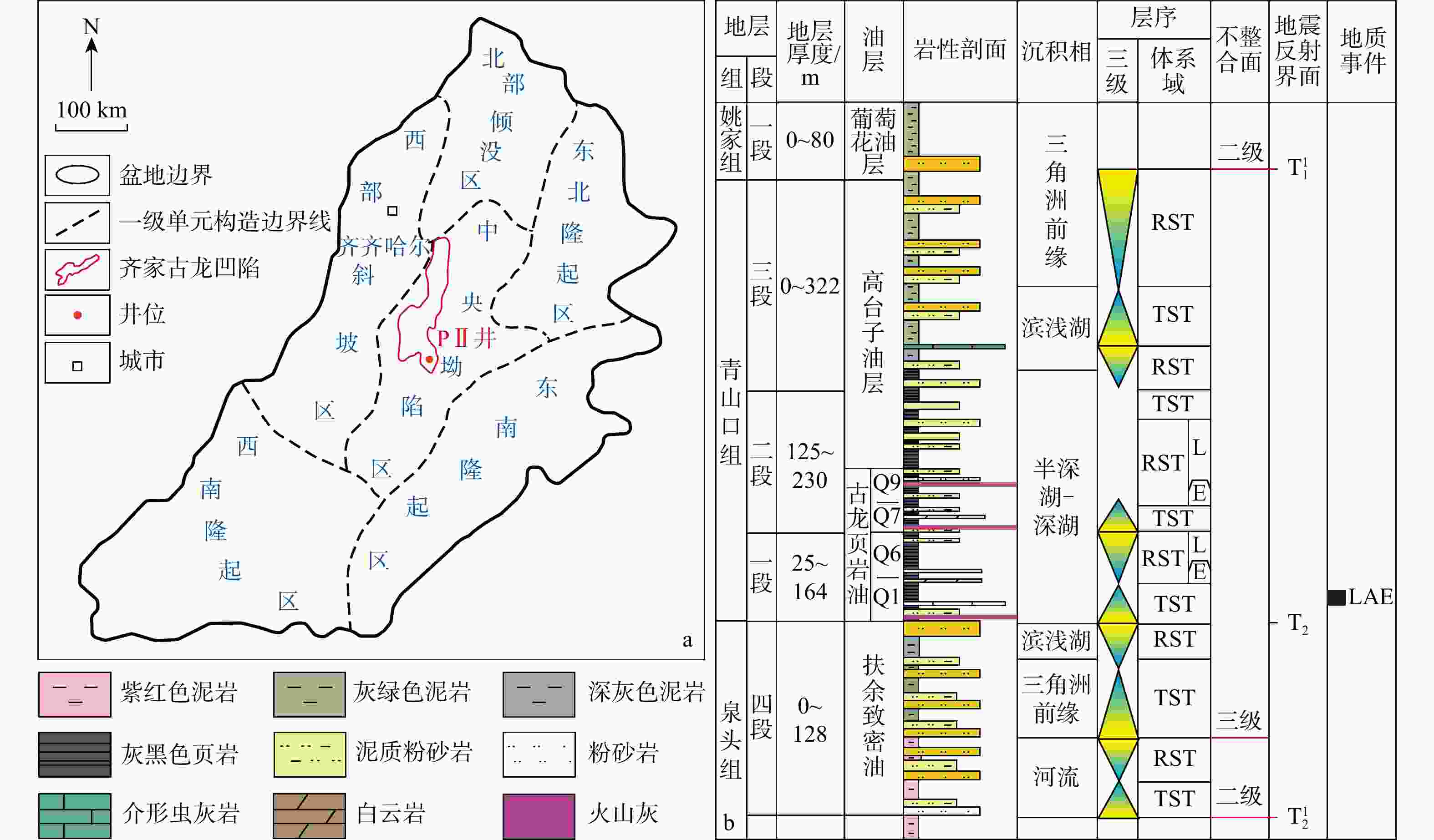
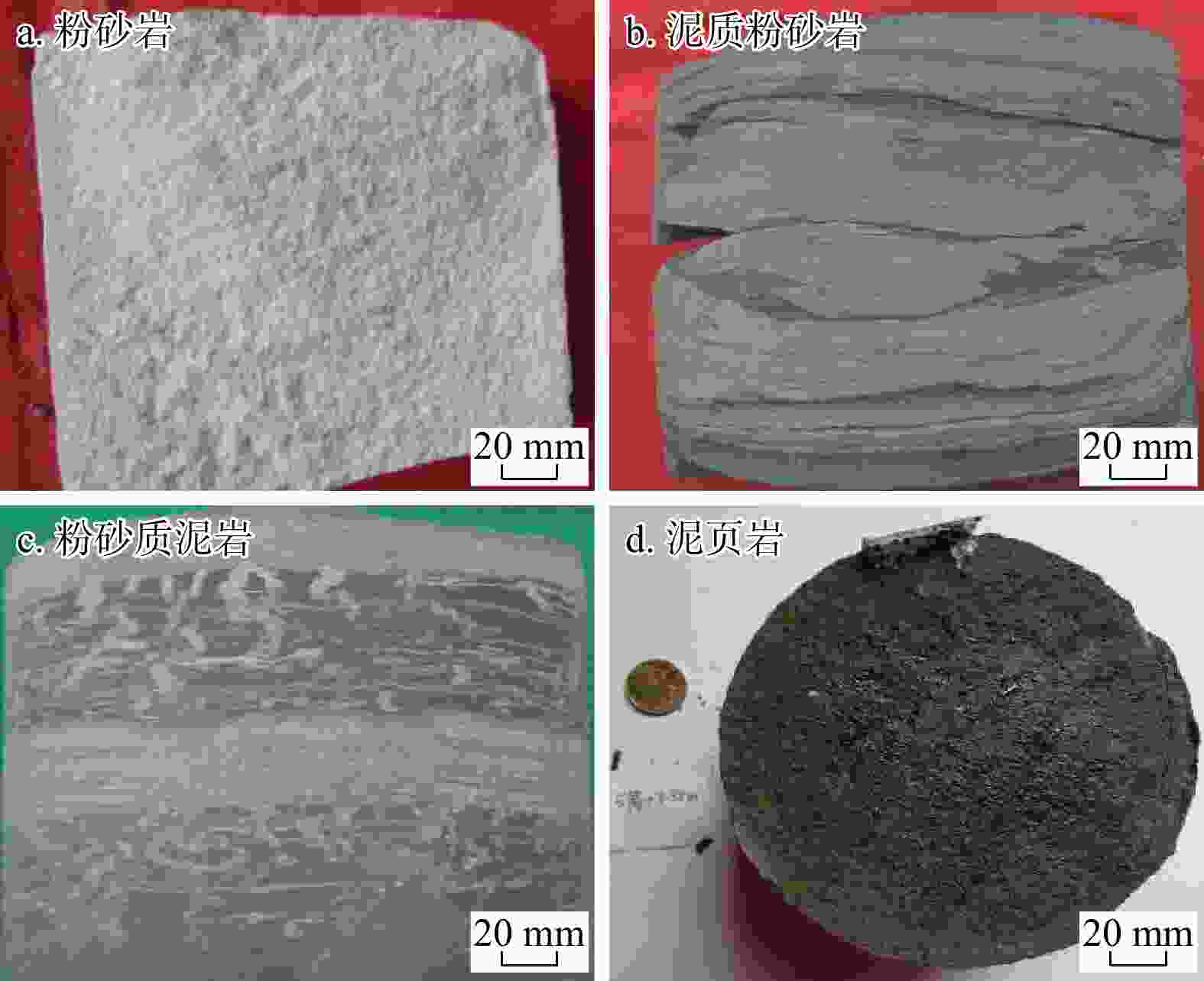
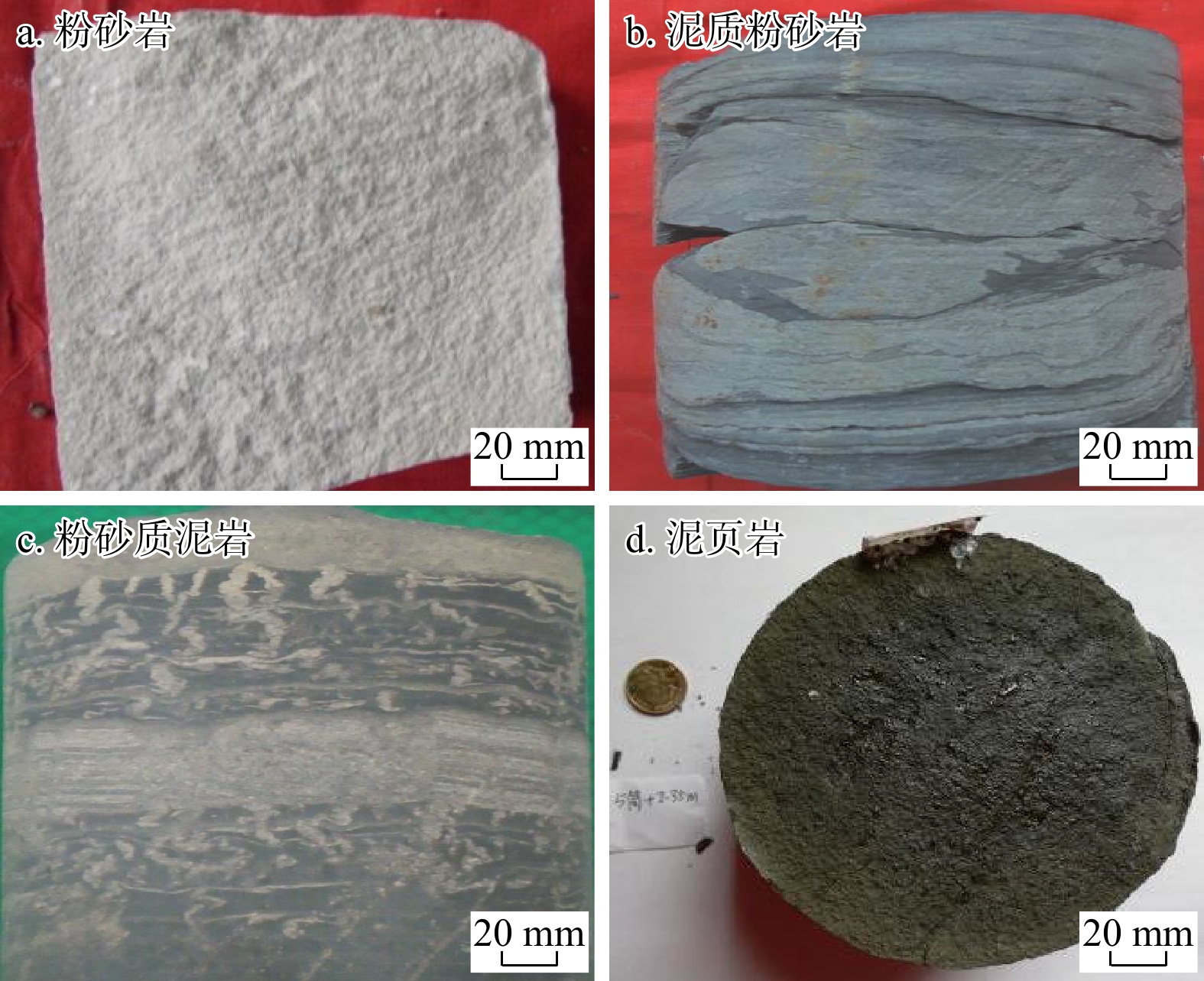
图 2 PⅡ井青一段夹层型页岩油典型岩心照片与纹层特征
Figure 2. Representative core photographs and lamination characteristics of interlayer-type shale oil in Qing-1 Member, Well PⅡ
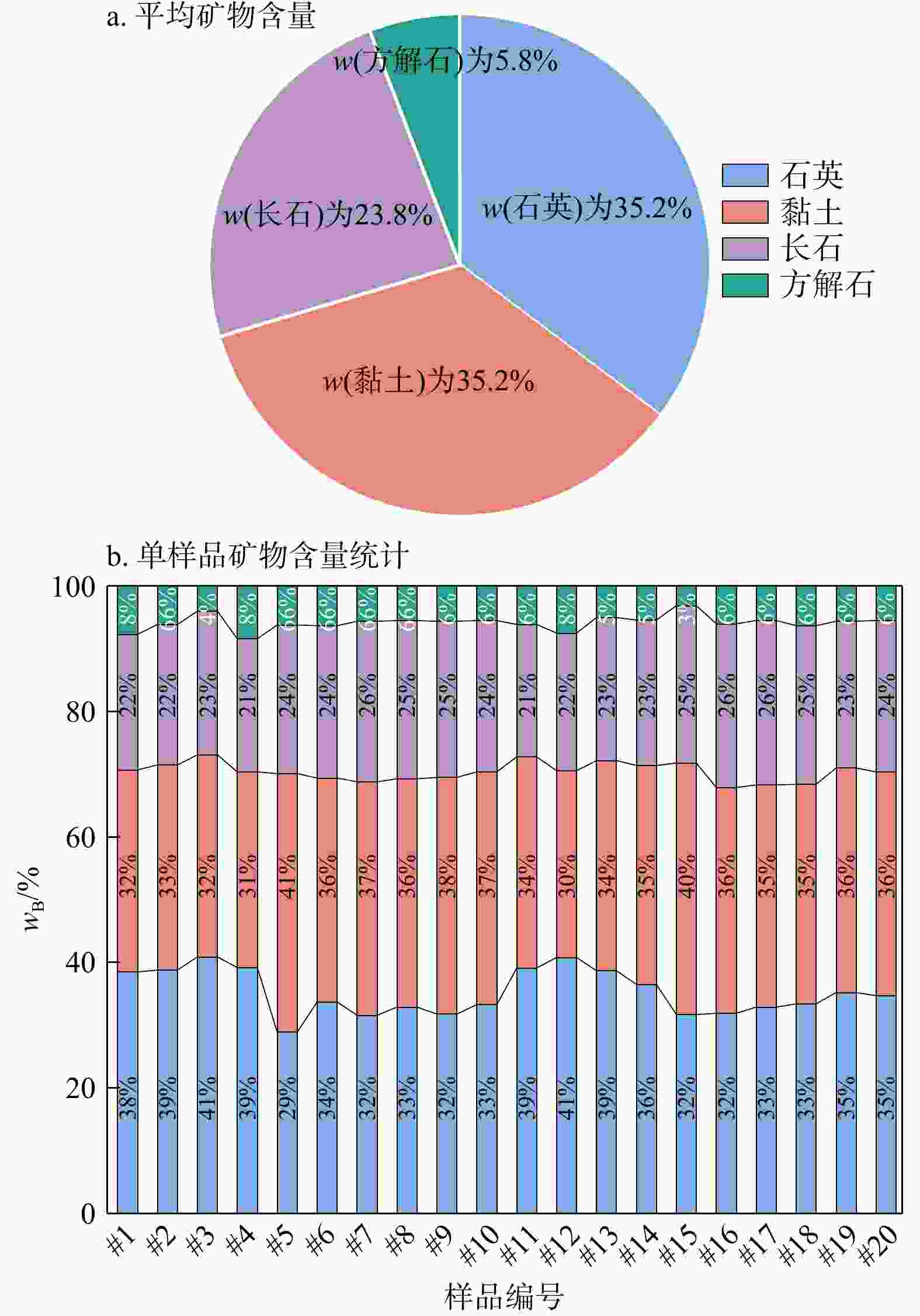
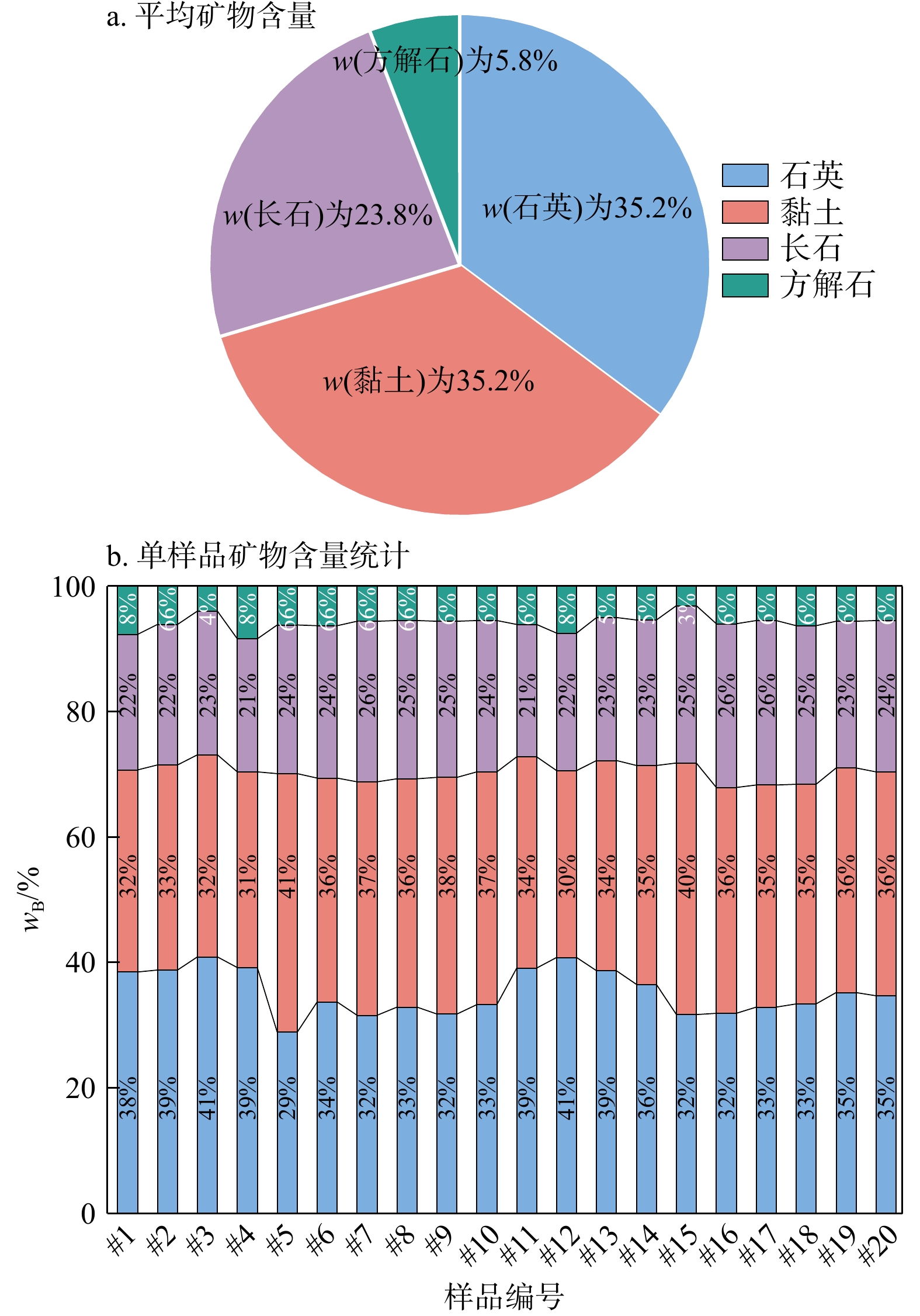
图 3 PⅡ井青一段样品主要矿物组成统计
Figure 3. Statistics of main mineral composition of samples from Qing-1 Member, Well PⅡ
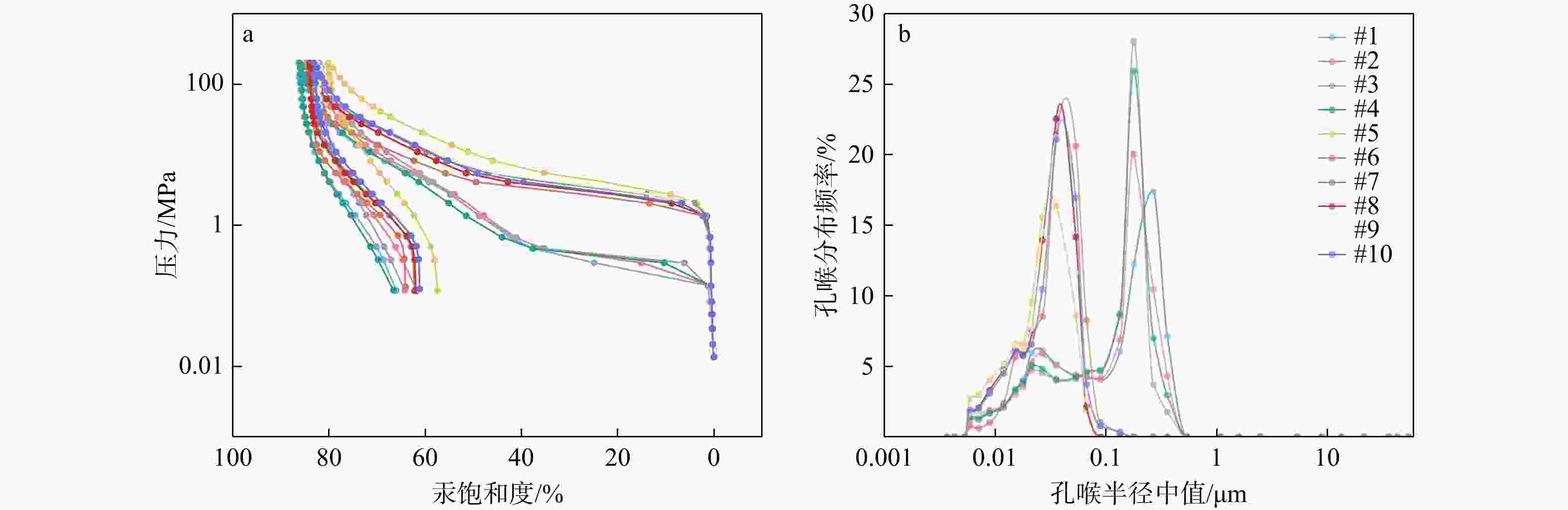
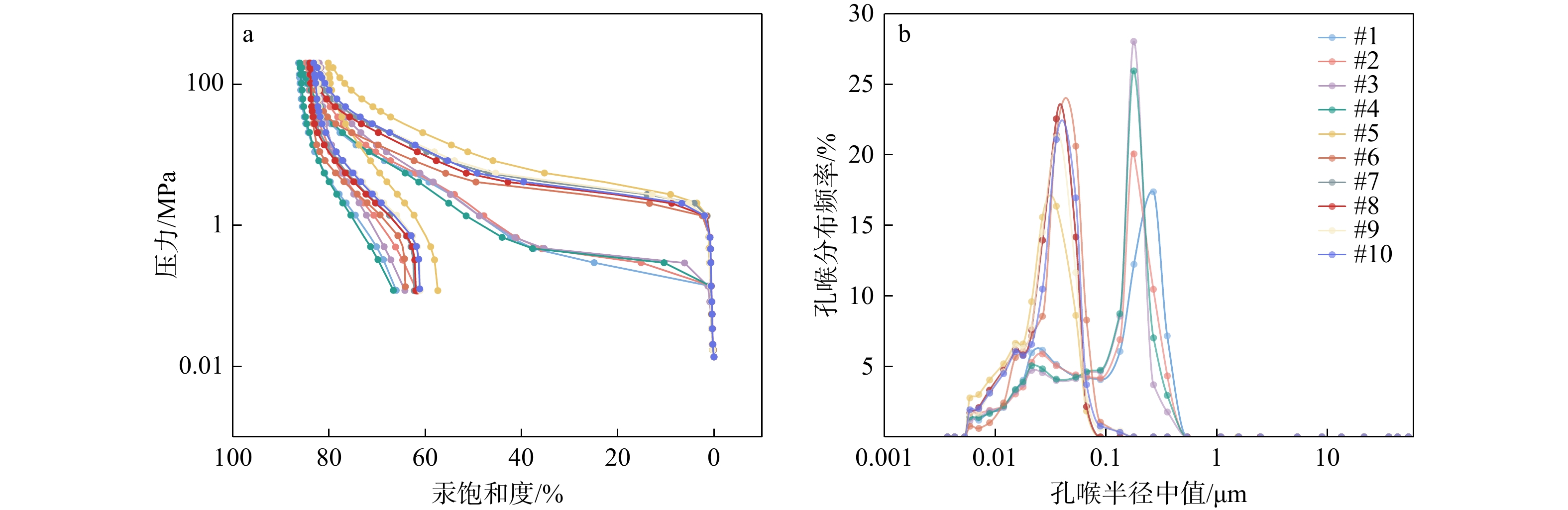
图 4 高压压汞进−退汞曲线(a)及孔喉半径分布(b)(#1~#10退汞效率见表2)
Figure 4. High-pressure mercury intrusion–extrusion curves (a) and pore-throat radius distribution (b)
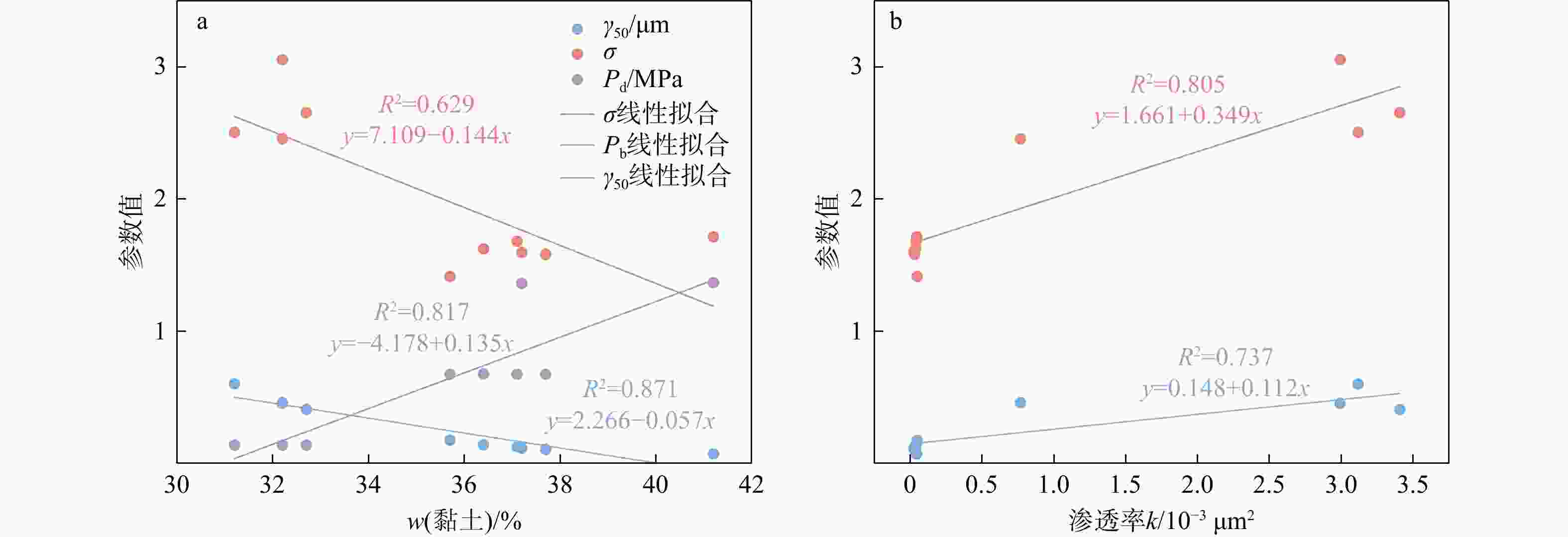
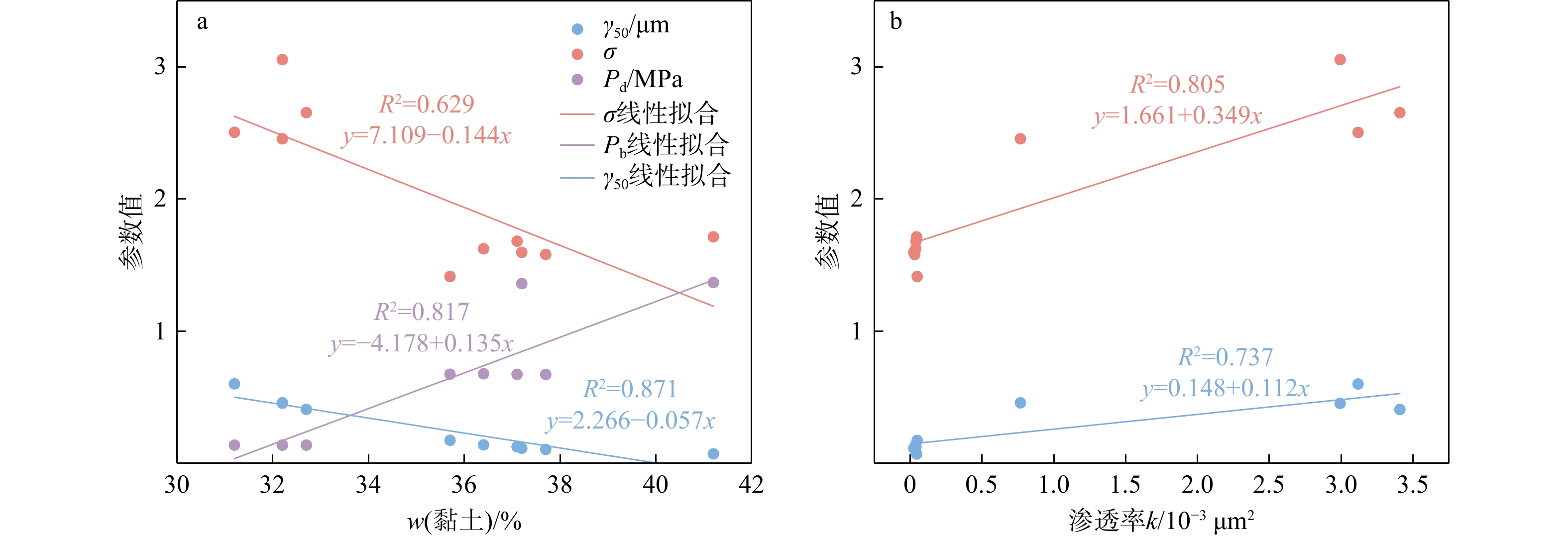
图 5 高压压汞孔喉参数与黏土含量 (a)、渗透率 (b) 的相关关系(R2为决定系数,下同)
Figure 5. Correlations of MIP-derived pore-throat parameters with clay content (a) and permeability (b)
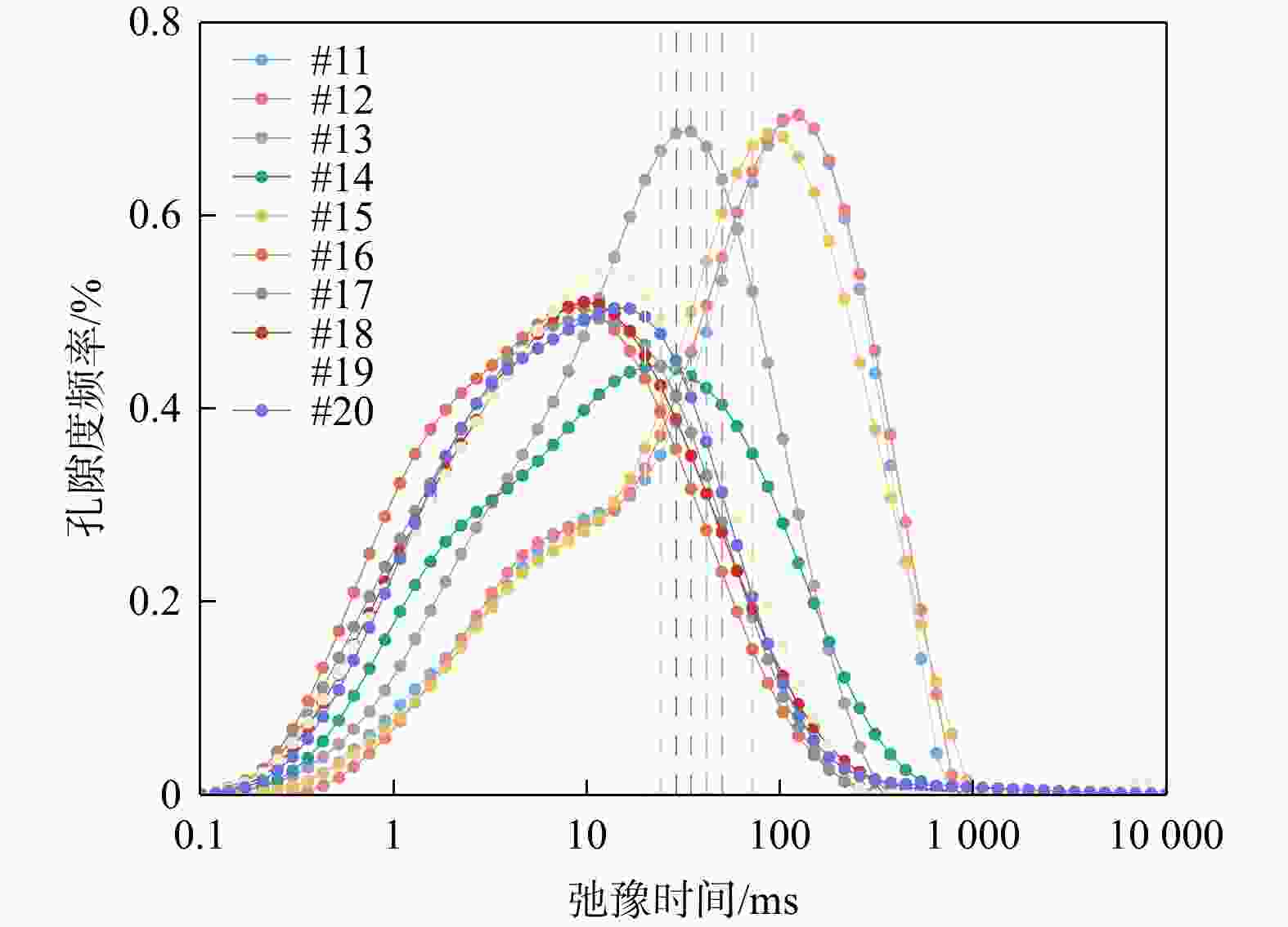
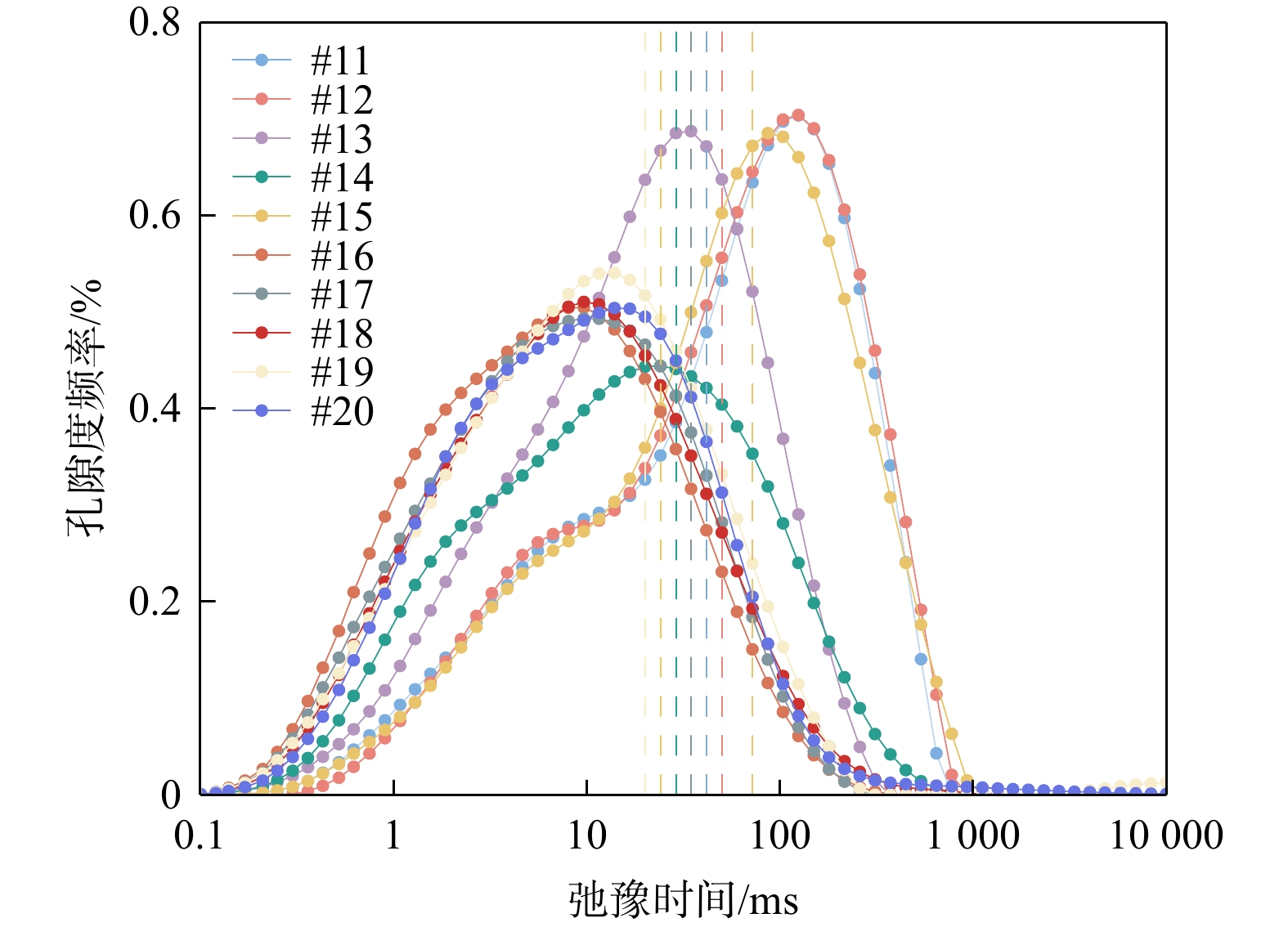
图 6 饱和状态离心核磁共振T2 弛豫谱与T2 截止值
#11~#20 T2截止值见表3;图中竖向虚线表示对应样品的T2截止值
Figure 6. Saturated-state centrifugal NMR T2 relaxation spectra and T2 cut-off values
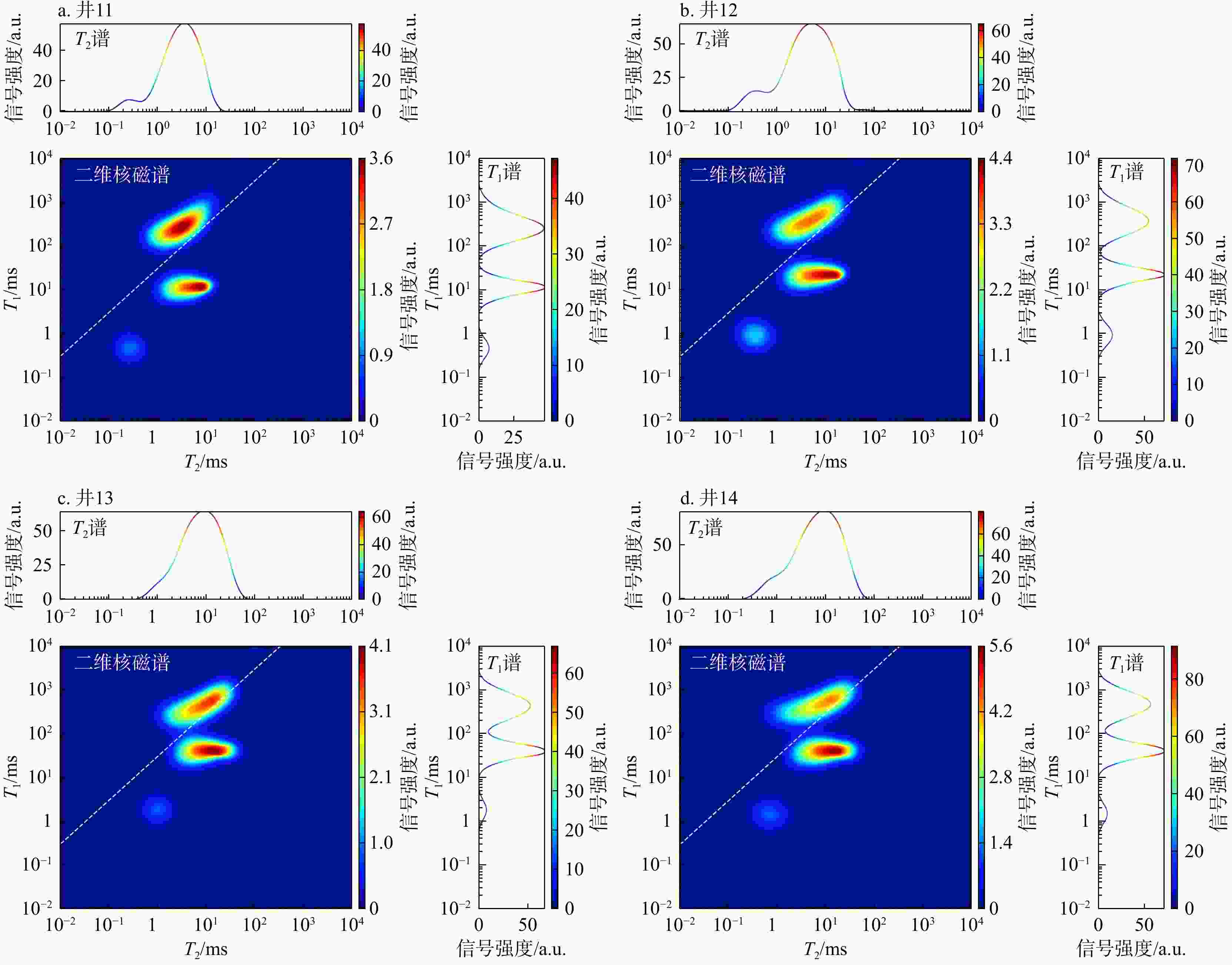
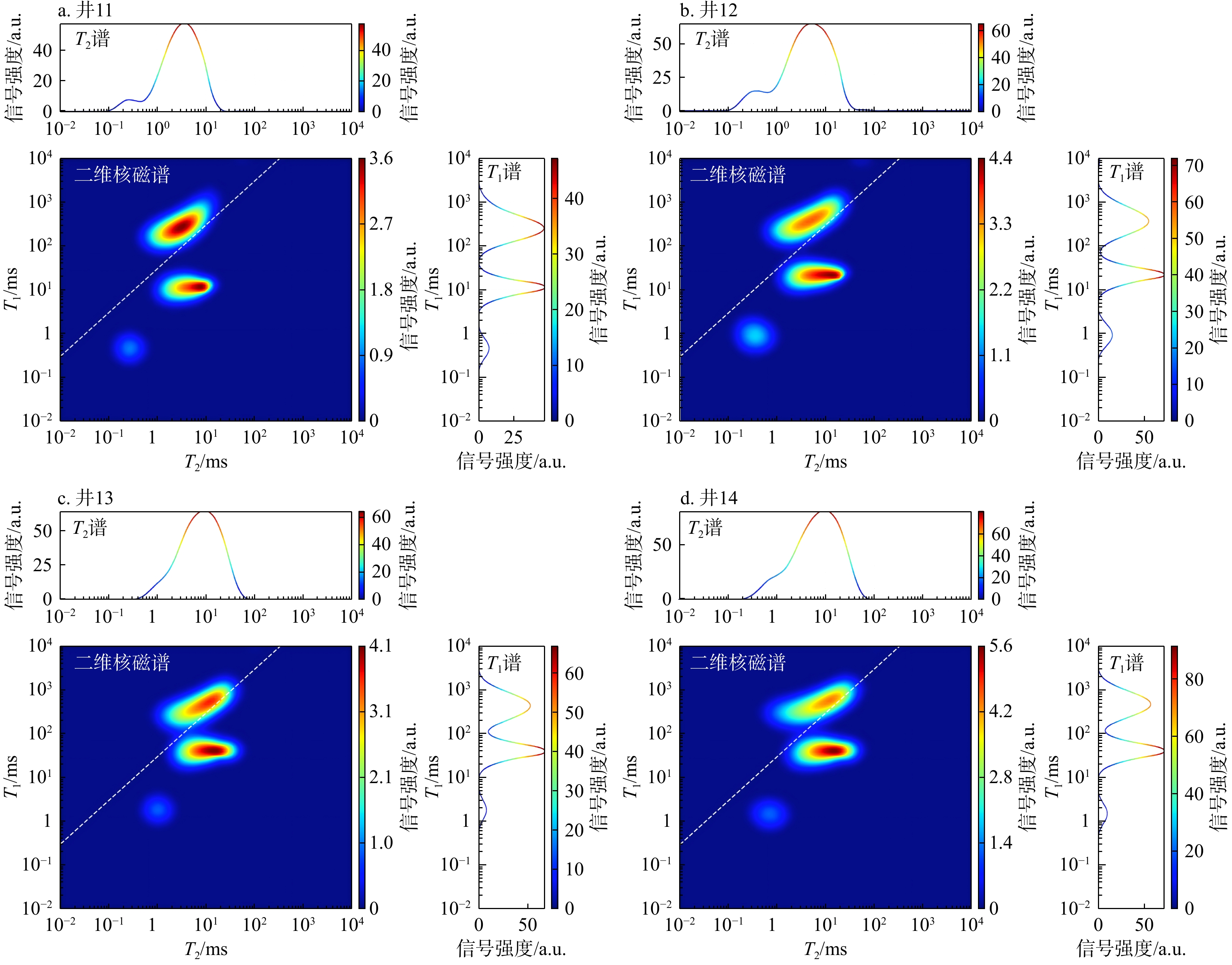
图 7 代表性样品T1-T2二维核磁共振谱及流体赋存解释(二维核磁谱图中白色虚线为T1/T2等比值参考线;T1为纵向弛豫时间;下同)
Figure 7. Representative T1-T2 two-dimensional NMR spectra and interpretation of fluid occurrence states
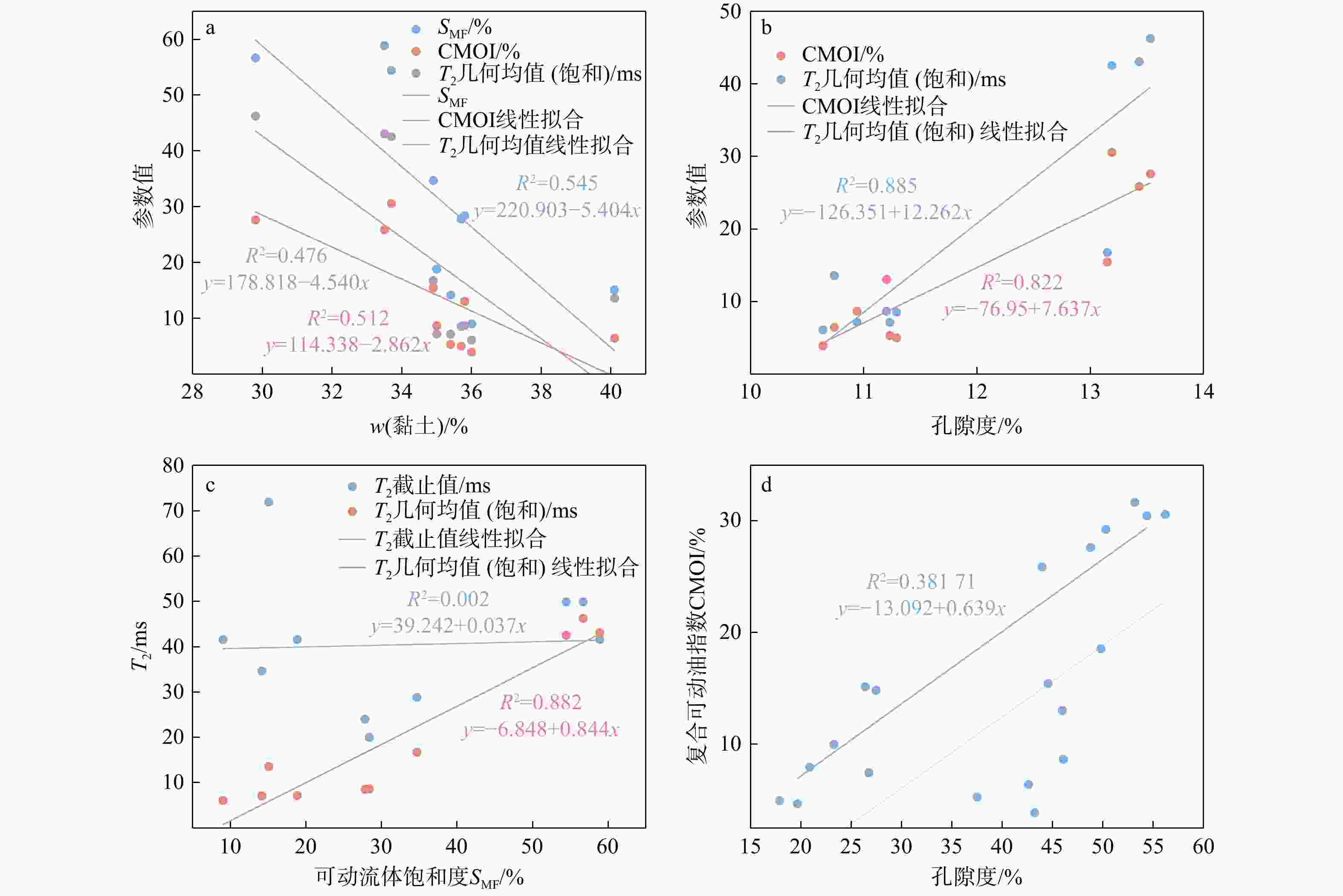
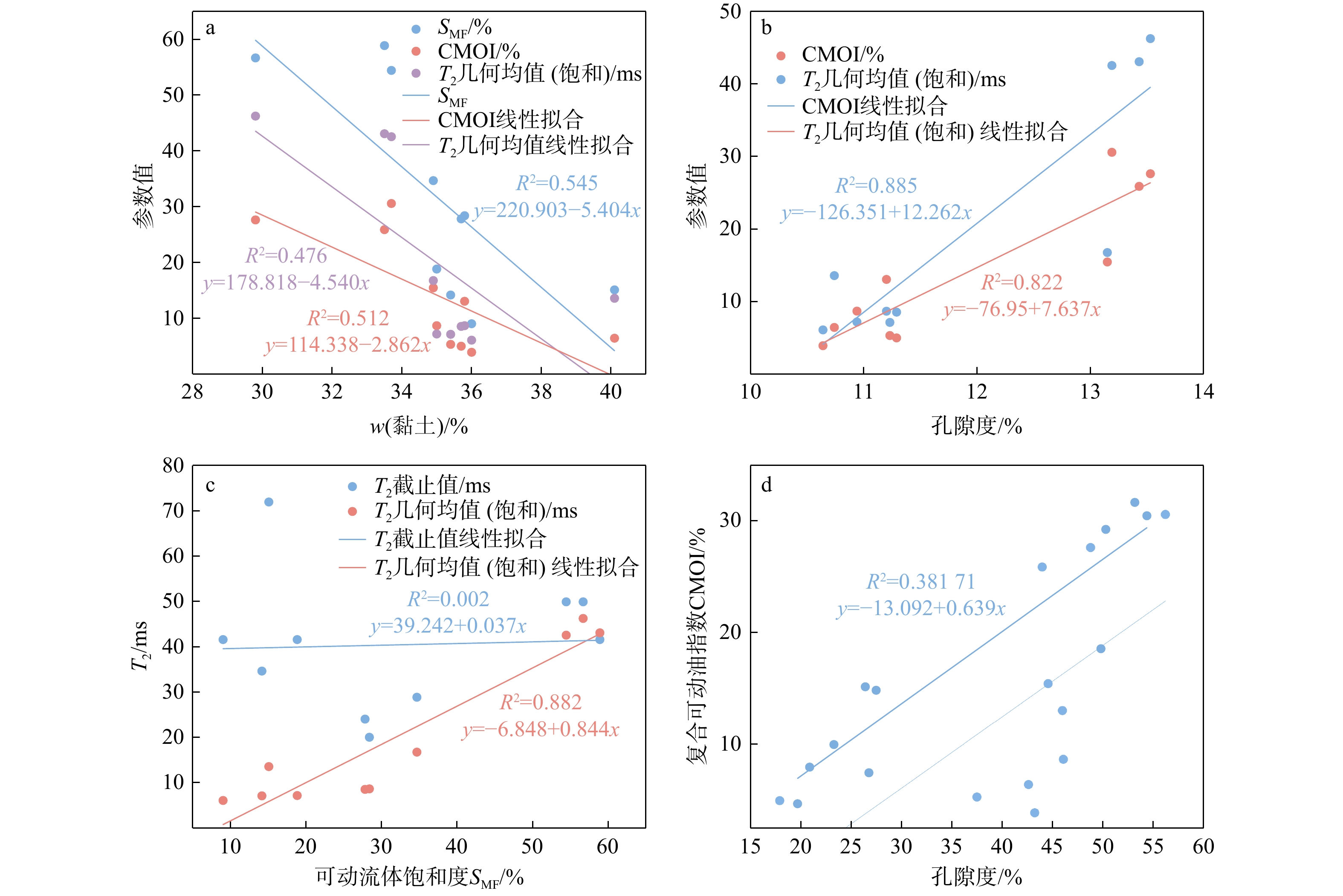
图 8 核磁共振参数与w(黏土)(a)、孔隙度(b)、可动流体饱和度(c)、含油饱和度(d)的统计关系
Figure 8. Statistical relationships of NMR parameters with clay content (w) (a), porosity (b), movable-fluid saturation (c), and oil saturation (d)

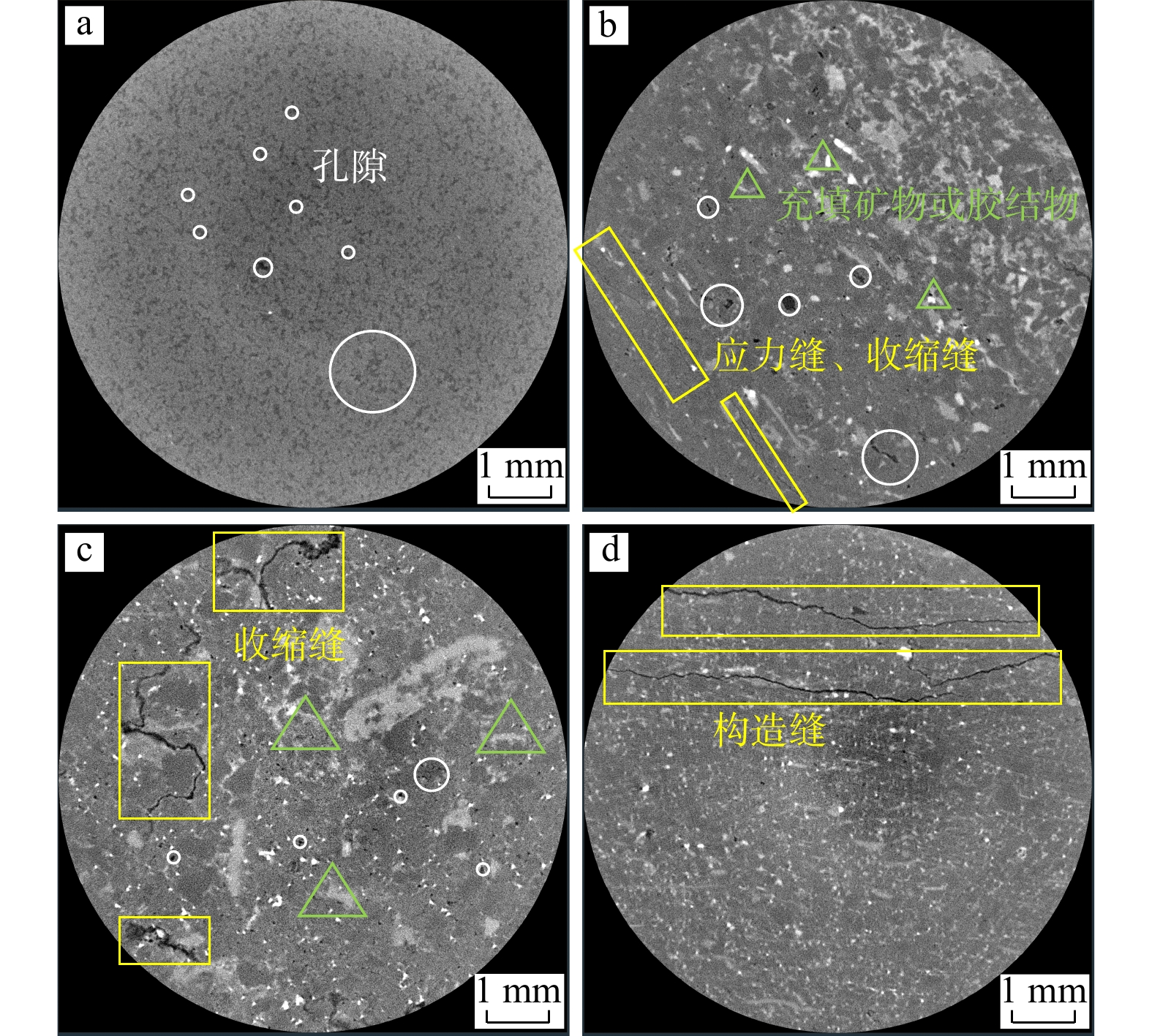
图 9 微米级 CT 孔−喉−裂缝微观结构特征(体素分辨率 2 μm,深度
2674.13 m)Figure 9. Micro-scale CT characteristics of pore-throat-fracture microstructures
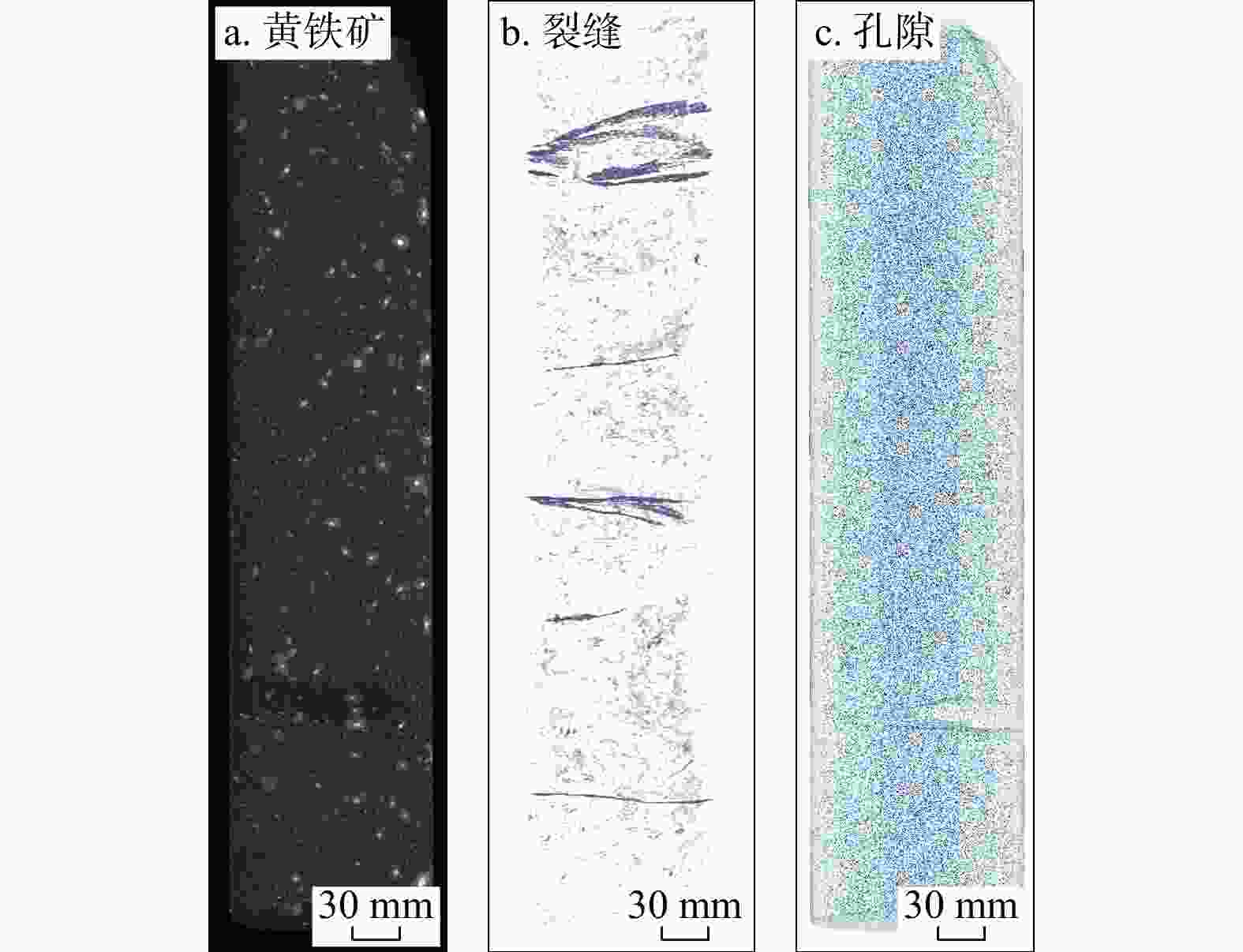
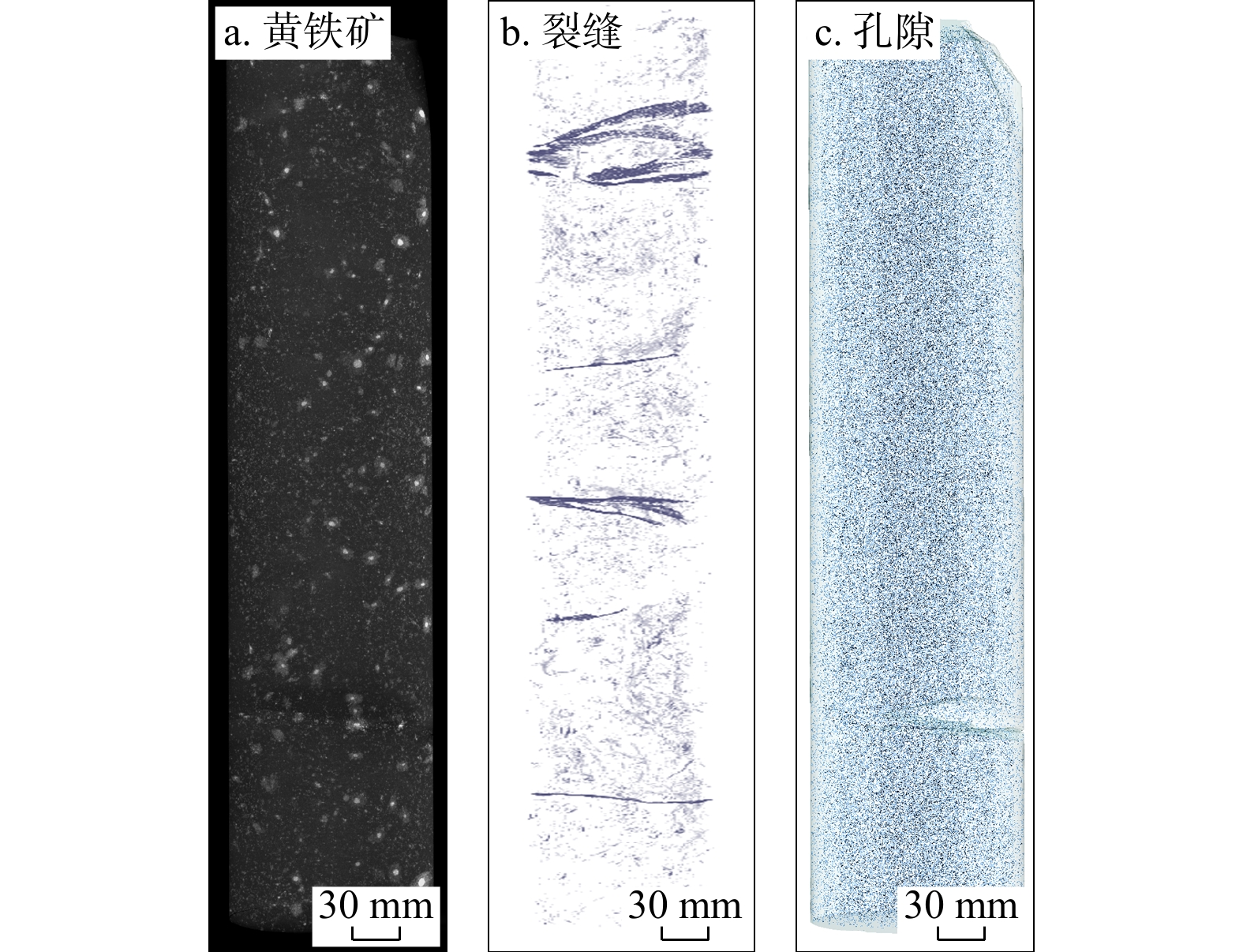
图 10 全直径岩心 CT 体素分割与三维渲染(体素分辨率 55 μm,深度
2673.82 ~2674.63 m)Figure 10. Whole-core CT voxel segmentation and 3D rendering of pyrite, fractures, and pores
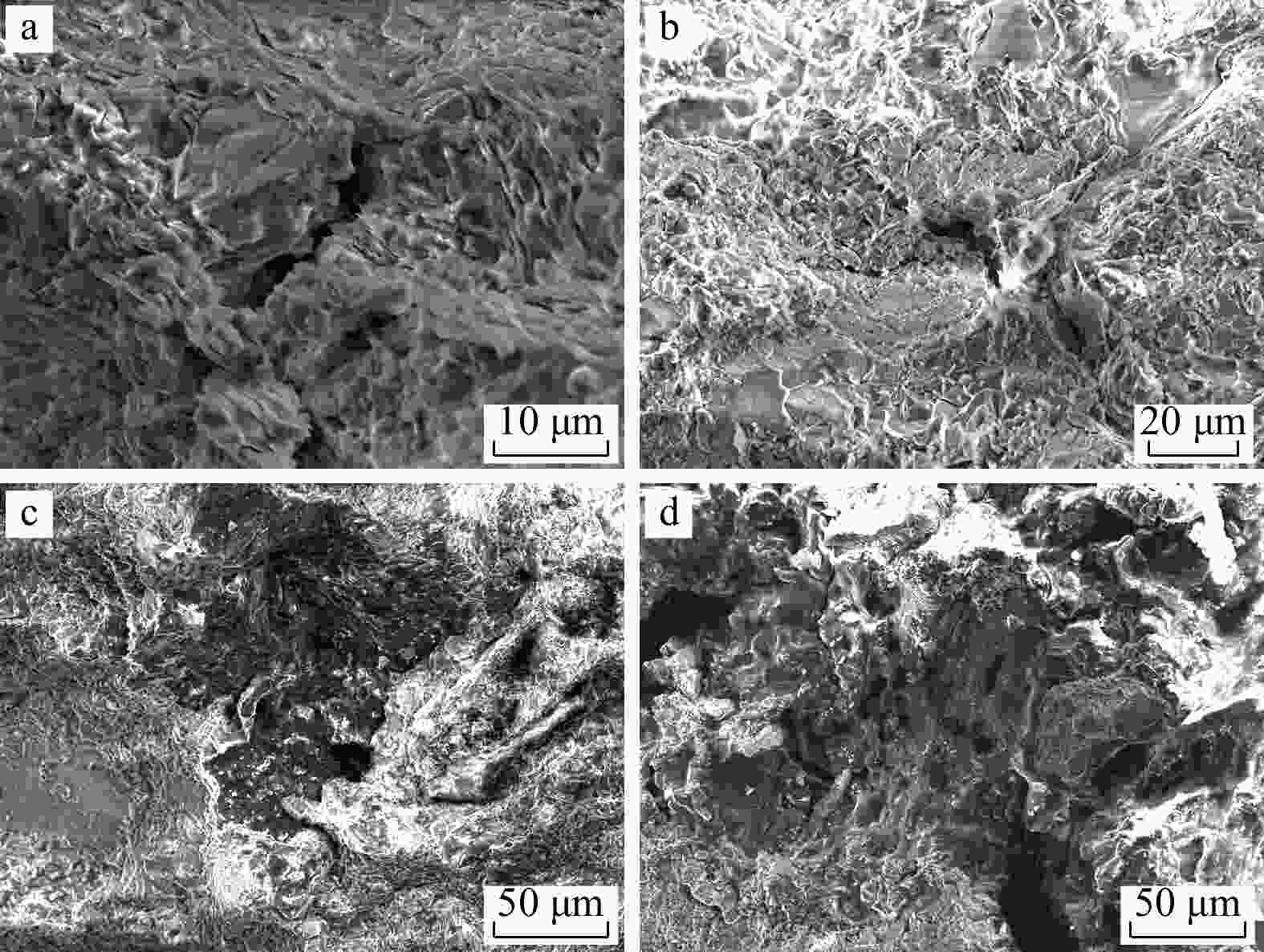
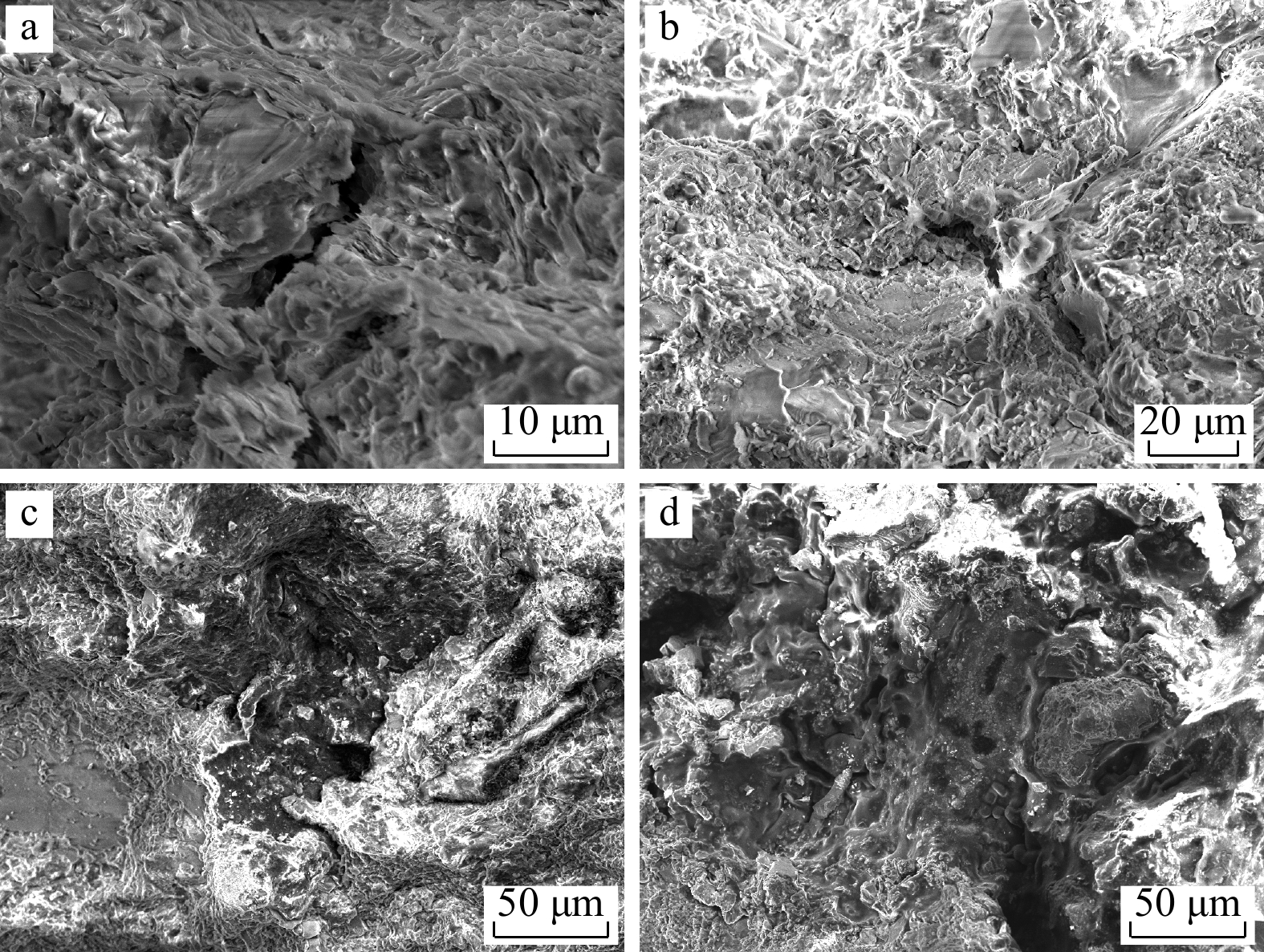
图 11 扫描电镜(SEM)图像:黏土胶结充填与孔喉连通特征
a. 孔喉被片状黏土胶结物充填,粒间孔少,储集能力受限,
2685.28 m;b. 粒间孔与线性微裂缝共同发育,局部改善、仍以细喉控制,2715.58 m;c. 粒间孔与溶蚀孔显著发育,孔喉畅通,储集潜力优,2671.52 m;d. 溶蚀作用增强孔喉畅通性,储集性能较高,2681.06 mFigure 11. SEM images of clay cementation and filling and pore-throat connectivity characteristics
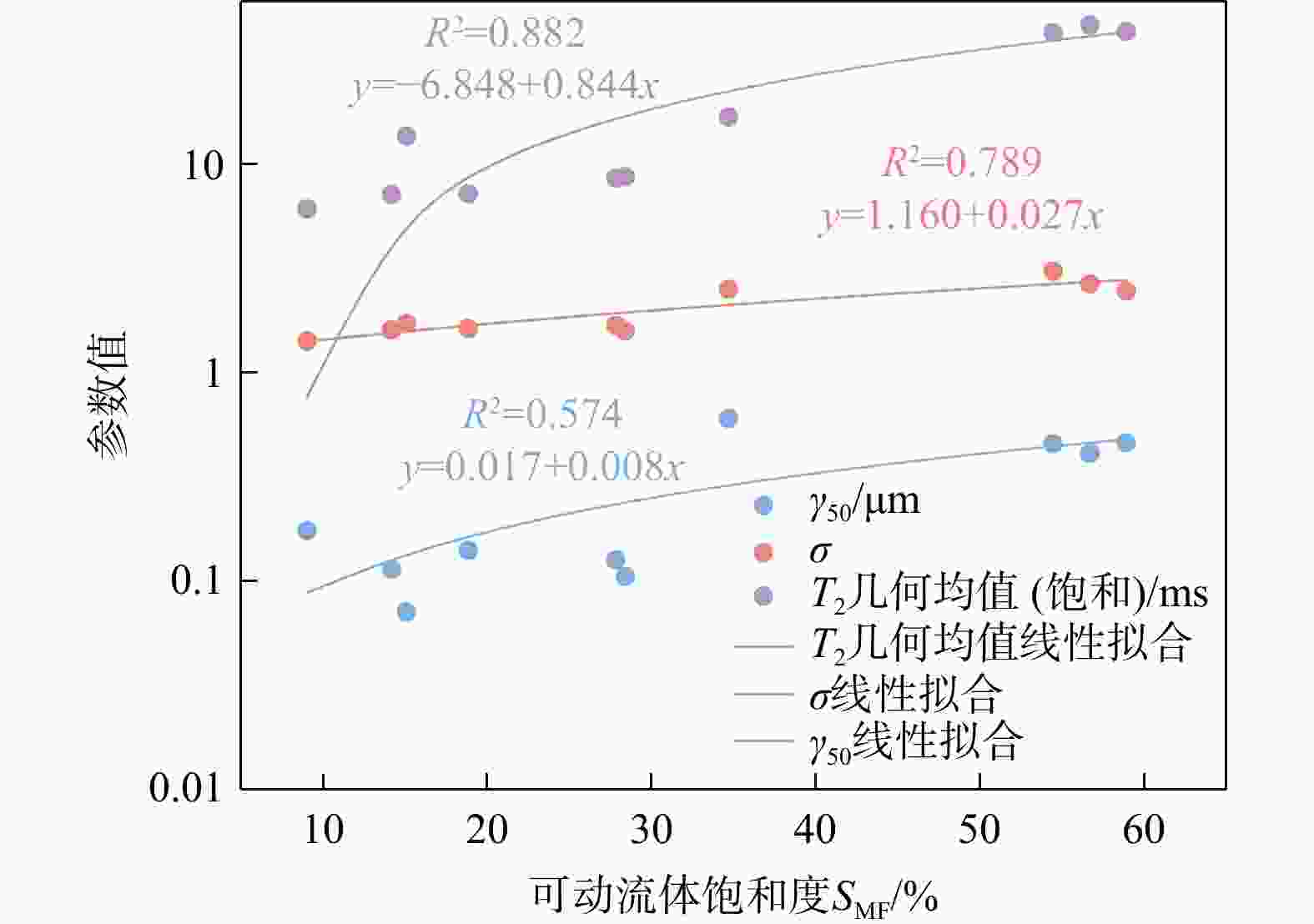
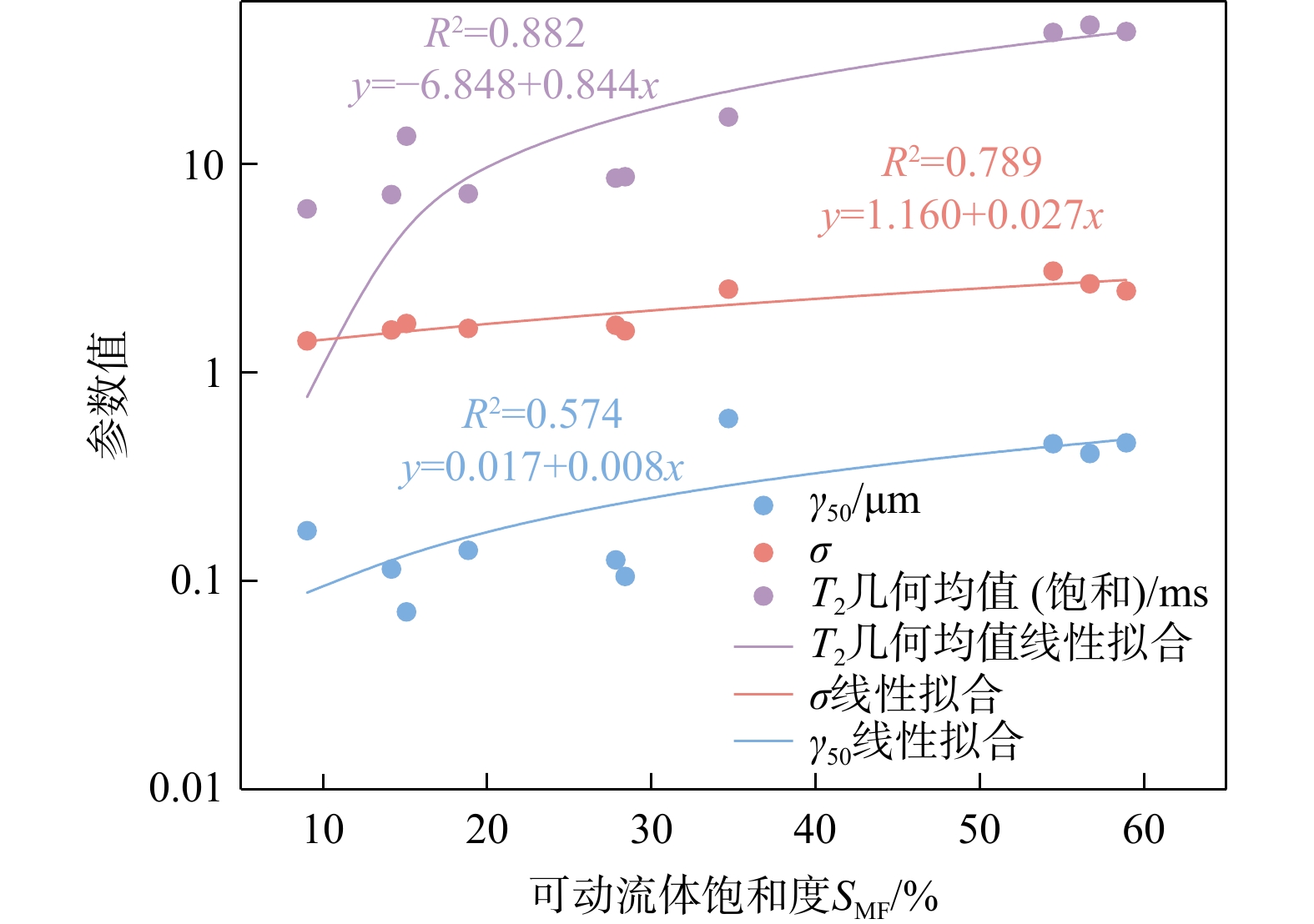
图 12 高压压汞孔喉参数与核磁共振可动流体参数相关关系
Figure 12. Correlations between MIP-derived pore-throat parameters and NMR-derived movable-fluid parameters
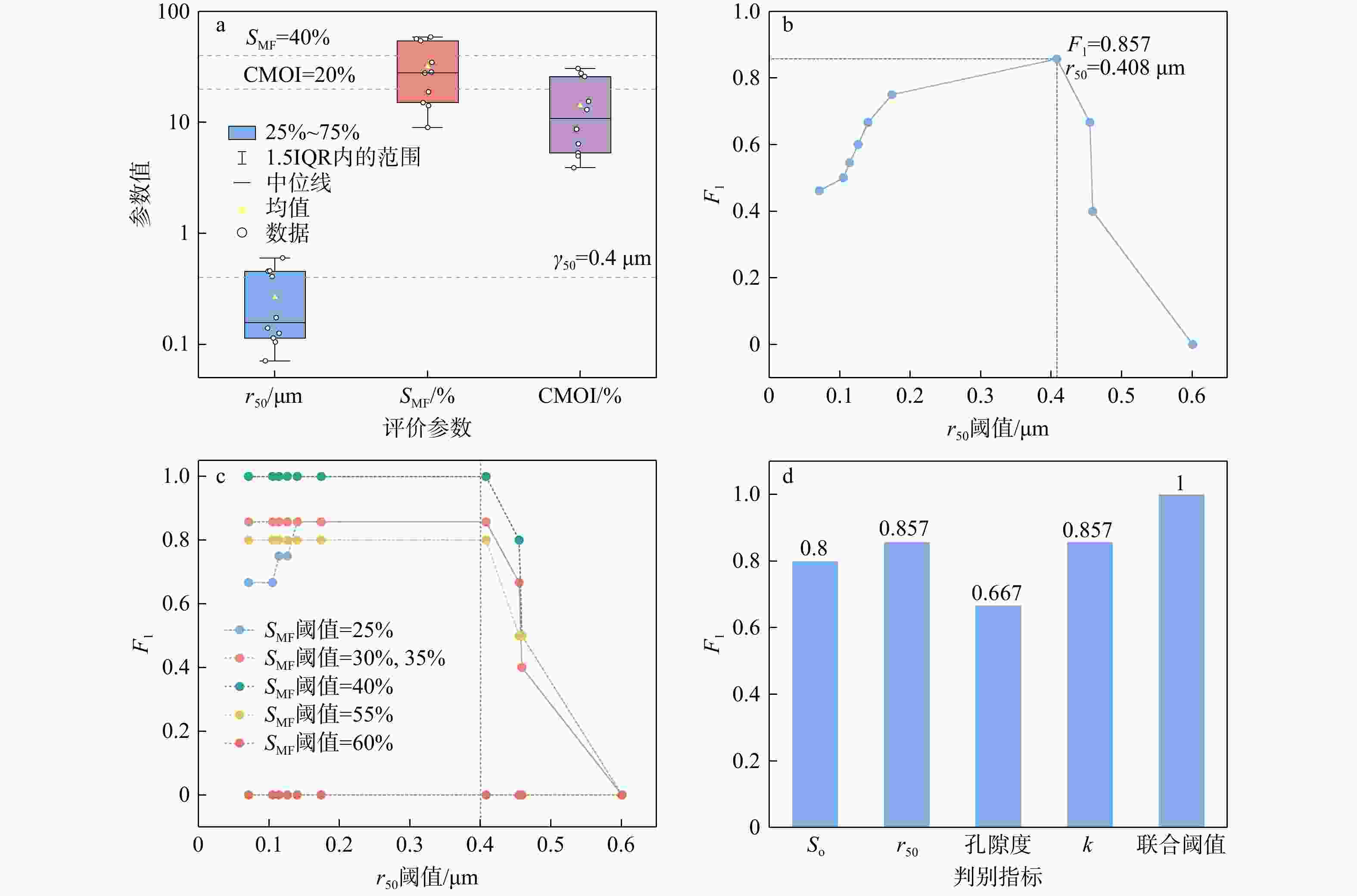
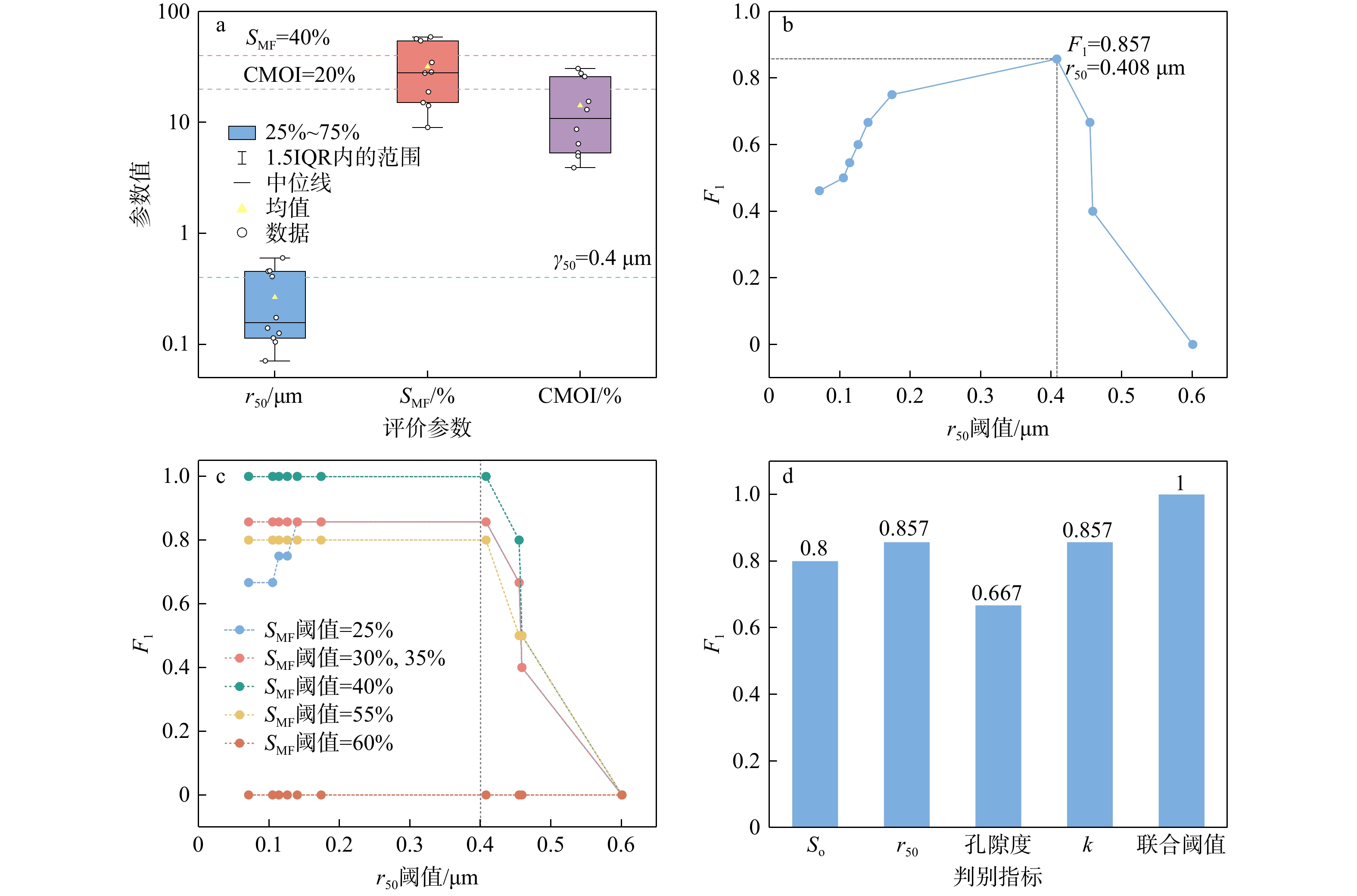
图 13 甜点判别阈值优选与模型判别性能评价
F1为精确率(PPV)与召回率(Recall)的调和平均数,是二分类任务的综合评价指标,F1=2×PPV×Recall/(PPV+Recall);25%~75%为四分位数区间;1.5IQR内的范围为1.5倍四分位距限定的正常数据范围
Figure 13. Optimization of sweet spot identification thresholds and evaluation of model identification performance
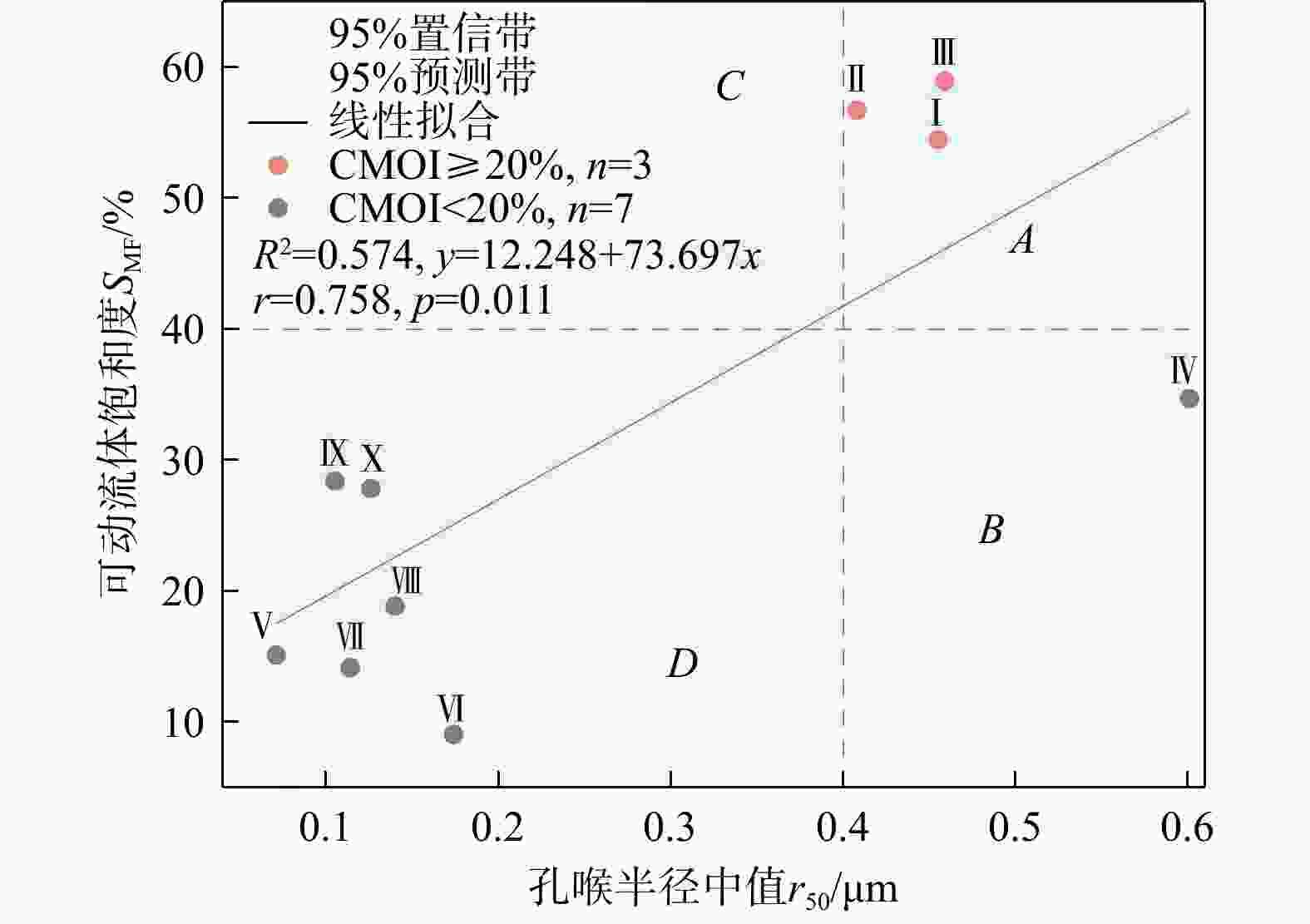
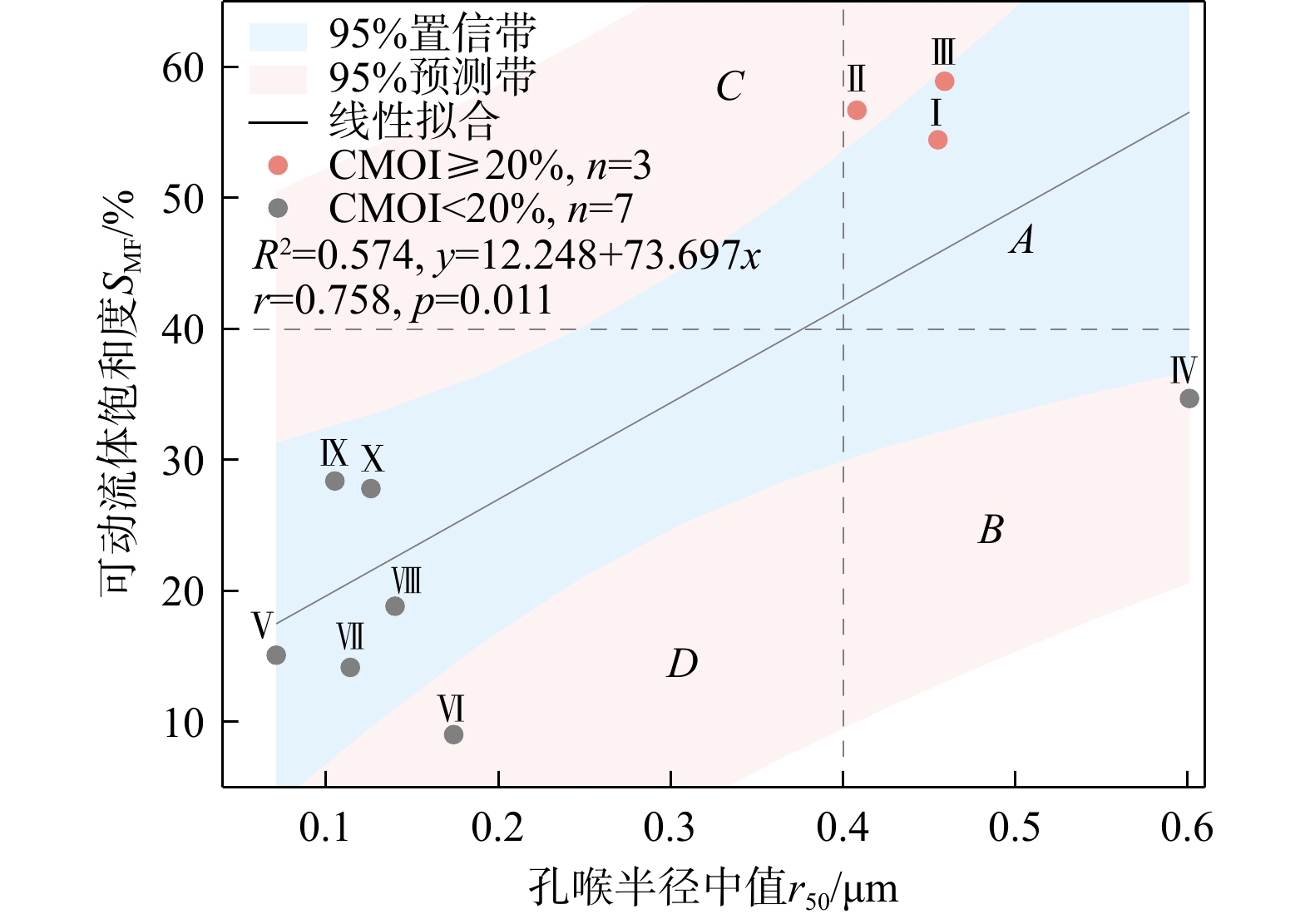
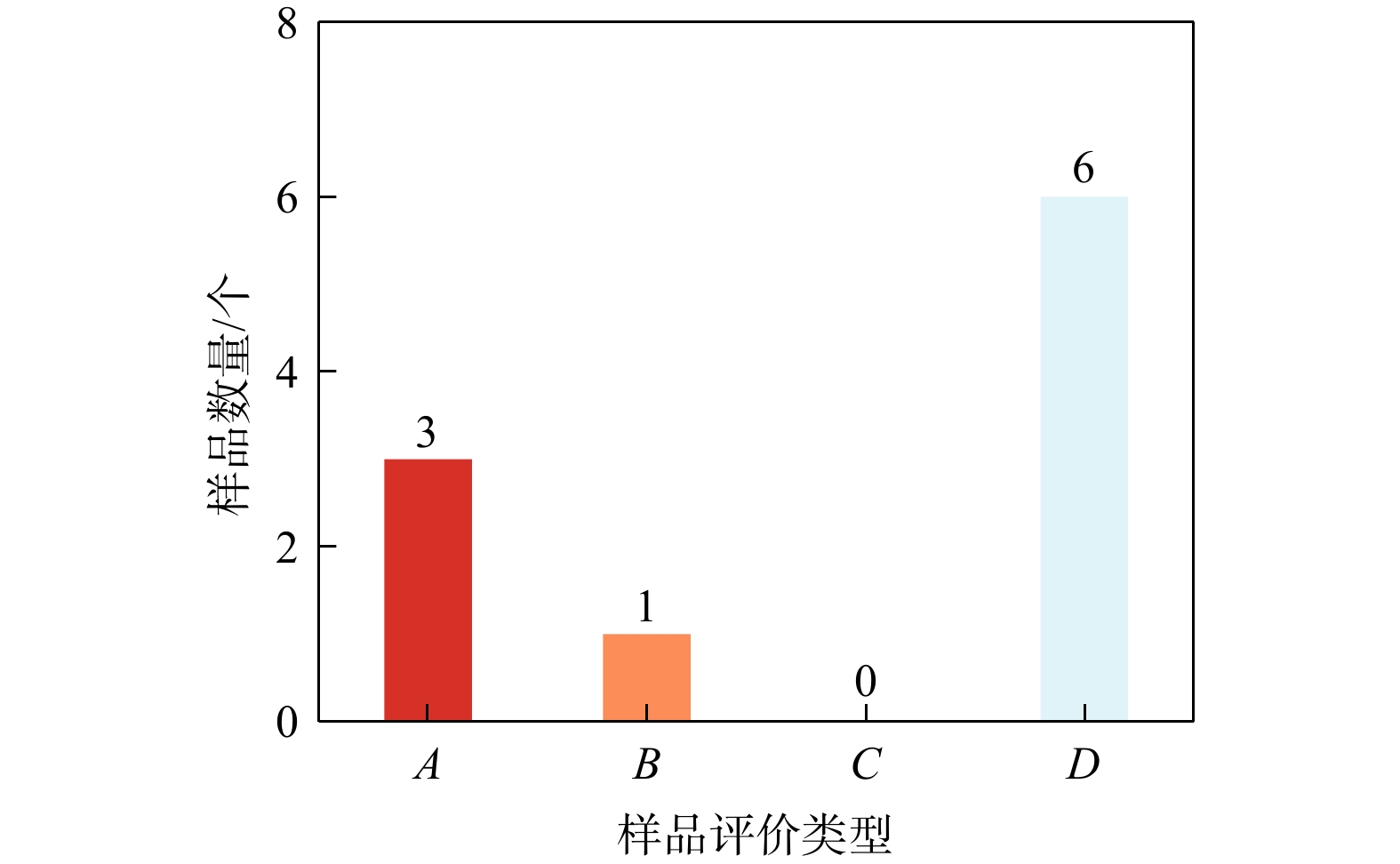
图 14 SMF−r50阈值判别及样品评价分区
n为样本数量;r为Pearson相关系数;p为显著性检验的 p 值,代表观测到当前相关特征由随机因素造成的概率;A~D 为4类评价分区编号;下同
Figure 14. SMF−r50 threshold discrimination and sample evaluation zones
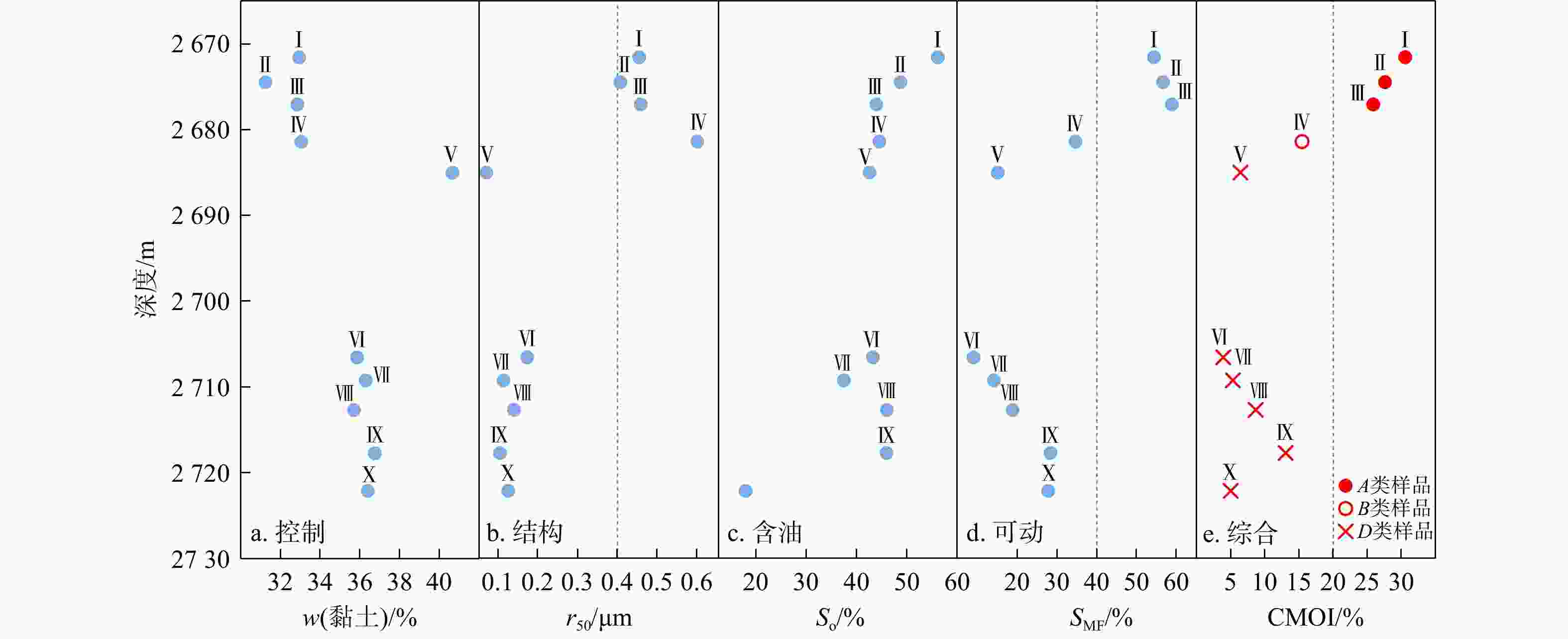
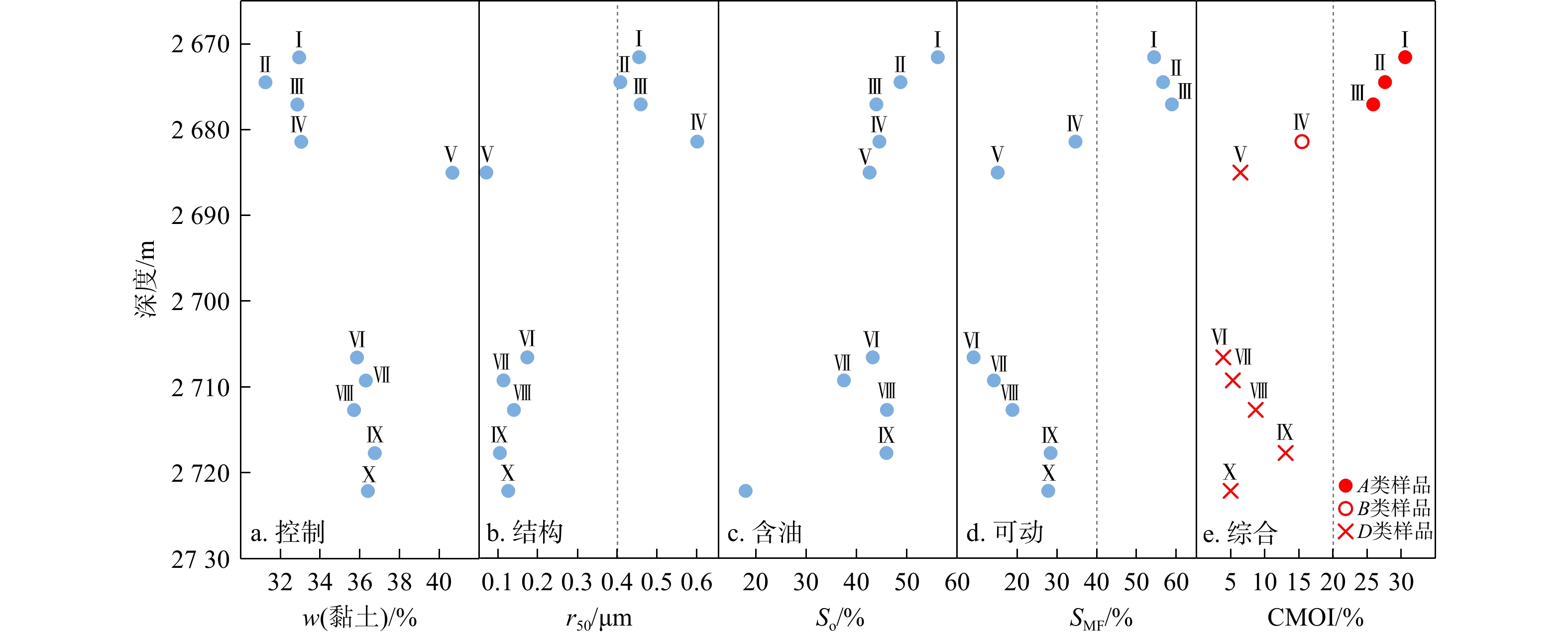
图 16 储层关键评价指标随深度变化对比
Figure 16. Comparison of variation of key reservoir evaluation indicators with depth
表 1 PⅡ井青一段粉砂岩夹层配对样品基础信息与矿物组成
Table 1. Basic information and mineral composition of paired siltstone interlayer samples, Qing-1 Member, Well PⅡ
配对
编号样品
编号埋深/m 实验项目 石英 黏土 长石 方解石 埋深
差/mMDI/% wB/% Ⅰ #1 2671.57 高压压汞 38.5 32.2 21.6 7.7 0 4.2 #11 2671.57 核磁共振 39.1 33.7 21.1 6.1 Ⅱ #2 2674.87 高压压汞 38.8 32.7 22.4 6.1 0.80 6.8 #12 2674.07 核磁共振 40.8 29.8 21.9 7.5 Ⅲ #3 2680.76 高压压汞 40.9 32.2 22.9 4.0 0.50 4.6 #13 2680.26 核磁共振 38.7 33.5 22.8 5.0 Ⅳ #4 2681.06 高压压汞 39.2 31.2 21.2 8.4 0.70 11.4 #14 2681.76 核磁共振 36.5 34.9 23.2 5.4 Ⅴ #5 2685.26 高压压汞 28.9 41.2 23.7 6.2 0.50 8.4 #15 2684.76 核磁共振 31.7 40.1 25.1 3.1 Ⅵ #6 2706.60 高压压汞 33.7 35.7 24.3 6.3 0.08 4.2 #16 2706.52 核磁共振 31.9 36.0 26.1 6.0 Ⅶ #7 2708.90 高压压汞 31.6 37.2 25.6 5.6 0.70 3.8 #17 2709.60 核磁共振 32.9 35.4 26.2 5.5 Ⅷ #8 2712.19 高压压汞 32.9 36.4 25.2 5.5 0 2.8 #18 2712.19 核磁共振 33.4 35.0 25.3 6.3 Ⅸ #9 2715.58 高压压汞 31.8 37.7 24.9 5.6 0.26 6.8 #19 2715.84 核磁共振 35.2 35.8 23.4 5.6 Ⅹ #10 2721.88 高压压汞 33.3 37.1 24.1 5.5 0.50 2.8 #20 2721.38 核磁共振 34.7 35.7 24.1 5.5 注:MDI为矿物差异指数;矿物含量为石英、黏土、长石、方解石的归一化结果(四者之和=100%),微量矿物未计入;单矿物定量不确定度一般为±2%~3%(绝对值),该参数用于计算MDI以评估样品组内可比性,配对判据为 MDI≤15%;配对样品垂向距离≤0.8 m;下同  下载: 导出CSV
表 2 样品高压压汞实验结果及孔喉结构参数
Table 2. High-pressure mercury intrusion porosimetry (MIP) experimental results and pore-throat structural parameters of samples
样品
编号退汞
效率/%Pb/MPa 最大进汞
饱和度/%r50/μm σ 压汞孔隙
度/%k/10−3 μm2 #1 23.496 0.13769 86.345 0.455 3.055 13.515 2.992 #2 27.229 0.13769 84.868 0.408 2.654 14.394 3.407 #3 21.727 0.13770 82.087 0.459 2.456 12.755 0.767 #4 22.622 0.13768 86.115 0.601 2.505 13.742 3.117 #5 28.395 1.36796 80.188 0.071 1.714 10.738 0.045 #6 23.492 0.67517 83.871 0.174 1.414 10.209 0.049 #7 26.007 1.35986 84.217 0.114 1.597 12.048 0.025 #8 26.261 0.67813 84.036 0.140 1.624 11.534 0.039 #9 26.132 0.67336 82.670 0.105 1.581 11.775 0.032 #10 26.489 0.67368 83.227 0.126 1.681 11.411 0.041 注: Pd为排驱压力;r50为孔喉半径中值;σ为孔喉分选系数;k为渗透率;下同
下载: 导出CSV
表 3 样品核磁共振实验参数与测试结果
Table 3. Experimental parameters and test results from NMR measurements
样品
编号SMF/% T2截止
值/msT2几何均值
(饱和)/msSo/% 核磁孔
隙度/%CMOI/% #11 54.44 49.94 42.56 56.18 13.19 30.58 #12 56.69 49.94 46.26 48.74 13.53 27.63 #13 58.90 41.60 43.08 43.95 13.43 25.89 #14 34.68 28.86 16.76 44.54 13.15 15.45 #15 15.08 71.97 13.57 42.60 10.74 6.42 #16 9.02 41.60 6.08 43.22 10.64 3.90 #17 14.16 34.65 7.12 37.49 11.23 5.31 #18 18.83 41.60 7.18 46.05 10.94 8.67 #19 28.39 20.03 8.66 45.95 11.20 13.05 #20 27.81 24.04 8.53 17.92 11.29 4.98 注: T2为横向弛豫时间;SMF为可动流体饱和度;So为含油饱和度;CMOI为复合可动油指数;下同
下载: 导出CSV
表 4 甜点判别结果及评价指标
Table 4. Sweet spot identification results and evaluation indicators
配对
编号r50/
μmSMF/
%CMOI/
%样本甜点
(CMOI≥20%)判别结果(r50>0.40,
SMF>40%)分类 Ⅰ 0.455 54.44 30.58 是 是 TP Ⅱ 0.408 56.69 27.63 是 是 TP Ⅲ 0.459 58.9 25.89 是 是 TP Ⅳ 0.601 34.68 15.45 否 否 TN Ⅴ 0.071 15.08 6.42 否 否 TN Ⅵ 0.174 9.02 3.90 否 否 TN Ⅶ 0.114 14.16 5.31 否 否 TN Ⅷ 0.14 18.83 8.67 否 否 TN Ⅸ 0.105 28.39 13.05 否 否 TN Ⅹ 0.126 27.81 4.98 否 否 TN 注:TP为真阳性(对照标准为甜点且判为甜点);FP为假阳性(对照标准为非甜点但判为甜点);FN为假阴性(对照标准为甜点未被判出);TN为真阴性(对照标准为非甜点且未被判出)。在该阈值组合下:TP=3,FP=0,FN=0,TN=7,PPV=1.00,Recall=1.00,F1=1.00。按表中列联结果进行Fisher精确检验,双侧p= 0.0083 ,表明该经验界值组合与样本内甜点对照结果具有较好的对应关系。需要指出的是,样本甜点为实验室尺度的对照标准,仅用于检验本研究判别标准在本井段样品集中的识别效果;受正类样本仅3件限制,相关结果主要用于井段内对比与优选,不作更大范围直接外推
下载: 导出CSV
-
[1] 赵喆, 白斌, 刘畅, 等. 中国石油陆上中−高成熟度页岩油勘探现状、进展与未来思考[J]. 石油与天然气地质, 2024, 45(2): 327-340. doi: 10.11743/ogg20240202ZHAO Z, BAI B, LIU C, et al. Current status, advances, and prospects of CNPC's exploration of onshore moderately to highly mature shale oil reservoirs[J]. Oil & Gas Geology, 2024, 45(2): 327-340. (in Chinese with English abstract) doi: 10.11743/ogg20240202 [2] 孙龙德, 贾承造, 张君峰, 等. 松辽盆地古龙页岩油重点地区资源潜力[J]. 石油学报, 2024, 45(12): 1699-1714. doi: 10.7623/syxb202412001SUN L D, JIA C Z, ZHANG J F, et al. Resource potential of Gulong shale oil in the key areas of Songliao Basin[J]. Acta Petrolei Sinica, 2024, 45(12): 1699-1714. (in Chinese with English abstract) doi: 10.7623/syxb202412001 [3] 孙龙德, 朱如凯, 张天舒, 等. 陆相页岩沉积学研究进展与发展方向: 以大庆古龙页岩为例[J]. 石油勘探与开发, 2024, 51(6): 1183-1198. doi: 10.11698/PED.20240258SUN L D, ZHU R K, ZHANG T S, et al. Advances and trends of non-marine shale sedimentology: A case study from Gulong shale of Daqing oilfield, Songliao Basin, NE China[J]. Petroleum Exploration and Development, 2024, 51(6): 1183-1198. (in Chinese with English abstract) doi: 10.11698/PED.20240258 [4] 孙龙德, 刘合, 何文渊, 等. 大庆古龙页岩油重大科学问题与研究路径探析[J]. 石油勘探与开发, 2021, 48(3): 453-463. doi: 10.11698/PED.2021.03.02SUN L D, LIU H, HE W Y, et al. An analysis of major scientific problems and research paths of Gulong shale oil in Daqing oilfield, NE China[J]. Petroleum Exploration and Development, 2021, 48(3): 453-463. (in Chinese with English abstract) doi: 10.11698/PED.2021.03.02 [5] 柳波, 石佳欣, 付晓飞, 等. 陆相泥页岩层系岩相特征与页岩油富集条件: 以松辽盆地古龙凹陷白垩系青山口组一段富有机质泥页岩为例[J]. 石油勘探与开发, 2018, 45(5): 828-838. doi: 10.11698/PED.2018.05.08LIU B, SHI J X, FU X F, et al. Petrological characteristics and shale oil enrichment of lacustrine fine-grained sedimentary system: A case study of organic-rich shale in First Member of Cretaceous Qingshankou Formation in Gulong Sag, Songliao Basin, NE China[J]. Petroleum Exploration and Development, 2018, 45(5): 828-838. (in Chinese with English abstract) doi: 10.11698/PED.2018.05.08 [6] 朱国文, 王小军, 张金友, 等. 松辽盆地陆相页岩油富集条件及勘探开发有利区[J]. 石油学报, 2023, 44(1): 110-124.ZHU G W, WANG X J, ZHANG J Y, et al. Enrichment conditions and favorable zones for exploration and development of continental shale oil in Songliao Basin[J]. Acta Petrolei Sinica, 2023, 44(1): 110-124. (in Chinese with English abstract) [7] 陈方文, 卢双舫, 黄振凯, 等. 松辽盆地古龙凹陷青一段沉积特征及有利勘探区[J]. 中南大学学报(自然科学版), 2013, 44(5): 1955-1963.CHEN F W, LU S F, HUANG Z K, et al. Sedimentary characteristics and favorable exploration zone of K1qn1 in Gulong Depression of Songliao Basin[J]. Journal of Central South University, 2013, 44(5): 1955-1963. (in Chinese with English abstract) [8] 于利民. 松辽盆地大情字井地区青山口组一段夹层型页岩油甜点综合评价[D]. 黑龙江大庆: 东北石油大学, 2023.YU L M. Comprehensive evaluation of sandwich shale oil dessert in the First Member of Qingshankou Formation in Daqingzijing area of Songliao Basin[D]. Daqing Heilongjiang: Northeast Petroleum University, 2023. (in Chinese with English abstract) [9] 陈鸿安, 付兰清. 松辽盆地青山口组页岩油储层孔隙结构对渗吸特征影响[J]. 特种油气藏, 2025, 32(3): 94-103. doi: 10.3969/j.issn.1006-6535.2025.03.011CHEN H A, FU L Q. Impact of pore structure on imbibition characteristics in Qingshankou Formation shale oil reservoirs, Songliao Basin[J]. Special Oil & Gas Reservoirs, 2025, 32(3): 94-103. (in Chinese with English abstract) doi: 10.3969/j.issn.1006-6535.2025.03.011 [10] 周志军, 张国青, 崔春雪, 等. 页岩储层孔隙结构表征及物性下限确定方法及应用[J]. 特种油气藏, 2024, 31(4): 96-102. doi: 10.3969/j.issn.1006-6535.2024.04.012ZHOU Z J, ZHANG G Q, CUI C X, et al. Methods and applications for characterizing pore structure and determining physical property lower limit in shale reservoirs[J]. Special Oil & Gas Reservoirs, 2024, 31(4): 96-102. (in Chinese with English abstract) doi: 10.3969/j.issn.1006-6535.2024.04.012 [11] 杨峰, 宁正福, 张世栋, 等. 基于氮气吸附实验的页岩孔隙结构表征[J]. 天然气工业, 2013, 33(4): 135-140. doi: 10.3787/j.issn.1000-0976.2013.04.025YANG F, NING Z F, ZHANG S D, et al. Characterization of shale pore structure based on nitrogen adsorption experiments[J]. Natural Gas Industry, 2013, 33(4): 135-140. (in Chinese with English abstract) doi: 10.3787/j.issn.1000-0976.2013.04.025 [12] 梁志凯, 李卓, 姜振学, 等. 基于NMR和SEM技术研究陆相页岩孔隙结构与分形维数特征: 以松辽盆地长岭断陷沙河子组页岩为例[J]. 地球科学与环境学报, 2020, 42(3): 313-328. doi: 10.19814/j.jese.2019.10003LIANG Z K, LI Z, JIANG Z X, et al. Characteristics of pore structure and fractal dimension in continental shale based on NMR experiments and SEM image analyses: A case study of Shahezi Formation shale in Changling fault depression of Songliao Basin, China[J]. Journal of Earth Sciences and Environment, 2020, 42(3): 313-328. (in Chinese with English abstract) doi: 10.19814/j.jese.2019.10003 [13] 王志伟, 王民, 卢双舫, 等. 基于高压压汞法的泥页岩储层分形研究: 以松辽盆地青山口组湖相泥岩为例[J]. 河南科学, 2015, 33(7): 1206-1213.WANG Z W, WANG M, LU S F, et al. Fractal characteristics of shale based on the mercury injection method[J]. Henan Science, 2015, 33(7): 1206-1213. (in Chinese with English abstract) [14] 白龙辉, 柳波, 迟亚奥, 等. 二维核磁共振技术表征页岩所含流体特征的应用: 以松辽盆地青山口组富有机质页岩为例[J]. 石油与天然气地质, 2021, 42(6): 1389-1400. doi: 10.11743/ogg20210613BAI L H, LIU B, CHI Y A, et al. 2D NMR studies of fluids in organic-rich shale from the Qingshankou Formation, Songliao Basin[J]. Oil & Gas Geology, 2021, 42(6): 1389-1400. (in Chinese with English abstract) doi: 10.11743/ogg20210613 [15] 李志清, 孙洋, 胡瑞林, 等. 基于核磁共振法的页岩纳米孔隙结构特征研究[J]. 工程地质学报, 2018, 26(3): 758-766. doi: 10.13544/j.cnki.jeg.2017-126LI Z Q, SUN Y, HU R L, et al. Quantitative analysis for nanopore structure characteristics of shales using NMR and NMR cryoporometry[J]. Journal of Engineering Geology, 2018, 26(3): 758-766. (in Chinese with English abstract) doi: 10.13544/j.cnki.jeg.2017-126 [16] 李军, 邹友龙, 路菁. 陆相页岩油储层可动油含量测井评价方法: 以苏北盆地古近系阜宁组二段页岩油为例[J]. 石油与天然气地质, 2024, 45(3): 816-826. doi: 10.11743/ogg20240317LI J, ZOU Y L, LU J. Well-log-based assessment of movable oil content in lacustrine shale oil reservoirs: A case study of the 2nd Member of the Paleogene Funing Formation, Subei Basin[J]. Oil & Gas Geology, 2024, 45(3): 816-826. (in Chinese with English abstract) doi: 10.11743/ogg20240317 [17] 黄千慧, 李海波, 邢济麟, 等. 松辽盆地页岩油藏可动油特征研究[J]. 科学技术与工程, 2024, 24(12): 4942-4951.HUANG Q H, LI H B, XING J L, et al. Movable oil characteristics of shale reservoir in Songliao Basin[J]. Science Technology and Engineering, 2024, 24(12): 4942-4951. (in Chinese with English abstract) [18] 郭秋麟, 王建, 陈晓明, 等. 页岩油原地量和可动油量评价方法与应用[J]. 石油与天然气地质, 2021, 42(6): 1451-1463. doi: 10.11743/ogg20210619GUO Q L, WANG J, CHEN X M, et al. Discussion on evaluation method of total oil and movable oil in-place[J]. Oil & Gas Geology, 2021, 42(6): 1451-1463. (in Chinese with English abstract) doi: 10.11743/ogg20210619 [19] 金旭, 李国欣, 孟思炜, 等. 陆相页岩油可动用性微观综合评价[J]. 石油勘探与开发, 2021, 48(1): 222-232. doi: 10.11698/PED.2021.01.21JIN X, LI G X, MENG S W, et al. Microscale comprehensive evaluation of continental shale oil recoverability[J]. Petroleum Exploration and Development, 2021, 48(1): 222-232. (in Chinese with English abstract) doi: 10.11698/PED.2021.01.21 [20] 吴松涛, 林士尧, 晁代君, 等. 基于孔隙结构控制的致密砂岩可动流体评价: 以鄂尔多斯盆地华庆地区上三叠统长6致密砂岩为例[J]. 天然气地球科学, 2019, 30(8): 1222-1232. doi: 10.11764/j.issn.1672-1926.2019.06.009WU S T, LIN S Y, CHAO D J, et al. Fluid mobility evaluation based on pore structure investigation in tight sandstones: Case study of Upper Triassic Chang 6 tight sandstones in Huaqing area, Ordos Basin[J]. Natural Gas Geoscience, 2019, 30(8): 1222-1232. (in Chinese with English abstract) doi: 10.11764/j.issn.1672-1926.2019.06.009 [21] 李庆峰, 闫学洪, 郑建东, 等. 页岩油储层核磁共振T1-T2谱响应特征及应用: 以松辽盆地古龙凹陷青山口组为例[J]. 东北石油大学学报, 2024, 48(3): 89-101. doi: 10.3969/j.issn.2095-4107.2024.03.007LI Q F, YAN X H, ZHENG J D, et al. Response characteristics and application of nuclear magnetic resonance T1-T2 spectrum in shale oil reser-voirs: A case study of Qingshankou Formation in Gulong Sag, Songliao Basin[J]. Journal of Northeast Petroleum University, 2024, 48(3): 89-101. (in Chinese with English abstract) doi: 10.3969/j.issn.2095-4107.2024.03.007 [22] 何文渊, 蒙启安, 付秀丽, 等. 松辽盆地古龙凹陷青山口组页岩沉积环境特征及其有机质富集机理[J]. 沉积学报, 2024, 42(5): 1799-1816. doi: 10.14027/j.issn.1000-0550.2022.128HE W Y, MENG Q A, FU X L, et al. Geochemical study of the sedimentary environment and its organic matter enrichment mechanism in Qingshankou Formation shale, Gulong Sag, Songliao Basin[J]. Acta Sedimentologica Sinica, 2024, 42(5): 1799-1816. (in Chinese with English abstract) doi: 10.14027/j.issn.1000-0550.2022.128 [23] 王岚, 曾雯婷, 夏晓敏, 等. 松辽盆地齐家−古龙凹陷青山口组黑色页岩岩相类型与沉积环境[J]. 天然气地球科学, 2019, 30(8): 1125-1133. doi: 10.11764/j.issn.1672-1926.2019.06.014WANG L, ZENG W T, XIA X M, et al. Study on lithofacies types and sedimentary environment of black shale of Qingshankou Formation in Qijia-Gulong Depression, Songliao Basin[J]. Natural Gas Geoscience, 2019, 30(8): 1125-1133. (in Chinese with English abstract) doi: 10.11764/j.issn.1672-1926.2019.06.014 [24] 林铁锋, 付秀丽, 艾鑫, 等. 松辽盆地古龙凹陷青山口组页岩层系岩相类型及旋回模式[J]. 世界地质, 2024, 43(3): 378-389. doi: 10.3969/j.issn.1004-5589.2024.03.005LIN T F, FU X L, AI X, et al. Lithofacies types and cycle patterns of shale layers of Qingshankou Formation in Gulong Sag, Songliao Basin[J]. Global Geology, 2024, 43(3): 378-389. (in Chinese with English abstract) doi: 10.3969/j.issn.1004-5589.2024.03.005 [25] 陈彬滔, 潘树新, 王天奇, 等. 松辽盆地齐家−古龙凹陷青山口组深水细粒沉积体系的微相类型及其页岩油气勘探意义[J]. 中南大学学报(自然科学版), 2015, 46(9): 3338-3345. doi: 10.11817/j.issn.1672-7207.2015.09.025CHEN B T, PAN S X, WANG T Q, et al. Sedimentary microfacies of deepwater fine-grained depositional system and its significance for shale oil and gas exploration in Qingshankou Formation, Qijia-Gulong Depression, Songliao Basin, Northeast China[J]. Journal of Central South University (Science and Technology), 2015, 46(9): 3338-3345. (in Chinese with English abstract) doi: 10.11817/j.issn.1672-7207.2015.09.025 [26] 高波, 何文渊, 冯子辉, 等. 松辽盆地古龙页岩岩性、物性、含油性特征及控制因素[J]. 大庆石油地质与开发, 2022, 41(3): 68-79. doi: 10.19597/J.ISSN.1000-3754.202111075GAO B, HE W Y, FENG Z H, et al. Lithology, physical property, oil-bearing property and their controlling factors of Gulong shale in Songliao Basin[J]. Petroleum Geology & Oilfield Development in Daqing, 2022, 41(3): 68-79. (in Chinese with English abstract) doi: 10.19597/J.ISSN.1000-3754.202111075 [27] 王鑫, 蒙启安, 白云风, 等. 页岩储集性与含油性的毫米级精细评价及意义: 以松辽盆地青山口组一段为例[J]. 石油学报, 2024, 45(6): 961-975. doi: 10.7623/syxb202406006WANG X, MENG Q A, BAI Y F, et al. Millimeter-scale fine evaluation and significance of shale reservoir performance and oil-bearing property: A case study of Member 1 of Qingshankou Formation in Songliao Basin[J]. Acta Petrolei Sinica, 2024, 45(6): 961-975. (in Chinese with English abstract) doi: 10.7623/syxb202406006 [28] 赵肖飞, 李王鹏, 葛勋, 等. 松辽盆地北部林甸地区青山口组一段页岩储层特征及主控因素[J]. 东北石油大学学报, 2024, 48(6): 31-48. doi: 10.3969/j.issn.2095-4107.2024.06.003ZHAO X F, LI W P, GE X, et al. Reservoir characteristics and main controlling factors of the First Member of Qingshankou Formation shale in the Lindian area, northern Songliao Basin[J]. Journal of Northeast Petroleum University, 2024, 48(6): 31-48. (in Chinese with English abstract) doi: 10.3969/j.issn.2095-4107.2024.06.003 [29] 何文渊, 崔宝文, 王凤兰, 等. 松辽盆地古龙凹陷白垩系青山口组储集空间与油态研究[J]. 地质论评, 2022, 68(2): 693-741. doi: 10.16509/j.georeview.2021.12.001HE W Y, CUI B W, WANG F L, et al. Study on reservoir spaces and oil states of the Cretaceous Qingshankou Formation in Gulong Sag, Songliao Basin[J]. Geological Review, 2022, 68(2): 693-741. (in Chinese with English abstract) doi: 10.16509/j.georeview.2021.12.001 [30] 何文渊, 赵莹, 钟建华, 等. 松辽盆地古龙凹陷白垩系青山口组页岩油储层中微米孔缝特征及油气意义[J]. 岩性油气藏, 2024, 36(3): 1-18. doi: 10.12108/yxyqc.20240301HE W Y, ZHAO Y, ZHONG J H, et al. Characteristics and significance of micron pores and micron fractures in shale oil reservoirs of Cretaceous Qingshankou Formation in Gulong Sag, Songliao Basin[J]. Lithologic Reservoirs, 2024, 36(3): 1-18. (in Chinese with English abstract) doi: 10.12108/yxyqc.20240301 [31] 朱国文, 王小军, 白雪峰, 等. 松辽盆地北部致密油勘探新领域及资源潜力[J]. 石油学报, 2025, 46(1): 33-47. doi: 10.7623/syxb202501003ZHU G W, WANG X J, BAI X F, et al. New exploration fields and resource potential of tight oil in northern Songliao Basin[J]. Acta Petrolei Sinica, 2025, 46(1): 33-47. (in Chinese with English abstract) doi: 10.7623/syxb202501003 [32] 中华人民共和国国家质量监督检验检疫总局, 中国国家标准化管理委员会. 岩心分析方法: GB/T 29172—2012[S]. 北京: 中国标准出版社, 2012.General Administration of Quality Supervision, Inspection and Quarantine of the People's Republic of China, Standardization Administration of China. Practices for core analysis: GB/T 29172—2012[S]. Beijing: Standards Press of China, 2012. (in Chinese) [33] 中华人民共和国国家质量监督检验检疫总局, 中国国家标准化管理委员会. 岩石毛管压力曲线的测定: GB/T 29171—2012[S]. 北京: 中国标准出版社, 2012.General Administration of Quality Supervision, Inspection and Quarantine of the People's Republic of China, Standardization Administration of China. Rock capillary pressure measurement: GB/T 29171—2012[S]. Beijing: Standards Press of China, 2012. (in Chinese) [34] 国家能源局. 岩样核磁共振参数实验室测量规范: SY/T 6490—2023[S]. 北京: 石油工业出版社, 2023.National Energy Administration. Specification for measurement of rock NMR parameter in laboratory: SY/T 6490—2023[S]. Beijing: Petroleum Industry Press, 2023. (in Chinese) [35] 郭雪晶, 何顺利, 陈胜, 等. 基于纳米CT及数字岩心的页岩孔隙微观结构及分布特征研究[J]. 中国煤炭地质, 2016, 28(2): 28-34. doi: 10.3969/j.issn.1674-1803.2016.02.06GUO X J, HE S L, CHEN S, et al. Research on microstructure of shale pores and distribution features based on nano-CT scanning and digital core analysis[J]. Coal Geology of China, 2016, 28(2): 28-34. (in Chinese with English abstract) doi: 10.3969/j.issn.1674-1803.2016.02.06 [36] GUO X B, HUANG Z L, ZHAO L B, et al. Pore structure and multi-fractal analysis of tight sandstone using MIP, NMR and NMRC methods: A case study from the Kuqa Depression, China[J]. Journal of Petroleum Science and Engineering, 2019, 178: 544-558. doi: 10.1016/j.petrol.2019.03.069 [37] ZHANG F, WANG M, CHEN Q, et al. Multiscale comprehensive study on the pore structure of tight sandstones combining HPMI, CRMI and NMR methods[J]. Marine and Petroleum Geology, 2019, 103: 540-557. [38] 鲍磊, 侯加根, 刘钰铭, 等. 致密砂岩储层多尺寸孔喉结构对可动流体分布的影响: 以鄂尔多斯盆地北部锦58井区下石盒子组为例[J]. 石油科学通报, 2025, 10(2): 342-360. doi: 10.3969/j.issn.2096-1693.2025.01.009BAO L, HOU J G, LIU Y M, et al. The impact of multi-scale pore-throat structures on movable fluid distribution in tight sandstone reservoirs: A case study of the Lower Shihezi Formation in the J58 well area, northern Ordos Basin[J]. Petroleum Science Bulletin, 2025, 10(2): 342-360. (in Chinese with English abstract) doi: 10.3969/j.issn.2096-1693.2025.01.009 [39] TESTAMANTI M N, REZAEE R. Determination of NMR T2 cut-off for clay bound water in shales: A case study of Carynginia Formation, Perth Basin, western Australia[J]. Journal of Petroleum Science and Engineering, 2017, 149: 497-503. doi: 10.1016/j.petrol.2016.10.066 [40] SUN L D, CUI B W, ZHU R K, et al. Shale oil enrichment evaluation and production law in Gulong Sag, Songliao Basin, NE China[J]. Petroleum Exploration and Development, 2023, 50(3): 505-519. doi: 10.1016/S1876-3804(23)60406-9 [41] 陈儒贤, 侯加根. 高尚堡油田高3102断块沙三2+3亚段中低渗透储层可动流体赋存特征及其影响因素[J]. 地质科技通报, 2023, 42(6): 174-186. doi: 10.19509/j.cnki.dzkq.tb20220184CHEN R X, HOU J G. Occurrence characteristics and influencing factors of movable fluid in the medium- and low-permeability reservoirs of the Es22+3 submember of the Gao3102 fault block in the Gaoshangpu oilfield[J]. Bulletin of Geological Science and Technology, 2023, 42(6): 174-186. (in Chinese with English abstract) doi: 10.19509/j.cnki.dzkq.tb20220184 [42] 辛红刚, 田杨, 冯胜斌, 等. 鄂尔多斯盆地典型夹层型页岩油地质特征及潜力评价: 以宁228井长7段为例[J]. 地质科技通报, 2023, 42(3): 114-124. doi: 10.19509/j.cnki.dzkq.tb20220224XIN H G, TIAN Y, FENG S B, et al. Geological characteristics and potential evaluation of typical interlayer shale oil in the Ordos Basin: A case study of the Chang 7 Member of Well Ning228[J]. Bulletin of Geological Science and Technology, 2023, 42(3): 114-124. (in Chinese with English abstract) doi: 10.19509/j.cnki.dzkq.tb20220224 [43] LI S S, LEI Z Y, HU W S, et al. Analysis of pore structure characteristics and controlling factors of shale reservoirs: A case study of the Qing-1 Member in Gulong Sag, Songliao Basin, China[J]. Applied Sciences, 2026, 16(1): 343. doi: 10.3390/app16010343 [44] PANG X J, WANG G W, MOUNTNEY N P, et al. Prediction of lamina structure and reservoir quality in shale using well logs: The Cretaceous Qingshankou Formation, Gulong Sag, Songliao Basin, China[J]. Geoenergy Science and Engineering, 2023, 227: 211827. doi: 10.1016/j.geoen.2023.211827 [45] 胡水清, 李庆, 黄文彪, 等. 玛湖凹陷南缘风城组致密砂岩微观结构及流体动用特征[J]. 石油学报, 2025, 46(7): 1418-1433. doi: 10.7623/syxb202507013HU S Q, LI Q, HUANG W B, et al. Microstructure and fluid mobilization characteristics of tight sandstone in Fengcheng Formation of southern Mahu Sag[J]. Acta Petrolei Sinica, 2025, 46(7): 1418-1433. (in Chinese with English abstract) doi: 10.7623/syxb202507013 [46] LI J B, HUANG W B, LU S F, et al. Nuclear magnetic resonance T1-T2 map division method for hydrogen-bearing components in continental shale[J]. Energy & Fuels, 2018, 32(9): 9043-9054. doi: 10.1021/acs.energyfuels.8b01541 [47] 张菲, 李秋政, 蒋阿明, 等. 高邮凹陷花庄地区页岩油二维核磁测井评价应用[J]. 油气藏评价与开发, 2024, 14(5): 707-713. doi: 10.13809/j.cnki.cn32-1825/te.2024.05.005ZHANG F, LI Q Z, JIANG A M, et al. Application of shale oil 2D NMR logging evaluation in Huazhuang area of Gaoyou Sag[J]. Petroleum Reservoir Evaluation and Development, 2024, 14(5): 707-713. (in Chinese with English abstract) doi: 10.13809/j.cnki.cn32-1825/te.2024.05.005 -

 下载:
下载:

 点击查看大图
计量
- 文章访问数: 123
- PDF下载量: 38
- 被引次数: 0