投审稿入口
投审稿入口


Review of soil moisture content measurement and ice-water phase identification methods in frozen soils
-
摘要:
土壤含水率是刻画土体三相、冰−水多相介质、表征冻融相变过程的核心物理参数,广泛支撑水文循环解析、农田墒情调控、生态演化评估与岩土工程稳定性评价。当前现有综述多局限单一监测尺度或单一测量技术,缺少面向冻土场景冰、水组分定量解耦的系统性对比,难以满足冻土路基、边坡、滑坡等工程冻胀融沉风险精准评估需求。以 2005—2026 年 CNKI、Web of Science 核心文献为基础开展文献计量分析,梳理国内外发文时序、核心科研机构与关键词演化规律,明确领域研究热点由传统单点监测逐步转向多源数据智能融合。系统梳理土壤含水率全套监测技术,划分为接触式基准 / 原位传感、非接触浅层地球物理/遥感两大体系,涵盖烘干基准法、时域反射(TDR)/频域反射(FDR) 介电传感、热脉冲、核磁共振(NMR)、探地雷达(GPR)、电阻率成像(ERT)、卫星遥感等手段,从测量原理、适用尺度、误差来源、冻土冰−水辨识能力开展全面对比评价;围绕冻融相变带来的热、介电、核磁、弹性波物性差异,剖析未冻水、冰晶赋存形态对各类传感信号的干扰机制;系统归纳土壤质地、盐分、温度、植被覆盖、设备耦合条件3类测量误差来源,给出配套标定与校正方案。研究表明:烘干法仅可作为标定基准,无法实现长期连续监测;原位传感可点位实时观测,但易受土体理化条件干扰;地球物理、遥感可拓宽监测空间范围,但存在物性多解与尺度偏差;冻土冰、水组分区分是现有监测体系核心短板,单一手段识别可靠性低,必须多源观测交叉验证。对比纯物理机理、纯数据驱动、物理−数据融合3类反演路径,物理约束智能模型兼顾机理解释与预测精度,优势显著。未来应推进天−空−地一体化协同观测网络构建,发展多源传感融合、物理信息神经网络反演技术,实现跨尺度、高精度土壤含水率与冻土冰−水组分同步监测,为寒区地质工程防灾减灾提供理论支撑。
Abstract:SignificanceSoil moisture content acts as a fundamental physical parameter to characterize multi-phase media consisting of soil solids, gas, liquid water, and ice, and it dominates freeze-thaw phase transition processes in frozen ground. Accurate quantification of unfrozen water and ice contents is essential for hydrological cycle simulation, farmland irrigation regulation, ecological environment assessment, and stability evaluation of geotechnical infrastructures such as frozen soil subgrades, slopes, and landslides. Existing review papers on soil moisture monitoring mostly focus on single measurement technology or single spatial scale, while few studies systematically compare the applicability of various techniques for differentiating ice and liquid water under freeze-thaw conditions. This research gap restricts the precise assessment of frost heave and thaw settlement risks in cold-region engineering, which necessitates a comprehensive systematic review to clarify the full technical system and key bottlenecks of ice-water differentiation.
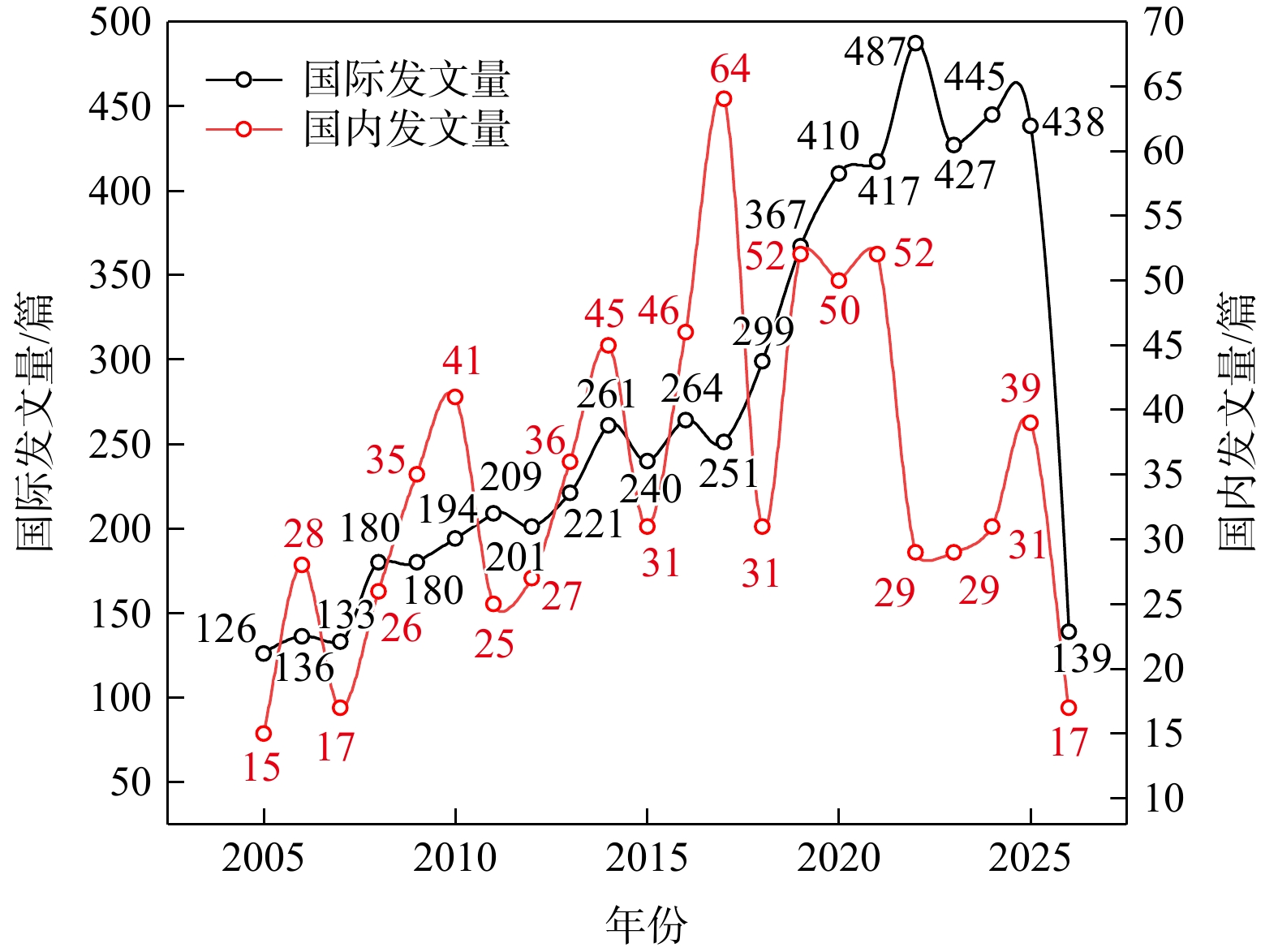
ProgressBased on bibliometric analysis of literature published from 2005 to 2026, this paper retrieves 766 valid Chinese core papers from CNKI and 6 025 international articles from the Web of Science Core Collection. Statistical results of annual publication number, core research institutions, and keyword bursts reveal that the research hotspot has shifted from simple single-point soil moisture monitoring to multi-source data fusion and artificial intelligence inversion over recent decades. All prevailing soil moisture measurement technologies are systematically classified into contact measurement and non-contact measurement categories. The contact category includes reference oven-drying method, in-situ dielectric sensors (TDR, FDR), thermal response probes, nuclear magnetic resonance (NMR), and actively heated-fiber Bragg grating (AH-FBG) sensing. The non-contact category covers shallow geophysical methods (GPR, ERT, electromagnetic induction, shallow seismic) and multi-type remote sensing inversion. Each technique is comprehensively evaluated from four dimensions: Working principle, applicable spatial scale, capacity of unfrozen water-ice differentiation, and inherent error sources. Furthermore, this review elaborates on the distortion mechanism of monitoring signals triggered by phase transition: Frozen soil exhibits unique thermal, dielectric, NMR, and elastic wave discrepancies between liquid water and ice, and the coexistence of bound water, capillary water, and ice crystals further aggravates the non-uniqueness of sensor response. Three major categories of interference factors affecting measurement precision are summarized, including soil physicochemical properties (texture, salinity, organic matter, bulk density), external environmental conditions (temperature fluctuation, vegetation coverage, freeze-thaw cycles) and inherent limitations of monitoring equipment, with targeted calibration and error correction strategies proposed correspondingly. In addition, this paper compares three mainstream inversion frameworks: Pure empirical physical models, data-driven machine learning algorithms, and physics-data hybrid inversion constrained by hydrothermal coupling theories.
Conclusion and ProspectThe analytical results demonstrate distinct complementary characteristics among different monitoring technologies. The oven-drying method can only serve as a calibration benchmark and fails to realize long-term continuous field monitoring. In-situ sensors enable real-time point monitoring but are highly susceptible to soil-sensor contact state and soil physicochemical properties. Shallow geophysics and satellite remote sensing expand monitoring coverage but suffer from ambiguous physical response and scale mismatch problems. A single monitoring method cannot reliably distinguish between unfrozen water and ice contents in frozen soils, and cross-validation combining laboratory tests, field sensing, geophysical prospecting, and remote sensing data is indispensable to improve phase identification accuracy. Among all inversion frameworks, the physics-data hybrid model balances physical interpretability and prediction accuracy and outperforms single-model methods. In future research, integrated space-air-ground collaborative observation networks, multi-sensor fusion algorithms, and physics-informed intelligent inversion models will become core technical approaches for achieving cross-scale, simultaneous high-precision measurement of soil moisture and ice content, providing theoretical support for hazard prevention in cold-region geotechnical engineering.
-
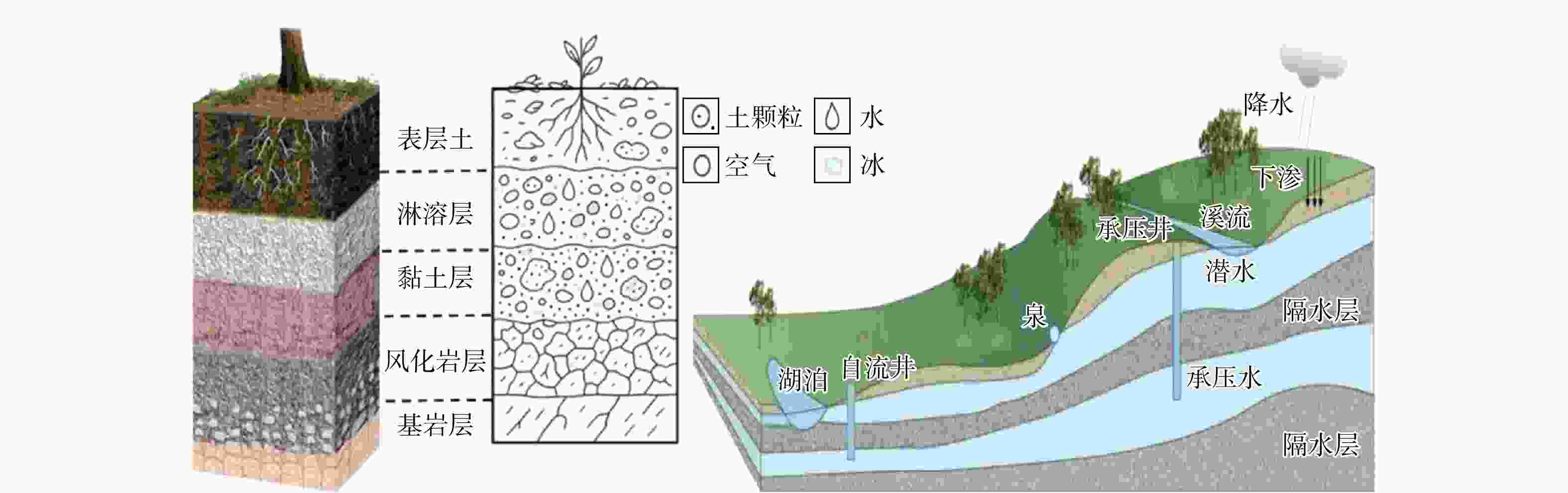
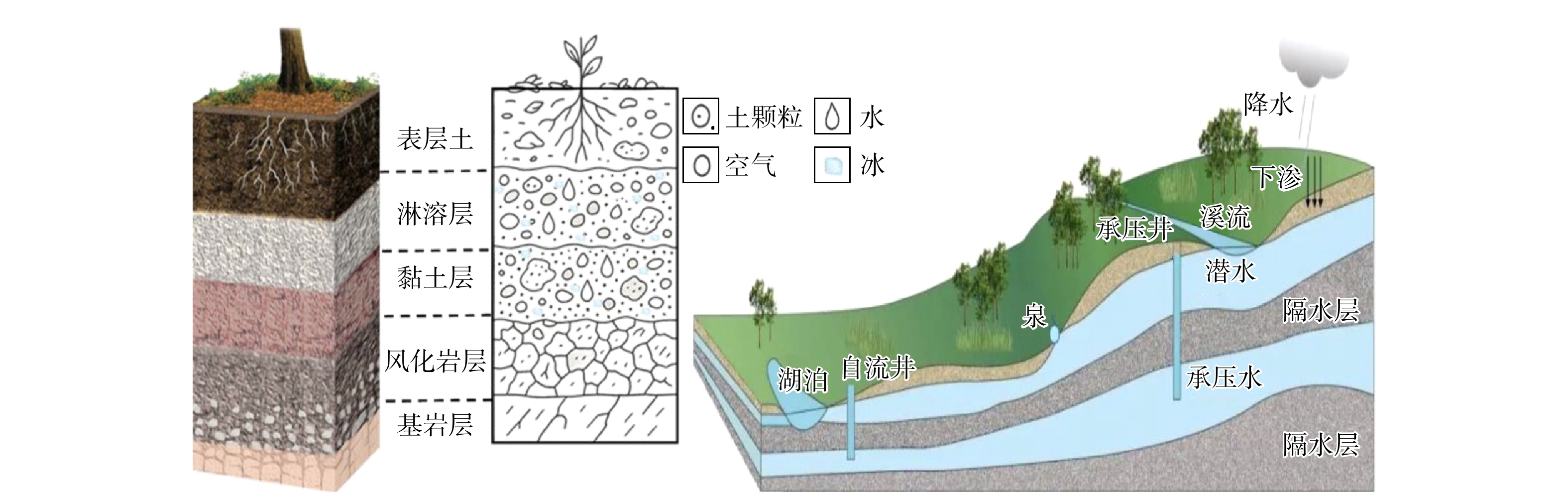
图 1 土壤剖面结构与多相组成示意图
Figure 1. Schematic diagram of soil profile structure and multi-phase composition
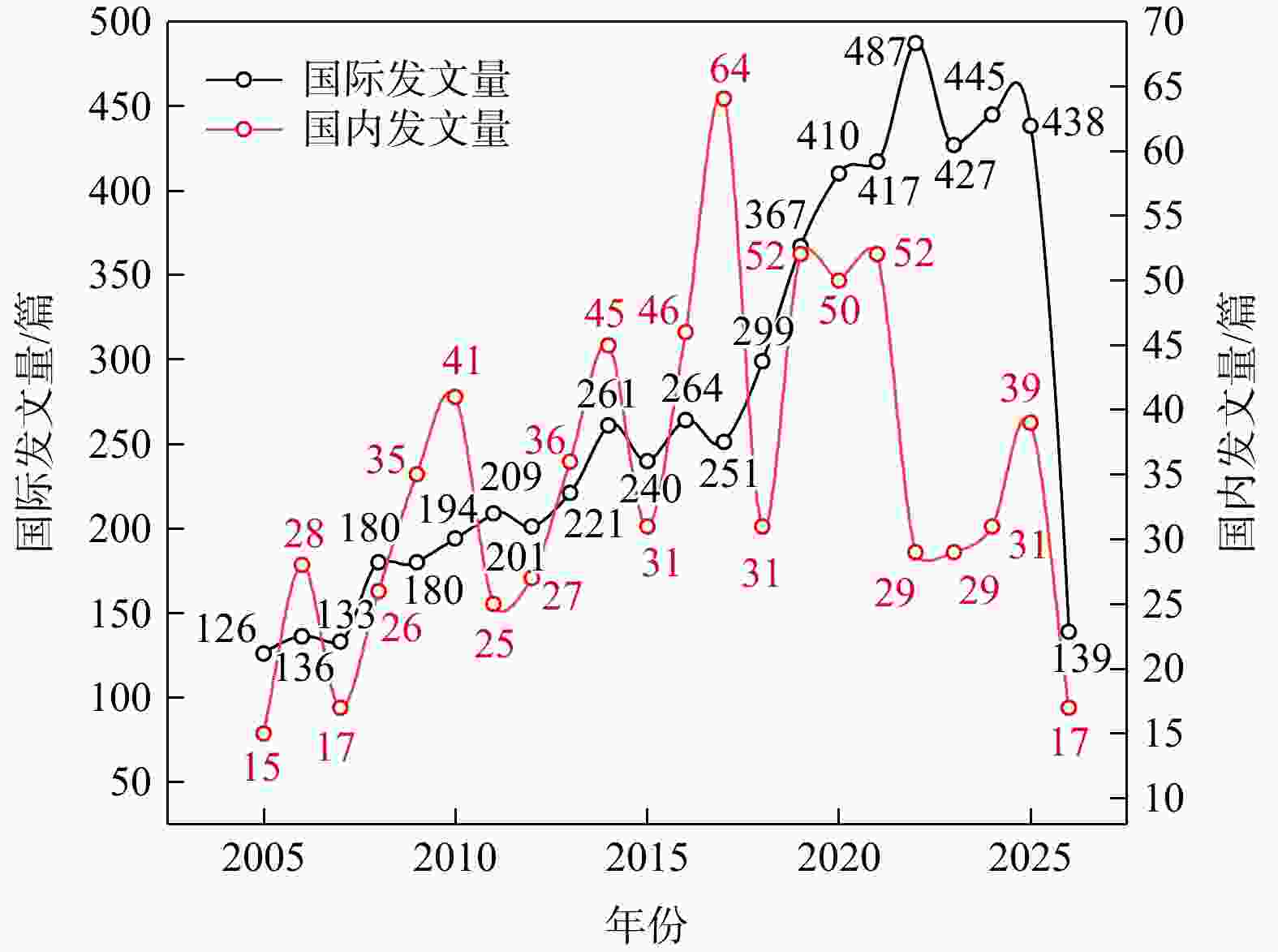
图 2 2005—2026年土壤含水率测量领域国内外发文数量统计图
数据来源于中国知网和Web of Science核心数据库,其中2026年数据统计截至2026年5月,未代表全年发文量
Figure 2. Statistics of number of domestic and international publications in field of soil moisture monitoring (2005-2026)
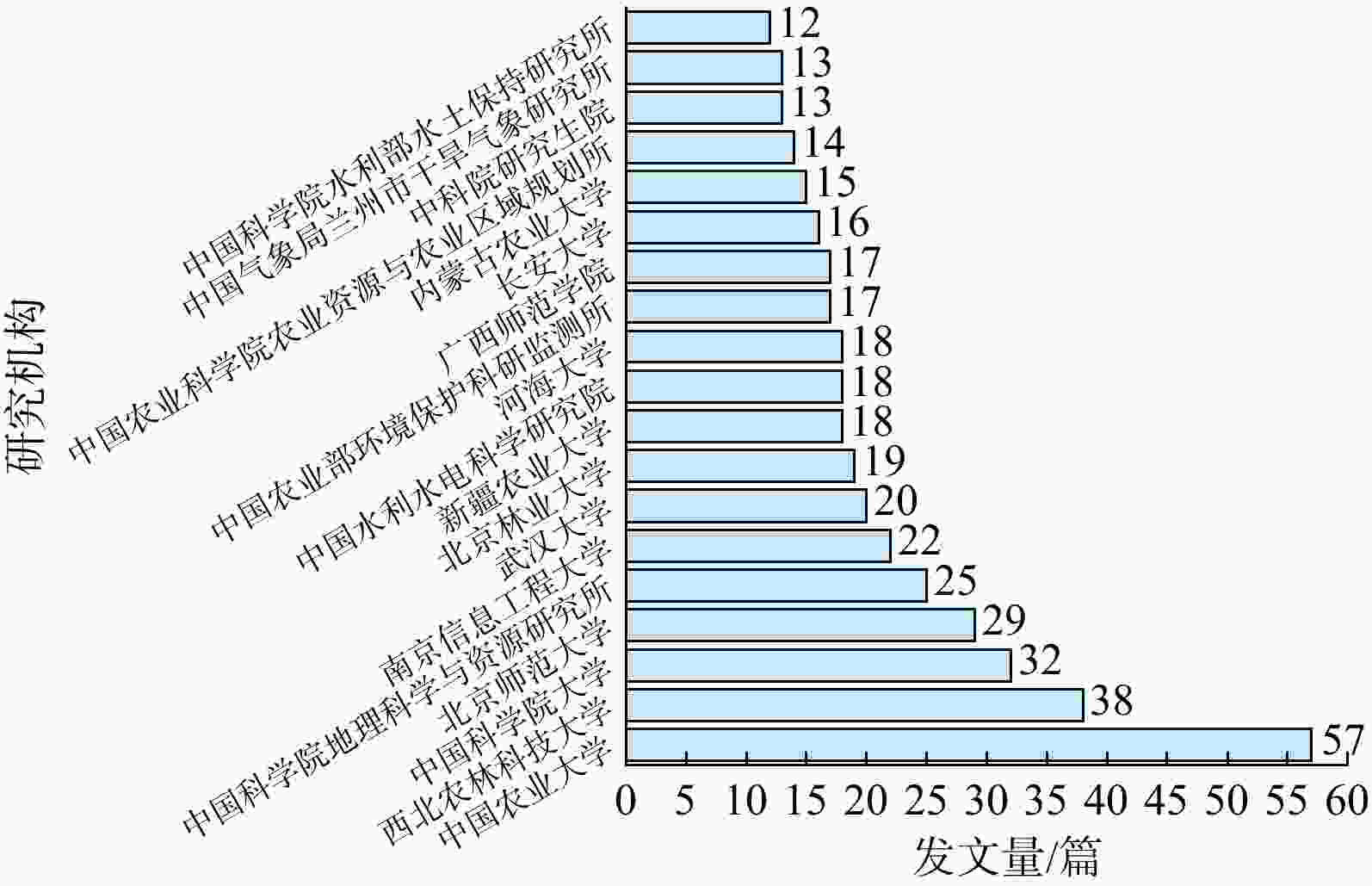
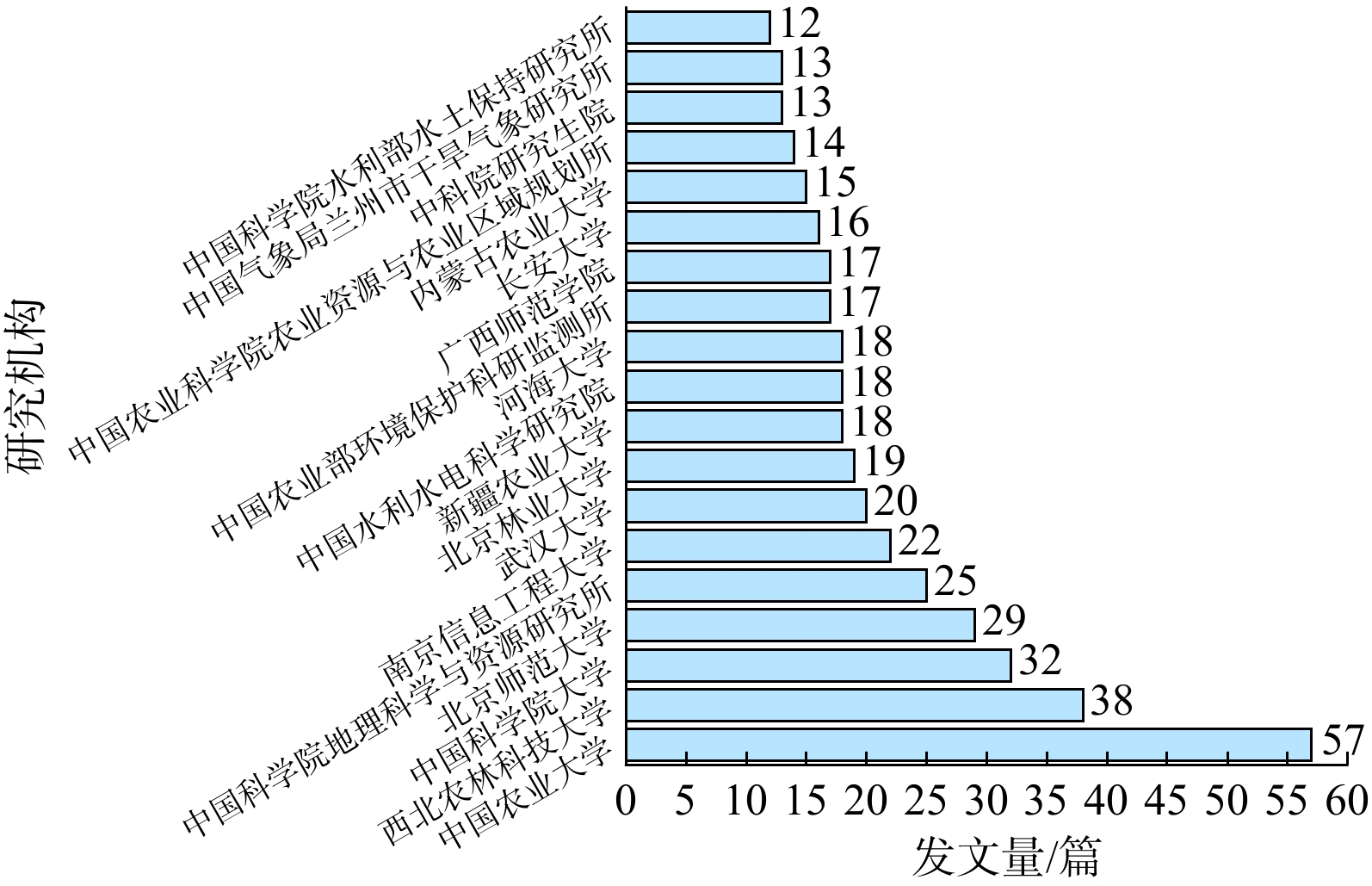
图 3 2005—2026年国内土壤含水率监测领域的主要研究机构
Figure 3. Major domestic research institutions in field of soil moisture monitoring (2005-2026)
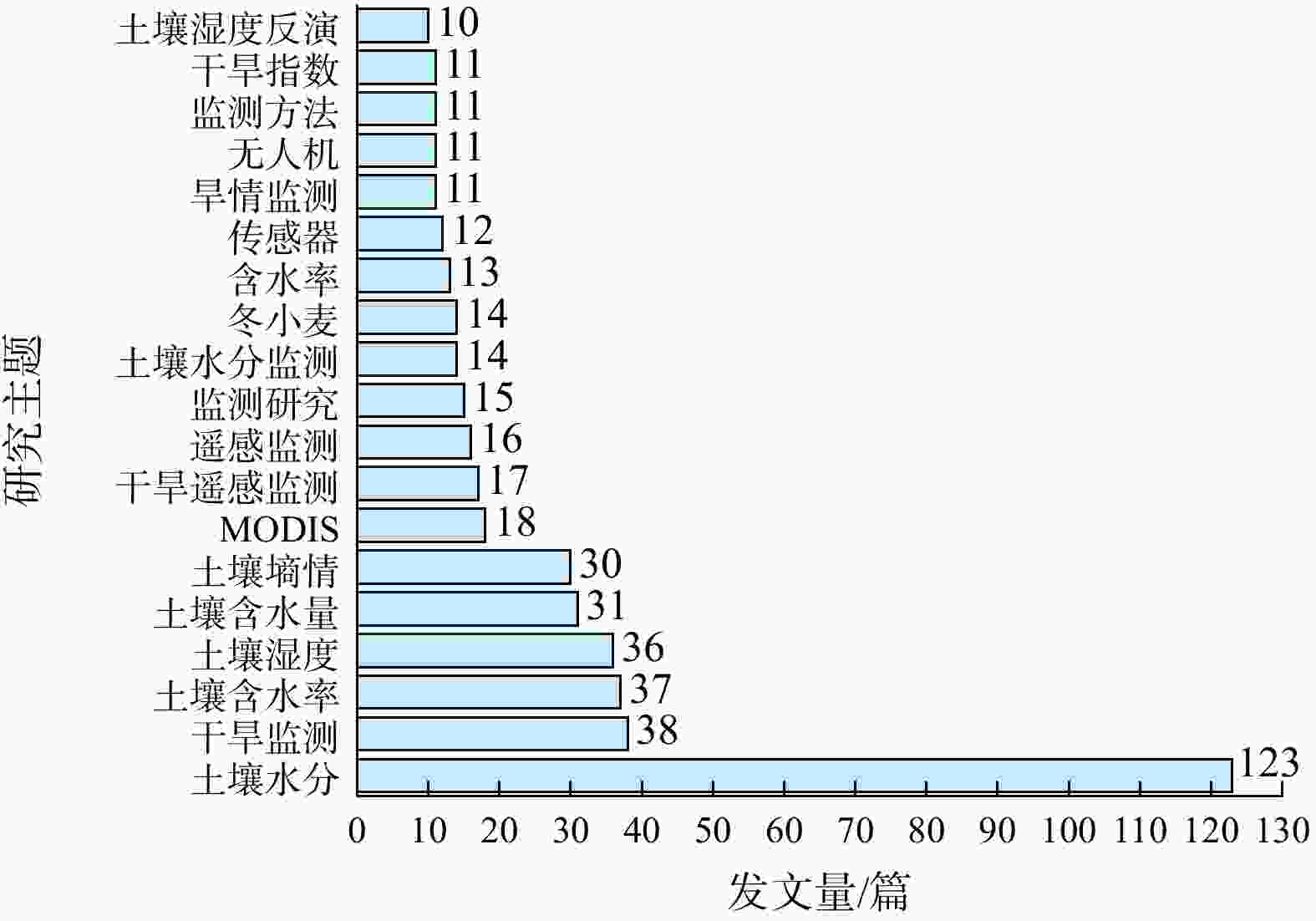
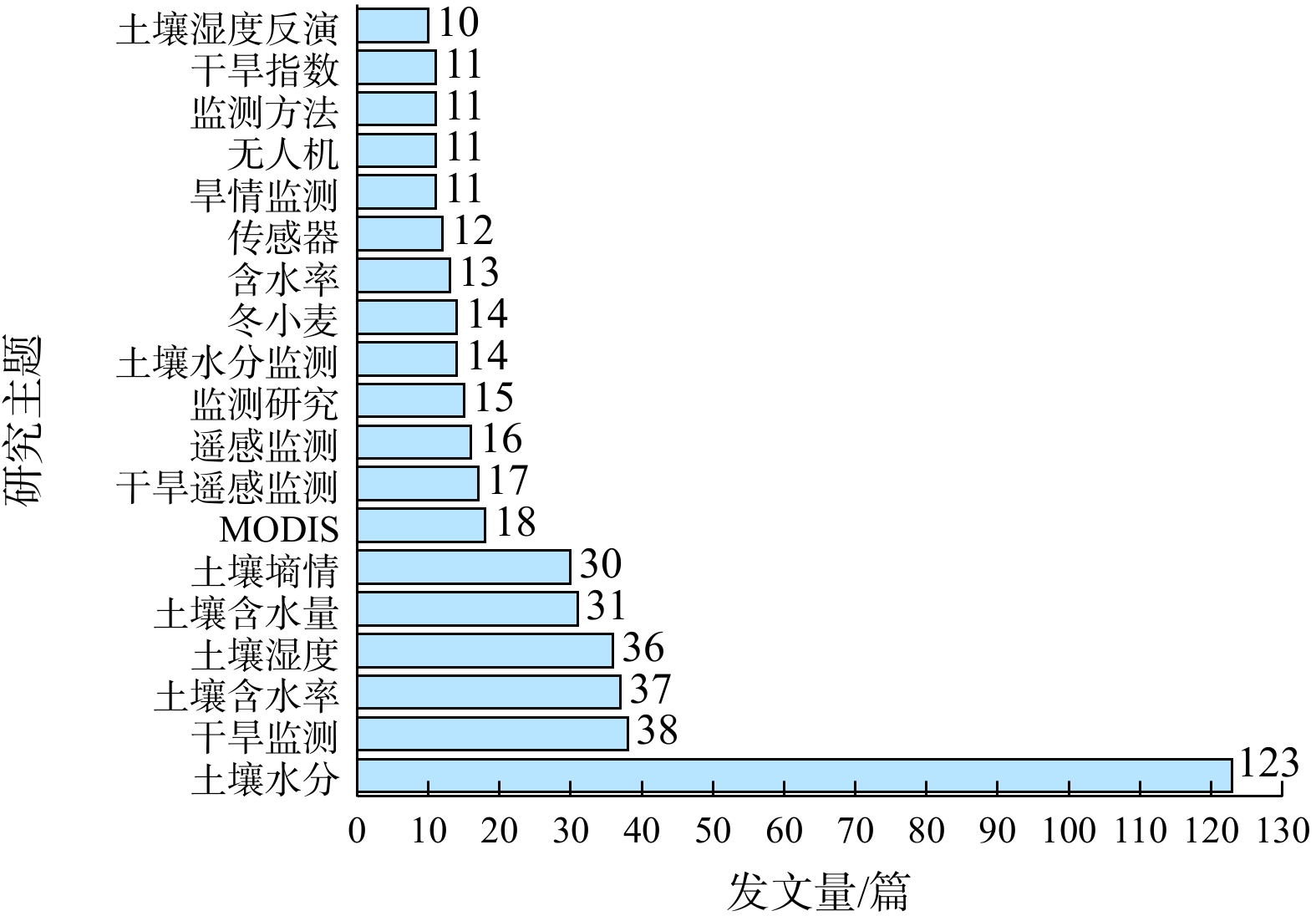
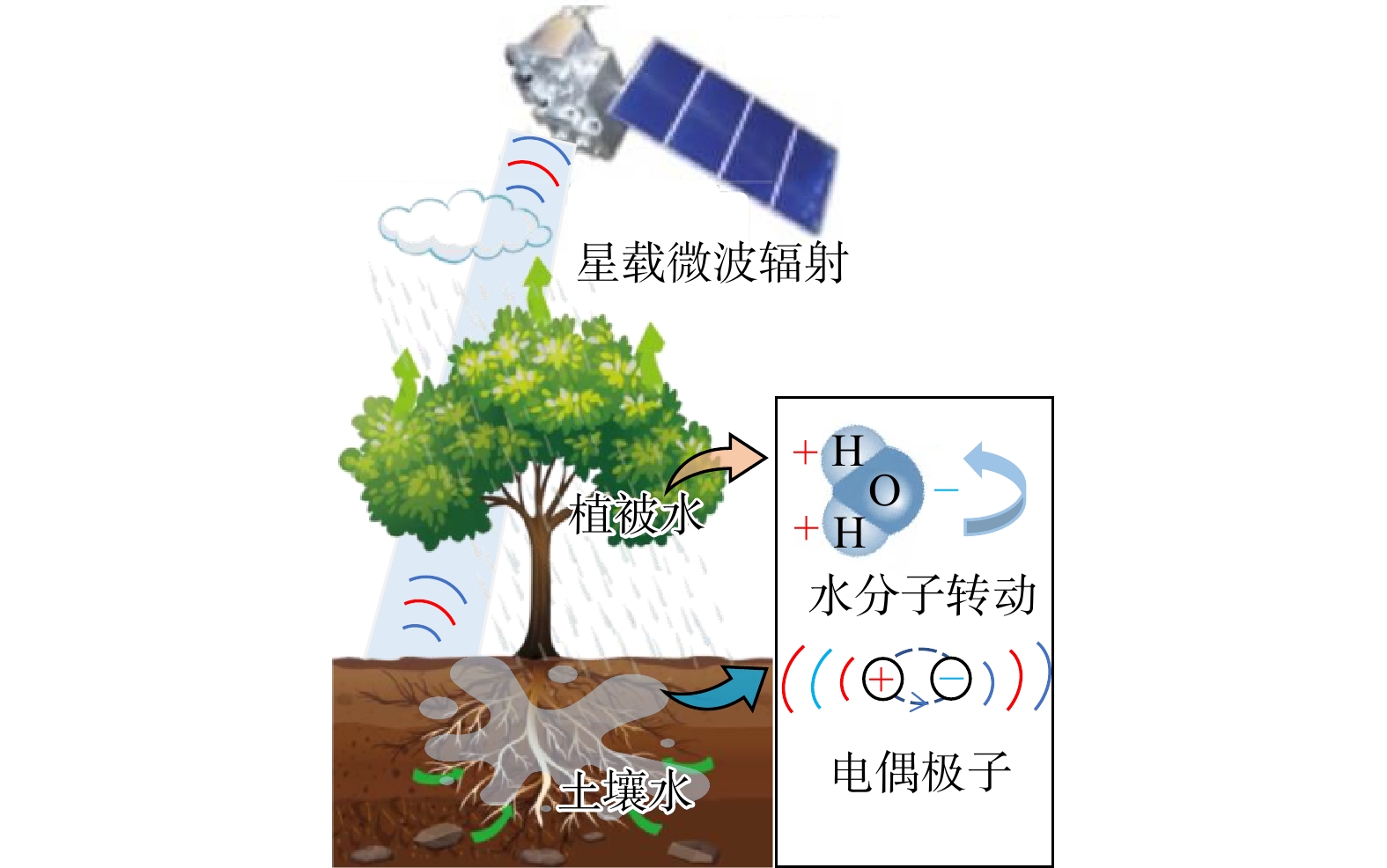
图 4 2005—2026年国内土壤含水率监测领域的研究主题
MODIS. 中分辨率成像光谱仪,下同
Figure 4. Domestic research topics in field of soil moisture monitoring (2005-2026)
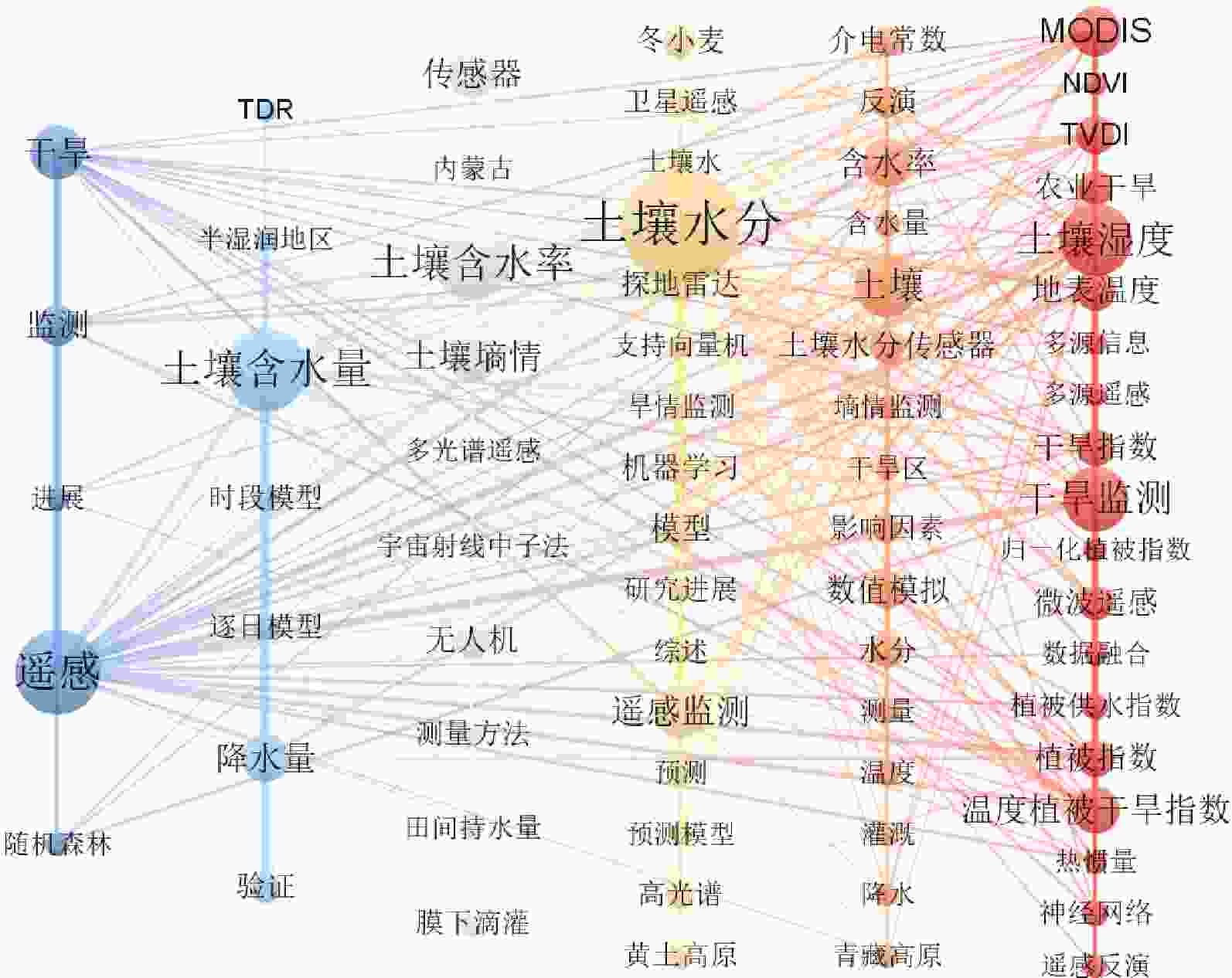
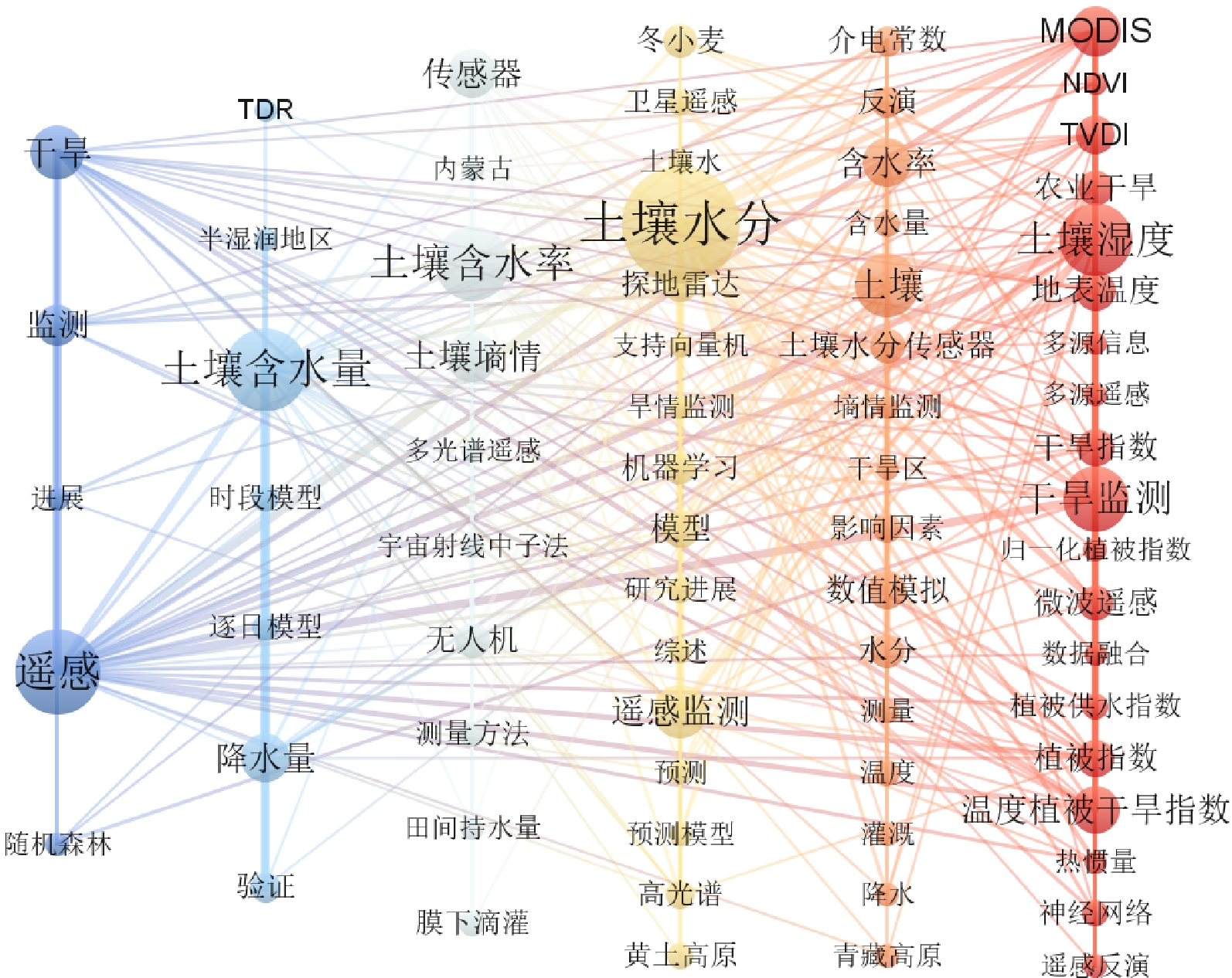
图 5 2005—2026年国内土壤含水率监测领域研究关键词共现网络
节点大小表示关键词的出现频次;不同颜色区分各类聚类群组;节点之间的连线代表关键词存在共现关联;TDR为时域反射;NDVI为归一化植被指数;TVDI为温度植被旱情指数;下同
Figure 5. Keyword co-occurrence network of domestic research in field of soil moisture monitoring (2005-2026)
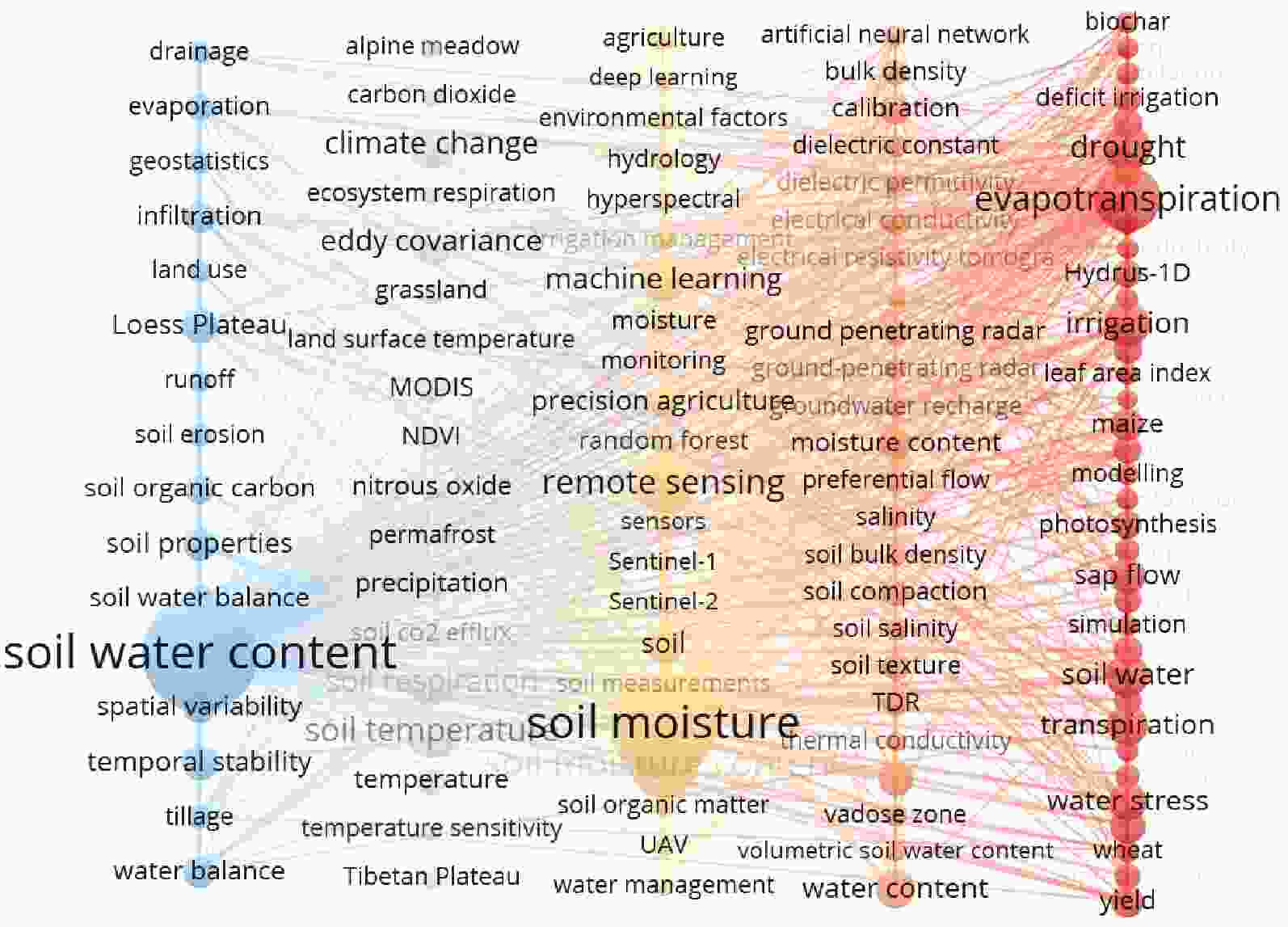
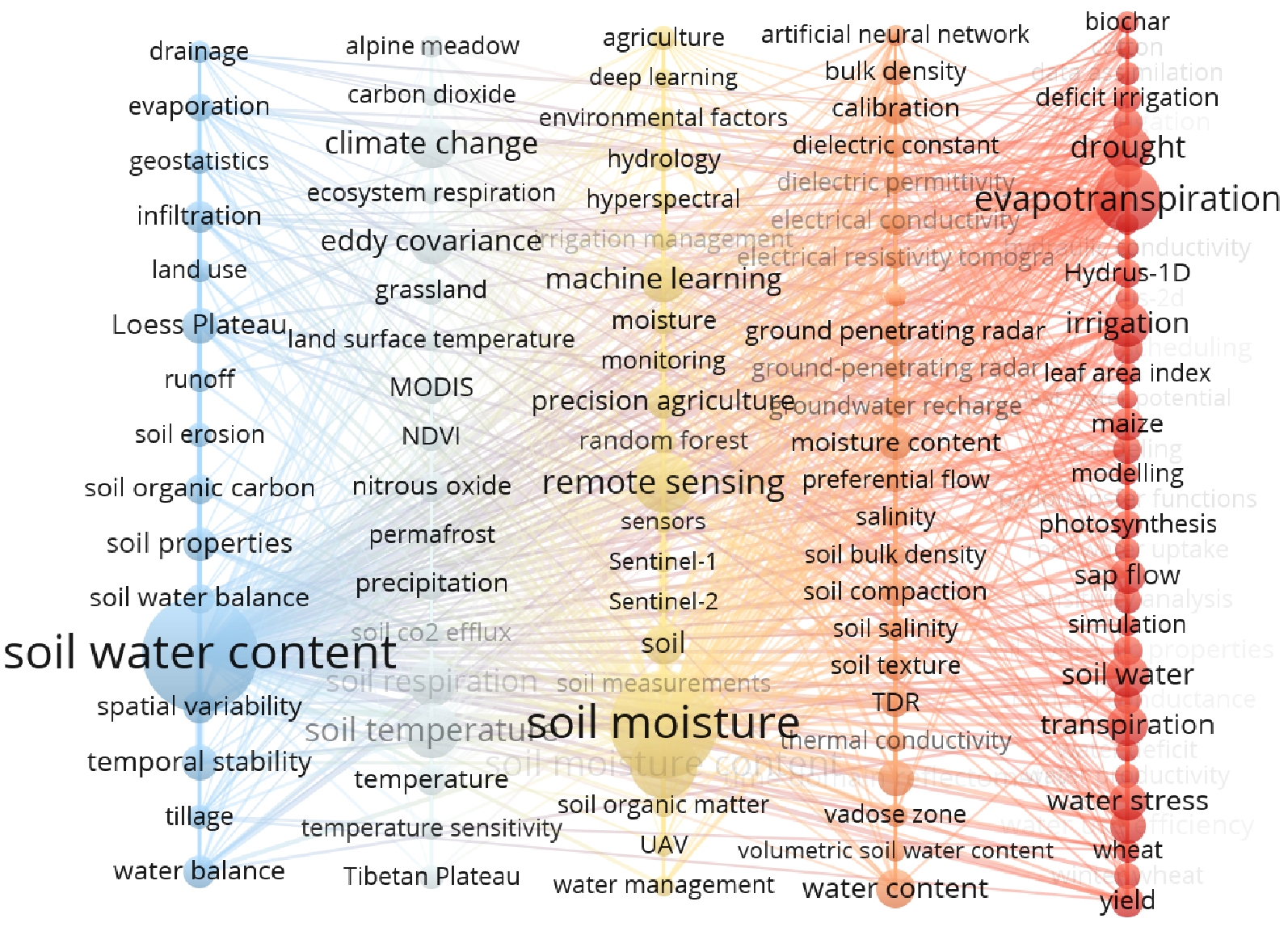
图 6 2005—2026年国际土壤含水率监测领域研究关键词共现网络
MODIS. moderate resolution imaging;NDVI. normalized differencevegetation index;GPR. ground-penetrating radar;UAV. unmanned aerial vehicle;TDR. time domain reflectometry;下同
Figure 6. Keyword co-occurrence network of international research in field of soil moisture monitoring (2005-2026)
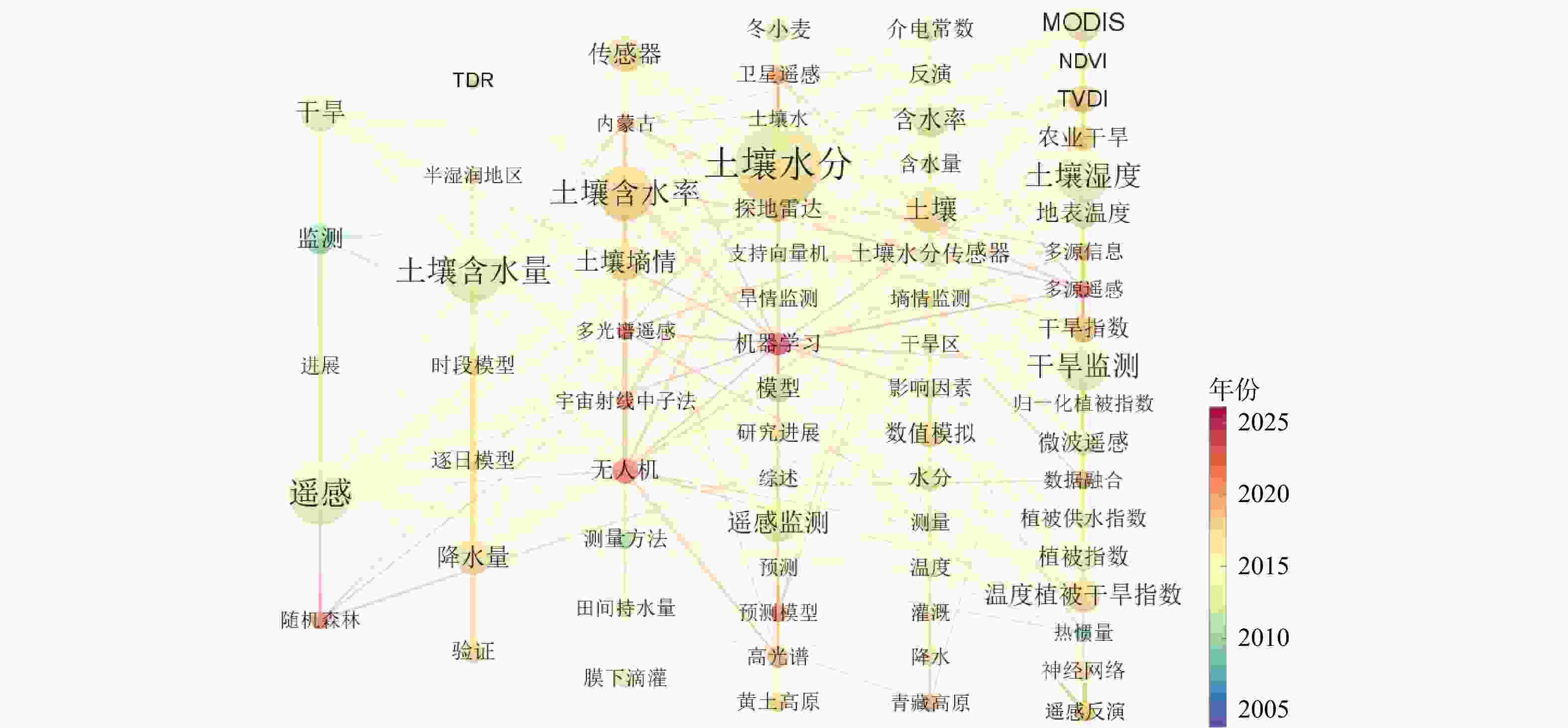
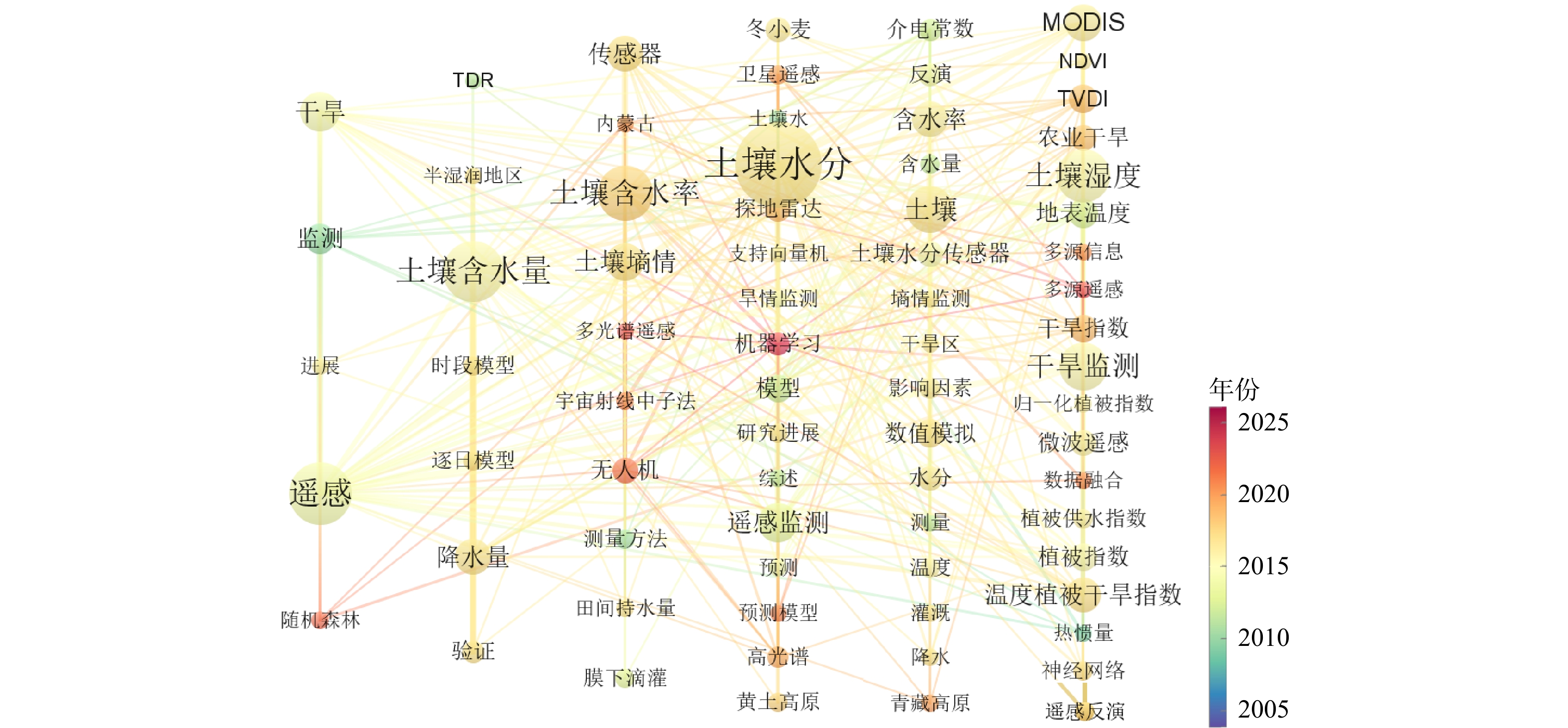
图 7 2005—2026年国内土壤含水率监测领域研究关键词时间演化图谱
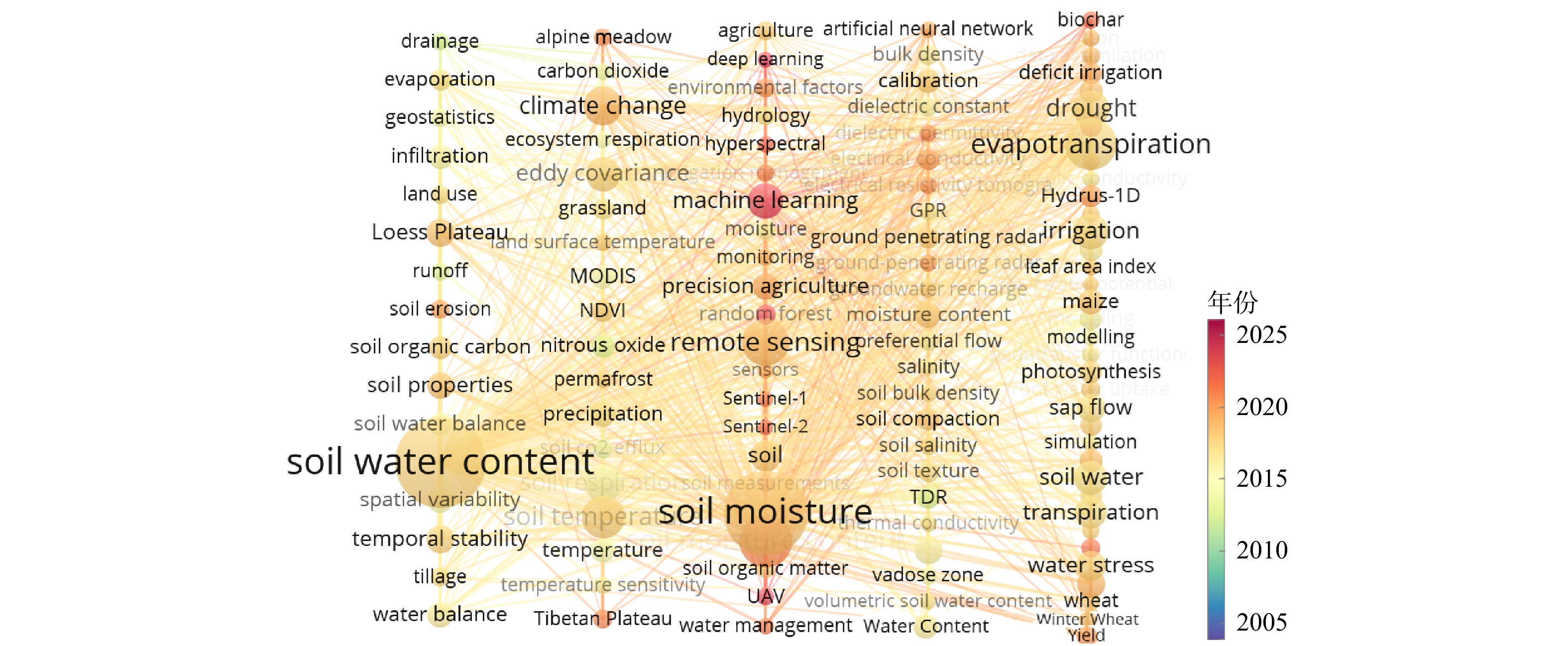
连线颜色表征各关键词之间构建研究关联的平均时间,下同
Figure 7. Temporal evolution map of domestic research keywords in field of soil moisture monitoring (2005-2026)
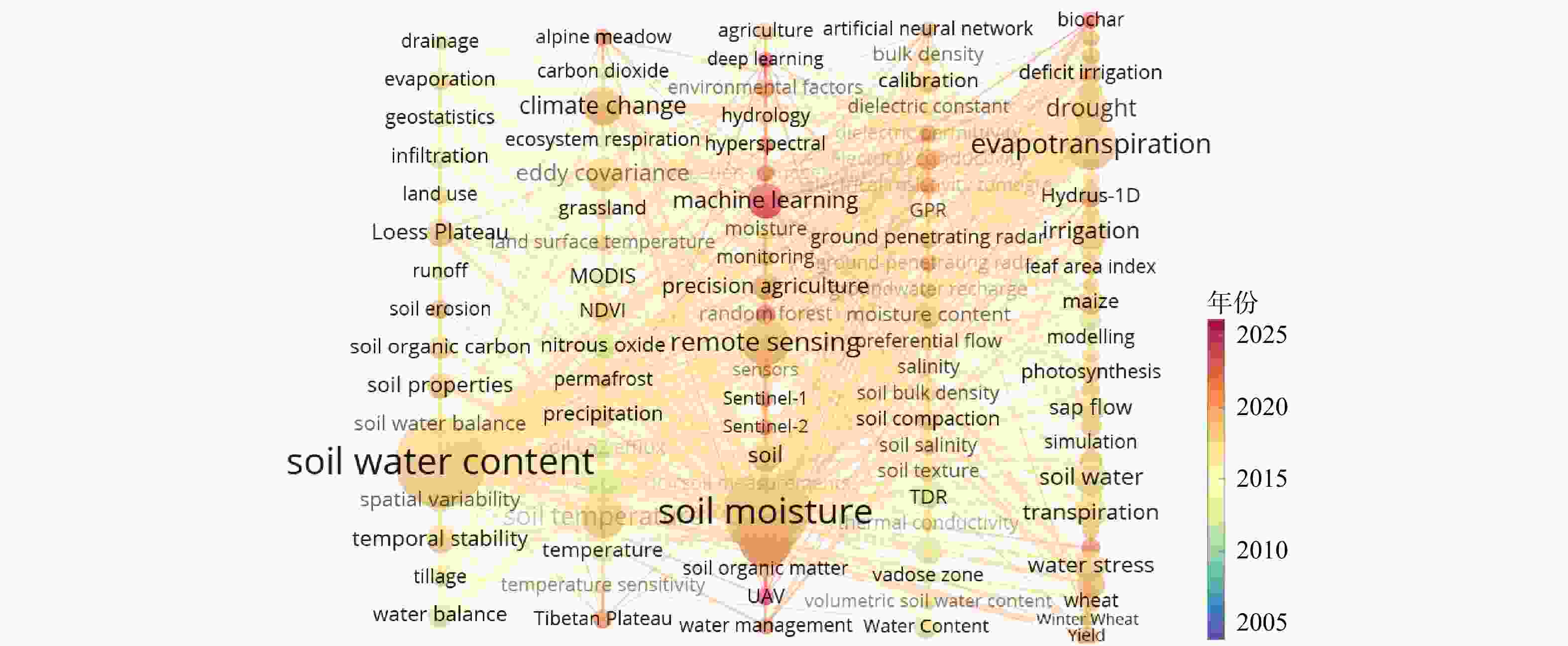
图 8 2005—2026年国际土壤含水率监测领域研究关键词时间演化图谱
Figure 8. Temporal evolution map of international research keywords in field of soil moisture monitoring (2005-2026)
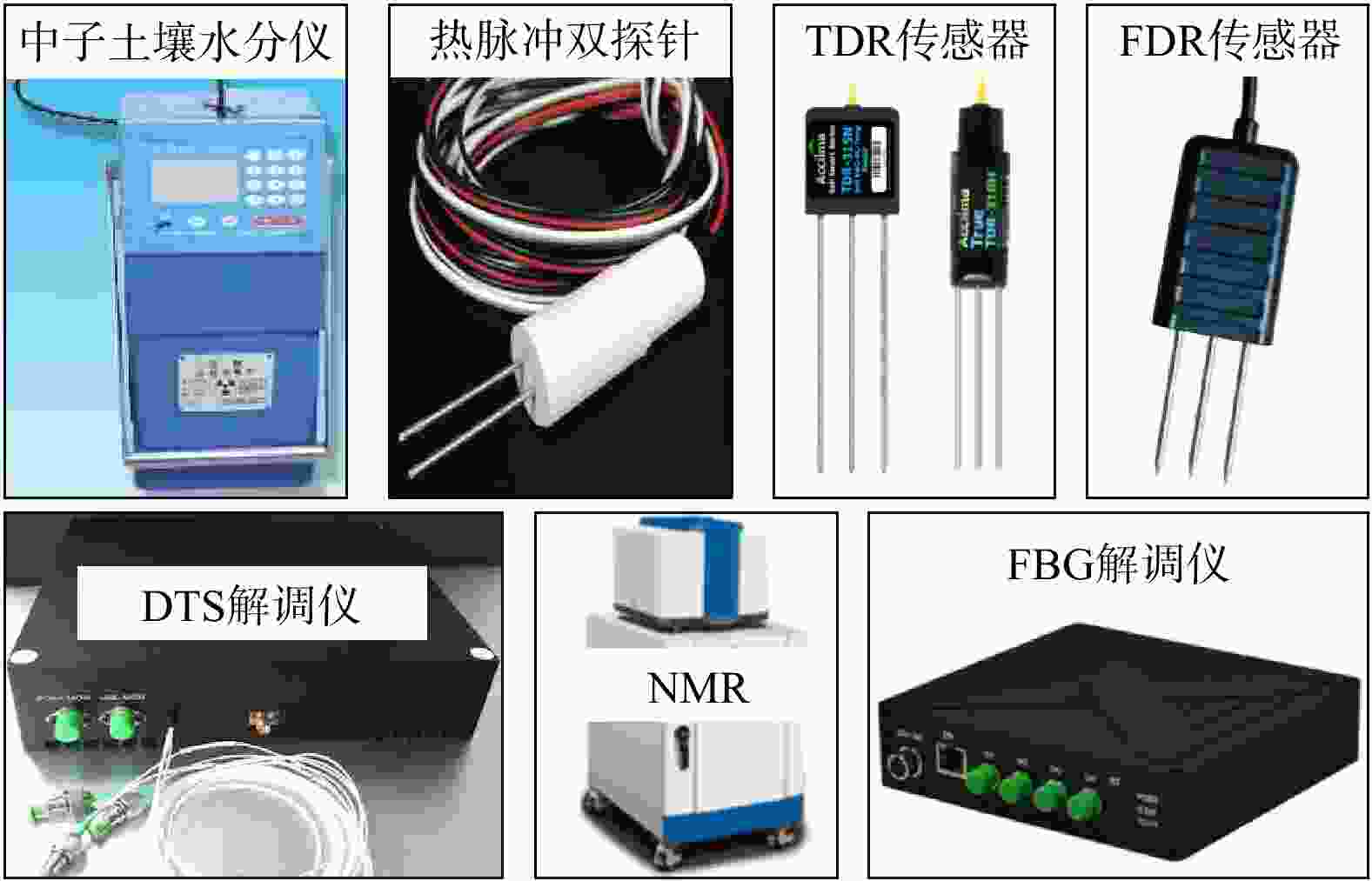
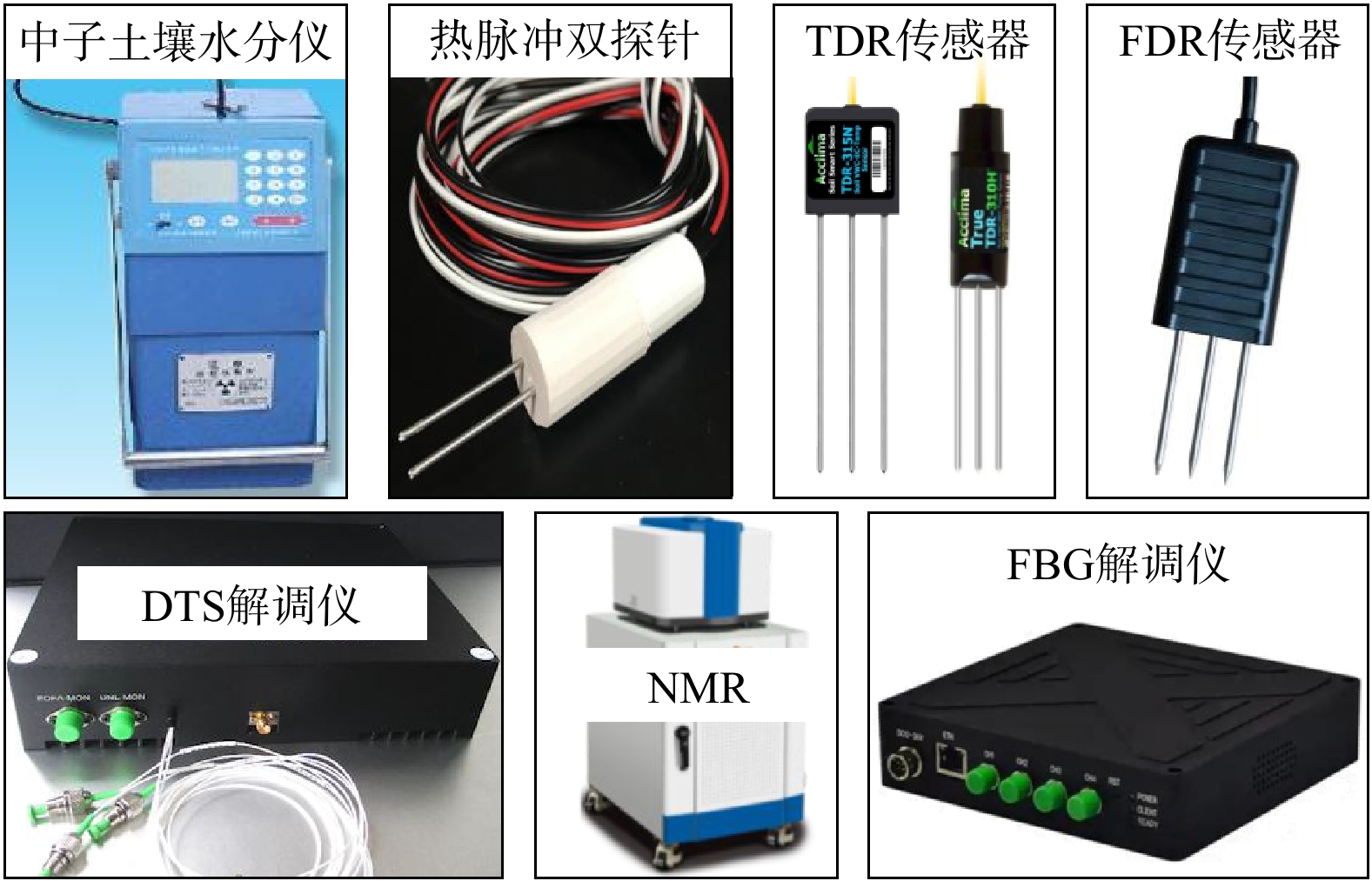
图 9 典型接触式土壤含水率测量设备示意图
FDR为频域反射;DTS为分布式温度传感;NMR为核磁共振;FBG为光纤布拉格光栅;设备示意图均来源于厂家图片;下同
Figure 9. Schematic diagram of typical contact measurement equipment for soil moisture content
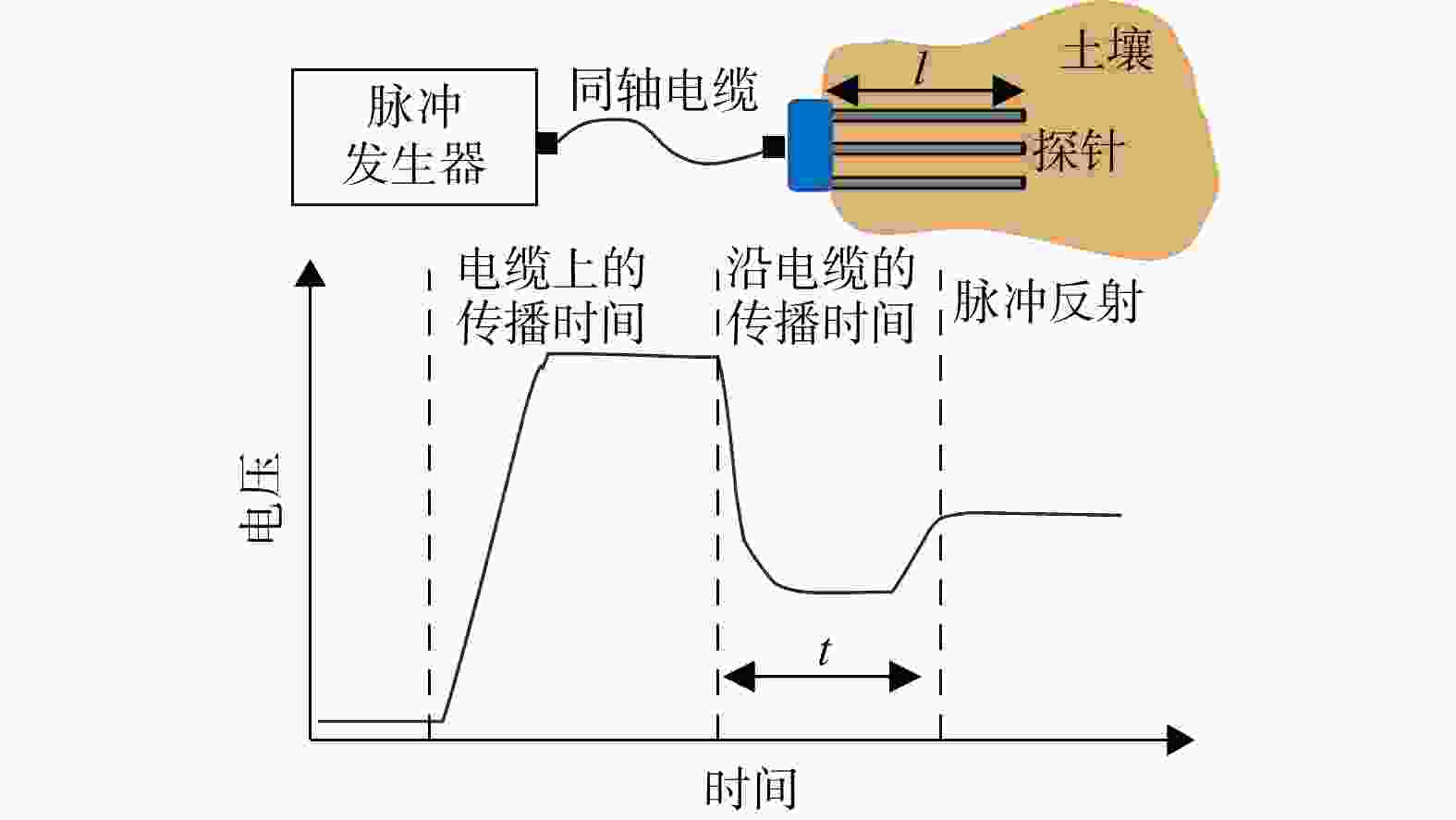
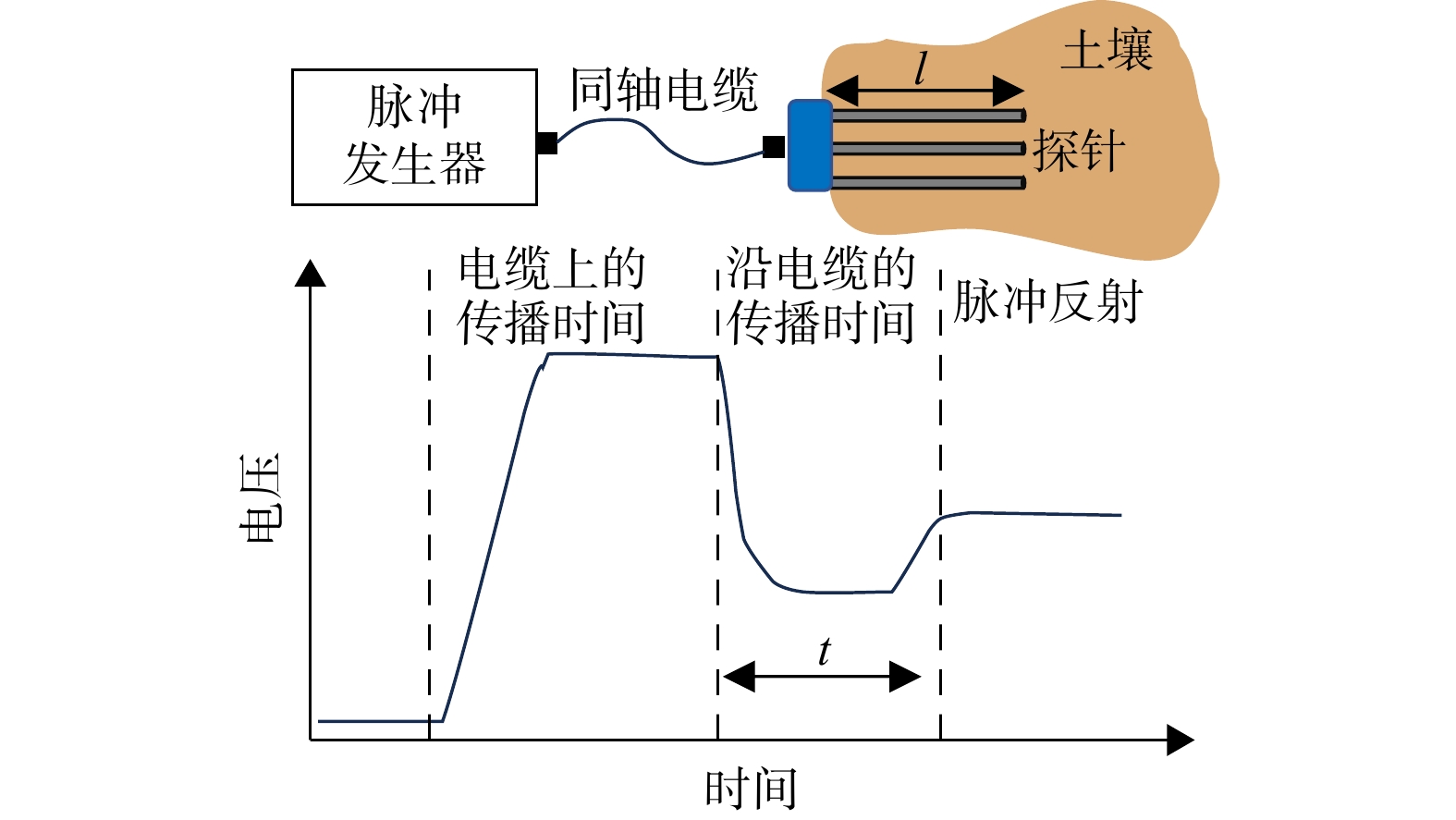
图 10 时域反射法(TDR)土壤含水率测量原理示意图
t为电磁波的传播时间;l为探针长度
Figure 10. Schematic diagram of time domain reflectometry (TDR) principle for soil moisture content measurement
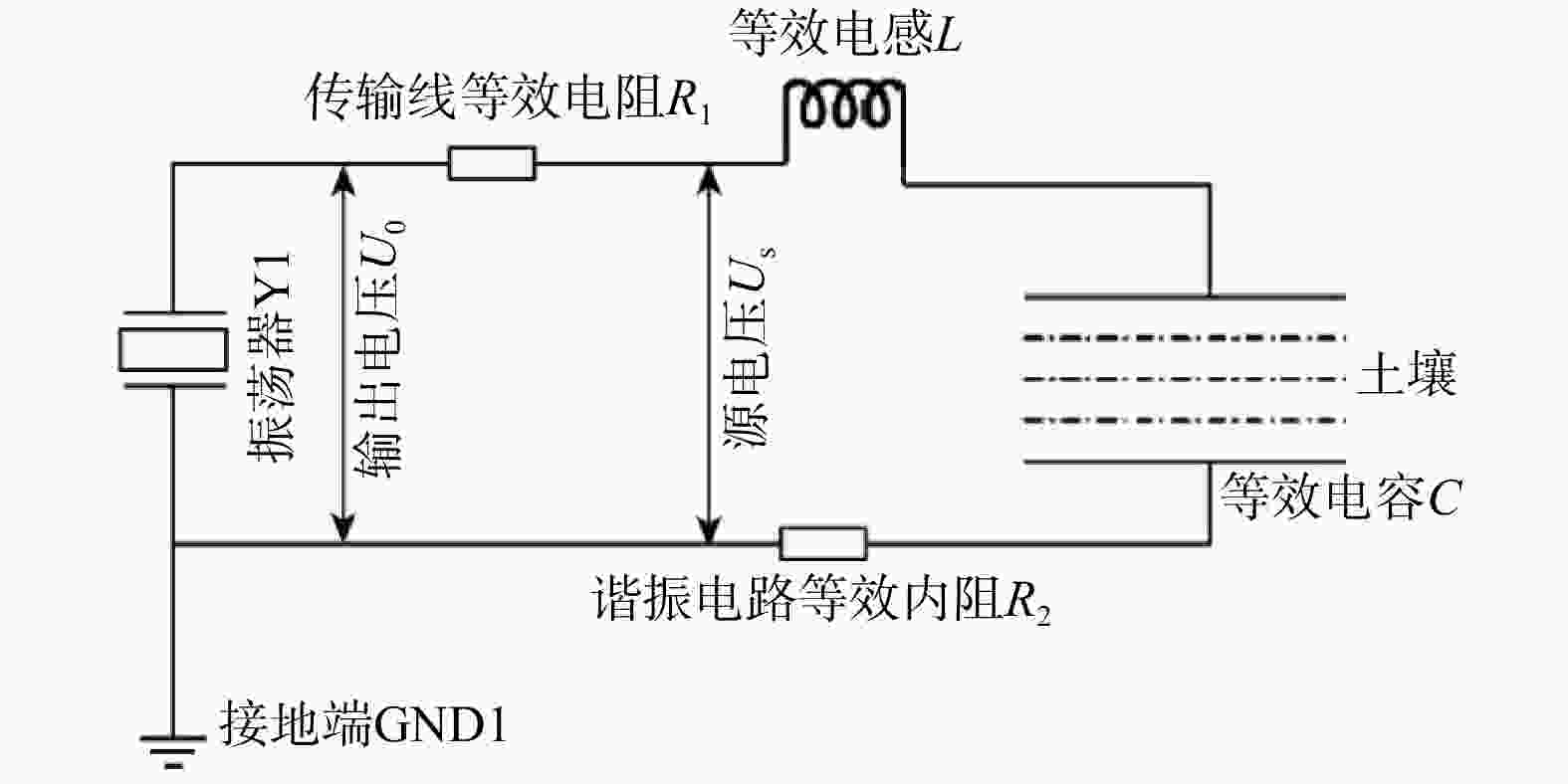
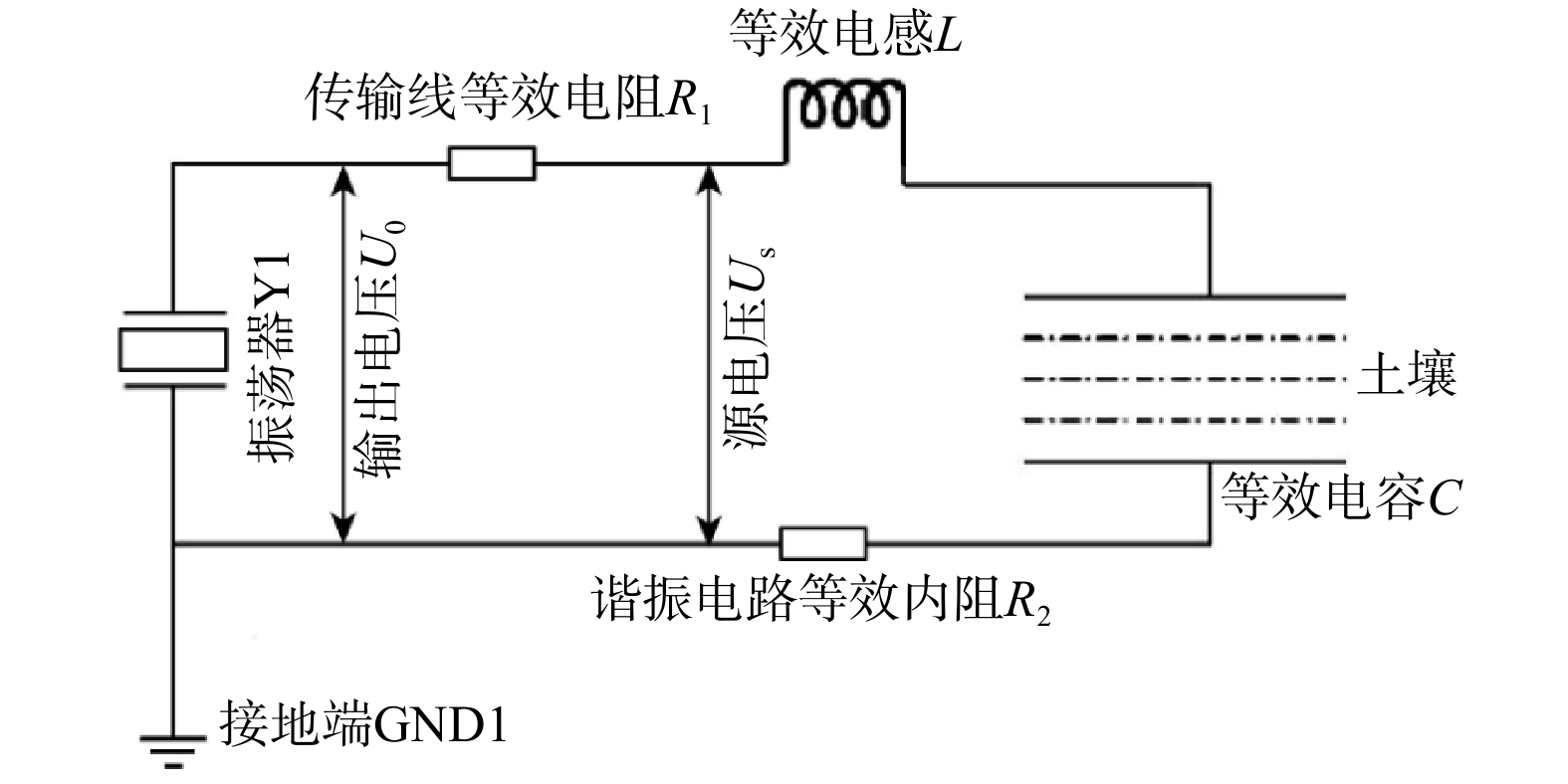
图 11 频域反射法(FDR)土壤含水率测量原理图
Figure 11. Schematic diagram of frequency domain reflectometry (FDR) principle for soil moisture content measurement
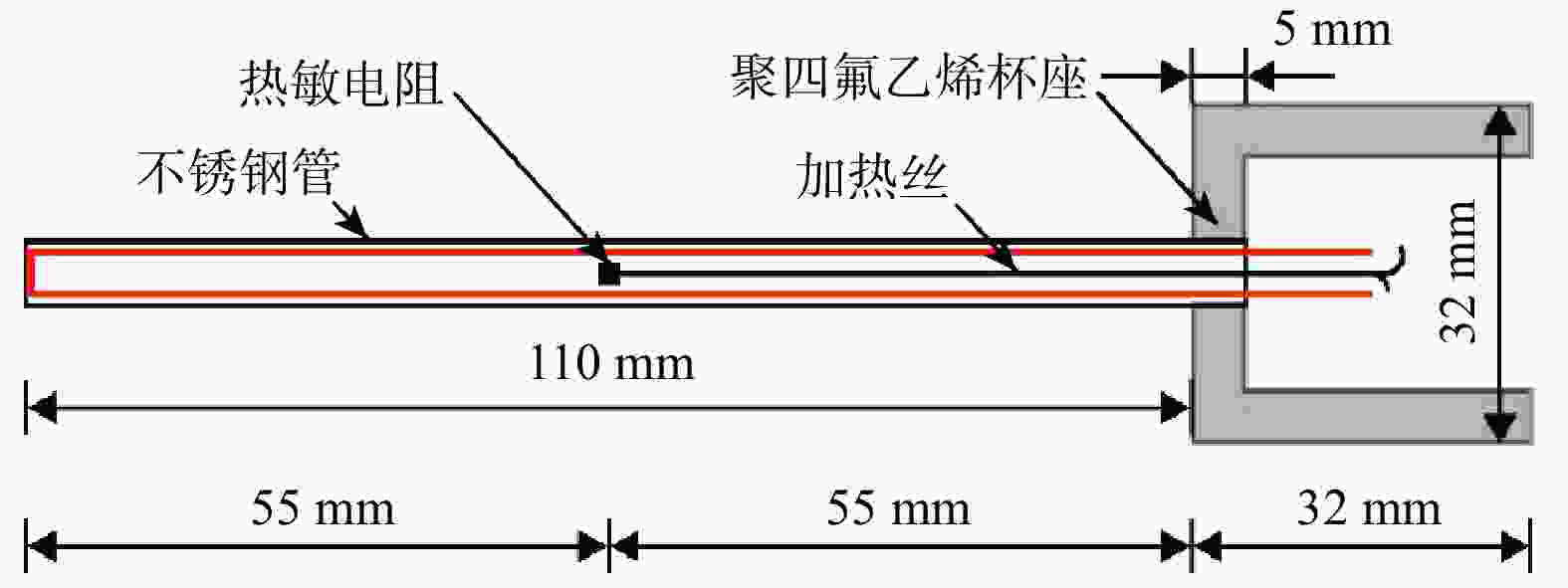
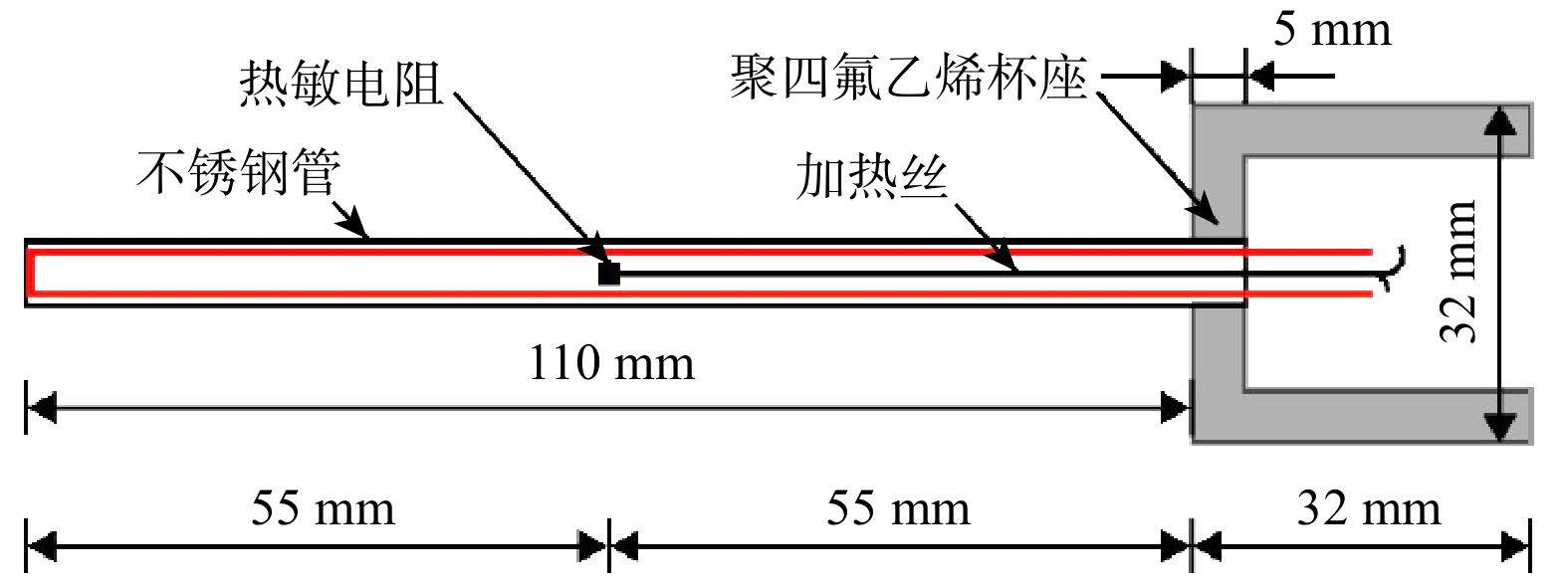
图 12 土壤监测热脉冲探针结构示意图[47]
Figure 12. Schematic diagram of heat pulse probe for soil monitoring
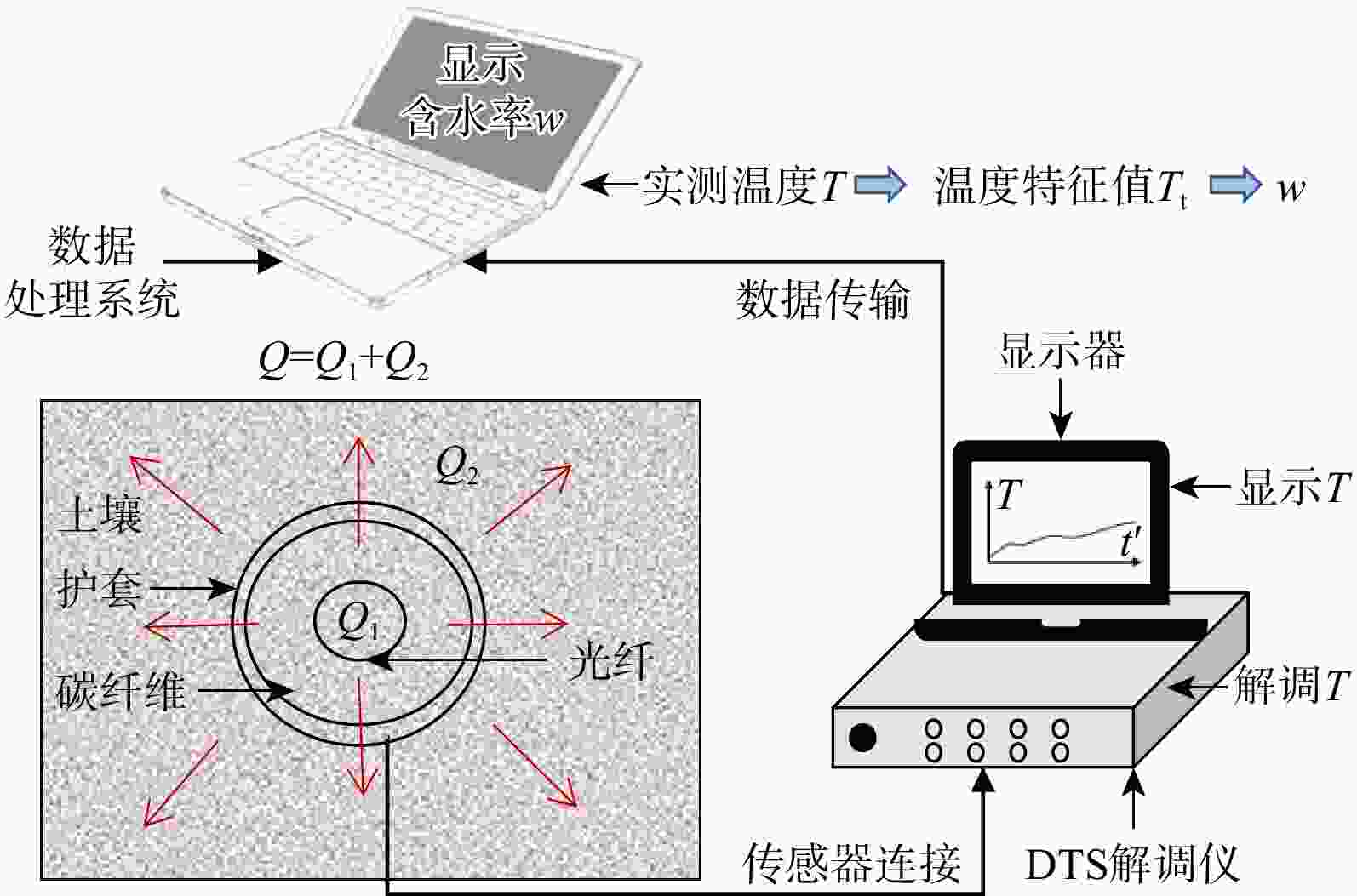
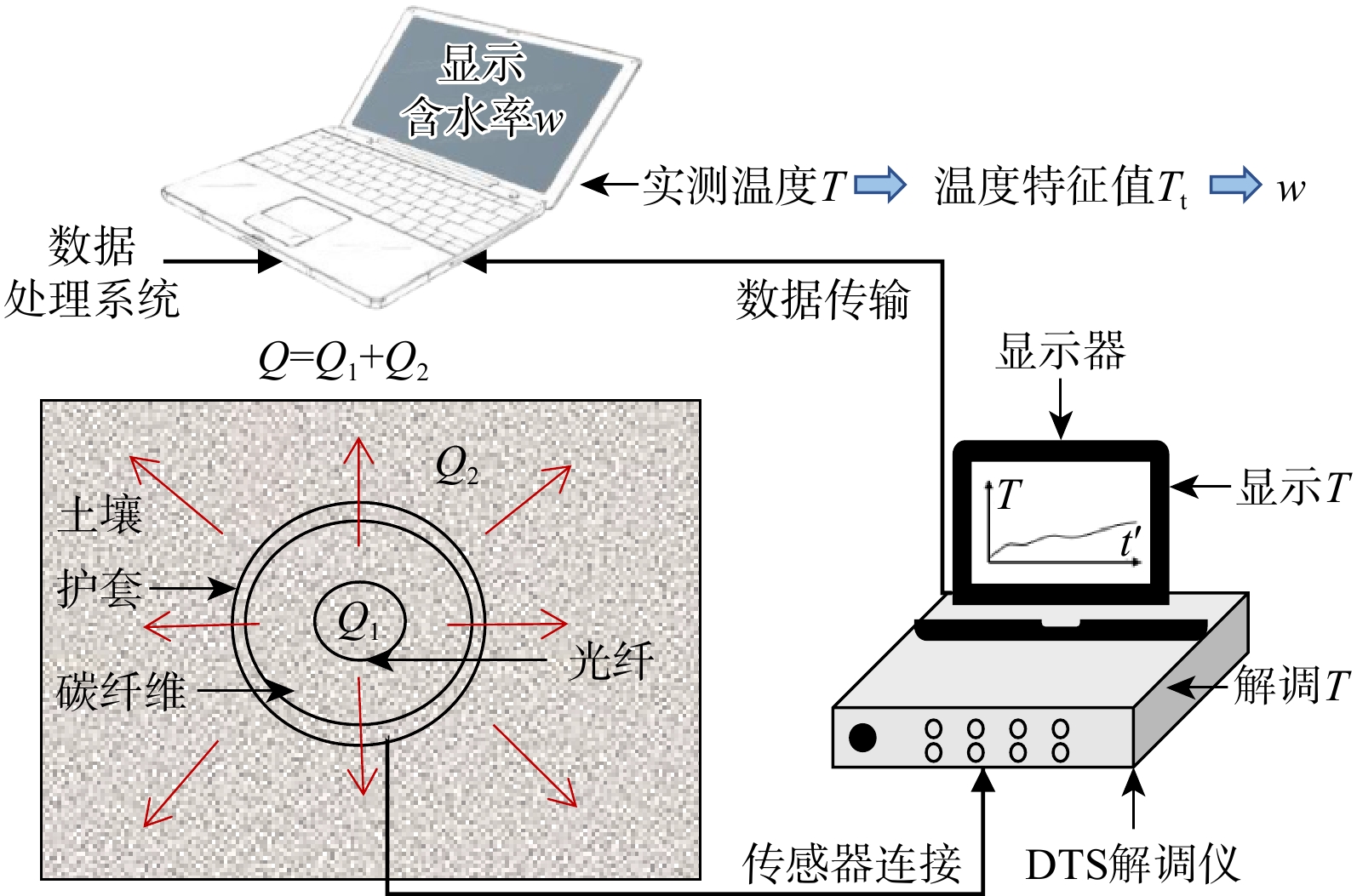
图 13 分布式温度传感(DTS)土壤监测系统工作示意图
Q为总加热功率;Q1为探头本体耗热;Q2为土壤耗热;
Figure 13. Schematic diagram of distributed temperature sensing (DTS) soil monitoring system
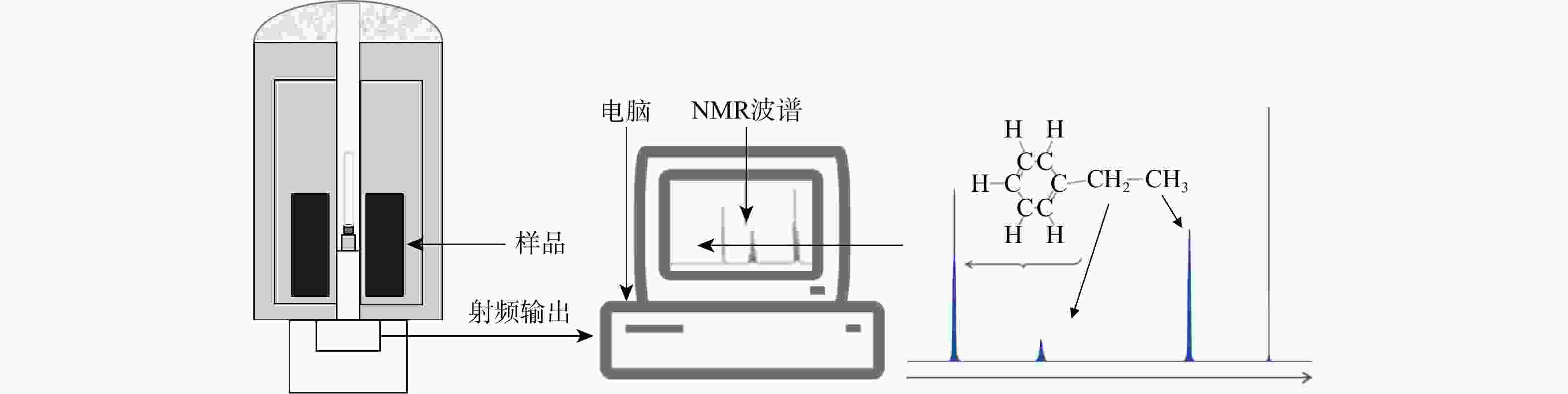
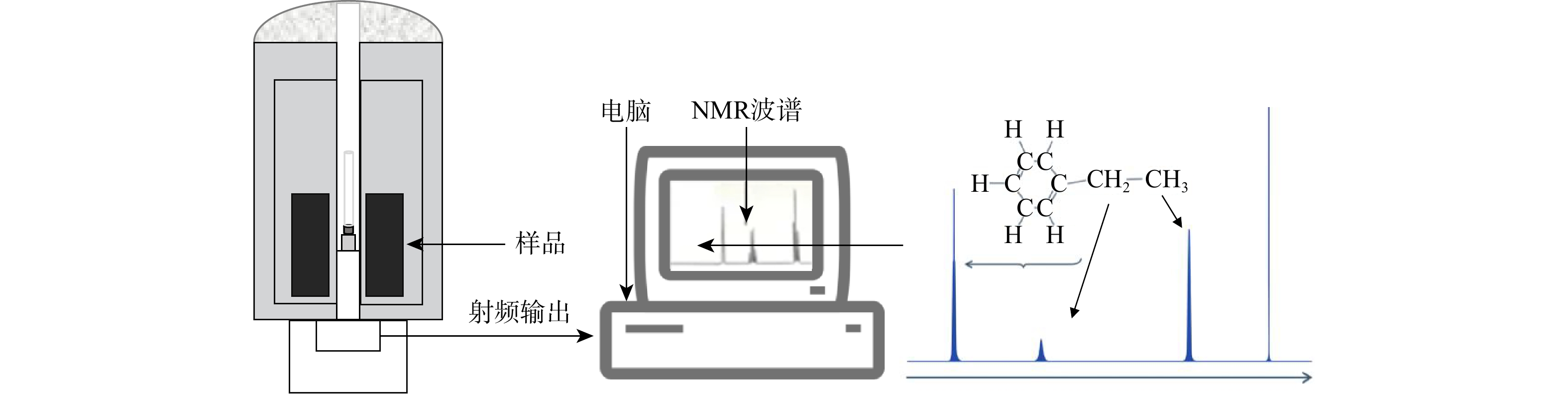
图 14 冻土水分核磁共振(NMR)测试系统示意图
Figure 14. Schematic diagram of nuclear magnetic resonance (NMR) system for frozen soil moisture testing
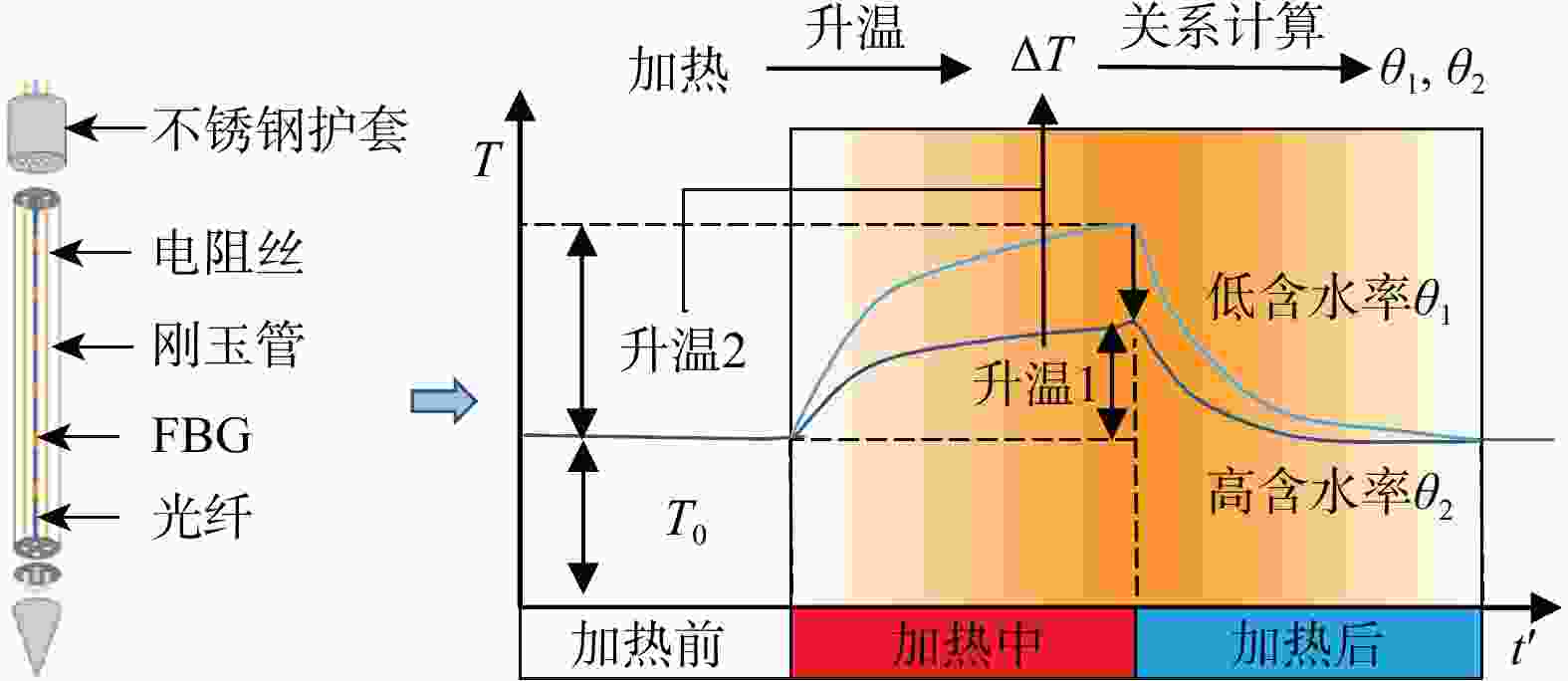
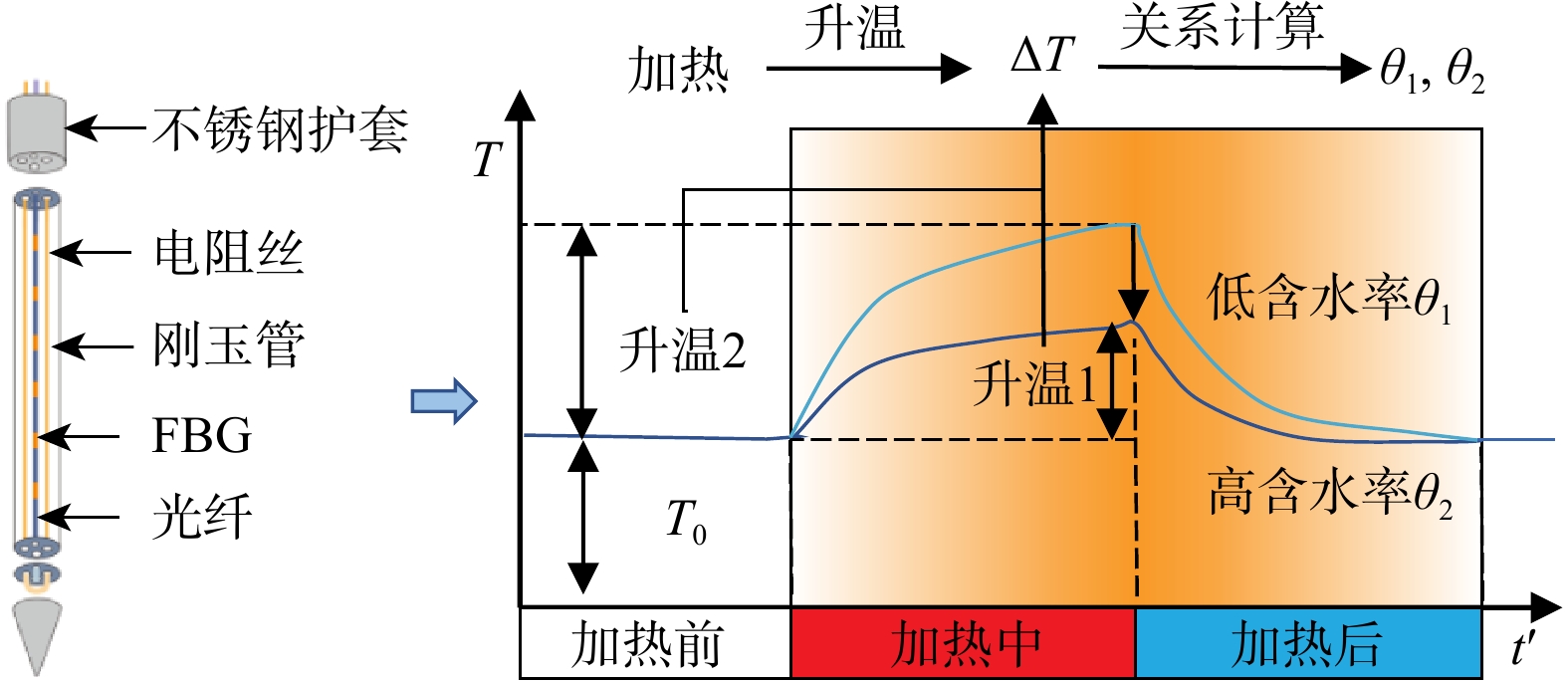
图 15 主动加热光纤布拉格光栅(AH-FBG)结构与升温监测示意图
$ \Delta T $为温度增量;$ {T}_{0} $为初始环境温度
Figure 15. Schematic diagram of actively heated fiber Bragg grating (AH-FBG) structure and heating monitoring process
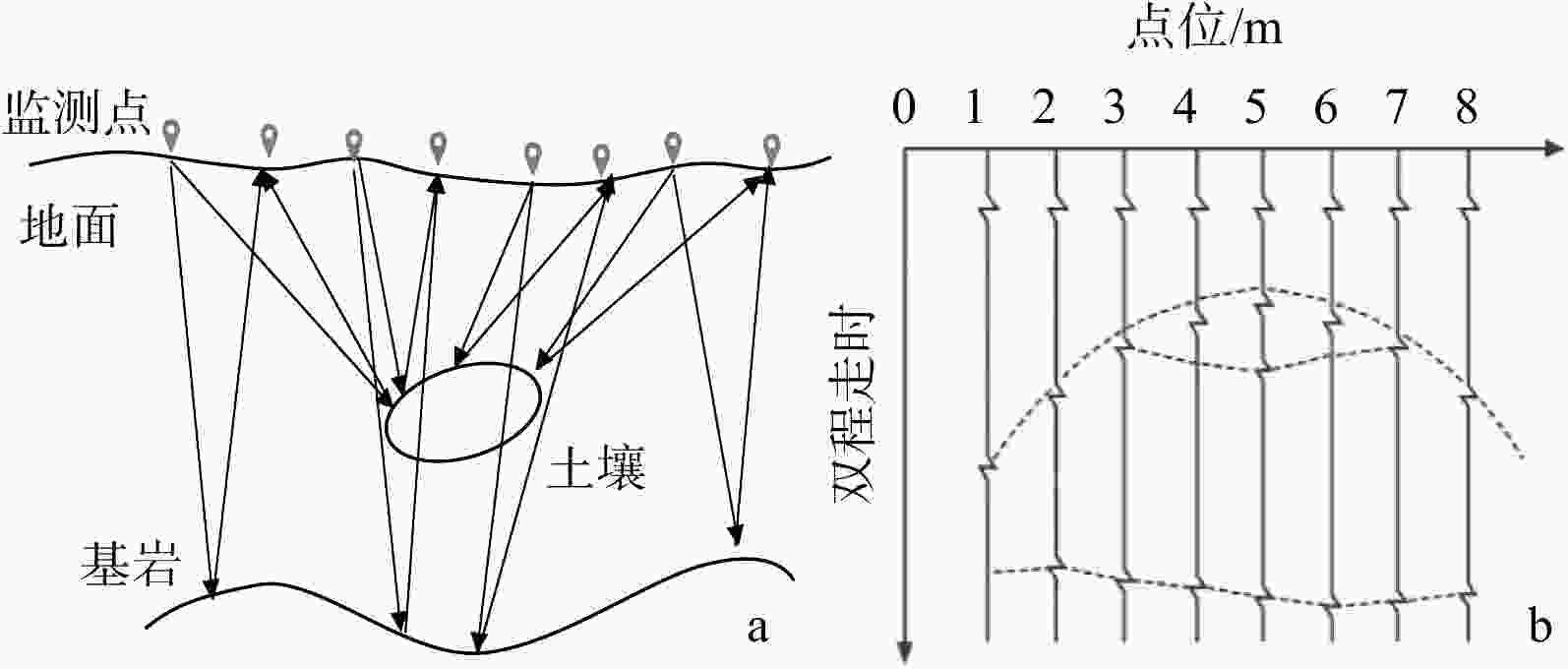
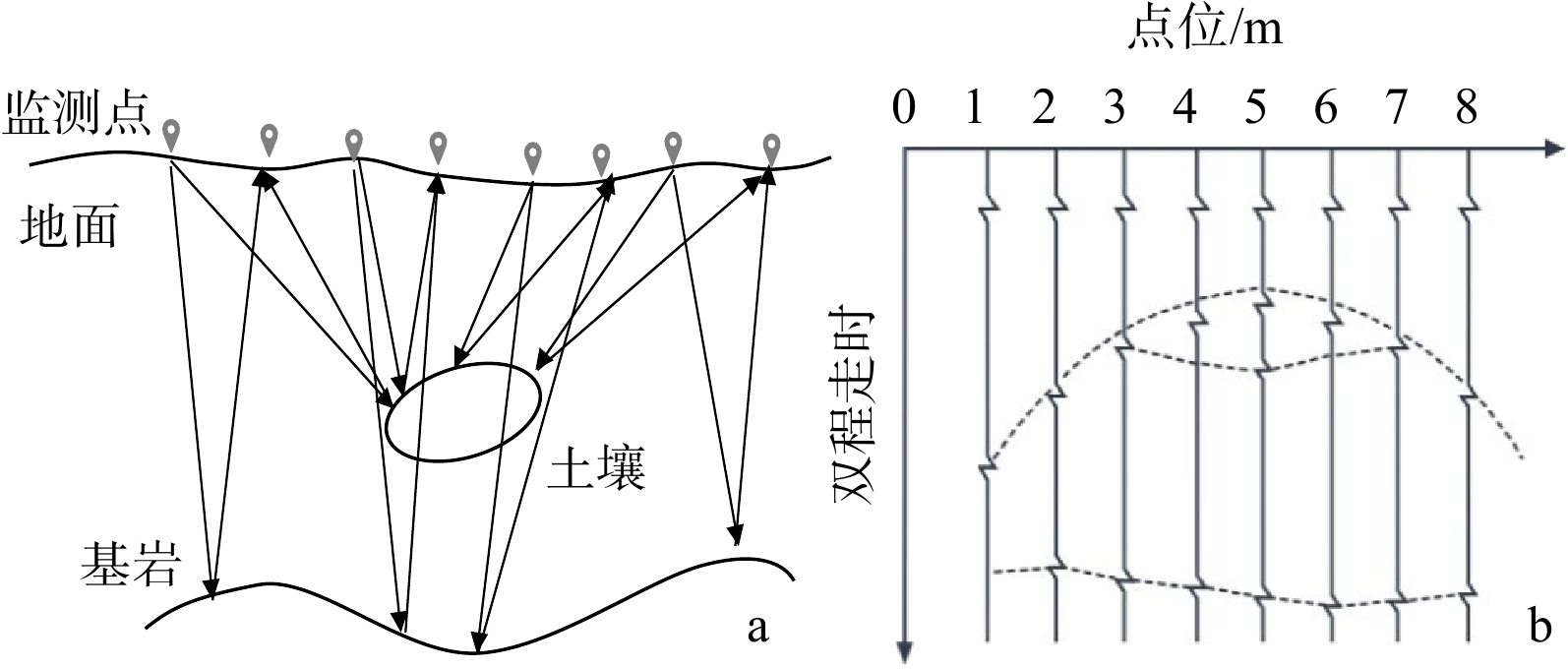
图 16 探地雷达(GPR)电磁波反射原理(a)与波形记录(b)示意图
Figure 16. Schematic diagram of electromagnetic wave reflection principle (a) and waveform recording (b) of ground-penetrating radar (GPR)
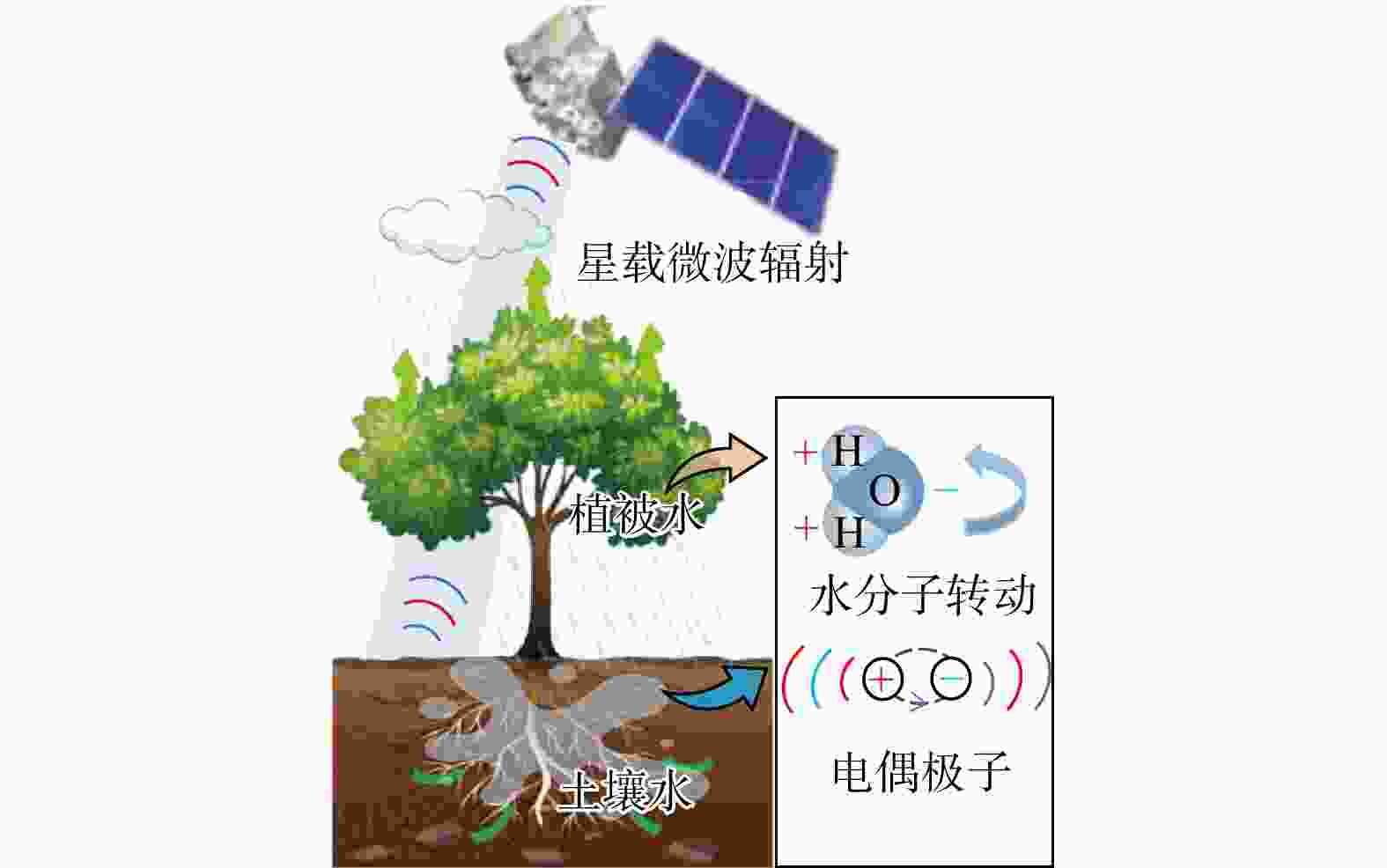
图 17 土壤水分被动微波遥感反演原理示意图
Figure 17. Schematic diagram of passive microwave remote sensing principle of soil moisture inversion
表 1 2005—2026 年土壤含水率监测领域关键词突现强度统计
Table 1. Statistics of keyword burst strength in field of soil moisture monitoring (2005-2026)
关键词 初现年 强度 起始年 终止年 热点时间跨度 监测(monitor) 2005 4.25 2005 2012 
地表温度(surface temperature) 2005 2.27 2005 2015 
遥感(remote sensing) 2006 2.25 2006 2009 
测量方法(measuring method) 2007 1.57 2007 2013 
遥感监测(remote sensing monitoring) 2006 3.15 2008 2010 
模型(model) 2008 2.01 2008 2009 
反演(inversion) 2009 2.06 2009 2010 
干旱监测(drought monitoring) 2010 2.68 2010 2011 
干旱(drought) 2012 3.01 2012 2013 
土壤(soil) 2013 3.59 2013 2014 
含水率(moisture content) 2014 1.84 2014 2015 
数值模拟(numerical simulation) 2014 1.72 2014 2017 
降水量(precipitation) 2016 10.39 2016 2017 
土壤墒情(soil moisture regime) 2019 3.51 2019 2020 
随机森林(random forest) 2019 1.63 2019 2025 
预测模型(prediction model) 2020 1.70 2020 2025 
机器学习(machine learning) 2021 2.86 2021 2025 
干旱指数(drought index) 2009 2.42 2021 2025 
无人机(UAV) 2019 2.97 2023 2025 
注:突发强度表示关键词在突发时间段被引频次增长幅度,数值越高表示关注度增长越剧烈;红色线段长度表示关键词突发的年份跨度,即关键词突发持续期  下载: 导出CSV
表 2 各类土壤含水率监测方法原理、冻土冰水分辨识能力及适用场景对比
Table 2. Comparison of principles, ice-water differentiation capacity in frozen soils, and application scenarios of various measurement methods for soil moisture content
方法类型 代表方法 主要敏感物理量或测量对象 冰−水相态辨识能力 适用场景 主要不确定性 应用定位 基准测量与标定方法 烘干法 土样烘干前后质量差 主要获得总含水量,不能直接区分未冻水与冰 实验室测试、传感器标定、模型验证 取样代表性、土样扰动、烘干温度、挥发性组分损失 提供基准含水率和误差评价依据 水势类原位测量方法 张力计、水势传感器 基质势或总水势 不能直接解耦冰−水组分,需结合水分特征曲线间接推算含水状态 非饱和土体入渗、排水、水分迁移和水分胁迫监测 水分特征曲线、干湿滞后、盐分、温度、接触状态 表征水分迁移驱动力,作为体积含水率测量的补充 介电与电学类原位
测量方法TDR、FDR、电容式、
电阻式、阻抗式传感器介电常数、电阻、
电导率或阻抗响应TDR、FDR和电容式方法可利用水与冰介电差异识别冻结状态,但定量解耦能力有限;电阻式主要反映干湿变化 农田墒情、边坡浅层水分、工程场地和生态水文长期监测 盐分、温度、土壤质地、黏粒含量、探头接触状态、传感器标定差异 适合长期连续监测,高精度应用需现场标定和环境补偿 热响应类原位
测量方法热脉冲法、热耗散传感器、DTS 热导率、体积热容、
温度响应或温度场变化可通过热响应变化推断含水率或含冰量,但受相变潜热影响,定量解耦需模型约束 根区土壤、浅层边坡、冻融界面、路基和堤坝温度−水分过程监测 土壤干密度、颗粒组成、初始温度场、加热功率、接触热阻、相变潜热 适合热水耦合过程识别和冻融动态监测 核物理类原位
测量方法中子散射法 氢原子对中子的慢化和
散射响应可反映总含水量,通常难以区分
液态水和冰深层土壤含水率、剖面储水量和体积平均含水状态监测 土壤干密度、有机质、含氢矿物、探测体积平均效应、放射源安全管理 适合深层和体积平均含水率监测,不适合高密度常规部署 核磁共振与主动加热光纤感测方法 NMR、AH-FBG 氢质子弛豫时间、主动加热后的温度响应特征 NMR可识别水分赋存状态和未冻水含量;AH-FBG可原位推断含水率和含冰量变化 冻土样品分析、冻土边坡、路基、浅层土体和工程界面监测 样品尺度、设备成本、温度控制、矿物干扰、加热功率、接触热阻、标定模型 适合冻土冰−水组分辨识、机理验证和原位动态监测 探地雷达法 GPR 介电常数、雷达波速、
反射振幅可识别冻结锋面和含水异常区,可辅助推断含冰状态 道路路基、边坡、堤坝、活动层和浅层水分异常调查 盐分、黏粒含量、地表粗糙度、天线频率、信号衰减 适合浅层水分空间分布和冻融界面识别 电阻率与电磁感应法 ERT、EMI 电阻率或表观电导率 可反映冻结融化和孔隙水连通性变化,但含水率与电性响应存在非唯一性 剖面尺度含水异常、湿润锋推进、场地快速扫描和空间分区 盐分、温度、孔隙结构、土壤质地、反演非唯一性 ERT适合剖面成像,EMI适合场地尺度快速调查 浅层地震法 浅层地震 纵波(P波)、横波(S波)速度、波阻抗或频散特征 可识别冻融界面、冰胶结增强和活动层变化,但难以单独定量含水率 冻土结构识别、工程场地分层、活动层厚度调查 孔隙率、密实度、颗粒组成、应力状态、冰胶结程度 适合作为冻土结构和冻融界面判别的辅助方法 遥感反演方法 光学遥感、热红外、
主动微波、被动微波反射率、亮度温度、
后向散射系数可监测区域尺度冻结融化状态和表层土壤水分变化,但垂向分辨能力有限 区域至全球尺度土壤水分、干湿异常和冻融状态监测 植被覆盖、地表粗糙度、空间分辨率、探测深度、尺度效应 适合区域背景监测,需与地面观测和地球物理方法验证 多源联合反演方法 原位传感、地球物理、
遥感与物理模型融合介电、电性、热学、
弹性和遥感多源响应可提高冰−水相态辨识能力,降低单一物性响应非唯一性 点 线 面多尺度综合监测,冻土区、边坡、路基和区域水分动态研究 数据尺度不一致、模型参数多、标定样本不足、反演框架复杂 未来发展方向,适合跨尺度、高可靠性土壤含水率综合表征 注:AH-FBG为主动加热光纤布拉格光栅;GPR为探地雷达;ERT为电阻率成像;EMI为电磁感应
下载: 导出CSV
表 3 不同土壤理化条件下含水率测量模型选取与误差校正方案
Table 3. Selection and error correction schemes of soil moisture content measurement models under different soil physicochemical conditions
干扰因素 对测量的主要影响 模型选择与校正策略 备注 盐分 电导率增高导致读数显著偏高 ①选用高频传感器 (>100 MHz)
②硬件补偿电路
③软件多元模型 (同时输入ε和σ)盐渍土是最主要的挑战之一 有机质 介电常数低导致读数系统偏低 ①乘以经验系数(如1.05~1.2)
②建立专属标定曲线有机质每增加1%,读数可能低估0.5%~1% 黏土含量与类型 束缚水导致非线性偏差(低含水时偏低) ①调整模型斜率与截距
②使用双常量混合模型分类标定是关键,必须为黏土单独标定 土壤容重/质地 影响孔隙度和电磁场传播,导致系统误差 ①分类标定
②在模型中引入容重参数出厂设置多为壤土,其他质地需重新标定 温度 影响水的介电常数,导致读数漂移 ①内置温度传感器自动补偿
②建立温度补偿函数对于长期测量至关重要,可消除温漂误差 注:ε为介电常数;σ为电导率
下载: 导出CSV
-
[1] 朱鸿鹄. 工程地质界面: 从多元表征到演化机理[J]. 地质科技通报, 2023, 42(1): 1-19. doi: 10.19509/j.cnki.dzkq.tb20220661ZHU H H. Engineering geological interface: From multivariate characterization to evolution mechanism[J]. Bulletin of Geological Science and Technology, 2023, 42(1): 1-19. (in Chinese with English abstract) doi: 10.19509/j.cnki.dzkq.tb20220661 [2] 赵珊, 许阳光, 郭文召, 等. 黄土塬区不同土地利用类型下土壤抗剪强度对强降雨的响应[J]. 农业工程学报, 2025, 41(4): 108-115.ZHAO S, XU Y G, GUO W Z, et al. Response of soil shear strength to heavy rainfall under different land use types on Loess Tableland[J]. Transactions of the Chinese Society of Agricultural Engineering, 2025, 41(4): 108-115. (in Chinese with English abstract) [3] HUANG S B, LIU Q S, CHENG A P, et al. A fully coupled thermo-hydro-mechanical model including the determination of coupling parameters for freezing rock[J]. International Journal of Rock Mechanics and Mining Sciences, 2018, 103: 205-214. doi: 10.1016/j.ijrmms.2018.01.029 [4] KARTHIKEYAN L, CHAWLA I, MISHRA A K. A review of remote sensing applications in agriculture for food security: Crop growth and yield, irrigation, and crop losses[J]. Journal of Hydrology, 2020, 586: 124905. doi: 10.1016/j.jhydrol.2020.124905 [5] 李奇龙, 周佳庆, 李长冬, 等. 气候变化环境下青藏高原含冰冰碛土斜坡水热力耦合特性与长期稳定性[J]. 地质科技通报, 2025, 44(1): 112-125. doi: 10.19509/j.cnki.dzkq.tb20240079LI Q L, ZHOU J Q, LI C D, et al. Coupling characteristics and stability evolution of ice-rich moraine soil slopes on the Tibetan Plateau under climate change[J]. Bulletin of Geological Science and Technology, 2025, 44(1): 112-125. (in Chinese with English abstract) doi: 10.19509/j.cnki.dzkq.tb20240079 [6] 王珂, 吴庆华, 杨野. 不同二元结构阻隔层抑制降雨入渗边坡规律的试验研究[J]. 地质科技通报, 2026, 45(3): 277-286. doi: 10.19509/j.cnki.dzkq.tb20250009WANG K, WU Q H, YANG Y. Experimental study on inhibition of rainfall infiltration into slopes by different dual-structure capillary barrier layers[J]. Bulletin of Geological Science and Technology, 2026, 45(3): 277-286. (in Chinese with English abstract) doi: 10.19509/j.cnki.dzkq.tb20250009 [7] GAO X Q, BAI R Q, JIN X, et al. Parameterized modeling of unfrozen water in frozen soil based on the freezing characteristics of multicomponent cation solutions and the electrical double-layer theory of clay colloids[J]. Water Resources Research, 2025, 61(10): e2025WR040886. doi: 10.1029/2025WR040886 [8] ZHANG X D, WU Y J, ZHAI E C, et al. Coupling analysis of the heat-water dynamics and frozen depth in a seasonally frozen zone[J]. Journal of Hydrology, 2021, 593: 125603. doi: 10.1016/j.jhydrol.2020.125603 [9] WU B, ZHU H H, GUO X H, et al. Experimental investigation of thermo-hydro-mechanical interactions in frozen soil using an integrated monitoring system[J]. Engineering Geology, 2025, 353: 108136. doi: 10.1016/j.enggeo.2025.108136 [10] JIN X, YANG W, GAO X Q, et al. Modeling the unfrozen water content of frozen soil based on the absorption effects of clay surfaces[J]. Water Resources Research, 2020, 56(12): e2020WR027482. doi: 10.1029/2020WR027482 [11] 曹鼎峰, 施斌, 顾凯, 等. 土的含水率AHFO法测量中分段函数模型建立[J]. 水文地质工程地质, 2016, 43(6): 41-47. doi: 10.16030/j.cnki.issn.1000-3665.2016.06.07CAO D F, SHI B, GU K, et al. Establishment of a piecewise function model in soil water content measurement using the AHFO method[J]. Hydrogeology & Engineering Geology, 2016, 43(6): 41-47. (in Chinese with English abstract) doi: 10.16030/j.cnki.issn.1000-3665.2016.06.07 [12] BUCKINGHAM E. Regnault's experiments on the Joule-Thomson effect[J]. Nature, 1907, 76(1976): 493. doi: 10.1038/076493a0 [13] GARDNER W. The capillary potential and its relation to soilmoisture constants[J]. Soil Science, 1920, 10(5): 357-360. doi: 10.1097/00010694-192011000-00003 [14] RICHARDS L A. The usefulness of capillary potential to soil moisture and plant investigators[J]. Journal of Agricultural Research, 1928, 37: 719-742. [15] RICHARDS L A. Capillary conduction of liquids through porous mediums[J]. Physics, 1931, 1(5): 318-333. doi: 10.1063/1.1745010 [16] ANDERSON D M, TICE A R, BANIN A. The water-ice phase composition of clay-water systems: Ⅰ. The kaolinite-water system[J]. Soil Science Society of America Journal, 1973, 37(6): 819-822. [17] GIMÉNEZ D, PERFECT E, RAWLS W J, et al. Fractal models for predicting soil hydraulic properties: A review[J]. Engineering Geology, 1997, 48(3/4): 161-183. doi: 10.1016/s0013-7952(97)00038-0 [18] BAKKE S, ØREN P E. 3-D pore-scale modelling of sandstones and flow simulations in the pore networks[J]. SPE Journal, 1997, 2(2): 136-149. doi: 10.2118/35479-PA [19] 孙鑫. 土壤含水率FBG监测系统研发与误差分析[D]. 南京: 南京大学, 2019.SUN X. Development of FBG-based soil moisture monitoring system and error analysis[D]. Nanjing: Nanjing University, 2019. (in Chinese with English abstract) [20] BELL J P, DEAN T J, HODNETT M G. Soil moisture measurement by an improved capacitance technique, part Ⅱ. Field techniques, evaluation and calibration[J]. Journal of Hydrology, 1987, 93(1/2): 79-90. [21] ROBINSON D A, SCHAAP M, JONES S B, et al. Considerations for improving the accuracy of permittivity measurement using time domain reflectometry: Air-water calibration, effects of cable length[J]. Soil Science Society of America Journal, 2003, 67(1): 62-70. doi: 10.2136/sssaj2003.6200 [22] TOPP G C, DAVIS J L, ANNAN A P. Electromagnetic determination of soil water content: Measurements in coaxial transmission lines[J]. Water Resources Research, 1980, 16(3): 574-582. doi: 10.1029/WR016i003p00574 [23] CHUDOBIAK W J, SYRETT B A, HAFEZ H M. Recent advances in broad-band VHF and UHF transmission line methods for moisture content and dielectric constant measurement[J]. IEEE Transactions on Instrumentation and Measurement, 1979, 28(4): 284-289. doi: 10.1109/TIM.1979.4314833 [24] MANE S, DAS N, SINGH G, et al. Advancements in dielectric soil moisture sensor Calibration: A comprehensive review of methods and techniques[J]. Computers and Electronics in Agriculture, 2024, 218: 108686. doi: 10.1016/j.compag.2024.108686 [25] RICHARDS L A. Methods of measuring soil moisture tension[J]. Soil Science, 1949, 68(1): 95. doi: 10.1097/00010694-194907000-00008 [26] 张巍, 施斌, 索文斌, 等. 冻土瞬态温度场的分布式光纤监测方法及应用[J]. 岩土工程学报, 2007, 29(5): 723-728.ZHANG W, SHI B, SUO W B, et al. Distributed optical fiber monitoring method and application of transient temperature field in frozen soil[J]. Chinese Journal of Geotechnical Engineering, 2007, 29(5): 723-728. (in Chinese with English abstract) [27] BENÍTEZ-BUELGA J, RODRÍGUEZ-SINOBAS L, SÁNCHEZ CALVO R, et al. Calibration of soil moisture sensing with subsurface heated fiber optics using numerical simulation[J]. Water Resources Research, 2016, 52(4): 2985-2995. doi: 10.1002/2015WR017897 [28] 张晓, 王月月, 任图生. 利用热脉冲技术测量土壤表层含水率[J]. 农业工程学报, 2015, 31(2): 72-78. doi: 10.3969/j.issn.1002-6819.2015.02.011ZHANG X, WANG Y Y, REN T S. Measurement of surface soil water content using heat pulse technology[J]. Transactions of the Chinese Society of Agricultural Engineering, 2015, 31(2): 72-78. (in Chinese with English abstract) doi: 10.3969/j.issn.1002-6819.2015.02.011 [29] CIOCCA F, LUNATI I, VAN DE GIESEN N, et al. Heated optical fiber for distributed soil-moisture measurements: A lysimeter experiment[J]. Vadose Zone Journal, 2012, 11(4): vzj2011.0199. doi: 10.2136/vzj2011.0199 [30] SAYDE C, BUELGA J B, RODRIGUEZ-SINOBAS L, et al. Mapping variability of soil water content and flux across 1− 1000 m scales using the actively heated fiber-optic method[J]. Water Resources Research, 2014, 50(9): 7302-7317.[31] 吴冰, 朱鸿鹄, 曹鼎峰, 等. 基于光纤光栅的冻土含冰量监测可行性试验研究[J]. 岩土工程学报, 2019, 41(12): 2323-2330. doi: 10.11779/CJGE201912018WU B, ZHU H H, CAO D F, et al. Feasibility experimental study on monitoring ice content of frozen soil based on fiber Bragg grating[J]. Chinese Journal of Geotechnical Engineering, 2019, 41(12): 2323-2330. (in Chinese with English abstract) doi: 10.11779/CJGE201912018 [32] KOZLOWSKI T. A comprehensive method of determining the soil unfrozen water curves: 2. Stages of the phase change process in frozen soil-water system[J]. Cold Regions Science and Technology, 2003, 36(1/2/3): 81-92. [33] WATANABE K, FLURY M. Capillary bundle model of hydraulic conductivity for frozen soil[J]. Water Resources Research, 2008, 44(12): 2008WR007012. doi: 10.1029/2008WR007012 [34] WATANABE K, WAKE T. Measurement of unfrozen water content and relative permittivity of frozen unsaturated soil using NMR and TDR[J]. Cold Regions Science and Technology, 2009, 59(1): 34-41. doi: 10.1016/j.coldregions.2009.05.011 [35] ABBASI G R, ARIF M, ISAH A, et al. Gas hydrate characterization in sediments via X-ray microcomputed tomography[J]. Earth-Science Reviews, 2022, 234: 104233. doi: 10.1016/j.earscirev.2022.104233 [36] VAN DER KRUK J, GUETING N, KLOTZSCHE A, et al. Quantitative multi-layer electromagnetic induction inversion and full-waveform inversion of crosshole ground penetrating radar data[J]. Journal of Earth Science, 2015, 26(6): 844-850. doi: 10.1007/s12583-015-0610-3 [37] PRICE J C. The potential of remotely sensed thermal infrared data to infer surface soil moisture and evaporation[J]. Water Resources Research, 1980, 16(4): 787-795. doi: 10.1029/WR016i004p00787 [38] ULABY F T, DUBOIS P C, VAN ZYL J. Radar mapping of surface soil moisture[J]. Journal of Hydrology, 1996, 184(1/2): 57-84. doi: 10.1016/0022-1694(95)02968-0 [39] KERR Y H, WALDTEUFEL P, WIGNERON J P, et al. The SMOS mission: New tool for monitoring key elements of the global water cycle[J]. Proceedings of the IEEE, 2010, 98(5): 666-687. doi: 10.1109/JPROC.2010.2043032 [40] ZWIEBACK S, BERG A A. Fine-scale SAR soil moisture estimation in the subarctic tundra[J]. IEEE Transactions on Geoscience and Remote Sensing, 2019, 57(7): 4898-4912. doi: 10.1109/TGRS.2019.2893908 [41] RAUTIAINEN K, PARKKINEN T, LEMMETYINEN J, et al. SMOS prototype algorithm for detecting autumn soil freezing[J]. Remote Sensing of Environment, 2016, 180: 346-360. doi: 10.1016/j.rse.2016.01.012 [42] GE Y, WANG J H, HEUVELINK G B M, et al. Sampling design optimization of a wireless sensor network for monitoring ecohydrological processes in the Babao River basin, China[J]. International Journal of Geographical Information Science, 2015, 29(1): 92-110. doi: 10.1080/13658816.2014.948446 [43] 中华人民共和国住房和城乡建设部. 土工试验方法标准: GB/T 50123—2019[S]. 北京: 中国计划出版社, 2019.Ministry of Housing and Urban-Rural Development of the People's Republic of China. Standard for geotechnical testing method: GB/T 50123—2019[S]. Beijing: China Planning Press, 2019. (in Chinese) [44] WHALLEY W R, OBER E S, JENKINS M. Measurement of the matric potential of soil water in the rhizosphere[J]. Journal of Experimental Botany, 2013, 64(13): 3951-3963. doi: 10.1093/jxb/ert044 [45] LEDIEU J, DE RIDDER P, DE CLERCK P, et al. A method of measuring soil moisture by time-domain reflectometry[J]. Journal of Hydrology, 1986, 88(3/4): 319-328. [46] 李元寿, 王根绪, 程玉菲, 等. FDR在高寒草地土壤水分测量中的标定及其应用[J]. 干旱区地理, 2006, 29(4): 543-547. doi: 10.3321/j.issn:1000-6060.2006.04.015LI Y S, WANG G X, CHENG Y F, et al. Calibration of FDR for soil moisture measurement in alpine grassland and its application[J]. Arid Land Geography, 2006, 29(4): 543-547. (in Chinese with English abstract) doi: 10.3321/j.issn:1000-6060.2006.04.015 [47] YU L M, GAO W L, SHAMSHIRI R R, et al. Review of research progress on soil moisture sensor technology[J]. International Journal of Agricultural and Biological Engineering, 2021, 14(4): 32-42. [48] SHOCK C C, WANG F X. Soil water tension, a powerful measurement for productivity and stewardship[J]. HortScience, 2011, 46(2): 178-185. doi: 10.21273/hortsci.46.2.178 [49] 韦昊延, 耿宁, 成静清, 等. 单探针热脉冲法对红壤土失水过程的监测[J]. 水资源与水工程学报, 2024, 35(5): 201-208. doi: 10.11705/j.issn.1672-643X.2024.05.24WEI H Y, GENG N, CHENG J Q, et al. Monitoring of water loss process in red soil by single-probe heat pulse method[J]. Journal of Water Resources and Water Engineering, 2024, 35(5): 201-208. (in Chinese with English abstract) doi: 10.11705/j.issn.1672-643X.2024.05.24 [50] FLINT A L, CAMPBELL G S, ELLETT K M, et al. Calibration and temperature correction of heat dissipation matric potential sensors[J]. Soil Science Society of America Journal, 2002, 66(5): 1439-1445. doi: 10.2136/sssaj2002.1439 [51] TYLER S W, SELKER J S, HAUSNER M B, et al. Environmental temperature sensing using Raman spectra DTS fiber-optic methods[J]. Water Resources Research, 2009, 45(4): 2008WR007052. doi: 10.1029/2008WR007052 [52] ZHANG Y Y, WEI S E, ZHAO W Z. Mesoscale unfrozen water content measurements in frozen oasis soils using combined cosmic-ray neutron sensing and time domain reflectometry networks[J]. Agricultural Water Management, 2025, 316: 109600. doi: 10.1016/j.agwat.2025.109600 [53] GUMMERSON R J, HALL C, HOFF W D, et al. Unsaturated water flow within porous materials observed by NMR imaging[J]. Nature, 1979, 281(5726): 56-57. doi: 10.1038/281056a0 [54] CAO D F, SHI B, ZHU H H, et al. A soil moisture estimation method using actively heated fiber Bragg grating sensors[J]. Engineering Geology, 2018, 242: 142-149. doi: 10.1016/j.enggeo.2018.05.024 [55] 吴冰, 朱鸿鹄, 曹鼎峰, 等. 基于主动加热光纤法的冻土相变温度场特征分析[J]. 工程地质学报, 2019, 27(5): 1093-1100. doi: 10.13544/j.cnki.jeg.2019135WU B, ZHU H H, CAO D F, et al. Characteristics of phase change temperature field of frozen soil based on actively heated optical fiber method[J]. Journal of Engineering Geology, 2019, 27(5): 1093-1100. (in Chinese with English abstract) doi: 10.13544/j.cnki.jeg.2019135 [56] COLLINS M E, PUCKETT W E, SCHELLENTRAGER G W, et al. Using GPR for micro-analyses of soils and karst features on the Chiefland limestone plain in Florida[J]. Geoderma, 1990, 47(1/2): 159-170. doi: 10.1016/0016-7061(90)90053-c [57] OLDENBORGER G A, LEBLANC A M. Monitoring changes in unfrozen water content with electrical resistivity surveys in cold continuous permafrost[J]. Geophysical Journal International, 2018, 215(2): 965-977. doi: 10.1093/gji/ggy321 [58] BOAGA J. The use of FDEM in hydrogeophysics: A review[J]. Journal of Applied Geophysics, 2017, 139: 36-46. doi: 10.1016/j.jappgeo.2017.02.011 [59] JAMES S R, KNOX H A, ABBOTT R E, et al. Insights into permafrost and seasonal active-layer dynamics from ambient seismic noise monitoring[J]. Journal of Geophysical Research: Earth Surface, 2019, 124(7): 1798-1816. doi: 10.1029/2019jf005051 [60] SCHMUGGE T, GLOERSEN P, WILHEIT T, et al. Remote sensing of soil moisture with microwave radiometers[J]. Journal of Geophysical Research, 1974, 79(2): 317-323. doi: 10.1029/JB079i002p00317 [61] BOBROV P P, MIRONOV V L, KONDRATYEVA O V, et al. The effect of clay and organic matter content on the dielectric permittivity of soils and grounds at the frequency range from 10 MHz to 1 GHz[C]//IEEE. 2010 IEEE International Geoscience and Remote Sensing Symposium. Piscataway, NJ: IEEE, 2010: 4433-4435. [62] 吴宇豪, 尹立普, 王晴, 等. 有机污染黏壤土热脱附后热导率的变化特性[J]. 环境工程学报, 2021, 15(12): 3967-3973.WU Y H, YIN L P, WANG Q, et al. Variation characteristics of thermal conductivity of organically contaminated clay loam after thermal desorption[J]. Chinese Journal of Environmental Engineering, 2021, 15(12): 3967-3973. (in Chinese with English abstract) [63] 陈壮. 温度自补偿的 SWR 土壤湿度传感器研究与系统设计[D]. 北京: 北京林业大学, 2019.CHEN Z. Research and system design of temperature self-compensated SWR soil moisture sensor[D]. Beijing: Beijing Forestry University, 2019. (in Chinese with English abstract) [64] EVETT S R, STEINER J L. Precision of neutron scattering and capacitance type soil water content gauges from field calibration[J]. Soil Science Society of America Journal, 1995, 59(4): 961-968. doi: 10.2136/sssaj1995.03615995005900040001x [65] KNIGHT J H, FERRÉ P A, RUDOLPH D L, et al. A numerical analysis of the effects of coatings and gaps upon relative dielectric permittivity measurement with time domain reflectometry[J]. Water Resources Research, 1997, 33(6): 1455-1460. doi: 10.1029/97WR00435 [66] PENG J, ALBERGEL C, BALENZANO A, et al. A roadmap for high-resolution satellite soil moisture applications-confronting product characteristics with user requirements[J]. Remote Sensing of Environment, 2021, 252: 112162. doi: 10.1016/j.rse.2020.112162 [67] CHEN X G, HUANG Y F, ZHANG S, et al. Projected strengthening of water constraint on seasonal peak photosynthesis under climatic warming in northern ecosystems[J]. Geophysical Research Letters, 2025, 52(15): e2024GL114461. doi: 10.1029/2024GL114461 [68] KANNAN A, TSAGKATAKIS G, MOGHADDAM M. Physics-constrained deep learning models for microwave retrieval of high-resolution soil moisture[C]//IEEE. IGARSS 2024-2024 IEEE International Geoscience and Remote Sensing Symposium. Piscataway, NJ: IEEE, 2024: 1478-1480. [69] ZHU H H, WU B, CAO D F, et al. Characterizing thermo-hydraulic behaviors of seasonally frozen loess via a combined opto-electronic sensing system: Field monitoring and assessment[J]. Journal of Hydrology, 2023, 622: 129647. doi: 10.1016/j.jhydrol.2023.129647 [70] 郭旭辉, 朱鸿鹄, 吴冰, 等. 基于人工神经网络的黄土含水率光纤被动感测技术研究[J]. 岩土力学, 2025, 46(2): 653-664.GUO X H, ZHU H H, WU B, et al. Fiber optic passive sensing of loess moisture content based on artificial neural network[J]. Rock and Soil Mechanics, 2025, 46(2): 653-664. (in Chinese with English abstract) [71] WU B, ZHU H H, CAO D F, et al. Fiber optic sensing-based field investigation of thermo-hydraulic behaviors of loess for characterizing land-atmosphere interactions[J]. Engineering Geology, 2023, 315: 107019. doi: 10.1016/j.enggeo.2023.107019 -

 下载:
下载:

 点击查看大图
计量
- 文章访问数: 342
- PDF下载量: 57
- 被引次数: 0