投审稿入口
投审稿入口


Prediction of shear strength parameters of granite residual soil based on Stacking ensemble learning strategy
-
摘要:
花岗岩残积土工程性质空间离散性强,其抗剪强度参数传统试验测试周期长、成本高、效率偏低,同时单一机器学习模型普遍存在泛化能力有限的问题。本研究构建基于 Stacking 集成学习的预测模型,实现花岗岩残积土黏聚力与内摩擦角的高精度预测,并揭示各物理指标对抗剪强度参数的影响机制。依托文献及工程勘察实测土工试验数据建立样本集,经数据筛选与归一化预处理后,搭建2层Stacking 集成学习框架;选取随机森林(RF)、支持向量机(SVM)、误差反向传播神经网络(BPNN)作为异构基学习器,采用五折交叉验证完成模型训练,以岭回归(Ridge 回归)作为元学习器融合多模型输出结果;选取细粒含量、孔隙比、含水率、液限、塑限、比重 6 项指标作为输入,黏聚力与内摩擦角作为输出,并引入 SHAP 可解释性方法分析参数影响规律。模型在验证集上,黏聚力、内摩擦角的决定系数
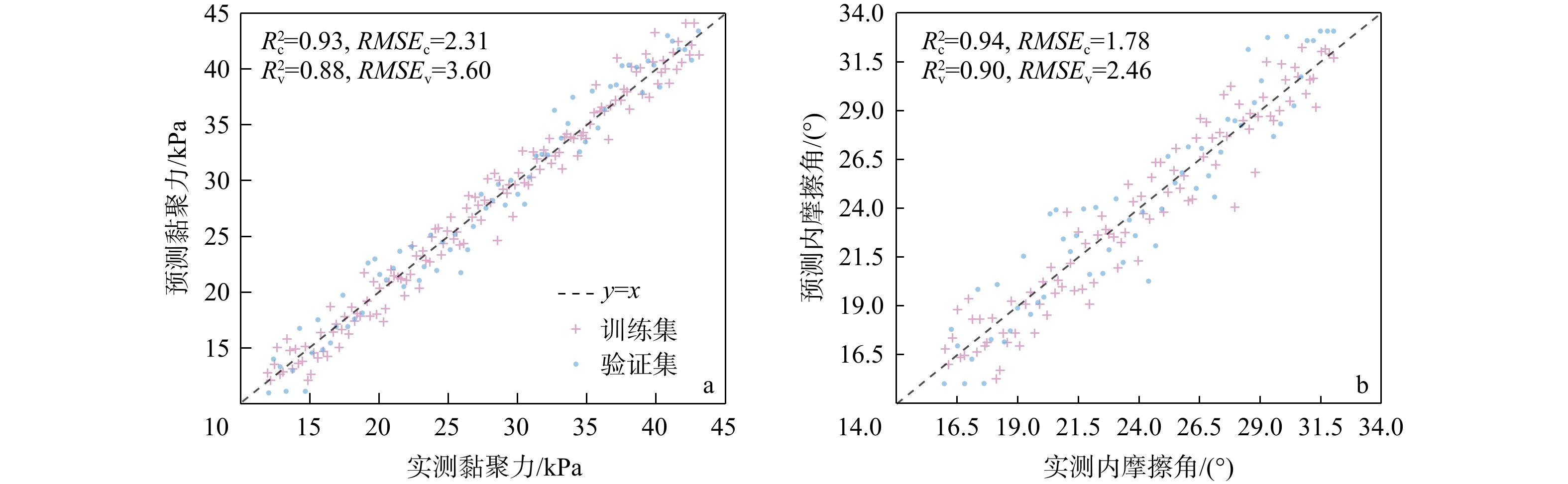
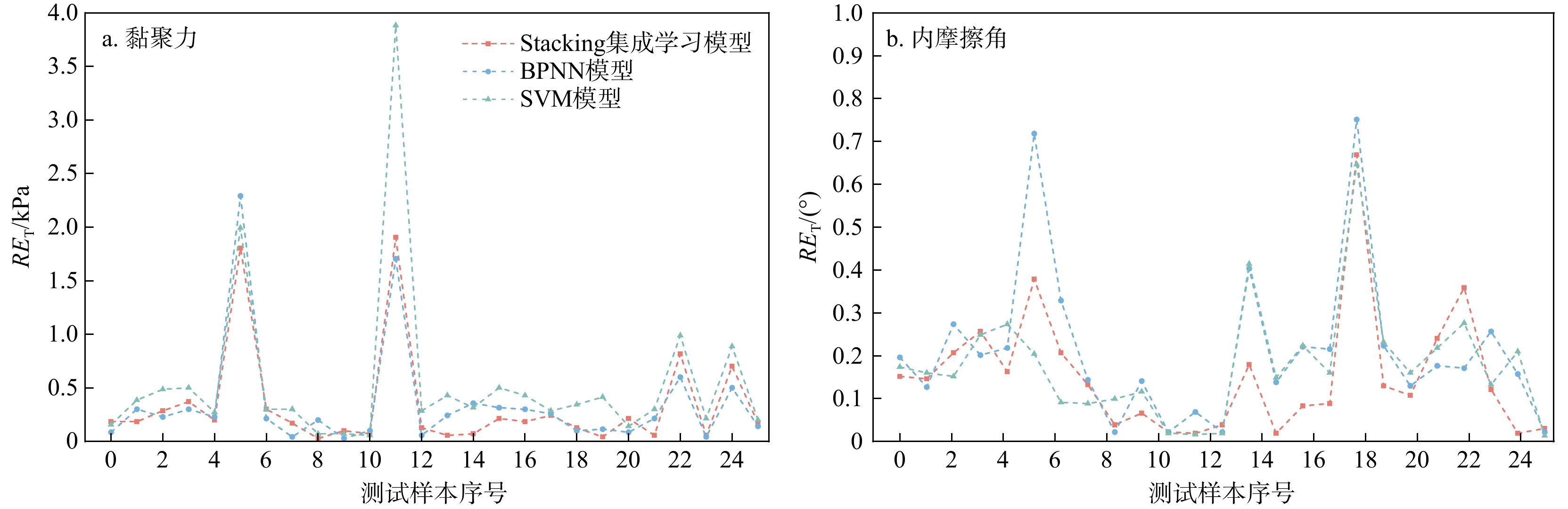
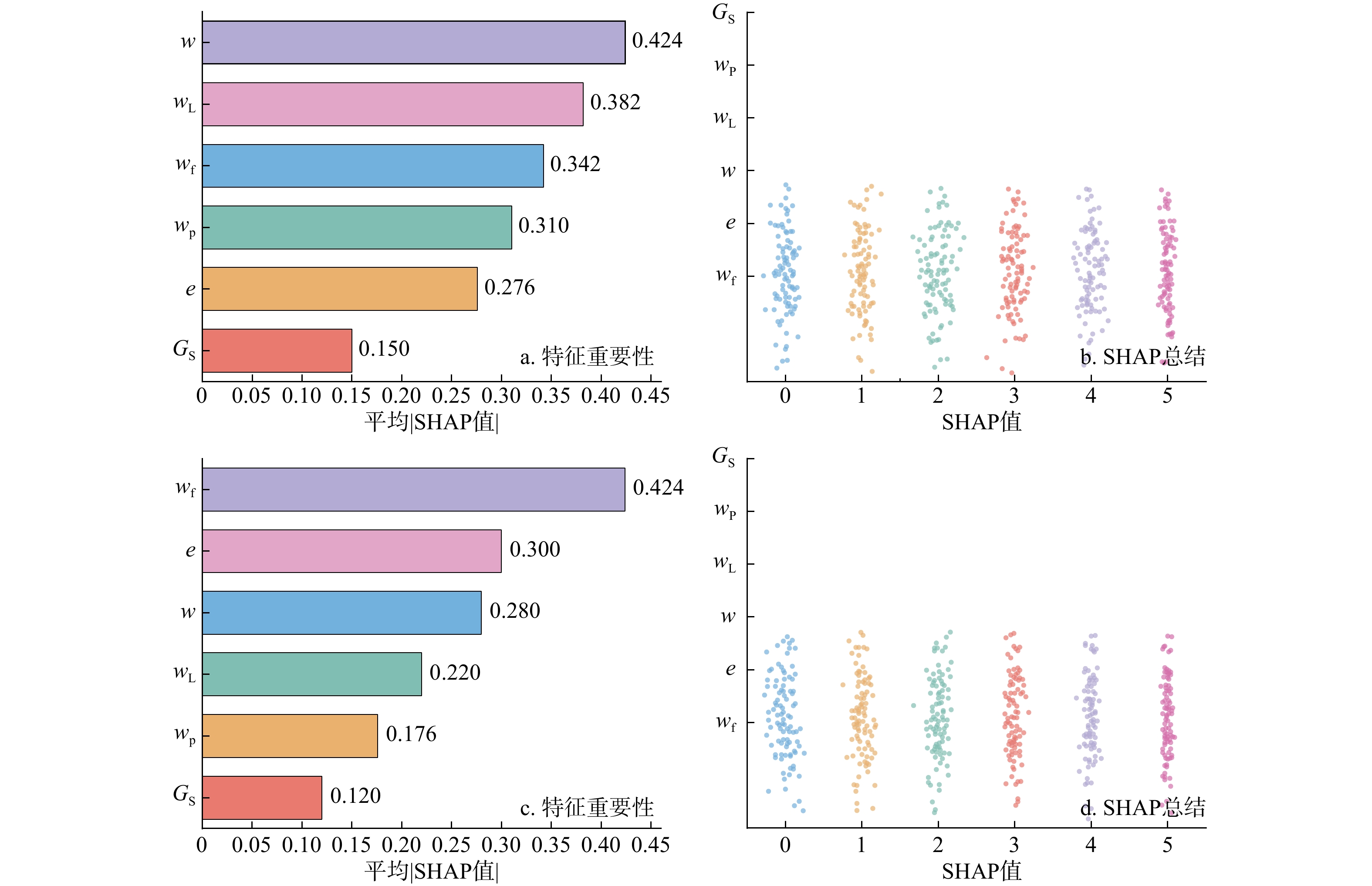
R 2分别为 0.88、0.90,均方根误差RMSE 依次为 3.60 kPa、2.46°,较最优单一基学习器R 2分别提升 1%、5%;独立工程测试集结果表明,黏聚力预测偏差为 0~1.91 kPa,内摩擦角预测偏差为 0°~0.67°,集成模型综合性能显著优于单一模型。SHAP 分析证实,黏聚力主控因素为含水率、液限、细粒含量,内摩擦角主控因素为细粒含量、孔隙比、含水率,变化规律与土力学理论相符。Stacking 集成学习能够充分发挥不同机器学习模型的优势,有效提升花岗岩残积土抗剪强度参数的预测精度与鲁棒性,可为该类土体分布区边坡稳定性评价、滑坡灾害防治提供高效、低成本的参数获取技术支撑。-
关键词:
- 花岗岩残积土 /
- 抗剪强度 /
- Stacking集成学习策略 /
- 机器学习 /
- SHAP分析
Abstract:ObjectiveGranite residual soil is widely distributed in humid and hot regions of southern China, and its highly variable engineering properties bring great challenges to slope stability evaluation and foundation design. The shear strength indices, including cohesion and internal friction angle, are the most critical mechanical parameters for analyzing the stability of geotechnical structures. Traditional laboratory tests for obtaining shear strength parameters are time-consuming, costly and labor-intensive, and cannot meet the demand for rapid parameter acquisition in disaster early warning. In addition, conventional single machine learning models often suffer from limited generalization performance when dealing with the strong nonlinear relationship between soil physical properties and shear strength. To solve the above practical problems, this study develops an innovative prediction framework based on the Stacking ensemble learning algorithm to realize the high-accuracy prediction of cohesion and internal friction angle, and further reveal the dominant influencing mechanism of physical indices on soil shear strength.
MethodsIn this study, a comprehensive dataset was compiled from published literature and field geotechnical investigation data, and data screening and normalization preprocessing were conducted to unify data quality and eliminate the interference of dimensional differences. A two-layer Stacking ensemble learning architecture was established. Three typical heterogeneous machine learning models—random forest (RF), support vector machine (SVM), and back propagation neural network (BPNN)—were adopted as base learners, and a 5-fold cross-validation strategy was applied to complete model training and avoid overfitting. Ridge regression was employed as the meta-learner to synthesize the prediction outputs from three base learners. Six common geotechnical indices, namely fines content, void ratio, natural water content, liquid limit, plastic limit, and specific gravity, were set as model inputs, while cohesion and internal friction angle were defined as model outputs. Furthermore, the SHapley Additive exPlanations (SHAP) method was introduced to interpret the black-box model and quantitatively analyze the contribution degree of each input parameter.
ResultsThe results demonstrated that the determination coefficient (
R 2) of the proposed Stacking model reached 0.88 for cohesion and 0.90 for internal friction angle on the validation set, with corresponding root mean square error (RMSE ) values of 3.60 kPa and 2.46°, respectively. Compared with the best-performing single base learner, theR 2 values increased by 1% and 5%, respectively. Verified by independent engineering test samples collected from Zixing City, Hunan Province, the absolute prediction deviation of cohesion ranged from 0 kPa to 1.91 kPa, and that of internal friction angle varied from 0° to 0.67°. The ensemble model exhibited obviously better prediction capability and robustness than individual models. SHAP interpretation results indicated that cohesion was mainly controlled by water content, liquid limit, and fines content, whereas fines content, void ratio, and water content served as the primary factors affecting internal friction angle. The variation characteristics of all parameters were well consistent with classical soil mechanics theories.ConclusionThe study proves that the Stacking ensemble learning strategy can effectively combine the respective strengths of different single machine learning models and overcome their inherent defects. The proposed method greatly improves the prediction accuracy and generalization ability for shear strength parameters of granite residual soil. It provides an efficient, low-cost, and reliable technical solution for rapid parameter determination, and has good application prospects in slope stability assessment and landslide disaster prevention in areas covered by granite residual soil.
-
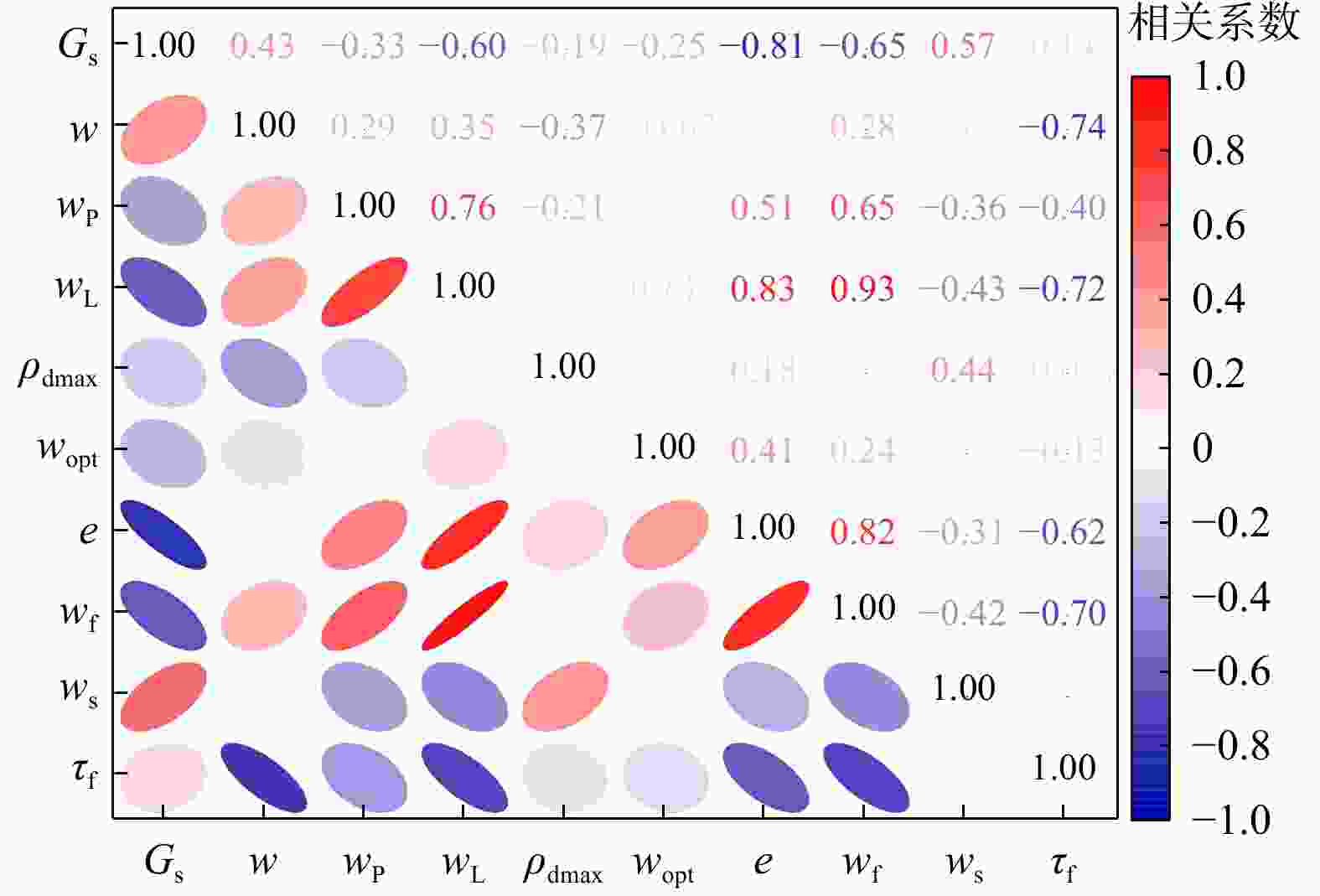
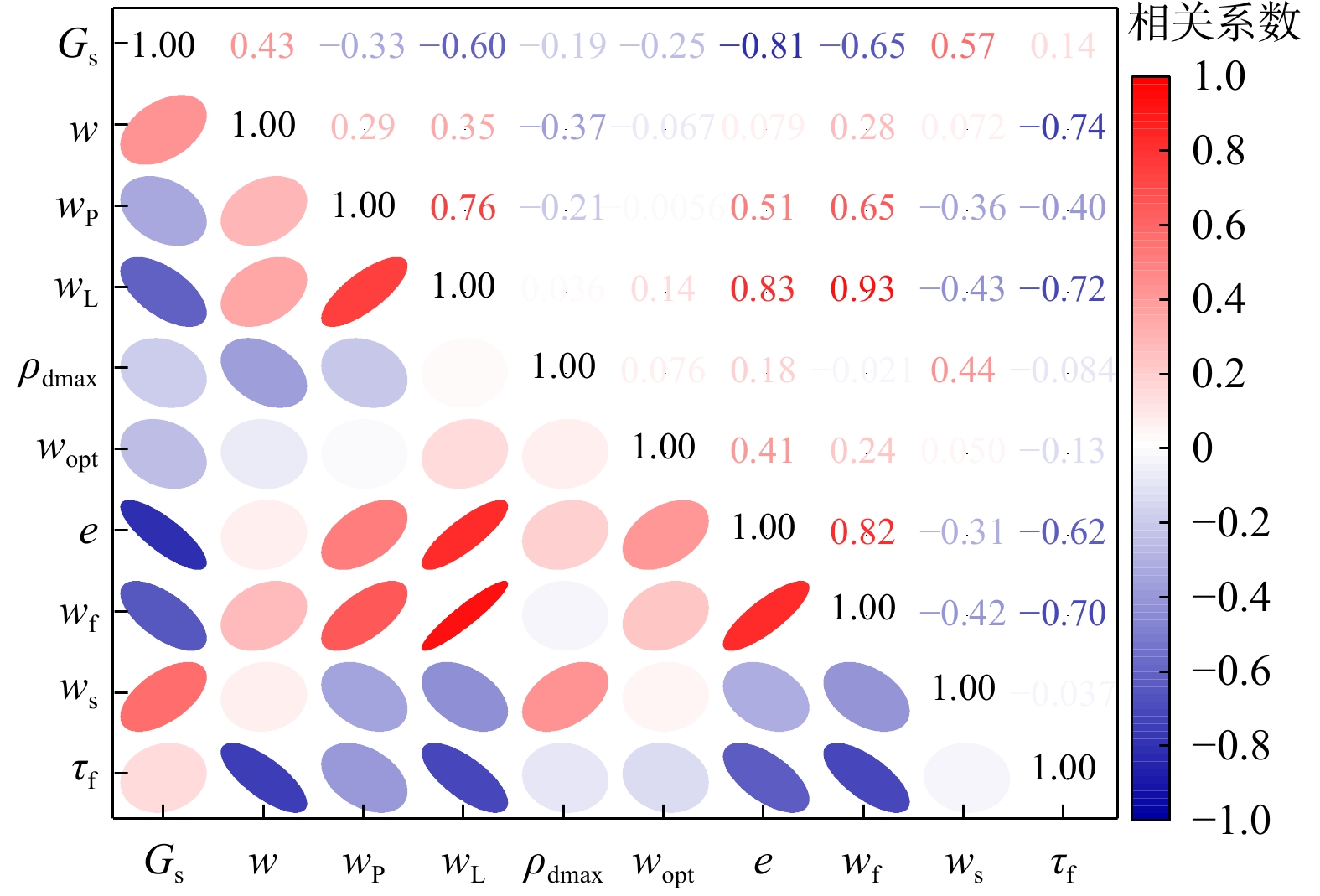
图 1 参数相关性分析
Gs为比重;w为含水率;wP为塑限;wL为液限;ρdmax为最大干密度;wopt为最优含水率;e为孔隙比;wf为细粒质量分数;ws为砂粒质量分数;τf为抗剪强度;下同
Figure 1. Correlation analysis of parameters
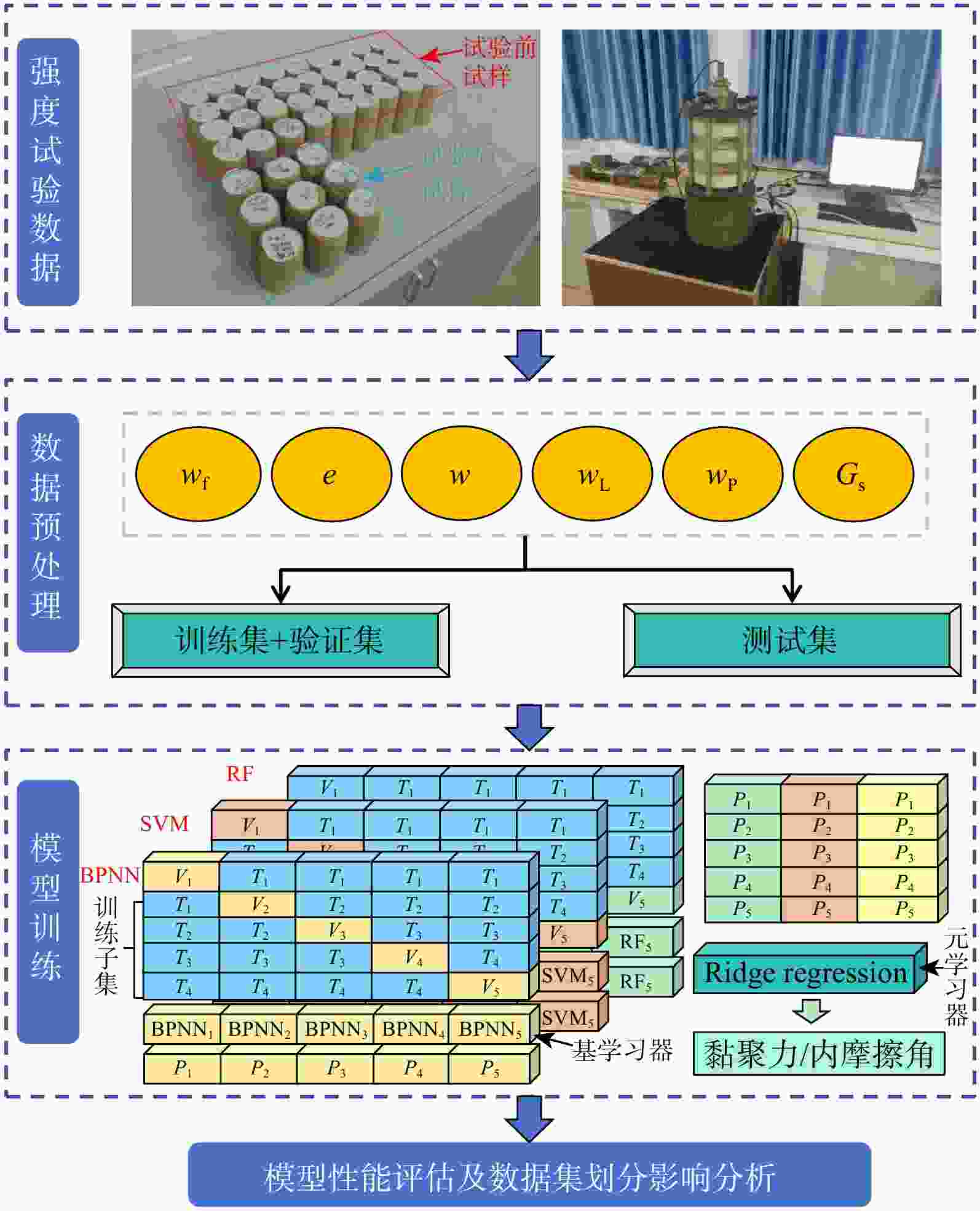
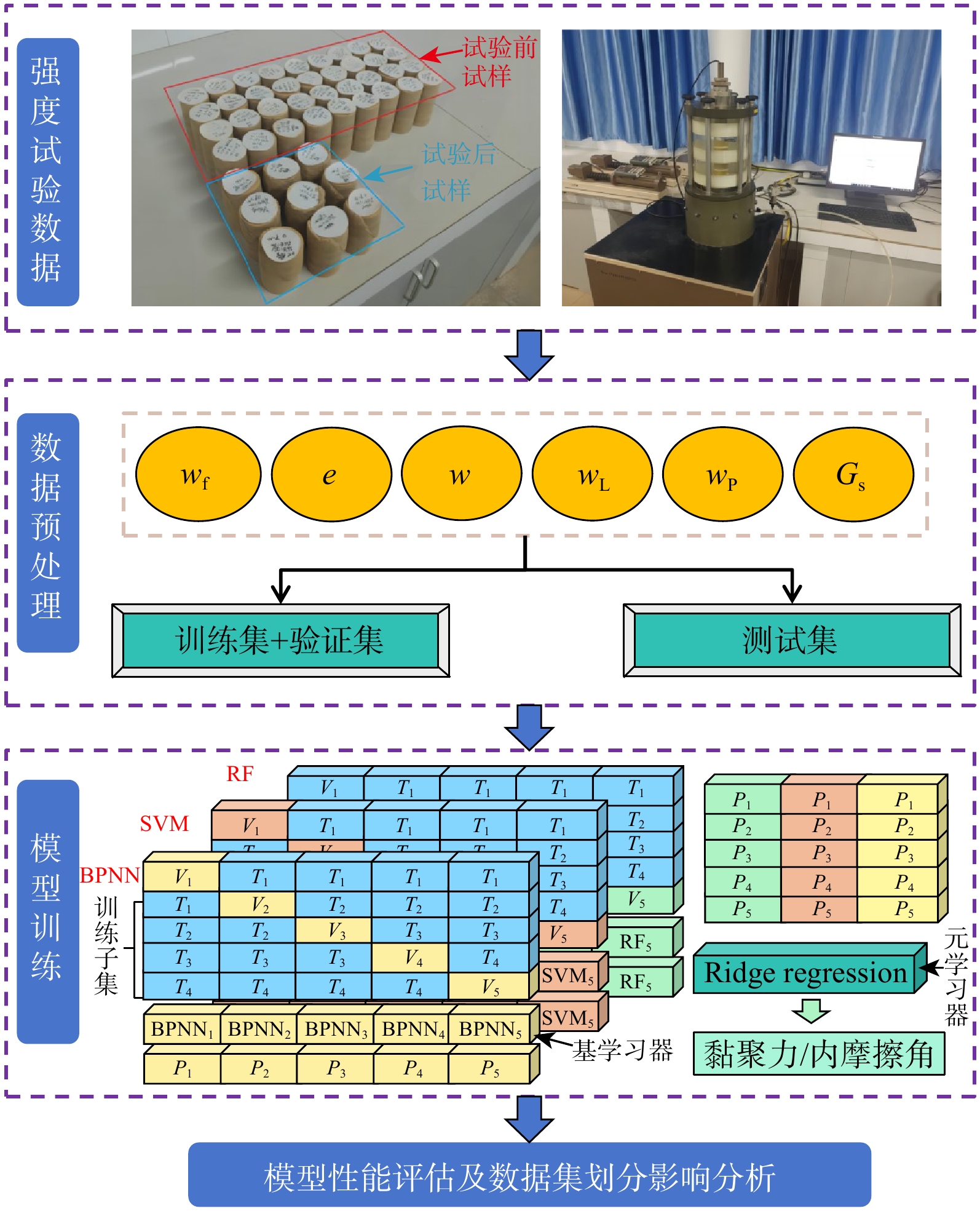
图 2 利用Stacking策略的抗剪强度集成学习模型建立过程
Vi为第i次划分的验证集;Ti为第i次划分的训练集;RFi为第i次划分训练完成的随机森林模型;SVMi 为第i次划分训练完成的支持向量机模型;BPNNi 为第i次划分训练完成的误差反向传播神经网络模型;Pi为第i次划分训练完成的基学习器;Ridge Regression为岭回归
Figure 2. Construction process of shear strength ensemble learning model using Stacking strategy
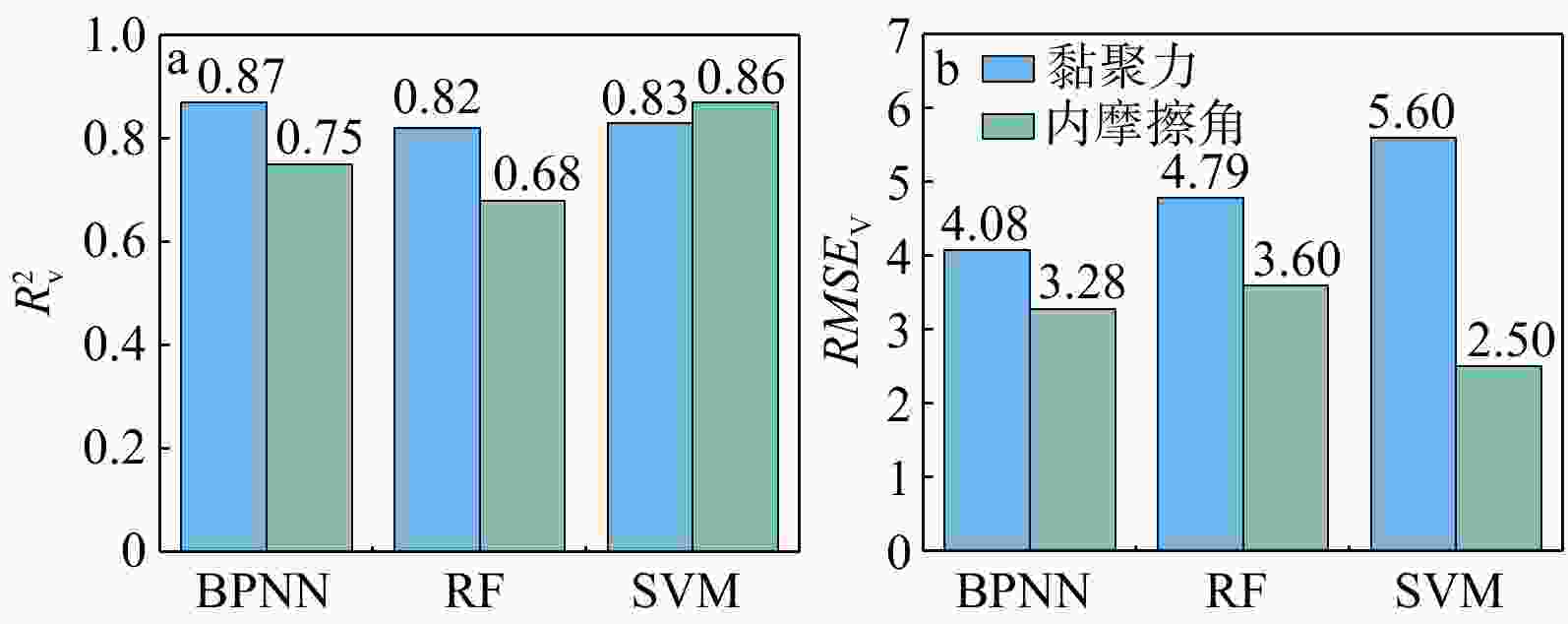
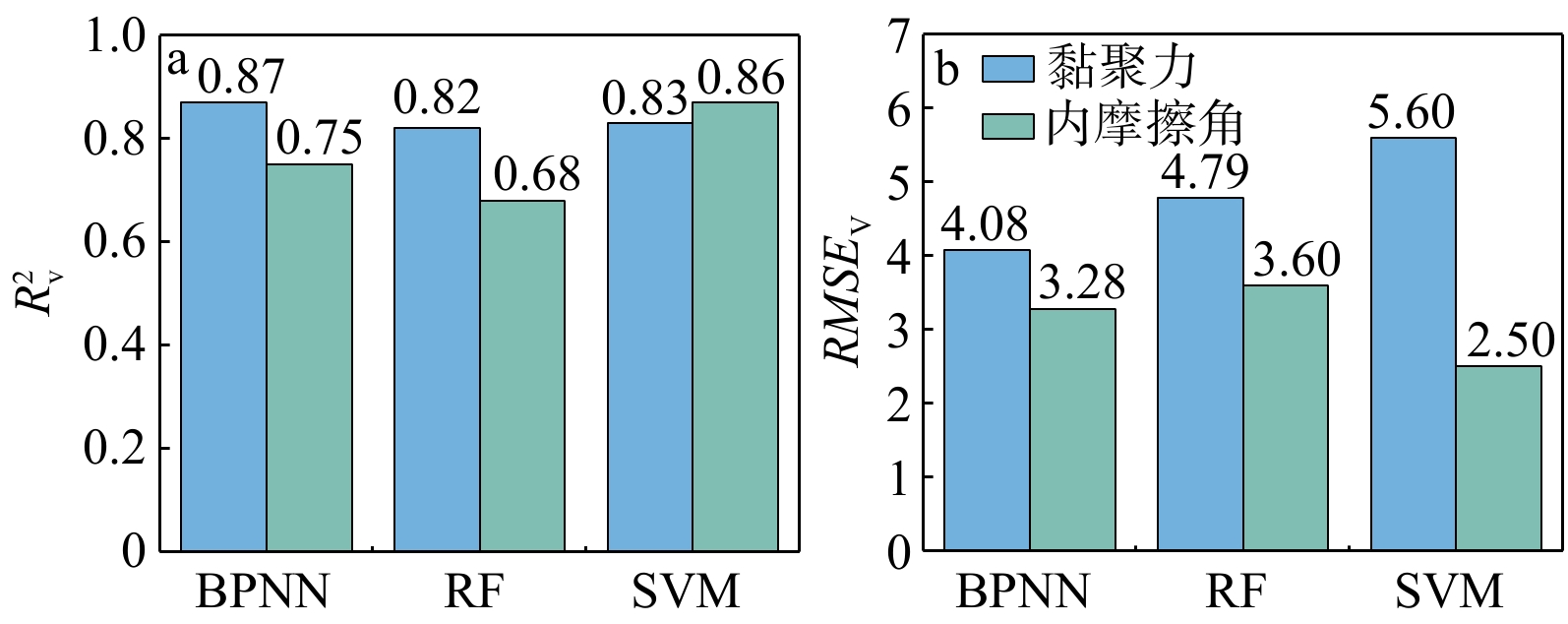
图 3 不同基学习器评价指标对比
R2为相关系数,RMSE为均方根误差,下标c和v分别代表对应训练集数据和验证集数据;下同
Figure 3. Comparison of evaluation indicators for different base learners
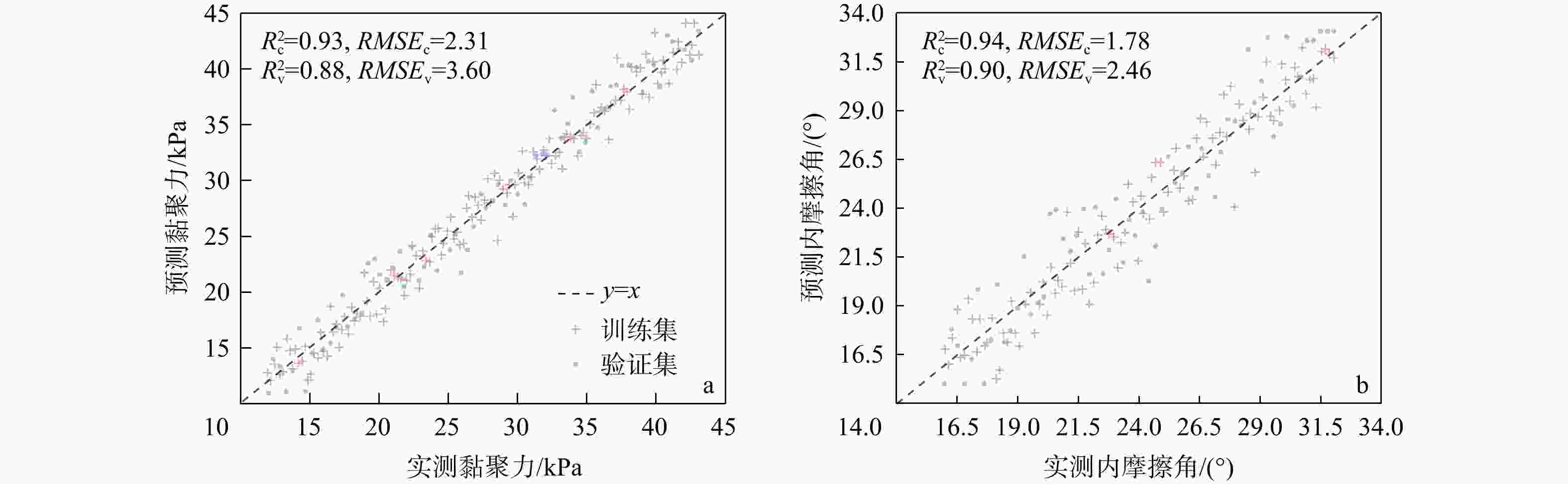
图 4 利用Stacking集成学习模型对抗剪强度参数的预测
Figure 4. Prediction of shear strength parameters using Stacking ensemble learning model
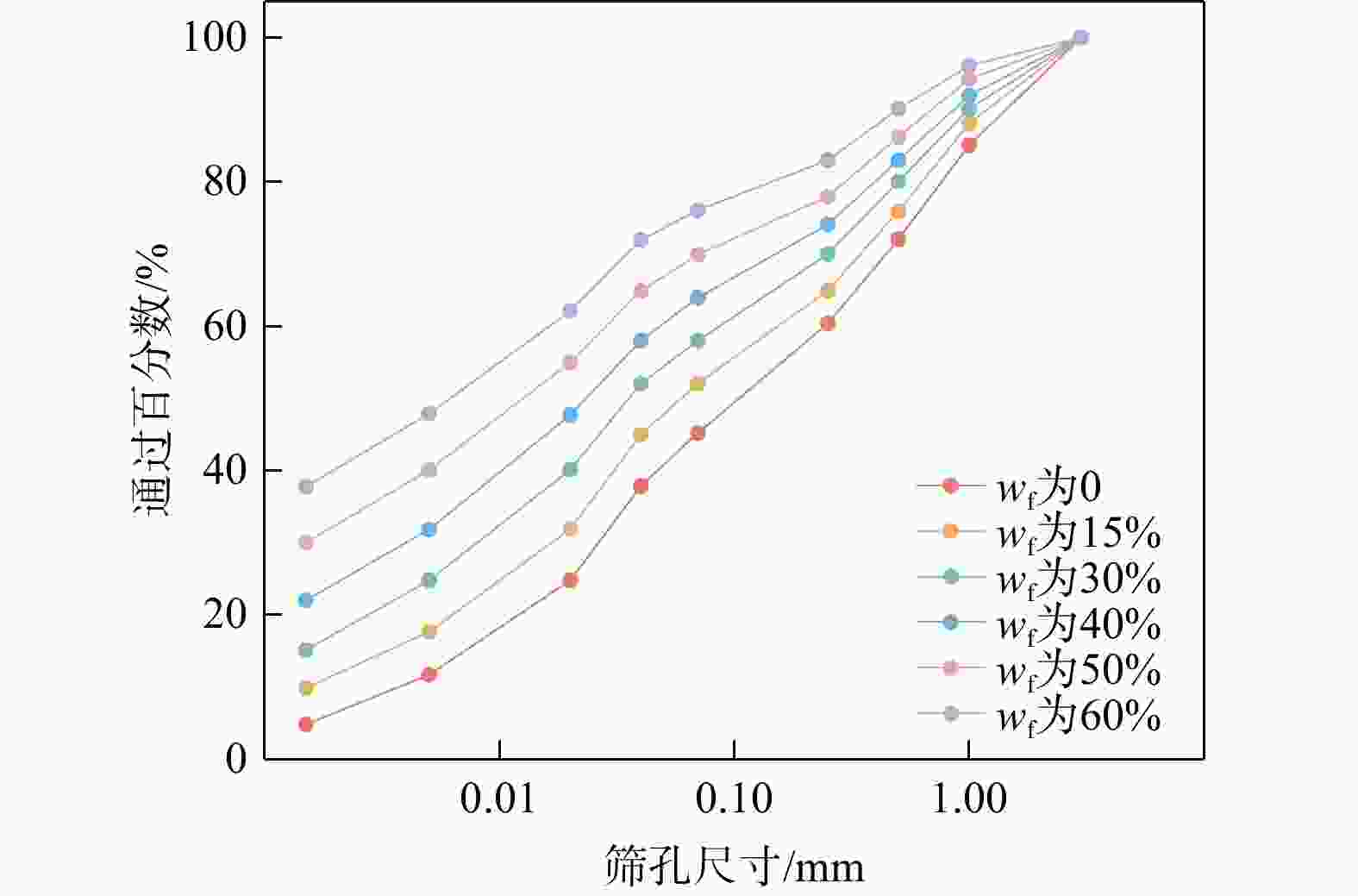
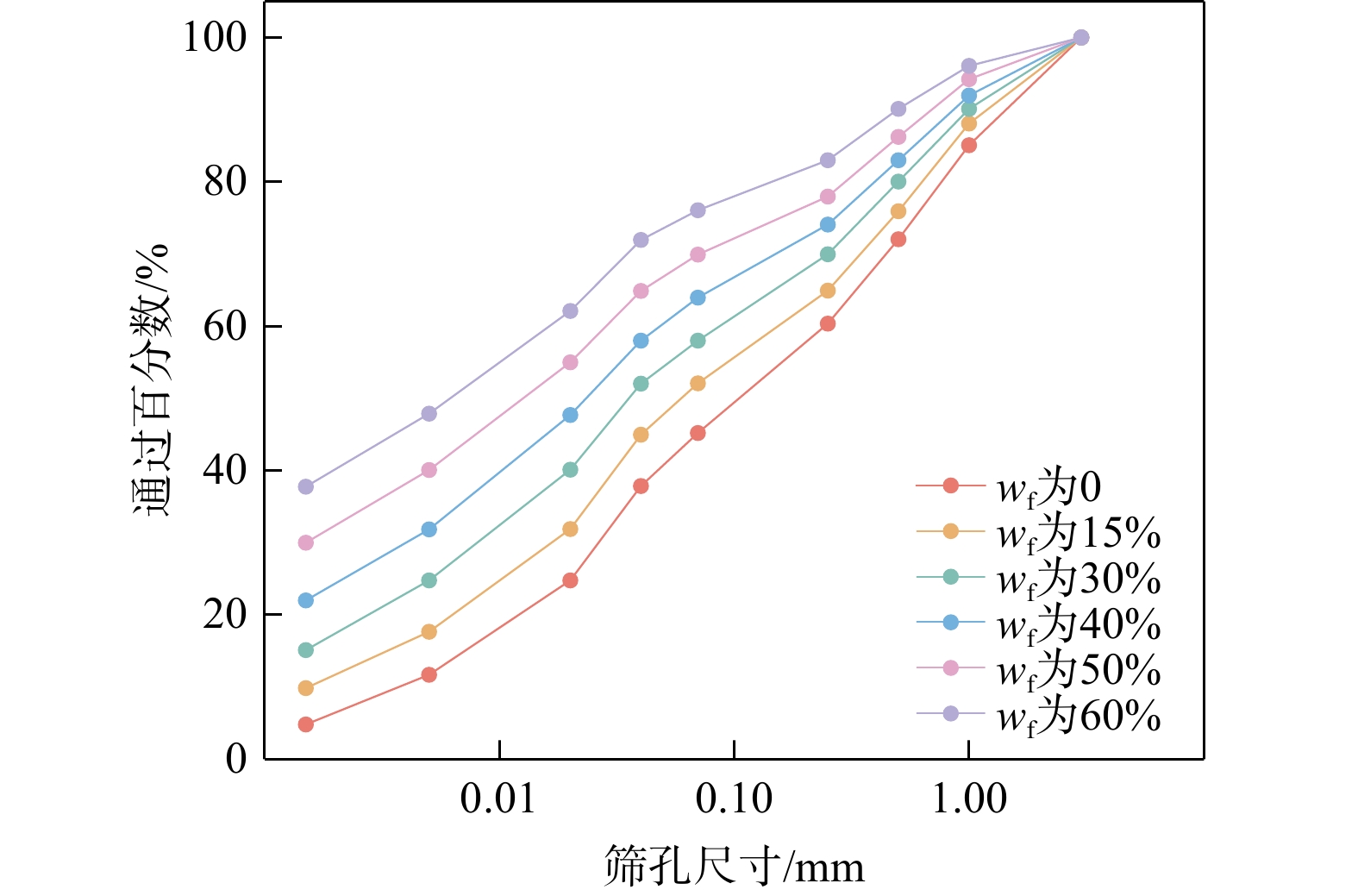
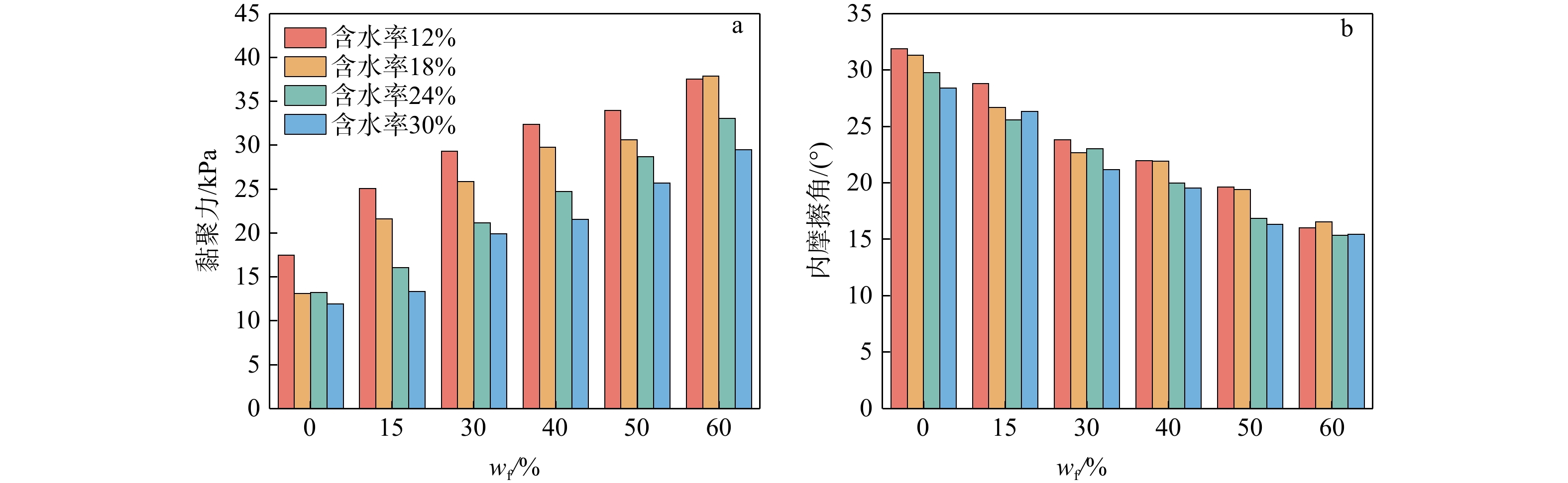
图 6 不同细粒质量分数(wf)的试样级配曲线
Figure 6. Gradation curves of specimens with different fines contents
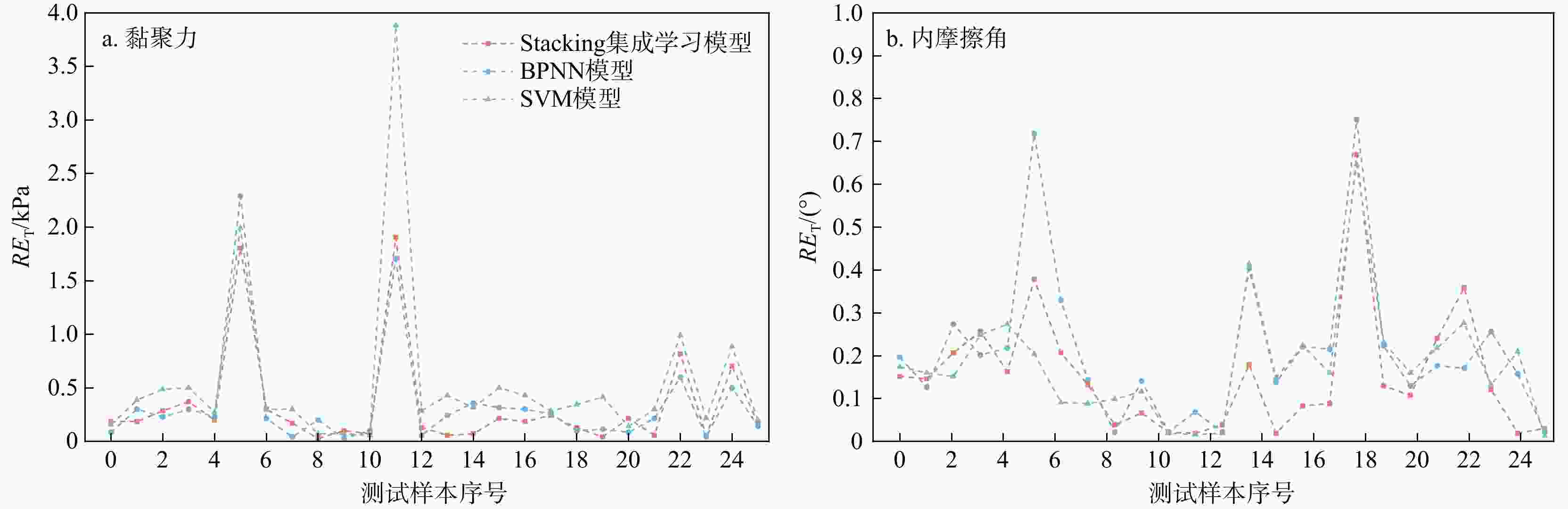
图 8 不同模型对应的测试集偏离值RET变化曲线
Figure 8. Variation curves of RET deviation values of test sets for different models
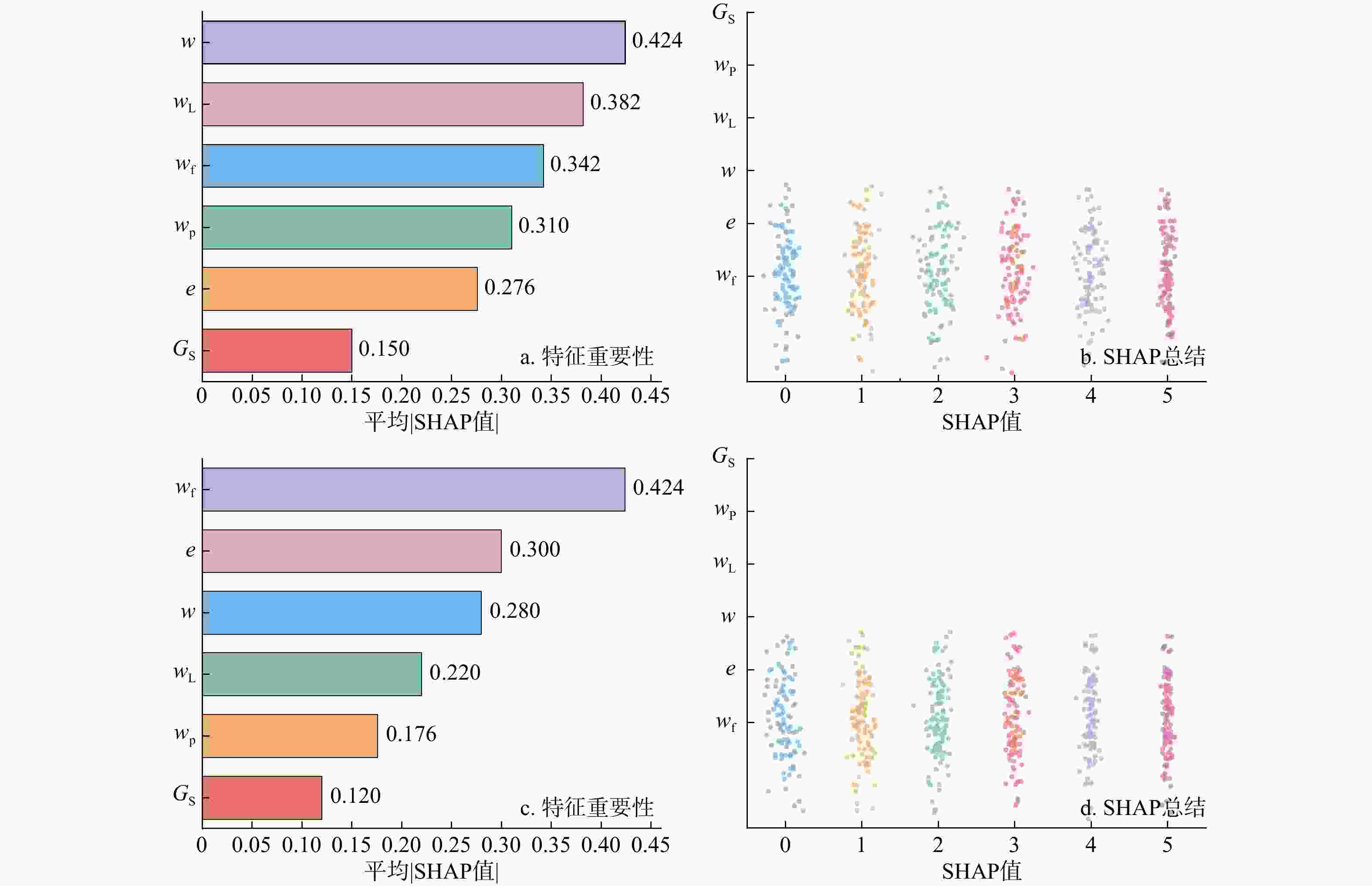
图 9 黏聚力(a, b)和内摩擦角(c, d)SHAP分析
Figure 9. SHAP analysis for cohesion (a, b) and internal friction angle (c, d)
表 1 花岗岩残积土数据集信息
Table 1. Information of granite residual soil dataset
数据来源 来源地区 土样状态 土层深度/m 矿物成分 文献[35] 湖南省湘潭市 未明确 未明确 未明确 文献[36] 福建省福州市 原状土、重塑土 未明确 石英、长石、高岭石 文献[37] 广东省肇庆市、佛山市 重塑土 未明确 未明确 文献[38] 广东省英德市 原状土 未明确 未明确 文献[39] 广东省广州市 原状土、重塑土 5~7 石英、长石、云母、高岭石、伊利石 工程地勘资料 湖南省郴州市桂新高速 原状土、重塑土 1~3 石英、长石、高岭石、伊利石 工程地勘资料 湖南省衡阳市衡永高速 原状土、重塑土 0.5~5 石英、长石、高岭石 工程地勘资料 湖南省永州市永零高速 重塑土 0.5~2 石英、长石、高岭石  下载: 导出CSV
表 2 花岗岩残积土数据集的各参数统计量
Table 2. Statistics of parameters for granite residual soil dataset
统计值 细粒质量分数/% 孔隙比 含水率/% 液限/% 塑限/% 比重 黏聚力/kPa 内摩擦角/(°) 最小值 0 0.51 11.8 20.1 15.5 2.58 11.74 15.66 最大值 65.23 0.98 30.84 45.8 35.6 2.73 38.95 32.16 平均值 38.32 0.76 19.68 32.3 20.3 2.64 20.77 21.73 中位数 35.21 0.75 19.25 32.1 21.5 2.63 20.91 21.70 标准差 9.30 0.08 3.63 6.80 4.10 0.05 8.29 4.46
下载: 导出CSV
表 3 基学习器超参数
Table 3. Hyperparameters of base learners
基学习器 超参数 最优参数 RF 决策树的数量 300 决策树的最大深度 20 分裂所需最小样本数 2 叶节点最小样本数 1 SVM 正则化参数c 10 惩罚参数γ 1 核函数(kernel)类型 高斯径向基核(RBF kernel) BPNN 隐藏层数 1 隐藏层单元数 8 学习率 0.001 激活函数 ReLU 注:RF为随机森林;SVM为支持向量机;BPNN为BP神经网络;下同
下载: 导出CSV
-
[1] 朱颖, 甘建军, 鹿淇瑞, 等. 降雨型花岗岩残积土滑坡碎屑流运动过程分析: 以湖北黄梅县袁山村为例[J]. 地质科技通报, 2025, 44(3): 268-279.ZHU Y, GAN J J, LU Q R, et al. Analysis of rainfall induced-movement of landslide debris flows in granite residual soil: A case study of Yuanshan Village, Huangmei County, Hubei Province[J]. Bulletin of Geological Science and Technology, 2025, 44(3): 268-279. (in Chinese with English abstract) [2] 贺斌, 周小文, 李泽健. 基于动三轴试验的花岗岩残积土结构性与动态力学特性研究[J]. 岩土工程学报, 2025, 47(增刊1): 96-101.HE B, ZHOU X W, LI Z J. Structural characteristics and dynamic mechanical properties of granite residual soil based on dynamic triaxial tests[J]. Chinese Journal of Geotechnical Engineering, 2025, 47(S1): 96-101. (in Chinese with English abstract) [3] 庄静茹, 林威, 简文彬, 等. 花岗岩残积土的微细观结构研究[J]. 中国地质灾害与防治学报, 2025, 36(2): 136-144.ZHUANG J R, LIN W, JIAN W B, et al. Study on the microstructure of granite residual soils[J]. The Chinese Journal of Geological Hazard and Control, 2025, 36(2): 136-144. (in Chinese with English abstract) [4] 陈孝轩, 陈琛, 郭一鹏. 干湿循环下沟渠弃土斜坡长期稳定性研究[J]. 水资源与水工程学报, 2025, 36(1): 199-207.CHEN X X, CHEN C, GUO Y P. Long-term stability of ditch spoil slopes under drying-wetting cycles[J]. Journal of Water Resources and Water Engineering, 2025, 36(1): 199-207. (in Chinese with English abstract) [5] 张勇, 姚赫, 李仁华, 等. 花岗岩残积土垂直层次抗剪强度变异性研究[J]. 人民长江, 2016, 47(23): 91-96. doi: 10.16232/j.cnki.1001-4179.2016.23.019ZHANG Y, YAO H, LI R H, et al. Study on spatial variability of shear strength in different vertical layers of granite residual soil[J]. Yangtze River, 2016, 47(23): 91-96. (in Chinese with English abstract) doi: 10.16232/j.cnki.1001-4179.2016.23.019 [6] LIU X Y, ZHANG X W, KONG L W, et al. Multiscale structural characterizations of anisotropic natural granite residual soil[J]. Canadian Geotechnical Journal, 2023, 60(9): 1383-1400. doi: 10.1139/cgj-2022-0188 [7] LIU X Y, ZHANG X W, KONG L W, et al. Disintegration of granite residual soils with varying degrees of weathering[J]. Engineering Geology, 2022, 305: 106723. doi: 10.1016/j.enggeo.2022.106723 [8] LIU X Y, ZHANG X W, KONG L W, et al. Effect of cementation on the small-strain stiffness of granite residual soil[J]. Soils and Foundations, 2021, 61(2): 520-532. doi: 10.1016/j.sandf.2021.02.001 [9] FENG W K, BAI H L, LAN B, et al. Spatial-temporal distribution and failure mechanism of group-occurring landslides in Mibei Village, Longchuan County, Guangdong, China[J]. Landslides, 2022, 19(8): 1957-1970. doi: 10.1007/s10346-022-01904-9 [10] OUYANG J, ZHANG Y J, GUO Y P, et al. Green stabilization of granite residual soils through synergistic vegetation and biocementation treatments[J]. Journal of Cleaner Production, 2025, 532: 146959. doi: 10.1016/j.jclepro.2025.146959 [11] TANG C S, LIU B, VAHEDIFARD F, et al. Enhancing soil resilience to climatic wetting-drying cycles through a bio-mediated approach[J]. Journal of Geophysical Research: Earth Surface, 2024, 129(5): e2023JF007573. doi: 10.1029/2023jf007573 [12] LIU X Y, ZHANG X W, KONG L W, et al. Shear strength anisotropy of natural granite residual soil[J]. Journal of Geotechnical and Geoenvironmental Engineering, 2022, 148: 04021168. doi: 10.1061/(ASCE)GT.1943-5606.0002709 [13] AN R, ZHANG X W, KONG L W, et al. Drying-wetting impacts on granite residual soil: A multi-scale study from macroscopic to microscopic investigations[J]. Bulletin of Engineering Geology and the Environment, 2022, 81(10): 447. doi: 10.1007/s10064-022-02950-2 [14] 李建鑫. 路基压缩强度的剪切波速评价[J]. 无损检测, 2019, 41(9): 48-52.LI J X. Evaluation of subgrade compressive strength by shear wave velocity[J]. Nondestructive Testing Technologying, 2019, 41(9): 48-52. (in Chinese with English abstract) [15] AN R, GAO H D, ZHANG X W, et al. Mechanical behaviour and microstructure of granite residual bio-cemented soil by microbially induced calcite precipitation with different cementation-solution concentrations[J]. Environmental Earth Sciences, 2023, 83(1): 31. doi: 10.1007/s12665-023-11352-w [16] 孙振兴, 杨忠年, 辛泽宇, 等. 橡胶纤维加筋膨胀土的剪切强度与强度预测模型[J]. 吉林大学学报(地球科学版), 2025, 55(5): 1644-1654. doi: 10.13278/j.cnki.jjuese.20240001SUN Z X, YANG Z N, XIN Z Y, et al. Shear strength and strength prediction model of rubber fiber-reinforced expansive soil[J]. Journal of Jilin University (Earth Science Edition), 2025, 55(5): 1644-1654. (in Chinese with English abstract) doi: 10.13278/j.cnki.jjuese.20240001 [17] 张立东, 朱亿, 张立中, 等. 基于随机森林和SHAP可解释性分析的多宝山外围斑岩型铜矿预测与评价[J/OL]. 地质科技通报: 1-18[2026-06-05]. https://doi.org/10.19509/j.cnki.dzkq.tb20250470.ZHANG L D, ZHU Y, ZHANG L Z, et al. Mineral prospectivity mapping of porphyry copper deposits in the Duobaoshan District using random forest and SHAP interpretation[J/OL]. Bulletin of Geological Science and Technology: 1-18[2026-06-05]. https://doi.org/10.19509/j.cnki.dzkq.tb20250470. (in Chinese with English abstract) [18] DAS S K, SAMUI P, KHAN S Z, et al. Machine learning techniques applied to prediction of residual strength of clay[J]. Central European Journal of Geosciences, 2011, 3(4): 449-461. doi: 10.2478/s13533-011-0043-1 [19] BESALATPOUR A, HAJABBASI M A, AYOUBI S, et al. Soil shear strength prediction using intelligent systems: Artificial neural networks and an adaptive neuro-fuzzy inference system[J]. Soil Science and Plant Nutrition, 2012, 58(2): 149-160. doi: 10.1080/00380768.2012.661078 [20] 李治斌, 袁立月, 丁黔, 等. 基于BP神经网络的改良盐渍土强度预测研究[J]. 水利科学与寒区工程, 2021, 4(5): 51-54. doi: 10.3969/j.issn.2096-5419.2021.05.012LI Z B, YUAN L Y, DING Q, et al. Study on the prediction of the strength of improved saline soil based on BP neural network[J]. Hydro Science and Cold Zone Engineering, 2021, 4(5): 51-54. (in Chinese with English abstract) doi: 10.3969/j.issn.2096-5419.2021.05.012 [21] KU C Y, WU T Y, LIU C Y, et al. AI-enhanced soil classification with incomplete CPT data for offshore wind farm[J]. Scientific Reports, 2026, 16: 10589. doi: 10.1038/s41598-026-46356-6 [22] 葛庆雷, 刘国坤, 李建刚, 等. 基于改进BP神经网络的大跨度斜拉桥抗震性能研究[J]. 公路工程, 2025, 50(1): 72-79. doi: 10.19782/j.cnki.1674-0610.2025.01.009GE Q L, LIU G K, LI J G, et al. Research on seismic performance of long span cable stayed bridge based on improved BP neural network[J]. Highway Engineering, 2025, 50(1): 72-79. (in Chinese with English abstract) doi: 10.19782/j.cnki.1674-0610.2025.01.009 [23] KHAWAJA L, ASIF U, ONYELOWE K, et al. Development of machine learning models for forecasting the strength of resilient modulus of subgrade soil: Genetic and artificial neural network approaches[J]. Scientific Reports, 2024, 14: 18244. doi: 10.1038/s41598-024-69316-4 [24] CERVANTES J, GARCIA-LAMONT F, RODRÍGUEZ-MAZAHUA L, et al. A comprehensive survey on support vector machine classification: Applications, challenges and trends[J]. Neurocomputing, 2020, 408: 189-215. doi: 10.1016/j.neucom.2019.10.118 [25] LIN S, LIANG Z L, ZHAO S X, et al. A comprehensive evaluation of ensemble machine learning in geotechnical stability analysis and explainability[J]. International Journal of Mechanics and Materials in Design, 2024, 20(2): 331-352. doi: 10.1007/s10999-023-09679-0 [26] QIU R N, YIN Y F, SU Q R, et al. Func-bagging: An ensemble learning strategy for improving the performance of heterogeneous anomaly detection models[J]. Applied Sciences, 2025, 15(2): 905. doi: 10.3390/app15020905 [27] LIANG G H. Ensemble predictions: Empirical studies on learners' performance and sample distributions[D]. Sydney, Australia: University of Technology Sydney, 2014. [28] SHI H X, WEI A L, XU X Z, et al. A CNN-LSTM based deep learning model with high accuracy and robustness for carbon price forecasting: A case of Shenzhen's carbon market in China[J]. Journal of Environmental Management, 2024, 352: 120131. doi: 10.1016/j.jenvman.2024.120131 [29] 屈鹏鑫, 谢婉丽, 刘琦琦, 等. 基于机器学习方法改进IVM-RF耦合模型的崩滑灾害危险性评价: 以延安市志丹县为例[J]. 地质科技通报, 2025, 44(3): 280-295.QU P X, XIE W L, LIU Q Q, et al. Collapse and landslide risk assessment based on machine learning improved IVM-RF coupling method: A case study of Zhidan County, Yan'an City[J]. Bulletin of Geological Science and Technology, 2025, 44(3): 280-295. (in Chinese with English abstract) [30] 卢建, 曾鹏, 冯兵, 等. 强度折减采样结合SVM代理模型的土质边坡可靠度高效分析[J]. 地质科技通报, 2026, 45(3): 265-276.LU J, ZENG P, FENG B, et al. Efficient reliability analysis of soil slopes by combining strength reduction sampling with SVM surrogate model[J]. Bulletin of Geological Science and Technology, 2026, 45(3): 265-276. (in Chinese with English abstract) [31] 贾卓鹏, 毕俊擘, 原勇, 等. 基于LM-BPNN的高寒地区地下水微生物−毒理指标预测模型[J]. 地质科技通报, 2025, 44(2): 368-377.JIA Z P, BI J B, YUAN Y, et al. Prediction model of groundwater microbiological toxicological indicators in Alpine regions based on LM-BPNN[J]. Bulletin of Geological Science and Technology, 2025, 44(2): 368-377. (in Chinese with English abstract) [32] VAN DEN BROECK G, LYKOV A, SCHLEICH M, et al. On the tractability of SHAP explanations[J]. Journal of Artificial Intelligence Research, 2022, 74: 851-886. doi: 10.1613/jair.1.13283 [33] HANCOCK J T, KHOSHGOFTAAR T M, LIANG Q X. A problem-agnostic approach to feature selection and analysis using SHAP[J]. Journal of Big Data, 2025, 12(1): 12. doi: 10.1186/s40537-024-01041-1 [34] LI Z Q. Extracting spatial effects from machine learning model using local interpretation method: An example of SHAP and XGBoost[J]. Computers, Environment and Urban Systems, 2022, 96: 101845. doi: 10.1016/j.compenvurbsys.2022.101845 [35] 陈铖, 吴传云, 韩中会. 干密度和饱和度对花岗岩残积土抗剪强度的影响[J]. 铁道勘察, 2018, 44(6): 75-78. doi: 10.19630/j.cnki.tdkc.201809060004CHEN C, WU C Y, HAN Z H. Effect of dry density and saturation on shear strength of granite residual soil[J]. Railway Investigation and Surveying, 2018, 44(6): 75-78. (in Chinese with English abstract) doi: 10.19630/j.cnki.tdkc.201809060004 [36] 陈志波, 方军, 蔡锦阳, 等. 试样特征对花岗岩残积土强度特性的影响[J]. 水土保持学报, 2025, 39(3): 127-134. doi: 10.13870/j.cnki.stbcxb.2025.03.013CHEN Z B, FANG J, CAI J Y, et al. Effect of sample characteristics on the strength characteristics of granite residual soil[J]. Journal of Soil and Water Conservation, 2025, 39(3): 127-134. (in Chinese with English abstract) doi: 10.13870/j.cnki.stbcxb.2025.03.013 [37] 龙志东, 王中文, 史斌, 等. 花岗岩残积土抗剪强度及其影响因素试验[J]. 长沙理工大学学报(自然科学版), 2016, 13(3): 25-31.LONG Z D, WANG Z W, SHI B, et al. Experimental research for shear strength and its influencing factors of granite residual soil[J]. Journal of Changsha University of Science & Technology (Natural Science), 2016, 13(3): 25-31. (in Chinese with English abstract) [38] 毛强, 呙锴, 周全, 等. 花岗岩残积土抗剪强度试验研究[J]. 工程勘察, 2025, 53(10): 34-40.MAO Q, GUO K, ZHOU Q, et al. Experimental study on shear strength of granite residual soil[J]. Geotechnical Investigation & Surveying, 2025, 53(10): 34-40. (in Chinese with English abstract) [39] 姚腾浩, 戚桂晌, 杨雪强, 等. 含水量变化对广州花岗岩残积土抗剪强度的影响[J]. 土工基础, 2024, 38(1): 135-138.YAO T H, QI G S, YANG X Q, et al. Water content variation on the mechanical characteristics of granite residual soil in Guangzhou[J]. Soil Engineering and Foundation, 2024, 38(1): 135-138. (in Chinese with English abstract) [40] 何国栋, 陈琛, 方传峰, 等. 颗粒圆度对路用碎石集料破碎特征及力学性能的影响[J]. 公路交通科技, 2025, 42(3): 95-103.HE G D, CHEN C, FANG C F, et al. Influence of particle roundness on crushing characteristics and mechanical properties of road crushed stone aggregates[J]. Journal of Highway and Transportation Research and Development, 2025, 42(3): 95-103. (in Chinese with English abstract) [41] 王万良. 人工智能及其应用[M]. 3版. 北京: 高等教育出版社, 2016.WANG W L. Artificial intelligence and its applications[M]. 3rd ed. Beijing: Higher Education Press, 2016. (in Chinese) [42] 中华人民共和国交通运输部. 公路土工试验规程: JTG3430-2020[S]. 北京: 人民交通出版社, 2020.Ministry of Transport of the People's Republic of China. Test methods of soils for highway engineering: JTG3430-2020[S]. Beijing: China Communications Press, 2020. (in Chinese) -

 下载:
下载:

 点击查看大图
计量
- 文章访问数: 286
- PDF下载量: 54
- 被引次数: 0