投审稿入口
投审稿入口


Compositional characteristics and enrichment mechanisms of dispersed elements in sphalerite from Taolin Pb-Zn deposit, Hunan Province
-
摘要:
稀散金属属于国家战略性关键矿产,在新能源、高端制造、信息技术领域具备不可替代的应用价值,多数稀散元素无独立成矿能力,主要伴生赋存于铅锌矿床的闪锌矿中,其赋存状态与富集机制是当前关键矿产研究的重点方向。湖南临湘桃林铅锌矿为江南造山带中段大型中低温热液铅锌矿床,具备巨大稀散金属综合利用潜力,但现有研究缺少基于微区原位测试的 Cd、Ga、In、Ge 系统地球化学约束,难以厘清区内稀散元素超常富集机理。为完善该区矿床成矿理论、支撑稀散金属综合找矿评价,以矿区不同世代闪锌矿为研究对象,系统采集 7 件钻孔原生矿石样品,通过手标本岩相观测、镜下光薄片矿物学鉴定区分早、晚2期闪锌矿;依托激光剥蚀质谱(LA-ICP-MS)微区原位技术完成 100 个微量元素单点定量测试与元素面扫描(elemental mapping),系统解析闪锌矿稀散元素组成、空间分布及赋存机制。测试结果显示,桃林矿床闪锌矿整体显著富集 Cd、Ga,中等富集 In,普遍亏损 Ge,未检出 Tl、Te;
w (Cd)最高11734.8 ×10−6、均值2978.0 ×10−6,w (Ga)最高3331.7 ×10−6、均值 310.7×10⁻⁶,w (In)最高322.4×10⁻⁶,均值27.1×10⁻⁶。Ga、In、Cd 在闪锌矿晶体内部整体均匀分布,Ga 与 Cu、Ga+In 总量与 Cu 均呈极强正相关(相关系数R 2分别为 0.93,0.92),证实元素以耦合类质同像替换进入晶格:Cu++(Ga+In)3+↔2Zn2+和Cd2+↔Zn2+;同时本区中低温闪锌矿 Cd 与 Fe 呈弱正相关,区别于高温铁闪锌矿 Cd-Fe 负相关规律,受控于成矿温度对晶格容纳能力的约束。物质源区分析表明,Cd、Ga、In 主要来自幕阜山燕山期花岗岩岩浆晚期分异热液;热液沿断裂运移途经冷家溪群、震旦系硅质碳质板岩时,会萃取地层中吸附态稀散元素,形成多源成矿物质供给。成矿过程中流体温度持续降低、大气降水不断混入提升流体氧化程度,金属络合物分解促使稀散元素随闪锌矿同步沉淀;晚期流体氧化升高造成 Cu+损耗,是晚世代闪锌矿 Ga 含量显著降低的核心控制因素。本研究完善了湘东北中低温铅锌矿床稀散金属富集理论,为江南造山带同类型矿床稀散资源勘查提供矿物学依据。Abstract:ObjectiveDispersed metals including Cd, Ga, In, Ge, Tl, Tc, Se, and Te are classified as national strategic critical mineral resources globally, which are irreplaceable raw materials for new energy equipment, semiconductor manufacturing, and information high-tech industries. Most dispersed elements are characterized by ultra-low crustal abundance and extremely scattered distribution, and they rarely form independent industrial deposits. Instead, they are dominantly hosted in sphalerite within hydrothermal Pb-Zn deposits, making sphalerite an ideal mineral carrier to decode the super-enrichment mechanisms of Cd, Ga, In, and Ge. The Taolin Pb-Zn deposit, located in Linxiang City, northeastern Hunan Province, lies in the central segment of the Jiangnan orogenic belt on the southeast margin of the Yangtze block. It is a large-scale medium-low temperature hydrothermal deposit with total proven Pb+Zn metal reserves of up to 0.98 million tons. Previous research on this deposit mainly focuses on regional tectonic controls, magmatic evolution, and general metallogenic patterns, while systematic microscale constraints on the occurrence and enrichment mechanisms of associated dispersed metals remain lacking, which restricts the comprehensive resource evaluation of co-existing critical metals. To fill this research gap and improve the metallogenic theory of polymetallic deposits in northeastern Hunan, this study takes zoned sphalerite from Taolin deposit as the research object and conducts integrated petrographic and in-situ geochemical analyses.
MethodsA total of seven weakly altered drill-core ore samples were collected from multiple mining segments of the deposit. Through hand-specimen observation and polished thin-section microscopic identification, two generations of sphalerite were distinguished: Early-stage SphⅠ formed in early hydrothermal veins and late-stage SphⅡ filling later veinlets that crosscut early mineralized zones. Laser ablation inductively coupled plasma mass spectrometry (LA-ICP-MS) microscale testing was conducted based on a 193 nm ArF excimer laser coupled with an Agilent 7700e mass spectrometer, including 100 quantitative trace element point analyses (69 spots for SphⅠ, 31 spots for SphⅡ) and full elemental mapping for representative sphalerite grains. NIST 610, NIST 612 glass standards and MASS-1 sulfide standard were adopted for signal calibration to ensure data reliability.
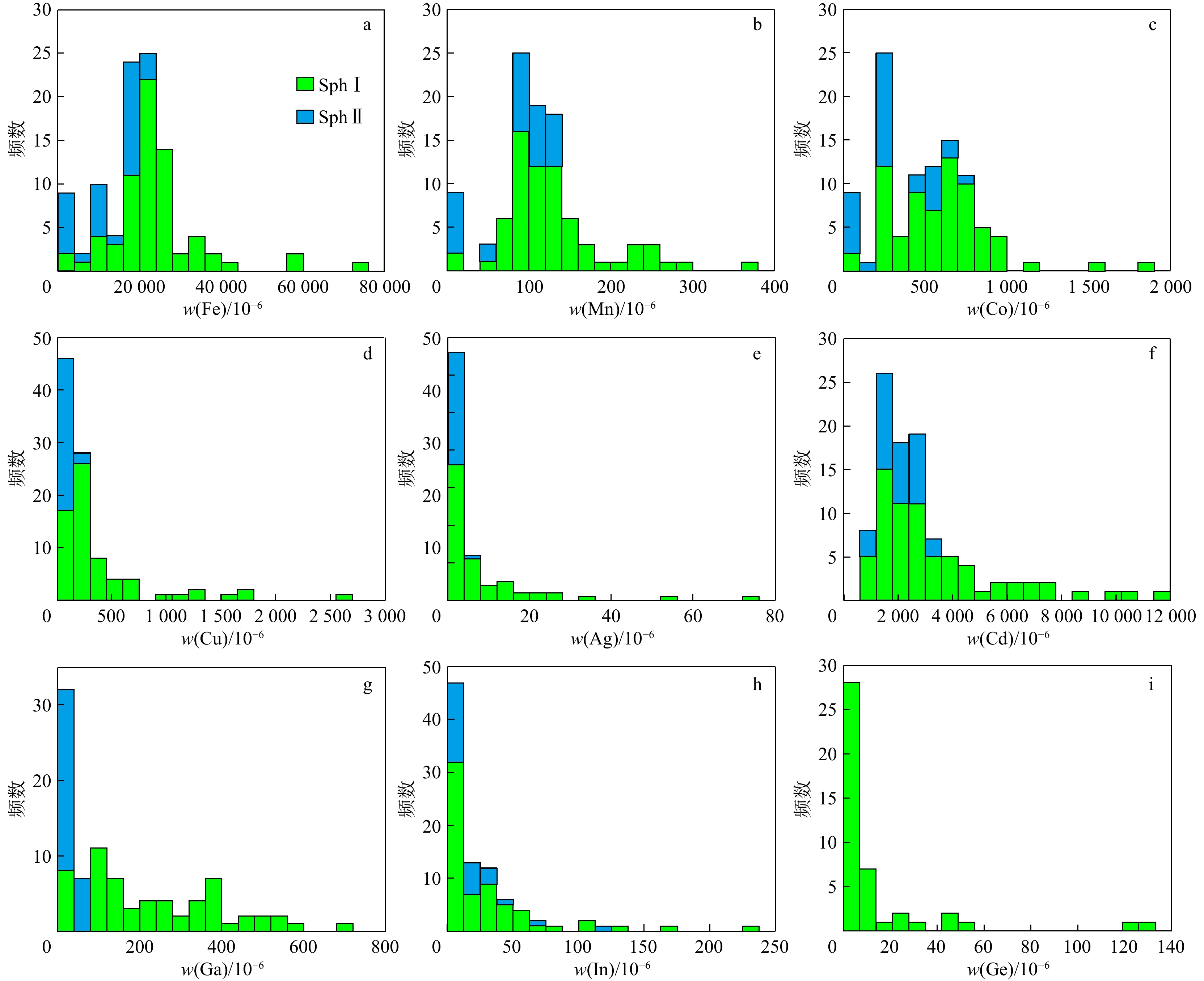
ResultsThe analytical results showed distinct differentiation of dispersed elements in Taolin sphalerite: The mineral was highly enriched in Cd and Ga, moderately enriched in In, and strongly depleted in Ge, while Tl and Te were not detected in all testing points. The mass fraction of Cd ranged from 945.9×10⁻⁶ to
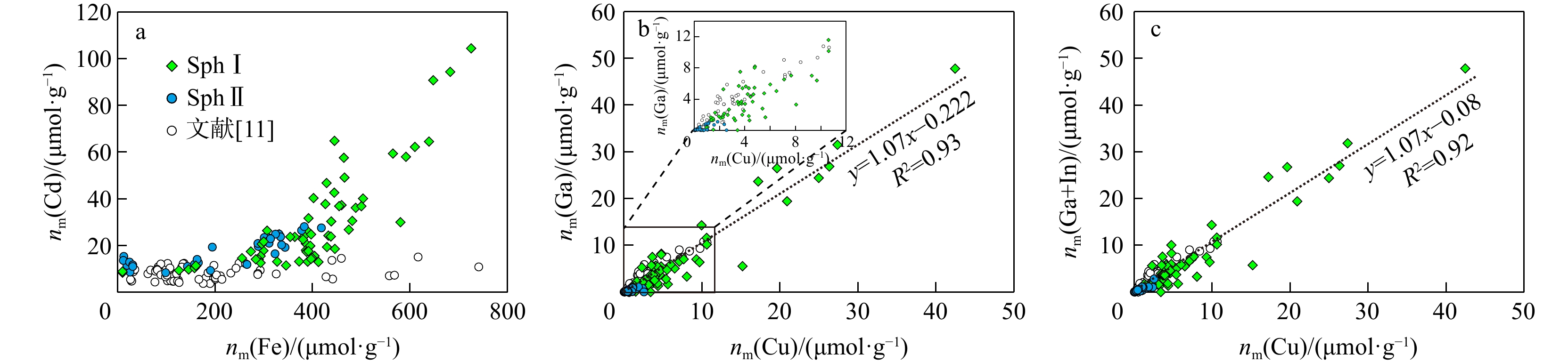
11734.8 ×10−6 with an average value of2978.0 ×10−6. Ga varied between 0.7×10⁻⁶ and3331.7 ×10−6, averaging 310.7×10⁻⁶. In had a mean concentration of only 27.1×10⁻⁶, with a maximum of 322.4×10⁻⁶, while Ge averaged merely 6.7×10⁻⁶, and over half of the testing points fell below the limit. Element mapping demonstrated that Cd, Ga, and In were unevenly distributed inside single sphalerite crystals, and Ga displayed an extremely strong positive correlation with Cu (R 2=0.93), as did the sum of Ga+In against Cu (R 2=0.92). These correlations indicated two isomorphic substitution pathways inside the sphalerite lattice. The coupled charge-balancing reactions were Cu++(Ga+In)3+↔2Zn2+ and Cd2+↔Zn2+. Notably, Cd presented a weak positive correlation with Fe in the samples, which contradicted the widely accepted negative correlation between Cd and Fe in high-temperature Fe-rich sphalerite. This discrepancy was interpreted as the limitation of crystal lattice capacity under different formation temperatures. Source tracing indicated that Cd, Ga, and In had mixed material supplies. The primary metal reservoir was late magmatic-hydrothermal fluids derived from the Mufushan Yanshanian biotite monzogranite, whose zircon U-Pb age (136±0.8 Ma) is consistent with the sphalerite Rb-Sr mineralization age (135.4±2.6 Ma). Secondary dispersed metals were extracted by ore-forming fluids when migrating through Neoproterozoic Lengjiaxi Group and Sinian siliceous-carbonaceous slates, containing abundant organic matter and adsorbed trace sulfides. Sulfur isotopic data of ores provided solid evidence for stratigraphic material contribution. During fluid migration, Cd, Ga, and In formed stable fluoride and organic humic complexes for long-distance transportation. As hydrothermal fluids ascended to shallow structural fractures, continuous temperature reduction and progressive mixing of meteoric water increased fluid oxidation intensity. Under high oxidation conditions, Cu+ converted to Cu2+, eliminating the monovalent cation required for coupled isomorphic substitution, explaining the evidently lower Ga content in late-generation SphⅡ compared with early SphⅠ.ConclusionThis study proposes a complete multi-source metallogenic model for dispersed elements in medium-low temperature Pb-Zn deposits within the Jiangnan orogenic belt. It innovatively reveals the temperature and redox controls on Cd-Ga-In enrichment in sphalerite, supplements geochemical discrimination criteria for hydrothermal mineralization, and offers significant mineralogical references for prospecting and comprehensive utilization of associated critical metals in analogous deposits across northeastern Hunan and the whole Jiangnan metallogenic belt.
-
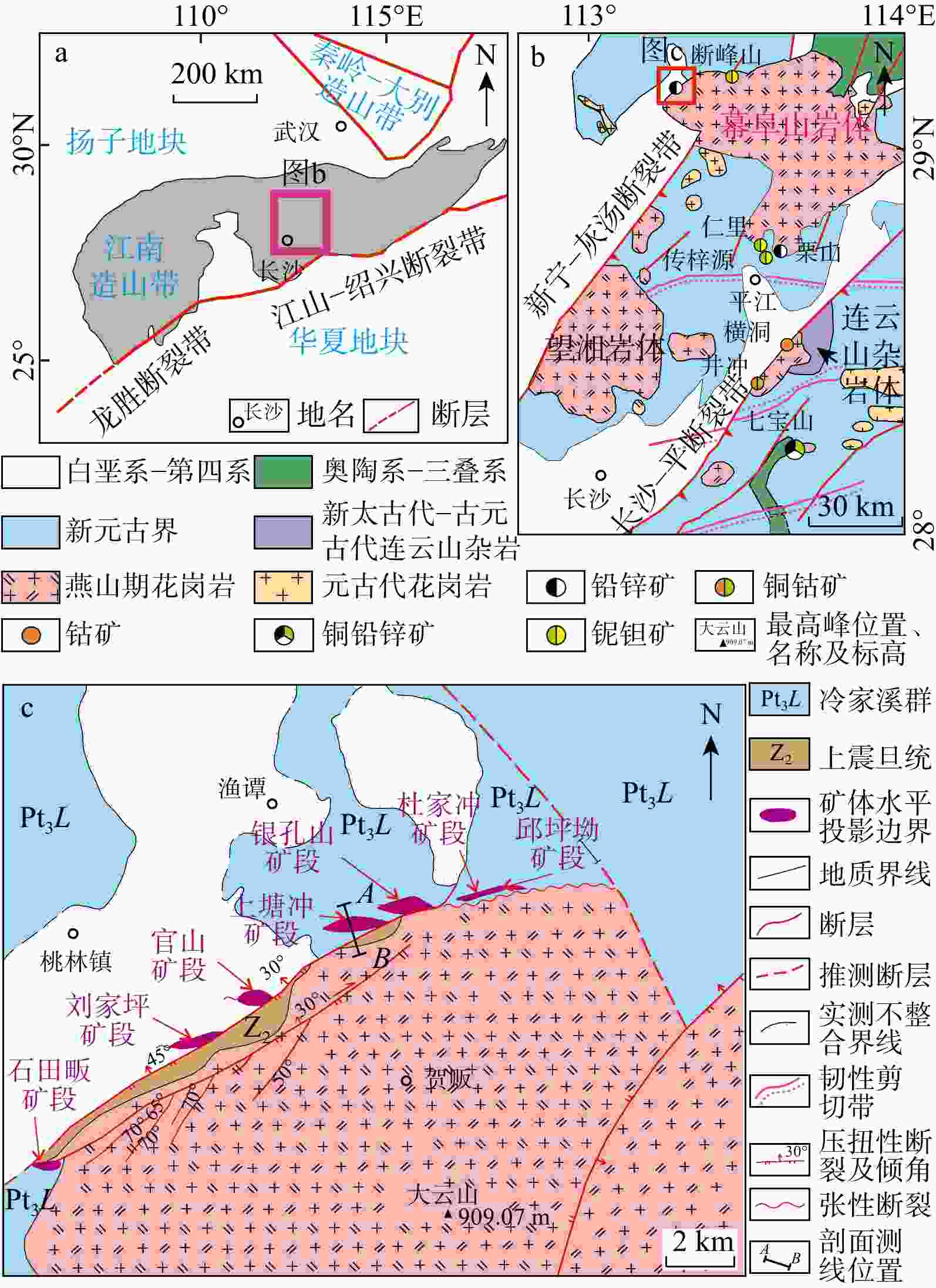
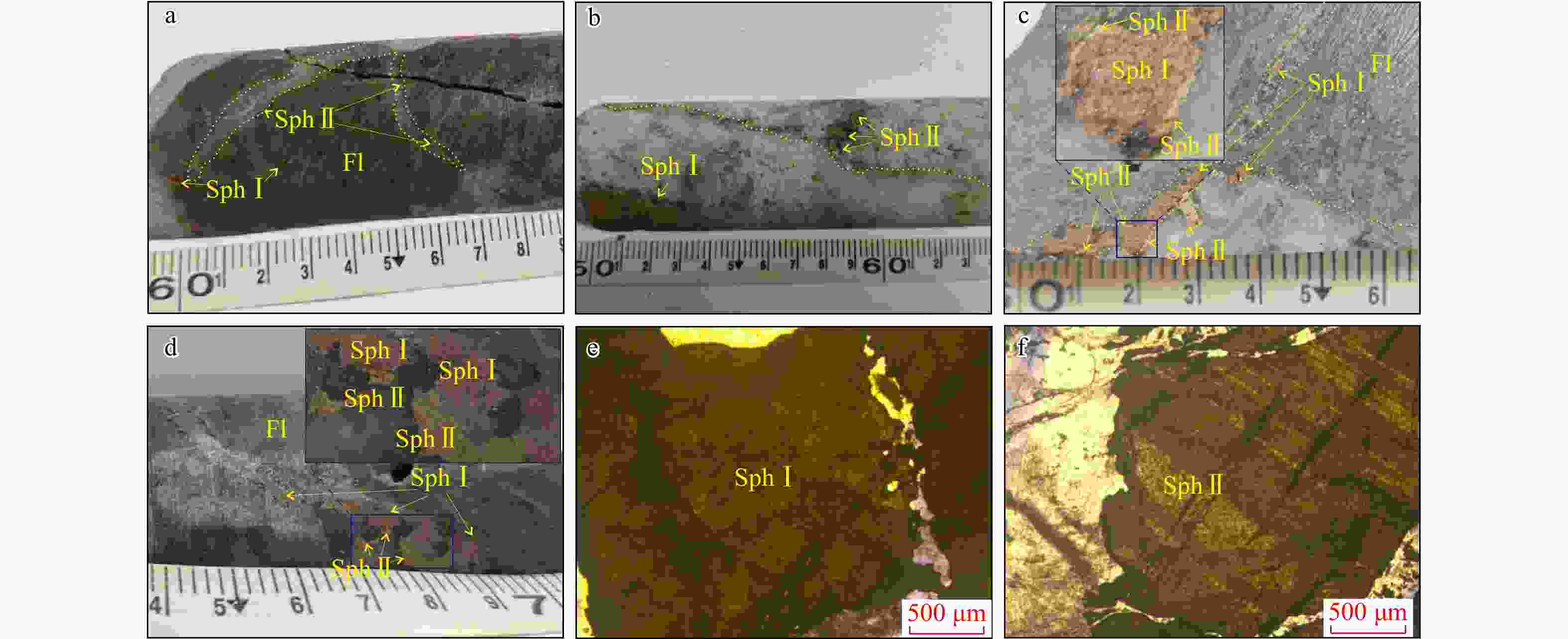
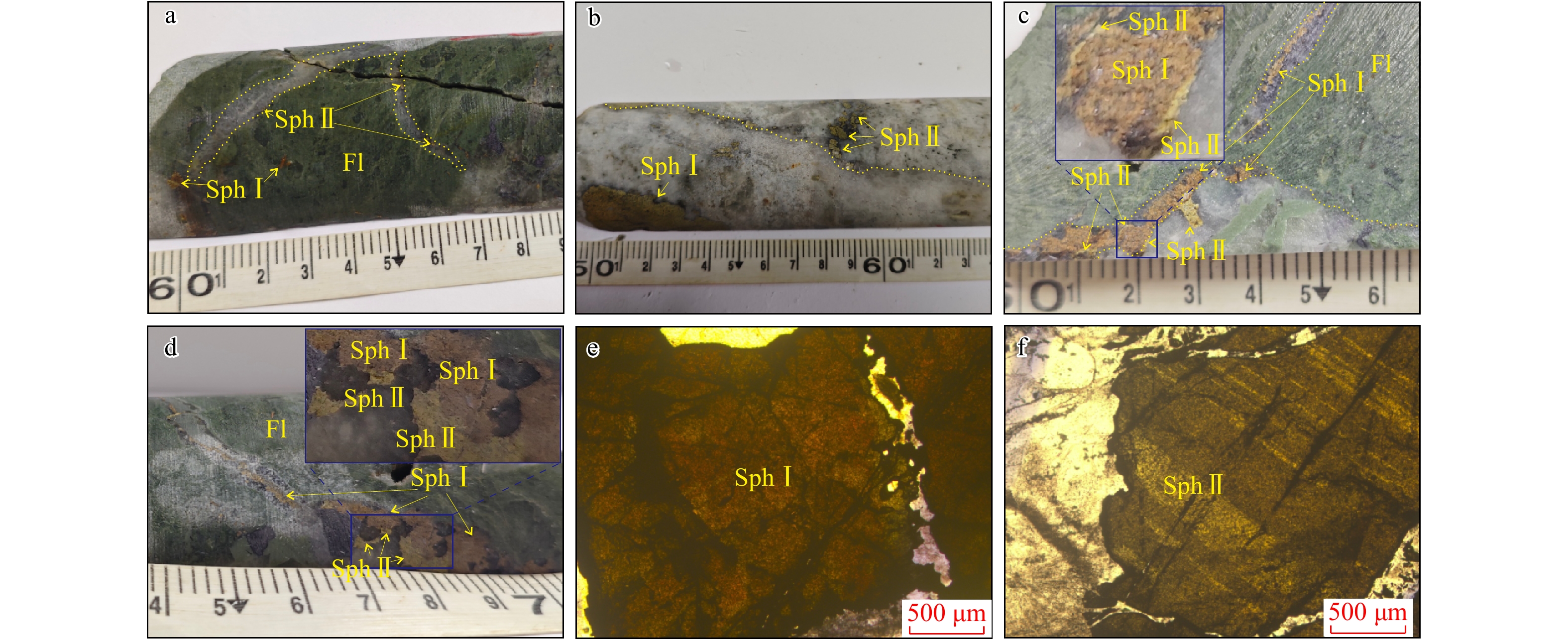
图 3 桃林铅锌矿床岩心样品照片(a~d)和闪锌矿镜下显微照片(e, f)
SphⅠ为第一世代闪锌矿;SphⅡ为第二世代闪锌矿;Fl为萤石;下同
Figure 3. Photographs of core samples (a-d) and microscopic images of sphalerite (e, f) from Taolin Pb-Zn deposit
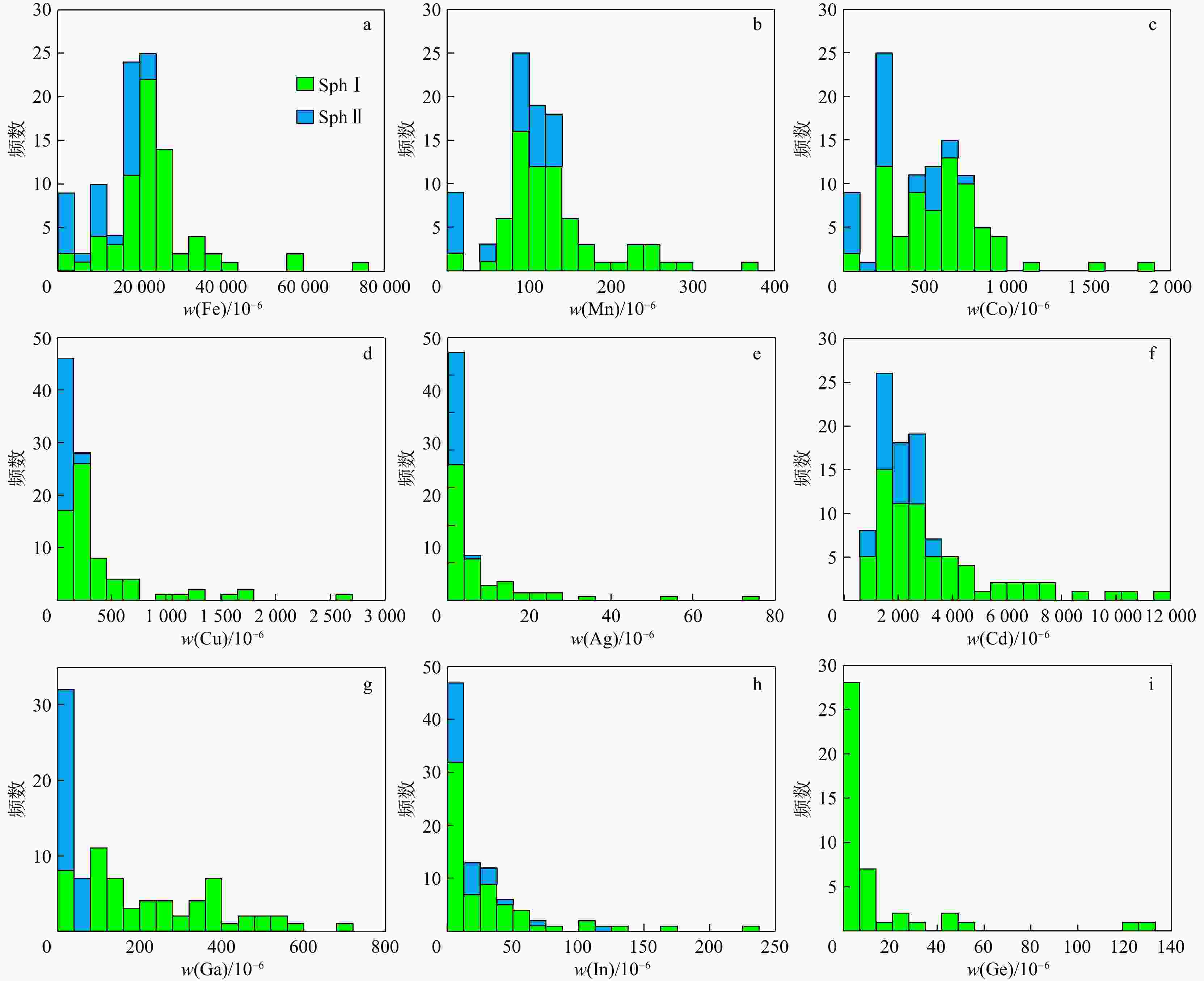
图 4 桃林铅锌矿床闪锌矿微量元素组成分布直方图
Figure 4. Histograms of trace element composition distribution of sphalerite from Taolin Pb–Zn deposit
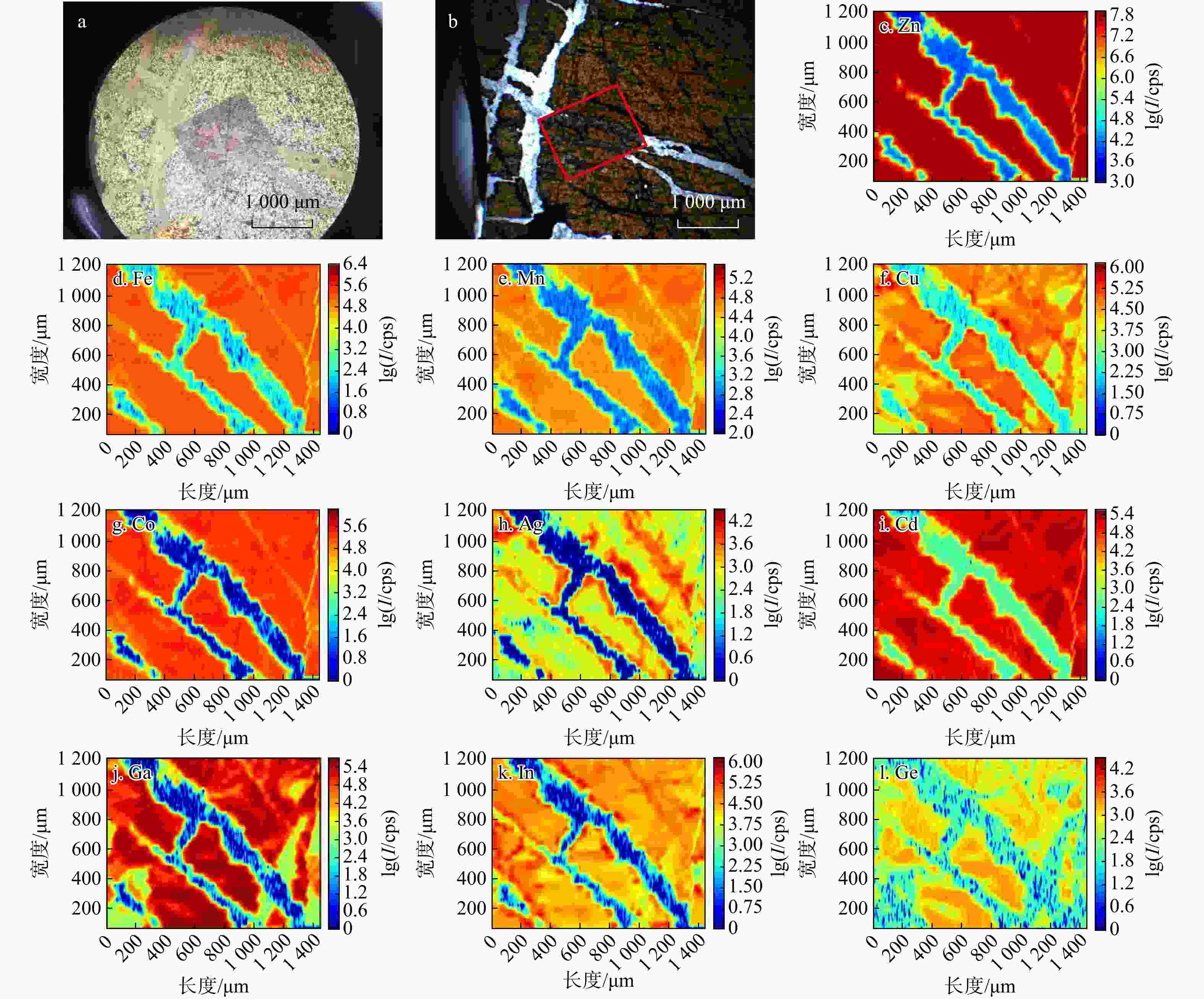
图 5 桃林铅锌矿床闪锌矿微量元素面扫描图
a. 反射光照片;b. 单偏光照片(红色框为面扫描范围);c~l. 面扫描结果。cps. 每秒计数(counts per second),代表质谱离子计数率,用以反映元素信号相对强度;I. 信号强度;下同
Figure 5. Trace element mapping images of sphalerite from Taolin Pb-Zn deposit
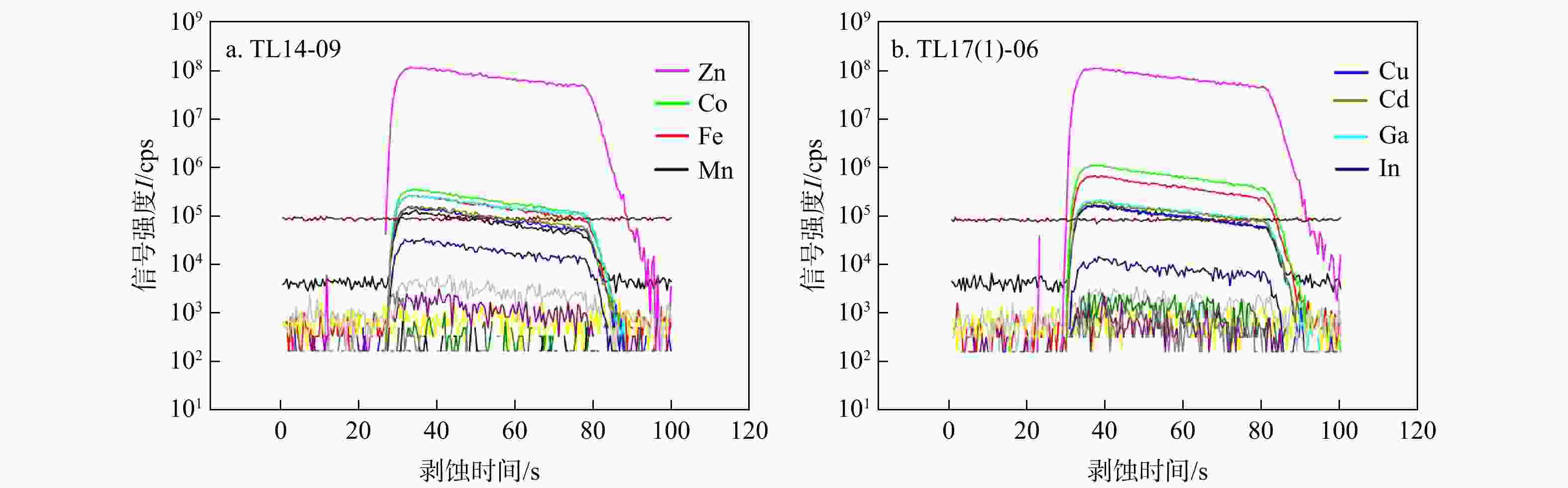
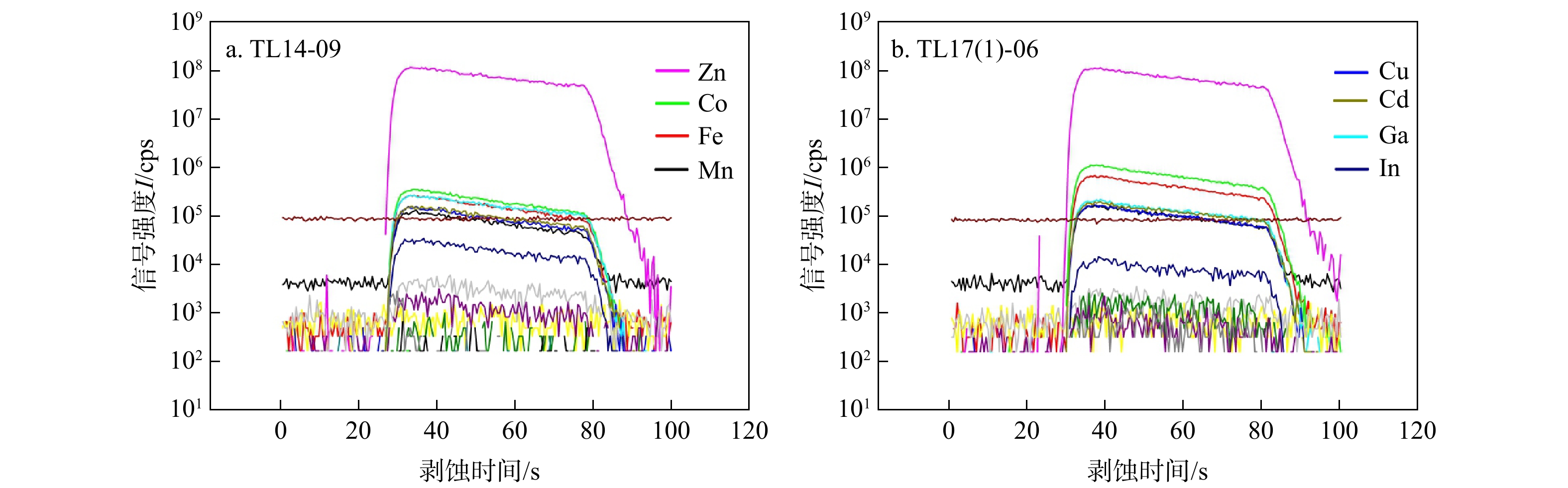
图 6 桃林铅锌矿床闪锌矿LA-ICP-MS时间分辨率剖面图
Figure 6. LA-ICP-MS time-resolved depth profile maps of sphalerite from Taolin Pb-Zn deposit
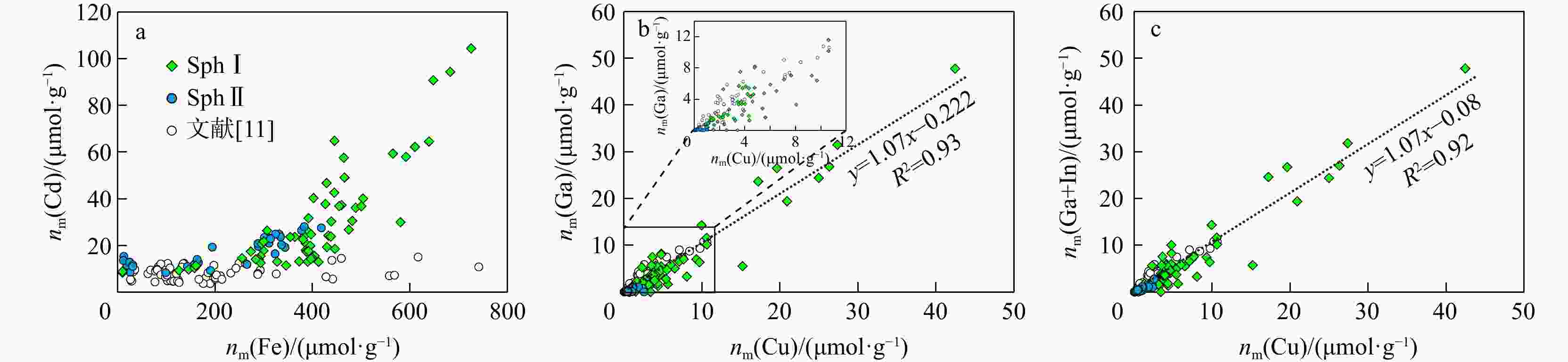
图 7 桃林铅锌矿床闪锌矿微量元素相关性图(nm为单位质量矿石中元素物质的量;R2为相关系数)
Figure 7. Correlation diagrams of trace elements in sphalerite from Taolin Pb-Zn deposit
表 1 桃林铅锌矿床闪锌矿LA-ICP-MS分析数据
Table 1. LA-ICP-MS analytical data of sphalerite from Taolin Pb-Zn deposit
wB/10−6 点号 世代 Mn Fe Co Ni Cu Ga Ge As Se Ag Cd In Sn Sb Pb TL03-01 SphⅠ 61.7 16395.8 283.8 — 269.0 323.2 — 0.9 — 0.7 1746.5 4.2 — 0.5 0.4 TL03-02 SphⅠ 57.9 16178.8 283.1 0.3 146.8 366.9 — 0.9 7.7 0.5 1577.1 42.7 2.2 0.2 0.3 TL03-03 SphⅡ 104.8 21079.5 242.4 — 31.7 1.4 — 0.9 — 0.4 2978.6 49.4 — — — TL03-04 SphⅡ 114.0 23345.2 228.0 0.3 67.0 4.0 — 0.7 — 1.0 3099.0 30.8 — 2.0 2.9 TL03-05 SphⅡ 106.6 21387.5 233.4 — 50.2 1.6 — 0.9 — 0.9 3162.9 24.6 0.2 — 1.4 TL03-06 SphⅡ 94.9 18488.9 249.3 0.4 100.0 49.0 — 1.1 — 2.5 2802.5 21.2 1.4 1.1 11.1 TL03-07 SphⅡ 94.3 18675.2 244.5 — 21.7 11.4 — 0.4 — 0.9 2672.1 10.5 0.4 0.1 1.9 TL03-08 SphⅠ 78.5 16517.7 254.8 0.6 218.6 254.8 4.2 1.1 4.5 1.0 2328.0 35.7 2.1 0.5 1.5 TL03-09 SphⅡ 88.0 17322.2 229.9 0.1 15.6 8.4 — 0.8 — 0.4 2622.7 12.5 0.3 — 0.3 TL03-10 SphⅠ 69.6 15275.1 269.2 0.7 303.0 380.7 6.2 1.6 4.1 1.4 1967.4 61.0 3.2 0.6 4.3 TL03-11 SphⅠ 61.7 14256.9 280.2 — 259.4 392.2 7.0 0.8 6.0 1.2 1647.6 21.7 1.6 0.6 9.3 TL03-12 SphⅡ 87.2 16805.6 240.8 0.6 55.1 52.3 — 0.4 — 0.6 2636.2 16.4 0.7 0.2 2.9 TL03-13 SphⅠ 83.3 16750.7 254.5 0.5 223.6 232.0 4.0 1.2 3.1 3.5 2441.0 35.8 2.1 1.0 6.6 TL03-14 SphⅡ 93.0 18091.0 230.6 — 9.8 2.5 — 0.6 — 0.6 2799.9 11.6 — — 0.7 TL03-15 SphⅠ 90.9 21577.9 344.5 — 413.3 350.9 2.5 0.8 — 12.4 2347.8 55.2 7.5 5.2 19.4 TL03-16 SphⅠ 87.0 19778.4 283.8 0.3 241.3 138.8 — 0.4 10.6 2.5 2671.7 77.5 3.0 1.2 1.8 TL03-17 SphⅠ 93.8 21252.3 309.6 0.1 239.4 237.5 — — — 2.8 2543.1 19.9 1.6 2.4 4.8 TL03-18 SphⅠ 98.8 24901.8 431.5 1.0 590.3 488.0 6.8 1.6 5.9 3.9 2092.2 55.5 4.1 7.5 7.2 TL03-19 SphⅠ 98.4 23992.6 400.9 0.5 451.7 454.3 5.3 0.4 5.8 3.0 2180.7 14.2 1.4 5.2 9.7 TL03-20 SphⅠ 113.3 24439.1 333.9 0.1 293.5 255.9 3.1 0.5 — 2.4 2684.0 42.1 3.3 6.8 8.9 TL14-01 SphⅠ 3.9 578.8 46.6 0.2 89.4 89.5 6.8 0.1 333.1 1.0 949.5 0.7 — 0.3 2.5 TL14-02 SphⅠ 4.1 565.3 44.9 — 124.6 123.8 12.0 0.7 — 3.5 1004.8 0.2 — 0.2 0.5 TL14-03 SphⅡ 5.4 710.7 46.4 — 2.8 1.9 — 1.2 109.5 0.5 1731.7 0.1 — — 1.4 TL14-04 SphⅡ 13.2 1429.5 65.7 1.0 28.1 29.2 — 0.5 86.6 0.9 970.9 3.4 — — 0.9 TL14-05 SphⅡ 58.6 5509.8 198.3 — 162.8 1.0 — 0.6 176.3 1.0 945.9 322.4 1.4 — 1.7 TL14-06 SphⅡ 81.3 8002.3 243.1 0.7 12.7 7.3 — 0.7 154.2 0.9 1246.4 7.8 — 0.1 0.3 TL14-07 SphⅠ 69.2 7033.5 240.6 0.5 144.2 115.1 8.5 1.2 134.5 3.5 1061.9 3.1 1.1 3.9 5.2 TL14-08 SphⅠ 72.8 8153.0 226.2 — 84.9 115.1 — 1.0 — 0.3 1101.8 14.4 1.7 — 0.9 TL14-09 SphⅠ 88.6 8822.0 280.6 0.3 242.6 375.9 9.7 0.3 — 0.4 1168.1 14.0 2.6 0.1 0.1 TL14-10 SphⅡ 133.0 10854.1 242.8 — 64.9 6.6 — 1.0 308.1 0.9 2174.4 115.1 3.1 — 0.2 TL14-11 SphⅡ 9.8 1079.3 68.9 0.4 6.6 5.1 — 0.4 313.5 1.1 1301.3 0.4 — — — TL14-12 SphⅡ 4.8 659.9 55.3 — 36.7 3.1 — — 32.5 0.6 1537.4 63.7 1.0 — 0.1 TL14-13 SphⅡ 13.0 1372.0 80.8 0.1 7.1 6.7 — — — 0.7 1457.8 0.1 — — 0.1 TL14-14 SphⅡ 16.8 1736.4 90.2 — 8.4 7.5 — 1.2 — 1.2 1317.4 — — — — TL14-15 SphⅡ 17.4 1741.9 93.4 — 8.4 6.4 — 0.6 47.0 1.5 1242.1 — — — — TL14-16 SphⅡ 100.8 9254.3 277.3 — 17.1 3.7 — — — 1.4 1430.8 22.9 1.0 — — TL14-17 SphⅠ 96.0 9006.9 287.7 0.7 150.6 149.7 — 0.9 33.6 1.8 1264.2 29.9 6.4 0.1 0.2 TL14-18 SphⅠ 95.2 8974.9 272.6 0.1 96.4 92.1 — 0.3 — 3.4 1290.0 18.2 3.5 0.1 1.7 TL14-19 SphⅡ 90.9 8812.3 257.9 0.1 19.2 4.8 — 0.4 — 1.8 1349.0 24.2 1.0 — 1.3 TL14-20 SphⅡ 96.2 9109.4 251.9 0.6 29.3 8.6 — 0.5 — 1.4 1584.8 36.2 2.4 0.1 1.6 TL17(1)-01 SphⅡ 118.9 16121.9 597.2 0.5 2.8 0.7 — 1.0 — 2.4 2208.3 — — 1.8 1.0 TL17(1)-02 SphⅡ 123.4 16074.7 580.5 — 3.6 1.4 — 1.4 — 0.7 2350.8 0.1 — 0.1 0.8 TL17(1)-03 SphⅠ 139.0 22070.2 711.4 — 357.8 116.0 2.3 0.4 — 5.0 2227.4 14.1 1.1 0.1 5.5 TL17(1)-04 SphⅠ 129.2 22566.3 862.1 0.8 255.8 236.4 4.3 0.5 30.9 2.3 1752.2 2.3 1.3 — 1.6 TL17(1)-05 SphⅠ 113.3 20805.3 858.7 0.4 175.6 186.0 3.8 0.6 34.1 1.8 1485.4 1.6 0.3 — 0.1 TL17(1)-06 SphⅠ 124.5 23024.5 928.6 0.3 283.5 303.9 5.1 0.6 4.5 2.5 1465.4 5.8 1.1 — 0.6 TL17(1)-07 SphⅡ 127.2 19187.2 619.6 — 60.5 59.0 — 1.3 — 1.3 2163.1 2.3 — 0.1 1.4 TL17(1)-08 SphⅡ 137.0 17337.9 588.0 0.3 4.4 2.9 — — — 0.6 2489.8 0.9 — 0.3 1.0 TL17(1)-09 SphⅠ 126.7 21579.1 729.4 0.5 168.8 137.2 3.5 0.6 — 4.6 2031.4 28.5 1.2 0.6 3.8 TL17(1)-10 SphⅠ 135.0 22075.4 695.2 — 145.1 130.7 1.9 1.0 — 4.5 2239.1 37.4 1.8 0.4 1.4 TL17(1)-11 SphⅠ 134.7 21654.1 760.2 — 206.5 88.8 — 1.4 — 7.6 1954.0 0.5 0.6 0.8 14.0 TL17(1)-12 SphⅡ 80.6 14825.9 548.7 — 151.3 53.3 — 0.5 — 6.4 1340.6 28.7 10.1 0.1 6.4 TL17(1)-13 SphⅡ 118.2 18035.2 732.9 0.4 118.1 76.4 — 1.4 — 2.3 1855.1 2.0 1.0 — 2.9 TL17(1)-14 SphⅠ 111.0 19310.2 897.5 — 283.3 299.6 5.6 0.7 5.5 1.7 1297.4 — — — 0.5 TL17(1)-15 SphⅠ 95.5 16391.2 695.0 — 199.8 107.8 2.2 — 8.6 5.3 1421.1 8.3 0.4 2.1 4.9 TL17(1)-16 SphⅠ 116.8 21790.6 871.4 0.1 233.2 245.2 3.8 0.6 — 1.8 1480.2 7.9 2.5 0.1 0.7 TL17(1)-17 SphⅡ 136.9 18792.7 686.8 0.2 74.2 69.7 — 0.7 — 1.1 2281.6 0.1 — — 0.4 TL17(1)-18 SphⅡ 50.3 10638.1 420.3 — 71.1 59.5 — 0.8 — 2.0 1052.0 5.1 12.5 — 1.1 TL17(1)-19 SphⅠ 133.3 22288.8 907.9 — 512.2 229.9 4.8 0.9 2.3 5.9 1659.2 — — 0.1 2.6 TL17(1)-20 SphⅡ 119.3 17350.8 445.9 0.1 24.7 18.0 — 0.7 — 1.9 2361.3 3.2 0.4 0.5 0.7 TL17(1)-21 SphⅡ 139.2 17519.6 590.3 0.8 9.2 3.4 — 0.3 — 1.4 2578.8 0.1 — 0.9 1.7 TL17(1)-22 SphⅠ 128.0 22170.4 900.3 — 237.8 258.3 5.8 0.5 115.5 2.6 1608.3 0.2 — — 0.4 TL17(1)-23 SphⅠ 91.8 15835.0 626.5 0.5 278.0 89.2 — 2.1 162.4 11.3 1591.7 6.9 0.8 4.4 11.7 TL17(1)-24 SphⅠ 134.6 21868.5 775.8 0.6 133.8 109.9 1.9 — — 5.4 1986.2 2.1 1.1 3.6 2.6 TL17(1)-25 SphⅠ 107.0 18288.4 788.6 — 274.6 127.8 2.2 0.4 269.1 5.9 1477.4 0.1 — — 2.8 TL17-3-01 SphⅠ 96.2 21812.7 875.2 — 632.7 994.6 12.2 — — 1.5 2931.0 10.4 0.3 — 2.8 TL17-3-02 SphⅠ 118.2 25667.6 920.8 0.5 95.3 105.5 — — — 1.2 4196.7 2.3 — — 11.5 TL17-3-03 SphⅠ 269.3 40503.7 722.9 0.9 96.7 5.9 — — — 0.7 11734.8 172.7 — 0.1 8.4 TL17-3-04 SphⅠ 215.9 36164.9 603.2 0.8 249.7 173.7 — — — 1.7 10199.4 133.5 4.0 19.9 41.7 TL17-3-05 SphⅠ 117.7 22448.7 503.2 — 305.1 570.6 9.4 0.4 — 1.8 4536.7 10.4 0.9 22.5 50.6 TL17-3-06 SphⅠ 258.9 38108.2 757.0 0.5 39.0 2.6 — 1.1 — 1.2 10605.7 60.0 0.3 0.5 43.8 TL21-1-01 SphⅠ 145.9 24825.5 455.3 — 274.7 376.0 2.7 0.5 — 27.2 4793.5 3.5 0.5 0.2 6.1 TL21-1-02 SphⅠ 159.9 23950.1 459.8 0.4 297.3 321.1 3.6 — — 52.6 5259.8 7.1 0.7 0.8 26.3 TL21-1-03 SphⅠ 135.2 25393.3 530.7 1.3 1094.1 1649.3 23.0 0.5 — 5.4 4148.9 110.3 17.5 4.1 12.7 TL21-1-04 SphⅠ 147.5 25924.7 456.0 — 303.6 558.4 — — — 2.7 6473.1 234.6 13.7 1.6 2.4 TL21-1-05 SphⅠ 191.5 24854.0 413.7 — 47.3 1.2 — — — 14.1 7287.3 25.1 — 0.1 1.8 TL21-1-06 SphⅠ 80.2 17141.4 556.9 — 1329.5 1354.2 122.2 0.3 — 33.8 2967.4 — — — 15.9 TL21-1-07 SphⅠ 86.0 18516.2 676.3 — 1587.2 1700.5 128.3 — — 22.9 2797.0 0.2 — 0.5 6.0 TL21-1-08 SphⅠ 143.8 27289.6 598.7 1.1 1246.9 1846.1 30.1 — — 2.8 4068.3 29.7 3.9 0.5 3.0 TL21-1-09 SphⅠ 143.5 26887.4 644.6 0.3 1739.6 2195.6 42.1 0.1 — 4.5 3441.2 38.4 6.1 — 3.6 TL21-1-10 SphⅠ 140.6 25999.3 508.8 0.3 231.8 522.9 — — — 3.3 5521.5 8.5 0.5 0.2 2.5 TL21-2-01 SphⅠ 115.6 21875.5 598.8 1.1 966.4 385.0 3.5 0.5 — 286.1 3565.8 26.8 3.0 2.5 239.0 TL21-2-02 SphⅠ 160.9 28127.3 625.7 0.9 217.8 0.9 — — — 75.6 4511.3 — — 0.2 4.4 TL21-2-03 SphⅠ 115.7 24160.2 701.4 0.4 615.9 445.0 49.5 0.4 — 118.3 2730.7 1.2 1.1 0.2 4.3 TL21-2-04 SphⅠ 163.4 27928.7 656.7 1.5 7710.4 829.3 11.6 1.2 — 319.4 4144.2 47.8 8.9 5.2 473.7 TL21-2-05 SphⅠ 256.6 31548.0 552.4 2.3 4619.2 17.6 — 0.4 — 159.4 6674.0 5.4 0.6 3.3 479.7 TL21-2-06 SphⅠ 90.6 21405.1 740.9 0.6 351.7 330.8 10.4 0.3 — 19.3 2708.9 43.3 16.4 0.6 11.6 TL21-2-07 SphⅠ 100.2 22174.9 614.7 0.8 224.5 396.0 3.9 0.2 — 3.1 2787.2 3.2 9.0 1.0 13.9 TL21-2-08 SphⅠ 118.9 24480.5 602.8 1.1 68.0 29.0 — — — 22.4 3411.5 0.8 — 0.2 11.3 TL21-5-01 SphⅠ 281.4 59825.5 1507.8 0.7 1673.6 1871.5 21.7 0.3 — 9.0 5884.7 22.5 1.8 6.3 20.4 TL21-5-02 SphⅠ 238.2 56168.2 1836.4 0.4 2698.3 3331.7 46.0 0.3 — 4.9 4114.5 4.9 0.9 1.4 5.9 TL21-5-03 SphⅠ 372.9 72181.7 1193.8 0.5 487.3 489.0 4.4 0.4 — 9.9 8722.3 64.9 2.6 10.1 20.0 TL21-5-04 SphⅠ 103.8 20302.4 470.1 — 674.0 807.0 6.2 — — 12.0 2670.1 10.3 0.3 0.3 6.3 TL21-5-05 SphⅠ 122.0 23813.7 440.7 0.3 105.1 157.3 — — — 2.6 4249.3 2.9 — 0.3 0.6 TL21-5-06 SphⅠ 83.2 16722.7 350.1 0.8 675.2 707.3 19.3 0.4 — 12.2 2007.7 3.8 0.5 0.3 2.8 TL21-5-07 SphⅠ 225.0 33031.3 631.7 — 62.4 25.9 — 0.2 — 16.5 6520.1 29.5 0.4 0.8 8.8 TL21-5-08 SphⅠ 236.1 34070.1 715.1 0.3 32.7 6.5 — 0.1 — 12.6 6995.4 2.3 — 0.6 1.4 TL21-5-09 SphⅠ 246.0 35680.6 683.3 1.1 343.2 194.5 — 0.6 — 25.2 7252.3 107.8 6.4 4.6 22.3 TL21-5-10 SphⅠ 169.1 32407.7 656.6 0.5 382.0 409.9 — 0.2 — 12.4 3376.4 — — — 4.5 TL21-5-11 SphⅠ 136.2 26487.3 427.1 0.7 86.4 92.1 — 0.3 — 0.8 3018.3 3.5 0.3 0.1 1.5 注:—代表未检测出或低于检出限  下载: 导出CSV
-
[1] 蒋少涌, 温汉捷, 许成, 等. 关键金属元素的多圈层循环与富集机理: 主要科学问题及未来研究方向[J]. 中国科学基金, 2019, 33(2): 112-118. doi: 10.16262/j.cnki.1000-8217.2019.02.003JIANG S Y, WEN H J, XU C, et al. Earth sphere cycling and enrichment mechanism of critical metals: Major scientific issues for future research[J]. Bulletin of National Natural Science Foundation of China, 2019, 33(2): 112-118. (in Chinese with English abstract) doi: 10.16262/j.cnki.1000-8217.2019.02.003 [2] 翟明国, 吴福元, 胡瑞忠, 等. 战略性关键金属矿产资源: 现状与问题[J]. 中国科学基金, 2019, 33(2): 106-111.ZHAI M G, WU F Y, HU R Z, et al. Critical metal mineral resources: Current research status and scientific issues[J]. Bulletin of National Natural Science Foundation of China, 2019, 33(2): 106-111. (in Chinese with English abstract) [3] 侯增谦, 陈骏, 翟明国. 战略性关键矿产研究现状与科学前沿[J]. 科学通报, 2020, 65(33): 3651-3652. doi: 10.1360/TB-2020-1417HOU Z Q, CHEN J, ZHAI M G. Current status and frontiers of research on critical mineral resources[J]. Chinese Science Bulletin, 2020, 65(33): 3651-3652. (in Chinese with English abstract) doi: 10.1360/TB-2020-1417 [4] 毛景文, 杨宗喜, 谢桂青, 等. 关键矿产: 国际动向与思考[J]. 矿床地质, 2019, 38(4): 689-698. doi: 10.16111/j.0258-7106.2019.04.001MAO J W, YANG Z X, XIE G Q, et al. Critical minerals: International trends and thinking[J]. Mineral Deposits, 2019, 38(4): 689-698. (in Chinese with English abstract) doi: 10.16111/j.0258-7106.2019.04.001 [5] 温汉捷, 朱传威, 杜胜江, 等. 中国镓锗铊镉资源[J]. 科学通报, 2020, 65(33): 3688-3699. doi: 10.1360/TB-2020-0267WEN H J, ZHU C W, DU S J, et al. Gallium (Ga), germanium (Ge), thallium (Tl) and cadmium (Cd) resources in China[J]. Chinese Science Bulletin, 2020, 65(33): 3688-3699. (in Chinese with English abstract) doi: 10.1360/TB-2020-0267 [6] 温汉捷, 周正兵, 朱传威, 等. 稀散金属超常富集的主要科学问题[J]. 岩石学报, 2019, 35(11): 3271-3291. doi: 10.18654/1000-0569/2019.11.01WEN H J, ZHOU Z B, ZHU C W, et al. Critical scientific issues of super-enrichment of dispersed metals[J]. Acta Petrologica Sinica, 2019, 35(11): 3271-3291. (in Chinese with English abstract) doi: 10.18654/1000-0569/2019.11.01 [7] 李凯旋, 冷成彪, 任志, 等. 铅锌矿伴生的稀散元素研究进展[J]. 矿物学报, 2021, 41(3): 225-233.LI K X, LENG C B, REN Z, et al. Progresses of researches on the dispersed elements associated with lead-zinc deposits[J]. Acta Mineralogica Sinica, 2021, 41(3): 225-233. (in Chinese with English abstract) [8] XU D R, GU X X, LI P C, et al. Mesoproterozoic-Neoproterozoic transition: Geochemistry, provenance and tectonic setting of clastic sedimentary rocks on the SE margin of the Yangtze block, South China[J]. Journal of Asian Earth Sciences, 2007, 29(5/6): 637-650. doi: 10.1016/j.jseaes.2006.04.006 [9] 许德如, 邹凤辉, 宁钧陶, 等. 湘东北地区地质构造演化与成矿响应探讨[J]. 岩石学报, 2017, 33(3): 695-715.XU D R, ZOU F H, NING J T, et al. Discussion on geological and structural characteristics and associated metallogeny in northeastern Hunan Province, South China[J]. Acta Petrologica Sinica, 2017, 33(3): 695-715. (in Chinese with English abstract) [10] 康博, 颜志强, 李恋宇. 湖南省临湘市桃林铅锌矿成矿模式及找矿标志[J]. 资源环境与工程, 2015, 29(2): 160-163.KANG B, YAN Z Q, LI L Y. Metallogenic model and prospecting criteria of Taolin lead-zinc deposit in Xianglin City, Hunan Province[J]. Resources Environment & Engineering, 2015, 29(2): 160-163. (in Chinese with English abstract) [11] YU D S, XU D R, ZHAO Z X, et al. Genesis of the Taolin Pb-Zn deposit in northeastern Hunan Province, South China: Constraints from trace elements and oxygen-sulfur-lead isotopes of the hydrothermal minerals[J]. Mineralium Deposita, 2020, 55(7): 1467-1488. doi: 10.1007/s00126-019-00947-8 [12] YU D S, WANG S J, ZHAO Z X, et al. Fluid origin and evolution of the Taolin Pb-Zn deposit in northeastern Hunan Province, South China: Insights from fluid inclusions and H-O-He-Ar isotopes[J]. Geochemistry, 2024, 84(3): 126149. doi: 10.1016/j.chemer.2024.126149 [13] 张九龄. 湖南桃林铅锌矿床控矿条件及成矿预测[J]. 地质与勘探, 1989, 25(4): 1-7.ZHANG J L. On the ore-controlling condition and metallogenic prognosis of the Taolin Pb-Zn deposit, Hunan[J]. Geology and Prospecting, 1989, 25(4): 1-7. (in Chinese with English abstract) [14] 张九龄, 符策美. 临湘县桃林铅锌矿床成矿条件及成因的重新探讨[J]. 湖南地质, 1987(3): 14-22.ZHANG J L, FU C M. Reapproach of metallogeny and controlling condition of Taolin lead-zinc ore deposit, Linxiang County[J]. Hunan Geology, 1987(3): 14-22. (in Chinese with English abstract) [15] 傅昭仁, 李先福, 李德威, 等. 不同样式的剥离断层控矿研究[J]. 地球科学, 1991, 16(6): 627-634.FU Z R, LI X F, LI D W, et al. On ore-controlling of sundry denudational faults[J]. Earth Science, 1991, 16(6): 627-634. (in Chinese with English abstract) [16] 喻爱南, 叶柏龙, 彭恩生. 湖南桃林大云山变质核杂岩构造与成矿的关系[J]. 大地构造与成矿学, 1998, 22(1): 82-88.YU A N, YE B L, PENG E S. Relationship between the Dayunshan metamorphic core complex and mineralization, Taolin, Hunan Province[J]. Geotectonica et Metallogenia, 1998, 22(1): 82-88. (in Chinese with English abstract) [17] 张鲲, 胡俊良, 徐德明. 湖南桃林铅锌矿区花岗岩地球化学特征及其与成矿的关系[J]. 华南地质与矿产, 2012, 28(4): 307-314. doi: 10.3969/j.issn.1007-3701.2012.04.004ZHANG K, HU J L, XU D M. Geochemistry of granite and its relationship with mineralization in Taolin Pb-Zn deposit, Hunan Province[J]. South China Geology, 2012, 28(4): 307-314. (in Chinese with English abstract) doi: 10.3969/j.issn.1007-3701.2012.04.004 [18] 陕亮, 姜军胜, 康博, 等. 湘东北地区主要有色金属矿床成矿物质来源: 来自硫、铅同位素的证据[J]. 地质通报, 2019, 38(5): 884-900.SHAN L, JIANG J S, KANG B, et al. Metallogenic material sources of important non-ferrous metal deposits in northern Northeast Hunan Province: Evidence from S and Pb isotopes[J]. Geological Bulletin of China, 2019, 38(5): 884-900. (in Chinese with English abstract) [19] XU D R, DENG T, CHI G X, et al. Gold mineralization in the Jiangnan orogenic belt of South China: Geological, geochemical and geochronological characteristics, ore deposit-type and geodynamic setting[J]. Ore Geology Reviews, 2017, 88: 565-618. doi: 10.1016/j.oregeorev.2017.02.004 [20] 康博, 宁钧陶, 高卓龙, 等. 湘东北矿集区井冲铜钴矿床钴的赋存状态[J]. 地质科技通报, 2025, 44(4): 167-184.KANG B, NING J T, GAO Z L, et al. Occurrence state of cobalt in Jingchong copper-cobalt deposit in Northeast Hunan Province, China[J]. Bulletin of Geological Science and Technology, 2025, 44(4): 167-184. (in Chinese with English abstract) [21] 彭尔柯. 湘东北井冲铜钴多金属矿床的成矿机制: 来自矿物学及流体包裹体的启示[D]. 长沙: 中南大学, 2024.PENG E K. Mineralization process of the Jingchong Cu-Co polymetallic deposit, Northeast Hunan: New insight from mineralogy and fluid inclusion study [D]. Changsha: Central South University, 2024. (in Chinese with English abstract) [22] ZHAO G C. Jiangnan orogen in South China: Developing from divergent double subduction[J]. Gondwana Research, 2015, 27(3): 1173-1180. doi: 10.1016/j.gr.2014.09.004 [23] 王智琳, 李世相, 许德如, 等. 湘东北横洞钴矿床钴的富集机制: 来自黄铁矿的微区结构、成分和硫同位素证据[J]. 岩石学报, 2023, 39(9): 2723-2740.WANG Z L, LI S X, XU D R, et al. Cobalt enrichment mechanism in the Hengdong cobalt deposit, Northeast Hunan Province: Evidence from texture, chemical composition and sulfur isotopic composition of pyrite[J]. Acta Petrologica Sinica, 2023, 39(9): 2723-2740. (in Chinese with English abstract) [24] 林子晗, 夏元, 张航川, 等. 幕阜山岩体北缘鄂南地区构造特征与构造控矿作用[J]. 地质科技通报, 2025, 44(2): 257-269.LIN Z H, XIA Y, ZHANG H C, et al. Structural characteristics and tectonic controls on mineralization in the northern margin of the Mufushan pluton, southern Hubei region[J]. Bulletin of Geological Science and Technology, 2025, 44(2): 257-269. (in Chinese with English abstract) [25] JI W B, LIN W, FAURE M, et al. Origin of the Late Jurassic to Early Cretaceous peraluminous granitoids in the northeastern Hunan Province (middle Yangtze region), South China: Geodynamic implications for the Paleo-Pacific subduction[J]. Journal of Asian Earth Sciences, 2017, 141: 174-193. doi: 10.1016/j.jseaes.2016.07.005 [26] 王卿铎, 丁碧英, 李石锦. 湖南桃林铅锌矿成矿温度特征及成矿预测初步研究[J]. 中南矿冶学院学报, 1978, 9(1): 72-83.WANG Q D, DING B Y, LI S J. Ore-forming temperature characteristics and preliminary metallogenic prognosis of Taolin lead-zinc deposit, Hunan Province[J]. Journal of Central South Institute of Mining and Metallurgy, 1978, 9(1): 72-83. (in Chinese) [27] SHAN L, LI Y J, JIANG J S, et al. Magmatism and mineralization of the Taolin Pb-Zn-Cu deposit in the Mufushan area, central Jiangnan orogen (South China): Insightfvs from zircon U-Pb and sphalerite Rb-Sr geochronology, and H-O-S-Pb isotope geochemistry[J]. Ore Geology Reviews, 2023, 153: 105266. doi: 10.1016/j.oregeorev.2022.105266 [28] ZONG K Q, KLEMD R, YUAN Y, et al. The assembly of Rodinia: The correlation of Early Neoproterozoic (ca. 900 Ma) high-grade metamorphism and continental arc formation in the southern Beishan orogen, southern Central Asian Orogenic Belt (CAOB)[J]. Precambrian Research, 2017, 290: 32-48. doi: 10.1016/j.precamres.2016.12.010 [29] HU Z C, ZHANG W, LIU Y S, et al. "Wave" signal-smoothing and mercury-removing device for laser ablation quadrupole and multiple collector ICPMS analysis: Application to lead isotope analysis[J]. Analytical Chemistry, 2015, 87(2): 1152-1157. doi: 10.1021/ac503749k [30] LIU Y S, HU Z C, GAO S, et al. In situ analysis of major and trace elements of anhydrous minerals by LA-ICP-MS without applying an internal standard[J]. Chemical Geology, 2008, 257(1/2): 34-43. [31] COOK N J, CIOBANU C L, PRING A, et al. Trace and minor elements in sphalerite: A LA-ICPMS study[J]. Geochimica et Cosmochimica Acta, 2009, 73(16): 4761-4791. doi: 10.1016/j.gca.2009.05.045 [32] 袁鑫, 吴越, 段登飞, 等. 新疆火烧云超大型铅锌矿床闪锌矿微量(稀散)元素组成特征与指示意义[J]. 地质与勘探, 2022, 58(3): 545-560.YUAN X, WU Y, DUAN D F, et al. Trace (dispersed) elements in sphalerite from the giant Huoshaoyun lead-zinc deposit, Xinjiang and their geological implications[J]. Geology and Exploration, 2022, 58(3): 545-560. (in Chinese with English abstract) [33] MENG Y M, ZHANG X, HUANG X W. A review of the Zn-Pb deposits in Sichuan-Yunnan-Guizhou metallogenic region with emphasis on the enrichment of Ge, Ga, and In[J]. Ore Geology Reviews, 2024, 164: 105853. doi: 10.1016/j.oregeorev.2023.105853 [34] SUN L H, CHEN X, ZHENG Y, et al. Critical metals Ga and Ge enrichment in the last-stage and low-temperature sphalerite from the Guojiagou Zn-Pb deposit, western Qinling orogen, NW China[J]. Ore Geology Reviews, 2025, 179: 106494. doi: 10.1016/j.oregeorev.2025.106494 [35] 何叶, 周高明, 钟华, 等. 云南毛坪铅锌矿床新发现Ⅵ号矿带硫化物稀散元素富集特征及其地质意义[J]. 岩石学报, 2023, 39(10): 2985-3001.HE Y, ZHOU G M, ZHONG H, et al. Enrichment characteristics and its geological significance of dispersed elements within sulfide minerals from the Ⅵ ore belt in the Maoping Pb-Zn deposit, Yunnan Province, China[J]. Acta Petrologica Sinica, 2023, 39(10): 2985-3001. (in Chinese with English abstract) [36] MURAKAMI H, ISHIHARA S. Trace elements of Indium-bearing sphalerite from tin-polymetallic deposits in Bolivia, China and Japan: A femto-second LA-ICPMS study[J]. Ore Geology Reviews, 2013, 53: 223-243. doi: 10.1016/j.oregeorev.2013.01.010 [37] GEORGE L L, COOK N J, CIOBANU C L. Partitioning of trace elements in co-crystallized sphalerite-galena-chalcopyrite hydrothermal ores[J]. Ore Geology Reviews, 2016, 77: 97-116. doi: 10.1016/j.oregeorev.2016.02.009 [38] YANG X, LI Y Q, CHEN J H. DFT study of the occurrence state of in and the correlation of In and Fe in sphalerite[J]. Minerals Engineering, 2022, 183: 107596. doi: 10.1016/j.mineng.2022.107596 [39] COOK N J, CIOBANU C L, BRUGGER J, et al. Determination of the oxidation state of Cu in substituted Cu-In-Fe-bearing sphalerite via-XANES spectroscopy[J]. American Mineralogist, 2012, 97(2/3): 476-479. doi: 10.2138/am.2012.4042 [40] BELISSONT R, MUÑOZ M, BOIRON M C, et al. Distribution and oxidation state of Ge, Cu and Fe in sphalerite by μ-XRF and K-edge μ-XANES: Insights into Ge incorporation, partitioning and isotopic fractionation[J]. Geochimica et Cosmochimica Acta, 2016, 177: 298-314. doi: 10.1016/j.gca.2016.01.001 [41] FRENZEL M, HIRSCH T, GUTZMER J. Gallium, germanium, indium, and other trace and minor elements in sphalerite as a function of deposit type: A meta-analysis[J]. Ore Geology Reviews, 2016, 76: 52-78. doi: 10.1016/j.oregeorev.2015.12.017 [42] DUAN H Y, WANG C M, HU R, et al. Supernormal enrichment of cadmium in sphalerite via coupled dissolution-reprecipitation process[J]. Communications Earth & Environment, 2023, 4: 356. doi: 10.1038/s43247-023-01025-8 [43] HEDENQUIST J W, LOWENSTERN J B. The role of magmas in the formation of hydrothermal ore deposits[J]. Nature, 1994, 370(6490): 519-527. doi: 10.1038/370519a0 [44] 杜胜江, 温汉捷, 朱传威, 等. 扬子板块西缘稀散金属超常富集的地球化学背景[J]. 岩石学报, 2019, 35(11): 3355-3369.DU S J, WEN H J, ZHU C W, et al. Geochemical background on the super-richening of disperse metal elements on the western margin of the Yangtze plate[J]. Acta Petrologica Sinica, 2019, 35(11): 3355-3369. (in Chinese with English abstract) [45] YARDLEY B W D. 100 th anniversary special paper: Metal concentrations in crustal fluids and their relationship to ore formation[J]. Economic Geology, 2005, 100(4): 613-632. doi: 10.2113/gsecongeo.100.4.613 [46] WEI C X, HUANG F F, WANG J T, et al. Mineral/melt In, Ga and Ge partitioning in crustal magma systems with implications for element enrichment processes[J]. Geochimica et Cosmochimica Acta, 2025, 405: 162-187. doi: 10.1016/j.gca.2025.08.007 [47] RYTUBA J J, JOHN D A, FOSTER A, et al. Hydrothermal enrichment of gallium in zones of advanced argillic alteration: Examples from the Paradise Peak and McDermitt ore deposits, Nevada[R]. Reston: U. S. Geological Survey, 2003. [48] 张乾, 刘志浩, 战新志, 等. 分散元素铟富集的矿床类型和矿物专属性[J]. 矿床地质, 2003, 22(3): 309-316.ZHANG Q, LIU Z H, ZHAN X Z, et al. Specialization of ore deposit types and minerals for enrichment of indium[J]. Mineral Deposits, 2003, 22(3): 309-316. (in Chinese with English abstract) [49] AUDÉTAT A, ZHANG D H. Abundances of S, Ga, Ge, Cd, In, Tl and 32 other major to trace elements in high-temperature (350-700 ℃) magmatic-hydrothermal fluids[J]. Ore Geology Reviews, 2019, 109: 630-642. doi: 10.1016/j.oregeorev.2019.05.017 [50] KUMAR A A, SANISLAV I V, CATHEY H E, et al. Geochemistry of indium in magmatic-hydrothermal tin and sulfide deposits of the Herberton mineral field, Australia[J]. Mineralium Deposita, 2023, 58(7): 1297-1316. doi: 10.1007/s00126-023-01179-7 [51] LIU J P, GU X P, SHAO Y J, et al. Indium mineralization in copper-tin stratiform skarn ores at the Saishitang-Rilonggou ore field, Qinghai, Northwest China[J]. Resource Geology, 2016, 66(4): 351-367. doi: 10.1111/rge.12108 [52] VALKAMA M, SUNDBLAD K, COOK N J, et al. Geochemistry and petrology of the indium-bearing polymetallic skarn ores at Pitkäranta, Ladoga Karelia, Russia[J]. Mineralium Deposita, 2016, 51(6): 823-839. doi: 10.1007/s00126-016-0641-4 [53] 刘亮明, 彭省临, 吴延之. 湘东北地区脉型金矿床的活化转移[J]. 中南工业大学学报, 1999, 30(1): 4-7.LIU L M, PENG S L, WU Y Z. Genetic features forming vein type gold deposits in northeastern Hunan[J]. Journal of Central South University of Technology (Natural Science), 1999, 30(1): 4-7. (in Chinese with English abstract) [54] 陶琰, 胡瑞忠, 唐永永, 等. 西南地区稀散元素伴生成矿的主要类型及伴生富集规律[J]. 地质学报, 2019, 93(6): 1210-1230.TAO Y, HU R Z, TANG Y Y, et al. Types of dispersed elements bearing ore-deposits and their enrichment regularity in Southwest China[J]. Acta Geologica Sinica, 2019, 93(6): 1210-1230. (in Chinese with English abstract) [55] 叶霖, 高伟, 杨玉龙, 等. 云南澜沧老厂铅锌多金属矿床闪锌矿微量元素组成[J]. 岩石学报, 2012, 28(5): 1362-1372.YE L, GAO W, YANG Y L, et al. Trace elements in sphalerite in Laochang Pb-Zn polymetallic deposit, Lancang, Yunnan Province[J]. Acta Petrologica Sinica, 2012, 28(5): 1362-1372. (in Chinese with English abstract) [56] 吴越, 孔志岗, 陈懋弘, 等. 扬子板块周缘MVT型铅锌矿床闪锌矿微量元素组成特征与指示意义: LA-ICPMS研究[J]. 岩石学报, 2019, 35(11): 3443-3460.WU Y, KONG Z G, CHEN M H, et al. Trace elements in sphalerites from the Mississippi Valley-type lead-zinc deposits around the margins of Yangtze block and its geological implications: A LA-ICPMS study[J]. Acta Petrologica Sinica, 2019, 35(11): 3443-3460. (in Chinese with English abstract) [57] 胡宇思, 叶霖, 黄智龙, 等. 滇东北麻栗坪铅锌矿床微量元素分布与赋存状态: LA-ICPMS研究[J]. 岩石学报, 2019, 35(11): 3477-3492.HU Y S, YE L, HUANG Z L, et al. Distribution and existing forms of trace elements from Maliping Pb-Zn deposit in northeastern Yunnan, China: A LA-ICPMS study[J]. Acta Petrologica Sinica, 2019, 35(11): 3477-3492. (in Chinese with English abstract) [58] ZHAO H T, ZHANG Y, SHAO Y J, et al. A new sphalerite thermometer based on machine learning with trace element geochemistry[J]. Natural Resources Research, 2024, 33(6): 2609-2626. doi: 10.1007/s11053-024-10408-3 -

 下载:
下载:


 点击查看大图
计量
- 文章访问数: 271
- PDF下载量: 46
- 被引次数: 0