投审稿入口
投审稿入口


Influence of rice husk ash particle size on early hydration characteristics of oil well cement under low-temperature conditions
-
摘要:
南海深水油气资源丰富,但低温环境显著延缓油井水泥早期强度发展,制约固井安全与效率。为解决深水低温固井水泥早强不足问题,实现绿色低碳材料应用,将稻壳灰(RHA)作为绿色辅助胶凝材料引入 G 级油井水泥,在 10 ℃低温条件下,系统研究 4 种粒径(11.4~56.9 μm)与 3 种掺量(5%,10%,15%)的 RHA 对油井水泥早期水化特性、抗压强度、放热规律及微观结构的影响。通过抗压强度测试、等温量热测试、热重分析(TG)及扫描电镜−能谱分析(SEM-EDS),揭示 RHA 粒径与掺量协同调控水泥水化的作用机制。结果表明:RHA 掺量与粒径共同控制水化进程、微观结构演化及水化产物生成;随 RHA 掺量增加,水泥石强度先升后降,水化龄期1 d 强度在 5% 掺量时最优,水化龄期3,7 d 强度在 10% 掺量时最高;随粒径细化,水化龄期1,3 d 强度持续升高,水化龄期7 d 强度呈先升后降趋势,T1RHA整体表现最优。低掺量 RHA 依靠火山灰反应、成核位点效应与空间填充效应提升强度;高掺量RHA则因稀释效应与颗粒团聚导致性能下降;粒径越细火山灰活性越强、放热越显著,但过细颗粒会因早期快速形成 C-S-H 凝胶包裹水泥颗粒,抑制后期水化。研究明确了低温下 RHA 优化油井水泥早期水化的调控机制,为深水低温固井绿色水泥体系设计提供理论依据与技术支撑。
Abstract:The South China Sea is rich in deep-water oil and gas resources, but dee-pwater low-temperature environments significantly delay the early strength development of oil well cement, which restricts the safety, quality, and efficiency of cementing operations and increases engineering costs.
Objective and MethodsTo solve the problem of insufficient early strength of oil well cement under deep-water low-temperature conditions and promote the application of green low-carbon building materials in petroleum engineering, rice husk ash (RHA), as an eco-friendly supplementary cementitious material, was incorporated into Class G oil well cement in this study. A systematic experimental investigation was conducted at a low temperature of 10℃ to reveal the effects of RHA particle size (four grades: 11.4-56.9 μm) and dosage (5%, 10%, 15%) on the early hydration characteristics, compressive strength development, hydration heat release behavior, hydration product evolution, and microstructure formation of oil well cement pastes. A series of characterization methods were adopted, including compressive strength test, isothermal calorimetry, thermogravimetric and derivative thermogravimetry (TG) analysis, and scanning electron microscopy equipped with energy-dispersive X-ray spectroscopy (SEM-EDS).
ResultsThe results showed that RHA dosage and particle size synergistically regulated cement hydration kinetics, microstructure evolution, and the generation of hydration products, thereby dominating the mechanical performance of hardened cement pastes. With the increase of RHA dosage, the compressive strength increased first and then decreased. The 1 d hydration age strength reached the maximum at 5% RHA dosage, while the 3 d and 7 d strengths reached their peaks at 10% RHA dosage. As RHA particles were refined, the 1 d and 3 d strengths increased continuously, whereas the 7 d strength rose first and then declined, with the T1RHA group exhibiting the optimal overall performance. Low-dosage RHA enhanced cement strength through three mechanisms: Pozzolanic reaction, nucleation site effect, and spatial filling effect. In contrast, high-dosage RHA caused performance degradation due to the dilution effect and particle agglomeration. Finer RHA possessed higher pozzolanic activity and more intense hydration heat release. Nevertheless, excessively fine RHA accelerated the early formation of C-S-H gels, wrapping unhydrated cement particles and hindering subsequent hydration. The TG results verified that RHA consumed calcium hydroxide (CH) via pozzolanic reaction to generate additional C-S-H gels, optimizing the composition and microstructure of hydration products. SEM-EDS observations showed that RHA refined the pore structure, converted amorphous C-S-H into fibrous and ribbon-like morphologies, and lowered the Ca/Si molar ratio, contributing to a denser microstructure.
ConclusionThis study clarifies the coordinated regulation mechanism of RHA particle size and dosage on the early hydration of oil well cement under low-temperature conditions, and provides a theoretical basis and technical support for the design and application of green and low-carbon cementing systems suitable for deep-water low-temperature environments.
-
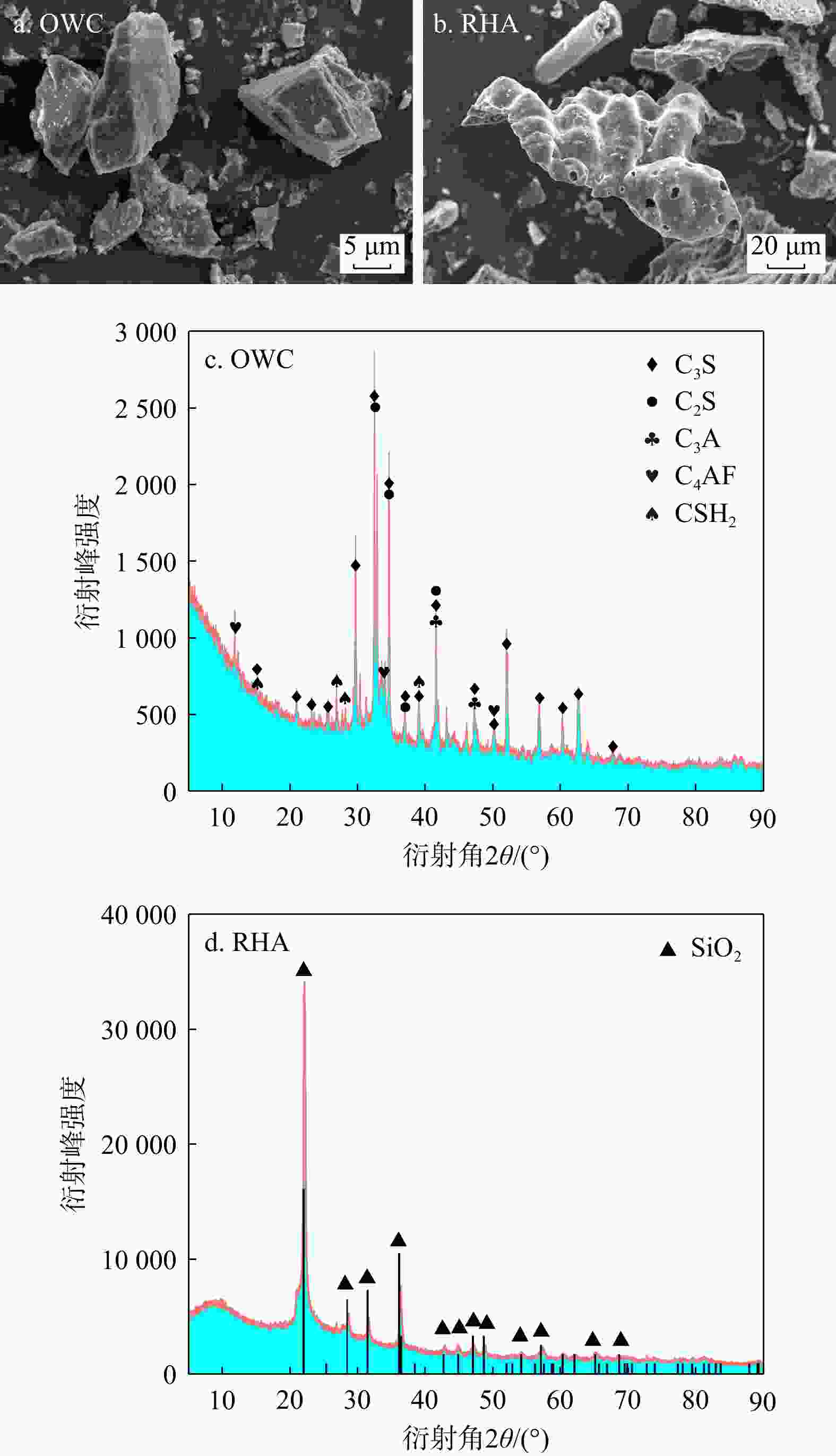
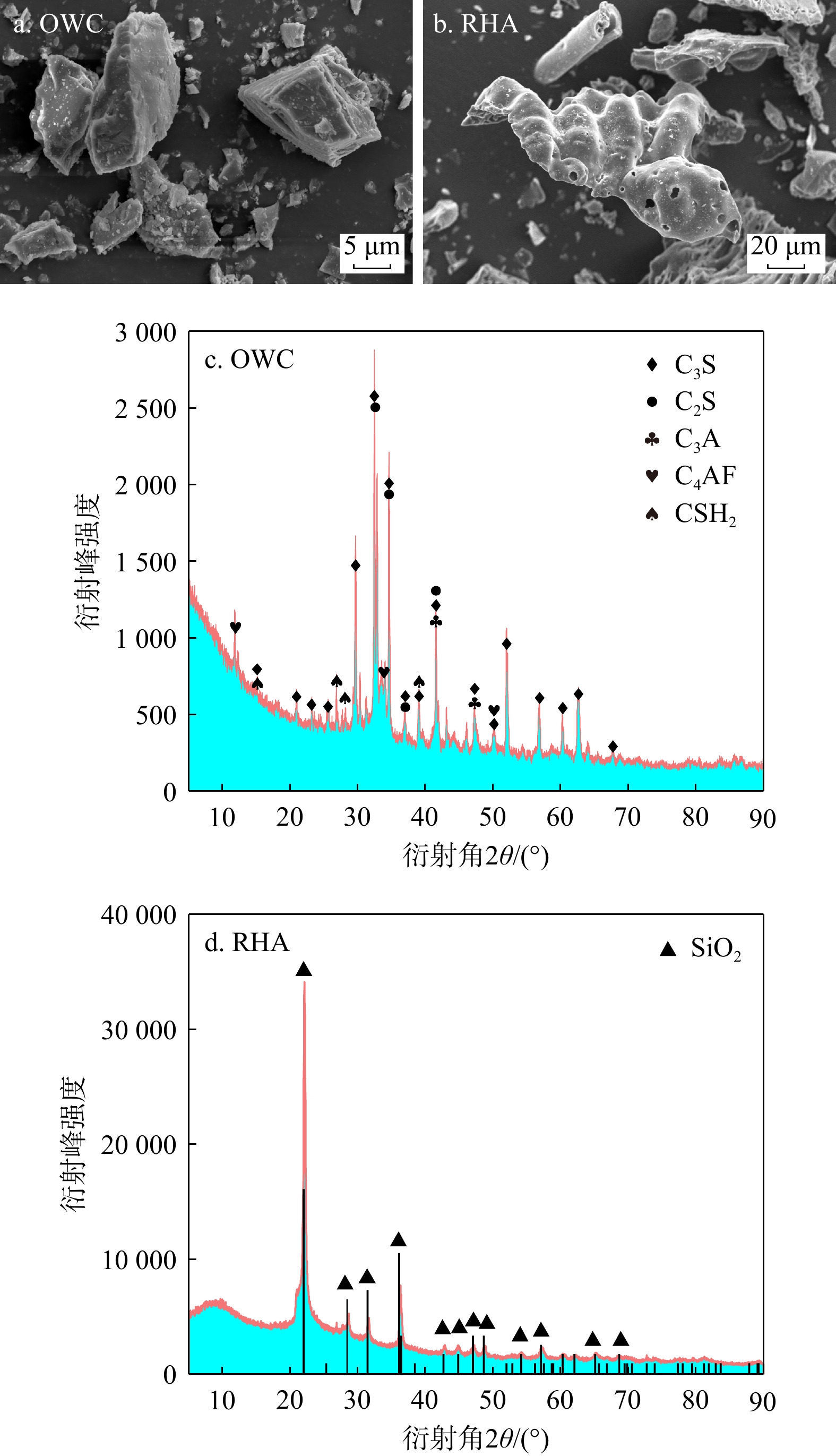
图 1 OWC和RHA的扫描电子显微镜(SEM)(a, b)及X 射线衍射(XRD)(c, d)结果
Figure 1. Scanning electron microscope (SEM) (a, b) and X-ray diffraction (XRD) (c, d) results of OWC and RHA
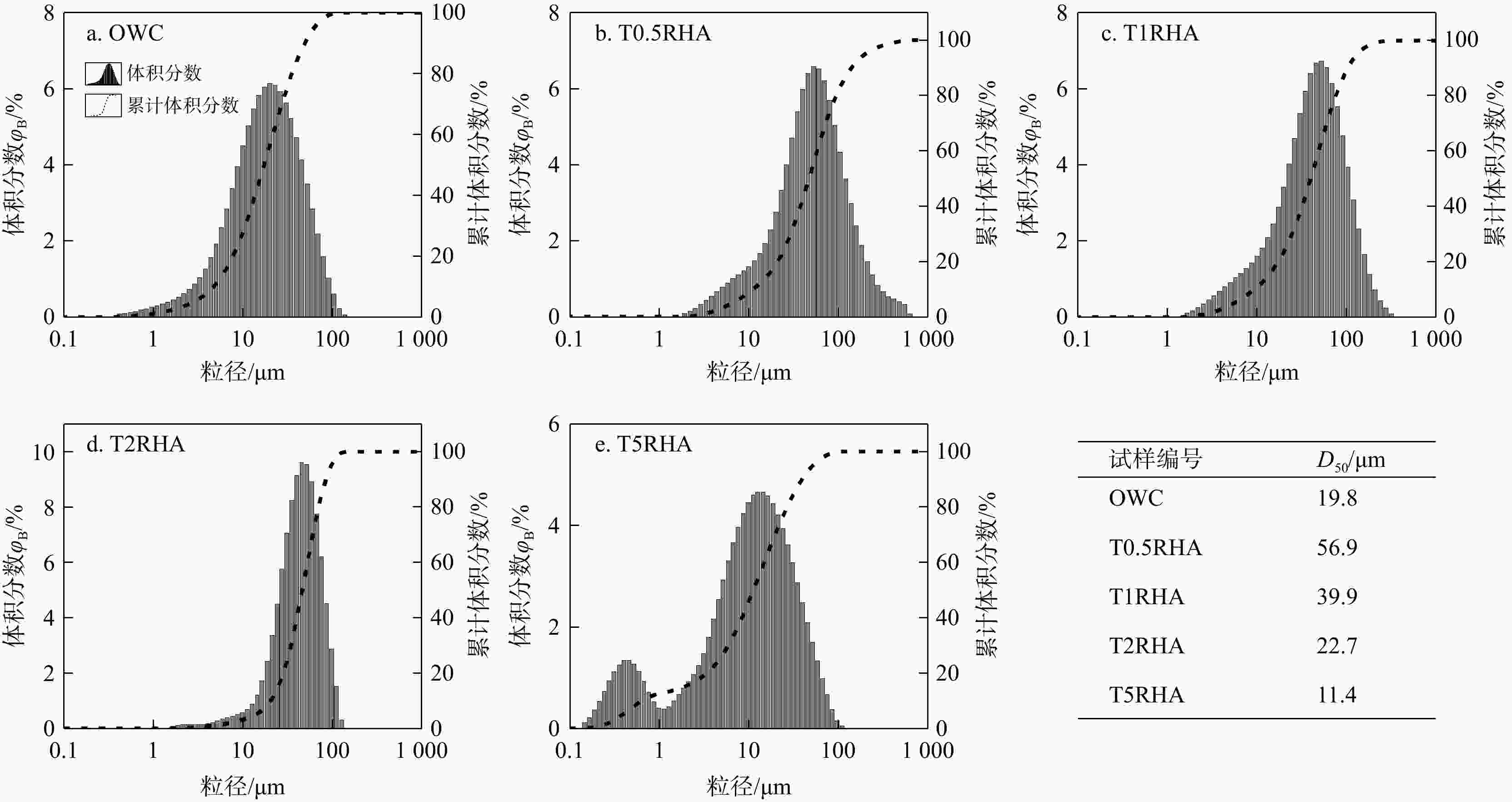
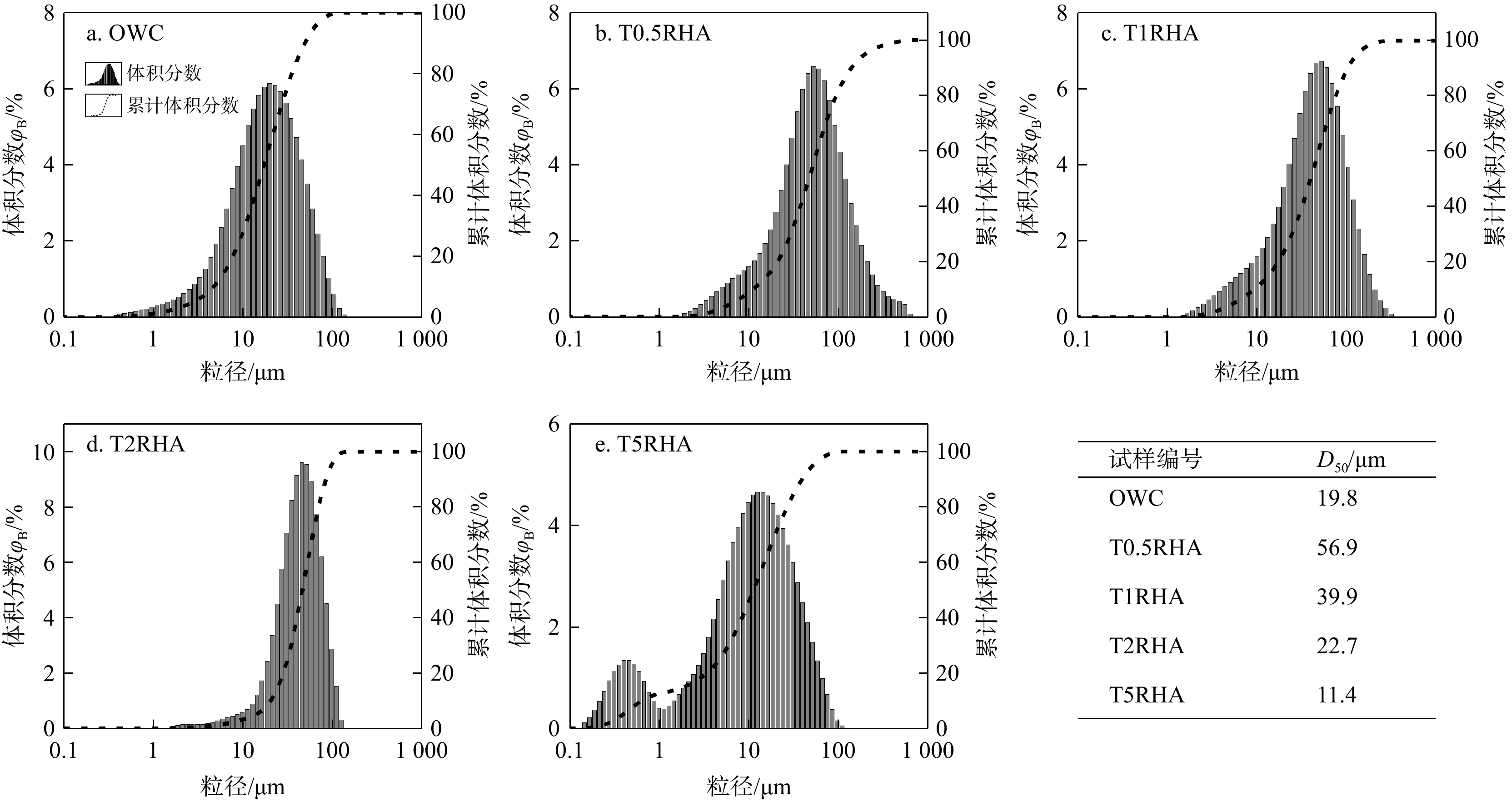
图 2 OWC、T0.5RHA、T1RHA、T2RHA和T5RHA的粒径分布图
T0.5RHA,T1RHA,T2RHA和T5RHA分别为原始灰烬粉磨0.5,1,2和5 min时制得的不同粒径RHA试样;D50为中位粒径;下同
Figure 2. Particle size distributions of OWC, T0.5RHA, T1RHA, T2RHA, and T5RHA
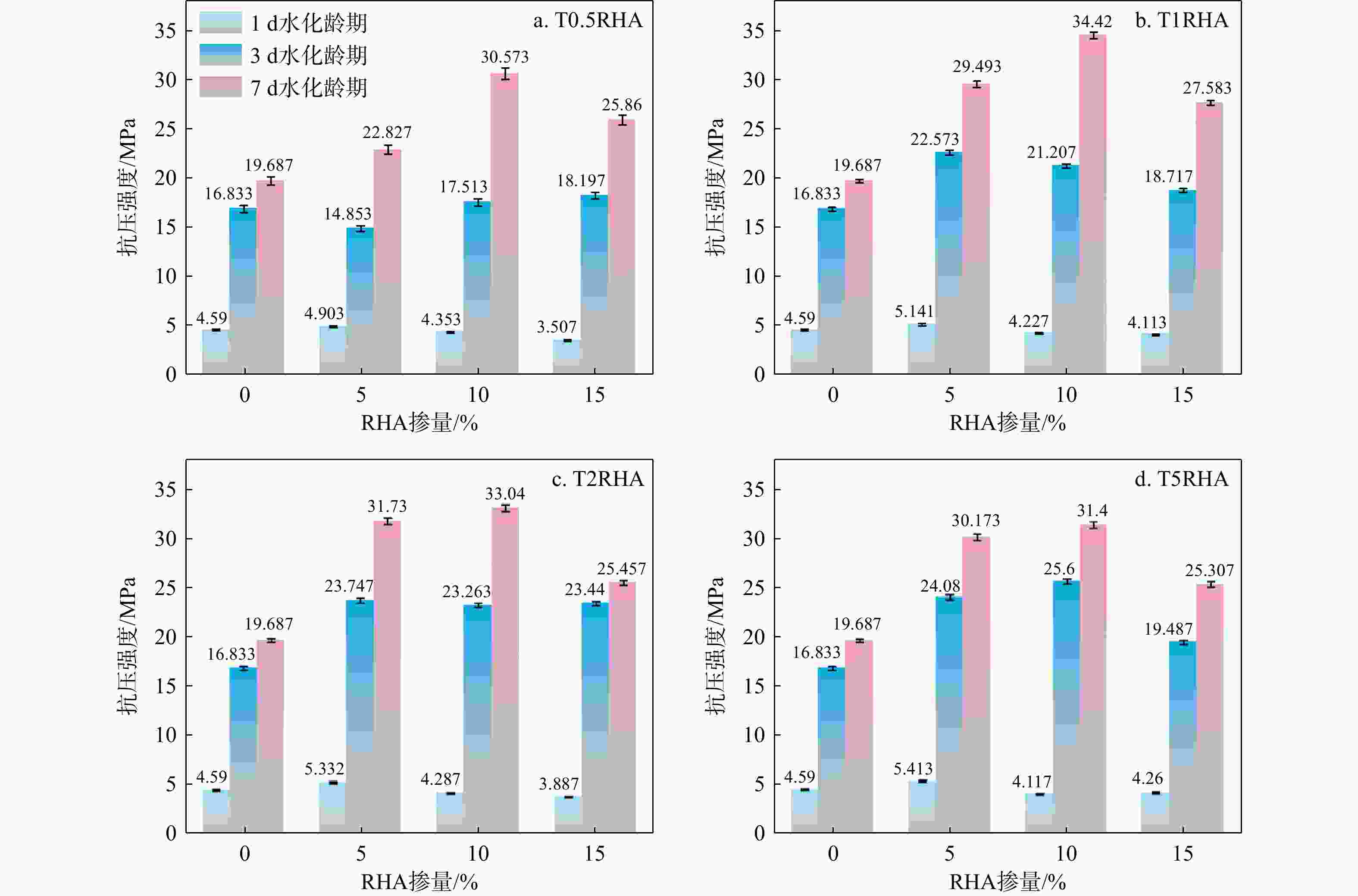
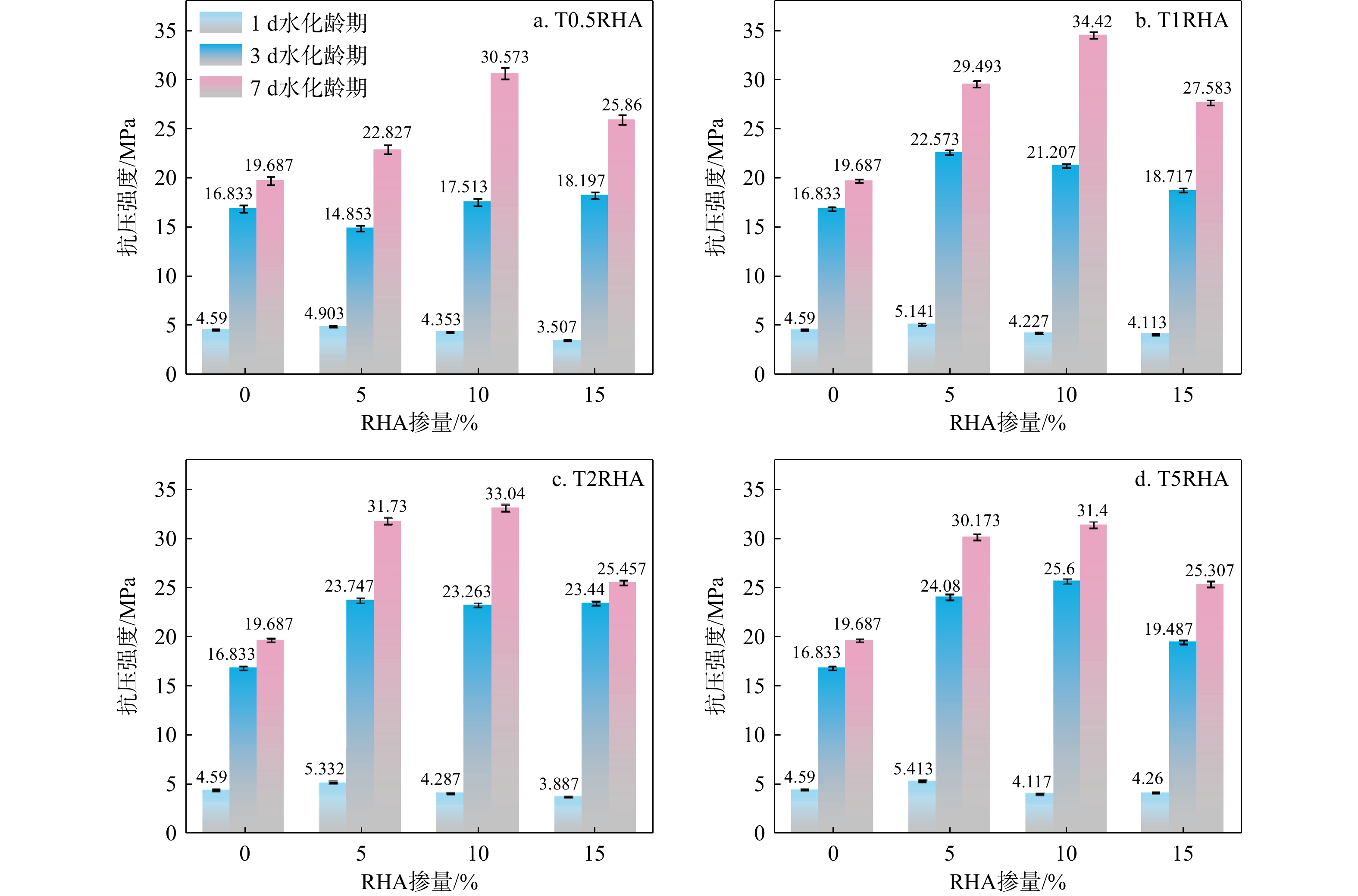
图 3 1,3,7 d水化龄期不同粒径及掺量RHA对油井水泥抗压强度的影响
Figure 3. Compressive strength of oil-well cement blended with RHA of different particle sizes and dosages at hydration ages of 1, 3, 7 d
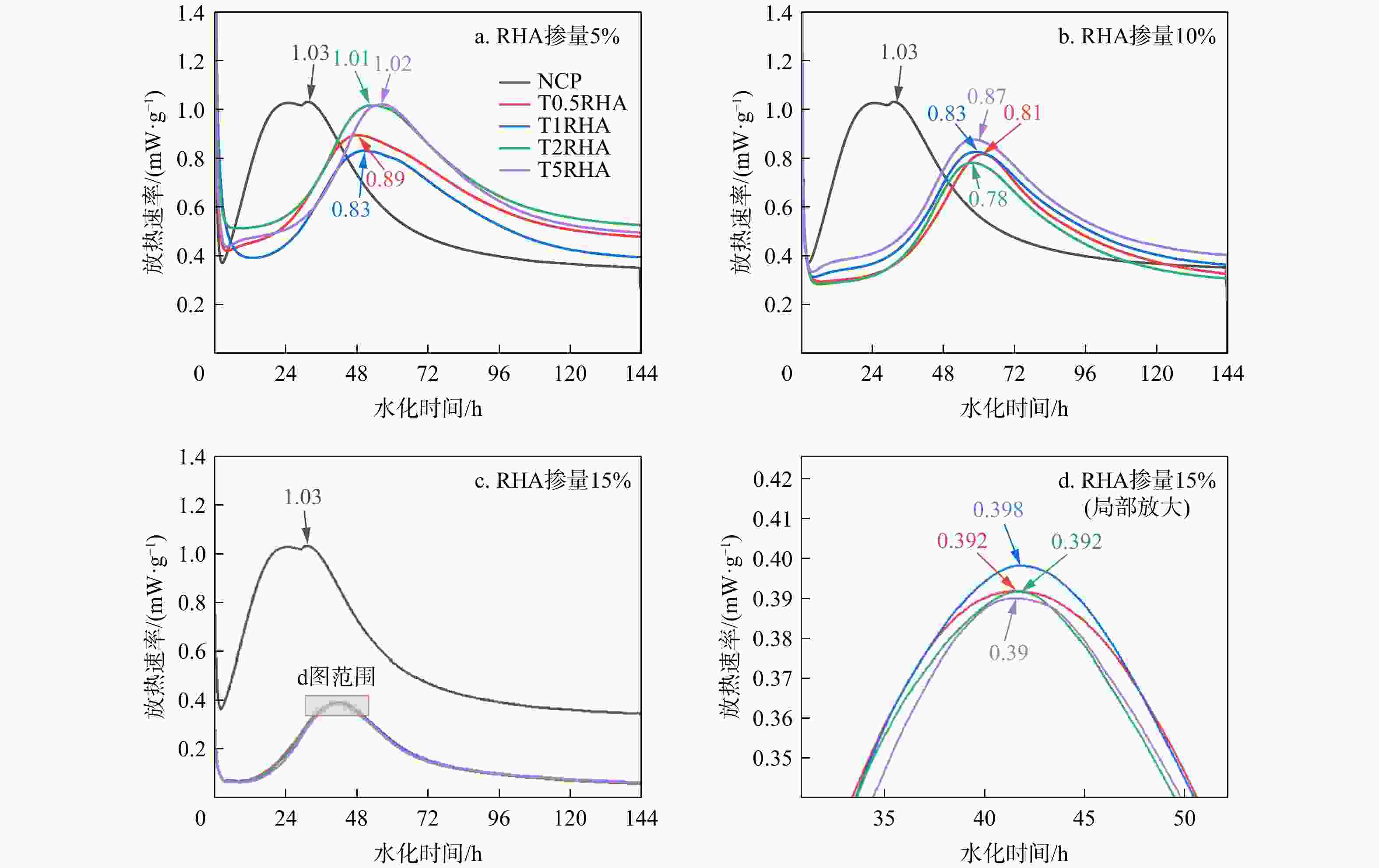
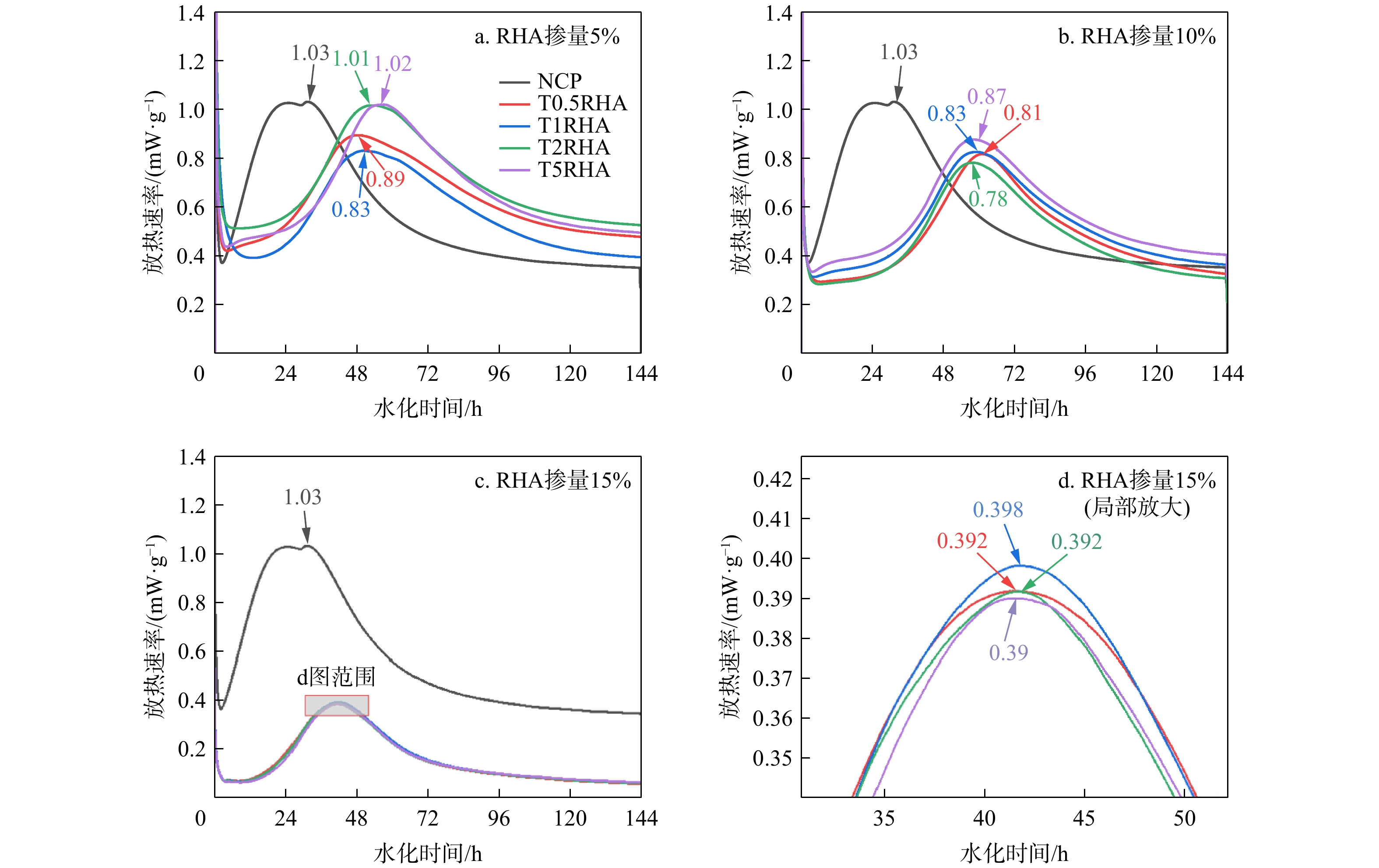
图 4 不同粒径与掺量 RHA 改性油井水泥浆的水化放热曲线
Figure 4. Hydration heat evolution curves of oil-well cement paste blended with RHA of different particle sizes and dosages
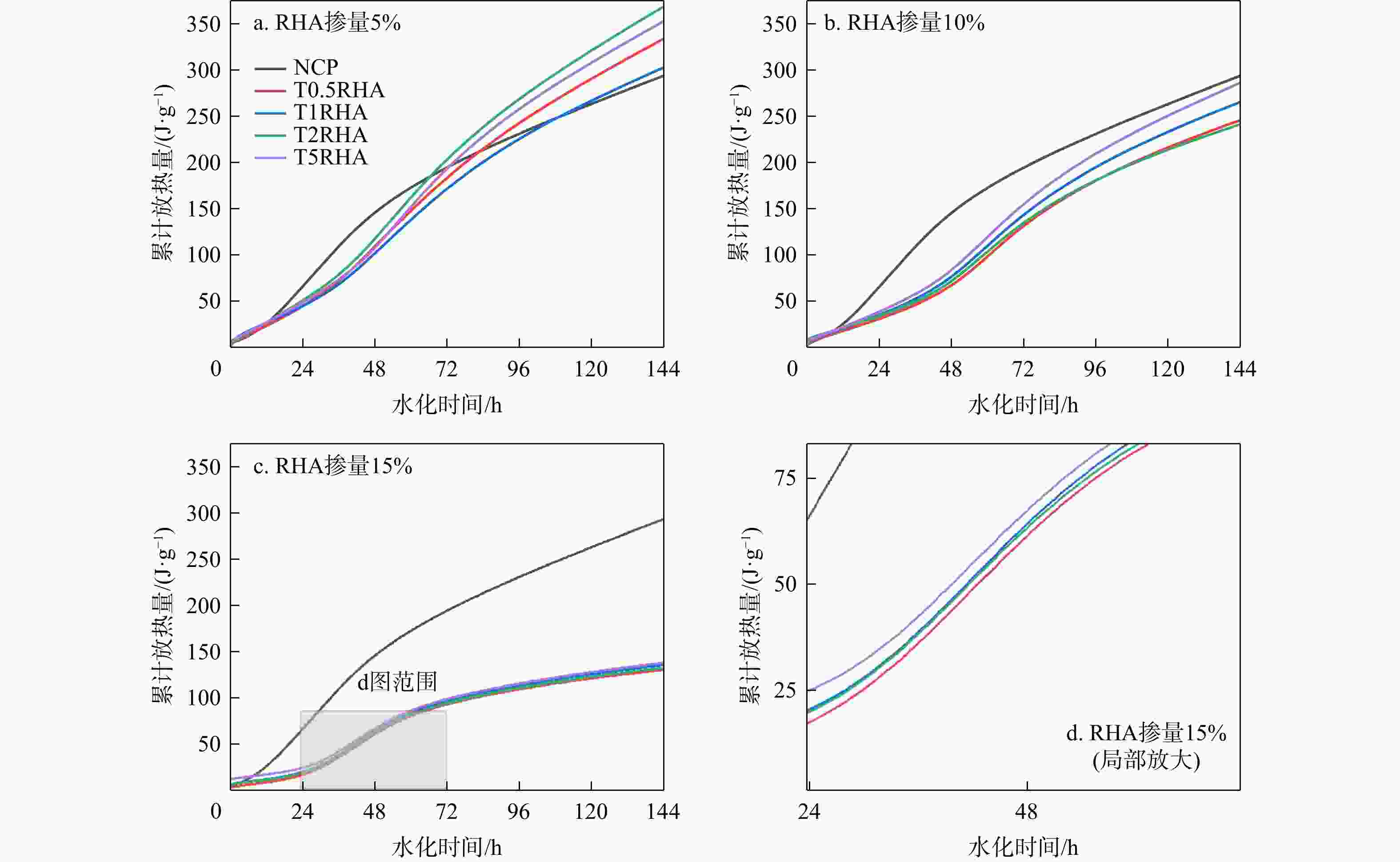
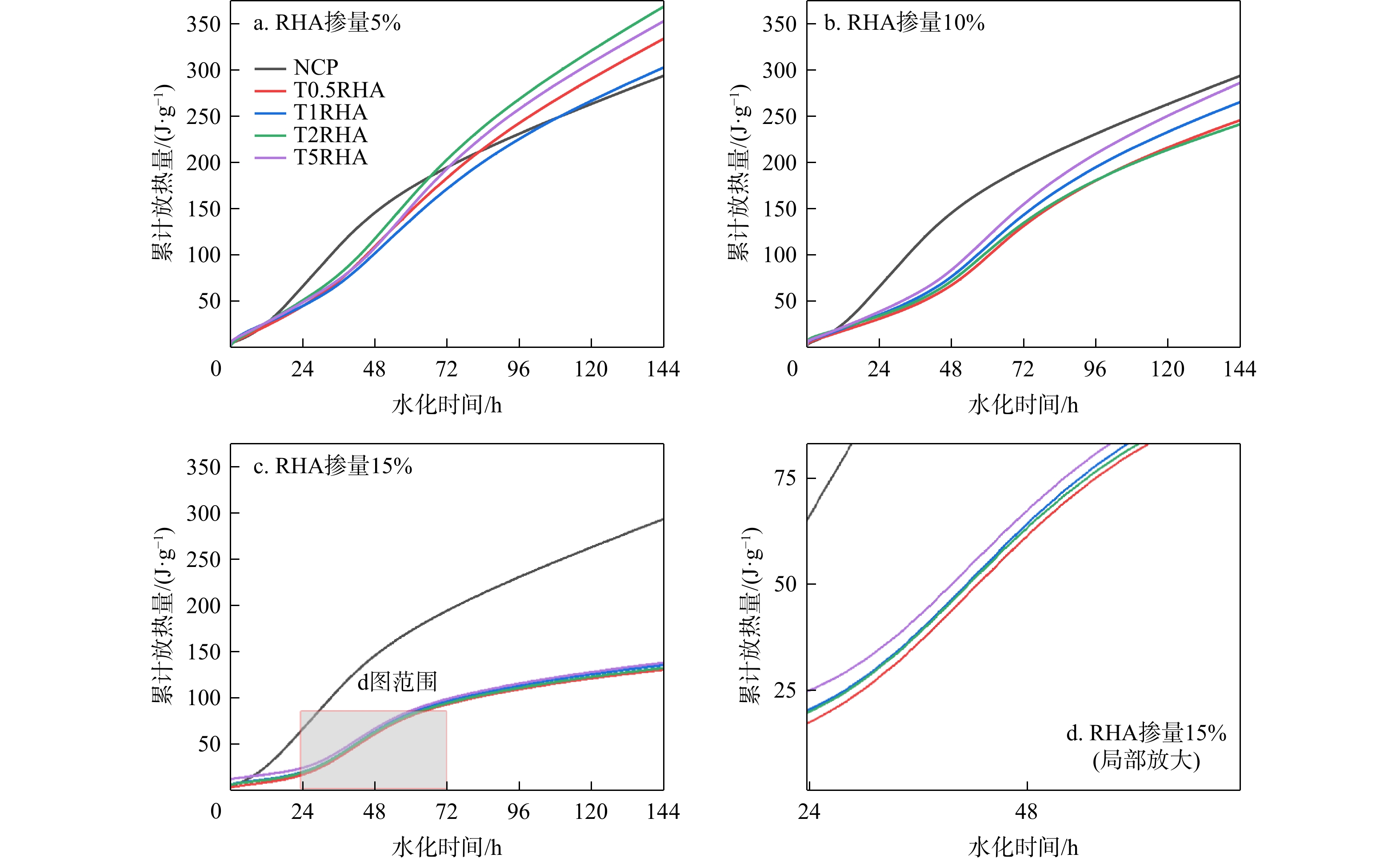
图 5 不同粒径与掺量RHA改性油井水泥浆的累计放热量曲线
Figure 5. Cumulative hydration heat curves of oil-well cement paste blended with RHA of different particle sizes and dosages
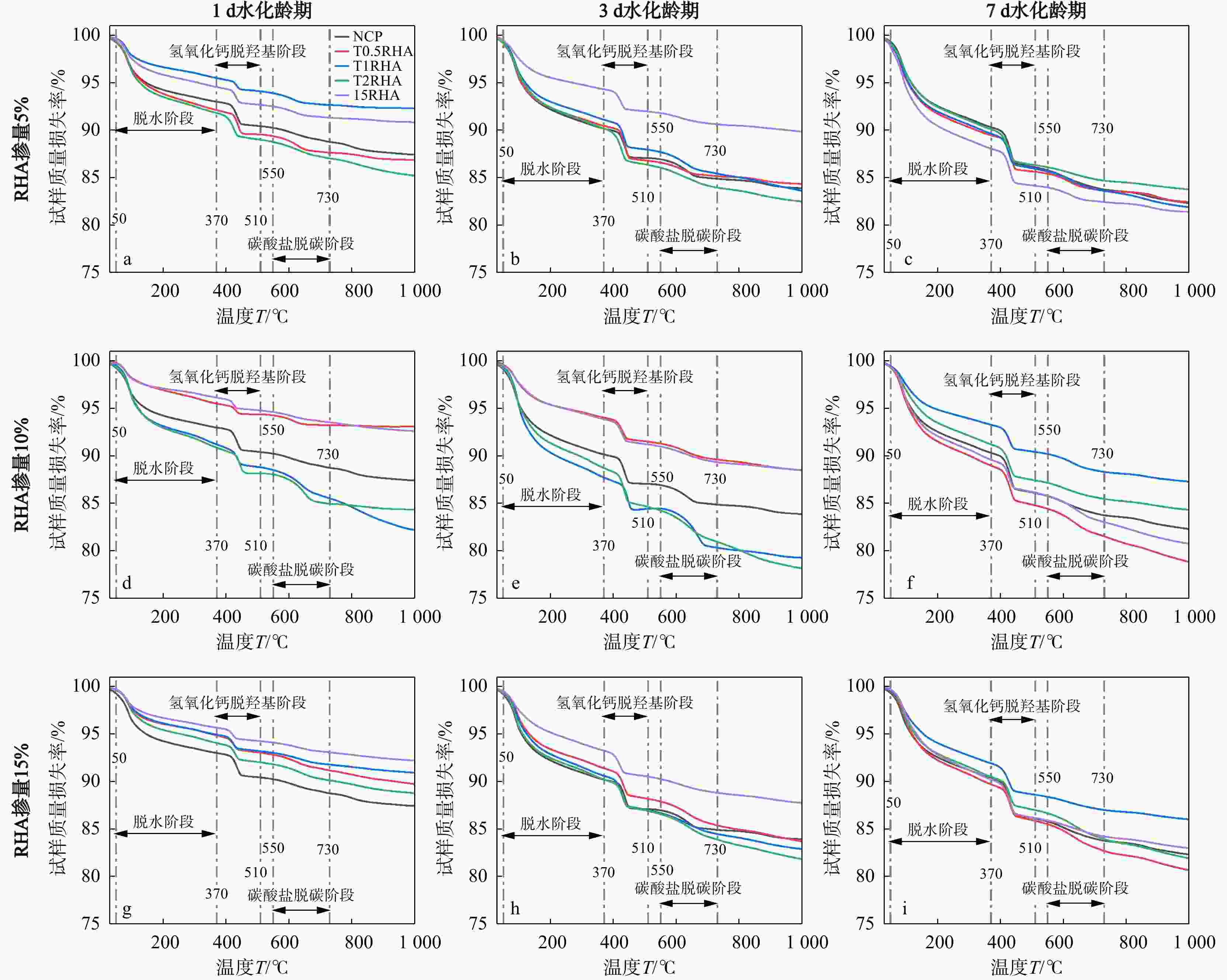
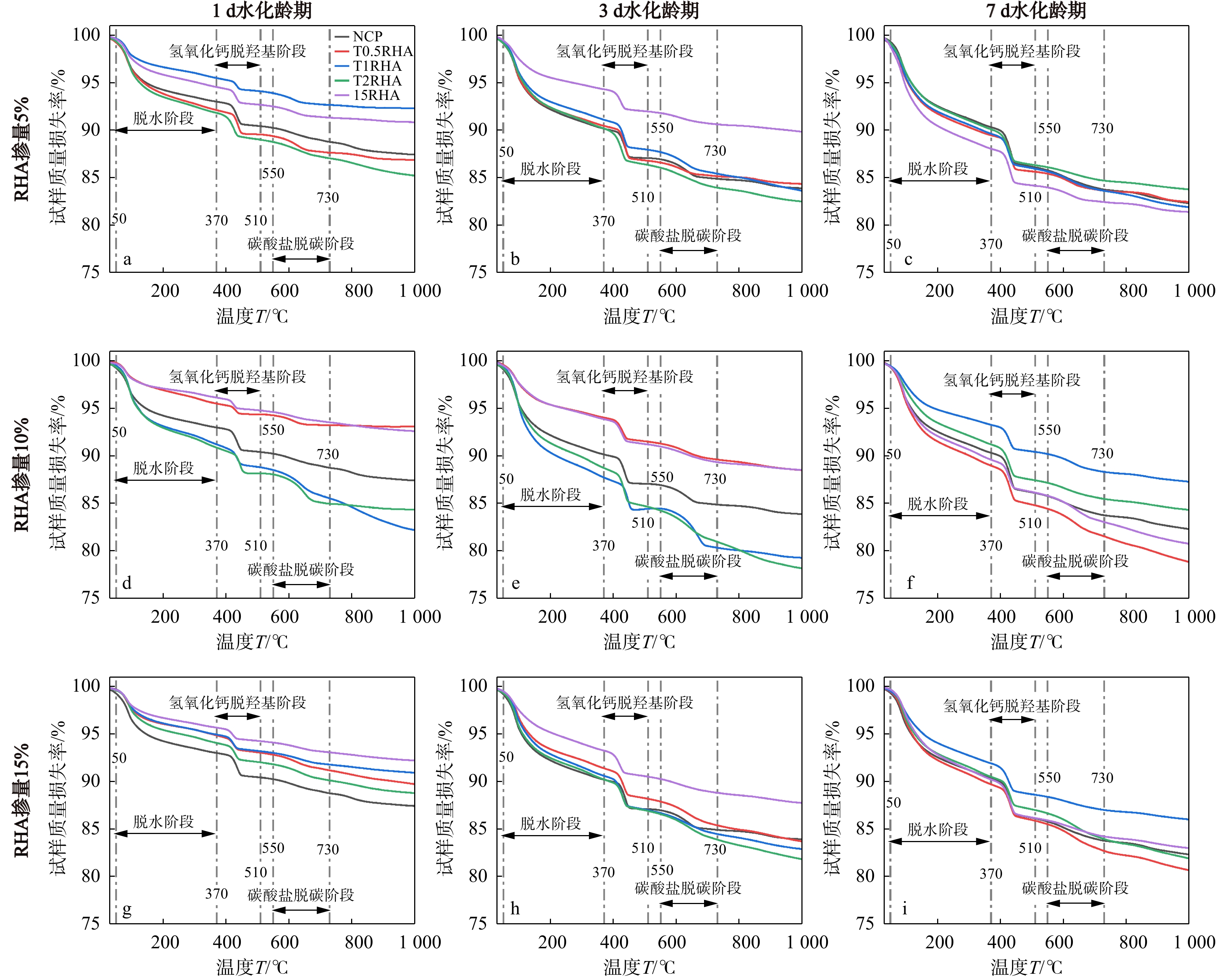
图 6 不同粒径及掺量 RHA 改性油井水泥石养护 1,3,7 d 的热重分析( TG )曲线
Figure 6. Thermogravimetric (TG) curves of RHA-modified oil-well cement pastes with different particle sizes and dosages cured for 1, 3 and 7 d
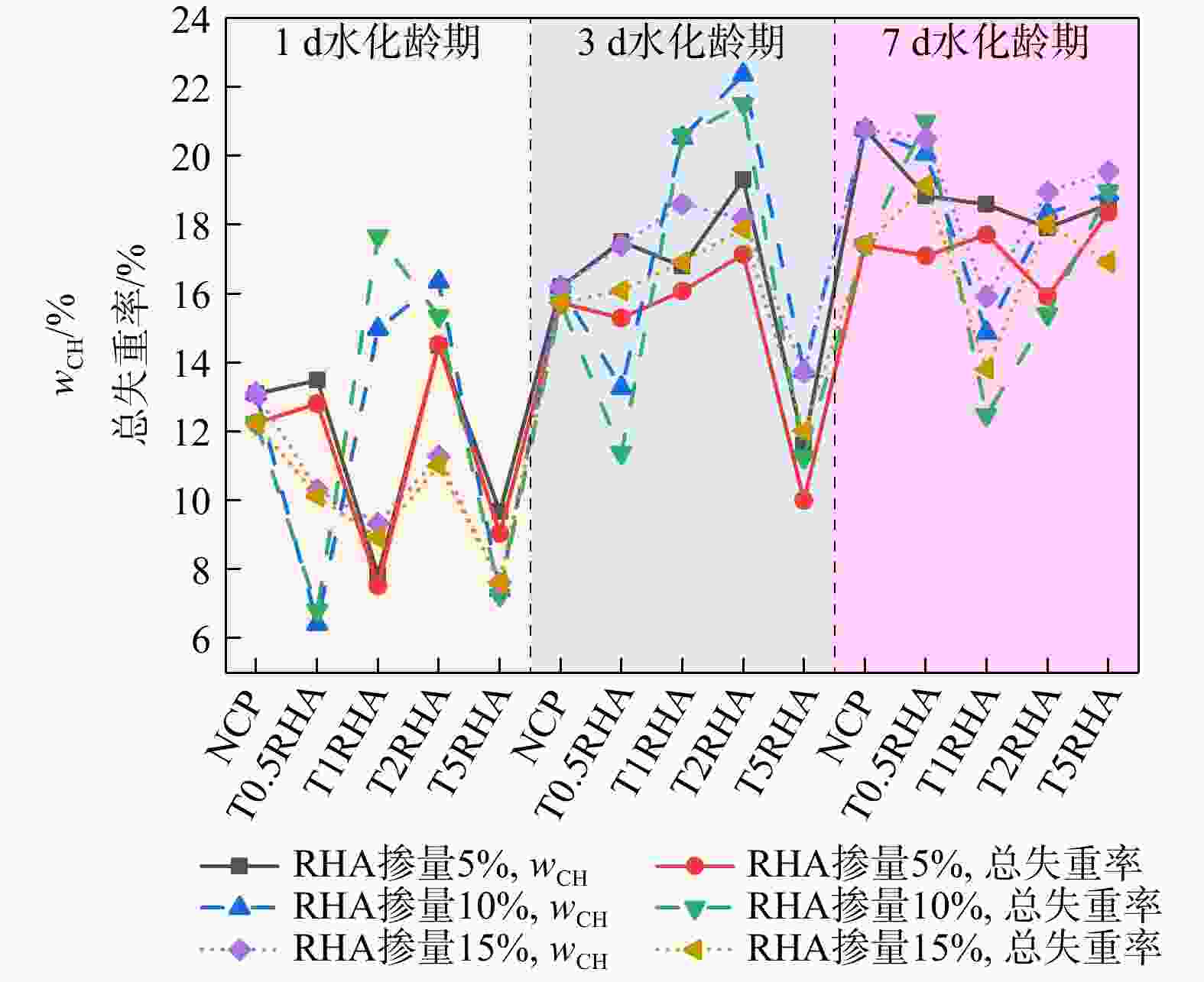
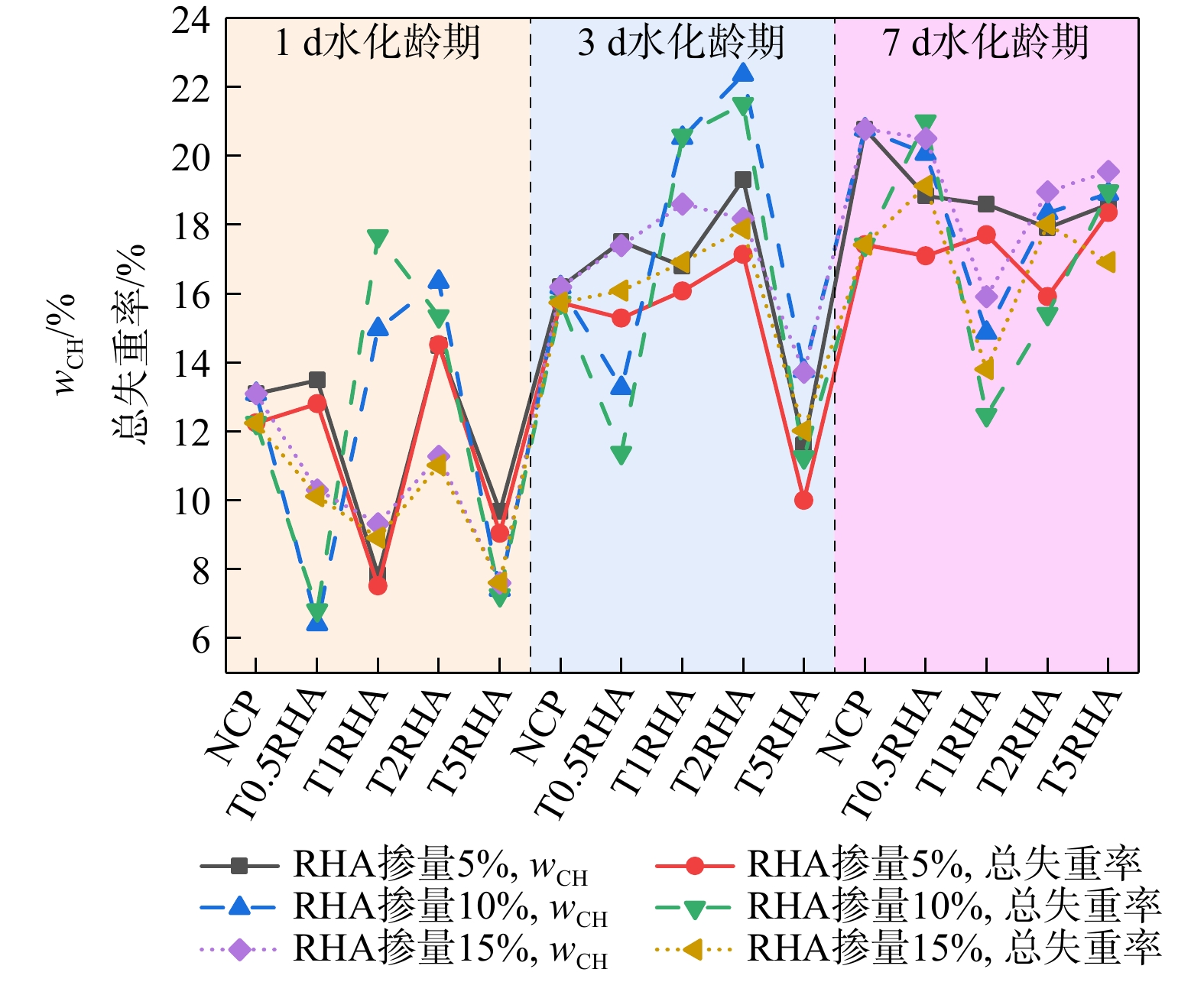
图 7 水泥试样在不同龄期的总失重率及等效CH质量分数wCH
Figure 7. Total weight loss and equivalent CH content of cement samples at different curing ages
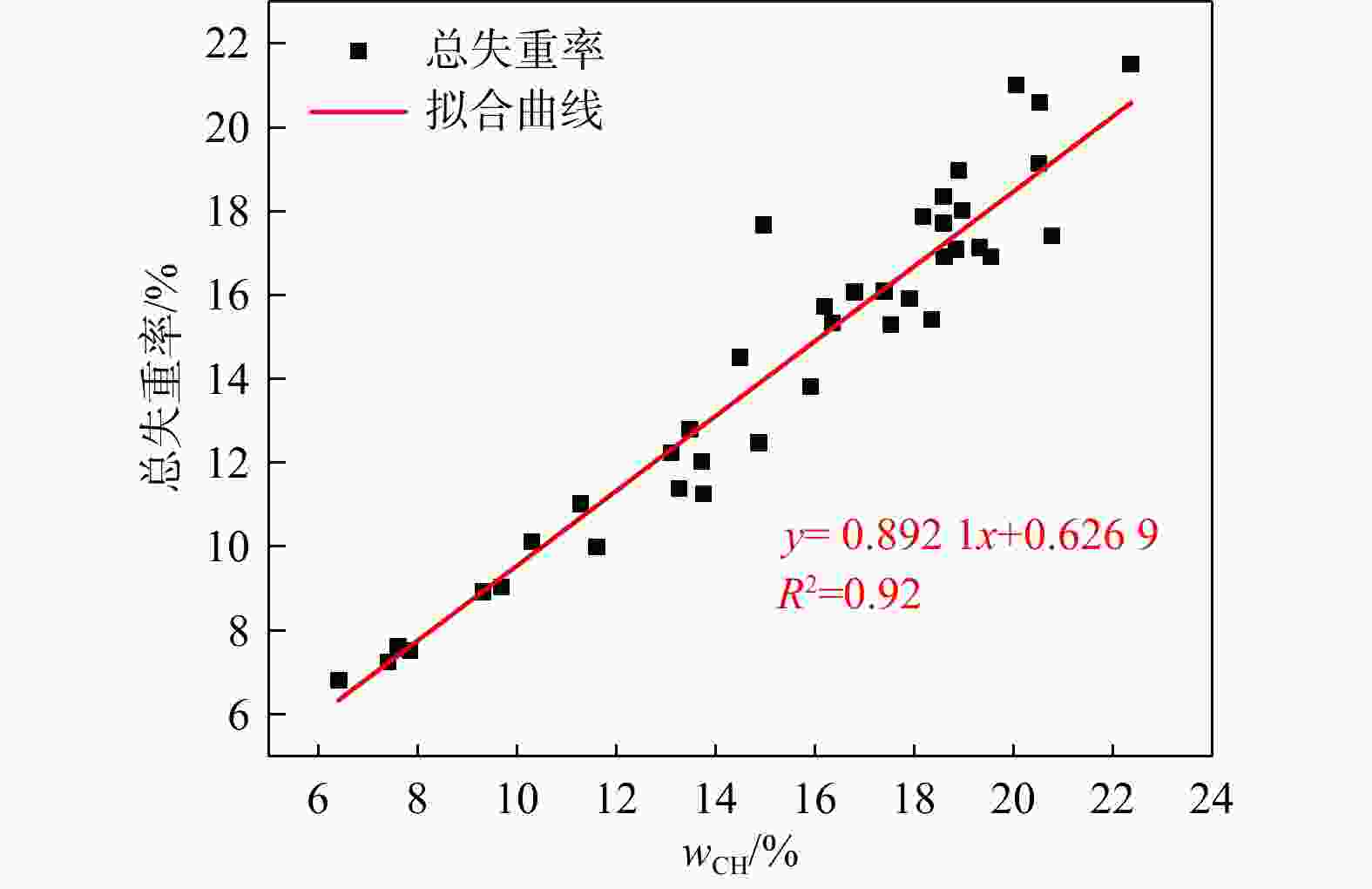
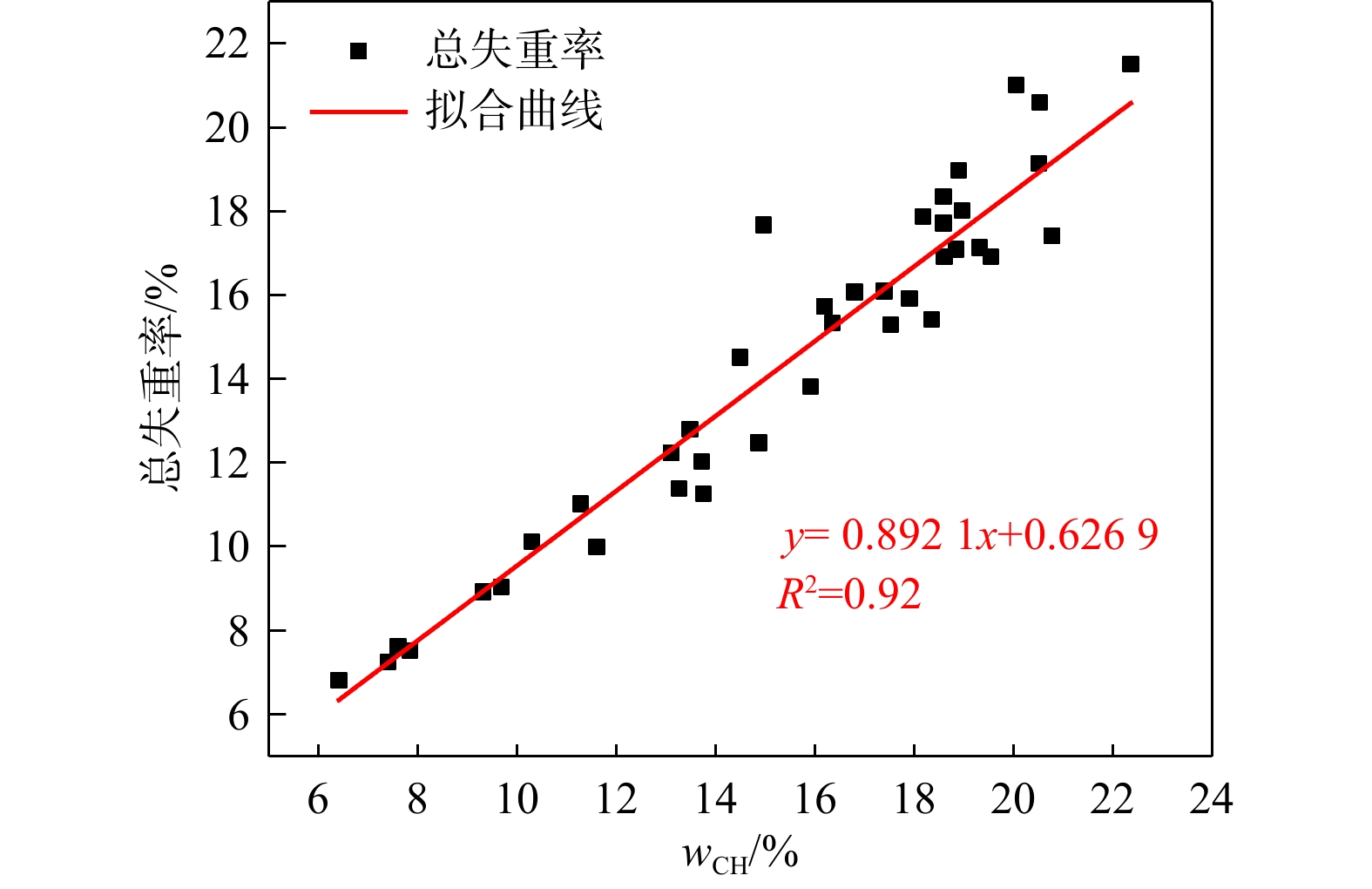
图 8 水泥试样的总失重率与等效CH质量分数wCH的关系
Figure 8. Relationship between total weight loss and equivalent CH content of cement samples
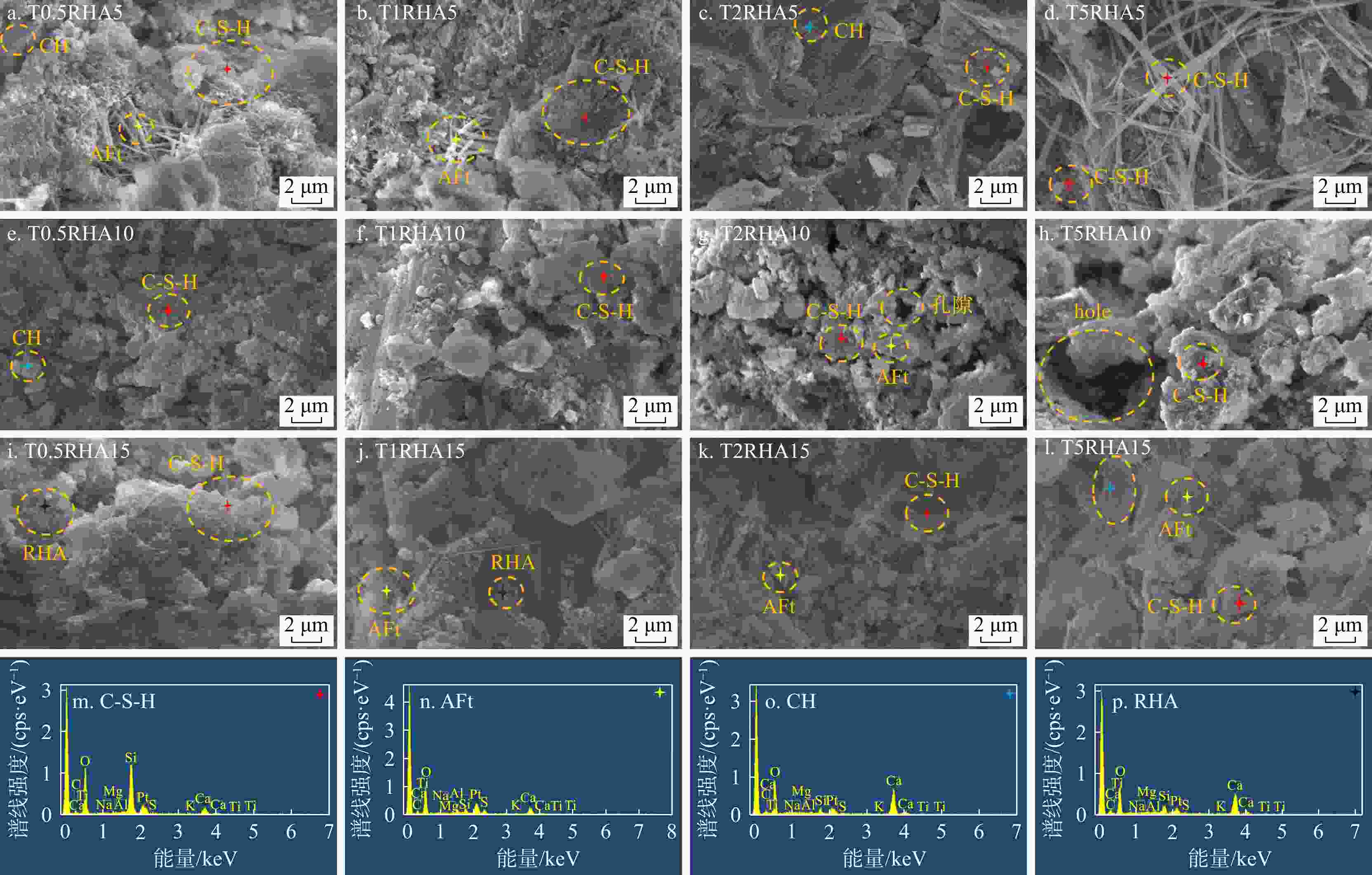
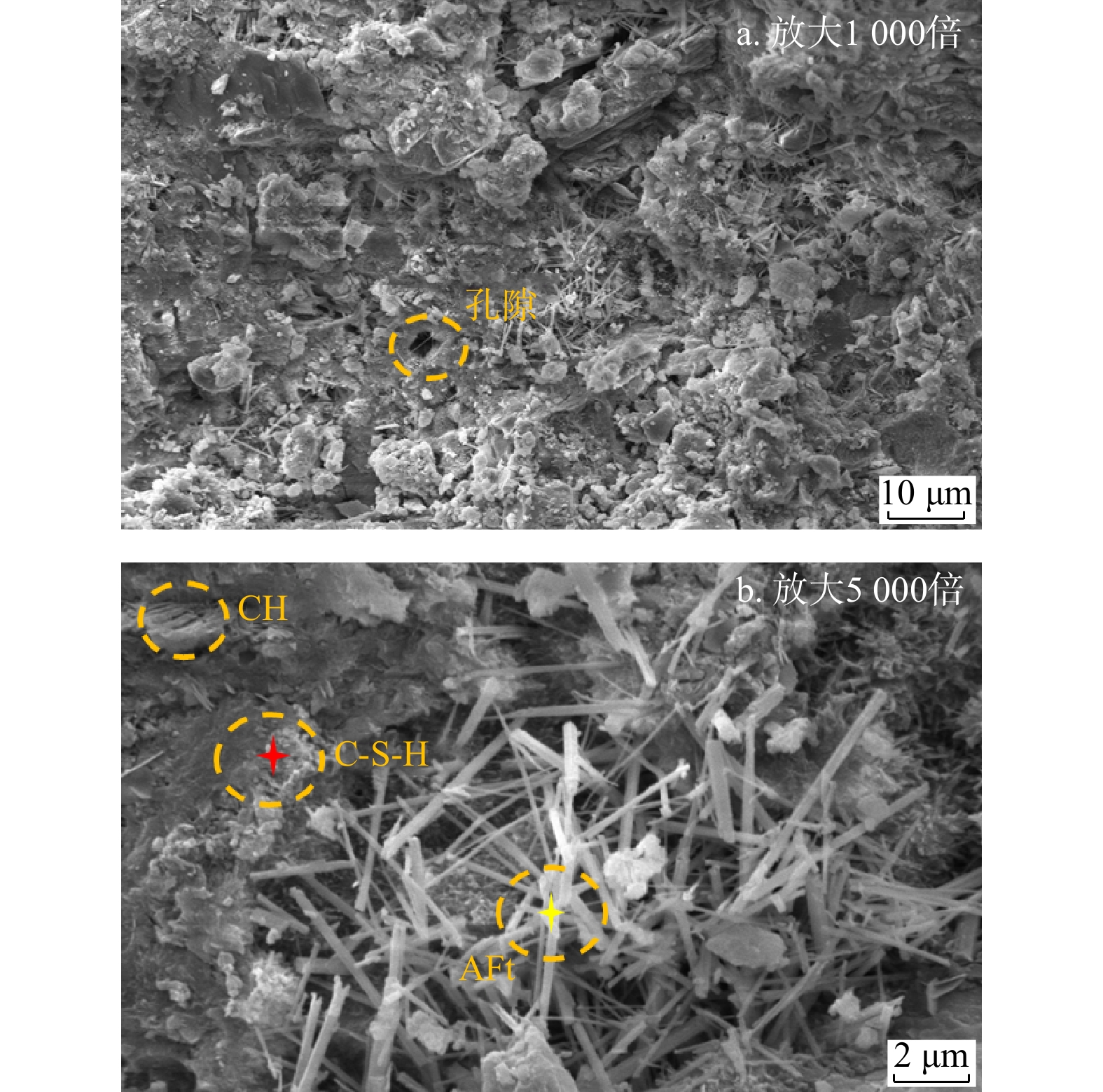
图 10 不同粒径及掺量 RHA改性油井水泥的SEM-EDS结果
Figure 10. SEM-EDS results of oil-well cement pastes modified by RHA with different particle sizes and dosages
表 1 G级油井水泥(OWC)和稻壳灰(RHA)的化学组成
Table 1. Chemical compositions of Class G oil well cement (OWC) and rice husk ash (RHA)
wB/% 氧化物 CaO SiO2 Al2O3 Fe2O3 MgO K2O SO3 Na2O 烧失量 OWC 62.53 21.17 3.93 4.75 2.33 0.58 2.94 0.27 1.50 RHA 0.96 93.80 0.118 0.26 0.34 3.36 0.15 0.07 0.942  下载: 导出CSV
表 2 实验中使用外加剂的类型和基本性质
Table 2. Types and basic properties of admixtures used in experiment
名称 型号 密度/(g·cm−3) pH 颜色及形态 消泡剂 X60 1.0 6~8 无色透明液体 减水剂 J-103 1.1 白色粉末 降失水剂 G86 1.08 5~6 淡黄色粘稠液体
下载: 导出CSV
表 3 不同粒径RHA水泥浆的材料配比
Table 3. Material proportions of cement slurries with different RHA particle sizes
试样编号 OWC RHA X60 J-103 G86 水固比 wB/% 质量配比因子 NCP 100 0 1 1 2 0.44 T0.5RHA5 95 5 T0.5RHA10 90 10 T0.5RHA15 85 15 T1RHA5 95 5 T1RHA10 90 10 T1RHA15 85 15 T2RHA5 95 5 T2RHA10 90 10 T2RHA15 85 15 T5RHA5 95 5 T5RHA10 90 10 T5RHA15 85 15 注:NCP为纯水泥浆;T0.5RHA5,T0.5RHA10,T0.5RHA15分别对应T0.5RHA掺量为 5%,10%,15% 的油井水泥试样;T1RHA5,T1RHA10,T1RHA15分别对应T1RHA掺量为 5%,10%,15% 的油井水泥试样;T2RHA5,T2RHA10,T2RHA15分别对应T2RHA掺量为 5%,10%,15% 的油井水泥试样;T5RHA5,T5RHA10,T5RHA15分别对应T5RHA掺量为 5%,10%,15% 的油井水泥试样;下同
下载: 导出CSV
-
[1] LI H Y, ZHANG M, LAU H C, et al. China's deepwater development: Subsurface challenges and opportunities[J]. Journal of Petroleum Science and Engineering, 2020, 195: 107761. doi: 10.1016/j.petrol.2020.107761 [2] 范春花, 王英民, 刘豪. 浅海陆架沉积特征研究综述[J]. 地质科技情报, 2013, 32(2): 29-34.FAN C H, WANG Y M, LIU H. A review of shallow continental shelf sedimentary characteristics[J]. Geological Science and Technology Information, 2013, 32(2): 29-34. (in Chinese with English abstract) [3] 廖雪妍, 成怀刚, 钱阿妞, 等. 电石渣循环利用碳减排潜力及其生命周期评价研究进展[J]. 洁净煤技术, 2024, 30(4): 157-170. doi: 10.13226/j.issn.1006-6772.ZPF24022801LIAO X Y, CHENG H G, QIAN A N, et al. Carbon emission reduction potential and life cycle assessment of calcium carbon slag utilisation[J]. Clean Coal Technology, 2024, 30(4): 157-170. (in Chinese with English abstract) doi: 10.13226/j.issn.1006-6772.ZPF24022801 [4] 施麟芸, 匡敬忠, 刘松柏. 尾矿制备辅助胶凝材料的潜能与机制评述[J]. 建筑材料学报, 2024, 27(10): 922-930. doi: 10.3969/j.issn.1007-9629.2024.10.007SHI L Y, KUANG J Z, LIU S B. Review on potential and mechanism of supplementary cementitious materials prepared by tailings[J]. Journal of Building Materials, 2024, 27(10): 922-930. (in Chinese with English abstract) doi: 10.3969/j.issn.1007-9629.2024.10.007 [5] 范炜, 刘国超, 陈龙辉, 等. 玉米秸秆灰柠檬酸改性处理对水泥基材料主要理化性能的影响[J]. 复合材料学报, 2024, 41(12): 6671-6680. doi: 10.13801/j.cnki.fhclxb.20240325.002FAN W, LIU G C, CHEN L H, et al. Effects if corn straw ash citric acid modification treatment on the main physicochemical properties of cement-based materials[J]. Acta Materiae Compositae Sinica, 2024, 41(12): 6671-6680. (in Chinese with English abstract) doi: 10.13801/j.cnki.fhclxb.20240325.002 [6] 郑山锁, 胡锦华, 张欣, 等. 绿色高性能纤维混凝土力学性能试验研究[J]. 湖南大学学报(自然科学版), 2024, 51(9): 155-164.ZHENG S S, HU J H, ZHANG X, et al. Experimental study on mechanical properties of green high performance fiber reinforced concrete[J]. Journal of Hunan University (Natural Sciences), 2024, 51(9): 155-164. (in Chinese with English abstract) [7] SCRIVENER K L, JOHN V M, GARTNER E M. Eco-efficient cements: Potential economically viable solutions for a low-CO2 cement-based materials industry[J]. Cement and Concrete Research, 2018, 114: 2-26. doi: 10.1016/j.cemconres.2018.03.015 [8] ALNAHHAL M F, KIM T, HAJIMOHAMMADI A. Waste-derived activators for alkali-activated materials: A review[J]. Cement and Concrete Composites, 2021, 118: 103980. doi: 10.1016/j.cemconcomp.2021.103980 [9] DI FILIPPO J, KARPMAN J, DESHAZO J R. The impacts of policies to reduce CO2 emissions within the concrete supply chain[J]. Cement and Concrete Composites, 2019, 101: 67-82. doi: 10.1016/j.cemconcomp.2018.08.003 [10] JUNG H, FRIGAARD I A. Evaluation of common cementing practices affecting primary cementing quality[J]. Journal of Petroleum Science and Engineering, 2022, 208: 109622. doi: 10.1016/j.petrol.2021.109622 [11] ALTHOEY F, ANSARI W S, SUFIAN M, et al. Advancements in low-carbon concrete as a construction material for the sustainable built environment[J]. Developments in the Built Environment, 2023, 16: 100284. doi: 10.1016/j.dibe.2023.100284 [12] 姚韦靖, 刘宜思, 庞建勇, 等. 硫酸盐侵蚀下掺稻壳灰混凝土的劣化性能及损伤模型[J]. 复合材料学报, 2022, 39(10): 4813-4823. doi: 10.13801/j.cnki.fhclxb.20210923.001YAO W J, LIU Y S, PANG J Y, et al. Performance degradation and damage model of concrete incorporating rice husk ash under sulfate attack[J]. Acta Materiae Compositae Sinica, 2022, 39(10): 4813-4823. doi: 10.13801/j.cnki.fhclxb.20210923.001 [13] 张广泰, 杨宇鹏. 硫酸盐环境下掺稻壳灰和锂渣的混凝土性能劣化及寿命预测[J]. 复合材料学报, 2026, 43(4): 2336-2348.ZHANG G T, YANG Y P. Performance deterioration and life prediction of concrete mixed with rice husk ash and lithium slag under sulfate environment[J]. Acta Materiae Compositae Sinica, 2026, 43(4): 2336-2348. (in Chinese with English abstract) [14] ZHANG Q L, LIU B, FENG Y, et al. Mechanism development of strength contributed by CPB with rice husk ash[J]. Journal of Central South University, 2024, 31(5): 1608-1618. doi: 10.1007/s11771-024-5648-x [15] 解国梁, 梁社, 徐洪斌, 等. 稻壳灰对水泥基材料的影响研究综述[J]. 混凝土, 2025(11): 103-108. doi: 10.3969/j.issn.1002-3550.2025.11.017XIE G L, LIANG S, XU H B, et al. Review of research on the effect of rice husk ash on cementitious materials[J]. Concrete, 2025(11): 103-108. (in Chinese with English abstract) doi: 10.3969/j.issn.1002-3550.2025.11.017 [16] 孙庆文, 许珂敬, 郭彦青. 高活性稻壳灰的制备、提纯及应用的研究进展[J]. 中国陶瓷, 2012, 48(7): 1-6. doi: 10.16521/j.cnki.issn.1001-9642.2012.07.029SUN Q W, XU K J, GUO Y Q. Research progress of the preparation, purification and application of high activity rice husk ash[J]. China Ceramics, 2012, 48(7): 1-6. (in Chinese with English abstract) doi: 10.16521/j.cnki.issn.1001-9642.2012.07.029 [17] CHOPRA D, SIDDIQUE R, KUNAL. Strength, permeability and microstructure of self-compacting concrete containing rice husk ash[J]. Biosystems Engineering, 2015, 130: 72-80. doi: 10.1016/j.biosystemseng.2014.12.005 [18] MUTHADHI A, KOTHANDARAMAN S. Experimental investigations of performance characteristics of rice husk ash-blended concrete[J]. Journal of Materials in Civil Engineering, 2013, 25(8): 1115-1118. doi: 10.1061/(ASCE)MT.1943-5533.0000656 [19] RAJASHEKHAR REDDY K, HARIHANANDH M, MURALI K. Strength performance of high-grade concrete using rice husk ash (RHA) as cement replacement material[J]. Materials Today: Proceedings, 2021, 46: 8822-8825. doi: 10.1016/j.matpr.2021.04.332 [20] HU L L, HE Z, ZHANG S P. Sustainable use of rice husk ash in cement-based materials: Environmental evaluation and performance improvement[J]. Journal of Cleaner Production, 2020, 264: 121744. doi: 10.1016/j.jclepro.2020.121744 [21] IFTIKHAR B, ALIH S C, VAFAEI M, et al. Predictive modeling of compressive strength of sustainable rice husk ash concrete: Ensemble learner optimization and comparison[J]. Journal of Cleaner Production, 2022, 348: 131285. doi: 10.1016/j.jclepro.2022.131285 [22] GARRETT T D, CARDENAS H E, LYNAM J G. Sugarcane bagasse and rice husk ash pozzolans: Cement strength and corrosion effects when using saltwater[J]. Current Research in Green and Sustainable Chemistry, 2020, 1: 7-13. doi: 10.1016/j.crgsc.2020.04.003 [23] 吕阳, 吴远帅, 葛云露, 等. 稻壳灰与SAP协同内养护对碱激发矿渣胶凝材料性能的影响[J]. 硅酸盐通报, 2025, 44(2): 634-641. doi: 10.16552/j.cnki.issn1001-1625.20241118.004LYU Y, WU Y S, GE Y L, et al. Effect of synergistic internal curing by rice husk ash and SAP on properties of alkali-activated slag cementitious materials[J]. Bulletin of the Chinese Ceramic Society, 2025, 44(2): 634-641. (in Chinese with English abstract) doi: 10.16552/j.cnki.issn1001-1625.20241118.004 [24] SUOMIE R W, MISHRA B P, DAS S. Performance of rice husk ash (RHA) and recycled coarse aggregate (RCA) for sustainable concrete: A review[J]. Next Materials, 2025, 8: 100778. doi: 10.1016/j.nxmate.2025.100778 [25] 侯永强, 尹升华, 王雷鸣, 等. 粉煤灰−稻壳灰基胶结充填体的力学性能、微观结构及参数优化[J]. 中国矿业, 2025, 34(8): 178-189.HOU Y Q, YIN S H, WANG L M, et al. Mechanical properties, microstructure and parameter optimization of fly ash-rice husk ash cement backfill[J]. China Mining Magazine, 2025, 34(8): 178-189. (in Chinese with English abstract) [26] 高鹏, 倪庄, 董伟, 等. 稻壳灰粒径对碱矿渣混凝土中碱-硅酸反应的抑制机理[J]. 材料导报, 2025, 39(24): 99-105.GAO P, NI Z, DONG W, et al. Inhibition mechanism of rice husk ash particle size on alkali-silica reaction in alkali-activated slag concrete[J]. Materials Reports, 2025, 39(24): 99-105. (in Chinese with English abstract) [27] VAN V T A, RÖßLER C, BUI D D, et al. Mesoporous structure and pozzolanic reactivity of rice husk ash in cementitious system[J]. Construction and Building Materials, 2013, 43: 208-216. doi: 10.1016/j.conbuildmat.2013.02.004 [28] 邓超. 水泥颗粒形貌及粒径分布对水化反应过程的影响[D]. 重庆: 重庆大学, 2017.DENG C. The effects of cement particle shape and size distribution on hydration process[D]. Chongqing: Chongqing University, 2017. (in Chinese with English abstract) [29] 吴浪, 吴小萍, 黄斯蕙铭, 等. 稻壳灰-水泥胶凝体系的水化动力学模型[J]. 功能材料, 2022, 53(5): 5178-5185. doi: 10.3969/j.issn.1001-9731.2022.05.023WU L, WU X P, HUANG S H M, et al. Hydrationkinetics model of rice husk ash-blended system[J]. Journal of Functional Materials, 2022, 53(5): 5178-5185. doi: 10.3969/j.issn.1001-9731.2022.05.023 [30] CORDEIRO G C, TOLEDO FILHO R D, DE MORAES REGO FAIRBAIRN E. Use of ultrafine rice husk ash with high-carbon content as pozzolan in high performance concrete[J]. Materials and Structures, 2009, 42(7): 983-992. doi: 10.1617/s11527-008-9437-z [31] JAMIL M, KHAN M N N, KARIM M R, et al. Physical and chemical contributions of rice husk ash on the properties of mortar[J]. Construction and Building Materials, 2016, 128: 185-198. doi: 10.1016/j.conbuildmat.2016.10.029 [32] 汤翟, 裴健翔, 赵军, 等. 南海深水超浅层含水合物气层测井识别与饱和度估算方法[J]. 地质科技通报, 2025, 44(6): 317-329.TANG Z, PEI J X, ZHAO J, et al. Logging identification and saturation estimation method for hydrate-bearing gas layers in the deep water and ultra-shallow strata of the South China Sea[J]. Bulletin of Geological Science and Technology, 2025, 44(6): 317-329. (in Chinese with English abstract) [33] 夏时宇, 陈进, 郑涪文, 等. 掺合料组合的水泥复合体系水化热特性研究[J/OL]. 长江科学院院报: 1-10(2025-12-08)[2026-05-18]. https://link.cnki.net/urlid/42.1171.TV.20251205.2004.008.XIA S Y, CHEN J, ZHENG F W, et al. Investigation into the evolutionary characteristics of hydration heat in cement composite systems incorporating blended material combinations[J/OL]. Journal of Yangtze River Scientific Research Institute: 1-10(2025-12-08)[2026-05-18]. https://link.cnki.net/urlid/42.1171.TV.20251205.2004.008. (in Chinese with English abstract) [34] MICHEL L, REITER L, SANNER A, et al. Structural build-up at rest in the induction and acceleration periods of Portland Cement[J]. Cement and Concrete Research, 2024, 186: 107665. doi: 10.1016/j.cemconres.2024.107665 [35] 官敏, 胡匡艺, 于涛, 等. 水泥矿物体系诱导期的水化进程及机理的研究进展[J]. 硅酸盐通报, 2021, 40(7): 2129-2137.GUAN M, HU K Y, YU T, et al. Research progress on understanding hydration process and its mechanism of cement mineral system during induction period[J]. Bulletin of the Chinese Ceramic Society, 2021, 40(7): 2129-2137. (in Chinese with English abstract) [36] ALI FARID S, ZAHEER M M. Production of new generation and sustainable concrete using rice husk ash (RHA): A review[J]. Materials Today:Proceedings, 2023, 8: 100778. [37] 全国水泥标准化技术委员会(SAC/TC 184). 油井水泥: GB/T10238-2015[S]. 北京: 中国标准出版社, 2015.National Cement Standardization Technical Committee (SAC/TC 184). Oil well cement: GB/T10238-2015[S]. Beijing: Standards Press of China, 2015. (in Chinese) [38] 郭家驹. 基于太赫兹光谱的水泥水化程度及其水化产物检测[D]. 哈尔滨: 哈尔滨工业大学, 2025.GUO J J. Detection of cement hydration degree and hydration products based on terahertz spectroscopy[D]. Harbin: Harbin Institute of Technology, 2025. (in Chinese with English abstract) [39] 覃源, 胡守彬, 周恒, 等. 聚丙烯纤维对再生砂浆力学性能及微观结构的影响[J]. 功能材料, 2025, 56(7): 7189-7199. doi: 10.3969/j.issn.1001-9731.2025.07.024QIN Y, HU S B, ZHOU H, et al. Effect of polypropylene fiber on mechanical properties and microstructure of recycled mortar[J]. Journal of Functional Materials, 2025, 56(7): 7189-7199. (in Chinese with English abstract) doi: 10.3969/j.issn.1001-9731.2025.07.024 [40] WANG C, CHAZALLON C, BRAYMAND S, et al. Thermogravimetric analysis (TGA) for characterization of self-cementation of recycled concrete aggregates in pavement[J]. Thermochimica Acta, 2024, 733: 179680. doi: 10.1016/j.tca.2024.179680 [41] LIU T L, ZHAO G R, QU B, et al. Characterization of a fly ash-based hybrid well cement under different temperature curing conditions for natural gas hydrate drilling[J]. Construction and Building Materials, 2024, 445: 137874. doi: 10.1016/j.conbuildmat.2024.137874 [42] 杨翔, 丁华柱, 白延平, 等. 纳米CaCO3对不同级配再生细骨料混凝土性能影响[J]. 建筑科学, 2023, 39(3): 57-64.YANG X, DING H Z, BAI Y P, et al. Effect of Nano-CaCO3 on properties of recycled fine aggregate concrete with different gradation[J]. Building Science, 2023, 39(3): 57-64. (in Chinese with English abstract) [43] SHA W. Differential scanning calorimetry study of the hydration products in Portland cement pastes with metakaolin replacement[M]. Amsterdam: Elsevier, 2002: 881-888. [44] BERNAL S A, PROVIS J L, WALKLEY B, et al. Gel nanostructure in alkali-activated binders based on slag and fly ash, and effects of accelerated carbonation[J]. Cement and Concrete Research, 2013, 53: 127-144. doi: 10.1016/j.cemconres.2013.06.007 [45] SONG H, JEONG Y, BAE S, et al. A study of thermal decomposition of phases in cementitious systems using HT-XRD and TG[J]. Construction and Building Materials, 2018, 169: 648-661. doi: 10.1016/j.conbuildmat.2018.03.001 [46] 姚晓, 葛荘, 汪晓静, 等. 加砂油井水泥石高温力学性能衰退机制研究进展[J]. 石油钻探技术, 2018, 46(1): 17-23.YAO X, GE Z, WANG X J, et al. Research progress of degradation of mechanical properties of sand-containing cement in high temperature regimes[J]. Petroleum Drilling Techniques, 2018, 46(1): 17-23. (in Chinese with English abstract) [47] ZHENG S J, LIU T L, QU B, et al. Experimental investigation on the effect of nano silica fume on physical properties and microstructural characteristics of lightweight cement slurry[J]. Construction and Building Materials, 2022, 329: 127172. doi: 10.1016/j.conbuildmat.2022.127172 -

 下载:
下载:


 点击查看大图
计量
- 文章访问数: 389
- PDF下载量: 40
- 被引次数: 0