投审稿入口
投审稿入口


Integrated prospecting prediction model for gold-polymetallic deposits in Xihuashan area, Ningxia: Insights from multi-source geological-geophysical-geochemical-remote sensing data
-
摘要:
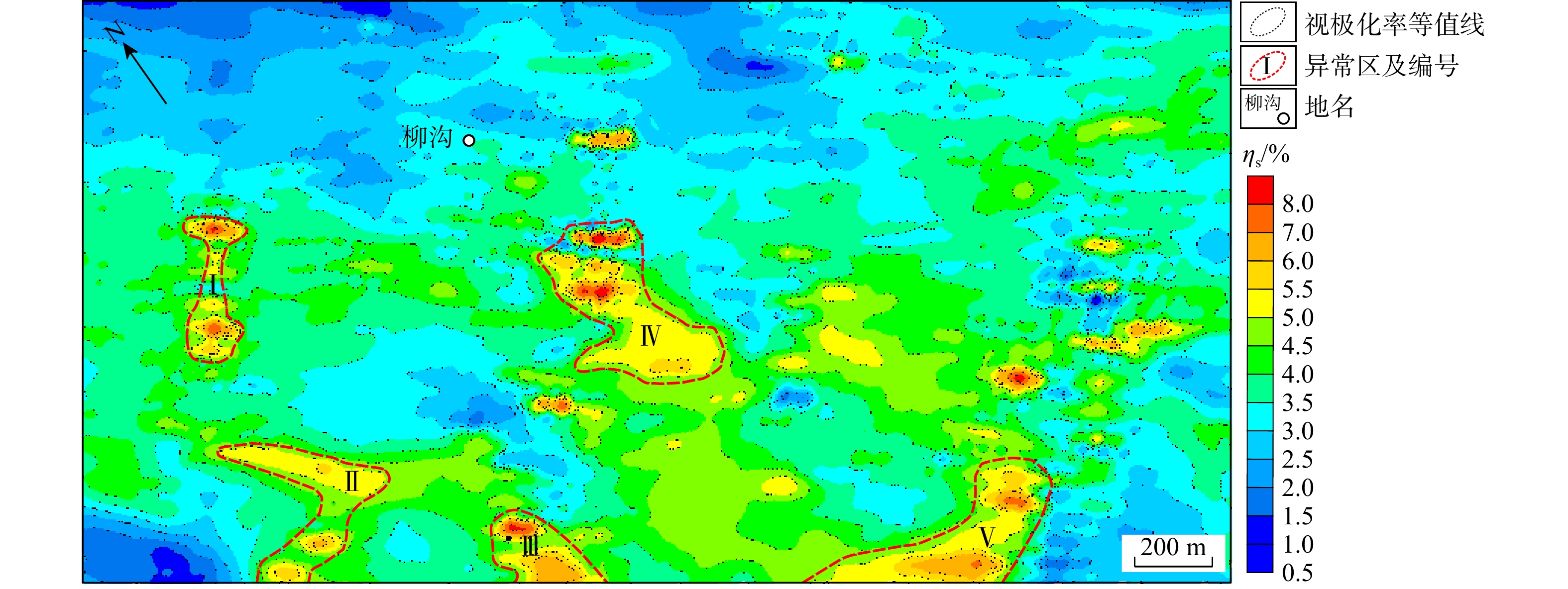
西华山地区地处北祁连造山带东段,是宁夏境内金多金属矿成矿条件优越、矿化点密集分布的重要区域。区内现已发现多处小型金多金属矿床、矿(化)点及物化探异常区,但以往研究多集中于单一矿床成因与地质特征描述,未系统梳理区域控矿规律,且勘查手段较为单一,整体勘查程度偏低,至今未取得重大找矿突破。在系统梳理区域以往勘查资料与野外实地调查的基础上,剖析区内金多金属矿主要控矿地质因素,融合地质、地球物理、地球化学、高光谱遥感多源数据,搭建地−物−化−遥综合找矿预测模型,并依托该模型完成找矿靶区圈定与有效性验证。研究表明,西华山地区金多金属矿主要受构造、地层与岩浆活动共同控制:区域发育三级控矿断裂体系,一级NW向区域性断裂为导矿构造,次一级NNW向断裂承担配矿作用,三级NW-NWW向层间断裂为主要容矿构造;断裂与褶皱形成于同一挤压构造背景,后期活化的一级断裂会对已形成矿体造成破坏。地层方面,天都山组为金矿有利赋矿层位,簸箕掌组为铜矿有利层位;加里东期岩浆活动为成矿提供了关键物质、流体来源及热动力条件。物探成果显示,柳沟地区 1∶
5000 激电异常整体以高极化率为典型特征,高阻−高极化异常大多对应地表浅部矿化蚀变带与含矿脉体,低阻−高极化异常则指示深部硫化物富集带或构造−流体活动迹象。1∶50000 水系沉积物测量圈定出 Au-Cu-Ag-As-Mo、Pb-Au-As-Ag 2类规模大、强度高的元素组合异常;利用主成分分析对 WorldView-3 高光谱遥感数据处理后,提取的铝羟基、碳酸盐化、铁染蚀变异常,与已知矿床空间匹配度较高。综合地质、地球物理、地球化学、遥感多源信息,本次共圈定 5 处找矿靶区,包含 3 处 Ⅰ 级重点靶区与 2 处 Ⅱ 级潜力靶区。3 处 Ⅰ 级靶区为勘查造山型金多金属矿的核心区域,分别对应两大特征元素组合;Ⅱ 级靶区成矿条件良好,具备一定找矿潜力。岩石化探剖面验证证实异常与矿化体对应关系良好,靶区圈定结果科学可靠,可为区域下一步矿产勘查与深部找矿工作提供重要依据。Abstract:ObjectiveLocated in the eastern segment of the North Qilian Orogenic Belt, the Xihuashan area is a key metallogenic zone in Ningxia Hui Autonomous Region, characterized by favorable geological conditions and densely distributed gold-polymetallic mineralization. A number of small-scale gold-polymetallic deposits, mineralized occurrences, and integrated geophysical-geochemical anomalies have been discovered in this region over previous exploration works. Nevertheless, prior studies have mainly focused on the genetic analysis and basic geological characteristics of individual deposits, failing to systematically summarize regional ore-controlling regularities. In addition, traditional exploration relies on single technical methods rather than integrated approaches, leading to a low degree of overall exploration and the absence of significant prospecting breakthroughs for a long time.
MethodsBased on comprehensive collation of historical exploration data and detailed field geological surveys, this study systematically analyzed the dominant ore-controlling factors of local gold-polymetallic deposits. Multiple geoscientific technologies were adopted in this study, including 1∶
5000 induced polarization (IP) survey, 1∶50000 stream sediment geochemical survey, and WorldView-3 (WV-3) hyperspectral remote sensing interpretation via principal component analysis (PCA). On this basis, an integrated prospecting prediction model coupled with multi-source geological, geophysical, geochemical, and remote sensing datasets was constructed, and potential prospecting targets were delineated and verified by rock geochemical profile measurements.ResultsThe analytical results revealed that regional gold-polymetallic mineralization was jointly controlled by tectonics, stratigraphy, and magmatic activities. A three-tier fault system dominated ore localization. The first-order NW-striking regional faults acted as major ore-transporting channels, the secondary NNW-striking faults controlled ore distribution, and the third-order NW-NWW striking interlayer fractures were the primary ore-hosting spaces. Faults and folds formed synchronously under a regional compressional tectonic regime, and the reactivation of first-order faults in the late stage caused damage to pre-existing ore bodies. Stratigraphically, the Tiandushan Formation served as the optimal host stratum for gold deposits, and the Bojizhang Formation was the favorable horizon for copper mineralization. Caledonian magmatism activity provided abundant ore-forming materials, hydrothermal fluids, and thermal power for the entire mineralization process. IP surveys at a scale of 1∶5 000 in the Liugou area revealed that all anomalies were characterized by high chargeability. The high-resistivity and high-chargeability anomalies were closely associated with shallow mineralized veins and alteration zones, whereas the low-resistivity and high-chargeability anomalies indicated deep-seated sulfide enrichment and active structural-hydrothermal fluid migration. The 1∶50 000 stream sediment geochemical survey delineated two large-scale and high-intensity composite geochemical anomalies: Au-Cu-Ag-As-Mo and Pb-Au-As-Ag. Hyperspectral remote sensing data from WV-3, processed by PCA, successfully identified three typical alteration anomalies including hydroxyl group anomalies, carbonatization anomalies, and iron-staining anomalies, which showed excellent spatial correlation with known deposits and mineralized outcrops in the study area. Integrating all multi-source geological, geophysical, geochemical, and remote sensing information, a total of five prospecting targets are delineated in this study, consisting of three Class Ⅰ high-priority targets and two Class Ⅱ potential targets. The three Class Ⅰ targets are the core areas for prospecting orogenic gold-polymetallic deposits, which correspond to two typical elemental assemblages of Au-Cu-Ag-As-Mo and Pb-Au-As-Ag, respectively. The Class Ⅱ targets also possess favorable metallogenic conditions and considerable prospecting potential. Field verification using rock geochemical profiles demonstrates that geochemical anomalies have a clear and positive correlation with underground and surface mineralization. The findings prove that the delineation of prospecting targets is scientifically sound and reliable.
ConclusionThis integrated research model and target evaluation results can provide solid theoretical support and practical guidance for further regional mineral exploration, deep ore prospecting, and engineering deployment in the Xihuashan area.
-
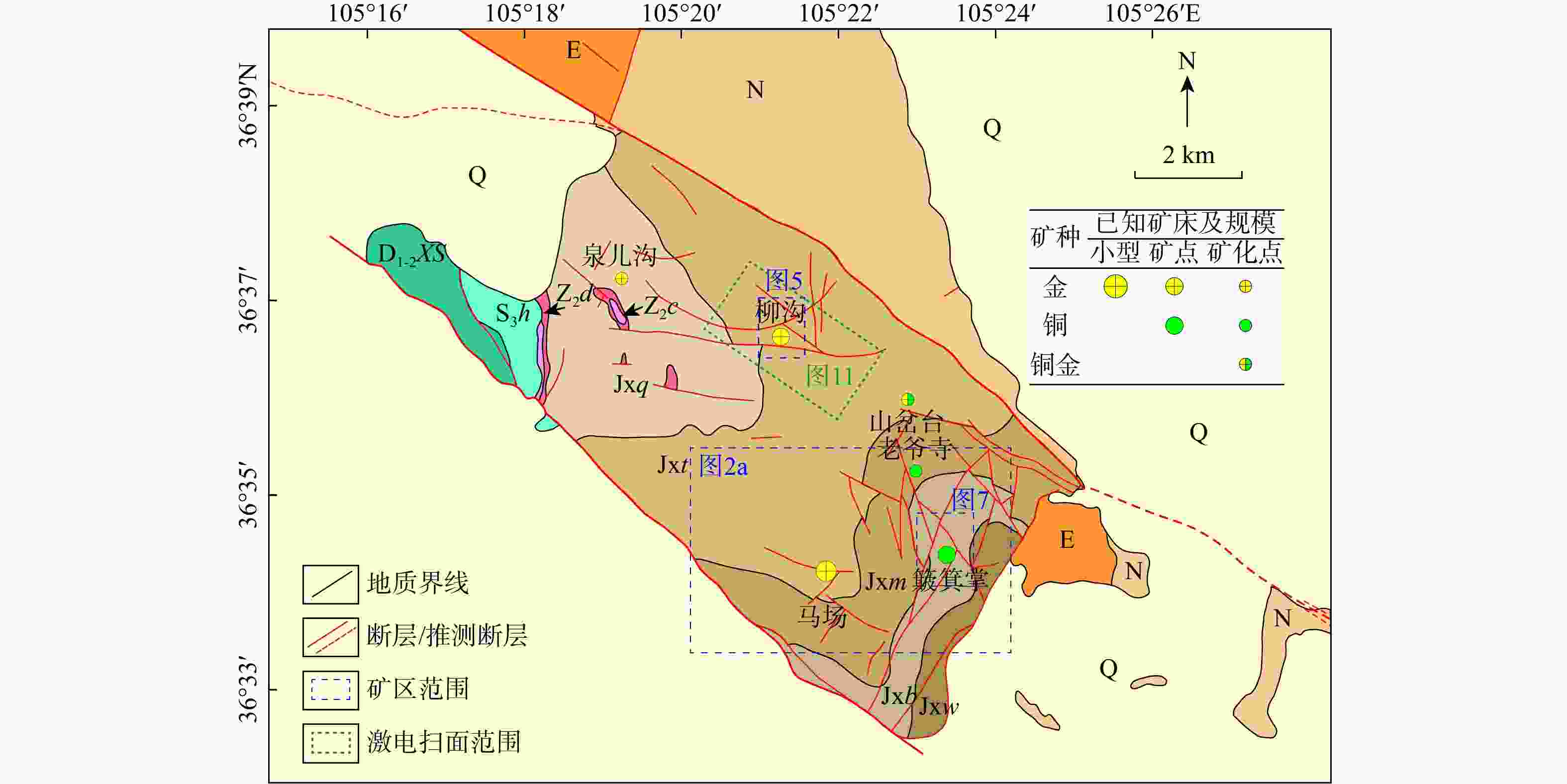
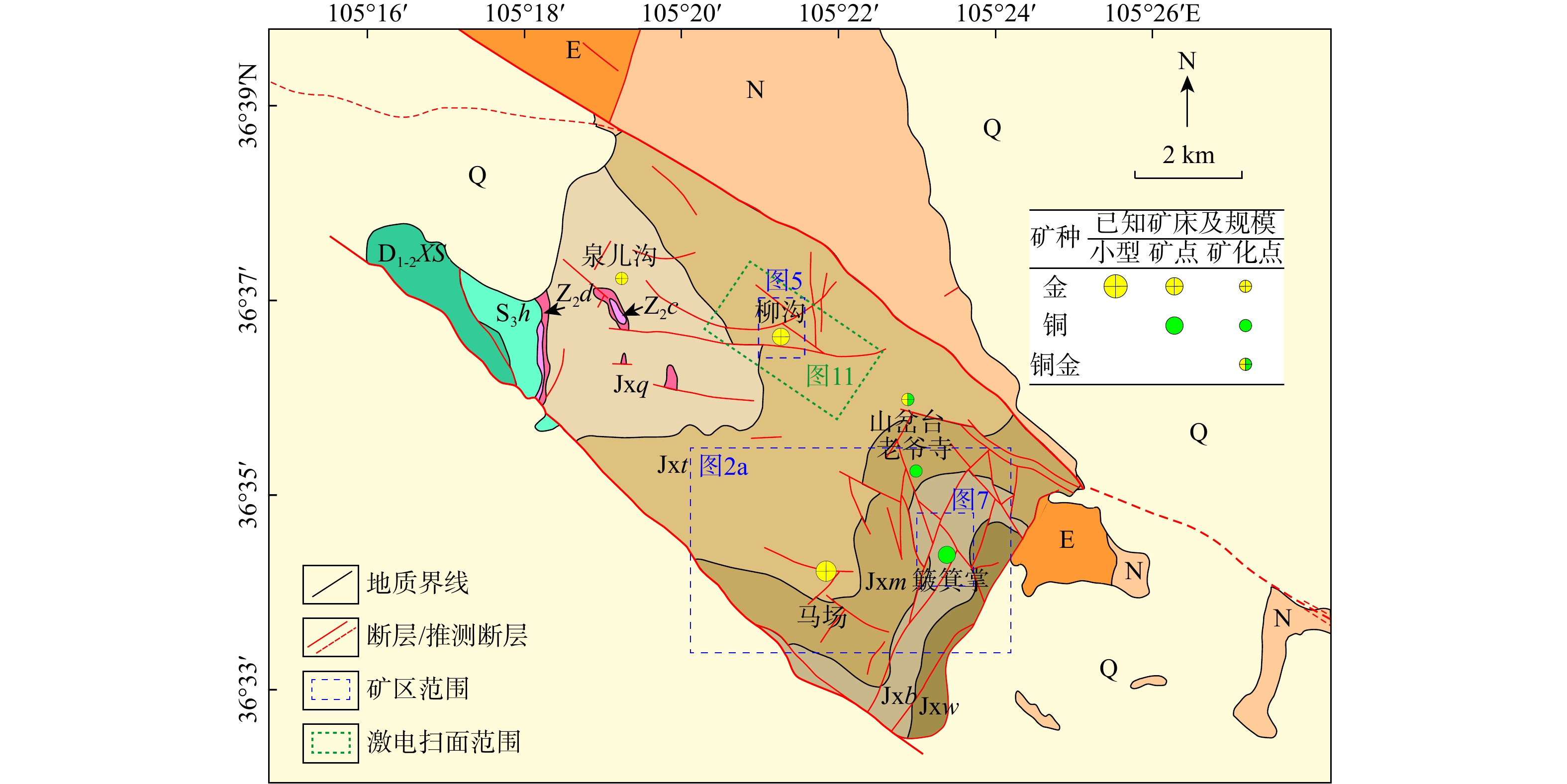
图 1 西华山地区区域地质图
Q. 第四系;N. 新近系;E. 古近系;D. 泥盆系;S. 志留系;D1-2XS. 泥盆系雪山群;S3h. 志留系旱峡组;Z2c. 震旦系曹家山组;Z2d. 震旦系墩墩梁组;Jxq. 蓟县系泉儿沟组;Jxt. 蓟县系天都山组;Jxm. 蓟县系马场组;Jxb. 蓟县系簸箕掌组;Jxw. 蓟县系五桥沟组;下同
Figure 1. Regional geological map of Xihuashan area
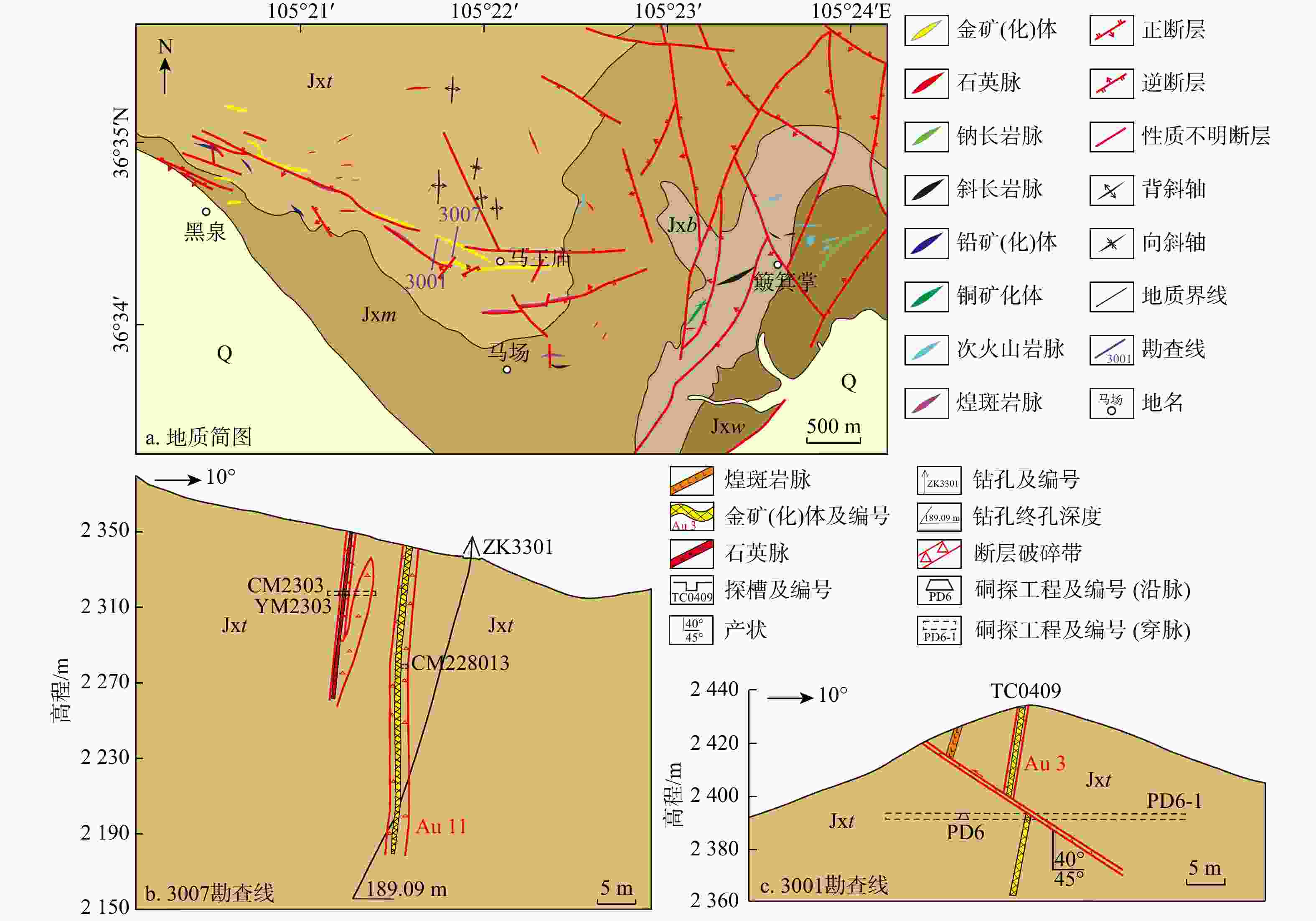
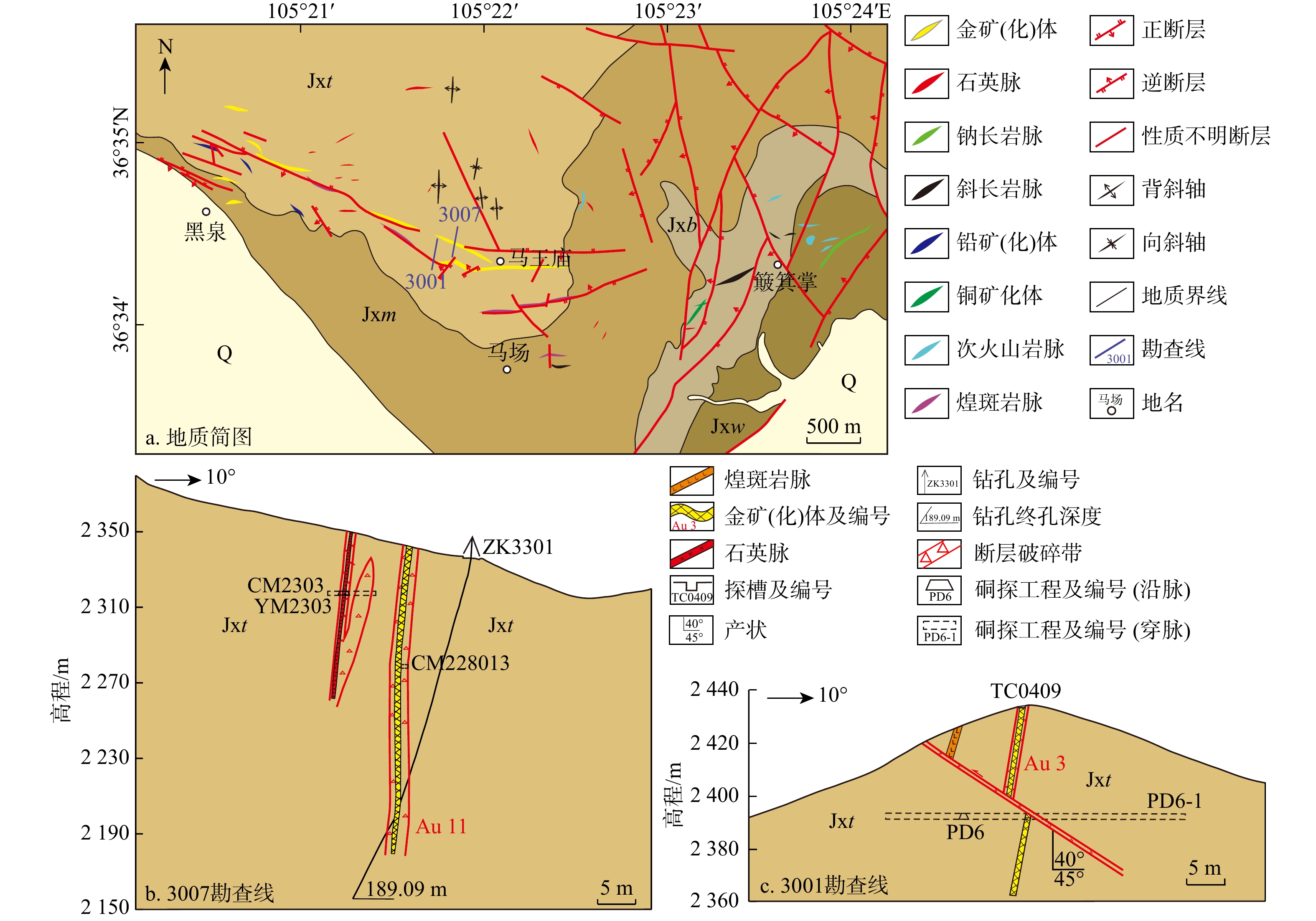
图 2 西华山地区马场金矿床地质简图(a)和剖面图(b, c)(据文献[21]修改)
Figure 2. Geological sketch map (a) and profiles (b, c) of Machang gold deposit in Xihuashan area
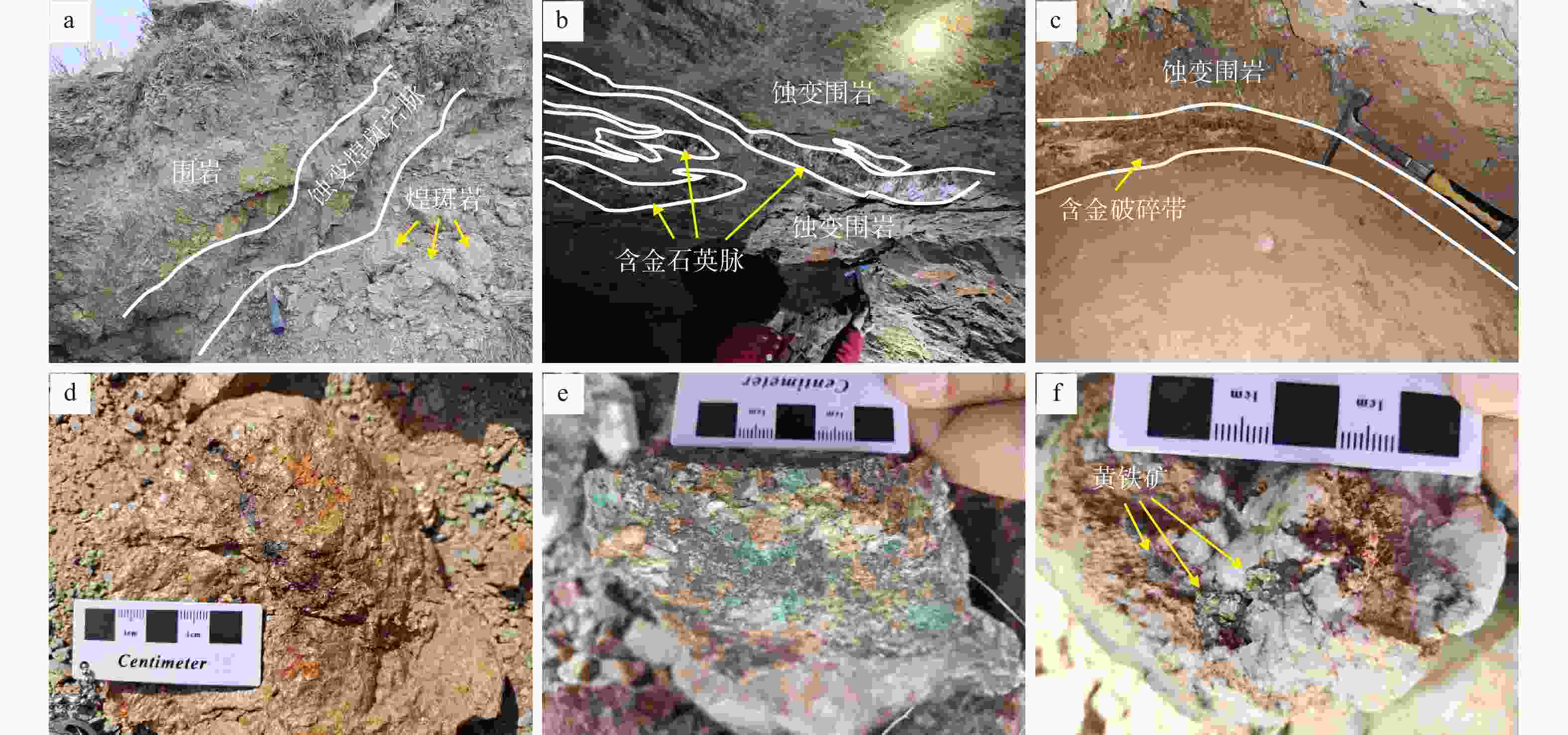
图 3 西华山地区马场金矿床典型矿石特征及围岩蚀变(据文献[21])
a. 蚀变煌斑岩脉;b. 老硐中的含金石英脉,围岩为云母钠长石英片岩;c. 老硐中的含金破碎带;d. 褐铁矿化的云母钠长石英片岩;e. 孔雀石化;f. 石英中的黄铁矿团块
Figure 3. Typical ore characteristics and wall-rock alteration of Machang gold deposit in Xihuashan area
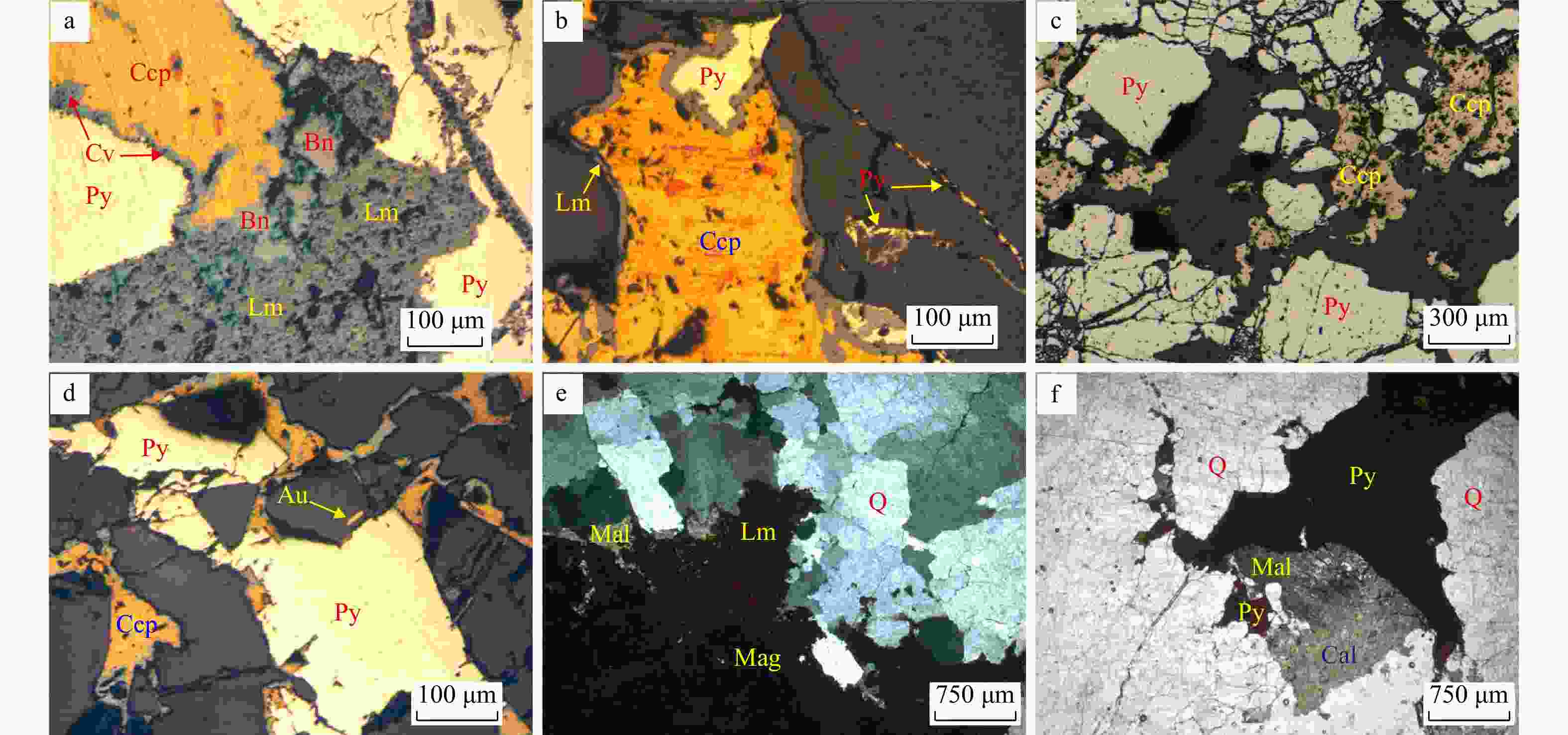
图 4 西华山地区马场金矿床主要矿物组成(据文献[21])
Py. 黄铁矿;Ccp. 黄铜矿;Cv. 蓝铜矿;Bn. 斑铜矿;Lm. 褐铁矿;Au. 自然金;Mal. 孔雀石;Mag. 磁铁矿;Q. 石英;Cal. 方解石;下同
Figure 4. Main mineral composition of Machang gold deposit in Xihuashan area
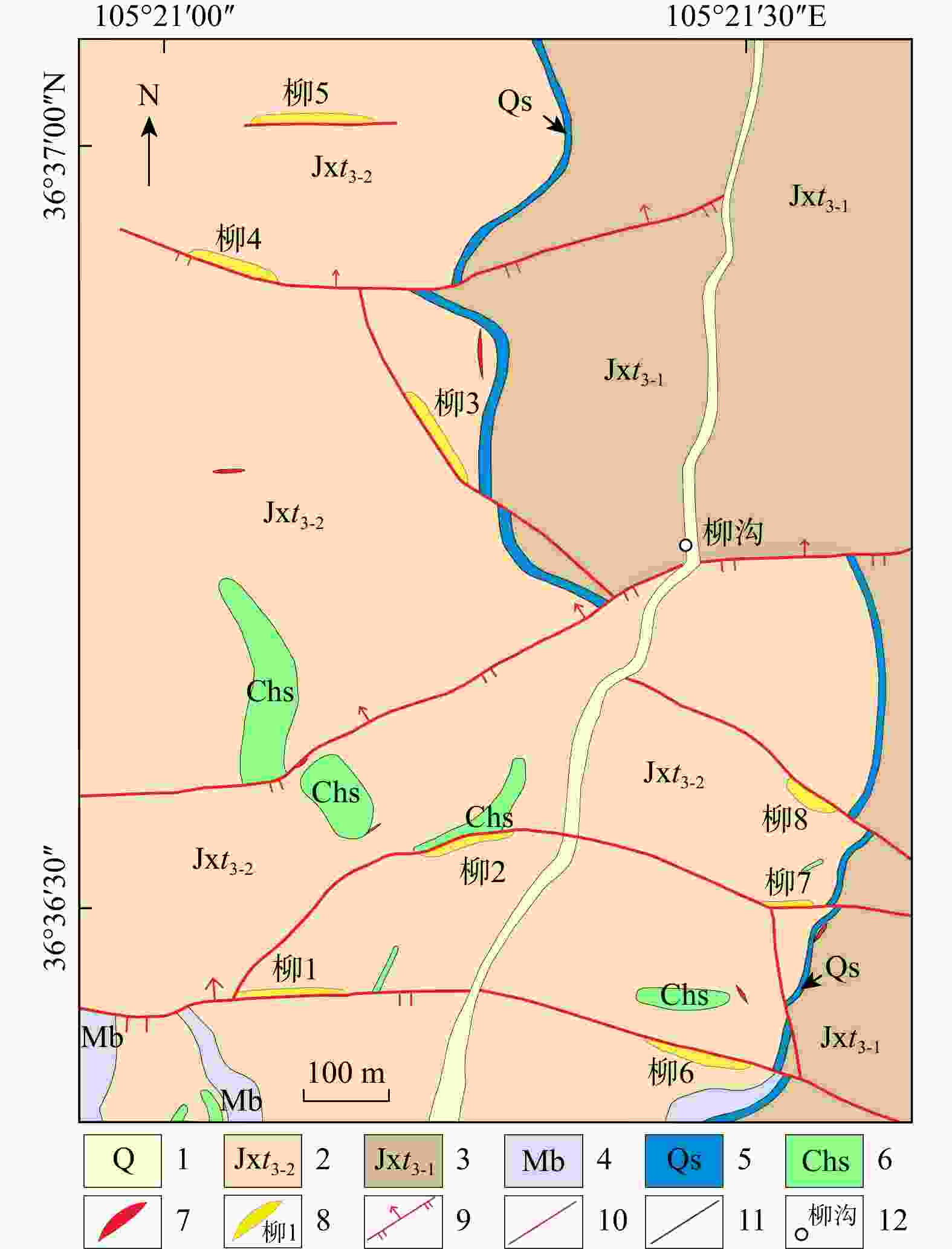
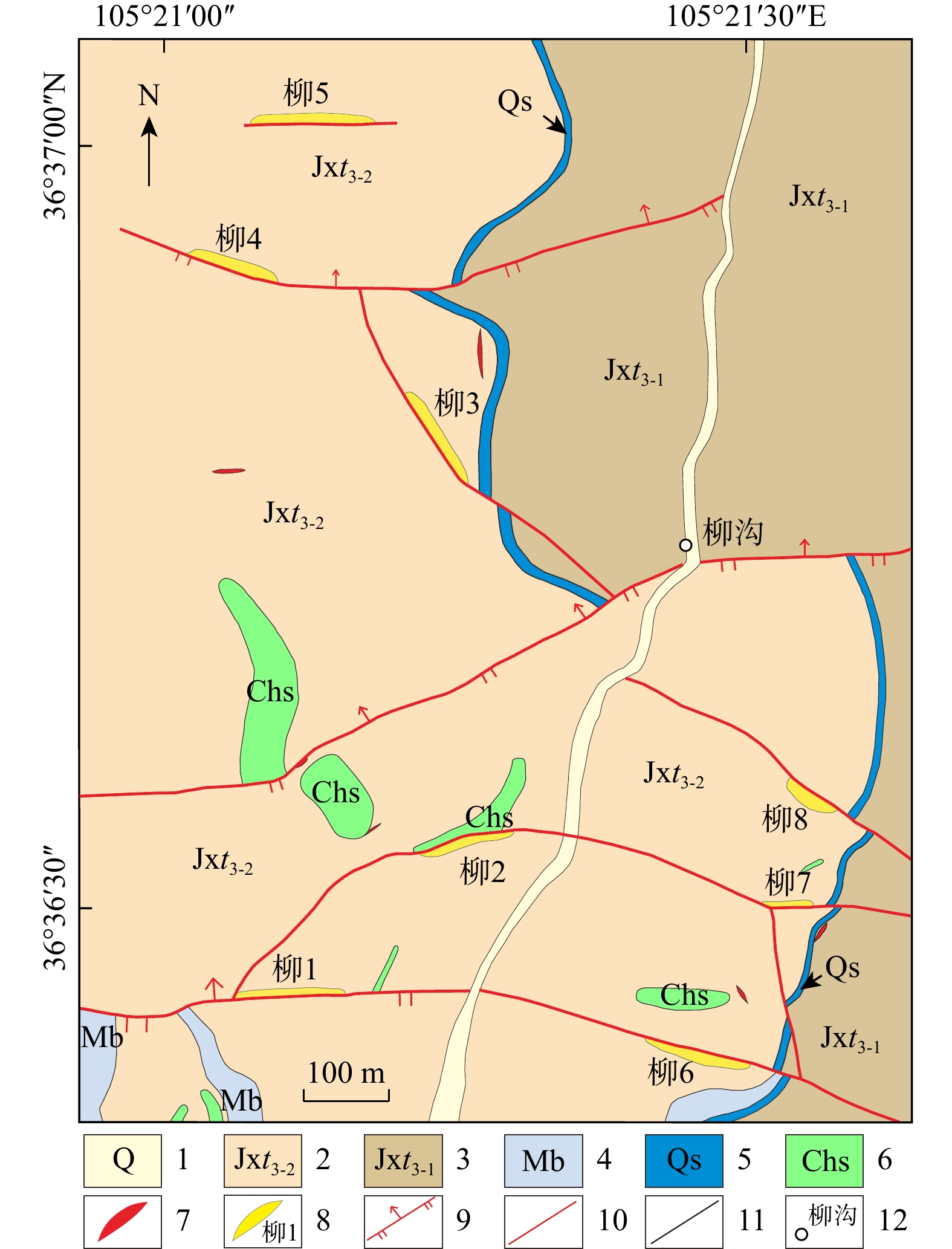
图 5 西华山地区柳沟金矿床地质简图(据文献[20]修改)
1. 第四系冲洪积或风积物;2. 蓟县系天都山组上段第二层云母钠长石英片岩;3. 蓟县系天都山组上段第一层云母钠长石英片岩;4. 大理岩;5. 石英片岩;6. 绿帘钠长阳起片岩;7. 石英脉;8. 金矿化体及编号;9. 逆断层;10. 性质不明断层;11. 地质界线;12. 地名
Figure 5. Geological sketch map of Liugou gold deposit in Xihuashan area
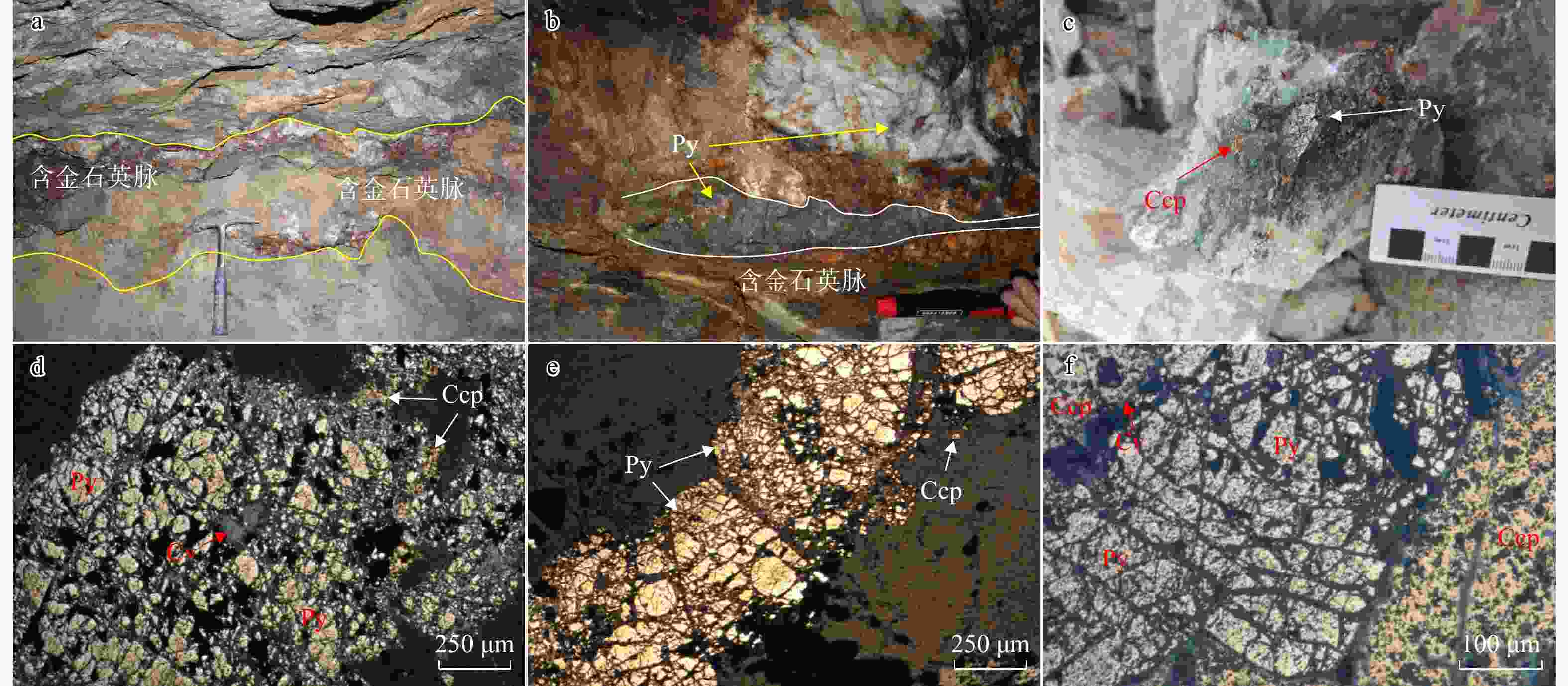
图 6 西华山地区柳沟金矿床典型矿(化)体与矿物组成特征
a. 老硐中的含金石英脉;b. 含金石英脉中的黄铁矿脉或黄铁矿团块;c. 黄铁矿与黄铜矿共生;d~f. 半自形−它形粒状黄铁矿,黄铜矿呈它形粒状交代黄铁矿,铜蓝沿黄铜矿边部、裂隙交代
Figure 6. Characteristics of typical ore (mineralized) bodies and main mineral composition of Liugou gold deposit in Xihuashan area
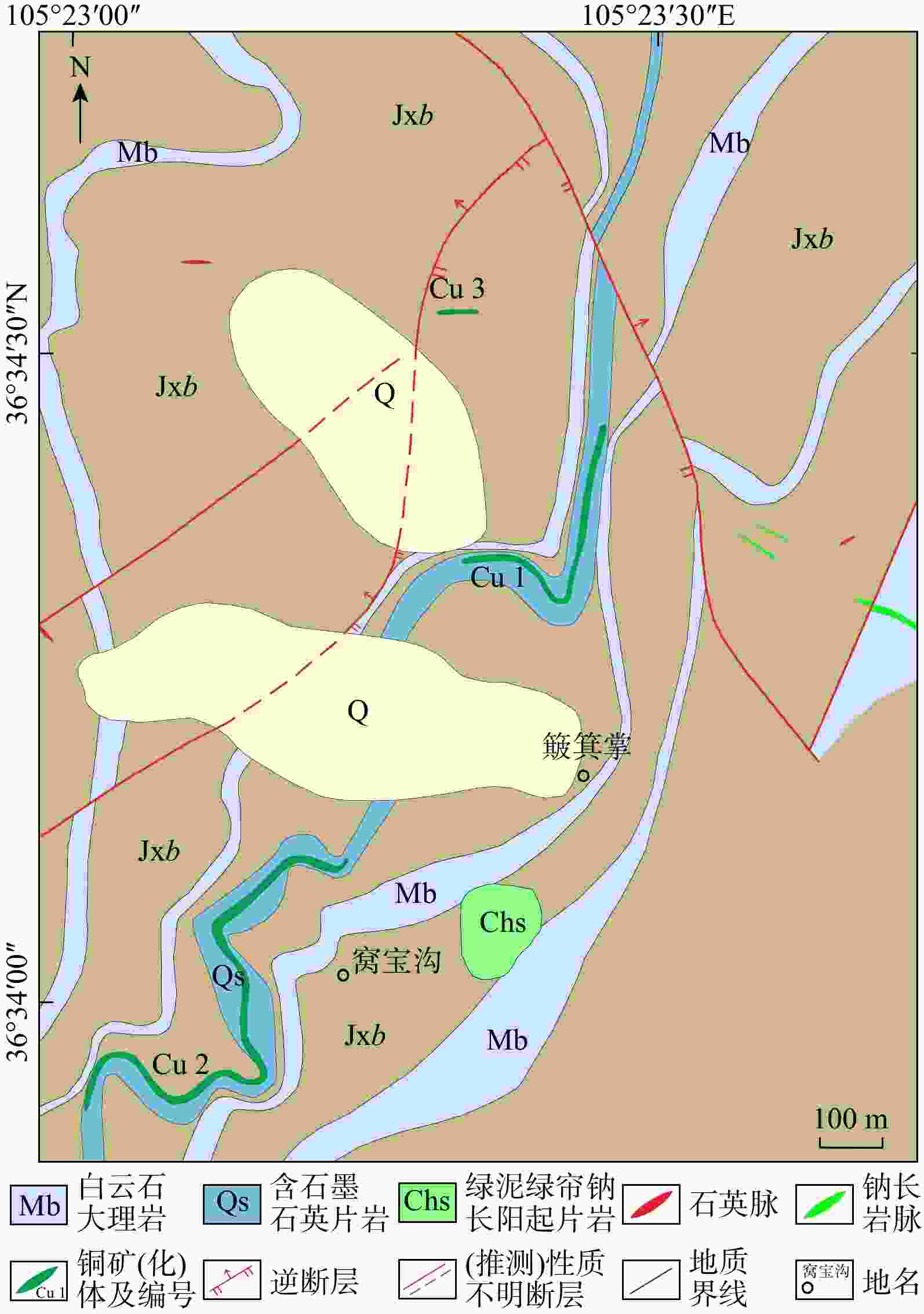
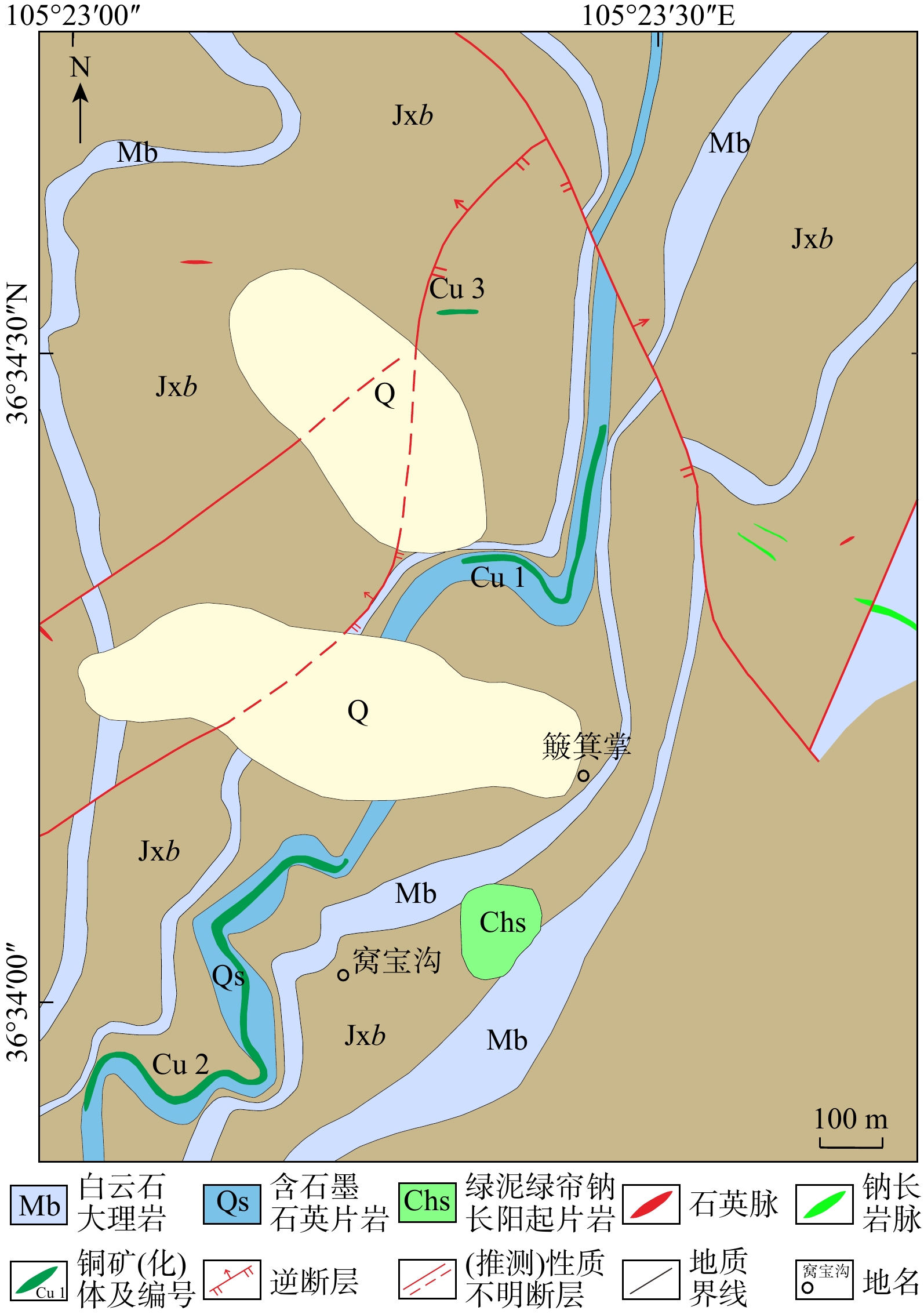
图 7 西华山地区簸箕掌铜矿床地质简图(据文献[18]修改)
Figure 7. Geological sketch map of Bojizhang copper deposit in Xihuashan area
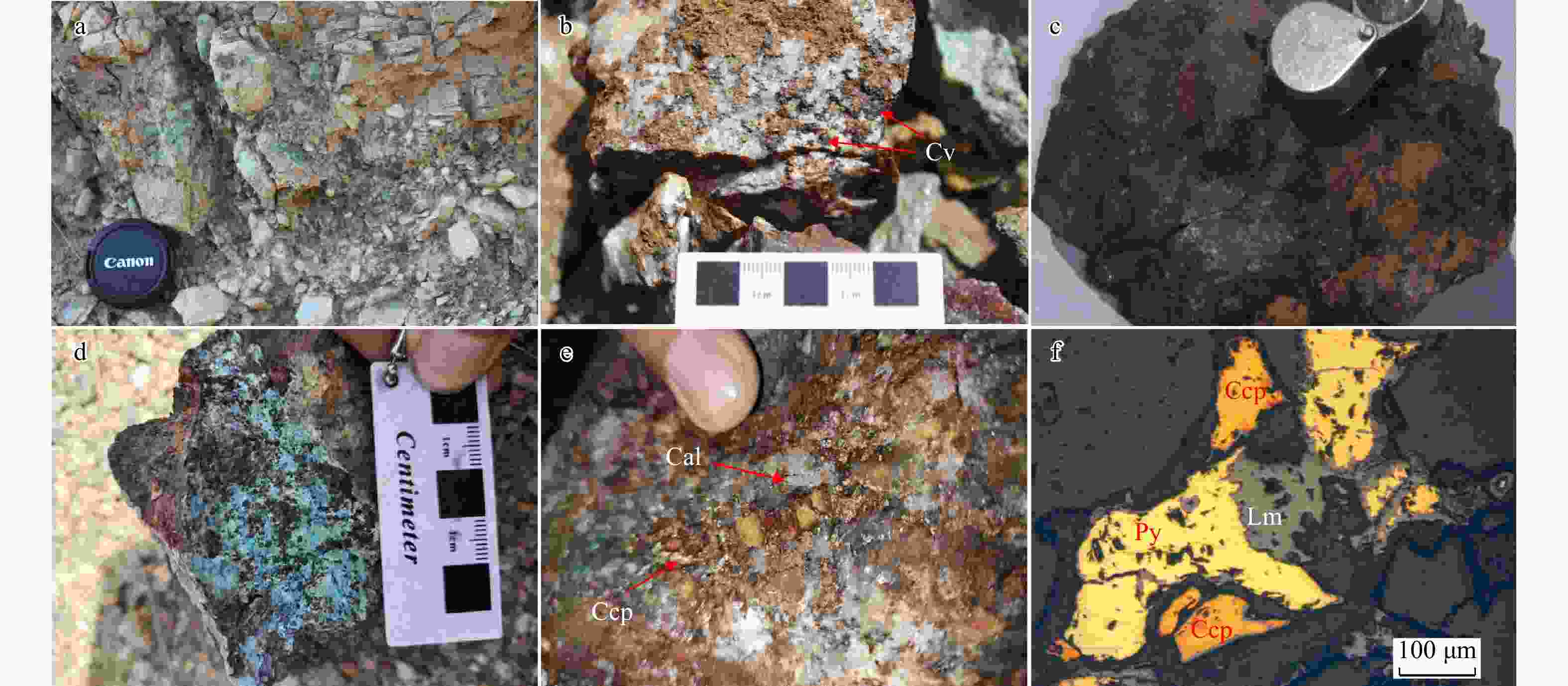
图 8 西华山地区簸箕掌铜矿床典型矿(化)体与矿物组成特征
a. 孔雀石化石英脉;b. 石英脉中的蓝铜矿;c. 氧化铜矿石;d. 蓝铜矿;e. 碳酸盐化,可见黄铜矿;f. 黄铜矿呈它形粒状交代黄铁矿
Figure 8. Characteristics of typical ore (mineralized) bodies and main mineral composition of Bojizhang copper deposit in Xihuashan area
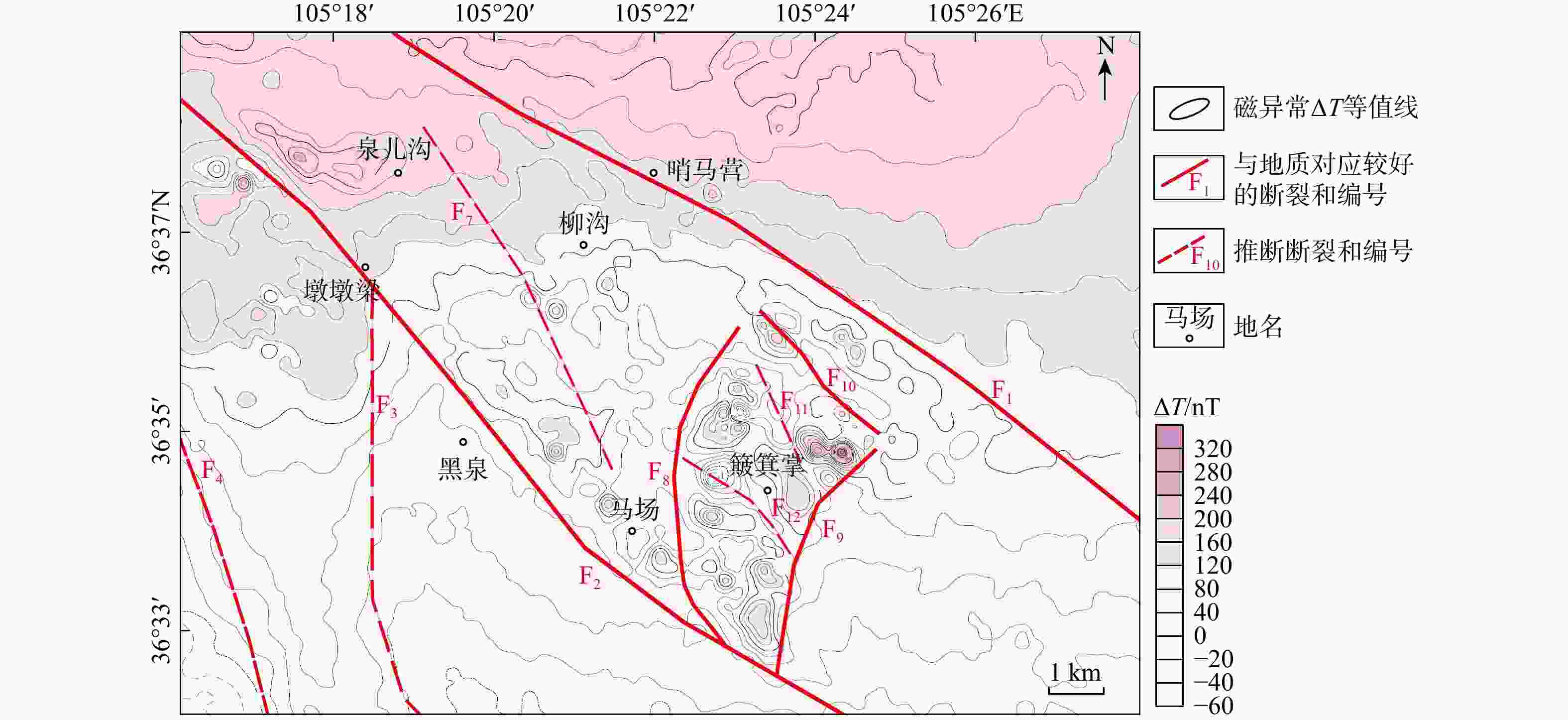
图 9 西华山地区1∶
50000 高精度磁测推断断裂分布(据文献[36]修改)Figure 9. Distribution map of inferred faults from 1:50 000 high-precision ground magnetic survey in Xihuashan area
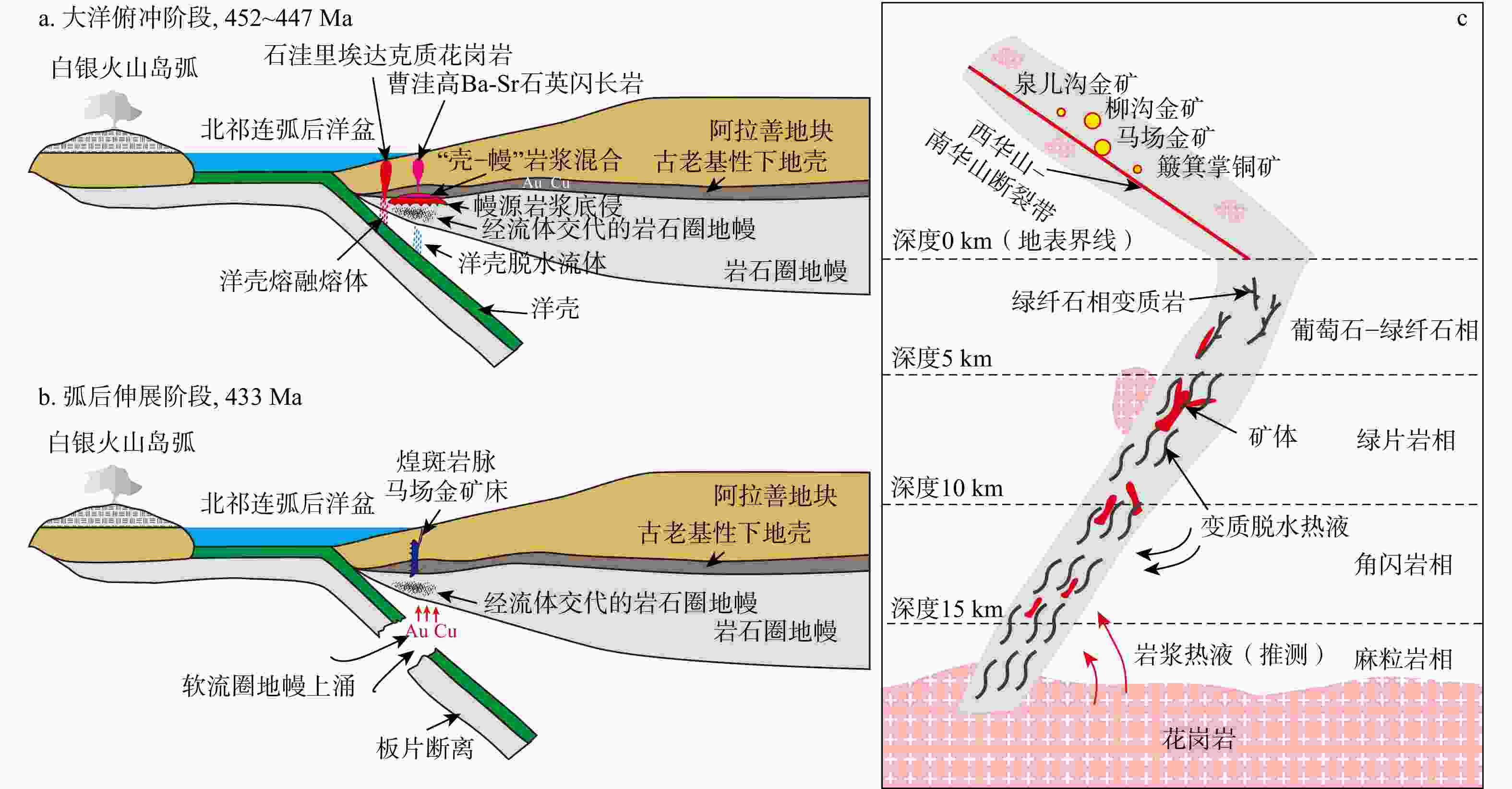
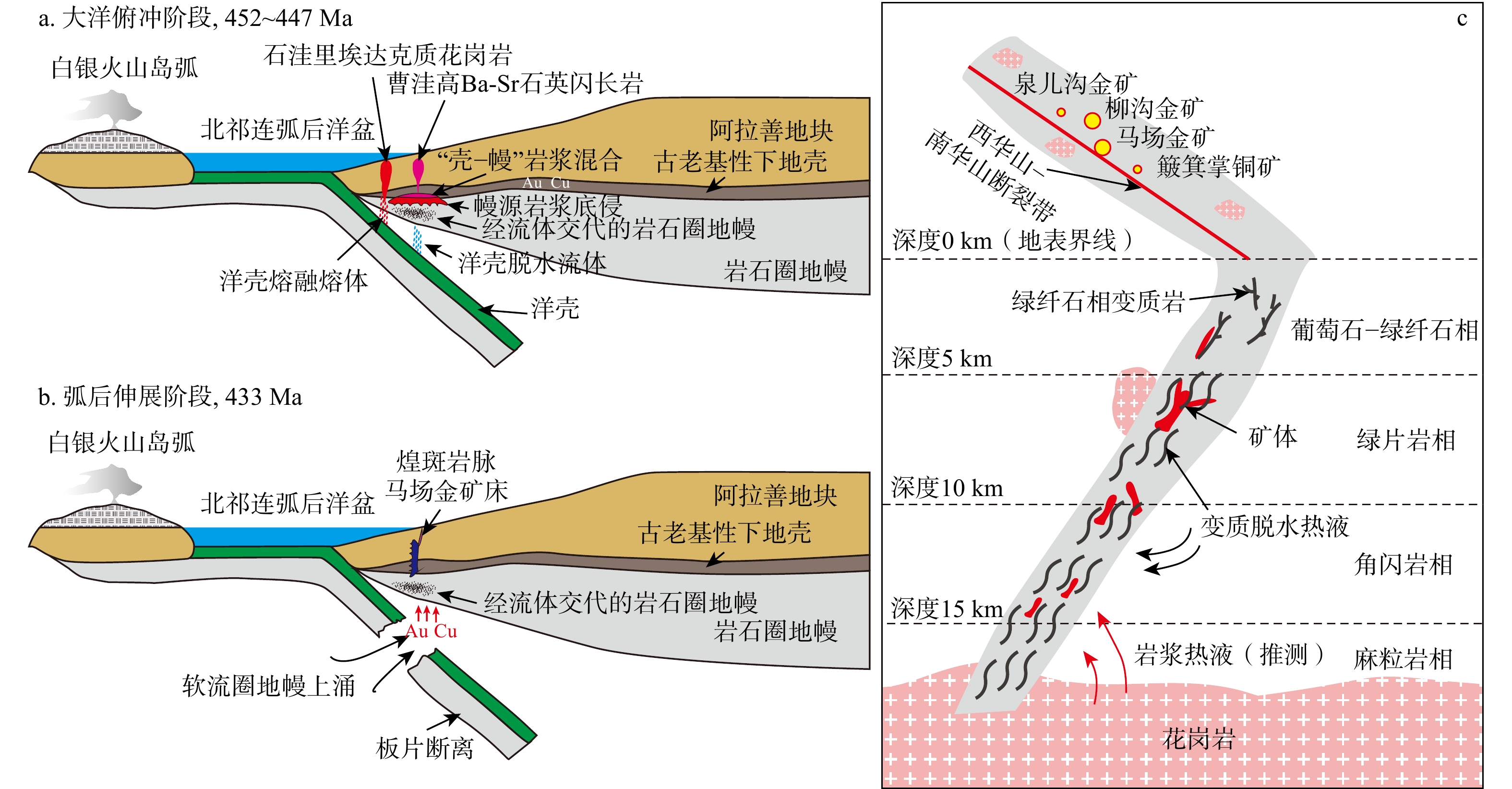
图 10 西华山地区构造−岩浆演化与金多金属矿成矿模式(据文献[21]修改)
Figure 10. Tectonic-magmatic evolution and metallogenic model for gold-polymetallic deposits in Xihuashan area
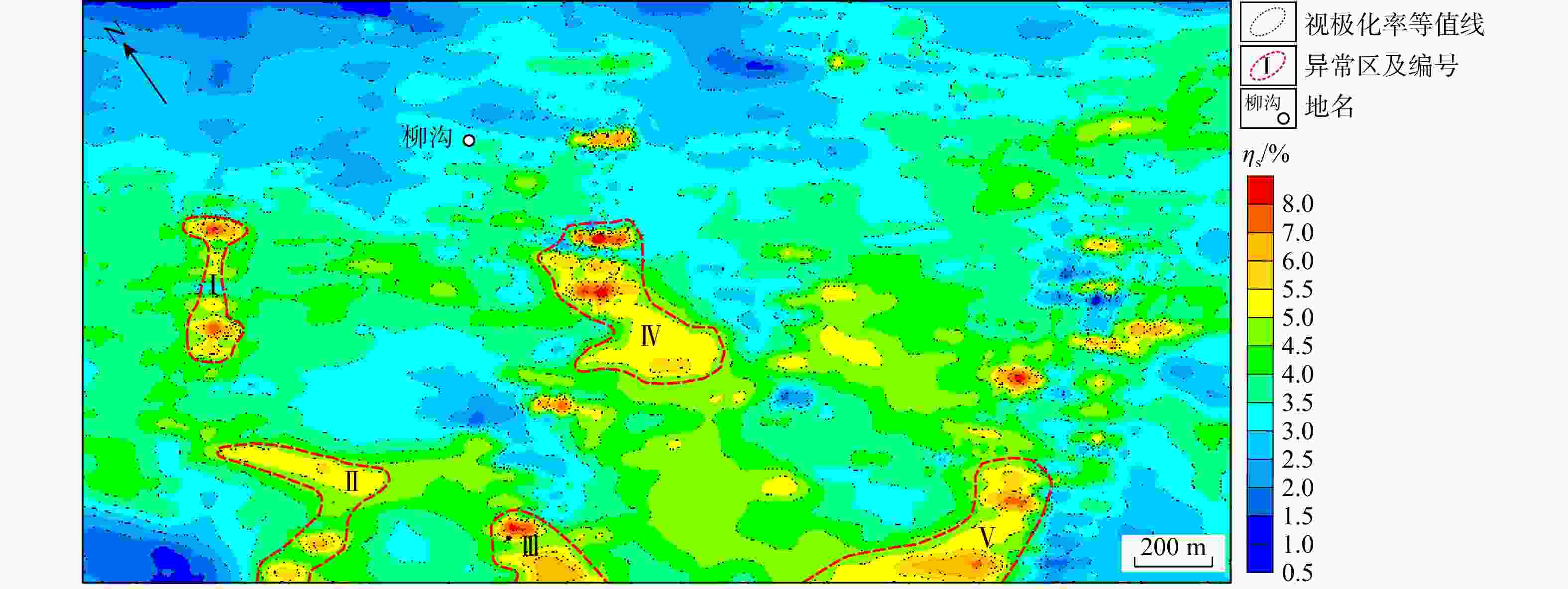
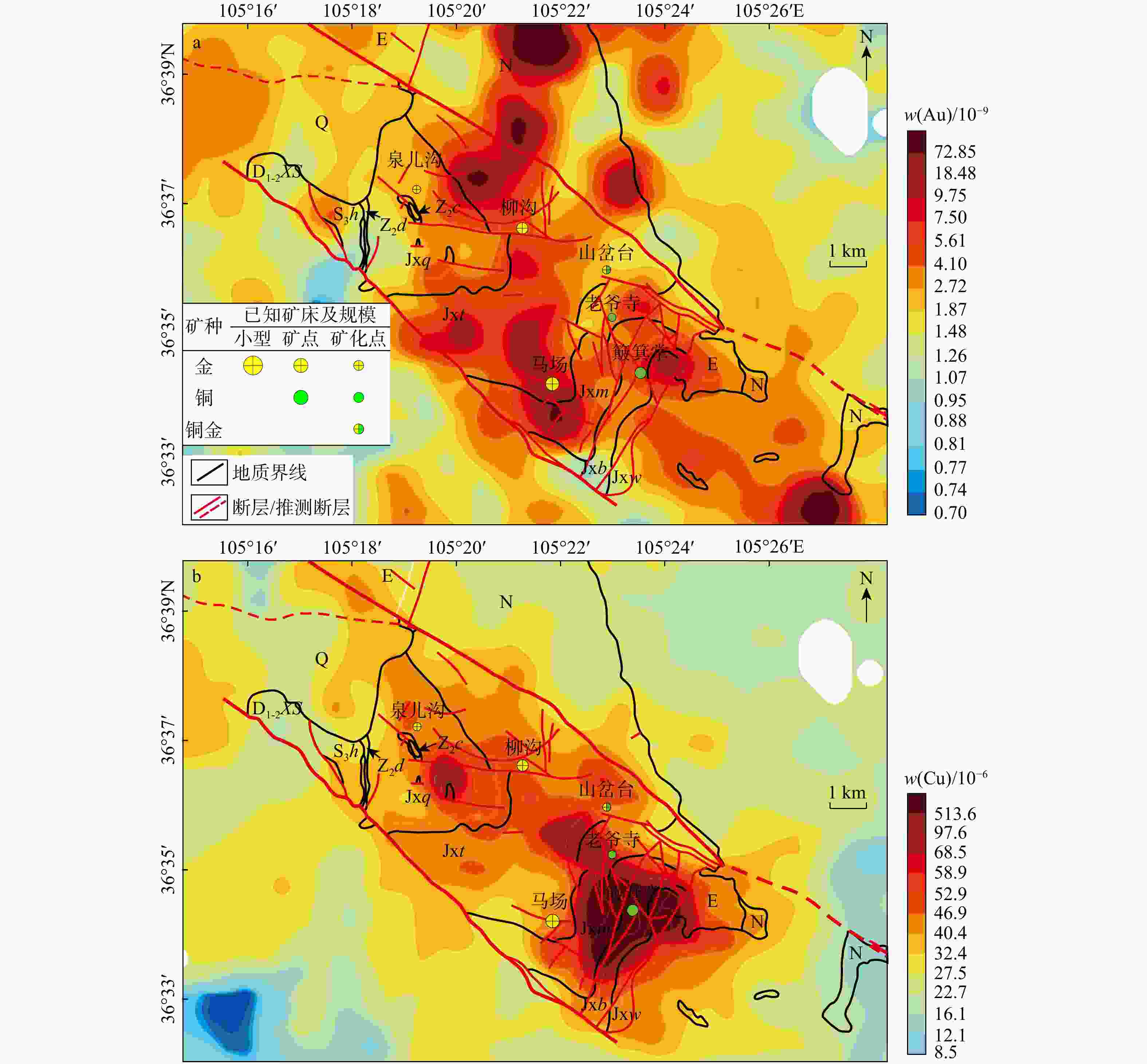
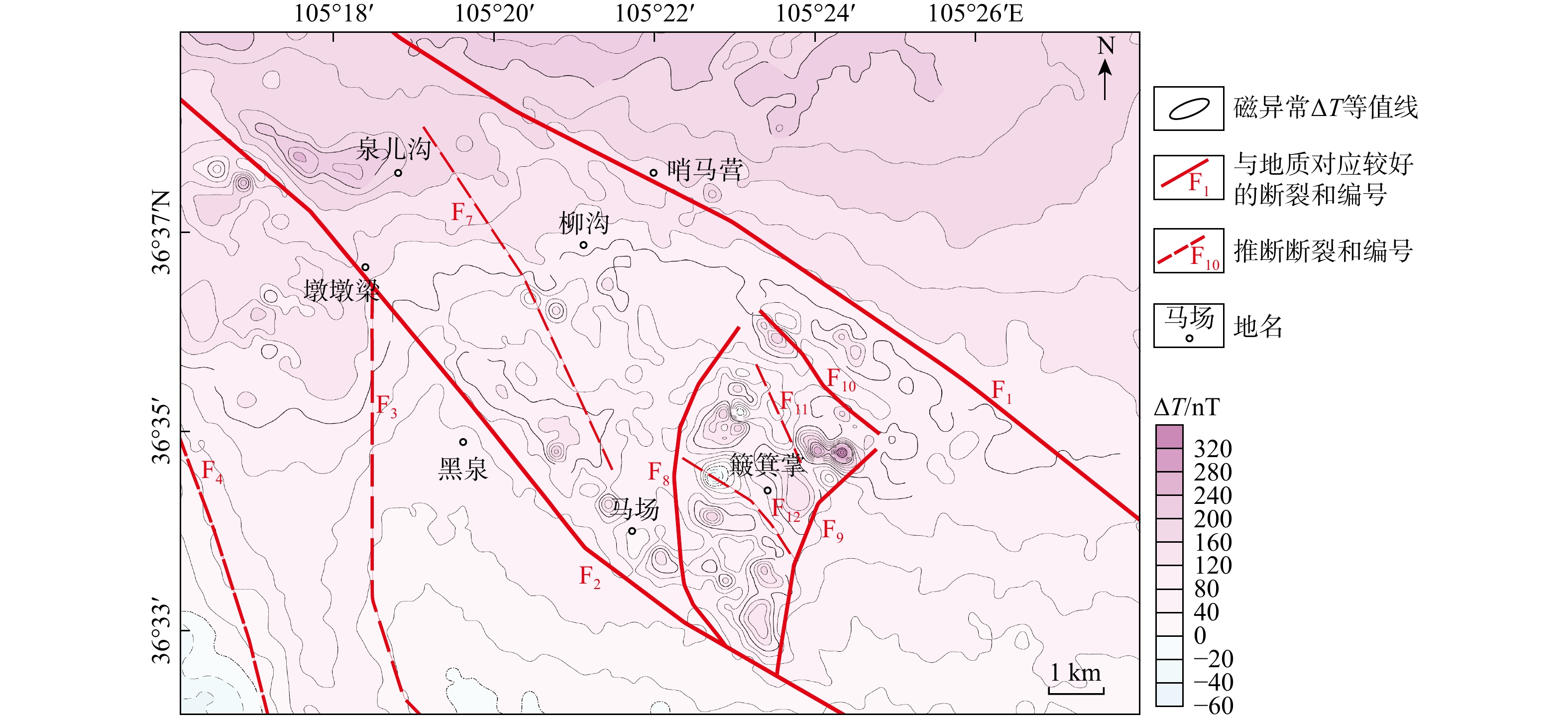
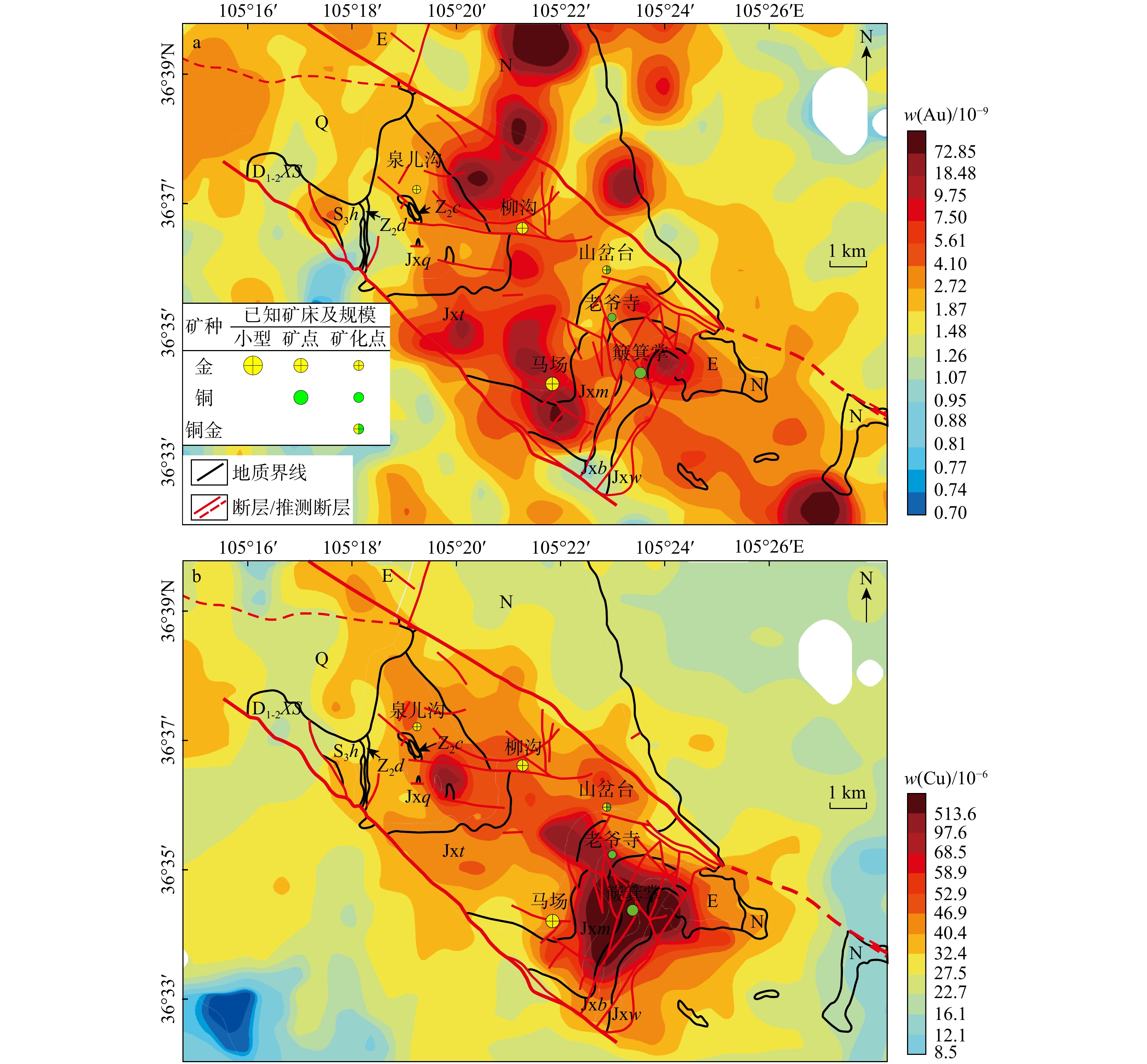
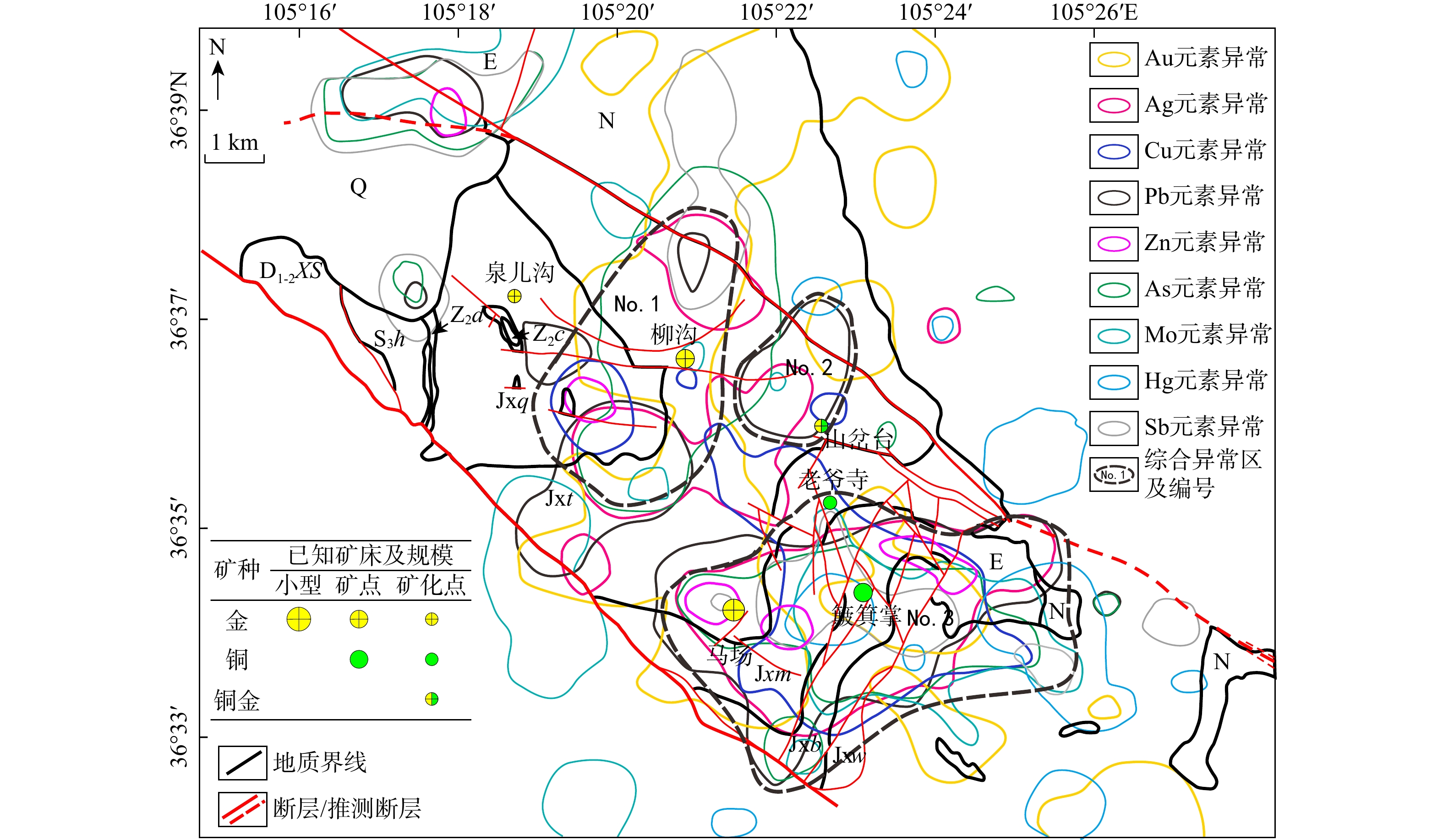
图 12 西华山地区1∶
50000 水系沉积物Au(a)和Cu(b)地球化学图(据文献[36]修改)Figure 12. Geochemical maps of Au (a) and Cu (b) in 1:
50000 stream sediments in Xihuashan area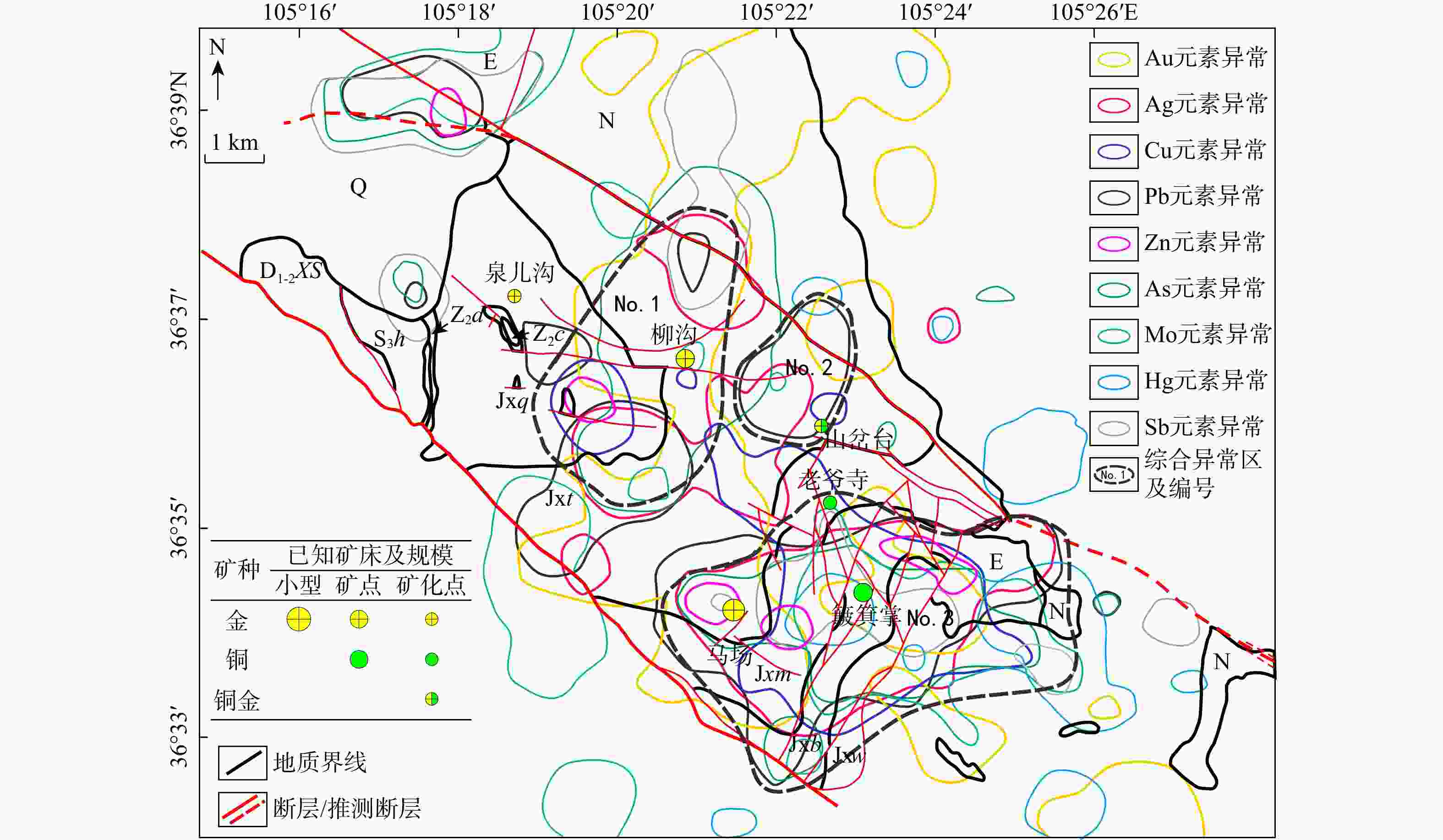
图 13 西华山地区1∶
50000 水系沉积物综合异常图(据文献[36]修改)Figure 13. Integrated anomaly map of 1:
50000 stream sediments in Xihuashan area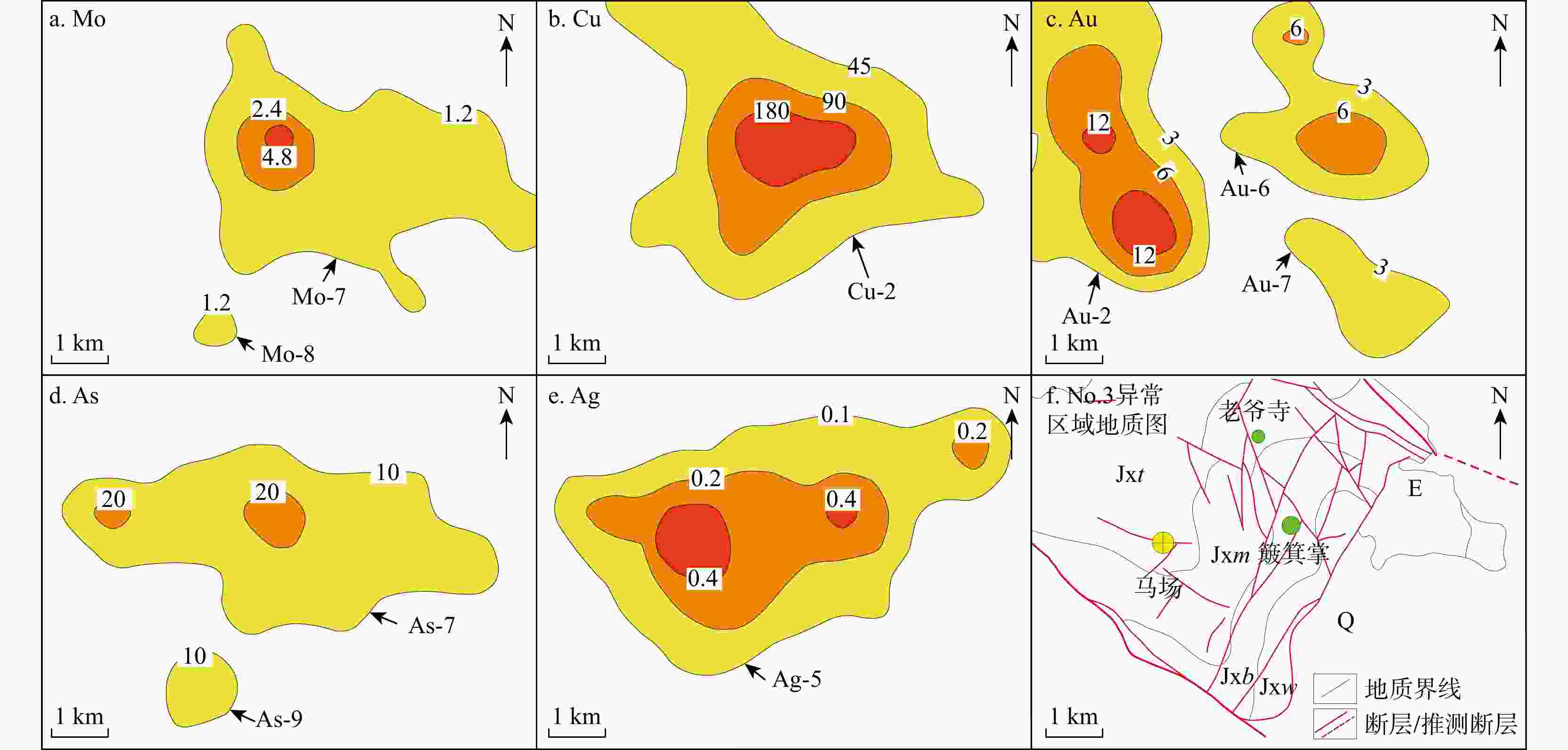
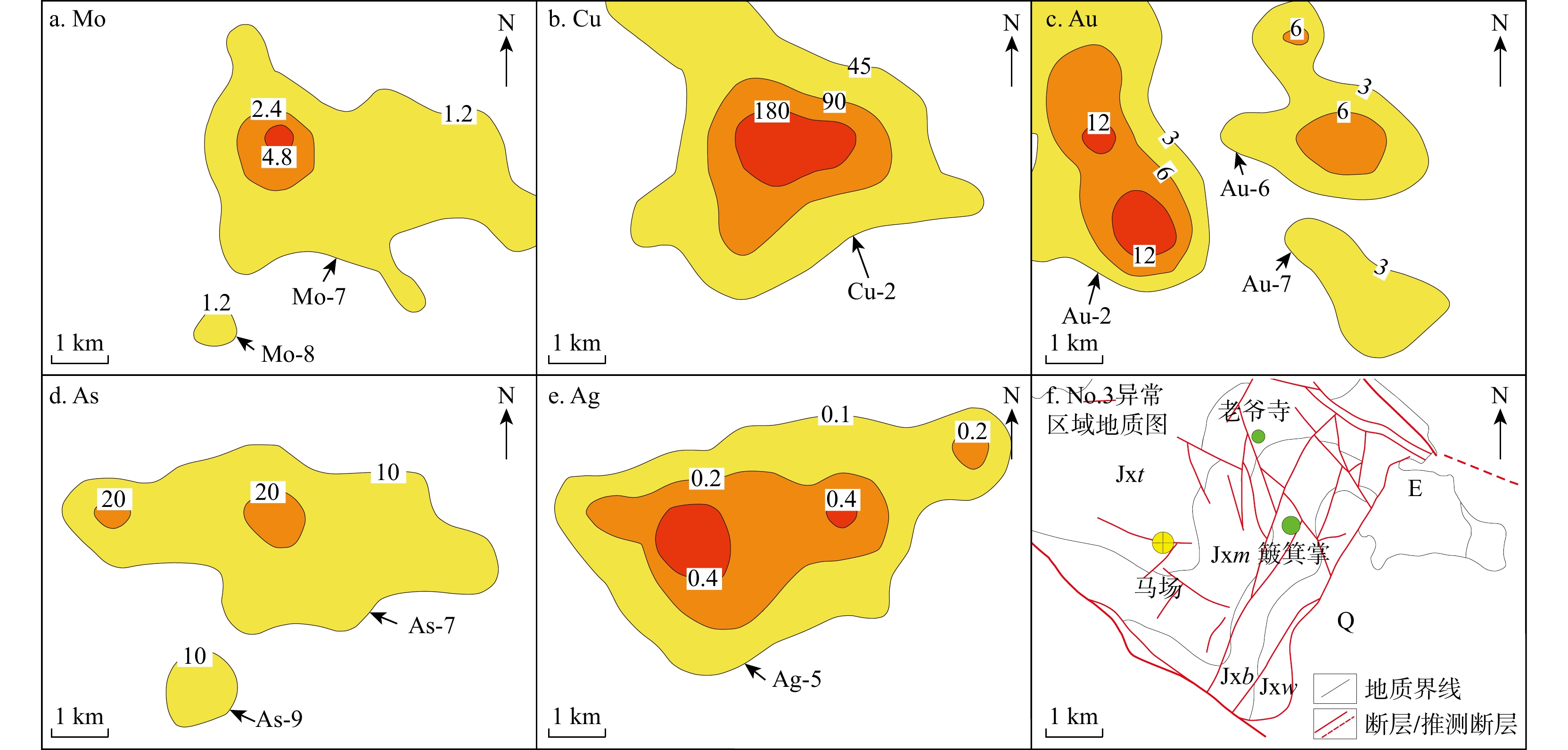
图 14 西华山地区No.3综合化探异常剖析图
Mo-7等为元素异常编号;等值线为元素质量分数,w(Au)单位为10−9,其余元素wB单位为10−6;图f位置见图13;据文献[36]修改
Figure 14. Interpretative diagram of No.3 integrated geochemical anomaly in Xihuashan area
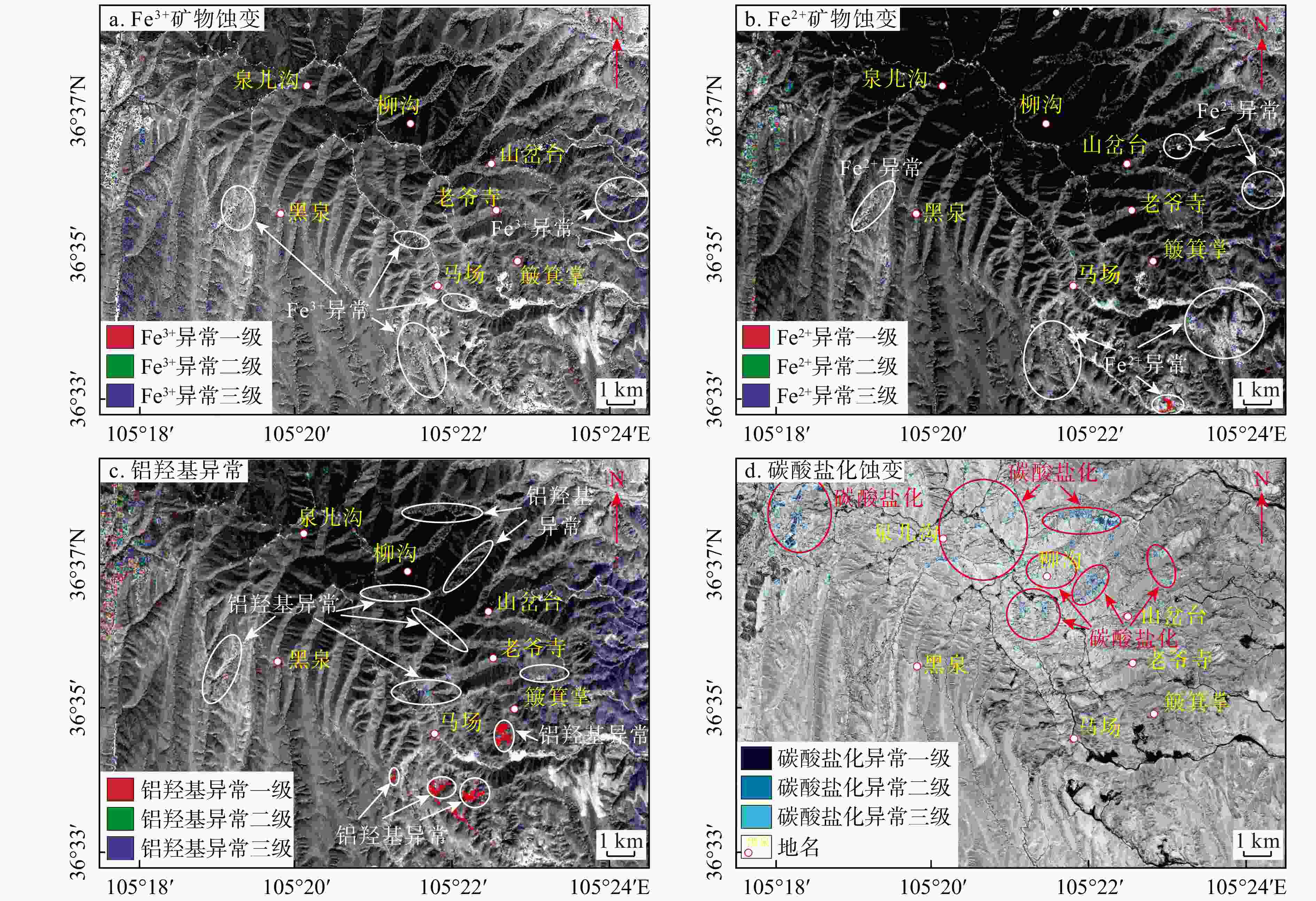
图 15 基于主成分分析的WV-3 遥感异常提取结果
Figure 15. Extraction results of anomaly information from WV-3 data based on principal component analysis
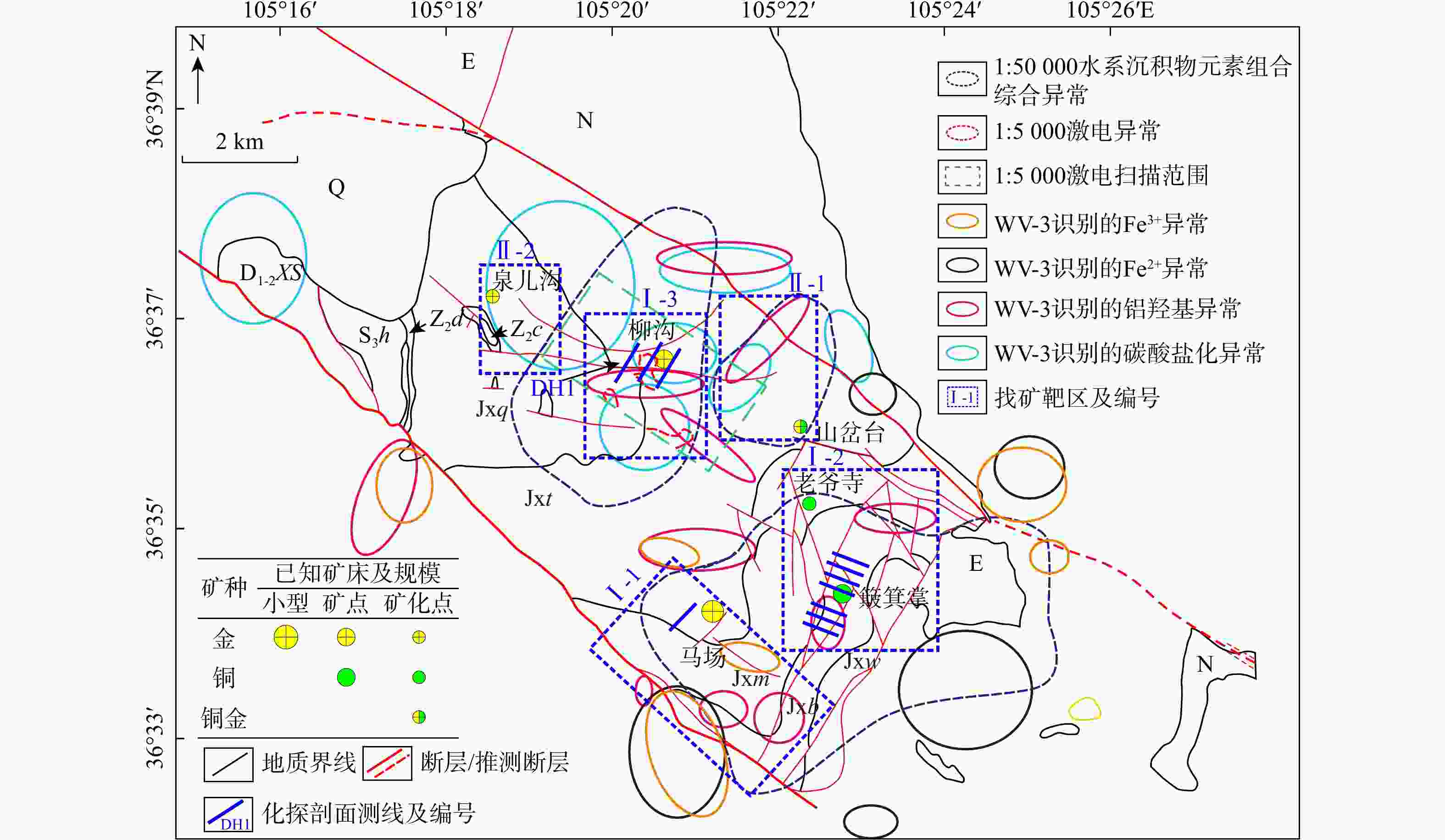
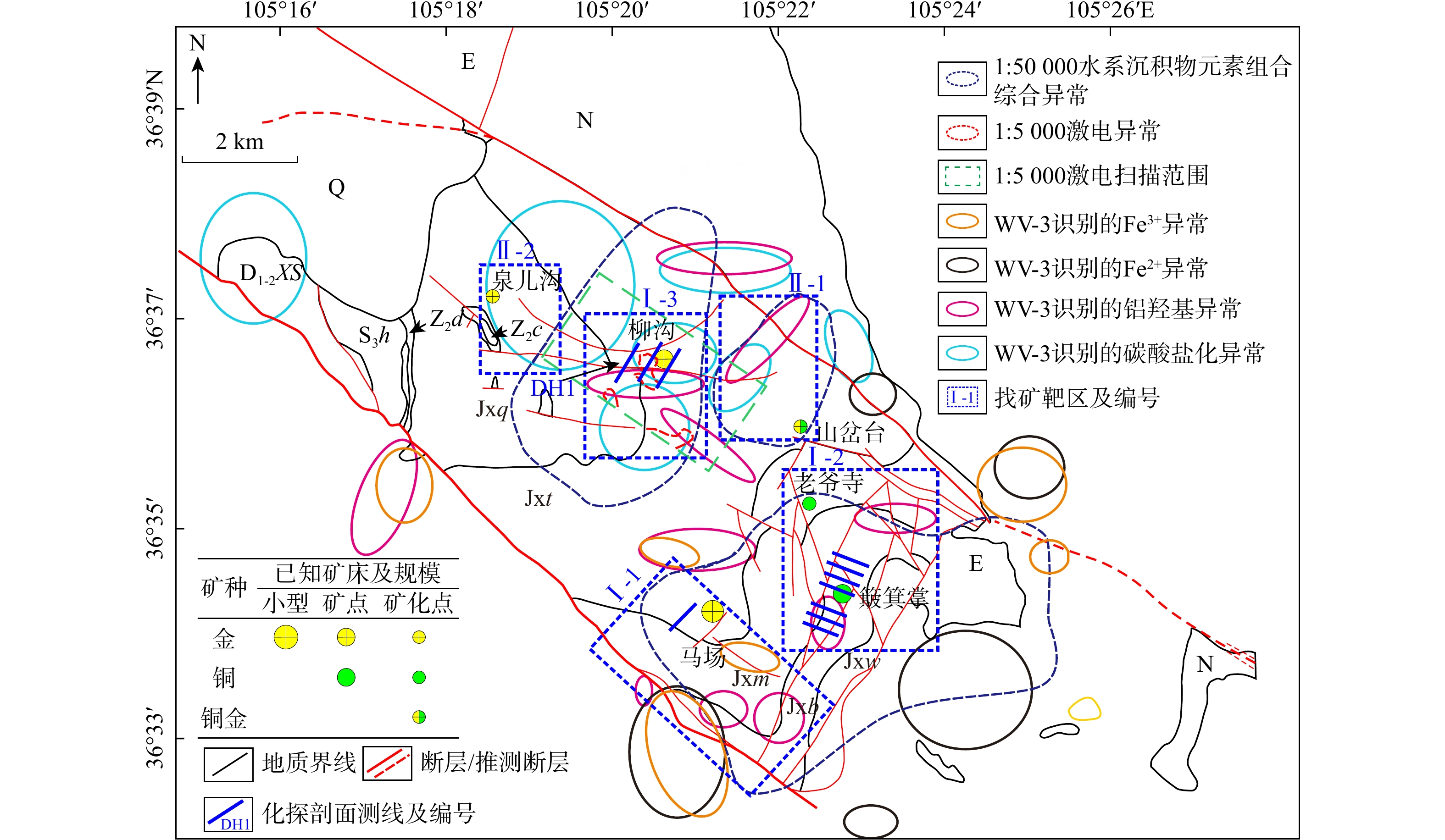
图 16 西华山地区金多金属矿综合找矿预测图
Figure 16. Integrated prospecting prediction map of gold-polymetallic deposits in Xihuashan area
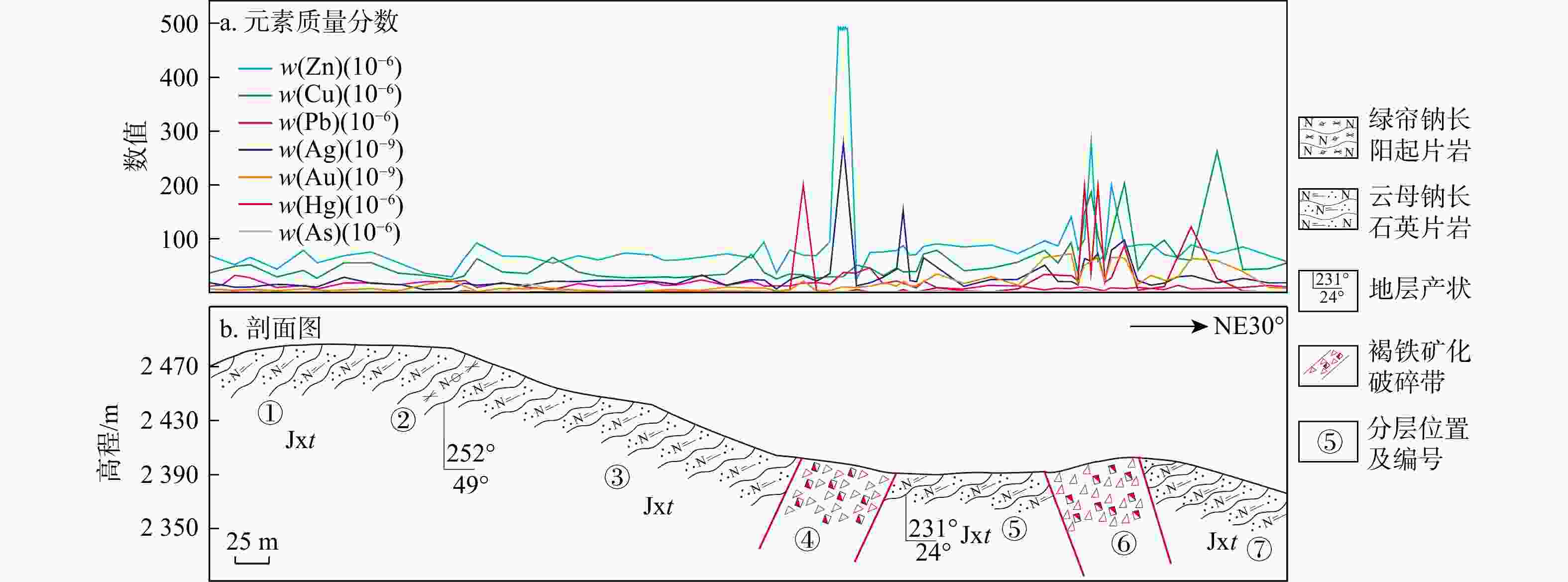
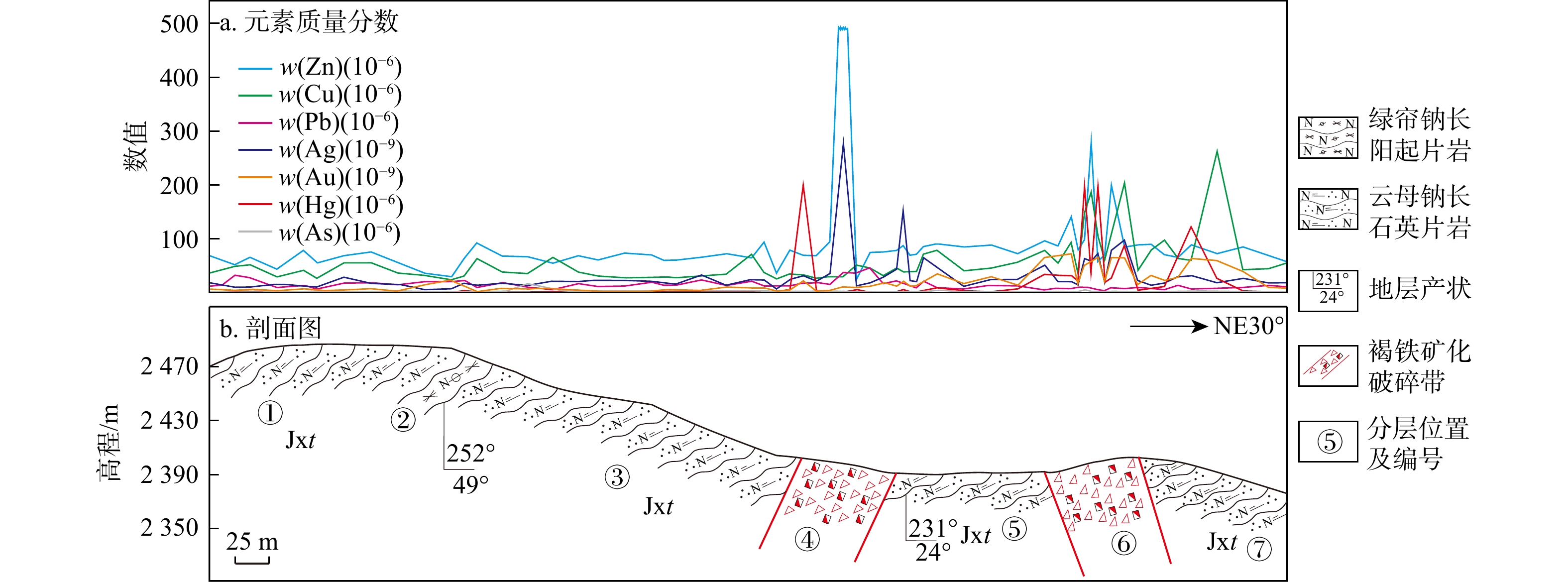
图 17 西华山地区柳沟矿区DH1 地质−化探综合剖面图(位置见图16)
Figure 17. Integrated geochemical-geological profile map of DH1 in Liugou gold mining area, Xihuashan area
表 1 西华山地区典型金多金属矿床成矿地质特征
Table 1. Metallogenic geological characteristics of typical gold-polymetallic deposits in Xihuashan area
矿床(点)名称 成矿/赋矿地质体 矿体形态 控矿
构造成矿元素组合 矿石类型 围岩蚀变 矿石矿物 成矿时代 矿床规模 金属矿物 非金属矿物 马场
金矿中元古界天都山组云母钠长石英片岩,早志留世煌斑岩脉及相关热液活动;含金煌斑岩脉、含金石英脉和含金碎裂云母钠长石英片岩 脉状、透镜状、扁豆状 NWW向断层 Au为主,Ag次之 石英脉型、蚀变
岩型、煌斑岩型褐铁矿化、黄铁矿化、硅化、碳酸盐化、孔雀石化 黄铁矿、黄铜矿、自然金、蓝铜矿、斑铜矿 石英、方解石、磁铁矿、白云母 早志留世(433 Ma,据煌斑岩脉年龄) 小型 柳沟
金矿中元古界天都山组云母钠长石英片岩,早志留世煌斑岩脉及相关热液活动;含金碎裂云母钠长石英片岩、含金石英脉和含金煌斑岩脉 脉状、
透镜状近EW向和NW向断层 Au为主,Ag次之 石英脉型、蚀变
岩型、煌斑岩型褐铁矿化、碳酸盐化、绢云母化、绿泥石化、钠长石化 黄铁矿、黄铜矿、铜蓝、毒砂、斑铜矿和自然金 石英、白云母、方解石、绢云母、绿泥石 早志留世(433 Ma,据煌斑岩脉年龄) 矿点 簸箕掌
铜矿中元古界簸箕掌组含石墨云母石英片岩,热液改造作用(沉积−变质−热液改造);其中充填的含矿石英脉和方解石脉 脉状 近SN向断层 Cu为主,伴生Au 石英脉型
(方解石脉型)褐铁矿化、孔雀石化、黄铁矿化、硅化、绢云母化、绿泥石化 孔雀石、蓝铜矿、黄铜矿、褐铁矿、斑铜矿 石英、方解石、白云母、绢云母 — 矿点  下载: 导出CSV
表 2 西华山地区海原群Au、Cu质量分数及浓集系数[37]
Table 2. Au and Cu contents and enrichment coefficients in Haiyuan Group strata of Xihuashan area
岩石类型 样品数/个 Au Cu wB/10−9 浓集系数 wB/10−6 浓集系数 变质基性火山岩 24 4.89 1.53 133.8 1.54 变质碎屑岩 37 2.87 1.04 40.7 1.23 碳酸盐岩 20 3.24 1.62 19.1 1.12 注:浓集系数=岩石元素质量分数/地壳标准丰度
下载: 导出CSV
表 3 西华山地区岩石物性参数[36]
Table 3. Physical property parameters of rocks in Xihuashan area
地层 岩性 视电阻率ρs/(Ω·m) 视极化率ηs/% 范围 均值 范围 均值 Jxq 白云母钠长石英片岩夹少量绿片岩、方解石大理岩 423.9~ 2528.8 1108.3 0.89~1.73 1.18 Jxt 白云钠长石英片岩矿化蚀变 148.3~ 1395.1 624.2 0.70~2.28 1.37 白云钠长石英片岩夹少量大理岩 345.5~ 1939.1 889.4 1.07~2.39 1.70 绿片岩 875.0~ 1272.0 1010.3 1.57~1.64 1.60 Jxm 云母片岩 97.7~552.0 387.0 0.26~1.99 0.97 褐铁矿化云母片岩 449.0~847.0 641.0 1.17~2.92 1.95 大理岩 353.0~575.0 454.0 0.11~1.77 1.04
下载: 导出CSV
表 4 西华山地区1∶
50000 水系沉积物地球化学背景特征[36]Table 4. Geochemical background characteristics of 1:50 000 stream sediments in Xihuashan area
元素 标准差 区域背景值 Q N E D S Jxq Jxt Jxb Jxw Jxm Co wB/10−6 7.75 8.93 9.33 9.69 13.90 3.58 7.31 15.89 13.85 13.83 15.98 6.27 Ni 13.45 17.24 17.26 19.49 24.93 8.09 12.77 31.25 28.49 24.61 28.20 11.55 Cu 53.54 19.11 19.50 21.98 32.10 8.39 13.27 36.50 38.81 61.10 42.10 12.59 Mo 0.84 0.52 0.59 0.87 0.94 0.32 0.33 0.84 1.00 1.11 0.94 0.30 Sb 0.19 0.23 0.26 0.41 0.36 0.31 0.25 0.40 0.36 0.25 0.22 0.22 W 0.70 0.91 0.87 1.06 1.08 1.28 0.87 1.24 1.38 1.03 1.41 0.99 Pb 54.19 13.04 13.42 16.85 18.41 10.68 11.21 40.55 34.24 19.61 15.66 10.02 Bi 0.22 0.17 0.18 0.21 0.22 0.12 0.14 0.36 0.28 0.22 0.24 0.13 Cr 25.97 34.36 35.41 41.85 51.98 16.27 27.24 61.60 56.96 44.00 59.53 24.50 Zn 27.03 34.76 34.58 40.77 53.09 15.12 32.27 61.90 59.10 53.70 60.13 23.96 Sn 0.68 1.82 1.62 1.94 2.07 1.59 1.65 2.33 2.54 1.93 2.42 1.56 Ag 0.13 0.05 0.05 0.07 0.06 0.04 0.04 0.11 0.12 0.09 0.08 0.04 As 19.12 3.85 4.34 15.24 6.17 2.96 2.61 8.93 10.38 6.49 4.71 2.37 Hg wB/10−9 2.88 7.90 8.12 9.09 8.61 8.06 8.31 8.24 8.31 8.02 8.81 8.03 Au 9.00 1.11 1.49 5.65 1.31 1.15 0.99 1.77 4.65 1.48 1.68 1.01
下载: 导出CSV
表 5 西华山地区金多金属矿综合找矿预测模型
Table 5. Integrated prospecting prediction model for gold-polymetallic deposits in Xihuashan area
模型要素 要素具体特征 含矿地质体 金矿主要为含金煌斑岩脉、含金石英脉和含金碎裂云母钠长石英片岩;铜矿主要为石墨化云母石英片岩中充填的含矿石英脉和方解石脉 围岩蚀变 褐铁矿化、黄铁矿化、碳酸盐化、孔雀石化、绢云母化、硅化 成矿控制
因素构造 三级断裂构造:区域性NW向断裂为主要导矿构造(一级构造),次一级NNW向断裂为配矿构造(二级构造),更次一级NW−NWW向层间断裂为主要赋矿构造(三级构造) 地层 金成矿有利层位主要为天都山组,铜成矿有利层位主要为簸箕掌组;初始矿源层为中元古界海原群变沉积岩系,尤其是变质基性火山岩;主要赋矿岩性为各类石英片岩 岩浆
活动加里东期(450~430 Ma)岩浆活动为成矿提供关键物质、流体和热动力来源;煌斑岩脉与成矿关系密切,部分直接构成矿体;成矿时代(433 Ma)与岩浆活动期次耦合 地球物理特征 1∶ 5000 激电测量显示,高极化率是共同特征。高阻−高极化异常多对应地表含矿石英脉及蚀变矿化体;低阻−高极化异常可能指示深部隐伏硫化物富集或石墨化带,是深部找矿的线索地球化学特征 1∶ 50000 水系沉积物测量中异常强度大、分布范围广的Au-Cu-Ag-As-Mo元素组合异常和Pb-Au-As-Ag元素组合异常高光谱遥感特征 基于主成分分析的WV-3数据所提取的铝羟基异常、碳酸盐化异常和铁染异常,特别是与已知金多金属矿在空间上吻合较好地区
下载: 导出CSV
表 6 西华山地区 1∶
2000 岩石地球化学测量结果Table 6. Results of 1∶2 000 rock geochemical survey in Xihuashan area
元素 簸箕掌地区,7 条剖面,514 件样品 柳沟−马场地区,4 条剖面,650 件样品 极小值 极大值 平均值 极小值 极大值 平均值 Au wB/10−9 0.69 9.89 1.72 0.01 551.30 2.73 Hg 4.04 637.37 18.61 3.67 46.79 16.43 Cu wB/10−6 1.81 > 5000.00 78.03 0.50 1116.95 43.30 Pb 0.63 387.10 11.22 0.30 928.35 26.29 Zn 0.28 267.88 41.24 2.72 676.51 59.92 Cr 1.06 348.15 34.37 4.93 524.13 66.27 Ni 1.82 519.50 30.97 5.31 709.32 39.12 Mo 0.19 46.45 2.65 0.26 326.69 7.73 Co 0.49 149.43 10.96 0.50 490.01 15.25 W 0.22 8.85 1.18 0.02 30.12 1.78 Bi 0.05 2.61 0.19 0.05 17.35 0.61 As 0.30 207.28 6.81 0 125.63 4.40 Sb 0.04 22.65 0.27 0.05 123.25 1.64 Sn 1.04 50.00 2.32 0.22 9.36 2.65 Ag 0.03 4.28 0.12 0.012 4.60 0.11
下载: 导出CSV
-
[1] 李双飞, 黄鹂, 陈建, 等. 山东省五莲七宝山金铜矿床成矿模式与找矿勘查模型: 来自综合物化探的证据[J]. 地质与勘探, 2023, 59(5): 961-973. doi: 10.12134/j.dzykt.2023.05.004LI S F, HUANG L, CHEN J, et al. Metallogenic model and prospecting model of the Qibaoshan gold-copper deposit in Wulian, Shandong Province: Evidence from comprehensive geophysical and geochemical exploration[J]. Geology and Exploration, 2023, 59(5): 961-973. (in Chinese with English abstract) doi: 10.12134/j.dzykt.2023.05.004 [2] 李秀章, 刘晨成, 邱成贵, 等. 大比例尺综合物化探测量在浅覆盖区脉状金矿中的找矿实践: 以胶东东部乳山于家圈金矿为例[J]. 地质与勘探, 2025, 61(1): 54-63.LI X Z, LIU C C, QIU C G, et al. Prospecting practice of comprehensive large-scale geophysical and geochemical exploration in vein-type gold deposits with shallow overburden: Taking the Yujiaquan gold deposit in Rushan City of eastern Jiaodong as an example[J]. Geology and Exploration, 2025, 61(1): 54-63. (in Chinese with English abstract) [3] 杨红恩, 董军, 徐云霞, 等. 辽宁辽阳大南沟金矿区物化探异常特征、找矿效果与找矿前景[J]. 黄金, 2025, 46(8): 92-98.YANG H E, DONG J, XU Y X, et al. Geophysical and geochemical anomaly characteristics, prospecting effectiveness, and prospecting potential in the Danangou gold district, Liaoyang, Liaoning Province[J]. Gold, 2025, 46(8): 92-98. (in Chinese with English abstract) [4] 游越新, 邓居智, 陈辉, 等. 综合物探方法在云南澜沧老厂多金属矿区深部找矿中的应用[J]. 物探与化探, 2023, 47(3): 638-647. doi: 10.11720/wtyht.2023.1578YOU Y X, DENG J Z, CHEN H, et al. Application of integrated geophysical methods in deep ore prospecting of Laochang polymetallic mining area in Lancang, Yunnan[J]. Geophysical and Geochemical Exploration, 2023, 47(3): 638-647. (in Chinese with English abstract) doi: 10.11720/wtyht.2023.1578 [5] 张晓团, 李新林, 周斌, 等. 综合物探方法在蟒岭矿集区深部找矿中的应用[J]. 地质与勘探, 2025, 61(3): 475-486.ZHANG X T, LI X L, ZHOU B, et al. Application of comprehensive geophysical prospecting methods in deep exploration of the Mangling ore concentration area[J]. Geology and Exploration, 2025, 61(3): 475-486. (in Chinese with English abstract) [6] 郭国强, 刘锋, 陈治国, 等. 胶西北石墨矿覆盖区金矿综合物探找矿方法和应用效果[J]. 地质通报, 2025, 44(9): 1662-1672. doi: 10.12097/gbc.2024.07.033GUO G Q, LIU F, CHEN Z G, et al. Comprehensive geophysical exploration methods and application effects for gold deposits in the graphite covered area of Northwest Jiaodong[J]. Geological Bulletin of China, 2025, 44(9): 1662-1672. (in Chinese with English abstract) doi: 10.12097/gbc.2024.07.033 [7] 张随波, 江泮雨辰, 蓝海洋, 等. 低缓磁异常下隐伏大型铁矿床的发现与综合勘查技术应用: 以鞍山地区梨花峪铁矿为例[J]. 地质与资源, 2025, 34(5): 602-610. doi: 10.13686/j.cnki.dzyzy.2025.05.008ZHANG S B, JIANG P Y C, LAN H Y, et al. Discovery of large concealed iron deposits beneath low-gradient magnetic anomalies with application of integrated exploration techniques: A case study of Lihuayu iron deposit in Anshan area[J]. Geology and Resources, 2025, 34(5): 602-610. (in Chinese with English abstract) doi: 10.13686/j.cnki.dzyzy.2025.05.008 [8] 赵志飞, 王斌, 王雷. 多元素衬值累加地球化学方法在找矿中的应用: 以青海省夏日哈−什多龙远景区为例[J]. 地质与勘探, 2020, 56(2): 328-336.ZHAO Z F, WANG B, WANG L. Application of the geochemical method based on multi-element contrast-value accumulation to ore prospecting: An example of the Xiariha-Shiduolong metallogenic prospect area in Qinghai Province[J]. Geology and Exploration, 2020, 56(2): 328-336. (in Chinese with English abstract) [9] 宋威方, 刘建中, 吴攀, 等. 构造地球化学弱信息提取方法在黔西南卡林型金矿找矿中的应用[J]. 物探与化探, 2022, 46(6): 1338-1348. doi: 10.11720/wtyht.2022.1502SONG W F, LIU J Z, WU P, et al. A successful application of the tectono-geochemistry weak information extraction method in the prospecting of Carlin-type gold deposits in southwestern Guizhou Province[J]. Geophysical and Geochemical Exploration, 2022, 46(6): 1338-1348. (in Chinese with English abstract) doi: 10.11720/wtyht.2022.1502 [10] 马文君, 谢海林, 李少南, 等. 地球化学测量方法在东昆仑茫崖河东金矿中的应用及找矿效果[J]. 黄金科学技术, 2025, 33(4): 717-734. doi: 10.11872/j.issn.1005-2518.2025.04.014MA W J, XIE H L, LI S N, et al. Application of geochemical survey method in mangyahedong gold deposit of east Kunlun and its prospecting effect[J]. Gold Science and Technology, 2025, 33(4): 717-734. (in Chinese with English abstract) doi: 10.11872/j.issn.1005-2518.2025.04.014 [11] 李志忠, 陈圣波, 刘德长, 等. 近年国内外遥感地质找矿主要进展[J]. 西北地质, 2025, 58(3): 183-195. doi: 10.12401/j.nwg.2025069LI Z Z, CHEN S B, LIU D C, et al. Progress of remote sensing geological prospecting domestic and abroad in recent years[J]. Northwestern Geology, 2025, 58(3): 183-195. (in Chinese with English abstract) doi: 10.12401/j.nwg.2025069 [12] 乔锴, 赵忠海, 罗涛, 等. 综合混合像元分解与分形理论方法的遥感蚀变信息提取[J]. 地质论评, 2025, 71(增刊1): 211-212. doi: 10.16509/j.georeview.2025.s1.077QIAO K, ZHAO Z H, LUO T, et al. Extraction of remote sensing alteration information based on integrated spectral mixture analysis and fractal analysis[J]. Geological Review, 2025, 71(S1): 211-212. (in Chinese with English abstract) doi: 10.16509/j.georeview.2025.s1.077 [13] 范玉海. 西昆仑造山带黑恰地区地物化遥异常特征综合研究与找矿有利区(定位定量)预测[D]. 西安: 长安大学, 2022.FAN Y H. Mineral location and quantitative prediction based on geology, geophysical, geochemical and remote sensing anomaly information in Heiqia area, West Kunlun orogenic belt[D]. Xi'an: Chang'an University, 2022 (in Chinese with English abstract) [14] 娄元林, 钱建利, 朱志平, 等. 物化遥综合找矿方法在西藏隆子县拉九地区的应用[J]. 黄金科学技术, 2024, 32(2): 241-257. doi: 10.11872/j.issn.1005-2518.2024.02.163LOU Y L, QIAN J L, ZHU Z P, et al. Application of integrated geophysical, geochemical and remote sensing prospecting methods in Lajiu area, Longzi County, Tibet[J]. Gold Science and Technology, 2024, 32(2): 241-257. (in Chinese with English abstract) doi: 10.11872/j.issn.1005-2518.2024.02.163 [15] 李红宇, 郭合伟, 孙文坤. 宁夏西华山柳沟金矿地质特征及成矿地质条件分析[J]. 矿产与地质, 2009, 23(1): 21-26.LI H Y, GUO H W, SUN W K. Geological characteristics and metallogenic geological conditions of the Liugou gold deposit in Xihuashan, Ningxia[J]. Mineral Resources and Geology, 2009, 23(1): 21-26. (in Chinese with English abstract) [16] 杨克成, 母彩霞, 海连富, 等. 宁夏西华山地区马场金矿床地质特征与成因[J]. 地质找矿论丛, 2022, 37(4): 414-419. doi: 10.6053/j.issn.1001-1412.2022.04.003YANG K C, MU C X, HAI L F, et al. Geological characteristics and genesis of Machang Au deposit in Xihuashan area, Ningxia[J]. Contributions to Geology and Mineral Resources Research, 2022, 37(4): 414-419. (in Chinese with English abstract) doi: 10.6053/j.issn.1001-1412.2022.04.003 [17] 孙永亮, 海连富, 赵少卿, 等. 宁夏西华山地区马场金矿床物质来源及矿床成因: 来自S同位素证据[J]. 矿产勘查, 2023, 14(11): 2039-2048. doi: 10.20008/j.kckc.202311003SUN Y L, HAI L F, ZHAO S Q, et al. Material source and genesis of Machang gold deposit in Xihuashan area, Ningxia: Evidence from S isotope[J]. Mineral Exploration, 2023, 14(11): 2039-2048. (in Chinese with English abstract) doi: 10.20008/j.kckc.202311003 [18] 梅超, 魏向成, 海连富, 等. 宁夏西华山地区簸箕掌铜金矿床地质特征及成矿地质条件分析[J]. 地质找矿论丛, 2023, 38(4): 407-414. doi: 10.6053/j.issn.1001-1412.2023.04.001MEI C, WEI X C, HAI L F, et al. Geological characteristics and metallogenic conditions of Bojizhang copper-gold deposits in Xihuashan area, Ningxia Hui Autonomous Region[J]. Contributions to Geology and Mineral Resources Research, 2023, 38(4): 407-414. (in Chinese with English abstract) doi: 10.6053/j.issn.1001-1412.2023.04.001 [19] 赵翌辰. 宁夏海原县西华山金矿成矿物质来源及矿床成因[D]. 西安: 长安大学, 2024.ZHAO Y C. Ore-forming material source and genesis of Xihuashan gold mine, Haiyuan Country, Ningxia Hui Autonomous Region[D]. Xi'an: Chang'an University, 2024. (in Chinese with English abstract) [20] 苏力, 朱海军, 谷守江, 等. 宁夏海原西华山地区金矿床地质地球化学特征及成因分析[J]. 黄金科学技术, 2024, 32(2): 191-206.SU L, ZHU H J, GU S J, et al. Geological and geochemistry characteristics and genesis analysis of gold deposits in Xihuashan area, Haiyuan, Ningxia[J]. Gold Science and Technology, 2024, 32(2): 191-206. (in Chinese with English abstract) [21] 海连富, 母彩霞, 梅超, 等. 北祁连东段宁夏马场金矿床成因: 煌斑岩年代学、流体包裹体和C-H-O-S同位素约束[J]. 中国有色金属学报, 2025, 35(5): 1799-1820. doi: 10.11817/j.ysxb.1004.0609.2024-45374HAI L F, MU C X, MEI C, et al. Genesis of Machang gold deposit in eastern part of North Qilian orogen: Constraints from zircon geochronology of lamprophyre, fluid inclusions and C-H-O-S isotopes[J]. The Chinese Journal of Nonferrous Metals, 2025, 35(5): 1799-1820. (in Chinese with English abstract) doi: 10.11817/j.ysxb.1004.0609.2024-45374 [22] 李厚民, 孙继东, 王崇礼, 等. 海原西华山地区金矿化的地球化学特征及成因[J]. 西安工程学院学报, 1997, 19(2): 1-5. doi: 10.19814/j.jese.1997.02.001LI H M, SUN J D, WANG C L, et al. Geochemical characteristics and genesis of the gold mineralization in Xihua mountains, Haiyuan, Ningxia Autonomous Region[J]. Journal of Xi'an College of Geology, 1997, 19(2): 1-5. (in Chinese with English abstract) doi: 10.19814/j.jese.1997.02.001 [23] FU D, HUANG B, JOHNSON T E, et al. Boninitic blueschists record subduction initiation and subsequent accretion of an arc-forearc in the northeastern Proto-Tethys Ocean[J]. Geology, 2022, 50(1): 10-15. doi: 10.1130/G49457.1 [24] 张建新, 于胜尧, 李云帅, 等. 原特提斯洋的俯冲、增生及闭合: 阿尔金−祁连−柴北缘造山系早古生代增生/碰撞造山作用[J]. 岩石学报, 2015, 31(12): 3531-3554.ZHANG J X, YU S Y, LI Y S, et al. Subduction, accretion and closure of Proto-Tethyan Ocean: Early Paleozoic accretion/collision orogeny in the Altun-Qilian-North Qaidam orogenic system[J]. Acta Petrologica Sinica, 2015, 31(12): 3531-3554. (in Chinese with English abstract) [25] 宋述光, 吴珍珠, 杨立明, 等. 祁连山蛇绿岩带和原特提斯洋演化[J]. 岩石学报, 2019, 35(10): 2948-2970. doi: 10.18654/1000-0569/2019.10.02SONG S G, WU Z Z, YANG L M, et al. Ophiolite belts and evolution of the Proto-Tethys Ocean in the Qilian orogen[J]. Acta Petrologica Sinica, 2019, 35(10): 2948-2970. (in Chinese with English abstract) doi: 10.18654/1000-0569/2019.10.02 [26] 董云鹏, 惠博, 孙圣思, 等. 中国中央造山系原−古特提斯多阶段复合造山过程[J]. 地质学报, 2022, 96(10): 3426-3448. doi: 10.3969/j.issn.0001-5717.2022.10.010DONG Y P, HUI B, SUN S S, et al. Multiple orogeny and geodynamics from Proto-Tethys to Paleo-Tethys of the central China orogenic belt[J]. Acta Geologica Sinica, 2022, 96(10): 3426-3448. (in Chinese with English abstract) doi: 10.3969/j.issn.0001-5717.2022.10.010 [27] SONG S G, NIU Y L, SU L, et al. Tectonics of the North Qilian orogen, NW China[J]. Gondwana Research, 2013, 23(4): 1378-1401. doi: 10.1016/j.gr.2012.02.004 [28] 夏林圻, 李向民, 余吉远, 等. 祁连山新元古代中−晚期至早古生代火山作用与构造演化[J]. 中国地质, 2016, 43(4): 1087-1138.XIA L Q, LI X M, YU J Y, et al. Mid-Late Neoproterozoic to Early Paleozoic volcanism and tectonic evolution of the Qilian Mountain[J]. Geology in China, 2016, 43(4): 1087-1138. (in Chinese with English abstract) [29] 李延栋. 中国区域地质志: 宁夏志[M]. 北京: 地质出版社, 2017.LI Y D. Regional geology of China: Ningxia Volume[M]. Beijing: Geological Publishing House, 2017. (in Chinese) [30] 赵少卿, 海连富, 孙永亮, 等. 北祁连东段早古生代洋壳俯冲作用记录: 来自晚奥陶世高镁埃达克岩的证据[J]. 岩石矿物学杂志, 2023, 42(4): 465-482.ZHAO S Q, HAI L F, SUN Y L, et al. A record of Early Paleozoic subduction of oceanic crust in the eastern part of the North Qilian Mountains: Evidence from the Late Ordovician high-Mg adakites[J]. Acta Petrologica et Mineralogica, 2023, 42(4): 465-482. (in Chinese with English abstract) [31] 海连富. 宁夏卫宁北山地区金场子金矿床成因与找矿潜力评价[D]. 武汉: 中国地质大学(武汉), 2023.HAI L F. Genesis and prospecting potential evaluation of Jinchangzi gold deposit in Weiningbeishan area, Ningxia[D]. Wuhan: China University of Geosciences (Wuhan), 2023. (in Chinese with English abstract) [32] 海连富, 张晓军, 孙永亮, 等. 宁夏卫宁北山地区伴生钴矿床地质特征、控矿因素及找矿方向[J]. 地质科技通报, 2024, 43(5): 55-69. doi: 10.19509/j.cnki.dzkq.tb20230691HAI L F, ZHANG X J, SUN Y L, et al. Geological characteristics, controlling factors and prospecting directions of associated cobalt deposits in the Weiningbeishan area, Ningxia[J]. Bulletin of Geological Science and Technology, 2024, 43(5): 55-69. (in Chinese with English abstract) doi: 10.19509/j.cnki.dzkq.tb20230691 [33] CAO H, SUN Z L, JIANG Z K, et al. Source origin and ore-controlling factors of hydrothermal sulfides from the Tianzuo hydrothermal field, Southwest Indian Ridge[J]. Ore Geology Reviews, 2021, 134: 104168. doi: 10.1016/j.oregeorev.2021.104168 [34] MUCHEZ P, CORBELLA M. Factors controlling the precipitation of copper and cobalt minerals in sediment-hosted ore deposits: Advances and restrictions[J]. Journal of Geochemical Exploration, 2012, 118: 38-46. doi: 10.1016/j.gexplo.2012.04.006 [35] 赵鹏大, 池顺都, 李志德, 等. 矿床勘查理论与方法[M]. 武汉: 中国地质大学出版社, 2001.ZHAO P D, CHI S D, LI Z D, et al. Theory and method of ore exploration[M]. Wuhan: China University of Geosciences Press, 2001. (in Chinese) [36] 张海波, 邹武建, 胥维刚, 等. 宁夏海原县柳沟−簸箕掌地区矿产地质调查报告[R]. 银川: 宁夏回族自治区地质矿产勘查院, 2016.ZHANG H B, ZOU W J, XU W G, et al. Report on the mineral geological survey of the Liugou-Bojizhang area in Haiyuan County, Ningxia[R]. Yinchuan: Ningxia Hui Autonomous Region Institute of Geology and Mineral Resources Exploration, 2016. (in Chinese) [37] 李厚民, 孙继东, 王崇礼. 宁夏海原县南、西华山地区铜、金矿化的控矿条件[J]. 黄金科学技术, 1996, 4(1): 17-20.LI H M, SUN J D, WANG C L. Ore-controlling conditions of copper-gold mineralization in the Nanhuashan and Xihuashan area of Haiyuan County, Ningxia[J]. Gold Science and Technology, 1996, 4(1): 17-20. (in Chinese with English abstract) [38] YANG F, WANG G W, SANTOSH M, et al. Delineation of potential exploration targets based on 3D geological modeling: A case study from the Laoangou Pb-Zn-Ag polymetallic ore deposit, China[J]. Ore Geology Reviews, 2017, 89: 228-252. doi: 10.1016/j.oregeorev.2017.06.013 [39] 娄渝明. 基于地质三维建模的西藏雄村矿区2号矿体深部资源定量预测[D]. 成都: 成都理工大学, 2019.LOU Y M. Quantitative prediction of deep resources of Xiongcun No. 2 deposit based on geological 3D modeling[D]. Chengdu: Chengdu University of Technology, 2019 . (in Chinese with English abstract) -

 下载:
下载:






 点击查看大图
计量
- 文章访问数: 247
- PDF下载量: 55
- 被引次数: 0