投审稿入口
投审稿入口


Susceptibility assessment of rainfall-induced clustered landslides integrating ensemble machine learning and negative sample sampling strategies
-
摘要:
我国南方丘陵山地降雨群发滑坡具备短时爆发、多点并发、空间集聚的特点,滑坡点位和周边稳定斜坡环境条件高度相似,负样本采样方案是制约滑坡易发性评价精度的关键瓶颈。传统负样本采样容易选取环境差异悬殊的简单负样本,造成模型难以识别滑坡区内部斜坡稳定性差异,产生大量预测误判。以 2023 年 10 月广东信宜−罗定交界极端降雨诱发群发滑坡为研究对象,探究不同负样本采样策略与机器学习模型耦合对滑坡易发性评价的影响。基于灾前、灾后 Planet 遥感影像目视解译得到
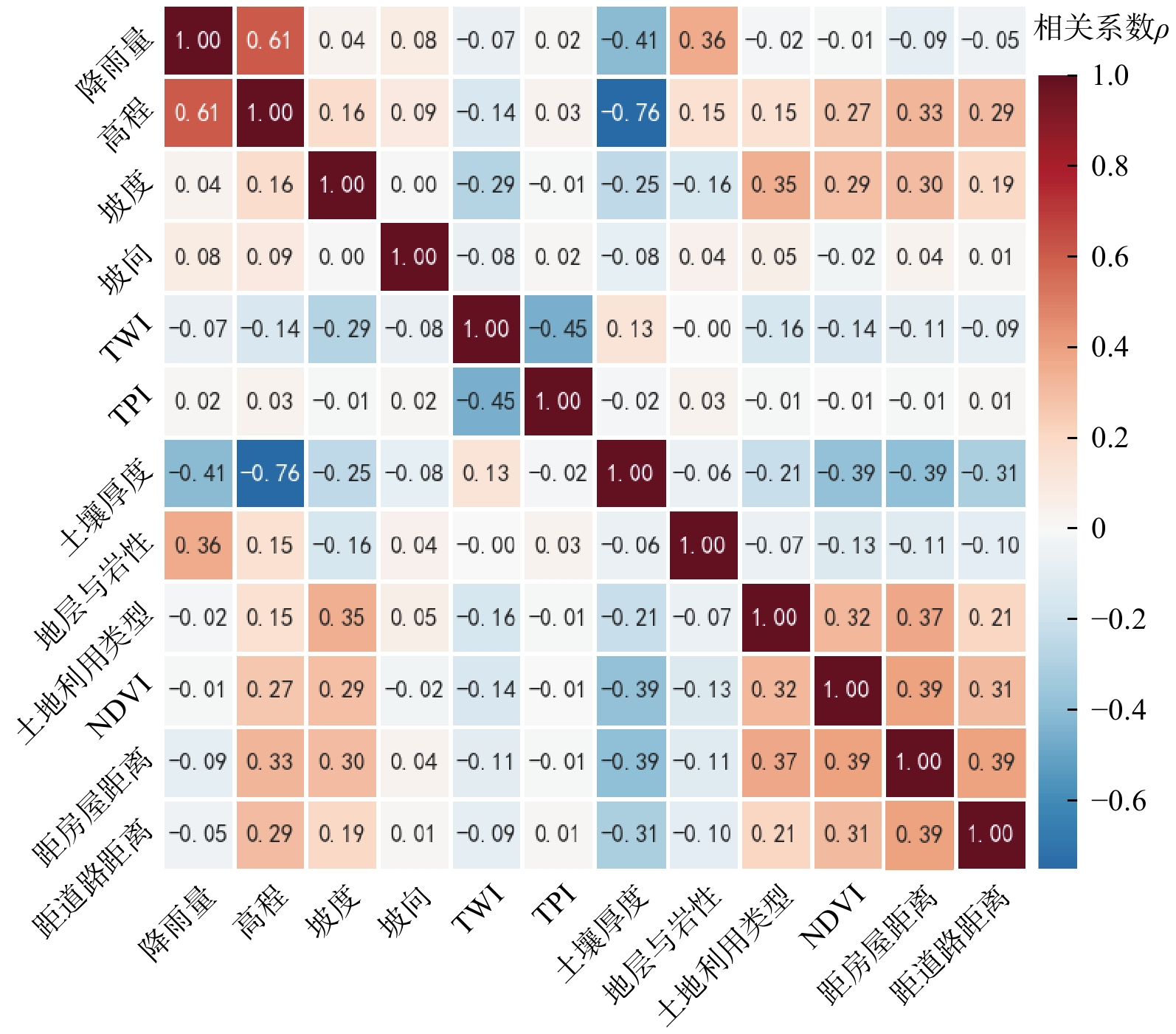
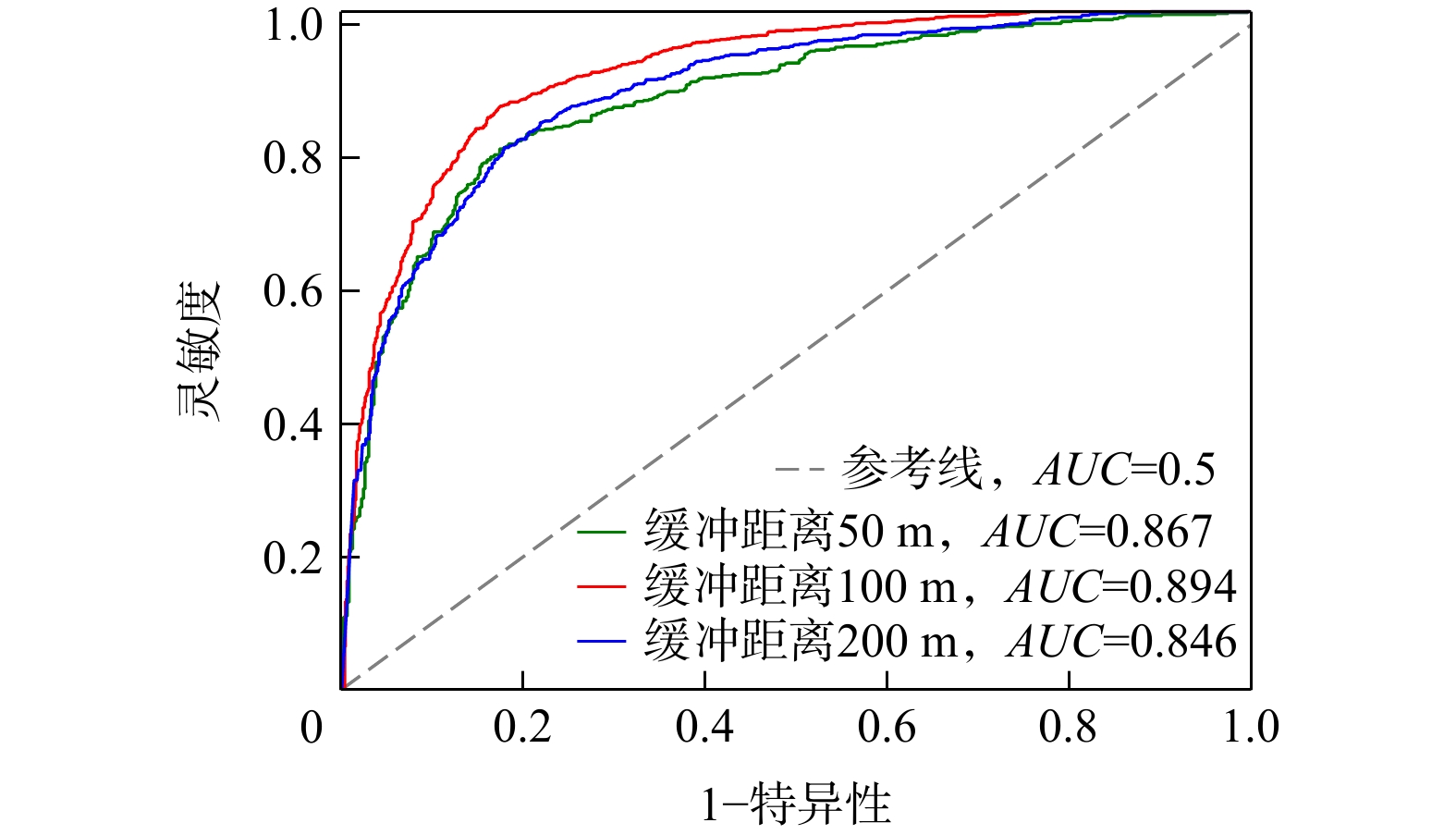
3792 处滑坡正样本;从气象水文、地形地貌、地质土壤、植被覆盖、人类活动 5 个维度筛选评价因子,通过斯皮尔曼相关性分析剔除存在强共线性的高程因子;在正负样本 1∶1、统一设置 100 m 滑坡缓冲区的条件下构建缓冲区随机采样(非滑坡区采样)、低坡度约束采样(低坡度区采样)、K-means 聚类采样 3 类负样本集;采用 70% 训练集、30% 测试集划分数据集,利用网格搜索结合 5 折交叉验证对随机森林(RF)、极端梯度提升(XGBoost)、堆叠集成学习(Stacking)模型调参,以曲线下面积(AUC)、准确率(ACC)、F1 分数开展模型检验,借助自然断点法完成滑坡易发性分级制图。Stacking具备较高基础精度,负样本采样策略对模型性能影响显著;ACC、F1 分数在不同方案间差异较小,但AUC与空间制图效果区分明显。K-means 聚类采样可刻画非滑坡区环境异质性,与 Stacking模型耦合时综合性能最优,AUC达 0.93,ACC与 F1 分数最优,识别得到的高、极高易发区集中分布于研究区西北部中低山−丘陵过渡带,与实际滑坡集聚区高度吻合;缓冲区随机采样次之,低坡度约束采样模型效果最弱,易发性图件易出现高估与离散噪点。K-means 无监督聚类采样能够充分刻画群发滑坡区非滑坡环境异质性,结合Stacking可同时提升模型统计精度与空间地质合理性,可为南方丘陵山地降雨群发滑坡精细化易发性评价提供方法参考。Abstract:ObjectiveRainfall-triggered clustered landslides frequently occur in the hilly and mountainous regions of southern China, posing severe threats to local lives and property. Such geohazards feature short-term abrupt occurrence, multi-point concurrent failures, and strong spatial aggregation. Critically, landslide sites share highly similar geo-environmental conditions with adjacent stable slopes, which brings great challenges to landslide susceptibility modeling. Conventional negative sample sampling strategies often generate oversimplified non-landslide samples from environmentally distinct stable areas. These easy negative samples make machine learning models achieve seemingly high statistical scores while failing to capture subtle differences between unstable and stable slopes within landslide-prone zones, consequently producing widespread spatial misjudgments. Taking the clustered landslide event triggered by extreme rainfall in October 2023 across the Xinyi-Luoding border area, western Guangdong Province, China as the study object, this study aims to explore how coupling different negative sample sampling strategies with machine learning models affects the performance of landslide susceptibility assessment.
MethodsBased on pre- and post-event Planet satellite images, visual image interpretation was implemented to acquire
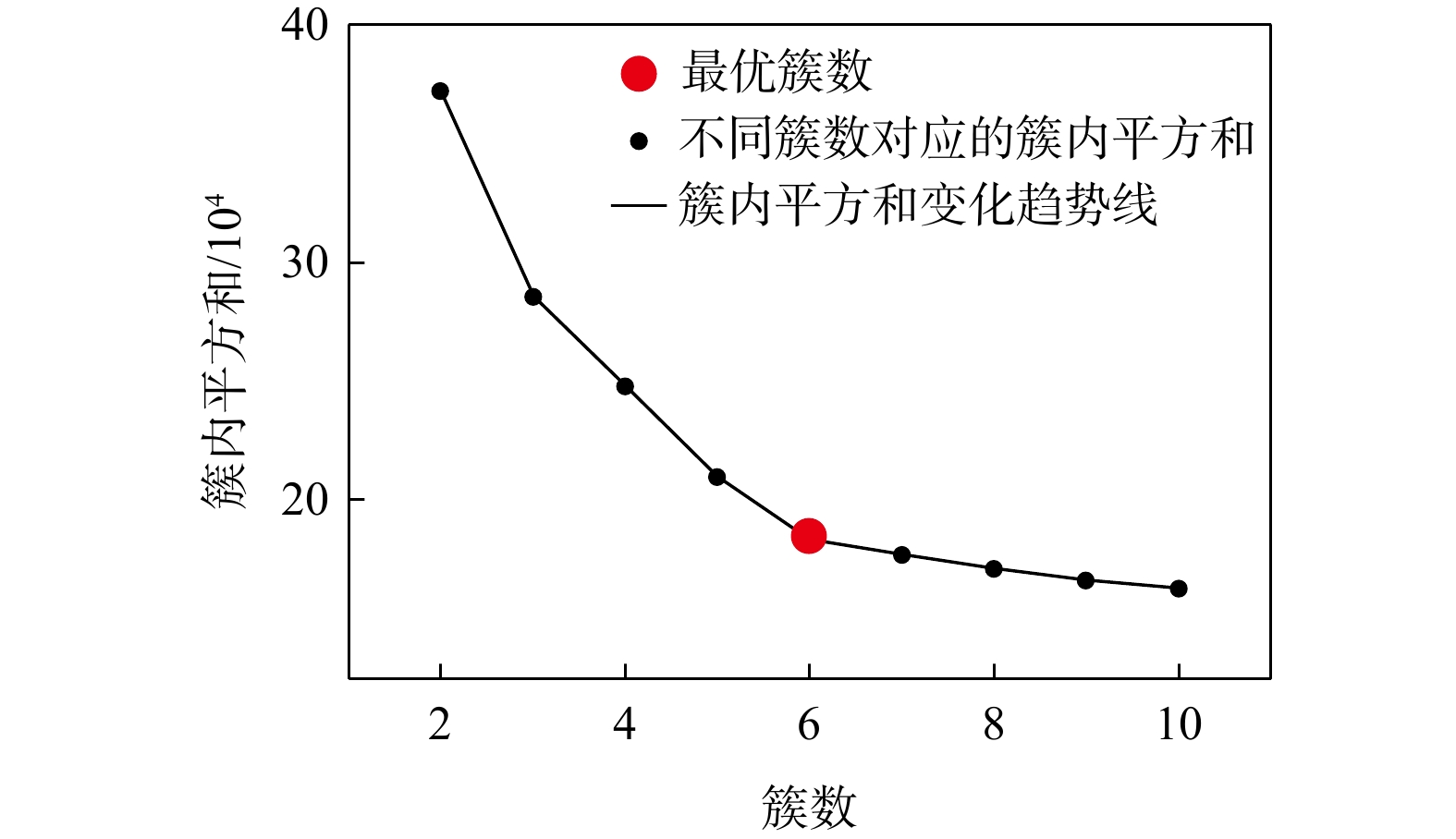
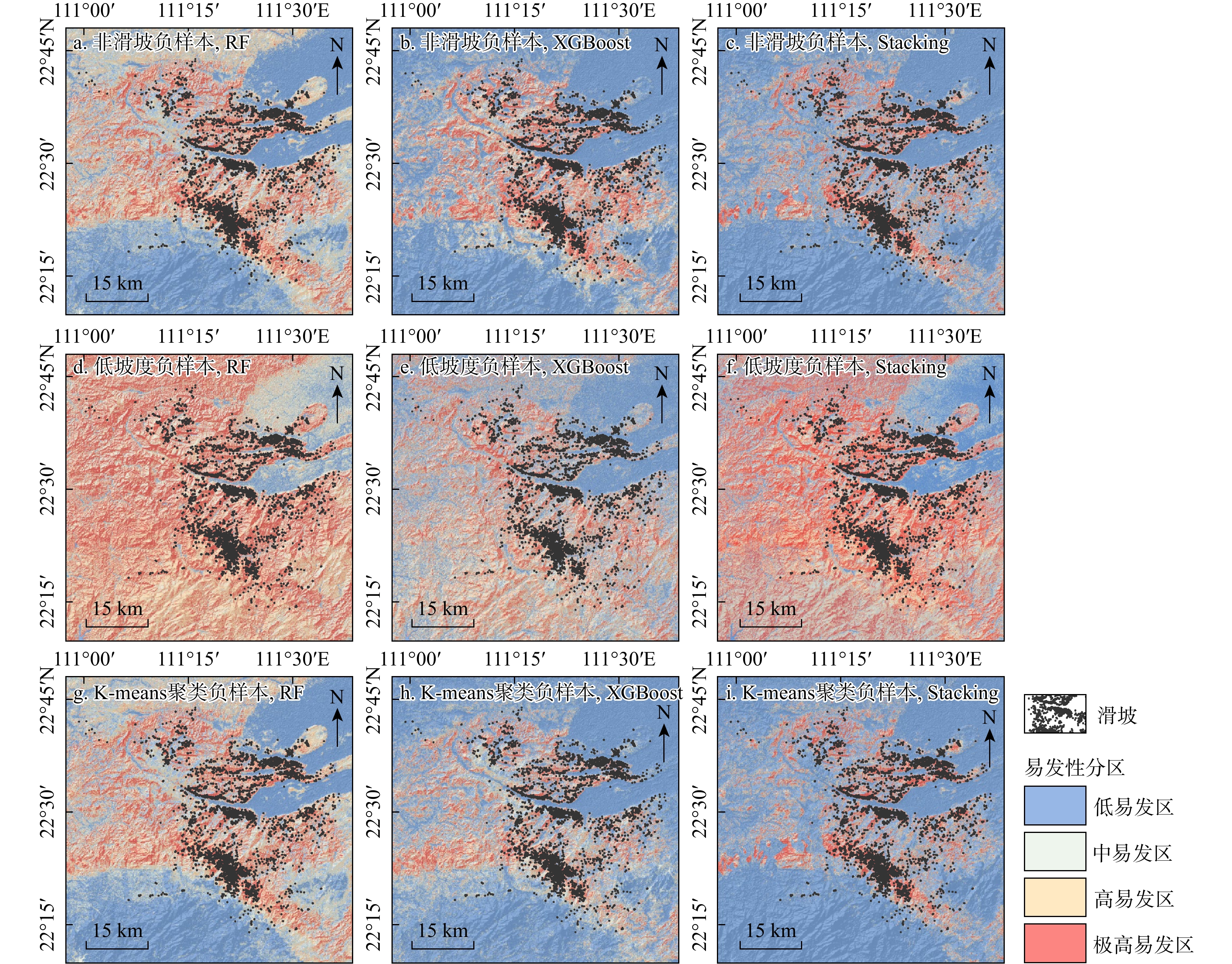
3792 positive landslide samples. Twelve evaluation factors were selected from five dimensions: meteorology and hydrology, topography and geomorphology, geology and soil, vegetation cover, and human activities. Spearman correlation analysis was applied to detect multicollinearity, and the elevation factor was eliminated due to strong collinearity. Under a 1∶1 positive-to-negative sample ratio and a unified 100-m buffer constraint around landslide boundaries, three types of negative sample datasets were established via buffer-based random sampling, low-slope constrained sampling and K-means unsupervised clustering sampling. The whole dataset was partitioned into a 70 % training subset and a 30 % testing subset. Grid search combined with five-fold cross-validation was adopted for hyperparameter optimization of random forest (RF), extreme gradient boosting (XGBoost), and Stacking models (using RF and XGBoost as base learners and logistic regression as the meta-learner). Model performance was quantified using AUC-ROC, accuracy (ACC), and F1-score, and the natural-breaks method was adopted to generate multi-grade landslide susceptibility maps.ResultsThe results demonstrated that ensemble machine learning algorithms could achieve relatively high baseline performance, yet negative sample sampling strategies had a prominent influence on model outputs. Noticeably, ACC and F1-score values only showed slight discrepancies across different sampling schemes. Nevertheless, obvious differences were observed in AUC values and spatial pattern rationality of susceptibility maps. Benefiting from its capacity to characterize environmental heterogeneity within non-landslide domains, the K-means clustering sampling combined with the Stacking model obtained the optimal overall performance with an AUC of 0.93, accompanied by the highest ACC and F1-score. The derived high- and very-high-susceptibility zones were mainly distributed in the northwestern transition zone between low-to-middle mountains and hills, showing good agreement with the spatial pattern of actual landslide clusters. By comparison, buffer-based random sampling yielded moderate performance, while low-slope constrained sampling performed worst and tended to produce overestimated susceptibility and scattered mapping noise.
ConclusionThis study shows that the K-means-based unsupervised clustering sampling can sufficiently capture the environmental heterogeneity of non-landslide areas in clustered landslide areas. When integrated with the Stacking, it improves both statistical accuracy and spatial-geological rationality of susceptibility outputs. The proposed workflow provides a reliable methodological reference for refined susceptibility evaluation of rainfall-induced clustered landslides in hilly and mountainous regions across southern China.
-
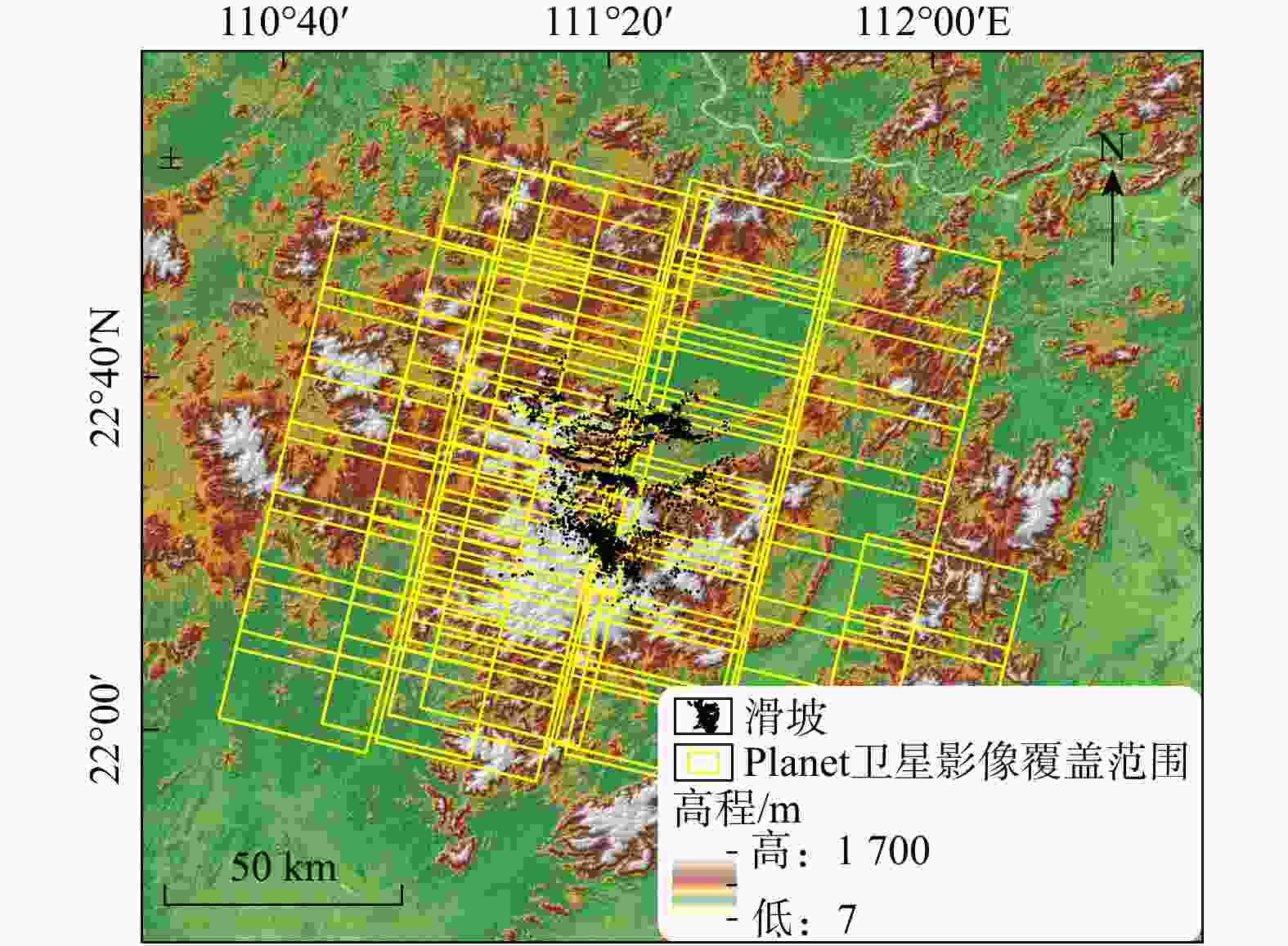
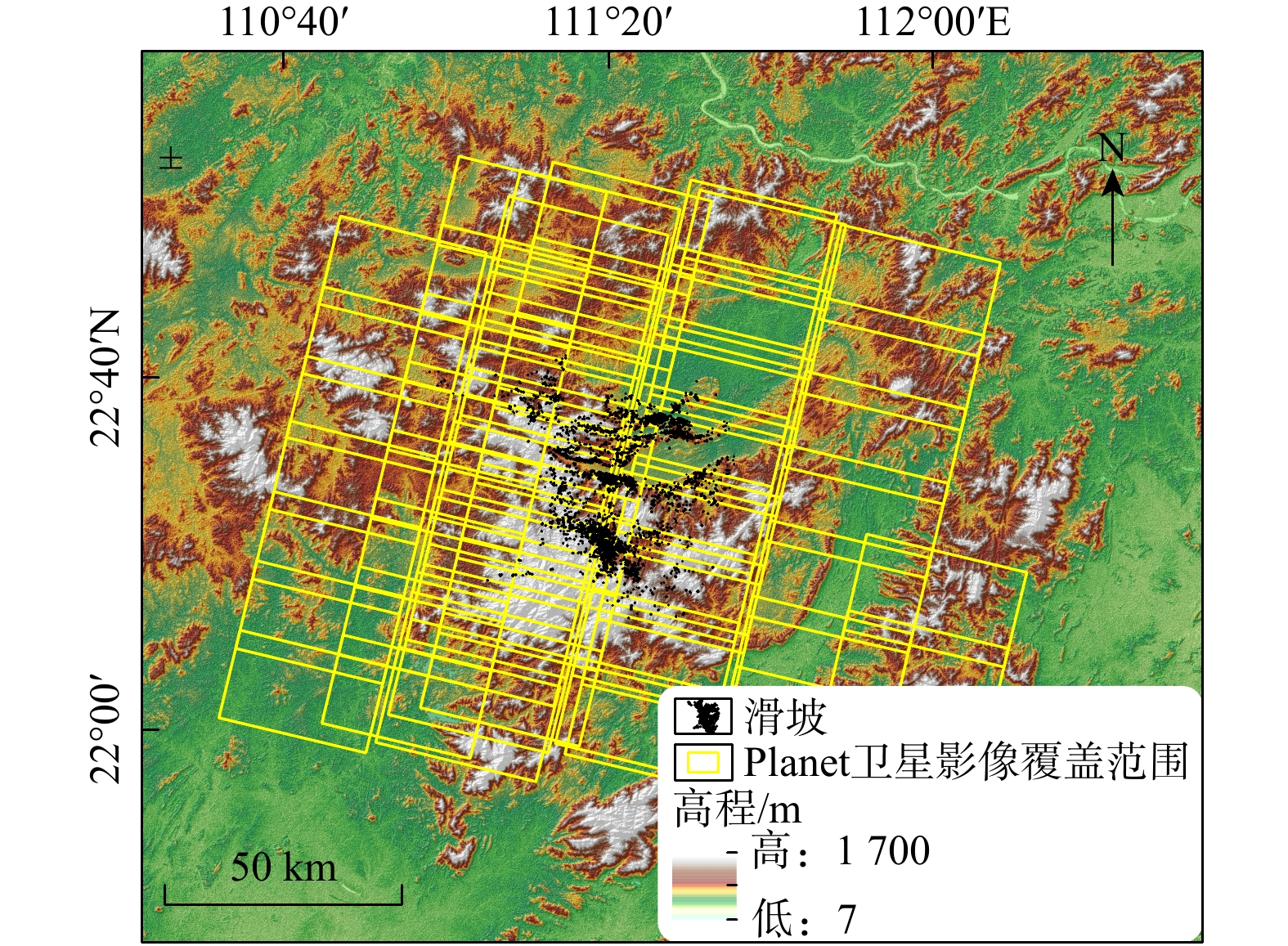
图 1 Planet 卫星影像与滑坡点分布
Figure 1. Planet satellite imagery and landslide-point distribution
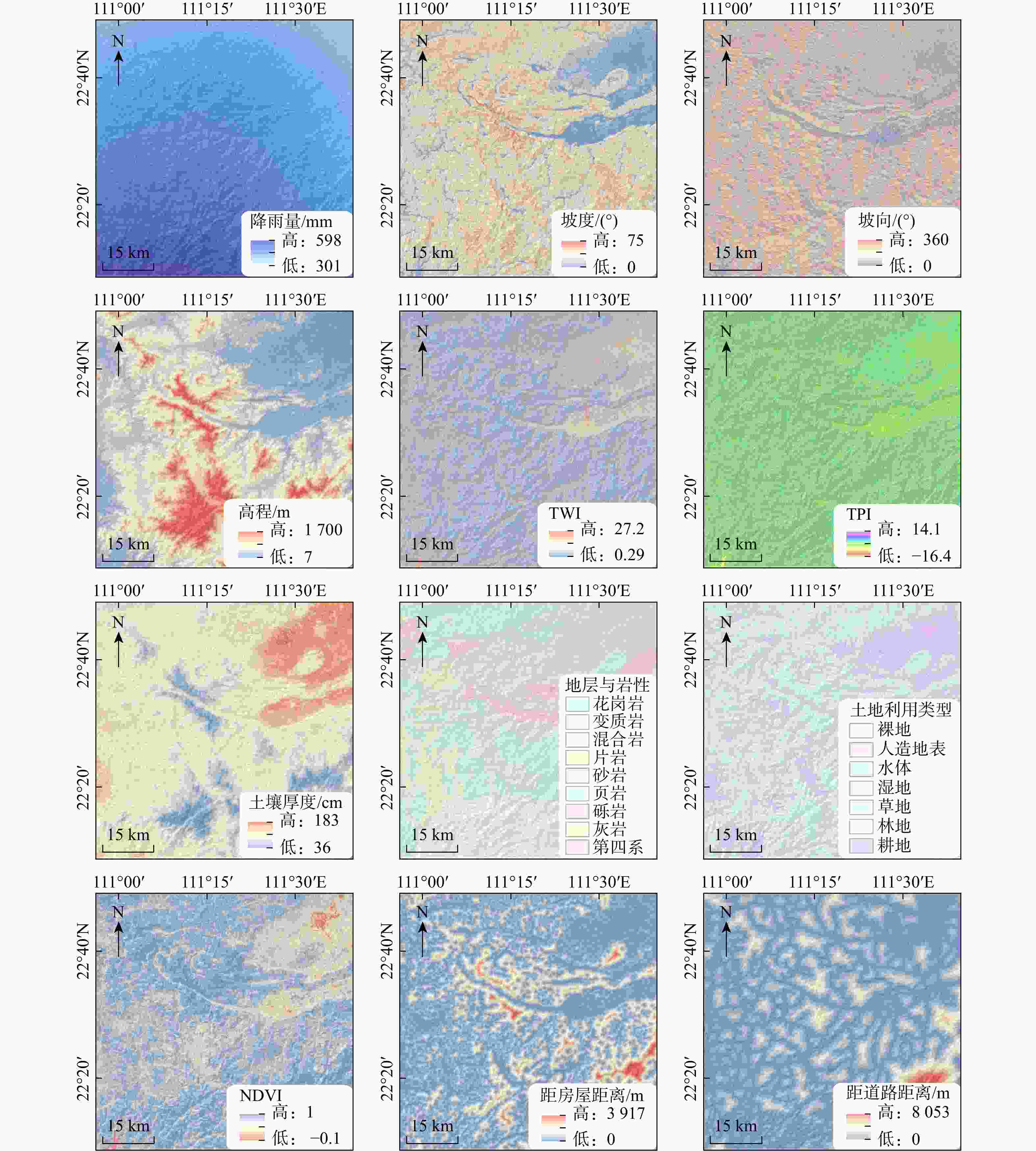
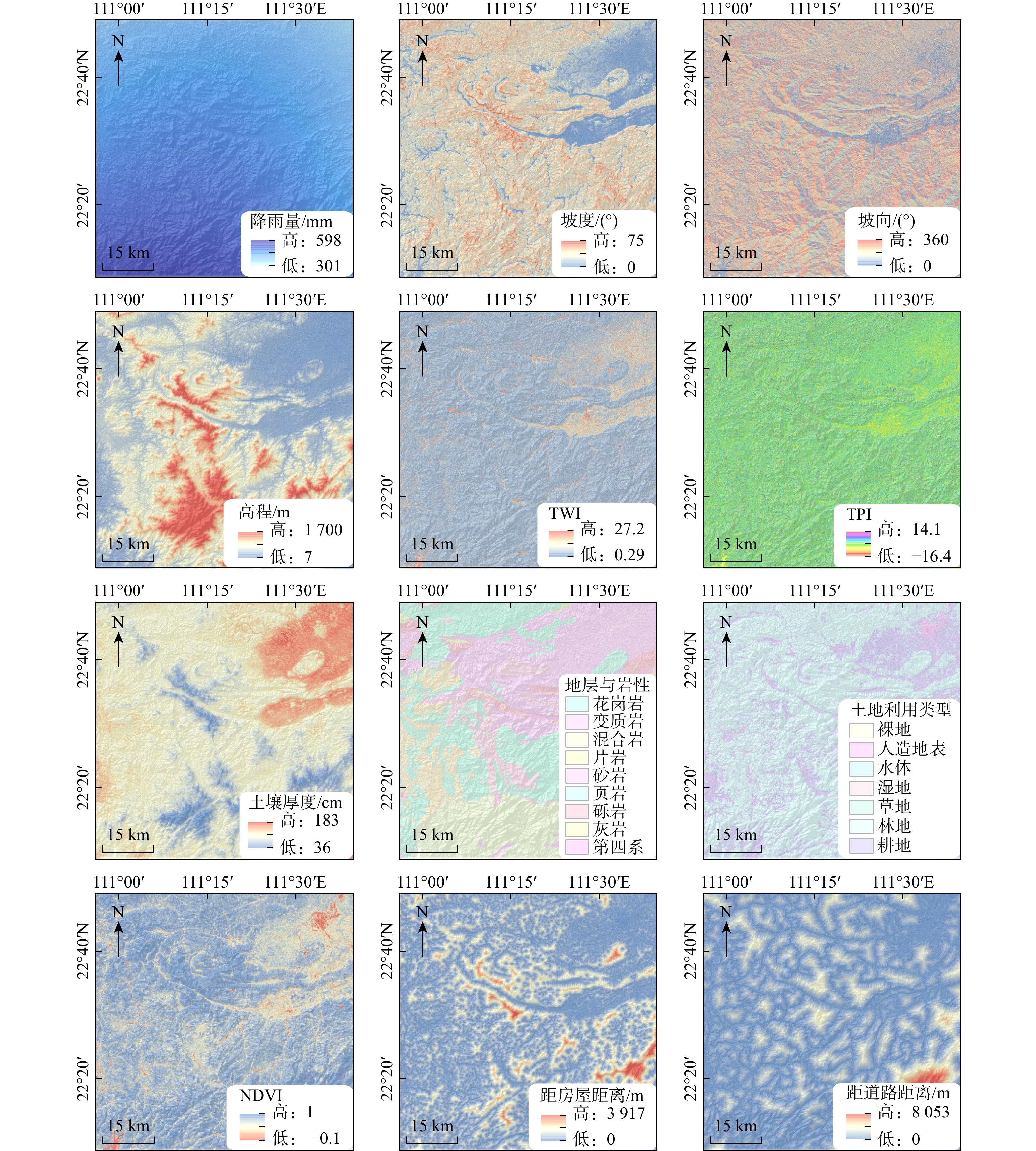
图 2 各环境评价因子空间分布图(TWI. 地形湿度指数;TPI. 地形位置指数;NDVI. 归一化植被指数;下同)
Figure 2. Spatial distribution of environmental evaluation factors
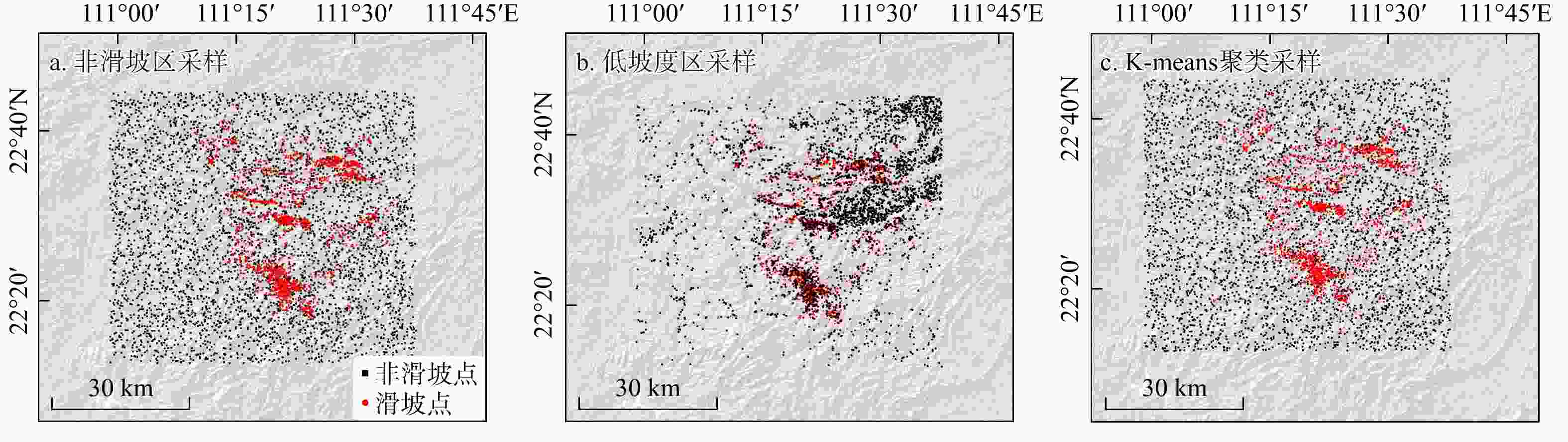
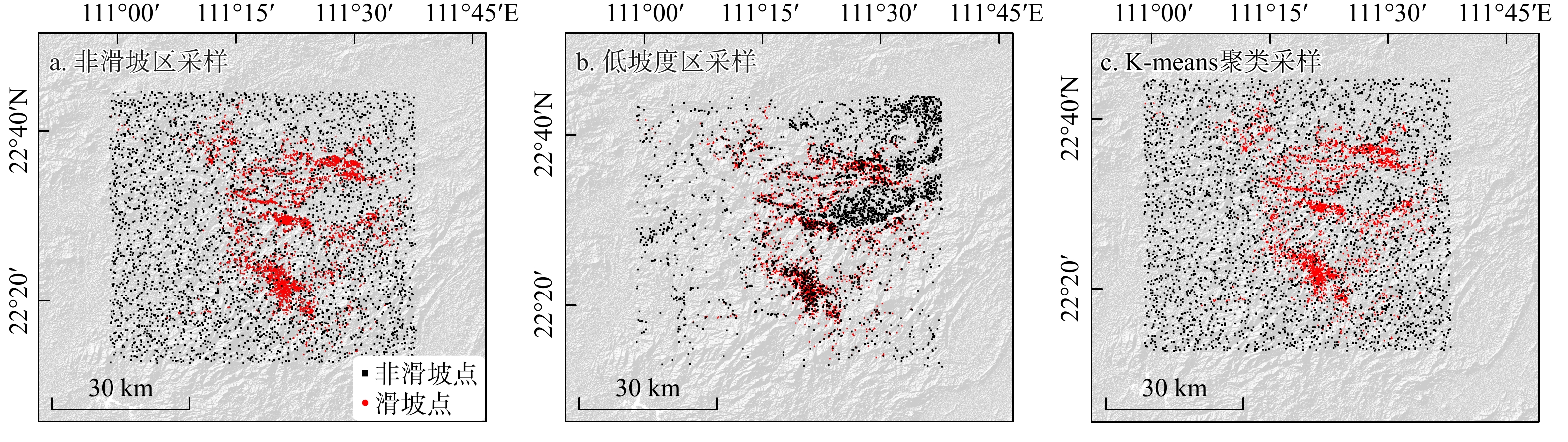
图 3 不同采样方法负样本空间分布
Figure 3. Spatial distribution of negative samples obtained by different sampling methods
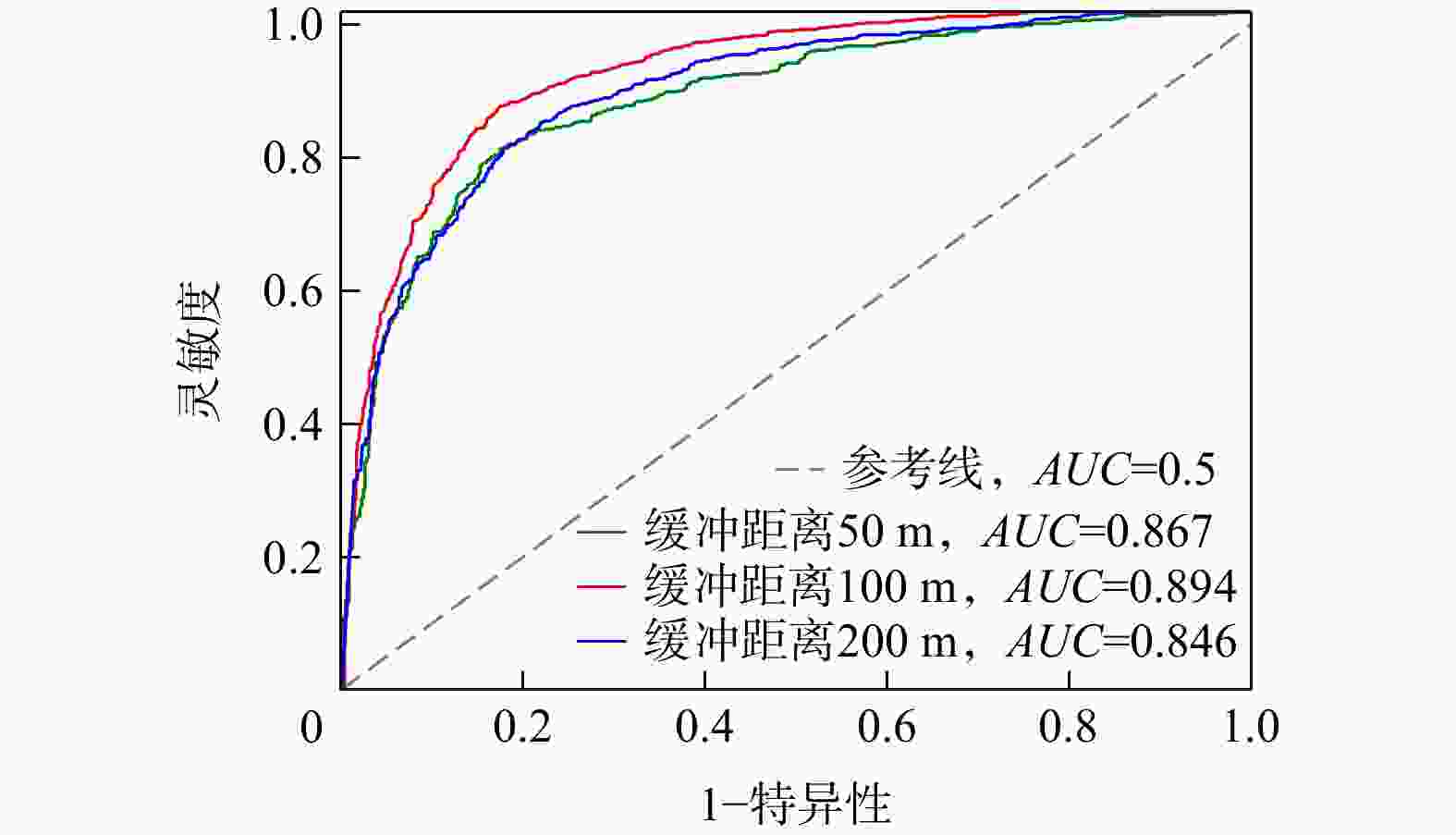
图 6 不同缓冲区距离条件下随机森林(RF)模型的受试者工作特征(ROC )曲线(AUC为曲线下面积,下同)
Figure 6. Receiver operating characteristic curves of random forest model under different buffer distance conditions
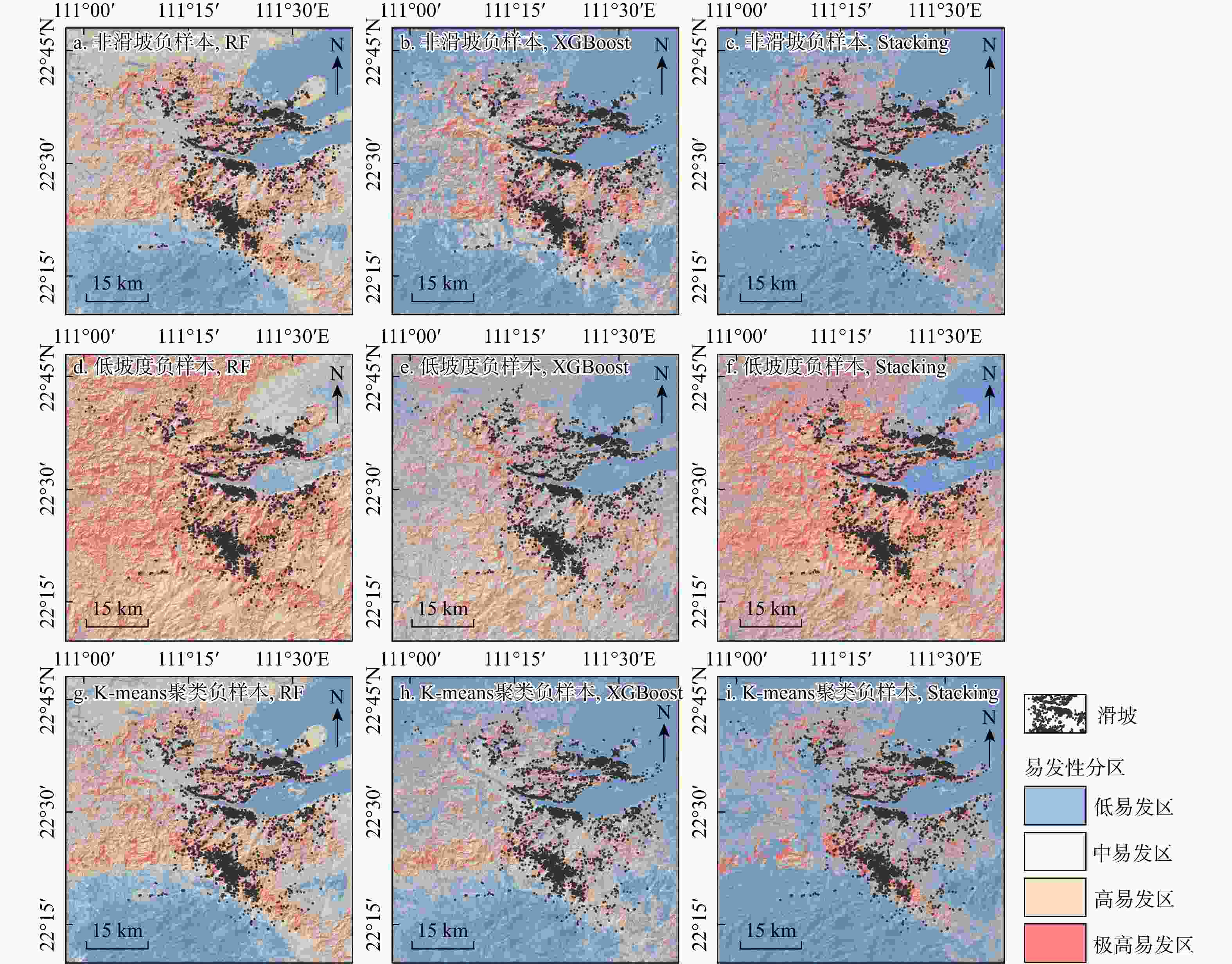
图 7 基于自然断点法的多组方案滑坡易发性评价结果
Figure 7. Landslide susceptibility assessment results of multiple schemes based on natural-breaks method
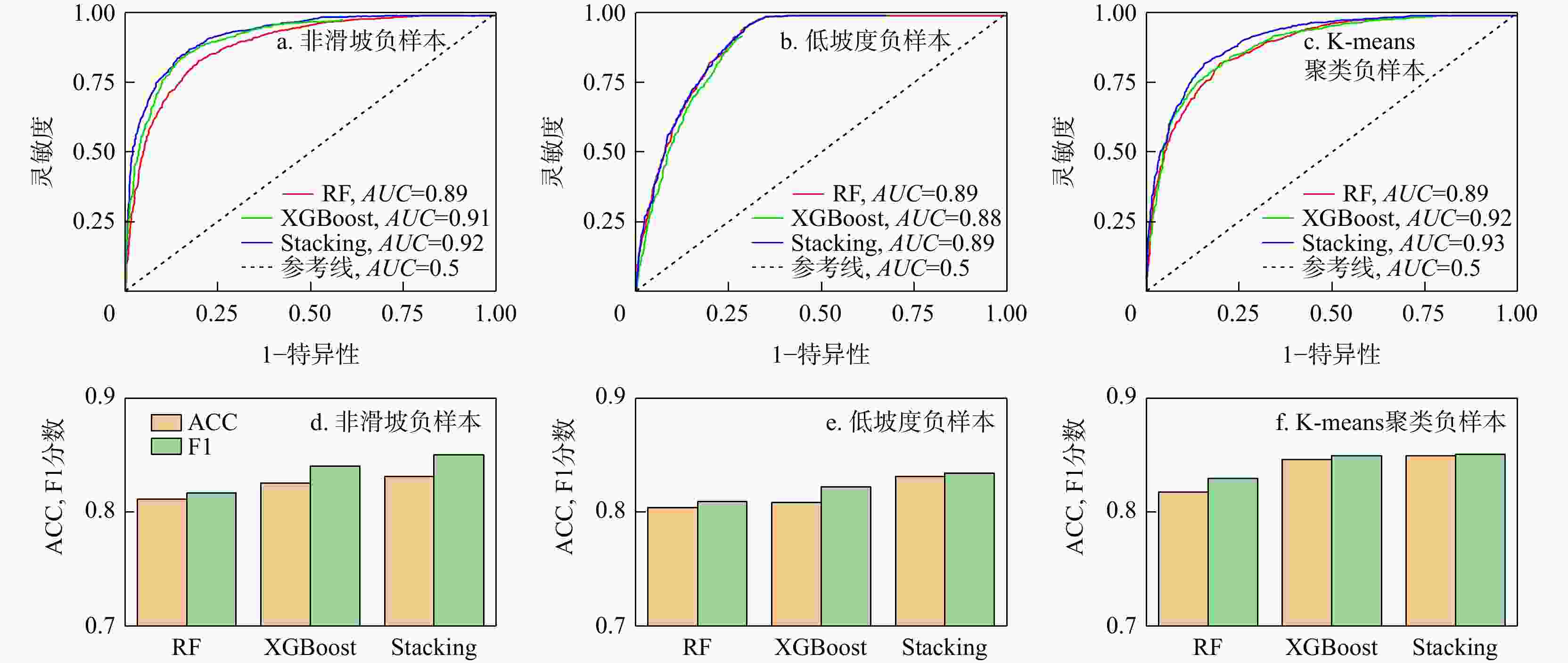
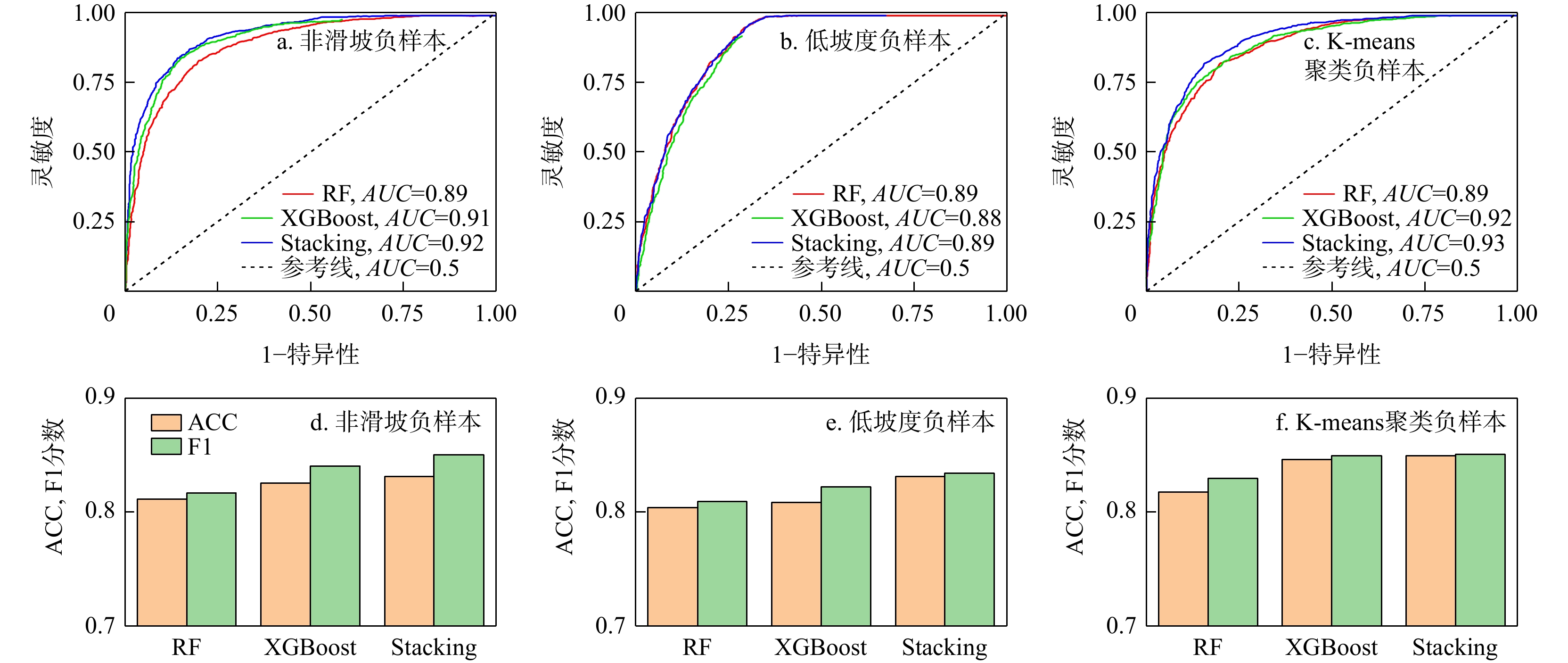
图 8 不同采样−模型组合的模型精度评价
a~c为ROC 曲线;d~f为ACC,F1 分数。ACC为准确率,表征预测正确样本占总样本的比重;F1 分数为精确率与召回率的调和均值
Figure 8. Model accuracy evaluation for different sampling–model combinations
表 1 环境评价因子数据来源
Table 1. Data sources of environmental evaluation factors
因子名称 分辨率 因子来源 降雨量 0.1°×0.1° https://search.earthdata.nasa.gov 坡度 12.5 m 由数字高程模型(DEM)计算得到 坡向 12.5 m 高程 12.5 m https://www.gscloud.cn TWI 12.5 m 由DEM计算得到 TPI 12.5 m 土壤厚度 30 m http://dcc.ngac.org.cn/ 地层与岩性 1∶ 200000 土地利用类型 30 m https://www.ncdc.ac.cn/ NDVI 30 m 距房屋距离 — https://www.gscloud.cn 距道路距离 —  下载: 导出CSV
表 2 不同负样本采样策略下各模型最优超参数
Table 2. Optimal hyperparameters of models under different negative sample sampling strategies
模型 采样策略 超参数 RF 非滑坡区采样 n_estimators=500; max_depth=20; max_features=sqrt; min_samples_split=2; min_samples_leaf=1; criterion='gini' 低坡度区采样 n_estimators=400; max_depth=15; max_features=sqrt; min_samples_split=2; min_samples_leaf=5; criterion='gini' K-means聚类采样 n_estimators=800; max_depth=25; max_features=sqrt; min_samples_split=2; min_samples_leaf=1; criterion='gini' XGBoost 非滑坡区采样 n_estimators=300; learning_rate=0.05; max_depth=6; subsample=0.8; colsample_bytree=0.8; gamma=0.1 低坡度区采样 n_estimators=300; learning_rate=0.1; max_depth=4; subsample=0.8; colsample_bytree=0.8; gamma=0.1 K-means聚类采样 n_estimators= 1000 ; learning_rate=0.01; max_depth=8; subsample=0.7; colsample_bytree=0.8; gamma=0.1Stacking 非滑坡区采样 Meta_Learner=Logistic Regression; C=1.0; penalty=l2; solver='lbfgs' 低坡度区采样 Meta_Learner=Logistic Regression; C=1.0; penalty=l2; solver='lbfgs' K-means聚类采样 Meta_Learner=Logistic Regression; C=1.0; penalty=l2; solver='lbfgs' 注:n_estimators 为决策树数量;max_depth 为树最大深度;max_features 为节点分裂候选特征数;min_samples_split 为节点分裂最小样本数;min_samples_leaf 为叶节点最小样本数;criterion 为分裂准则;learning_rate 为学习率;subsample 为样本采样比例;colsample_bytree 为特征采样比例;gamma 为节点分裂最小损失下降阈值;Meta_Learner 为元学习器;C 为逻辑回归正则化系数;penalty 为正则化类型;solver 为优化求解器。RF为随机森林;XGBoost为极端梯度提升;Stacking为堆叠集成学习;下同
下载: 导出CSV
-
[1] 陈博, 张灿灿, 李振洪, 等. 福建龙岩市2024年“6·16”特大暴雨诱发滑坡发育特征及其调控因子分析[J]. 武汉大学学报(信息科学版), 2024, 49(11): 2145-2155. doi: 10.13203/j.whugis20240336CHEN B, ZHANG C C, LI Z H, et al. Developmental characteristics and controlling factors of landslides triggered by extreme rainfalls on 16 June 2024 in Longyan, Fujian Province[J]. Geomatics and Information Science of Wuhan University, 2024, 49(11): 2145-2155. (in Chinese with English abstract) doi: 10.13203/j.whugis20240336 [2] 陈文鸿, 余斌, 吴雨夫, 等. 浅层滑坡和沟谷型泥石流的关系研究: 以福建省宝庄村2010年6月18日灾害为例[J]. 科学技术与工程, 2024, 24(26): 11067-11073. doi: 10.12404/j.issn.1671-1815.2400544CHEN W H, YU B, WU Y F, et al. Relationship between shallow landslide and gully-type debris flow: A case study of disaster on June 18th, 2010 in Baozhuang Village, Fujian Province[J]. Science Technology and Engineering, 2024, 24(26): 11067-11073. (in Chinese with English abstract) doi: 10.12404/j.issn.1671-1815.2400544 [3] GARIANO S L, GUZZETTI F. Landslides in a changing climate[J]. Earth-Science Reviews, 2016, 162: 227-252. doi: 10.1016/j.earscirev.2016.08.011 [4] FENG W K, BAI H L, LAN B, et al. Spatial-temporal distribution and failure mechanism of group-occurring landslides in Mibei Village, Longchuan County, Guangdong, China[J]. Landslides, 2022, 19(8): 1957-1970. doi: 10.1007/s10346-022-01904-9 [5] 黄远东, 许冲, 刘毅, 等. 2024年4月广东韶关暴雨诱发的浅层滑坡编目与滑坡分布特征分析[J]. 中国地质灾害与防治学报, 2025, 36(2): 28-42. doi: 10.16031/j.cnki.issn.1003-8035.202412019HUANG Y D, XU C, LIU Y, et al. Inventory and distribution feature of shallow landslides triggered by heavy rain event in Shaoguan, Guangdong Province in April 2024[J]. The Chinese Journal of Geological Hazard and Control, 2025, 36(2): 28-42. (in Chinese with English abstract) doi: 10.16031/j.cnki.issn.1003-8035.202412019 [6] 许强, 徐繁树, 蒲川豪, 等. 2024年4月广东韶关江湾镇极端降雨诱发群发性滑坡初步分析[J]. 武汉大学学报(信息科学版), 2024, 49(8): 1264-1274. doi: 10.13203/j.whugis20240202XU Q, XU F S, PU C H, et al. Preliminary analysis of extreme rainfall-induced cluster landslides in Jiangwan Township, Shaoguan, Guangdong, April 2024[J]. Geomatics and Information Science of Wuhan University, 2024, 49(8): 1264-1274. (in Chinese with English abstract) doi: 10.13203/j.whugis20240202 [7] 冯文凯, 赵家琛, 易小宇, 等. 闽粤赣边区“6·16”强降雨诱发群发滑坡特征与驱动因素[J]. 地球科学, 2025, 50(10): 4111-4124. doi: 10.3799/dqkx.2025.087FENG W K, ZHAO J C, YI X Y, et al. Characteristics and drivers of clustered landslides induced by extreme rainstorm on June 16 in Fujian-Guangdong-Jiangxi junction area[J]. Earth Science, 2025, 50(10): 4111-4124. (in Chinese with English abstract) doi: 10.3799/dqkx.2025.087 [8] YI X Y, ZHAO J C, FENG W K, et al. Data-driven insights into the characteristics and drivers of the June 16, 2024 clustered shallow landslides in southeastern China[J]. Landslides, 2025, 22(9): 3049-3064. doi: 10.1007/s10346-025-02586-9 [9] KAVZOGLU T, SAHIN E K, COLKESEN I. Landslide susceptibility mapping using GIS-based multi-criteria decision analysis, support vector machines, and logistic regression[J]. Landslides, 2014, 11(3): 425-439. doi: 10.1007/s10346-013-0391-7 [10] HUANG F M, CAO Z S, GUO J F, et al. Comparisons of heuristic, general statistical and machine learning models for landslide susceptibility prediction and mapping[J]. Catena, 2020, 191: 104580. doi: 10.1016/j.catena.2020.104580 [11] XUE Z H, FENG W K, LI B T, et al. Landslide susceptibility mapping based on the coupling of two correlation methods and the BP neural network model: A case study of the Baihetan Reservoir area, China[J]. Frontiers in Environmental Science, 2022, 10: 1039985. doi: 10.3389/fenvs.2022.1039985 [12] REICHENBACH P, ROSSI M, MALAMUD B D, et al. A review of statistically-based landslide susceptibility models[J]. Earth-Science Reviews, 2018, 180: 60-91. doi: 10.1016/j.earscirev.2018.03.001 [13] PRADHAN B. A comparative study on the predictive ability of the decision tree, support vector machine and neuro-fuzzy models in landslide susceptibility mapping using GIS[J]. Computers & Geosciences, 2013, 51: 350-365. doi: 10.1016/j.cageo.2012.08.023 [14] KONG L H, FENG W K, YI X Y, et al. Enhanced landslide susceptibility mapping in data-scarce regions via unsupervised few-shot learning[J]. Gondwana Research, 2025, 138: 31-46. doi: 10.1016/j.gr.2024.10.011 [15] GAMEIRO S, RIFFEL E S, DE OLIVEIRA G G, et al. Artificial neural networks applied to landslide susceptibility: The effect of sampling areas on model capacity for generalization and extrapolation[J]. Applied Geography, 2021, 137: 102598. doi: 10.1016/j.apgeog.2021.102598 [16] 郑元勋, 周康康, 胡少伟, 等. 基于集成学习和考虑滑坡负样本的滑坡易发性评价[J]. 人民黄河, 2025, 47(7): 116-123. doi: 10.3969/j.issn.1000-1379.2025.07.019ZHENG Y X, ZHOU K K, HU S W, et al. Landslide susceptibility evaluation based on integrated learning and considering landslide negative samples[J]. Yellow River, 2025, 47(7): 116-123. (in Chinese with English abstract) doi: 10.3969/j.issn.1000-1379.2025.07.019 [17] DOU H Q, HE J B, HUANG S Y, et al. Influences of non-landslide sample selection strategies on landslide susceptibility mapping by machine learning[J]. Geomatics, Natural Hazards and Risk, 2023, 14(1): 2285719. doi: 10.1080/19475705.2023.2285719 [18] 窦杰, 向子林, 许强, 等. 机器学习在滑坡智能防灾减灾中的应用与发展趋势[J]. 地球科学, 2023, 48(5): 1657-1674.DOU J, XIANG Z L, XU Q, et al. Application and development trend of machine learning in landslide intelligent disaster prevention and mitigation[J]. Earth Science, 2023, 48(5): 1657-1674. (in Chinese with English abstract) [19] KE C Y, SUN P, ZHANG S, et al. Influences of non-landslide sampling strategies on landslide susceptibility mapping: A case of Tianshui City, northwest of China[J]. Bulletin of Engineering Geology and the Environment, 2025, 84(3): 123. doi: 10.1007/s10064-025-04147-9 [20] 缪亚敏, 朱阿兴, 杨琳, 等. 滑坡危险度制图中一种新型的负样本采样方法[J]. 地理与地理信息科学, 2016, 32(4): 61-67. doi: 10.3969/j.issn.1672-0504.2016.04.011MIAO Y M, ZHU A X, YANG L, et al. A new method of pseudo absence data generation in landslide susceptibility mapping[J]. Geography and Geo-Information Science, 2016, 32(4): 61-67. (in Chinese with English abstract) doi: 10.3969/j.issn.1672-0504.2016.04.011 [21] LI M Y, TIAN H L. Insights from optimized non-landslide sampling and SHAP explainability for landslide susceptibility prediction[J]. Applied Sciences, 2025, 15(3): 1163. doi: 10.3390/app15031163 [22] HE L, WU X T, HE Z W, et al. Susceptibility assessment of landslides in the Loess Plateau based on machine learning models: A case study of Xining City[J]. Sustainability, 2023, 15(20): 14761. doi: 10.3390/su152014761 [23] 刘少泽, 崔美娟, 付晓祎, 等. 顾及缓冲区范围与负样本优化的随机森林地质灾害易发性评价[J]. 科学技术与工程, 2025, 25(15): 6220-6229. doi: 10.12404/j.issn.1671-1815.2405249LIU S Z, CUI M J, FU X Y, et al. Random forest evaluation of geological hazard susceptibility considering buffer range and negative sample optimization[J]. Science Technology and Engineering, 2025, 25(15): 6220-6229. (in Chinese with English abstract) doi: 10.12404/j.issn.1671-1815.2405249 [24] 朱颖, 甘建军, 鹿淇瑞, 等. 降雨型花岗岩残积土滑坡碎屑流运动过程分析: 以湖北黄梅县袁山村为例[J]. 地质科技通报, 2025, 44(3): 268-279. doi: 10.19509/j.cnki.dzkq.tb20240564ZHU Y, GAN J J, LU Q R, et al. Analysis of rainfall induced-movement of landslide debris flows in granite residual soil: A case study of Yuanshan Village, Huangmei County, Hubei Province[J]. Bulletin of Geological Science and Technology, 2025, 44(3): 268-279. (in Chinese with English abstract) doi: 10.19509/j.cnki.dzkq.tb20240564 [25] SHARMA N, SAHARIA M, RAMANA G V. High resolution landslide susceptibility mapping using ensemble machine learning and geospatial big data[J]. Catena, 2024, 235: 107653. doi: 10.1016/j.catena.2023.107653 [26] 鲁蕊, 李成林, 邵青青, 等. 基于逻辑回归和卷积神经网络耦合模型的地质灾害易发性评价研究[J]. 中国矿业, 2025, 34(增刊2): 95-103. doi: 10.12075/j.issn.1004-4051.20251480LU R, LI C L, SHAO Q Q, et al. Research on geological hazard susceptibility evaluation based on LR-CNN coupling model[J]. China Mining Magazine, 2025, 34(S2): 95-103. (in Chinese with English abstract) doi: 10.12075/j.issn.1004-4051.20251480 [27] 赵风顺, 江山, 吴舒天, 等. 基于信息量−支持向量机模型的大比例尺地质灾害易发性评价: 以广东省鹤山市古劳镇为例[J]. 华南地质, 2025, 41(3): 623-632. doi: 10.3969/j.issn.2097-0013.2025.03.013ZHAO F S, JIANG S, WU S T, et al. Large-scale geological disaster susceptibility assessment using information value-support vector machine model: A case study of Gulao Town, Heshan City, Guangdong Province[J]. South China Geology, 2025, 41(3): 623-632. (in Chinese with English abstract) doi: 10.3969/j.issn.2097-0013.2025.03.013 [28] FANG Z C, WANG Y, PENG L, et al. A comparative study of heterogeneous ensemble-learning techniques for landslide susceptibility mapping[J]. International Journal of Geographical Information Science, 2021, 35(2): 321-347. doi: 10.1080/13658816.2020.1808897 [29] 屈鹏鑫, 谢婉丽, 刘琦琦, 等. 基于机器学习方法改进IVM-RF耦合模型的崩滑灾害危险性评价: 以延安市志丹县为例[J]. 地质科技通报, 2025, 44(3): 280-295. doi: 10.19509/j.cnki.dzkq.tb20240583QU P X, XIE W L, LIU Q Q, et al. Collapse and landslide risk assessment based on machine learning improved IVM-RF coupling method: A case study of Zhidan County, Yan'an City[J]. Bulletin of Geological Science and Technology, 2025, 44(3): 280-295. (in Chinese with English abstract) doi: 10.19509/j.cnki.dzkq.tb20240583 [30] 郭荣昌, 张尚欢. 基于均值粒子群优化的随机森林法的滑坡易发性评价[J]. 自然灾害学报, 2025, 34(5): 119-128. doi: 10.13577/j.jnd.2025.0511GUO R C, ZHANG S H. Landslide susceptibility assessment based on random forest method with mean particle swarm optimization[J]. Journal of Natural Disasters, 2025, 34(5): 119-128. (in Chinese with English abstract) doi: 10.13577/j.jnd.2025.0511 [31] 王洁, 林诚杰, 梁峰铭, 等. 基于不同机器学习模型的滑坡易发性分析及适应性评估[J]. 科学技术与工程, 2025, 25(2): 513-520. doi: 10.12404/j.issn.1671-1815.2402810WANG J, LIN C J, LIANG F M, et al. Landslide susceptibility analysis and adaptability evaluation based on different machine learning models[J]. Science Technology and Engineering, 2025, 25(2): 513-520. (in Chinese with English abstract) doi: 10.12404/j.issn.1671-1815.2402810 [32] GOETZ J N, BRENNING A, PETSCHKO H, et al. Evaluating machine learning and statistical prediction techniques for landslide susceptibility modeling[J]. Computers & Geosciences, 2015, 81: 1-11. doi: 10.1016/j.cageo.2015.04.007 [33] LU J G, HE Y, ZHANG L F, et al. Ensemble learning landslide susceptibility assessment with optimized non-landslide samples selection[J]. Geomatics, Natural Hazards and Risk, 2024, 15(1): 2378176. doi: 10.1080/19475705.2024.2378176 [34] 吴逢涛, 杨志全, 赵旭光. 基于Stacking集成机器学习模型的川西重大交通干线地质灾害易发性评价[J]. 科学技术与工程, 2025, 25(13): 5340-5350. doi: 10.12404/j.issn.1671-1815.2405875WU F T, YANG Z Q, ZHAO X G. Susceptibility assessment of geological hazards on major traffic arteries in western Sichuan based on stacking ensemble machine learning models[J]. Science Technology and Engineering, 2025, 25(13): 5340-5350. (in Chinese with English abstract) doi: 10.12404/j.issn.1671-1815.2405875 [35] MERGHADI A, YUNUS A P, DOU J, et al. Machine learning methods for landslide susceptibility studies: A comparative overview of algorithm performance[J]. Earth-Science Reviews, 2020, 207: 103225. doi: 10.1016/j.earscirev.2020.103225 [36] 赵恒梓, 李素敏, 郭庆, 等. 样本优化的集成学习模型在滑坡易发性评价中的应用[J]. 测绘科学, 2024, 49(12): 132-141. doi: 10.16251/j.cnki.1009-2307.2024.12.013ZHAO H Z, LI S M, GUO Q, et al. Application of ensemble learning model based on sample optimization in landslide susceptibility evaluation[J]. Science of Surveying and Mapping, 2024, 49(12): 132-141. (in Chinese with English abstract) doi: 10.16251/j.cnki.1009-2307.2024.12.013 [37] 朱路路. 基于多种负样本取样方法的滑坡易发性评价: 以凉山州为例[D]. 安徽淮南: 安徽理工大学, 2025.ZHU L L. Landslide susceptibility evaluation based on multiple negative samplesampling methods: A case study of Liangshan Prefecture[D]. Huainan, Anhui: Anhui University of Science and Technology, 2025. (in Chinese with English abstract) [38] LADEL L, MASTERE M, KADER S, et al. Machine learning methods for landslide mapping studies: A comparative study of SVM and RF algorithms in the Oued Aoulai watershed (Morocco)[J]. Open Geosciences, 2025, 17: 20220740. doi: 10.1515/geo-2022-0740 [39] CHOWDHURI I, PAL S C, CHAKRABORTTY R, et al. Torrential rainfall-induced landslide susceptibility assessment using machine learning and statistical methods of eastern Himalaya[J]. Natural Hazards, 2021, 107(1): 697-722. doi: 10.1007/s11069-021-04601-3 [40] YU L B, WANG Y, PRADHAN B. Enhancing landslide susceptibility mapping incorporating landslide typology via stacking ensemble machine learning in Three Gorges Reservoir, China[J]. Geoscience Frontiers, 2024, 15(4): 101802. doi: 10.1016/j.gsf.2024.101802 [41] ZHANG J Y, MA X L, ZHANG J L, et al. Insights into geospatial heterogeneity of landslide susceptibility based on the SHAP-XGBoost model[J]. Journal of Environmental Management, 2023, 332: 117357. doi: 10.1016/j.jenvman.2023.117357 -

 下载:
下载:

 点击查看大图
计量
- 文章访问数: 179
- PDF下载量: 4
- 被引次数: 0