投审稿入口


Sedimentary characteristics and depositional model of Crocker submarine fan: Evidence from outcrop areas in Sabah, Malaysia
-
摘要:目的
南海南部陆缘属于典型汇聚型大陆边缘,完整记录了从裂陷、漂移到前陆盆地的构造闭合演化过程。晚始新世-渐新世克拉克海底扇(Crocker Fan)是沙捞越碰撞运动形成的大型深水沉积体系,但受露头分散、地震资料缺失限制,其内部沉积相构成、演化机制及沉积模式仍有待系统剖析。
方法以马来西亚沙巴北部西克拉克组 10 条野外露头剖面为基础,通过野外实测、岩性相与成因相划分、沉积构造识别以及垂向沉积序列对比,系统剖析克拉克海底扇的沉积特征。
结果西克拉克组以未变质深水海底扇与深海泥质沉积为主,分布于沙巴北部及沙捞越滨岸带,为一套非限定性深水海底扇群。该扇体主要发育砂质高密度浊积岩、泥质低密度浊积岩,局部发育含砾块体流沉积;可识别浊积水道、朵叶、席状砂、块体流等成因相,划分出外扇−扇缘、中扇朵叶复合体、内扇浊积水道−朵叶复合体 3 类沉积组合,垂向上呈现向上变粗的进积序列。朵叶与席状砂中发育不完整鲍马序列,底模构造、深水遗迹化石十分常见,指示浊流事件频发;席状砂−泥岩互层层面大量产出陆源植物碎屑与镜质条带,证明窄陆架背景下滨岸泥炭沼泽物质可高效输送至深水盆地。
结论保存完好的露头剖面为碰撞前渊窄陆架背景下非限定性富砂海底扇提供了良好研究实例;构造活动既塑造前渊古地貌,也触发多期重力流,共同控制克拉克海底扇群演化,该成果对南海南部陆缘动力学及深水油气储层研究具有参考价值。
Abstract:ObjectiveThe southern continental margin of the South China Sea represents a typical convergent margin that archives the complete tectonic transition from rifting and drifting to foreland basin closure. The Late Eocene–Oligocene Crocker Fan was initiated by the Sarawak orogenic collision and constitutes a giant deep-water depositional system developed in northern Borneo. Nevertheless, constrained by scattered distribution of outcrops and the absence of seismic data, the internal facies architecture, evolutionary mechanism, and depositional model of the Crocker Fan remain insufficiently understood.
MethodsThis study investigated ten field outcrop sections of the West Crocker Formation in northern Sabah, Malaysia. Integrated approaches including field-based measurement, lithofacies and genetic-facies subdivision, sedimentary structure identification, and vertical depositional sequence correlation were applied to systematically analyze the sedimentary characteristics of the Crocker submarine fan.
ResultsThe West Crocker Formation was composed mainly of unmetamorphosed deep-water submarine-fan successions and pelagic-hemipelagic mudstone deposits, which cropped out along the coastal belt of northern Sabah and Sarawak. It was interpreted as an unconfined deep-water submarine-fan complex. Two major turbidite associations were recognized: sandy high-density turbidites dominated by fine- to medium-grained sandstones, and argillaceous low-density turbidites dominated by siltstones; gravel-bearing mass-transport deposits occurred sporadically. Four primary genetic facies—turbidite channels, lobes, sheet sands, and mass-transport deposits—were distinguished. Three types of sedimentary assemblages were further classified: outer-fan to fan-fringe assemblage, middle-fan lobe-complex assemblage, and inner-fan turbidite channel-lobe complex assemblage, showing a vertically upward-coarsening progradational sequence. Incomplete Bouma sequences, sole marks, and deep-water trace fossils were widely preserved within lobes and sheet sands, indicating frequent turbidity-current activities. Abundant terrestrial plant debris and vitrinite bands occurred on the bedding surfaces of interbedded sheet sands and mudstones, demonstrating efficient transport of coastal peat-swamp-derived organic materials into deep-water basin settings under a narrow-shelf configuration.
ConclusionThese well-preserved outcrop sections provide a valuable case study for unconfined sand-rich submarine fans developed within collisional foredeep basins with narrow shelves. Tectonic orogenic activities not only construct the foredeep paleotopography but also trigger recurrent gravity-flow events, jointly controlling the evolution of the Crocker submarine fan complex. The findings improve the understanding of depositional processes along the southern convergent margin of the South China Sea and offer insights for deep-water hydrocarbon reservoir prediction in analogous settings.
-
Key words:
- southern margin of South China Sea /
- submarine fan /
- turbidite sand body /
- depositional model /
- Sabah
-
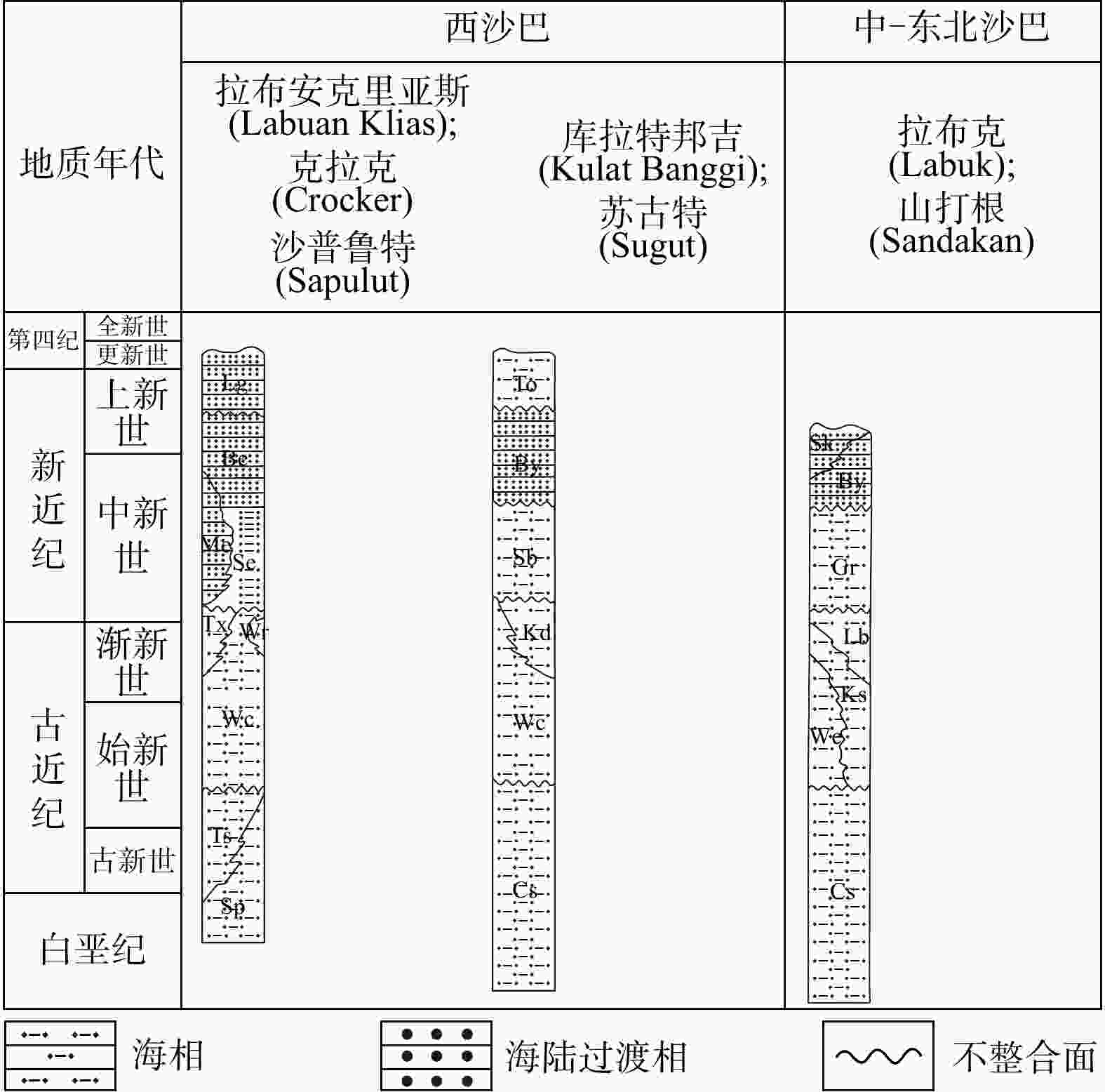
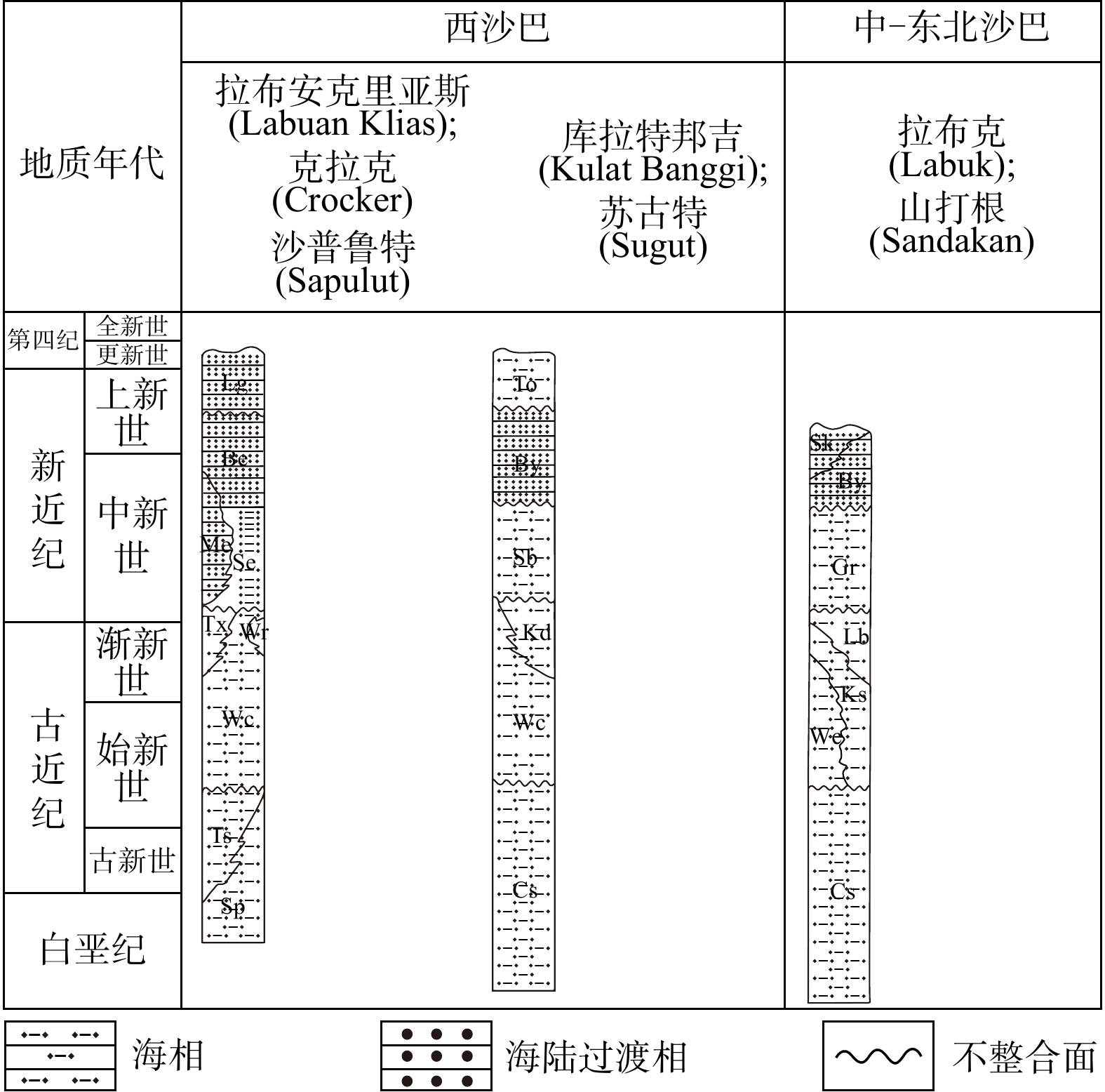
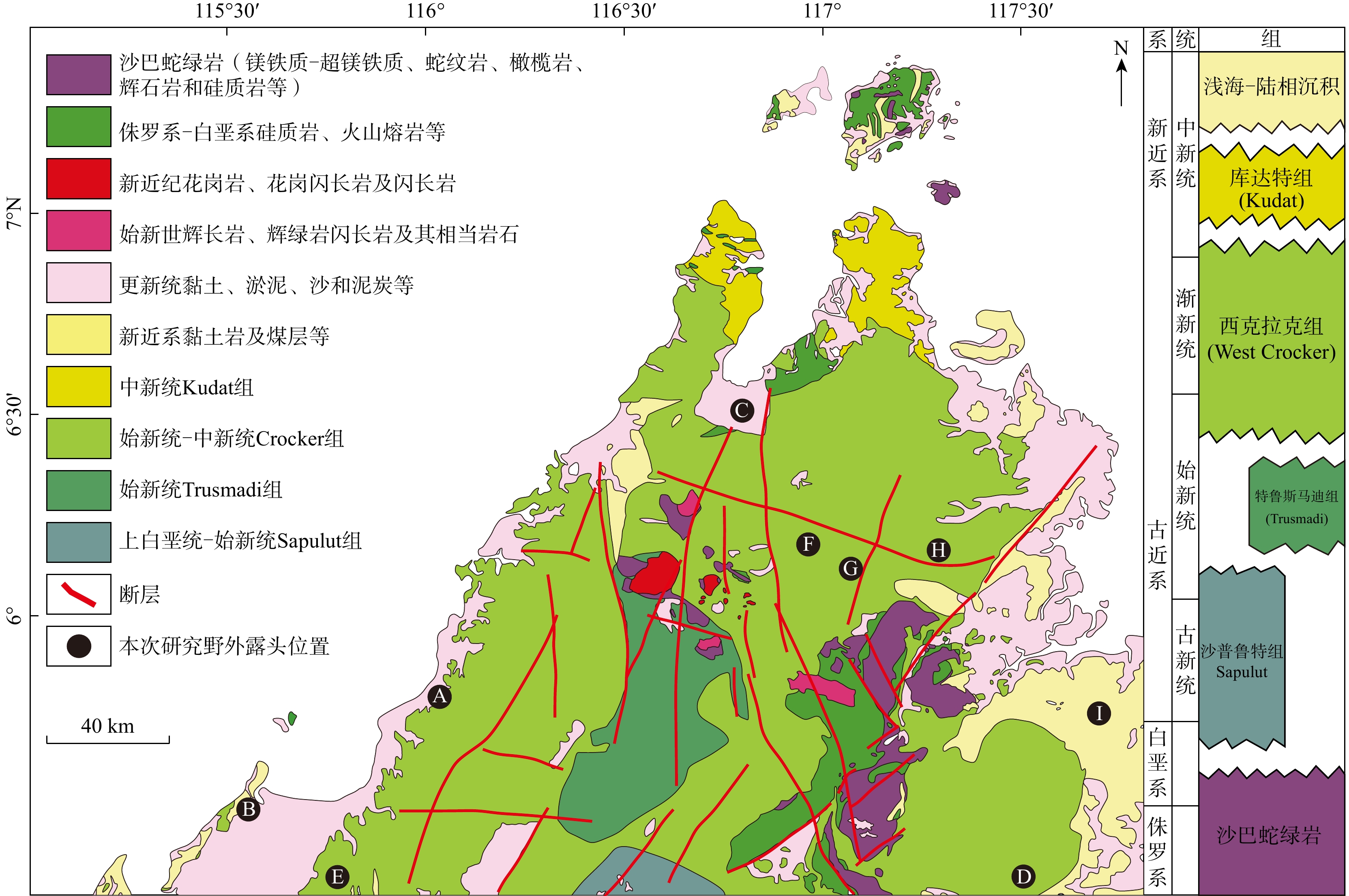
图 2 西沙巴、中−东北沙巴地区地层柱状图
Lg 为梁组(Liang);Be 为白赖特组(Belait);Me 为梅里根组(Meligan);Se 为塞塔普组(Setap);Wr 为瓦里乌组(Wariu);Tx 为腾布隆组(Temburong);Wc 为西克拉克组(West Crocker);Ts 为特鲁斯马迪组(Trusmadi);Sp 为沙普鲁特组(Sapulut);To 为蒂莫兴组(Timohing);By 为邦加亚组(Bongaya);Sb 为南邦吉组(South Banggi);Kd 为库达特组(Kudat);Cs 为燧石辉绿岩组(Chert-Spilite);Sk 为山打根组(Sandankan);Gr 为加里诺诺组(Garinono);Lb 为拉芒组(Labang);Ks 为库拉皮斯组(Kulapis)
Figure 2. Stratigraphic columns of western Sabah and central-northeastern Sabah
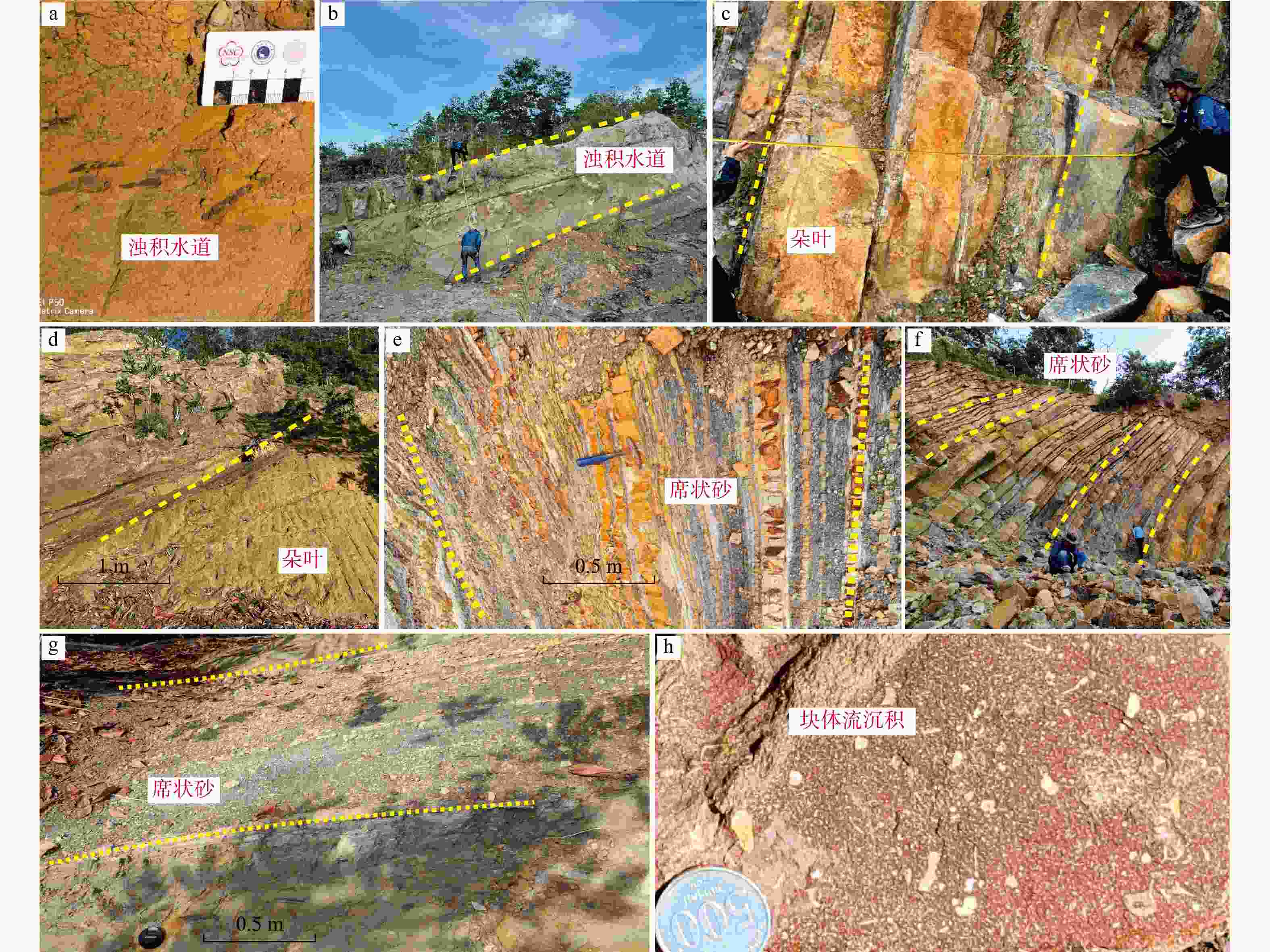
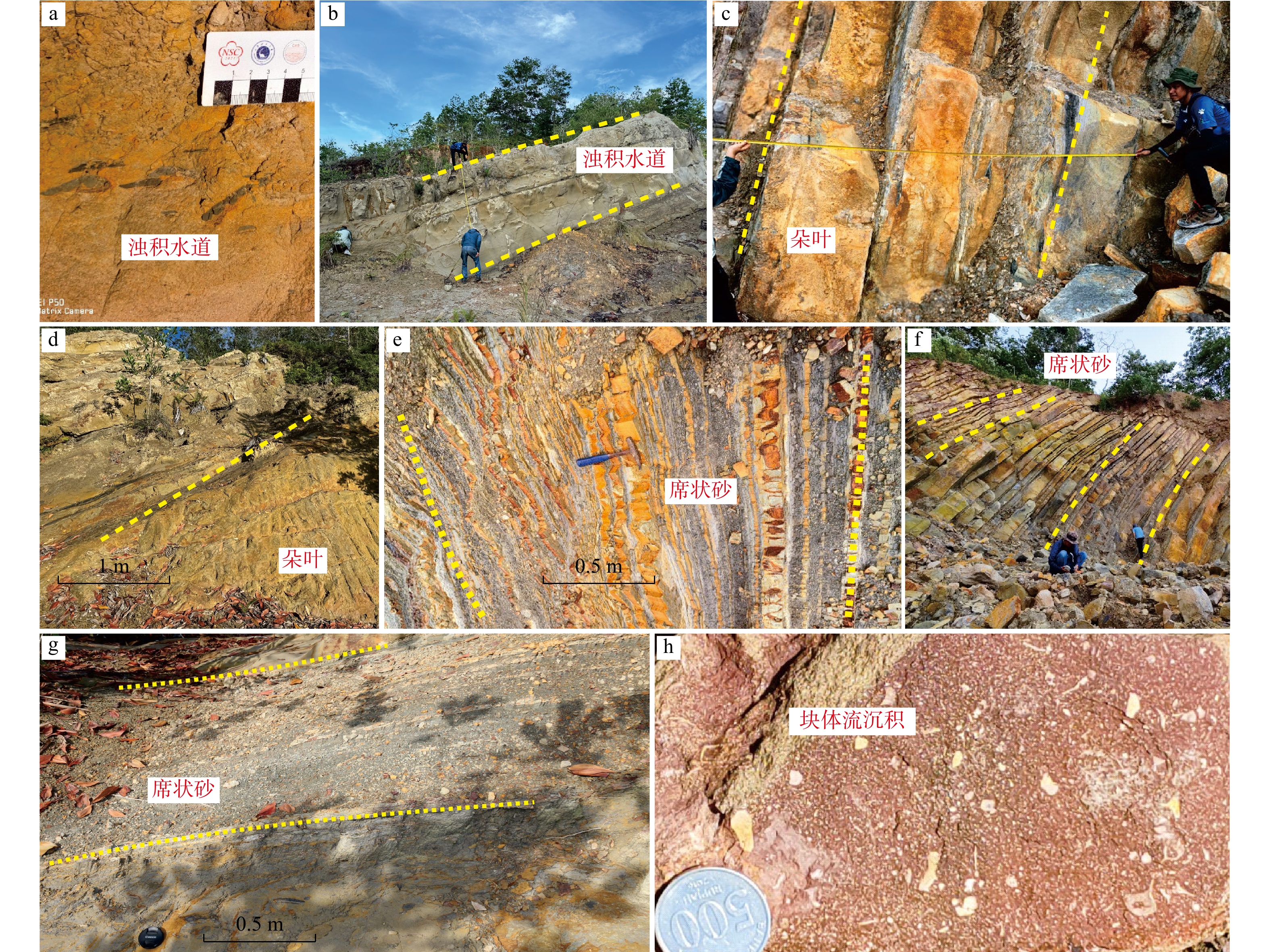
图 3 典型浊积水道 (a、b)、朵叶 (c、d)、席状砂 (e-g) 及块体流 (h) 沉积露头照片
图a,b,d和g位于C剖面;图c,f位于B剖面;图e位于A剖面;图h位于D剖面。剖面位置见图1
Figure 3. Outcrop photographs of typical turbidite channels (a,b), lobes (c,d), sheet sands (e-g), and mass-transport deposits (h)
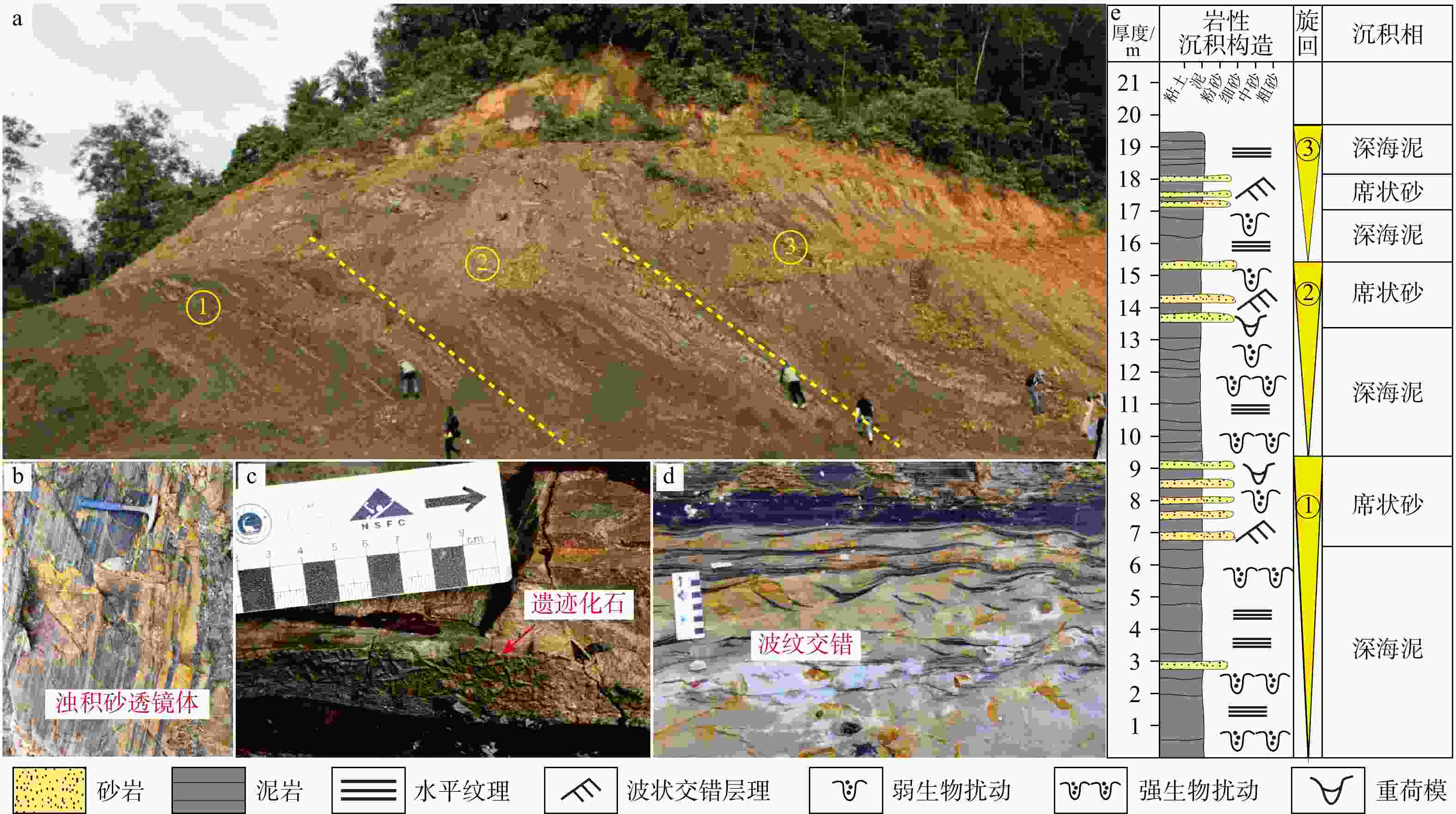
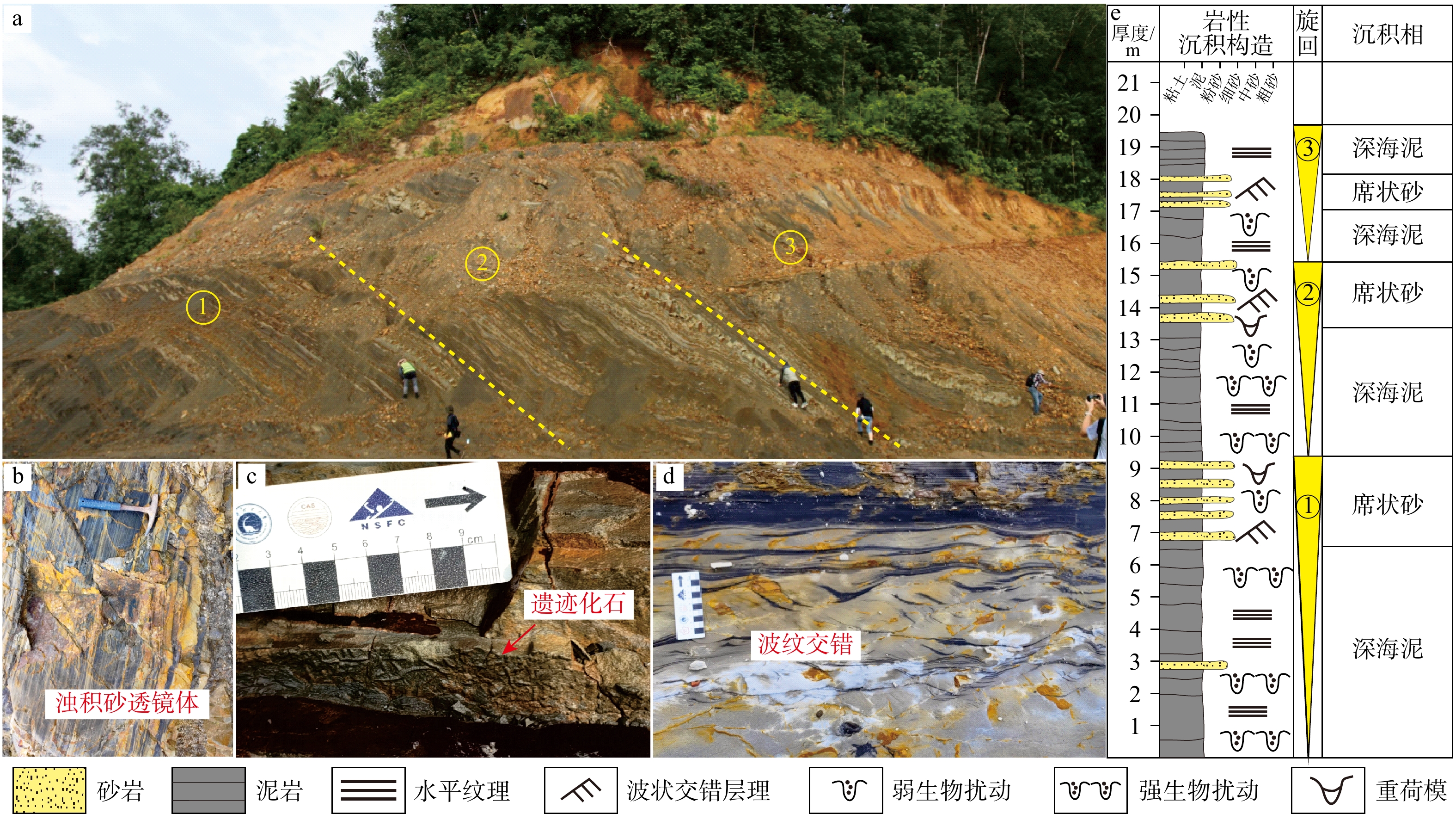
图 4 克拉克扇外扇−扇缘沉积组合露头 (a-d) 及沉积构造特征 (e)(露头剖面A 位置见图 1)
①等为沉积旋回编号,下同
Figure 4. Outcrops (a-d) and sedimentary structures (e) of outer-fan to fan-fringe sedimentary assemblages of Crocker Fan
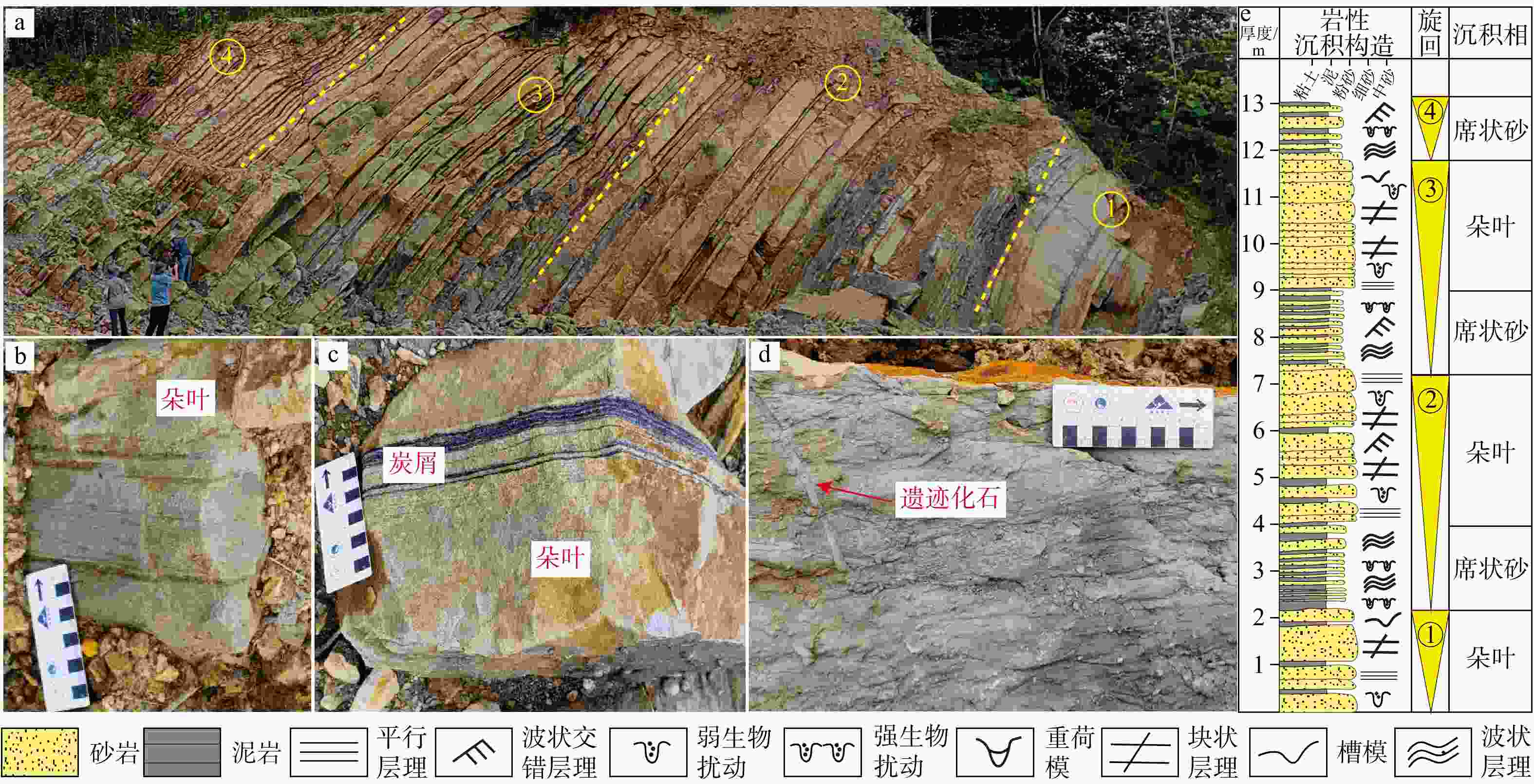
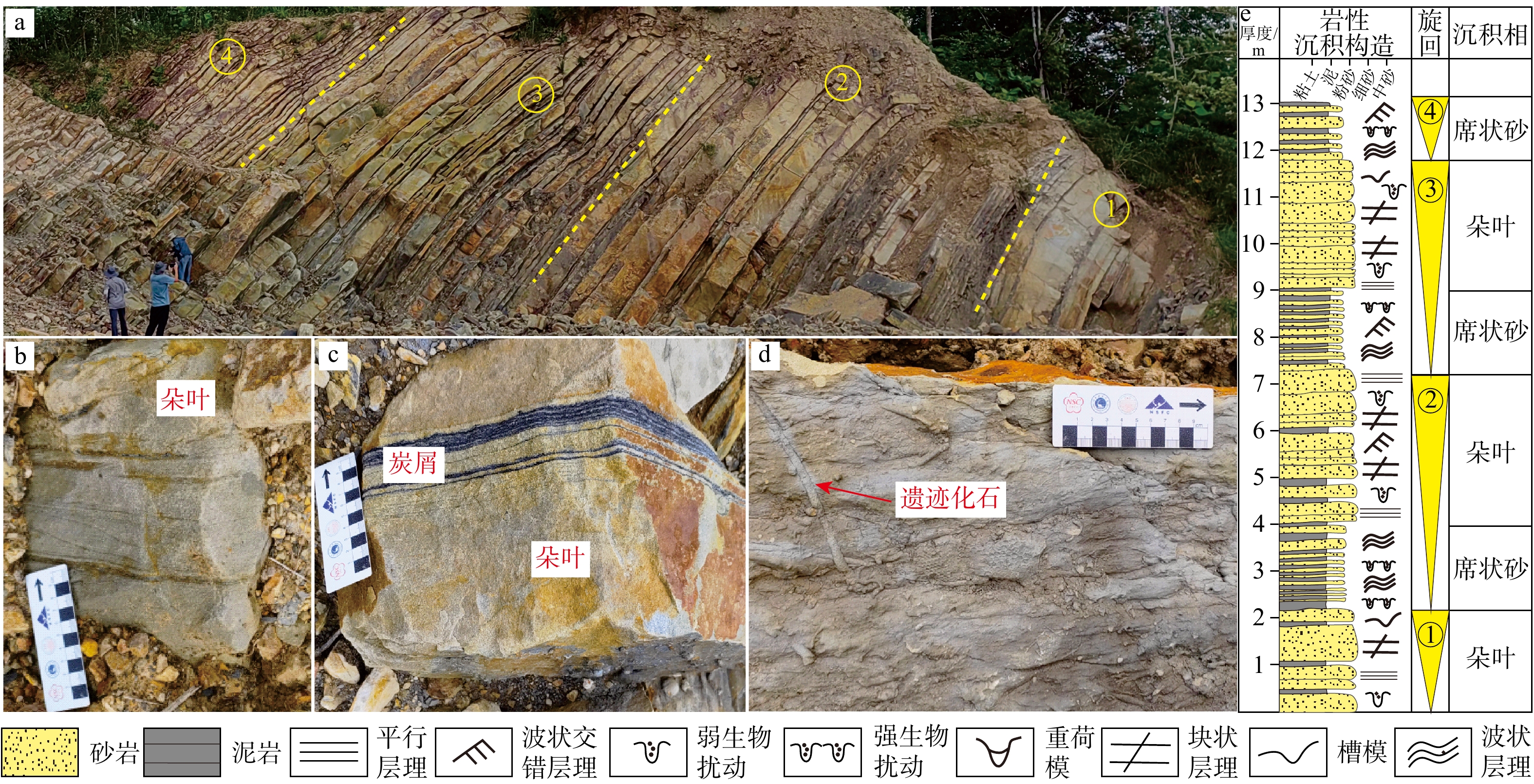
图 5 克拉克扇中扇沉积组合露头及沉积构造特征(露头剖面B 位置见图1)
Figure 5. Outcrops and sedimentary structures of middle-fan sedimentary assemblages of Crocker Fan
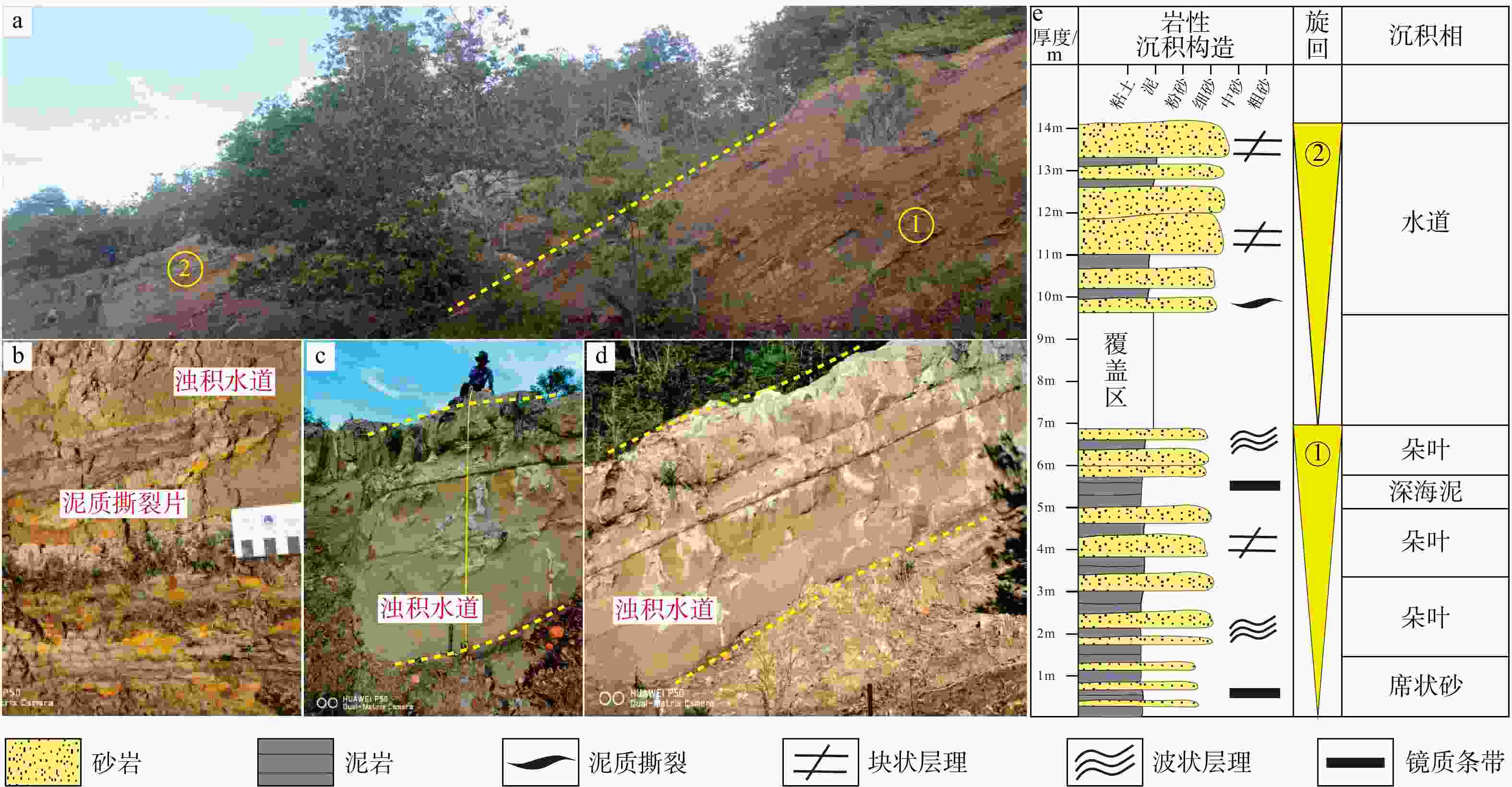
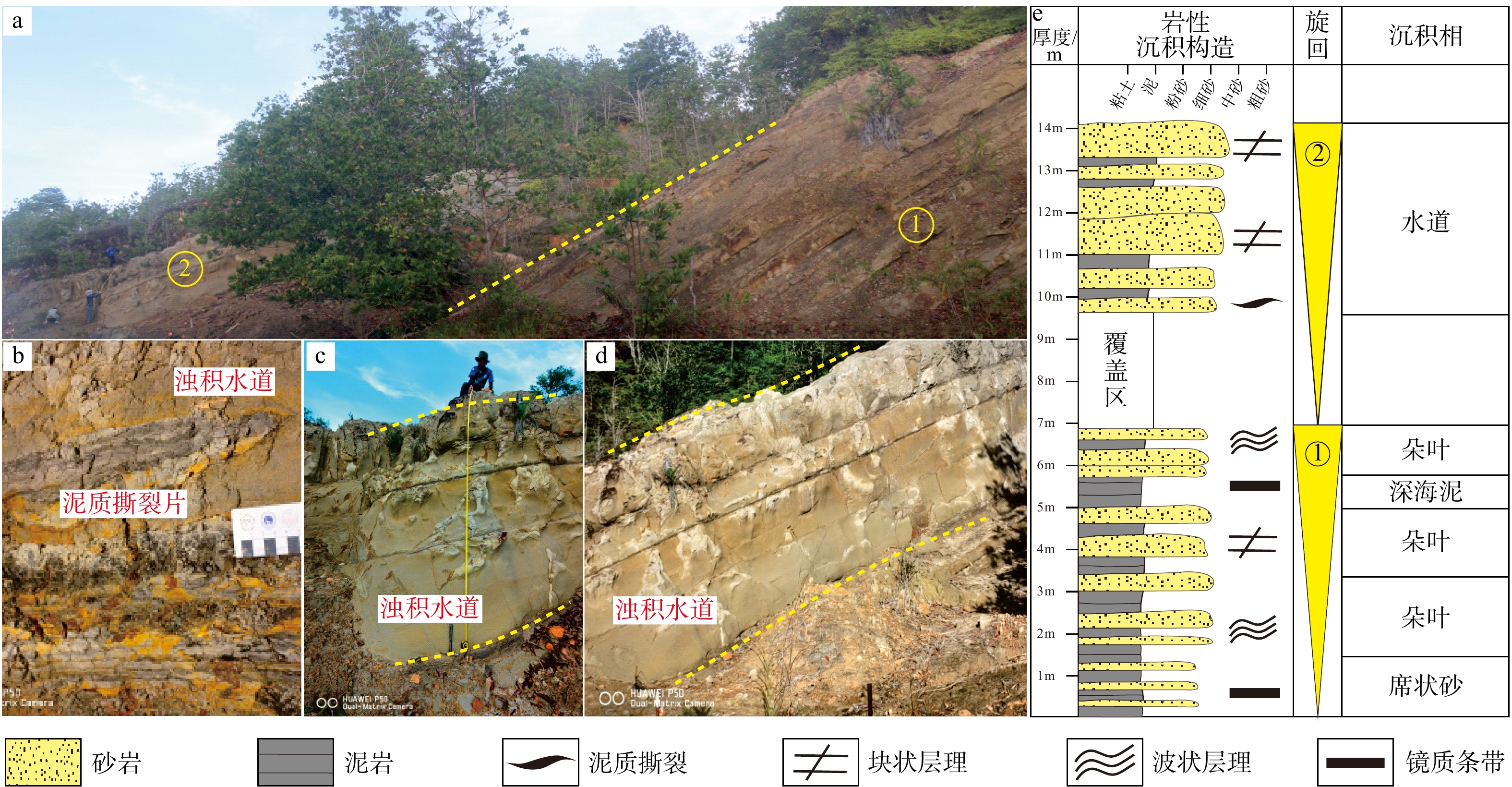
图 6 克拉克扇内扇沉积组合露头及沉积构造特征(露头剖面C 位置见图1)
Figure 6. Outcrops and sedimentary structures of inner-fan sedimentary assemblages of Crocker Fan
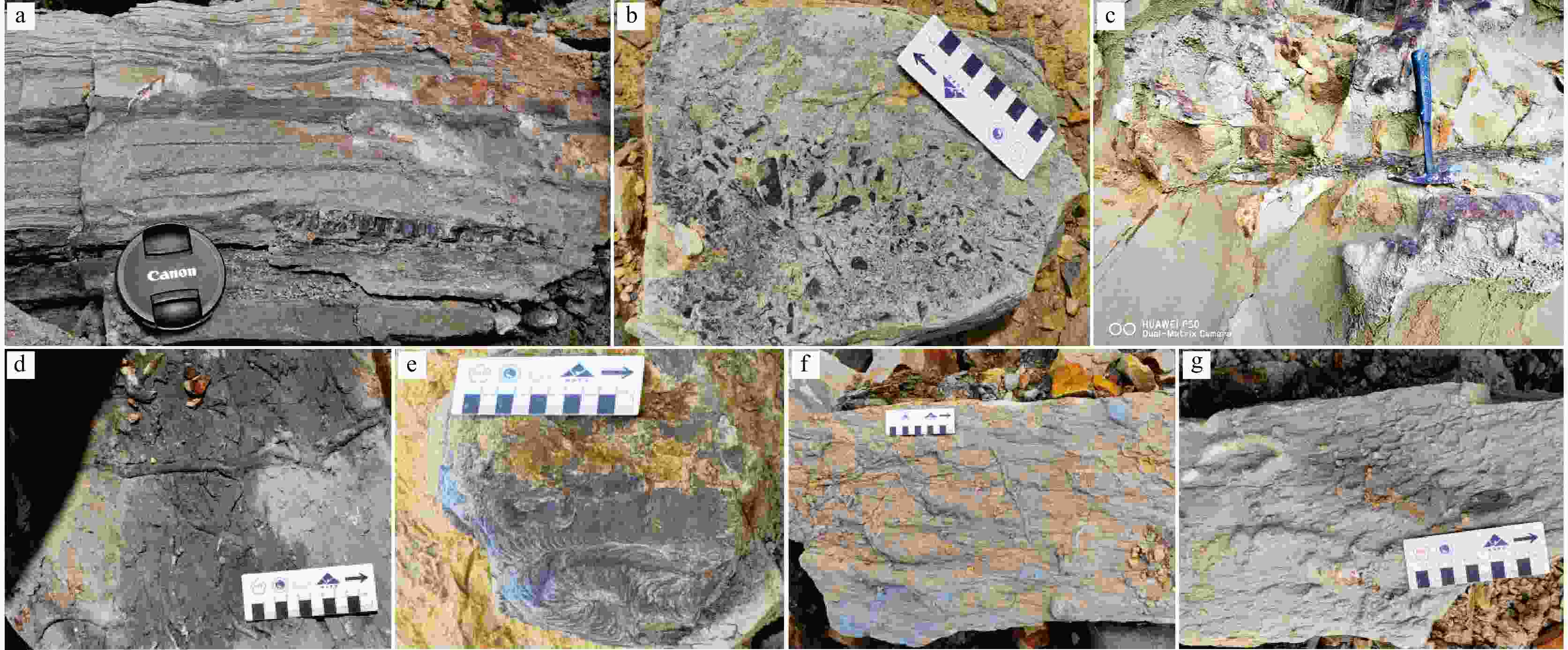
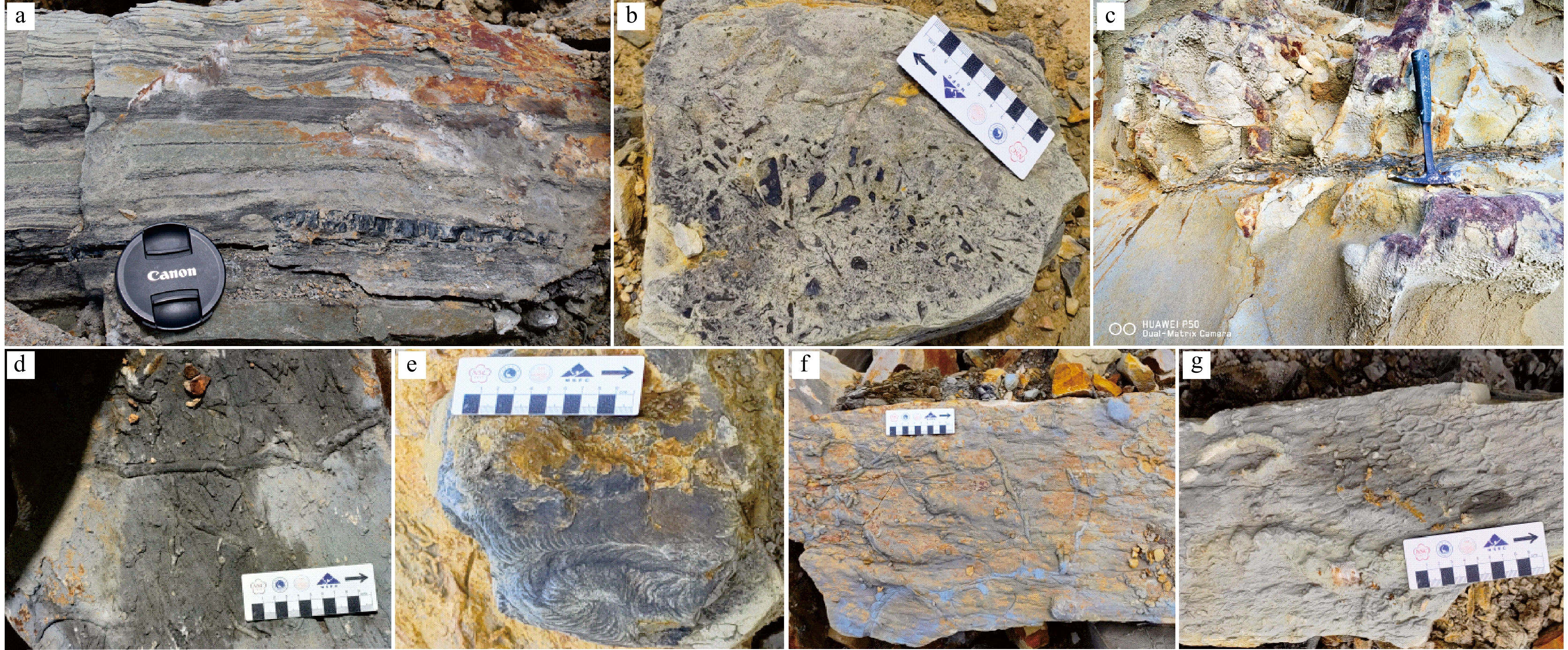
图 7 克拉克扇植物碎屑 (a~c) 与遗迹化石 (d~g)
a. 镜质条带;b. 植物碎片;c. 碳屑;d. Thalassinoides;e. Zoophycos;f. Chondrites;g. Paleodictyon
Figure 7. Plant fragments (a-c) and trace fossils (d-g) from Crocker Fan
表 1 克拉克海底扇主要岩性相类型及沉积特征
Table 1. Main lithofacies types and sedimentary characteristics of Crocker submarine fan
岩相 描述 块状砂岩相(MS) 主要为灰白色中厚层至厚层中−粗粒砂岩,无粒序或无结构的砂岩,块状构造 含泥质撕裂屑砂岩相(IS) 中−细粒砂岩中夹大量撕裂状泥质碎屑,其中夹有浊流水体携带泥质碎块或沿途冲刷下
伏泥质沉积所形成的泥质撕裂片。砂体多为中厚层块状,局部变形明显递变层理砂岩相(GS) 主要为灰白色中厚层中−细粒砂岩,表现出明显的正粒序构造。层底常见底模构造如槽模,
顶部可见生物扰动或微弱纹层,代表重力流快速沉积并逐渐减弱的过程平行层理细−粗砂岩相(PS) 灰白色至灰绿色中厚层细−粗粒砂岩,发育平行层理,反映稳定低湍流沉积环境,即鲍马序列
B段Tb,多见于席状砂或远端浊积砂体。层理清晰,粒度可变,常与粉砂岩或泥岩互层波纹交错层理砂岩相(RS) 灰白色中−细粒砂岩,发育波纹交错层理,即鲍马序列C段Tc。常与细粒砂岩或粉砂岩互层 含砾砂岩相(CS) 灰白色中厚层至巨厚层粗砂岩至砾质砂岩,常夹漂砾石,呈块状构造,反映出高能块体流快速
搬运并沉积的特征。砾石多为次棱角状,可见滑塌层理或软沉积变形构造软沉积变形构造砂岩相(DS) 纹层状砂岩或粉砂岩,发育软沉积变形构造 纹层状粉砂岩相(LSS) 灰色至灰黑色粉砂岩,发育水平纹层或波状纹层。常见遗迹化石和生物扰动,与纹层状泥岩互层出现 纹层状粉砂质泥岩相(LSM) 灰黑色薄层泥岩,发育细密水平纹层,可见炭屑、生物扰动痕迹等,表示沉积环境稳定,沉积速率较低  下载: 导出CSV
-
[1] NORMARK W R. Growth patterns of deep-sea fans[J]. AAPG Bulletin, 1970, 54(11): 2170-2195. doi: 10.1306/5D25CC79-16C1-11D7-8645000102C1865D [2] STOW D A V, HOWELL D G, NELSON C H. Sedimentary, tectonic, and sea-level controls on submarine fan and slope-apron turbidite systems[J]. Geo-Marine Letters, 1983, 3(2): 57-64. doi: 10.1007/bf02462448 [3] POSAMENTIER H W, WALKER R G. Deep-water turbidites and submarine fans[M]//POSAMENTIER H W, WALKER R G. Facies models revisited. Tulsa: Society for Sedimentary Geology, 2006: 397-520. [4] PAYROS A, PUJALTE V. Calciclastic submarine fans: An integrated overview[J]. Earth-Science Reviews, 2008, 86(1-4): 203-246. doi: 10.1016/j.earscirev.2007.09.001 [5] SHANMUGAM G, MOIOLA R J. Submarine fans: Characteristics, models, classification, and reservoir potential[J]. Earth-Science Reviews, 1988, 24(6): 383-428. doi: 10.1016/0012-8252(88)90064-5 [6] DEPTUCK M E, SYLVESTER Z. Submarine fans and their channels, levees, and lobes[M]//MICALLEF A, KRASTEL S, SAVINI A. Submarine geomorphology. Cham: Springer International Publishing, 2018: 273-299. [7] PICKERING K T. Two types of outer fan lobe sequence, from the Late Precambrian Kongsfjord Formation submarine fan, Finnmark, North Norway[J]. Journal of Sedimentary Petrology, 1981, 51(4): 1277-1286. [8] SHANNON P M. Submarine fan types in the Porcupine Basin, Ireland[M]//SPENCER A M. Generation, accumulation and production of Europe's hydrocarbons Ⅲ(Special Publication of the European Association of Petroleum Geoscientists No. 3). Berlin, Heidelberg: Springer, 1993: 111-120. [9] WALKER R G. Deep-water sandstone facies and ancient submarine fans: Models for exploration for stratigraphic traps[J]. AAPG Bulletin, 1978, 62(6): 932-966. doi: 10.1306/C1EA4F77-16C9-11D7-8645000102C1865D [10] MUTTI E, NORMARK W R. Comparing examples of modern and ancient turbidite systems: Problems and concepts[M]//LEGGETT J K, ZUFFA G G. Marine clastic sedimentology: Concepts and case studies. Dordrecht: Springer Netherlands, 1987: 1-38. [11] 党亚云. 莺歌海盆地东方区黄流组一段海底扇地震沉积学研究[J]. 地质科技通报, 2023, 42(6): 118-128. doi: 10.19509/j.cnki.dzkq.tb20220208DANG Y Y. Seismic sedimentology of submarine fan system in the 1st Member of the Huangliu Formation, Dongfang area, Yinggehai Basin, China[J]. Bulletin of Geological Science and Technology, 2023, 42(6): 118-128. (in Chinese with English abstract) doi: 10.19509/j.cnki.dzkq.tb20220208 [12] 朱沛苑, 尤丽, 元庆涛, 等. 乐东—陵水凹陷梅山组海底扇储层物性与孔喉结构[J]. 天然气技术与经济, 2018, 12(5): 1-4. doi: 10.3969/j.issn.2095-1132.2018.05.001ZHU P Y, YOU L, YUAN Q T, et al. Petrophysical property and pore-throat structure of submarine-fan reservoirs in Meishan Formation, Ledong-Lingshui Sag[J]. Natural Gas Technology, 2018, 12(5): 1-4. (in Chinese with English abstract) doi: 10.3969/j.issn.2095-1132.2018.05.001 [13] 罗泉源, 焦祥燕, 刘昆, 等. 乐东−陵水凹陷梅山组海底扇识别及沉积模式[J]. 海洋地质与第四纪地质, 2020, 40(2): 90-99. doi: 10.16562/j.cnki.0256-1492.2018122001LUO Q Y, JIAO X Y, LIU K, et al. Identification of submarine fan in the Meishan Formation of the Ledong-Lingshui Sag in the Qiongdongnan Basin and its depositional model[J]. Marine Geology & Quaternary Geology, 2020, 40(2): 90-99. (in Chinese with English abstract) doi: 10.16562/j.cnki.0256-1492.2018122001 [14] 李建平, 熊连桥, 黄琪斐, 等. 琼东南盆地梅山组浊积扇分类及其勘探意义[J]. 油气地质与采收率, 2023, 30(6): 1-12. doi: 10.13673/j.pgre.202211029LI J P, XIONG L Q, HUANG Q F, et al. Classification of turbidite fans of Meishan Formation in Qiongdongnan Basin and their exploration significance[J]. Petroleum Geology and Recovery Efficiency, 2023, 30(6): 1-12. (in Chinese with English abstract) doi: 10.13673/j.pgre.202211029 [15] RICHARDS M, BOWMAN M, READING H. Submarine-fan systems Ⅰ: Characterization and stratigraphic prediction[J]. Marine and Petroleum Geology, 1998, 15(7): 689-717. doi: 10.1016/S0264-8172(98)00036-1 [16] READING H G, RICHARDS M. Turbidite systems in deep-water basin margins classified by grain size and feeder system[J]. AAPG Bulletin, 1994, 78(5): 792-822. doi: 10.1306/A25FE3BF-171B-11D7-8645000102C1865D [17] RICHARDS M, BOWMAN M. Submarine fans and related depositional systems Ⅱ: Variability in reservoir architecture and wireline log character[J]. Marine and Petroleum Geology, 1998, 15(8): 821-839. doi: 10.1016/S0264-8172(98)00042-7 [18] BOUMA A H. Comparison of fine-grained, mud-rich and coarse-grained, sand-rich submarine fans for exploration-development purposes[J]. AAPG Bulletin, 1997, 81(11): 1622. doi: 10.1306/3b05c014-172a-11d7-8645000102c1865d [19] WILLIAM A G, LAMBIASE J J, BACK S, et al. Sedimentology of the Jalan Salaiman and Bukit Melinsung outcrops, western Sabah: Is the West Crocker Formation an analogue for Neogene turbidites offshore?[J]. Bulletin of the Geological Society of Malaysia, 2003, 47: 63-75. doi: 10.7186/bgsm47200305 [20] ZAKARIA A A, JOHNSON H D, JACKSON C A L, et al. Sedimentary facies analysis and depositional model of the Palaeogene West Crocker submarine fan system, NW Borneo[J]. Journal of Asian Earth Sciences, 2013, 76: 283-300. doi: 10.1016/j.jseaes.2013.05.002 [21] JAMIL M, SIDDIQUI N A, BIN ABD RAHMAN A H, et al. Facies heterogeneity and lobe facies multiscale analysis of deep-marine sand-shale complexity in the West Crocker Formation of Sabah Basin, NW Borneo[J]. Applied Sciences, 2021, 11(12): 5513. doi: 10.3390/app11125513 [22] MOHD RADZIR N A, ALI C A, MOHAMED K R. Sedimentological analysis of the turbidite sequence in the northern part of the West Crocker Formation, Northwest Sabah[J]. Applied Sciences, 2022, 12(23): 12149. doi: 10.3390/app122312149 [23] VAN HATTUM M W A, HALL R, PICKARD A L, et al. Southeast Asian sediments not from Asia: Provenance and geochronology of north Borneo sandstones[J]. Geology, 2006, 34(7): 589. doi: 10.1130/G21939.1 [24] VAN HATTUM M W A, HALL R, PICKARD A L, et al. Provenance and geochronology of Cenozoic sandstones of northern Borneo[J]. Journal of Asian Earth Sciences, 2013, 76: 266-282. doi: 10.1016/j.jseaes.2013.02.033 [25] HALL R. Contraction and extension in northern Borneo driven by subduction rollback[J]. Journal of Asian Earth Sciences, 2013, 76: 399-411. doi: 10.1016/j.jseaes.2013.04.010 [26] WANG Y J, QIAN X, CAWOOD P A, et al. Temporal-spatial patterns of Mesozoic Paleo-Pacific and Tethyan supra-subduction systems in SE Asia: Key observations and controversies in Borneo and its surroundings[J]. Earth-Science Reviews, 2024, 252: 104762. doi: 10.1016/j.earscirev.2024.104762 [27] 韦娉婷, 钱鑫, Junaidi Bin Asis, 等. 沙巴地区新生代碎屑岩物源分析及构造意义——锆石年代学和Lu-Hf同位素组成约束[J]. 大地构造与成矿学, 2024, 48(3): 512-528.WEI P T, QIAN X, ASIS J, et al. Provenance and tectonic significance of the Cenozoic sandstones in Sabah: Constraints from zircon geochronology and Lu-Hf isotope[J]. Geotectonica et Metallogenia, 2024, 48(3): 512-528. (in Chinese with English abstract) [28] HUTCHISON C S. Geology of North-West Borneo: Sarawak, Brunei and Sabah[M]. Amsterdam: Elsevier, 2005. [29] HALL R. Cenozoic geological and plate tectonic evolution of SE Asia and the SW Pacific: Computer-based reconstructions, model and animations[J]. Journal of Asian Earth Sciences, 2002, 20(4): 353-431. doi: 10.1016/S1367-9120(01)00069-4 [30] MADON M. Basin types, tectono-stratigraphic provinces, and structural styles[M]//PETRONAS. The petroleum geology and resources of Malaysia. Kuala Lumpur: PETRONAS, 1999: 77-112. [31] STAUFFER P H. Studies in the Crocker Formation, Sabah[J]. Geological Survey of Malaysia, Borneo Region Bulletin, 1967, 8: 1-13. [32] HUTCHISON C S. The 'Rajang accretionary prism' and 'Lupar Line' problem of Borneo[J]. Geological Society, London, Special Publications, 1996, 106(1): 247-261. doi: 10.1144/GSL.SP.1996.106.01.16 [33] JACKSON C A L, ZAKARIA A A, JOHNSON H D, et al. Sedimentology, stratigraphic occurrence and origin of linked debrites in the West Crocker Formation (Oligo-Miocene), Sabah, NW Borneo[J]. Marine and Petroleum Geology, 2009, 26(10): 1957-1973. doi: 10.1016/j.marpetgeo.2009.02.019 [34] 吴佳男, 魏慧, 范国章, 等. 孟加拉湾若开盆地上上新统深水沉积及储集特征分析[J]. 地质科技通报, 2024, 43(6): 244-257. doi: 10.19509/j.cnki.dzkq.tb20230577WU J N, WEI H, FAN G Z, et al. Sedimentary and reservoir characteristics of Late Pliocene deep-water depositional units in Rakhine Basin in the Bay of Bengal[J]. Bulletin of Geological Science and Technology, 2024, 43(6): 244-257. (in Chinese with English abstract) doi: 10.19509/j.cnki.dzkq.tb20230577 [35] 苏海霞, 刘姗, 张莉, 等. 南海南部北康盆地晚中新世以来深水沉积单元时空分布特征及其控制因素[J]. 地质科技通报, 2023, 42(6): 129-139. doi: 10.19509/j.cnki.dzkq.tb20220126SU H X, LIU S, ZHANG L, et al. Spatiotemporal distribution characteristics and controlling factors of deep-water sediments in the Beikang Basin since the Late Miocene, southern South China Sea[J]. Bulletin of Geological Science and Technology, 2023, 42(6): 129-139. (in Chinese with English abstract) doi: 10.19509/j.cnki.dzkq.tb20220126 [36] ABDULLAH W H, TOGUNWA O S, MAKEEN Y M, et al. Hydrocarbon source potential of Eocene-Miocene sequence of western Sabah, Malaysia[J]. Marine and Petroleum Geology, 2017, 83: 345-361. doi: 10.1016/j.marpetgeo.2017.02.031 [37] MUTTI E, RICCI LUCCHI F. Turbidites of the northern Apennines: Introduction to facies analysis[J]. International Geology Review, 1978, 20(2): 125-166. doi: 10.1080/00206817809471524 [38] MUTTI E. Turbidite sandstones[M]. Parma: AGIP, Istituto di Geologia, Università di Parma, 1992. [39] CREVELLO P D, JOHNSON H D, TONGKUL F, et al. Overview of mixed braided- and leveed-channel turbidites, West Crocker fan system, Northwest Borneo[M]//AAPG. Atlas of deep water outcrops. Tulsa: American Association of Petroleum Geologists, 2008. [40] BOUMA A H. Sedimentology of some flysch deposits: A graphic approach to facies interpretation[M]. Amsterdam: Elsevier, 1962: 168. [41] LOWE D R. Sediment gravity flows: Ⅱ. Depositional models with special reference to the deposits of high-density turbidity currents[J]. Journal of Sedimentary Research, 1982, 52(1): 279-297. [42] MOHAMED A, RAHMAN A H A, ISMAIL M S. Sedimentary facies of the West Crocker Formation North Kota Kinabalu-Tuaran area, Sabah, Malaysia[J]. IOP Conference Series: Earth and Environmental Science, 2016, 30(1): 012004. [43] BAKAR N A, HADI ABD RAHMAN, MAZLAN MADON. Sedimentary facies and depositional framework of the Tertiary West Crocker Formation around Kota Kinabalu, Sabah[C]//Anon. PGCE 2006. Kuala Lumpur: European Association of Geoscientists & Engineers, 2006: cp-256-00050. [44] MOHD RADZIR N A, ARSHAD A, ALI C A, et al. Sedimentological analysis of thin-bedded sequence of eastern part of West Crocker Formation, Northwest Sabah, Malaysia[J]. Sains Malaysiana, 2023, 52(12): 3371-3394. doi: 10.17576/jsm-2023-5212-03 -

 下载:

 点击查看大图
计量
- 文章访问数: 318
- PDF下载量: 15
- 被引次数: 0