投审稿入口
投审稿入口


Generative adversarial network-based sedimentary facies modeling under different conditional simulation strategies
-
摘要:
已有的生成对抗网络条件化建模研究主要集中于理论方法的发展和应用探索,缺乏对不同井网密度下各类条件化方法模拟效果的系统性定量评估,难以给实际沉积相建模的方法选择提供精准参考。针对生成对抗网络地质建模的条件化方法开展研究,系统评估不同井网密度下3种条件化方法的模拟效果,具体为:①在训练中显式引入井点条件损失优化生成器的条件损失函数法;②基于梯度下降的输入向量搜索方法;③基于前置神经网络的输入向量搜索方法。以井点匹配率、砂体连通性为评价指标,在 2%~10% 井密度下开展对比实验,同时探究了条件损失权重与井网密度的交互作用对建模效果的影响。实验表明,条件损失约束法在操作便捷性与建模效率上整体更优,且可通过调整损失权重灵活平衡约束精度与模式多样性,适配兼顾全局结构与局部精度的场景;梯度下降法在匹配率上有优势,但计算成本高;神经网络映射法生成速度快,适合快速推断场景,且该方法存在100~
1000 的损失权重临界区间,可实现约束精度与地质模式多样性的合理平衡。研究结果揭示了不同条件化方法在不同井网密度下的性能差异,明确了各方法的适用场景,为不同井网密度下沉积相建模的条件化策略选择提供了定量参考与实操参数依据。Abstract:ObjectiveReservoir sedimentary facies modeling is a core link in oil and gas exploration and development, and generative adversarial networks (GANs) have become an important technical means for this research field due to their strong ability to learn complex geological spatial features. However, existing studies on conditional geological modeling using GANs have mainly focused on the development of theoretical methods and the exploration of their preliminary applications, while lacking a systematic and quantitative evaluation of the simulation performance of different conditioning approaches under varying well densities. This deficiency makes it difficult to provide accurate and operable references for the selection of conditioning methods in practical reservoir sedimentary facies modeling.
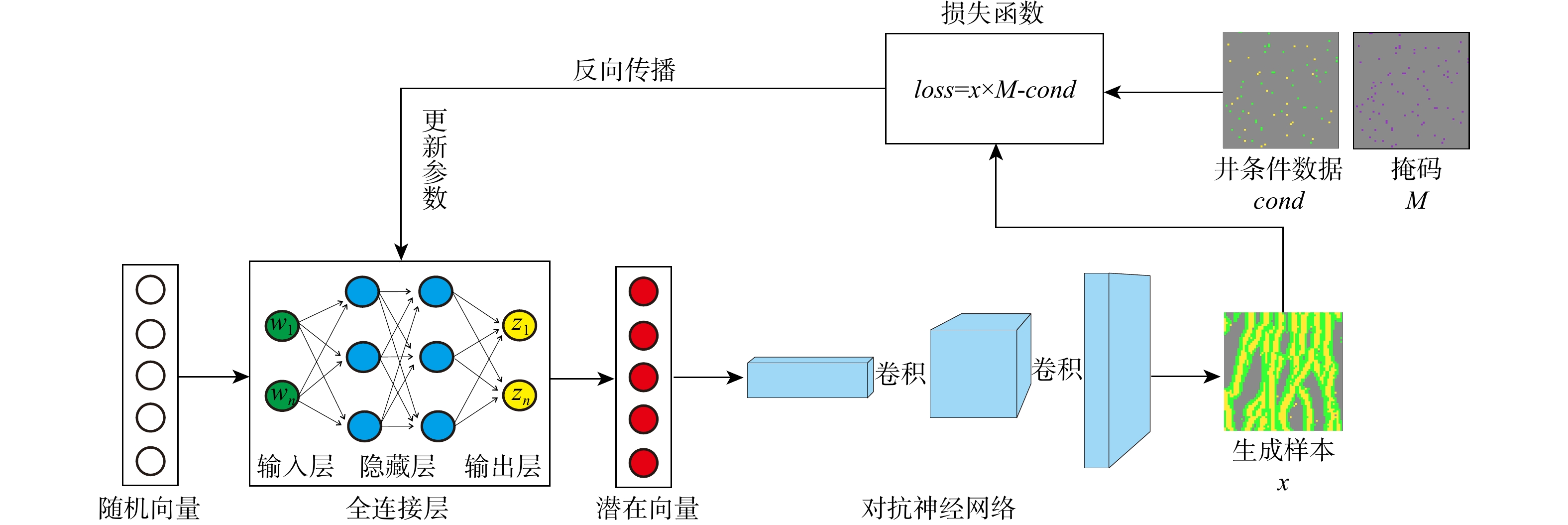
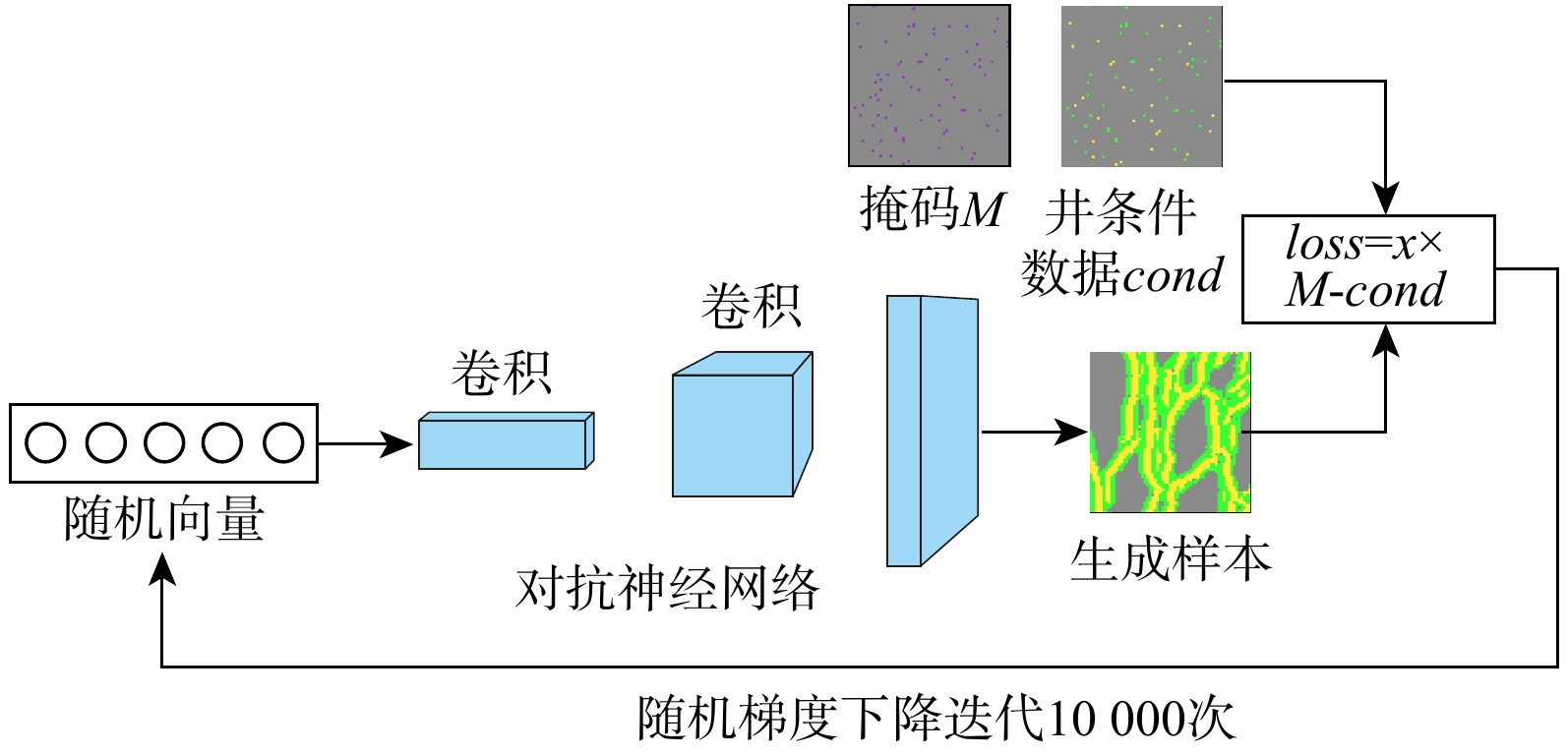
MethodsTo fill this research gap, this study investigated the conditioning methods for GAN-based geological modeling and systematically evaluated the simulation effects of three typical conditioning strategies under different well densities (2%, 4%, 6%, 8% and 10% in this experiment). The three strategies are as follows: ① A conditional loss function method that explicitly incorporates well-point conditioning loss into the training process to optimize the generator of GANs; ② A latent vector search method based on gradient descent, which iteratively optimizes the latent vector to match the well-point constraints; ③ A latent vector search method based on a pre-trained neural network, which builds a mapping network to realize the rapid conversion from conditional data to latent vectors. In the research, well-point matching rate was used as the quantitative index to evaluate the local constraint satisfaction degree, and sandbody connectivity analysis was adopted as the key index to characterize the rationality of the global geological structure. On this basis, a series of comparative experiments were designed to verify the performance of the three methods, and the study further explored the interactive effect between conditional loss weight and well density on the modeling results for the conditional loss function method, which is the most potential one among the three strategies.
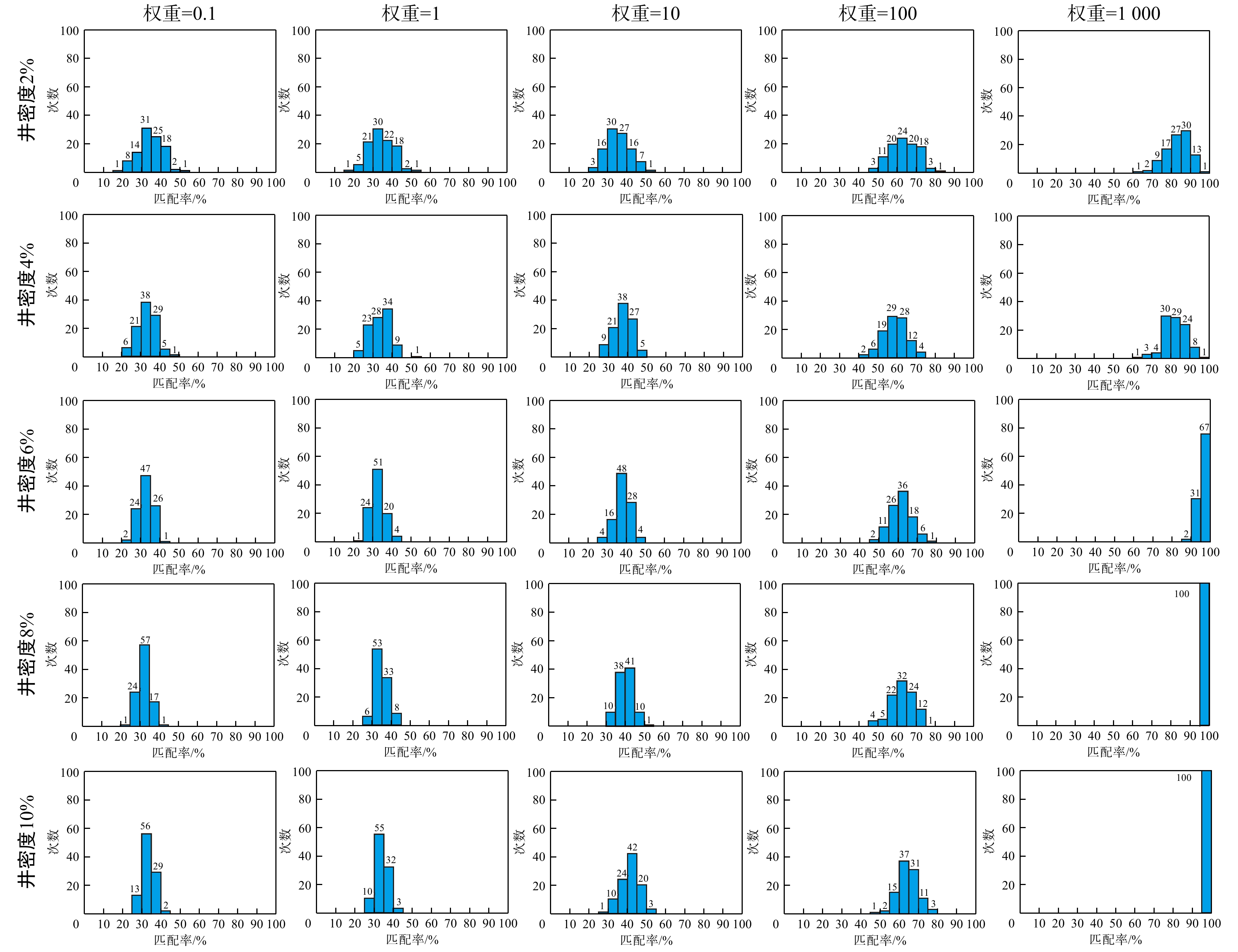
ResultsComprehensive experimental results show that the conditional loss function strategy is overall superior to the other two methods in terms of operational convenience and modeling efficiency. More importantly, it can flexibly balance the constraint accuracy and geological pattern diversity by adjusting the weight of conditional loss, making it suitable for the modeling scenarios that need to take both global geological structure and local well-point precision into account. The gradient descent method has obvious advantages in well-point matching rate, especially under low well density conditions, but it has the disadvantages of high computational cost and high sensitivity to the initial value of latent vector. The neural network mapping method features ultra-fast model generation speed, which is suitable for rapid inference and large-scale batch simulation scenarios. In addition, the experiment also found that there is a critical interval of loss weight (from 100 to
1000 ) for the conditional loss function method, and selecting the weight within this interval can effectively achieve a reasonable balance between constraint accuracy and geological pattern diversity in sedimentary facies modeling.ConclusionsThis study reveals the inherent law of performance variation of different GAN conditioning methods under different well densities, and clarifies the applicable characteristics of each method. The research results provide quantitative references for the selection of conditioning strategies and the setting of key parameters in sedimentary facies modeling under different well densities, and also lay a certain technical foundation for the engineering application of GANs in the field of oil and gas reservoir geological modeling.
-
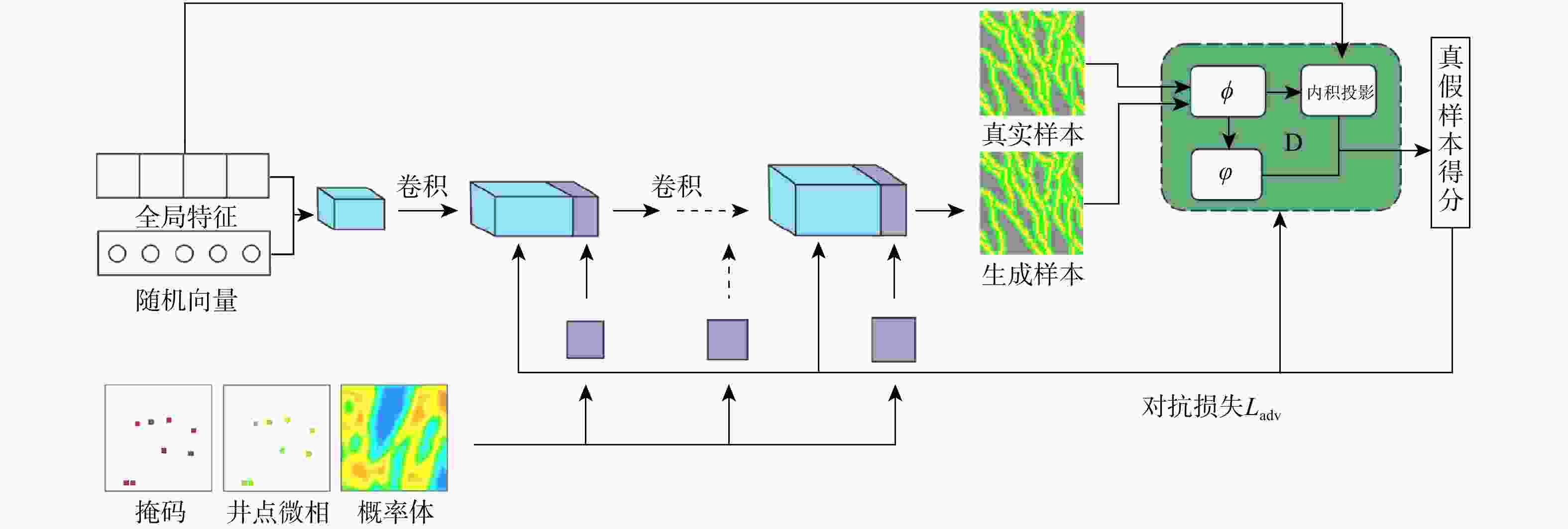
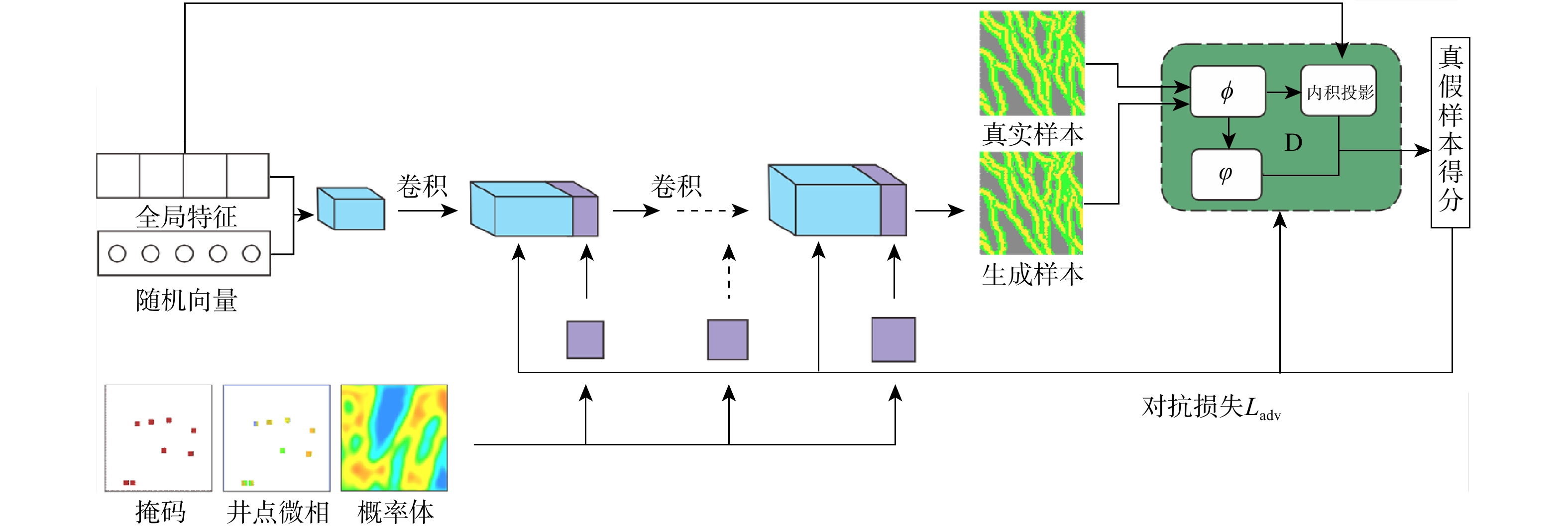
图 3 基于条件损失约束法
D为判别器;ϕ为特征提取函数,表示用卷积神经网络把输入图像(真实/生成的沉积相)提取成一个高维特征向量;φ为条件特征(井点条件)
Figure 3. Conditional loss-based constraint method
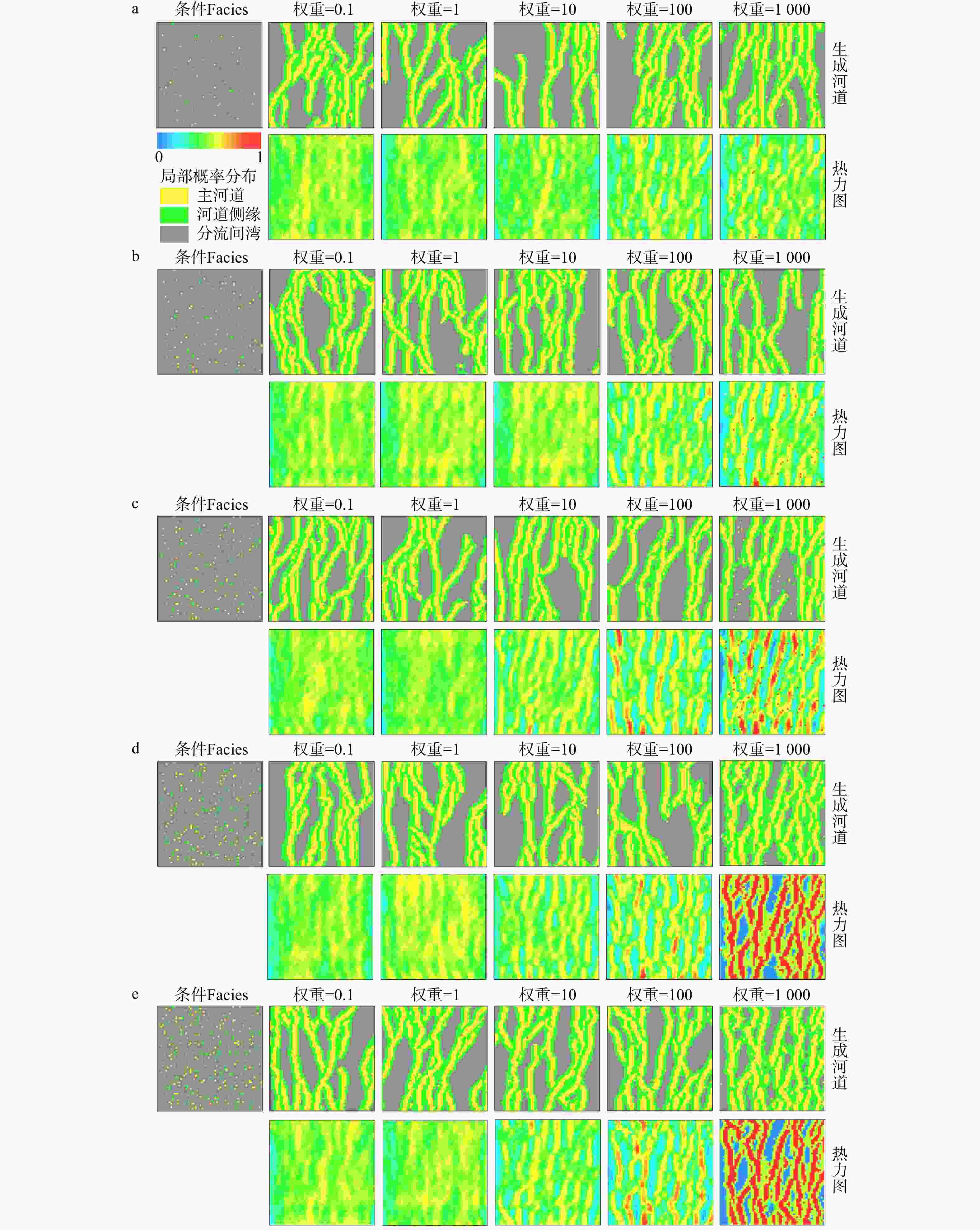
图 4 井密度为2%(a),4%(b),6%(c),8%(d)及10%(e)时条件化模拟结果
Figure 4. Conditional simulation results at well density of 2%(a), 4%(b), 6%(c), 8%(d) and 10%(e)
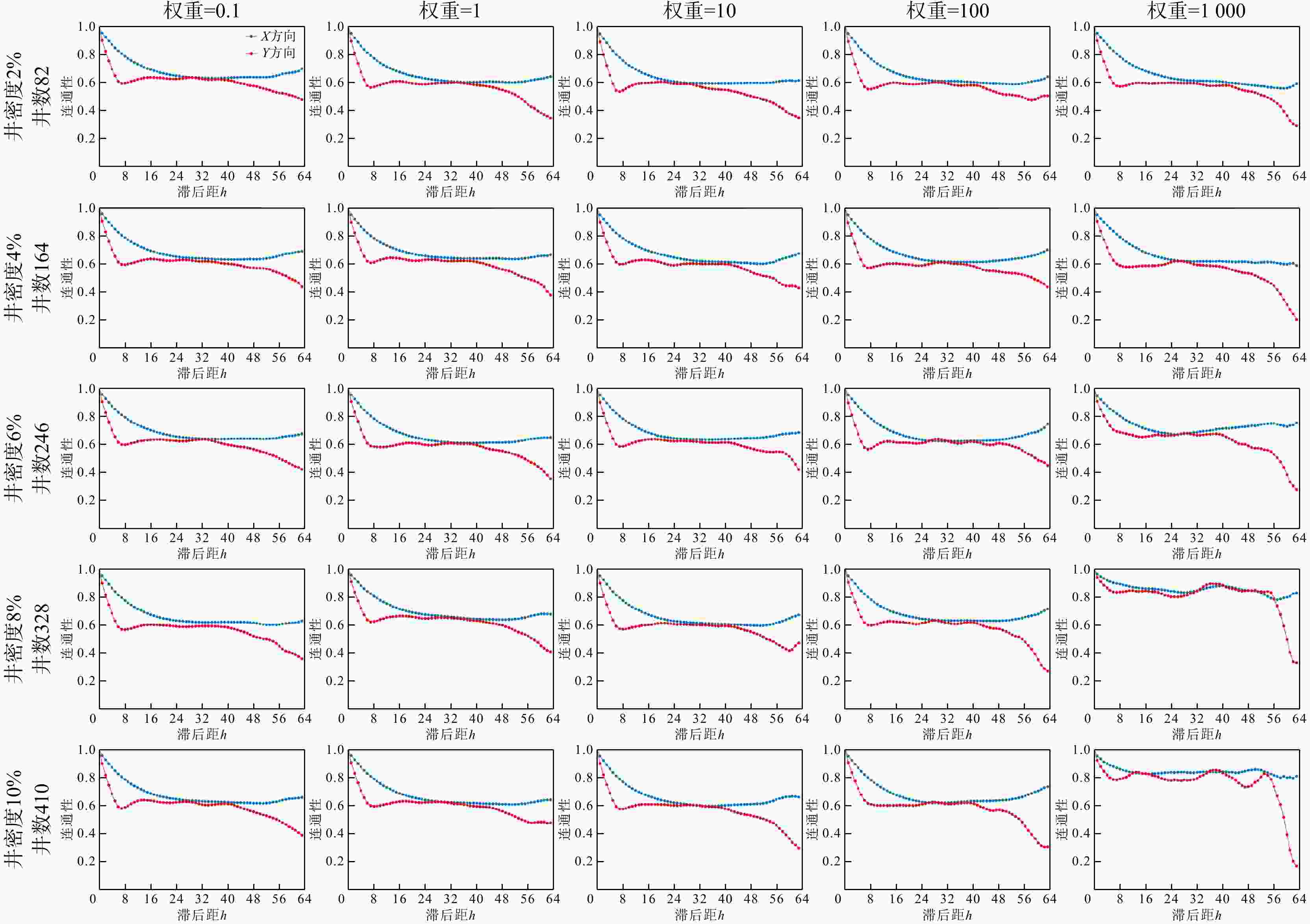
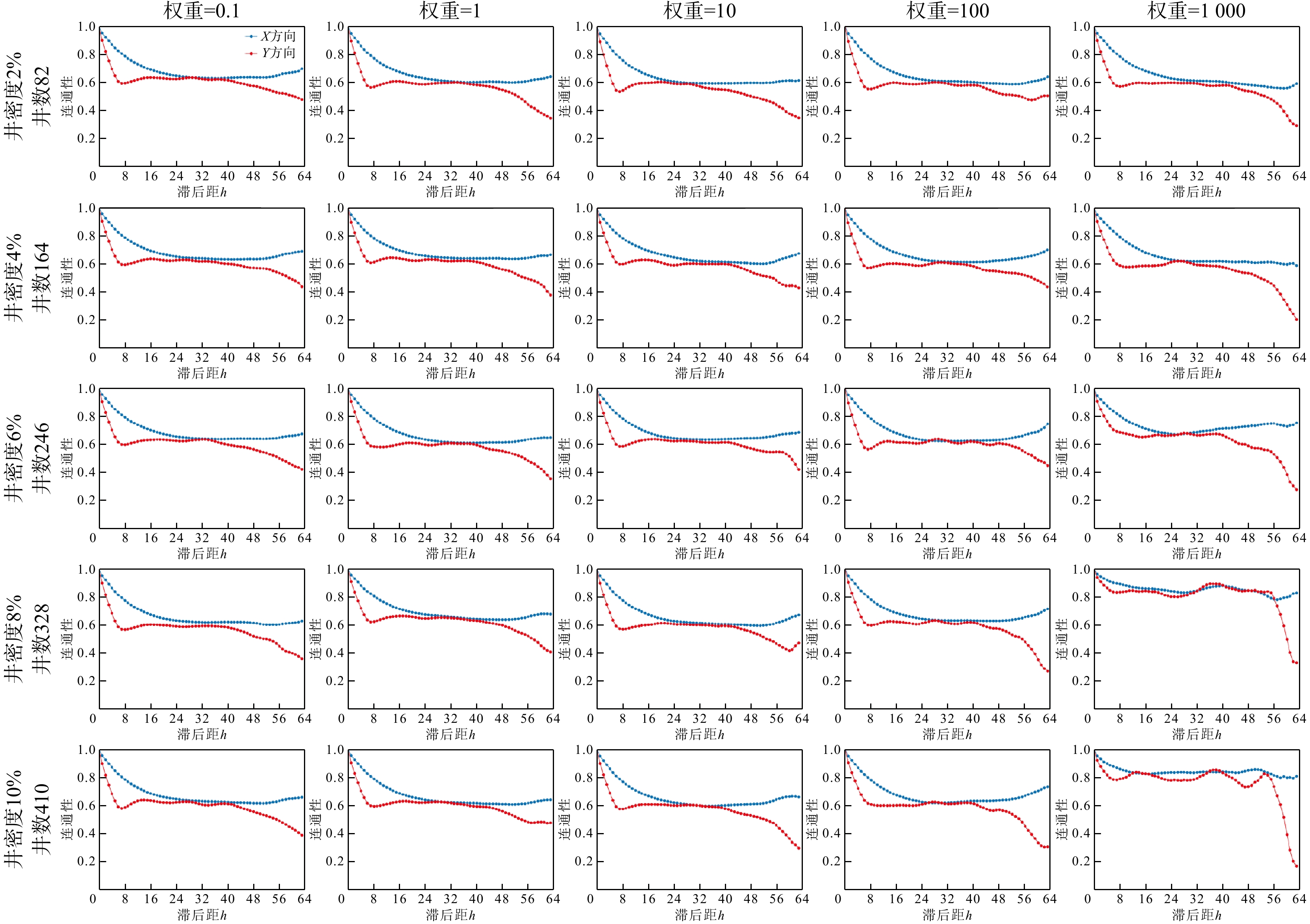
图 6 不同井密度与损失权重条件下的砂体连通性曲线
Figure 6. Sandbody connectivity curves under different well densities and loss weights
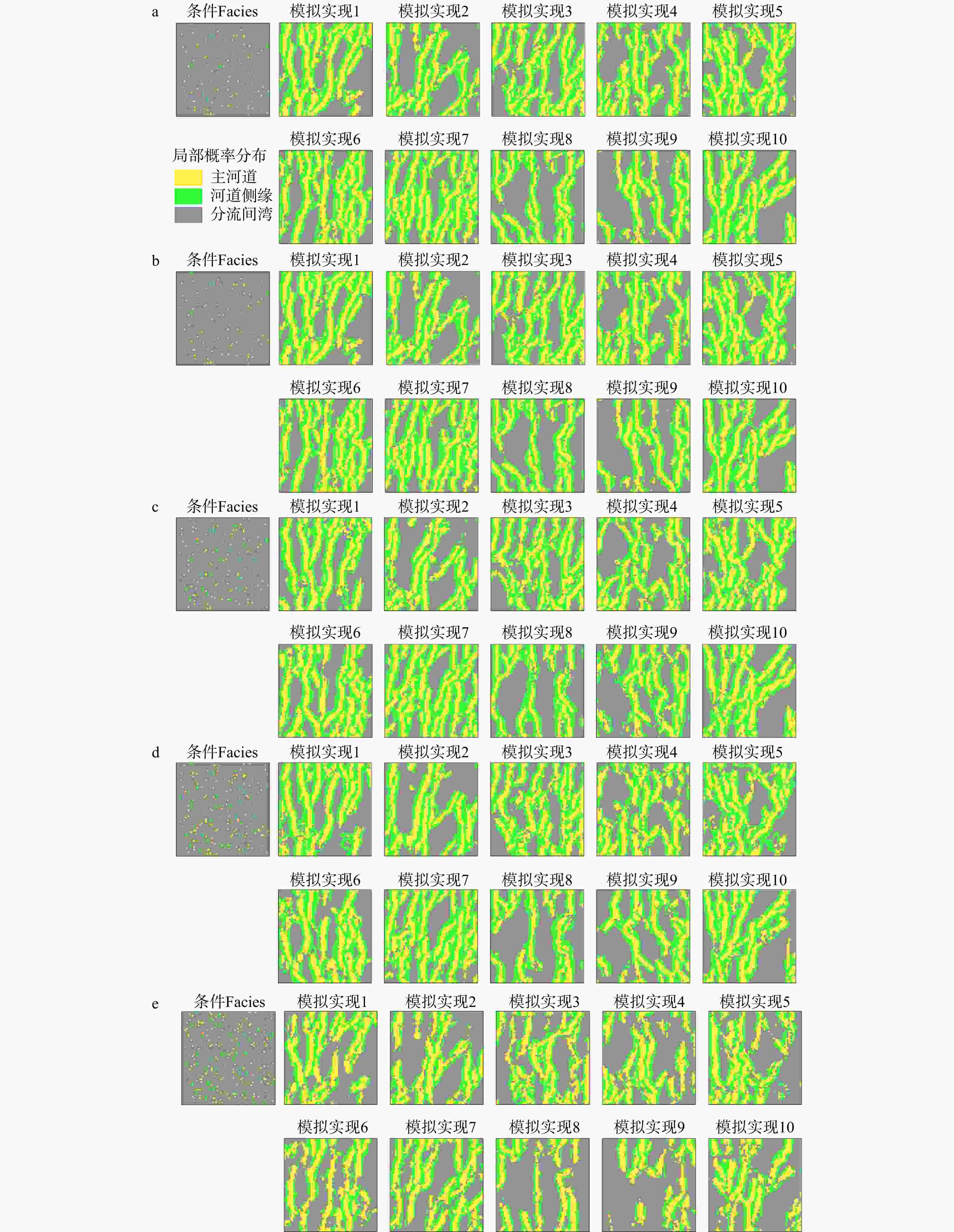
图 7 井密度为2%(a),4%(b),6%(c),8%(d)和10%(e)时梯度下降法的10组模拟结果
Figure 7. Ten simulation realizations of gradient descent method at well density of 2%(a), 4%(b), 6%(c), 8%(d) and 10%(e)
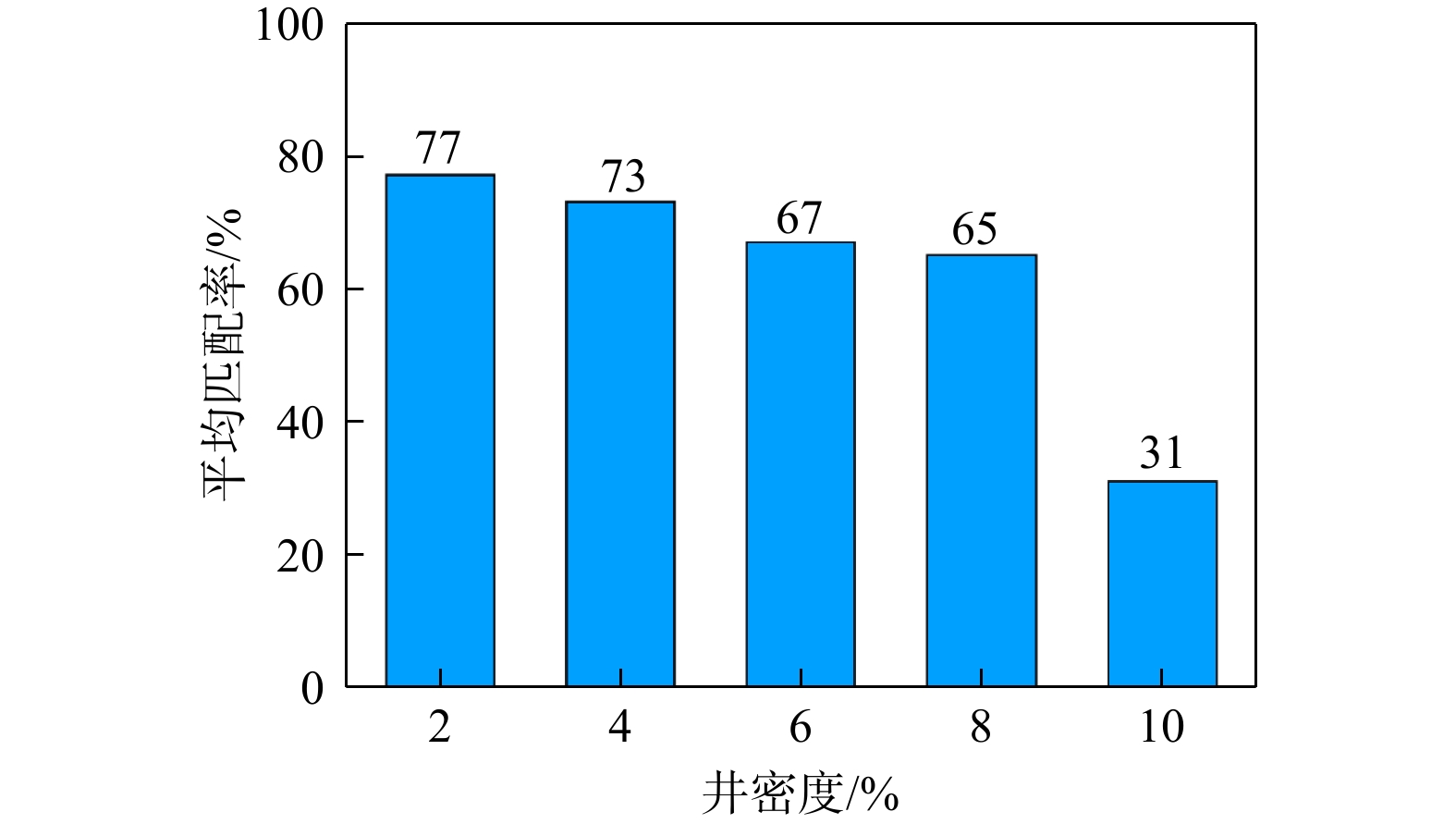
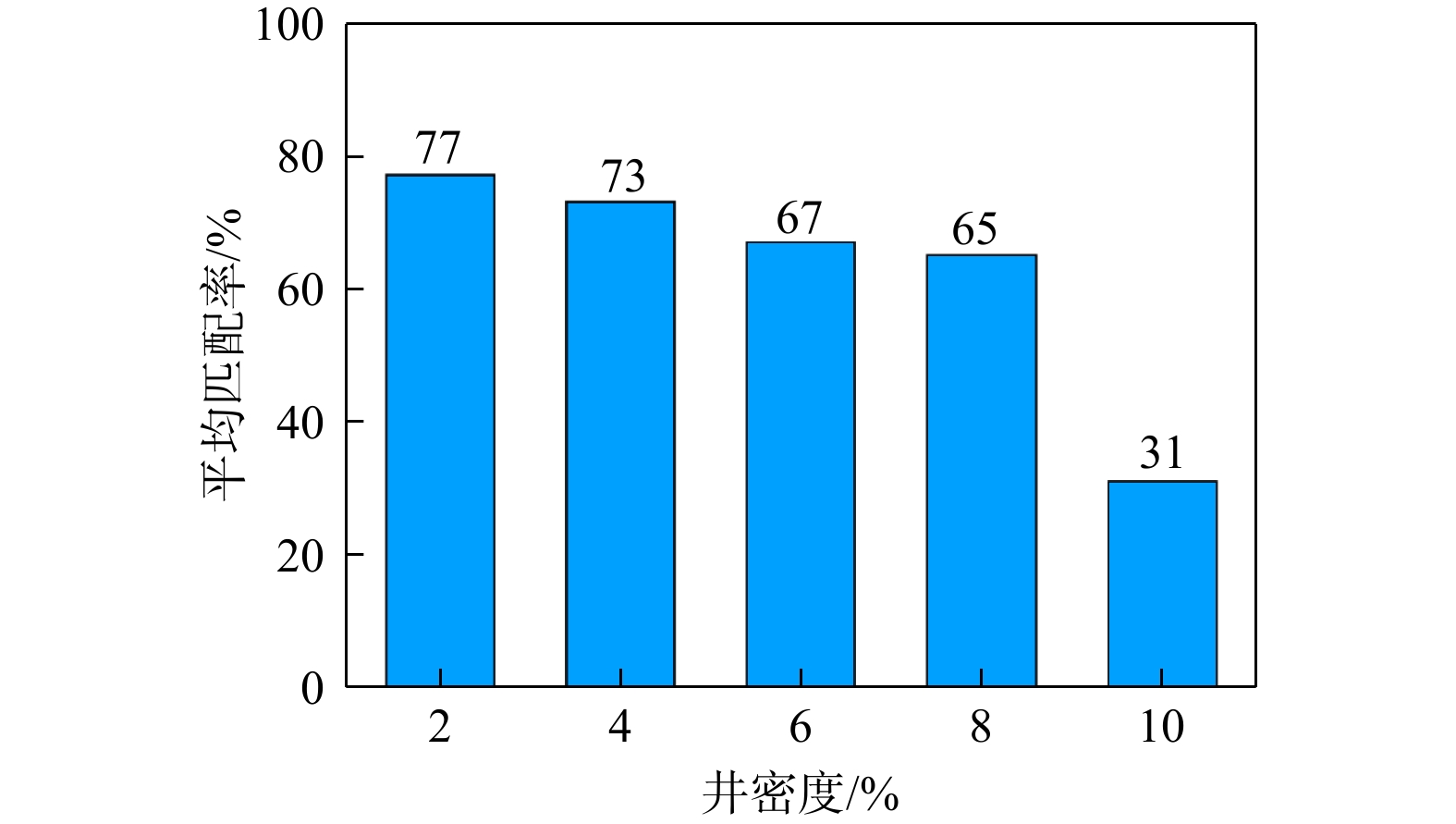
图 8 梯度下降法的平均匹配率与井密度关系
Figure 8. Relationship between average matching rate and well density for gradient descent method
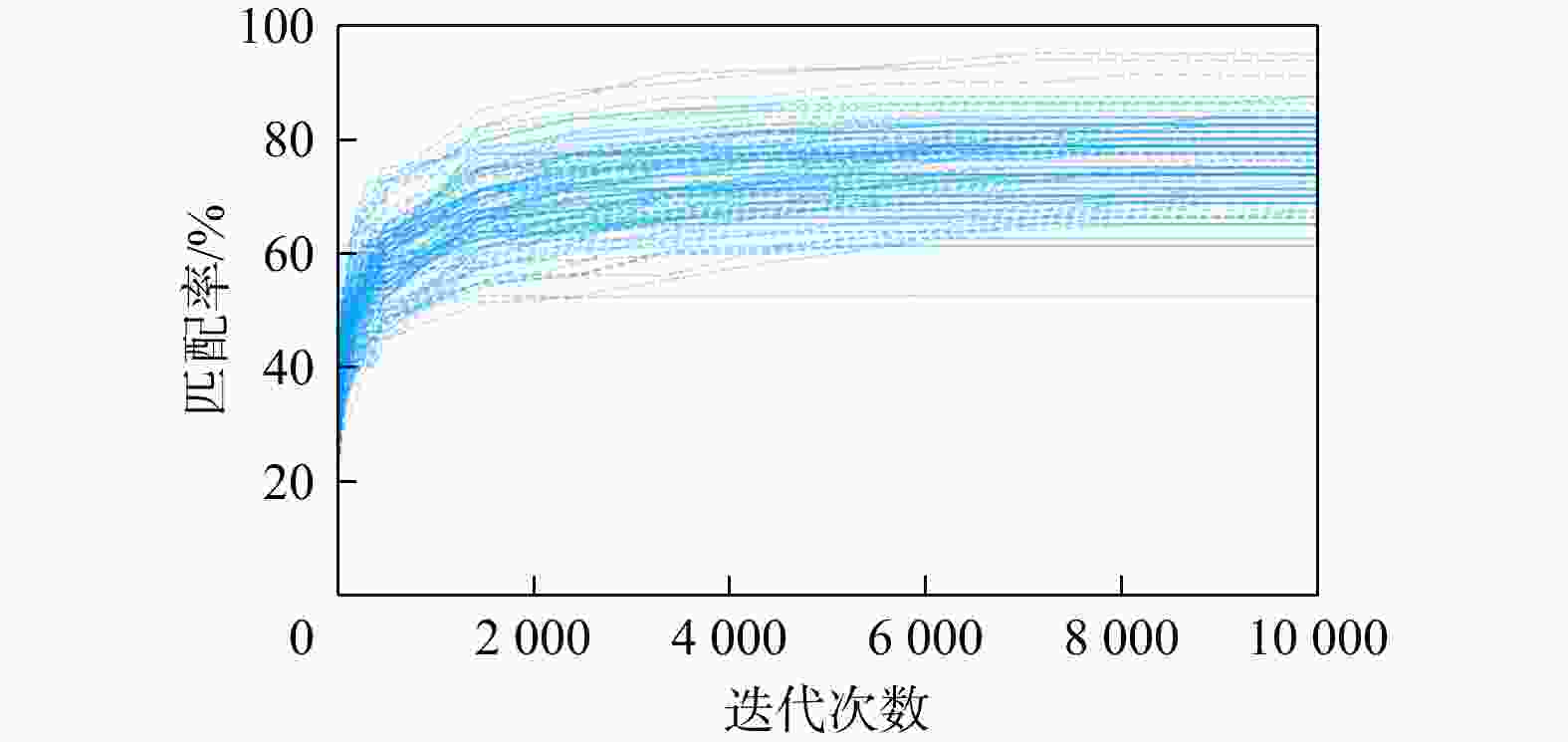
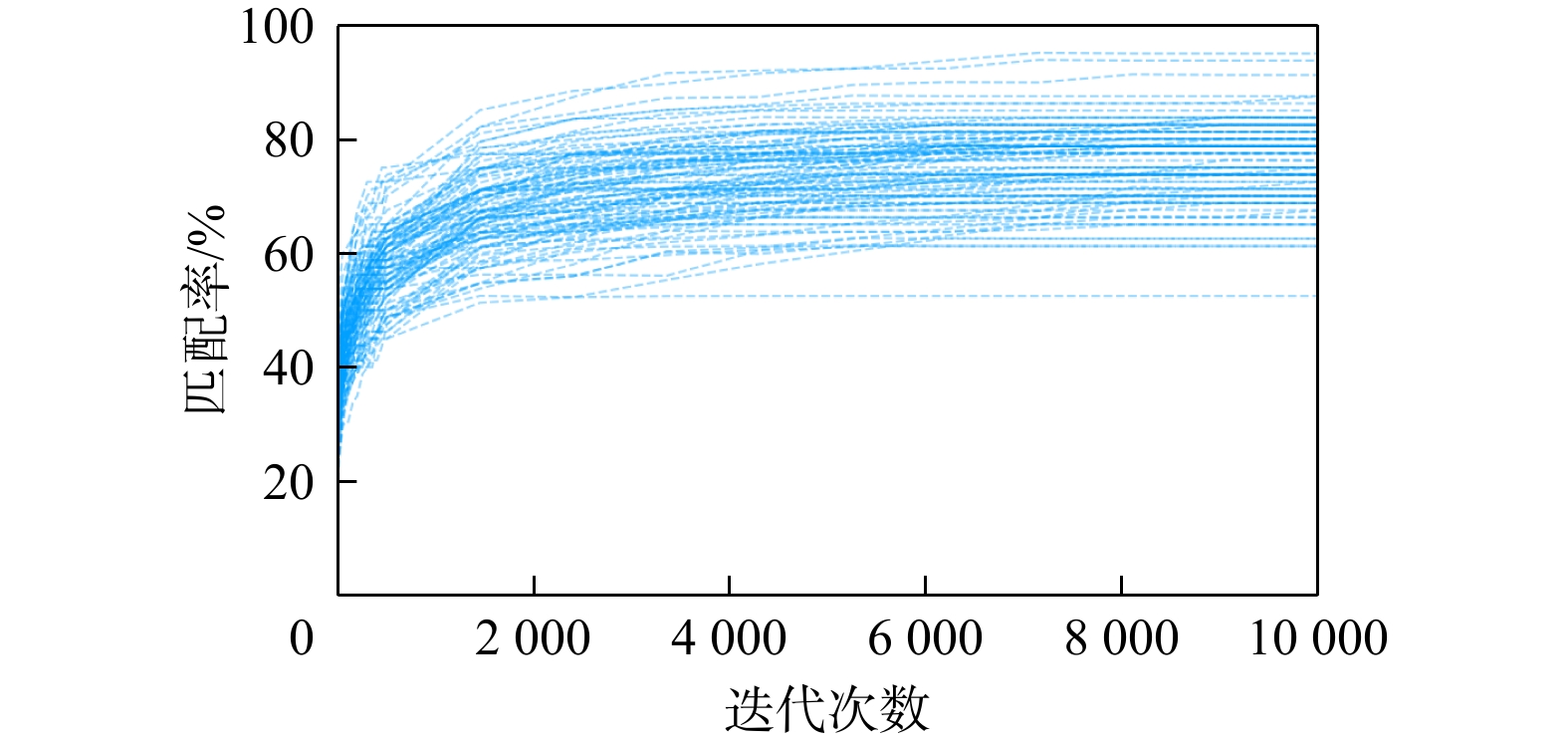
图 9 100组模拟实现的匹配率与迭代次数变化关系
Figure 9. Relationship between matching rates across 100 simulation realizations and the number of iterations

图 10 不同井密度条件下梯度下降法的砂体连通性曲线
Figure 10. Sandbody connectivity curves of gradient descent method under different well densities
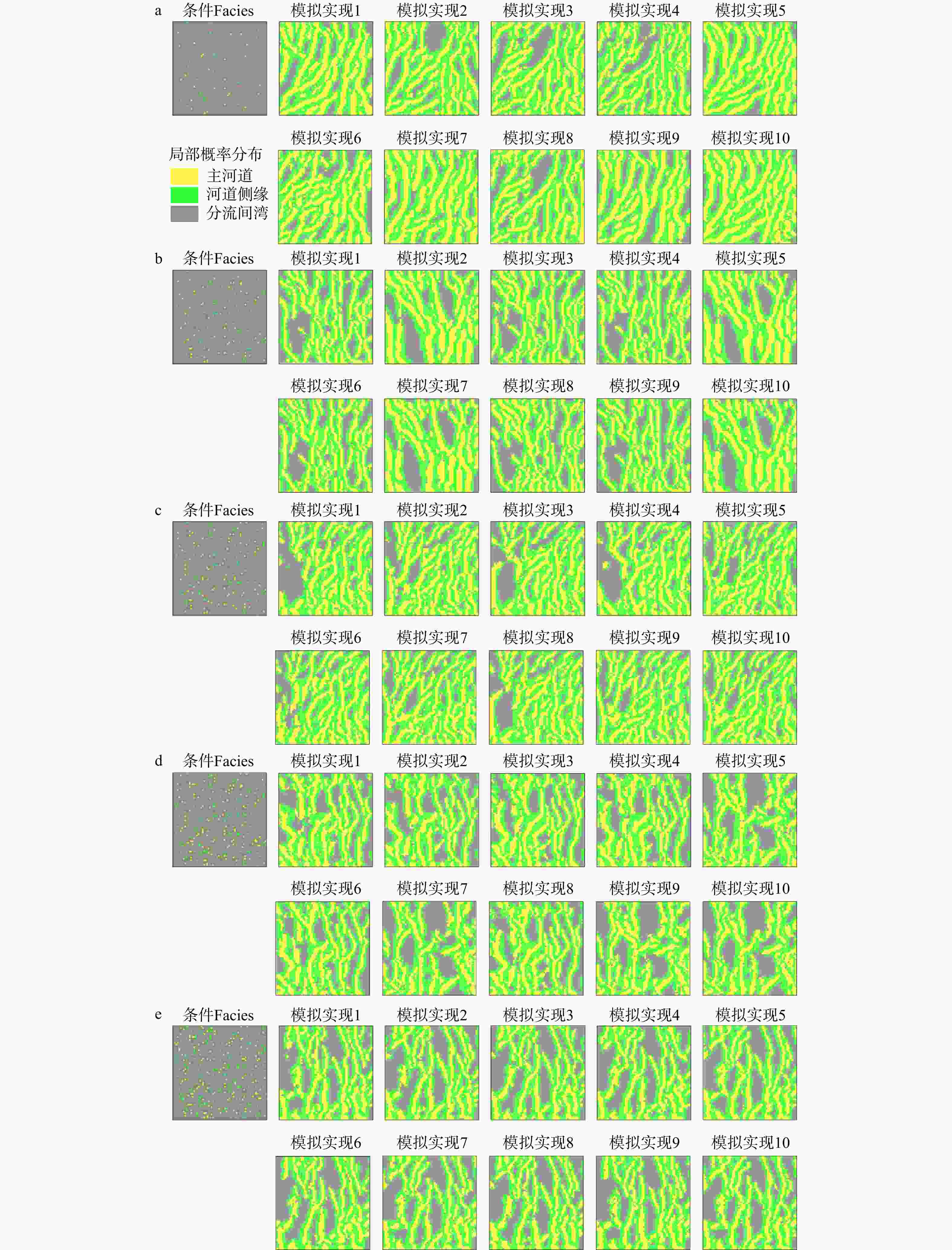
图 11 井密度为2%(a),4%(b),6%(c),8%(d)和10%(e)时神经网络映射法的10组模拟结果
Figure 11. Ten simulation realizations of neural network mapping method at well density of 2%(a), 4%(b), 6%(c), 8%(d) and 10%(e)
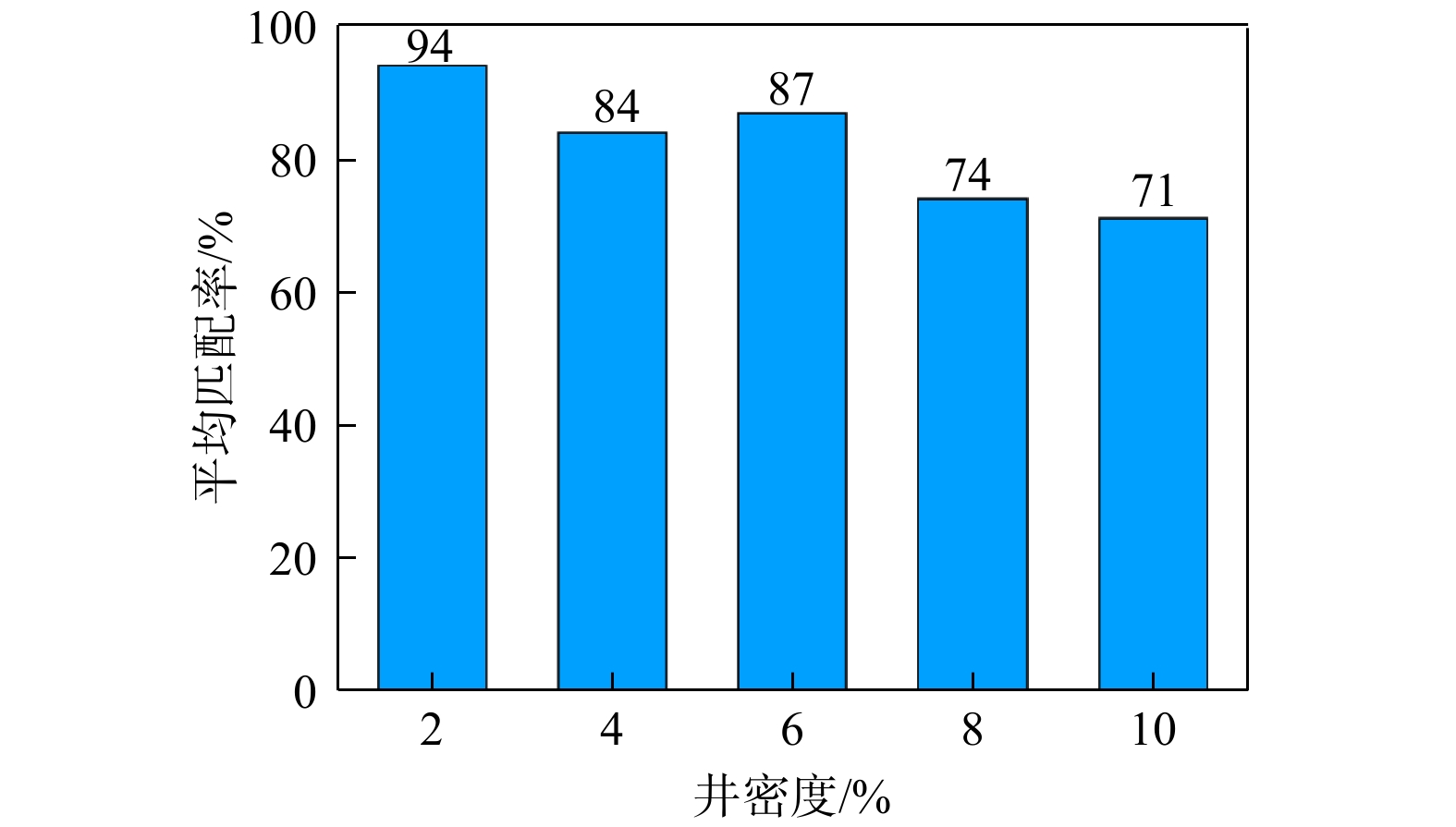
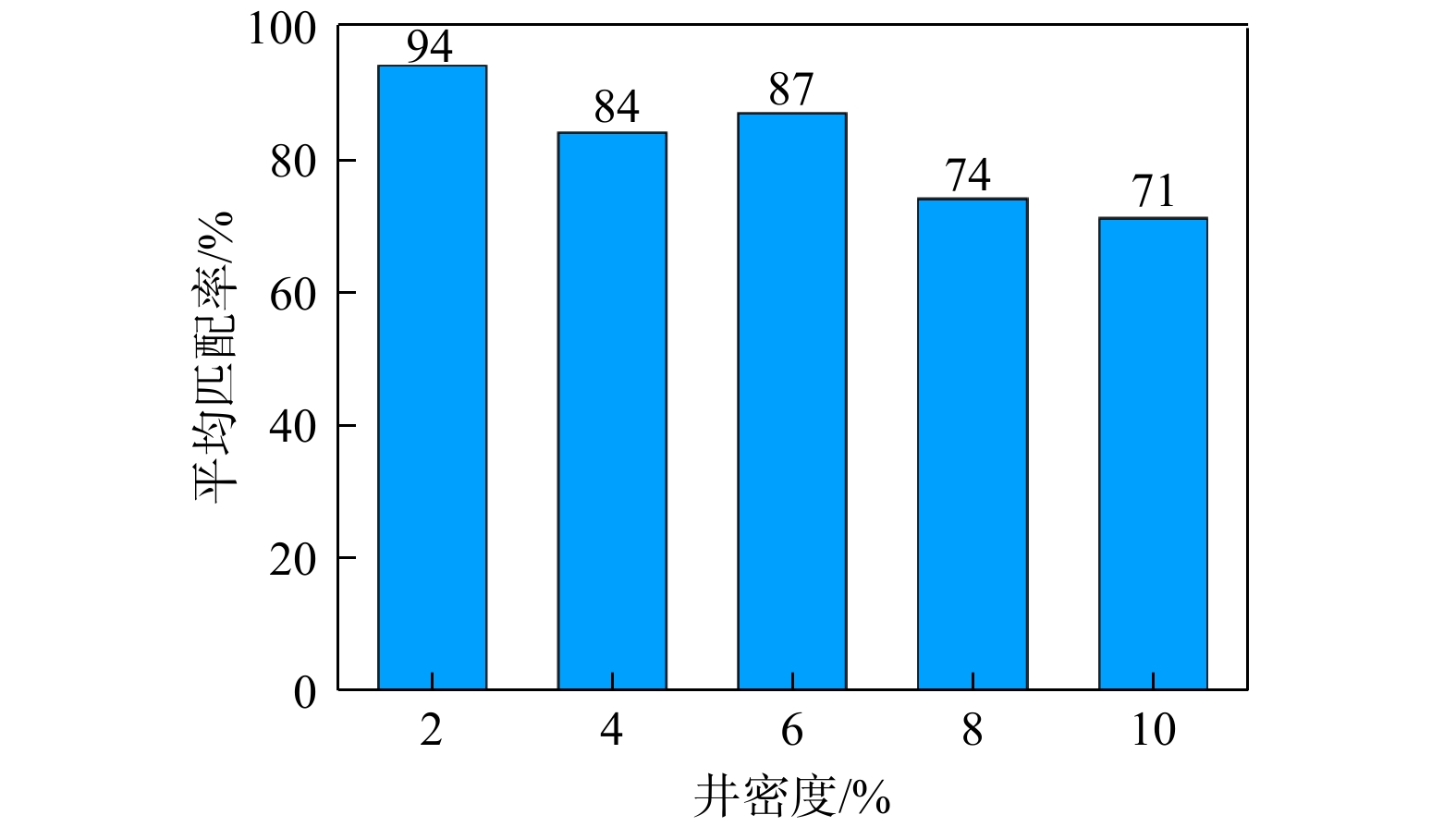
图 12 神经网络映射法的平均匹配率与井密度关系
Figure 12. Relationship between average matching rate and well density for neural network mapping method

图 13 不同井密度条件下神经网络映射法的砂体连通性曲线
Figure 13. Sandbody connectivity curves of neural network mapping method under different well densities
表 1 生成器结构
Table 1. Generator architecture
层类型 参数 激活函数 输出尺寸 输入 — — 1×1×8×8 卷积层 3×3 LReLU 1×16×8×8 卷积层 3×3 LReLU 1×16×8×8 卷积层 3×3 LReLU 1×16×8×8 卷积层 3×3 LReLU 1×16×8×8 上采样 2×scale — 1×16×16×16 卷积层 3×3 LReLU 1×16×16×16 卷积层 3×3 LReLU 1×16×16×16 卷积层 3×3 LReLU 1×16×16×16 上采样 2×scale — 1×16×32×32 卷积层 3×31 LReLU 1×16×32×32 卷积层 3×3 LReLU 1×16×32×32 卷积层 3×3 LReLU 1×16×32×32 上采样 2×scale — 1×16×64×64 卷积层 3×3 Tanh 1×1×64×64 注:2×scale为2倍尺度放大  下载: 导出CSV
表 2 判别器网络结构
Table 2. Discriminator network architecture
层类型 参数 激活函数 输出尺寸 输入 — — 1×1×64×64 卷积层 3×3 LReLU 1×16×64×64 卷积层 3×3 LReLU 1×16×64×64 卷积层 3×3 LReLU 1×16×32×32 卷积层 3×3 LReLU 1×32×32×32 卷积层 3×3 LReLU 1×32×16×16 卷积层 3×3 LReLU 1×64×16×16 卷积层 3×3 LReLU 1×64×8×8 卷积层 3×3 LReLU 1×128×8×8 卷积层 4×4 Sigmoid 1×1×1×1
下载: 导出CSV
表 3 条件模拟的训练参数表
Table 3. Training parameters for conditional simulation
训练参数 数值 条件损失函数权重 0.1,1,10,100, 1000 井密度/% 2,4,6,8,10 全局标签数量 1 训练轮次 10,20,30,60 样本数量 128 指数移动平均(EMA)衰减因子 0.999 每训练1次判别器,生成器训练次数 1 每批次数据判别器迭代几次 1 训练新层时,需要多少百分比轮次完全放弃旧层 20% 最大迭代轮数(条件损失约束法) 100 最大迭代次数(梯度下降法) 1×10⁴ 最大迭代次数(神经网络映射法) 3×10³ 学习率(判别器) 1×10⁻³ 学习率(生成器) 2×10⁻³ 学习率(梯度下降法) 1×10⁻³ 学习率(神经网络映射法) 5×10⁻⁴
下载: 导出CSV
-
[1] 贾爱林, 郭智, 郭建林, 等. 中国储层地质模型30年[J]. 石油学报, 2021, 42(11): 1506-1515.JIA A L, GUO Z, GUO J L, et al. Thirty years of reservoir geological modeling in China[J]. Acta Petrolei Sinica, 2021, 42(11): 1506-1515. (in Chinese with English abstract [2] 李宏达, 吴志春, 柏瑞, 等. 复杂脉状矿体精细化三维建模方法探讨[J]. 地质科技通报, 2025, 44(4): 379-390. doi: 10.19509/j.cnki.dzkq.tb20240050LI H D, WU Z C, BAI R, et al. Discussion on fine 3D modeling method of complex vein-type ore body[J]. Bulletin of Geological Science and Technology, 2025, 44(4): 379-390. (in Chinese with English abstract doi: 10.19509/j.cnki.dzkq.tb20240050 [3] 陈麒玉, 荀磊, 崔哲思, 等. 三维地质建模技术的最新进展和发展趋势[J]. 地质科技通报, 2025, 44(3): 373-387. doi: 10.19509/j.cnki.dzkq.tb20240284CHEN Q Y, XUN L, CUI Z S, et al. Recent progress and development trends of three-dimensional geological modeling[J]. Bulletin of Geological Science and Technology, 2025, 44(3): 373-387. (in Chinese with English abstract doi: 10.19509/j.cnki.dzkq.tb20240284 [4] 曹砚锋, 李汉兴, 黄辉, 等. 海上油田高效开发钻完井关键技术研究新进展[J]. 中国海上油气, 2022, 34(6): 124-134.CAO Y F, LI H X, HUANG H, et al. Research progress on drilling and completion technology for efficient development of offshore oilfields[J]. China Offshore Oil and Gas, 2022, 34(6): 124-134. (in Chinese with English abstract [5] 孙福街. 中国海上油田高效开发与提高采收率技术现状及展望[J]. 中国海上油气, 2023, 35(5): 91-99. doi: 10.11935/j.issn.1673-1506.2023.05.009SUN F J. Status and prospects of efficient development and EOR technologies in China offshore oilfields[J]. China Offshore Oil and Gas, 2023, 35(5): 91-99. (in Chinese with English abstract doi: 10.11935/j.issn.1673-1506.2023.05.009 [6] 丁祖鹏, 张雨晴, 王俊杰, 等. 基于自注意力机制生成对抗网络的三维储层建模方法[J]. 地质科技通报, 2025, 44(4): 391-402. doi: 10.19509/j.cnki.dzkq.tb20250109DING Z P, ZHANG Y Q, WANG J J, et al. A self-attention enhanced generative adversarial network approach for three-dimensional reservoir modeling[J]. Bulletin of Geological Science and Technology, 2025, 44(4): 391-402. (in Chinese with English abstract doi: 10.19509/j.cnki.dzkq.tb20250109 [7] 宋随宏, 史燕青, 侯加根. 基于生成对抗网络的储层地质建模方法研究进展[J]. 石油科学通报, 2022, 7(1): 34-49.SONG S H, SHI Y Q, HOU J G. Review of a generative adversarial networks(GANs)-based geomodelling method[J]. Petroleum Science Bulletin, 2022, 7(1): 34-49. (in Chinese with English abstract [8] ARJOVSKY M, CHINTALA S, BOTTOU L. Wasserstein generative adversarial networks[C]//Proceedings of the 34th International Conference on Machine Learning (ICML). Sydney: PMLR, 2017: 214-223. [9] ZHONG Z, SUN A Y, JEONG H. Predicting CO2 plume migration in heterogeneous formations using conditional deep convolutional generative adversarial network[J]. Water Resources Research, 2019, 55(7): 5830-5851. doi: 10.1029/2018WR024592 [10] AVALOS S, ORTIZ J M. Geological modeling using a recursive convolutional neural networks approach[OL]. arXiv: 1904.12190 [cs. CV]. 2019 [2026-04-20]. DOI: 10.48550/arXiv.1904.12190. [11] DRAMSCH J S. 70 years of machine learning in geoscience in review[OL]. arXiv:2006.13311 [cs.LG]. 2020 [2026-04-20]. https://arxiv.org/abs/2006.13311. [12] LALOY E, LINDE N, RUFFINO C, et al. Gradient-based deterministic inversion of geophysical data with generative adversarial networks: Is it feasible?[J]. Computers & Geosciences, 2019, 133: 104333. [13] SONG S H, ZHANG D X, MUKERJI T, et al. GANSim-surrogate: An integrated framework for stochastic conditional geomodelling[J]. Journal of Hydrology, 2023, 620: 129493. doi: 10.1016/j.jhydrol.2023.129493 [14] SONG S H, MUKERJI T, HOU J G. Bridging the gap between geophysics and geology with generative adversarial networks[J]. IEEE Transactions on Geoscience and Remote Sensing, 2022, 60: 5902411. doi: 10.31223/osf.io/ch8xf [15] MOSSER L, DUBRULE O, BLUNT M J. Stochastic seismic waveform inversion using generative adversarial networks as a geological prior[J]. Mathematical Geosciences, 2020, 52(1): 53-79. doi: 10.1007/s11004-019-09832-6 [16] SONG S H, MUKERJI T, HOU J G, et al. GANSim-3D for conditional geomodeling: Theory and field application[J]. Water Resources Research, 2022, 58(7): e2021WR031865. [17] GOODFELLOW I, POUGET-ABADIE J, MIRZA M, et al. Generative adversarial networks[J]. Communications of the ACM, 2020, 63(11): 139-144. doi: 10.1145/3422622 [18] 李逸达, 朱双, 郑贵洲. 一种基于不规则三角网的精确求交方法及三维地质建模应用[J]. 地质科技通报, 2026, 45(1): 351-359. doi: 10.19509/j.cnki.dzkq.2021.0417LI Y D, ZHU S, ZHENG G Z. An exact intersection method for triangulated irregular network and its application to 3D geological modeling[J]. Bulletin of Geological Science and Technology, 2026, 45(1): 351-359.(in Chinese with English abstract doi: 10.19509/j.cnki.dzkq.2021.0417 [19] KARRAS T, AILA T, LAINE S, et al. Progressive growing of GANs for improved quality, stability, and variation[OL]. arXiv:1710.10196 [cs.CV]. 2017 [2026-04-20]. https://arxiv.org/abs/1710.10196. [20] LIU L, MALDONADO-CRUZ E, JO H, et al. Data conditioning for subsurface models with single-image generative adversarial network (SinGAN)[J]. Mathematical Geosciences, 2025, 57(8): 1451-1470. doi: 10.1007/s11004-025-10206-4 [21] DUPONT E, ZHANG T F, TILKE P, et al. Generating realistic geology conditioned on physical measurements with generative adversarial networks[OL]. arXiv:1802.03065 [physics.geo-ph]. 2018 [2026-04-20]. https://arxiv.org/abs/1802.03065. [22] LALOY E, HÉRAULT R, JACQUES D, et al. Training-image based geostatistical inversion using a spatial generative adversarial neural network[J]. Water Resources Research, 2018, 54(1): 381-406. doi: 10.1002/2017WR022148 [23] ZHANG T F, TILKE P, DUPONT E, et al. Generating geologically realistic 3D reservoir facies models using deep learning of sedimentary architecture with generative adversarial networks[J]. Petroleum Science, 2019, 16(3): 541-549. doi: 10.1007/s12182-019-0328-4 [24] NESVOLD E, MUKERJI T. Simulation of fluvial patterns with GANs trained on a data set of satellite imagery[J]. Water Resources Research, 2021, 57(5): e2019WR025787. doi: 10.1029/2019WR025787 [25] CHAN S, ELSHEIKH A H. Parametric generation of conditional geological realizations using generative neural networks[J]. Computational Geosciences, 2019, 23(5): 925-952. doi: 10.1007/s10596-019-09850-7 [26] SONG S H, MUKERJI T, HOU J G. Geological Facies modeling based on progressive growing of generative adversarial networks (GANs)[J]. Computational Geosciences, 2021, 25(3): 1251-1273. doi: 10.1007/s10596-021-10059-w [27] 刘振峰. 致密砂岩油气藏储层建模技术方案及其应用[J]. 地球物理学进展, 2014, 29(2): 815-823. doi: 10.3969/j.issn.2095-0446.2016.10.026LIU Z F. Reservoir modeling program for tight oil & gas sands and its applications[J]. Progress in Geophysics, 2014, 29(2): 815-823. (in Chinese with English abstract doi: 10.3969/j.issn.2095-0446.2016.10.026 [28] WANG G C, LONG S X, JU Y W, et al. Application of horizontal wells in three-dimensional shale reservoir modeling: A case study of Longmaxi-Wufeng shale in Fuling gas field, Sichuan Basin[J]. AAPG Bulletin, 2018, 102(11): 2333-2354. doi: 10.1306/09241919081 [29] WANG L X, YIN Y S, ZHANG C M, et al. A MPS-based novel method of reconstructing 3D reservoir models from 2D images using seismic constraints[J]. Journal of Petroleum Science and Engineering, 2022, 209: 109974. doi: 10.1016/j.petrol.2021.109974 [30] CAUMON G, GRAY G, ANTOINE C, et al. Three-dimensional implicit stratigraphic model building from remote sensing data on tetrahedral meshes: Theory and application to a regional model of La Popa Basin, NE Mexico[J]. IEEE Transactions on Geoscience and Remote Sensing, 2013, 51(3): 1613-1621. doi: 10.1109/TGRS.2012.2207727 [31] CAUMON G, COLLON-DROUAILLET P, LE CARLIER DE VESLUD C, et al. Surface-based 3D modeling of geological structures[J]. Mathematical Geosciences, 2009, 41(8): 927-945. doi: 10.1007/s11004-009-9244-2 [32] 王清媛. 基于深度学习的沉积微相识别研究[D]. 西安: 西安石油大学, 2021.WANG Q Y. Research on sedimentary microfacies recognition based on deep learning[D]. Xi'an: Xi'an Shiyou University, 2021. (in Chinese with English abstract [33] 王海峰, 任梦怡, 李伟, 等. 复合砂体构型约束的井间连通性定量评价[J]. 中国海上油气, 2025, 37(5): 83-93. doi: 10.11935/j.issn.1673-1506.2025.05.008WANG H F, REN M Y, LI W, et al. Quantitative evaluation of inter-well connectivity constrained by compound sandbody configuration[J]. China Offshore Oil and Gas, 2025, 37(5): 83-93. (in Chinese with English abstract doi: 10.11935/j.issn.1673-1506.2025.05.008 [34] 周静萍, 李震, 吴迪, 等. 稀井网条件下基于单砂体构型的井间连通性评价[J]. 重庆科技大学学报(自然科学版), 2025, 27(2): 30-38. doi: 10.19406/j.issn.2097-4531.2025.02.004ZHOU J P, LI Z, WU D, et al. Evaluation of interwell connectivity based on sandbody configuration under the thin well pattern conditions[J]. Journal of Chongqing University of Science and Technology (Natural Science Edition), 2025, 27(2): 30-38. (in Chinese with English abstract doi: 10.19406/j.issn.2097-4531.2025.02.004 [35] 卢昌盛. 基于生成对抗网络的储层地质建模[D]. 武汉: 长江大学, 2025.LU C S. Reservoir geological modeling based on generative adversarial networks [D]. Wuhan: Yangtze University, 2025. (in Chinese with English abstract [36] STREBELLE S. Conditional simulation of complex geological structures using multiple-point statistics[J]. Mathematical Geology, 2002, 34(1): 1-21. doi: 10.1023/A:1014009426274 [37] 王立鑫, 尹艳树, 冯文杰, 等. 多点地质统计学中训练图像优选方法及其在地质建模中的应用[J]. 石油勘探与开发, 2019, 46(4): 703-709. doi: 10.11698/PED.2019.04.08WANG L X, YIN Y S, FENG W J, et al. Training image selection methods in multiple-point geostatistics and their application to geological modeling[J]. Petroleum Exploration and Development, 2019, 46(4): 703-709. (in Chinese with English abstract doi: 10.11698/PED.2019.04.08 [38] SHI C, WANG Y. Training image selection for development of subsurface geological cross-section by conditional simulations[J]. Engineering Geology, 2021, 295: 106415. doi: 10.1016/j.enggeo.2021.106415 [39] 王鸣川, 段太忠. 基于图型矢量距离的多点地质统计相建模算法[J]. 石油学报, 2018, 39(8): 916-923. doi: 10.7623/syxb201808007WANG M C, DUAN T Z. A multiple-point geostatistical facies modeling algorithm based on pattern vector distance[J]. Acta Petrolei Sinica, 2018, 39(8): 916-923. (in Chinese with English abstract doi: 10.7623/syxb201808007 [40] 喻思羽, 李少华, 段太忠, 等. 基于局部各向异性的非平稳多点地质统计学算法[J]. 物探与化探, 2017, 41(2): 262-269. doi: 10.11720/wtyht.2017.2.11YU S Y, LI S H, DUAN T Z, et al. Non-stationary multiple-point geostatistics algorithm base on local anisotropy[J]. Geophysical and Geochemical Exploration, 2017, 41(2): 262-269. (in Chinese with English abstract doi: 10.11720/wtyht.2017.2.11 [41] STREBELLE S, CAVELIUS C. Solving speed and memory issues in multiple-point statistics simulation program SNESIM[J]. Mathematical Geosciences, 2014, 46(2): 171-186. doi: 10.1007/s11004-013-9489-7 [42] ARPAT G B, CAERS J. Conditional simulation with patterns[J]. Mathematical Geology, 2007, 39(2): 177-203. doi: 10.1007/s11004-006-9075-3 -

 下载:
下载:






 点击查看大图
计量
- 文章访问数: 498
- PDF下载量: 167
- 被引次数: 0