投审稿入口


Indicators and multi-factor interaction analysis of flocculation efficiency for ultra-fine tailings with flocculant addition
-
摘要:
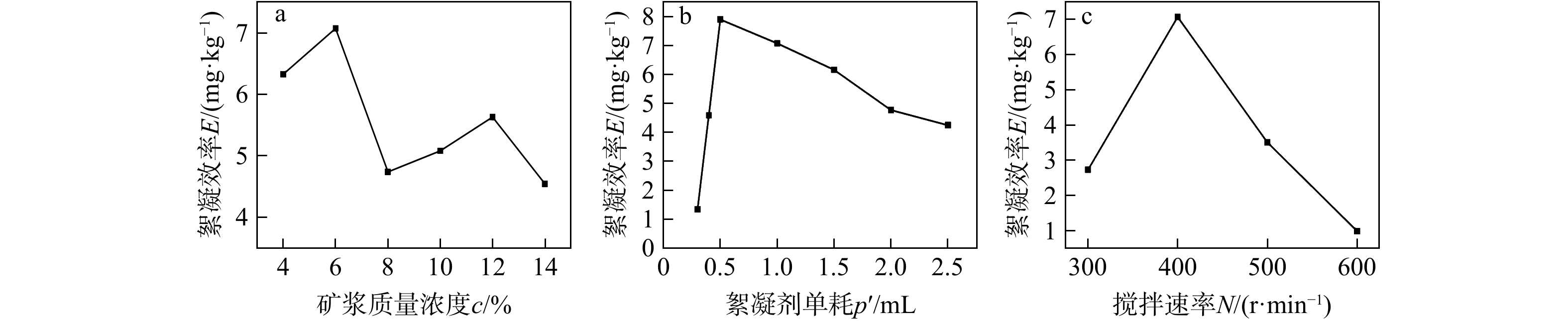
通过优化矿浆质量浓度、絮凝剂单耗和搅拌速率等参数,可提高絮凝沉降性能,解决超细尾矿在土工管袋充灌过程中存在的沉降速度慢、脱水效率低等问题,从而提高尾矿脱水后的力学强度和堆存稳定性。通过量筒沉降试验,引入“絮凝效率”作为核心评价指标,采用单因素分析法研究矿浆质量浓度、絮凝剂单耗和搅拌速率对絮凝效果的影响;基于Box-Behnken设计(BBD)进行3因素3水平响应曲面试验,利用Design-Expert软件建立絮凝效率与各因素之间的定量模型,分析多因素交互作用及其机理。单因素试验表明,矿浆质量浓度为4%~8%、絮凝剂单耗为0.5~1.5 mL、搅拌速率为300~500 r/min时絮凝效率较高;响应曲面设计优化模型的方差分析结果显示,各因素对絮凝效率的影响显著性依次为:$X_3^2 $>$X_1^2 $>$X_2 $>$X_1X_2 $>$X_1 $>$X_2^2 $>$X_3 $>$X_2X_3$(
X 1,X 2,X 3)。最优参数组合为矿浆质量浓度5.45%、絮凝剂单耗0.5 mL、搅拌速率415 r/min,此时絮凝效率预测值为8.086 %/(mg·kg−1),实测值与预测误差小于5%。本研究建立的絮凝效率模型能有效预测超细尾矿絮凝沉降性能,响应曲面法可揭示多因素交互作用机制,优化参数组合显著提升絮凝效率,为土工管袋脱水工艺提供理论依据和技术支持。-
关键词:
- 超细尾矿 /
- 沉降性能 /
- 絮凝效率 /
- 响应面设计(BBD) /
- Design-Expert软件
Abstract:ObjectiveThis study aims to enhance flocculation-sedimentation performance by optimizing parameters such as slurry mass concentration, specific flocculant consumption, and agitation rate, thereby solving problems such as slow sedimentation speed and low dewatering efficiency during the filling of geotextile tubes with ultra-fine tailings. The ultimate goal is to improve the mechanical strength and storage stability of dewatered tailings.
MethodsCylinder sedimentation tests were conducted, with "flocculation efficiency" introduced as the core evaluation indicator. Single-factor analysis was employed to investigate the effects of slurry mass concentration, specific flocculant consumption, and agitation rate on flocculation performance. A three-factor, three-level Box-Behnken design (BBD) was utilized for response surface methodology (RSM) experiments. Design-Expert software was applied to establish a quantitative model between flocculation efficiency and various factors to analyze multi-factor interactions and their underlying mechanisms.
ResultsSingle-factor tests indicated that higher flocculation efficiency was achieved within the following ranges: slurry mass concentration of 4%-8%, specific flocculant consumption of 0.5-1.5 mL, and agitation rate of 300-500 r/min. Analysis of variance of the response surface optimization model showed that the significance of factors affecting flocculation efficiency followed the order: square of agitation rate > square of slurry mass concentration > specific flocculant consumption > interaction between slurry mass concentration and specific flocculant consumption > slurry mass concentration > square of specific flocculant consumption > agitation rate > interaction between specific flocculant consumption and agitation rate > interaction between slurry mass concentration and agitation rate. The optimal parameter combination was identified as slurry mass concentration of 5.45%, specific flocculant consumption of 0.5 mL, and agitation rate of 415 r/min, yielding a predicted flocculation efficiency of 8.086 %/(mg·kg−1). The error between measured and predicted values was less than 5%.
ConclusionThe established flocculation efficiency model can effectively predict the flocculation-sedimentation performance of ultra-fine tailings. The response surface methodology can reveal the mechanisms of multi-factor interactions, and the optimized parameter combination significantly enhances flocculation efficiency. This study provides a theoretical foundation and technical support for the dewatering process of geotextile tubes.
-
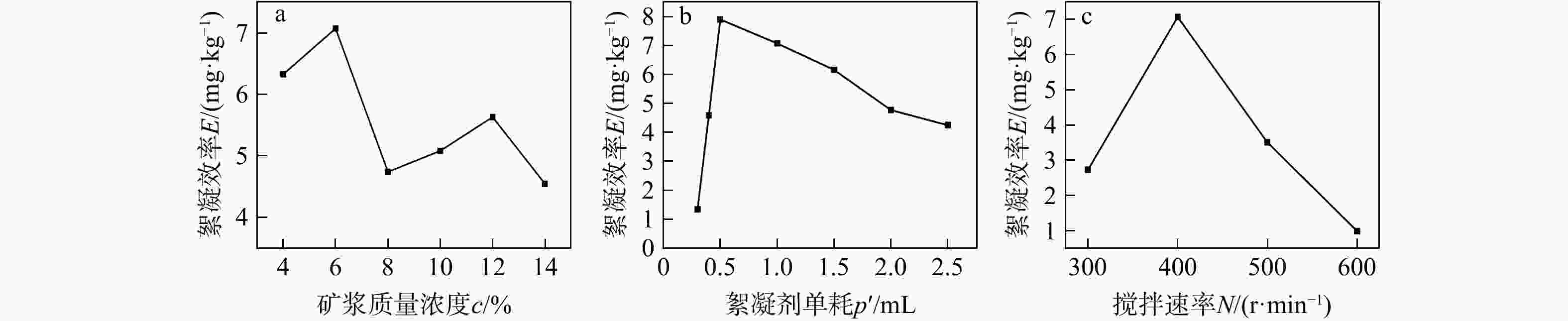
图 2 絮凝效率与矿浆质量浓度(a)、絮凝剂单耗(b)、搅拌速率(c)的关系
Figure 2. Relationship between flocculation efficiency and slurry mass concentration (a), specific flocculant consumption (b), agitation rate (c)
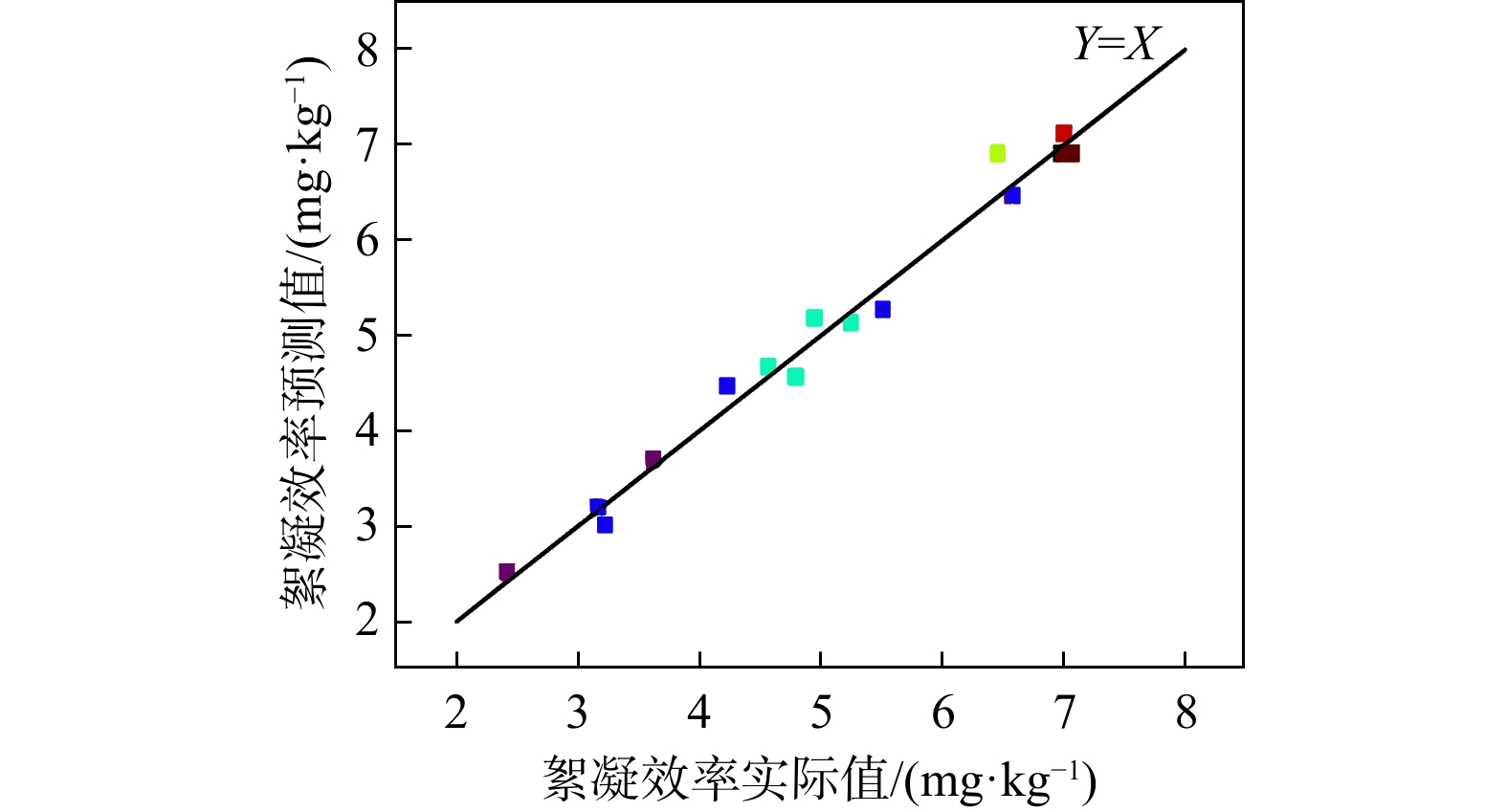
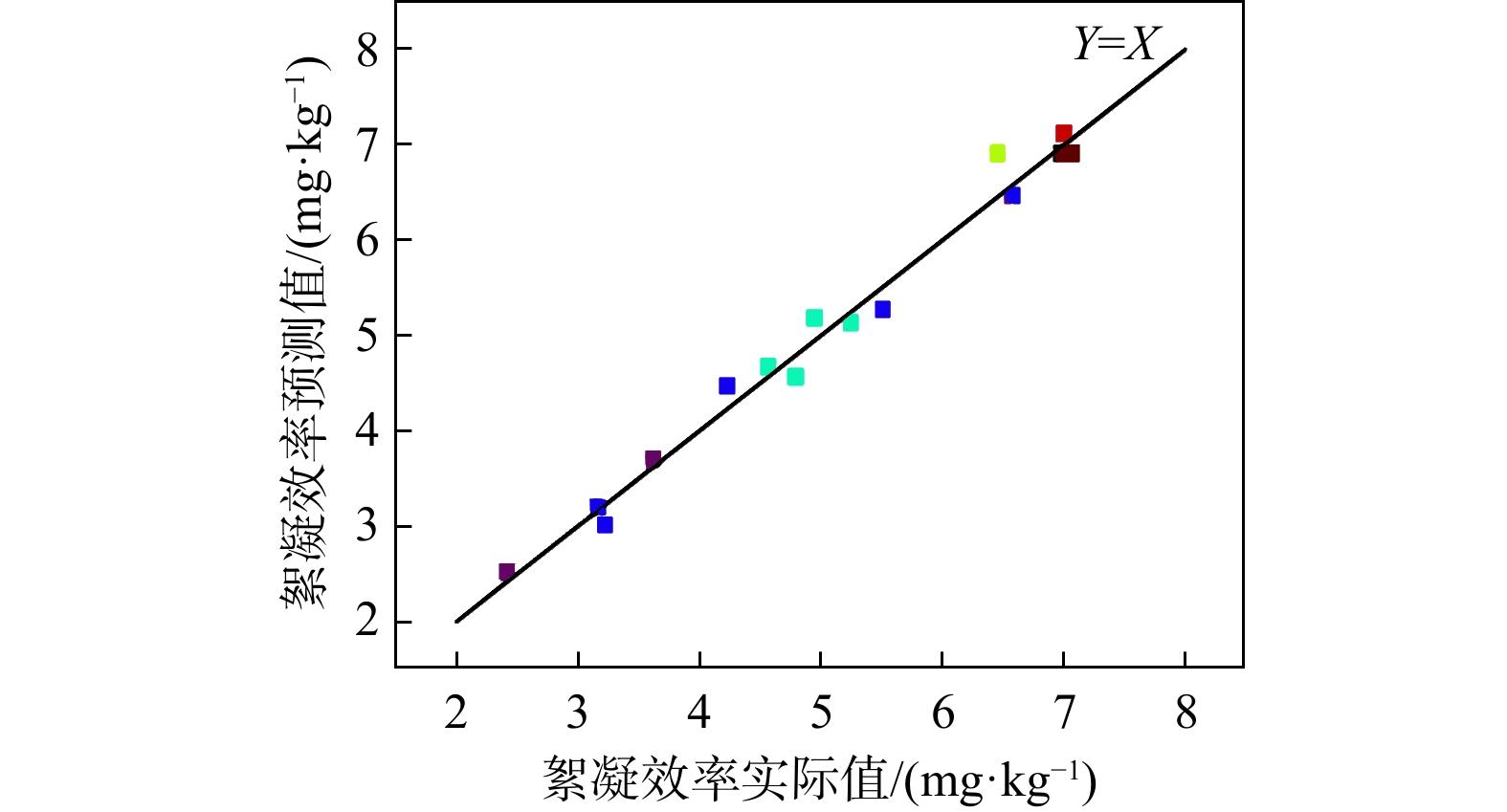
图 3 超细尾矿絮凝效率预测值与实际值关系
Figure 3. Relationship between predicted and actual flocculation efficiency of ultra-fine tailings
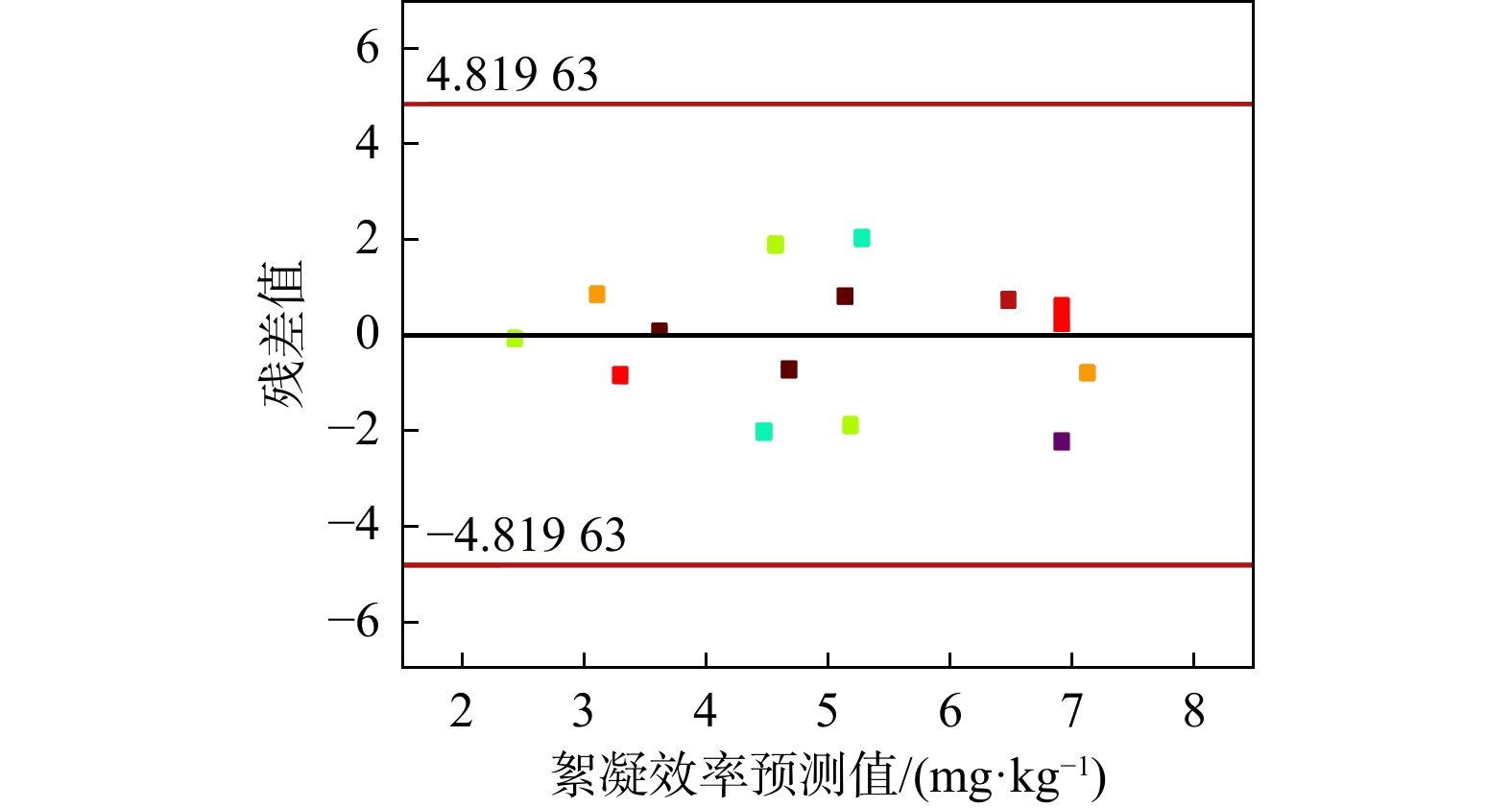
图 4 超细尾矿絮凝效率残差分布
Figure 4. Residual distribution of flocculation efficiency for ultra-fine tailings
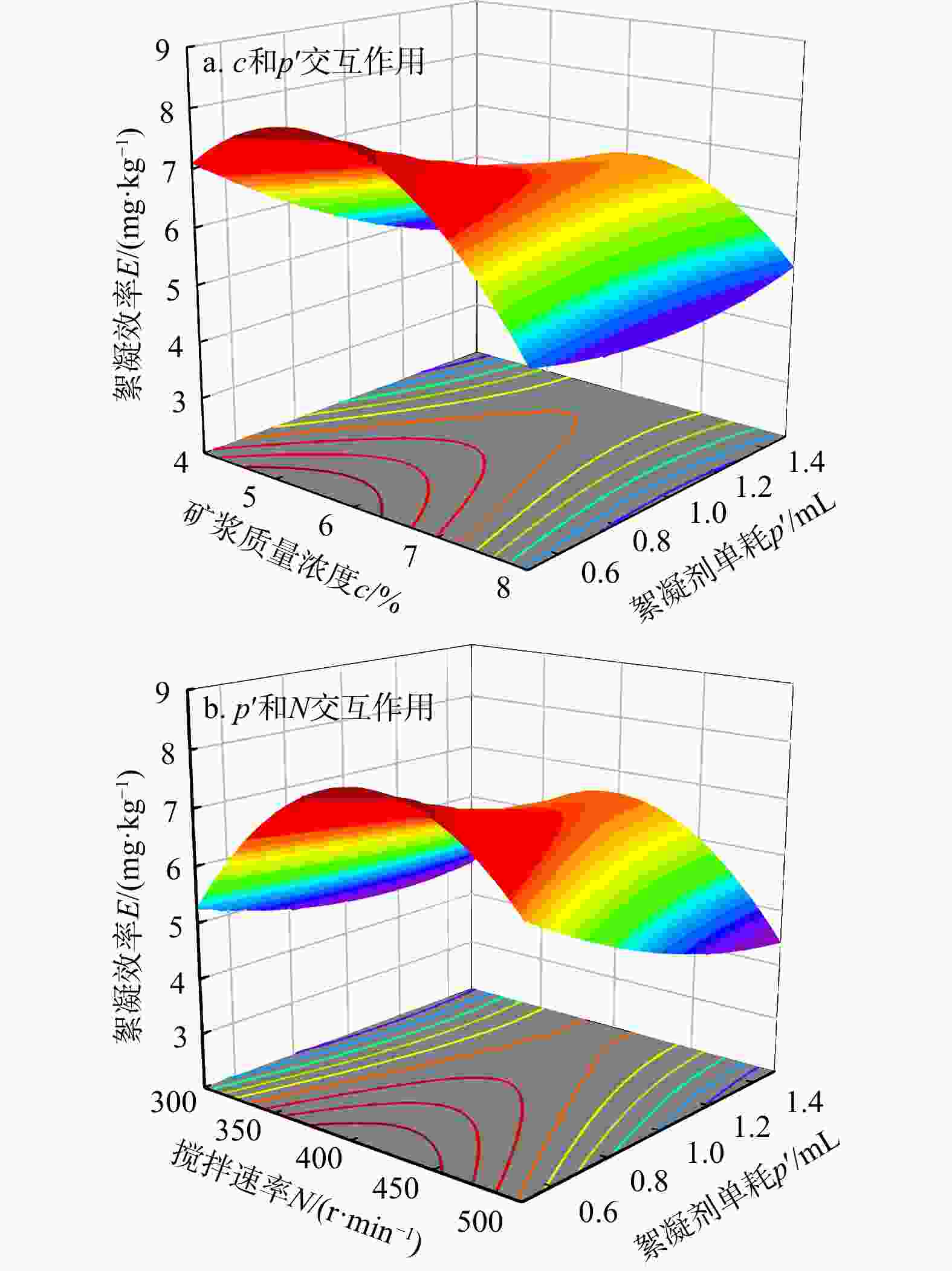
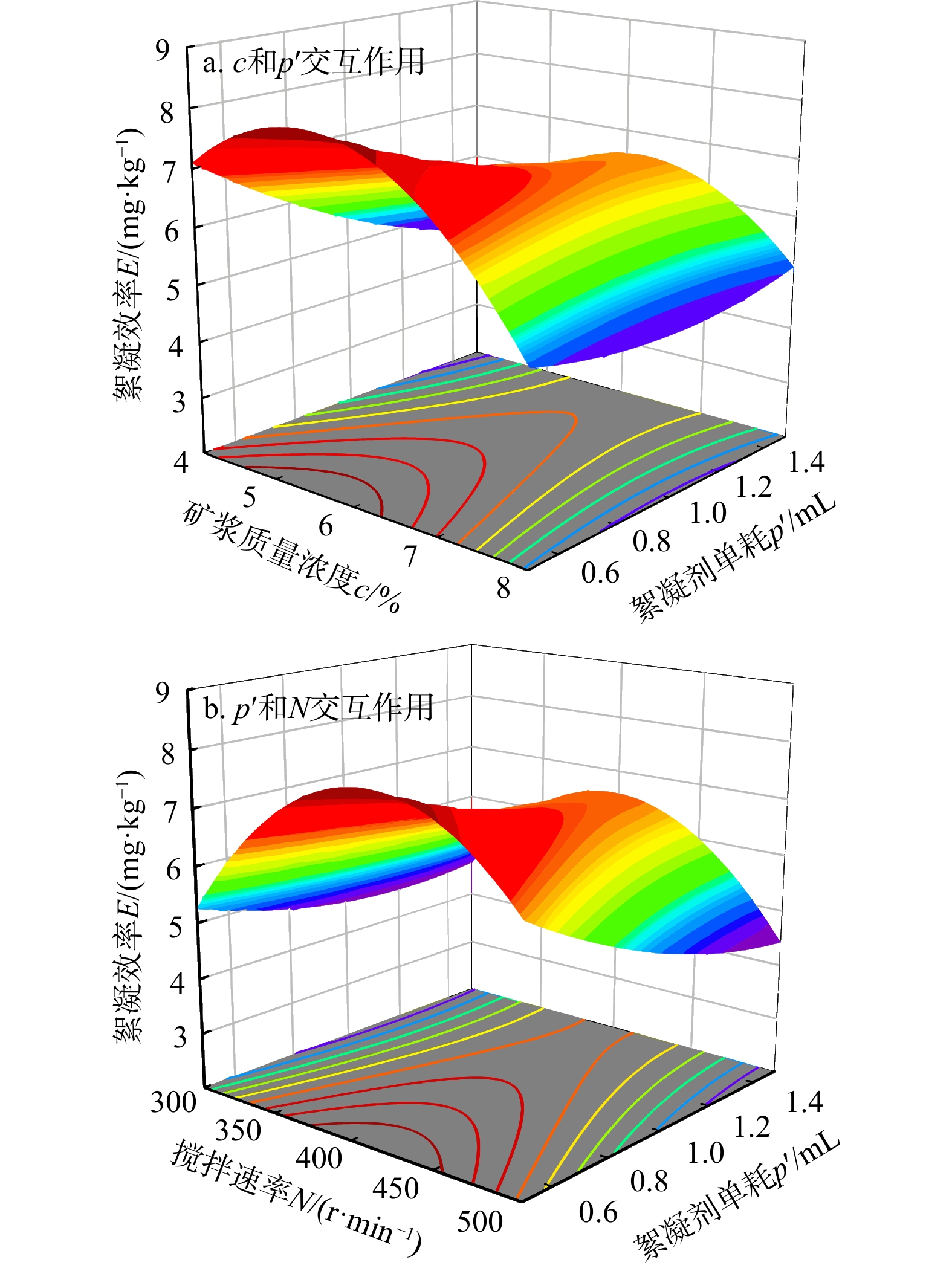
图 5 矿浆质量浓度c、絮凝剂单耗p′和搅拌速率N交互作用影响分析
Figure 5. Interaction effect analysis of slurry mass concentration c, specific flocculant consumption p′ and agitation rate N
表 1 不同矿浆质量浓度试验工况
Table 1. Test conditions at different slurry mass concentrations
类别 工况 矿浆质量
浓度c/%絮凝剂单耗p′/mL 搅拌速率
N/(r·min−1)絮凝沉降 自然沉降 不同矿浆
质量浓度1# 4 1 0 400 2# 6 1 0 400 3# 8 1 0 400 4# 10 1 0 400 5# 12 1 0 400 6# 14 1 0 400 不同絮凝剂
单耗1# 6 0.3 0 400 2# 6 0.4 0 400 3# 6 0.5 0 400 4# 6 1 0 400 5# 6 1.5 0 400 6# 6 2 0 400 7# 6 2.5 0 400 不同搅拌
速率1# 6 1 0 300 2# 6 1 0 400 3# 6 1 0 500 4# 6 1 0 600  下载: 导出CSV
表 2 响应面试验因素与水平
Table 2. Factors and levels for response surface experiments
试验因素 因素编码 因素水平 −1 0 1 矿浆质量浓度c/% X1 4 6 8 絮凝剂单耗p′/mL X2 0.5 1 1.5 搅拌速率N/(r·min−1) X3 300 400 500
下载: 导出CSV
表 3 试验方案与结果
Table 3. Experimental design and results
试验
编号试验
类型矿浆质量
浓度c/%絮凝剂
单耗p′/mL搅拌速率
N/(r·min−1)絮凝效率
E/(%/(mg·kg−1))1 因子点 4 1.0 300 3.169 2 因子点 8 1.0 500 3.225 3 因子点 4 1.5 400 4.795 4 中心点 6 1.0 400 7.067 5 中心点 6 1.0 400 6.975 6 因子点 4 1.0 500 3.622 7 因子点 8 1.0 300 2.419 8 因子点 6 1.5 300 4.567 9 中心点 6 1.0 400 6.975 10 因子点 8 0.5 400 4.949 11 因子点 6 0.5 300 5.511 12 因子点 4 0.5 400 7.001 13 中心点 6 1.0 400 7.067 14 因子点 6 1.5 500 4.231 15 因子点 8 1.5 400 5.249 16 因子点 6 0.5 500 6.576 17 中心点 6 1.0 400 6.455
下载: 导出CSV
表 4 超细尾矿絮凝沉降絮凝效率模型方差分析结果
Table 4. ANOVA results of flocculation efficiency model for ultra-fine tailings sedimentation
来源 平方和 自由度 均方差 F值 P值 模型 39.21 9 4.36 54.04 < 0.0001 X1 0.9419 1 0.9419 11.68 0.0112 X2 3.37 1 3.37 41.84 0.0003 X3 0.4940 1 0.4940 6.13 0.0425 X1X2 1.57 1 1.57 19.47 0.0031 X1X3 0.0312 1 0.0312 0.3864 0.5539 X2X3 0.4907 1 0.4907 6.09 0.0430 X12 13.06 1 13.06 161.93 < 0.0001 X22 0.5205 1 0.5205 6.46 0.0386 X32 17.49 1 17.49 216.94 < 0.0001 残差 0.5644 7 0.0806 — — 失拟 0.2996 3 0.0999 1.51 0.3410 纯误差 0.2647 4 0.0662 — — 总离差 39.78 16 — — 预测R2= 0.9858; 调整R2=0.9676; 变异系数CV=5.37%;信噪比=21.5296
下载: 导出CSV
表 5 超细尾矿沉降絮凝效率优化模型方差分析结果
Table 5. ANOVA results of optimized flocculation efficiency model for ultra-fine tailings flocculation-sedimentation
来源 平方和 自由度 均方差 F值 P值 模型 39.18 9 4.90 65.79 < 0.0001 X1 0.9419 1 0.9419 12.65 0.0074 X2 3.37 1 3.37 45.32 0.0001 X3 0.4940 1 0.4940 6.64 0.0328 X1X2 1.57 1 1.57 21.09 0.0018 X2X3 0.4907 1 0.4907 6.59 0.0333 X12 13.06 1 13.06 175.39 < 0.0001 X22 0.5205 1 0.5205 6.99 0.0295 X32 17.49 1 17.49 234.96 < 0.0001 残差 0.5955 8 0.0744 — — 失拟 0.3308 3 0.0827 1.25 0.3410 纯误差 0.2647 4 0.0662 — — 总离差 39.78 16 — — 预测R2= 0.9858; 调整R2=0.9701;变异系数 CV=5.16%;信噪比=23.1735
下载: 导出CSV
表 6 絮凝效率预测值与实测值
Table 6. Predicted and measured flocculation efficiency
数据类型 矿浆质量
浓度c/%絮凝剂
单耗p′/mL搅拌速率
N(r·min−1)絮凝效率
E/(%/mg·kg−1)预测值 5.45 0.5 415 8.086 实测值1 5.45 0.5 415 7.998 实测值2 5.45 0.5 415 8.100 实测值3 5.45 0.5 415 8.128
下载: 导出CSV
-
[1] 蔡路, 唐龙, 周东东, 等. 贵州省清镇市小院铝土矿地质特征、古地貌及其与铝土矿分布的关系[J]. 地质科技通报, 2025, 44(6): 50-60. doi: 10.19509/j.cnki.dzkq.tb20240016CAI L, TANG L, ZHOU D D, et al. Geological characteristics, paleolandforms, and their relationship with bauxite distribution in the Xiaoyuan bauxite mine, Qingzhen City, Guizhou Province[J]. Bulletin of Geological Science and Technology, 2025, 44(6): 50-60. (in Chinese with English abstract) doi: 10.19509/j.cnki.dzkq.tb20240016 [2] 傅渊慧, 张丹, 肖晓, 等. 尾矿库在线监测与安全管理研究与应用[J]. 中国设备工程, 2025(18): 191-193. doi: 10.3969/j.issn.1671-0711.2025.18.081FU Y H, ZHANG D, XIAO X, et al. Research and application of online monitoring and safety management for tailings ponds[J]. China Plant Engineering, 2025(18): 191-193. (in Chinese with English abstract) doi: 10.3969/j.issn.1671-0711.2025.18.081 [3] 吴爱祥, 杨盛凯, 王洪江, 等. 超细全尾膏体处置技术现状与趋势[J]. 采矿技术, 2011, 11(3): 4-8. doi: 10.3969/j.issn.1671-2900.2011.03.002WU A X, YANG S K, WANG H J, et al. Current situation and trend of ultrafine full-tail paste treatment technology[J]. Mining Technology, 2011, 11(3): 4-8. (in Chinese with English abstract) doi: 10.3969/j.issn.1671-2900.2011.03.002 [4] XU G Z, QIU C C, SONG M M, et al. Flocculant effects on fluidity and strength behavior of cemented dredged clay with high water content[J]. Marine Georesources & Geotechnology, 2021, 39(8): 951-961. doi: 10.1080/1064119X.2020.1786198 [5] 张锦峰, 宋志飞, 耿闻泽. 我国尾矿库数量事故统计分析和防范[J]. 现代矿业, 2023, 39(3): 6-9. doi: 10.3969/j.issn.1674-6082.2023.03.002ZHANG J F, SONG Z F, GENG W Z. Statistical analysis and prevention of the tailings pond quantity accidents in China[J]. Modern Mining, 2023, 39(3): 6-9. (in Chinese with English abstract) doi: 10.3969/j.issn.1674-6082.2023.03.002 [6] 常广品, 束一鸣, 尹家春, 等. 管袋充填高含粘量泥浆的高效脱水方法[J]. 水电能源科学, 2014, 32(3): 129-133. doi: 10.20040/j.cnki.1000-7709.2014.03.031CHANG G P, SHU Y M, YIN J C, et al. Efficient dehydration method of geotube filled high adhesive content mud[J]. Water Resources and Power, 2014, 32(3): 129-133. (in Chinese with English abstract) doi: 10.20040/j.cnki.1000-7709.2014.03.031 [7] 范海文, 杨晓松, 张金刚, 等. 土工合成材料在昌邑匡围工程建设中的应用[J]. 中国水运(下半月), 2022, 22(3): 130-132.FAN H W, YANG X S, ZHANG J G, et al. Application of geosynthetic materials in the construction of Changyi enclosure project[J]. China Water Transport (Second Half of the Month), 2022, 22(3): 130-132. (in Chinese with English abstract) [8] 韩亚兵, 崔旋, 郄永波. 基于不同模袋材质的细粒分级尾矿模袋堆坝工业试验研究[J]. 有色金属(矿山部分), 2019, 71(4): 41-46. doi: 10.3969/j.issn.1671-4172.2019.04.009HAN Y B, CUI X, XIE Y B. Industrial experimental research on fine-grained graded tailings bagged dam based on different bagged materials[J]. Nonferrous Metals (Mining Section), 2019, 71(4): 41-46. (in Chinese with English abstract) doi: 10.3969/j.issn.1671-4172.2019.04.009 [9] LEE C S, ROBINSON J, CHONG M F. A review on application of flocculants in wastewater treatment[J]. Process Safety and Environmental Protection, 2014, 92(6): 489-508. doi: 10.1016/j.psep.2014.04.010 [10] 胡智锋, 彭振华, 徐灏龙. 新型有机高分子絮凝剂的合成及在造纸废水处理中的应用[J]. 中国造纸, 2009, 28(8): 36-38. doi: 10.3969/j.issn.0254-508X.2011.z1.010HU Z F, PENG Z H, XU H L. Synthesis of new organic polymer flocculant and its application in papermaking wastewater treatment[J]. China Pulp & Paper, 2009, 28(8): 36-38. (in Chinese with English abstract) doi: 10.3969/j.issn.0254-508X.2011.z1.010 [11] 罗倩. 不同絮凝剂对长江疏浚淤泥的絮凝试验研究[J]. 中国水运, 2023(9): 94-96. doi: 10.13646/j.cnki.42-1395/u.2023.05.033LUO Q. Experimental study on flocculation of dredged silt from the Yangtze River using different flocculants[J]. China Water Transport, 2023(9): 94-96. (in Chinese with English abstract) doi: 10.13646/j.cnki.42-1395/u.2023.05.033 [12] 王东星, 唐弈锴, 伍林峰. 疏浚淤泥化学絮凝−真空预压深度脱水效果评价[J]. 岩土力学, 2020, 41(12): 3929-3938. doi: 10.16285/j.rsm.2020.0391WANG D X, TANG Y K, WU L F. Evaluation of deep dewatering effect of dredged sludge by chemical flocculation combined with vacuum preloading[J]. Rock and Soil Mechanics, 2020, 41(12): 3929-3938. (in Chinese with English abstract) doi: 10.16285/j.rsm.2020.0391 [13] 吴敏, 黄英豪, 董仕骏, 等. 高分子絮凝剂对淤泥板框压滤脱水效果及影响机理[J]. 岩土工程学报, 2025, 47(3): 470-476. (in Chinese with English abstract doi: 10.11779/CJGE20231212WU M, HUANG Y H, DONG S J, et al. Effects of polymer flocculant on dredged sediment by plate and frame filter press dewatering technology and its influence mechanism[J]. Chinese Journal of Geotechnical Engineering, 2025, 47(3): 470-476. (in Chinese with English abstract) doi: 10.11779/CJGE20231212 [14] 赵森, 曾芳金, 王军, 等. 絮凝−真空预压加固吹填淤泥试验研究[J]. 岩石力学与工程学报, 2016, 35(6): 1291-1296.ZHAO S, ZENG F J, WANG J, et al. Experimental study on reinforcement of dredged fill sludge by flocculation-vacuum preloading[J]. Chinese Journal of Rock Mechanics and Engineering, 2016, 35(6): 1291-1296. (in Chinese with English abstract) [15] 邹建. 复合絮凝剂对真空预压加固吹填淤泥土影响研究[D]. 江西赣州: 江西理工大学, 2016.ZOU J. Experimental study on composite flocculants combined with vaccum preloading to reinforce dredged fill[D]. Ganzhou Jiaangxi: Jiangxi University of Science and Technology, 2016. (in Chinese with English abstract) [16] 孙军波, 朱建文, 胡惠宁, 等. CPAM对河道泥水混合物的絮凝效果研究[J]. 中国给水排水, 2021, 37(11): 84-88. doi: 10.19853/j.zgjsps.1000-4602.2021.11.014SUN J B, ZHU J W, HU H N, et al. Study on the flocculation effect of CPAM on river sludge-water mixture[J]. China Water & Wastewater, 2021, 37(11): 84-88. (in Chinese with English abstract) doi: 10.19853/j.zgjsps.1000-4602.2021.11.014 [17] 吴敏, 黄英豪, 尹洪斌, 等. 典型无机絮凝剂对疏浚淤泥絮凝效果及出水水质影响研究[J]. 岩土工程学报, 2023, 45(增刊1): 79-83. doi: 10.11779/CJGE2023S10021WU M, HUANG Y H, YIN H B, et al. Influences of typical inorganic flocculants on flocculation effects of dredging materials and quality of effluent water[J]. Chinese Journal of Geotechnical Engineering, 2023, 45(S1): 79-83. (in Chinese with English abstract) doi: 10.11779/CJGE2023S10021 [18] 张伟. 絮凝剂提高疏浚泥浆泥水分离性能研究[D]. 合肥: 合肥工业大学, 2018.ZHANG W. Research on improving the separation property of dredged sludge by flocculants[D]. Hefei: Hefei University of Technology, 2018. (in Chinese with English abstract) [19] YIN S H, HOU Y Q, YANG S X, et al. Study on static and dynamic flocculation settlement characteristics of fine tailings slurry and influence of flocculant on strength of fine tailings backfill[J]. Case Studies in Construction Materials, 2022, 17: e01525. doi: 10.1016/j.cscm.2022.e01525 [20] 卞继伟, 王新民, 肖崇春. 全尾砂动态絮凝沉降试验研究[J]. 中南大学学报(自然科学版), 2017, 48(12): 3278-3283. doi: 10.11817/j.issn.1672-7207.2017.12.019BIAN J W, WANG X M, XIAO C C. Experimental study on dynamic flocculating sedimentation of unclassified tailings[J]. Journal of Central South University (Science and Technology), 2017, 48(12): 3278-3283. (in Chinese with English abstract) doi: 10.11817/j.issn.1672-7207.2017.12.019 [21] SADANGI J K, SAHOO A K, SUSHOBHAN B R, et al. Effect of anionic flocculant on settling rate of iron ore ultra-fines[J]. Materials Today: Proceedings, 2020, 30: 316-321. [22] KARADOĞAN Ü, KORKUT S, ÇEVIKBILEN G, et al. Evaluation of beneficial of polyacrylamide use dewatering of dredged sludge obtained from golden horn[J]. Marine Georesources & Geotechnology, 2021, 39(8): 919-928. doi: 10.1080/1064119X.2020.1780526 [23] 程昊, 陈辉, 张抒, 等. 基于响应面试验设计的深基坑降水开挖地表沉降特性[J]. 地质科技通报, 2024, 43(5): 181-196. doi: 10.19509/j.cnki.dzkq.tb20230294CHENG H, CHEN H, ZHANG S, et al. Investigations into ground surface settlement characteristics of excavation under dewatering and excavating conditions using the response surface ex-perimental design method[J]. Bulletin of Geological Science and Technology, 2024, 43(5): 181-196. (in Chinese with English abstract) doi: 10.19509/j.cnki.dzkq.tb20230294 [24] 温震江, 杨晓炳, 李立涛, 等. 基于RSM-BBD的全尾砂浆絮凝沉降参数选择及优化[J]. 中国有色金属学报, 2020, 30(6): 1437-1445. doi: 10.11817/j.ysxb.1004.0609.2020-36421WEN Z J, YANG X B, LI L T, et al. Selection and optimization of flocculation sedimentation parameters of unclassified tailings slurry based on RSM-BBD[J]. The Chinese Journal of Nonferrous Metals, 2020, 30(6): 1437-1445. (in Chinese with English abstract) doi: 10.11817/j.ysxb.1004.0609.2020-36421 [25] 牛福生, 武佳慧, 于晓东, 等. 响应曲面法优化细粒铁尾矿浆絮凝沉降试验研究[J]. 矿冶工程, 2023, 43(3): 47-51. doi: 10.3969/j.issn.0253-6099.2023.03.011NIU F S, WU J H, YU X D, et al. Optimization of flocculation settlement parameters of fine iron tailings slurry by response surface methodology[J]. Mining and Metallurgical Engineering, 2023, 43(3): 47-51. (in Chinese with English abstract) doi: 10.3969/j.issn.0253-6099.2023.03.011 [26] LI S, WANG X M, ZHANG Q L. Dynamic experiments on flocculation and sedimentation of argillized ultrafine tailings using fly-ash-based magnetic coagulant[J]. Transactions of Nonferrous Metals Society of China, 2016, 26(7): 1975-1984. doi: 10.1016/S1003-6326(16)64308-X [27] 冯冶, 张兴华, 常丹. 离子剂−无机材料固化盐渍土的直剪力学特性与离散元数值模拟[J]. 地质科技通报, 2026, 45(5): 182-194. doi: 10.19509/j.cnki.dzkq.tb20250256FENG Y, ZHANG X H, CHANG D. Direct shear mechanical properties and discrete element numerical simulation of saline soil stabilized with ionic additives and inorganic materials[J]. Bulletin of Geological Science and Technology, 2026, 45(5): 182-194. (in Chinese with English abstract) doi: 10.19509/j.cnki.dzkq.tb20250256 [28] 朱世彬, 王晓东, 武博强, 等. 煤矸石地质聚合物骨料浆液力学与输送特性分析[J]. 水文地质工程地质, 2025, 52(4): 62-74. doi: 10.16030/j.cnki.issn.1000-3665.202502037ZHU S B, WANG X D, WU B Q, et al. Mechanical and transportation characteristics of gangue geopolymer aggregate slurry[J]. Hydrogeology & Engineering Geology, 2025, 52(4): 62-74. (in Chinese with English abstract) doi: 10.16030/j.cnki.issn.1000-3665.202502037 [29] HAN M M, DONG Y H, DONG L H, et al. Characteristics and functionality of high efficiency composite microbial flocculant (EPC-7) for the treatment of black smelly river wastewater[J]. Journal of Water Process Engineering, 2023, 54: 103952. doi: 10.1016/j.jwpe.2023.103952 [30] LEE K E, NORHASHIMAH M, TOW T T. Development, characterization and the application of hybrid materials in coagulation/flocculation of wastewater: A review[J]. Chemical Engineering Journal, 2012, 203(01): 370-386. doi: 10.1016/j.cej.2012.06.109 [31] RAN F Y, WU S Q, ZHENG X Y, et al. Impact of flocculant compounding on dewatering of river sludge with high water content via flocculation, filter-pressing, and electro-osmotic coupled process[J]. Journal of Environmental Chemical Engineering, 2025, 13(1): 115390. doi: 10.1016/j.jece.2025.115390 [32] XIE Y, YIN W Z, YAO J, et al. Application and mechanism of an efficient hydrophobic flocculant CPAM in the flocculation reverse flotation of hematite and microfine-grained chlorite[J]. Journal of Environmental Chemical Engineering, 2024, 12(3): 112608. doi: 10.1016/j.jece.2024.112608 [33] ZHA X, YU Y R, HUANG Y. Structure-activity relationships of a novel coarse flocculant for organic carbon capture in municipal wastewater[J]. Environmental Technology & Innovation, 2025, 37: 104007. doi: 10.1016/j.eti.2024.104007 [34] 李海霞, 田玥, 解静静, 等. 污水处理中常用絮凝剂综述[J]. 化工设计通讯, 2023, 49(9): 38-40. doi: 10.3969/j.issn.1003-6490.2023.09.014LI H X, TIAN Y, XIE J J, et al. Overview of commonly used flocculants in sewage treatment[J]. Chemical Engineering Design Communications, 2023, 49(9): 38-40. (in Chinese with English abstract) doi: 10.3969/j.issn.1003-6490.2023.09.014 [35] 朱进. 浅谈絮凝剂在污水处理中的应用[J]. 山西化工, 2019, 39(6): 161-163. doi: 10.16525/j.cnki.cn14-1109/tq.2019.06.60ZHU J. Application of flocculant in sewage treatment[J]. Shanxi Chemical Industry, 2019, 39(6): 161-163. (in Chinese with English abstract) doi: 10.16525/j.cnki.cn14-1109/tq.2019.06.60 [36] 李晓旭, 段冲. 有机高分子絮凝剂在处理炼油废水中的应用[J]. 当代化工研究, 2018(4): 30-31. doi: 10.3969/j.issn.1672-8114.2018.04.020LI X X, DUAN C. The application of organic polymer flocculant in the treatment of refinery wastewater[J]. Modern Chemical Research, 2018(4): 30-31. (in Chinese with English abstract) doi: 10.3969/j.issn.1672-8114.2018.04.020 [37] 王瑞, 许婷婷, 张逸飞. 絮凝剂在水处理中的应用与研究进展[J]. 节能与环保, 2020(4): 91-92. doi: 10.3969/j.issn.1009-539X.2020.04.039WANG R, XU T T, ZHANG Y F. Application and research progress of flocculant in water treatment[J]. Energy Conservation and Environmental Protection, 2020(4): 91-92. (in Chinese with English abstract) doi: 10.3969/j.issn.1009-539X.2020.04.039 [38] 姜金国. 高效有机絮凝剂合成机理及其水处理中的应用研究[J]. 山东化工, 2023, 52(14): 253-255. doi: 10.3969/j.issn.1008-021X.2023.14.069JIANG J G. Study on synthesis mechanism of high-efficiency organic flocculants and their application in water treatment[J]. Shandong Chemical Industry, 2023, 52(14): 253-255. (in Chinese with English abstract) doi: 10.3969/j.issn.1008-021X.2023.14.069 [39] CHENG Y C, WANG C P, LIU K Y, et al. Towards sustainable management of polyacrylamide in soil-water environment: Occurrence, degradation, and risk[J]. Science of the Total Environment, 2024, 926: 171587. doi: 10.1016/j.scitotenv.2024.171587 [40] 刘丰畅, 龚文静, 吉晓鹏, 等. 不同絮凝剂对污水中无机砂的去除效能研究[J]. 应用化工, 2024, 53(11): 2684-2689. doi: 10.3969/j.issn.1671-3206.2024.11.030LIU F C, GONG W J, JI X P, et al. Study on the removal efficiency of different flocculants on sand-containing wastewater[J]. Applied Chemical Industry, 2024, 53(11): 2684-2689. (in Chinese with English abstract) doi: 10.3969/j.issn.1671-3206.2024.11.030 [41] LIU R Y, YUAN J L, HUANG L, et al. Synergistic enhancement of coal slurry water sedimentation and dehydration process using PDMDAAC/PAM[J]. Journal of Cleaner Production, 2024, 434: 140160. doi: 10.1016/j.jclepro.2023.140160 [42] LI L, PENG C, DENG L, et al. Understanding the synergistic mechanism of PAM-FeCl3 for improved sludge dewaterability[J]. Journal of Environmental Management, 2022, 301: 113926. [43] KYNCH G J. A theory of sedimentation[J]. Transactions of the Faraday Society, 1952, 48: 166-176. [44] JENSEN W A. Response surface methodology: Process and product optimization using designed experiments 4th edition[J]. Journal of Quality Technology, 2017, 49(2): 186-188. doi: 10.1080/00224065.2017.11917988 -

 下载:


 点击查看大图
计量
- 文章访问数: 282
- PDF下载量: 24
- 被引次数: 0