投审稿入口


Miocene paleoclimate, paleoenvironmental characteristics, and lake basin ecological environment evolution in Qaidam Basin
-
摘要:
柴达木盆地作为青藏高原东北部新生代规模最大的陆相山间盆地,其中新世所记录的连续完整的湖相沉积序列,为精准重建古环境与湖盆生态演化提供了优质载体。本研究旨在揭示中新世柴达木盆地气候−构造耦合过程对湖盆生态系统演化的控制机制,阐明气候变化与湖盆及流域生态环境演化的协同演变关系。本研究以柴达木盆地一里坪凹陷JS-2井作为研究对象,综合运用元素录井、岩石热解、饱和烃色谱分析等技术手段,从有机质类型、古气候和沉积环境角度,剖析中新世沉积期间湖盆生态环境的演化特征。研究结果表明,下油砂山组下段至上油砂山组沉积期,盆地气候呈现明显干湿波动变化,湖泊沉积环境逐渐贫氧,盐度与水体深度同步发生多次波动,有机质类型以水生植物和陆生高等植物为主。而狮子沟组沉积期,盆地气候持续干旱,湖盆萎缩,湖泊水体盐度分层,沉积环境为强还原状态,陆生有机质输入显著增强,草本植物进一步占据优势。中新世期间,构造演化、气候波动是柴达木盆地湖盆生态环境及植被群落演化的关键所在。下油砂山组下段沉积期干旱化源于全球气候变冷与东昆仑山的初次隆升阻挡了水汽的输入;下油砂山组上部沉积期由于全球变暖与冰盖阶段性的消融强化了季风携带的水汽向盆地输送,促使这一时期气候温暖湿润;上油砂山组沉积期至狮子沟组沉积期,盆地气候转为冷干,且整体呈现急剧干旱化;这一变化主要受全球变冷(南极永久冰盖形成)驱动,加之青藏高原及周缘山脉加速隆升,有效阻断了向柴达木盆地输送的水汽。气候波动通过驱动湖泊水体环境演变,调节流域生产力水平与生态空间格局,最终主导了植被群落的演替过程。
Abstract:ObjectiveThe Qaidam Basin is the largest Cenozoic continental intermountain basin on the northeastern Qinghai-Xizang Plateau. The continuous and complete lacustrine sedimentary sequence recorded in the Miocene provides a good carrier for the accurate reconstruction of the paleoenvironment and the ecological evolution process of the lake basin. This study aims to reveal the controlling mechanism of the climate–tectonic coupling process on the evolution of the lake basin ecosystem in the Qaidam Basin during the Miocene, and to clarify the synergistic evolution relationship between climate change and the evolution of the lake basin and watershed ecological environment.
MethodsIn this study, the Well JS-2 in the Yiliping Sag of the Qaidam Basin was taken as the research object. By comprehensively applying technical methods including elemental logging, rock pyrolysis, and saturated hydrocarbon chromatography analysis, the evolutionary characteristics of the lake basin ecological environment during the Miocene sedimentary period were systematically analyzed from the perspectives of organic matter types, paleoclimate, and sedimentary environment.
ResultsThe results indicated that during the sedimentary period from the lower member of the Lower Youshashan Formation to the Upper Youshashan Formation, the climate of the basin exhibited obvious fluctuations between arid and humid conditions. Meanwhile, the lacustrine sedimentary environment gradually became hypoxic, with multiple synchronous fluctuations occurring in salinity and water depth, and the organic matter was dominated by aquatic plants and terrestrial higher plants. In contrast, during the sedimentary period of the Shizigou Formation, the basin climate was persistently arid, the lake basin shrank significantly, and the lake water column developed salinity stratification. The sedimentary environment was characterized by a strongly reducing state, the input of terrestrial organic matter increased remarkably, and herbaceous plants further became the dominant vegetation type.
ConclusionDuring the Miocene, tectonic evolution and climatic fluctuations were the key drivers of changes in the lake basin ecological environment and vegetation communities in the Qaidam Basin. The aridity during the deposition of the lower member of the Lower Youshashan Formation results from global cooling and the initial uplift of the East Kunlun Mountains, which blocks moisture transport into the basin. During the deposition of the upper member of the Lower Youshashan Formation, global warming and the periodic melting of ice sheets enhance moisture transport by monsoons into the basin, resulting in a warm and humid climate during this period. From the deposition of the Upper Youshashan Formation to the Shizigou Formation, the basin climate shifts to cold and dry conditions, with pronounced aridification across the basin. This change was primarily driven by global cooling (marked by the establishment of a permanent Antarctic ice sheet) coupled with the accelerated uplift of the Qinghai-Xizang Plateau and its surrounding ranges, which effectively obstructs moisture transport into the Qaidam Basin. Based on geological fundamentals, climate fluctuations drive the transformation of the lake aquatic environment, regulate the basin's productivity and ecological space, and ultimately control the succession of vegetation communities.
-
Key words:
- Qaidam Basin /
- elemental geochemistry /
- n-alkanes /
- paleoclimate /
- paleoenvironment
-
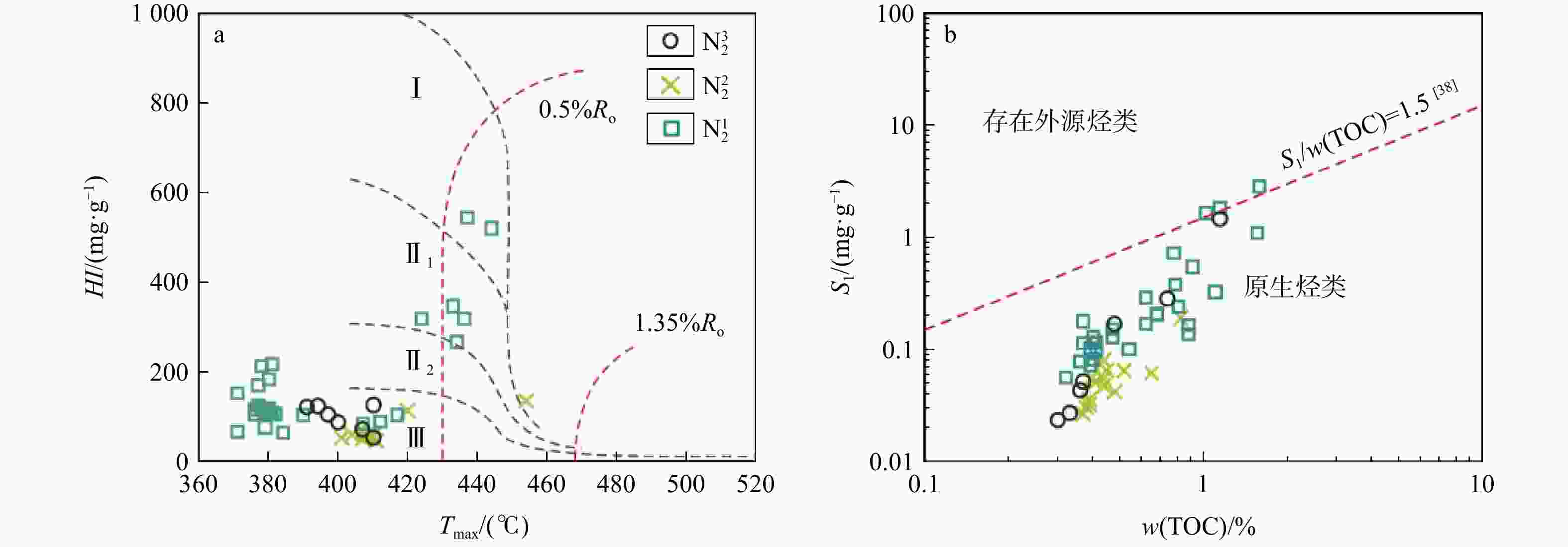
图 2 柴达木盆地JS-2井烃源岩HI与Tmax交汇图(a)和S1与w(TOC)交汇图(b)
Ro. 镜质体反射率;Ⅰ,Ⅱ1,Ⅱ2,Ⅲ为干酪根类型
Figure 2. Cross plots of HI versus Tmax (a) and S1 versus w(TOC) (b) of source rocks in Well JS-2, Qaidam Basin
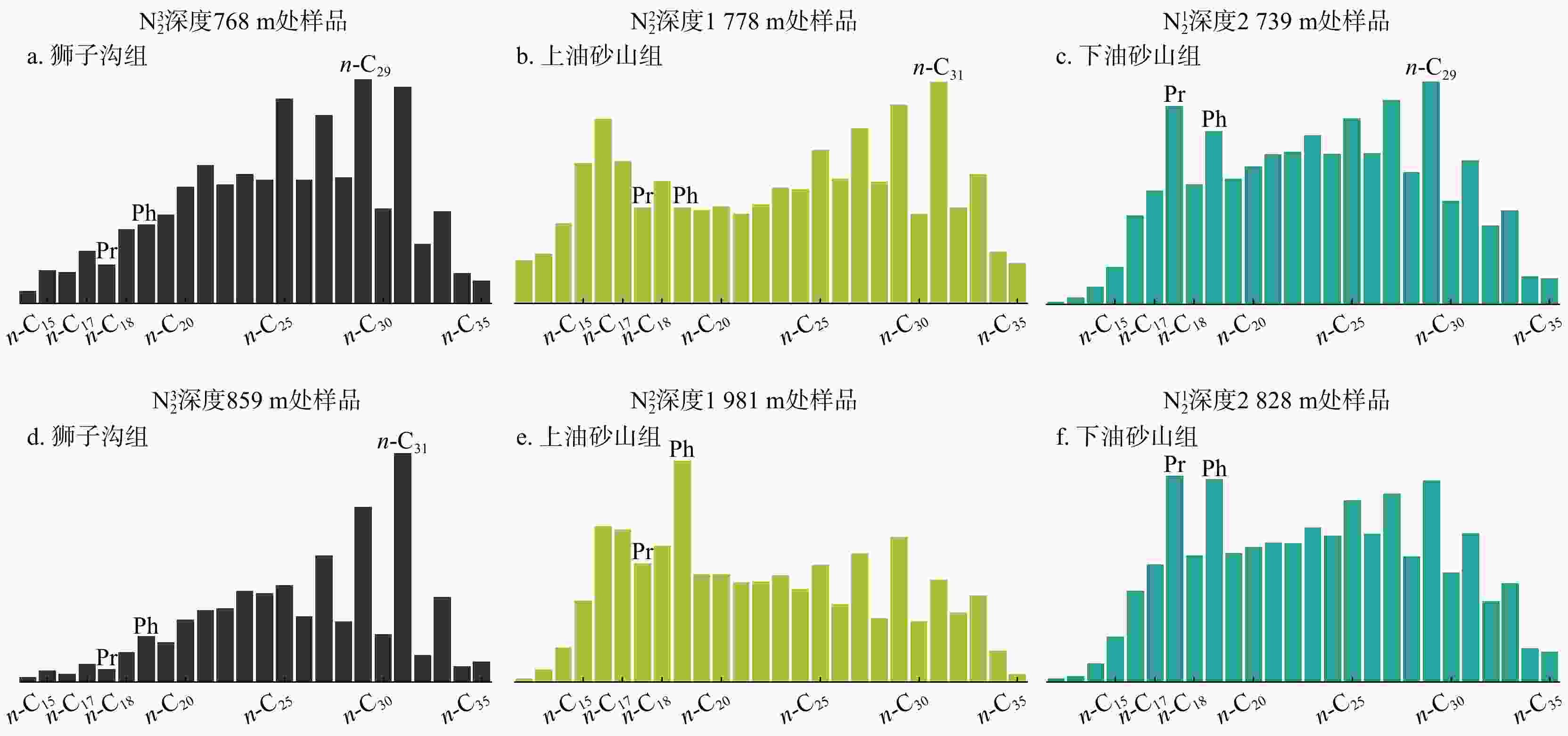
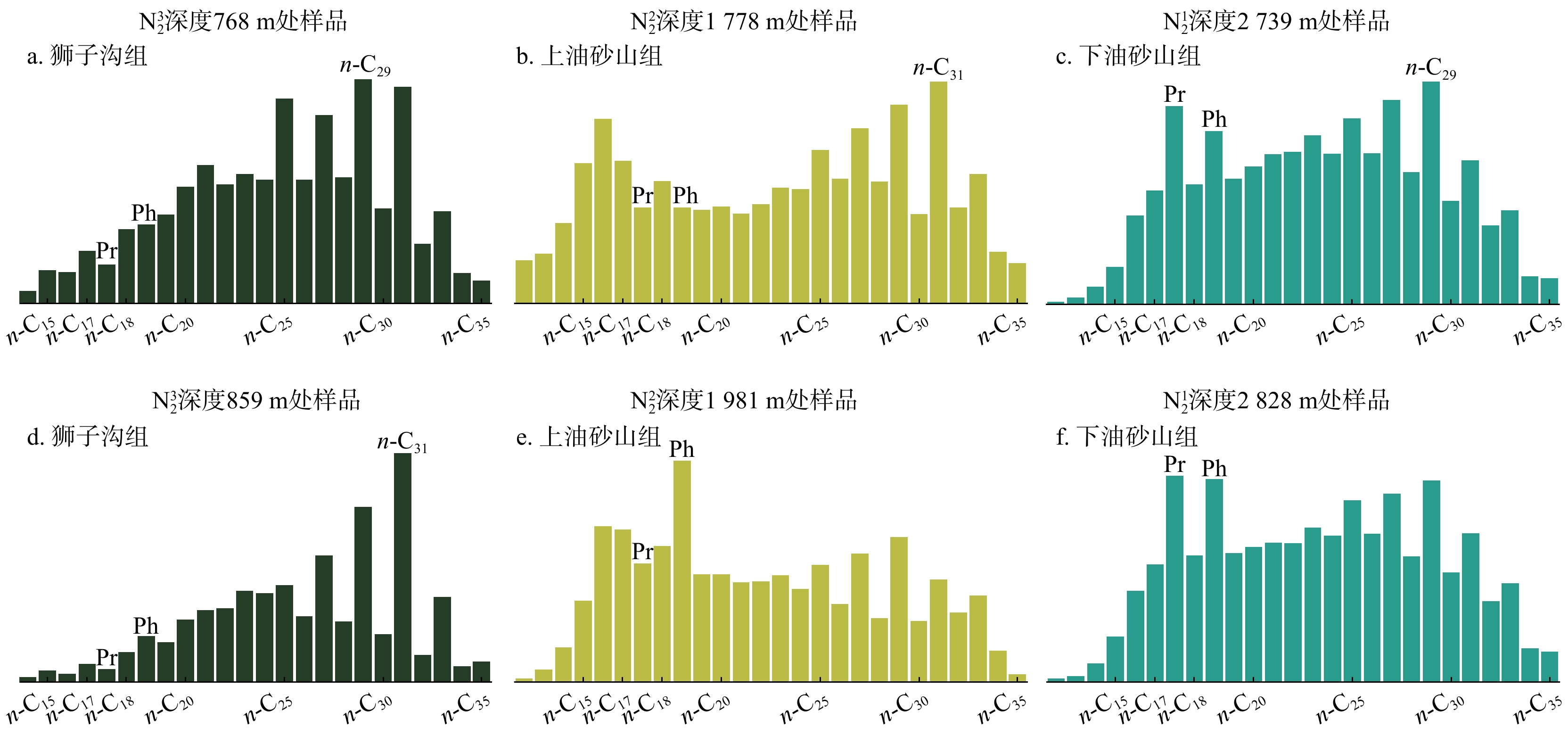
图 3 柴达木盆地JS-2井正构烷烃分布特征
Figure 3. Distribution characteristics of n-alkanes in Well JS-2, Qaidam Basin
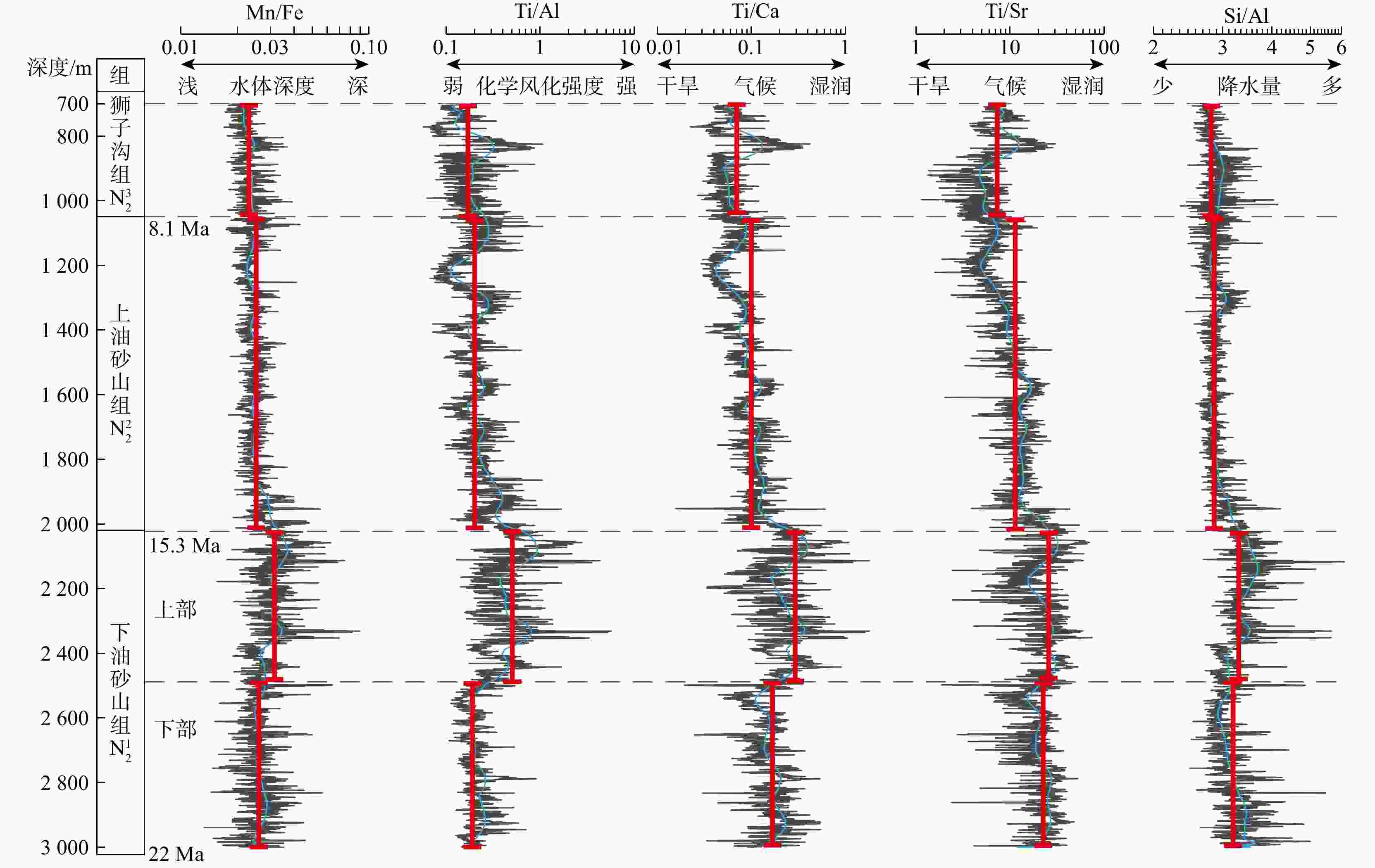
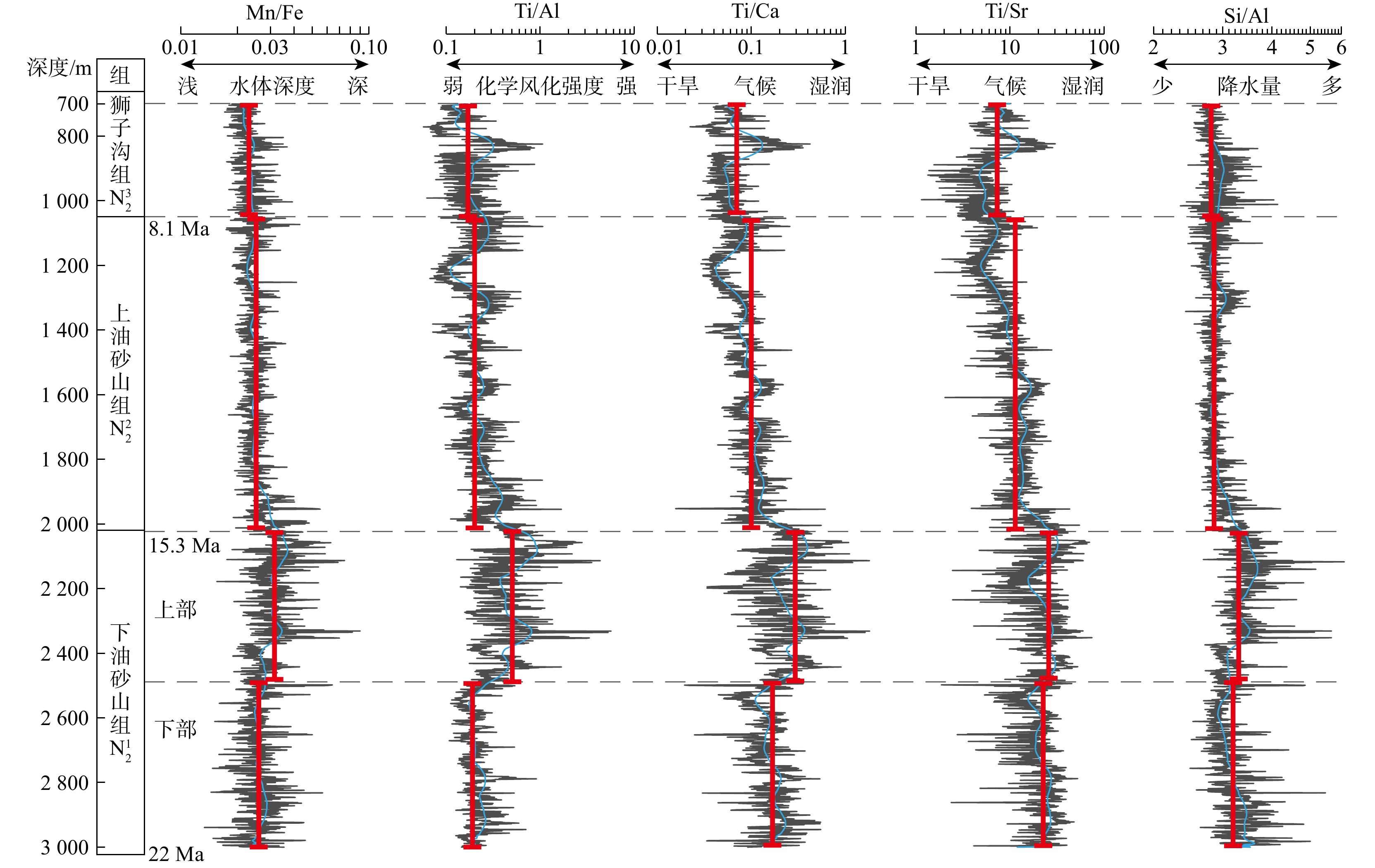
图 4 柴达木盆地JS-2井烃源岩元素比值剖面图
注:红线为各阶段平均值;蓝线为平滑曲线;剖面平滑采用滑动平均(相邻平均法),窗口为10个数据点
Figure 4. Element ratio profiles of source rocks in Well JS-2, Qaidam Basin
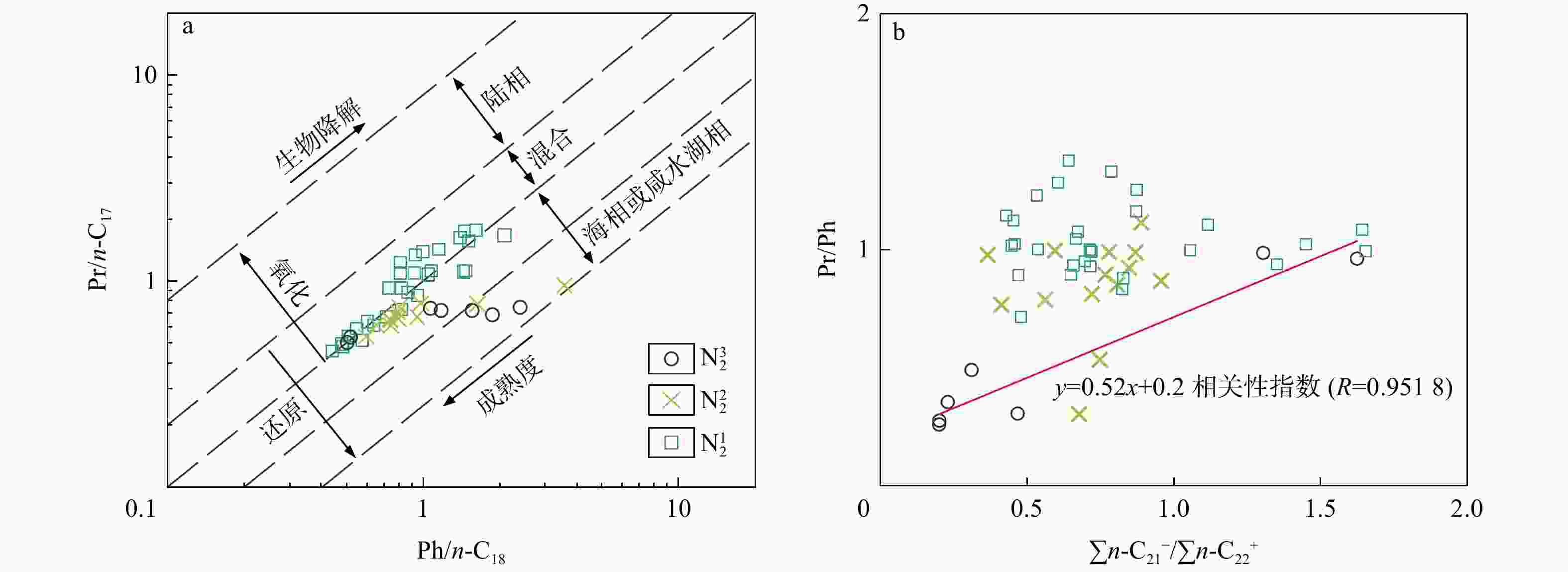
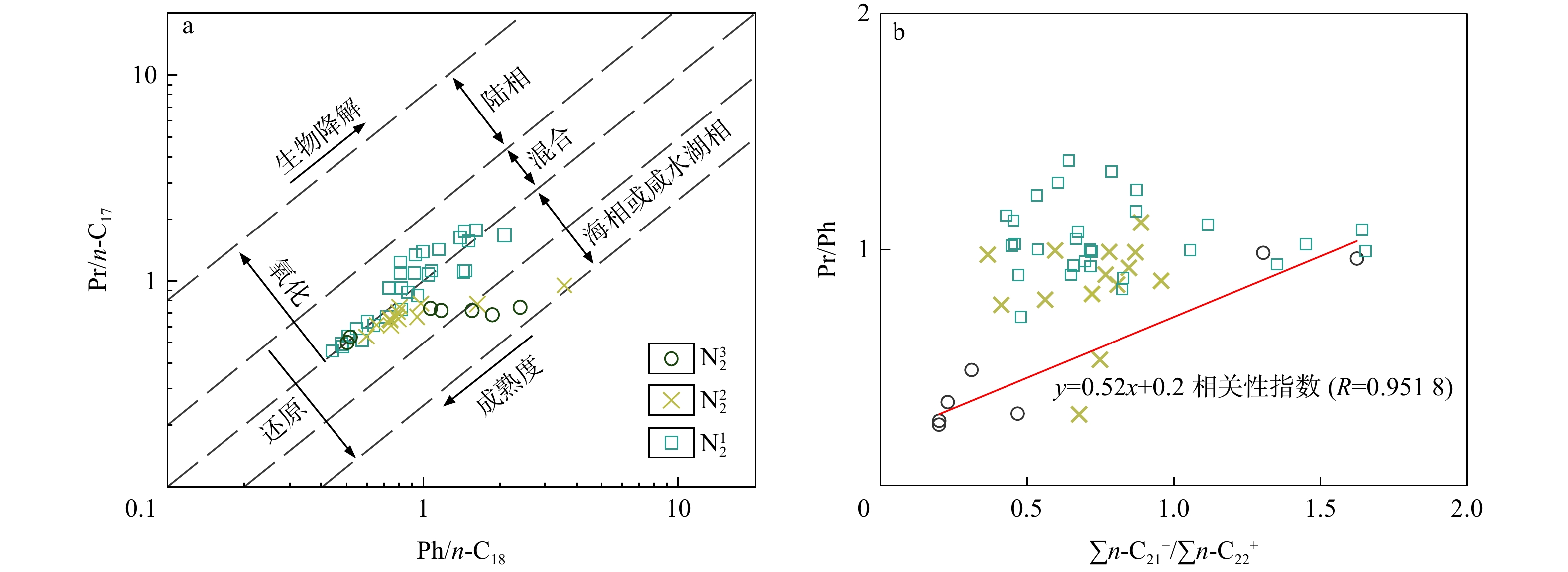
图 5 柴达木盆地JS-2井烃源岩Pr/n-C17与Ph/n-C18交汇图(a)和Pr/Ph与∑n-C21−/∑n-C22+交汇图(b)
Figure 5. Cross plots of Pr/n-C17 versus Ph/n-C18 (a) and Pr/Ph versus ∑n-C21−/∑n-C22+ (b) of source rocks in JS-2 well, Qaidam Basin
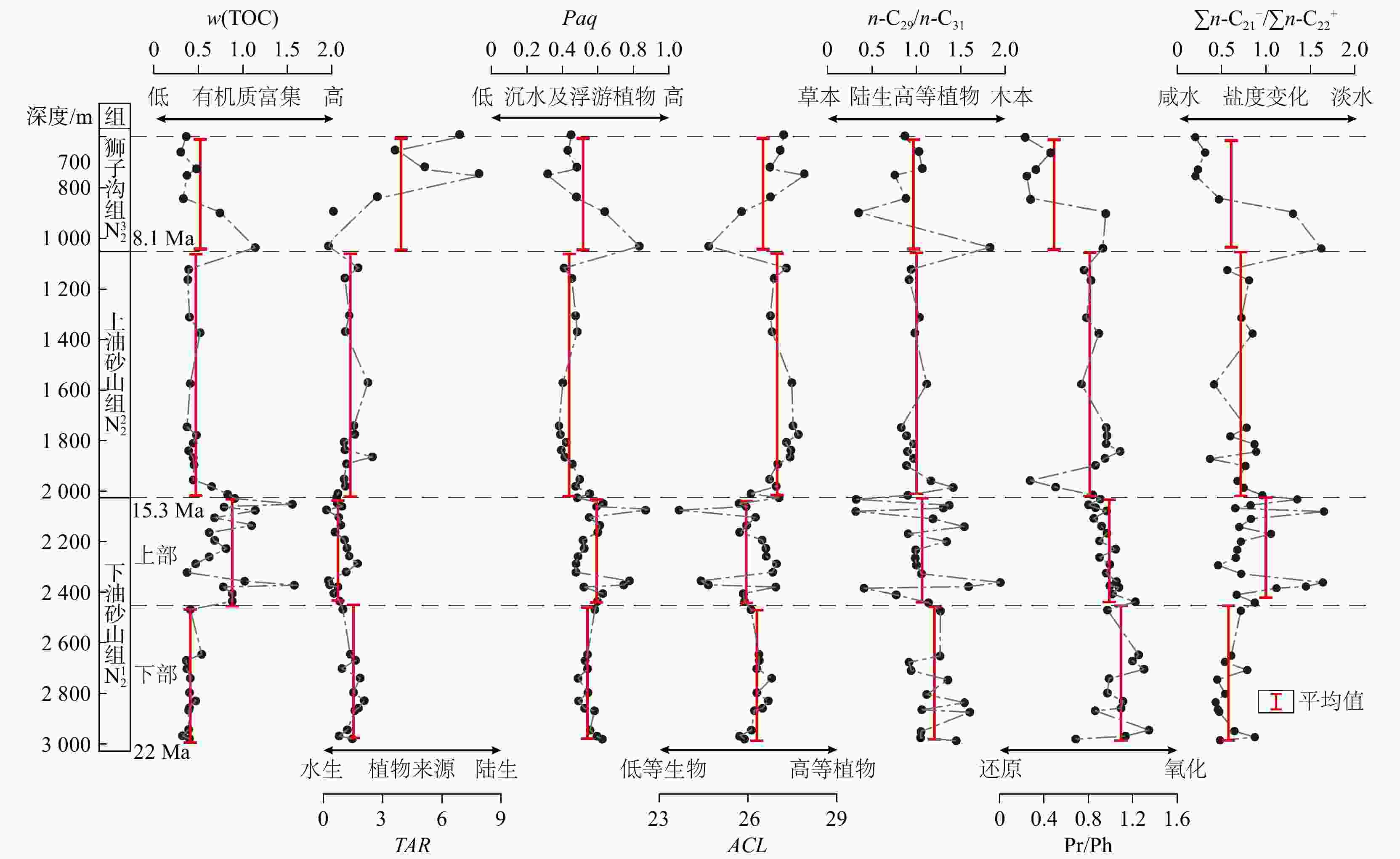
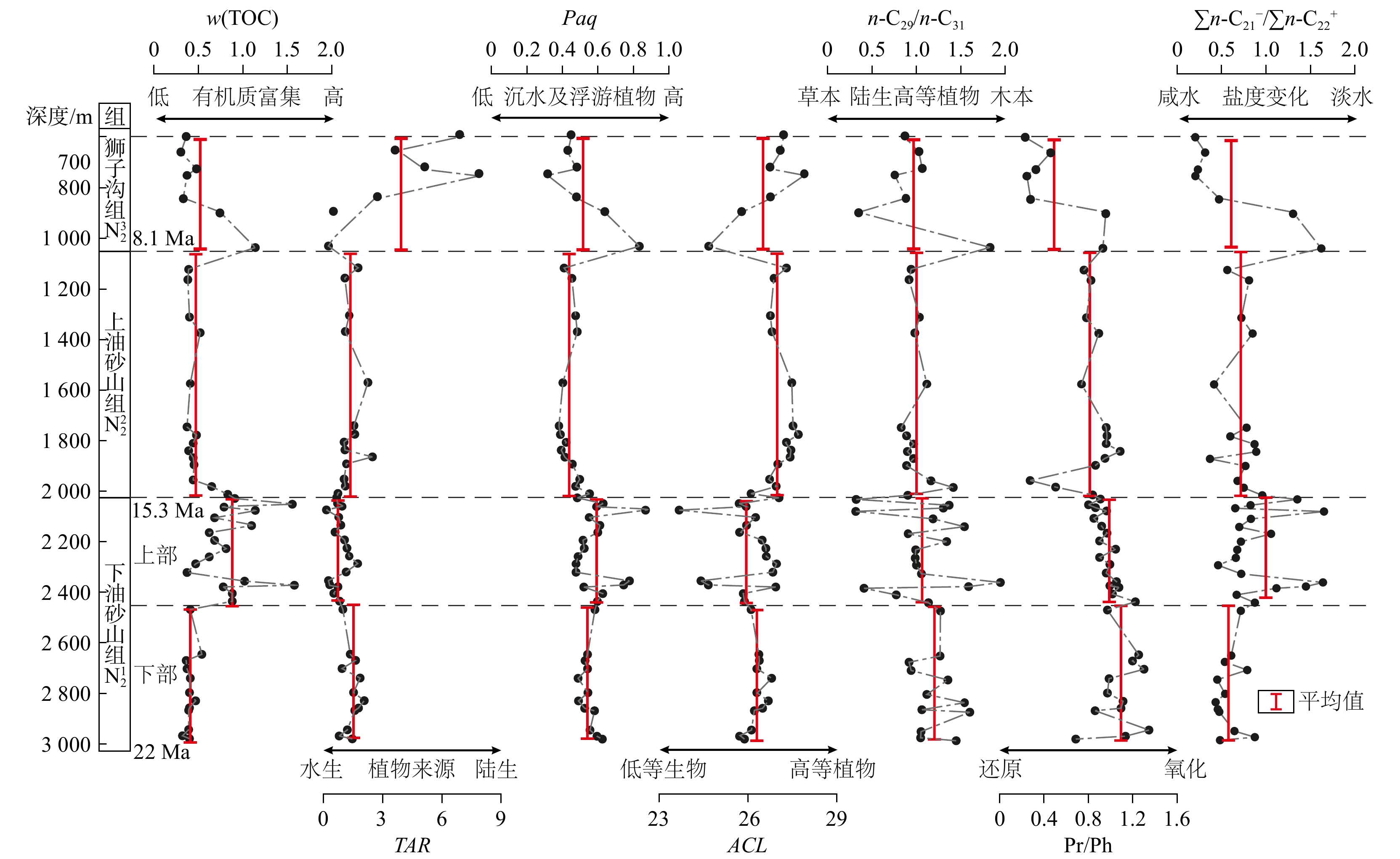
图 6 柴达木盆地JS-2井烃源岩样品w(TOC)及正构烷烃参数随深度变化图(红线为各阶段平均值)
Figure 6. Plot of TOC and n-alkane parameters versus depth for source rock samples in Well JS-2, Qaidam Basin
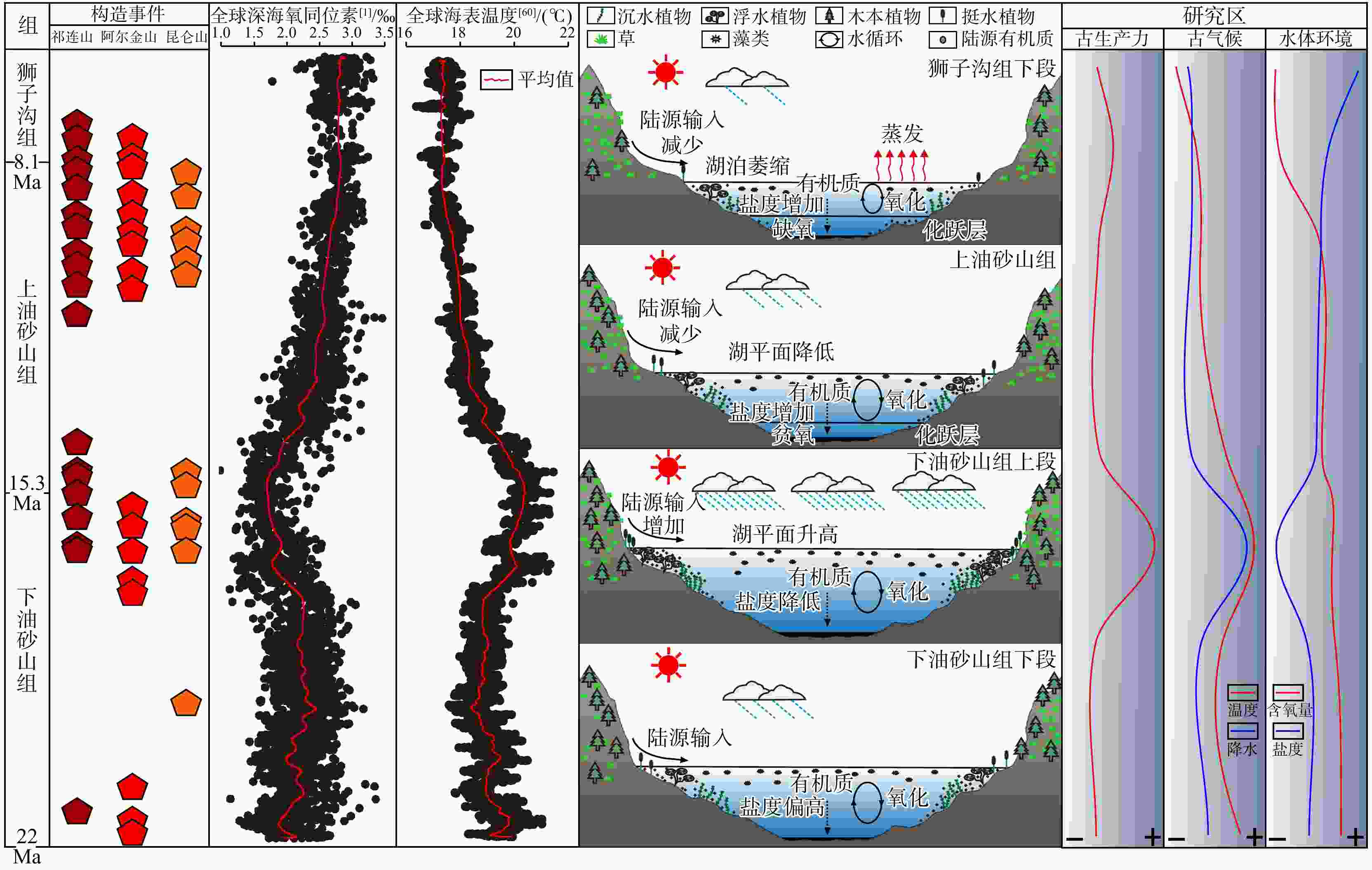
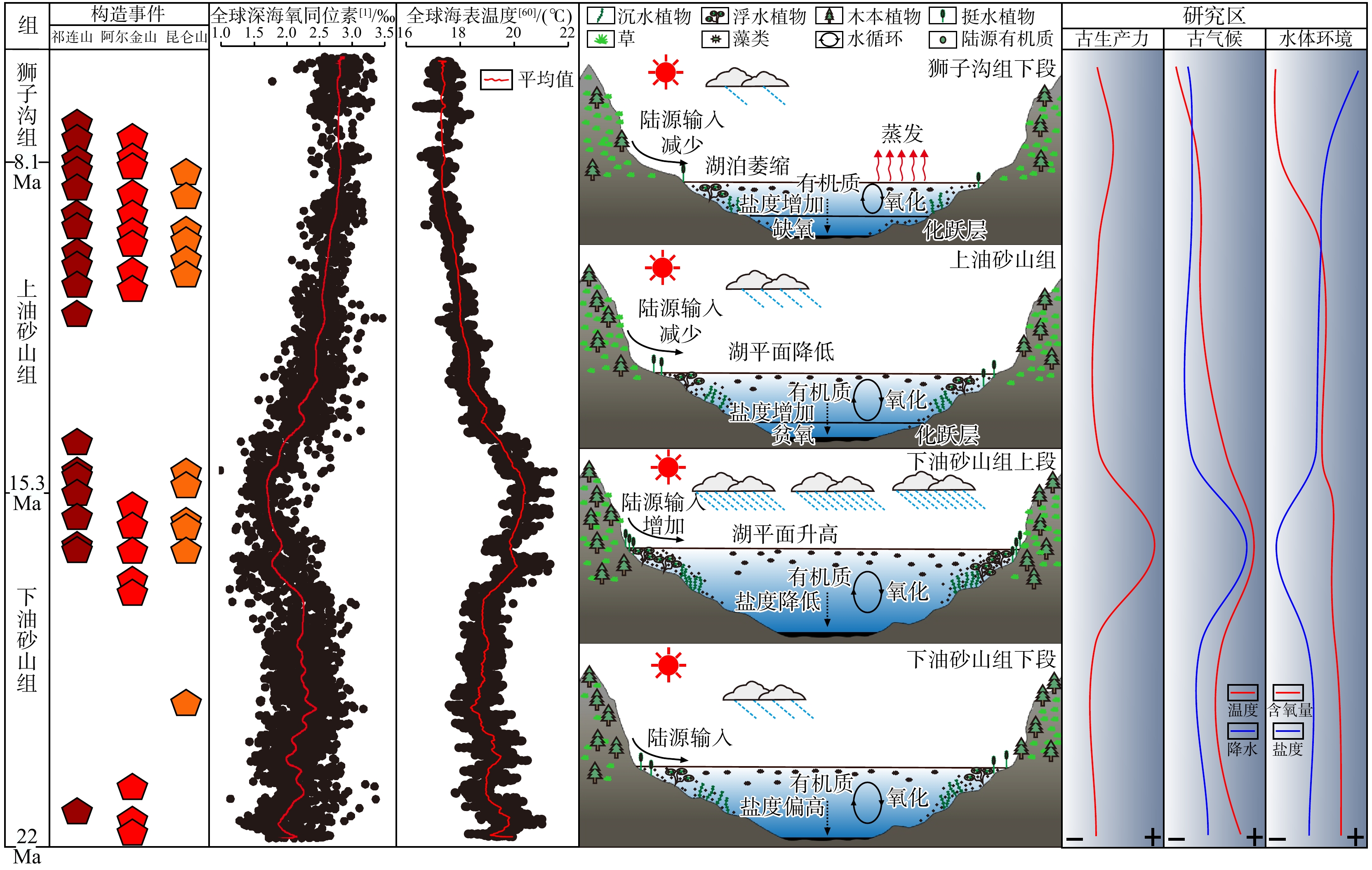
图 7 柴达木盆地中新世湖盆生态演化图(构造事件统计据文献[61]修改)
Figure 7. Ecological evolution map of Miocene lake basin in Qaidam Basin
表 1 柴达木盆地JS-2井烃源岩元素含量及相关参数
Table 1. Element content and related parameters of source rocks in Well JS-2, Qaidam Basin
层位 w(Al)/% w(Ca)/% w(Ti)/% w(Mn)/% w(Sr)/% w(Si)/% w(Fe)/% Mn/Fe Ti/Al Ti/Ca Ti/Sr Si/Al 狮子沟
组${\mathrm{N}}_2^3 $$ \dfrac{0.22\sim 5.85}{3.26(351)} $ $ \dfrac{0.76\sim 11.22}{6.64(351)} $ $ \dfrac{0.05\sim 3.08}{0.48(351)} $ $ \dfrac{0.02\sim 0.08}{0.05(351)} $ $ \dfrac{0.02\sim 0.34}{0.06(351)} $ $ \dfrac{0.71\sim 16.44}{9.25(351)} $ $ \dfrac{0.17\sim 3.03}{2.06(351)} $ $ \dfrac{0.02\sim 0.04}{0.02(351)} $ $ \dfrac{0.05\sim 0.89}{0.17(351)} $ $ \dfrac{0.02\sim 0.42}{0.07(351)} $ $ \dfrac{0.68\sim 30.34}{7.30(351)} $ $ \dfrac{2.34\sim 4.13}{2.89(351)} $ 上油砂
山组${\mathrm{N}}_2^2 $$ \dfrac{0.52\sim 6.79}{3.94(971)} $ $ \dfrac{1.83\sim 21.23}{7.59(971)} $ $ \dfrac{0.12\sim 3.74}{0.72(971)} $ $ \dfrac{0.03\sim 0.12}{0.06(971)} $ $ \dfrac{0.01\sim 0.42}{0.07(971)} $ $ \dfrac{1.79\sim 17.62}{11.32(971)} $ $ \dfrac{0.68\sim 3.25}{2.24(971)} $ $ \dfrac{0.02\sim 0.06}{0.03(971)} $ $ \dfrac{0.06\sim 1.41}{0.20(971)} $ $ \dfrac{0.02\sim 0.61}{0.10(971)} $ $ \dfrac{1.58\sim 54.82}{11.64(971)} $ $ \dfrac{2.41\sim 4.21}{2.90(971)} $ 下油砂
山组${\mathrm{N}}_2^1 $$ \dfrac{0.86\sim 6.89}{4.20(980)} $ $ \dfrac{1.97\sim 20.00}{5.83(980)} $ $ \dfrac{0.35\sim 4.82}{1.14(980)} $ $ \dfrac{0.03\sim 0.12}{0.07(980)} $ $ \dfrac{0.01\sim 0.35}{0.05(980)} $ $ \dfrac{4.20\sim 23.96}{13.44(980)} $ $ \dfrac{0.55\sim 4.39}{2.36(980)} $ $ \dfrac{0.01\sim 0.09}{0.03(980)} $ $ \dfrac{0.09\sim 4.76}{0.33(980)} $ $ \dfrac{0.02\sim 1.82}{0.22(980)} $ $ \dfrac{1.86\sim 74.51}{23.76(980)} $ $ \dfrac{2.47\sim 6.10}{3.28(980)} $ 注:$\dfrac{0.22\sim 5.85}{3.26(351)} $表示$ \dfrac{最小值\sim 最大值}{平均值(样品数量件)} $,元素比值均为质量分数比值;下同  下载: 导出CSV
表 2 柴达木盆地JS-2井烃源岩总有机碳w(TOC)及岩石热解相关参数
Table 2. Total organic carbon w(TOC) and rock pyrolysis-related parameters of source rocks in Well JS-2, Qaidam Basin
层位 w(TOC)/% (S1+S2)/(mg·g−1) HI/(mg·g−1) Tmax/(℃) 狮子沟组${\mathrm{N}}_2^3 $ $ \dfrac{0.30\sim 1.14}{0.53(7)} $ $ \dfrac{0.18\sim 2.91}{0.87(7)} $ $ \dfrac{53.57\sim 126.44}{98.75(7)} $ $ \dfrac{391.00\sim 410.00}{401.29(7)} $ 上油砂山组${\mathrm{N}}_2^2 $ $ \dfrac{037\sim 0.83}{0.47(14)} $ $ \dfrac{0.20\sim 1.31}{0.40(14)} $ $ \dfrac{45.46\sim 135.27}{67.74(14)} $ $ \dfrac{371.00\sim 454.00}{411.64(14)} $ 下油砂山组${\mathrm{N}}_2^1 $ $ \dfrac{0.32\sim 1.58}{0.68(29)} $ $ \dfrac{0.39\sim 11.47}{1.82(29)} $ $ \dfrac{64.90\sim 544.62}{175.69(29)} $ $ \dfrac{391.00\sim 444.00}{393.97(29)} $ 注:w(TOC)为总有机碳质量分数;(S1+S2)为生烃潜量;HI为氢指数;Tmax为热解最高峰温;下同
下载: 导出CSV
表 3 柴达木盆地JS-2井烃源岩正构烷烃参数
Table 3. n-alkane parameters of source rocks in Well JS-2, Qaidam Basin
层位 ACL21~33 TAR CPI OEP Pr/n-C17 Ph/n-C18 Pr/Ph Paq ∑n-C21−/∑n-C22+ 狮子沟组${\mathrm{N}}_2^3 $ $ \dfrac{24.67\sim 27.90}{26.59(7)} $ $ \dfrac{0.25\sim 7.88}{3.86(7)} $ $ \dfrac{1.06\sim 2.99}{1.97(7)} $ $ \dfrac{0.89\sim 5.53}{2.11(7)} $ $ \dfrac{0.51\sim 0.75}{0.67(7)} $ $ \dfrac{0.50\sim 2.38}{1.29(7)} $ $ \dfrac{0.26\sim 0.99}{0.52(7)} $ $ \dfrac{0.32\sim 0.83}{0.52(7)} $ $ \dfrac{0.20\sim 1.62}{0.62(7)} $ 上油砂山组${\mathrm{N}}_2^2 $ $ \dfrac{26.10\sim 27.70}{27.10(14)} $ $ \dfrac{0.73\sim 2.48}{1.38(14)} $ $ \dfrac{1.16\sim 2.43}{1.79(14)} $ $ \dfrac{0.85\sim 3.84}{1.72(14)} $ $ \dfrac{0.54\sim 0.95}{0.69(14)} $ $ \dfrac{0.60\sim 3.58}{1.04(14)} $ $ \dfrac{0.30\sim 1.12}{0.84(14)} $ $ \dfrac{0.38\sim 0.55}{0.44(14)} $ $ \dfrac{0.37\sim 0.96}{0.71(14)} $ 下油砂山组${\mathrm{N}}_2^1 $ $ \dfrac{23.67\sim 27.05}{26.10(29)} $ $ \dfrac{0.15\sim 2.07}{1.07(29)} $ $ \dfrac{0.77\sim 1.71}{1.41(29)} $ $ \dfrac{0.89\sim 2.61}{1.17(29)} $ $ \dfrac{0.46\sim 1.76}{1.03(29)} $ $ \dfrac{0.44\sim 2.07}{0.96(29)} $ $ \dfrac{0.71\sim 1.38}{1.04(29)} $ $ \dfrac{0.48\sim 0.87}{0.58(29)} $ $ \dfrac{0.43\sim 1.65}{0.79(29)} $ 注:ACL21~33为平均碳链长度,ACL21~33=(∑[n-Ci]×i)/(∑[n-Ci])(21≤i≤33);TAR为陆生高等植物与水生植物的比值,TAR=(n-C27+n-C29+n-C31)/(n-C15+n-C17+n-C19);CPI为碳优势指数,CPI=[∑(n-C25-n-C33)odd/∑(n-C24-n-C32)even+∑(n-C25-n-C33)odd/∑(n-C26-n-C34)even]/2;OEP为奇偶优势比,OEP=(n-C23+6×n-C25+n-C27)/[4×(n-C24+n-C26)];Paq为水生植物比例指数,Paq=(n-C23+n-C25)/(n-C23+n-C25+n-C29+n-C31);Pr/Ph为姥鲛烷与植烷的比值;∑n-C21−/∑n-C22+为短链正构烷烃与长链正构烷烃比值
下载: 导出CSV
-
[1] ZACHOS J, PAGANI M, SLOAN L, et al. Trends, rhythms, and aberrations in global climate 65 Ma to present[J]. Science, 2001, 292(5517): 686-693. doi: 10.1126/science.1059412 [2] 韩文霞. 柴达木盆地新生代地层记录的亚洲内陆干旱气候演化[D]. 兰州: 兰州大学, 2008.HAN W X. Climatic records of Cenozoic sediments from Qaidam Basin and their implications on drying of Asian inland[D]. Lanzhou: Lanzhou University, 2008. (in Chinese with English abstract) [3] 王海涛. 孢粉记录的柴达木盆地中中新世气候适宜期生态环境演化特征[D]. 北京: 中国科学院大学, 2020.WANG H T. Middle Miocene climatic optimum ecological environment evolution characteristic recorded by sporopollen in Qaidam Basin[D]. Beijing: University of Chinese Academy of Sciences, 2020. (in Chinese with English abstract) [4] MEYER B, TAPPONNIER P, BOURJOT L, et al. Crustal thickening in Gansu-Qinghai, lithospheric mantle subduction, and oblique, strike-slip controlled growth of the Tibet Plateau[J]. Geophysical Journal International, 1998, 135(1): 1-47. doi: 10.1046/j.1365-246x.1998.00567.x [5] 张文静. 柴达木盆地东北缘新生代古气候事件的沉积学研究[D]. 杭州: 浙江大学, 2016.ZHANG W J. The sedimentary studies of Cenozoic paleoclimatic events in the northeastern Qaidam Basin[D]. Hangzhou: Zhejiang University, 2016. (in Chinese with English abstract) [6] CHENG F, JOLIVET M, GUO Z J, et al. Cenozoic evolution of the Qaidam Basin and implications for the growth of the northern Tibetan Plateau: A review[J]. Earth-Science Reviews, 2021, 220: 103730. doi: 10.1016/j.earscirev.2021.103730 [7] MIAO Y F, FANG X M, LIU Y C, et al. Late Cenozoic pollen concentration in the western Qaidam Basin, northern Tibetan Plateau, and its significance for paleoclimate and tectonics[J]. Review of Palaeobotany and Palynology, 2016, 231: 14-22. doi: 10.1016/j.revpalbo.2016.04.008 [8] 郭佩. 柴达木新生代湖盆咸化环境演变及其烃源岩发育特征[D]. 西安: 西北大学, 2018.GUO P. Saline environment evolution of the Cenozoic Qaidam palaeolake and the characterizarion of its hydrocarbon source rocks[D]. Xi'an: Northwest University, 2018. (in Chinese with English abstract) [9] 王伟涛, 张培震, 段磊, 等. 柴达木盆地新生代地层年代框架与沉积−构造演化[J]. 科学通报, 2022, 67(28): 3452-3475. (in Chinese with English abstract doi: 10.1360/TB-2022-0108WANG W T, ZHANG P Z, DUAN L, et al. Cenozoic stratigraphic chronology and sedimentary-tectonic evolution of the Qaidam Basin[J]. Chinese Science Bulletin, 2022, 67(28): 3452-3475. doi: 10.1360/TB-2022-0108 [10] 李元, 孙媛媛, 邓国仕, 等. 湖泊沉积物C4植物含量重建方法的讨论: 以新生代柴达木盆地大红沟剖面为例[J]. 沉积与特提斯地质, 2022, 42(4): 572-584. doi: 10.19826/j.cnki.1009-3850.2022.04019LI Y, SUN Y Y, DENG G S, et al. Reconstruction of C4 plant content in Cenozoic lacustrine sediments: An example from the Dahonggou section, Qaidam Basin[J]. Sedimentary Geology and Tethyan Geology, 2022, 42(4): 572-584. (in Chinese with English abstract) doi: 10.19826/j.cnki.1009-3850.2022.04019 [11] SUN X J, WANG P X. How old is the Asian monsoon system? Palaeobotanical records from China[J]. Palaeogeography, Palaeoclimatology, Palaeoecology, 2005, 222(3/4): 181-222. [12] JIAN X, GUAN P, FU S T, et al. Miocene sedimentary environment and climate change in the northwestern Qaidam Basin, northeastern Tibetan Plateau: Facies, biomarker and stable isotopic evidences[J]. Palaeogeography, Palaeoclimatology, Palaeoecology, 2014, 414: 320-331. [13] 李旋. 柴达木盆地新生代沉积中心迁移的源−汇响应[D]. 西安: 西北大学, 2022.LI X. Source-to-sink responses to the migration of depocenters during Cenozoic in the Qaidam Basin[D]. Xi'an: Northwest University, 2022. (in Chinese with English abstract) [14] 胡超. 柴达木盆地一里坪地区新近系沉积特征与演化[D]. 西安: 西北大学, 2020.HU C. Sedimentary characteristics and evolution of the Neogene in the Yiliping area, Qaidam Basin[D]. Xi'an: Northwest University, 2020. (in Chinese with English abstract) [15] 应红, 宋春晖, 鲍晶, 等. 柴达木盆地东北缘中中新世以来古气候变化[J]. 第四纪研究, 2016, 36(4): 847-858. doi: 10.11928/j.issn.1001-7410.2016.04.06YING H, SONG C H, BAO J, et al. Paleoclimate change since the Middle Miocene in the northeastern Qaidam Basin[J]. Quaternary Sciences, 2016, 36(4): 847-858. (in Chinese with English abstract) doi: 10.11928/j.issn.1001-7410.2016.04.06 [16] 路晶芳, 张克信, 宋博文, 等. 柴达木盆地大红沟地区始新世—上新世孢粉记录及气候变化[J]. 现代地质, 2020, 34(4): 732-744. doi: 10.19657/j.geoscience.1000-8527.2020.027LU J F, ZHANG K X, SONG B W, et al. Paleogene-Neogene pollen and climate change in Dahonggou region of Qaidam Basin[J]. Geoscience, 2020, 34(4): 732-744. (in Chinese with English abstract) doi: 10.19657/j.geoscience.1000-8527.2020.027 [17] 鲍晶. 柴达木盆地沉积通量及元素地球化学记录的新生代风化剥蚀[D]. 兰州: 兰州大学, 2017.BAO J. Cenozoic sediment flux and geochemical records in the Qaidam Basin, northern Tibetan Plateau, and their implications for weathering and denudation Cenozoic weathering and denudation[D]. Lanzhou: Lanzhou University, 2017. (in Chinese with English abstract) [18] BAO J, YANG Y B, YE C C, et al. Evolution of weathering intensity in the Qaidam Basin, northeastern Tibetan Plateau, since the Middle Miocene: Insights from clay mineral records[J]. Palaeogeography, Palaeoclimatology, Palaeoecology, 2024, 645: 112210. [19] 樊小龙, 余平辉, 曾亮, 等. 柴达木盆地新生界生物地层年代研究[J]. 微体古生物学报, 2016(4): 363-378. doi: 10.16087/j.cnki.1000-0674.20161221.004FAN X L, YU P H, ZENG L, et al. The biostratigraphic and chronological research of Cenozoic in the Qaidam Basin, Northwest China[J]. Acta Micropalaeontologica Sinica, 2016(4): 363-378. (in Chinese with English abstract) doi: 10.16087/j.cnki.1000-0674.20161221.004 [20] 张益铭, 黄雷, 宋世骏, 等. 柴达木盆地一里坪凹陷新近纪孢粉特征及其古环境意义[J]. 地质论评, 2021, 67(6): 1586-1604. doi: 10.16509/j.georeview.2021.08.015ZHANG Y M, HUANG L, SONG S J, et al. Characteristics of Neogene palynology and palaeoenvironment significance in Yiliping Sag, Qaidam Basin[J]. Geological Review, 2021, 67(6): 1586-1604. (in Chinese with English abstract) doi: 10.16509/j.georeview.2021.08.015 [21] 苏庆达, 聂军胜, 李祥忠, 等. 柴达木盆地中新世−早上新世有机碳同位素记录和植被演化历史[J]. 第四纪研究, 2022, 42(4): 948-957.SU Q D, NIE J S, LI X Z, et al. Organic carbon isotopic record and vegetation evolution history in the Qaidam Basin during Miocene-Early Pliocene[J]. Quaternary Sciences, 2022, 42(4): 948-957. (in Chinese with English abstract) [22] ZHANG B, HE Y Y, CHEN Y, et al. Petrologic and geochemical characteristics of high-quality saline lacustrine source rocks in western Qaidam Basin[J]. Petroleum Research, 2018, 3(4): 359-369. doi: 10.1016/j.ptlrs.2018.11.001 [23] 袁情. 柴达木盆地咸水湖相烃源岩和原油中甾烷类化合物特征研究[D]. 湖北荆州: 长江大学, 2019.YUAN Q. Study on steranes in hydrocarbon source rocks and crude oils of saltwater lacustrine faces in the Qaidam Basin[D]. Jingzhou Hubei: Yangtze University, 2019. (in Chinese with English abstract) [24] LIANG Y, ZHANG B, ZHANG Y S, et al. Evolution of the Miocene megalake in the western Qaidam Basin, northwestern China[J]. Palaeogeography, Palaeoclimatology, Palaeoecology, 2021, 571: 110384. [25] XIA G Q, WU C H, LI G J, et al. Cenozoic growth of the Eastern Kunlun Range (northern Tibetan Plateau): Evidence from sedimentary records in the Southwest Qaidam Basin[J]. International Geology Review, 2021, 63(6): 769-786. doi: 10.1080/00206814.2020.1731717 [26] 乔艳萍, 伊帆, 陈晓冬, 等. 柴达木盆地始新统—中新统湖相沉积记录的植被演替及古环境变化[J]. 西北地质, 2025, 58(6): 118-130. doi: 10.12401/j.nwg.2024062QIAO Y P, YI F, CHEN X D, et al. Vegetation succession and paleoenvironmental changes unraveled from the Eocene-Miocene lacustrine sediments in the Qaidam Basin[J]. Northwestern Geology, 2025, 58(6): 118-130. (in Chinese with English abstract) doi: 10.12401/j.nwg.2024062 [27] LI L L, WU C D, FAN C F, et al. Carbon and oxygen isotopic constraints on paleoclimate and paleoelevation of the southwestern Qaidam Basin, northern Tibetan Plateau[J]. Geoscience Frontiers, 2017, 8(5): 1175-1186. doi: 10.1016/j.gsf.2016.12.001 [28] 柴达木油气区编纂委员会. 中国石油地质志: 卷十八−柴达木油气区[M]. 2版. 北京: 石油工业出版社, 2022.Compilation Committee of Qaidam Oil and Gas Province. China Petroleum Geology: Volume 18, Qaidam Oil and Gas Province[M]. 2th ed. Beijing: Petroleum Industry Press, 2022. (in Chinese) [29] 王冰, 刘成林, 李宗星, 等. 柴达木盆地东部中生代以来构造应力场及构造演化[J]. 地球科学与环境学报, 2017, 39(1): 83-94. doi: 10.3969/j.issn.1672-6561.2017.01.006WANG B, LIU C L, LI Z X, et al. Tectonic-stress field and tectonic evolution in the eastern Qaidam Basin since Mesozoic[J]. Journal of Earch Sciences and Environment, 2017, 39(1): 83-94. (in Chinese with English abstract) doi: 10.3969/j.issn.1672-6561.2017.01.006 [30] 张超, 王善博, 俞礽安, 等. 柴西北缘中新生代构造演化及铀源分析[J]. 华北地质, 2021, 44(2): 67-73. doi: 10.19948/j.12-1471/P.2021.02.09ZHANG C, WANG S B, YU R A, et al. Mesozoic-Cenozoic tectonic evolution and uranium source analysis in northwestern Qaidam Basin[J]. North China Geology, 2021, 44(2): 67-73. (in Chinese with English abstract) doi: 10.19948/j.12-1471/P.2021.02.09 [31] SUN Z M, YANG Z Y, PEI J L, et al. Magnetostratigraphy of Paleogene sediments from northern Qaidam Basin, China: Implications for tectonic uplift and block rotation in northern Tibetan Plateau[J]. Earth and Planetary Science Letters, 2005, 237(3/4): 635-646. doi: 10.1016/j.epsl.2005.07.007 [32] YIN A, DANG Y Q, WANG L C, et al. Cenozoic tectonic evolution of Qaidam Basin and its surrounding regions (Part 1): The southern Qilian Shan-Nan Shan thrust belt and northern Qaidam Basin[J]. Geological Society of America Bulletin, 2008, 120(7/8): 813-846. doi: 10.1130/b26180.1 [33] YIN A, DANG Y Q, ZHANG M, et al. Cenozoic tectonic evolution of the Qaidam Basin and its surrounding regions (Part 3): Structural geology, sedimentation, and regional tectonic reconstruction[J]. Geological Society of America Bulletin, 2008, 120(7/8): 847-876. [34] KE X, JI J L, ZHANG K X, et al. Magnetostratigraphy and anisotropy of magnetic susceptibility of the Lulehe Formation in the northeastern Qaidam Basin[J]. Acta Geologica Sinica (English Edition), 2013, 87(2): 576-587. doi: 10.1111/1755-6724.12069 [35] FANG X M, ZHANG W L, MENG Q Q, et al. High-resolution magnetostratigraphy of the Neogene Huaitoutala section in the eastern Qaidam Basin on the NE Tibetan Plateau, Qinghai Province, China and its implication on tectonic uplift of the NE Tibetan Plateau[J]. Earth and Planetary Science Letters, 2007, 258(1/2): 293-306. doi: 10.1016/j.epsl.2007.03.042 [36] LU H J, XIONG S F. Magnetostratigraphy of the Dahonggou section, northern Qaidam Basin and its bearing on Cenozoic tectonic evolution of the Qilian Shan and Altyn Tagh Fault[J]. Earth and Planetary Science Letters, 2009, 288(3/4): 539-550. doi: 10.1016/j.epsl.2009.10.016 [37] WU W J, YUAN J Y, WANG J G, et al. A Late Neogene framework and transpressional system within the Yingxiongling Range, western Qaidam Basin, Northeast Tibetan Plateau: Insights from seismic reflection profiles and active tectonics[J]. Journal of Asian Earth Sciences, 2020, 198: 104061. doi: 10.1016/j.jseaes.2019.104061 [38] HUNT J M. Petroleum geochemistry and geology[M]. New York: W. H. Freeman Company, 1995. [39] XIE M M, SUN Q, DONG H W, et al. n-Alkanes and compound carbon isotope records from Lake Yiheshariwusu in the Hulun Buir sandy land, northeastern China[J]. The Holocene, 2020, 30(10): 1451-1461. doi: 10.1177/0959683620932968 [40] 赵佳玉, 王淑贤, DARIN A, 等. 新疆阿尔泰全新世双湖沉积物正构烷烃分布及其环境意义[J]. 第四纪研究, 2021, 41(4): 965-975.ZHAO J Y, WANG S X, DARIN A, et al. N-alkane distribution and their paleoenvironmental implications during Holocene in lacustrine sediments in Lake Shuang, Xinjiang[J]. Quaternary Sciences, 2021, 41(4): 965-975. (in Chinese with English abstract) [41] 温旺彪, 赵红静, 王志勇, 等. 准噶尔盆地吉南凹陷二叠系芦草沟组烃源岩地球化学特征及油源分析[J]. 地质科技通报, 2025, 44(3): 165-181. doi: 10.19509/j.cnki.dzkq.tb20240443WEN W B, ZHAO H J, WANG Z Y, et al. Oil-source correlations and geochemical characteristics of source rock from the Permian Lucaogou Formation in the Jinan Sag, Junggar Basin[J]. Bulletin of Geological Science and Technology, 2025, 44(3): 165-181. (in Chinese with English abstract) doi: 10.19509/j.cnki.dzkq.tb20240443 [42] 刘烨, 常象春, 陈果, 等. 基于有机−无机地球化学约束的胶莱盆地下白垩统莱阳群沉积环境重建[J]. 西安石油大学学报(自然科学版), 2022, 37(6): 22-31. doi: 10.3969/j.issn.1673-064X.2022.06.003LIU Y, CHANG X C, CHEN G, et al. Reconstruction of sedimentary environment of Lower Cretaceous Laiyang Group in Jiaolai Basin constrained by organic-inorganic geochemistry[J]. Journal of Xi'an Shiyou University (Natural Science Edition), 2022, 37(6): 22-31. (in Chinese with English abstract) doi: 10.3969/j.issn.1673-064X.2022.06.003 [43] 任增莹. 贵州威宁麻窝山岩溶盆地剖面沉积物矿物学特征及其古气候指示[D]. 贵阳: 贵州大学, 2015.REN Z Y. Mineralogical characteristics of sediments in the Mawoshan karst basin section, Weining, Guizhou and their paleoclimate implications[D]. Guiyang: Guizhou University, 2015. (in Chinese with English abstract) [44] 杨欢. 黔西南11.4~3.5 kaBP植被和气候演化的泥炭记录[D]. 浙江金华: 浙江师范大学, 2021.YANG H. 11.4~3.5 ka BP vegetation and climate dynamics derived from a peat record in the southwest of Guizhou Province[D]. Jinhua Zhejiang: Zhejiang Normal University, 2021. (in Chinese with English abstract) [45] 邓云凯, 李亮, 马春梅, 等. 江西玉华山泥炭2000 a BP以来的元素地球化学记录及其气候意义[J]. 地层学杂志, 2019(4): 352-363.DENG Y K, LI L, MA C M, et al. The geochemical records and paleoclimate significance in peat from the Yuhua mountain in Jiangxi Province since the last two millennia[J]. Journal of Stratigraphy, 2019(4): 352-363. (in Chinese with English abstract) [46] 叶荷, 张克信, 季军良, 等. 青海循化盆地23.1~5.0 Ma沉积地层中常量、微量元素组成特征及其古气候演变[J]. 地球科学, 2010(5): 811-820.YE H, ZHANG K X, JI J L, et al. Major and trace element characters of the sediments and paleoclimatic evolvement during about 23.1-5.0 Ma in Xunhua Basin, Qinghai[J]. Earth Science, 2010(5): 811-820. (in Chinese with English abstract) [47] 谢世文, 王宇辰, 舒誉, 等. 珠一坳陷湖盆古环境恢复与优质烃源岩发育模式[J]. 海洋地质与第四纪地质, 2022, 42(1): 159-169. doi: 10.16562/j.cnki.0256-1492.2021110901XIE S W, WANG Y C, SHU Y, et al. Environmental reconstruction for the paleo-lake of ZhuⅠdepression and the depositional model for high-quality source rocks[J]. Marine Geology & Quaternary Geology, 2022, 42(1): 159-169. (in Chinese with English abstract) doi: 10.16562/j.cnki.0256-1492.2021110901 [48] 阳宏, 刘成林, 王飞龙, 等. 渤中凹陷西南洼东营组烃源岩地球化学特征及环境指示意义[J]. 地质科技通报, 2023, 42(1): 339-349. doi: 10.19509/j.cnki.dzkq.2021.0077YANG H, LIU C L, WANG F L, et al. Geochemical characteristics and environmental implications of source rocks of the Dongying Formation in Southwest subsag of Bozhong Sag[J]. Bulletin of Geological Science and Technology, 2023, 42(1): 339-349. (in Chinese with English abstract) doi: 10.19509/j.cnki.dzkq.2021.0077 [49] PETERS K E, WALTERS C C, MOLDOWAN J M, et al. The biomarker guide[M]. London: Cambridge University Press, 2005. [50] 张珂. 东胜煤田东部延安组富惰质组煤的有机地球化学特征及古沉积环境分析[D]. 河北邯郸: 河北工程大学, 2021.ZHANG K. Organic geochemical characteristics and palaeoenvironment reconstruction of inertinite-enriched coal from Yan'an formation in eastern Dongsheng coalfield[D]. Handan Hebei: Hebei University of Engineering, 2021. (in Chinese with English abstract) [51] WANG B C, YANG J, JIANG H C, et al. Chemical composition of n-alkanes and microbially mediated n-alkane degradation potential differ in the sediments of Qinghai-Tibetan lakes with different salinity[J]. Chemical Geology, 2019, 524: 37-48. doi: 10.1016/j.chemgeo.2019.05.038 [52] 朱华汇, 陈家旭, 张佼杨, 等. 歧口凹陷滨海斜坡沙一中亚段烃源岩地球化学特征及沉积环境[J]. 地质科技通报, 2025, 44(3): 43-56. doi: 10.19509/j.cnki.dzkq.tb20240651ZHU H H, CHEN J X, ZHANG J Y, et al. Geochemical characteristics and sedimentary environment of source rock in the Middle Section of Es1 in the Binhai slope, Qikou Sag[J]. Bulletin of Geological Science and Technology, 2025, 44(3): 43-56. (in Chinese with English abstract) doi: 10.19509/j.cnki.dzkq.tb20240651 [53] LIU W G, LI X Z, WANG Z, et al. Carbon isotope and environmental changes in lakes in arid Northwest China[J]. Science China Earth Sciences, 2019, 62(8): 1193-1206. doi: 10.1007/s11430-018-9232-4 [54] FICKEN K J, LI B, SWAIN D L, et al. An n-alkane proxy for the sedimentary input of submerged/floating freshwater aquatic macrophytes[J]. Organic Geochemistry, 2000, 31(7/8): 745-749. doi: 10.1016/s0146-6380(00)00081-4 [55] ANKIT Y, MISHRA P K, KUMAR P, et al. Molecular distribution and carbon isotope of n-alkanes from Ashtamudi Estuary, South India: Assessment of organic matter sources and paleoclimatic implications[J]. Marine Chemistry, 2017, 196: 62-70. doi: 10.1016/j.marchem.2017.08.002 [56] 杨桂芳, 武法东, 陈正洪, 等. 内蒙古磴口河湖相沉积物正构烷烃分布特征及其环境意义[J]. 地球科学, 2015(2): 327-333.YANG G F, WU F D, CHEN Z H, et al. N-alkane distribution and their palaeoenvironmental implications in fluvial-lacustrine sediments in Dengkou, Inner Mongolia[J]. Earth Science, 2015(2): 327-333. (in Chinese with English abstract) [57] 汪素风, 陈云, 伊海生, 等. 西藏尼玛盆地古近纪湖相油页岩正构烷烃特征及其古环境与古气候意义[J]. 沉积与特提斯地质, 2023, 43(3): 542-554. doi: 10.19826/j.cnki.1009-3850.2022.10001WANG S F, CHEN Y, YI H S, et al. The characteristics of n-alkanes from the Palaeogene lacustrine oil shale in the Kanggale area, Nyima Basin, and their paleoenvironment and Paleoclimate significance[J]. Sedimentary Geology and Tethyan Geology, 2023, 43(3): 542-554. (in Chinese with English abstract) doi: 10.19826/j.cnki.1009-3850.2022.10001 [58] 刘虎, 刘卫国. 植物叶蜡正构烷烃分子分布特征与植被类型的关系[J]. 地球环境学报, 2015, 6(3): 168-179. doi: 10.7515/JEE201503005LIU H, LIU W G. Relationship of plant leaf wax n-alkanes molecular distribution characteristics and vegetation types[J]. Journal of Earth Environment, 2015, 6(3): 168-179. (in Chinese with English abstract) doi: 10.7515/JEE201503005 [59] 刘东生, 郑绵平, 郭正堂. 亚洲季风系统的起源和发展及其与两极冰盖和区域构造运动的时代耦合性[J]. 第四纪研究, 1998, 18(3): 194-204.LIU D S, ZHENG M P, GUO Z T. Initiation and evolution of the Asian monsoon system timely coupled with the ice-sheet growth and the tectonic movements in Asia[J]. Quaternary Sciences, 1998, 18(3): 194-204. (in Chinese with English abstract) [60] HANSEN J, SATO M, RUSSELL G, et al. Climate sensitivity, sea level and atmospheric carbon dioxide[J]. Philosophical Transactions of the Royal Society A: Mathematical, Physical and Engineering Sciences, 2013, 371(2001): 20120294. doi: 10.1098/rsta.2012.0294 [61] BAO J, WANG Y D, SONG C H, et al. Cenozoic sediment flux in the Qaidam Basin, northern Tibetan Plateau, and implications with regional tectonics and climate[J]. Global and Planetary Change, 2017, 155: 56-69. doi: 10.1016/j.gloplacha.2017.03.006 [62] STEINTHORSDOTTIR M, COXALL H K, DE BOER A M, et al. The Miocene: The future of the past[J]. Paleoceanography and Paleoclimatology, 2021, 36(4): e2020PA004037. doi: 10.1029/2020PA004037 [63] 李乐意, 常宏, 关冲, 等. 晚渐新世以来青藏高原北部东昆仑山构造隆升对亚洲内陆干旱化的潜在影响: 基于现代地质观测证据[J]. 地质论评, 2021, 67(3): 655-666. doi: 10.16509/j.georeview.2021.03.041LI (L /Y)Y, CHANG H, GUAN C, et al. Potential role of the late Oligocene tectonic uplift in the eastern Kunlun mountains of the Xizang(Tibet) in the formation of inner Asia aridification: Based on present geological observational evidence[J]. Geological Review, 2021, 67(3): 655-666. (in Chinese with English abstract) doi: 10.16509/j.georeview.2021.03.041 [64] 吴珍汉, 赵立国, 叶培盛, 等. 青藏高原中段渐新世逆冲推覆构造[J]. 中国地质, 2011, 38(3): 522-535. doi: 10.3969/j.issn.1000-3657.2011.03.002WU Z H, ZHAO L G, YE P S, et al. Oligocene thrust systems in central Tibetan Plateau[J]. Geology in China, 2011, 38(3): 522-535. (in Chinese with English abstract) doi: 10.3969/j.issn.1000-3657.2011.03.002 [65] ZENG X, LIN T, ZHOU F, et al. Carbon and oxygen isotope characteristics of carbonate and Neogene depositional environment in the Yiliping area of Qaidam Basin[J]. Natural Gas Geoscience, 2021, 32(1): 73-85. [66] WANG J, ZHOU X Y, WANG S Q, et al. Two-stage climate and vegetation change at the East Asian monsoonal margin across the Miocene climatic optimum[J]. Paleoceanography and Paleoclimatology, 2024, 39(9): e2024PA004894. doi: 10.1029/2024PA004894 [67] WRIGHT J D, MILLER K G, FAIRBANKS R G. Early and Middle Miocene stable isotopes: Implications for deepwater circulation and climate[J]. Paleoceanography, 1992, 7(3): 357-389. doi: 10.1029/92PA00760 [68] HOLBOURN A, KUHNT W, SCHULZ M, et al. Orbitally-paced climate evolution during the Middle Miocene “Monterey” carbon-isotope excursion[J]. Earth and Planetary Science Letters, 2007, 261(3/4): 534-550. doi: 10.1016/j.epsl.2007.07.026 [69] FOSTER G L, LEAR C H, RAE J W B. The evolution of pCO2, ice volume and climate during the Middle Miocene[J]. Earth and Planetary Science Letters, 2012, 341/342/343/344: 243-254. [70] 王海涛, 吴福莉, 方小敏, 等. 中中新世气候适宜期西北内陆干旱区气候演化特征[J]. 地球环境学报, 2020, 11(1): 45-65. doi: 10.7515/JEE192020WANG H T, WU F L, FANG X M, et al. Climate evolution of the Northwest China during Middle Miocene climatic optimum[J]. Journal of Earth Environment, 2020, 11(1): 45-65. (in Chinese with English abstract) doi: 10.7515/JEE192020 [71] 安芷生, 张培震, 王二七, 等. 中新世以来我国季风−干旱环境演化与青藏高原的生长[J]. 第四纪研究, 2006, 26(5): 678-693. doi: 10.3321/j.issn:1001-7410.2006.05.002AN Z S, ZHANG P Z, WANG E Q, et al. Changes of the monsoon-arid environment in China and growth of the Tibetan Plateau since the Miocene[J]. Quaternary Sciences, 2006, 26(5): 678-693. (in Chinese with English abstract) doi: 10.3321/j.issn:1001-7410.2006.05.002 [72] GUAN C, CHANG H, YAN M D, et al. Rock magnetic constraints for the Mid-Miocene climatic optimum from a high-resolution sedimentary sequence of the northwestern Qaidam Basin, NE Tibetan Plateau[J]. Palaeogeography, Palaeoclimatology, Palaeoecology, 2019, 532: 109263. [73] 向明星. 亚洲内陆中新世以来的降水定量重建与干旱演化[D]. 北京: 中国科学院大学, 2022.XIANG M X. Quantitative reconstruction of precipitation and evolution of the arid in inland Asia since the Miocene[D]. Beijing: University of Chinese Academy of Sciences, 2022. (in Chinese with English abstract) [74] 晏文权. 柴达木盆地西部跃进—七个泉地区新近系—第四系沉积环境及物源分析[D]. 成都: 成都理工大学, 2020.YAN W Q. Sedimentary environment and provenance analysis of Neogene-quaternary in Yuejin-Qigequan area, western Qaidam Basin[D]. Chengdu: Chengdu University of Technology, 2020. (in Chinese with English abstract) [75] AN Z S, KUTZBACH J E, PRELL W L, et al. Evolution of Asian monsoons and phased uplift of the Himalaya-Tibetan Plateau since Late Miocene times[J]. Nature, 2001, 411(6833): 62-66. doi: 10.1038/35075035 [76] MIAO Y F, FANG X M, SUN J M, et al. A new biologic paleoaltimetry indicating Late Miocene rapid uplift of northern Tibet Plateau[J]. Science, 2022, 378(6624): 1074-1079. doi: 10.1126/science.abo2475 [77] 崔明明. 柴北缘东段新生代构造隆升的沉积记录[D]. 北京: 中国地质科学院, 2019.CUI M M. The sedimentary records of tectonic uplift of the East northern Qaidam Basin in the Cenozoic[D]. Beijing: Chinese Academy of Geological Sciences, 2019. (in Chinese with English abstract) -

 下载:


 点击查看大图
计量
- 文章访问数: 429
- PDF下载量: 41
- 被引次数: 0