投审稿入口


Thermochronologic study on initiation timing of north–south rift systems in Qinghai-Xizang Plateau: A case study of western Lhasa terrane
-
摘要:
青藏高原中新世以来南北向裂谷的形成机制与扩展规律是当前青藏高原综合研究的核心科学问题,对揭示高原深部动力学过程具有重要意义。目前对于单条南北向裂谷是自南向北抑或自北向南单向扩展仍存在较大争议。本研究聚焦拉萨地体西部隆格尔裂谷与当惹雍错−许如错裂谷,旨在约束2条裂谷南段的构造活动时限,并结合北段已发表热年代学数据,辨析裂谷沿走向的扩展规律,进一步揭示其深部动力学机制。采用锆石与磷灰石裂变径迹分析手段,对2条裂谷南段采集的冈底斯花岗岩及中新世碎屑砂岩开展低温热年代学研究;利用 HeFTy 软件开展蒙特卡洛热历史反演模拟,重建岩体冷却−剥露演化过程,为限定正断层的活动时代提供年代学约束。花岗岩样品锆石裂变径迹得到 (25.9 ± 2.7) Ma 早中新世冷却年龄;磷灰石裂变径迹年龄主要集中在 12~10 Ma。热历史模拟揭示岩石在10~8 Ma之间发生显著快速冷却事件,冷却速率约为 50 ℃/Ma,对应的垂向抬升速率约为 2 km/Ma。结合北段已有热年代学数据对比,裂谷南、北段活动时间大体同步;碎屑磷灰石样品识别出 (13.7 ± 2.0),(8.0 ± 2.9) Ma 2组剥露年龄峰值,指示源区多期构造剥露活动,未表现出自南向北或自北向南的单向扩展趋势。青藏高原南北向裂谷启动主要受控于印度板块撕裂引发的软流圈上涌以及中−下地壳流动产生的垂向浮力应力,裂谷的空间分布与印度岩石圈板片撕裂窗口不存在一一对应的空间匹配关系。裂谷形成记录了上地壳与下伏印度岩石圈由耦合向解耦转变的构造过程,建议重新审视传统的裂谷单向扩展模式。
Abstract:ObjectiveThe Miocene north-south rift systems within the Qinghai-Xizang Plateau represent a key expression of intracontinental east-west extension following the India-Eurasia collision, and investigating their initiation mechanism and along-strike propagation patterns is critical for deciphering deep lithospheric geodynamic processes. Two competing end-member hypotheses have been proposed for these rifts. One advocates north-to-south rift propagation, whereas the other supports south-to-north unidirectional expansion, and this controversy remains unresolved. This study focuses on the Lunggar Rift and the Dangre Yongcuo-Xuru Co Rift in the western Lhasa terrane. It aims to constrain the timing of tectonic activity along the southern segments of these two major rifts, compare the new results with published thermochronological datasets from their northern segments, discriminate the along-strike propagation behaviour, and further unravel the deep geodynamic driving forces.
MethodsZircon and apatite fission-track low-temperature thermochronology was applied to Gangdese granite and Miocene clastic sandstone samples collected from the southern segments of the two rifts. Monte Carlo thermal-history inversion was implemented via the HeFTy software package to reconstruct the cooling-exhumation evolutionary paths of rocks and provide chronological constraints on the activation timing of normal faults.
ResultsZircon fission-track dating on granite samples yielded an early-Miocene cooling age of (25.9±2.7) Ma. Apatite fission-track ages were predominantly clustered within 12~10 Ma. Thermal-history modeling identified a prominent rapid-cooling episode during 12~10 Ma, with an estimated cooling rate of ~50 ℃/Ma and a corresponding vertical uplift rate of ~2 km/Ma. When integrated with previously published thermochronological results from northern rift segments, data from this study demonstrated roughly synchronous rift-related exhumation along strike. Detrital apatite fission-track analyses resolved two distinct exhumation age peaks at (13.7±2.0), (8.0±2.9) Ma, documenting multiphase tectonic exhumation of source terranes. No northward-only or southward-only unidirectional rift propagation was observed. The initiation of north-south rifts in the Qinghai-Xizang Plateau is predominantly driven by asthenospheric upwelling induced by Indian lithospheric slab tearing, together with vertical buoyancy stresses generated by middle-lower crustal flow. There is no one-to-one spatial correspondence between the surface distribution of rifts and deep slab-tear windows. The development of these rifts marks a critical tectonic transition from mechanical coupling to decoupling between the upper crust and the underthrust Indian lithosphere. Therefore, classical unidirectional rift-propagation models should be reconsidered.
ConclusionThis study provides new thermochronological constraints for understanding continental extensional deformation within collisional orogens of the Xizang-Himalayan system.
-
Key words:
- Qinghai-Xizang Plateau /
- north-south rift /
- fission-track /
- slab tearing
-
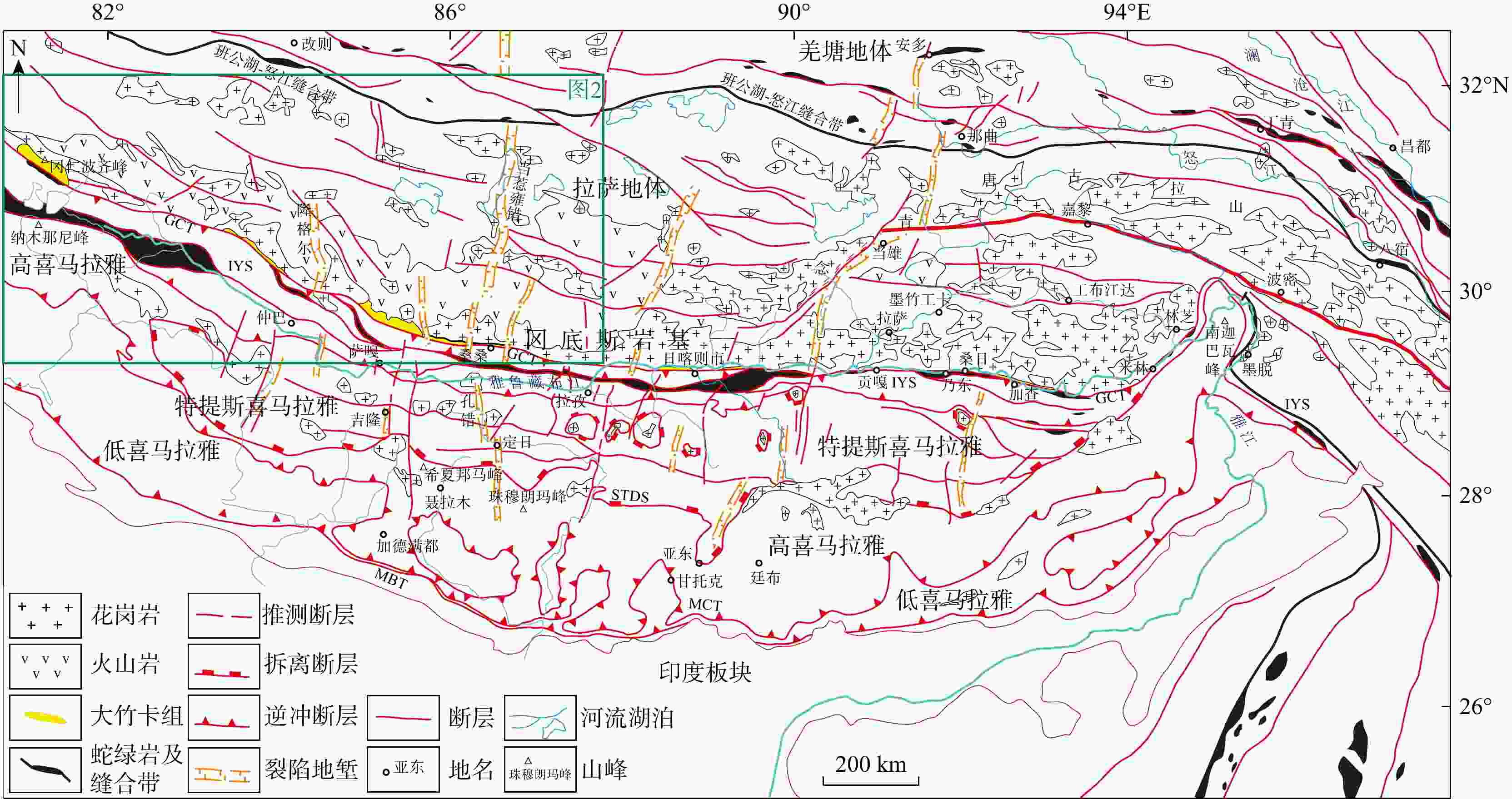
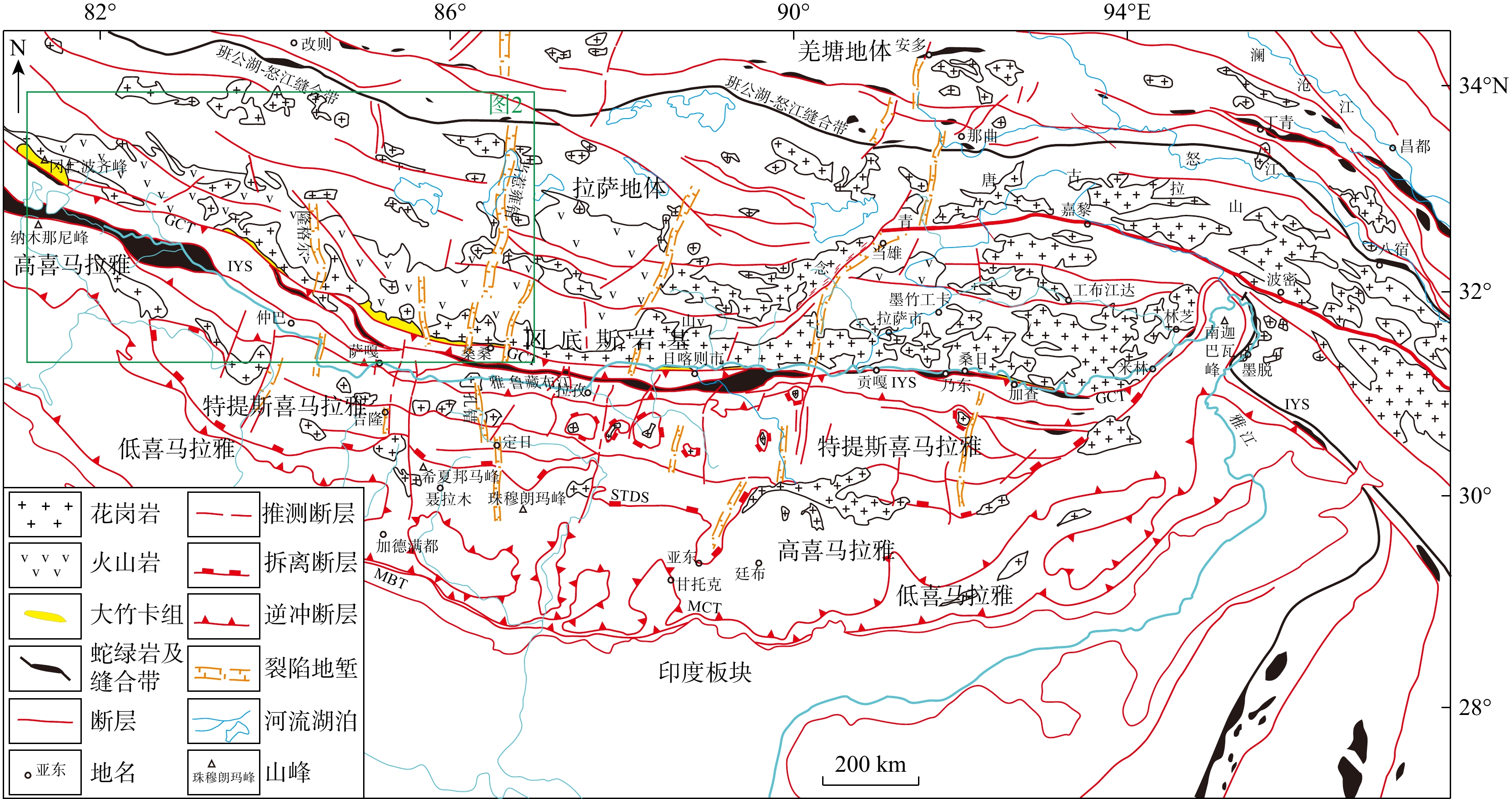
图 1 西藏南部构造简图(据文献[12])
IYS. 雅鲁藏布缝合带;GCT. 大反冲断裂;STDS. 藏南拆离系;MCT. 主中央逆冲断裂;MBT. 主边界逆冲断裂;下同
Figure 1. Tectonic map of southern Xizang
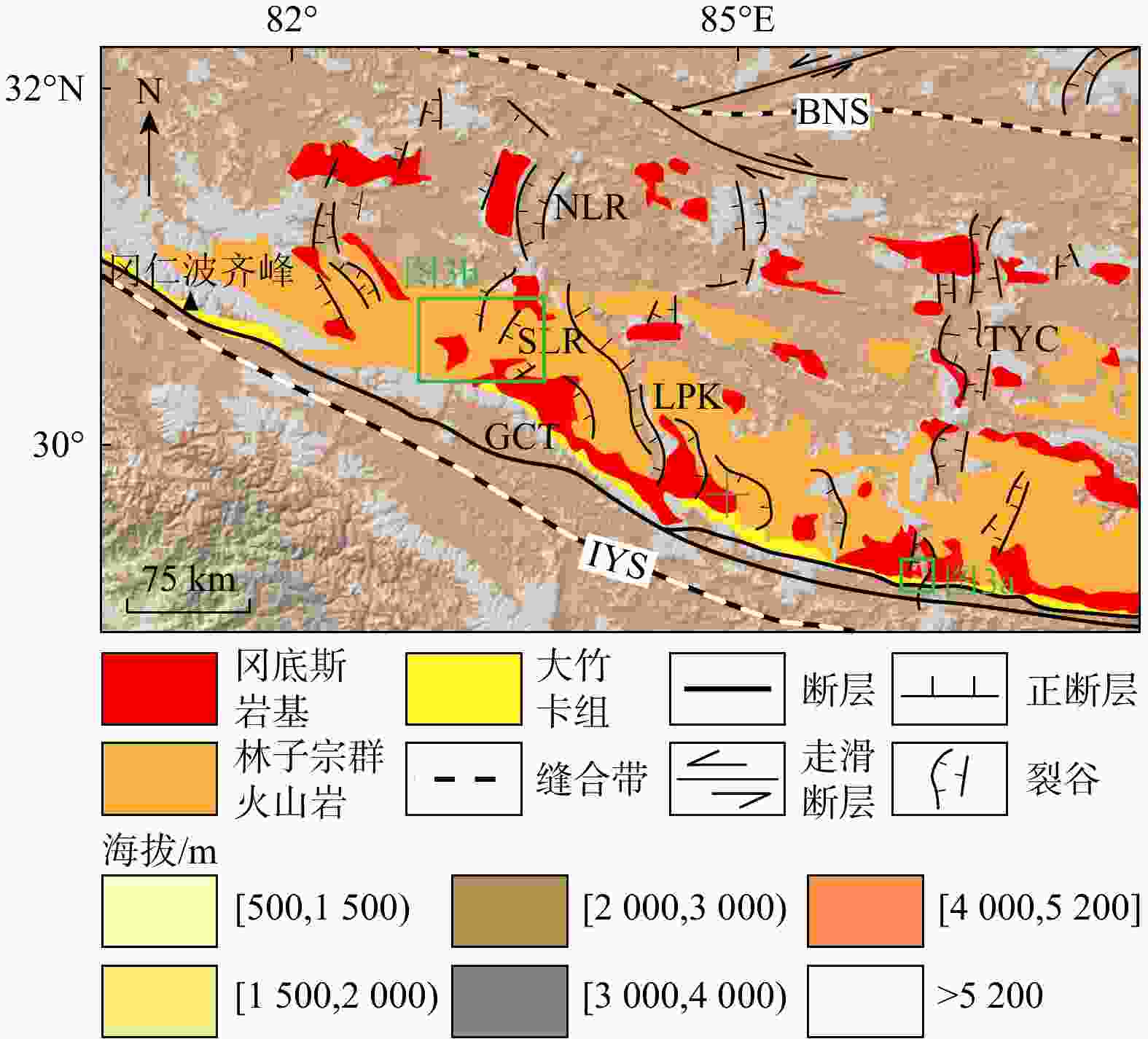
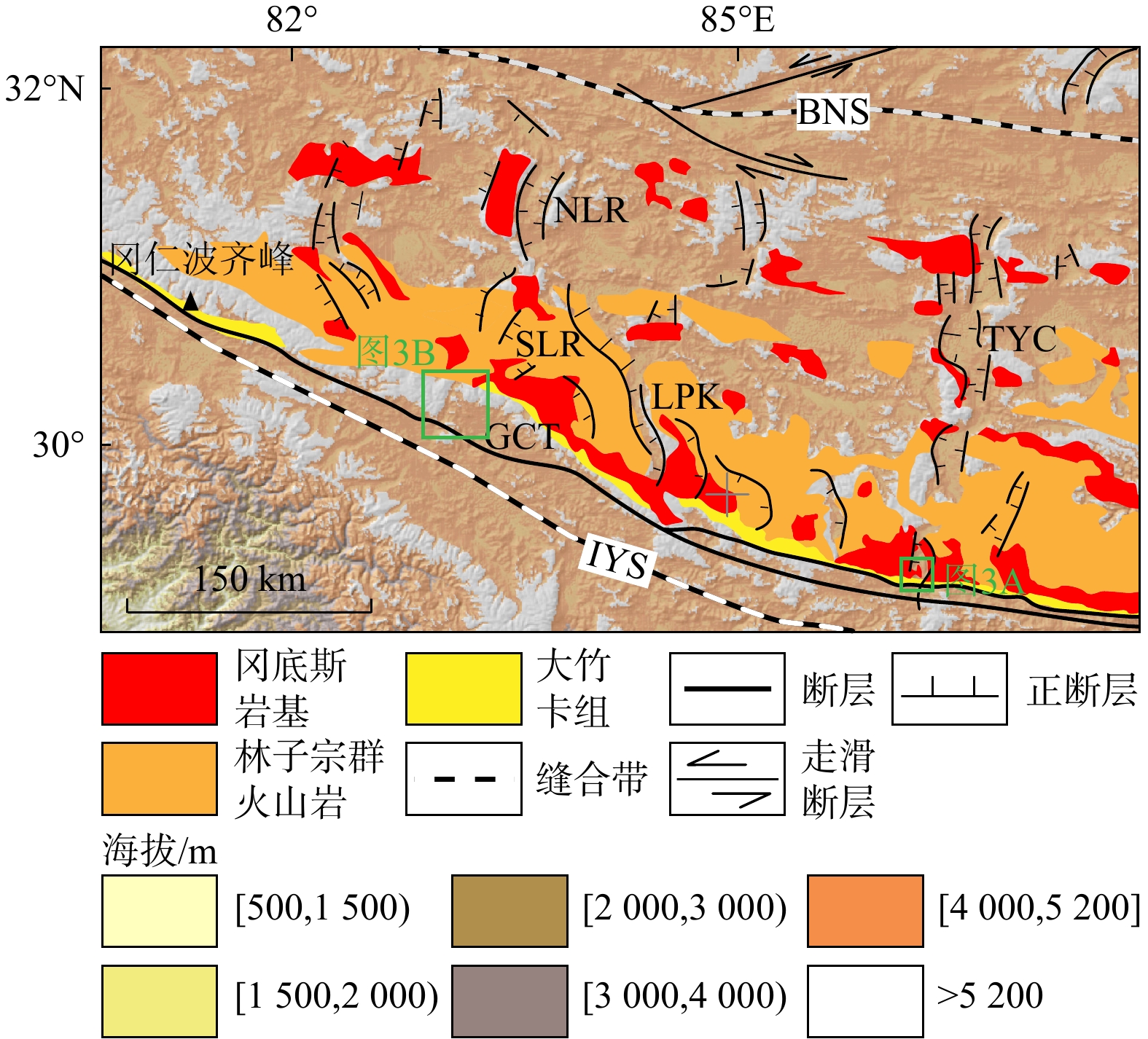
图 2 拉萨地体西部SN向裂谷及主要新生代岩石地层单元示意图
BNS. 班公湖−怒江缝合带;NLR. 北隆格尔裂谷;SLR. 南隆格尔裂谷;LPK. 冷布岗日裂谷;TYC. 当惹雍错裂谷
Figure 2. Schematic diagram of north-south rift systems and major Cenozoic lithostratigraphic units in western Lhasa terrane
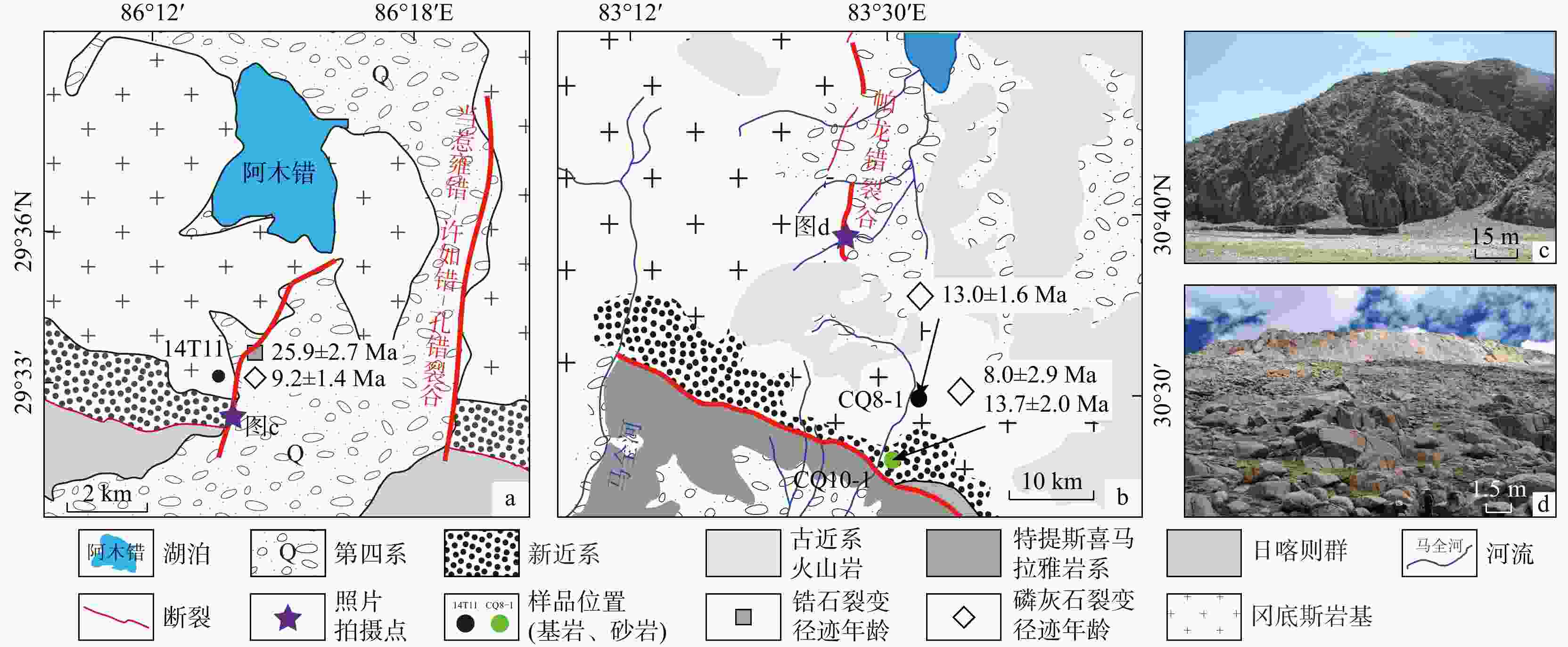
图 3 研究区地质简图(a, b)及野外照片(c, d)
a. 许如错裂谷南段;b. 帕龙错裂谷南段;c. 许如错断裂切断了大竹卡组砾岩(镜头朝西);d. 帕龙错南端形成的近直立断层崖(镜头朝西)
Figure 3. Simplified geological maps (a, b) and field photographs (c, d) of study area
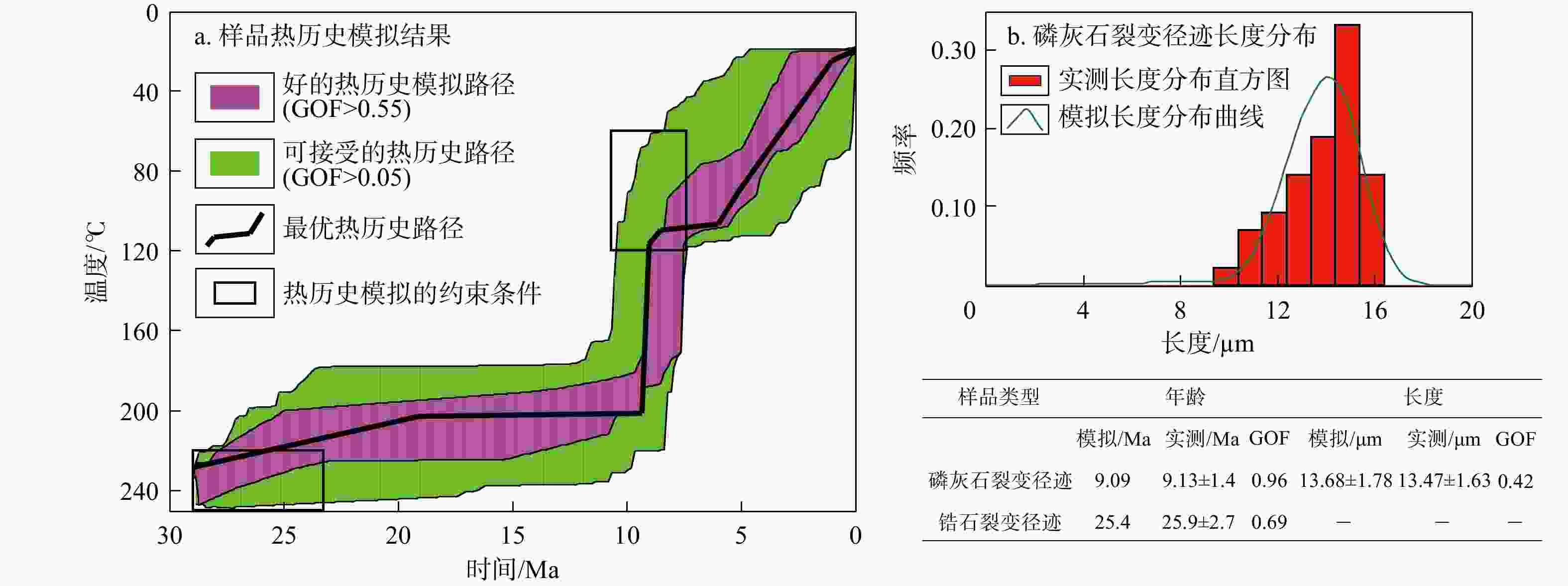
图 4 裂变径迹样品14T11 HeFTy热历史模拟结果(GOF为拟合优度)
Figure 4. HeFTy thermal-history modeling results for fission-track sample 14T11
表 1 碎屑磷灰石裂变径迹数据
Table 1. Detrital apatite fission-track data
样品编号 海拔/m 岩性 N 年龄范围/Ma P(χ2)/% D/% 年龄峰值P1 年龄峰值P2 中心年龄/Ma 年龄/Ma 占比/% 年龄/Ma 占比/% CQ10-1 4923 砂岩 100 31.1~4.4 7.0 20.6 8.0±2.9 25.6 13.7±2.0 74.4 12.1±1.0 注:N为样品测试颗粒数;P(χ2)为自由度υ=N−1时χ2的概率值,当P(χ2)>5%,裂变径迹年龄代表单一组分年龄,否则为多组分年龄; D为年龄离散指数;下同  下载: 导出CSV
表 2 花岗岩锆石裂变径迹数据
Table 2. Zircon fission-track data of granite sample
样品编号 海拔/m 岩性 ρs/(条·cm−2) Ns ρi/(条·cm−2) Ni ρd/(条·cm−2) Nd N P(χ2)/% 池年龄±2σ/Ma w(U)±2σ/10−6 14T11 4935 闪长岩 3.25×10⁶ 1017 1.99×10⁶ 624 2.54×10⁵ 3162 20 88.7 25.9±2.7 393±33 注:ρs和Ns分别为自发裂变径迹密度和径迹条数;ρi和Ni分别为诱发裂变径迹密度和径迹条数;ρd和Nd分别为标准玻璃径迹密度和径迹条数;2σ 为2倍标准偏差;下同
下载: 导出CSV
表 3 花岗岩磷灰石裂变径迹数据
Table 3. Apatite fission-track data of granite samples
样品编号 海拔/m 岩性 ρs/(条·cm−2) Ns ρi/(条·cm−2) Ni ρd/(条·cm−2) Nd N P(χ2)/% 池年龄±2σ/Ma w(U)±2σ/10−6 n MTL ± 1σ/μm 标准偏差/μm CQ8-1 5035 花岗岩 2.56×10⁵ 328 2.94×10⁶ 3760 1.21×10⁶ 4101 20 79.3 13.0±1.6 37±2 11 13.84±0.4 1.40 14T11 4935 闪长岩 1.97×10⁵ 184 2.90×10⁶ 2703 1.09×10⁶ 3474 25 93.8 9.2±1.4 40±2 42 13.47±0.3 1.63 注:n为裂变径迹长度测试条数;MTL为平均径迹长度;1σ为1倍标准偏差;σ为平均径迹长度标准差
下载: 导出CSV
-
[1] DING L, KAPP P, CAI F L, et al. Timing and mechanisms of Tibetan Plateau uplift[J]. Nature Reviews Earth & Environment, 2022, 3(10): 652-667. doi: 10.1038/s43017-022-00318-4 [2] KAPP P, DECELLES P G. Mesozoic-Cenozoic geological evolution of the Himalayan-Tibetan orogen and working tectonic hypotheses[J]. American Journal of Science, 2019, 319(3): 159-254. doi: 10.2475/03.2019.01 [3] TAPPONNIER P, XU Z Q, ROGER F, et al. Oblique stepwise rise and growth of the Tibet Plateau[J]. Science, 2001, 294(5547): 1671-1677. doi: 10.1126/science.105978 [4] YIN A, HARRISON T M. Geologic evolution of the Himalayan-Tibetan orogen[J]. Annual Review of Earth and Planetary Sciences, 2000, 28: 211-280. doi: 10.1146/annurev.earth.28.1.211 [5] 王先彦, 于洋. 试论河流地貌学的新进展和趋势[J]. 地质科技通报, 2024, 43(1): 150-159. doi: 10.19509/j.cnki.dzkq.tb20220259WANG X Y, YU Y. Progress in fluvial geomorphology and trend: A brief review[J]. Bulletin of Geological Science and Technology, 2024, 43(1): 150-159. (in Chinese with English abstract) doi: 10.19509/j.cnki.dzkq.tb20220259 [6] FENG J K, YAO H J, CHEN L, et al. Massive lithospheric delamination in southeastern Tibet facilitating continental extrusion[J]. National Science Review, 2022, 9(4): nwab174. doi: 10.1093/nsr/nwab174 [7] 张进江, 丁林. 青藏高原东西向伸展及其地质意义[J]. 地质科学, 2003, 38(2): 179-189. doi: 10.3321/j.issn:0563-5020.2003.02.005ZHANG J J, DING L. East-west extension in Tibetan Plateau and its significance to tectonic evolution[J]. Chinese Journal of Geology (Scientia Geologica Sinica), 2003, 38(2): 179-189. (in Chinese with English abstract) doi: 10.3321/j.issn:0563-5020.2003.02.005 [8] STYRON R, TAYLOR M, SUNDELL K. Accelerated extension of Tibet linked to the northward underthrusting of Indian crust[J]. Nature Geoscience, 2015, 8(2): 131-134. doi: 10.1038/ngeo2336 [9] TAYLOR M, YIN A, RYERSON F J, et al. Conjugate strike-slip faulting along the Bangong-Nujiang suture zone accommodates coeval east-west extension and north-south shortening in the interior of the Tibetan Plateau[J]. Tectonics, 2003, 22(4): 2002TC001361. doi: 10.1029/2002TC001361 [10] 张星宇, 杜劲松, 陈超, 等. 青藏高原挠曲均衡重力异常特征及其地质意义[J]. 地质科技通报, 2023, 42(2): 223-233. doi: 10.19509/j.cnki.dzkq.tb20220621ZHANG X Y, DU J S, CHEN C, et al. Characteristics of flexural isostatic gravity anomalies in the Tibetan Plateau and its geological significances[J]. Bulletin of Geological Science and Technology, 2023, 42(2): 223-233. (in Chinese with English abstract) doi: 10.19509/j.cnki.dzkq.tb20220621 [11] 张佳伟, 李汉敖, 张会平, 等. 青藏高原新生代南北走向裂谷研究进展[J]. 地球科学进展, 2020, 35(8): 848-862.ZHANG J W, LI H A, ZHANG H P, et al. Research progress in Cenozoic N-S striking rifts in Tibetan Plateau[J]. Advances in Earth Science, 2020, 35(8): 848-862. (in Chinese with English abstract) [12] 王国灿, 曹凯, 张克信, 等. 青藏高原新生代构造隆升阶段的时空格局[J]. 中国科学: 地球科学, 2011, 41(3): 332-349.WANG G C, CAO K, ZHANG K X, et al. Spatio-temporal framework of tectonic uplift stages of the Tibetan Plateau in Cenozoic[J]. Science China Earth Sciences, 2011, 54: 29-40. (in Chinese with English abstract) [13] 卞爽. 印度板块拆离及其对青藏高原后碰撞构造变形的效应[D]. 杭州: 浙江大学, 2021.BIAN S. Effect of Indian slab detachment on the post-collisional tectonics in the Tibetan Plateau[D]. Hangzhou: Zhejiang University, 2021. (in Chinese with English abstract) [14] MOLNAR P, TAPPONNIER P. Cenozoic tectonics of Asia: Effects of a continental collision: Features of recent continental tectonics in Asia can be interpreted as results of the India-Eurasia collision[J]. Science, 1975, 189(4201): 419-426. doi: 10.1126/science.189.4201.419 [15] ZHANG P Z, SHEN Z K, WANG M, et al. Continuous deformation of the Tibetan Plateau from global positioning system data[J]. Geology, 2004, 32(9): 809. doi: 10.1130/G20554.1 [16] KAPP P, TAYLOR M, STOCKLI D, et al. Development of active low-angle normal fault systems during orogenic collapse: Insight from Tibet[J]. Geology, 2008, 36(4): 336. doi: 10.1130/0091-7613(2008)36[336:doalnf]2.0.co;2 [17] CLARK M K, FARLEY K A, ZHENG D W, et al. Early Cenozoic faulting of the northern Tibetan Plateau margin from apatite (U-Th)/He ages[J]. Earth and Planetary Science Letters, 2010, 296(1/2): 78-88. doi: 10.1016/j.epsl.2010.04.051 [18] LI J T, SONG X D. Tearing of Indian mantle lithosphere from high-resolution seismic images and its implications for lithosphere coupling in southern Tibet[J]. Proceedings of the National Academy of Sciences of the United States of America, 2018, 115(33): 8296-8300. [19] CHEN Y, LI W, YUAN X H, et al. Tearing of the Indian lithospheric slab beneath southern Tibet revealed by SKS-wave splitting measurements[J]. Earth and Planetary Science Letters, 2015, 413: 13-24. doi: 10.1016/j.epsl.2014.12.041 [20] WOLFF R, HETZEL R, DUNKL I, et al. High-angle normal faulting at the Tangra Yumco graben (southern Tibet) since ~15 Ma[J]. The Journal of Geology, 2019, 127(1): 15-36. doi: 10.1086/700406 [21] LEE J, HAGER C, WALLIS S R, et al. Middle to Late Miocene extremely rapid exhumation and thermal reequilibration in the Kung Co rift, southern Tibet[J]. Tectonics, 2011, 30(2): 2010TC002745. doi: 10.1029/2010TC002745 [22] MAHÉO G, LELOUP P H, VALLI F, et al. Post 4 Ma initiation of normal faulting in southern Tibet. Constraints from the Kung Co half graben[J]. Earth and Planetary Science Letters, 2007, 256(1/2): 233-243. doi: 10.1016/j.epsl.2007.01.029 [23] STYRON R H, TAYLOR M H, SUNDELL K E, et al. Miocene initiation and acceleration of extension in the South Lunggar rift, western Tibet: Evolution of an active detachment system from structural mapping and (U-Th)/He thermochronology[J]. Tectonics, 2013, 32(4): 880-907. doi: 10.1002/tect.20053 [24] SUNDELL K E, TAYLOR M H, STYRON R H, et al. Evidence for constriction and Pliocene acceleration of east-west extension in the North Lunggar rift region of west central Tibet[J]. Tectonics, 2013, 32(5): 1454-1479. doi: 10.1002/tect.20086 [25] MALUSÀ M G, FITZGERALD P G. Fission-track thermochronology and its application to geology[M]. Cham: Springer International Publishing, 2019. [26] KETCHAM R A. Forward and inverse modeling of low-temperature thermochronometry data[J]. Reviews in Mineralogy and Geochemistry, 2005, 58(1): 275-314. [27] YIN A. Mode of Cenozoic east-west extension in Tibet suggesting a common origin of rifts in Asia during the Indo-Asian collision[J]. Journal of Geophysical Research: Solid Earth, 2000, 105(B9): 21745-21759. doi: 10.1029/2000JB900168 [28] 贺日政, 高锐. 西藏高原南北向裂谷研究意义[J]. 地球物理学进展, 2003, 18(1): 35-43. doi: 10.3969/j.issn.1004-2903.2003.01.006HE R Z, GAO R. Some significances of studying north-southern rift in Tibet Plateau[J]. Progress in Geophysics, 2003, 18(1): 35-43. (in Chinese with English abstract) doi: 10.3969/j.issn.1004-2903.2003.01.006 [29] HOU Z Q, LIU L J, ZHANG H J, et al. Cenozoic eastward growth of the Tibetan Plateau controlled by tearing of the Indian slab[J]. Nature Geoscience, 2024, 17(3): 255-263. doi: 10.1038/s41561-024-01382-9 [30] 侯增谦, 曲晓明, 杨竹森, 等. 青藏高原碰撞造山带: Ⅲ. 后碰撞伸展成矿作用[J]. 矿床地质, 2006, 25(6): 629-651. doi: 10.3969/j.issn.0258-7106.2006.06.001HOU Z Q, QU X M, YANG Z S, et al. Metallogenesis in Tibetan collisional orogenic belt: Ⅲ. Mineralization in post-collisional extension setting[J]. Mineral Deposits, 2006, 25(6): 629-651. (in Chinese with English abstract) doi: 10.3969/j.issn.0258-7106.2006.06.001 [31] BIAN S, GONG J F, ZUZA A V, et al. Along-strike variation in the initiation timing of the north-trending rifts in southern Tibet as revealed from the Yadong-Gulu rift[J]. Tectonics, 2022, 41(7): e2021TC007091. doi: 10.1029/2021TC007091 [32] BIAN S, GONG J F, ZUZA A V, et al. Late Pliocene onset of the Cona rift, eastern Himalaya, confirms eastward propagation of extension in Himalayan-Tibetan orogen[J]. Earth and Planetary Science Letters, 2020, 544: 116383. doi: 10.1016/j.epsl.2020.116383 [33] SHEN T Y, WANG G C, VAN DER BEEK P, et al. Impacts of Late Miocene normal faulting on Yarlung Tsangpo River evolution, southeastern Tibet[J]. GSA Bulletin, 2022, 134(11/12): 3142-3154. doi: 10.1130/gsab.s.19149074 [34] WOLFF R, HETZEL R, HÖLZER K, et al. Rift propagation in south Tibet controlled by under-thrusting of India: A case study of the Tangra Yumco graben (South Tibet)[J]. Journal of the Geological Society, 2023, 180(2): jgs2022-090. doi: 10.5194/egusphere-egu23-1407 [35] CHUNG S L, CHU M F, ZHANG Y Q, et al. Tibetan tectonic evolution inferred from spatial and temporal variations in post-collisional magmatism[J]. Earth-Science Reviews, 2005, 68(3/4): 173-196. doi: 10.1016/j.earscirev.2004.05.001 [36] NOMADE S, RENNE P R, MO X X, et al. Miocene volcanism in the Lhasa block, Tibet: Spatial trends and geodynamic implications[J]. Earth and Planetary Science Letters, 2004, 221(1/2/3/4): 227-243. doi: 10.1016/s0012-821x(04)00072-x [37] CHUNG S L, CHU M F, JI J Q, et al. The nature and timing of crustal thickening in southern Tibet: Geochemical and zircon Hf isotopic constraints from postcollisional adakites[J]. Tectonophysics, 2009, 477(1/2): 36-48. [38] COPELAND P, MARK HARRISON T, KIDD W S F, et al. Rapid Early Miocene acceleration of uplift in the Gangdese belt, Xizang (southern Tibet), and its bearing on accommodation mechanisms of the India-Asia collision[J]. Earth and Planetary Science Letters, 1987, 86(2/3/4): 240-252. doi: 10.1016/0012-821x(87)90224-x [39] COPLEY A, AVOUAC J P, WERNICKE B P. Evidence for mechanical coupling and strong Indian lower crust beneath southern Tibet[J]. Nature, 2011, 472(7341): 79-81. doi: 10.1038/nature09926 [40] AGIUS M R, LEBEDEV S. Tibetan and Indian lithospheres in the upper mantle beneath Tibet: Evidence from broadband surface-wave dispersion[J]. Geochemistry, Geophysics, Geosystems, 2013, 14(10): 4260-4281. -

 下载:


 点击查看大图
计量
- 文章访问数: 328
- PDF下载量: 25
- 被引次数: 0