投审稿入口
投审稿入口


A rugged seabed signal compensation method based on W transform compressive sensing framework
-
摘要:
南海北部琼东南盆地海底地形复杂,横跨浅海、陆架坡折、深海海域。在崎岖海底附近发育了多个潜力目标,是发现储量的重点区带。然而深水崎岖海底下方地震资料振幅、频率失真,与陆地采集的地震资料差距较大,传统的信号补偿方法很难有效处理这类数据。为了得到高品质的地震资料,准确评价崎岖海底下方目标,亟需开发一种合理有效的补偿方法。本研究设计了基于W变换的压缩感知补偿框架,通过构建参考道与目标道之间的补偿矩阵,快速实现地震资料的振幅补偿;引入稀疏变换正则化方法,保证补偿资料的高信噪比,提高地震资料的质量。利用本方法对南海北部复合崎岖海底地震数据进行了信号补偿处理,补偿后的地震数据剖面能量分布一致性得到了较好的改善。本次信号补偿处理的成功应用证明了方法的可行性,可为类似地震资料的信号补偿处理提供借鉴。
Abstract:The Qiongdongnan Basin, situated in the northern part of the South China Sea, is a geologically significant and resource-rich marine area, characterized by extremely complex seabed topography that transitions seamlessly across shallow coastal waters, gently sloping continental shelves, steep shelf break zones, and abyssal deep-sea basins. Within this basin, the vicinities of the rugged and uneven seabed-marked by abrupt topographic variations such as submerged ridges, fault scarps, and scattered seamounts-have emerged as key exploration zones, as geological surveys and preliminary prospecting have identified a multitude of potential hydrocarbon and mineral reserve targets in these sub-seabed formations. However, the amplitude and frequency of seismic data under the rugged seabed in deep water are distorted, and there is a large gap between the seismic data collected on land and that under the rugged seabed. Traditional signal compensation methods fail to effectively process such data.
ObjectiveIn order to obtain high-quality seismic data and accurately evaluate targets under the rugged seabed, it is urgent to develop a reasonable and effective compensation method.
MethodsInspired by time-frequency analysis and compressive sensing methods, this paper designed a compressive sensing compensation framework based on W transform. By constructing the compensation matrix between the reference trace and the target trace, the amplitude compensation of seismic data was rapidly achieved in a single step. The sparse transform regularization method was introduced to ensure the high signal-to-noise ratio of the compensation data and improve the quality of the seismic data.
ResultsThis method was used to compensate the seismic data under complex rugged seabed conditions in the northern part of the South China Sea, and the consistency of the energy distribution of the seismic data profile after compensation was effectively improved.
ConclusionThe successful application of the signal compensation processing demonstrates the feasibility of the method and provides a reference for the signal compensation processing of similar seismic data.
-

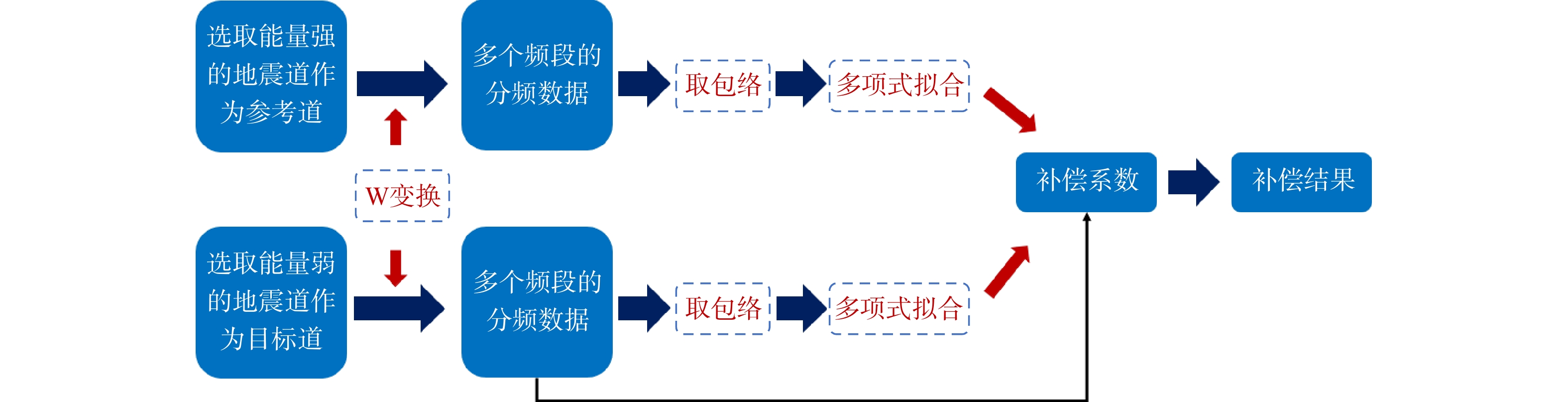
图 1 基于W变换压缩感知框架的信号补偿方法流程图
Figure 1. Flowchart of signal compensation method based on W-transform compressive sensing framework

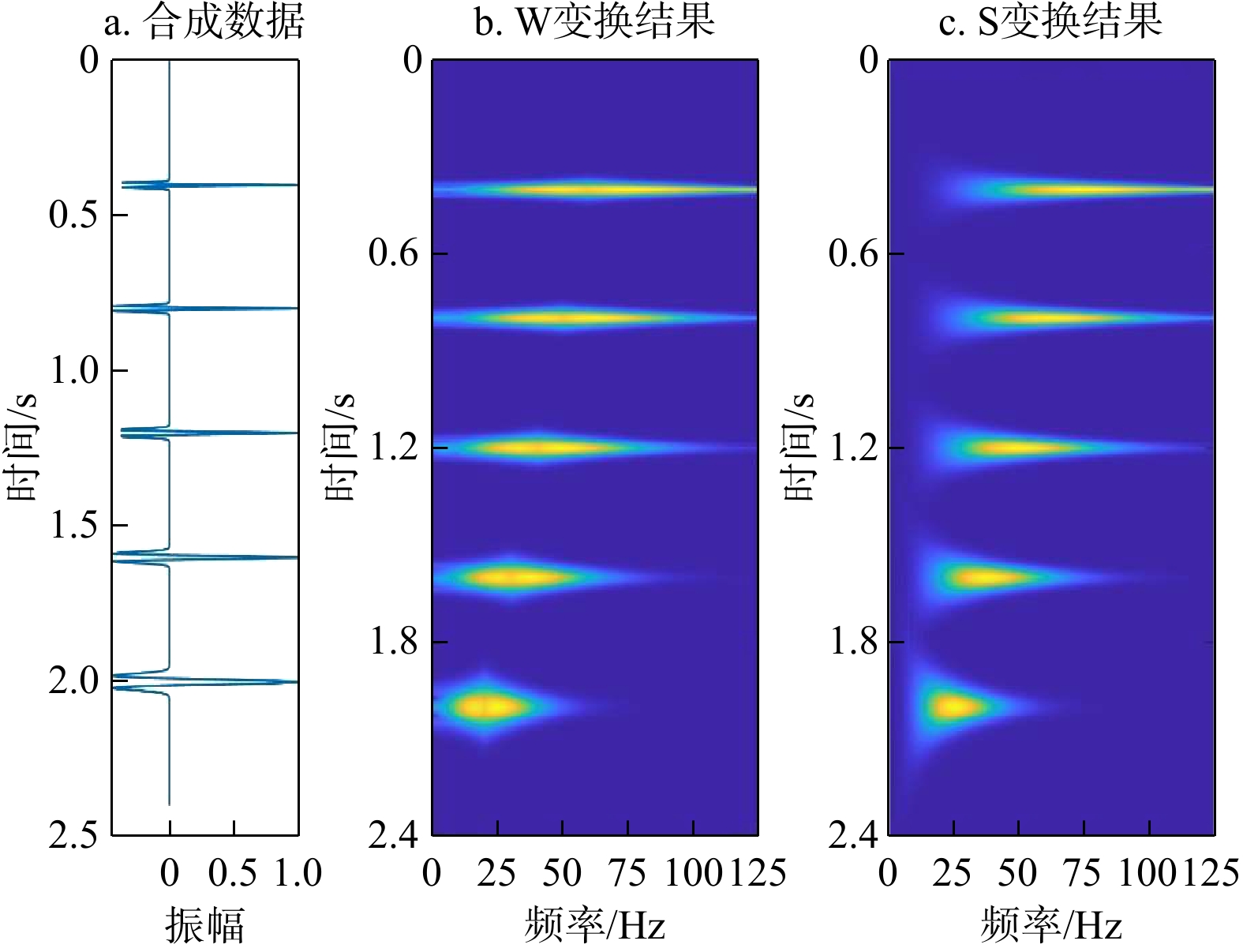
图 2 W变换和S变换的时频分析结果
Figure 2. Time-frequency analysis results of W transform and S transform

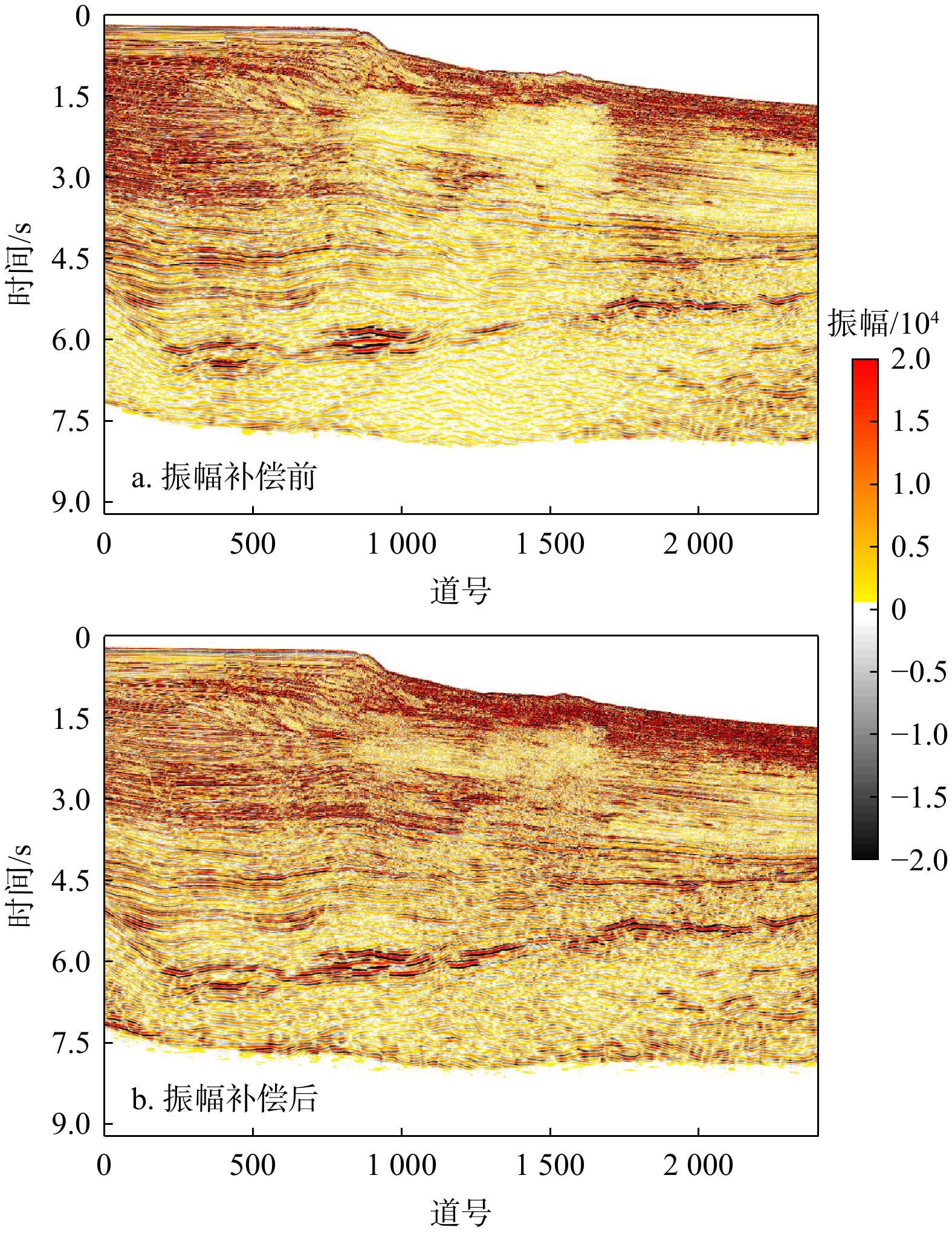
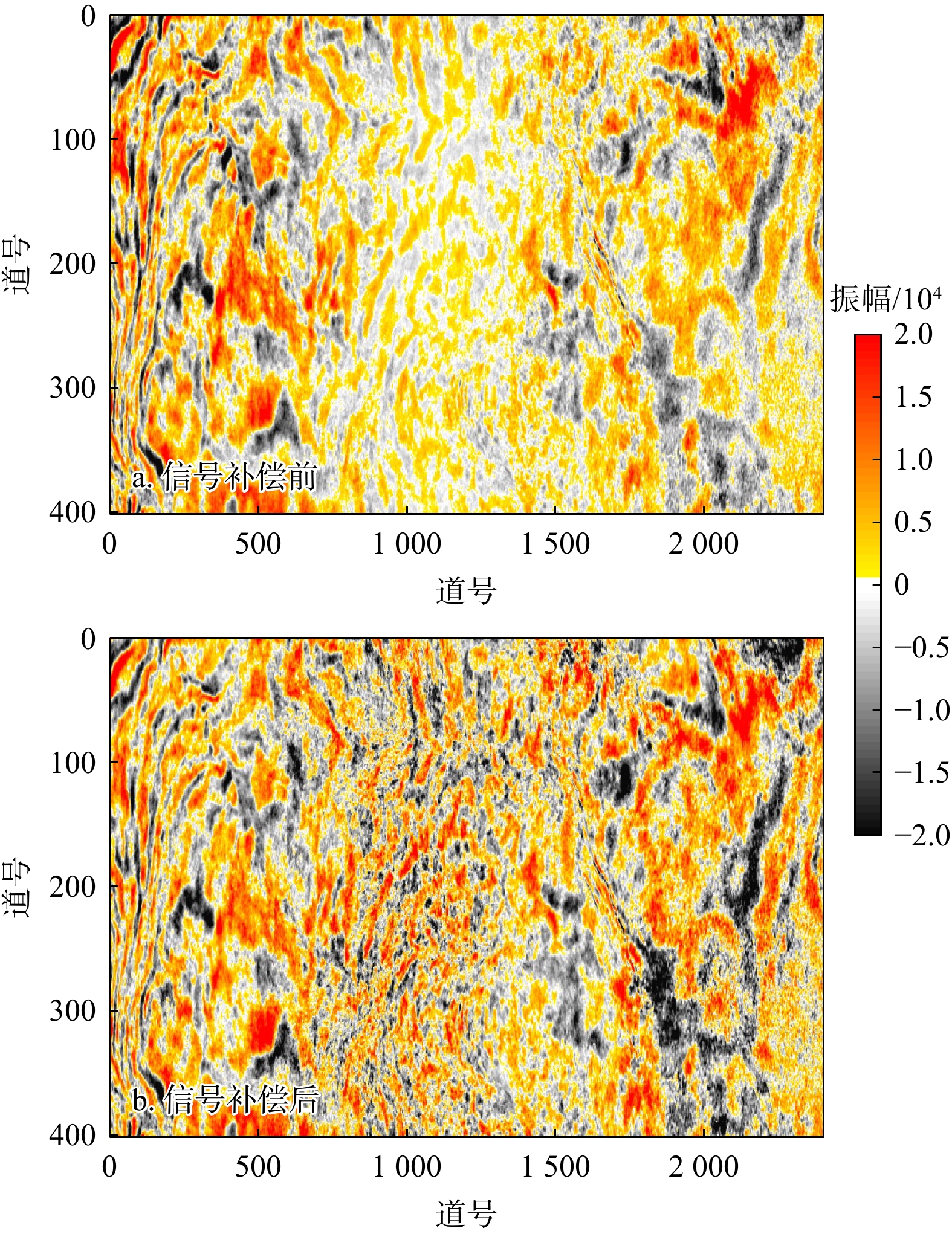
图 3 振幅补偿前后地震剖面对比图(采样间隔2 ms;下同)
Figure 3. Seismic profiles before and after compensation

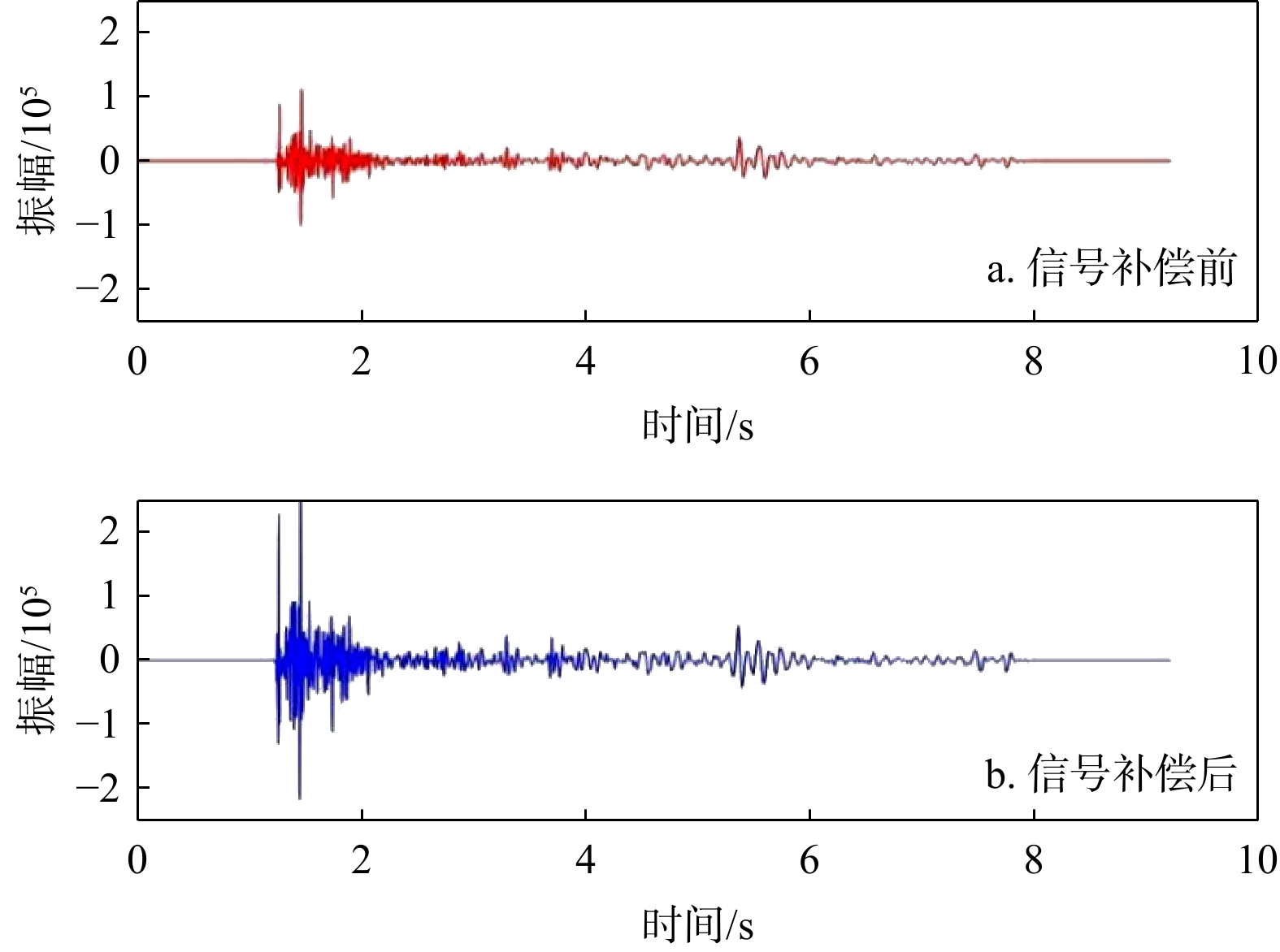
图 4 信号补偿前(a)、后(b)时域对比图
Figure 4. Time-domain comparison before and after signal compensation

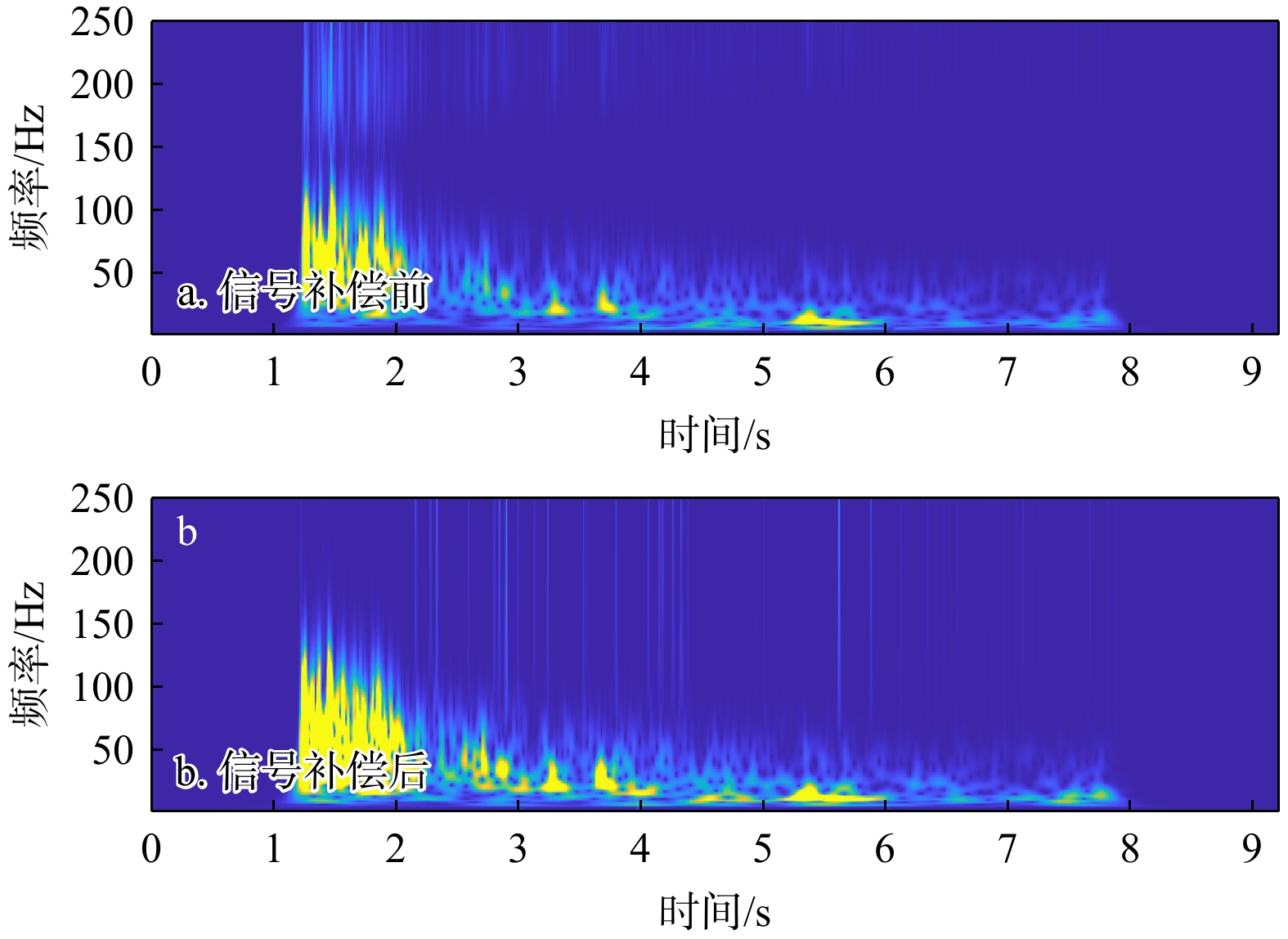
图 6 信号补偿前(a)、后(b)时频谱对比图
Figure 6. Comparison of time-frequency spectra before and after signal compensation

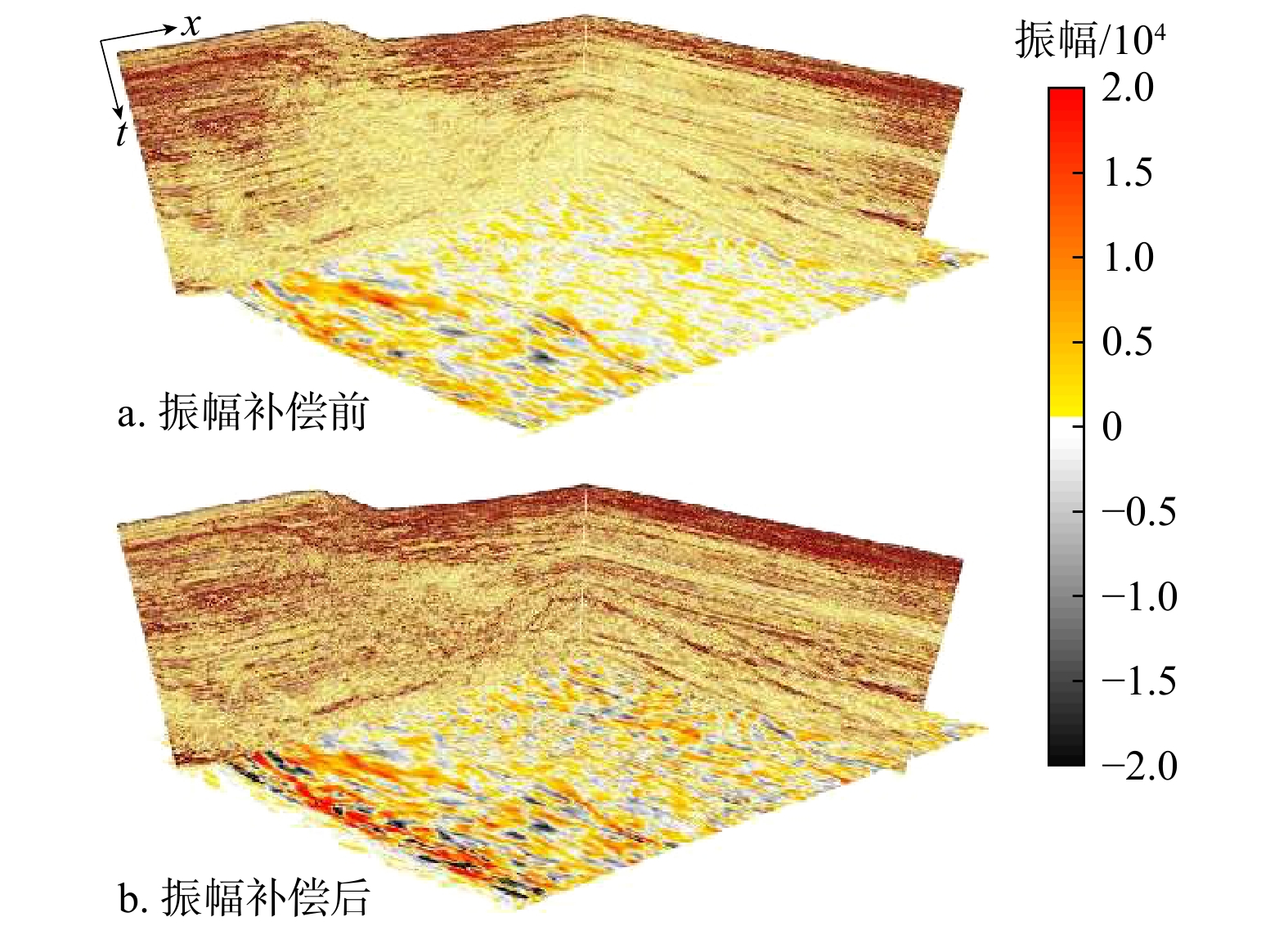
图 7 信号补偿前后时间切片对比图
Figure 7. Comparison of time slices before and after signal compensation
-
[1] 朱伟林, 崔旱云, 吴培康, 等. 被动大陆边缘盆地油气勘探新进展与展望[J]. 石油学报, 2017, 38(10): 1099-1109.ZHU W L, CUI H Y, WU P K, et al. New development and outlook for oil and gas exploration in passive continental margin basins[J]. Acta Petrolei Sinica, 2017, 38(10): 1099-1109. (in Chinese with English abstract [2] 张功成, 米立军, 吴时国, 等. 深水区——南海北部大陆边缘盆地油气勘探新领域[J]. 石油学报, 2007, 28(2): 15-21.ZHANG G C, MI L J, WU S G, et al. Deepwater area: The new prospecting targets of northern continental margin of South China Sea[J]. Acta Petrolei Sinica, 2007, 28(2): 15-21. (in Chinese with English abstract [3] 马玲, 褚梦凡, 包锐. 浅谈南海天然气水合物分解、甲烷转化及衍生碳的埋藏[J]. 地质科技通报, 2025, 44(6): 281-291.MA L, CHU M F, BAO R. Gas hydrate decomposition, methane conversion and burial of methane-derived carbon in the South China Sea[J]. Bulletin of Geological Science and Technology, 2025, 44(6): 281-291. (in Chinese with English abstract [4] 江汝锋, 曹立成, 邓孝亮, 等. 琼东南盆地宝岛21-1区陵水组沉积特征及其油气地质意义[J]. 地质科技通报, 2024, 43(5): 31-44.JIANG R F, CAO L C, DENG X L, et al. Sedimentary characteristics of the Lingshui Formation in the Baodao 21-1 area of the Qiongdongnan Basin and their significance in hydrocarbon ex-ploration[J]. Bulletin of Geological Science and Technology, 2024, 43(5): 31-44. (in Chinese with English abstract [5] 杨东升, 赵志刚, 杨海长, 等. 深水崎岖海底区构造解释与圈闭落实: 以琼东南盆地深水区宝岛凹陷为例[J]. 石油学报, 2018, 39(7): 767-774.YANG D S, ZHAO Z G, YANG H C, et al. Structural interpretation and trap definition in the deep-water rugged seabed area: A case of Baodao Sag, deep-water area of Qiongdongnan Basin[J]. Acta Petrolei Sinica, 2018, 39(7): 767-774. (in Chinese with English abstract [6] 邓志勇, 张治忠, 廖显锋, 等. 深水崎岖海底地震资料问题及处理对策: 以南海L盆地二维地震重处理为例[J]. 地球物理学进展, 2015, 30(3): 1410-1417.DENG Z Y, ZHANG Z Z, LIAO X F, et al. Challenges and resolution on seismic processing of rugged bathy area: An instance of 2D seismic reprocessing on L Basin, South China Sea[J]. Progress in Geophysics, 2015, 30(3): 1410-1417. (in Chinese with English abstract [7] 杨凯, 李列. 深水崎岖海底对下伏地层反射波特征的影响分析[J]. 工程地球物理学报, 2010, 7(1): 1-6.YANG K, LI L. The effect of rough deep sea bottom on characters of seismic wave in underlying reflectors[J]. Chinese Journal of Engineering Geophysics, 2010, 7(1): 1-6. (in Chinese with English abstract [8] 刘志强, 黄磊, 李钢柱, 等. 崎岖海底对下伏水平地层反射波特征的影响[J]. 吉林大学学报(地球科学版), 2023, 53(1): 274-282.LIU Z Q, HUANG L, LI G Z, et al. Effects of rugged seabed on reflection wave characteristics of underlying horizontal strata[J]. Journal of Jilin University (Earth Science Edition), 2023, 53(1): 274-282. (in Chinese with English abstract [9] 孙章庆, 汪登科, 韩复兴. 复杂海底各种地震波的射线追踪与运动学特征[J]. 吉林大学学报(地球科学版), 2019, 49(4): 1169-1181.SUN Z Q, WANG D K, HAN F X. Ray tracing and kinematic characteristics of different types of seismic waves in complex seabed[J]. Journal of Jilin University (Earth Science Edition), 2019, 49(4): 1169-1181. (in Chinese with English abstract [10] 张振波. 南海北部深水地震勘探所遇到的挑战与对策[J]. 海洋石油, 2015, 35(1): 9-15.ZHANG Z B. Challenges and measures in seismic exploration in northern deepwater area of South China Sea[J]. Offshore Oil, 2015, 35(1): 9-15. (in Chinese with English abstract [11] 王建花, 魏伟, 李绪宣, 等. 深水崎岖海底对下伏地层地震成像的影响研究[J]. 地球物理学进展, 2012, 27(2): 702-708.WANG J H, WEI W, LI X X, et al. The effects of the deep rough seafloor on seismic imaging by focal beam analysis[J]. Progress in Geophysics, 2012, 27(2): 702-708. (in Chinese with English abstract [12] WANG Y H. The W transform[J]. Geophysics, 2021, 86(1): 31-39. doi: 10.1190/geo2020-0316.1 [13] 刘可, 尹成. 地震数据低频补偿方法研究及应用[J]. 中国石油和化工标准与质量, 2019, 39(19): 151-152.LIU K, YIN C. Research and application of low frequency compensation method for seismic data[J]. China Petroleum and Chemical Standard and Quality, 2019, 39(19): 151-152. (in Chinese) [14] 王仰华, 饶莹, 赵振聪. 地震数据时频分析的W变换及其改进方法[J]. 石油勘探与开发, 2024, 51(4): 774-782.WANG Y H, RAO Y, ZHAO Z C. The W transform and its improved methods for time-frequency analysis of seismic data[J]. Petroleum Exploration and Development, 2024, 51(4): 774-782. (in Chinese with English abstract [15] 张俊杰, 李景叶, 王守东, 等. 改进型W变换方法及其应用[J]. 石油物探, 2023, 62(3): 498-506.ZHANG J J, LI J Y, WANG S D, et al. A time frequency method of seismic wave based on W Transform[J]. Geophysical Prospecting for Petroleum, 2023, 62(3): 498-506. (in Chinese with English abstract [16] 李雷, 王祥春, 刘梦灵, 等. 压缩感知提频技术在莺琼盆地W1井区地震资料处理中的应用[J]. 地质学报, 2024, 98(6): 1918-1927.LI L, WANG X C, LIU M L, et al. Application of compressed sensing frequency lifting method in seismic data processing of Well W1 in the Yingqiong Basin[J]. Acta Geologica Sinica, 2024, 98(6): 1918-1927. (in Chinese with English abstract [17] 廖文婷, 郭廷超, 许冲, 等. 压缩感知拓频技术在SHB地区应用[J]. 复杂油气藏, 2024, 17(2): 169-173.LIAO W T, GUO T C, XU C, et al. Application of compressed sensing frequency extension technology in the SHB area[J]. Complex Hydrocarbon Reservoirs, 2024, 17(2): 169-173. (in Chinese with English abstract [18] 李才, 陈文雄, 李芳, 等. 基于压缩感知的地震弱反射融合重构技术研究及应用[J]. 地球物理学进展, 2025, 40(1): 387-397.LI C, CHEN W X, LI F, et al. Research and application of seismic weak reflection fusion reconstruction technology based on compressed sensing[J]. Progress in Geophysics, 2025, 40(1): 387-397. (in Chinese with English abstract [19] 董烈乾, 周恒, 桑运云, 等. 基于压缩感知的地震数据同时规则化和插值方法[J]. 地球物理学进展, 2025, 40(1): 276-284.DONG L Q, ZHOU H, SANG Y Y, et al. Seismic data regularization and interpolation approach based on compressive sensing principle[J]. Progress in Geophysics, 2025, 40(1): 276-284. (in Chinese with English abstract [20] 李宗杰, 饶莹, 赵振聪, 等. 基于W变换时频分析的超深层栅状储集体识别[J]. 地球物理学报, 2025, 68(4): 1533-541.LI Z J, RAO Y, ZHAO Z C, et al. Delineation of ultra-deep grid-like reservoirs based on W transform[J]. Chinese Journal of Geophysics, 2025, 68(4): 1533-541. (in Chinese with English abstract [21] NEUMANN J, STEIDL G. Dual-tree complex wavelet transform in the frequency domain and an application to signal classification[J]. International Journal of Wavelets, Multiresolution and Information Processing, 2005, 3(1): 43-65. doi: 10.1142/s0219691305000749 [22] KINGSBURY N. Image processing with complex wavelets[J]. Philosophical Transactions: Mathematical, Physical and Engineering Sciences, 1999, 357(1760): 2543-2560. doi: 10.1098/rsta.1999.0447 [23] KINGSBURY N. Complex wavelets for shift invariant analysis and filtering of signals[J]. Applied and Computational Harmonic Analysis, 2001, 10(3): 234-253. doi: 10.1006/acha.2000.0343 [24] FREEMAN W T, ADELSON E H. The design and use of steerable filters[J]. IEEE Transactions on Pattern Analysis and Machine Intelligence, 1991, 13(9): 891-906. doi: 10.1109/34.93808 [25] SIMONCELLI E P, FREEMAN W T, ADELSON E H, et al. Shiftable multiscale transforms[J]. IEEE Transactions on Information Theory, 1992, 38(2): 587-607. doi: 10.1109/18.119725 [26] LEE T S. Image representation using 2D Gabor wavelets[J]. IEEE Transactions on Pattern Analysis and Machine Intelligence, 1996, 18(10): 959-971. doi: 10.1109/34.541406 [27] DONOHO D L. Wedgelets: Nearly minimax estimation of edges[J]. The Annals of Statistics, 1999, 27(3): 859-897. [28] MALLAT S, PEYRÉ G. A review of Bandlet methods for geometrical image representation[J]. Numerical Algorithms, 2007, 44(3): 205-234. doi: 10.1007/s11075-007-9092-4 [29] DO M N, VETTERLI M. The contourlet transform: An efficient directional multiresolution image representation[J]. IEEE Transactions on Image Processing, 2005, 14(12): 2091-2106. doi: 10.1109/TIP.2005.859376 [30] GUO K H, LABATE D. Optimally sparse multidimensional representation using shearlets[J]. SIAM Journal on Mathematical Analysis, 2007, 39(1): 298-318. doi: 10.1137/060649781 [31] DEMANET L, YING L X. Wave atoms and sparsity of oscillatory patterns[J]. Applied and Computational Harmonic Analysis, 2007, 23(3): 368-387. doi: 10.1016/j.acha.2007.03.003 [32] WANG Y H. Multichannel matching pursuit for seismic trace decomposition[J]. Geophysics, 2010, 75(4): V61-V66. doi: 10.1190/1.3462015 [33] LI S J, RAO Y. Seismic low-frequency amplitude analysis for identifying gas reservoirs within thinly layered media[J]. Journal of Geophysics and Engineering, 2020, 17(1): 175-188. doi: 10.1093/jge/gxz099 [34] ASKARI R, FERGUSON R J. Dispersion and the dissipative characteristics of surface waves in the generalized S-transform domain[J]. Geophysics, 2012, 77(1): 11-20. doi: 10.1190/geo2010-0330.1 [35] ABDOLLAHI AGHDAM B, ALI RIAHI M. Application of modified AOGST to study the low frequency shadow zone in a gas reservoir[J]. Journal of Geophysics and Engineering, 2015, 12(5): 770-779. doi: 10.1088/1742-2132/12/5/770 [36] 韩立国, 张莹, 韩利, 等. 基于压缩感知和稀疏反演的地震数据低频补偿[J]. 吉林大学学报(地球科学版), 2012, 42(增刊3): 259-264.HAN L G, ZHANG Y, HAN L, et al. Compressed sensing and sparse inversion based low-frequency information compensation of seismic data[J]. Journal of Jilin University (Earth Science Edition), 2012, 42(S3), 259-264. (in Chinese with English abstract [37] 吕公河, 邸志欣, 霍守东, 等. 基于压缩感知的地震数据采集实践[J]. 石油物探, 2018, 57(6): 831-841.LYU G H, DI Z X, HUO S D, et al. Seismic data acquisition based on compressive sensing[J]. Geophysical Prospecting for Petroleum, 2018, 57(6): 831-841. (in Chinese with English abstract [38] 马坚伟. 压缩感知走进地球物理勘探[J]. 石油物探, 2018, 57(1): 24-27.MA J W. Compressive sensing in geophysical exploration[J]. Geophysical Prospecting for Petroleum, 2018, 57(1): 24-27. (in Chinese with English abstract [39] SUN M M, LI Z C, LIU Y L, et al. Low-frequency expansion approach for seismic data based on compressed sensing in low SNR[J]. Applied Sciences, 2021, 11(11): 5028-5049. doi: 10.3390/app11115028 [40] 夏红敏, 刘兰锋, 张显辉, 等. 地震数据谱反演压缩感知算法实现及应用[J]. 石油地球物理勘探, 2021, 56(2): 295-301. doi: 10.13810/j.cnki.issn.1000-7210.2021.02.011XIA H M, LIU L F, ZHANG X H, et al. Implementation and application of compressed sensing algorithm for seismic spectrum inversion[J]. Oil Geophysical Prospecting, 2021, 56(2): 295-301. (in Chinese with English abstract doi: 10.13810/j.cnki.issn.1000-7210.2021.02.011 -

 下载:
下载:

 点击查看大图
计量
- 文章访问数: 356
- PDF下载量: 139
- 被引次数: 0