投审稿入口
投审稿入口


Characterization of hydraulic-fracturing-induced fractures in tight sandstone of Shaximiao Formation using multi-scale microseismic monitoring
-
摘要:
四川盆地沙溪庙组为重要致密砂岩气及地热潜力储层,储层强非均质性造成水力压裂裂缝演化识别困难。针对该套致密砂岩,识别水力压裂条件下裂缝发育特征,揭示岩体破裂机制,为储层压裂改造与增产提供理论支撑。开展致密砂岩真三轴大型水力压裂物理模拟实验,采集岩样声发射信号;结合研究区 6 个钻井平台共 12 口井的工程尺度水力压裂微地震监测资料,综合利用室内声发射、现场多尺度微地震事件时空分布开展裂缝特征解析。结果表明:①天然裂缝的复杂程度显著影响破裂特征。三轴应力作用下,天然裂缝形成应力薄弱面及尖端应力集中区;水力压裂产生的孔隙压力使裂缝面正应力衰减,诱发裂缝活动;同时,依托裂缝面的应力传导效应,孔隙压力在裂缝尖端持续累积并不断升高,当突破破裂阈值时驱动裂缝扩展,激发声发射信号。②裂缝分布特征由天然裂缝与人工缝网共同决定。天然裂缝较弱时,人工裂缝主导,呈现多尺度耦合的复杂破裂;水下分流河道砂体的走向和分布决定了裂缝初始扩展方向,裂缝倾向于沿砂体延展方向延伸,在砂体厚度大、物性好的区域更易形成和扩展,使破裂在平面上呈现与沉积相带相关的特征。③孔隙度对破裂特征具有重要影响。研究区沙溪庙组均为低孔低渗储层,低渗性增大微地震事件发生难度,且岩石各向异性对微裂纹网络的起裂压力、声发射特性和几何形态均有显著影响。脆性指数较低的层段微地震事件较少,压裂改造效果差;而测井解释显示好的压裂段事件密集,改造效果好。孔隙度升高会消耗更多压裂流体;孔隙度、脆性指数、地应力差异系数三者相互耦合,共同制约裂缝复杂程度与改造体积(SRV)。致密砂岩裂缝发育受多因素耦合机制控制:天然裂缝与人工缝网相互作用、沉积相带(砂体展布)的空间约束、地应力条件以及储层物性(低孔低渗、脆性指数、各向异性)的内在约束,共同形成了非均质、多尺度的网状破裂特征,其破裂机制为地质因素(脆性矿物、层理各向异性)与力学因素(应力差异、孔隙压力累积)共同作用下的张−剪复合破裂模式。
Abstract:ObjectiveThe Jurassic Shaximiao Formation in the Sichuan Basin represents a critical tight sandstone target for both tight gas production and enhanced geothermal system (EGS) exploitation. Strong reservoir heterogeneity complicates the characterization of hydraulic fracture evolution, restricting the optimization of fracturing treatments and the joint development of tight gas and geothermal energy. This study aims to characterize multi-scale fracture behaviors and reveal the underlying rock-rupture mechanisms of tight sandstone during hydraulic stimulation, providing theoretical support for reservoir stimulation and production enhancement in heterogeneous tight reservoirs.
MethodsLarge-scale true-triaxial hydraulic fracturing experiments were performed on two groups of tight sandstone specimens (samples α and β). Acoustic emission (AE) signals were recorded to capture microcrack activity at laboratory scale. Field monitoring data collected from six drilling platforms and 12 wells within the study area were analyzed. Laboratory AE responses were integrated with the spatiotemporal distributions of field multi-scale microseismic events to characterize fracture propagation under coupled geological and mechanical controls.
Results① The complexity of pre-existing natural fractures exerted a dominant control on rock-rupture behaviors. Under true-triaxial confining stress conditions, natural fractures acted as mechanical weak planes and produced localized stress concentrations at fracture tips. Pore pressure generated by hydraulic fracturing reduced the normal stress on fracture planes and activated natural fractures. Pore pressure was transmitted along the fracture planes and continuously accumulated at fracture tips. Once the local pressure exceeded the critical rupture threshold, the fractures propagated forward and generated detectable AE signals. ② Final fracture geometry was jointly governed by the interactions between pre-existing natural fractures and artificially induced hydraulic fracture networks. Where natural fractures were poorly developed, induced hydraulic fractures prevailed and formed complex multi-scale coupled fracture systems. The strike and distribution of subaqueous distributary-channel sand bodies determined the initial orientation of fracture propagation. Fractures preferentially extended along the orientation of sand-body deposition. Thick sand bodies with favorable reservoir properties promoted fracture initiation and propagation, yielding planar fracture patterns closely associated with sedimentary facies distributions. ③ Porosity was a vital parameter controlling fracturing responses. The Shaximiao Formation comprised typical low-porosity and low-permeability reservoirs. Its low matrix permeability increased the difficulty of triggering microseismic events. Rock anisotropy significantly influenced the initiation pressure, AE responses, and the geometric configuration of hydraulic microfracture networks. Intervals with low brittleness index produced sparse microseismic events and poor stimulation performance. By contrast, intervals with favorable logging interpretations showed dense microseismic clusters and effective reservoir stimulation. Reservoirs with higher porosity required larger volumes of fracturing fluid. Porosity, brittleness index, and in-situ stress-difference coefficient were mutually coupled and jointly controlled fracture complexity and stimulated reservoir volume (SRV).
ConclusionFracture development within the Shaximiao Formation tight sandstone is governed by a multi-factor coupling mechanism. The interactions among natural and hydraulic fractures, spatial restrictions imposed by sedimentary facies (sand-body distribution), geostress conditions, and intrinsic reservoir properties (low porosity and permeability, brittleness index, rock anisotropy) collectively generate heterogeneous multi-scale fracture networks. Fracture generation follows a mixed tension-shear rupture mode, jointly controlled by geological factors (brittle-mineral fraction, bedding-induced anisotropy) and mechanical factors (in-situ stress contrast and pore-pressure accumulation). The integration of laboratory physical simulation and field microseismic monitoring provides an effective approach for elucidating fracture evolution in highly heterogeneous tight sandstone reservoirs.
-
Key words:
- hydraulic fracturing /
- fracture /
- heterogeneity /
- tight sandstone /
- geothermal reservoir /
- microseismic
-
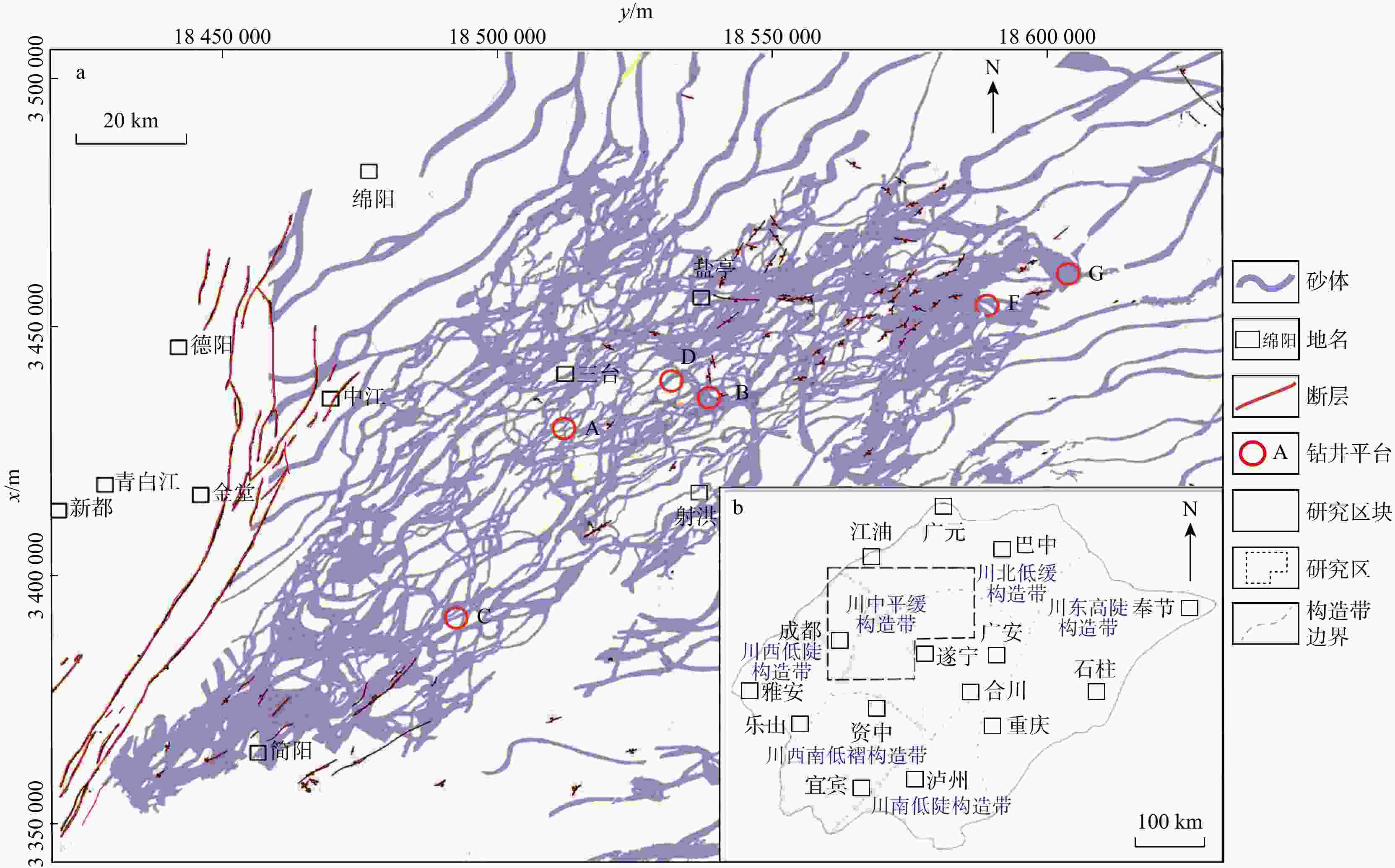
图 1 研究区沙溪庙组砂体预测分布图(a)及区域构造位置图(b)
Figure 1. Predicted sand-body distribution map (a) and regional structural location map (b) of Shaximiao Formation in study area
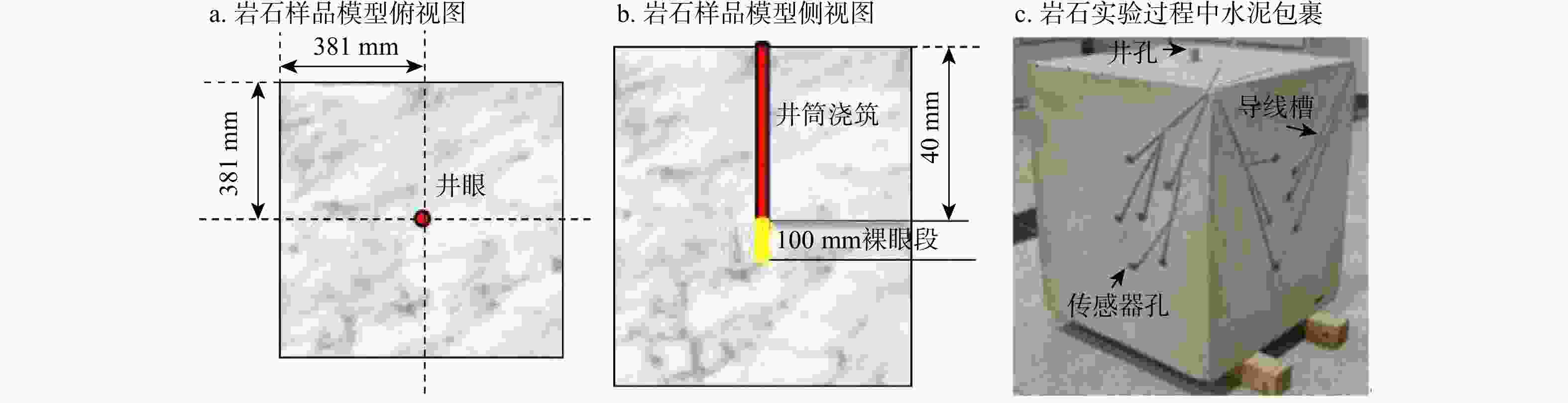
图 2 真三轴水力压裂实验模型示意图(图 c 中井孔为观测探头外部引线)
Figure 2. Schematic diagrams of true-triaxial hydraulic fracturing experimental model
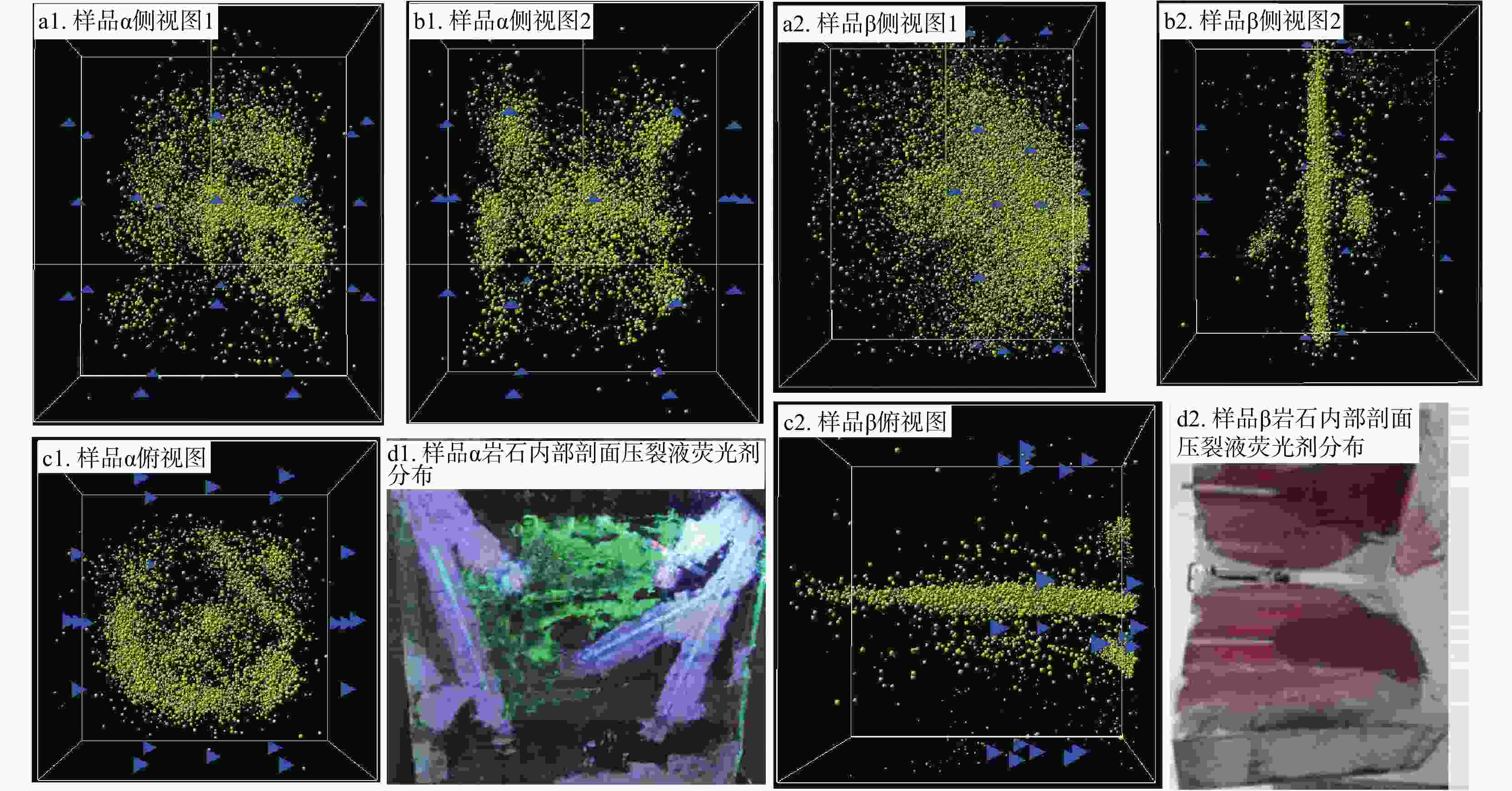
图 3 致密砂岩样品 α (a1~d1)、β (a2~d2)声发射事件空间分布
图a1~c1,a2~c2中绿色线为注入井;蓝色三角形为观测探头;图d1中紫色、绿色区域为裂缝发育区域
Figure 3. Spatial distribution of acoustic emission events for tight sandstone samples α (a1-d1) and β (a2-d2)
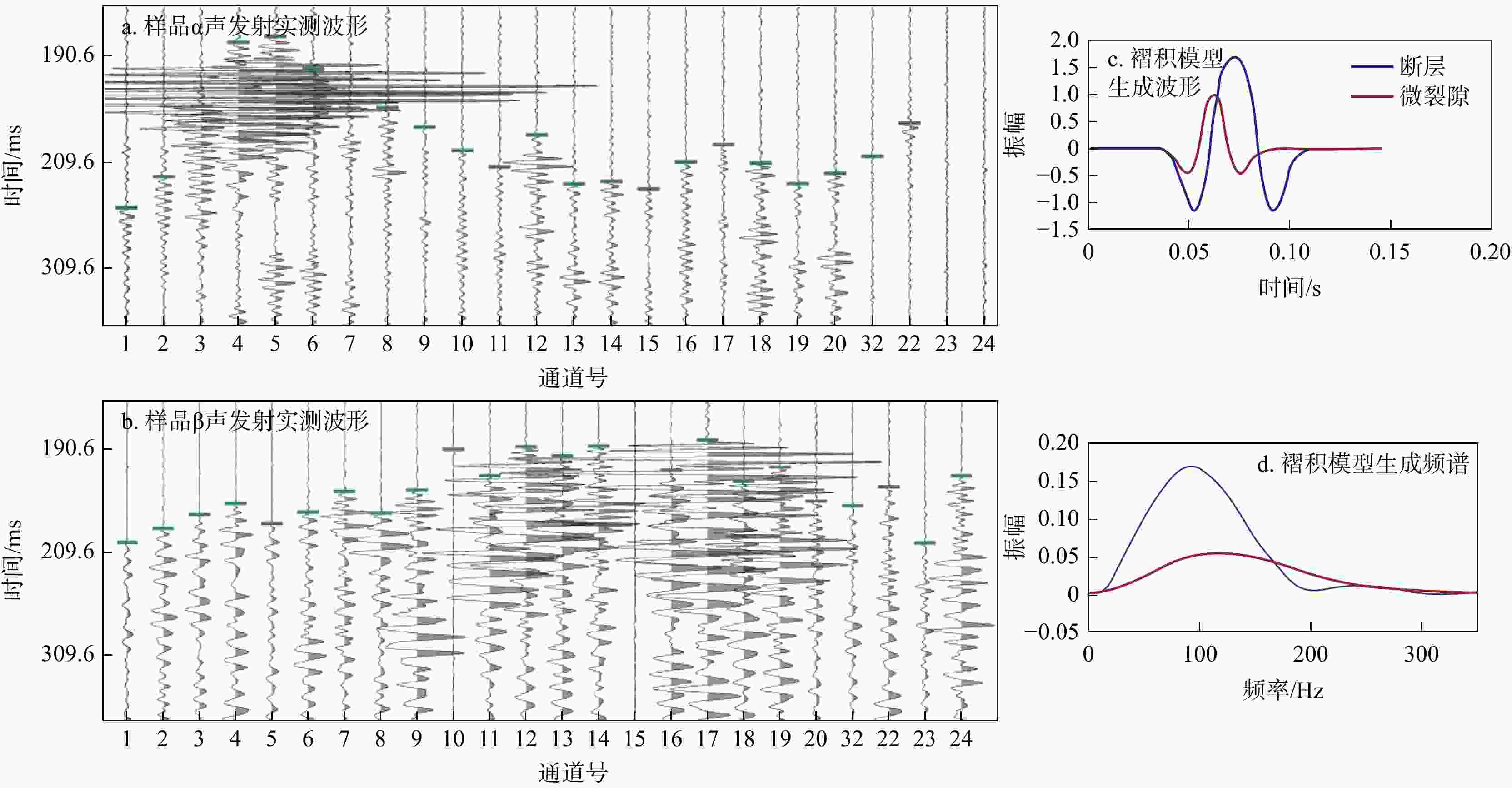
图 4 致密砂岩样品声发射实测波形(a, b)与褶积模型生成的波形(c)、频谱(d)
Figure 4. Measured acoustic emission waveforms of tight sandstone samples (a,b), and waveforms (c) and spectra (d) generated by convolutional model
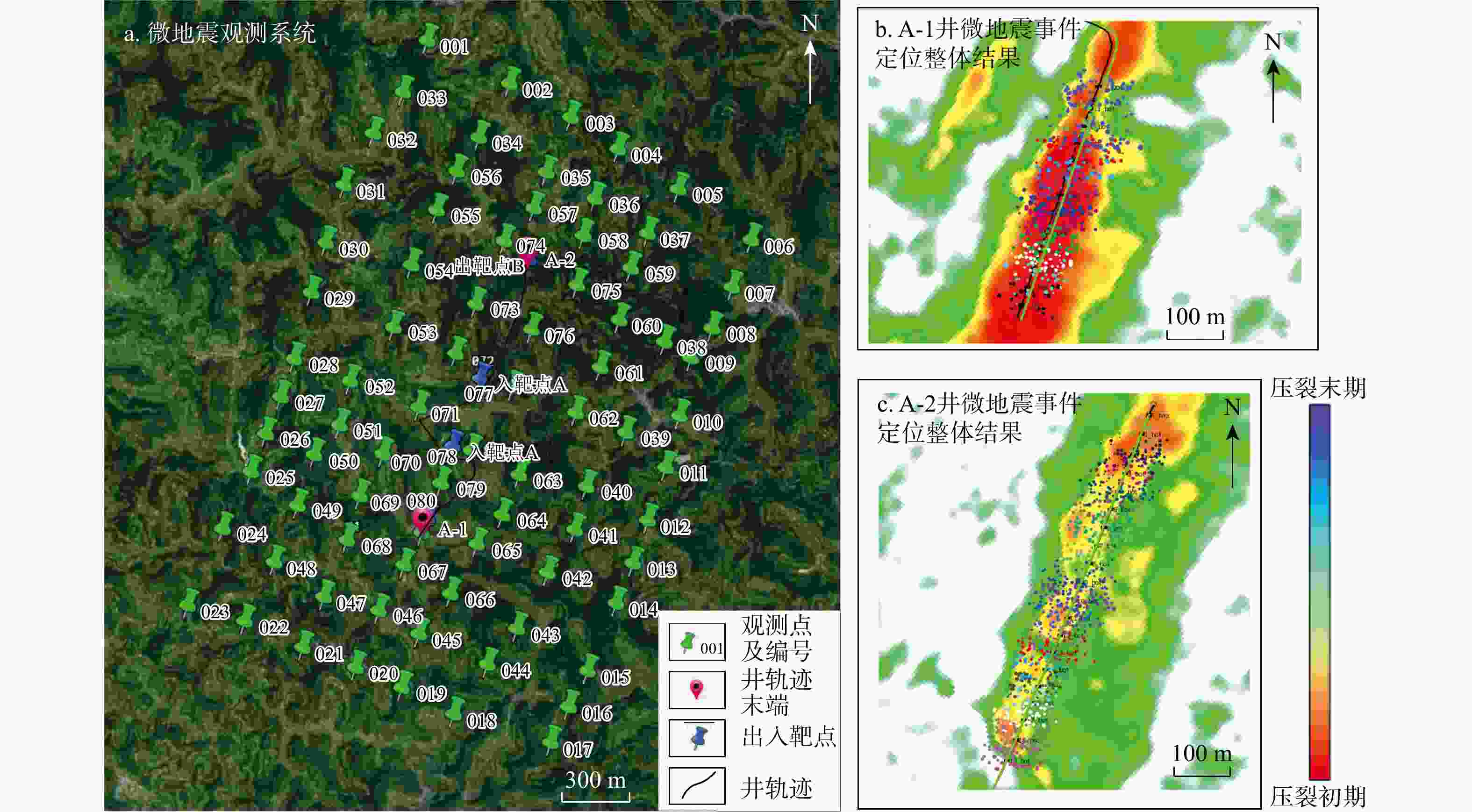
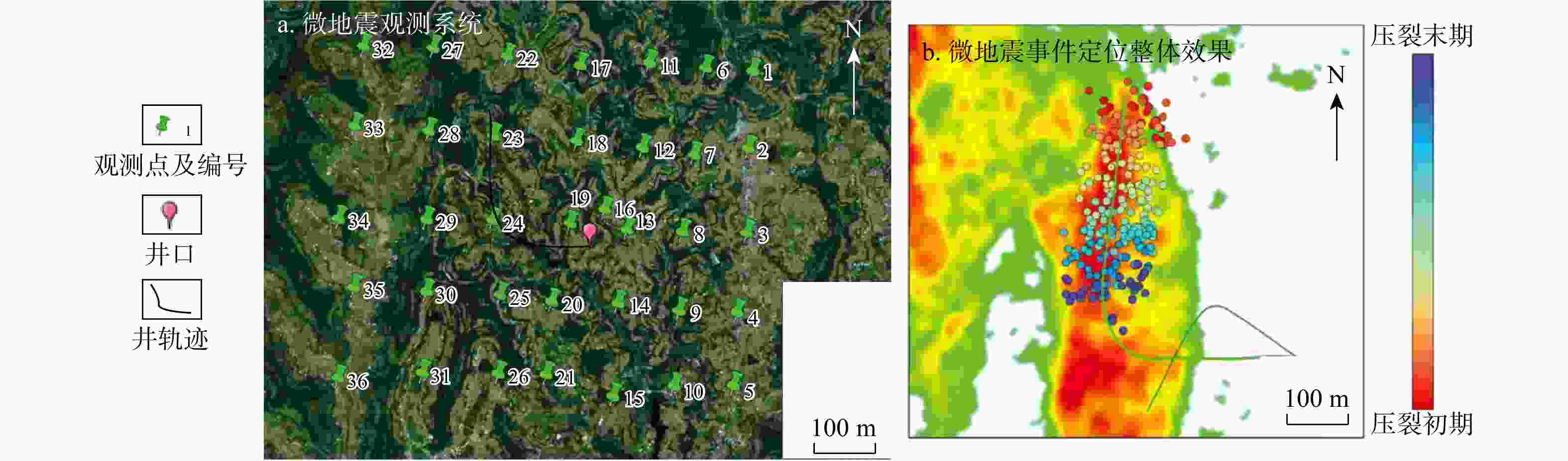
图 6 C平台致密砂岩水力压裂微地震观测系统(a)及微地震事件定位整体效果图(b)
Figure 6. Microseismic monitoring system (a) and overall location effect maps of microseismic events (b) for hydraulic fracturing of tight sandstone at Platform C
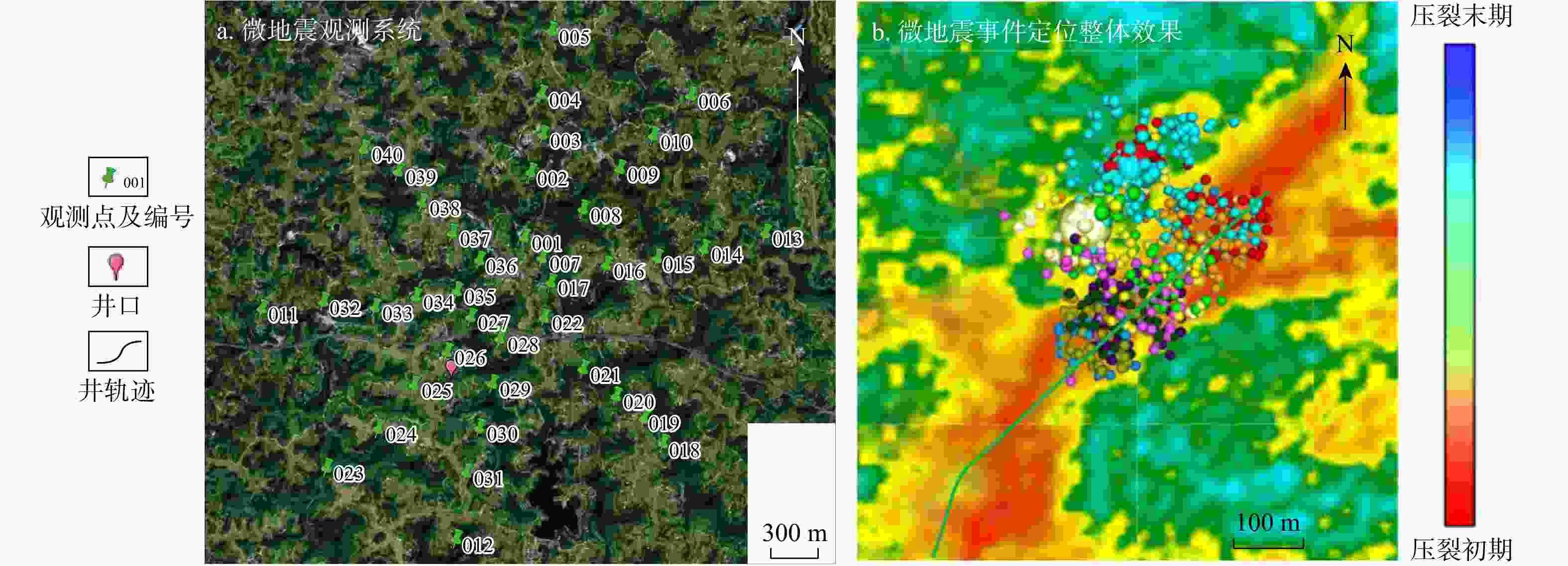
图 7 F平台致密砂岩水力压裂微地震观测系统(a)及微地震事件定位整体效果图(b)
Figure 7. Microseismic monitoring system (a) and overall location effect maps of microseismic events (b) for hydraulic fracturing of tight sandstone at Platform F
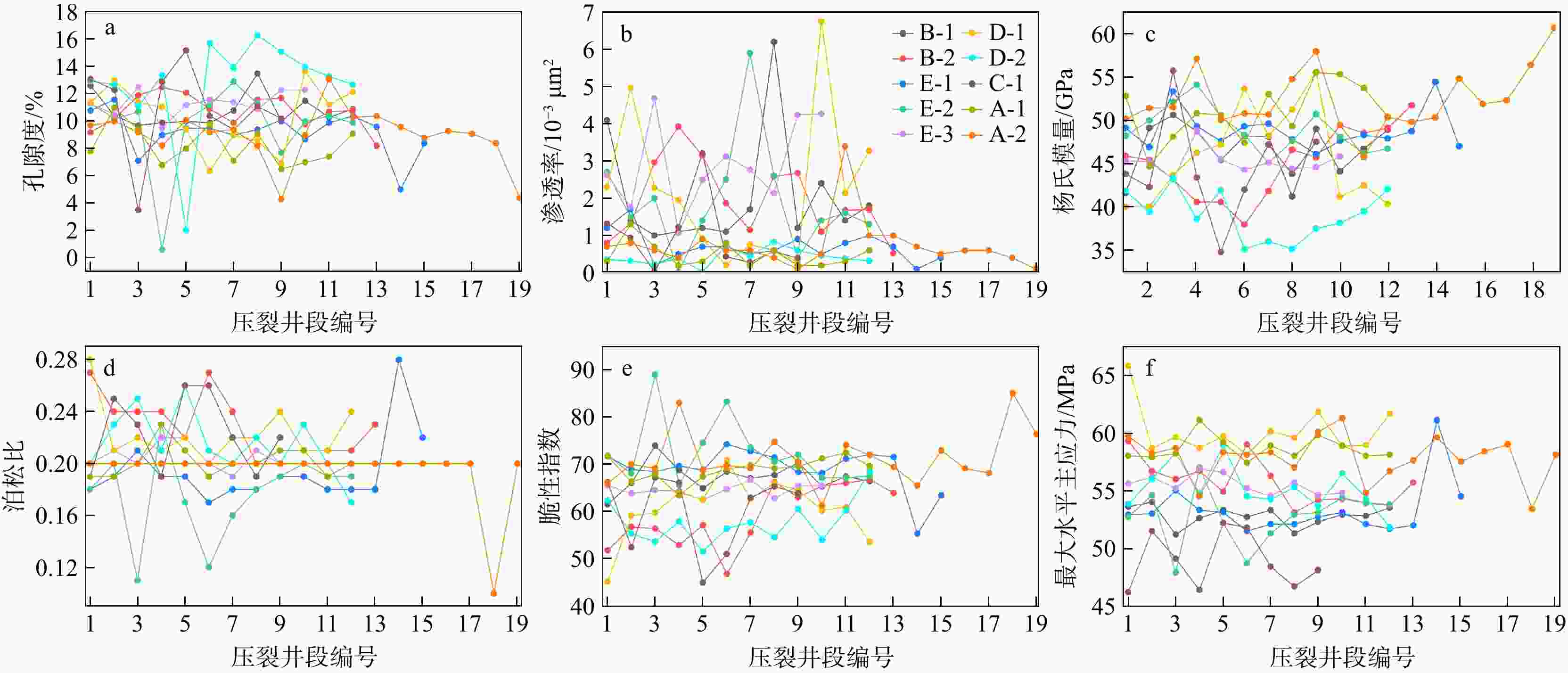
图 8 研究区多平台岩石孔隙度(a)、渗透率(b)、力学参数(c~f)与微地震事件数量关系图(B-1等为井编号)
Figure 8. Relationships among rock porosity (a), permeability (b), mechanical parameters (c~f), and numbers of microseismic event across multiple platforms in study area
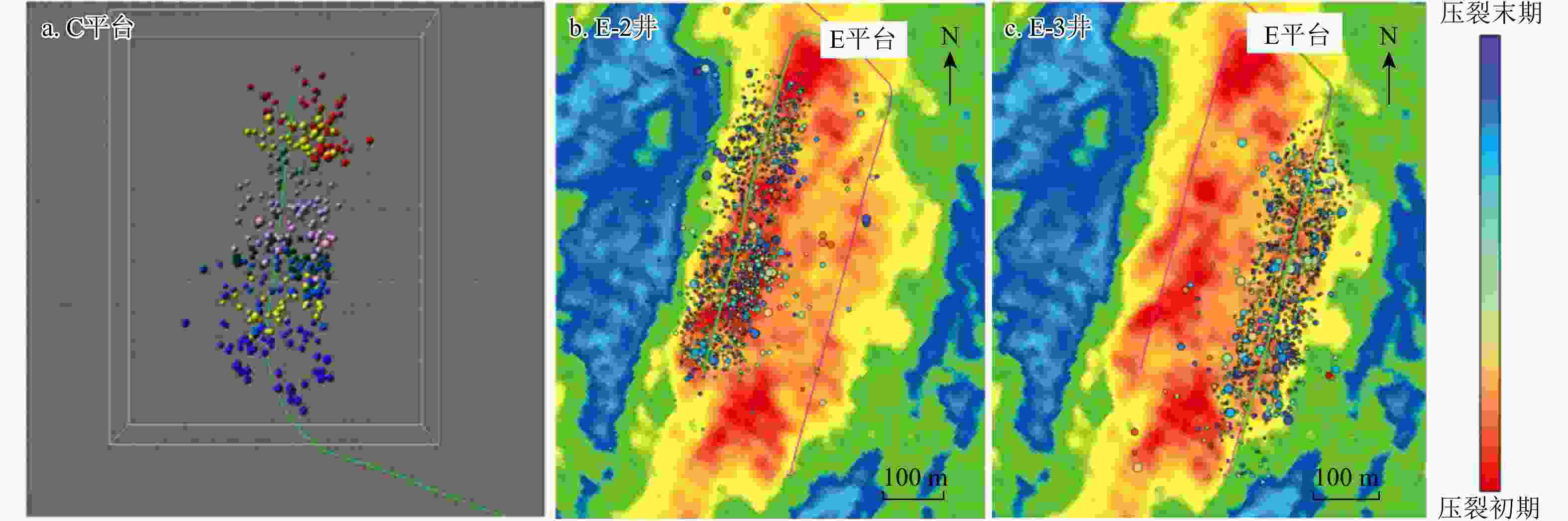
图 9 典型井 / 平台水力压裂微地震破裂特征(图a中不同颜色散点代表不同压裂井段)
Figure 9. Microseismic rupture characteristics of hydraulic fracturing for typical wells/platforms
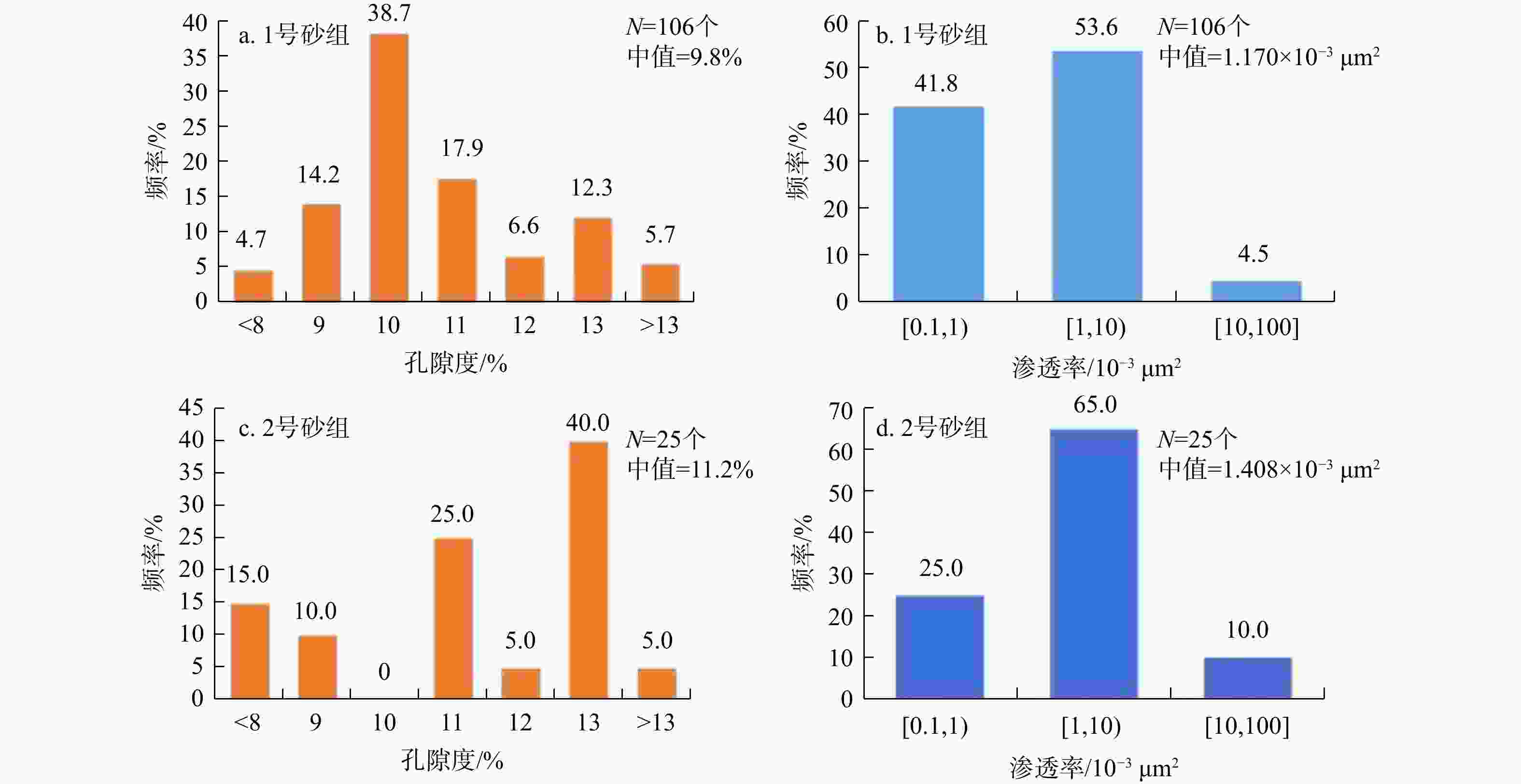
图 10 研究区沙溪庙组砂体储层孔隙度(a, c)、渗透率(b, d)频率直方图(N为样品数量)
Figure 10. Frequency histograms of porosity (a, c) and permeability (b, d) of sand-body reservoirs in Shaximiao Formation of study area
表 1 各平台基础数据
Table 1. Basic data of each platform
平台 孔隙度Φ/% 最大主应力方向/(°) 平台 孔隙度Φ/% 最大主应力方向/(°) A 9.3 80~90 E 9.8 130 B 8~11 100~120 F 10.4 100~110 C 11.5 132 G 9.6 108 D 13.2 110  下载: 导出CSV
表 2 A平台井段水力压裂裂缝方位统计
Table 2. Statistics of fracture azimuths for hydraulic fracturing intervals of Platform A
A-1井 A-2 井 压裂井段
编号裂缝方
向/(°)事件数
量/个压裂井段
编号裂缝方
向/(°)事件数
量/个1 135 21 1 60 10 2 90 38 2 65 69 3 100 62 3 65 44 4 85 68 4 95 66 5 85 65 5 70 46 6 130 62 6 95 76 7 130 50 7 65 34 8 120 41 8 110 52 9 100 56 9 105 56 10 95 59 10 105 72 11 95 53 11 115 62 12 110 65 12 110 58 13 — — 13 105 56 14 — — 14 110 56 15 — — 15 100 54 16 — — 16 95 53 17 — — 17 85 52 18 — — 18 105 64 19 — — 19 110 60
下载: 导出CSV
表 3 C平台井段水力压裂裂缝方位统计
Table 3. Statistics of fracture azimuths for hydraulic fracturing intervals of Platform C
压裂井段
编号裂缝方
向/(°)事件数
量/个压裂井段
编号裂缝方
向/(°)事件数
量/个1 137 42 6 120 34 2 125 36 7 110 53 3 135 16 8 130 40 4 120 26 9 70 55 5 110 37
下载: 导出CSV
表 4 F平台井段水力压裂裂缝方位统计
Table 4. Statistics of fracture azimuths for hydraulic fracturing intervals of Platform F
压裂井段
编号裂缝方
向/(°)事件数
量/个压裂井段
编号裂缝方
向/(°)事件数
量/个1 102 109 7 104 56 2 103 219 8 102 75 3 103 70 9 105 40 4 105 74 10 103 75 5 103 170 11 101 24 6 102 133
下载: 导出CSV
-
[1] 张道伟. 四川盆地未来十年天然气工业发展展望[J]. 天然气工业, 2021, 41(8): 34-45. doi: 10.3787/j.issn.1000-0976.2021.08.004ZHANG D W. Development prospect of natural gas industry in the Sichuan Basin in the next decade[J]. Natural Gas Industry, 2021, 41(8): 34-45. (in Chinese with English abstract) doi: 10.3787/j.issn.1000-0976.2021.08.004 [2] LI J L, KANG F X, BAI T, et al. Geo-temperature response to reinjection in sandstone geothermal reservoirs[J]. Geothermal Energy, 2023, 11(1): 35. doi: 10.1186/s40517-023-00277-z [3] 杨雨, 谢继容, 曹正林, 等. 四川盆地天府气田沙溪庙组大型致密砂岩气藏形成条件及勘探开发关键技术[J]. 石油学报, 2023, 44(6): 917-932. doi: 10.7623/syxb202306003YANG Y, XIE J R, CAO Z L, et al. Forming conditionsand key technologies for exploration and development of largetight sandstone gas reservoirs in Shaximiao Formation, Tianfu gasfield of Sichuan Basin[J]. Acta Petrolei Sinica, 2023, 44(6): 917-932. (in Chinese with English abstract) doi: 10.7623/syxb202306003 [4] 陈勇, 翟明洋. 基于岩心脆性特征的致密砂砾岩储层水力裂缝复杂性分析[J]. 油气地质与采收率, 2020, 27(5): 33-43. doi: 10.13673/j.cnki.cn37-1359/te.2020.05.004CHEN Y, ZHAI M Y. Complexity analysis of hydraulic fracture in tight glutenite reservoir based on core brittleness[J]. Petroleum Geology and Recovery Efficiency, 2020, 27(5): 33-43. (in Chinese with English abstract) doi: 10.13673/j.cnki.cn37-1359/te.2020.05.004 [5] 王光付, 李凤霞, 王海波, 等. 四川盆地非常规气藏地质−工程一体化压裂实践与认识[J]. 石油与天然气地质, 2022, 43(5): 1221-1237. doi: 10.11743/ogg20220517WANG G F, LI F X, WANG H B, et al. Application of an integrated geology-reservoir engineering approach to fracturing in unconventional gas reservoirs, Sichuan Basin and some insights[J]. Oil & Gas Geology, 2022, 43(5): 1221-1237. (in Chinese with English abstract) doi: 10.11743/ogg20220517 [6] 詹国卫, 顾战宇, 庞河清, 等. 致密砂岩储层孔隙结构特征及其对开发的影响[J]. 西南石油大学学报(自然科学版), 2022, 44(3): 70-84. doi: 10.11885/j.issn.1674-5086.2022.01.24.07ZHAN G W, GU Z Y, PANG H Q, et al. Pore structure characteristics of tight sandstone reservoir and its influence on development[J]. Journal of Southwest Petroleum University (Science & Technology Edition), 2022, 44(3): 70-84. (in Chinese with English abstract) doi: 10.11885/j.issn.1674-5086.2022.01.24.07 [7] 高金栋, 周立发, 冯乔, 等. 储层构造裂缝识别及预测研究进展[J]. 地质科技情报, 2018, 37(4): 158-166. doi: 10.19509/j.cnki.dzkq.2018.0421GAO J D, ZHOU L F, FENG Q, et al. Progress in reservoir structural fracture characterization and prediction[J]. Geological Science and Technology Information, 2018, 37(4): 158-166. (in Chinese with English abstract) doi: 10.19509/j.cnki.dzkq.2018.0421 [8] 曾波, 杨扬, 宋毅, 等. 基于混合优化算法的电磁监测裂缝参数识别[J]. 石油物探, 2024, 63(3): 684-693. doi: 10.12431/issn.1000-1441.2024.63.03.016ZENG B, YANG Y, SONG Y, et al. Fracturing parameter identification in electromagnetic monitoring based on hybrid optimization algorithm[J]. Geophysical Prospecting for Petroleum, 2024, 63(3): 684-693. (in Chinese with English abstract) doi: 10.12431/issn.1000-1441.2024.63.03.016 [9] 高翔, 冯建伟, 渠继航, 等. 基于数字露头的多尺度裂缝模型建立及其对地下裂缝预测指导[J]. 地质科技通报, 2024, 43(2): 143-155. doi: 10.19509/j.cnki.dzkq.tb20220599GAO X, FENG J W, QU J H, et al. Establishment of multi-scale fracture model based on digital outcrop and its guidance for subsurface fracture prediction[J]. Bulletin of Geological Science and Technology, 2024, 43(2): 143-155. (in Chinese with English abstract) doi: 10.19509/j.cnki.dzkq.tb20220599 [10] 郭雯, 王彦春, 强敏. 多分量地震资料在致密含气储层预测中的应用[J]. 西安石油大学学报(自然科学版), 2016, 31(4): 1-7. doi: 10.3969/j.issn.1673-064X.2016.04.001GUO W, WANG Y C, QIANG M. Application of multi-component seismic exploration data in prediction of tight gas-bearing reservoirs[J]. Journal of Xi'an Shiyou University (Natural Science), 2016, 31(4): 1-7. (in Chinese with English abstract) doi: 10.3969/j.issn.1673-064X.2016.04.001 [11] REYES-SALAZAR A, LÓPEZ-BARRAZA A, LÓPEZ-LÓPEZ A, et al. Multi-component seismic response analysis: A critical review[J]. Journal of Earthquake Engineering, 2008, 12(5): 779-799. doi: 10.1080/13632460701672979 [12] CHEN K, ZHANG G Z, DI G D, et al. Application of multi-component seismic data in identifying dolomite reservoirs in the Sichuan Basin[J]. Journal of Geophysics and Engineering, 2024, 21(4): 1230-1241. doi: 10.1093/jge/gxae068 [13] 赵邦六. 多分量地震勘探在岩性气藏勘探开发中的应用[J]. 石油勘探与开发, 2008, 35(4): 397-409. doi: 10.1016/S1876-3804(08)60088-9ZHAO B L. Application of multi-component seismic exploration in the exploration and production of lithologic gas reservoirs[J]. Petroleum Exploration and Development, 2008, 35(4): 397-409. (in Chinese with English abstract) doi: 10.1016/S1876-3804(08)60088-9 [14] 李庆忠, 王建花. 多波地震勘探的难点与展望[M]. 山东青岛: 中国海洋大学出版社, 2007.LI Q Z, WANG J H. Difficulties and prospects of multiwave seismic exploration[M]. Qingdao, Shandong: China Ocean University Press, 2007. (in Chinese) [15] 王赟, 陈晓非, 底青云, 等. 深部找矿: 金属矿地震技术的机遇与挑战[J]. 地球科学, 2025, 50(11): 4284-4299. doi: 10.3799/dqkx.2025.109WANG Y, CHEN X F, DI Q Y, et al. Deep mineral exploration: Opportunities and challenges faced by reflection seismic[J]. Earth Science, 2025, 50(11): 4284-4299. (in Chinese with English abstract) doi: 10.3799/dqkx.2025.109 [16] FARFOUR M, YOON W J. A review on multicomponent seismology: A potential seismic application for reservoir characterization[J]. Journal of Advanced Research, 2016, 7(3): 515-524. [17] MAXWELL S C, RUTLEDGE J, JONES R, et al. Petroleum reservoir characterization using downhole microseismic monitoring[J]. Geophysics, 2010, 75(5): 75A129-75A137. doi: 10.1190/1.3477966 [18] REFUNJOL X E, MARFURT K J, LE CALVEZ J H. Inversion and attribute-assisted hydraulically induced microseismic fracture characterization in the North Texas Barnett Shale[J]. The Leading Edge, 2011, 30(3): 292-299. doi: 10.1190/1.3567260 [19] 王维红, 时伟, 柯璇, 等. 松辽盆地北部页岩油水力压裂微地震监测技术及应用[J]. 地质与资源, 2021, 30(3): 357-365. doi: 10.13686/j.cnki.dzyzy.2021.03.018WANG W H, SHI W, KE X, et al. Application of microseismic monitoring technology in hydraulic fracturing of the shale oil in northern Songliao Basin[J]. Geology and Resources, 2021, 30(3): 357-365. (in Chinese with English abstract) doi: 10.13686/j.cnki.dzyzy.2021.03.018 [20] 赵超峰, 周治岳, 田建涛, 等. 疏松砂岩气藏压裂井中微地震监测应用研究: 以涩北气田为例[J]. 地球物理学进展, 2020, 35(5): 1919-1925. doi: 10.6038/pg2020DD0390ZHAO C F, ZHOU Z Y, TIAN J T, et al. Borehole microseismic monitoring technology for fracturing in unconsolidated sandstone gas reservoir: A case study from the Sebei gas field[J]. Progress in Geophysics, 2020, 35(5): 1919-1925. (in Chinese with English abstract) doi: 10.6038/pg2020DD0390 [21] 赵超峰, 张伟, 田建涛, 等. 基于微地震监测技术的油田开发方案调整及效果: 以辽河探区J2块为例[J]. 地球物理学进展, 2022, 37(1): 320-327. doi: 10.6038/pg2022FF0080ZHAO C F, ZHANG W, TIAN J T, et al. Adjustment and effect of oilfield development based on microseismic monitoring technology: A case study from the Block J2 in Liaohe exploration area[J]. Progress in Geophysics, 2022, 37(1): 320-327. (in Chinese with English abstract) doi: 10.6038/pg2022FF0080 [22] 赵超峰, 王海波, 郭伟, 等. 页岩气压裂微地震监测技术及其在四川盆地威远地区X平台的应用[J]. 地球物理学进展, 2022, 37(5): 2089-2096. doi: 10.6038/pg2022GG0182ZHAO C F, WANG H B, GUO W, et al. Microseismic monitoring technology of shale gas pressure fracture: A case study from X platform in Weiyuan area of Sichuan Basin[J]. Progress in Geophysics, 2022, 37(5): 2089-2096. (in Chinese with English abstract) doi: 10.6038/pg2022GG0182 [23] 刘博, 梁雪莉, 容娇君, 等. 非常规油气层压裂微地震监测技术及应用[J]. 石油地质与工程, 2016, 30(1): 142-145. doi: 10.3969/j.issn.1673-8217.2016.01.038LIU B, LIANG X L, RONG J J, et al. Microseismic monitoring technology and its application in unconventional reservoir fracturing[J]. Petroleum Geology and Engineering, 2016, 30(1): 142-145. (in Chinese with English abstract) doi: 10.3969/j.issn.1673-8217.2016.01.038 [24] 刘博, 徐刚, 纪拥军, 等. 页岩油水平井体积压裂及微地震监测技术实践[J]. 岩性油气藏, 2020, 32(6): 172-180. doi: 10.12108/yxyqc.20200617LIU B, XU G, JI Y J, et al. Practice of volume fracturing and microseismic monitoring technology in horizontal wells of shale oil[J]. Lithologic Reservoirs, 2020, 32(6): 172-180. (in Chinese with English abstract) doi: 10.12108/yxyqc.20200617 [25] 朱海燕, 宋宇家, 唐煊赫, 等. 页岩气藏加密井压裂时机优化: 以四川盆地涪陵页岩气田X1井组为例[J]. 天然气工业, 2021, 41(1): 154-168. doi: 10.3787/j.issn.1000-0976.2021.01.014ZHU H Y, SONG Y J, TANG X H, et al. Optimization of fracturing timing of infill wells in shale gas reservoirs: A case study on Well Group X1 of Fuling shale gas field in the Sichuan Basin[J]. Natural Gas Industry, 2021, 41(1): 154-168. (in Chinese with English abstract) doi: 10.3787/j.issn.1000-0976.2021.01.014 [26] 赵金洲, 付永强, 王振华, 等. 页岩气水平井缝网压裂施工压力曲线的诊断识别方法[J]. 天然气工业, 2022, 42(2): 11-19. doi: 10.3787/j.issn.1000-0976.2022.02.002ZHAO J Z, FU Y Q, WANG Z H, et al. Study on diagnosis model of shale gas fracture network fracturing operation pressure curves[J]. Natural Gas Industry, 2022, 42(2): 11-19. (in Chinese with English abstract) doi: 10.3787/j.issn.1000-0976.2022.02.002 [27] 黄浩勇, 苟其勇, 刘胜军, 等. 页岩气叠后裂缝综合预测技术: 以长宁国家级页岩气示范区为例[J]. 断块油气田, 2022, 29(2): 218-223. doi: 10.6056/dkyqt202202013HUANG H Y, GOU Q Y, LIU S J, et al. Post-stack fracture comprehensive prediction technology for shale gas: Taking Changning national shale gas demonstration area as an example[J]. Fault-Block Oil and Gas Field, 2022, 29(2): 218-223. (in Chinese with English abstract) doi: 10.6056/dkyqt202202013 [28] 赵争光, 杨瑞召, 孙志朋, 等. 储层岩性对水力裂缝延伸的影响[J]. 地球物理学进展, 2014, 29(2): 885-888.ZHAO Z G, YANG R Z, SUN Z P, et al. Influence of reservoir lithology on hydraulic fracture propagation[J]. Progress in Geophysics, 2014, 29(2): 885-888. (in Chinese with English abstract) [29] 林鹤, 李德旗, 周博宇, 等. 天然裂缝对压裂改造效果的影响[J]. 石油地球物理勘探, 2018, 53(A2): 156-161. doi: 10.13810/j.cnki.issn.1000-7210.2018.S2.024LIN H, LI D Q, ZHOU B Y, et al. The effect of natural fracture on the fracturing effect[J]. Oil Geophysical Prospecting, 2018, 53(A2): 156-161. (in Chinese with English abstract) doi: 10.13810/j.cnki.issn.1000-7210.2018.S2.024 [30] CIPOLLA C, MAXWELL S, MACK M, et al. A practical guide to interpreting microseismic measurements[C]//Anon. North American Unconventional Gas Conference and Exhibition. The Woodlands, Texas, USA. Richardson: Society of Petroleum Engineers, 2011: SPE 144067-MS. [31] JIANG R C, DAI F, LIU Y, et al. A novel method for automatic identification of rock fracture signals in microseismic monitoring[J]. Measurement, 2021, 175: 109129. doi: 10.1016/j.measurement.2021.109129 [32] SUN H, HE N, GURKALO F. Application and research of microseismic monitoring system and hydraulic fracturing technology in coal mines[J]. Water, 2024, 16(7): 1062. [33] ZHAO J B, LIU P, LI J J, et al. Fracture propagation induced by hydraulic fracturing using microseismic monitoring technology: Field test in CBM wells in Zhengzhuang region, southern Qinshui Basin, China[J]. Frontiers in Earth Science, 2023, 11: 1130280. [34] LU Z H, JIA Y Z, CHENG L J, et al. Microseismic monitoring of hydraulic fracture propagation and seismic risks in shale reservoir with a steep dip angle[J]. Natural Resources Research, 2022, 31(5): 2973-2993. [35] QIAN Y N, LIU T, ZHAI C, et al. Real-time monitoring and analysis of hydraulic fracturing in surface well using microseismic technology: Case insights and methodological advances[J]. International Journal of Mining Science and Technology, 2025, 35(4): 619-638. [36] LI N, FANG L L, SUN W C, et al. Evaluation of borehole hydraulic fracturing in coal seam using the microseismic monitoring method[J]. Rock Mechanics and Rock Engineering, 2021, 54(2): 607-625. [37] QIAN Y N, LI Q G, LIANG Y P, et al. Evaluation of hydraulic fracturing in coal seam using ground microseismic monitoring and source location[J]. Rock Mechanics and Rock Engineering, 2024, 57(1): 679-694. [38] ZHAO J S, JIANG Q, LU J F, et al. Rock fracturing observation based on microseismic monitoring and borehole imaging: In situ investigation in a large underground cavern under high geostress[J]. Tunnelling and Underground Space Technology, 2022, 126: 104549. [39] LIU Z W, WU J P, HAN W Z, et al. Methodology and application of shale-reservoir natural fracture modeling based on microseismic monitoring data[J]. Interpretation, 2020, 8(4): SP167-SP174. [40] 王赟, 文鹏飞, 李宗杰, 等. 多分量油气地震勘探技术急需解决的几个问题[J]. 石油地球物理勘探, 2020, 55(6): 1395-1406.WANG Y, WEN P F, LI Z J, et al. Several urgent problems requiring resolution in multi-component seismic exploration technology for oil and gas[J]. Oil Geophysical Prospecting, 2020, 55(6): 1395-1406. (in Chinese with English abstract) [41] 张明, 张昕, 梁菁, 等. 多分量地震在致密气储层精细描述中的应用[J]. 石油地球物理勘探, 2023, 58(6): 1454-1462.ZHANG M, ZHANG X, LIANG J, et al. Application of multi-component seismic technology in fine description of tight gas reservoirs[J]. Oil Geophysical Prospecting, 2023, 58(6): 1454-1462. (in Chinese with English abstract) [42] 李向阳, 王九拴. 多波地震勘探及裂缝储层预测研究进展[J]. 石油科学通报, 2016, 1(1): 45-60.LI X Y, WANG J S. Advances in multi-wave seismic exploration and fractured reservoir prediction[J]. Petroleum Science Bulletin, 2016, 1(1): 45-60. (in Chinese with English abstract) [43] 帅达. 裂隙参数对地震波传播影响分析和复杂裂隙介质模型构建[D]. 北京: 中国石油大学(北京), 2020.SHUAI D. The influence of fracture parameters on the seismic wave propagation and complicated fractured model construction[D]. Beijing: China University of Petroleum (Beijing), 2020. (in Chinese with English abstract) [44] QIAO S Q, ZHANG Q S, ZHANG Q M. Mine fracturing monitoring analysis based on high-precision distributed wireless microseismic acquisition station[J]. IEEE Access, 2019, 7: 147215-147223. [45] 张国印. 川西坳陷沙溪庙组致密砂岩优质储层识别及预测方法研究[D]. 北京: 中国石油大学(北京), 2019.ZHANG G Y. Recognition and prediction methods of high-quality reservoirs of tight sandstones in Shaximiao Formation in Chuanxi Depression[D]. Beijing: China University of Petroleum (Beijing), 2019. (in Chinese with English abstract) [46] 刘玲, 沃玉进, 孙炜, 等. 龙门山前侏罗系沙溪庙组致密砂岩 储层叠前地震预测[J]. 天然气地球科学, 2019, 30(7): 1072-1082.LIU L, WO Y J, SUN W, et al. Prestack seismic prediction of tight sandstones for Jurassic Shaximiao Formation in front of Longmenshan[J]. Natural Gas Geoscience, 2019, 30(7): 1072-1082. (in Chinese with English abstract) [47] 吕正祥, 刘四兵. 川西须家河组超致密砂岩成岩作用与相对优质储层形成机制[J]. 岩石学报, 2009, 25(10): 2373-2383.LYU Z X, LIU S B. Ultra-tight sandstone diagenesis and mechanism for the formation of relatively high-quality reservoir of Xujiahe Group in western Sichuan[J]. Acta Petrologica Sinica, 2009, 25(10): 2373-2383. (in Chinese with English abstract) [48] 郑荣才, 朱如凯, 翟文亮, 等. 川西类前陆盆地晚三叠世须家河期构造演化及层序充填样式[J]. 中国地质, 2008, 35(2): 246-255.ZHENG R C, ZHU R K, ZHAI W L, et al. Late Triassic tectonic evolution and sequence filling patterns of the foreland-like basin in western Sichuan during the Xujiahe period[J]. Geology in China, 2008, 35(2): 246-255. (in Chinese with English abstract) [49] 邓广哲, 王世斌, 黄炳香. 煤岩水压裂缝扩展行为特性研究[J]. 岩石力学与工程学报, 2004, 23(20): 3489-3493.DENG G Z, WANG S B, HUANG B X. Research on behavior character of crack development induced by hydraulic fracturing in coal-rockmass[J]. Chinese Journal of Rock Mechanics and Engineering, 2004, 23(20): 3489-3493. (in Chinese with English abstract) [50] 尹陈, 石学文, 才博, 等. 天然裂缝复杂程度对致密储层破裂特征的影响[J]. 高校地质学报, 2023, 29(1): 128-137.YIN C, SHI X W, CAI B, et al. The effect of pre-existing fracture complexity on rupture characteristics of tight reservoir[J]. Geological Journal of China Universities, 2023, 29(1): 128-137. (in Chinese with English abstract) [51] 夏英杰, 李连崇, 唐春安, 等. 储层砂岩破坏特征与脆性指数相关性影响的试验及数值研究[J]. 岩石力学与工程学报, 2017, 36(1): 10-28.XIA Y J, LI L C, TANG C A, et al. Experiment and numerical research on failure characteristic and brittleness index for reservoir sandstone[J]. Chinese Journal of Rock Mechanics and Engineering, 2017, 36(1): 10-28. (in Chinese with English abstract) [52] 冯笑含, 赵万春, 王婷婷. 非均质致密储层微观力学特征分析及脆性评价方法研究[J]. 特种油气藏, 2019, 26(6): 113-117.FENG X H, ZHAO W C, WANG T T. Micromechanical analysis and brittleness evaluation of heterogeneous tight reservoir[J]. Special Oil & Gas Reservoirs, 2019, 26(6): 113-117. (in Chinese with English abstract) -

 下载:
下载:


 点击查看大图

计量
- 文章访问数: 158
- PDF下载量: 1
- 被引次数: 0