投审稿入口
投审稿入口


Susceptibility assessment of thermal thawing geohazards in Haibei Prefecture based on Kruskal-Wallis test and dimensionality reduction-based indicator optimization
-
摘要:
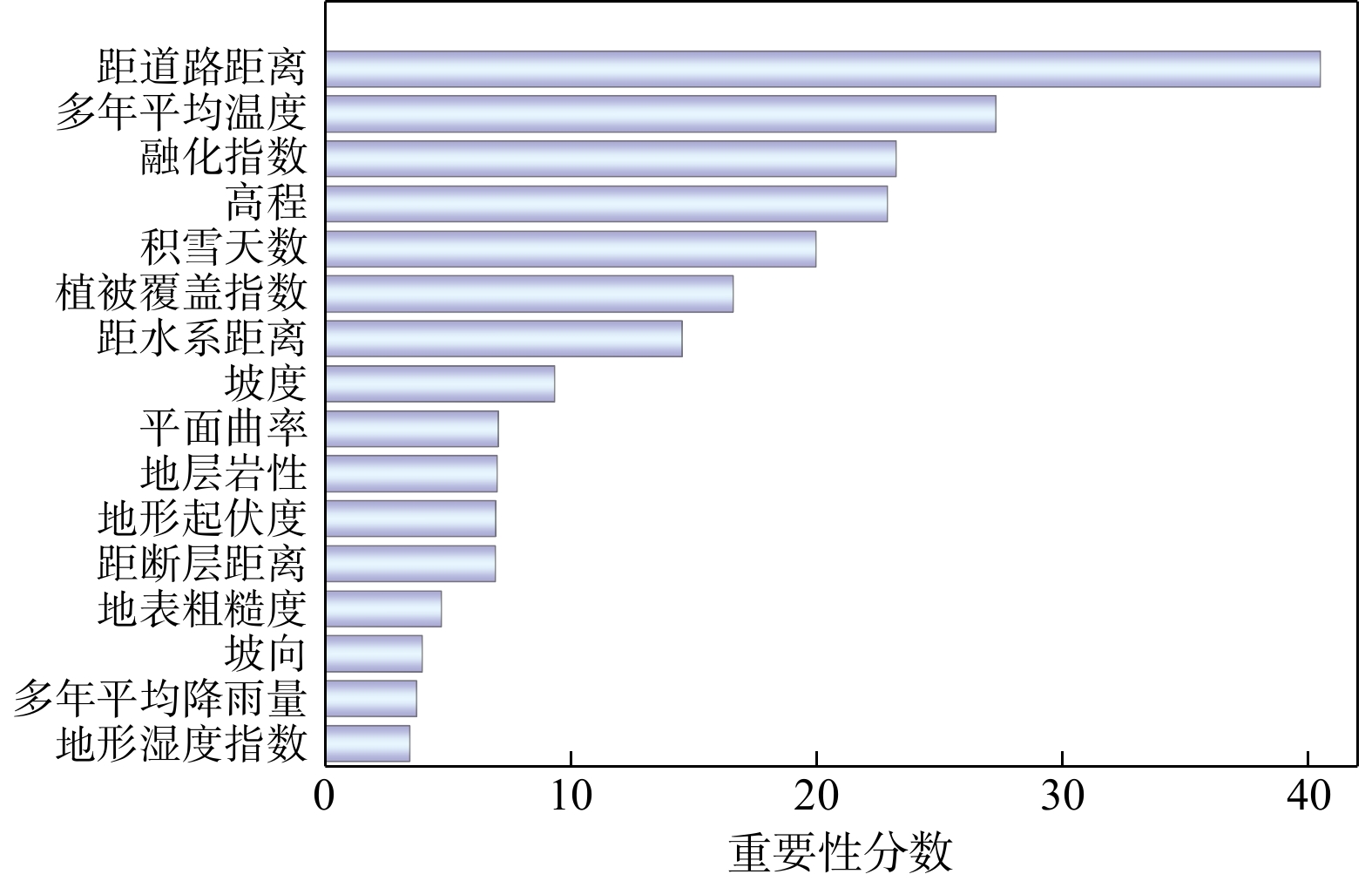
青海省海北藏族自治州(以下简称:海北州)地处祁连山中部地带,多年冻土分布广泛,随着全球气候变暖,区域内热融地质灾害发生较为频繁,对居民的生命财产构成严重威胁。针对区域热融灾害主控因素不明、传统影响因子剔除式指标优化易丢失有效信息的问题,开展易发性评价工作可为区域持续性建设发展与灾害预警提供技术支撑。以海北州为研究区域,对初步选取的16个评价指标进行相关性和重要性分析,采用降维技术优化评价指标,选用3种不同机器学习方法进行建模分析,研究表明:①经Kruskal-Wallis检验算法分析,距道路距离、多年平均温度、融化指数、高程、积雪天数为海北州热融地质灾害发生的主要影响因素。②与常规地质灾害不同,降雨通常不是热融地质灾害的决定性孕灾条件,评价中应重点考虑能够表征冻土热状态及工程扰动强度的相关指标。③采用降维技术对冗余因子进行处理,不仅可消除因子间的高相关性,还可保留原始数据的主要信息,生成的降维融合因子的重要性得到显著提升,优化了评价指标。④经降维技术评价指标优化后的3种机器学习模型预测性能均有所提高,且评价指标优化后的LR模型综合性能最优。基于 Kruskal-Wallis检验与降维技术评价指标优化方法可靠性强,LR 耦合模型适用于研究区热融灾害易发性评估,可为青藏高原同类冻土区灾害评价提供参考。
Abstract:ObjectiveHaibei Tibetan Autonomous Prefecture is located in the central part of the Qilian Mountains with widespread permafrost coverage. Accelerated global warming has aggravated permafrost degradation and triggered frequent thermal thawing geohazards, posing a serious threat to local residents' lives and property safety. The dominant controlling factors of regional thermal thawing geohazards remain unclear, and the conventional direct elimination of redundant conditioning factors tends to cause the loss of valid information. To address these two key scientific bottlenecks, this study carries out susceptibility assessment to provide technical support for regional sustainable infrastructure construction and geohazard early warning.
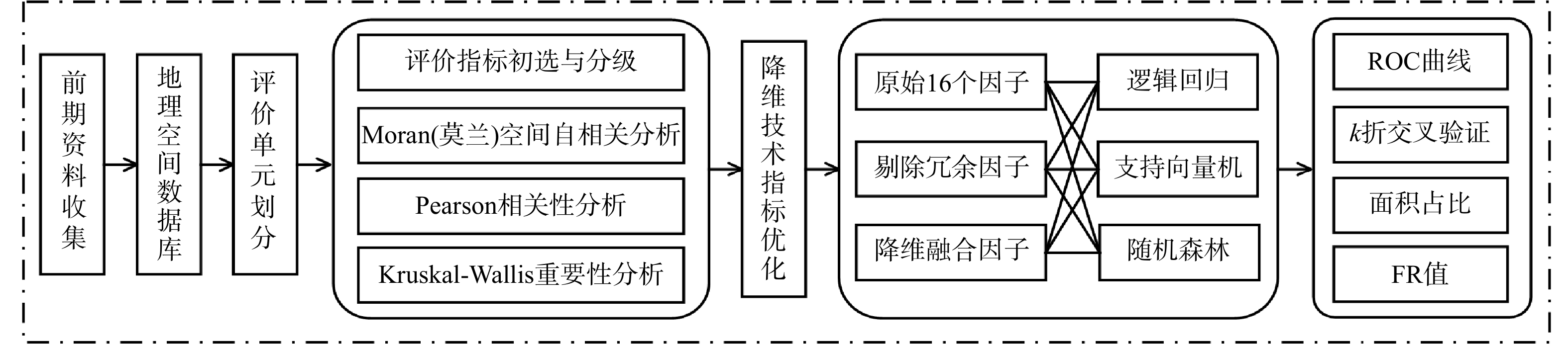
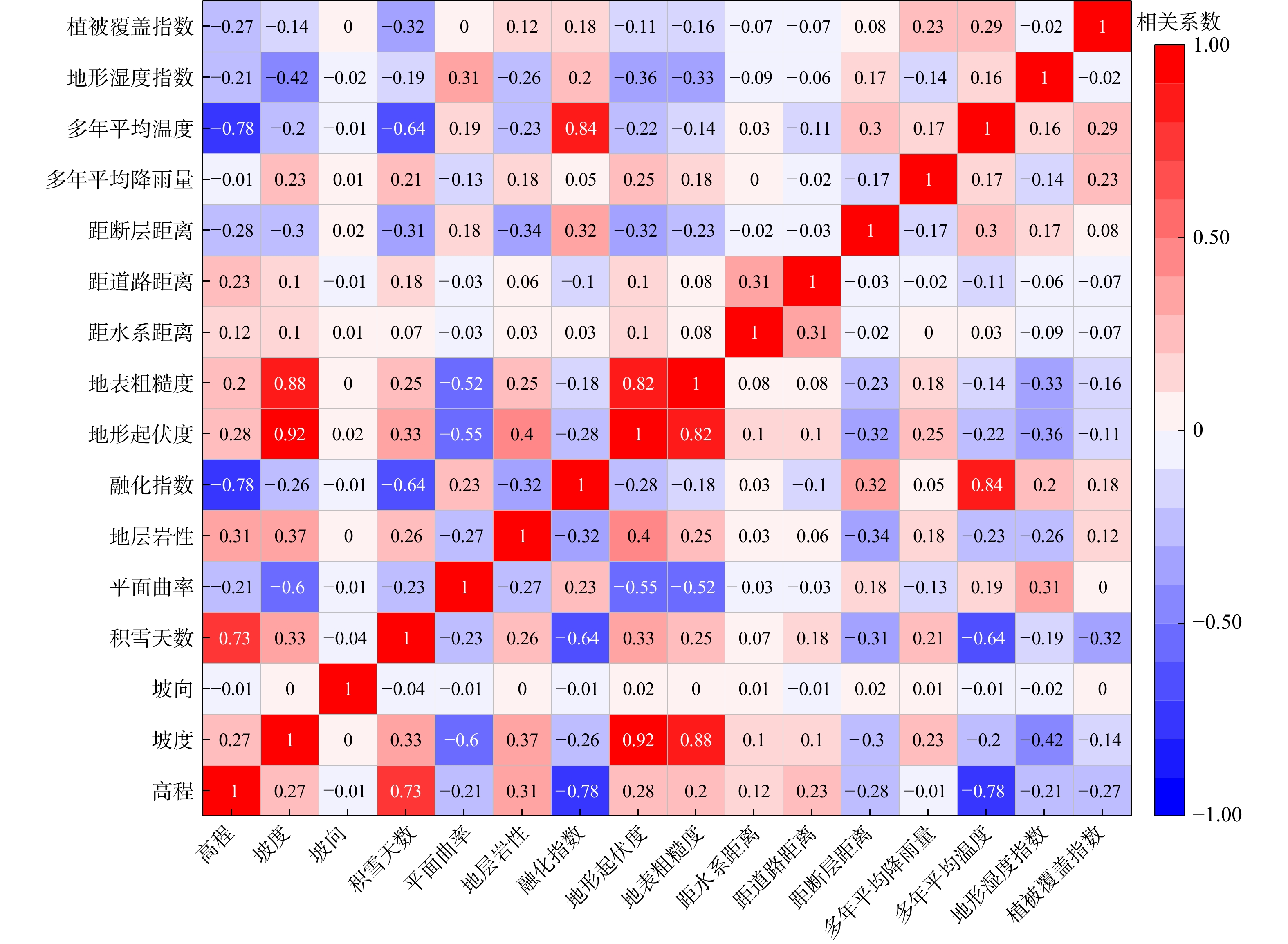
MethodsHaibei Tibetan Autonomous Prefecture was taken as the study area, and 16 preliminary conditioning factors covering topography, meteorology, geological setting, and human engineering interference were selected in this study. Pearson correlation analysis and Kruskal-Wallis test were sequentially adopted to quantify multicollinearity and factor importance. Principal component analysis (PCA)-based dimensionality reduction was applied to integrate highly correlated redundant variables for indicator optimization. Three machine learning algorithms-logistic regression (LR), support vector machine (SVM), and random forest (RF)-were used for susceptibility modeling and analysis. The frequency ratio method was also applied. Model performance was verified via ROC-AUC metric and five-fold cross-validation.
ResultsThe results showed that: ① Kruskal-Wallis testing identified distance to roads, multi-year average temperature, thawing index, elevation, and annual snow cover days as the dominant controlling factors. ② Different from common rainfall-triggered landslides, precipitation did not play a dominant role in the formation of thaw-related geohazards. Therefore, relevant indicators characterizing the thermal state of permafrost and the intensity of engineering disturbances should be prioritized in assessment. ③ PCA-based dimensionality reduction was applied to process redundant factors. It not only effectively eliminated strong inter-factor correlation but also preserved the main information of the original data. The importance of the generated dimensionality-reduced fusion factors was significantly improved, thereby optimizing the evaluation indicators. ④ The prediction performance of all three machine learning models was improved after optimization of the evaluation indicators using dimensionality reduction techniques, and the optimized LR model achieved the best overall performance with an average AUC of 0.875 via five-fold cross-validation.
ConclusionThe indicator optimization framework combining Kruskal-Wallis significance test and PCA-based dimensionality reduction possesses high reliability, and the optimized LR coupling model is applicable to thaw hazard susceptibility mapping in the study area. The proposed research framework can serve as a technical reference for geohazard assessment in analogous permafrost regions across the Qinghai-Xizang Plateau.
-
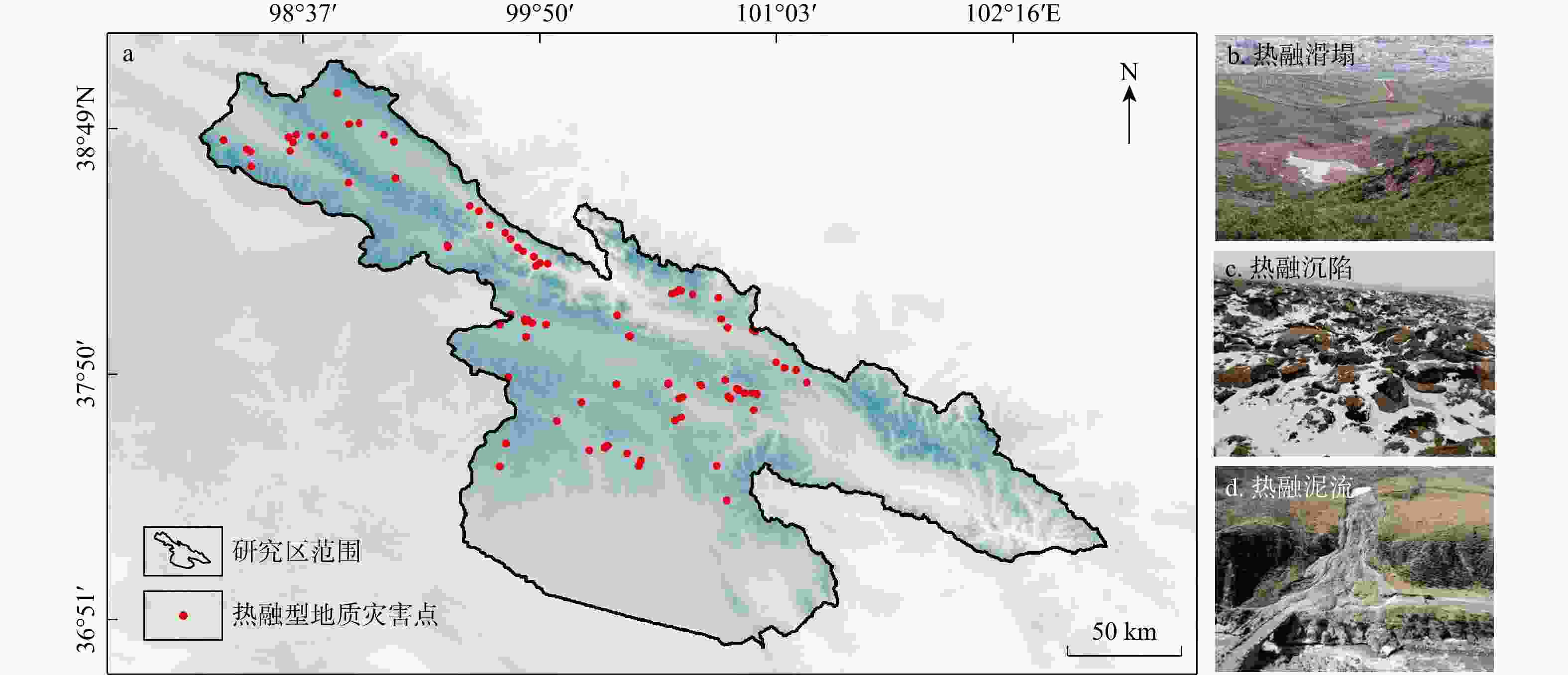
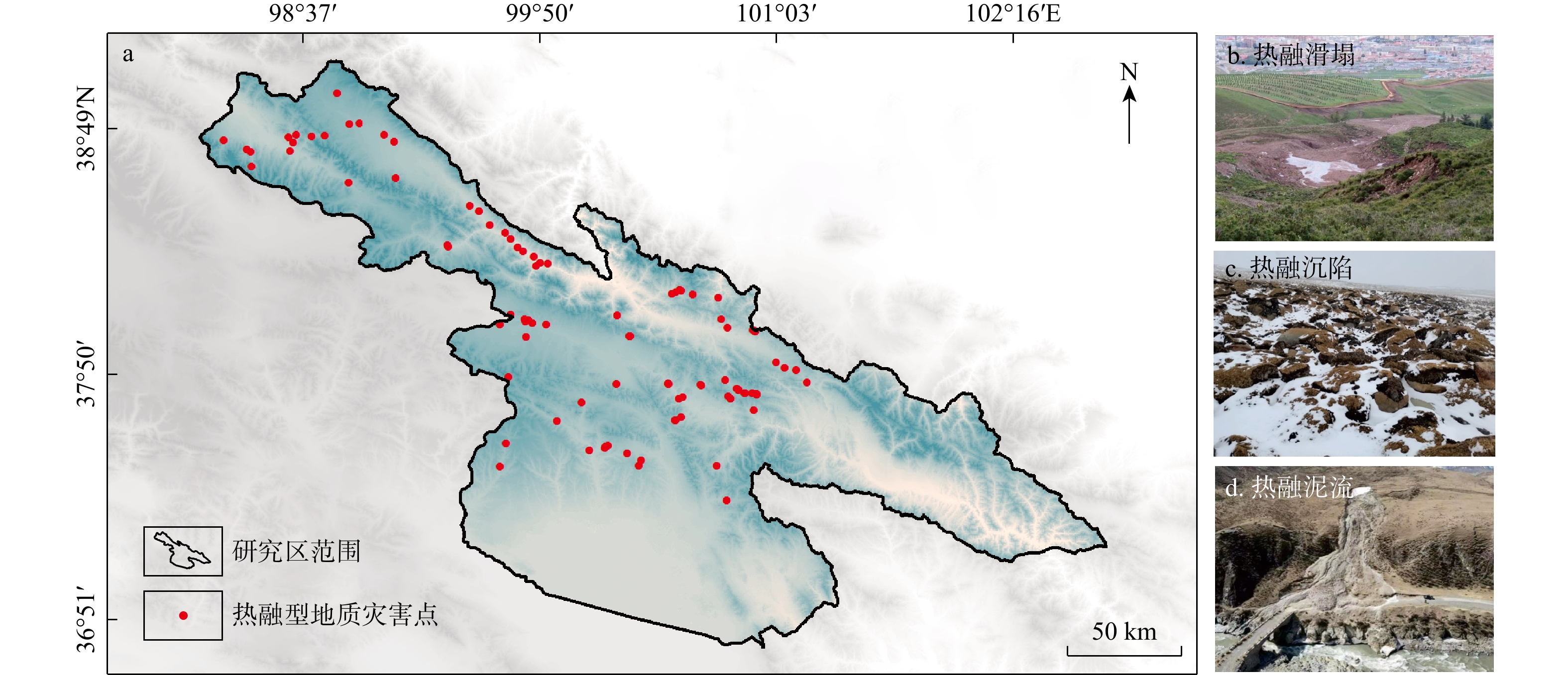
图 1 研究区范围(a)及区域内主要热融地质灾害类型(b~d)
Figure 1. Scope of study area (a) and main types of thermal thawing geohazards within area (b-d)
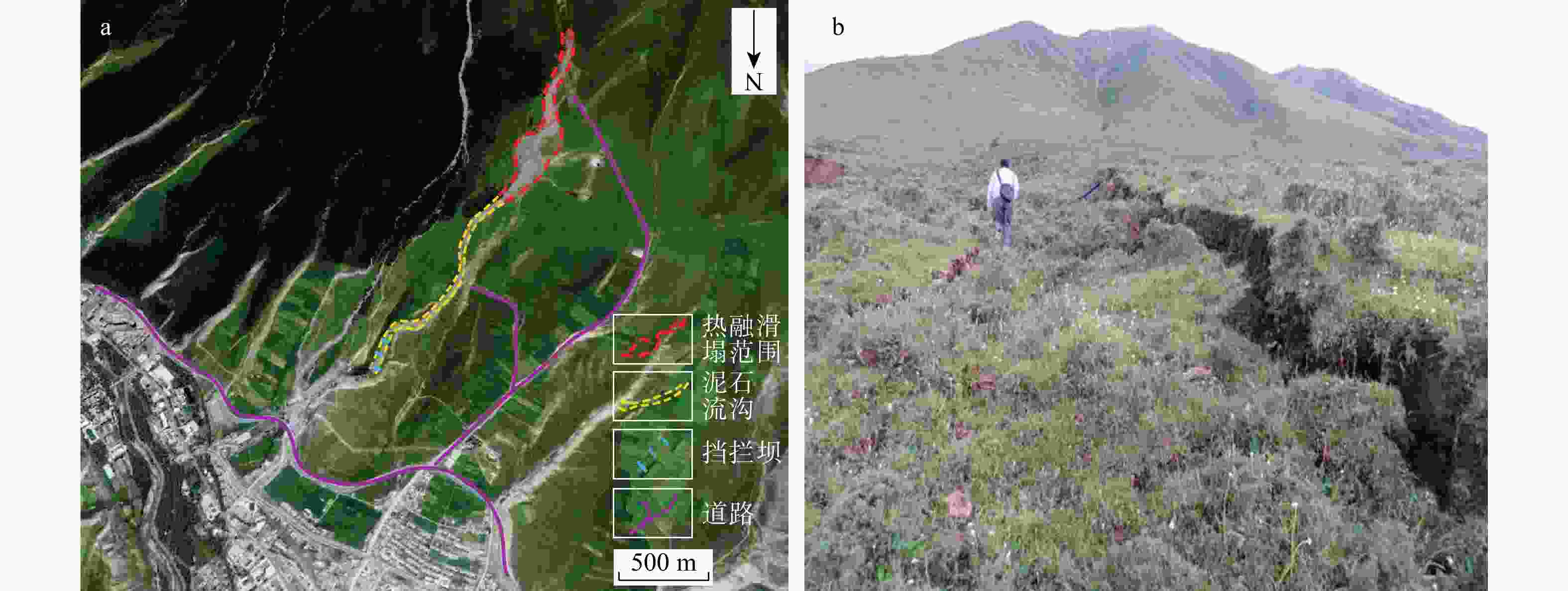
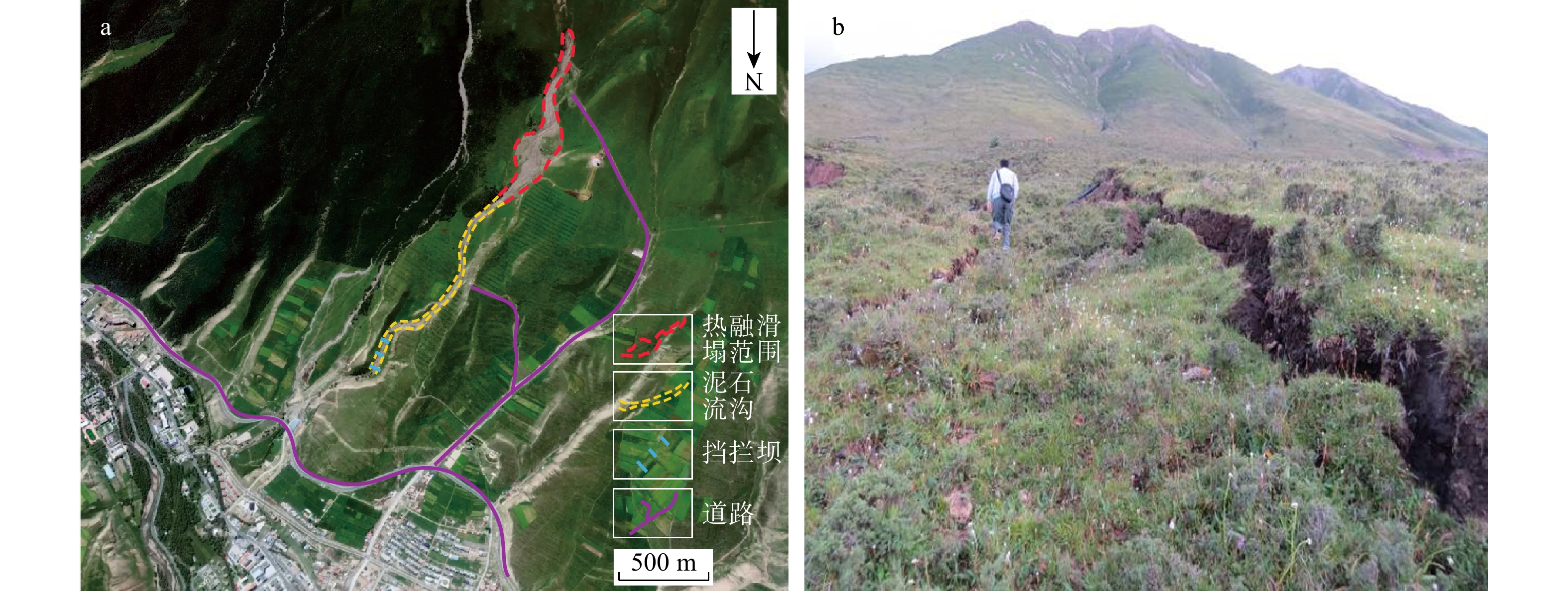
图 2 牛心山热融滑塌遥感影像(a)及滑塌后缘大裂缝(b)
Figure 2. Remote sensing image of thaw slump (a) and large tension crack at rear edge of thaw slump (b) in Niuxin Mountain
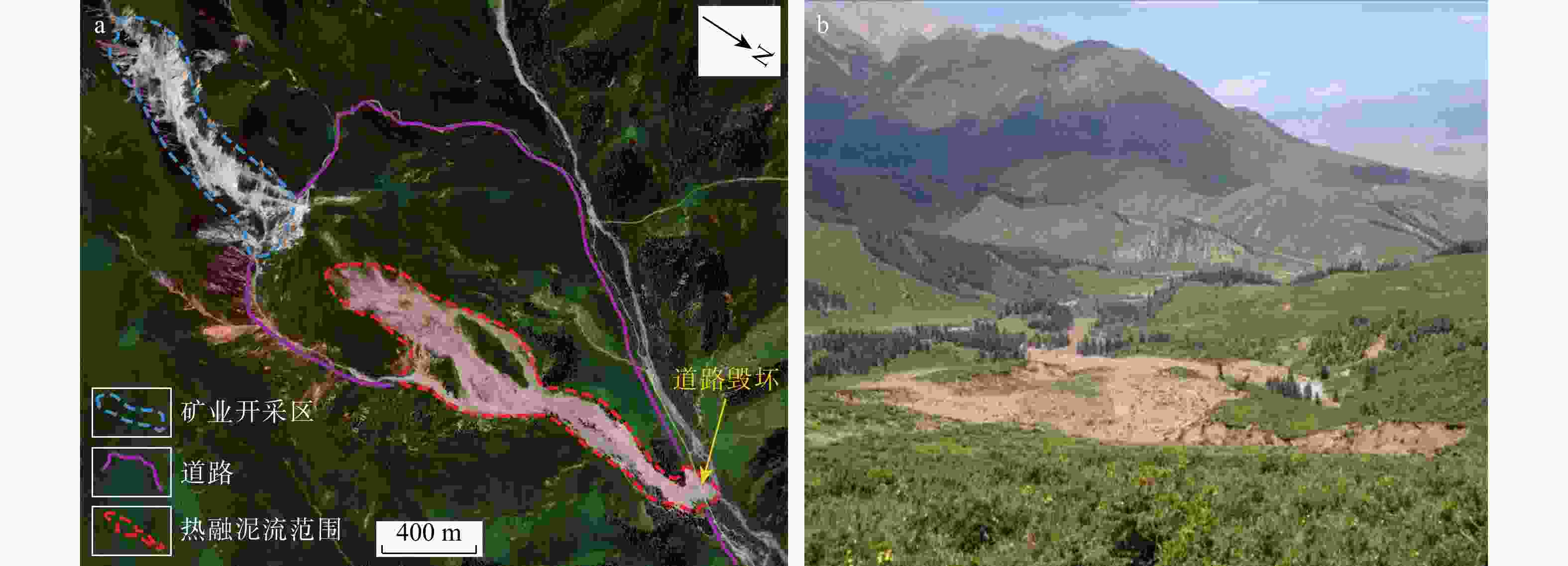
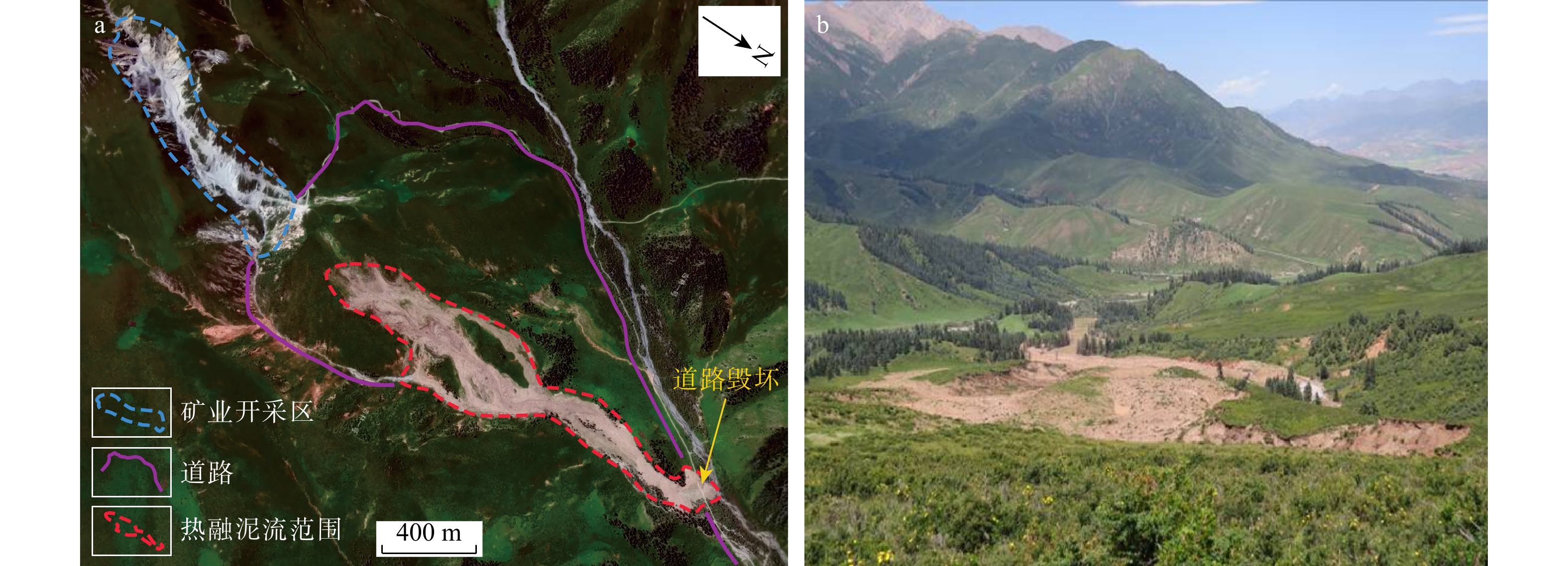
图 3 小东索热融泥流遥感影像(a)及后缘滑塌部分(b)
Figure 3. Remote sensing image of thaw mudflow (a) and residual slump at rear edge (b) in Xiaodongsuo
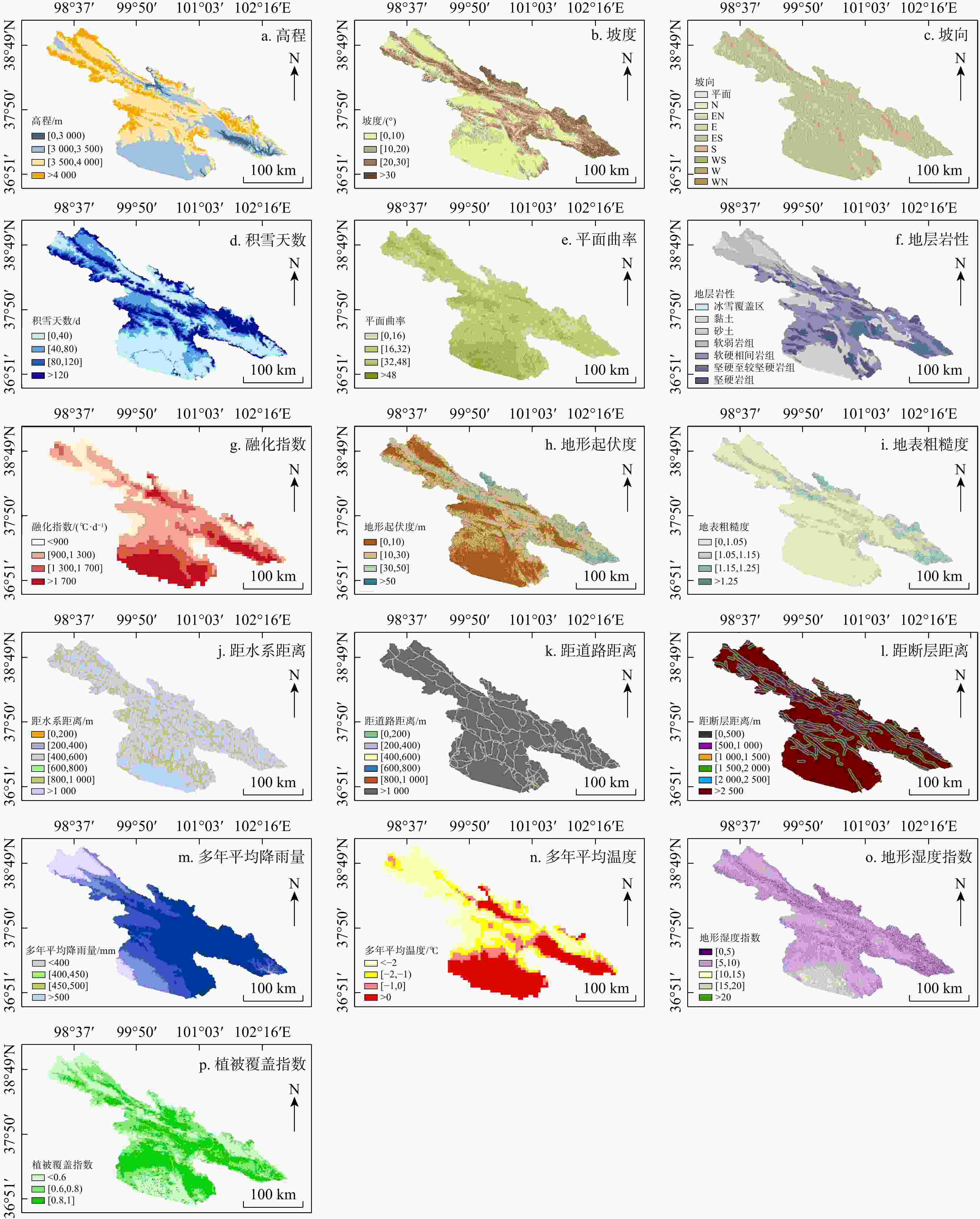
图 5 研究区热融地质灾害易发性评价指标状态分级
Figure 5. Classification of evaluation indicators for the susceptibility to thermal-melting geological disasters in the study area
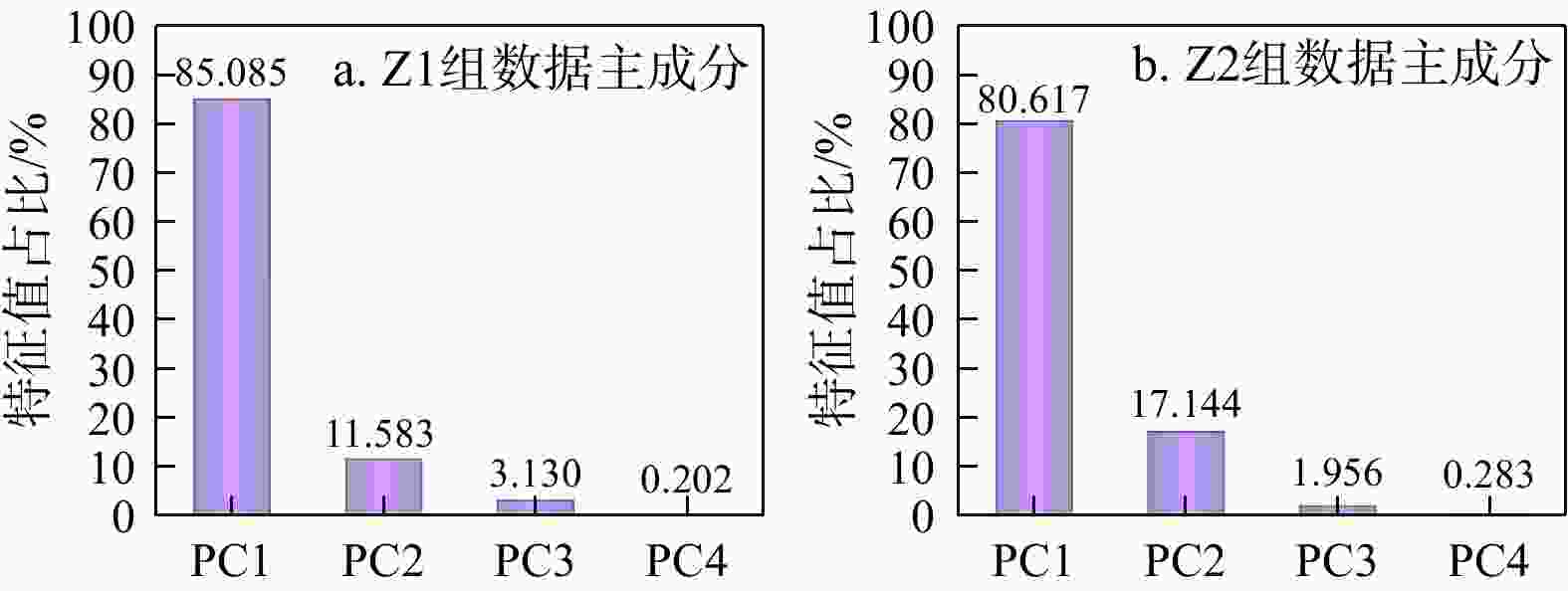
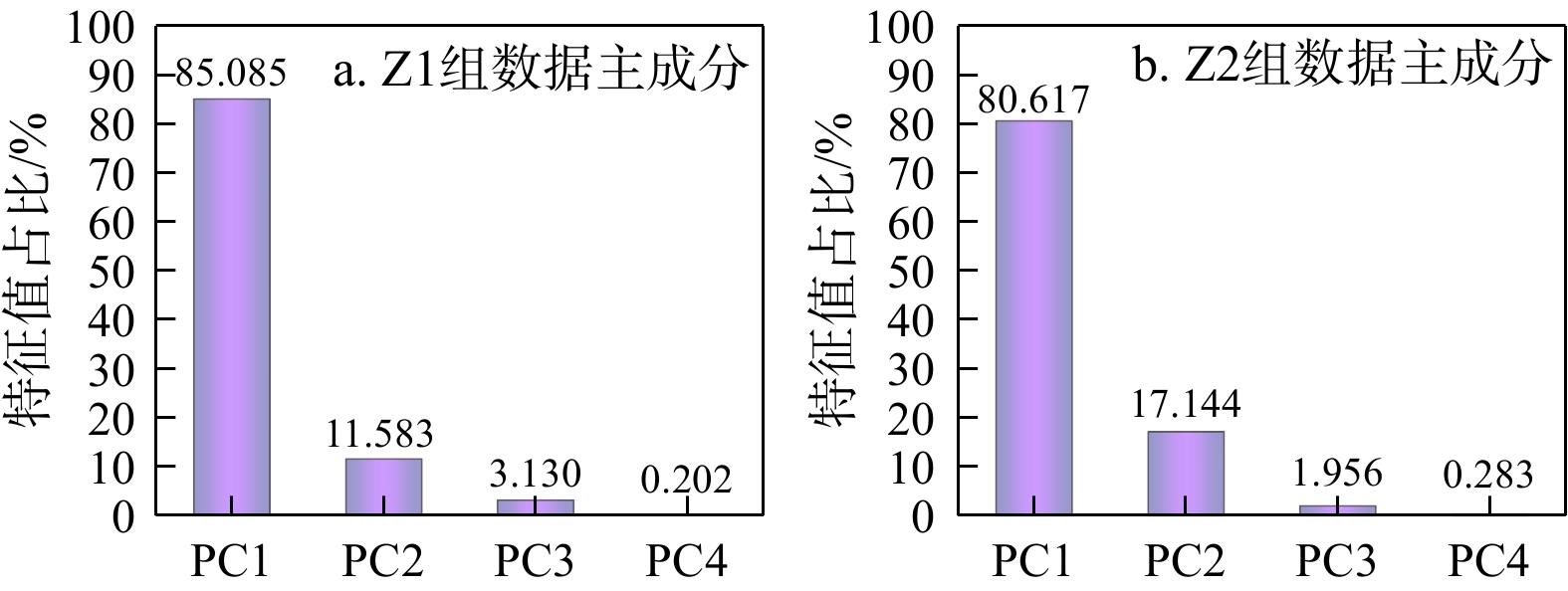
图 8 Z1和Z2组数据主成分特征值占比
Figure 8. Proportion of principal component eigenvalues for group Z1 and Z2 data
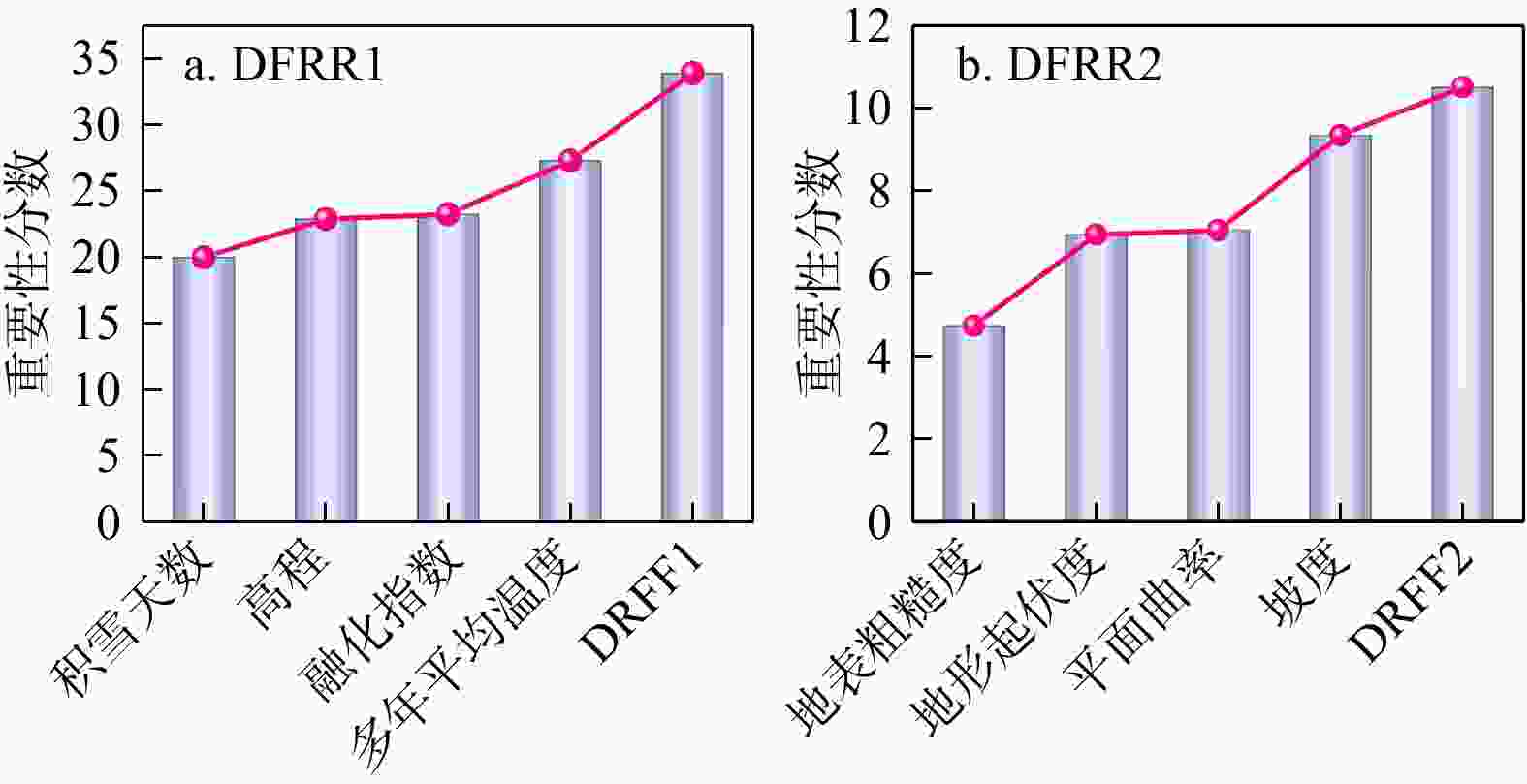
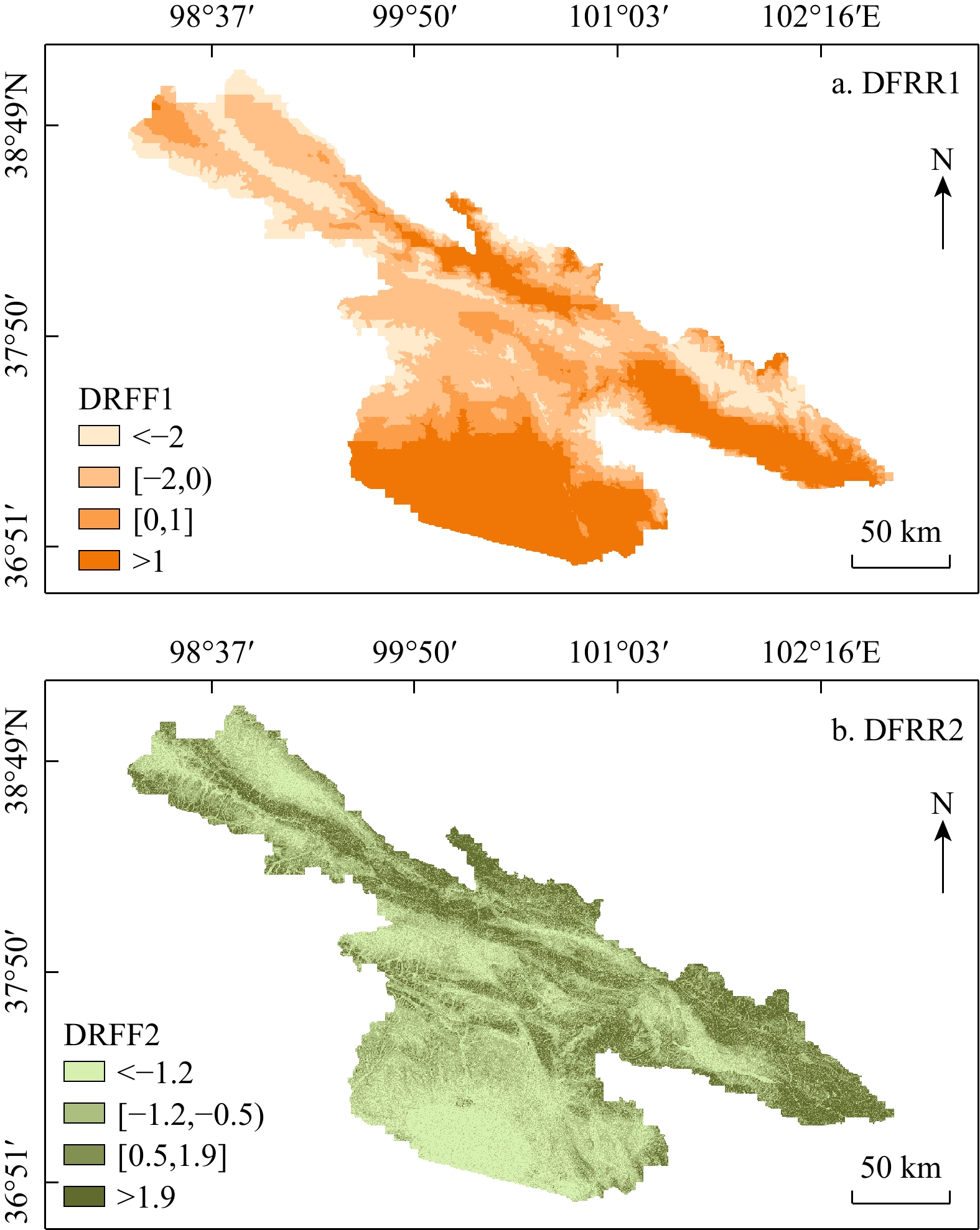
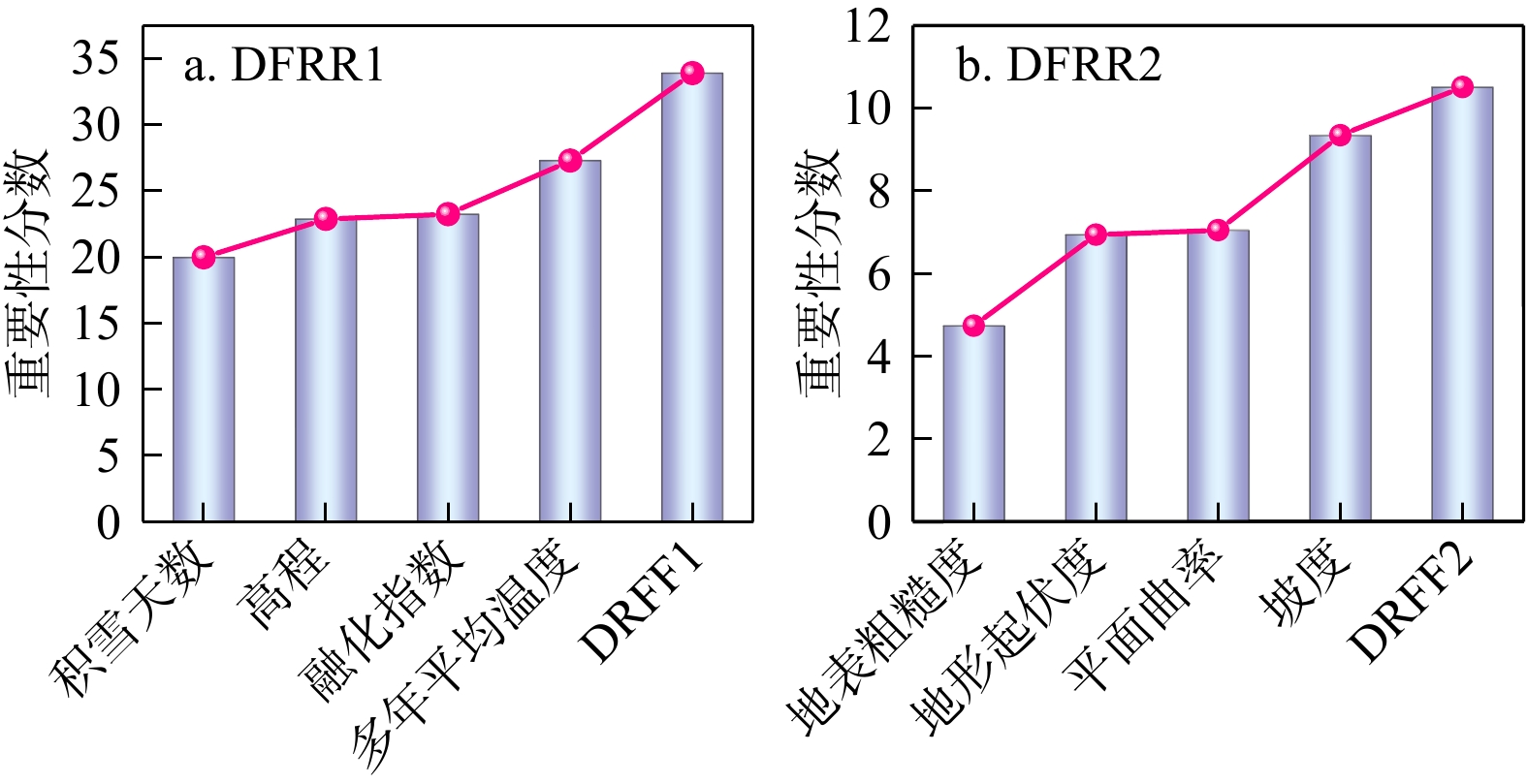
图 10 降维融合因子DFRR与降维前因子重要性对比
Figure 10. Comparison of importance between DFRR and pre-dimensionality-reduced factors
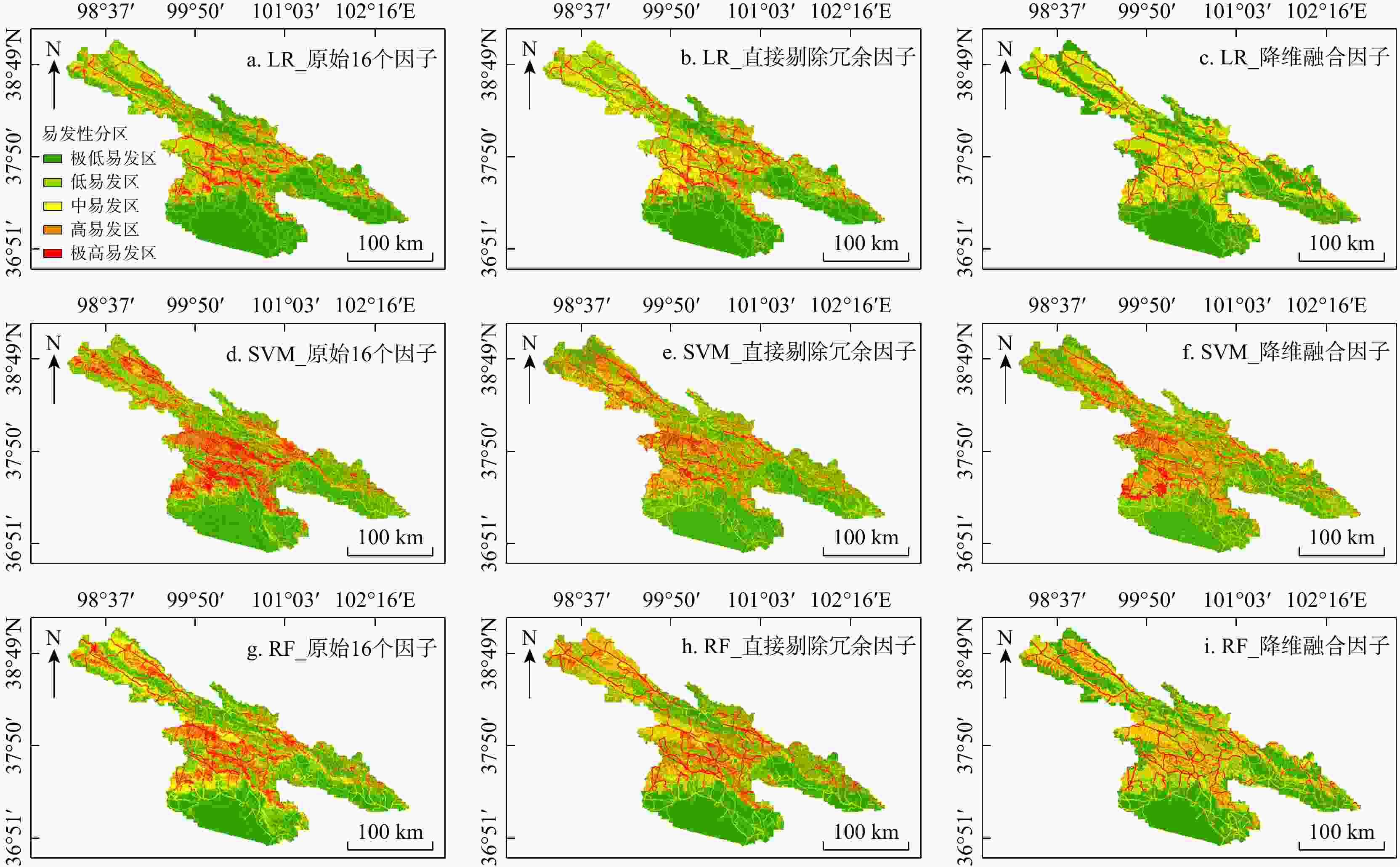
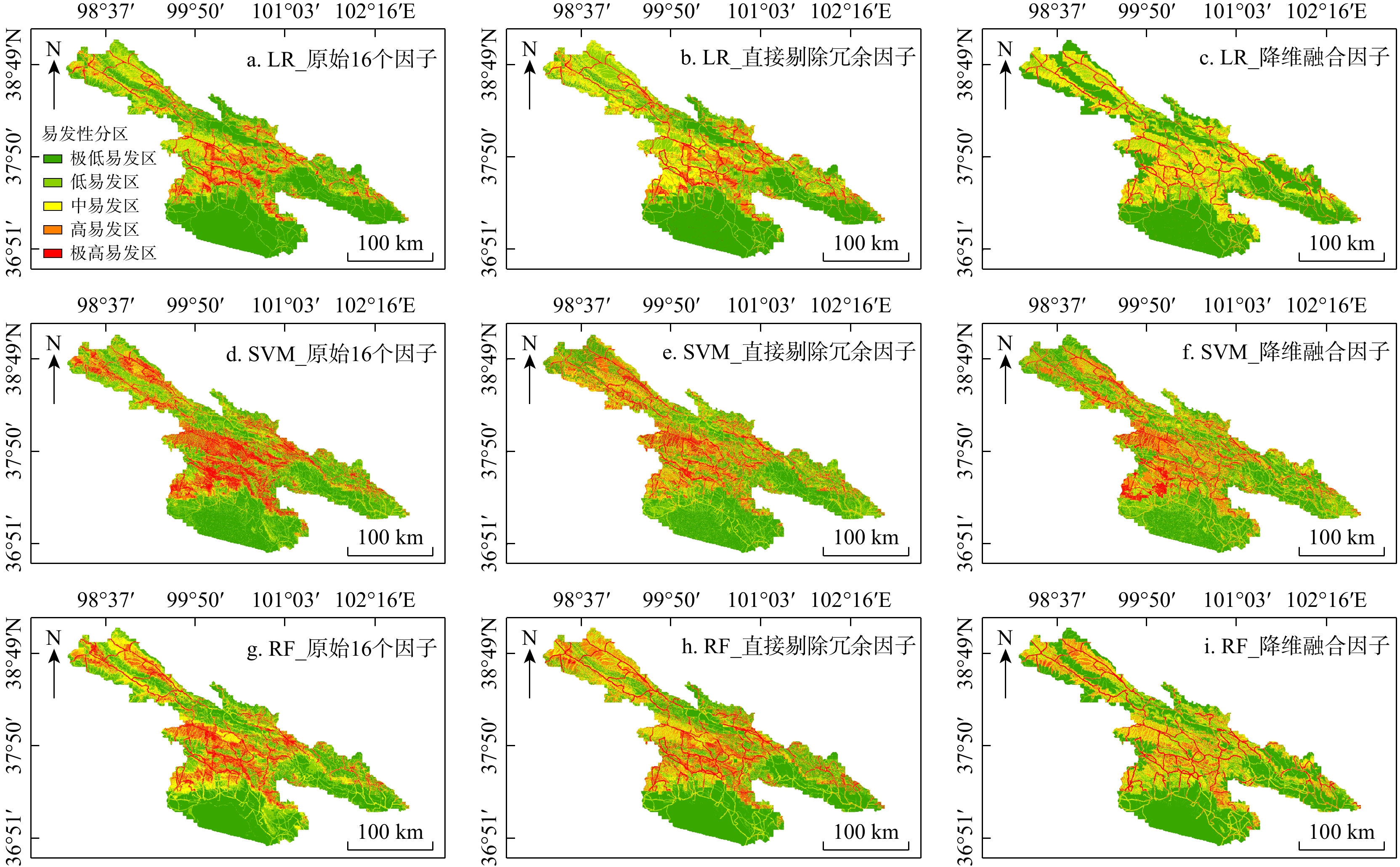
图 11 不同机器学习方法和前处理方式下研究区热融地质灾害易发性分区
LR. 逻辑回归模型;SVM. 支持向量机模型;RF. 随机森林;下同
Figure 11. Susceptibility zoning maps of thermal thawing geohazards in the study area under different machine learning methods and preprocessing approaches
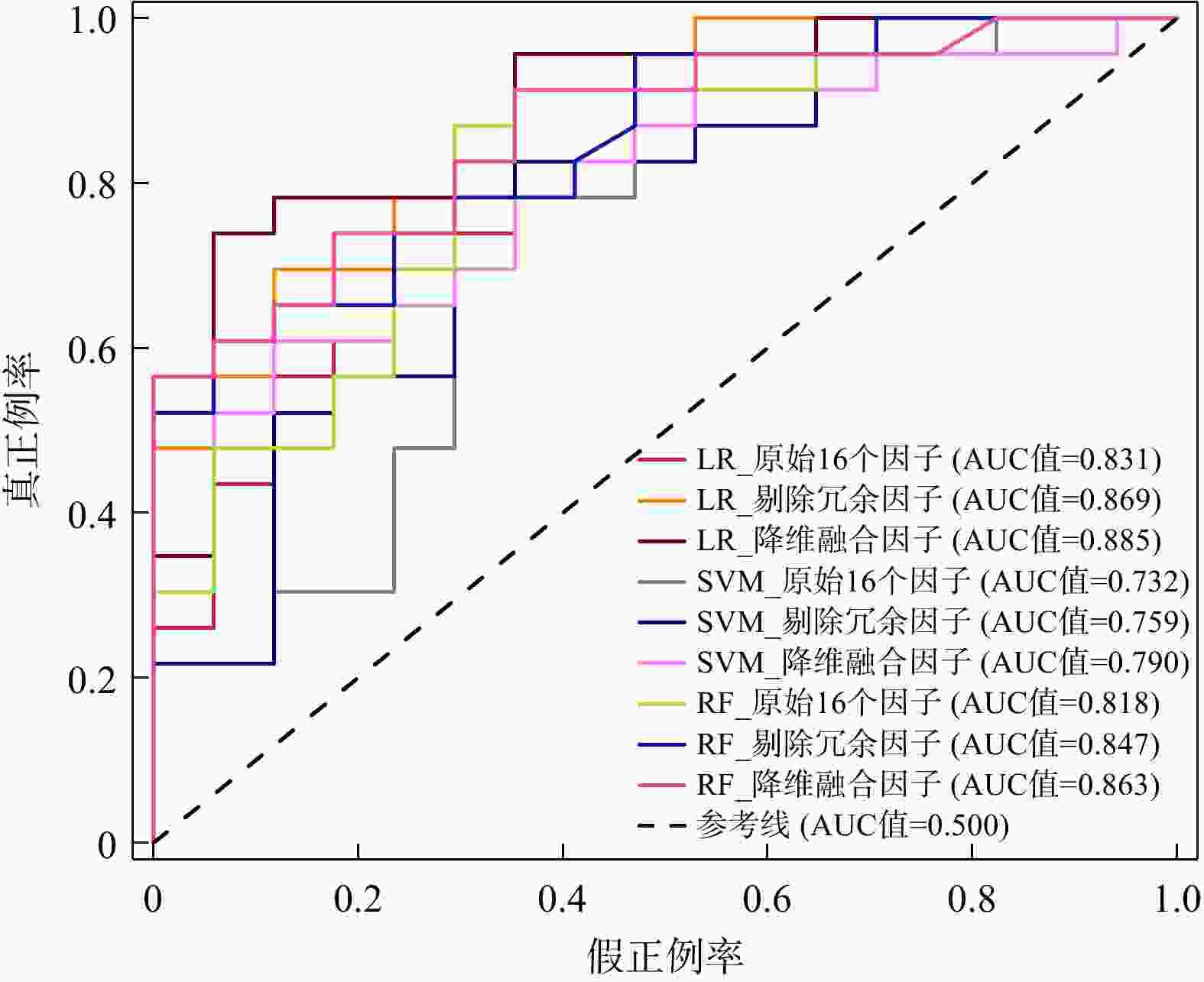
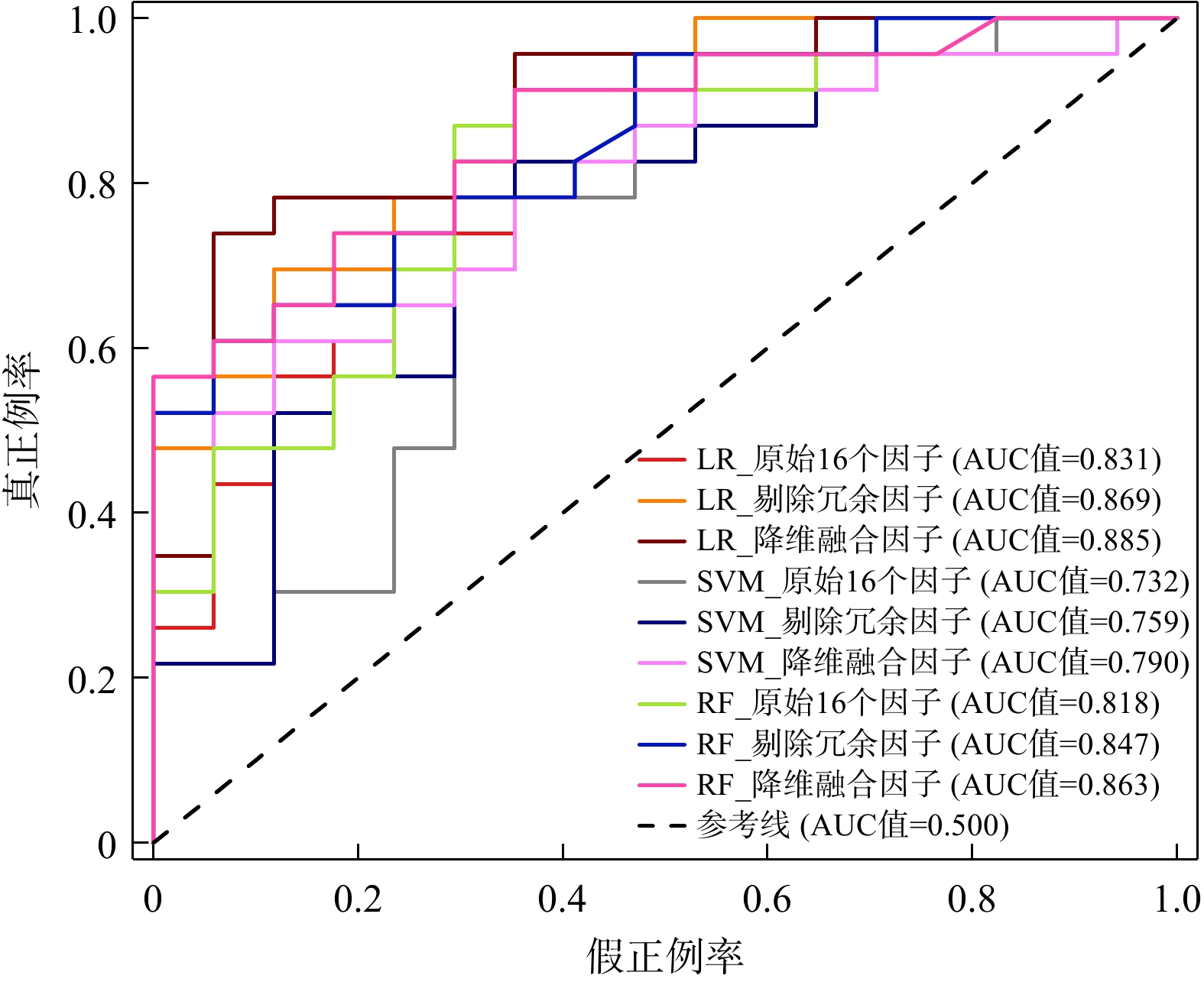
图 12 不同模型下的ROC曲线和AUC值
AUC. ROC曲线下面积;下同
Figure 12. ROC curves and AUC values under different models
表 1 本研究数据类型及来源
Table 1. Data types and sources of the study
影响因子 数据获取 数据来源 热融地质灾害点 海北藏族自治州热融地质灾害点经纬度 青海省地质环境监测总站( http://125.72.96.94:16306/ )高程、坡向、坡度、地形起伏度、
地表粗糙度、平面曲率、地形湿度指数海北藏族自治州ASTER GDEM 30 m
分辨率数字高程数据地理空间数据云( https://www.gscloud.cn/ )多年平均温度、融化指数、多年平均降雨量 海北藏族自治州2016—2020年气象数据集 国家青藏高原科学数据中心( https://data.tpdc.ac.cn/home )积雪天数 海北藏族自治州2016—2020年
AVHRR中国积雪物候数据集国家冰川冻土沙漠科学数据中心( https://www.ncdc.ac.cn/ )距道路距离 海北藏族自治州1∶100万公众版地形数据 全国地理信息资源目录服务系统( https://www.webmap.cn/ )距水系距离 地层岩性、距断层距离、植被覆盖指数 海北藏族自治州1∶250万数字地质图空间 中国地质调查局( https://www.cgs.gov.cn/ )海北藏族自治州MOD13A3数据集 美国国家航空航天局( https://search.earthdata.nasa.gov/search ) 下载: 导出CSV
表 2 各影响因子分级标签与归一化频率比值汇总
Table 2. Summary of classification labels and normalized frequency ratios of influencing factors
影响因子 分级 标签 归一化频率比值 影响因子 分级 标签 归一化频率比值 高程/m [0, 3000) 1 0.041 地表粗糙度 [0, 1.05) 1 0.164 [3000 ,3500) 2 0.083 [1.05, 1.15) 2 0.090 [3500 ,4000] 3 0.241 [1.15, 1.25] 3 0.020 > 4000 4 0.027 >1.25 4 0.049 坡度/(°) [0, 10) 1 0.149 距水系距离/m [0, 200) 1 0.531 [10, 20) 2 0.194 [200, 400) 2 0.265 [20, 30] 3 0.062 [400, 600) 3 0.121 >30 4 0.030 [600, 800) 4 0.126 坡向 平面 1 0 [800, 1000] 5 0.057 N 2 0.248 > 1000 6 0.076 EN 3 0.123 距道路距离/m [0, 200) 1 1.000 E 4 0.075 [200, 400) 2 0.494 ES 5 0.093 [400, 600) 3 0.452 S 6 0.129 [600, 800) 4 0.034 WS 7 0.172 [800, 1000] 5 0.035 W 8 0.161 > 1000 6 0.059 WN 9 0.111 距断层距离/m [0, 500) 1 0.156 积雪天数/d [0, 40) 1 0.091 [500, 1000) 2 0.175 [40, 80) 2 0.230 [1000 ,1500) 3 0.190 [80, 120] 3 0.175 [1500 , 2000)4 0.246 >120 4 0.097 [ 2000 ,2500] 5 0.111 平面曲率 [0, 16) 1 0.149 > 2500 6 0.106 [16, 32) 2 0.164 多年平均降雨量/mm <400 1 0.192 [32, 48] 3 0.109 [400, 450) 2 0.092 >48 4 0.087 [450, 500] 3 0.096 地层岩性 冰雪覆盖区 1 0 >500 4 0.156 黏土 2 0.112 多年平均温度/℃ <−2 1 0.192 砂土 3 0.115 [−2, −1) 2 0.254 软弱岩组 4 0.133 [−1, 0] 3 0.148 软硬相间岩组 5 0.192 >0 4 0.008 坚硬至较坚硬岩组 6 0.120 地形湿度指数 [0, 5) 1 0.122 坚硬岩组 7 0.063 [5, 10) 2 0.135 融化指数/(℃·d−1) <900 1 0.071 [10, 15) 3 0.149 [900, 1300) 2 0.264 [15, 20] 4 0.100 [1300 ,1700] 3 0.092 >20 5 0.698 > 1700 4 0 地形起伏度/m [0, 10) 1 0.142 植被覆盖指数 <0.6 1 0.100 [10, 30) 2 0.181 [0.6, 0.8) 2 0.174 [30, 50] 3 0.043 [0.8, 1] 3 0.098 >50 4 0.050
下载: 导出CSV
表 3 灾害点空间自相关分析结果
Table 3. Spatial autocorrelation analysis of disaster points
影响因子 高程 坡度 坡向 积雪
天数平面
曲率地层
岩性融化
指数地形
起伏度地表
粗糙度距水系
距离距道路
距离距断层
距离多年平
均降雨量多年平
均温度地形湿
度指数植被覆
盖指数Moran指数 0.2670 0.3753 0.2770 0.3365 0.1946 0.1274 0.3690 0.3831 0.3204 0.1536 0.1889 0.1615 0.2366 0.0522 0.1493 0.1124 P-value 0.7365 0.5833 0.7202 0.6340 0.7893 0.8637 0.6050 0.5737 0.6499 0.8369 0.8027 0.8306 0.7569 0.9372 0.8434 0.8865
下载: 导出CSV
表 4 不同模型性能指标汇总
Table 4. Summary of performance indicators for different models
机器学
习方法指标 前处理方式 原始16个因子 直接剔除6个因子 降维融合因子 LR AUC值 0.831 0.869 0.885 95%置信区间 [0.700, 0.963] [0.762, 0.977] [0.780, 0.990] 渐进显著性 7.66×10⁻⁷ 1.45×10⁻¹¹ 7.17×10⁻¹³ Delong检验P值 4.66×10⁻¹⁵ 9.50×10⁻³ SVM AUC值 0.732 0.759 0.790 95%置信区间 [0.565, 0.898] [0.606, 0.914] [0.649, 0.931] 渐进显著性 6.56×10⁻³ 9.57×10⁻⁴ 5.37×10⁻⁵ Delong检验P值 1.27×10⁻² 5.37×10⁻³ RF AUC值 0.818 0.847 0.863 95%置信区间 [0.684, 0.953] [0.732, 0.964] [0.752, 0.974] 渐进显著性 3.30×10⁻⁶ 4.44×10⁻⁹ 1.34×10⁻¹⁰ Delong检验P值 4.94×10⁻⁷ 4.56×10⁻³ 注:Delong检验P值为该值相邻2种不同前处理方式下得到的易发性模型对应的AUC值的差异显著性结果
下载: 导出CSV
表 5 灾害点在不同模型和不同易发等级下的面积占比和FR值
Table 5. Area proportions and FR values of disaster points under different models and different susceptibility levels
机器学习方法 前处理方式 不同易发等级面积占比 不同易发等级下FR值 极低 低 中 高 极高 极低 低 中 高 极高 LR 原始16个因子 0.486 0.188 0.159 0.095 0.071 0.082 0.478 1.132 1.576 7.582 直接剔除冗余因子 0.419 0.188 0.213 0.109 0.071 0.095 0.425 0.845 1.104 8.223 降维融合因子 0.451 0.168 0.249 0.078 0.055 0.067 0.476 0.764 2.056 9.892 SVM 原始16个因子 0.339 0.261 0.127 0.123 0.150 0.148 0.077 0.786 0.974 4.745 直接剔除冗余因子 0.351 0.248 0.147 0.152 0.103 0.085 0.484 0.409 1.054 6.146 降维融合因子 0.338 0.254 0.155 0.152 0.101 0.030 0.237 0.388 1.444 6.414 RF 原始16个因子 0.371 0.210 0.202 0.113 0.104 0.054 0.190 0.397 1.066 7.104 直接剔除冗余因子 0.396 0.184 0.159 0.167 0.094 0.076 0.217 0.504 0.717 7.767 降维融合因子 0.416 0.191 0.201 0.097 0.095 0.048 0.105 0.447 1.234 7.905
下载: 导出CSV
表 6 不同模型的5折交叉验证结果
Table 6. Five-fold cross-validation results of different models
机器学习方法 前处理方式 5折交叉验证下不同子集的AUC值 5折交叉验证
平均AUC值Set 1 Set 2 Set 3 Set 4 Set 5 LR 原始16个因子 0.848 0.849 0.923 0.778 0.821 0.844 直接剔除冗余因子 0.868 0.840 0.928 0.811 0.843 0.858 降维融合因子 0.896 0.862 0.936 0.829 0.854 0.875 SVM 原始16个因子 0.750 0.707 0.779 0.696 0.689 0.724 直接剔除冗余因子 0.805 0.716 0.815 0.705 0.687 0.746 降维融合因子 0.811 0.736 0.839 0.707 0.725 0.763 RF 原始16个因子 0.836 0.846 0.836 0.802 0.804 0.825 直接剔除冗余因子 0.851 0.853 0.878 0.805 0.790 0.835 降维融合因子 0.860 0.867 0.885 0.821 0.818 0.850
下载: 导出CSV
-
[1] LIN Z J, GAO Z Y, NIU F J, et al. High spatial density ground thermal measurements in a warming permafrost region, Beiluhe Basin, Qinghai-Tibet Plateau[J]. Geomorphology, 2019, 340: 1-14. doi: 10.1016/j.geomorph.2019.04.032 [2] ZHANG Z Y, WANG Y B, MA Z H, et al. Thaw slump development in permafrost regions alters the soil hydrothermal processes and responses to precipitation[J]. Engineering Geology, 2025, 354: 108183. doi: 10.1016/j.enggeo.2025.108183 [3] 曹文庚, 潘登, 徐郅杰, 等. 河南省滑坡灾害易发性制图研究: 多种机器学习模型的对比[J]. 地质科技通报, 2025, 44(1): 101-111. doi: 10.19509/j.cnki.dzkq.tb20230338CAO W G, PAN D, XU Z J, et al. Landslide disaster vulnerability mapping study in Henan Province: Comparison of different machine learning models[J]. Bulletin of Geological Science and Technology, 2025, 44(1): 101-111. (in Chinese with English abstract) doi: 10.19509/j.cnki.dzkq.tb20230338 [4] 黄发明, 陈杰, 杨阳, 等. 滑坡易发性相关致灾环境因子研究的综述与展望[J]. 地质科技通报, 2025, 44(2): 14-37.HUANG F M, CHEN J, YANG Y, et al. A review and prospect of disaster-causing environmental factors related to landslide susceptibility prediction[J]. Bulletin of Geological Science and Technology, 2025, 44(2): 14-37. (in Chinese with English abstract) [5] CHEN C F, LIU Y T, LI Y Y, et al. Mapping landslide susceptibility with the consideration of spatial heterogeneity and factor optimization[J]. Natural Hazards, 2025, 121(4): 4067-4093. doi: 10.1007/s11069-024-06955-w [6] 袁旭山, 刘京会, 黄龙生, 等. 基于机器学习模型的新源县滑坡易发性评估[J]. 科学技术与工程, 2025, 25(5): 1815-1826.YUAN X S, LIU J H, HUANG L S, et al. Assessment of landslide susceptibility in Xinyuan County based on machine learning models[J]. Science Technology and Engineering, 2025, 25(5): 1815-1826. (in Chinese with English abstract) [7] 王中羽, 李素敏, 袁利伟, 等. 考虑影响因子重要性选择和土壤含水率的滑坡易发性评价[J]. 水文地质工程地质, 2025, 52(3): 211-221. doi: 10.16030/j.cnki.issn.1000-3665.202309009WANG Z Y, LI S M, YUAN L W, et al. Landslide susceptibility evaluation considering the importance selection of influencing factors and soil moisture content[J]. Hydrogeology & Engineering Geology, 2025, 52(3): 211-221. (in Chinese with English abstract) doi: 10.16030/j.cnki.issn.1000-3665.202309009 [8] 李信, 薛桂澄, 柳长柱, 等. 基于信息量模型和信息量−逻辑回归模型的海南岛中部山区地质灾害易发性研究[J]. 地质力学学报, 2022, 28(2): 294-305.LI X, XUE G C, LIU C Z, et al. Evaluation of geohazard susceptibility based on information value model and information value-logistic regression model: A case study of the central mountainous area of Hainan Island[J]. Journal of Geomechanics, 2022, 28(2): 294-305. (in Chinese with English abstract) [9] 盛明强, 刘梓轩, 张晓晴, 等. 基于频率比联接法和支持向量机的滑坡易发性预测[J]. 科学技术与工程, 2021, 21(25): 10620-10628. doi: 10.3969/j.issn.1671-1815.2021.25.009SHENG M Q, LIU Z X, ZHANG X Q, et al. Landslide susceptibility prediction based on frequency ratio analysis and support vector machine[J]. Science Technology and Engineering, 2021, 21(25): 10620-10628. (in Chinese with English abstract) doi: 10.3969/j.issn.1671-1815.2021.25.009 [10] HONG H Y, ILIA I, TSANGARATOS P, et al. A hybrid fuzzy weight of evidence method in landslide susceptibility analysis on the Wuyuan area, China[J]. Geomorphology, 2017, 290: 1-16. doi: 10.1016/j.geomorph.2017.04.002 [11] LIU Y M, ZHANG W C, ZHANG Z J, et al. Risk factor detection and landslide susceptibility mapping using geo-detector and Random Forest models: The 2018 Hokkaido eastern Iburi earthquake[J]. Remote Sensing, 2021, 13(6): 1157. doi: 10.3390/rs13061157 [12] 饶姗姗, 冷小鹏. 基于RSIV-RF模型的凉山州泥石流易发性评价[J]. 地质科技通报, 2024, 43(1): 275-287. doi: 10.19509/j.cnki.dzkq.tb20220267RAO S S, LENG X P. Debris flow susceptibility evaluation of Liangshan Prefecture based on the RSIV-RF model[J]. Bulletin of Geological Science and Technology, 2024, 43(1): 275-287. (in Chinese with English abstract) doi: 10.19509/j.cnki.dzkq.tb20220267 [13] 刘少泽, 崔美娟, 付晓祎, 等. 顾及缓冲区范围与负样本优化的随机森林地质灾害易发性评价[J]. 科学技术与工程, 2025, 25(15): 6220-6229. doi: 10.12404/j.issn.1671-1815.2405249LIU S Z, CUI M J, FU X Y, et al. Random Forest evaluation of geological hazard susceptibility considering buffer range and negative sample optimization[J]. Science Technology and Engineering, 2025, 25(15): 6220-6229. (in Chinese with English abstract) doi: 10.12404/j.issn.1671-1815.2405249 [14] BAI S B, WANG J, LYU G N, et al. GIS-based logistic regression for landslide susceptibility mapping of the Zhongxian segment in the Three Gorges Reservoir area, China[J]. Geomorphology, 2010, 115(1/2): 23-31. doi: 10.1016/j.geomorph.2009.09.025 [15] ZHANG Z Q, SUN J C. Regional landslide susceptibility assessment and model adaptability research[J]. Remote Sensing, 2024, 16(13): 2305. doi: 10.3390/rs16132305 [16] MARJANOVIĆ M, KOVAČEVIĆ M, BAJAT B, et al. Landslide susceptibility assessment using SVM machine learning algorithm[J]. Engineering Geology, 2011, 123(3): 225-234. doi: 10.1016/j.enggeo.2011.09.006 [17] ABBASZADEH SHAHRI A, SPROSS J, JOHANSSON F, et al. Landslide susceptibility hazard map in Southwest Sweden using artificial neural network[J]. Catena, 2019, 183: 104225. doi: 10.1016/j.catena.2019.104225 [18] 王璇, 师芸, 陈浩. CF耦合LR模型的地质灾害易发性评价[J]. 测绘通报, 2022(11): 112-117.WANG X, SHI Y, CHEN H. Evaluation of geological hazard susceptibility based on certainty factors coupling logistic regression[J]. Bulletin of Surveying and Mapping, 2022(11): 112-117. (in Chinese with English abstract) [19] 樊芷吟, 苟晓峰, 秦明月, 等. 基于信息量模型与Logistic回归模型耦合的地质灾害易发性评价[J]. 工程地质学报, 2018, 26(2): 340-347. doi: 10.13928/j.cnki.wrahe.2019.03.018FAN Z Y, GOU X F, QIN M Y, et al. Information and logistic regression models based coupling analysis for susceptibility of geological hazards[J]. Journal of Engineering Geology, 2018, 26(2): 340-347. (in Chinese with English abstract) doi: 10.13928/j.cnki.wrahe.2019.03.018 [20] 周晓亭, 黄发明, 吴伟成, 等. 基于耦合信息量法选择负样本的区域滑坡易发性预测[J]. 工程科学与技术, 2022, 54(3): 25-35.ZHOU X T, HUANG F M, WU W C, et al. Regional landslide susceptibility prediction based on negative sample selected by coupling information value method[J]. Advanced Engineering Sciences, 2022, 54(3): 25-35. (in Chinese with English abstract) [21] LIU L L, ZHANG Y L, XIAO T, et al. A frequency ratio: Based sampling strategy for landslide susceptibility assessment[J]. Bulletin of Engineering Geology and the Environment, 2022, 81(9): 360. doi: 10.1007/s10064-022-02836-3 [22] LIN N, DING K, TAN L B, et al. Dynamic landslide susceptibility mapping on time-series InSAR and explainable machine learning: A case study at Wushan in the Three Gorges Reservoir area, China[J]. Advances in Space Research, 2025, 75(12): 8439-8465. doi: 10.1016/j.asr.2025.03.067 [23] WANG S B, ZHUANG J Q, ZHENG J, et al. Application of Bayesian hyperparameter optimized Random Forest and XGBoost model for landslide susceptibility mapping[J]. Frontiers in Earth Science, 2021, 9: 712240. doi: 10.3389/feart.2021.712240 [24] SUN K, LI Z Q, WANG S J, et al. A support vector machine model of landslide susceptibility mapping based on hyperparameter optimization using the Bayesian algorithm: A case study of the highways in the southern Qinghai-Tibet Plateau[J]. Natural Hazards, 2024, 120(12): 11377-11398. doi: 10.1007/s11069-024-06665-3 [25] LUO J, NIU F J, LIN Z J, et al. Recent acceleration of thaw slumping in permafrost terrain of Qinghai-Tibet Plateau: An example from the Beiluhe Region[J]. Geomorphology, 2019, 341: 79-85. doi: 10.1016/j.geomorph.2019.05.020 [26] 罗京, 牛富俊, 林战举, 等. 青藏高原多年冻土区热融滑塌发育特征及规律[J]. 冰川冻土, 2022, 44(1): 96-105.LUO J, NIU F J, LIN Z J, et al. The characteristics and patterns of retrogressive thaw slumps developed in permafrost region of the Qinghai-Tibet Plateau[J]. Journal of Glaciology and Geocryology, 2022, 44(1): 96-105. (in Chinese with English abstract) [27] 李艳, 金会军, 温智, 等. 多年冻土区斜坡稳定性研究综述[J]. 冰川冻土, 2022, 44(1): 203-216.LI Y, JIN H J, WEN Z, et al. Stability of permafrost slopes: A review[J]. Journal of Glaciology and Geocryology, 2022, 44(1): 203-216. (in Chinese with English abstract) [28] SUN Z, WANG Y B, SUN Y, et al. Creep characteristics and process analyses of a thaw slump in the permafrost region of the Qinghai-Tibet Plateau, China[J]. Geomorphology, 2017, 293: 1-10. doi: 10.1016/j.geomorph.2017.04.045 [29] LOU P Q, WU T H, CHEN J, et al. Recognition of thaw slumps based on machine learning and UAVs: A case study in the Qilian Mountains, northeastern Qinghai-Tibet Plateau[J]. International Journal of Applied Earth Observation and Geoinformation, 2023, 116: 103163. doi: 10.1016/j.jag.2022.103163 [30] 张航, 胡海瑞, 朱杰清, 等. 基于非接触测量楔形危岩体稳定性快速评价[J]. 地质科技通报, 2025, 44(2): 67-77. doi: 10.19509/j.cnki.dzkq.tb20240496ZHANG H, HU H R, ZHU J Q, et al. Rapid analysis of the stability of a wedge-shaped unstable rock mass on the basis of non-contact measurements[J]. Bulletin of Geological Science and Technology, 2025, 44(2): 67-77. (in Chinese with English abstract) doi: 10.19509/j.cnki.dzkq.tb20240496 [31] GOYES-PEÑAFIEL P, HERNANDEZ-ROJAS A. Landslide susceptibility index based on the integration of logistic regression and weights of evidence: A case study in Popayan, Colombia[J]. Engineering Geology, 2021, 280: 105958. doi: 10.1016/j.enggeo.2020.105958 [32] HUANG F M, LIU K J, JIANG S H, et al. Optimization method of conditioning factors selection and combination for landslide susceptibility prediction[J]. Journal of Rock Mechanics and Geotechnical Engineering, 2025, 17(2): 722-746. doi: 10.1016/j.jrmge.2024.04.029 [33] JIN J C, CHEN G, MENG X M, et al. Prediction of river damming susceptibility by landslides based on a logistic regression model and InSAR techniques: A case study of the Bailong River Basin, China[J]. Engineering Geology, 2022, 299: 106562. doi: 10.1016/j.enggeo.2022.106562 [34] 苏志萍, 杨成生, 王子倩. 结合负样本优化与机器学习模型的怒江洲峡谷段滑坡易发性评价[J]. 地球信息科学学报, 2025, 27(4): 979-993. doi: 10.12082/dqxxkx.2025.240614SU Z P, YANG C S, WANG Z Q. Landslide susceptibility assessment in Nujiang canyon using negative sample optimization and machine learning models[J]. Journal of Geo-Information Science, 2025, 27(4): 979-993. (in Chinese with English abstract) doi: 10.12082/dqxxkx.2025.240614 [35] WEN H J, LI J Y, LIAO M Y, et al. A hybrid-optimized Random Forest interpretable model for debris flow susceptibility by prior model-based negative sampling[J]. Advances in Space Research, 2025, 76(1): 202-220. doi: 10.1016/j.asr.2025.04.055 [36] 毕结昂, 徐佩华, 宋盛渊, 等. 基于信息量−逻辑回归耦合模型的玛纳斯河流域地质灾害易发性评价[J]. 工程地质学报, 2022, 30(5): 1549-1560. doi: 10.13544/j.cnki.jeg.2022-0327BI J A, XU P H, SONG S Y, et al. Assessment of the susceptibility to geological hazards in the Manas River Basin based on the coupled information value-logistic regression model[J]. Journal of Engineering Geology, 2022, 30(5): 1549-1560. (in Chinese with English abstract) doi: 10.13544/j.cnki.jeg.2022-0327 [37] 李郎平, 兰恒星, 郭长宝, 等. 基于改进频率比法的川藏铁路沿线及邻区地质灾害易发性分区评价[J]. 现代地质, 2017, 31(5): 911-929.LI L P, LAN H X, GUO C B, et al. Geohazard susceptibility assessment along the Sichuan-Tibet railway and its adjacent area using an improved frequency ratio method[J]. Geoscience, 2017, 31(5): 911-929. (in Chinese with English abstract) [38] 杨永刚, 殷坤龙, 赵海燕, 等. 基于C5.0决策树−快速聚类模型的万州区库岸段乡镇滑坡易发性区划[J]. 地质科技情报, 2019(6): 189-197. doi: 10.19509/j.cnki.dzkq.2019.0622YANG Y G, YIN K L, ZHAO H Y, et al. Landslide susceptibility evaluation for township units of bank section in Wanzhou district based on C5.0 decision tree and K-means cluster model[J]. Geological Science and Technology Information, 2019(6): 189-197. (in Chinese with English abstract) doi: 10.19509/j.cnki.dzkq.2019.0622 [39] HU X D, HUANG C, MEI H B, et al. Landslide susceptibility mapping using an ensemble model of Bagging scheme and random subspace: Based naïve Bayes tree in Zigui County of the Three Gorges Reservoir area, China[J]. Bulletin of Engineering Geology and the Environment, 2021, 80(7): 5315-5329. doi: 10.1007/s10064-021-02275-6 [40] LIU D L, XIANG Q, SANG X J, et al. Landslide susceptibility prediction method based on HSOM and IABPA-CNN in Wenchuan earthquake disaster area[J]. Journal of Mountain Science, 2024, 21(12): 4001-4018. doi: 10.1007/s11629-024-8971-7 [41] LIANG Z, LIU W, PENG W P, et al. Improved shallow landslide susceptibility prediction based on statistics and ensemble learning[J]. Sustainability, 2022, 14(10): 6110. doi: 10.3390/su14106110 [42] NEFESLIOGLU H A, GOKCEOGLU C, SONMEZ H. An assessment on the use of logistic regression and artificial neural networks with different sampling strategies for the preparation of landslide susceptibility maps[J]. Engineering Geology, 2008, 97(3/4): 171-191. doi: 10.1016/j.enggeo.2008.01.004 [43] SUN X H, CHEN J P, HAN X D, et al. Landslide susceptibility mapping along the upper Jinsha River, south-western China: A comparison ofhydrological and curvature watershed methods for slope unit classification[J]. Bulletin of Engineering Geology and the Environment, 2020, 79(9): 4657-4670. doi: 10.1007/s10064-020-01849-0 [44] REICHENBACH P, ROSSI M, MALAMUD B D, et al. A review of statistically-based landslide susceptibility models[J]. Earth-Science Reviews, 2018, 180: 60-91. doi: 10.1016/j.earscirev.2018.03.001 [45] 古腾飞, 段平, 王伟鹏, 等. 滑坡易发性评价方法综述[J]. 自然灾害学报, 2024, 33(6): 1-16.GU T F, DUAN P, WANG W P, et al. Review of methods for landslide susceptibility assessment[J]. Journal of Natural Disasters, 2024, 33(6): 1-16. (in Chinese with English abstract) [46] 李国营, 刘平, 张凯, 等. 量纲统一在滑坡易发性评价中的影响分析[J]. 水文地质工程地质, 2024, 51(3): 118-129. doi: 10.16030/j.cnki.issn.1000-3665.202304005LI G Y, LIU P, ZHANG K, et al. Analysis of the influence of dimensional unity in landslide susceptibility assessment[J]. Hydrogeology and Engineering Geology, 2024, 51(3): 118-129. (in Chinese with English abstract) doi: 10.16030/j.cnki.issn.1000-3665.202304005 [47] 朱路路. 基于多种负样本取样方法的滑坡易发性评价[D]. 安徽淮南: 安徽理工大学, 2024.ZHU L L. Landslide susceptibility evaluation based on multiple negative sample sampling methods[D]. Huainan Anhui: Anhui University of Science & Technology, 2024. (in Chinese with English abstract) [48] 田煜坤. 广西崇左市3S及多模型耦合的滑坡易发性评价研究[D]. 广西 桂林: 桂林理工大学, 2024.TIAN Y K. Evaluation of landslide susceptibility in Chongzuo City, Guangxi with 3S and multi-model coupling[D]. Guilin Guangxi: Guilin University of Technology, 2024. (in Chinese with English abstract) [49] 王浩. 桂北地区滑坡地质灾害易发性耦合模型的选取与评价[D]. 广西 桂林: 桂林理工大学, 2023.WANG H. Selection and evaluation of integration model for landslide geological hazard susceptibility in northern Guangxi[D]. Guilin Guangxi: Guilin University of Technology, 2023. (in Chinese with English abstract) [50] LIN M S, TENG S, CHEN G F, et al. Application of convolutional neural networks based on Bayesian optimization to landslide susceptibility mapping of transmission tower foundation[J]. Bulletin of Engineering Geology and the Environment, 2023, 82(2): 51. doi: 10.1007/s10064-023-03069-8 [51] YANG C, LIU L L, HUANG F M, et al. Machine learning-based landslide susceptibility assessment with optimized ratio of landslide to non-landslide samples[J]. Gondwana Research, 2023, 123: 198-216. doi: 10.1016/j.gr.2022.05.012 -

 下载:
下载:


 点击查看大图
计量
- 文章访问数: 176
- PDF下载量: 22
- 被引次数: 0