投审稿入口
投审稿入口


Mineral prospectivity prediction based on ensemble learning: A case study of skarn-type iron-gold polymetallic deposits in Miaoshan-Xintai area, western Shandong
-
摘要:
传统成矿预测模型处理复杂地质场景时存在多源地学数据融合能力弱的问题,现有集成学习成矿预测方法对不同基学习器的地质变量识别互补效应剖析不足,且数据驱动建模对先验地质背景约束融合有限。针对上述问题,本研究构建一套堆叠集成学习成矿预测方法。采用2层 Stacking 堆叠集成框架,基学习器选取随机森林(RF)、极端梯度提升(XGBoost)、类别特征提升(CatBoost),元学习器采用逻辑回归融合基模型输出;构建基于模型扰动重要性评分的特征筛选工具,实现非线性模型下地质评价因子定量解析。以鲁西苗山−新泰矽卡岩型铁金多金属矿为研究实例,综合地质、地球物理、地球化学多源地学信息,通过相关性分析剔除冗余变量,得到 17 个核心评价因子;采用合成少数类过采样技术(SMOTE)处理样本类别不平衡,基于 5 折分层交叉验证完成模型训练与性能评估。Stacking 集成模型的准确率、精确率、
F 1 值、AUC 等评价指标均优于 RF、XGBoost、CatBoost 单一模型,成矿概率空间分布与已知矿床匹配程度高;3类基学习器对控矿地质要素识别具备互补效应,模型解析表明断裂构造与燕山晚期侵入岩体是本区矽卡岩型矿床的核心控矿要素。综合模型成矿有利度与区域成矿地质条件,圈定3处具有勘查潜力的找矿靶区;所建立的特征重要性评估工具具备较好方法学借鉴意义,多源数据与异质模型协同优化思路有效提升成矿预测可靠性,可为新一轮找矿突破战略行动提供技术支撑,模型参数优化、多尺度样本平衡仍是后续需要完善的方向。-
关键词:
- 集成学习 /
- 矽卡岩型铁金多金属矿 /
- 成矿预测 /
- 鲁西
Abstract:ObjectiveTraditional mineral prospectivity models show limited capacity for fusing multi-source geoscience datasets under complex geological settings. Current ensemble-learning-based mineral prospectivity studies still have two major drawbacks: insufficient analysis of complementary effects among base learners in identifying geological ore-controlling variables, and inadequate integration of prior geological constraints within data-driven modelling workflows. To address these gaps, this study constructs a two-layer stacking ensemble learning framework for skarn-type iron-gold polymetallic mineral prospectivity prediction.
MethodsThe stacking architecture consisted of a base-learner layer and a meta-learner layer. Random forest (RF), extreme gradient boosting (XGBoost), and categorical boosting (CatBoost) were selected as base learners, while logistic regression was adopted as the meta-learner to synthesize prediction outputs from individual base models. A perturbation-based feature importance scoring evaluator was developed to quantitatively interpret geological predictive variables under nonlinear model conditions. Taking the skarn-type iron-gold polymetallic deposits in the Miaoshan-Xintai area of western Shandong as the research case, this study integrated multi-source geological, geophysical, and geochemical datasets. Redundant variables were eliminated through combined Pearson linear-correlation and Spearman rank-correlation analyses, and 17 core predictive factors were finally retained. The synthetic minority oversampling technique (SMOTE) was applied to mitigate severe sample imbalance between mineralized positive samples and barren negative samples. A five-fold stratified cross-validation strategy was implemented for model training and comprehensive performance assessment.
ResultsThe stacking ensemble model outperformed three standalone base-learner models (RF, XGBoost, and CatBoost) in multiple quantitative indicators including accuracy, precision, F1-score, and AUC value. The spatial distribution of predicted mineral prospectivity probabilities showed high consistency with the locations of known skarn-type deposits in the study area. Three base learners exhibited obvious complementary capabilities in identifying ore-controlling geological factors. Model interpretation results further revealed that fault structures and Late Yanshanian intrusive rock bodies represented the dominant ore-controlling factors for skarn-type iron-gold polymetallic mineralization in this study area.
ConclusionBy integrating model-derived mineral prospectivity maps with regional metallogenic geological constraints, three prospecting target areas with exploration potential are delineated for further field investigation. The proposed perturbation-driven feature-importance evaluation tool provides a useful methodological reference for mineral prospectivity modelling. The technical workflow combining multi-source geodata fusion and heterogeneous-model collaborative optimization substantially improves the reliability of mineral prospectivity prediction and can provide technical support for the new-round national mineral exploration breakthrough strategy. Nevertheless, further improvements are still required in intelligent hyper-parameter optimization and multi-scale sample balancing strategies, thereby enhancing the generalizability of the mineral prospectivity approach based on ensemble learning.
-
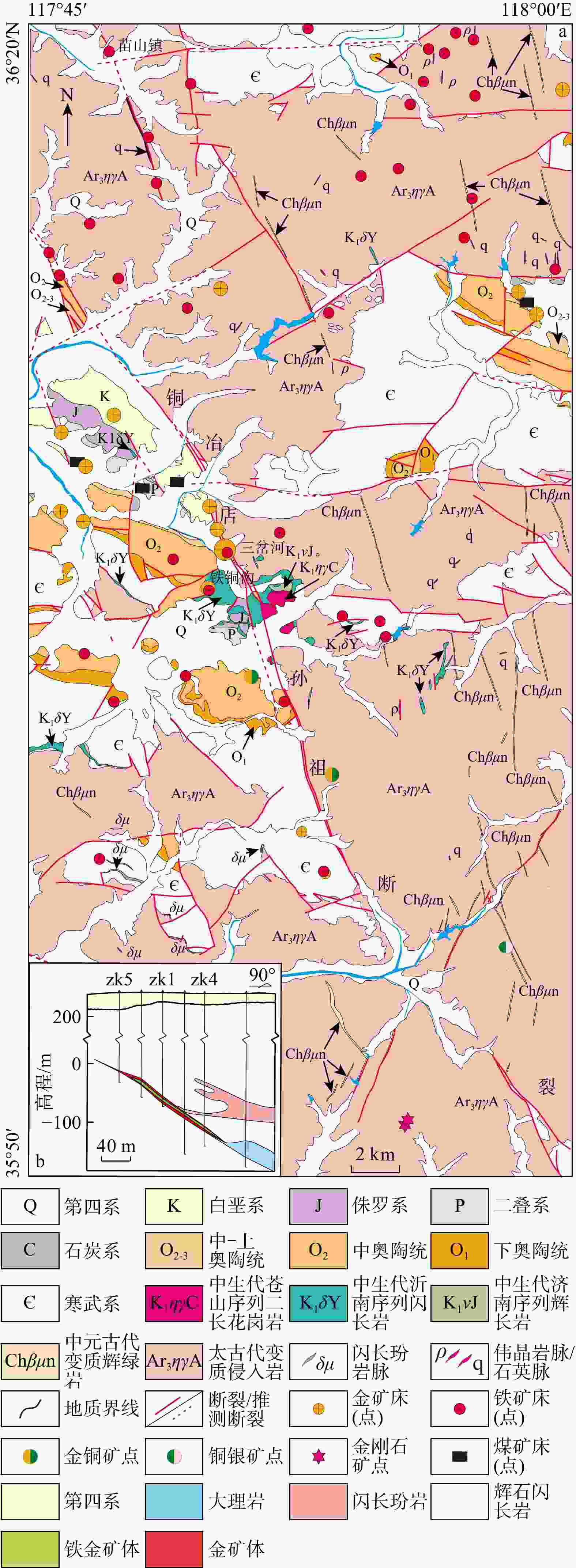
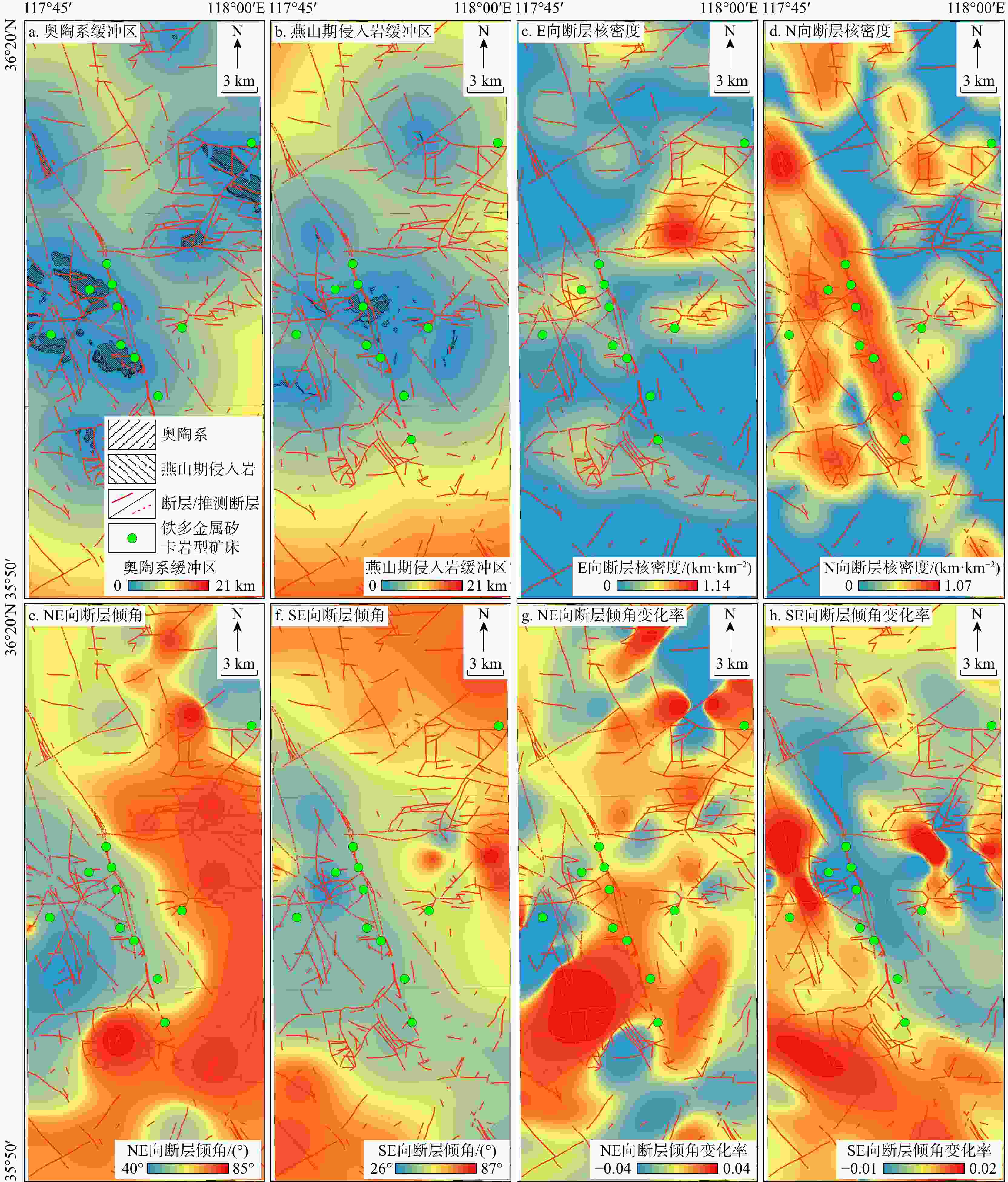
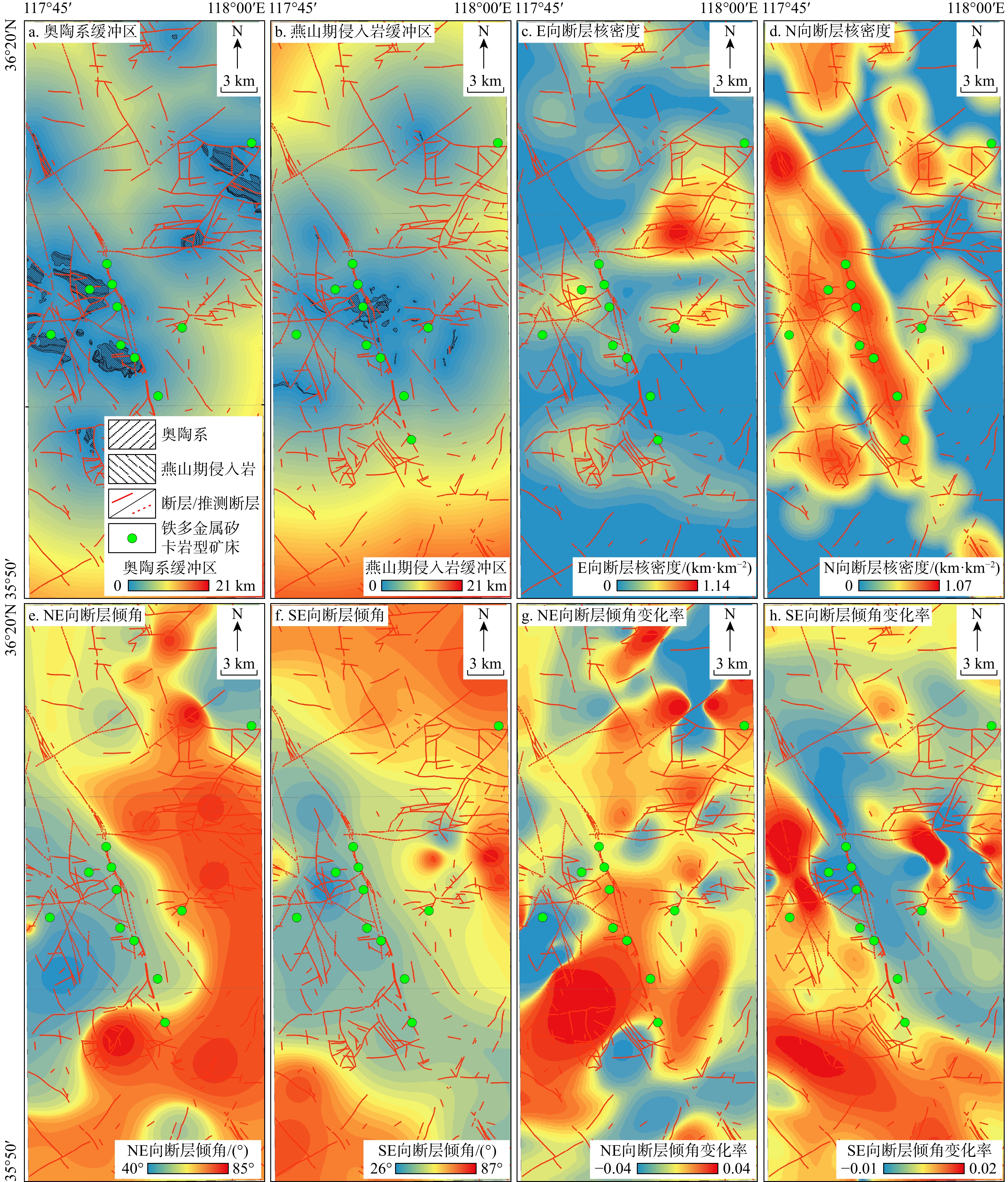
图 2 苗山−新泰地区矽卡岩型铁金多金属矿地质预测变量
Figure 2. Geological predictive variables for skarn-type iron-gold polymetallic deposits in Miaoshan-Xintai area
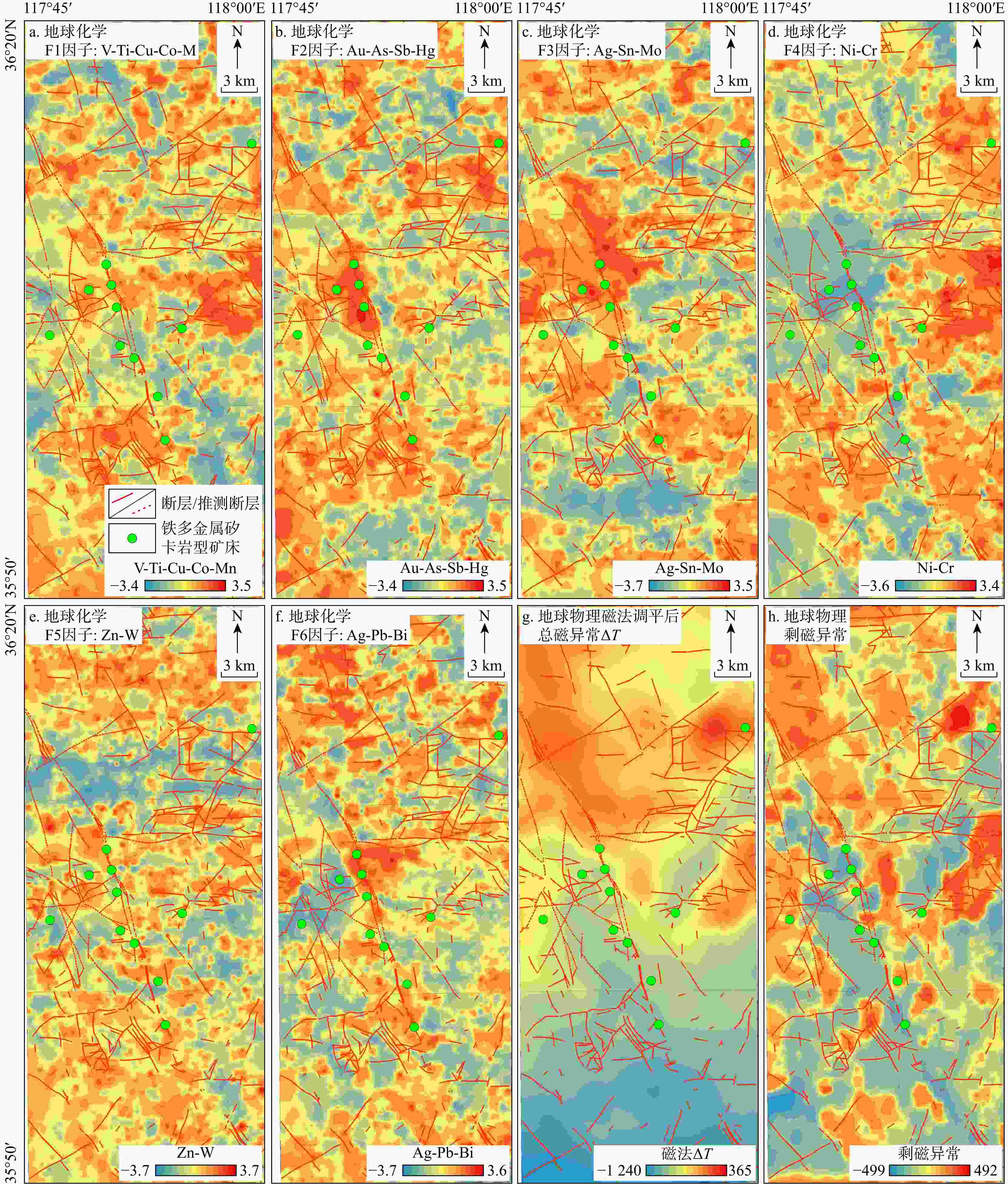
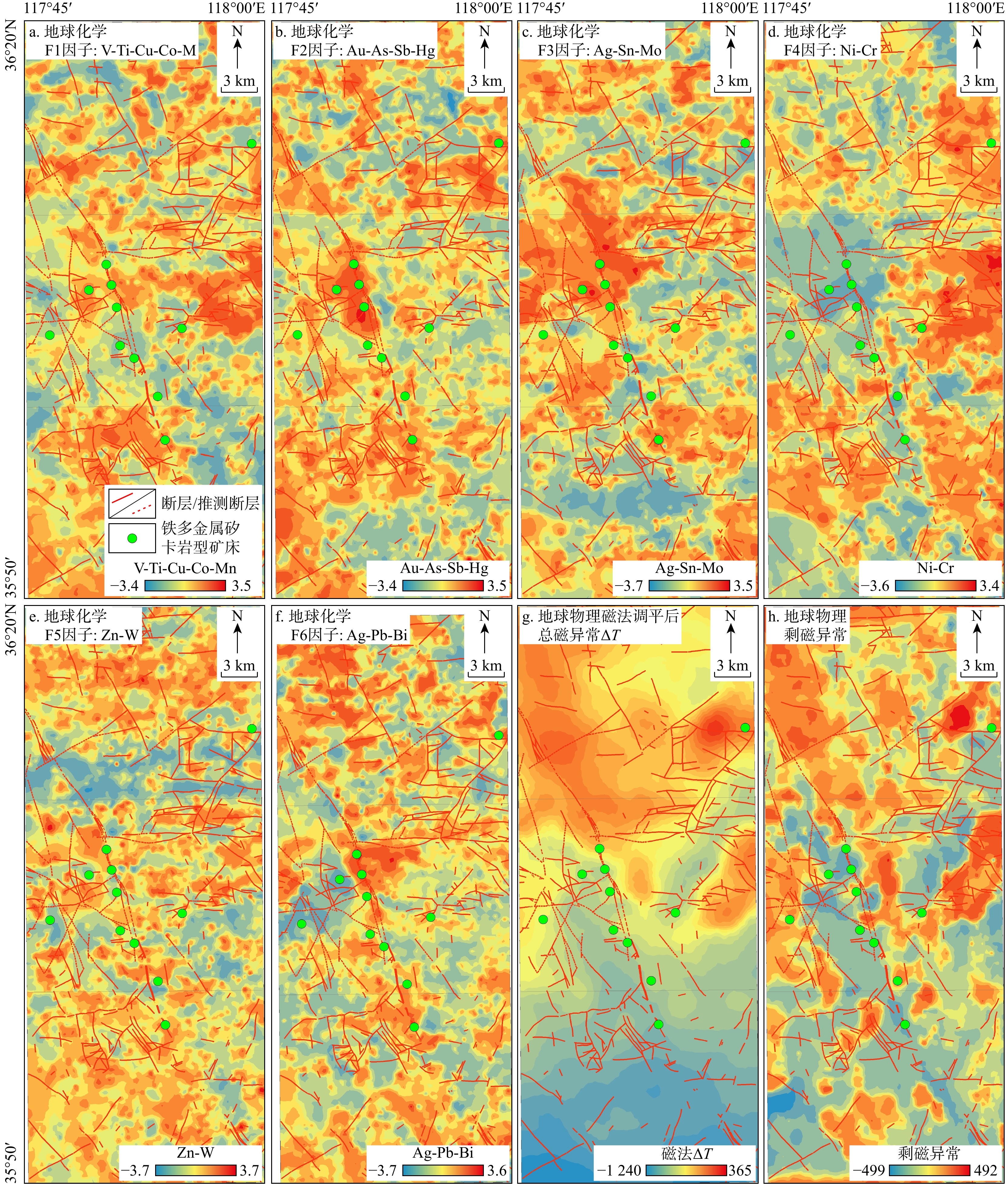
图 3 苗山−新泰地区矽卡岩型铁金多金属矿地球化学、地球物理预测变量
Figure 3. Geochemical and geophysical predictive variables for skarn-type iron-gold polymetallic deposits in Miaoshan-Xintai area
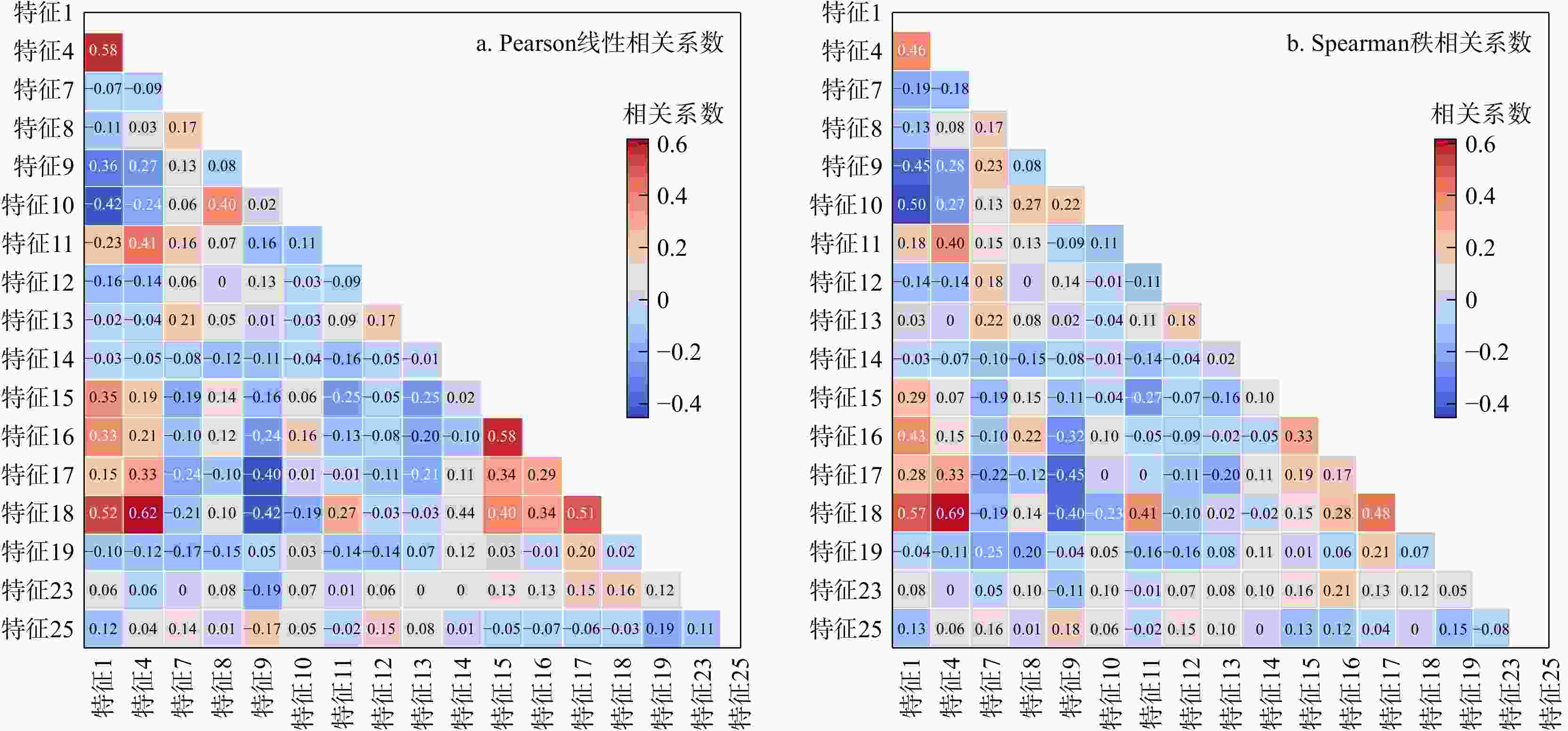
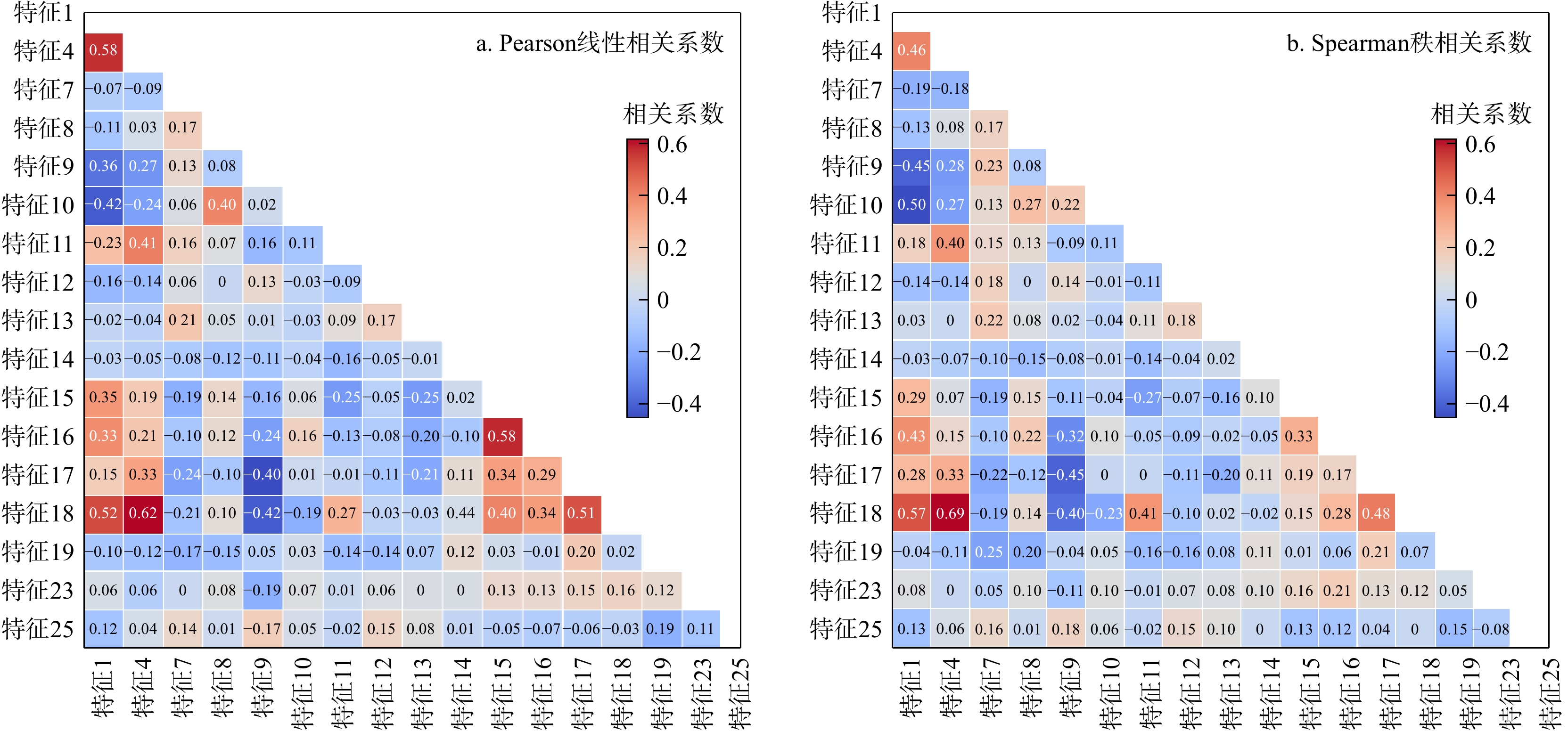
图 4 预测变量Pearson线性相关系数(a)与Spearman秩相关系数(b)热力图
Figure 4. Heatmaps of Pearson linear correlation coefficients (a) and Spearman rank correlation coefficients (b) for predictive variables
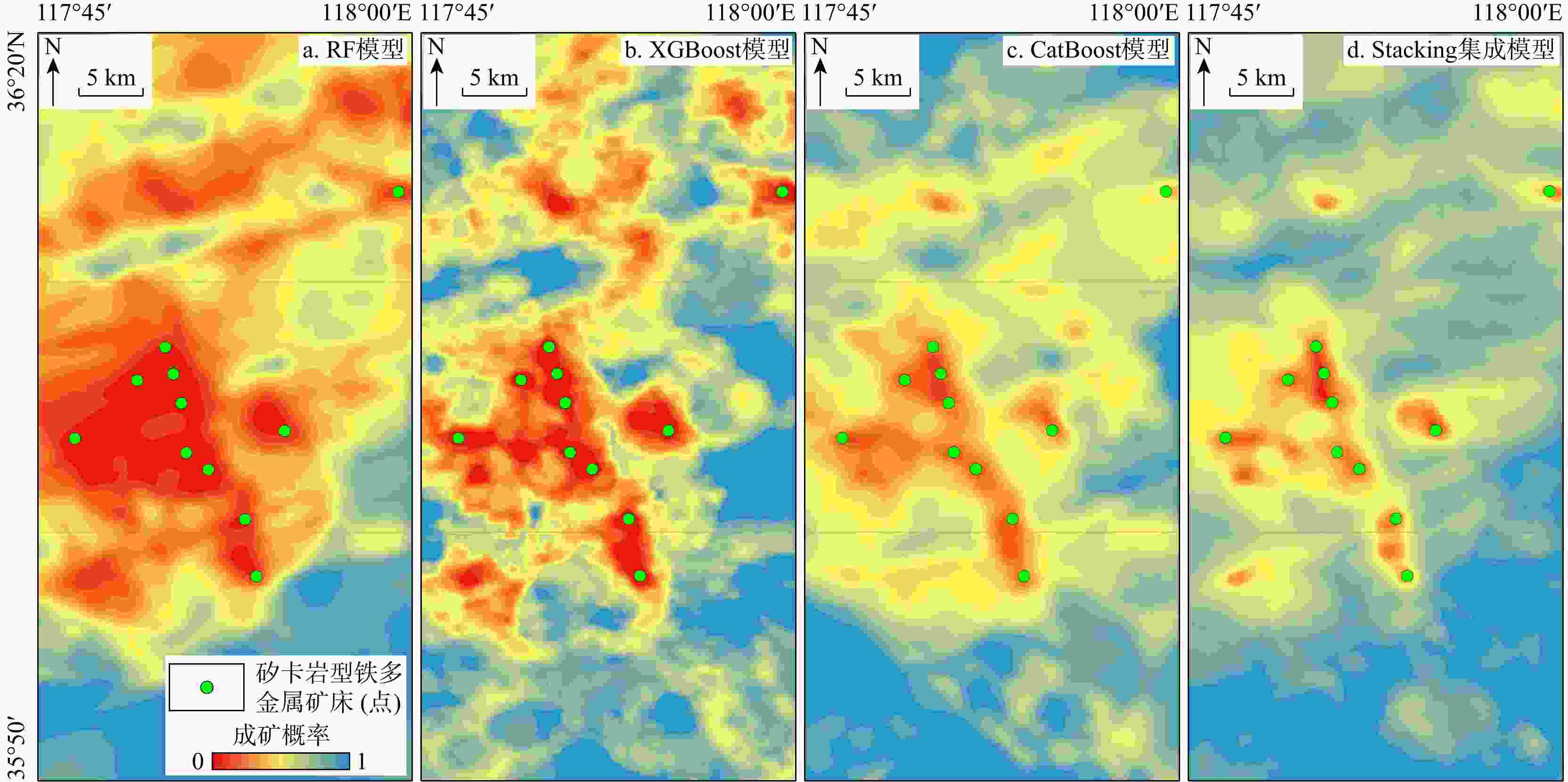
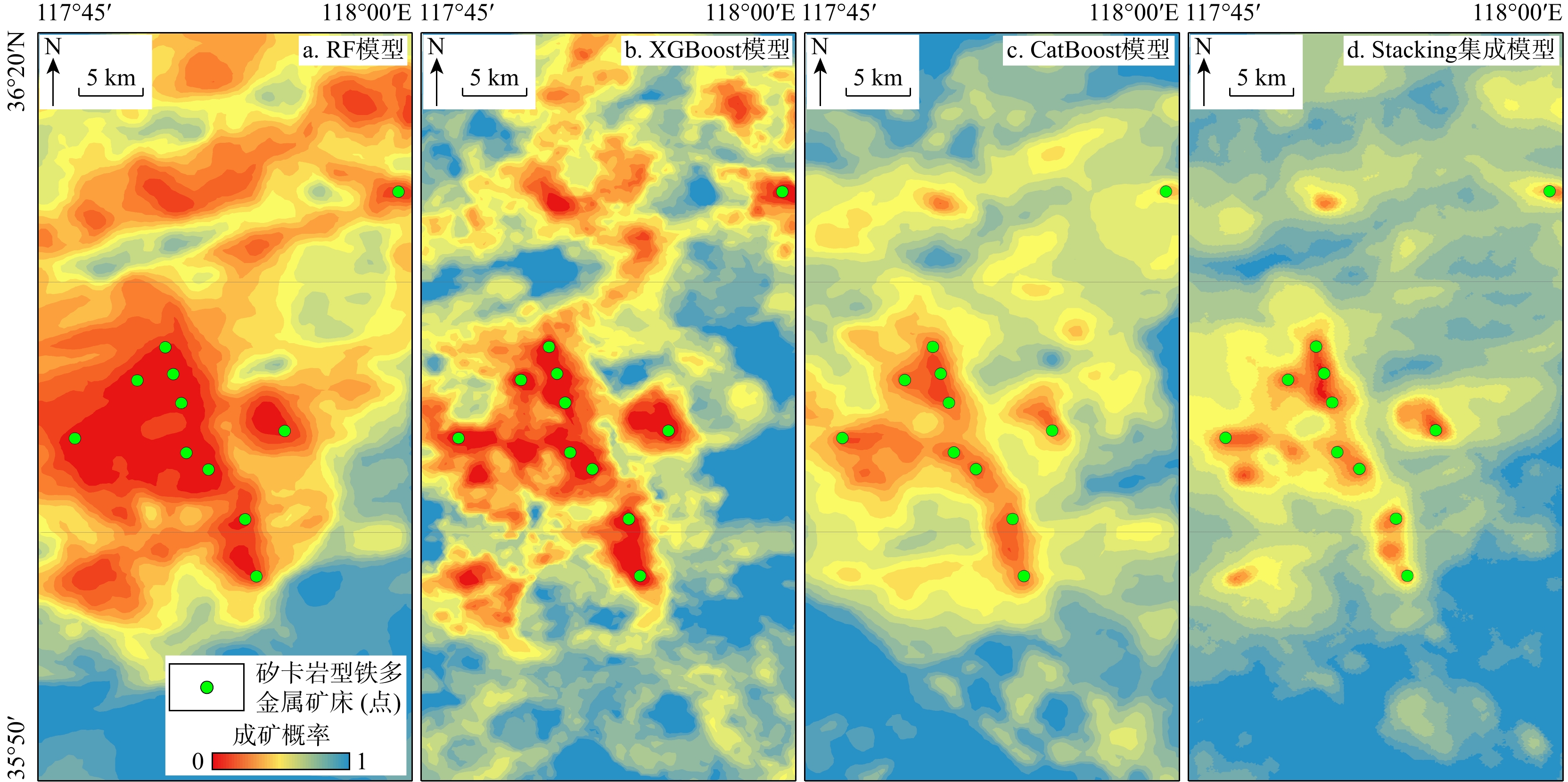
图 6 随机森林 (a)、XGBoost (b)、CatBoost (c)、Stacking 集成 (d) 模型预测的矽卡岩型铁金多金属矿成矿有利度图
Figure 6. Mineral prospectivity maps of skarn-type iron-gold polymetallic deposits predicted by random forest (a), XGBoost (b), CatBoost (c), and stacking ensemble (d) models
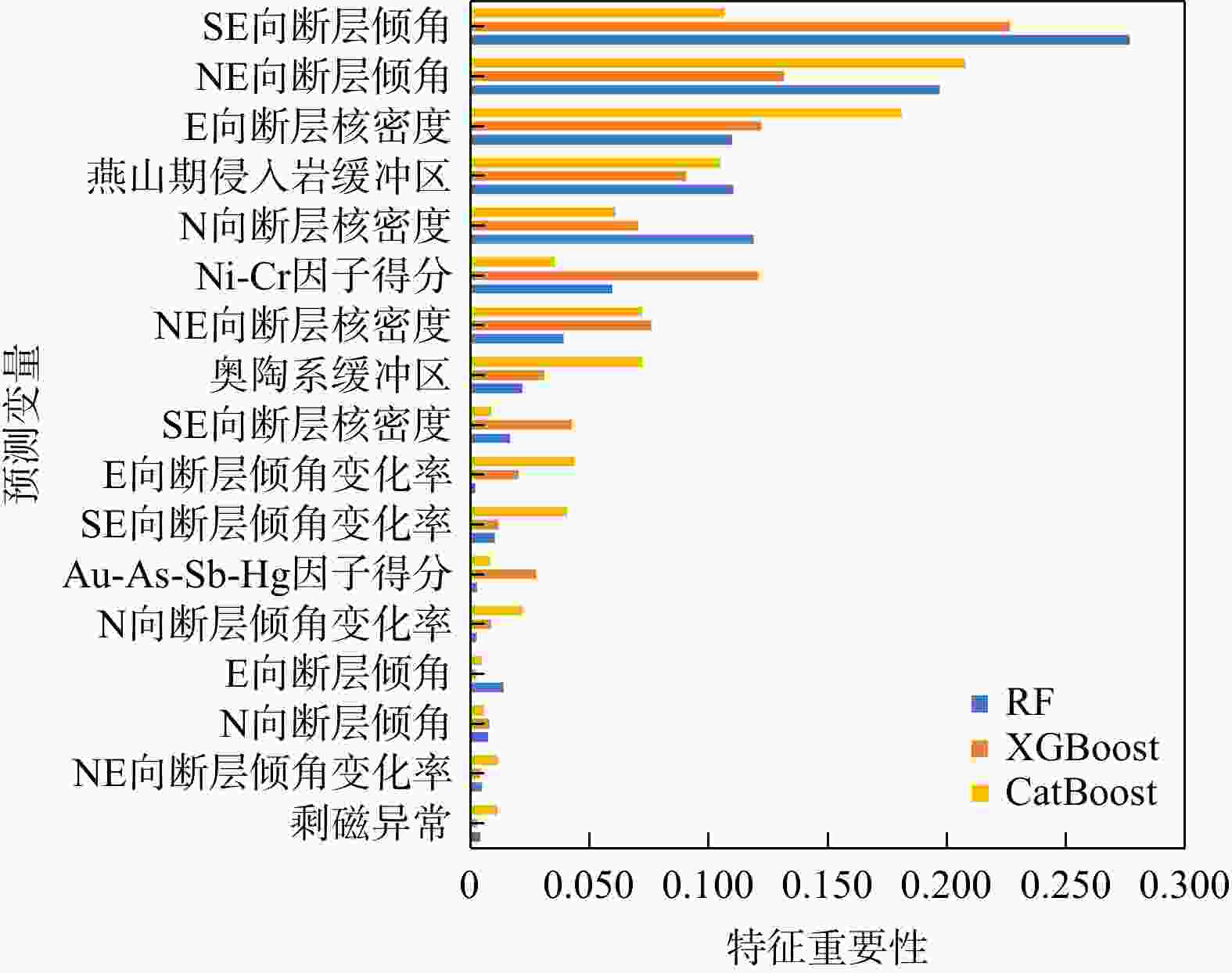
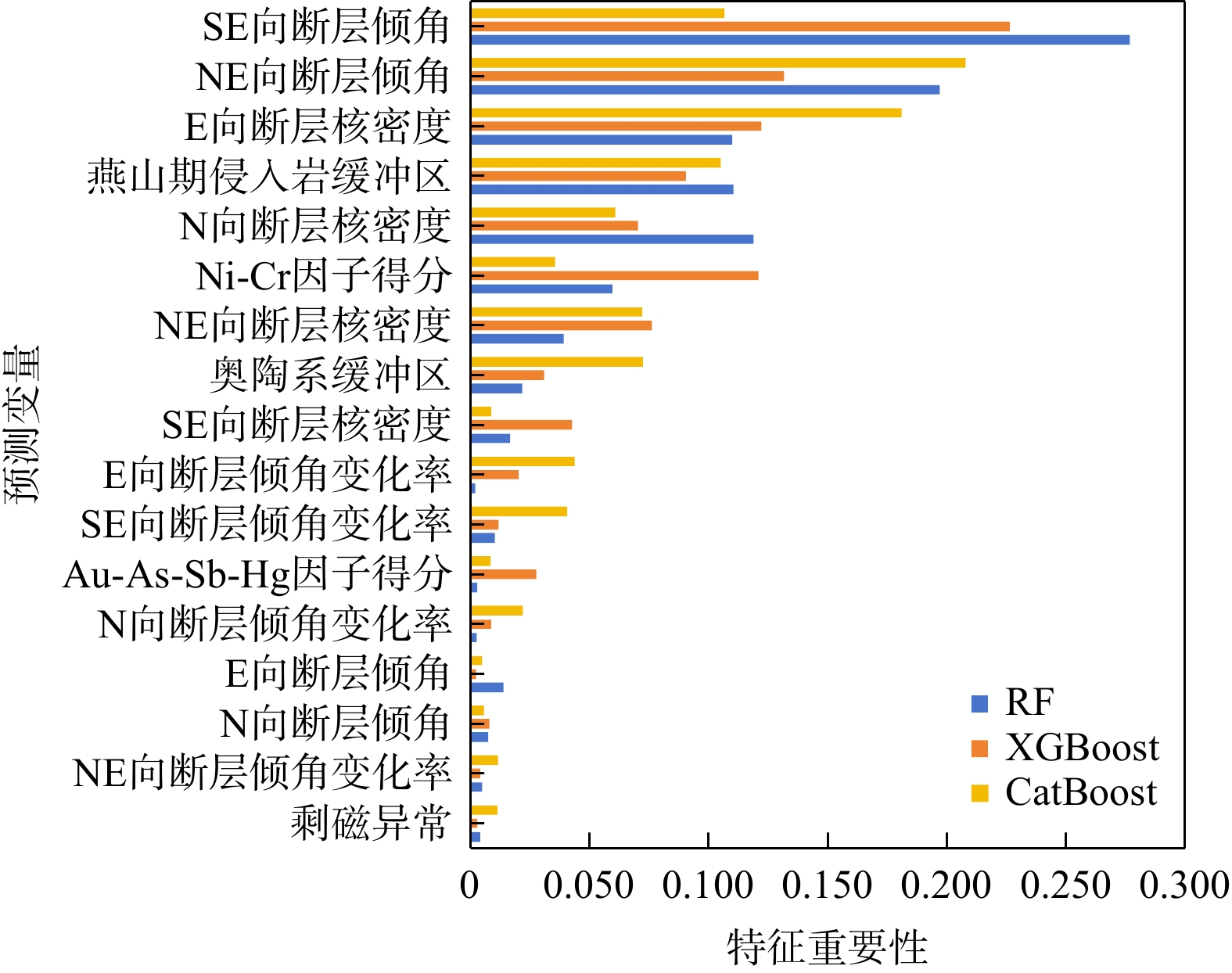
图 8 RF、XGBoost、CatBoost模型特征重要性对比图
Figure 8. Comparison of feature importance for random forest, XGBoost, and CatBoost models
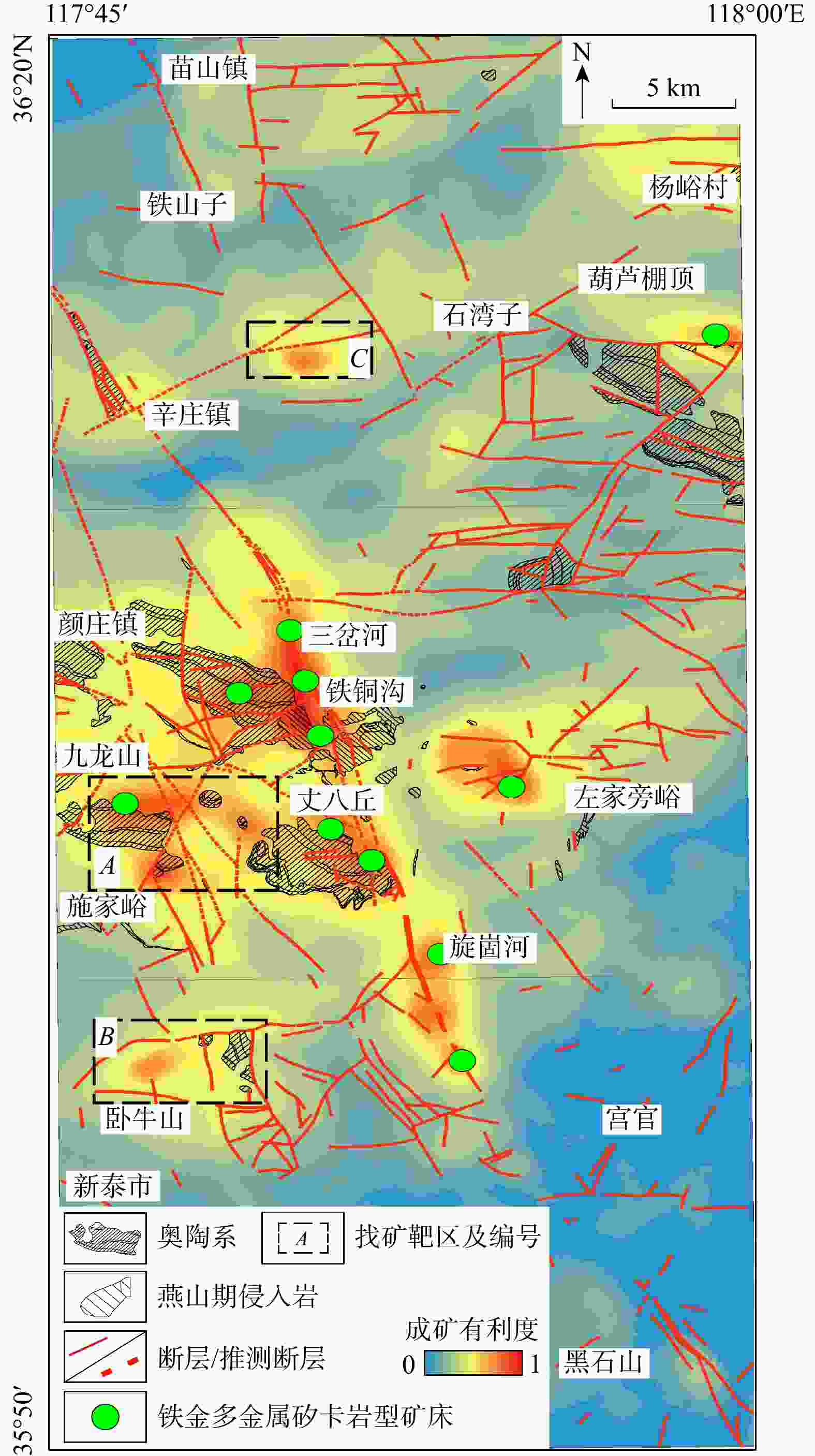
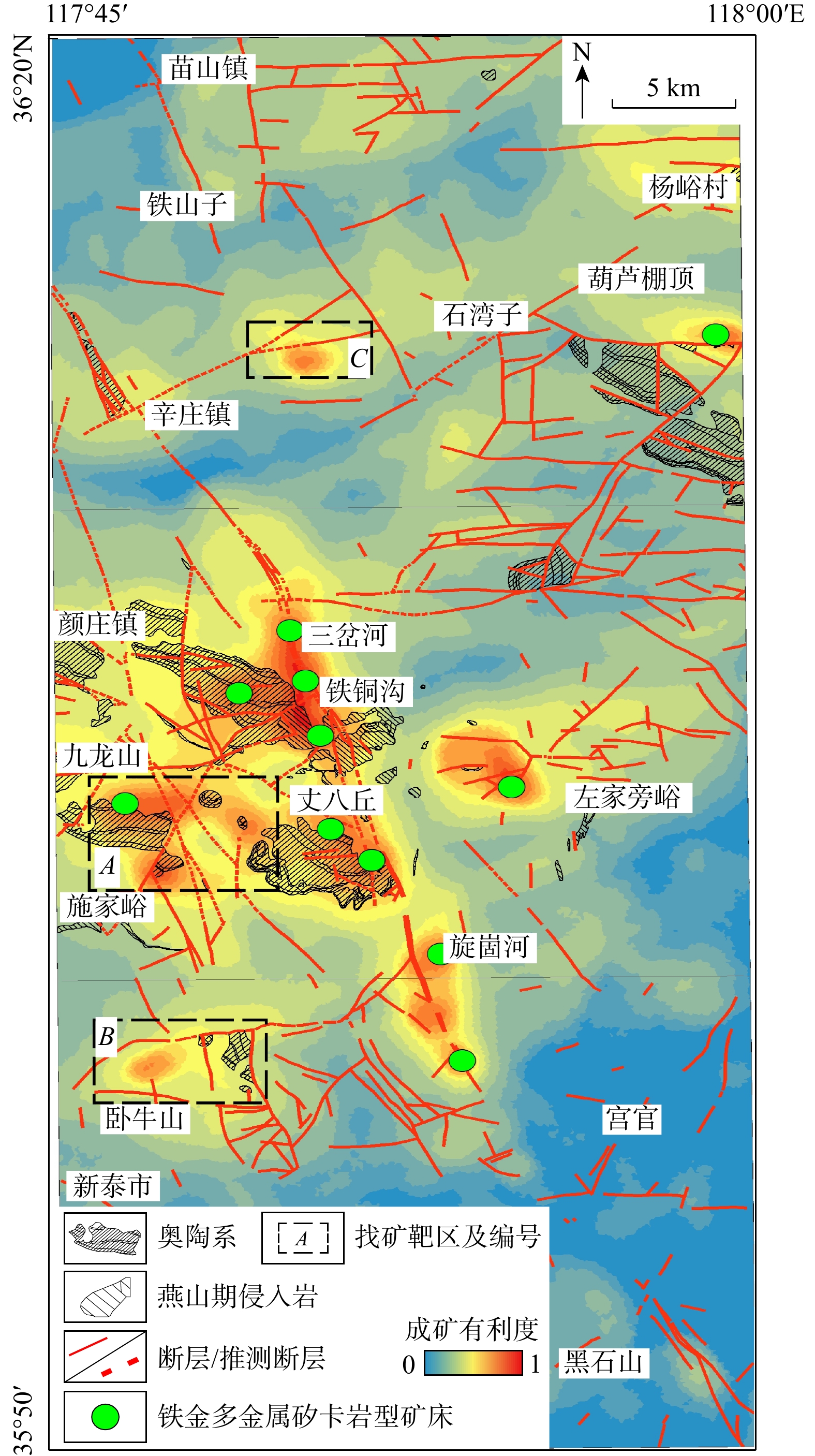
图 9 苗山−新泰地区矽卡岩型铁金多金属矿成矿有利度图
Figure 9. Mineral prospectivity map of skarn-type iron-gold polymetallic deposits in Miaoshan-Xintai area
表 1 成矿预测输入变量特征筛选结果
Table 1. Feature screening results of input variables for mineral prospectivity prediction
变量类型 变量编号 变量名称 变量类型 变量编号 变量名称 地质变量 特征1 奥陶系缓冲区 地质变量 特征14 E向断层倾角变化率 特征4 燕山期侵入岩缓冲区 特征15 N向断层倾角 特征7 SE向断层核密度 特征16 NE向断层倾角 特征8 NE向断层核密度 特征17 SE向断层倾角 特征9 N向断层核密度 特征18 E向断层倾角 特征10 E向断层核密度 地球物理变量 特征19 剩磁异常 特征11 SE向断层倾角变化率 地球化学变量 特征23 Ni-Cr因子得分 特征12 NE向断层倾角变化率 特征25 Au-As-Sb-Hg因子得分 特征13 N向断层倾角变化率  下载: 导出CSV
表 2 不同模型性能评价指标对比
Table 2. Comparison of performance evaluation indicators for different models
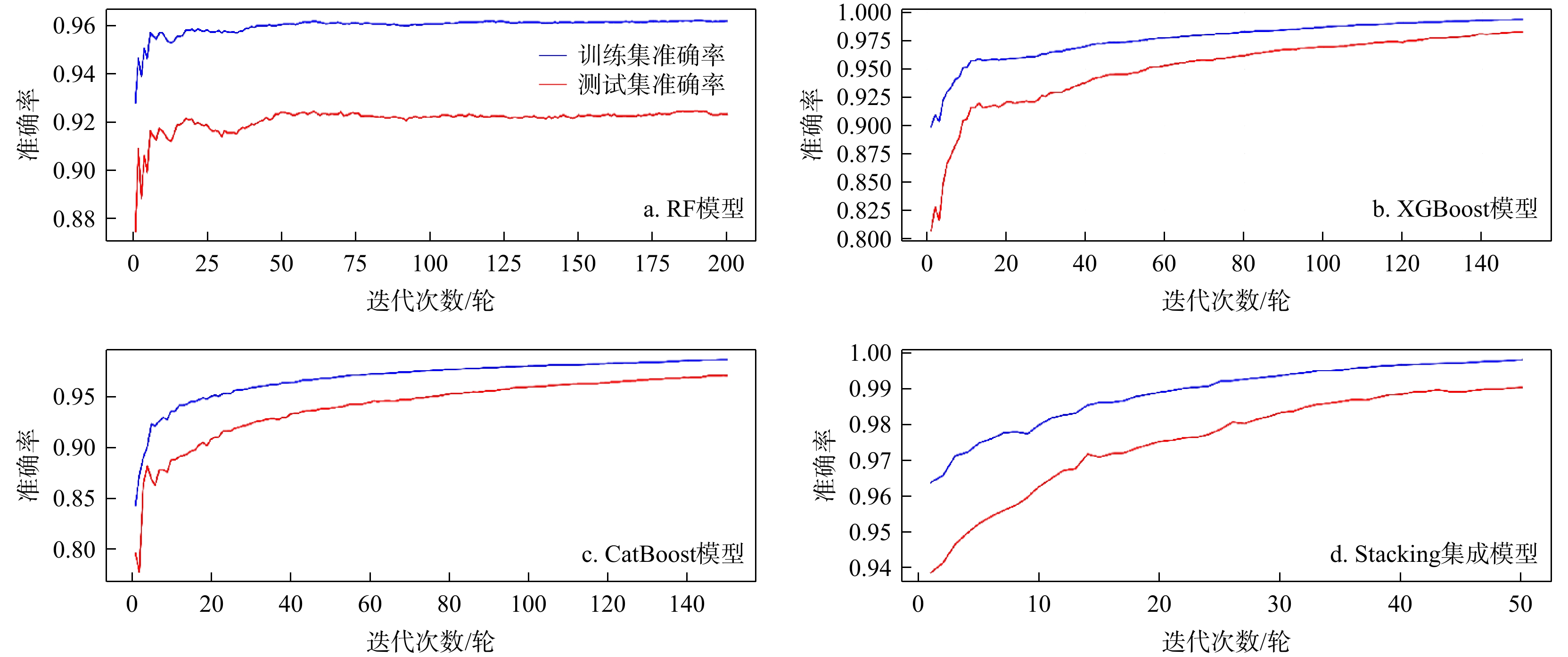
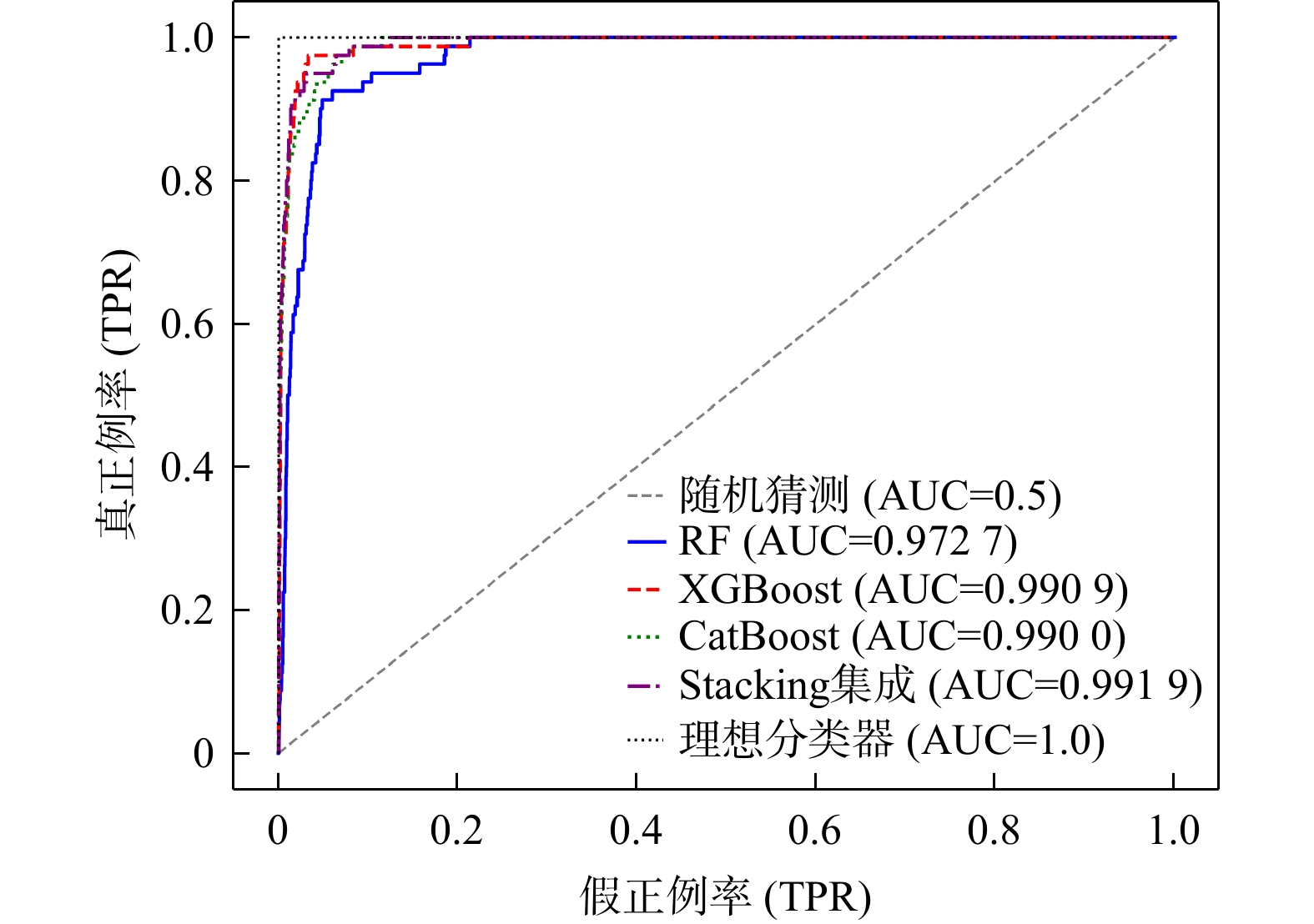
模型 准确率 精确率 召回率 F1值 AUC RF 0.982 0.358 0.488 0.413 0.968 XGBoost 0.992 0.712 0.650 0.680 0.991 CatBoost 0.991 0.671 0.638 0.654 0.990 Stacking集成 0.993 0.803 0.613 0.695 0.990
下载: 导出CSV
-
[1] 杨昌彬, 宗信德, 卢铁元, 等. 浅析莱芜接触交代−热液铁矿的双交代渗滤作用[J]. 地质找矿论丛, 2006, 21(增刊1): 85-89. doi: 10.3969/j.issn.1001-1412.2006.z1.021YANG C B, ZONG X D, LU T Y, et al. Preliminary analysis of bi-metasomatism infiltration of Laiwu style contact Fe deposits[J]. Contributions to Geology and Mineral Resources Research, 2006, 21(S1): 85-89. (in Chinese with English abstract) doi: 10.3969/j.issn.1001-1412.2006.z1.021 [2] SUN T, CHEN F, ZHONG L X, et al. GIS-based mineral prospectivity mapping using machine learning methods: A case study from Tongling ore district, eastern China[J]. Ore Geology Reviews, 2019, 109: 26-49. doi: 10.1016/j.oregeorev.2019.04.003 [3] MOU N N, CARRANZA E J M, WANG G W, et al. A framework for data-driven mineral prospectivity mapping with interpretable machine learning and modulated predictive modeling[J]. Natural Resources Research, 2023, 32(6): 2439-2462. doi: 10.1007/s11053-023-10272-7 [4] YOUSEFI M, CARRANZA E J M. Data-driven index overlay and Boolean logic mineral prospectivity modeling in greenfields exploration[J]. Natural Resources Research, 2016, 25(1): 3-18. doi: 10.1007/s11053-014-9261-9 [5] FORD A, MILLER J M, MOL A G. A comparative analysis of weights of evidence, evidential belief functions, and fuzzy logic for mineral potential mapping using incomplete data at the scale of investigation[J]. Natural Resources Research, 2016, 25(1): 19-33. doi: 10.1007/s11053-015-9263-2 [6] ARJMAND LARY Z, HONARMAND M, SHAHRIARI H, et al. Data integration by fuzzy logic for mineral prospectivity mapping in Ferdows-Gonabad-Bajestan belt, Razavi Khorasan Province, Iran[J]. Journal of the Indian Society of Remote Sensing, 2024, 52(6): 1223-1243. doi: 10.1007/s12524-024-01873-7 [7] 王成彬, 王明果, 王博, 等. 融合知识图谱的矿产资源定量预测[J]. 地学前缘, 2024, 31(4): 26-36. doi: 10.13745/j.esf.sf.2024.5.3WANG C B, WANG M G, WANG B, et al. Knowledge graph-infused quantitative mineral resource forecasting[J]. Earth Science Frontiers, 2024, 31(4): 26-36. (in Chinese with English abstract) doi: 10.13745/j.esf.sf.2024.5.3 [8] YAN Q, ZHAO J, XUE L F, et al. Mineral prospectivity mapping based on spatial feature classification with geological map knowledge graph embedding: Case study of gold ore prediction at Wulonggou, Qinghai Province (western China)[J]. Natural Resources Research, 2024, 33(6): 2385-2406. doi: 10.1007/s11053-024-10386-6 [9] CARRANZA E J M, LABORTE A G. Random forest predictive modeling of mineral prospectivity with small number of prospects and data with missing values in Abra (Philippines)[J]. Computers & Geosciences, 2015, 74: 60-70. doi: 10.1016/j.cageo.2014.10.004 [10] ZUO R G. Geodata science-based mineral prospectivity mapping: A review[J]. Natural Resources Research, 2020, 29(6): 3415-3424. doi: 10.1007/s11053-020-09700-9 [11] 马瑶, 赵江南. 机器学习方法在矿产资源定量预测应用研究进展[J]. 地质科技通报, 2021, 40(1): 132-141. doi: 10.19509/j.cnki.dzkq.2021.0108MA Y, ZHAO J N. Advances in the application of machine learning methods in mineral prospectivity mapping[J]. Bulletin of Geological Science and Technology, 2021, 40(1): 132-141. (in Chinese with English abstract) doi: 10.19509/j.cnki.dzkq.2021.0108 [12] CHEN Y L, WU W. Mapping mineral prospectivity using an extreme learning machine regression[J]. Ore Geology Reviews, 2017, 80: 200-213. doi: 10.1016/j.oregeorev.2016.06.033 [13] 陶金涛, 张楠楠, 常金雨, 等. 基于逻辑回归的东天山红海矿床三维成矿预测研究[J]. 新疆地质, 2022, 40(1): 27-32. doi: 10.3969/j.issn.1000-8845.2022.01.006TAO J T, ZHANG N N, CHANG J Y, et al. Three-dimensional metallogenic prediction of Honghai deposit, eastern Tianshan, northwestern China based on logistic regression[J]. Xinjiang Geology, 2022, 40(1): 27-32. (in Chinese with English abstract) doi: 10.3969/j.issn.1000-8845.2022.01.006 [14] RODRIGUEZ-GALIANO V, SANCHEZ-CASTILLO M, CHICA-OLMO M, et al. Machine learning predictive models for mineral prospectivity: An evaluation of neural networks, random forest, regression trees and support vector machines[J]. Ore Geology Reviews, 2015, 71: 804-818. doi: 10.1016/j.oregeorev.2015.01.001 [15] LAUZON D, GLOAGUEN E. Quantifying uncertainty and improving prospectivity mapping in mineral belts using transfer learning and Random Forest: A case study of copper mineralization in the Superior Craton Province, Quebec, Canada[J]. Ore Geology Reviews, 2024, 166: 105918. doi: 10.1016/j.oregeorev.2024.105918 [16] DAVIRAN M, GHEZELBASH R, HAJIHOSSEINLOU M, et al. Uncertainty quantification in genetic algorithm-optimized artificial intelligence-based mineral prospectivity models: Automated hyperparameter tuning for support vector machines and random forest[J]. Modeling Earth Systems and Environment, 2024, 11(1): 10. doi: 10.1007/s40808-024-02176-z [17] LI Q K, CHEN G X, WANG D T. Mineral prospectivity mapping using semi-supervised machine learning[J]. Mathematical Geosciences, 2025, 57(2): 275-305. doi: 10.1007/s11004-024-10161-6 [18] BULLOCK E L, WOODCOCK C E, HOLDEN C E. Improved change monitoring using an ensemble of time series algorithms[J]. Remote Sensing of Environment, 2020, 238: 111165. doi: 10.1016/j.rse.2019.04.018 [19] WOLPERT D H, MACREADY W G. No free lunch theorems for optimization[J]. IEEE Transactions on Evolutionary Computation, 1997, 1(1): 67-82. doi: 10.1109/4235.585893 [20] GE H X, MA F, LI Z W, et al. Improved accuracy of phenological detection in rice breeding by using ensemble models of machine learning based on UAV-RGB imagery[J]. Remote Sensing, 2021, 13(14): 2678. doi: 10.3390/rs13142678 [21] WANG Z Y, HONG Y L, HUANG L Y, et al. A comprehensive review and future research directions of ensemble learning models for predicting building energy consumption[J]. Energy and Buildings, 2025, 335: 115589. doi: 10.1016/j.enbuild.2025.115589 [22] KAYA M, ÇETIN-KAYA Y. A novel ensemble learning framework based on a genetic algorithm for the classification of pneumonia[J]. Engineering Applications of Artificial Intelligence, 2024, 133: 108494. doi: 10.1016/j.engappai.2024.108494 [23] WANG K J, ZHENG X Q, WANG G W, et al. A multi-model ensemble approach for gold mineral prospectivity mapping: A case study on the Beishan region, western China[J]. Minerals, 2020, 10(12): 1126. doi: 10.3390/min10121126 [24] YIN J N, LI N. Ensemble learning models with a Bayesian optimization algorithm for mineral prospectivity mapping[J]. Ore Geology Reviews, 2022, 145: 104916. doi: 10.1016/j.oregeorev.2022.104916 [25] YU Z B, LI B B, WANG X J. Mineral prospectivity mapping susceptibility evaluation based on interpretable ensemble learning[J]. Ore Geology Reviews, 2024, 173: 106248. doi: 10.1016/j.oregeorev.2024.106248 [26] ZHANG H, XIE M, DAN S Y, et al. Optimization of feature selection in mineral prospectivity using ensemble learning[J]. Minerals, 2024, 14(10): 970. doi: 10.3390/min14100970 [27] 崔俊强, 吴秉禄, 王兴启, 等. 中华人民共和国1∶5 万苗山幅(J50E023016)、颜庄幅(J50E024016)区域矿产地质调查报告[R]. 济南: 山东省第一地质矿产勘查院, 2020.CUI J Q, WU B L, WANG X Q, et al. Regional mineral geological survey report of the 1∶ 50000 Miaoshan Sheet (J50E023016) and Yanzhuang Sheet (J50E024016), People's Republic of China[R]. Jinan: Shandong No. 1 Institute of Geology and Mineral Resources Exploration, 2020. (in Chinese)[28] 刘小琼, 田忠平, 石周清, 等. 中华人民共和国1∶5 万新泰幅(I50E001016)、蒙阴幅(I50E002016)区域矿产地质调查报告[R]. 山东泰安: 山东钰镪地质资源勘查开发有限责任公司, 2018.LIU X Q, TIAN Z P, SHI Z Q, et al. Regional mineral geological survey report of the 1∶ 50000 Xintai Sheet (I50E001016) and Mengyin Sheet (I50E002016), People's Republic of China[R]. Taian Shandong: Shandong Yuqiang Geological Resources Exploration and Development Co. , Ltd. , 2018. (in Chinese)[29] 马明, 宋建华, 刘世俊, 等. 山东省莱芜市三岔河矿区铁金矿详查报告[R]. 济南: 山东省第一地质矿产勘查院, 2016.MA M, SONG J H, LIU S J, et al. Detailed survey report of the iron-gold deposit in the Sanchahe mining area, Laiwu City, Shandong Province[R]. Jinan: Shandong No. 1 Institute of Geology and Mineral Resources Exploration, 2016. (in Chinese) [30] 江海洋. 山东省莱芜市三岔河铁金矿地质特征及找矿方向[D]. 长春: 吉林大学, 2019.JIANG H Y. Geological characteristics and prospecting direction of Sanchahe iron-gold deposit in Laiwu City, Shandong Province[D]. Changchun: Jilin University, 2019. (in Chinese with English abstract) [31] 段壮. 山东莱芜地区矽卡岩型铁矿床成矿作用与成矿机制研究[D]. 武汉: 中国地质大学(武汉), 2019.DUAN Z. The mineralization and mechanism of the iron skarn deposits in Laiwu District, Shandong Province[D]. Wuhan: China University of Geosciences (Wuhan), 2019. (in Chinese with English abstract) [32] 张振华. 铜冶店−孙祖断裂带构造演化背景及其控矿机理[J]. 山东煤炭科技, 2025, 43(3): 108-111. doi: 10.3969/j.issn.1005-2801.2025.03.022ZHANG Z H. Tectonic evolution background and its ore-controlling mechanism of the Tongyedian-Sunzu fault zone[J]. Shandong Coal Science and Technology, 2025, 43(3): 108-111. (in Chinese with English abstract) doi: 10.3969/j.issn.1005-2801.2025.03.022 [33] 宗信德, 石周清, 彭超, 等. 泰安−莱芜地区幔枝构造与铁金铜矿床成矿潜力[J]. 地质找矿论丛, 2015, 30(2): 182-189. doi: 10.6053/j.issn.1001-1412.2015.02.004ZONG X D, SHI Z Q, PENG C, et al. Mantle plume branch structure and gold, iron and copper ore potential in Taian-Laiwu area[J]. Contributions to Geology and Mineral Resources Research, 2015, 30(2): 182-189. (in Chinese with English abstract) doi: 10.6053/j.issn.1001-1412.2015.02.004 [34] 刘书锋. 山东莱芜地区中生代侵入杂岩特征与成矿关系[J]. 地质学刊, 2020, 44(1): 34-47. doi: 10.3969/j.issn.1674-3636.2020.h1.003LIU S F. Characteristics of the Mesozoic intrusive complexes and their relation to metallogeny in Laiwu area, Shandong Province[J]. Journal of Geology, 2020, 44(1): 34-47. (in Chinese with English abstract) doi: 10.3969/j.issn.1674-3636.2020.h1.003 [35] 方邵平, 赵映普. 山东淄博金岭铁矿区王旺庄矿床地质特征及控矿因素简析[J]. 能源研究与管理, 2017, 9(1): 57-61. doi: 10.16056/j.1005-7676.2017.01.015FANG S P, ZHAO Y P. Shandong Zibo area of Wangwangzhuang ore in Jinling iron mine geological features and ore controling factors analysis[J]. Energy Research and Management, 2017, 9(1): 57-61. (in Chinese with English abstract) doi: 10.16056/j.1005-7676.2017.01.015 [36] 郝兴中. 鲁西地区铁矿成矿规律与预测研究[D]. 北京: 中国地质大学(北京), 2014.HAO X Z. Study on metallogenic regularities and prognosis of iron deposits in western Shandong Province[D]. Beijing: China University of Geosciences (Beijing), 2014. (in Chinese with English abstract) [37] 徐国民, 徐勇, 韩金芳, 等. 鲁中地区铜冶店断裂带文祖断裂带两侧找矿前景[J]. 山东国土资源, 2008, 24(5): 21-26. doi: 10.3969/j.issn.1672-6979.2008.05.011XU G M, XU Y, HAN J F, et al. Ore-prospecting future in both sides of Tongyedian and Wenzu fault belts in Luzhong area[J]. Land and Resources in Shandong Province, 2008, 24(5): 21-26. (in Chinese with English abstract) doi: 10.3969/j.issn.1672-6979.2008.05.011 [38] 李肖鹏, 胡雪平, 祝德成, 等. 山东省鲁中地区1∶5万高精度磁测调查报告[R]. 济南: 山东省地质调查院, 2016.LI X P, HU X P, ZHU D C, et al. High-precision magnetic survey report of the 1∶ 50000 central Shandong area, Shandong Province[R]. Jinan: Shandong Institute of Geological Survey, 2016. (in Chinese)[39] ZHOU J, JIANG Z B, CHUNG F L, et al. Formulating ensemble learning of SVMs into a single SVM formulation by negative agreement learning[J]. IEEE Transactions on Systems, Man, and Cybernetics: Systems, 2021, 51(10): 6015-6028. [40] AGARWAL S, CHOWDARY C R. A-Stacking and A-Bagging: Adaptive versions of ensemble learning algorithms for spoof fingerprint detection[J]. Expert Systems with Applications, 2020, 146: 113160. doi: 10.1016/j.eswa.2019.113160 [41] WANG G, MA J, YANG S. IGF-Bagging: Information gain based feature selection for Bagging[J]. International Journal of Innovative Computing, Information and Control, 2011, 7 (11): 6247-6259. [42] DONG X B, YU Z W, CAO W M, et al. A survey on ensemble learning[J]. Frontiers of Computer Science, 2020, 14(2): 241-258. doi: 10.1007/s11704-019-8208-z [43] HASNAIN M, PASHA M F, GHANI I, et al. Evaluating trust prediction and confusion matrix measures for web services ranking[J]. IEEE Access, 2020, 8: 90847-90861. doi: 10.1109/ACCESS.2020.2994222 [44] 刘粤蛟, 赖富强, 徐浩, 等. 基于测井曲线深程度耦合的页岩岩相智能识别方法[J]. 地质科技通报, 2025, 44(1): 308-320. doi: 10.19509/j.cnki.dzkq.tb20230361LIU Y J, LAI F Q, XU H, et al. Intelligent identification methods for shale lithology based on the coupling deeply of logging curves[J]. Bulletin of Geological Science and Technology, 2025, 44(1): 308-320. (in Chinese with English abstract) doi: 10.19509/j.cnki.dzkq.tb20230361 [45] DENG K Y, ZHANG X Y, CHENG Y J, et al. A remaining useful life prediction method with long-short term feature processing for aircraft engines[J]. Applied Soft Computing, 2020, 93: 106344. doi: 10.1016/j.asoc.2020.106344 [46] HONG H Y. Assessing landslide susceptibility based on hybrid Best-first decision tree with ensemble learning model[J]. Ecological Indicators, 2023, 147: 109968. doi: 10.1016/j.ecolind.2023.109968 [47] 严德天. 评论: 基于机器学习测井反演的煤体结构评价: 以鄂尔多斯盆地榆林地区本溪组8号煤为例[J]. 地质科技通报, 2025, 44(4): 1. doi: 10.19509/j.cnki.dzkq.tb20250003YAN D T. Comment: Evaluation of coal structure based on machine learning logging inversion: Taking Benxi Formation No. 8 coal in Yulin area of Ordos Basin as an example[J]. Bulletin of Geological Science and Technology, 2025, 44(4): 1. (in Chinese with English abstract) doi: 10.19509/j.cnki.dzkq.tb20250003 [48] HAN R Y, WANG Z W, WANG W H, et al. Lithology identification of igneous rocks based on XGBoost and conventional logging curves, a case study of the eastern depression of Liaohe Basin[J]. Journal of Applied Geophysics, 2021, 195: 104480. doi: 10.1016/j.jappgeo.2021.104480 [49] DING Y, CHEN Z Q, LU W F, et al. A CatBoost approach with wavelet decomposition to improve satellite-derived high-resolution PM2.5 estimates in Beijing-Tianjin-Hebei[J]. Atmospheric Environment, 2021, 249: 118212. doi: 10.1016/j.atmosenv.2021.118212 [50] NGUYEN N H, TONG K T, LEE S, et al. Prediction compressive strength of cement-based mortar containing metakaolin using explainable categorical gradient boosting model[J]. Engineering Structures, 2022, 269: 114768. doi: 10.1016/j.engstruct.2022.114768 -

 下载:
下载:

 点击查看大图
计量
- 文章访问数: 386
- PDF下载量: 31
- 被引次数: 0