投审稿入口
投审稿入口


Identification of confined water migration patterns in Multi-layer aquifer systems of strong deformation zones
-
摘要:
强变形构造区多层岩溶含水系统结构空间上变化强烈,地下水赋存运移规律复杂多变,给深埋引水隧洞的突涌水风险预测带来巨大挑战。在建引江补汉工程输水隧洞横穿金斗−鞍子寨强变形构造区,多个勘探钻孔揭露高压力、大流量的承压水,隧洞施工遭遇突涌水风险极高。综合采用水文地质钻探、孔内电视录像、水化学、同位素、水文动态监测等多方法手段,识别了多层含水系统承压水的补给、赋存和运移规律。研究表明,金斗−鞍子寨复式背斜垂向上为多个岩溶含水层与隔水层相间的互层结构,岩溶发育弱,含水介质以裂隙为主;承压水径流途径较长、循环更替较慢、不能直接接受现代降雨快速补给;地下水运移受地形、构造等共同控制,总体由WS向EN方向径流,承压水通过断层向上排泄。补给来源高、径流途径长、排泄通道窄是高水头承压水形成的根本原因,隧洞在穿越断层破碎带、褶皱核部、含水层与隔水层交界处部位时存在高压突涌水风险,涌水来源为地下水静储量释放为主,研究成果可为类似强烈变形构造区深埋隧洞水害识别提供参考。
Abstract:ObjectiveIn strong deformation tectonic zones, the structure of multi-layer karst aquifer systems exhibits significant spatial variability, leading to complex and variable characteristics of groundwater occurrence and migration. This presents considerable challenges for predicting water inrush risks in deep-buried water diversion tunnels. The water conveyance tunnel of the under-construction Yangtze-to-Han River Water Diversion Project traverses the Jindou-Anzizhai strong deformation zone, where multiple exploration boreholes have exposed confined water with high pressure and large flow rates, resulting in an extremely high risk of water inrush during tunnel construction.
MethodsA comprehensive combination of hydrogeological drilling, borehole television imaging, hydrochemical analysis, isotopic tracing, and hydrodynamic monitoring techniques was employed to systematically identify the recharge, occurrence, and migration patterns of confined water in the multi-layer aquifer system.
ResultsThe Jindou-Anzizhai composite anticline is characterized by an interbedded structure of alternating karst aquifers and aquitards, with weak karst development and fracture-dominated water-bearing media. The confined water is characterized by long runoff paths, slow circulation renewal, and the inability to receive direct and rapid recharge from modern precipitation. Groundwater migration is jointly controlled by topographic and tectonic factors, with an overall runoff direction from Southwest to Northeast, and the confined water is discharged upward through faults.
ConclusionHigh recharge elevation, long runoff paths, and narrow discharge channels are the fundamental factors governing the formation of high-head confined water. The tunnel is prone to high-pressure water inrush risks when crossing fault fracture zones, fold cores, and the interfaces between aquifers and aquitards in strong deformation tectonic zones, and water inrush is mainly attributed to the release of static groundwater reserves. The research can provide a valuable reference for water hazard identification in deep-buried tunnels located in similar strong deformation tectonic zones.
-
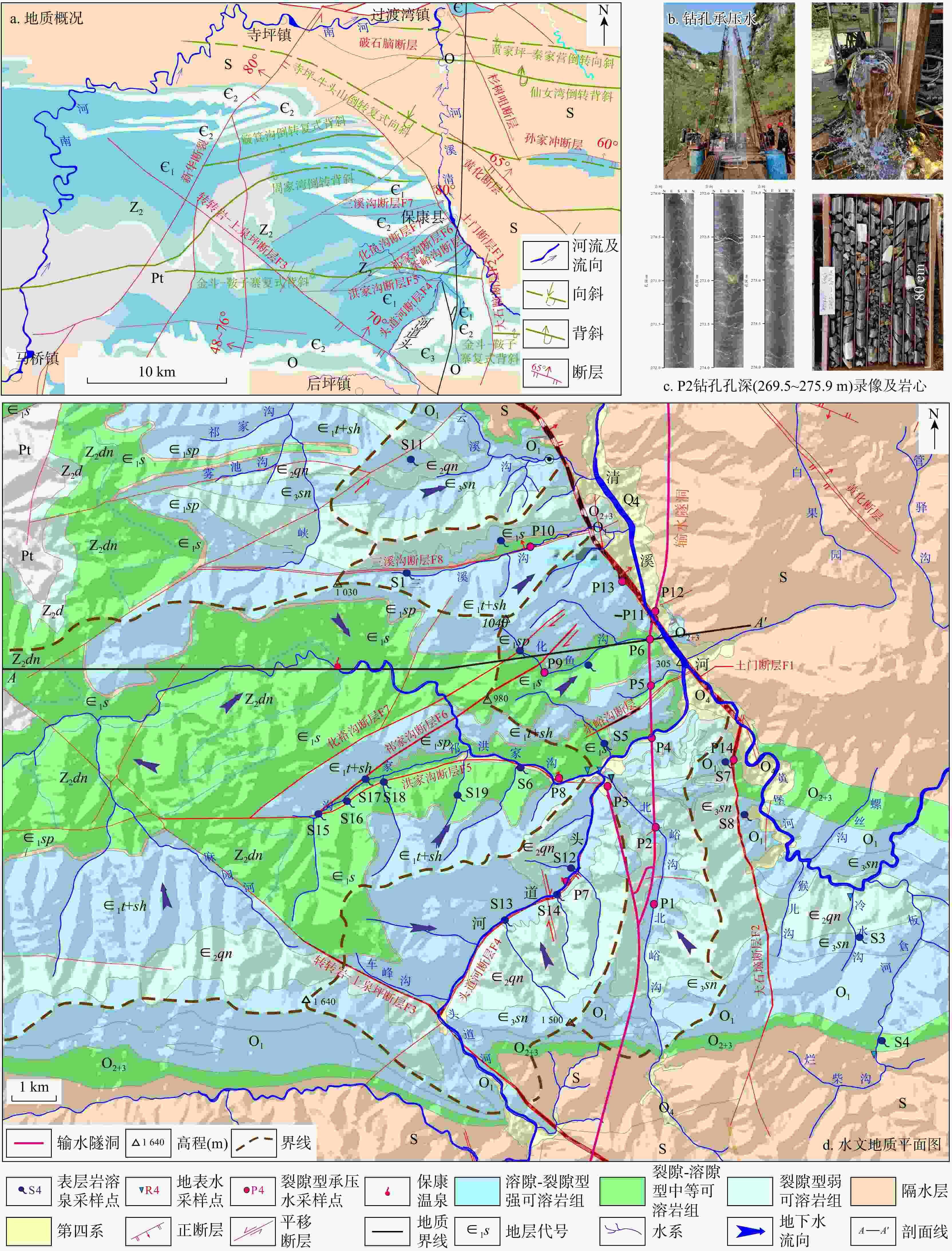
图 1 金斗−鞍子寨复式背斜水文地质平面图
Є. 寒武系;O. 奥陶系;Q. 第四系;S. 志留系;O1. 奥陶系下统;O2+3. 奥陶系中上统;O1n. 奥陶系南津关组;Є3sn. 寒武系上统三游洞组;Є2qn. 寒武系中统覃家庙组;Є1sh. 寒武系下统石龙洞组;Є1t. 寒武系下统天河板组;Є1sp. 寒武系下统石牌组;Є1s. 寒武系下统水井沱组;Є1. 下寒武统;Є2. 中寒武统;Є1. 上寒武统;Z2. 中震旦统;Z2dn. 震旦系中统灯影组;Z2d. 震旦系中统陡山沱组;Pt. 元古界
Figure 1. Hydrogeological Plan of Jindou-Anzizhai Complex Anticline
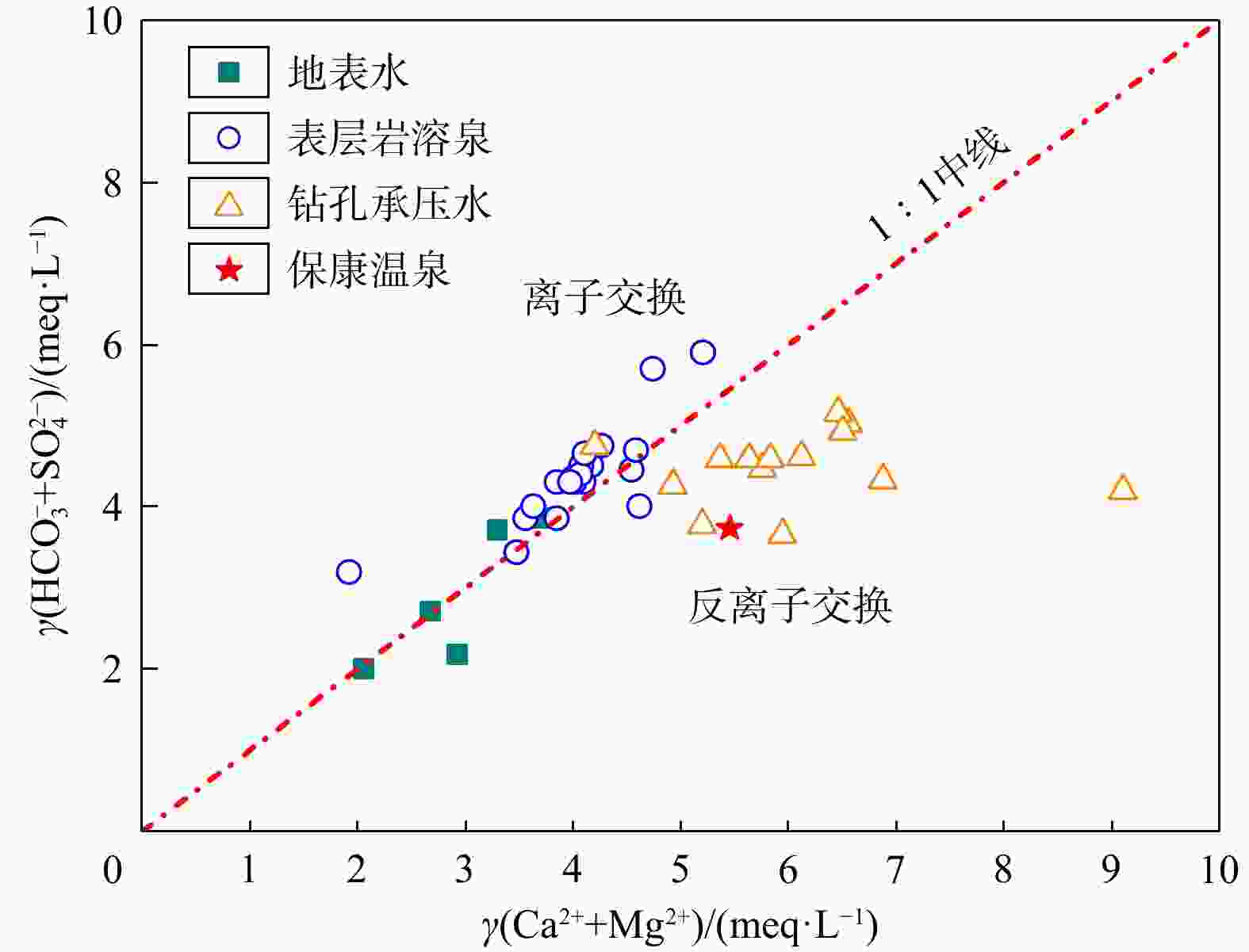
图 4 研究区不同水体γ(Ca2++Mg2+)−γ(${\mathrm{HCO}}_3^-+{\mathrm{SO}}_{4}^{2-} $)离子关系图
Figure 4. The relationship of γ(Ca2++Mg2+) and $\gamma({\mathrm{HCO}}_3^-+{\mathrm{SO}}_{4}^{2-}) $ for different types water
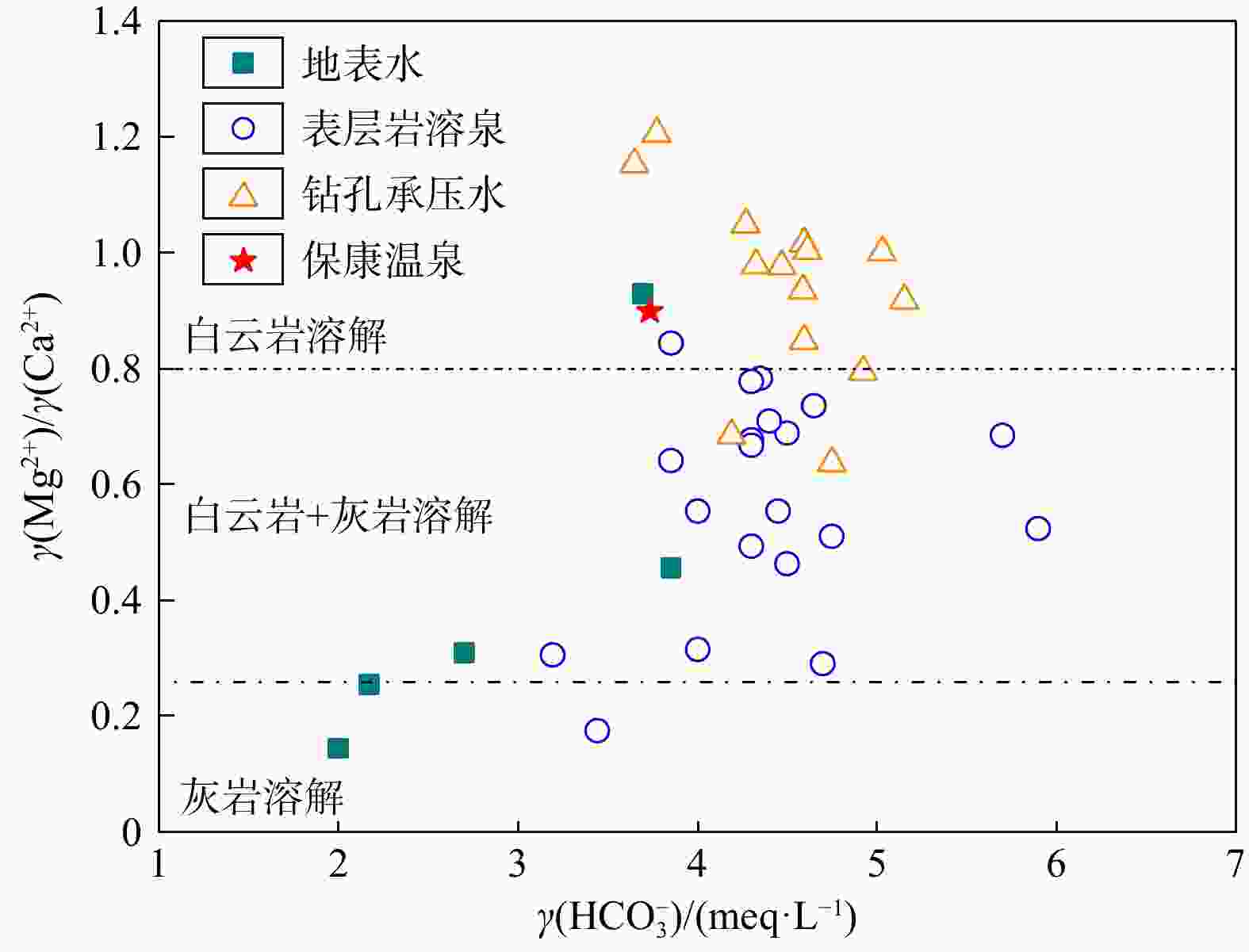
图 5 研究区不同水体γ(Mg2+)/γ(Ca2+)−γ(${\mathrm{HCO}}_3^- $)离子关系图
Figure 5. The relationship of γ(Mg2+)/γ(Ca2+) and $\gamma({\mathrm{HCO}}_3^-) $ for different types water
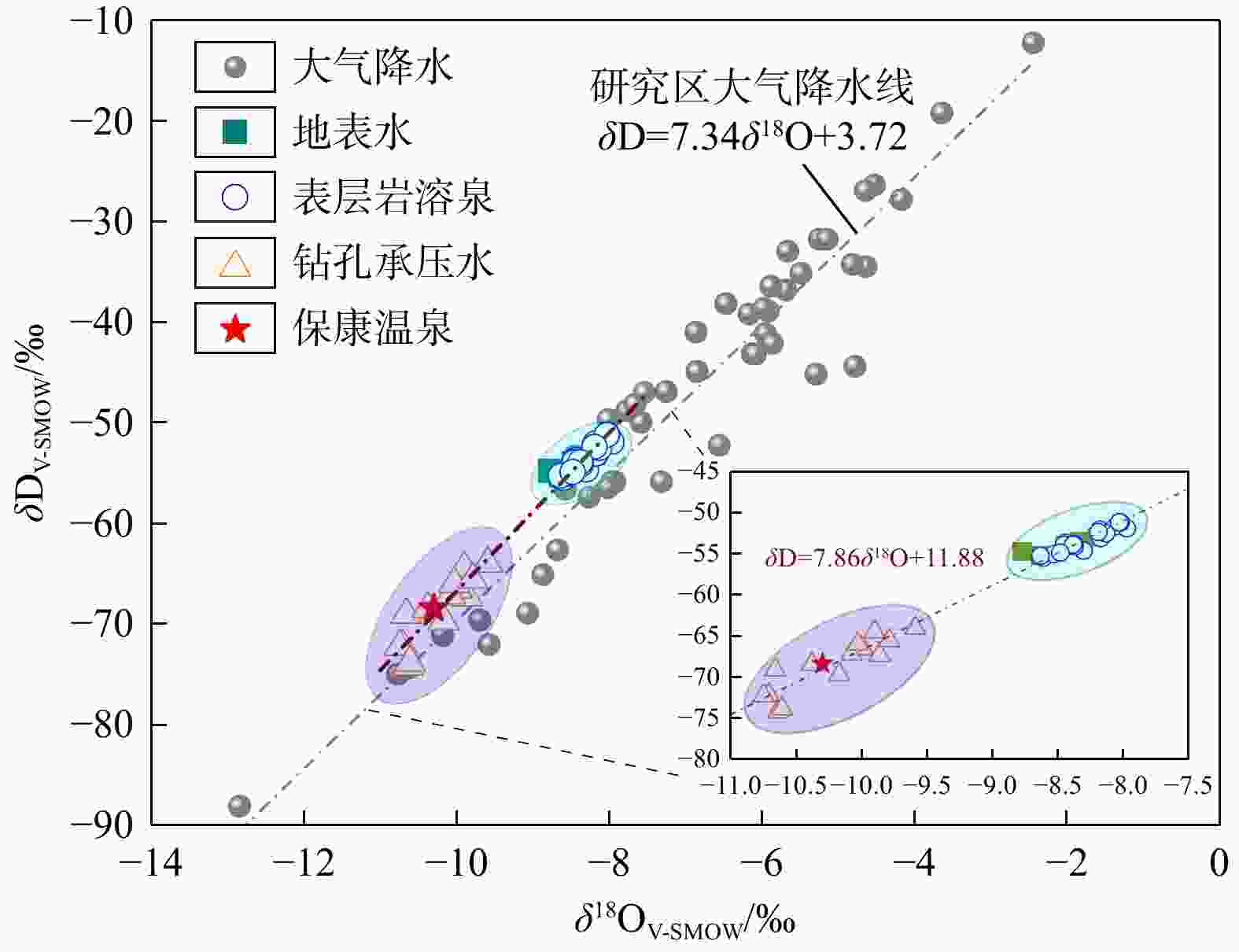
图 6 研究区不同水体氢氧稳定同位素关系图
Figure 6. Deuterium oxygen stable isotope relationship diagram of different types water
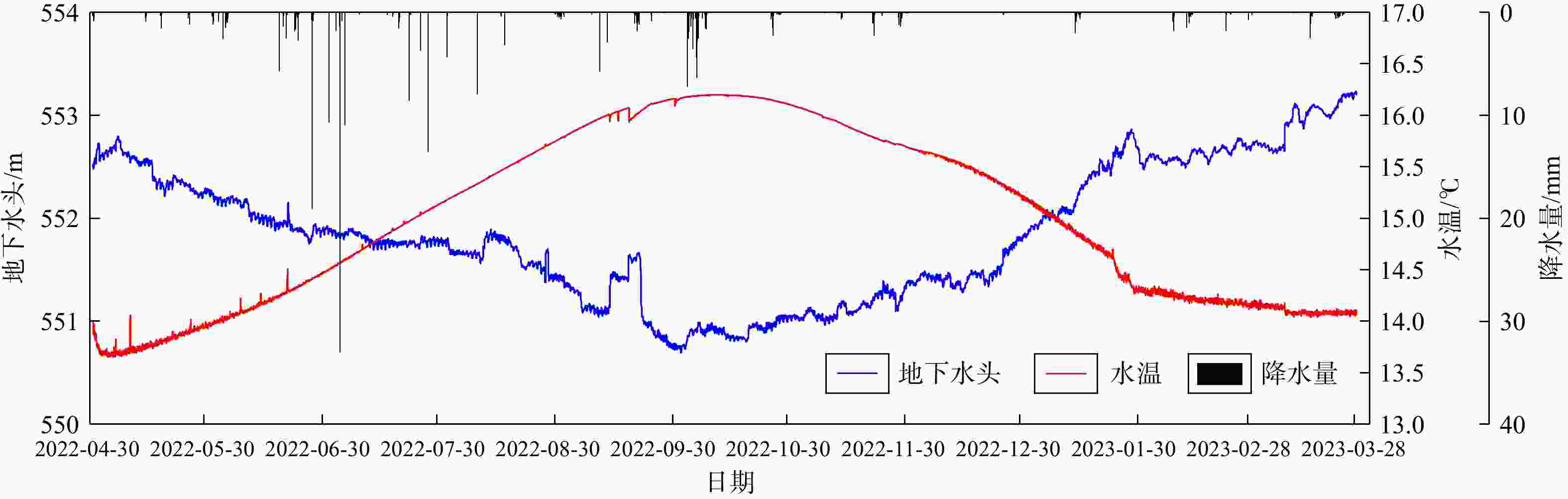
图 7 P9钻孔揭示裂隙型承压水降雨−水头−水温动态变化
Figure 7. Rainfall-Groundwater Head-Temperature dynamic variation of P9 drilling
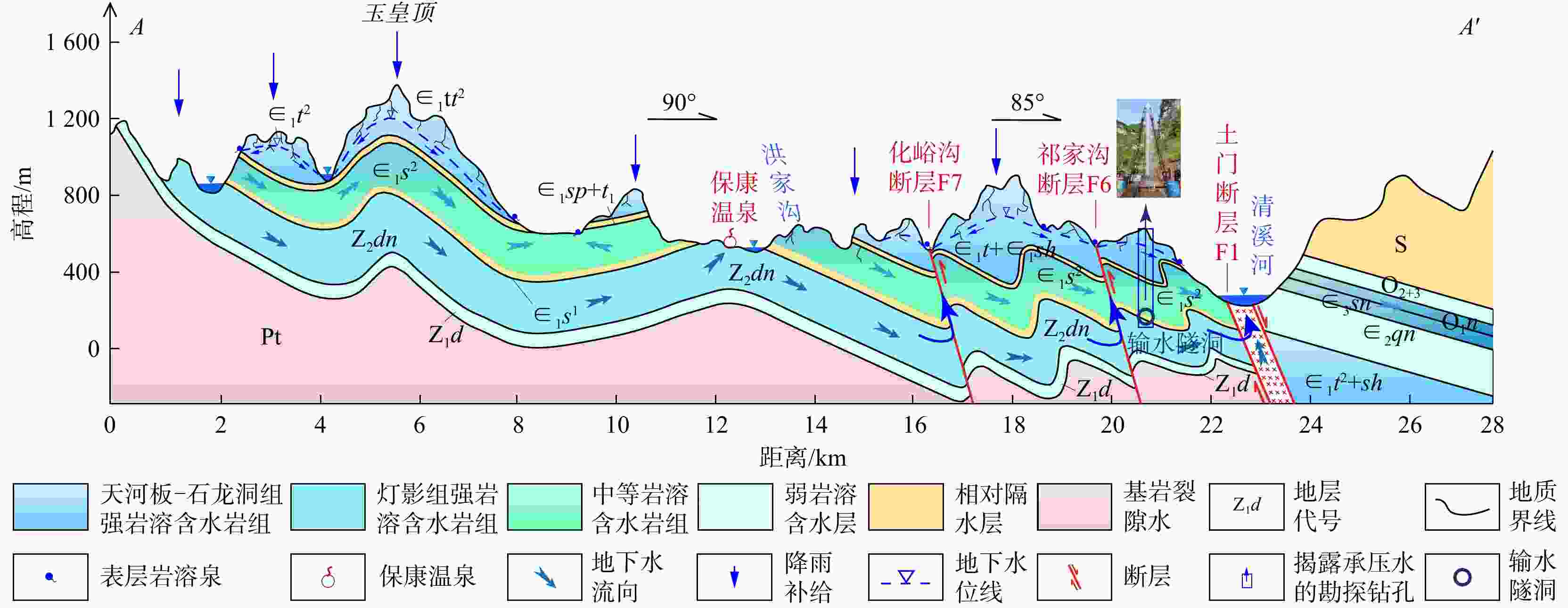
图 8 研究区地下水补给、径流、排泄模式
Figure 8. Groundwater recharge, runoff and discharge patterns in the study area
表 1 钻孔承压水基本信息
Table 1. Information of confined water exposed by boreholes
钻孔编号 孔口高程/m 孔深/m 承压水点地层岩性及时代 单孔流量/(L·min−1) 孔口水压力/MPa 地下水头/m P1 443.5 411.5 白云岩Є1t2 230.0 0.320 475.5 P2 373.0 351.3 白云岩Є1t2 138.0 0.380 411.0 P3 355.0 290.2 白云岩Z2dn 720.0 1.300 485.0 P4 326.0 237.5 白云岩Z2dn 108.0 0.800 406.0 P5 426.0 364.9 白云岩Z2dn 180.0 0.250 451.0 P6 318.0 263.9 白云岩Є1s2 96.0 1.000 418.0 P7 368.5 291.6 白云岩Є1t2 292.0 0.500 418.5 P8 370.7 258.0 白云岩Є1t2 800.0 0.850 455.7 P9 551.5 646.5 白云岩Є1s2 4.1 0.010 552.5 P10 388.0 362.4 白云岩Є1s2 366.0 0.350 423.0 P11 295.5 300.2 碎裂岩F1 66.0 0.810 376.5 P12 299.7 200.1 碎裂岩F1 10.8 0.013 301.2 P13 339.6 300.2 碎裂岩F1 220.0 0.550 394.6 P14 424.8 220.3 碎裂岩F1 200.0 0.260 450.8 注:地下水头=孔口高程+孔口水压力×100  下载: 导出CSV
表 2 不同类型水样水化学及同位素测试结果
Table 2. Test results of water chemistry and isotopes for different types of water samples
水样编号 水体类型 取样高程/m Na K Ca Mg SO4 Cl HCO3 TDS 水化学类型 δD/‰ δ18O/‰ 补给高程/m ρB/(mg·L−1) R1 地表水 350.0 2.3 4.7 41.1 7.6 32.2 3.2 164.8 173.5 HCO3-Ca −54.1 −8.5 1179 R2 348.0 1.8 1.6 34.3 19.1 27.7 2.7 225.8 200.0 HCO3-Ca·Mg −53.0 −8.2 1093 R3 352.0 0.7 2.8 46.7 7.1 14.8 2.7 132.8 141.2 HCO3-Ca −54.8 −8.8 1289 R4 502.0 2.4 5.3 36.0 3.1 28.6 3.1 122.0 139.6 HCO3-Ca −53.5 −8.3 1137 R5 449.0 1.2 1.7 50.7 13.9 30.0 3.5 234.9 218.4 HCO3-Ca·Mg −55.3 −8.6 1241 S1 表层岩溶泉 713.0 0.7 0.8 56.4 23.2 27.2 1.5 348.0 283.6 HCO3-Ca·Mg −55.5 −8.6 1234 S2 542.0 1.9 3.1 58.6 19.4 34.8 5.5 271.5 259.0 HCO3-Ca·Mg −51.7 −8.1 1044 S3 500.0 0.8 1.1 68.4 21.45 29.5 1.7 360.0 303.0 HCO3-Ca·Mg −55.1 −8.5 1206 S4 560.0 3.9 1.5 70.3 13.3 81.1 4.5 244.1 296.7 HCO3·SO4-Ca −52.1 −8.2 1086 S5 380.0 1.5 1.9 49.4 20.4 43.0 2.6 274.6 256.0 HCO3-Ca·Mg −54.7 −8.3 1127 S6 393.0 1.1 0.8 45.0 21.6 31.4 1.8 265.4 234.0 HCO3-Ca·Mg −53.1 −8.2 1082 S7 520.0 0.9 1.1 71.2 12.4 31.7 1.9 286.8 262.6 HCO3-Ca −51.9 −7.9 1013 S8 435.0 1.5 0.7 55.8 15.5 21.5 1.4 274.6 233.6 HCO3-Ca·Mg −52.6 −8.1 1068 S9 679.0 1.4 1.1 56.6 17.3 18.2 2.9 289.8 242.5 HCO3-Ca·Mg −51.2 −8.0 1031 S10 544.0 1.3 1.4 55.0 16.2 21.7 3.0 262.4 229.8 HCO3-Ca·Mg −51.2 −8.0 1034 S11 741.0 0.9 1.9 59.3 6.3 29.4 1.6 210.0 204.3 HCO3-Ca −51.2 −8.0 1034 S12 380.0 1.2 0.9 48.0 19.5 28.0 1.7 262.4 230.4 HCO3-Ca·Mg −53.8 −8.4 1155 S13 428.0 1.4 1.3 47.0 18.1 29.5 2.0 234.9 216.7 HCO3-Ca·Mg −53.7 −8.4 1175 S14 396.0 0.9 0.6 38.7 19.6 27.3 1.9 234.9 206.5 HCO3-Ca·Mg −53.9 −8.5 1179 S15 582.0 1.3 1.7 46.8 15.5 20.0 1.4 244.1 208.6 HCO3-Ca·Mg −55.3 −8.6 1241 S16 562.0 1.2 0.6 47.7 20.3 30.6 1.8 268.5 236.4 HCO3-Ca·Mg −52.4 −8.2 1089 S17 525.0 1.0 1.1 46.3 18.5 23.3 1.6 262.4 223.0 HCO3-Ca·Mg −54.2 −8.4 1151 S18 512.0 1.1 0.6 44.8 20.9 26.9 1.5 262.4 227.0 HCO3-Ca·Mg −53.9 −8.4 1155 S19 560.0 1.0 0.6 47.5 20.9 22.4 1.4 283.7 235.8 HCO3-Ca·Mg −54.9 −8.5 1189 P1 钻孔承压水 443.5 2.4 1.4 55.3 38.2 13.0 2.8 222.7 224.5 HCO3-Ca·Mg −69.1 −10.7 1941 P2 373.0 2.7 1.9 53.3 32.5 20.8 1.1 280.2 252.4 HCO3-Ca·Mg −67.3 −9.9 1665 P3 355.0 3.1 3.8 58.3 34.1 37.5 1.7 272.7 274.7 HCO3-Ca·Mg −69.7 −10.2 1772 P4 326.0 4.4 9.7 69.6 40.8 9.1 2.2 264.0 267.7 HCO3-Ca·Mg −68.5 −10.4 1844 P5 426.0 2.0 2.1 65.6 39.4 31.7 0.8 306.6 294.9 HCO3-Ca·Mg −64.5 −9.9 1679 P6 318.0 3.0 3.3 61.2 36.8 15.6 3.3 281.4 263.9 HCO3-Ca·Mg −66.5 −10.0 1710 P7 368.5 2.7 2.3 47.2 34.1 30.9 1.4 230.0 233.6 HCO3-Ca·Mg −72.2 −10.7 1958 P8 370.7 3.1 5.4 48.2 30.3 62.4 3.3 260.4 282.8 HCO3-Ca·Mg −72.3 −10.8 1972 P9 646.5 2.3 1.2 67.5 37.1 15.9 1.1 314.3 282.2 HCO3-Ca·Mg −67.2 −10.1 1741 P10 388.0 3.6 2.5 72.5 34.6 37.1 1.6 300.4 300.4 HCO3-Ca·Mg −64.0 −9.6 1572 P11 295.5 3.8 4.0 58.3 32.6 30.8 1.8 279.9 271.3 HCO3-Ca·Mg −74.2 −10.6 1934 P12 299.7 19.0 56.8 108.1 44.4 18.3 2.8 255.5 377.1 HCO3-Ca·Mg −73.8 −10.6 1924 P13 326.0 1.6 2.2 63.1 32.1 186.2 11.9 280.2 437.2 HCO3·SO4-Ca·Mg −66.0 −10.0 1724 P14 424.8 1.9 1.8 51.5 19.7 30.6 1.8 289.8 252.2 HCO3-Ca·Mg −65.6 −9.8 1641 HS1 温泉 492.0 2.6 4.3 57.6 31.0 65.3 38.8 228.1 313.6 HCO3-Ca·Mg −68.4 −10.3 1817
下载: 导出CSV
-
[1] 张小宝, 司富安, 段世委, 等. 深埋水工长隧洞主要工程地质问题与勘察经验[J]. 水利规划与设计, 2021(12): 55-60. doi: 10.3969/j.issn.1672-2469.2021.12.012ZHANG X B, SI F A, DUAN S W, et al. Main engineering geological problems and survey experience of deep buried hydraulic long tunnels[J]. Water Resources Planning and Design, 2021(12): 55-60. (in Chinese with English abstract) doi: 10.3969/j.issn.1672-2469.2021.12.012 [2] 许晓君, 周航, 张宇婷, 等. 滇西北山区某深埋隧道水文地质特征及突涌水危险性评价[J]. 铁道技术标准(中英文), 2025, 7(3): 15-21.XU X J, ZHOU H, ZHANG Y T, et al. Hydrogeological characteristics and risk assessment of sudden water influx in a deep buried tunnel in the mountainous area of Northwest Yunnan[J]. Railway Technical Standards (Chinese and English), 2025, 7(3): 15-21. (in Chinese with English abstract) [3] 王吉亮, 向家菠, 颜慧明, 等. 引江补汉工程输水线路工程地质选线研究[J]. 长江科学院院报, 2023, 40(5): 100-105. doi: 10.11988/ckyyb.20221280WANG J L, XIANG J B, YAN H M, et al. Research on geological route selection for the water transfer line of the Yangtze River and Han River Diversion Project[J]. Journal of the Yangtze River Academy of Sciences, 2023, 40(5): 100-105. (in Chinese with English abstract) doi: 10.11988/ckyyb.20221280 [4] 郭延辉, 李顺银, 严航, 等. 深埋隧道穿越富水断层破碎带突水突泥灾变演化规律研究[J]. 地质科技通报, 2026, 45(1): 160-170. doi: 10.19509/j.cnki.dzkq.2022.0141GUO Y H, LI S Y, YAN H, et al. Evolution law of water and mud inrush disaster in deep-buried tunnel crossing water-rich fault fracture zone[J]. Bulletin of Geological Science and Technology, 2026, 45(1): 160-170. (in Chinese with English abstract) doi: 10.19509/j.cnki.dzkq.2022.0141 [5] 潘晓东, 梁杏, 唐建生, 等. 黔东北高原斜坡地区4种岩溶地下水系统模式及特点: 基于地貌和蓄水构造特征[J]. 地球学报, 2015, 36(1): 84-92. doi: 10.3975/cagsb.2015.01.10PAN X D, LIANG X, TANG J S, et al. The patterns and characteristics of four karst groundwater systems in Northeast Guizhou slope zone based on the landscape and reservoir structure[J]. Acta Geoscientia Sinica, 2015, 36(1): 84-92. (in Chinese with English abstract) doi: 10.3975/cagsb.2015.01.10 [6] 司富安, 贾国臣, 高玉生. 水利水电工程深埋长隧洞勘察技术方法[J]. 中国水利, 2010(20): 69-71. doi: 10.3969/j.issn.1000-1123.2010.20.019SI F A, JIA G C, GAO Y S. Hydropower engineering survey technology of the deep-buried long tunnel[J]. China Water Resources, 2010(20): 69-71. (in Chinese with English abstract) doi: 10.3969/j.issn.1000-1123.2010.20.019 [7] 贾国臣, 刘康和, 周明. 大地电磁测深法在深埋隧洞勘察中的应用[J]. 水利水电技术, 2017, 48(10): 18-25. doi: 10.13928/j.cnki.wrahe.2017.10.003JIA G C, LIU K H, ZHOU M. Application of magnetotelluric sounding method to exploration of deeply buried tunnel[J]. Water Resources and Hydropower Engineering, 2017, 48(10): 18-25. (in Chinese with English abstract) doi: 10.13928/j.cnki.wrahe.2017.10.003 [8] 李爱国, 张少峰, 罗仁辉, 等. 基于多种方法的多层低水头基岩裂隙承压含水层层位探测[J]. 资源环境与工程, 2013, 27(4): 468-471. doi: 10.16536/j.cnki.issn.1671-1211.2013.04.011LI A G, ZHANG S F, LUO R H, et al. Detection of multilayer low head fracture confined aquifer based on multiple analysis methods[J]. Resources Environment & Engineering, 2013, 27(4): 468-471. (in Chinese with English abstract) doi: 10.16536/j.cnki.issn.1671-1211.2013.04.011 [9] 颜慧明, 项洋, 齐凌轩, 等. 定向钻探技术在水利水电深埋隧洞勘察中的应用研究: 以引江补汉工程为例[J]. 钻探工程, 2025, 52(3): 22-29. doi: 10.12143/j.ztgc.2025.03.003YAN H M, XIANG Y, QI L X, et al. Application research of directional drilling technology for deep buried tunnel engineering investigation: Taking the water diversion project from the Yangtze River to the Hanjiang River as an example[J]. Drilling Engineering, 2025, 52(3): 22-29. (in Chinese with English abstract) doi: 10.12143/j.ztgc.2025.03.003 [10] GOLDSCHEIDER N, ANDREO B. The geological and geomorphological framework. In: Goldscheider, N. , Drew, D. , (Eds.), Methods in Karst Hydrogeology: IAH, International Contributions to Hydrogeology[M]. Taylor & Francis, London, 2007, 9-23. [11] DE LA TORRE B, MUDARRA M, ANDREO B. Investigating karst aquifers in tectonically complex alpine areas coupling geological and hydrogeological methods[J]. Journal of Hydrology X, 2020, 6: 100047. doi: 10.1016/j.hydroa.2019.100047 [12] GOLDSCHEIDER N. Karst groundwater vulnerability mapping: Application of a new method in the Swabian Alb, Germany[J]. Hydrogeology Journal, 2005, 13(4): 555-564. doi: 10.1007/s10040-003-0291-3 [13] PERRIN J, LUETSCHER M. Inference of the structure of karst conduits using quantitative tracer tests and geological information: Example of the Swiss Jura[J]. Hydrogeology Journal, 2008, 16(5): 951-967. doi: 10.1007/s10040-008-0281-6 [14] KRAINER K, WINKLER G, PERNREITER S, et al. Unusual catchment runoff in a high alpine karst environment influenced by a complex geological setting (northern Calcareous Alps, Tyrol, Austria)[J]. Hydrogeology Journal, 2021, 29(8): 2837-2852. doi: 10.1007/s10040-021-02405-0 [15] PRTOLJAN B, KAPELJ S, DUKARIĆ F, et al. Hydrogeochemical and isotopic evidences for definition of tectonically controlled catchment areas of the Konavle area springs (SE Dalmatia, Croatia)[J]. Journal of Geochemical Exploration, 2012, 112: 285-296. doi: 10.1016/j.gexplo.2011.09.006 [16] MUDARRA M, HARTMANN A, ANDREO B. Combining experimental methods and modeling to quantify the complex recharge behavior of karst aquifers[J]. Water Resources Research, 2019, 55(2): 1384-1404. doi: 10.1029/2017WR021819 [17] GIL-MÁRQUEZ J M, DE LA TORRE B, MUDARRA M, et al. Complementary use of dating and hydrochemical tools to assess mixing processes involving centenarian groundwater in a geologically complex Alpine karst aquifer[J]. Hydrological Processes, 2020, 34(20): 3981-3999. doi: 10.1002/hyp.13848 [18] 曹园园, 虎新军, 倪萍, 等. 银川盆地地热水成因机制: 来自水化学和同位素的约束[J]. 地质科技通报, 2026, 45(3): 287-302. doi: 10.19509/j.cnki.dzkq.tb20210791CAO Y Y, HU X J, NI P, et al. Genesis mechanism of geothermal water in Yinchuan Basin: Constraints from hydrochemistry and isotopes[J]. Bulletin of Geological Science and Technology, 2026, 45(3): 287-302. (in Chinese with English abstract) doi: 10.19509/j.cnki.dzkq.tb20210791 [19] 常威, 颜慧明, 万军伟, 等. 索伦山地区地下水的赋存运移规律及富水模式[J]. 安全与环境工程, 2025, 32(5): 255-263. doi: 10.13578/j.cnki.issn.1671-1556.20240748CHANG W, YAN H M, WAN J W, et al. Occurrence, migration laws and enrichment models of groundwater in Solun Mountain area[J]. Safety and Environmental Engineering, 2025, 32(5): 255-263. (in Chinese with English abstract) doi: 10.13578/j.cnki.issn.1671-1556.20240748 [20] 罗明明, 尹德超, 张亮, 等. 南方岩溶含水系统结构识别方法初探[J]. 中国岩溶, 2015, 34(6): 543-550. doi: 10.11932/karst20150602LUO M M, YIN D C, ZHANG L, et al. Identifying methods of karst aquifer system structure in South China[J]. Carsologica Sinica, 2015, 34(6): 543-550. (in Chinese with English abstract) doi: 10.11932/karst20150602 [21] ADINEHVAND R, RAEISI E, HARTMANN A. An integrated hydrogeological approach to evaluate the leakage potential from a complex and fractured karst aquifer, example of Abolabbas Dam (Iran)[J]. Environmental Earth Sciences, 2020, 79(22): 501. doi: 10.1007/s12665-020-09244-4 [22] JI H S, CHIOGNA G, CHANG W, et al. Investigating the structure of a multiple karst aquifer system and its hydrological process response using high-resolution multi-tracer data[J]. Journal of Hydrology, 2025, 657: 133152. doi: 10.1016/j.jhydrol.2025.133152 [23] 李术才, 许振浩, 黄鑫, 等. 隧道突水突泥致灾构造分类、地质判识、孕灾模式与典型案例分析[J]. 岩石力学与工程学报, 2018, 37(5): 1041-1069. doi: 10.13722/j.cnki.jrme.2017.1332LI S C, XU Z H, HUANG X, et al. Classification, geological identification, hazard mode and typical case studies of hazard-causing structures for water and mud inrush in tunnels[J]. Chinese Journal of Rock Mechanics and Engineering, 2018, 37(5): 1041-1069. (in Chinese with English abstract) doi: 10.13722/j.cnki.jrme.2017.1332 [24] 潘毅, 王思琪, 谭家华, 等. 基于MODFLOW-CFP模型的岩溶隧道涌水量预测[J]. 地质科技通报, 2026, 45(1): 247-257. doi: 10.19509/j.cnki.dzkq.2021.0054PAN Y, WANG S Q, TAN J H, et al. Prediction water inflow in a karst tunnel based on MODFLOW-CFP model[J]. Bulletin of Geological Science and Technology, 2026, 45(1): 247-257. (in Chinese with English abstract) doi: 10.19509/j.cnki.dzkq.2021.0054 [25] 肖竞, 万军伟, 成建梅, 等. MODFLOW-CFPv2模型在岩溶隧道突涌水及对地下水环境影响中的应用: 以云南鹤庆锰矿沟岩溶水系统为例[J]. 地质科技通报, 2024, 43(3): 301-310. doi: 10.19509/j.cnki.dzkq.tb20230072XIAO J, WAN J W, CHENG J M, et al. Application of MODFLOW-CFPv2 model in karst tunnel water inrush and its impact on groundwater environment: Example of the Mengkuanggou karst water system in Heqing County, Yunnan Province[J]. Bulletin of Geological Science and Technology, 2024, 43(3): 301-310. (in Chinese with English abstract) doi: 10.19509/j.cnki.dzkq.tb20230072 [26] WANG Z J, GUO X L, KUANG Y, et al. Recharge sources and hydrogeochemical evolution of groundwater in a heterogeneous karst water system in Hubei Province, Central China[J]. Applied Geochemistry, 2022, 136: 105165. doi: 10.1016/j.apgeochem.2021.105165 [27] 邱凌. 富水深埋TBM隧道突涌水机理分析及反坡排水设计[J]. 施工技术(中英文), 2026, 55(7): 93-98. doi: 10.7672/sgjs2026070093QIU L. Water inrush mechanism analysis and reverse slope drainage design in water-rich deep-buried TBM tunnel[J]. Construction Technology, 2026, 55(7): 93-98. (in Chinese with English abstract) doi: 10.7672/sgjs2026070093 [28] 范威, 王川, 金晓文, 等. 吉莲高速公路钟家山隧道涌突水条件分析[J]. 水文地质工程地质, 2015, 42(2): 38-43. doi: 10.16030/j.cnki.issn.1000-3665.2015.02.06FAN W, WANG C, JIN X W, et al. Water inrush condition analysis of the Zhongjiashan tunnel in the Jilian Highway[J]. Hydrogeology & Engineering Geology, 2015, 42(2): 38-43. (in Chinese with English abstract) doi: 10.16030/j.cnki.issn.1000-3665.2015.02.06 [29] 常威, 谭家华, 黄琨, 等. 地下水多元示踪试验在岩溶隧道水害预测中的应用: 以张吉怀高铁兰花隧道为例[J]. 中国岩溶, 2020, 39(3): 400-408. doi: 10.11932/karst2020y27CHANG W, TAN J H, HUANG K, et al. Application of groundwater multi-element tracing tests to water hazard prediction of karst tunnels: An example of the Lanhua tunnel on the Zhangjiajie-Jishou-Huaihua high-speed railway[J]. Carsologica Sinica, 2020, 39(3): 400-408. (in Chinese with English abstract) doi: 10.11932/karst2020y27 [30] LUO M M, CHEN J, JAKADA H, et al. Identifying and predicting karst water inrush in a deep tunnel, South China[J]. Engineering Geology, 2022, 305: 106716. doi: 10.1016/j.enggeo.2022.106716 [31] 郑克勋, 裴熊伟, 朱代强, 等. 岩溶地区地下水位变动带隧道涌水问题的思考[J]. 中国岩溶, 2019, 38(4): 473-479. doi: 10.11932/karst20190401ZHENG K X, PEI X W, ZHU D Q, et al. Thoughts on tunnel water inrush in changing zones of groundwater level in karst areas[J]. Carsologica Sinica, 2019, 38(4): 473-479. (in Chinese with English abstract) doi: 10.11932/karst20190401 [32] BEHZAD H M, FORD D, NIE Y P, et al. Illuminating the complexity of hydrogeological regimes in fault-influenced, anticlinal karst aquifers: Insights into the recharge patterns in tectonically complex karst catchments[J]. Journal of Hydrology, 2023, 626: 130247. doi: 10.1016/j.jhydrol.2023.130247 [33] PETRELLA E, AQUINO D, FIORILLO F, et al. The effect of low-permeability fault zones on groundwater flow in a compartmentalized system. Experimental evidence from a carbonate aquifer (southern Italy)[J]. Hydrological Processes, 2015, 29(6): 1577-1587. doi: 10.1002/hyp.10294 [34] BAUER H, SCHRÖCKENFUCHS T C, DECKER K. Hydrogeological properties of fault zones in a karstified carbonate aquifer (northern Calcareous Alps, Austria)[J]. Hydrogeology Journal, 2016, 24(5): 1147-1170. doi: 10.1007/s10040-016-1388-9 [35] FAN Y, JI H S, LU R Y, et al. Control of structural landform evolution on karst groundwater cycle in a large-scale anticlinorium[J]. Groundwater, 2024, 62(2): 196-211. doi: 10.1111/gwat.13341 [36] 周艳松, 曾洋, 杨涛, 等. 湖北省保康县地质灾害分布特征及发育规律研究[J]. 资源环境与工程, 2022, 36(3): 344-350. doi: 10.16536/j.cnki.issn.1671-1211.2022.03.011ZHOU Y S, ZENG Y, YANG T, et al. Research on the distribution characteristics and development law of geological disasters in Baokang County, Hubei Province[J]. Resources Environment & Engineering, 2022, 36(3): 344-350. (in Chinese with English abstract) doi: 10.16536/j.cnki.issn.1671-1211.2022.03.011 [37] 李丽华, 张维江, 张磊. 保康温泉崩塌成因机制与稳定性评价[J]. 资源环境与工程, 2020, 34(3): 396-399. doi: 10.16536/j.cnki.issn.1671-1211.2020.03.015LI L H, ZHANG W J, ZHANG L. Genetic mechanism and stability evaluation of Baokang hot spring collapse[J]. Resources Environment & Engineering, 2020, 34(3): 396-399. (in Chinese with English abstract) doi: 10.16536/j.cnki.issn.1671-1211.2020.03.015 [38] 张禹, 赵康, 张维江, 等. 湖北省保康县万年山地区地热地质特征与成因模式[J]. 资源环境与工程, 2023, 37(6): 671-680. doi: 10.16536/j.cnki.issn.1671-1211.2023.06.006ZHANG Y, ZHAO K, ZHANG W J, et al. Geothermal geological characteristics and genetic model of Wannianshan area in Baokang County, Hubei Province[J]. Resources Environment & Engineering, 2023, 37(6): 671-680. (in Chinese with English abstract) doi: 10.16536/j.cnki.issn.1671-1211.2023.06.006 [39] 吴慈华, 曹劲, 左丽敏. 鄂西南岩溶地下水系统划分和研究[J]. 资源环境与工程, 2018, 32(增刊1): 55-62. doi: 10.16536/j.cnki.issn.1671-1211.2018.S1.010WU C H, CAO J, ZUO L M. Division of karst groundwater system in Southwest Hubei[J]. Resources Environment & Engineering, 2018, 32(S1): 55-62. (in Chinese with English abstract) doi: 10.16536/j.cnki.issn.1671-1211.2018.S1.010 [40] 罗明明, 肖天昀, 陈植华, 等. 香溪河岩溶流域几种岩溶水系统的地质结构特征[J]. 水文地质工程地质, 2014, 41(6): 13-19. doi: 10.16030/j.cnki.issn.1000-3665.2014.06.004LUO M M, XIAO T Y, CHEN Z H, et al. Geological structure characteristics of several karst water systems in the Xiangxi River karst basin[J]. Hydrogeology and Engineering Geology, 2014, 41(6): 13-19. (in Chinese with English abstract) doi: 10.16030/j.cnki.issn.1000-3665.2014.06.004 [41] 许琦, 向家菠, 王吉亮, 等. 黄陵断穹北缘盖层岩溶水文地质结构建立及其在深埋长隧洞工程的应用[J]. 工程勘察, 2024, 52(10): 36-43.XU Q, XIANG J B, WANG J L, et al. Building of karst hydrogeological structures on the Northeast wing of Huangling faulted dome and its application in the deep-buried long tunnel engineering[J]. Geotechnical Investigation & Surveying, 2024, 52(10): 36-43. (in Chinese with English abstract) [42] 李潇, 漆继红, 许模. 西南典型紧窄褶皱小尺度浅层岩溶水系统特征及隧道涌水分析[J]. 中国岩溶, 2020, 39(3): 375-383. doi: 10.11932/karst2020y32LI X, QI J H, XU M. Analysis on the characteristics of small-scale shallow karst water systems in typical tight-narrow folds and tunnel water inrush in southwestern China[J]. Carsologica Sinica, 2020, 39(3): 375-383. (in Chinese with English abstract) doi: 10.11932/karst2020y32 [43] 耿军民, 颜慧明, 贾建红, 等. 引江补汉工程深埋长隧洞主要工程地质问题[J]. 中国水利, 2022(18): 51-53. doi: 10.3969/j.issn.1000-1123.2022.18.020GENG J M, YAN H M, JIA J H, et al. Main issues with geology for deep buried long tunnel of the River Diversion Project from the Yangtze River to the Han River[J]. China Water Resources, 2022(18): 51-53. (in Chinese with English abstract) doi: 10.3969/j.issn.1000-1123.2022.18.020 [44] 谭显江, 张建清, 刘方文, 等. 高清数字钻孔电视技术研发及其在水电工程中的应用[J]. 长江科学院院报, 2012, 29(8): 62-66. doi: 10.3969/j.issn.1001-5485.2012.08.012TAN X J, ZHANG J Q, LIU F W, et al. R & D of high-resolution digital borehole TV technology and its application in hydropower project[J]. Journal of Changjiang River Scientific Research Institute, 2012, 29(8): 62-66. (in Chinese with English abstract) doi: 10.3969/j.issn.1001-5485.2012.08.012 [45] 燕子琪, 周宏. 宜昌长江南岸岩溶地下水系统水化学特征分析[J]. 安全与环境工程, 2022, 29(6): 139-148. doi: 10.13578/j.cnki.issn.1671-1556.20210616YAN Z Q, ZHOU H. Hydrochemical characteristics of karst groundwater system on the south bank of the Yangtze River in Yichang[J]. Safety and Environmental Engineering, 2022, 29(6): 139-148. (in Chinese with English abstract) doi: 10.13578/j.cnki.issn.1671-1556.20210616 -

 下载:
下载:


 点击查看大图

计量
- 文章访问数: 178
- PDF下载量: 5
- 被引次数: 0