投审稿入口
投审稿入口


Evolutionary patterns of contact angle in CO2-water-oil-quartz system under temperature and pressure variations
-
摘要:
CO2驱提高石油采收率技术(CO2-enhanced oil recovery,简称CO2-EOR)是兼顾增产与碳封存的关键技术,但深层高温高压砂岩储层中 CO2−水−油−岩石多相界面演化机制尚不明确,现有研究对温压协同、不同气相(CO2/N2)作用下润湿性变化规律缺乏系统对比,制约现场驱替参数优化。搭建高温高压可视化石英毛细管测试装置,以十六烷模拟地层原油,设置多梯度温度(25~200℃)、压力(5~30 MPa)工况,分别测定 CO2−水、水−十六烷两相及CO2/N2参与的三相体系接触角,结合界面张力、流体黏度演化规律分析润湿性调控机理。结果表明CO2−水接触角随温压小幅上升,水−十六烷接触角随升温显著降低、受压力影响微弱;气相组分可改变油水界面张力实现润湿性改造,CO2溶解降低原油粘度的调控作用强于 N2;温度 120~150℃是石英润湿性转变临界区间,超过该温度石英完全由油润湿转为水润湿;升温降低原油黏度、提升油相渗流能力,压力对流体物性影响有限。 高温更利于石英储层亲水转化,合理调控驱替温度可显著改善 CO2驱开采效果。本研究通过毛细管微观多相试验揭示温压与气相类型对界面接触角的耦合影响,可为深层石英砂岩油藏 CO2-EOR 温压制度优化提供试验支撑。
Abstract:ObjectiveCO2-enhanced oil recovery (CO2-EOR) serves as a vital technology that simultaneously realizes crude oil production increase and geological carbon sequestration. However, existing research lacks systematic comparative investigations on wettability evolution under coupled temperature-pressure conditions and different gas phases (CO2, N2) in deep high-temperature high-pressure sandstone reservoirs, and the interfacial evolution mechanism of the CO2-water-oil-quartz multiphase system remains unclear, which restricts the optimization of field injection-production parameters for CO2 flooding. This study carries out microscopic experimental research to clarify the coupling mechanism of contact angle and wettability controlled by temperature, pressure, and gas composition.
MethodsA high-temperature high-pressure visual quartz capillary experimental setup was constructed, with n-hexadecane adopted to simulate formation crude oil. Continuous temperature gradients ranging from 25℃ to 200℃ and pressure gradients from 5 MPa to 30 MPa were set up for testing. Contact angles of two-phase CO2-water, water-hexadecane systems, and three-phase systems filled with CO2 or N2 were measured separately. Combined with the variation patterns of interfacial tension and fluid viscosity, the internal control mechanism of gas composition on reservoir wettability was analyzed quantitatively.
ResultsThe test results indicated that the CO2-water contact angle increased slightly with the growth of temperature and pressure, while the water-hexadecane contact angle decreased remarkably with temperature rise and showed weak response to pressure variation. Gas injection could adjust oil-water interfacial tension to alter reservoir wettability, and CO2 exerted a stronger viscosity-reducing effect on crude oil than N2. The critical temperature range for complete wettability transition of quartz mineral was 120-150℃. Above this threshold, the quartz surface completely transformed from oil-wet to water-wet. Heating could effectively reduce crude viscosity and enhance the seepage capacity of oil phase, while pressure had a limited effect on the physical properties of oil and water fluids.
ConclusionHigher temperature facilitates the hydrophilic transformation of quartz matrix in sandstone reservoirs. Reasonable regulation of flooding temperature can greatly improve the recovery efficiency of CO2-EOR. This study innovatively conducts comparative micro-capillary experiments with CO2 and N2 as contrasting gas phases, and reveals the coupled controlling effect of temperature, pressure, and gas species on multiphase contact angle. The experimental conclusions can provide a reliable basis for optimizing temperature-pressure operation schemes for CO2 flooding in deep quartz sandstone oil reservoirs.
-
Key words:
- multiphase contact angle /
- CO2-EOR /
- quartz reservoir /
- multiphase flow /
- wettability regulation /
- fluid viscosity
-
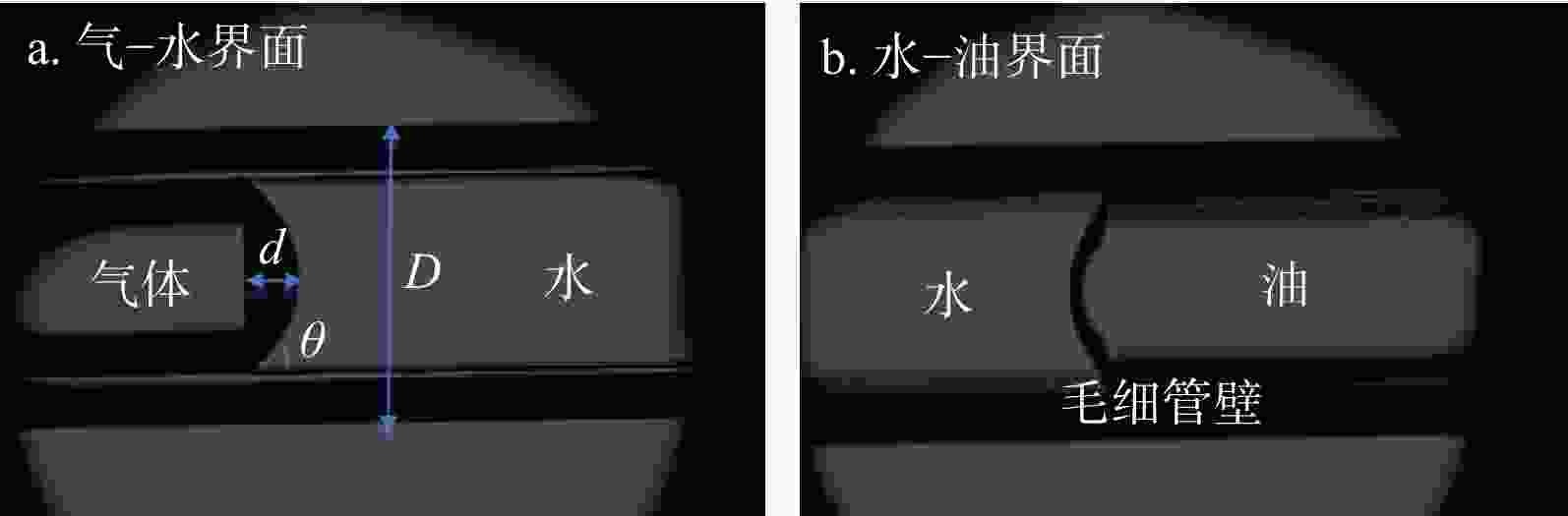
图 2 气−水−油界面接触角示意图
Figure 2. Schematic diagram of contact angle of gas-water-oil interface
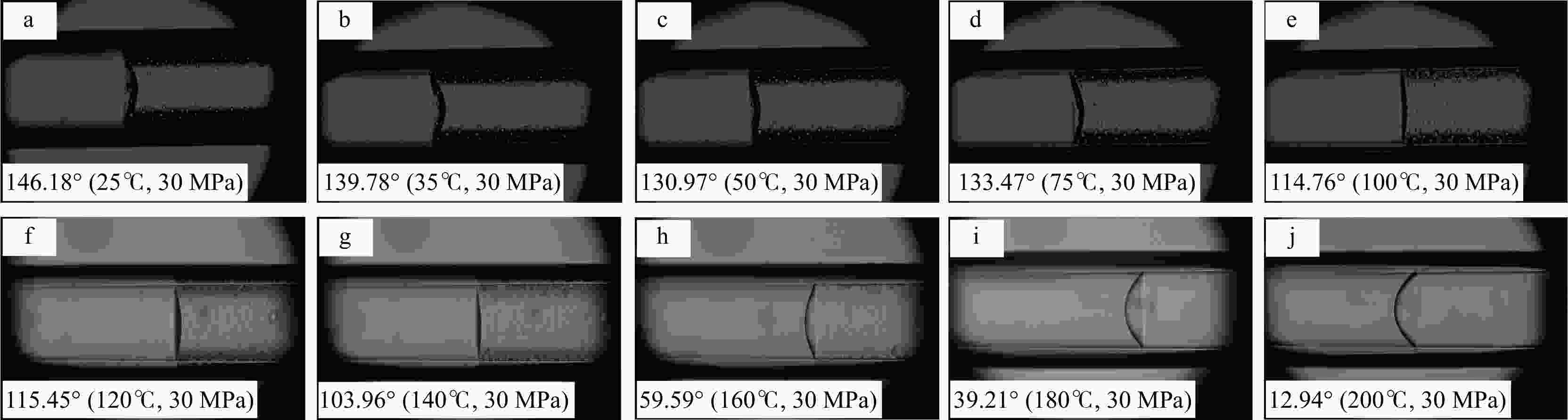
图 3 石英毛细管内水−十六烷接触角变化图
Figure 3. Contact angle variation of water-hexadecane in quartz capillary
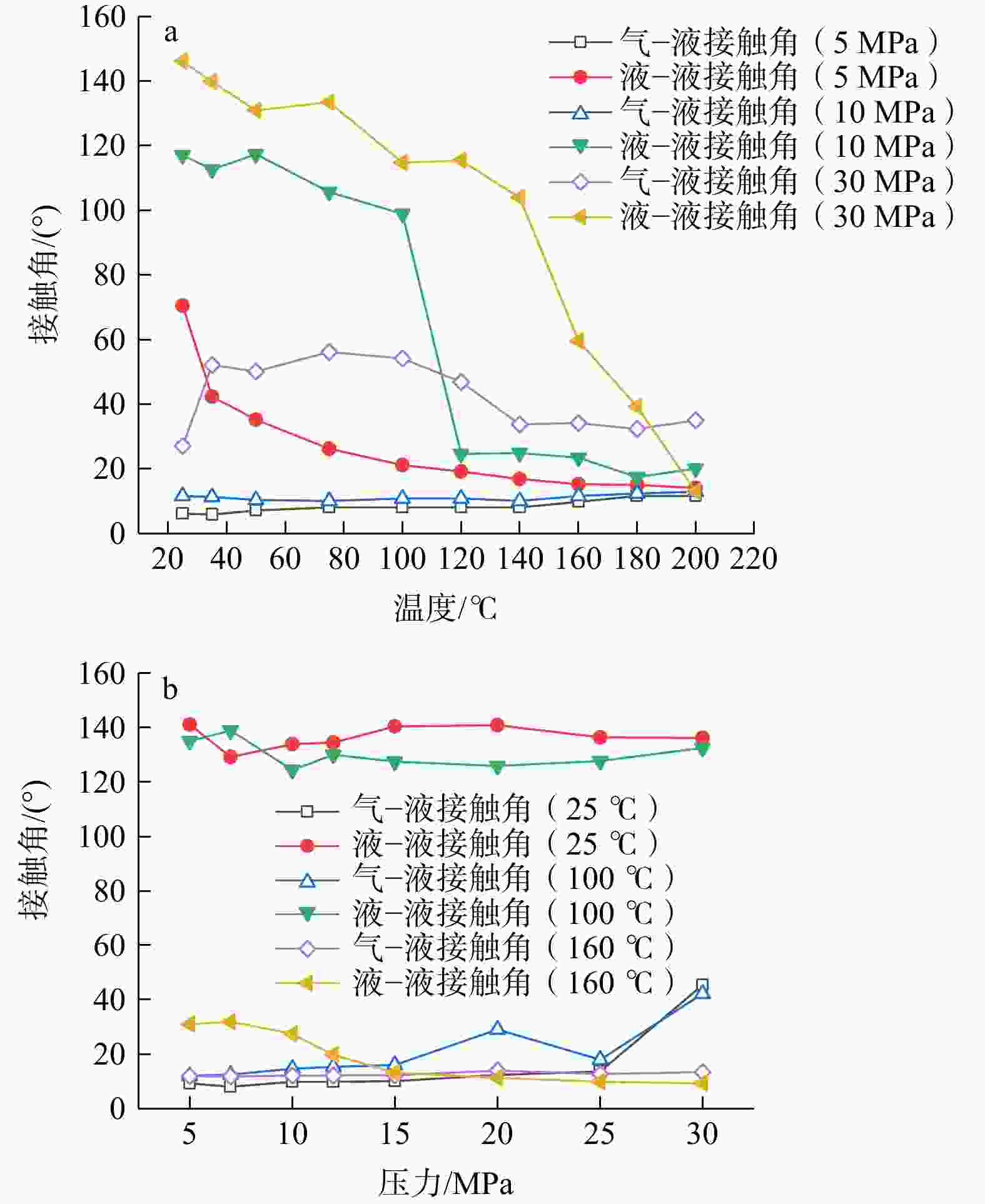
图 4 毛细管内CO2−水−十六烷−石英接触角随温度(a)、压力(b)变化
Figure 4. Variation of CO2-water-hexadecane-quartz contact angle with temperature (a) and pressure (b) in capillary
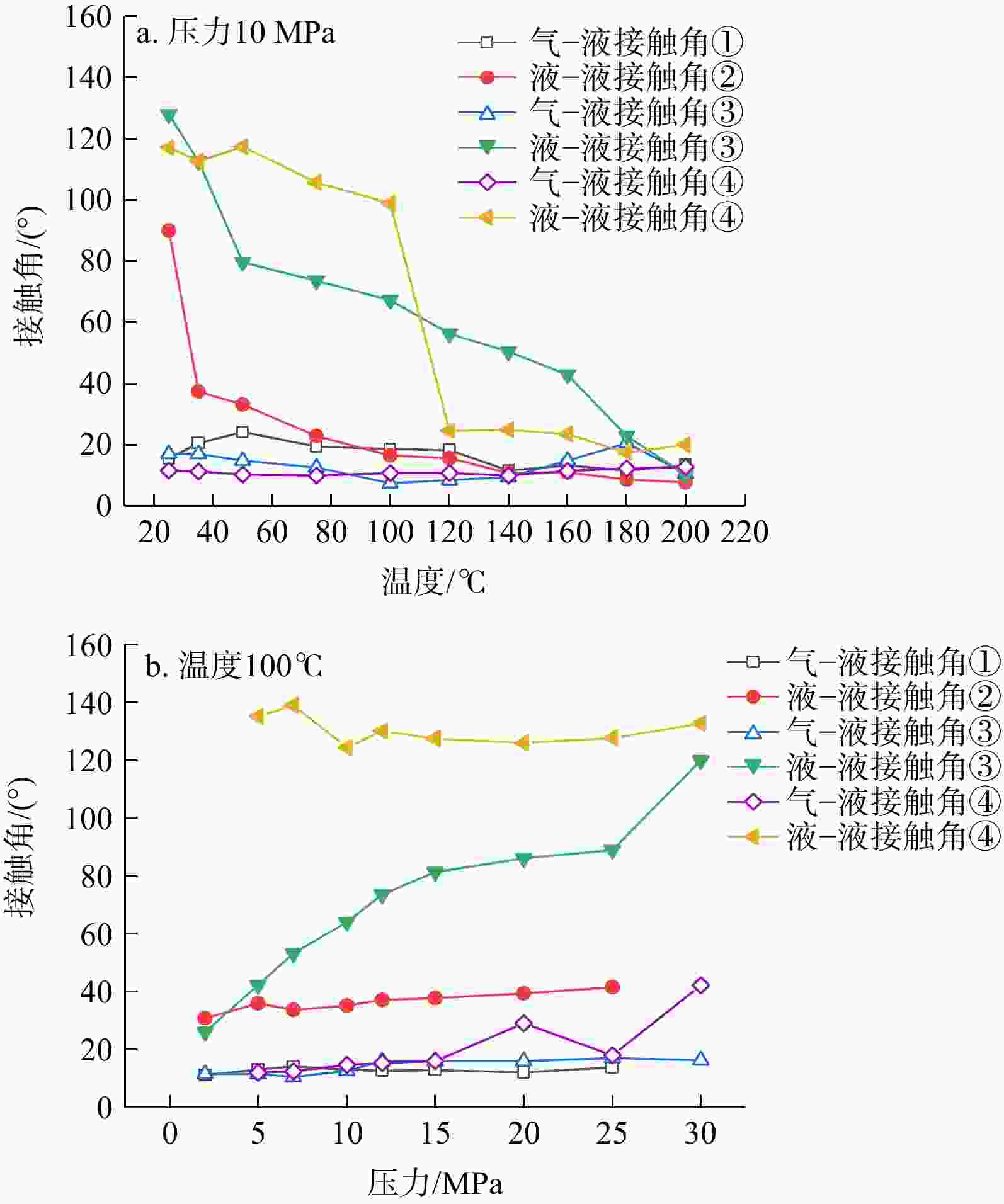
图 5 CO2−水−石英、水−十六烷−石英、CO2/N2−水−十六烷−石英接触角随温度(a)、压力(b)变化
Figure 5. Variation of contact angles of CO2-H2O-silica, H2O-C16H34-silica, and CO2/N2-H2O-C16H34-silica with temperature (a) and pressure (b)
表 1 试剂与器材
Table 1. Reagents and equipment
试剂/材料 纯度/规格 来源 二氧化碳(CO2) 99.99% 武汉明辉气体有限公司 正十六烷(C16H34) 99% 翁江化学试剂有限公司 去离子水 99.99% 武汉优普仪器设备有限公司 氢氧化钾溶液(KOH) 0.1mol/L 广东蒙科化学科技有限公司 毛细管 TSP300665,
TSP075200美国PolymicroTenchnologies公司 阀门 HIP 15-14AFI,
HIP 60-14AF2美国HIP公司 高压管线 1/16英寸 南通华兴石油仪器有限公司 冷热台 Linkam CAP500 英国Linkam公司 压力传感器 Setra 204D 美国Omega公司 真空干燥箱 DZF- 6050 上海一恒科学仪器有限公司  下载: 导出CSV
表 2 石英毛细管内接触角随温度变化数据
Table 2. Data of contact angle variation with temperature in quartz capillary
温度/(℃) 5 MPa 10 MPa 30 MPa 气−液接触角/(°) 液−液接触角/(°) 气−液接触角/(°) 液−液接触角/(°) 气−液接触角/(°) 液−液接触角/(°) 25 6.14 70.49 11.58 117.04 27.04 146.18 35 5.87 42.40 11.32 112.66 52.11 139.78 50 7.07 35.20 10.30 117.31 50.11 130.97 75 8.05 26.16 10.04 105.69 56.16 133.47 100 8.05 21.16 10.80 98.88 54.13 114.76 120 8.05 19.10 10.80 24.56 46.85 115.45 140 8.06 16.80 10.05 24.87 33.80 103.96 160 9.79 15.16 11.57 23.45 34.14 59.59 180 11.59 14.99 12.36 17.45 32.33 39.21 200 11.57 14.09 12.88 20.11 35.02 12.94
下载: 导出CSV
表 3 石英毛细管内接触角随压力变化数据
Table 3. Data of contact angle variation with pressure in quartz capillary
压力/MPa 25℃ 100℃ 160℃ 气−液接触角/(°) 液−液接触角/(°) 气−液接触角/(°) 液−液接触角/(°) 气−液接触角/(°) 液−液接触角/(°) 5 9.28 141.21 12.01 135.11 11.95 30.96 7 8.05 129.22 12.47 138.99 11.80 31.97 10 9.79 133.98 14.69 124.40 12.10 27.44 12 9.79 134.48 15.33 130.11 12.11 19.79 15 10.04 140.50 15.99 127.54 12.27 13.19 20 12.37 140.97 29.10 125.98 13.98 11.34 25 13.57 136.44 18.01 127.78 12.72 9.86 30 45.43 136.19 42.16 132.62 13.35 9.30
下载: 导出CSV
表 4 石英毛细管内接触角随温度变化(实验压力:10 MPa)
Table 4. Data of contact angle variation with temperature in quartz capillary
温度/(℃) 气液接触
角①/(°)液液接触
角②/(°)气液接触
角③/(°)液液接触
角④/(°)25 15.51 90.00 17.08 127.96 35 20.61 37.33 17.08 112.62 50 24.20 33.11 14.83 79.62 75 19.45 22.85 12.65 73.61 100 18.68 16.52 7.47 67.29 120 18.31 15.70 8.47 56.29 140 11.60 10.83 9.49 50.47 160 13.35 11.02 14.83 42.91 180 11.60 8.75 20.58 22.90 200 13.35 7.82 10.75 10.31
下载: 导出CSV
表 5 石英毛细管内接触角随压力变化(实验温度:100℃)
Table 5. Data of contact angle variation with pressure in quartz capillary
压力/MPa 气−液接触
角①/(°)液−液接触
角②/(°)气−液接触
角③/(°)液−液接触
角④/(°)2 11.18 30.76 11.58 26.11 5 13.08 35.94 11.58 42.30 7 14.18 33.72 10.53 53.24 10 13.01 35.25 12.65 64.04 12 12.66 37.09 15.95 73.66 15 12.83 37.79 15.95 81.37 20 12.13 39.42 15.95 86.10 30 13.89 41.56 17.08 88.97
下载: 导出CSV
-
[1] LI S, LIANG Y, JIANG F, et al. Multiscale simulation of water/oil displacement with dissolved CO2: Implications for geological carbon storage and CO2-enhanced oil recovery[J]. Chemical Engineering Journal, 2024, 499. [2] 张菊, 季玉轩, 郭会荣, 等. 海底沉积层裂隙中水合物封堵CO2效果与失稳条件实验[J]. 地质科技通报, 2025, 44(5): 285-292. doi: 10.19509/j.cnki.dzkq.tb20230651ZHANG J, JI Y X, GUO H R, et al. Experimental study on CO2 plugging effect and instability conditions of hydrates in fractures in seafloor sediments[J]. Bulletin of Geological Science and Technology, 2025, 44(5): 285-292. (in Chinese with English abstract) doi: 10.19509/j.cnki.dzkq.tb20230651 [3] 高亚慧, 宫汝祥, 郑玉飞, 等. CO2驱油用增稠剂体系研究现状及展望[J]. 世界石油工业, 2024, 31(5): 56-64. doi: 10.20114/j.issn.1006-0030.20240428002GAO Y H, GONG R X, ZHENG Y F, et al. Research status and prospects of thickener systems for CO2 enhanced oil recovery[J]. World Petroleum Industry, 2024, 31(5): 56-64. (in Chinese with English abstract) doi: 10.20114/j.issn.1006-0030.20240428002 [4] ELRYES A A, NEGASH B M, MD AKHIR N A, et al. Enhancing CO2 sequestration in saline aquifer through wettability alteration: A comprehensive review of in-situ factors and application of nanofluid technology[J]. Energy & Fuels, 2024, 38(21): 20196-20223. doi: 10.1021/acs.energyfuels.4c03678 [5] KHAN M J, MAHMOOD S M, ALAKBARI F S, et al. Rock wettability and its implication for caprock integrity in CO2–brine systems: A comprehensive review[J]. Energy & Fuels, 2024, 38(21): 19966-19991. doi: 10.1021/acs.energyfuels.4c02736 [6] KIM H, LIM J H, LEE K, et al. Direct measurement of contact angle change in capillary rise[J]. Langmuir, 2020, 36(48): 14597-14606. doi: 10.1021/acs.langmuir.0c02372 [7] CHENG Q, TANG J R, LIU Y L, et al. Capillary sealing capability alteration of shale caprock induced by CO2-brine-rock interaction: Implication for CO2 geological storage[J]. Geoenergy Science and Engineering, 2024, 241: 213149. doi: 10.1016/j.geoen.2024.213149 [8] YANG K, ZHOU J P, XIAN X F, et al. Changes of wettability of shale exposed to supercritical CO2-water and its alteration mechanism: Implication for CO2 geo-sequestration[J]. Fuel, 2024, 357: 129942. doi: 10.1016/j.fuel.2023.129942 [9] SONG J W, FAN L W. Temperature dependence of the contact angle of water: A review of research progress, theoretical understanding, and implications for boiling heat transfer[J]. Advances in Colloid and Interface Science, 2021, 288: 102339. doi: 10.1016/j.cis.2020.102339 [10] 肖娜, 李实, 林梅钦, 等. CO2−水−岩石相互作用对砂岩储集层润湿性影响机理[J]. 新疆石油地质, 2017, 38(4): 460-465. doi: 10.7657/XJPG20170414XIAO N, LI S, LIN M Q, et al. Influence of CO2-water-rock interactions on wettability of sandstone reservoirs[J]. Xinjiang Petroleum Geology, 2017, 38(4): 460-465. (in Chinese with English abstract) doi: 10.7657/XJPG20170414 [11] PALAMARA D R, NEEMAN T, GOLAB A N, et al. A statistical analysis of the effects of pressure, temperature and salinity on contact angles in CO2-brine-quartz systems[J]. International Journal of Greenhouse Gas Control, 2015, 42: 516-524. doi: 10.1016/j.ijggc.2015.09.007 [12] FAROKHPOOR R, BJØRKVIK B J A, LINDEBERG E, et al. CO2 wettability behavior during CO2 sequestration in saline aquifer-an experimental study on minerals representing sandstone and carbonate[J]. Energy Procedia, 2013, 37: 5339-5351. doi: 10.1016/j.egypro.2013.06.452 [13] SARMADIVALEH M, AL-YASERI A Z, IGLAUER S. Influence of temperature and pressure on quartz-water-CO2 contact angle and CO2-water interfacial tension[J]. Journal of Colloid and Interface Science, 2015, 441: 59-64. doi: 10.1016/j.jcis.2014.11.010 [14] SARAJI S, PIRI M, GOUAL L. The effects of SO2 contamination, brine salinity, pressure, and temperature on dynamic contact angles and interfacial tension of supercritical CO2/brine/quartz systems[J]. International Journal of Greenhouse Gas Control, 2014, 28: 147-155. doi: 10.1016/j.ijggc.2014.06.024 [15] BIKKINA P K. Contact angle measurements of CO2-water-quartz/calcite systems in the perspective of carbon sequestration[J]. International Journal of Greenhouse Gas Control, 2011, 5(5): 1259-1271. doi: 10.1016/j.ijggc.2011.07.001 [16] ARIF M, LEBEDEV M, BARIFCANI A, et al. CO2 storage in carbonates: Wettability of calcite[J]. International Journal of Greenhouse Gas Control, 2017, 62: 113-121. doi: 10.1016/j.ijggc.2017.04.014 [17] FAROKHPOOR R, BJØRKVIK B J A, LINDEBERG E, et al. Wettability behaviour of CO2 at storage conditions[J]. International Journal of Greenhouse Gas Control, 2013, 12: 18-25. doi: 10.1016/j.ijggc.2012.11.003 [18] ESPINOZA D N, SANTAMARINA J C. Water-CO2-mineral systems: Interfacial tension, contact angle, and diffusion: Implications to CO2 geological storage[J]. Water Resources Research, 2010, 46(7): 2009WR008634. doi: 10.1029/2009WR008634 [19] CHIQUET P, BROSETA D, THIBEAU S. Wettability alteration of caprock minerals by carbon dioxide[J]. Geofluids, 2007, 7(2): 112-122. doi: 10.1111/j.1468-8123.2007.00168.x [20] IGLAUER S, SALAMAH A, SARMADIVALEH M, et al. Contamination of silica surfaces: Impact on water-CO2-quartz and glass contact angle measurements[J]. International Journal of Greenhouse Gas Control, 2014, 22: 325-328. doi: 10.1016/j.ijggc.2014.01.006 [21] ALI M, AL-ANSSARI S, ARIF M, et al. Organic acid concentration thresholds for ageing of carbonate minerals: Implications for CO2 trapping/storage[J]. Journal of Colloid and Interface Science, 2019, 534: 88-94. doi: 10.1016/j.jcis.2018.08.106 [22] CHEN C, WAN J M, LI W Z, et al. Water contact angles on quartz surfaces under supercritical CO2 sequestration conditions: Experimental and molecular dynamics simulation studies[J]. International Journal of Greenhouse Gas Control, 2015, 42: 655-665. doi: 10.1016/j.ijggc.2015.09.019 [23] FAUZIAH C A, AL-YASERI A Z, BELOBORODOV R, et al. Carbon dioxide/brine, nitrogen/brine, and oil/brine wettability of montmorillonite, illite, and kaolinite at elevated pressure and temperature[J]. Energy & Fuels, 2019, 33(1): 441-448. doi: 10.1021/acs.energyfuels.8b02845 [24] KIRK S, STROBEL M, LYONS C S, et al. A statistical comparison of contact angle measurement methods[J]. Journal of Adhesion Science and Technology, 2019, 33(16): 1758-1769. doi: 10.1080/01694243.2019.1611400 [25] AL-ZAIDI E, FAN X F. Effect of aqueous electrolyte concentration and valency on contact angle on flat glass surfaces and inside capillary glass tubes[J]. Colloids and Surfaces A: Physicochemical and Engineering Aspects, 2018, 543: 1-8. [26] ZHENG X L, BARRIOS A C, PERREAULT F, et al. Interfacial tension and contact angle in CO2-water/nanofluid-quartz system[J]. Greenhouse Gases: Science and Technology, 2018, 8(4): 734-746. doi: 10.1002/ghg.1781 [27] YANG Y F, NARAYANAN NAIR A K, ANWARI CHE RUSLAN M F, et al. Bulk and interfacial properties of the decane + water system in the presence of methane, carbon dioxide, and their mixture[J]. The Journal of Physical Chemistry B, 2020, 124(43): 9556-9569. doi: 10.1021/acs.jpcb.0c05759 [28] AL-ZAIDI E, FAN X F. Effect of aqueous electrolyte concentration and valency on contact angle on flat glass surfaces and inside capillary glass tubes[J]. Colloids and Surfaces A: Physicochemical and Engineering Aspects, 2018, 543: 1-8. [29] WANG X, ZENG Y J, YUAN Z Y, et al. Forced capillary wetting of viscoelastic fluids[J]. Journal of Colloid and Interface Science, 2024, 662: 555-562. doi: 10.1016/j.jcis.2024.02.078 [30] BUTT H J, LIU J, KOYNOV K, et al. Contact angle hysteresis[J]. Current Opinion in Colloid & Interface Science, 2022, 59: 101574. doi: 10.1016/j.cocis.2022.101574 [31] ERBIL H Y. The debate on the dependence of apparent contact angles on drop contact area or three-phase contact line: A review[J]. Surface Science Reports, 2014, 69(4): 325-365. doi: 10.1016/j.surfrep.2014.09.001 [32] SEDEV R. Surface tension, interfacial tension and contact angles of ionic liquids[J]. Current Opinion in Colloid & Interface Science, 2011, 16(4): 310-316. doi: 10.1016/j.cocis.2011.01.011 [33] ALNOUSH W, SAYED A, ALYAFEI N. Optimization of contact angle and interfacial tension measurements for fluid/rock systems at ambient conditions[J]. MethodsX, 2019, 6: 1706-1715. doi: 10.1016/j.mex.2019.07.009 [34] LV P F, STEVAR M S P, MARTIN TRUSLER J P. Interfacial tensions in the (CH4 + CO2 + H2O) system under two- and three-phase conditions[J]. Fluid Phase Equilibria, 2020, 522: 112760. doi: 10.1016/j.fluid.2020.112760 [35] CHANG Q H, DEMPSEY D, ZHANG L H, et al. Molecular dynamics insights into gas-water interfacial tension: Optimizing hydrogen storage in subsurface conditions[J]. International Journal of Hydrogen Energy, 2024, 64: 896-905. doi: 10.1016/j.ijhydene.2024.03.341 [36] YANG P R, GUO H R, WANG Z, et al. Density and volumetric properties of binary mixtures of CO2 + hexadecane from (303.2 to 473.2) K and pressures up to 50.0 MPa[J]. Journal of Chemical & Engineering Data, 2019, 64(6): 2568-2577. doi: 10.1021/acs.jced.9b00078 [37] SARLAK M, MCCUE A J, TANINO Y. Laboratory data on the interfacial tension, viscosity, and density of two naphthenic acids in n-hexadecane across varying temperatures and concentrations[J]. Data in Brief, 2025, 59: 111322. doi: 10.1016/j.dib.2025.111322 [38] LI Z, ZENG D Q, LI T, et al. Molecular insights into the interfacial tension of liquid sulfur with formation water/natural Gas: Effects of temperature, pressure, and composition[J]. Gas Science and Engineering, 2025, 139: 205633. doi: 10.1016/j.jgsce.2025.205633 [39] 陈汉钊, 吴正彬, 李轩, 等. 基于分子动力学模拟的致密储层CO2/N2换油机理研究[J]. 地质科技通报, 2025, 44(1): 36-47. doi: 10.19509/j.cnki.dzkq.tb20230456CHEN H Z, WU Z B, LI X, et al. Mechanism of CO2/N2 oil exchange in tight reservoirs based on molecular dynamics simulation[J]. Bulletin of Geological Science and Technology, 2025, 44(1): 36-47. (in Chinese with English abstract) doi: 10.19509/j.cnki.dzkq.tb20230456 [40] 郭平, 孙雷, 孙良田, 等. 不同种类气体注入对原油物性的影响研究[J]. 西南石油学院学报, 2000, 22(3): 57-60. doi: 10.3863/j.issn.1674-5086.2000.03.015GUO P, SUN L, SUN L T, et al. Study on the influence of different types of gas injection on crude oil properties[J]. Journal of Southwest Petroleum Institute, 2000, 22(3): 57-60. (in Chinese with English abstract) doi: 10.3863/j.issn.1674-5086.2000.03.015 [41] MCCAFFERY F G. Measurement of interfacial tensions and contact angles At high temperature and pressure[J]. Journal of Canadian Petroleum Technology, 1972, 11(3). [42] MOHAMMED M, CIOTTA F, MARTIN TRUSLER J P. Viscosities and densities of binary mixtures of hexadecane with dissolved methane or carbon dioxide at temperatures from (298 to 473) K and at pressures up to 120 MPa[J]. Journal of Chemical & Engineering Data, 2017, 62(1): 422-439. doi: 10.1021/acs.jced.6b00750 [43] 杨俊兰, 马一太, 曾宪阳, 等. 超临界压力下CO2流体的性质研究[J]. 流体机械, 2008, 36(1): 53-57. doi: 10.3969/j.issn.1005-0329.2008.01.014YANG J L, MA Y T, ZENG X Y, et al. Study on the properties of CO2 fluid at supercritical pressure[J]. Fluid Machinery, 2008, 36(1): 53-57. (in Chinese with English abstract) doi: 10.3969/j.issn.1005-0329.2008.01.014 [44] 杨盼瑞, 郭会荣, 周倩, 等. 广泛温度和盐度条件下二氧化碳在盐水中的扩散系数[J]. 地质科技情报, 2018(6): 252-257. doi: 10.19509/j.cnki.dzkq.2018.0632YANG P R, GUO H R, ZHOU Q, et al. Diffusion coefficient of carbon dioxide in brine in wide temperature and salinity ranges: Measurement and model calculation[J]. Geological Science and Technology Information, 2018(6): 252-257. (in Chinese with English abstract) doi: 10.19509/j.cnki.dzkq.2018.0632 [45] JUNG J W, WAN J M. Supercritical CO2 and ionic strength effects on wettability of silica surfaces: Equilibrium contact angle measurements[J]. Energy & Fuels, 2012, 26(9): 6053-6059. doi: 10.1021/ef300913t -

 下载:
下载:


 点击查看大图

计量
- 文章访问数: 227
- PDF下载量: 17
- 被引次数: 0