投审稿入口
投审稿入口


Influence of pore-throat characteristics and displacement parameters of 3D digital cores on seepage and displacement capability: A case study of tight oil reservoir of Chang 8 reservoir group in Fuxian area, Ordos Basin
-
摘要:
鄂尔多斯盆地长 8 段为典型特低孔、特低渗致密砂岩储层,微观孔喉非均质性强、水驱剩余油分布规律复杂;现有数字岩心渗流研究多单独剖析孔隙结构或单一驱替条件,缺少孔喉本征参数与驱替工况协同作用的定量表征体系。厘清微观孔喉结构、驱替参数共同控制下的渗流驱替演化机理,可为富县地区致密油高效注水开发提供微观理论支撑。以鄂尔多斯盆地富县延长组长 8 致密砂岩储层为研究载体,选取 2 块代表性岩心开展显微 CT 扫描,通过灰度增强、非局部均值滤波、阈值二值化完成切片预处理,依托最大球算法重构三维孔隙网络;开展表征体元(REV)单元尺度校验后对孔隙网格粗化、几何缺陷修复,采用Navier-Stokes(N-S)方程组耦合Cahn–Hilliard(C-H)相场法搭建微观渗流数值模型,分别开展单相水渗流、油水两相水驱油瞬态仿真;设置多梯度驱替压力、油水黏度比2组控制变量,定量对比 YP1、YP2样品2类差异化孔喉岩心的渗流与驱替响应规律,系统揭示孔喉结构、驱替参数对渗流驱替效率的协同控制机制。单相水渗流条件下,流体流速、压差集中于细小喉道形成应力集中带,孔隙腔体内流速、压力波动微弱;YP1样品具备大孔隙、细喉道、强微观非均质特征,驱替演化曲线分段陡变,若要达到与 YP2样品同等剩余油饱和度,所需驱替压力显著更高;2类岩心绝对渗透率均随驱替压力增大呈递减趋势,低压区间绝对渗透率保持稳定。油水两相渗流条件下,细小喉道与复杂孔喉网络产生的应力集中易造成流体封堵、驱替停滞;喉道半径、孔喉非均质性直接控制水驱推进速度与平面波及范围,连通孔隙的体积占比决定有效可动用储集空间规模,孤立微小孔隙易形成永久剩余油滞留区。定量模拟结果显示:喉道半径<8 μm 占比高的 YP1样品岩心,提高驱替压力可大幅提升驱替效率;喉道整体偏大的 YP2样品升压增效幅度微弱;孔隙半径>18 μm 占比高、优势渗流通道发育岩心,降低油水黏度比可拓宽波及范围、改善驱替效果;以微小孔隙为主的岩心,减小黏度比会增大渗流阻力,驱替效率出现衰减。综合孔喉本征属性与人为驱替工况的耦合响应规律,建立了区分孔隙、喉道2类主控因素的微观驱替定量认识,可为鄂尔多斯盆地富县长 8 致密油储层注水参数优化、剩余油精准预测提供微观数值理论依据。
Abstract:ObjectiveThe Chang 8 Member of the Yanchang Formation in the Ordos Basin is a typical ultra-low-porosity and ultra-low-permeability tight sandstone reservoir characterized by severe microscopic pore-throat heterogeneity and complex distribution patterns of residual oil after water flooding. Existing studies utilizing digital core simulation mostly focus on the independent characterization of pore structure or single displacement condition, and few quantitative investigations have systematically revealed the synergistic effects of intrinsic pore-throat properties and displacement conditions. A comprehensive quantitative understanding of seepage and displacement evolution mechanism under the joint control of microscopic pore-throat structure and displacement parameters can provide a microscopic theoretical basis for efficient water-flooding development of tight oil in Fuxian area, Ordos Basin.
MethodsIn this study, the tight sandstone reservoir in the Chang 8 Member of the Yanchang Formation in Fuxian area, Ordos Basin was selected as the study object. Two representative tight sandstone core samples (labeled YP1 and YP2) were collected and scanned by micro-CT scan with a spatial resolution of 1 μm. A series of image preprocessing procedures, including grayscale enhancement, non-local mean filtering, and threshold binarization, were performed to eliminate instrument noise, and the maximal ball algorithm was adopted to reconstruct 3D pore-throat network. Representative elementary volume (REV) analysis was carried out to confirm the stable core calculation unit with a side length of 350 μm. Subsequently, grid coarsening and geometric defect repair were conducted to reduce computational cost. A microscopic seepage numerical model coupling Navier-Stokes (N-S) equations with the Cahn–Hilliard (C-H) phase-field method was established to simulate single-phase water seepage and transient oil-water two-phase displacement separately. Two sets of controlled variables—multiple gradient driving pressures (0.25-50 MPa) and eight groups of oil-water viscosity ratios (0.06-3.00)—were designed to quantitatively compare the seepage and displacement response patterns of YP1 and YP2 with distinct pore-throat configurations.
ResultsUnder single-phase seepage conditions, fluid velocity and differential pressure were concentrated within narrow throats to form high stress concentration zones, while fluid velocity and pressure fluctuated slightly inside large pore cavities. Sample YP1 was characterized by large pores, small throats, and strong microscopic heterogeneity, and its displacement evolution curves showed segmented steep changes. To achieve the same residual oil saturation as YP2, YP1 required remarkably higher driving pressure. For both samples, the calculated absolute permeability declined continuously as driving pressure increased, while absolute permeability remained stable in the low-pressure range. Under oil-water two-phase seepage conditions, Stress concentration generated by small throats and intricate pore-throat networks easily caused fluid blockage and displacement stagnation. Throat radius and pore-throat heterogeneity directly controlled the advancing speed and sweep range of water flooding, while the volume fraction of connected pores determined the scale of effectively mobilizable pore space and ultimately controlled final displacement efficiency. Isolated micropores were prone to forming permanent residual oil retention zones. Quantitative simulation results showed that, for cores with a high proportion of throats smaller than 8 μm, increasing driving pressure could greatly improve displacement efficiency, whereas cores dominated by large throats showed limited efficiency improvement after increasing pressure. For samples with abundant pores larger than 18 μm and well-developed preferential seepage channels, reducing the oil-water viscosity ratio could expand the sweep range and improve displacement performance. In contrast, reservoirs dominated by micropores showed higher seepage resistance and lower displacement efficiency when the viscosity ratio decreased. The simulated absolute permeability values (0.32×10⁻³-0.75×10⁻³ μm2) were consistent with laboratory core measurements, which verified the reliability of the established simulation model.
ConclusionThis study distinguishes the respective controlling effects of pores and throats on microscopic oil-water displacement and clarifies their coupling response patterns under different water-flooding parameters. The quantitative relationships among pore-throat configuration, driving pressure, and viscosity ratio can provide a basis for optimizing water-flooding parameters and predicting residual oil for Chang 8 tight oil reservoirs in Fuxian area, Ordos Basin. Unlike previous single-factor simulation studies, this study establishes a complete quantitative evaluation framework considering the joint influence of intrinsic pore-throat properties and artificial displacement conditions, which offers new microscopic insights for the efficient exploitation of analogous tight sandstone reservoirs worldwide.
-
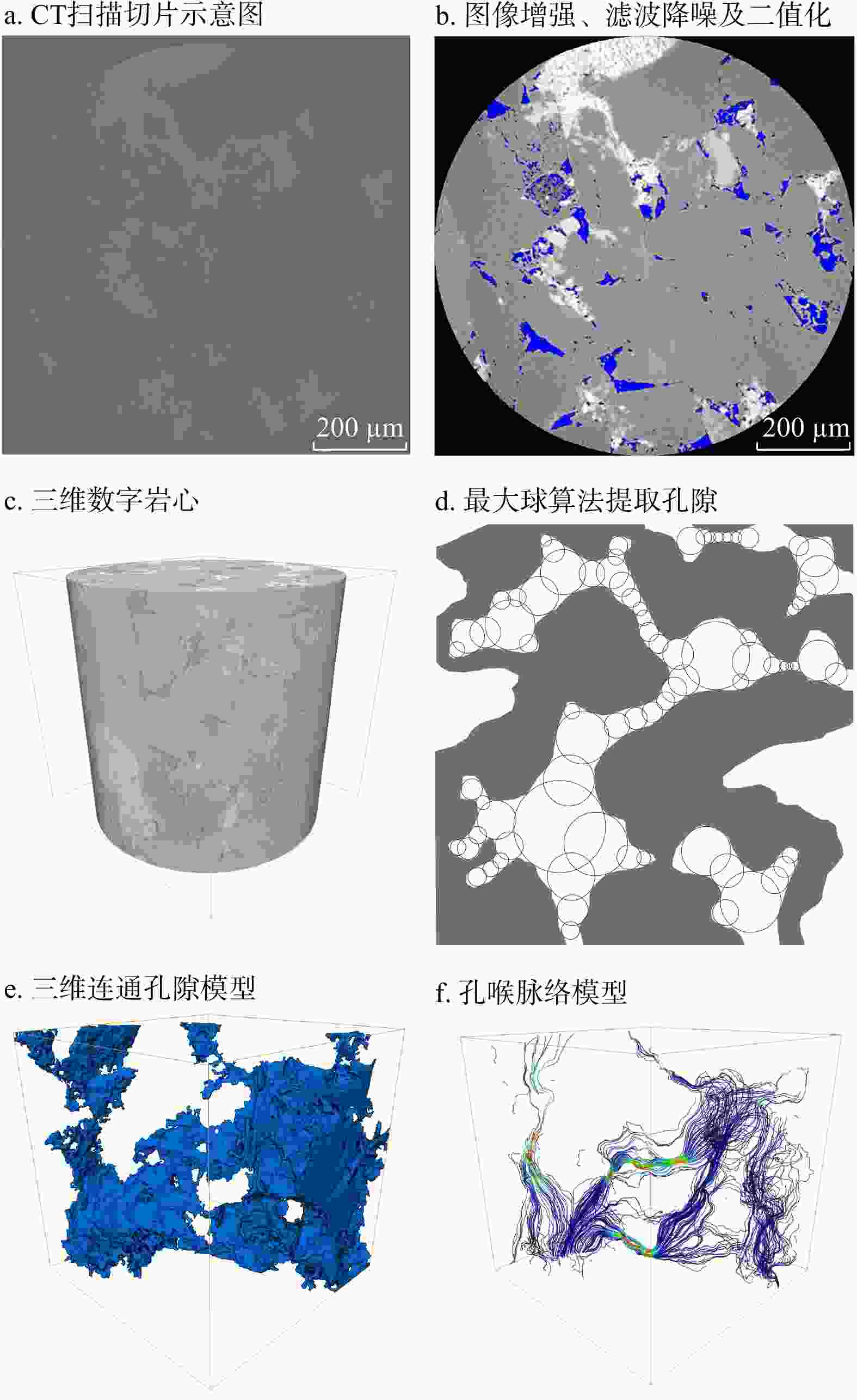
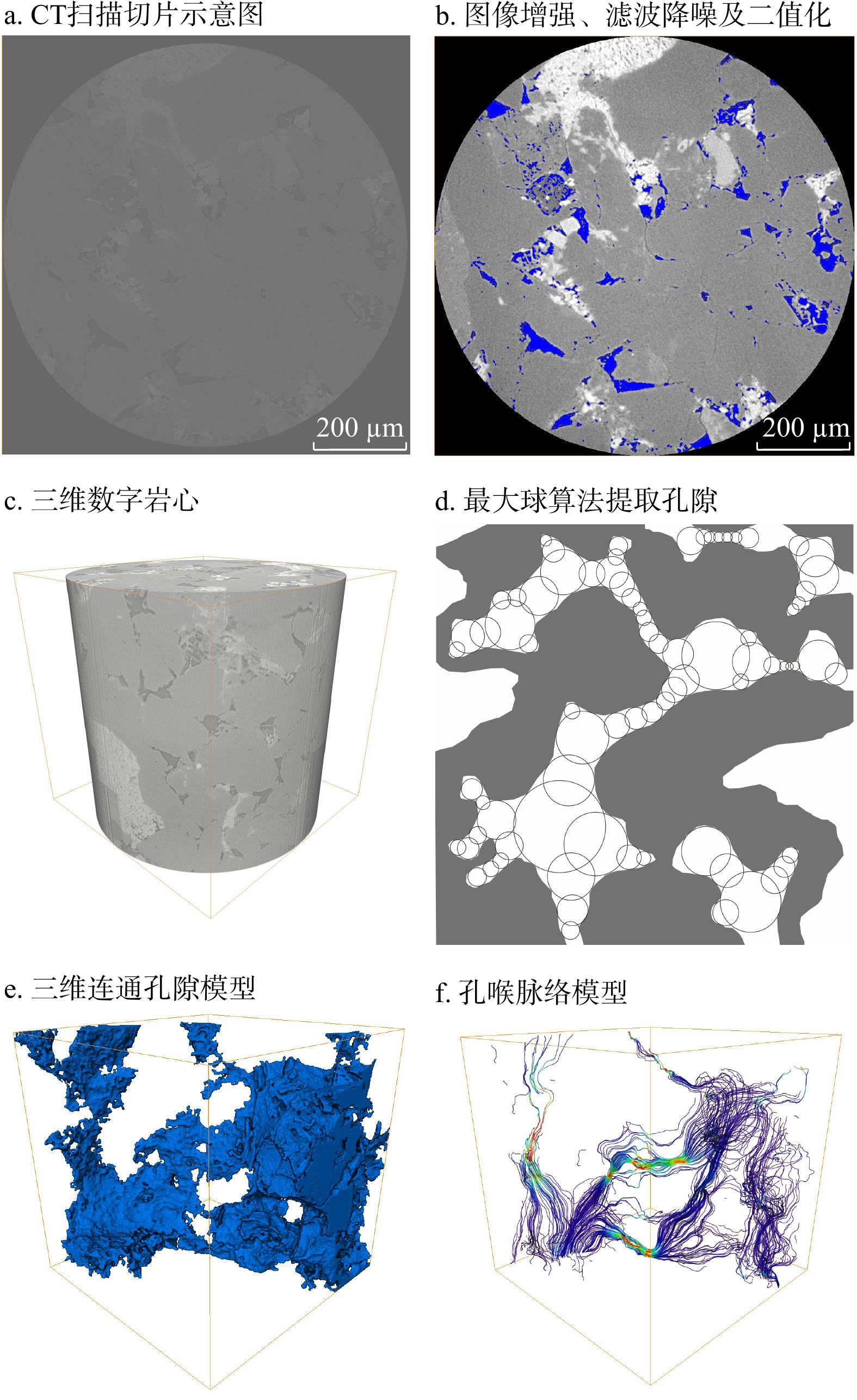
图 1 CT 切片预处理、三维数字岩心重构、最大球算法提取及孔喉网络模型
图b 中蓝色区域为阈值分割提取的孔隙;图 e 中蓝色代表重建填充后的孔隙空间;图 f 内曲线为流体优势渗流通道,其中蓝色为孔隙,黄、红色分别对应不同尺寸喉道
Figure 1. CT slice preprocessing, 3D digital core reconstruction, extraction via maximal ball algorithm, and pore-throat network model
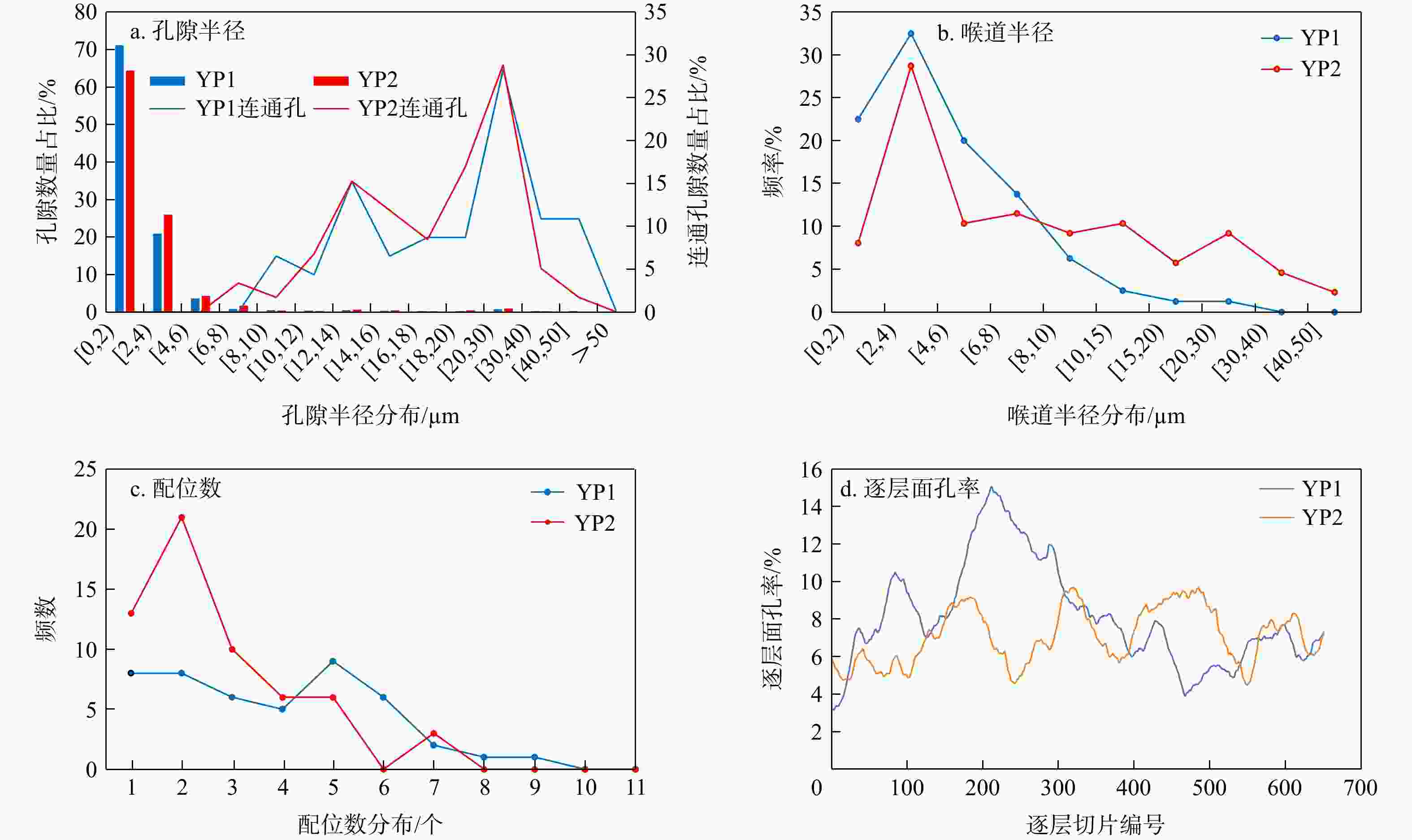
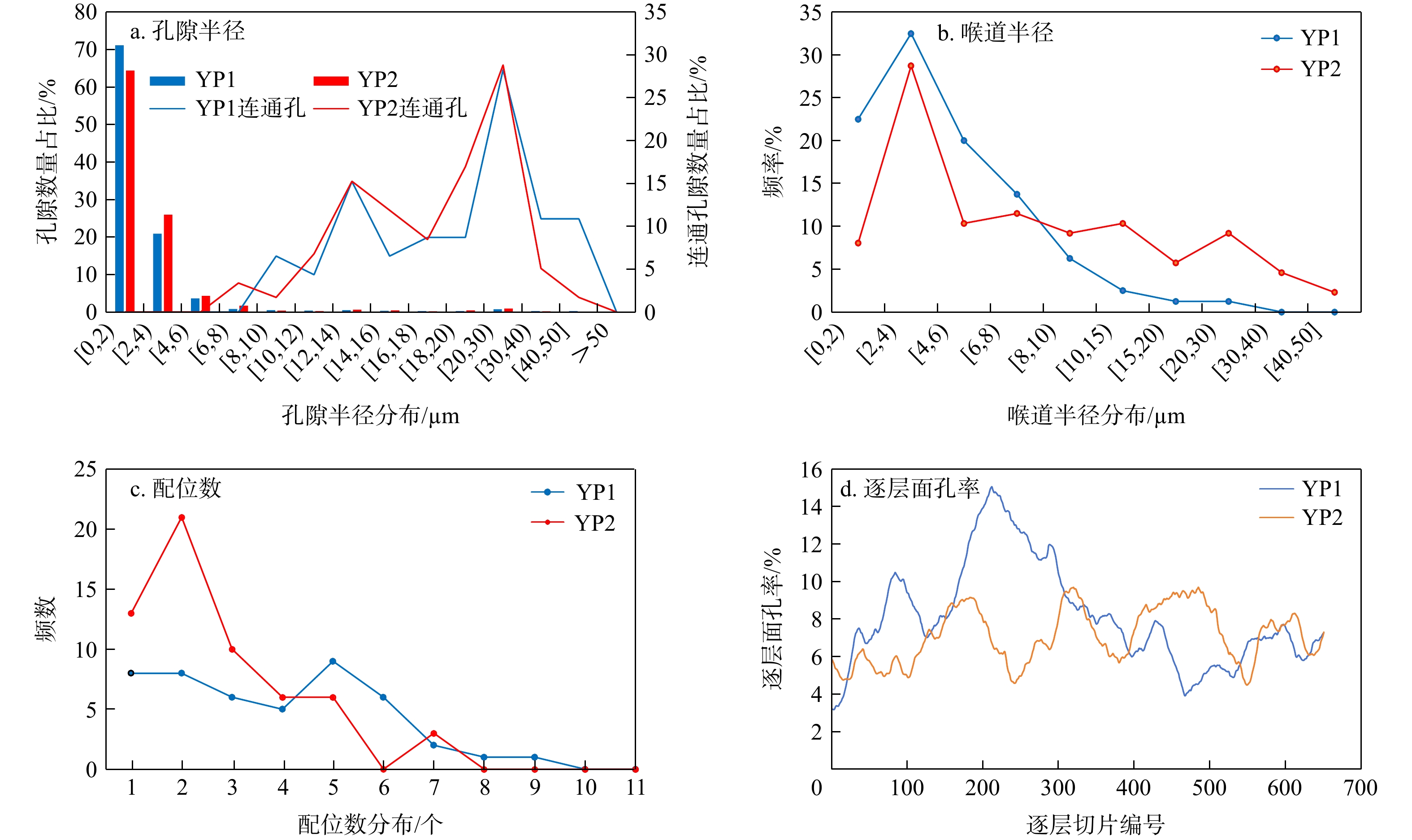
图 2 YP1、YP2 样品孔喉结构参数分布直方图
Figure 2. Histograms of pore-throat structural parameters for samples YP1 and YP2
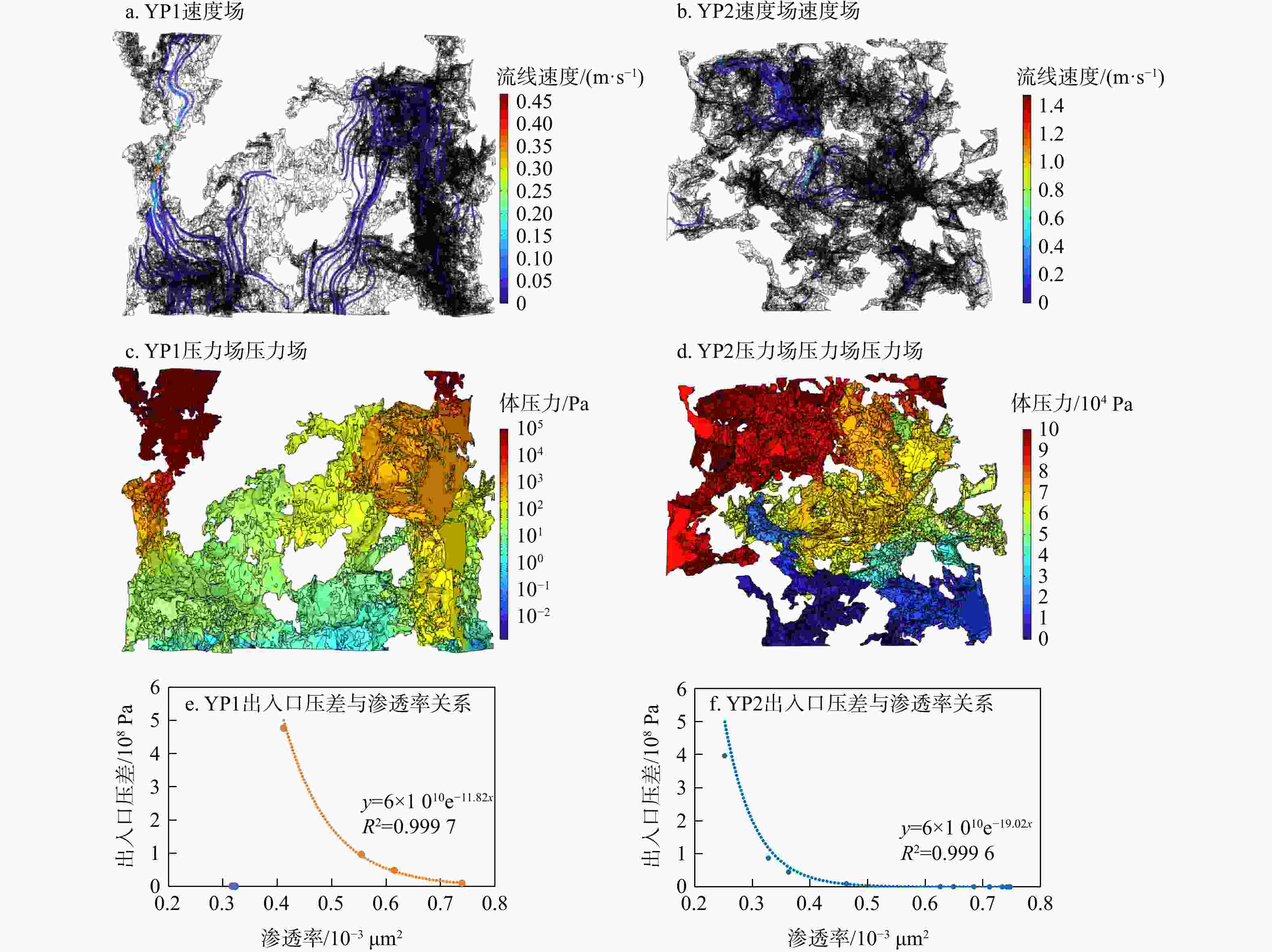
图 3 初始压力0.1 MPa 下单相渗流速度场(a, b)、压力场(c, d)及出入口压差−绝对渗透率拟合曲线(e, f)
Figure 3. Single-phase seepage velocity field (a, b), pressure field (c, d), and differential pressure between inlet and outlet-absolute permeability fitting curves (e, f) under an initial driving pressure of 0.1 MPa
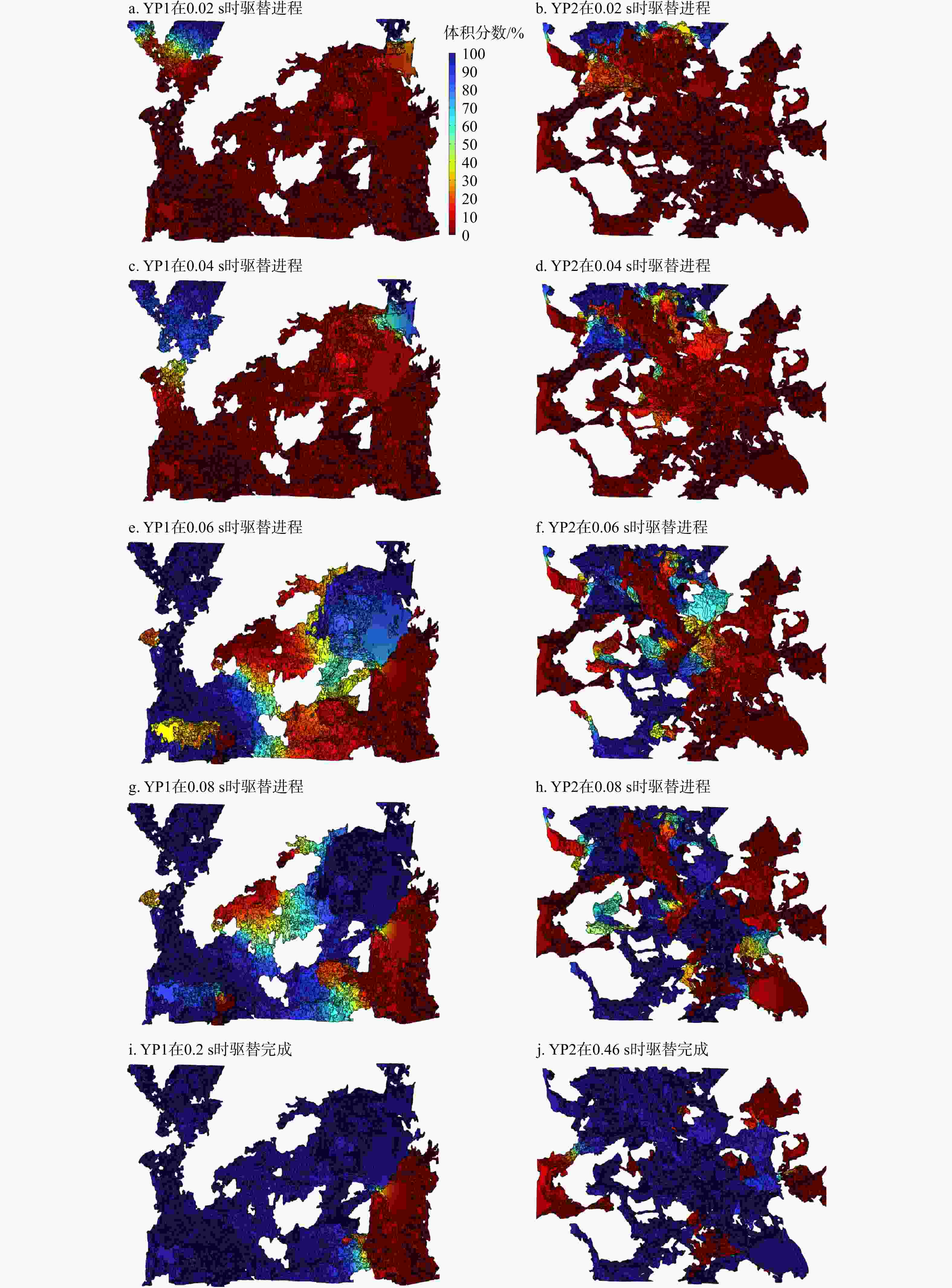
图 4 驱替压力5 MPa 下 YP1、YP2 样品水驱油饱和度演化时序图
模型上、下边界分别为驱替入口与出口,红色表征油相,蓝色表征水相,下同
Figure 4. Temporal evolution of oil and water saturation in samples YP1 and YP2 under a driving pressure of 5 MPa
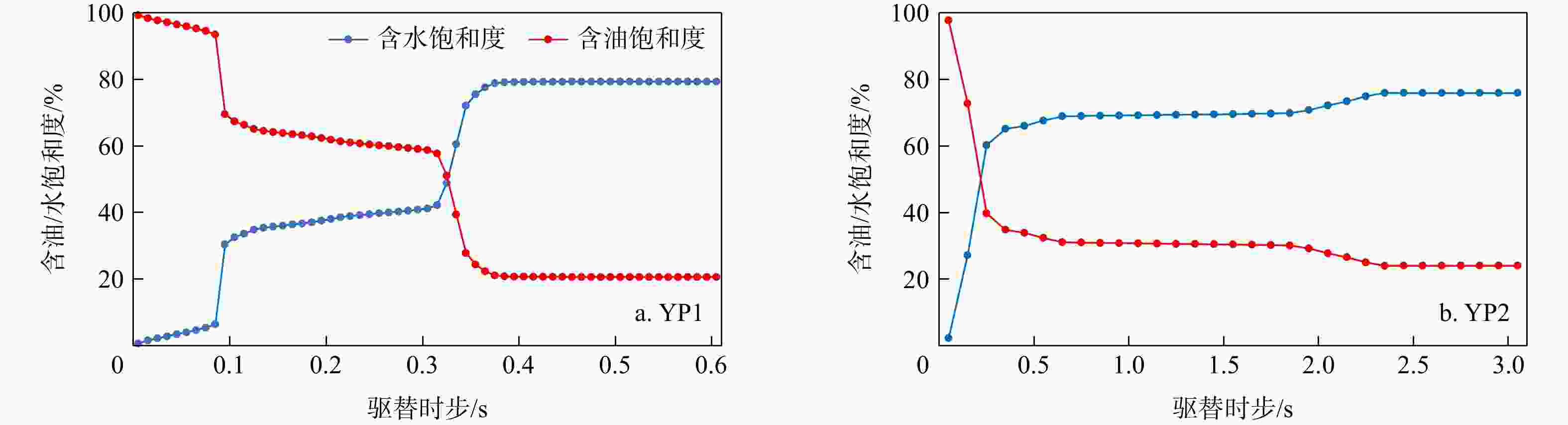
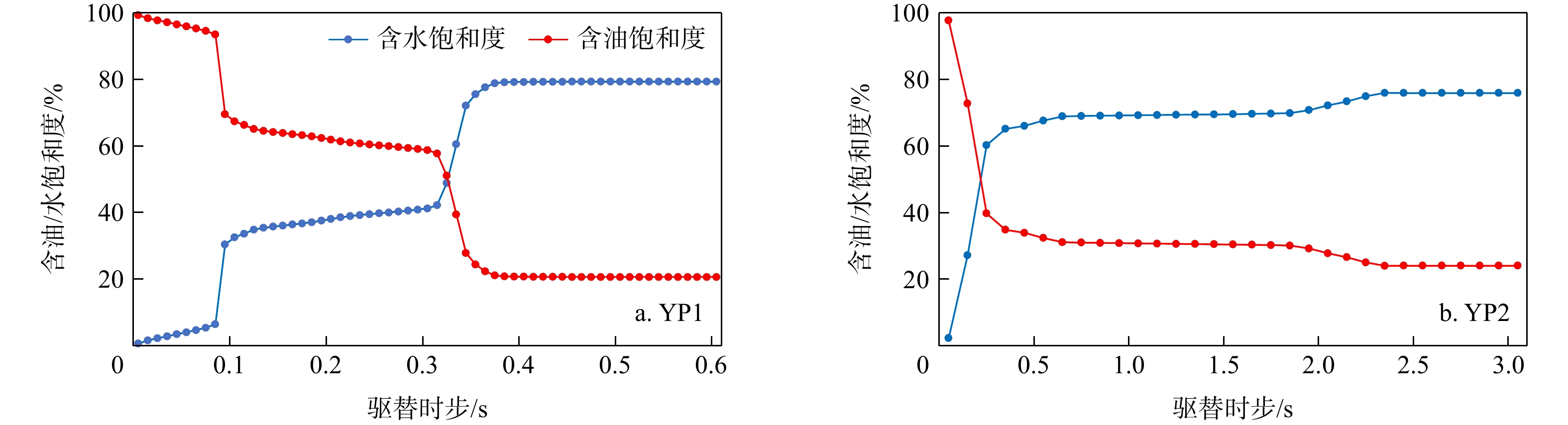
图 5 YP1、YP2 样品驱替过程含油(水)饱和度随时步变化曲线
Figure 5. Variation curves of oil and water saturation with time step during displacement in samples YP1 and YP2
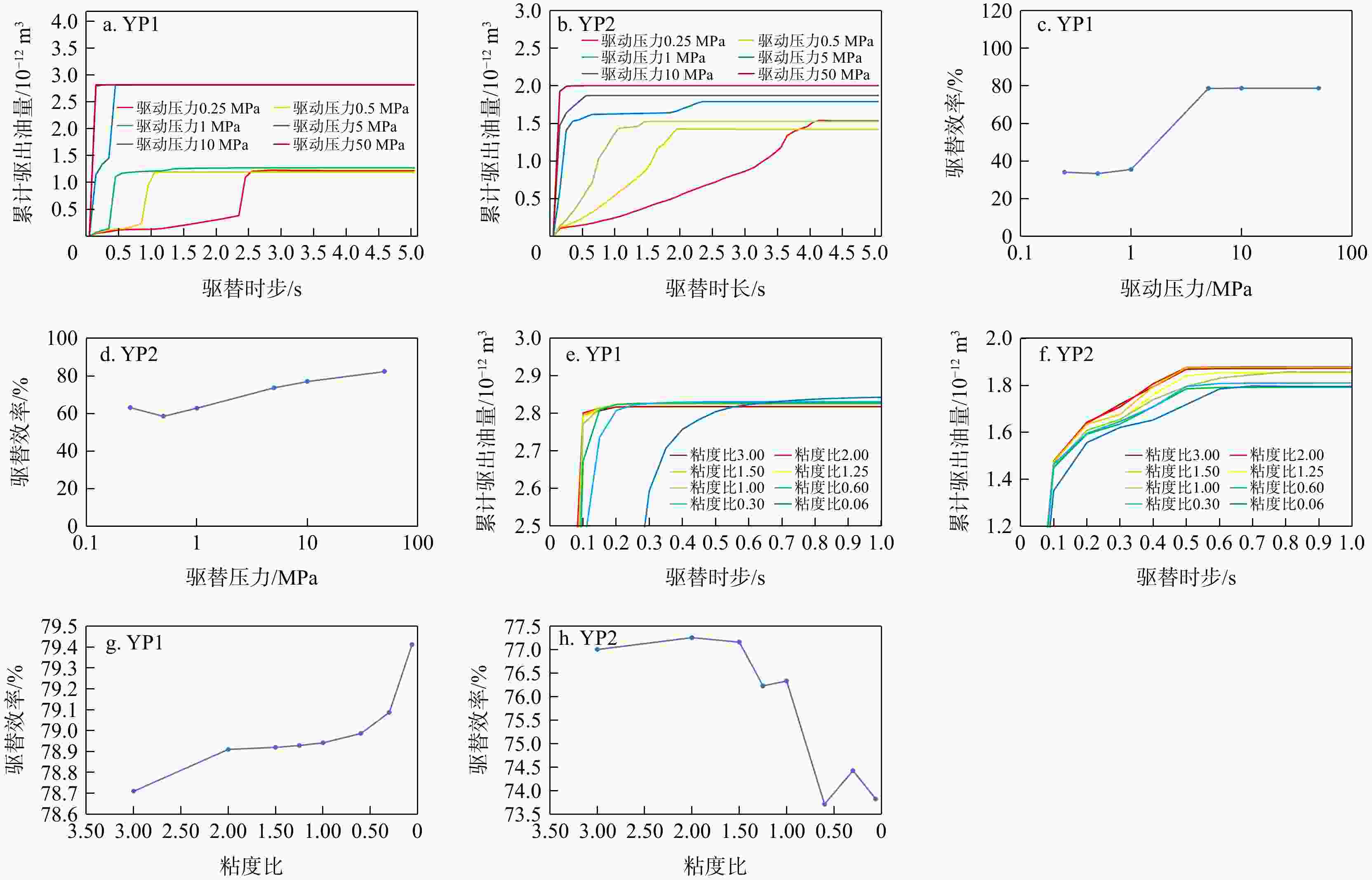
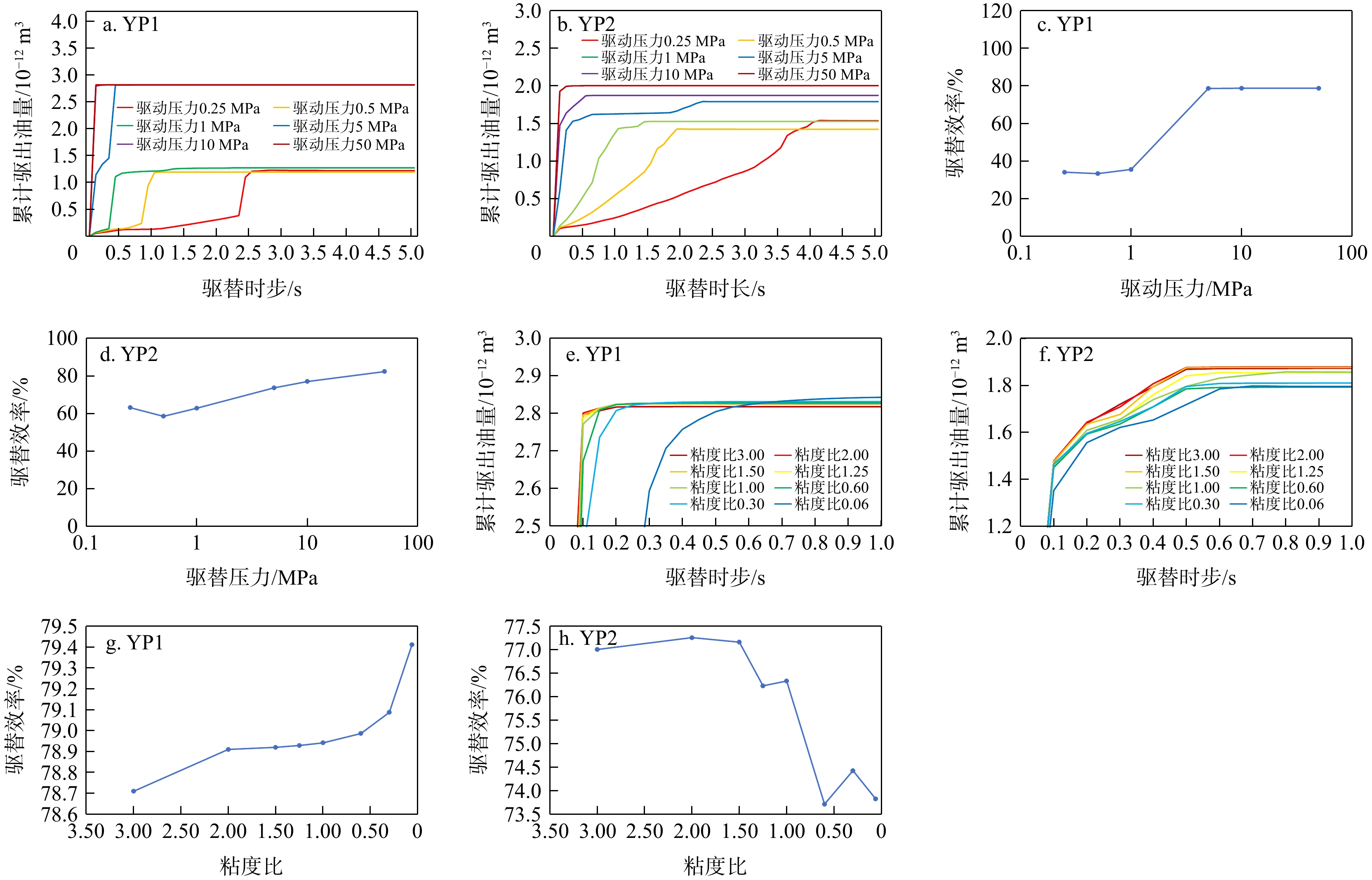
图 6 不同驱替压力(a~d)和黏度比(e~h)下累计驱出油量和驱替效率
Figure 6. Cumulative oil displacement and displacement efficiency under different driving pressures (a-d) and viscosity ratios (e-h)
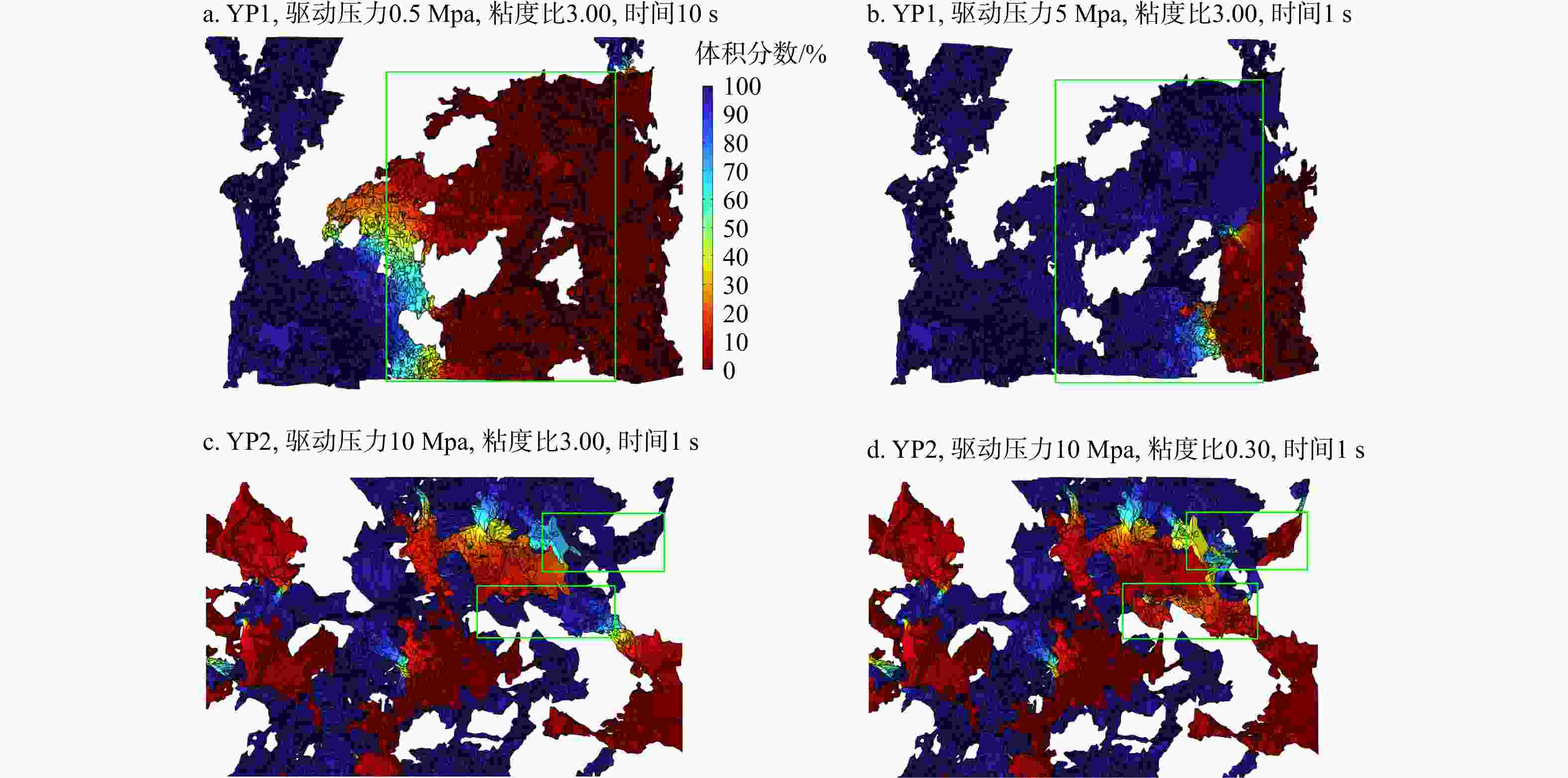
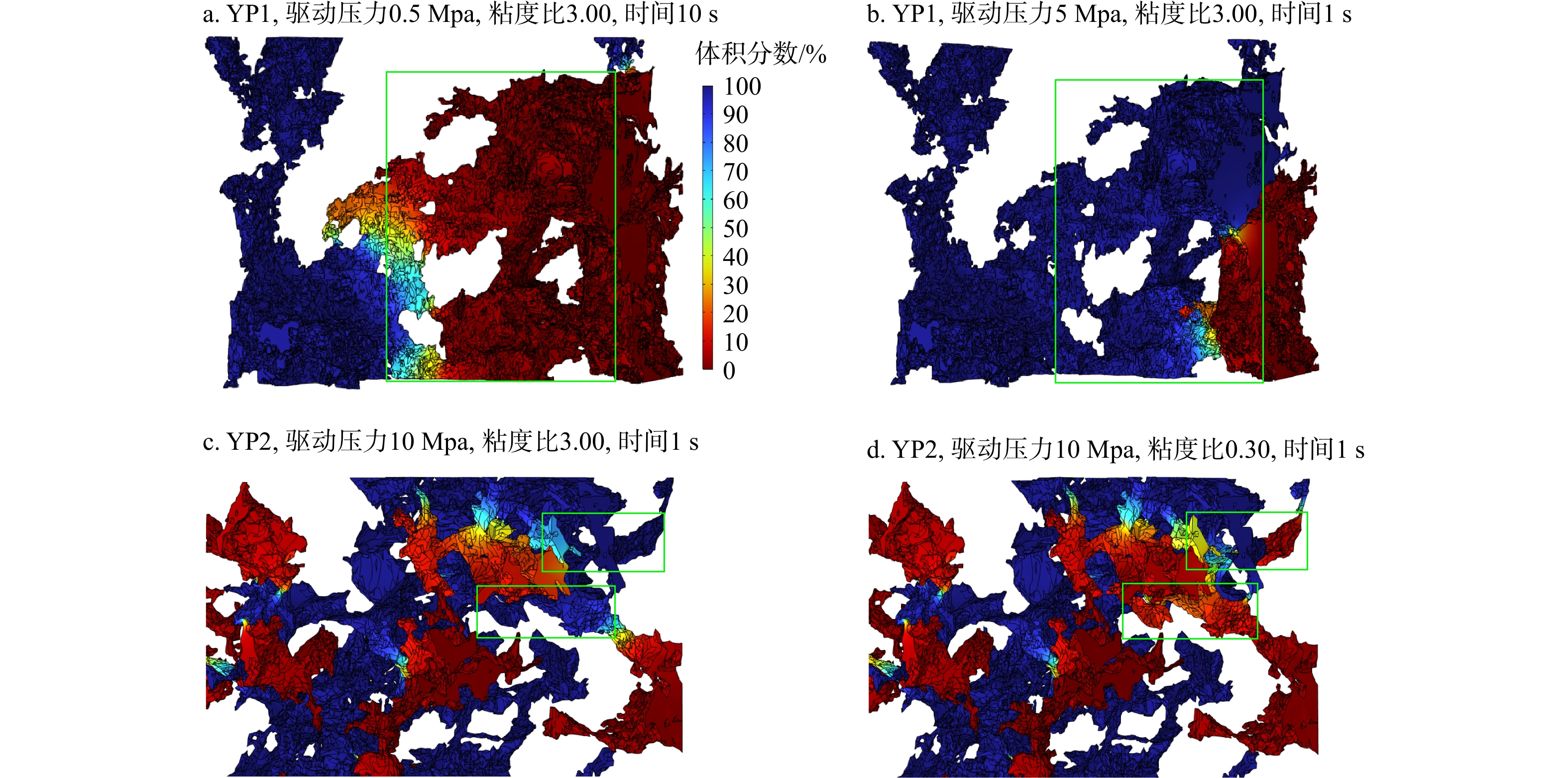
图 7 不同驱替压力和黏度比下驱替结果对比
绿色线框用于圈定典型区域,直观突出不同模拟压力、黏度比下油水分布与驱替效果的差异;图c,d为模型局部放大
Figure 7. Comparison of displacement results under different driving pressures and viscosity ratios
表 1 样品孔喉结构参数及对比
Table 1. Pore-throat structural parameters and comparison of samples
样品编号 孔隙 喉道 非均质性 孤立孔隙
数量占比/%连通孔隙
体积占比/%连通孔隙半径/μm
(主流外高占比/%)数量连通率/% 体积连通率/% 孔喉半径/μm(主流
外高占比/%)迂曲度 逐层面孔率
标准差YP1 97.60 85.64 >18(54) 2.40 91.78 <8(83) 2.62 0.028 YP2 97.43 72.67 <18(58) 2.57 76.23 >8(58) 1.58 0.015 对比 YP1>YP2 YP1<YP2 YP1<YP2  下载: 导出CSV
表 2 不同出入口压差下渗流模拟绝对渗透率
Table 2. Absolute permeability obtained from seepage simulations under different inlet-outlet pressure differences
样品编号 驱替压
力/MPa体积流量
Q/(m3·s−1)流动横截
面积A/m2入口压力
p1/Pa出口压力
p2/Pa绝对渗透率
K/10−3 μm2YP1 0.1 2.52×10⁻¹¹ 2.81×10⁻⁹ 9.81×10⁴ 3.34 0.32 0.25 6.28×10⁻¹¹ 2.81×10⁻⁹ 2.45×10⁵ 8.39 0.32 0.5 1.25×10⁻¹⁰ 2.81×10⁻⁹ 4.91×10⁵ 1.20×10 0.32 0.8 1.99×10⁻¹⁰ 2.81×10⁻⁹ 7.85×10⁵ 2.72×10 0.32 1 2.47×10⁻¹⁰ 2.81×10⁻⁹ 9.81×10⁵ 3.43×10 0.32 10 2.17×10⁻⁹ 2.81×10⁻⁹ 9.76×10⁶ 4.23×10² 0.74 50 8.95×10⁻⁹ 2.81×10⁻⁹ 4.84×10⁷ 4.19×10³ 0.62 100 1.61×10⁻⁸ 2.81×10⁻⁹ 9.63×10⁷ 1.30×10⁴ 0.55 500 5.90×10⁻⁸ 2.81×10⁻⁹ 4.76×10⁸ 1.79×10⁵ 0.41 YP2 0.001 9.11×10⁻¹³ 4.40×10⁻⁹ 9.87×10² 7.45 0.75 0.025 2.27×10⁻¹¹ 4.40×10⁻⁹ 2.47×10⁴ 1.90×10² 0.74 0.05 4.52×10⁻¹¹ 4.40×10⁻⁹ 4.94×10⁴ 3.85×10² 0.74 0.1 8.94×10⁻¹¹ 4.40×10⁻⁹ 9.87×10⁴ 7.93×10² 0.73 0.25 2.17×10⁻¹⁰ 4.40×10⁻⁹ 2.47×10⁵ 2.13×10³ 0.71 0.5 4.16×10⁻¹⁰ 4.40×10⁻⁹ 4.93×10⁵ 4.73×10³ 0.68 0.8 6.29×10⁻¹⁰ 4.40×10⁻⁹ 7.88×10⁵ 8.44×10³ 0.65 1 7.58×10⁻¹⁰ 4.40×10⁻⁹ 9.84×10⁵ 1.12×10⁴ 0.63 10 5.44×10⁻⁹ 4.40×10⁻⁹ 9.71×10⁶ 2.76×10⁵ 0.46 50 2.03×10⁻⁸ 4.40×10⁻⁹ 4.77×10⁷ 2.71×10⁶ 0.36 100 3.57×10⁻⁸ 4.40×10⁻⁹ 9.45×10⁷ 7.14×10⁶ 0.33 500 1.24×10⁻⁷ 4.40×10⁻⁹ 4.60×10⁸ 6.37×10⁷ 0.25
下载: 导出CSV
-
[1] 贾承造, 郑民, 张永峰. 中国非常规油气资源与勘探开发前景[J]. 石油勘探与开发, 2012, 39(2): 129-136.JIA C Z, ZHENG M, ZHANG Y F. Unconventional hydrocarbon resources in China and the prospect of exploration and development[J]. Petroleum Exploration and Development, 2012, 39(2): 129-136. (in Chinese with English abstract) [2] 贾承造, 邹才能, 李建忠, 等. 中国致密油评价标准、主要类型、基本特征及资源前景[J]. 石油学报, 2012, 33(3): 343-350.JIA C Z, ZOU C N, LI J Z, et al. Assessment criteria, main types, basic features and resource prospects of the tight oil in China[J]. Acta Petrolei Sinica, 2012, 33(3): 343-350. (in Chinese with English abstract) [3] 邹才能, 朱如凯, 吴松涛, 等. 常规与非常规油气聚集类型、特征、机理及展望: 以中国致密油和致密气为例[J]. 石油学报, 2012, 33(2): 173-187.ZOU C N, ZHU R K, WU S T, et al. Types, characteristics, genesis and prospects of conventional and unconventional hydrocarbon accumulations: Taking tight oil and tight gas in China as an instance[J]. Acta Petrolei Sinica, 2012, 33(2): 173-187. (in Chinese with English abstract) [4] 赵继勇, 刘振旺, 谢启超, 等. 鄂尔多斯盆地姬塬油田长7致密油储层微观孔喉结构分类特征[J]. 中国石油勘探, 2014, 19(5): 73-79. doi: 10.3969/j.issn.1672-7703.2014.05.008ZHAO J Y, LIU Z W, XIE Q C, et al. Micro pore throat structural classifi cation of Chang 7 tight oil reservoir of Jiyuan oilfield in Ordos Basin[J]. China Petroleum Exploration, 2014, 19(5): 73-79. (in Chinese with English abstract) doi: 10.3969/j.issn.1672-7703.2014.05.008 [5] 任晓霞, 李爱芬, 王永政, 等. 致密砂岩储层孔隙结构及其对渗流的影响: 以鄂尔多斯盆地马岭油田长8储层为例[J]. 石油与天然气地质, 2015, 36(5): 774-779. doi: 10.11743/ogg20150508REN X X, LI A F, WANG Y Z, et al. Pore structure of tight sand reservoir and its influence on percolation: Taking the Chang 8 reservoir in Maling oilfield in Ordos Basin as an example[J]. Oil & Gas Geology, 2015, 36(5): 774-779. (in Chinese with English abstract) doi: 10.11743/ogg20150508 [6] 刘晓鹏, 刘燕, 陈娟萍, 等. 鄂尔多斯盆地盒8段致密砂岩气藏微观孔隙结构及渗流特征[J]. 天然气地球科学, 2016, 27(7): 1225-1234. doi: 10.11764/j.issn.1672-1926.2016.07.1225LIU X P, LIU Y, CHEN J P, et al. Characteristics of micro pore structure and seepage in tight sandstone gas reservoir of the 8th section of Shihezi Formation in Ordos Basin, China[J]. Natural Gas Geoscience, 2016, 27(7): 1225-1234. (in Chinese with English abstract) doi: 10.11764/j.issn.1672-1926.2016.07.1225 [7] 屈乐, 孙卫, 杜环虹, 等. 基于CT扫描的三维数字岩心孔隙结构表征方法及应用: 以莫北油田116井区三工河组为例[J]. 现代地质, 2014, 28(1): 190-196. doi: 10.3969/j.issn.1000-8527.2014.01.020QU L, SUN W, DU H H, et al. Characterization technique of pore structure by 3D digital core based on CT scanning and its application: An example from Sangonghe Formation of 116 well field in Mobei oilfield[J]. Geoscience, 2014, 28(1): 190-196. (in Chinese with English abstract) doi: 10.3969/j.issn.1000-8527.2014.01.020 [8] ZHANG Y X, YANG S L, ZHANG Z, et al. Multiscale pore structure characterization of an ultra-deep carbonate gas reservoir[J]. Journal of Petroleum Science and Engineering, 2022, 208: 109751. doi: 10.1016/j.petrol.2021.109751 [9] 李文涛, 涂利辉, 鲁明宇, 等. 基于数字岩心的碳酸盐岩复杂孔隙特征研究: 以普光气田飞仙关组储层为例[J]. 断块油气田, 2024, 31(1): 114-122. doi: 10.6056/dkyqt202401014LI W T, TU L H, LU M Y, et al. Study on complex pore characteristics of carbonate reservoirs based on digital core: A case study of Feixianguan Formation in Puguang gas field[J]. Fault-Block Oil and Gas Field, 2024, 31(1): 114-122. (in Chinese with English abstract) doi: 10.6056/dkyqt202401014 [10] 杨沛, 胡望水, 崔莺莺, 等. 基于多尺度CT扫描的长岭凹陷青一段储层特征及渗流机理[J]. 断块油气田, 2025, 32(2): 211-220. doi: 10.6056/dkyqt202503005YANG P, HU W S, CUI Y Y, et al. Reservoir characteristics and seepage mechanism of Qing 1 Member in Changling Sag based on CT scanning[J]. Fault-Block Oil & Gas Field, 2025, 32(2): 211-220. (in Chinese with English abstract) doi: 10.6056/dkyqt202503005 [11] 姚军, 赵秀才, 衣艳静, 等. 数字岩心技术现状及展望[J]. 油气地质与采收率, 2005, 12(6): 52-54. doi: 10.3969/j.issn.1009-9603.2005.06.017YAO J, ZHAO X C, YI Y J, et al. The current situation and prospect on digital core technology[J]. Oil & Gas Recovery Technology, 2005, 12(6): 52-54. (in Chinese with English abstract) doi: 10.3969/j.issn.1009-9603.2005.06.017 [12] 刘学锋, 张伟伟, 孙建孟. 三维数字岩心建模方法综述[J]. 地球物理学进展, 2013, 28(6): 3066-3072. doi: 10.6038/pg20130630LIU X F, ZHANG W W, SUN J M. Methods of constructing 3D digital cores: A review[J]. Progress in Geophysics, 2013, 28(6): 3066-3072. (in Chinese with English abstract) doi: 10.6038/pg20130630 [13] ESHGHINEJADFARD A, DARÓCZY L, JANIGA G, et al. Calculation of the permeability in porous media using the lattice Boltzmann method[J]. International Journal of Heat and Fluid Flow, 2016, 62: 93-103. doi: 10.1016/j.ijheatfluidflow.2016.05.010 [14] BULTREYS T, DE BOEVER W, CNUDDE V. Imaging and image-based fluid transport modeling at the pore scale in geological materials: A practical introduction to the current state-of-the-art[J]. Earth-Science Reviews, 2016, 155: 93-128. doi: 10.1016/j.earscirev.2016.02.001 [15] 林承焰, 王杨, 杨山, 等. 基于CT的数字岩心三维建模[J]. 吉林大学学报(地球科学版), 2018, 48(1): 307-317. doi: 10.13278/j.cnki.jjuese.20160305LIN C Y, WANG Y, YANG S, et al. 3D modeling of digital core based on X-ray computed tomography[J]. Journal of Jilin University (Earth Science Edition), 2018, 48(1): 307-317. (in Chinese with English abstract) doi: 10.13278/j.cnki.jjuese.20160305 [16] 林承焰, 吴玉其, 任丽华, 等. 数字岩心建模方法研究现状及展望[J]. 地球物理学进展, 2018, 33(2): 679-689. doi: 10.6038/pg2018BB0335LIN C Y, WU Y Q, REN L H, et al. Review of digital core modeling methods[J]. Progress in Geophysics, 2018, 33(2): 679-689. (in Chinese with English abstract) doi: 10.6038/pg2018BB0335 [17] 赵建鹏, 陈惠, 李宁, 等. 三维数字岩心技术岩石物理应用研究进展[J]. 地球物理学进展, 2020, 35(3): 1099-1108. doi: 10.6038/pg2020DD0486ZHAO J P, CHEN H, LI N, et al. Research advance of petrophysical application based on digital core technology[J]. Progress in Geophysics, 2020, 35(3): 1099-1108. (in Chinese with English abstract) doi: 10.6038/pg2020DD0486 [18] 孙建孟, 孙晓娟, 迟蓬, 等. 数字岩心和数字井筒技术研究与应用进展[J]. 石油物探, 2023, 62(5): 806-819. doi: 10.12431/issn.1000-1441.2023.62.05.002SUN J M, SUN X J, CHI P, et al. Digital cores and digital wellbore technology: Application and research progress[J]. Geophysical Prospecting for Petroleum, 2023, 62(5): 806-819. (in Chinese with English abstract) doi: 10.12431/issn.1000-1441.2023.62.05.002 [19] BABAMAHMOUDI S, SAEEDI DEHAGHANI A H, HOSSEINI MOGHADAM A. Absolute permeability assessment of porous structures under different boundary conditions using lattice Boltzmann method[J]. Geoenergy Science and Engineering, 2023, 221: 211357. [20] LIU Q, SUN M D, SUN X D, et al. Pore network characterization of shale reservoirs through state-of-the-art X-ray computed tomography: A review[J]. Gas Science and Engineering, 2023, 113: 204967. [21] BERA B, MITRA S K, VICK D. Understanding the micro structure of Berea sandstone by the simultaneous use of micro-computed tomography (micro-CT) and focused ion beam-scanning electron microscopy (FIB-SEM)[J]. Micron, 2011, 42(5): 412-418. [22] RYAZANOV A V, SORBIE K S, VAN DIJKE M I J. Structure of residual oil as a function of wettability using pore-network modelling[J]. Advances in Water Resources, 2014, 63: 11-21. [23] 刘向君, 朱洪林, 梁利喜. 基于微CT技术的砂岩数字岩石物理实验[J]. 地球物理学报, 2014, 57(4): 1133-1140.LIU X J, ZHU H L, LIANG L X. Digital rock physics of sandstone based on micro-CT technology[J]. Chinese Journal of Geophysics, 2014, 57(4): 1133-1140. (in Chinese with English abstract) [24] 韩文学, 高长海, 韩霞. 核磁共振及微、纳米CT技术在致密储层研究中的应用: 以鄂尔多斯盆地长7段为例[J]. 断块油气田, 2015, 22(1): 62-66.HAN W X, GAO C H, HAN X. Application of NMR and micrometer and nanometer CT technology in research of tight reservoir: Taking Chang 7 Member in Ordos Basin as an example[J]. Fault-Block Oil & Gas Field, 2015, 22(1): 62-66. (in Chinese with English abstract) [25] 刘向君, 熊健, 梁利喜, 等. 基于微CT技术的致密砂岩孔隙结构特征及其对流体流动的影响[J]. 地球物理学进展, 2017, 32(3): 1019-1028.LIU X J, XIONG J, LIANG L X, et al. Study on the characteristics of pore structure of tight sand based on micro-CT scanning and its influence on fluid flow[J]. Progress in Geophysics, 2017, 32(3): 1019-1028. (in Chinese with English abstract) [26] 刘洋, 王春生, 孙启冀, 等. 低渗砂岩储层数字岩心构建及渗流模拟[J]. 断块油气田, 2017, 24(6): 817-821.LIU Y, WANG C S, SUN Q J, et al. Digital core construction and seepage simulation of low permeability sandstone reservoir[J]. Fault-Block Oil & Gas Field, 2017, 24(6): 817-821. (in Chinese with English abstract) [27] 杨峰, 王昊, 黄波, 等. 基于CT扫描的致密砂岩渗流特征及应力敏感性研究[J]. 地质力学学报, 2019, 25(4): 475-482.YANG F, WANG H, HUANG B, et al. Study on the stress sensitivity and seepage characteristics of tight sandstone based on CT scanning[J]. Journal of Geomechanics, 2019, 25(4): 475-482. (in Chinese with English abstract) [28] HASNAN H K, SHEPPARD A, AMIR HASSAN M H, et al. Digital core analysis: Improved connectivity and permeability characterization of thin sandstone layers in heterolithic rocks[J]. Marine and Petroleum Geology, 2020, 120: 104549. [29] HAN G, HAN W S, KIM K Y, et al. Characterizing locality- and scale-dependent heterogeneity in conglomerate core and associated fluid flow using X-ray CT imaging[J]. Journal of Hydrology, 2021, 602: 126736. [30] XIE L L, YOU Q, WANG E Z, et al. Quantitative characterization of pore size and structural features in ultra-low permeability reservoirs based on X-ray computed tomography[J]. Journal of Petroleum Science and Engineering, 2022, 208: 109733. [31] LI J, WANG H S, WU Z P, et al. Mesoscale migration of oil in tight sandstone reservoirs by multi-field coupled two-phase flow[J]. Marine and Petroleum Geology, 2024, 161: 106684. [32] XIE Y T, LI J, LIU H M, et al. Study on hydro-mechanical-damage coupling seepage in digital shale cores: A case study of shale in Bohai Bay Basin[J]. Energy, 2023, 268(C): 126759. [33] SHUKLA A, SAHOO S, SARKAR P. Assessment of micro-structure and flow entrapment in Indian Gondwana shale reservoir using digital rock analysis[J]. Marine and Petroleum Geology, 2024, 169: 107066. [34] 李春玉, 谢渊, 刘绍光, 等. 陕北富县延长组特低孔渗砂岩储层控制因素分析[J]. 成都理工学院学报, 2002, 29(3): 285-289.LI C Y, XIE Y, LIU S G, et al. Factors controlling the very low-porosity and-permeability sandstone reservoir of the Yanchang Formation in Fuxian area, North Shaanxi[J]. Journal of Chengdu University of Technology, 2002, 29(3): 285-289. (in Chinese with English abstract) [35] 郭艳琴, 惠磊, 张秀能, 等. 鄂尔多斯盆地三叠系延长组沉积体系特征及湖盆演化[J]. 西北大学学报(自然科学版), 2018, 48(4): 593-602.GUO Y Q, HUI L, ZHANG X N, et al. Sedimentary system characteristics and lake basin evolution of Triassic Yanchang Formation in Ordos Basin[J]. Journal of Northwest University (Natural Science Edition), 2018, 48(4): 593-602. (in Chinese with English abstract) [36] 郭艳琴. 富县探区延长组储层微观特征研究[D]. 西安: 西北大学, 2006.GUO Y Q. Research on reservoir micro-characteristic of Yanchang Formation in Fuxian exploration area of the Ordos Basin[D]. Xi'an: Northwest University, 2006. (in Chinese with English abstract) [37] 黄龙, 田景春, 肖玲, 等. 鄂尔多斯盆地富县地区长6砂岩储层特征及评价[J]. 岩性油气藏, 2008, 20(1): 83-88.HUANG L, TIAN J C, XIAO L, et al. Characteristics and evaluation of Chang 6 sandstone reservoir of Upper Triassic in Fuxian area, Ordos Basin[J]. Lithologic Reservoirs, 2008, 20(1): 83-88. (in Chinese with English abstract) [38] 谢正温, 谢渊, 王剑, 等. 鄂尔多斯盆地富县地区延长组主要油层组储层特征[J]. 石油实验地质, 2005, 27(6): 575-582.XIE Z W, XIE Y, WANG J, et al. The reservoir characteristics of Yanchang Formation in Fuxian region, Ordos Basin[J]. Petroleum Geology & Experiment, 2005, 27(6): 575-582. (in Chinese with English abstract) [39] 刘化清, 李相博, 完颜容, 等. 鄂尔多斯盆地长8油层组古地理环境与沉积特征[J]. 沉积学报, 2011, 29(6): 1086-1095.LIU H Q, LI X B, WANYAN R, et al. Palaeogeographic and sedimentological characteristics of the Triassic Chang 8, Ordos Basin, China[J]. Acta Sedimentologica Sinica, 2011, 29(6): 1086-1095. (in Chinese with English abstract) [40] 陈飞, 胡光义, 孙立春, 等. 鄂尔多斯盆地南部上三叠统延长组层序地层格架内沉积相特征与演化[J]. 古地理学报, 2012, 14(3): 321-330.CHEN F, HU G Y, SUN L C, et al. Characteristics of sedimentary facies and evolution in sequence stratigraphic framework of the Upper Triassic Yanchang Formation in southern Ordos Basin[J]. Journal of Palaeogeography, 2012, 14(3): 321-330. (in Chinese with English abstract) [41] 徐永强, 何永宏, 卜广平, 等. 基于微观孔喉结构及渗流特征建立致密储层分类评价标准: 以鄂尔多斯盆地陇东地区长7储层为例[J]. 石油实验地质, 2019, 41(3): 451-460.XU Y Q, HE Y H, BU G P, et al. Establishment of classification and evaluation criteria for tight reservoirs based on characteristics of microscopic pore throat structure and percolation: A case study of Chang 7 reservoir in Longdong area, Ordos Basin[J]. Petroleum Geology & Experiment, 2019, 41(3): 451-460. (in Chinese with English abstract) [42] AN S Y, YAO J, YANG Y F, et al. Influence of pore structure parameters on flow characteristics based on a digital rock and the pore network model[J]. Journal of Natural Gas Science and Engineering, 2016, 31: 156-163. [43] 刘惠民, 王学军, 杜振京, 等. 准中4区块致密砂岩孔隙结构特征研究[J]. 地质力学学报, 2020, 26(1): 96-105.LIU H M, WANG X J, DU Z J, et al. Study on pore structure characteristics of tight sandstone in Block 4 of the central Junggar Basin[J]. Journal of Geomechanics, 2020, 26(1): 96-105. (in Chinese with English abstract) [44] MAHROUS M, CURTI E, CHURAKOV S V, et al. Petrophysical initialization of core-scale reactive transport simulations on Indiana limestones: Pore-scale characterization, spatial autocorrelations, and representative elementary volume analysis[J]. Journal of Petroleum Science and Engineering, 2022, 213: 110389. [45] 白斌, 朱如凯, 吴松涛, 等. 利用多尺度CT成像表征致密砂岩微观孔喉结构[J]. 石油勘探与开发, 2013, 40(3): 329-333.BAI B, ZHU R K, WU S T, et al. Multi-scale method of Nano(Micro)-CT study on microscopic pore structure of tight sandstone of Yanchang Formation, Ordos Basin[J]. Petroleum Exploration and Development, 2013, 40(3): 329-333. (in Chinese with English abstract) [46] 胡心玲, 雷浩. 基于CT扫描技术的低渗油藏水敏效应后微观孔隙结构特征[J]. 地质科技通报, 2023, 42(2): 178-185.HU X L, LEI H. Using CT scanning technology to investigate microscopic pore structure characteristics of low-permeability reservoir rocks after water sensitivity experiments[J]. Bulletin of Geological Science and Technology, 2023, 42(2): 178-185. (in Chinese with English abstract) [47] 严敏, 赵靖舟, 黄延昭, 等. 鄂尔多斯盆地东南部长6段致密砂岩孔喉结构及演化[J]. 新疆石油地质, 2023, 44(6): 674-682.YAN M, ZHAO J Z, HUANG Y Z, et al. Pore throat structure and evolution in Chang 6 tight sandstone reservoirs in southeastern Ordos Basin[J]. Xinjiang Petroleum Geology, 2023, 44(6): 674-682. (in Chinese with English abstract) [48] 赵军, 闫文雯, 徐通, 等. 朝阳沟阶地扶杨油层微观孔隙结构及渗流机理分析[J]. 地质科技通报, 2023, 42(2): 194-206.ZHAO J, YAN W W, XU T, et al. Analysis of microscopic pore structure and seepage mechanism of the Fuyang oil reservoir in Chaoyanggou Terrace[J]. Bulletin of Geological Science and Technology, 2023, 42(2): 194-206. (in Chinese with English abstract) [49] 胡钦红, 张宇翔, 孟祥豪, 等. 渤海湾盆地东营凹陷古近系沙河街组页岩油储集层微米−纳米级孔隙体系表征[J]. 石油勘探与开发, 2017, 44(5): 681-690.HU Q H, ZHANG Y X, MENG X H, et al. Characterization of micro-nano pore networks in shale oil reservoirs of Paleogene Shahejie Formation in Dongying Sag of Bohai Bay Basin, East China[J]. Petroleum Exploration and Development, 2017, 44(5): 681-690. (in Chinese with English abstract) [50] 尹帅, 谢润成, 丁文龙, 等. 常规及非常规储层岩石分形特征对渗透率的影响[J]. 岩性油气藏, 2017, 29(4): 81-90.YIN S, XIE R C, DING W L, et al. Influences of fractal characteristics of reservoir rocks on permeability[J]. Lithologic Reservoirs, 2017, 29(4): 81-90. (in Chinese with English abstract) [51] 黄向胜, 罗程飞, 张群, 等. 油气勘探领域微米CT实验关键技术探讨及应用[J]. 石油实验地质, 2025, 47(3): 659-670.HUANG X S, LUO C F, ZHANG Q, et al. Discussion on key technologies in micro-CT experiments and their applications in oil and gas exploration[J]. Petroleum Geology & Experiment, 2025, 47(3): 659-670. (in Chinese with English abstract) -

 下载:
下载:



 点击查看大图
计量
- 文章访问数: 300
- PDF下载量: 20
- 被引次数: 0