投审稿入口
投审稿入口


Distribution characteristics and inversion analysis of in-situ stress field at tunnel site of an extra-long and ultra-deep tunnel in Wumeng Mountain area
-
摘要:
以鲁甸−巧家高速巧家特长极深分离式隧道为研究对象,隧址地处乌蒙山区复杂构造带,隧道最大埋深超
1600 m,区域构造挤压作用显著,地应力以水平构造应力为主,有限钻孔测点难以反映全域应力分布,为精准揭示隧址区三维初始地应力空间分布特征、完善深埋隧道地应力反演手段,依托勘察报告中K67+910钻孔346~637 m深度范围内6组水压致裂原位地应力实测数据,系统分析深部岩体三向主应力随埋深的演化规律;采用MIDAS GTS NX有限元软件构建2400 m×2400 m三维地质力学模型,选取地层勘察获取的多组围岩力学参数,分别开展位移约束边界、应力加载边界、混合边界、初始应变能理论边界4类边界条件的反演对比试验,筛选匹配实测应力场最优的边界加载方案,再将最优边界应用于全域模型完成地应力反演,并以相对误差±20%为精度标准,对比实测与反演应力值验证方法可靠性。现场测试表明,三向主应力随埋深近似线性增大,应力量级关系为最大水平主应力S H>垂直自重应力S V>最小水平主应力S h,实测最大主应力优势方向NW32°;数值反演得到最大主应力集中于NW30°~35°,与实测方向高度吻合,各测点应力反演相对误差多控制在15%以内,均处于允许误差区间,应力随深度增长趋势与实测规律统一,证明基于初始应变能理论的反演模型可靠。研究明确了4类边界条件各自适用场景与局限性,证实该应变能反演方法可同时实现自重与构造应力场重构,所得分布规律与量化数据能够为同类型超深埋高地应力隧道的地应力反演、围岩支护优化及施工地质灾害防控提供理论支撑与工程借鉴。Abstract:ObjectiveIn-situ stress is a fundamental geological parameter dominating the design and construction safety of deep mountain tunnels. With the rapid expansion of transportation infrastructure in southwest China, numerous extra-long and deeply buried tunnels inevitably pass through complex tectonic zones with intense horizontal tectonic compression, where severely high in-situ stress easily triggers large deformation of surrounding rock and rockburst hazards. The Qiaojia Tunnel on the Ludian-Qiaojia Expressway, located on the northeastern margin of the Wumeng Mountain tectonic belt, is a separated double-line extra-long tunnel with a maximum burial depth exceeding 1 600 m. Restricted by field construction conditions, only limited borehole measuring points can be arranged for hydraulic fracturing tests, which fail to reflect the overall spatial distribution of the three-dimensional in-situ stress field across the entire tunnel site. To fully characterize the initial in-situ stress distribution and develop a reliable inversion framework applicable to ultra-deep tunnels under strong tectonic extrusion, this paper carries out systematic field measurement and numerical comparative research.
MethodsFirst, six sets of hydraulic fracturing in-situ stress data ranging in depths from 346-637 m were collected from borehole K67+910 in the tunnel exit section and were used to analyze the variation patterns of the three principal stresses with burial depth. The finite element software MIDAS GTS NX was utilized to establish a three-dimensional geomechanical model with a plane size of 2 400 m × 2 400 m. Multiple sets of mechanical parameters for dolomite, limestone, and mudstone are assigned to the model according to official geological investigation documents. Four types of boundary schemes, namely displacement constraint boundary, stress loading boundary, hybrid boundary, and the boundary scheme derived from initial strain energy theory, were separately implemented for comparative inversion tests. The strain-energy-based scheme was selected as the optimal boundary condition due to its superior fitting performance with the measured stress data. After applying the optimal boundary condition to the full-domain model, the inversion results at each measuring point were extracted and compared with field test values, with ±20% defined as the allowable relative error threshold for evaluating inversion accuracy.
ResultsField test results demonstrated that the magnitudes of the three principal stresses increased approximately linearly with burial depth. The magnitude sequence of in-situ stress ranked as follows: maximum horizontal principal stress (
S H) > vertical overburden stress (S V) > minimum horizontal principal stress (S h). The dominant azimuth of the measuredS H was NW32°, proving that the regional stress field was dominated by horizontal tectonic stress. The numerical inversion results indicated that the simulatedS H azimuth was concentrated between NW30° and NW35°, which achieved high consistency with field measurement. The relative errors at most measuring points were controlled within 15%, and all errors fell within the permissible range. In addition, the simulated growth gradient of principal stress with depth was consistent with field measurements, verifying the stability and reliability of the strain-energy-based inversion method.ConclusionThis study systematically clarifies the applicable scope and inherent limitations of four commonly used boundary schemes for in-situ stress inversion. Compared with traditional single-boundary inversion methods, the proposed strain-energy-based approach can simultaneously reconstruct both gravity-induced stress and regional tectonic stress fields without obvious distortion of stress contour distribution. The distribution patterns and quantitative stress data obtained in this research can provide solid theoretical support and practical engineering references for the in-situ stress inversion of analogous ultra-deep extra-long tunnels, and can guide the optimization of surrounding rock support parameters and the early warning of high-stress geological disasters such as rockbursts and large deformation caused by extrusion.
-
Key words:
- in-situ stress /
- distribution pattern /
- boundary condition /
- inversion analysis /
- numerical simulation /
- tunnel /
- Wumeng Mountain area
-
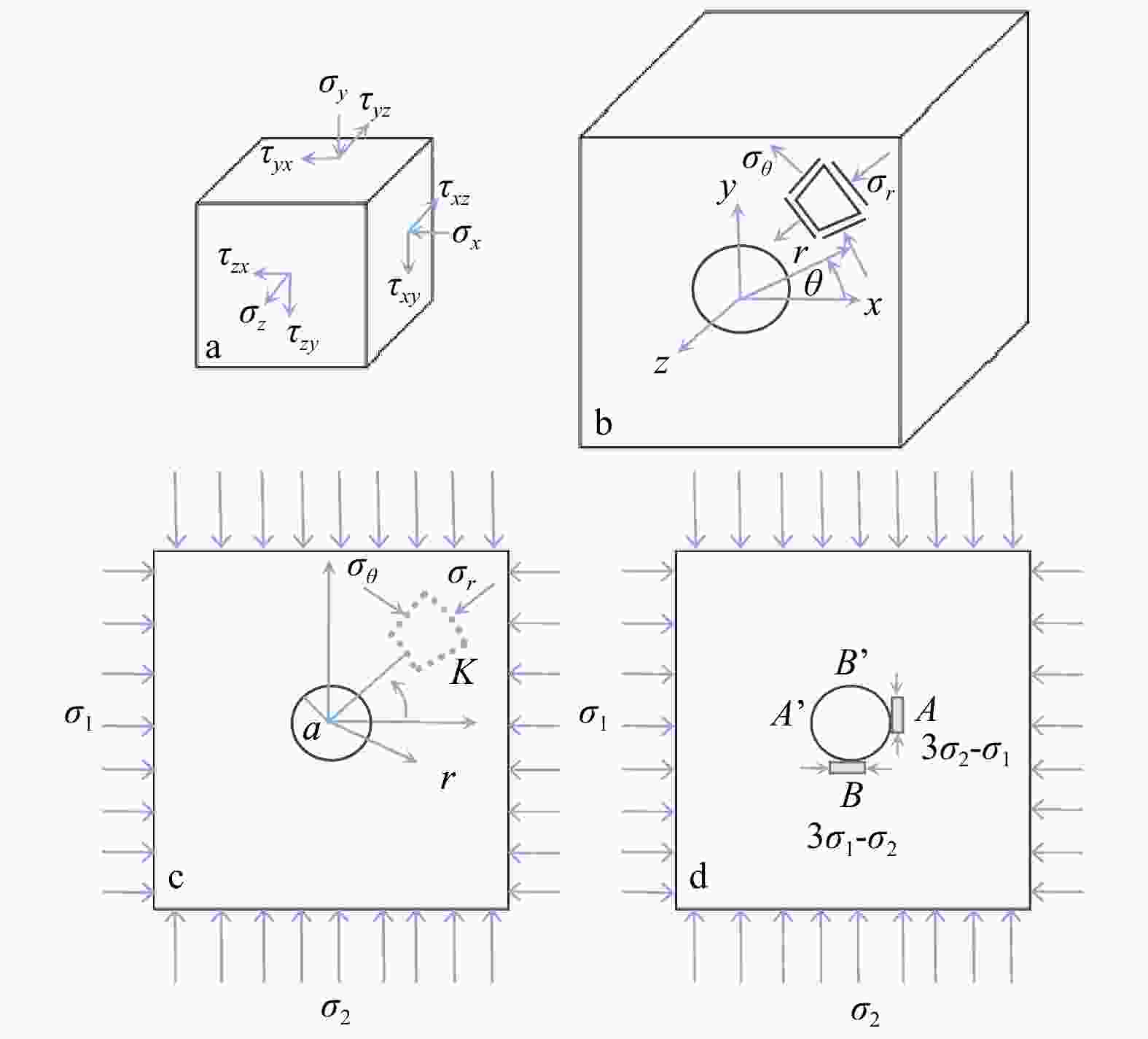
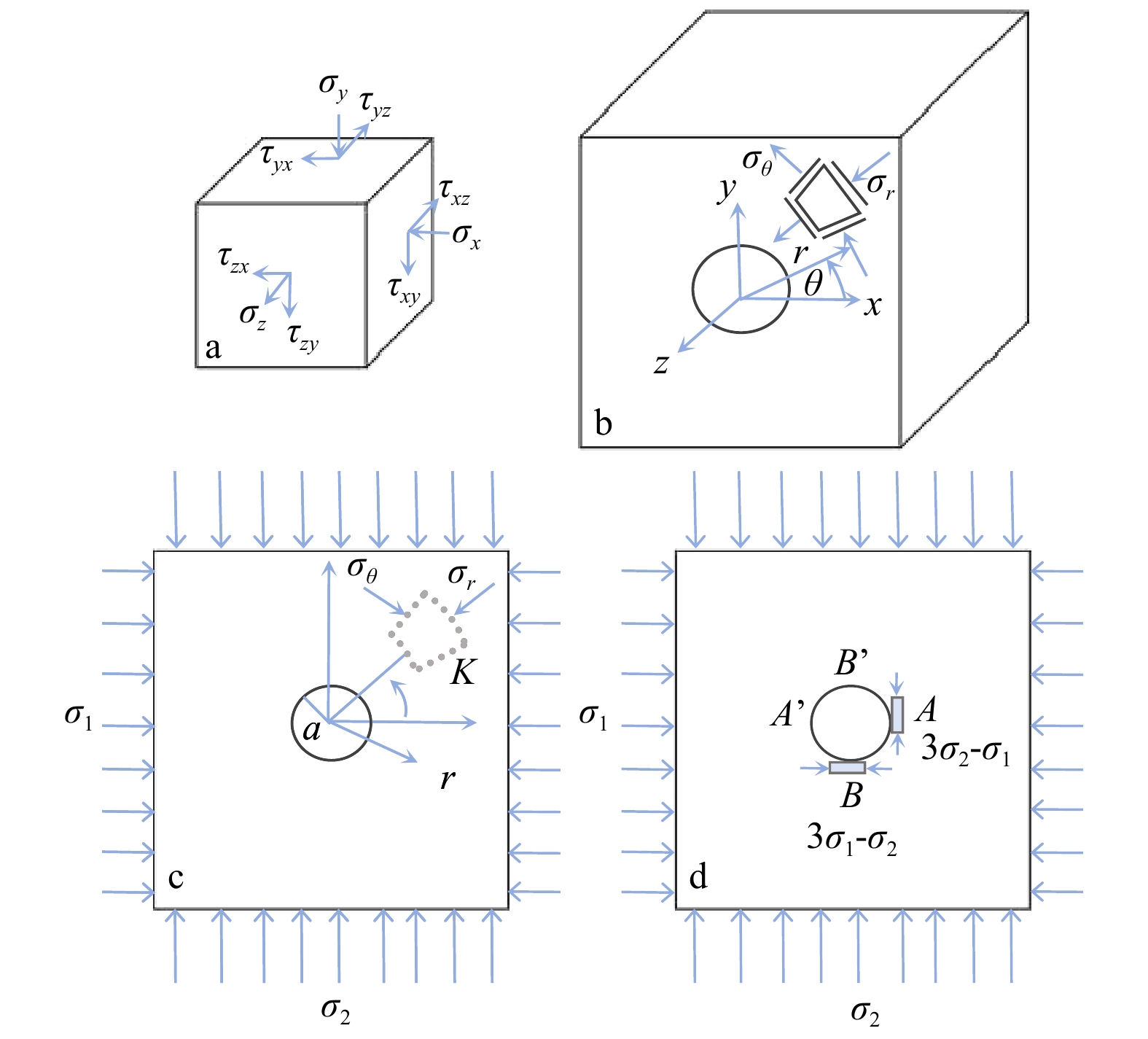
图 2 水压致裂法的应力场及弹性力学模型示意图[37]
a. 三维单元体应力状态;b. 极坐标下钻孔围岩应力状态;c. 钻孔围岩应力场与裂纹起裂位置;d. 钻孔孔壁切向应力分布。σx,σy,σz分别为直角坐标系下x,y,z方向的正应力分量;τxy(τyx),τyz(τzy),τzx(τxz)分别为x,y,z方向的剪应力分量;σr为径向应力;σθ为切向应力;r为钻孔外任意点K到钻孔中心的距离;σ1,σ2分别为原地应力场中的最大水平主应力和最小水平主应力;a为钻孔半径;θ为点K与σ1方向的夹角;A,A'为σ1作用方向的孔壁点(水平轴端点);B,B'为σ2作用方向的孔壁点(垂直轴端点)
Figure 2. Stress field and elastic mechanics model diagrams of hydraulic fracturing method
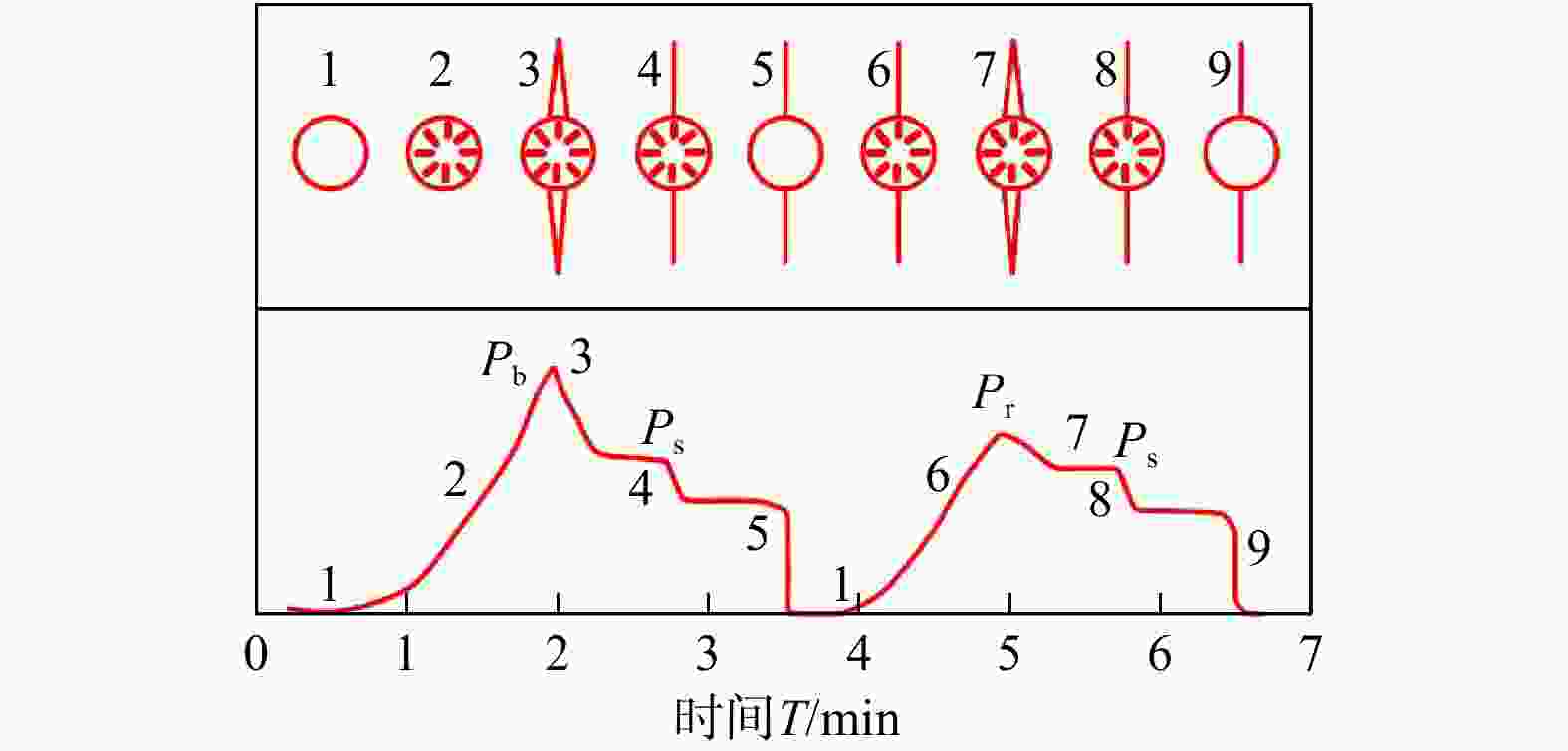
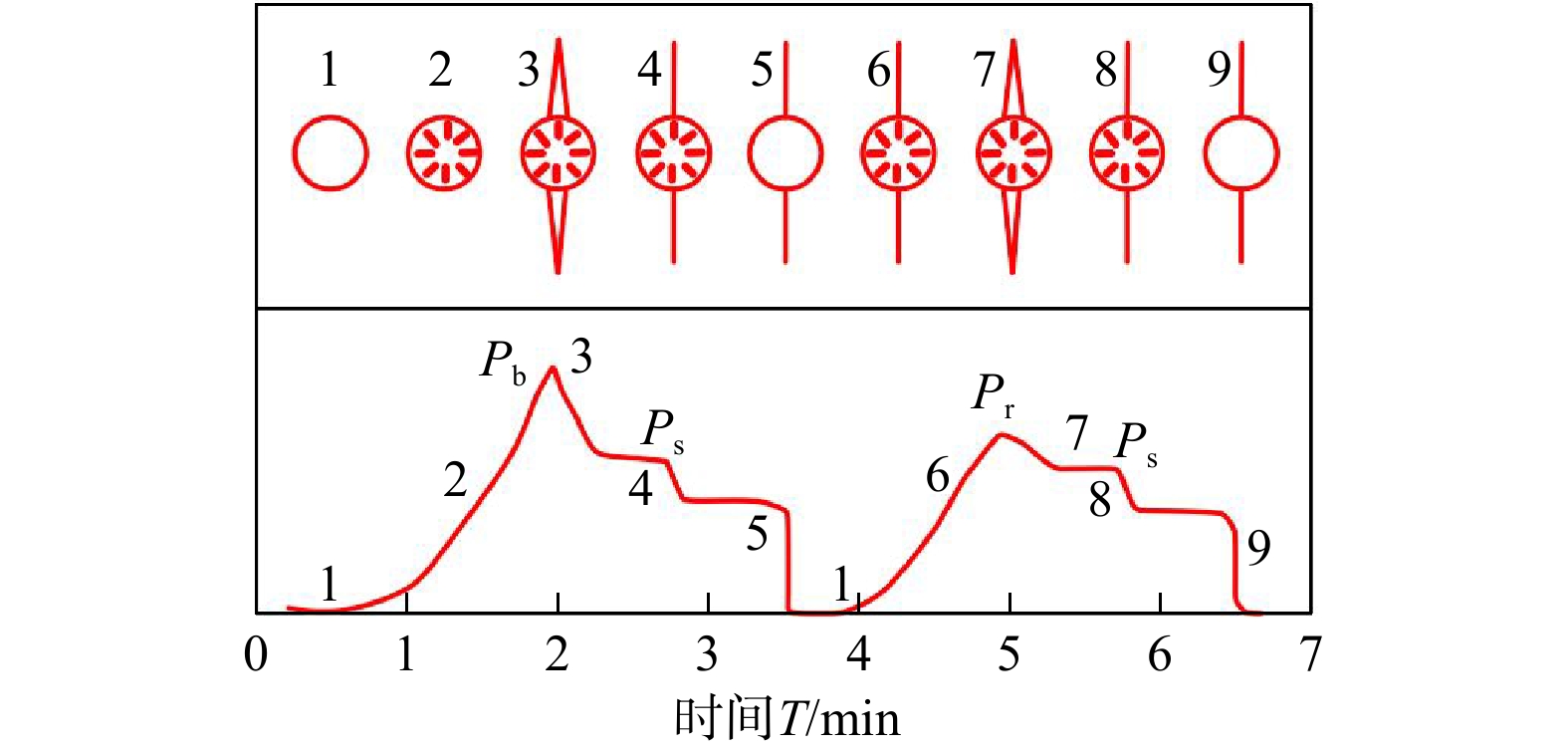
图 3 水压致裂典型测试曲线
①~⑨为水压致裂测试标准操作流程的9个关键阶段,分别代表初始注水、升压、孔壁破裂、压力骤降、裂缝瞬时闭合、重张加压、裂缝重张、裂缝扩展、测试结束;Pb为临界破裂压力;Ps为瞬时关闭压力;Pr为裂缝重张压力
Figure 3. Typical test curve of hydraulic fracturing
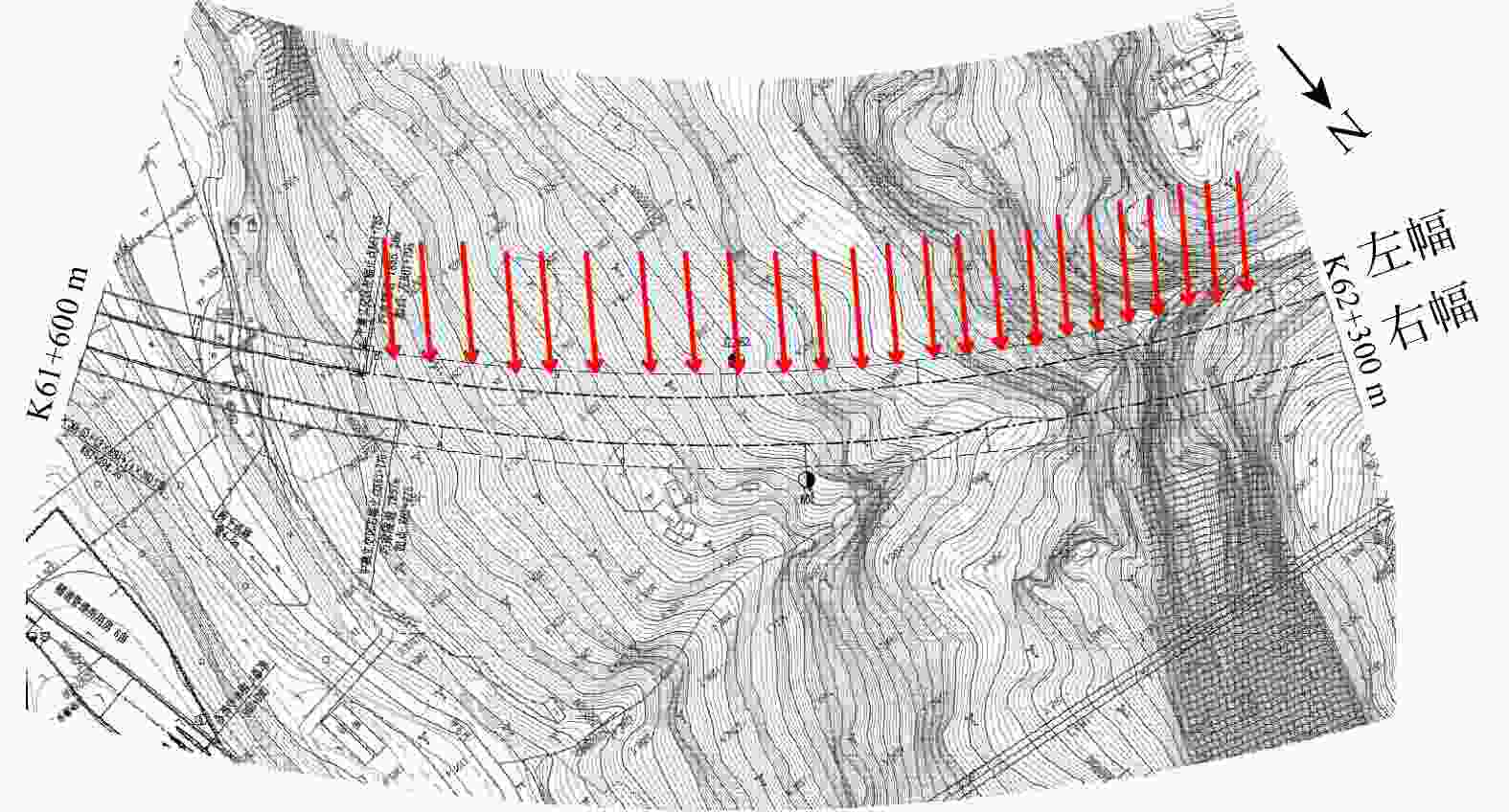
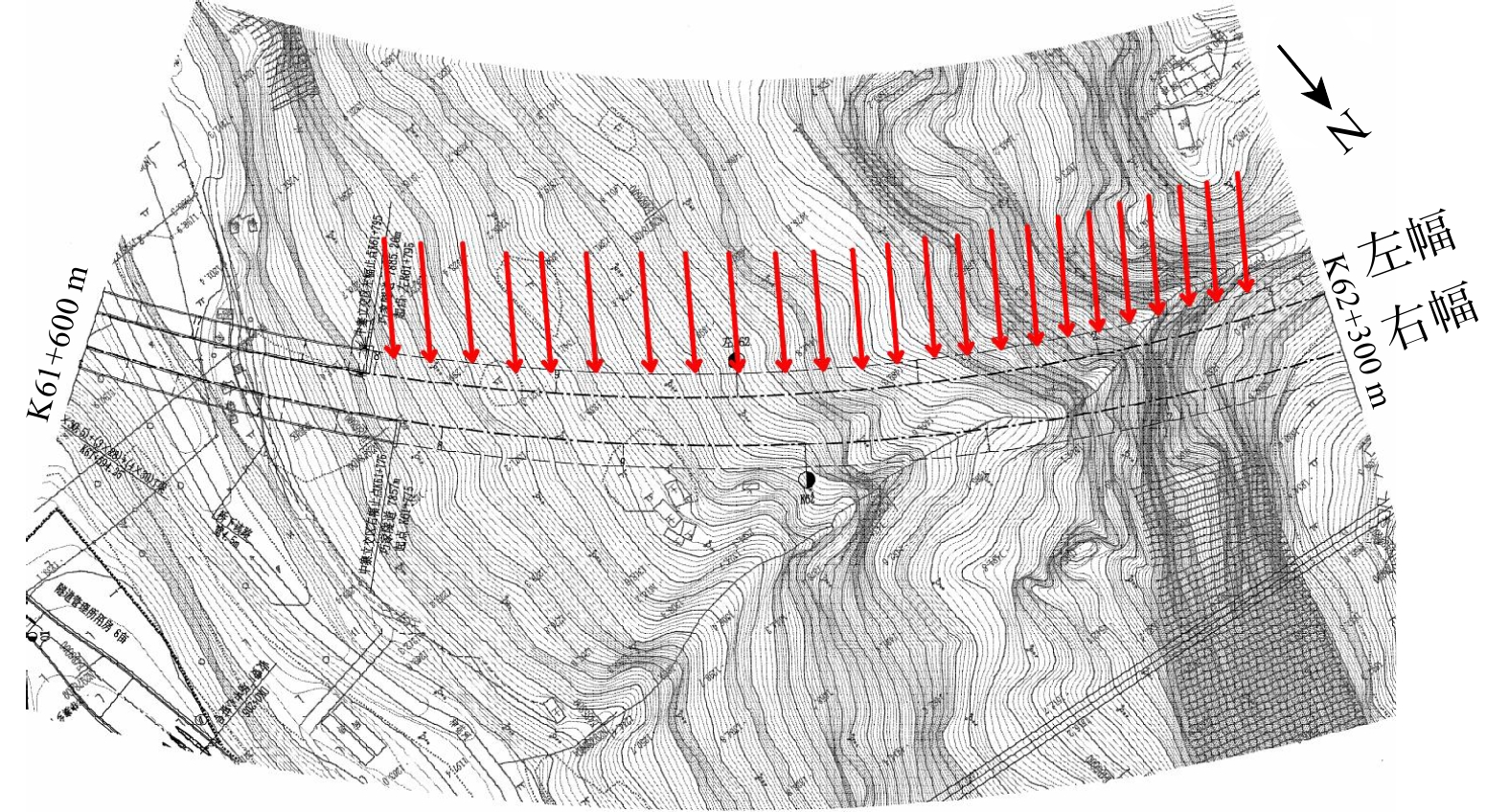
图 4 最大水平主应力优势方向图
红色箭头代表最大水平主应力优势方向
Figure 4. Dominant direction diagram of maximum horizontal principal stress
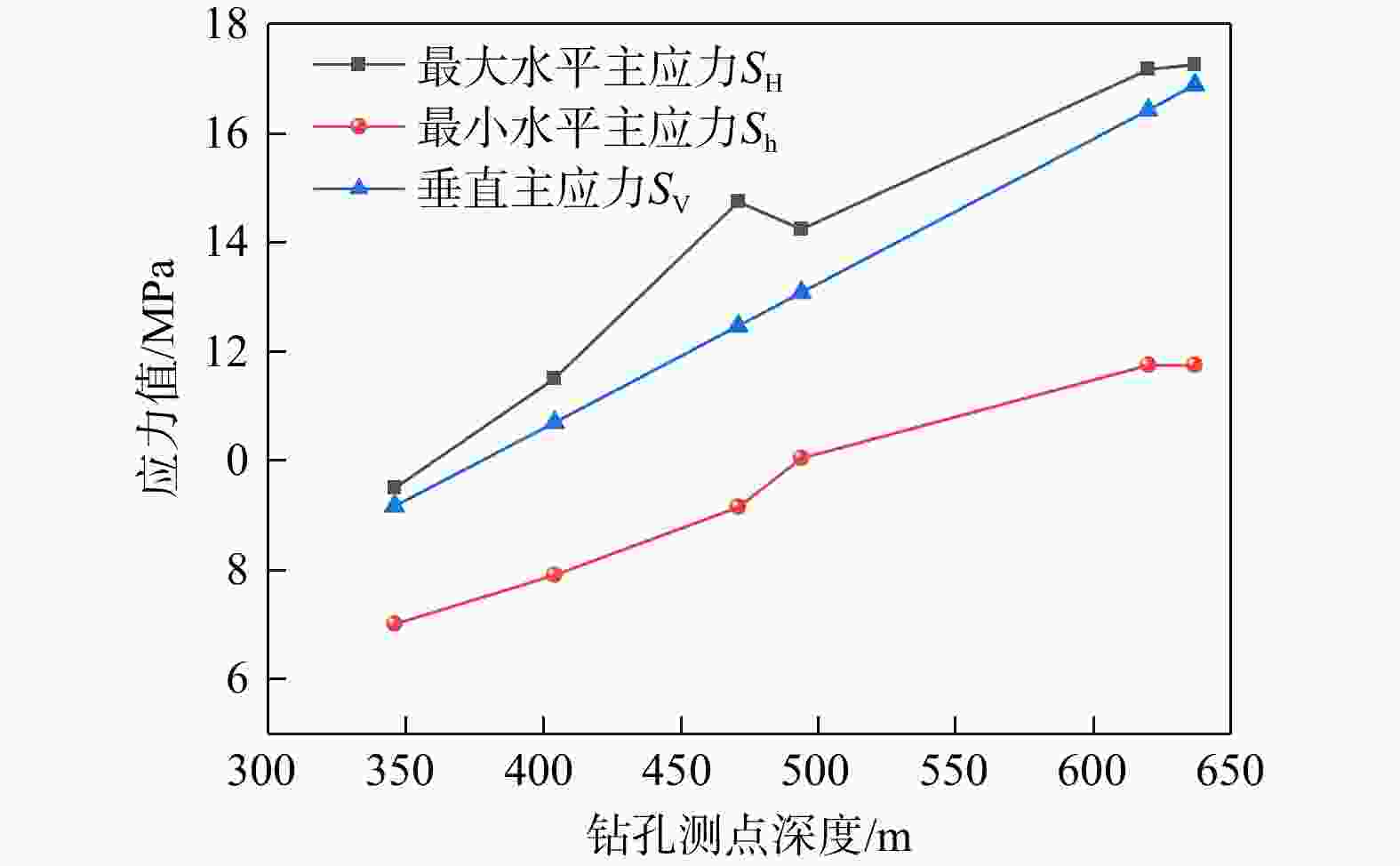
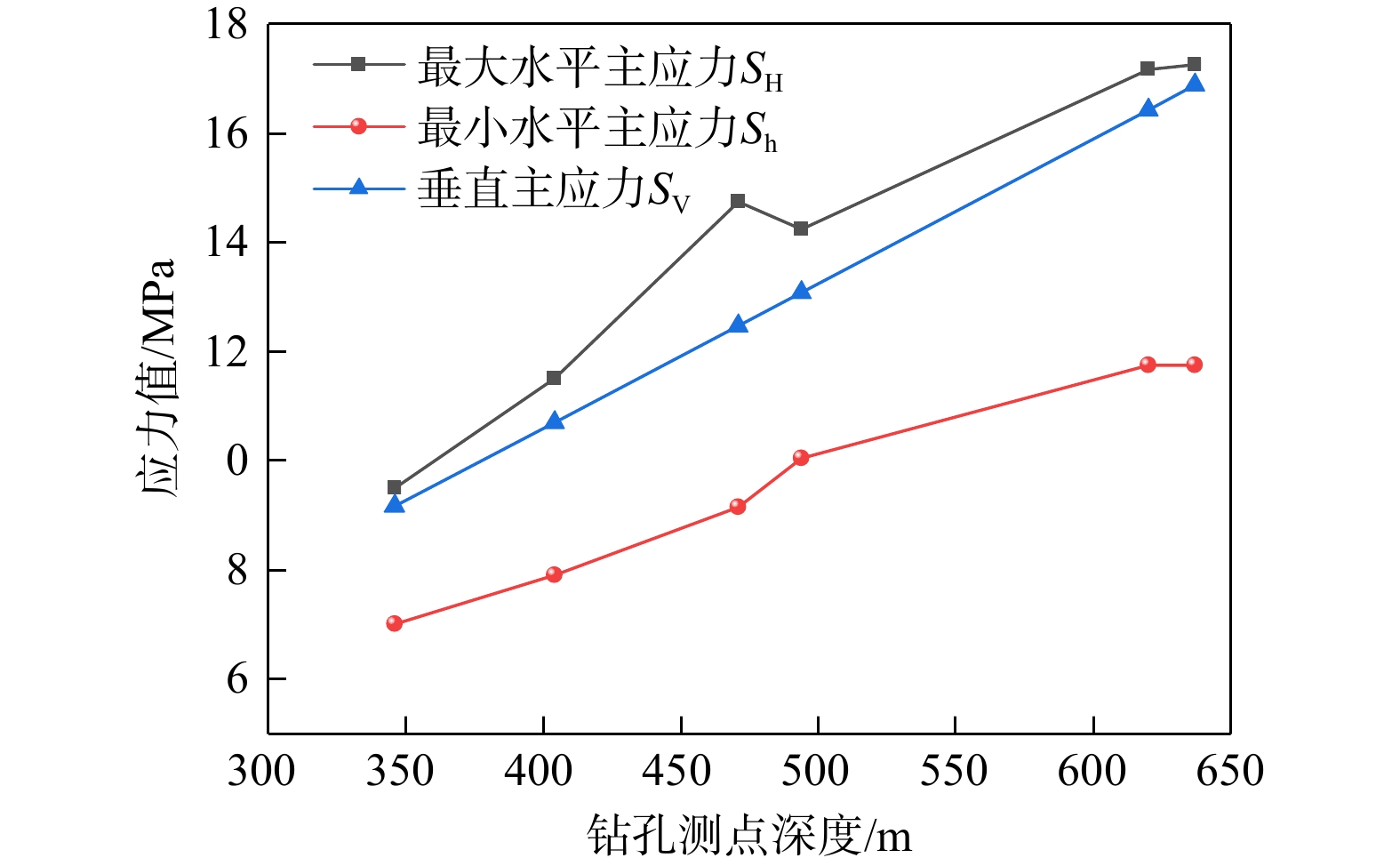
图 5 K67+910钻孔三向主应力随深度变化曲线
Figure 5. Variation curves of three principal stresses with depth for borehole K67+910
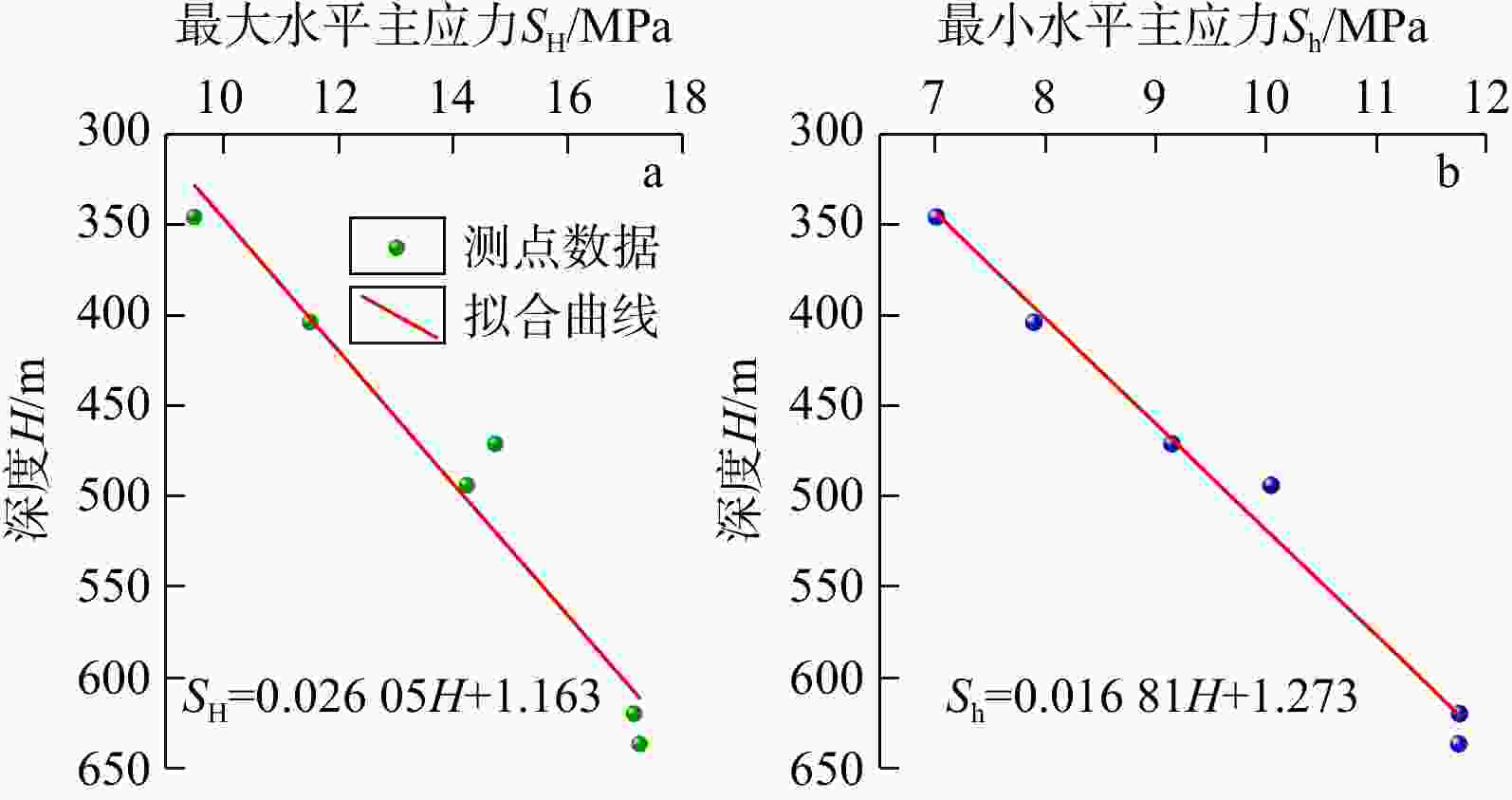
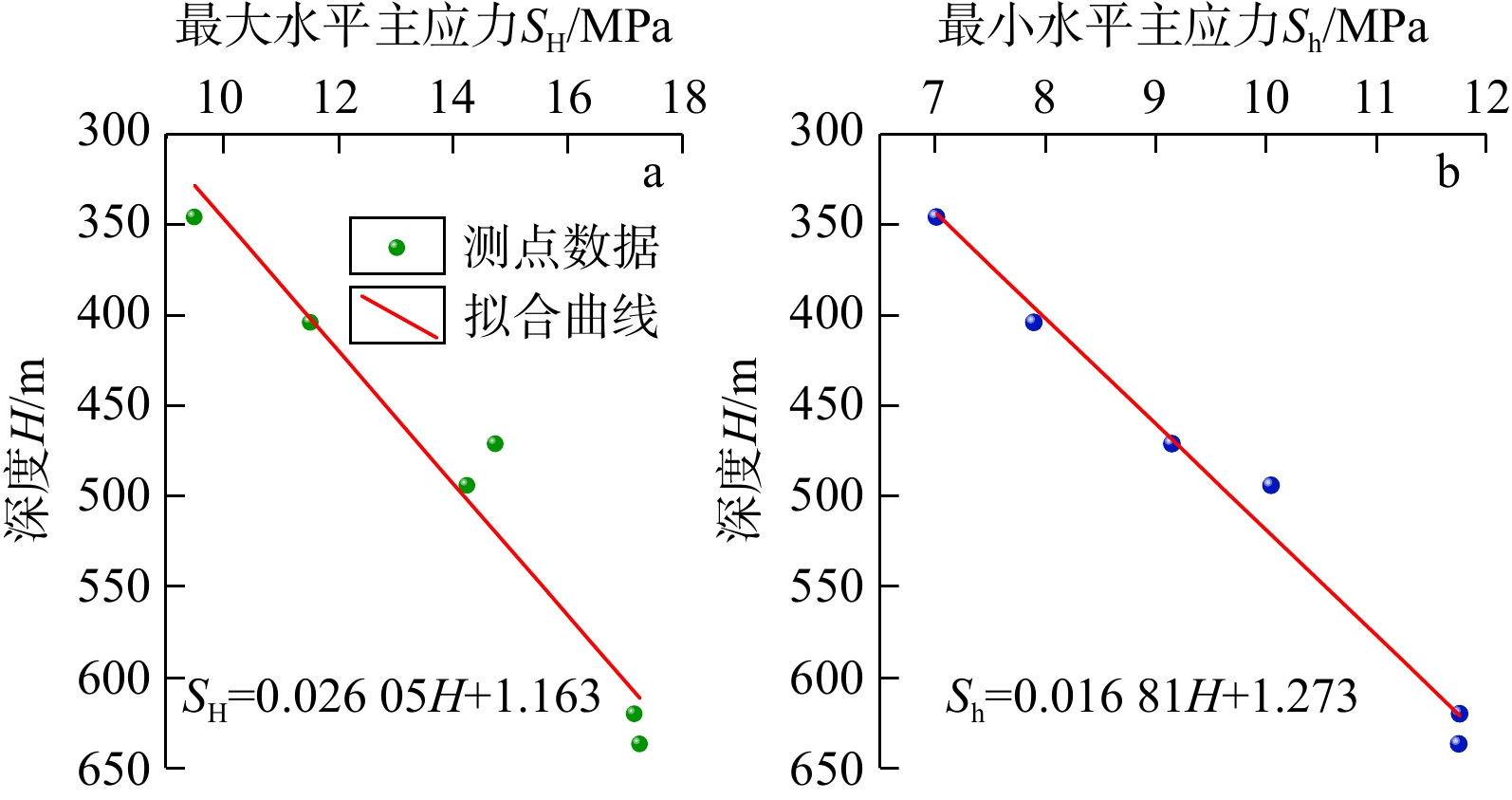
图 6 最大(a)、最小(b)水平主应力随深度拟合曲线
Figure 6. Fitting curves of maximum (a) and minimum (b) horizontal principal stresses versus depth
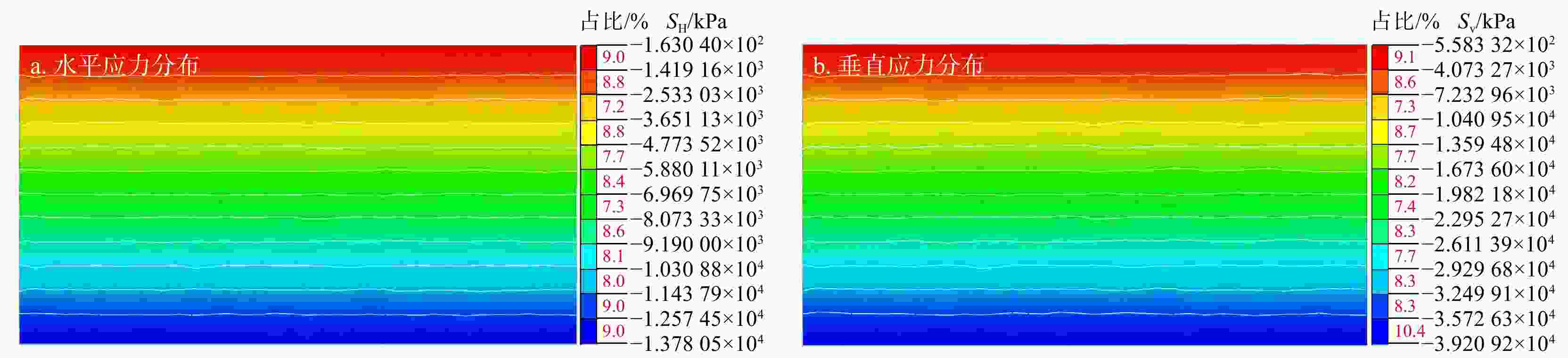
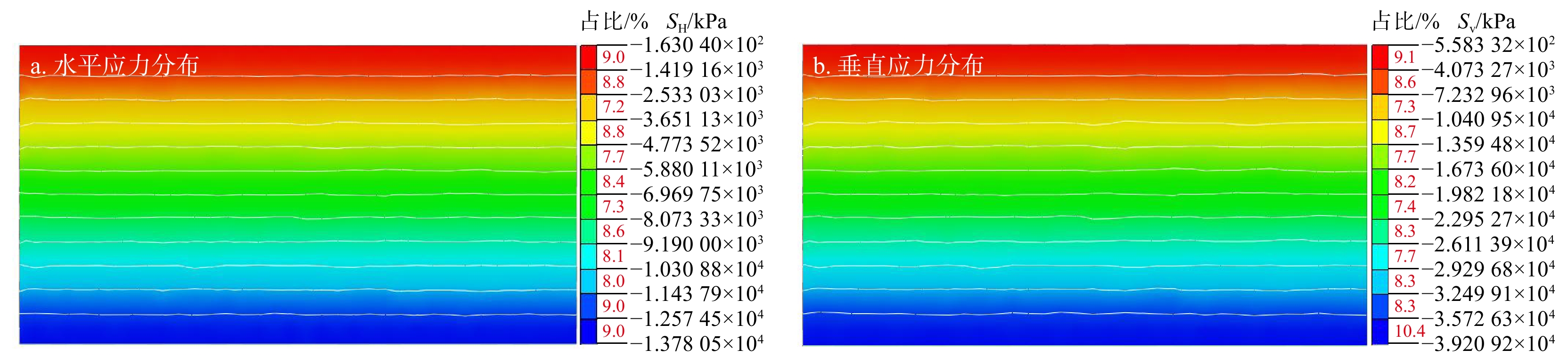
图 7 位移约束边界下初始地应力等值线剖面图(SH,SV分别为最大、最小水平主应力;白色线为应力等值线;下同)
Figure 7. Contour cross-sections of initial in-situ stress under displacement constraint boundary condition
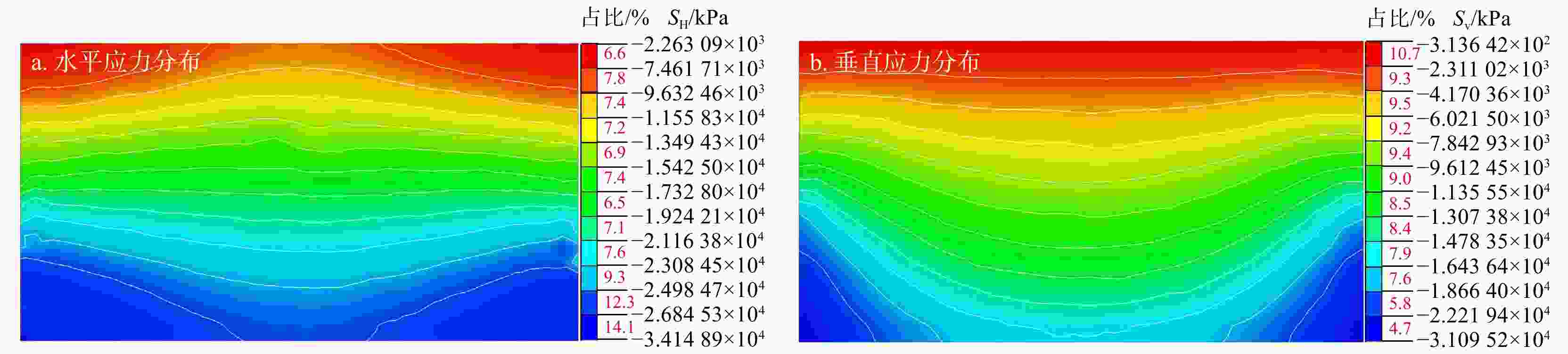
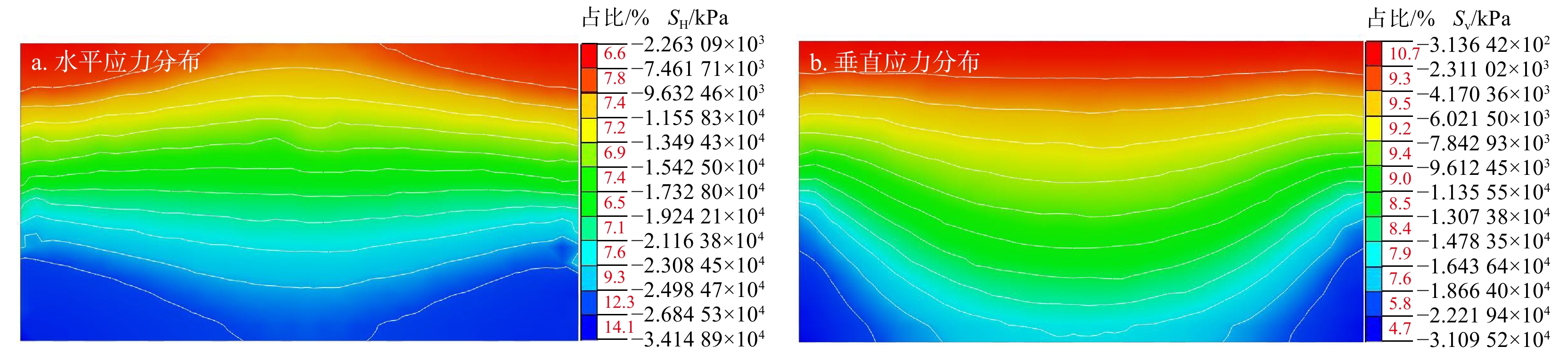
图 8 应力加载边界下初始地应力等值线剖面图
Figure 8. Contour cross-sections of initial in-situ stress under stress loading boundary condition
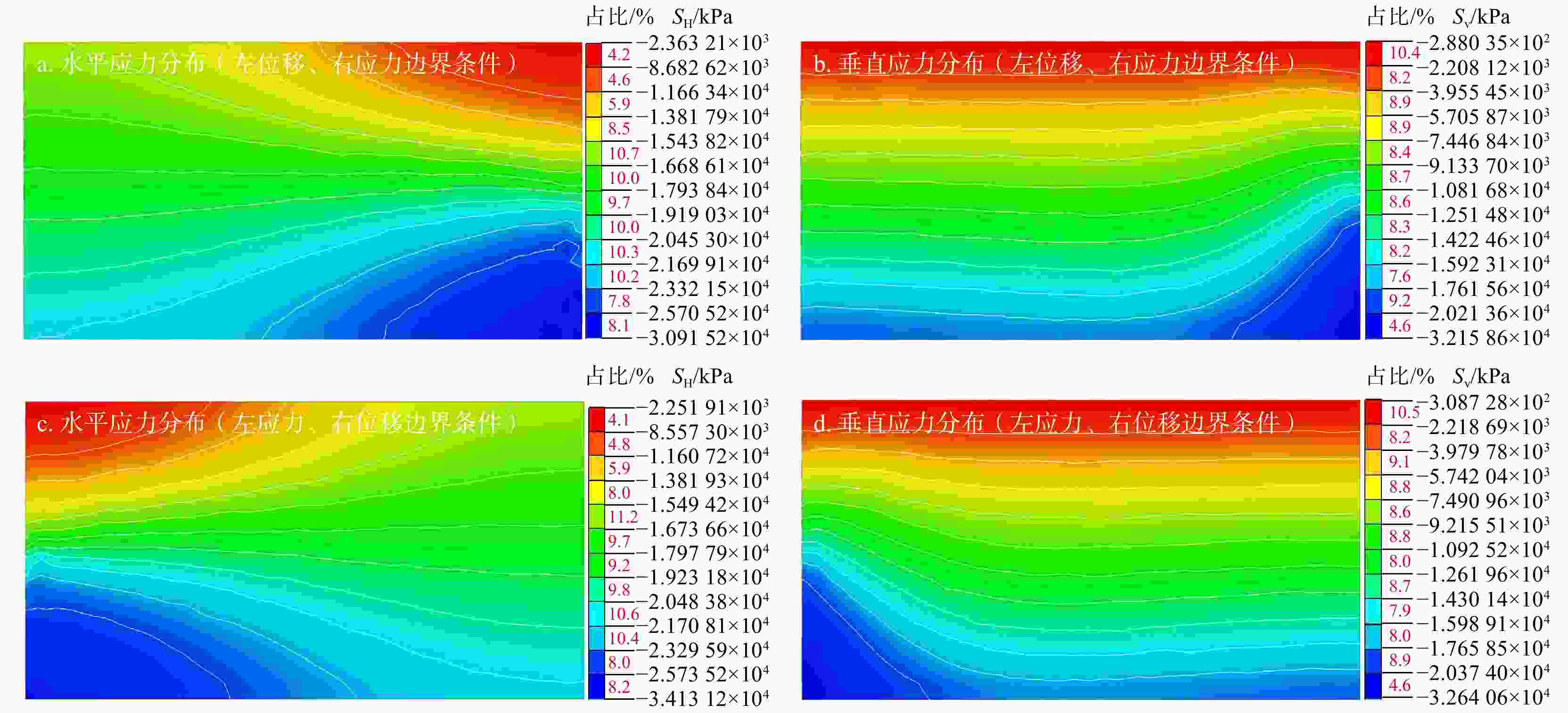
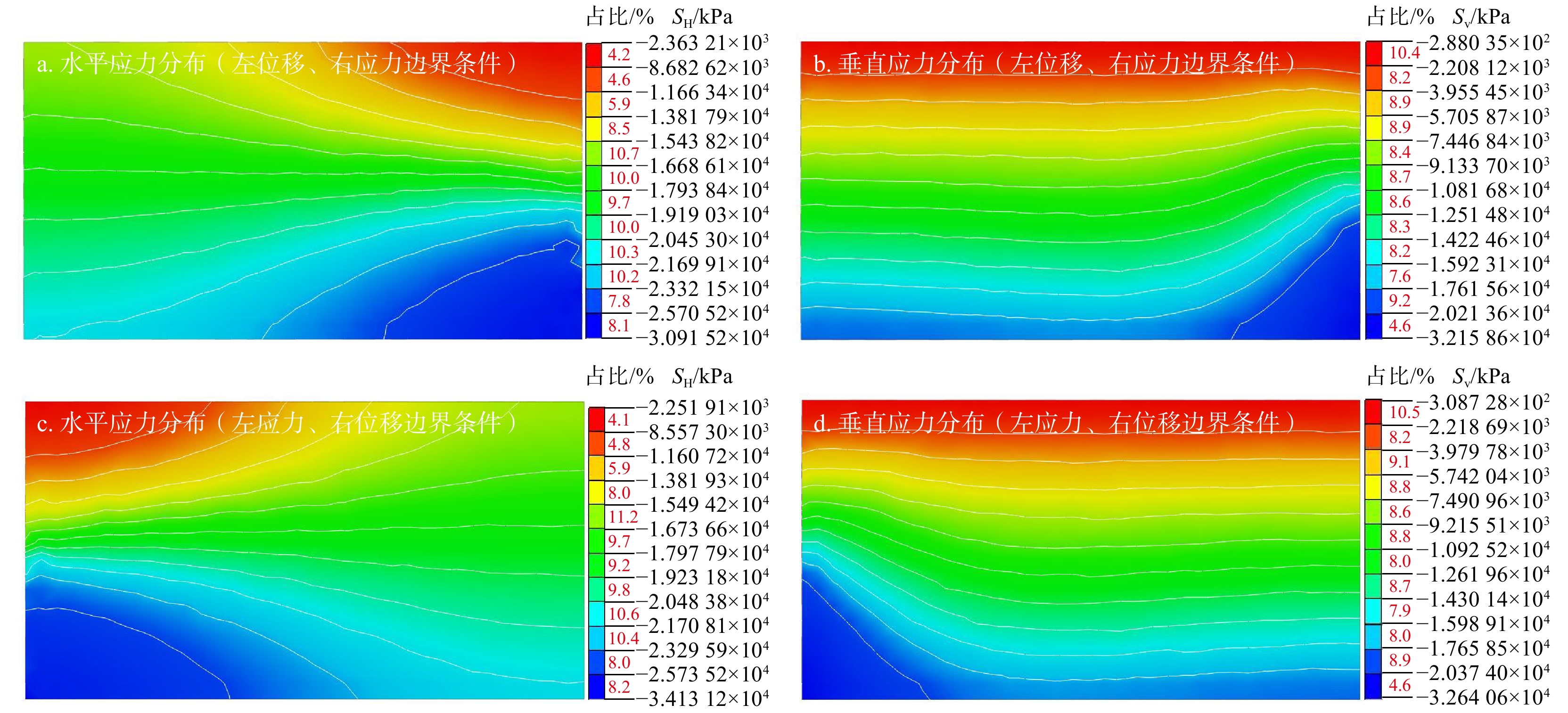
图 9 2类混合边界条件下初始地应力等值线剖面图
Figure 9. Contour cross-sections of initial in-situ stress under two hybrid boundary conditions
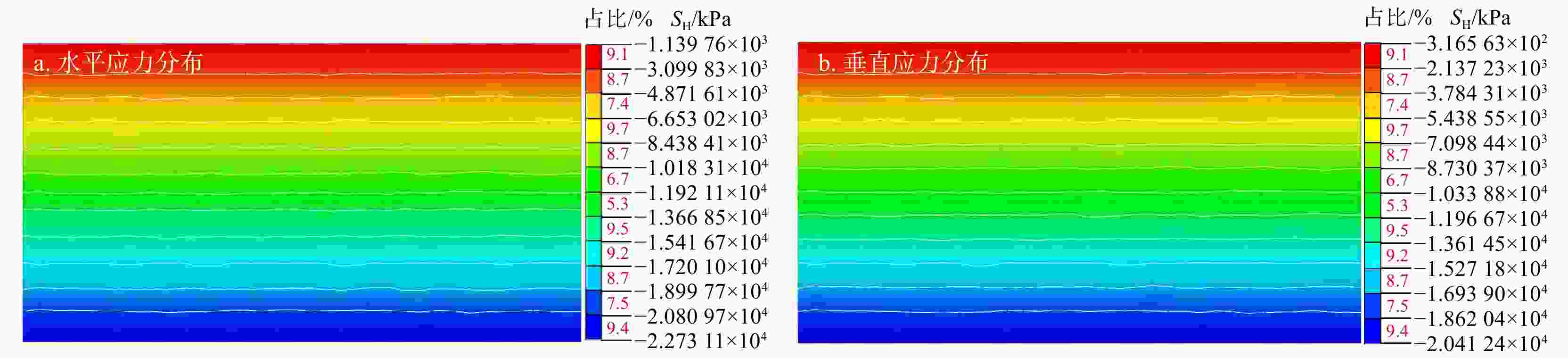
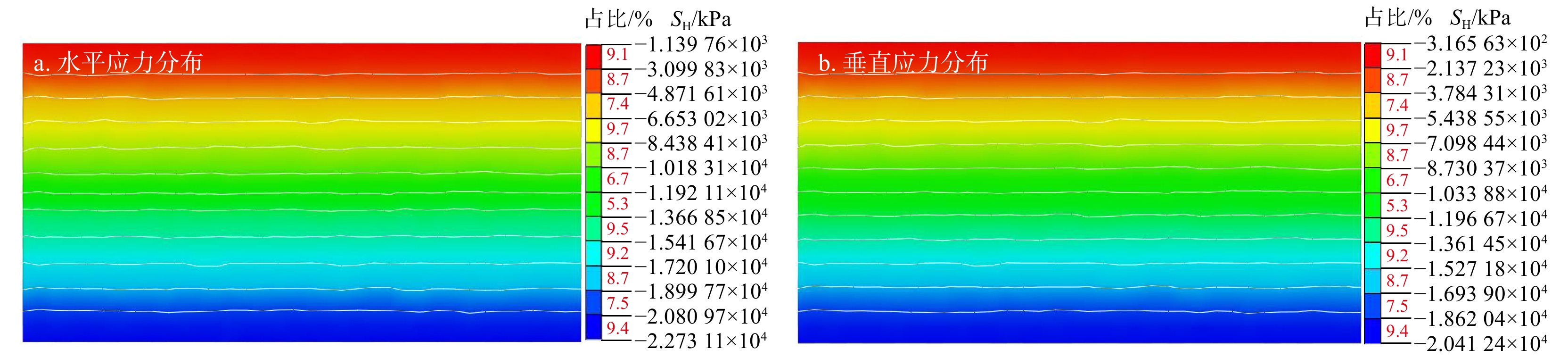
图 10 基于初始应变能理论的初始地应力等值线剖面图
Figure 10. Contour cross-sections of initial in-situ stress based on initial strain energy theory
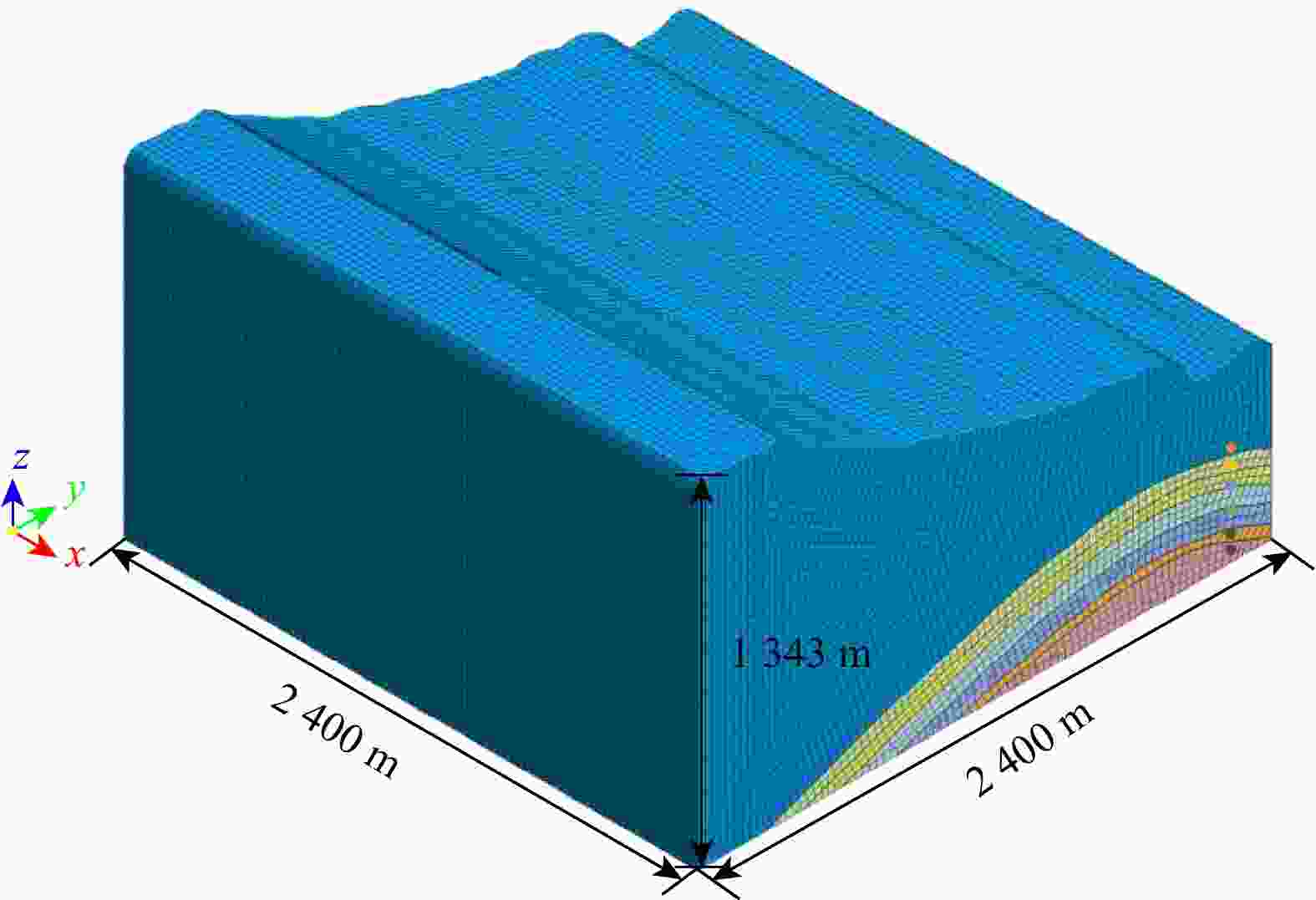
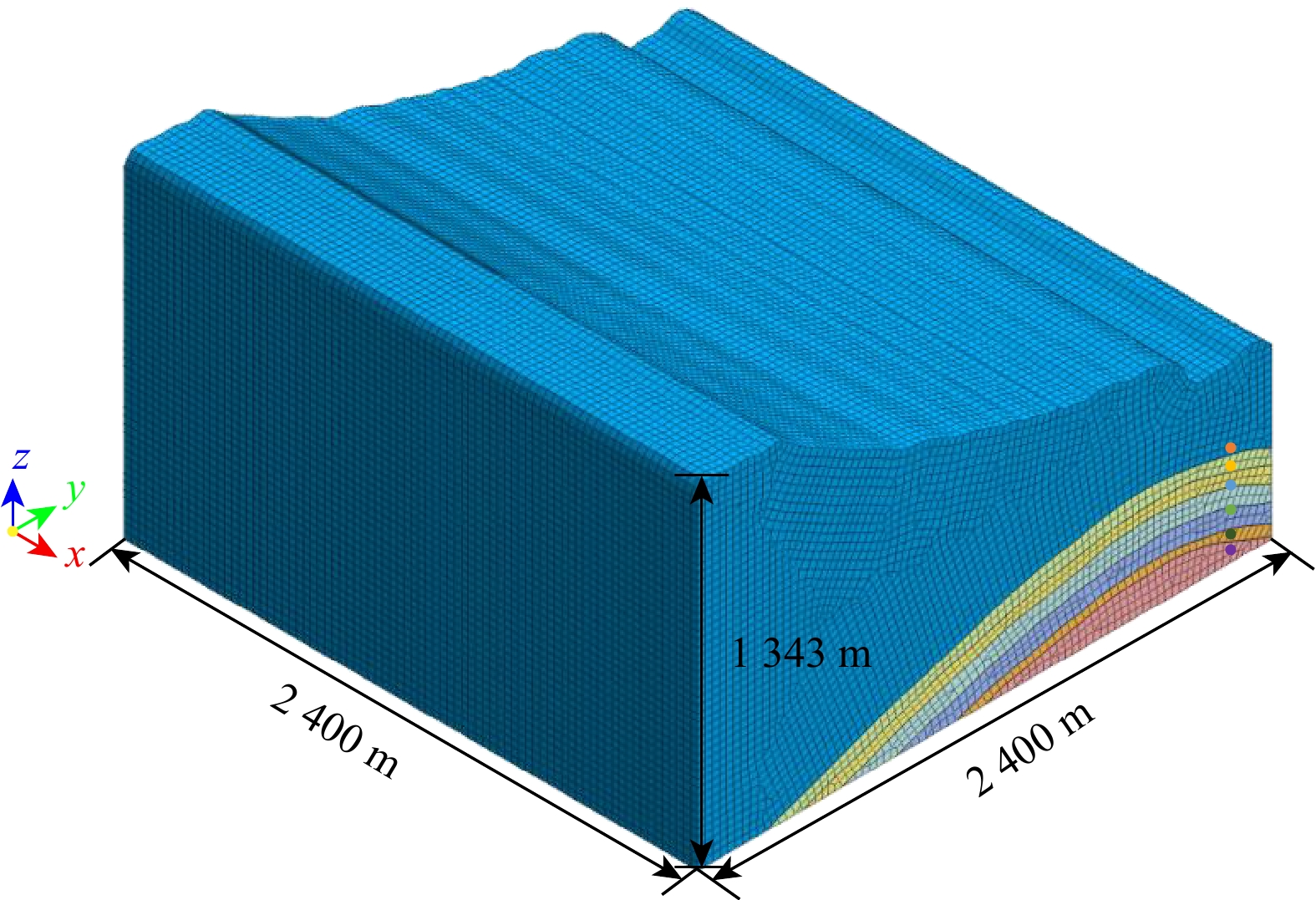
图 11 巧家隧道隧址区三维地应力反演数值计算模型
Figure 11. Three-dimensional numerical calculation model for in-situ stress inversion in Qiaojia Tunnel site area
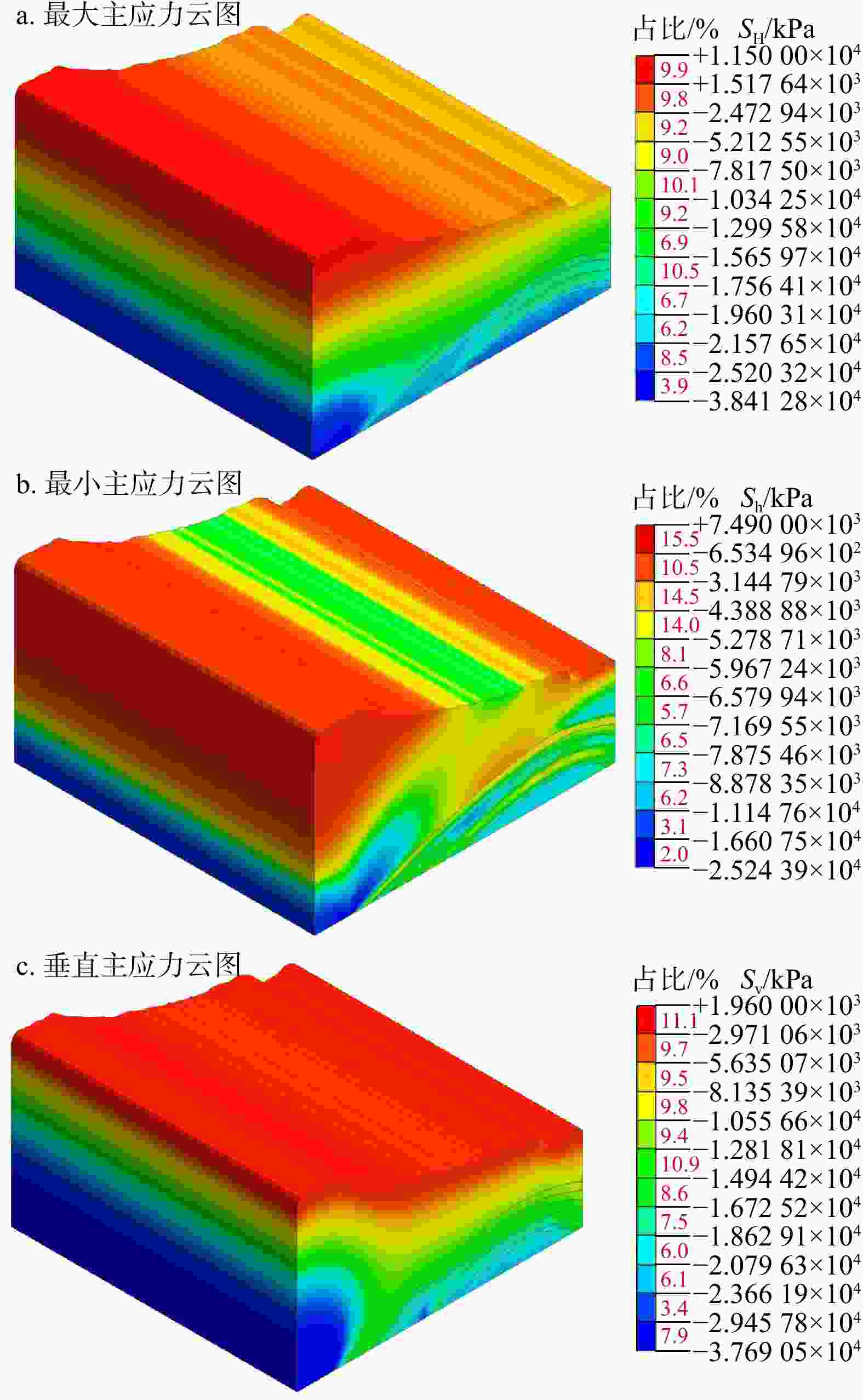
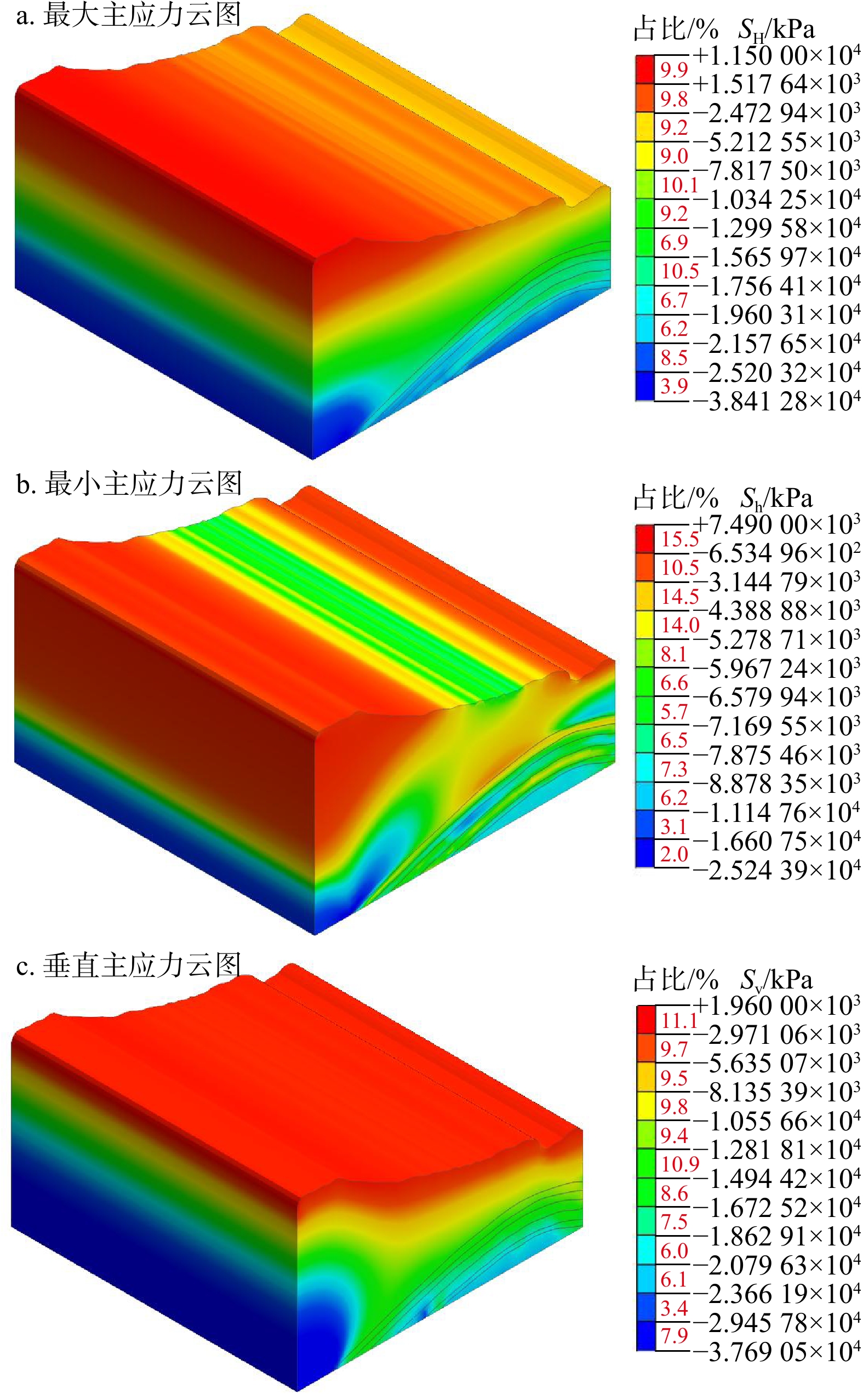
图 12 巧家隧道隧址区三向主应力数值模拟云图
Figure 12. Numerical simulation contour maps of three principal stresses in Qiaojia Tunnel site area
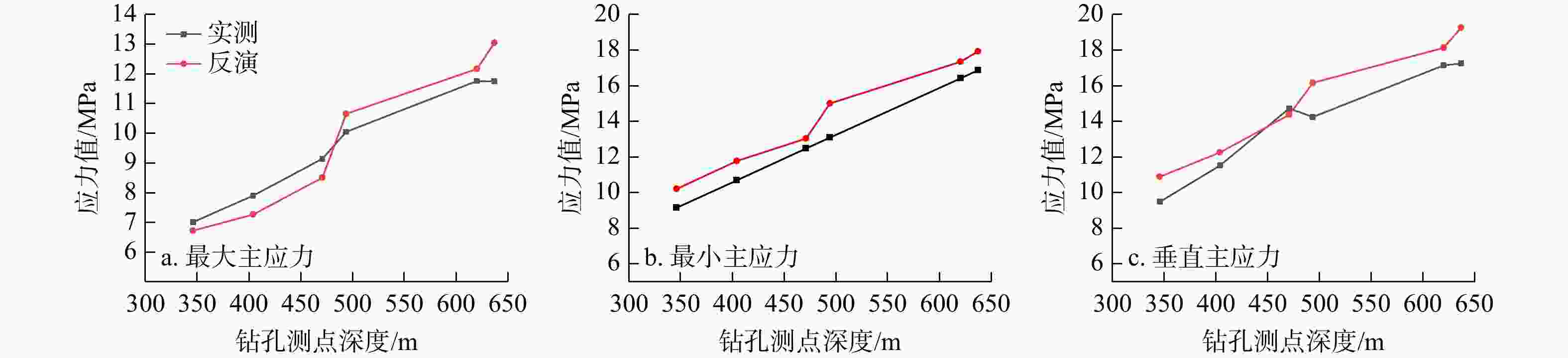
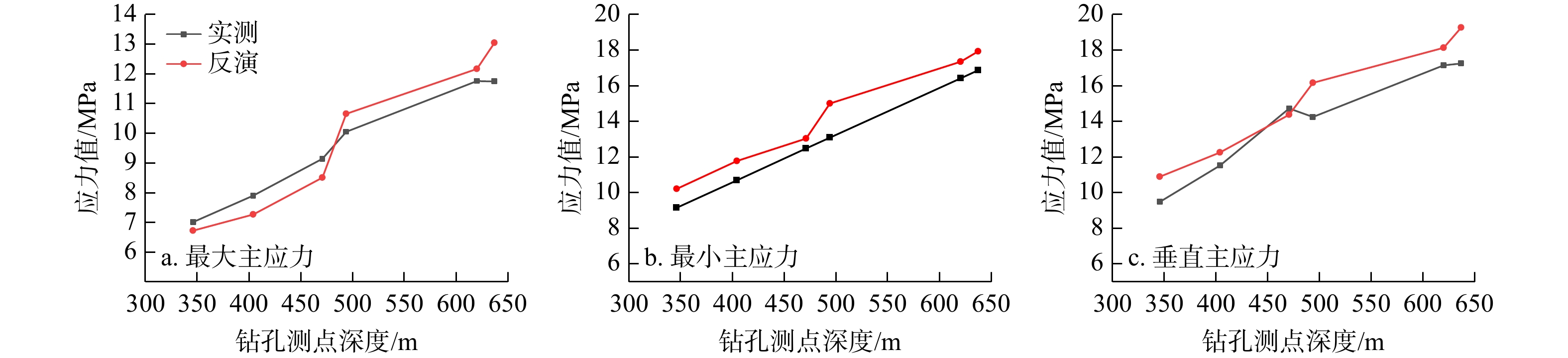
图 13 钻孔测点三向主应力实测值与数值反演值对比曲线
Figure 13. Comparison curves of measured and inverted three principal stresses at borehole measuring points
表 1 巧家隧道K67+910钻孔地应力测试结果[39]
Table 1. In-situ stress test results of borehole K67+910 in Qiaojia Tunnel
测点编号 测点深度/m 临界破裂
压力Pb/MPa裂缝重张
压力Pr/MPa瞬时关闭
压力Ps/MPa孔隙水
压力P0/MPa抗拉强度
T/MPa最大水平
主应力SH/MPa最小水平
主应力Sh/MPa垂直主
应力SV/MPa最大主应
力方向1 346.0 10.28 7.92 3.55 0.16 2.36 9.49 7.01 9.17 2 404.0 9.70 7.40 3.86 0.74 2.30 11.52 7.90 10.71 NW23° 3 471.0 9.56 6.59 4.44 1.41 2.97 14.74 9.15 12.48 NW42° 4 494.0 10.84 9.32 5.11 1.64 1.52 14.25 10.05 13.09 NW32° 5 620.0 11.33 9.02 5.56 2.90 2.31 17.16 11.76 16.43 6 637.0 8.80 8.57 5.38 3.07 0.23 17.25 11.75 16.88 注:最大水平主应力优势方向NW32°  下载: 导出CSV
表 2 场区各类围岩岩体物理力学参数
Table 2. Physical and mechanical parameters of various surrounding rock masses in study area
名称 弹性模量
E/GPa泊松比
μ容重γ/
(kN·m−3)黏聚力
c/MPa内摩擦
角φ/(°)白云质灰岩 30.00 0.25 22.0 0.25 27 页岩 7.53 0.33 23.0 1.05 21 灰岩 45.20 0.28 26.2 0.54 37 白云岩 25.00 0.27 26.0 2.60 40 泥质白云岩 20.00 0.20 26.0 10.00 40 泥岩 5.00 0.30 22.0 2.50 23
下载: 导出CSV
表 3 钻孔测点地应力实测值与数值反演结果对比
Table 3. Comparison between measured and inverted in-situ stress values at borehole measuring points
测点
编号测点
深度/m对比项 最大主应
力SH/MPa最小主应
力Sh/MPa垂直应力
SV/MPa最大主应
力方向1 346.0 实测值/MPa 9.49 7.01 9.17 反演值/MPa 10.89 6.73 10.23 相对误差/% 14.75 −3.99 11.56 2 404.0 实测值/MPa 11.52 7.90 10.71 NW23° 反演值/MPa 12.25 7.27 11.77 NW30° 相对误差/% 6.34 −7.97 9.90 3 471.0 实测值/MPa 14.74 9.15 12.48 NW42° 反演值/MPa 14.38 8.51 13.03 NW35° 相对误差/% −2.44 −6.99 4.41 4 494.0 实测值/MPa 14.25 10.05 13.09 NW32° 反演值/MPa 16.16 10.66 15.01 NW33° 相对误差/% 13.40 6.07 14.67 5 620.0 实测值/MPa 17.16 11.76 16.43 反演值/MPa 18.13 12.17 17.36 相对误差/% 5.65 3.49 5.66 6 637.0 实测值/MPa 17.25 11.75 16.88 反演值/MPa 19.28 13.04 17.94 相对误差/% 11.77 10.98 6.28
下载: 导出CSV
-
[1] 刘泉声, 王栋, 朱元广, 等. 支持向量回归算法在地应力场反演中的应用[J]. 岩土力学, 2020, 41(增刊1): 319-328. doi: 10.16285/j.rsm.2019.0860LIU Q S, WANG D, ZHU Y G, et al. Application of support vector regression algorithm in inversion of geostress field[J]. Rock and Soil Mechanics, 2020, 41(S1): 319-328. (in Chinese with English abstract) doi: 10.16285/j.rsm.2019.0860 [2] 姜山, 陈诺, 李健康, 等. 高地应力公路隧道应力场反演及岩爆预测[J]. 公路交通科技, 2025, 42(9): 168-175.JIANG S, CHEN N, LI J K, et al. Stress field inversion and rockburst prediction on highway tunnel with high geostress[J]. Journal of Highway and Transportation Research and Development, 2025, 42(9): 168-175. (in Chinese with English abstract) [3] 于清浩. 隧道极高地应力反演及大变形预警标准研究[J]. 铁道工程学报, 2025, 42(9): 80-85.YU Q H. Research on inversion of extremely in-situ stress and warning standard of large deformation in tunnel[J]. Journal of Railway Engineering Society, 2025, 42(9): 80-85. (in Chinese with English abstract) [4] 赵勐, 钮新强, 颜天佑, 等. 考虑层状构造特征影响的岩体地应力场精细反演分析研究[J]. 岩土工程学报, 2025, 47(6): 1239-1248.ZHAO M, NIU X Q, YAN T Y, et al. Inverse analysis method for in-situ stress field of rock mass considering influences of characteristics of layered structure[J]. Chinese Journal of Geotechnical Engineering, 2025, 47(6): 1239-1248. (in Chinese with English abstract) [5] DU J J, QIN X H, ZENG Q L, et al. Estimation of the present-day stress field using in-situ stress measurements in the Alxa area, Inner Mongolia for China's HLW disposal[J]. Engineering Geology, 2017, 220: 76-84. [6] KUANG Z H, QIU S L, LI S J, et al. A new rock brittleness index based on the characteristics of complete stress-strain behaviors[J]. Rock Mechanics and Rock Engineering, 2021, 54(3): 1109-1128. [7] 赖锦, 苏洋, 肖承文, 等. 地球物理测井在地质领域应用经典案例解析[J]. 地质科技通报, 2024, 43(5): 279-288.LAI J, SU Y, XIAO C W, et al. Analysis of typical applications of geophysical well logs in geological fields[J]. Bulletin of Geological Science and Technology, 2024, 43(5): 279-288. (in Chinese with English abstract) [8] ITO T, IGARASHI A, KATO H, et al. Crucial effect of system compliance on the maximum stress estimation in the hydrofracturing method: Theoretical considerations and field-test verification[J]. Earth, Planets and Space, 2006, 58(8): 963-971. [9] 崔松, 王晓南, 丁勇, 等. 基于卸荷应力的思山岭深部采区地应力场反演方法研究[J]. 金属矿山, 2025(7): 25-32.CUI S, WANG X N, DING Y, et al. Study on inversion method of in-situ stress field in the deep mining process of Sishanling based on unloading stress[J]. Metal Mine, 2025(7): 25-32. (in Chinese with English abstract) [10] XU X Y, XU W Y, SUN N, et al. Inversion study of in-situ stress in the underground powerhouse area of a large hydropower project in Southwest China[J]. Rock Mechanics and Rock Engineering, 2025, 58(9): 10755-10776. [11] 谢朝杭, 贾哲强, 罗佳鑫, 等. 高地应力条件下多因素耦合大变形分级评价方法研究: 以王家沟隧道为例[J]. 岩土工程学报, 2025, 47(增刊2): 115-120.XIE ZH, JIA Z Q, LUO J X, et al. Evaluation method of multi-factor coupled large deformation grading under high geo-stress conditions: Taking Wangjiagou Tunnel as an example[J]. Chinese Journal of Geotechnical Engineering, 2025, 47(S2): 115-120. (in Chinese with English abstract) [12] WANG X L, ZHAO C G, CHENG F Y, et al. Study of in situ stress inversion of deeply incised valleys considering the river evolution process[J]. Scientific Reports, 2025, 15: 17295. [13] 蒋健, 董志宏, 周春华, 等. 新疆某高水头抽蓄电站地应力综合测量及应力场反演分析[J]. 水资源与水工程学报, 2025, 36(2): 144-152.JIANG J, DONG Z H, ZHOU C H, et al. Comprehensive measurement of geostress and analysis of initial stress field inversion in a high-head pumped storage power station in Xinjiang[J]. Journal of Water Resources and Water Engineering, 2025, 36(2): 144-152. (in Chinese with English abstract) [14] 田勇华, 陈焕杰, 罗滔, 等. 西南某水电站地下厂房围岩稳定仿真分析[J]. 武汉大学学报(工学版), 2024, 57(增刊2): 16-20.TIAN Y H, CHEN H J, LUO T, et al. Simulation analysis of surrounding rock stability of underground power station chambers in a certain hydropower station in Southwest China[J]. Engineering Journal of Wuhan University, 2024, 57(S2): 16-20. (in Chinese with English abstract) [15] 裴书锋, 臧东升, 孙常新, 等. 复杂地质大型地下洞室群地应力场反演方法与应用[J]. 工程科学与技术, 2024, 56(5): 176-189.PEI S F, ZANG D S, SUN C X, et al. Inversion of in-situ stress field of large underground cavern group in complex geology methods and applications[J]. Advanced Engineering Sciences, 2024, 56(5): 176-189. (in Chinese with English abstract) [16] 韩晓玉, 郑炜烽, 董志宏, 等. 高水头抽水蓄能电站地应力综合测试及抗劈裂分析[J]. 岩土力学, 2024, 45(7): 2167-2174.HAN X Y, ZHENG W F, DONG Z H, et al. Comprehensive testing and analysis of crack resistance in high-head pumped storage power stations[J]. Rock and Soil Mechanics, 2024, 45(7): 2167-2174. (in Chinese with English abstract) [17] TANG Z, WU Z W, JIA D W, et al. The distribution law of ground stress field in Yingcheng coal mine based on rhino surface modeling[J]. Processes, 2024, 12(4): 668. [18] 高桂云, 王成虎, 刘冀昆, 等. 倾斜钻孔三维地应力张量反演方法及其应用研究[J]. 岩石力学与工程学报, 2024, 43(增刊2): 3700-3709.GAO G Y, WANG C H, LIU J K, et al. Three-dimensional in-situ stress tensor inversion method for inclined drilling and its application research[J]. Chinese Journal of Rock Mechanics and Engineering, 2024, 43(S2): 3700-3709. (in Chinese with English abstract) [19] LIANG J, ZHU Q J, SUI L K, et al. Research on elaborate construction of complex 3D geological model and in-situ stress inversion[J]. Geotechnical and Geological Engineering, 2024, 42(2): 1373-1388. [20] 张社荣, 胡安奎, 王超, 等. 基于SLR-ANN的地应力场三维智能反演方法研究[J]. 岩土力学, 2017, 38(9): 2737-2745.ZHANG S R, HU A K, WANG C, et al. Three-dimensional intelligent inversion method for in-situ stress field based on SLR-ANN algorithm[J]. Rock and Soil Mechanics, 2017, 38(9): 2737-2745. (in Chinese with English abstract) [21] 周围维, 冯永存, 李晓蓉, 等. 量子群优化算法在断层滑动擦痕反演地应力中的应用研究[J]. 地质力学学报, 2025, 31(6): 1238-1254.ZHOU W W, FENG Y C, LI X R, et al. Research on the application of the quantum-behaved particle swarm optimization algorithm in the inverse estimation of in-situ stress based on fault-slip fractures[J]. Journal of Geomechanics, 2025, 31(6): 1238-1254. (in Chinese with English abstract) [22] 曹子阳, 王建, 袁智焕, 等. 地应力反演修正的Stacking集成模型与工程应用[J]. 水力发电学报, 2025, 44(11): 115-126.CAO Z Y, WANG J, YUAN Z H, et al. Stacking ensemble model for in-situ stress inversion correction and its engineering application[J]. Journal of Hydroelectric Engineering, 2025, 44(11): 115-126. (in Chinese with English abstract) [23] 周正, 杨旺, 侯东波, 等. 基于机器学习的深埋长隧道沿线地应力场反演方法[J]. 安全与环境工程, 2025, 32(5): 56-65.ZHOU Z, YANG W, HOU D B, et al. Inversion method of stress field along deep buried long tunnel based on machine learning[J]. Safety and Environmental Engineering, 2025, 32(5): 56-65. (in Chinese with English abstract) [24] 李建新, 张继勋, 马佳, 等. 基于LASSO-OLS方法的初始地应力场反演优化[J]. 隧道建设(中英文), 2025, 45(9): 1698-1710.LI J X, ZHANG J X, MA J, et al. Optimizing initial geostress field inversion using least absolute shrinkage and selection operator-ordinary least squares method[J]. Tunnel Construction, 2025, 45(9): 1698-1710. (in Chinese with English abstract) [25] 王金安, 李飞. 复杂地应力场反演优化算法及研究新进展[J]. 中国矿业大学学报, 2015, 44(2): 189-205.WANG J A, LI F. Review of inverse optimal algorithm of in-situ stress filed and new achievement[J]. Journal of China University of Mining & Technology, 2015, 44(2): 189-205. (in Chinese with English abstract) [26] 蒙伟, 何川, 陈子全, 等. 岭回归在岩体初始地应力场反演中的应用[J]. 岩土力学, 2021, 42(4): 1156-1169.MENG W, HE C, CHEN Z Q, et al. Application of ridge regression in the inversion analysis of the initial geo-stress field of rock masses[J]. Rock and Soil Mechanics, 2021, 42(4): 1156-1169. (in Chinese with English abstract) [27] REN Y Q, TANG B L, CHEN X M, et al. Inversion analysis of the three-dimensional geostress field in a tunnel[J]. IOP Conference Series: Earth and Environmental Science, 2021, 643(1): 012047. [28] 索朗, 徐正宣, 冯涛, 等. 鲜水河构造带某隧道地应力反演与分析[J]. 西南交通大学学报, 2022, 57(2): 331-338.SUO L, XU Z X, FENG T, et al. Inversion and analysis of ground stress in a tunnel in Xianshuihe tectonic belt[J]. Journal of Southwest Jiaotong University, 2022, 57(2): 331-338. (in Chinese with English abstract) [29] 周佐健, 陈焕杰, 罗滔, 等. 地下厂房初始地应力简易FLAC3D反演方法[J]. 武汉大学学报(工学版), 2024, 57(增刊2): 11-15.ZHOU Z J, CHEN H J, LUO T, et al. Simple FLAC3D inversion method for initial geostress of underground powerhouse[J]. Engineering Journal of Wuhan University, 2024, 57(S2): 11-15. (in Chinese with English abstract) [30] LIU X G, HUANG C C, ZHU W C, et al. In situ stress inversion using nonlinear stress boundaries achieved by the bubbling method[J]. Journal of Rock Mechanics and Geotechnical Engineering, 2025, 17(3): 1510-1527. [31] 何军杰, 胡松, 郭永刚, 等. 基于多元线性回归原理的高海拔深埋隧道地应力反演分析[J]. 防灾减灾工程学报, 2024, 44(1): 120-127.HE J J, HU S, GUO Y G, et al. Inversion analysis of ground stress in high-altitude deep-buried tunnels based on multiple linear regression principle[J]. Journal of Disaster Prevention and Mitigation Engineering, 2024, 44(1): 120-127. (in Chinese with English abstract) [32] 周家兴. 基于深度学习的深部复杂地应力场反演算法研究[J]. 岩石力学与工程学报, 2024, 43(4): 1040.ZHOU J X. Research on inversion algorithm of deep complex in-situ stress field based on depth learning[J]. Chinese Journal of Rock Mechanics and Engineering, 2024, 43(4): 1040. (in Chinese with English abstract) [33] 张晨, 沈波, 刘桂卫. 浩吉铁路某长深隧道地应力三维反演技术研究[J]. 铁道工程学报, 2022, 39(8): 30-34.ZHANG C, SHEN B, LIU G W. Study on three-dimensional inversion technology of ground stress in a long deep tunnel of Haoji Railway[J]. Journal of Railway Engineering Society, 2022, 39(8): 30-34. (in Chinese with English abstract) [34] 骆俊晖, 米德才, 叶琼瑶, 等. 基于Midas模型下考虑构造应力场深埋隧道围岩稳定性研究[J]. 灾害学, 2018, 33(增刊1): 81-86.LUO J H, MI D C, YE Q Y, et al. Study on the stability of surrounding rock of deep buried tunnel considering tectonic stress field based on Midas model[J]. Journal of Catastrophology, 2018, 33(S1): 81-86. (in Chinese with English abstract) [35] 柳禄湧, 李凯舟, 王能伟, 等. 山东招远水旺庄金矿深部地应力特征及其岩爆倾向性分析[J]. 地质力学学报, 2023, 29(3): 417-429.LIU L Y, LI K Z, WANG N W, et al. In-situ stress characteristics and rockburst tendency of surrounding rocks in the Shuiwangzhuang gold deposit, Zhaoyuan, Shandong Province[J]. Journal of Geomechanics, 2023, 29(3): 417-429. (in Chinese with English abstract) [36] 张斌, 孙尧, 马秀敏, 等. 东构造结墨脱关键区域地应力场特征及其构造稳定性分析[J]. 地质力学学报, 2023, 29(3): 388-401.ZHANG B, SUN Y, MA X M, et al. In-situ stress field characteristics and tectonic stability analysis of the key area of Jiemotuo in the eastern structure[J]. Journal of Geomechanics, 2023, 29(3): 388-401. (in Chinese with English abstract) [37] 王世业. 基于初始应力场反演的高地应力层状隧道围岩稳定性评价及变形处理措施研究[D]. 西安: 长安大学, 2021.WANG S Y. Study on stability evaluation and deformation treatment measures of surrounding rock of layered tunnel with high ground stress based on inversion of initial stress field[D]. Xi'an: Changan University, 2021. (in Chinese with English abstract) [38] 朱明德, 王照亚, 张月征, 等. 基于水压致裂法的三山岛深竖井工程区地应力测量与反演分析[J]. 地质力学学报, 2023, 29(3): 430-441.ZHU M D, WANG Z Y, ZHANG Y Z, et al. In-situ stress measurement and inversion analysis of Sanshandao deep shaft engineering area based on hydraulic fracturing method[J]. Journal of Geomechanics, 2023, 29(3): 430-441. (in Chinese with English abstract) [39] 云南省交通规划设计研究院有限公司. 鲁甸−巧家高速公路两阶段施工图设计工程地质勘察报告[R]. 昆明: 云南省交通规划设计研究院有限公司, 2022.Yunnan Provincial Transportation Planning and Design Institute Co., Ltd. Engineering geological investigation report on two-stage construction drawing design of Ludian-Qiaojia Expressway[R]. Kunming: Yunnan Provincial Transportation Planning and Design Institute Co., Ltd., 2022. (in Chinese) [40] 林子晗, 夏元, 张航川, 等. 幕阜山岩体北缘鄂南地区构造特征与构造控矿作用[J]. 地质科技通报, 2025, 44(2): 257-269.LIN Z H, XIA Y, ZHANG H C, et al. Structural characteristics and tectonic controls on mineralization in the northern margin of the Mufushan pluton, southern Hubei region[J]. Bulletin of Geological Science and Technology, 2025, 44(2): 257-269. (in Chinese with English abstract) [41] 郭延辉, 侯克鹏. 基于FLAC3D的岩体初始高水平构造应力场反演方法[J]. 科学技术与工程, 2020, 20(21): 8523-8529.GUO Y H, HOU K P. Inversion method of initial high level tectonic stress field of rock mass based on FLAC3D[J]. Science Technology and Engineering, 2020, 20(21): 8523-8529. (in Chinese with English abstract) -

 下载:
下载:

 点击查看大图

计量
- 文章访问数: 256
- PDF下载量: 18
- 被引次数: 0