投审稿入口
投审稿入口


Brillouin optical time-domain sensing technology and its application in tunnel monitoring
-
摘要:
隧道是城市地下交通体系中的重要基础设施,其结构安全与服役稳定性直接关系到工程运行安全,因此开展长期、连续的结构健康监测具有重要的工程应用价值。布里渊光时域传感技术作为一种典型的分布式光纤监测技术,具有监测距离长、布设灵活、抗电磁干扰能力强及长期稳定性好等优点,近年来已逐步应用于隧道结构监测领域,展现出良好的工程应用潜力。结合隧道工程监测实践,系统阐述了布里渊光时域反射(BOTDR)和布里渊光时域分析(BOTDA)技术的基本原理、测试方式及技术特征,总结了其在隧道结构应力与变形监测中的研究现状与工程应用进展。在此基础上,从“传感光缆−结构−围岩”协同作用角度出发,归纳分析了不同隧道结构形式、光纤布设方式及耦合条件下的监测适用性与误差特征;进一步对 BOTDR 与 BOTDA 在监测精度、空间分辨率、测试距离及复杂环境适应性等方面的差异进行了对比,明确了2种技术在不同隧道工程条件下的适用场景与技术优势。综合现有研究可知,监测效果不仅取决于传感技术本身,还与光缆−结构耦合性能、结构形式、施工条件及环境扰动等因素密切相关。研究表明,布里渊光时域传感技术能够实现隧道结构应力与变形信息的全分布式、长期连续监测,在隧道运行状态评估、病害识别及安全预警中具有良好的应用前景。未来,应重点围绕复杂环境下传感光缆与隧道结构协同变形机理、温度与应变解耦方法、高耐久传感封装技术以及监测数据智能分析方法等方面开展深入研究,以进一步提升该技术在隧道结构健康监测中的可靠性、精细化水平与工程适用性。
-
关键词:
- 布里渊光时域传感技术 /
- 光纤 /
- 空间分辨率 /
- 隧道监测
Abstract:SignificanceTunnels are indispensable components of urban underground transportation systems, and their structural safety and service stability are closely related to the safety of transportation networks and other critical infrastructure. With the rapid development of urban rail transit, highway tunnels, and mountain tunnels, many tunnel structures are constructed and operated in increasingly complex geological, hydrological, and environmental conditions. During long-term service, tunnels are subjected to surrounding rock pressure, groundwater action, construction disturbance, material deterioration, and cyclic loading, which may lead to cracking, lining deformation, local stress concentration, and even structural damage. Therefore, long-term and continuous structural health monitoring is of great engineering significance for condition assessment, damage diagnosis, risk warning, and maintenance decision-making. As a typical distributed fiber optic sensing technology, Brillouin optical time-domain sensing (BOTDS) has the advantages of long monitoring distance, flexible deployment, strong immunity to electromagnetic interference, and good long-term stability, and has demonstrated significant potential in tunnel structural monitoring.
ProgressCombined with practical applications in tunnel engineering monitoring, this paper systematically introduces the fundamental principles, testing modes, and technical characteristics of Brillouin optical time-domain reflectometry (BOTDR) and Brillouin optical time-domain analysis (BOTDA), and reviews their research status and engineering applications in monitoring tunnel stress and deformation. Existing studies show that both BOTDR and BOTDA can provide distributed strain information along the sensing fiber, thereby overcoming the limitations of conventional point-based methods in spatial continuity and coverage. From the perspective of interaction among the sensing cable, tunnel structure, and surrounding rock, the applicability and error characteristics under different tunnel structural forms, fiber deployment methods, and coupling conditions are further analyzed. Particular attention is given to the influence of installation methods, such as surface bonding, groove embedding, internal embedding, and surface-attached laying, on strain transfer behavior and monitoring reliability. In addition, BOTDR and BOTDA are compared in terms of monitoring accuracy, spatial resolution, sensing distance, real-time performance, and adaptability to complex environments, so as to clarify their respective application scopes and technical advantages. The review indicates that monitoring performance depends not only on the sensing technology itself, but also on the coupling quality between the sensing cable and the structure, tunnel type, construction conditions, temperature variation, humidity, and other environmental disturbances.
Conclusions and ProspectsCombined with practical applications in tunnel engineering monitoring, this paper systematically introduces the fundamental principles, testing modes, and technical characteristics of Brillouin optical time-domain reflectometry (BOTDR) and Brillouin optical time-domain analysis (BOTDA), and reviews their research status and engineering applications in monitoring tunnel stress and deformation. Existing studies show that both BOTDR and BOTDA can provide distributed strain information along the sensing fiber, thereby overcoming the limitations of conventional point-based methods in spatial continuity and coverage. From the perspective of interaction among the sensing cable, tunnel structure, and surrounding rock, the applicability and error characteristics under different tunnel structural forms, fiber deployment methods, and coupling conditions are further analyzed. Particular attention is given to the influence of installation methods, such as surface bonding, groove embedding, internal embedding, and surface-attached laying, on strain transfer behavior and monitoring reliability. In addition, BOTDR and BOTDA are compared in terms of monitoring accuracy, spatial resolution, sensing distance, real-time performance, and adaptability to complex environments, so as to clarify their respective application scopes and technical advantages. The review indicates that monitoring performance depends not only on the sensing technology itself, but also on the coupling quality between the sensing cable and the structure, tunnel type, construction conditions, temperature variation, humidity, and other environmental disturbances.
-
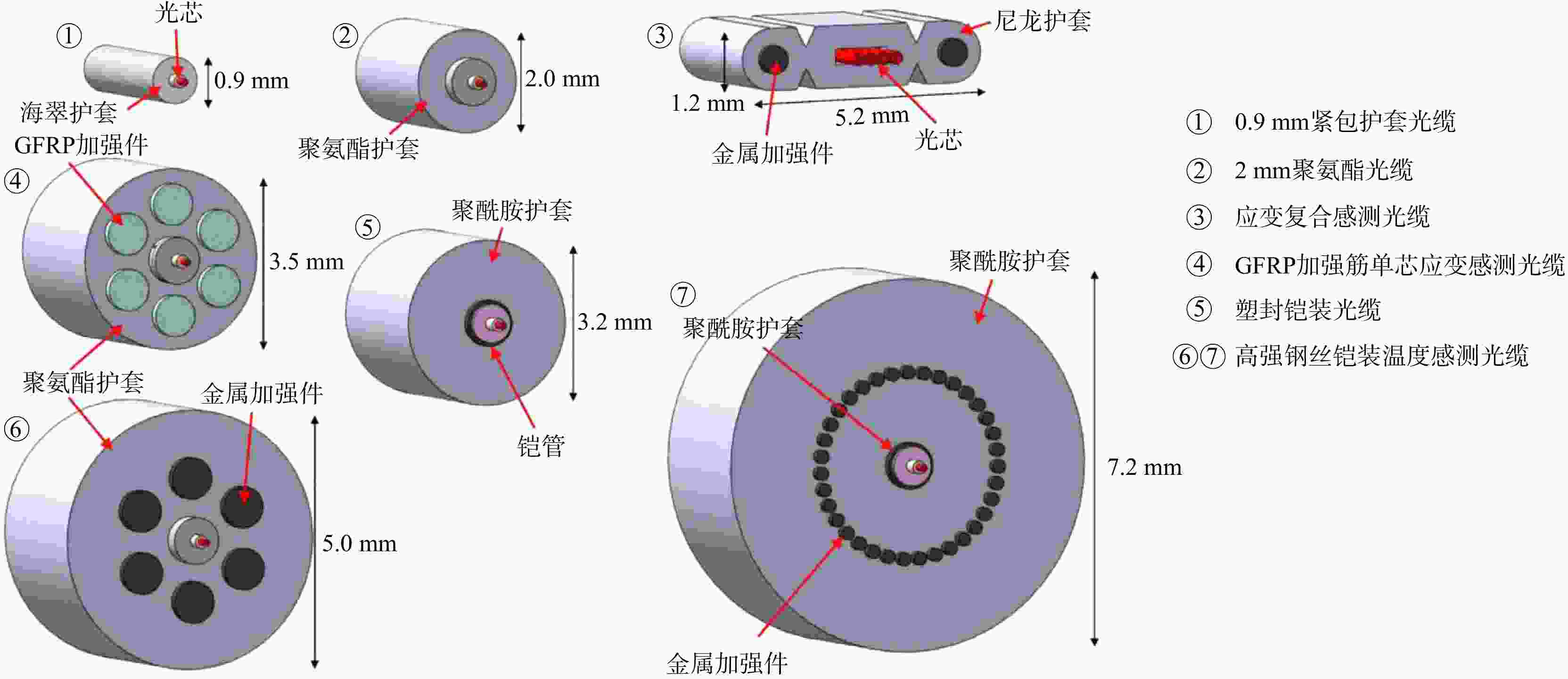
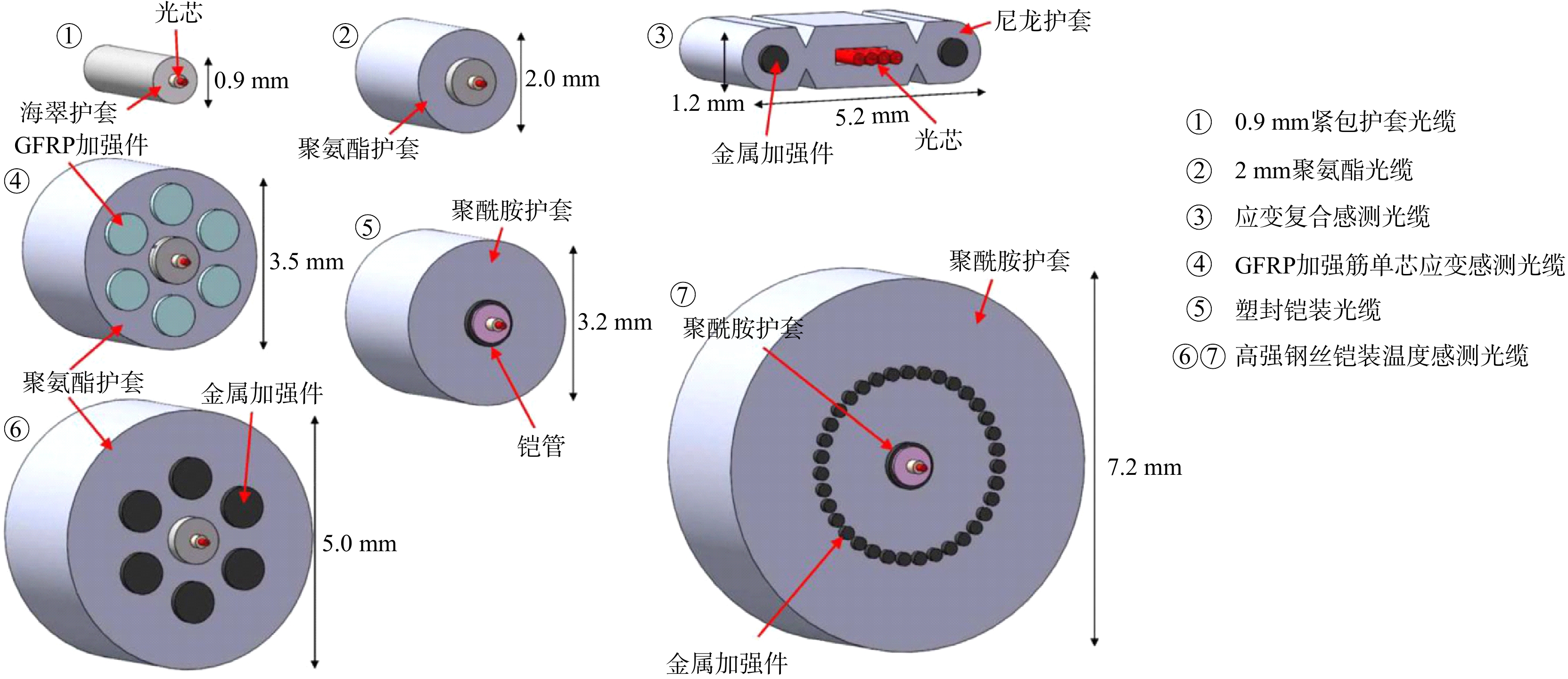
图 2 光缆的结构简图[17](GFRP. 玻璃纤维增强聚合物)
Figure 2. Schematic diagrams of optical fiber cable structure
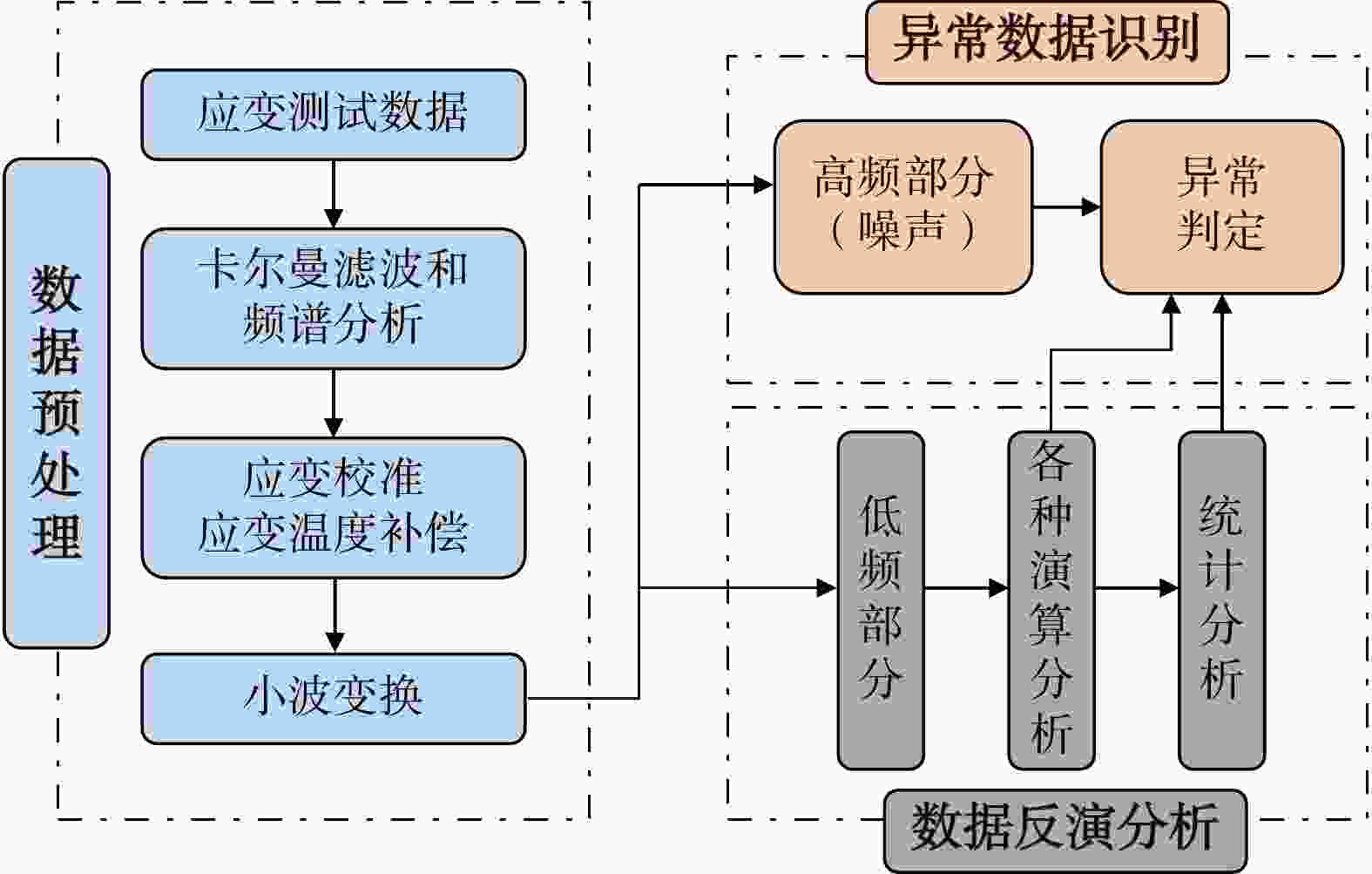
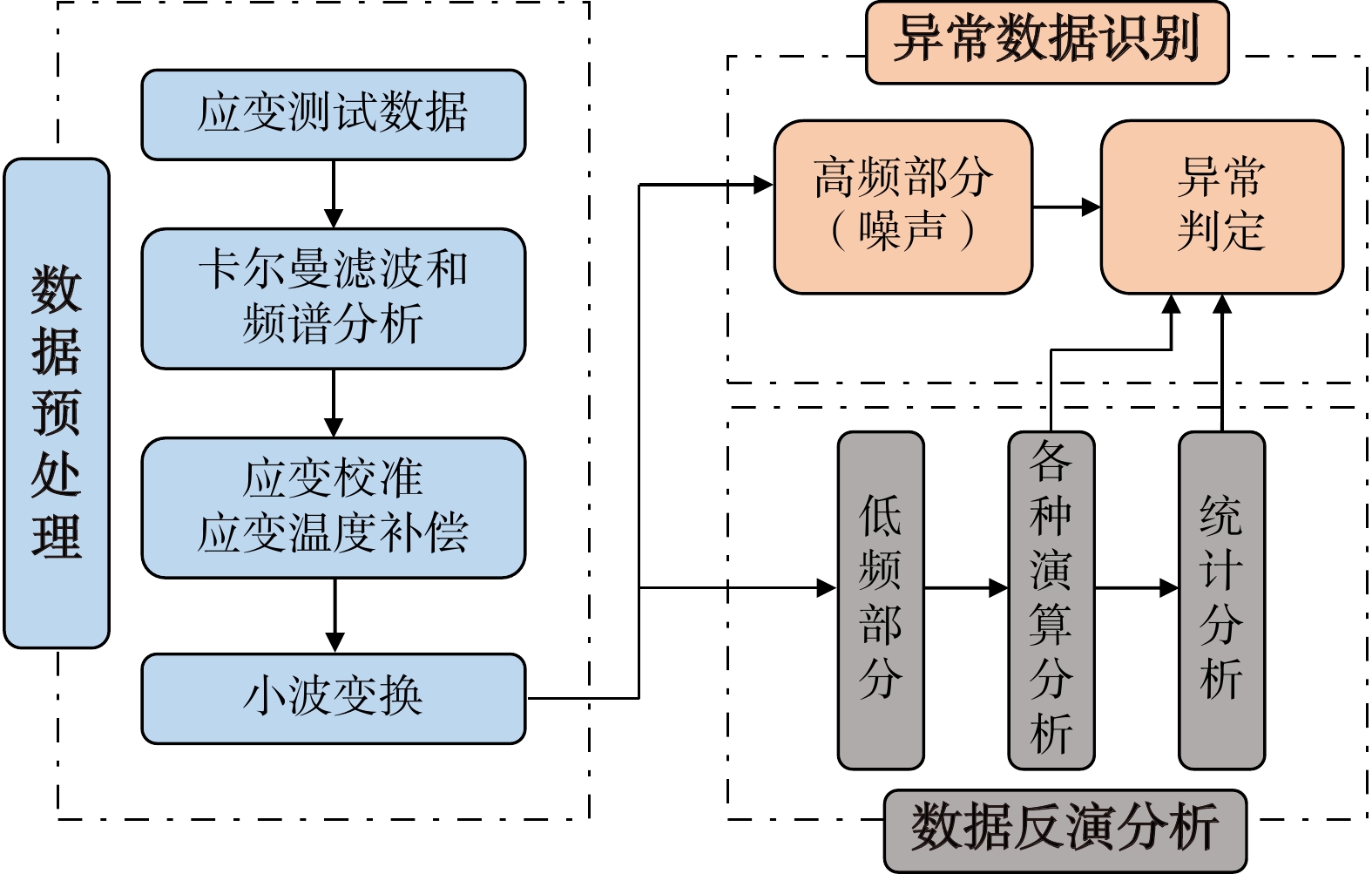
图 4 分布式光纤监测数据处理流程
Figure 4. Data processing workflow of distributed optic fiber monitoring data
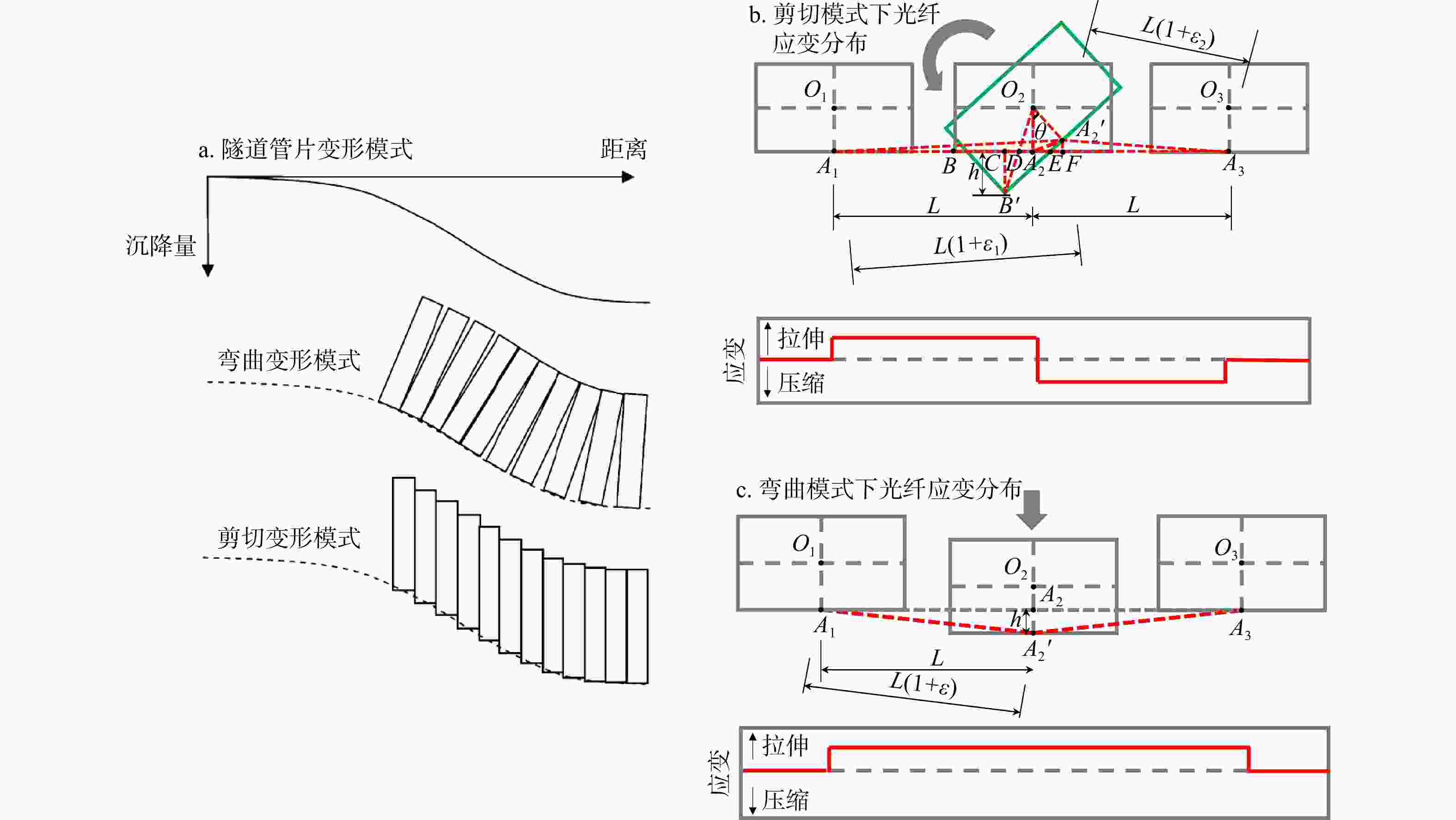
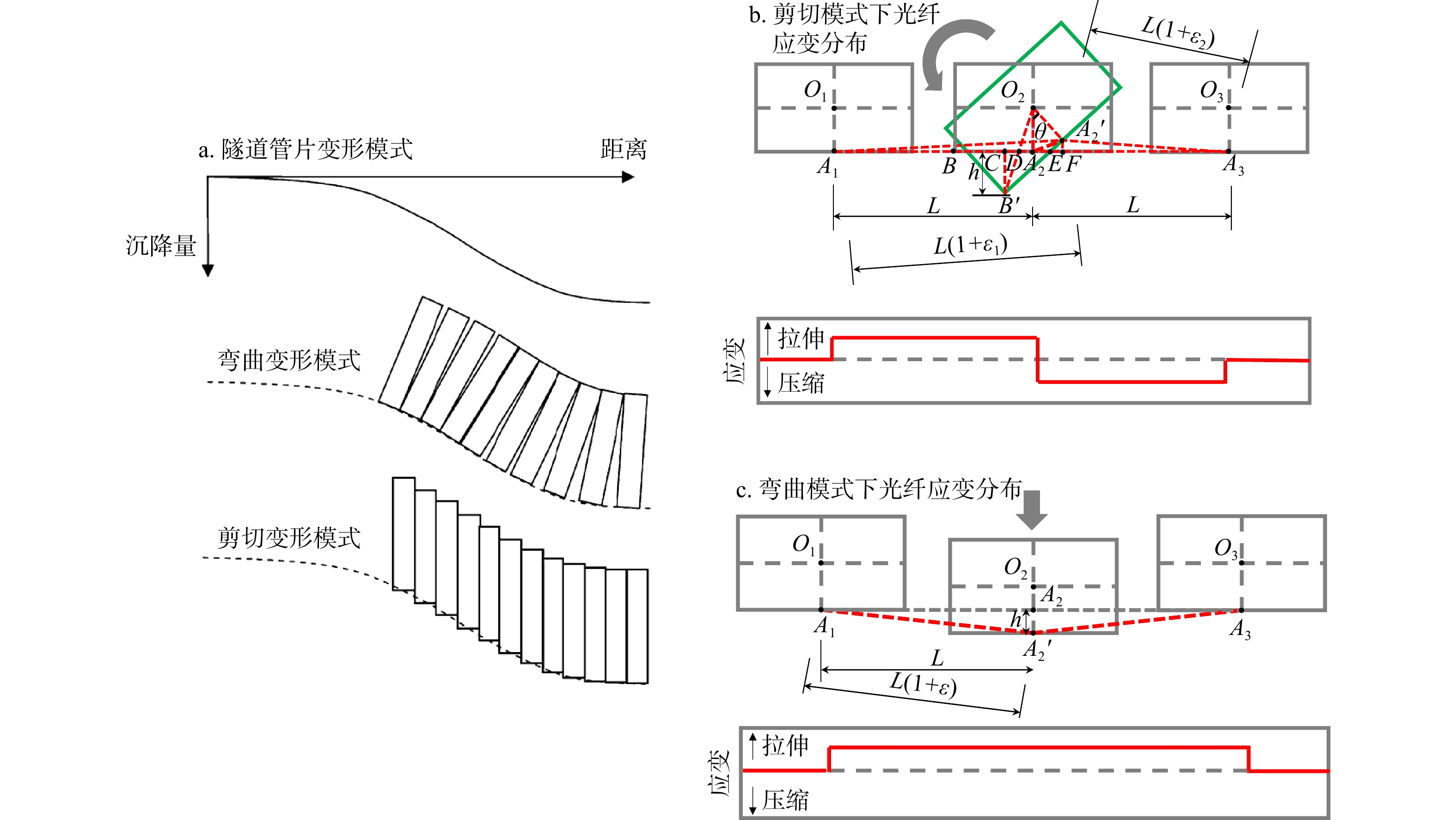
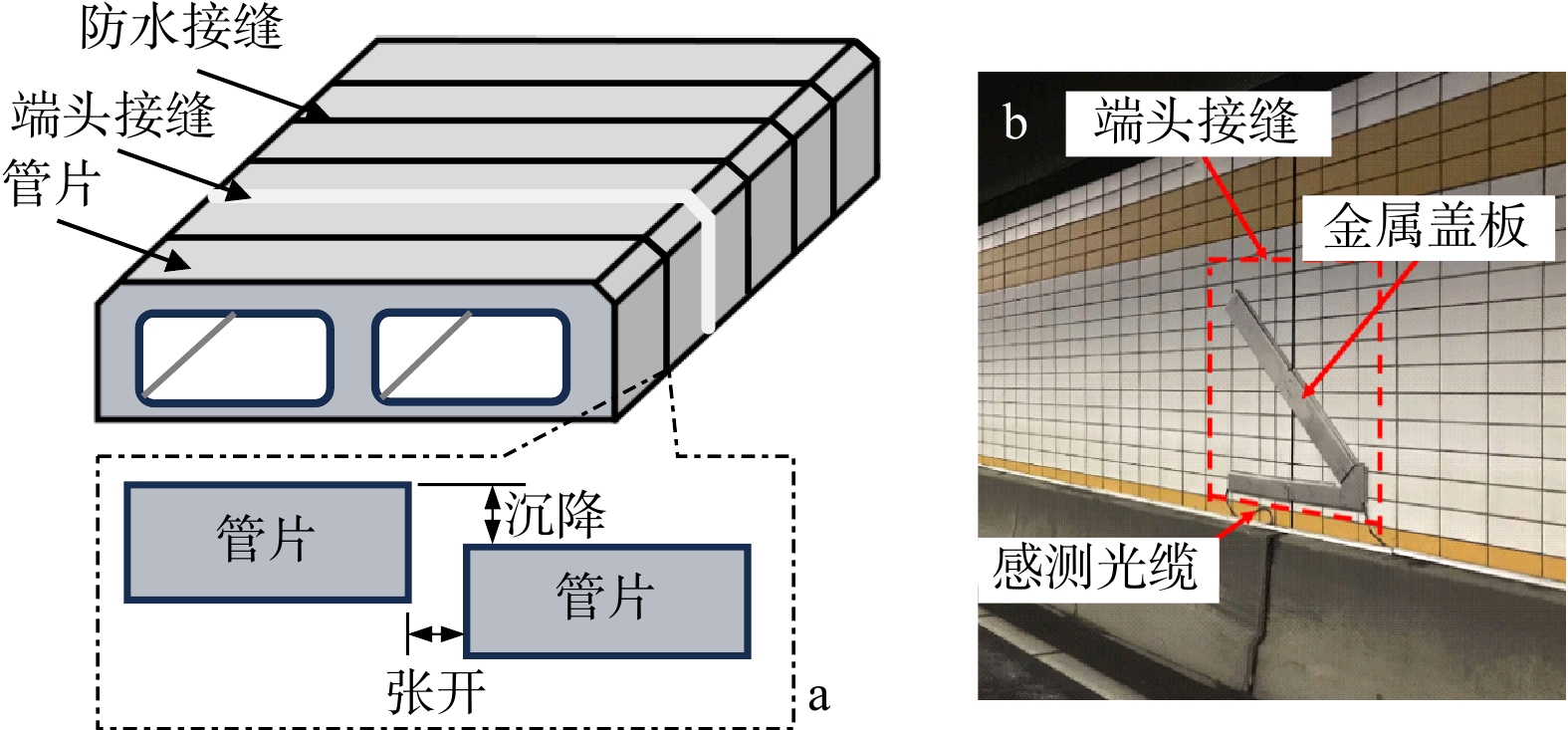
图 5 剪切和弯曲变形作用下光缆应变分布模式[20]
h. 管片错动距离;θ. 管片旋转角度;L. 管片中心间距;$ {\varepsilon }_{1} $,$ {\varepsilon }_{2} $,$ \varepsilon $. 相邻管片表面光纤发生的应变;Q1,Q2,Q3. 管片中心点;A1,A2,A'2,A3,B,B',C,D,E,F. 位置编号
Figure 5. Strain distribution patterns of optical fiber cable under shear and bending deformation
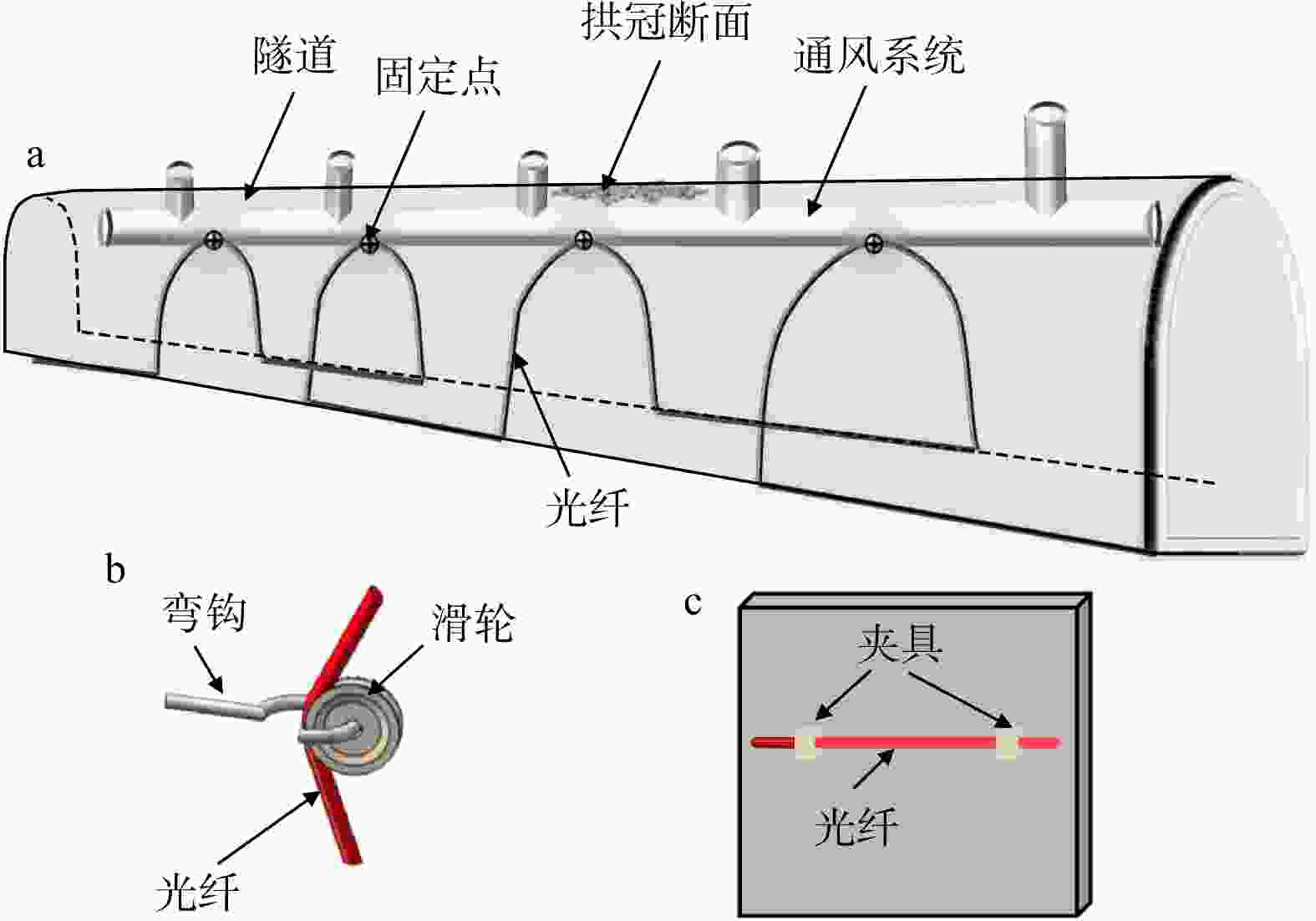
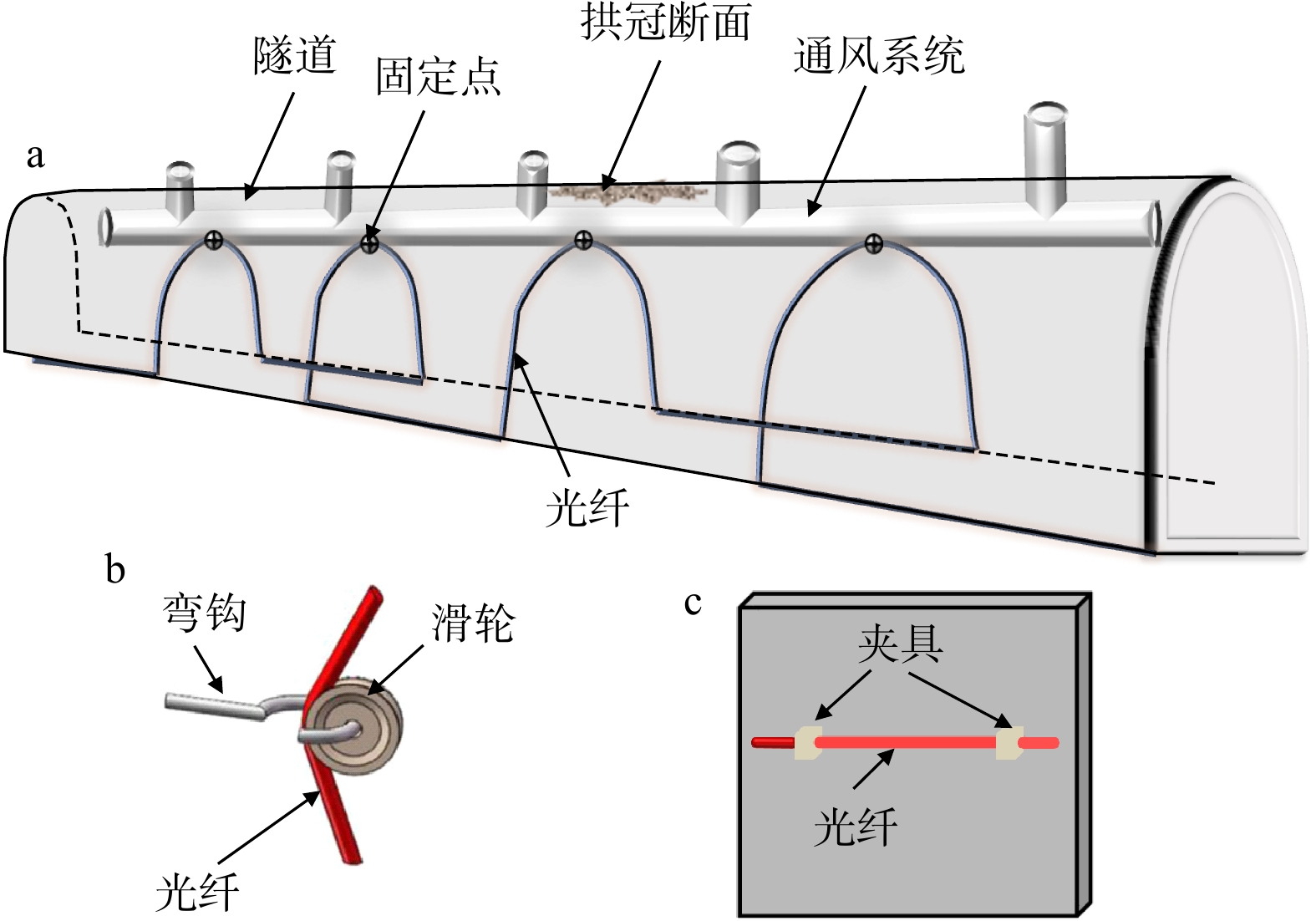
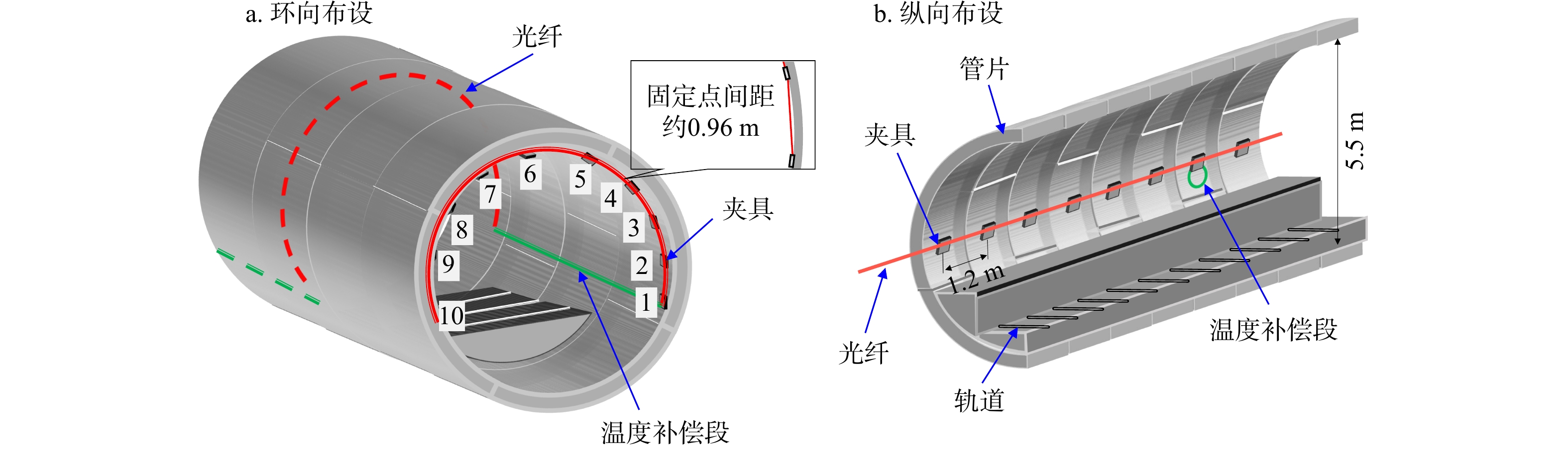
图 7 伦敦某古老隧道监测布置图[13]
a. 光纤布设示意图;b. 环向滑轮固定点;c. 纵向夹具固定点
Figure 7. Monitoring layout of an ancient tunnel in London
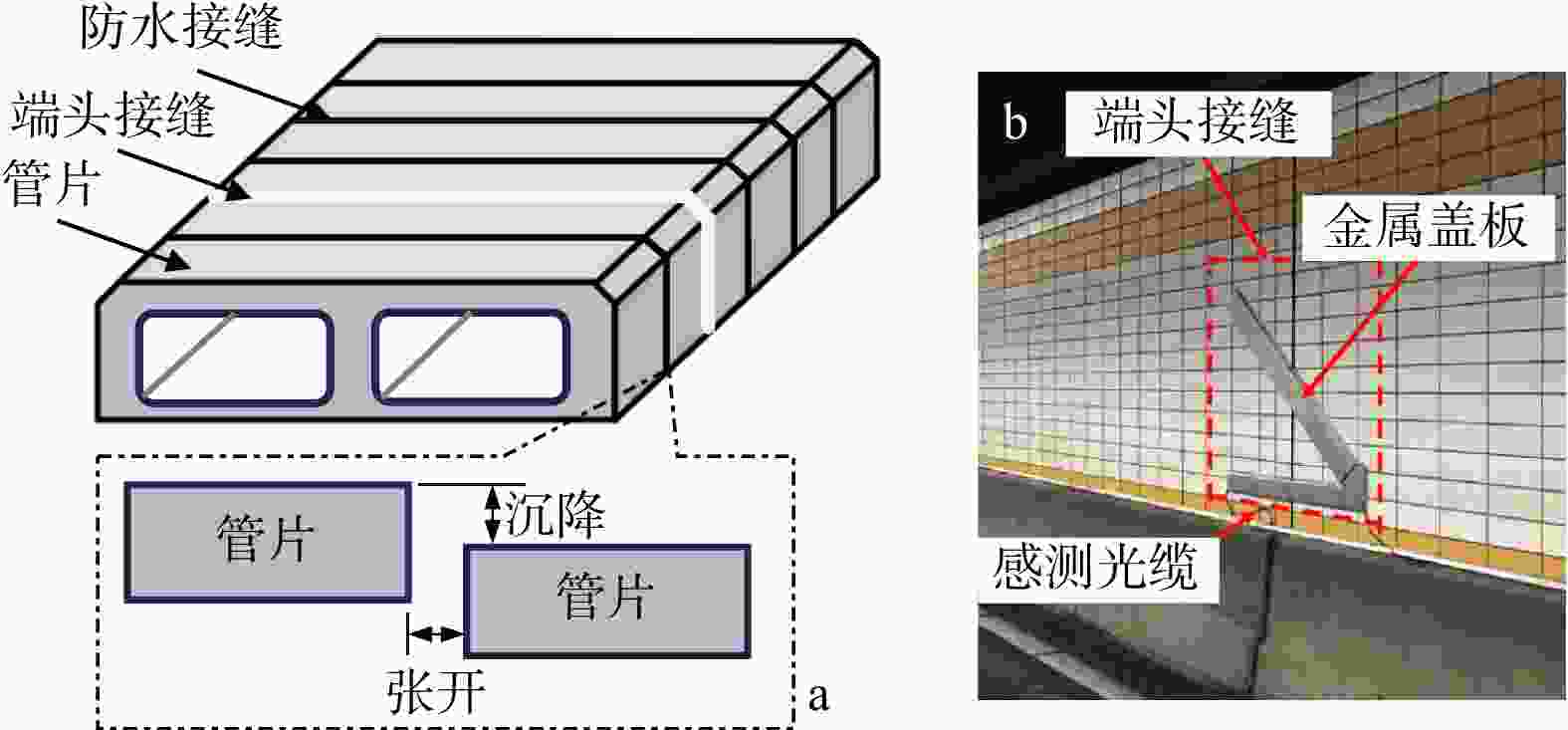
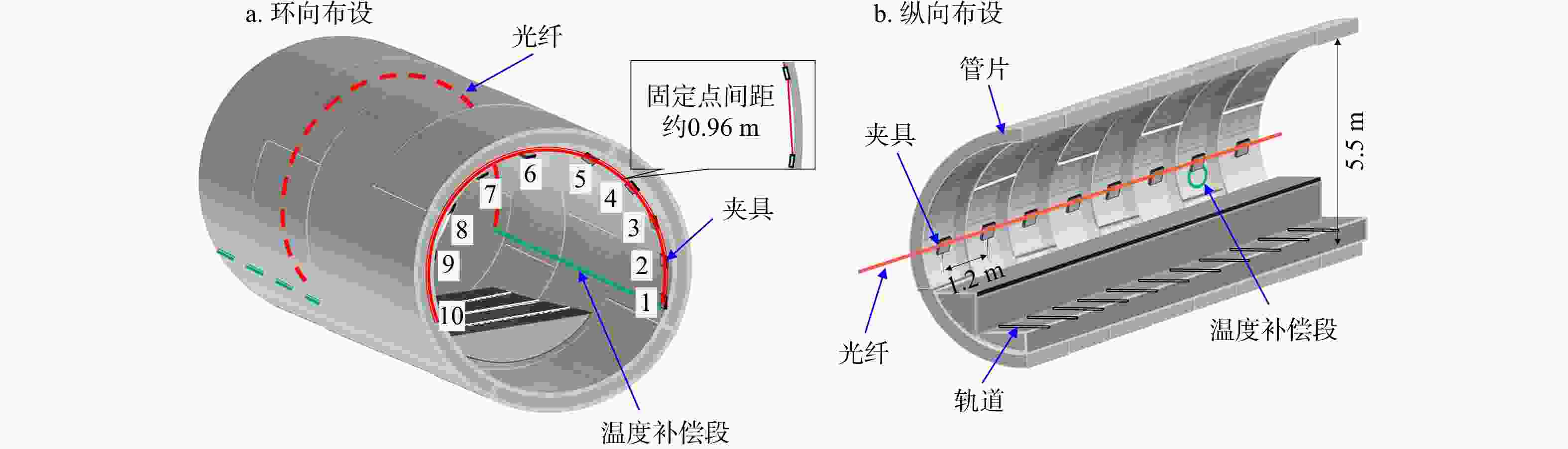
图 9 苏州地铁二号线光缆布置示意图[20](1~10. 固定点编号)
Figure 9. Optical fiber cable layout of Suzhou Metro Line 2
表 1 布里渊光时域传感技术与其他监测技术对比
Table 1. Comparison of Brillouin optical time-domain sensing technology with other techniques
对比维度 点式传感器(应变计、位移计) 大地测量方法(全站仪等) 三维激光扫描技术 布里渊光时域传感技术(BOTDR,BOTDA) 测量形式 离散点 离散点 表面面状 连续分布式 空间分辨率 单点(间距通常≥1~5 m) 通常 ≥5~20 m 5~20 mm(表面点云) BOTDR:0.05~1 m;BOTDA:0.02~1 m 测量精度 应变:±1~5 με;位移:±0.01~0.1 mm 位移:±1~3 mm 位置精度:±2~5 mm 应变:±1~50 με 监测距离 单点或局部(<100 m) 通常<1~2 km 单次扫描断面(10~100 m) BOTDR:10~30 km;BOTDA:5~10 km 测点数量 数十个 数十至上百个 数百万点(表面) 等效测点数 10³~10⁵级 是否连续监测 可(局部) 否(周期测量) 否(周期扫描) 是(全线连续) 时间分辨率 秒−分钟级 天−周级 天−周级 秒−分钟级 反映结构内部状态 可以(局部) 否 否 可以(沿衬砌或结构布设) 长期稳定性 易受老化影响 依赖人工 设备敏感 光纤寿命 ≥20~30 a 典型适用场景 关键部位精细监测 变形普查 断面(局部)形态分析 长距离隧道全寿命期监测  下载: 导出CSV
表 2 BOTDA和BOTDR 2种技术区别
Table 2. Differences between BOTDA and BOTDR technologies
特征 BOTDR BOTDA 工作原理 发射单个泵浦脉冲,通过测量其反射信号的频移来确定应变和温度 发送泵浦脉冲和探测脉冲,通过两者的交叉相互作用来测量布里渊频移 信号来源 仅使用回波反射信号 使用泵浦脉冲与探测脉冲的交叉作用产生散射信号 测量方式 基于时间域反射,
适用于单端测量基于频率域分析,适用于双端测量或分布式长距离测量 应用范围 最长的测量距离可以达到80 km,尤其是隧道、
管道等结构最长的测量距离可以达到50 km,适用于高精度、短距离的分布式应变和温度监测 测量精度 ±10~50 με ±1~10 με 空间采样间隔 0.05~1 m 0.02~1 m 测量时间 秒级 秒−分钟级 主要设备
型号国产AV6419型BOTDR 日本NBX‑ 6000 系列(如NBX‑6026 、NBX‑6166 )
下载: 导出CSV
-
[1] 牌立芳, 吴红刚, 梁柯鑫, 等. 隧道横穿主滑面系统“成灾模式–监测数据”双驱动地震损伤评价方法[J]. 岩石力学与工程学报, 2024, 43(增刊2): 3841-3860.PAI L F, WU H G, LIANG K X, et al. Seismic damage assessment method of "disaster model-monitoring data" dual-drive for tunnel crossing main-sliding surface system[J]. Chinese Journal of Rock Mechanics and Engineering, 2024, 43(S2): 3841-3860. (in Chinese with English abstract [2] LAI J X, ZHOU H, WANG K, et al. Shield-driven induced ground surface and Ming Dynasty city wall settlement of Xi'an metro[J]. Tunnelling and Underground Space Technology, 2020, 97: 103220. doi: 10.1016/j.tust.2019.103220 [3] 韩晨希, 黄宏伟, 欧阳凌涵, 等. 软土地基下城市超长地铁隧道的沉降与变形监测及时空数据插补方法[J]. 地质科技通报, 2024, 43(6): 152-161.HAN C X, HUANG H W, OUYANG L H, et al. Settlement and deformation monitoring and spatio-temporal data interpolation method for urban ultra long subway tunnels under soft soil foundation[J]. Bulletin of Geological Science and Technology, 2024, 43(6): 152-161. (in Chinese with English abstract [4] CHEN R P, MENG F Y, LI Z C, et al. Investigation of response of metro tunnels due to adjacent large excavation and protective measures in soft soils[J]. Tunnelling and Underground Space Technology, 2016, 58: 224-235. doi: 10.1016/j.tust.2016.06.002 [5] 马宁, 李韶凯, 田峰, 等. 滑坡光纤神经感测系统: 技术与应用[J]. 地质科技通报, 2024, 43(6): 26-38. doi: 10.19509/j.cnki.dzkq.tb20240422MA N, LI S K, TIAN F, et al. Fiber optic nerve sensing system for landslide monitoring: Technology and application[J]. Bulletin of Geological Science and Technology, 2024, 43(6): 26-38. (in Chinese with English abstract doi: 10.19509/j.cnki.dzkq.tb20240422 [6] GUE C Y, WILCOCK M, ALHADDAD M M, et al. The monitoring of an existing cast iron tunnel with distributed fibre optic sensing (DFOS)[J]. Journal of Civil Structural Health Monitoring, 2015, 5(5): 573-586. doi: 10.1007/s13349-015-0109-8 [7] 张雨蒙, 魏纲, 柳献. 基于激光扫描点云的盾构隧道结构横截面变形提取方法研究[J]. 隧道建设(中英文), 2024, 44(9): 1852-1862. doi: 10.3973/j.issn.2096-4498.2024.09.014ZHANG Y M, WEI G, LIU X. A cross-sectional deformation tracking method for laser scanning point clouds of shield tunnel linings[J]. Tunnel Construction, 2024, 44(9): 1852-1862. (in Chinese with English abstract doi: 10.3973/j.issn.2096-4498.2024.09.014 [8] LI Y H, XU S D, LIU J P. A new convergence monitoring system for tunnel or drift based on draw-wire displacement sensors[J]. Tunnelling and Underground Space Technology, 2015, 49: 92-97. doi: 10.1016/j.tust.2015.04.005 [9] 魏绍军, 廖孟光, 邱丙水. 基于分布式光纤的地铁隧道安全风险监测技术及其应用[J]. 测绘通报, 2024(6): 164-170. doi: 10.13474/j.cnki.11-2246.2024.0628WEI S J, LIAO M G, QIU B S. Subway tunnel safety risk monitoring technology and application based on distributed optical fiber[J]. Bulletin of Surveying and Mapping, 2024(6): 164-170. (in Chinese with English abstract doi: 10.13474/j.cnki.11-2246.2024.0628 [10] 莫伟樑, 杨雨冰, 林越翔, 等. 基于OFDR技术的盾构隧道管片错台变形测量与计算方法[J]. 现代隧道技术, 2022, 59(5): 179-187. doi: 10.13807/j.cnki.mtt.2022.05.022MO W L, YANG Y B, LIN Y X, et al. Measurement and calculation method for shield tunnel segment dislocation deformation based on OFDR technology[J]. Modern Tunnelling Technology, 2022, 59(5): 179-187. (in Chinese with English abstract doi: 10.13807/j.cnki.mtt.2022.05.022 [11] 董鹏, 夏开文, 于长一, 等. 浅埋隧道覆岩变形沉降的分布式光纤监测与分析[J]. 防灾减灾工程学报, 2019, 39(5): 724-732. doi: 10.13409/j.cnki.jdpme.2019.05.005DONG P, XIA K W, YU C Y, et al. Monitoring and analysis of stratum deformation and subsidence overlying a shallow tunnel using distributed optical fiber sensing technology[J]. Journal of Disaster Prevention and Mitigation Engineering, 2019, 39(5): 724-732. (in Chinese with English abstract doi: 10.13409/j.cnki.jdpme.2019.05.005 [12] 丁勇, 施斌, 孙宇, 等. 基于BOTDR的白泥井3号隧道拱圈变形监测[J]. 工程地质学报, 2006, 14(5): 649-653. doi: 10.3969/j.issn.1004-9665.2006.05.014DING Y, SHI B, SUN Y, et al. Monitoring on the arch rings deformation in the No. 3 tunnel of Bainijing with BOTDR based strain measurement technique[J]. Journal of Engineering Geology, 2006, 14(5): 649-653. (in Chinese with English abstract doi: 10.3969/j.issn.1004-9665.2006.05.014 [13] MOHAMAD H, SOGA K, BENNETT P J, et al. Monitoring twin tunnel interaction using distributed optical fiber strain measurements[J]. Journal of Geotechnical and Geoenvironmental Engineering, 2012, 138(8): 957-967. doi: 10.1061/(ASCE)GT.1943-5606.0000656 [14] ZHU H H, SHI B, ZHANG J, et al. Distributed fiber optic monitoring and stability analysis of a model slope under surcharge loading[J]. Journal of Mountain Science, 2014, 11(4): 979-989. doi: 10.1007/s11629-013-2816-0 [15] SCHENATO L. A review of distributed fibre optic sensors for geo-hydrological applications[J]. Applied Sciences, 2017, 7(9): 896. doi: 10.3390/app7090896 [16] YANG F Y, FENG X, ZHANG J, et al. Structural damage identification of subseabed shield tunnels based on distributed fiber optic sensors and information fusion[J]. Tunnelling and Underground Space Technology, 2023, 139: 105215. doi: 10.1016/j.tust.2023.105215 [17] ZHANG X H, ZHU H H, JIANG X, et al. Distributed fiber optic sensors for tunnel monitoring: A state-of-the-art review[J]. Journal of Rock Mechanics and Geotechnical Engineering, 2024, 16(9): 3841-3863. doi: 10.1016/j.jrmge.2024.01.008 [18] LIU Q S, WANG J T, XIAO L G, et al. Application of OFDR-based sensing technology in geo-mechanical model test on tunnel excavation using cross rock pillar method[J]. Chinese Journal of Rock Mechanics and Engineering, 2017, 36(5): 1063-1075. [19] GUO W Q, FENG K, LU X Y, et al. Experimental investigation on the damage evolution and failure mechanism of segmental joints based on DOFS and AE[J]. Engineering Failure Analysis, 2023, 152: 107471. doi: 10.1016/j.engfailanal.2023.107471 [20] ZHU H H, WANG D Y, SHI B, et al. Performance monitoring of a curved shield tunnel during adjacent excavations using a fiber optic nervous sensing system[J]. Tunnelling and Underground Space Technology, 2022, 124: 104483. doi: 10.1016/j.tust.2022.104483 [21] DE BATTISTA N, ELSHAFIE M, SOGA K, et al. Strain monitoring using embedded distributed fibre optic sensors in a sprayed concrete tunnel lining during the excavation of cross-passages[C]//Anon. Proceedings of the 7th International Conference on Structural Health Monitoring of Intelligent Infrastructure. [S. l. ]: [s. n. ], 2015: 1-3. [22] LI Z X, HOU G Y, HU T, et al. A study on the application of the distributed optical fiber sensing monitoring technology in the process of dismantling temporary tunnel shoring[J]. Arabian Journal of Geosciences, 2020, 13(19): 1036. doi: 10.1007/s12517-020-06069-0 [23] LI C, SUN Y, ZHAO Y G, et al. Monitoring pressure and thermal strain in the second lining of a tunnel with a Brillouin OTDR[J]. Smart Materials and Structures, 2006, 15(5): N107-N110. doi: 10.1088/0964-1726/15/5/N01 [24] CUI Y, LI Z, WEI G, et al. Pre-protection effect of underground comprehensive pipe gallery over proposed tunnel[J]. Journal of Zhejiang University (Engineering Science), 2021, 55(2): 330-337. [25] XUE X H, XIE Y L, ZHOU X X. Study on the life-cycle health monitoring technology of water-rich loess tunnel[J]. Advances in Materials Science and Engineering, 2019, 2019(1): 9461890. [26] GRUNICKE U H, LIENHART W, VORWAGNER A. Long-term monitoring of visually not inspectable tunnel linings using fibre optic sensing[J]. Geomechanics and Tunnelling, 2021, 14(1): 19-32. doi: 10.1002/geot.202000051 [27] MINARDO A, CATALANO E, COSCETTA A, et al. Long-term monitoring of a tunnel in a landslide prone area by Brillouin-based distributed optical fiber sensors[J]. Sensors, 2021, 21(21): 7032. doi: 10.3390/s21217032 [28] IMAI M, MIZUNO S. Aqueduct tunnel convergence measurement using a distributed optical fiber sensor[C]//Anon. Optical Fiber Sensors Conference 2020 Special Edition. Washington, DC: Optica Publishing Group, 2021: T3.22. [29] 侯公羽, 李子祥, 胡涛, 等. 基于分布式光纤应变传感技术的隧道沉降监测研究[J]. 岩土力学, 2020, 41(9): 3148-3158. doi: 10.16285/j.rsm.2019.1929HOU G Y, LI Z X, HU T, et al. Study of tunnel settlement monitoring based on distributed optic fiber strain sensing technology[J]. Rock and Soil Mechanics, 2020, 41(9): 3148-3158. (in Chinese with English abstract doi: 10.16285/j.rsm.2019.1929 [30] 张驰. 苏州地铁盾构隧道结构变形分布式光纤监测技术研究[D]. 南京: 南京大学, 2015.ZHANG C. Research on the DFOS-based monitoring for the structural deformation of metro shield tunnel in Suzhou[D]. Nanjing: Nanjing University, 2015. (in Chinese with English abstract [31] 王兴. 盾构隧道变形光纤监测关键技术与应用研究[D]. 南京: 南京大学, 2017.WANG X. Key technology and application research in shield tunnel deformation monitroing based on fiber optic sensing technologies[D]. Nanjing: Nanjing University, 2017. (in Chinese with English abstract [32] 张诚成, 施斌, 朱鸿鹄, 等. 地面沉降分布式光纤监测土-缆耦合性分析[J]. 岩土工程学报, 2019, 41(9): 1670-1678. doi: 10.11779/CJGE201909011ZHANG C C, SHI B, ZHU H H, et al. Theoretical analysis of mechanical coupling between soil and fiber optic strain sensing cable for distributed monitoring of ground settlement[J]. Chinese Journal of Geotechnical Engineering, 2019, 41(9): 1670-1678. (in Chinese with English abstract doi: 10.11779/CJGE201909011 [33] 陈冬冬, 朱鸿鹄, 张诚成, 等. 考虑埋入长度效应的应变传感光纤-土体界面特性试验研究[J]. 工程地质学报, 2017, 25(4): 1027-1034.CHEN D D, ZHU H H, ZHANG C C, et al. Experimental study on strain sensing optical fiber-soil interfacial properties considering influence of embedment length[J]. Journal of Engineering Geology, 2017, 25(4): 1027-1034. (in Chinese with English abstract [34] LIN S Q, TAN D Y, YIN J H, et al. A novel approach to surface strain measurement for cylindrical rock specimens under uniaxial compression using distributed fibre optic sensor technology[J]. Rock Mechanics and Rock Engineering, 2021, 54(12): 6605-6619. doi: 10.1007/s00603-021-02648-z [35] XU H Z, ZHANG D. Wavelet-based data processing for distributed fiber optic sensors[C]//Anon. 2006 International Conference on Machine Learning and Cybernetics. Dalian: IEEE, 2009: 4040-4045. [36] FENG X, ZHANG X T, SUN C S, et al. Stationary wavelet transform method for distributed detection of damage by fiber-optic sensors[J]. Journal of Engineering Mechanics, 2014, 140(4): 04013004. doi: 10.1061/(ASCE)EM.1943-7889.0000679 [37] 王角. 分布式光纤传感振动信号二维去噪方法研究[D]. 北京: 北京邮电大学, 2021.WANG J. Research on two-dimensional denoising method for vibration signals in distributed optical fiber sensing[D]. Beijing: Beijing University of Posts and Telecommunications, 2021. (in Chinese with English abstract [38] 傅建平. 小波去噪方法在光纤电流互感器中的应用研究[D]. 南昌: 南昌航空大学, 2019.FU J P. Application research of wavelet denoising method in fiber current transformer[D]. Nanchang: Nanchang Hangkong University, 2019. (in Chinese with English abstract [39] 柯天兵, 林琳, 李永倩, 等. 海缆布里渊光时域反射信号的去噪方法研究[J]. 激光技术, 2014, 38(3): 311-315.KE T B, LIN L, LI Y Q, et al. Study on denoising method of Brillouin optical time domain reflectometry signal of submarine cable[J]. Laser Technology, 2014, 38(3): 311-315. (in Chinese with English abstract [40] 邵向鑫, 王有朋, 张笑鸣, 等. 用于光纤传感的可调半软阈值小波去噪算法[J]. 激光与红外, 2020, 50(9): 1120-1125.SHAO X X, WANG Y P, ZHANG X M, et al. An adjustable semi-soft threshold wavelet denoising algorithm for optical fiber sensing[J]. Laser & Infrared, 2020, 50(9): 1120-1125. (in Chinese with English abstract [41] 殷瑞忠, 岳荣花, 徐东风, 等. 盾构隧道分布式沉降光纤监测技术应用研究[J]. 建筑技术, 2023, 54(21): 2613-2616.YIN R Z, YUE R H, XU D F, et al. Application of distributed optical fiber monitoring technology for shield tunnel settlement[J]. Architecture Technology, 2023, 54(21): 2613-2616. (in Chinese with English abstract [42] ZHANG X H, BROERE W. Design of a distributed optical fiber sensor system for measuring immersed tunnel joint deformations[J]. Tunnelling and Underground Space Technology, 2023, 131: 104770. doi: 10.1016/j.tust.2022.104770 [43] ZHANG X H, BROERE W. Monitoring of tidal variation and temperature change-induced movements of an immersed tunnel using distributed optical fiber sensors (DOFSs)[J]. Structural Control and Health Monitoring, 2023, 2023(1): 2419495. doi: 10.1155/2023/2419495 [44] WANG D Y, ZHU H H, HUANG J W, et al. Fiber optic sensing and performance evaluation of a water conveyance tunnel with composite linings under super-high internal pressures[J]. Journal of Rock Mechanics and Geotechnical Engineering, 2023, 15(8): 1997-2012. doi: 10.1016/j.jrmge.2023.02.026 [45] 王建宇. 理念的更新: 对软弱围岩隧道工程的思考[J]. 现代隧道技术, 2018, 55(6): 1-10.WANG J Y. The updated concept of conventional tunnelling in soft surrounding rocks[J]. Modern Tunnelling Technology, 2018, 55(6): 1-10. (in Chinese with English abstract [46] MONSBERGER C M, BAUER P, BUCHMAYER F, et al. Large-scale distributed fiber optic sensing network for short and long-term integrity monitoring of tunnel linings[J]. Journal of Civil Structural Health Monitoring, 2022, 12(6): 1317-1327. doi: 10.1007/s13349-022-00560-w [47] GAVIN K G, BROERE W, KOVAČEVIĆ M S, et al. Investigation of the remaining life of an immersed tube tunnel in the Netherlands[M]. Boca Raton: CRC Press, 2019: 4831-4838. [48] WANG S C, ZHANG X H, BAI Y. Comparative study on foundation treatment methods of immersed tunnels in China[J]. Frontiers of Structural and Civil Engineering, 2020, 14(1): 82-93. doi: 10.1007/s11709-019-0575-x [49] ZHANG X, WU X, BROERE W. Impact of subsoil spatial variability on deformations of immersed tunnel[M]. Boca Raton: CRC Press, 2021: 738-745. [50] 崔何亮, 张丹, 施斌. 布里渊分布式传感的空间分辨率及标定方法[J]. 浙江大学学报(工学版), 2013, 47(7): 1232-1237.CUI H L, ZHANG D, SHI B. Spatial resolution and its calibration method for Brillouin scattering based distributed sensors[J]. Journal of Zhejiang University (Engineering Science), 2013, 47(7): 1232-1237. (in Chinese with English abstract [51] 张卫兵, 王淑萍, 范启雄. BOTDR 温度监测技术在隧道工程中的应用研究[C]//刘代志. 国家安全地球物理丛书(九): 防灾减灾与国家安全. 西安: 西安地图出版社, 2013.ZHANG W B, WANG S P, FAN Q X. Application research of BOTDR temperature monitoring technology in tunnel engineering[C]//LIU D Z. Series on National Security Geophysics (9): Disaster Prevention and Mitigation & National Security. Xi'an: Xi'an Cartographic Publishing House, 2013. (in Chinese with English abstract [52] 张帅军, 李云. 光纤传感技术在城市地铁工程监测中的应用[J]. 隧道建设, 2010, 30(3): 262-267.ZHANG S J, LI Y. Application of optical fiber sensing technology in monitoring of urban metro works[J]. Tunnel Construction, 2010, 30(3): 262-267. (in Chinese with English abstract [53] GUE C, WILCOCK M, ALHADDAD M, et al. BOTDR distributed fibre optic strain sensing for the monitoring of an existing cast iron tunnel[D]. Cambridge: University of Cambridge, 2014. [54] LINKER R, KLAR A. Detection of tunnel excavation using fiber optic reflectometry: Experimental validation[J]. Detection and Sensing of Mines, Explosive Objects, and Obscured Targets Ⅹ Ⅷ, 2013, 8709: 87090X. doi: 10.1117/12.2015534 -

 下载:
下载:

 点击查看大图
计量
- 文章访问数: 667
- PDF下载量: 186
- 被引次数: 0