投审稿入口
投审稿入口


-
摘要:
地下水年龄蕴含着地下水循环与演化过程的信息,是重要的水文地质参数。通过对1975—2024年发表的
1804 篇基于示踪剂的地下水年龄研究领域论文系统的文献计量分析,梳理了该领域研究现状并解析了发展趋势。结果显示,该领域发文量总体呈指数上升趋势,美国、中国和德国在该领域居领先地位。关键词共现网络分析表明,地下水年龄主要在地下水水量、古气候和地下水质量3个研究领域发挥重要作用。从时间趋势看,早期3个主题的发展相对均衡;2002—2013年在社会需求驱动下更侧重于地下水水量的研究;2014—2024年在技术突破的驱动下开始重点关注古气候研究。近几十年来,原子阱痕量分析(ATTA)技术的突破和发展,使得长寿命放射性惰性气体同位素的应用成为可能,为构建130连续地下水年代学序列带来了新契机。除此之外,地下水年代学的重要发展方向包括但不限于发展单一示踪剂年龄校正模型、深化多示踪剂联用和耦合新技术方法等。Abstract:SignificanceGroundwater age contains critical information about groundwater circulation and evolutionary processes, which is an important hydrogeological parameter. A systematic bibliometric analysis of 1 804 papers published from 1975 to 2024 related to groundwater age with tracers is conducted to summarize the current research status and analyze development trends.
ProgressThe results reveal that the number of publications in this field has exhibited an overall exponential upward trend, with the United States, China, and Germany contributing the most publications. Keyword co-occurrence network analysis identifies three key research themes: groundwater quantity, paleoclimate, and groundwater quality. Temporal trends show relatively balanced development across these three themes from 1990 to 2001. During the period from 2002 to 2013, driven by social demand, research placed greater emphasis on groundwater quantity for groundwater resource management. During 2014 to 2024, driven by technological breakthroughs, research focus shifted toward paleoclimate studies to address climate change challenges.
Conclusion and ProspectOver the past two decades, breakthroughs in atom trap trace analysis (ATTA) technology have enabled the application of long-lived radioactive noble gas isotopes, creating new opportunities for constructing continuous groundwater chronology sequences spanning 1.3 million years. Important development trends in groundwater chronology include, but are not limited to, improvement of single-tracer age correction models, multi-tracer combination approaches, and coupling with groundwater numerical models. These advancements contribute to enhancing the precision and accuracy of groundwater age dating, providing theoretical support and technical guidance for groundwater resource management and climate change adaptation.
-
Key words:
- groundwater age /
- bibliometrics /
- age tracers /
- groundwater quantity /
- paleoclimate /
- groundwater quality
-
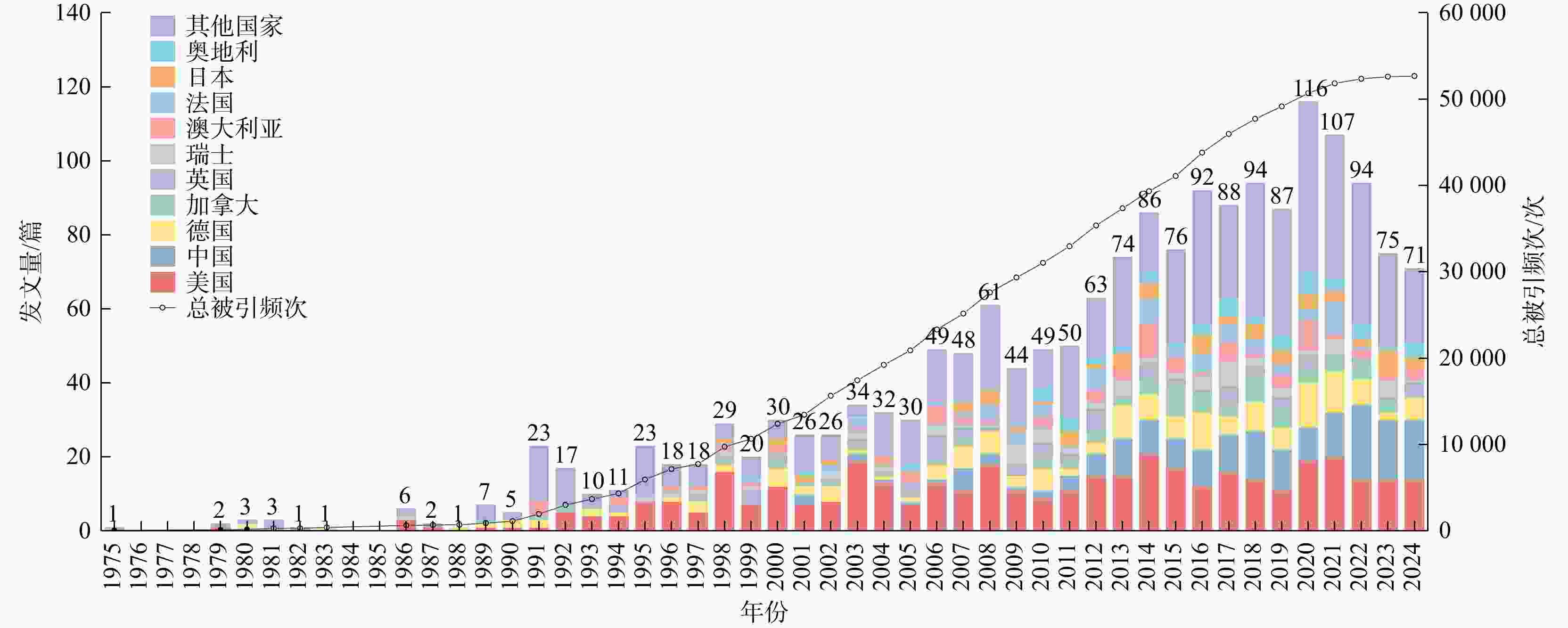
图 2 1975—2024年地下水年龄领域全球发文量趋势
Figure 2. Trends of global publication number in the field of groundwater age from 1975 to 2024
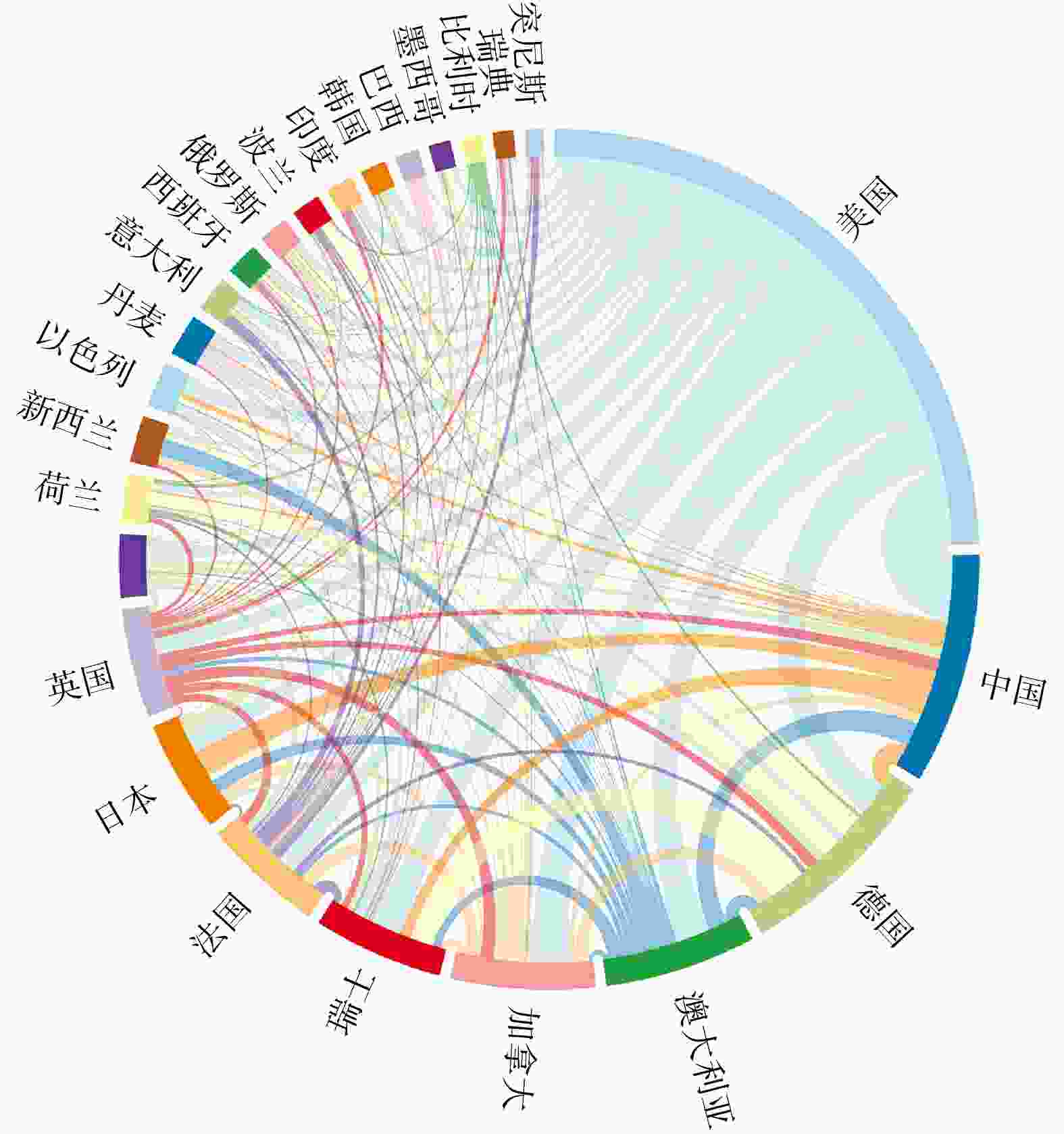
图 3 地下水年龄领域国际合作网络
圆弧长度代表该国参与国际合作的次数;国家间连线的粗细代表这2个国家的合作强度
Figure 3. International scientific collaboration network map in the field of groundwater age
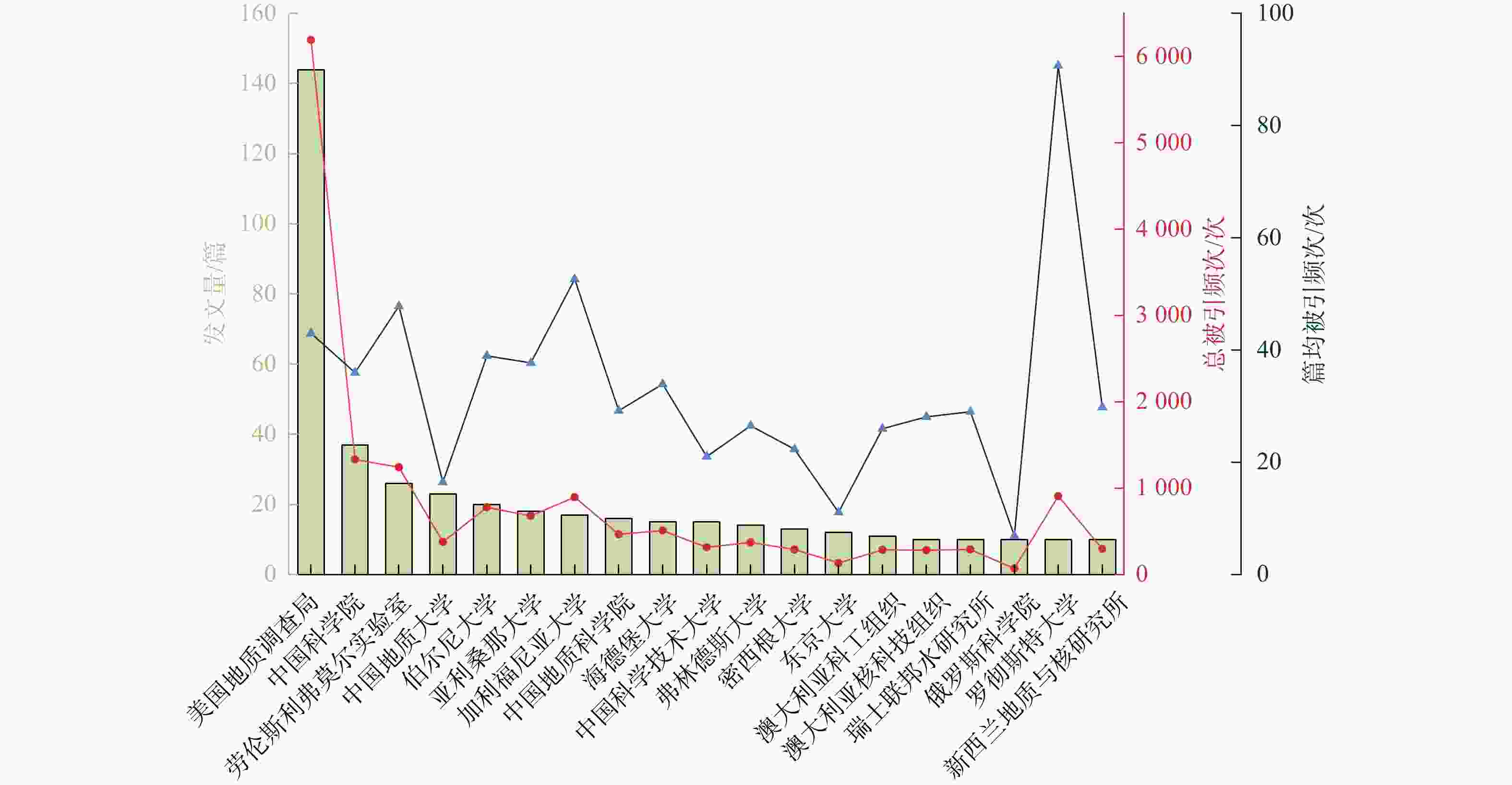
图 4 地下水年龄领域发文量最多的19个机构的发文量、总被引和篇均被引频次
Figure 4. Number of publications, total citations, and average citations per publication for top 19 institutions in the field of groundwater age
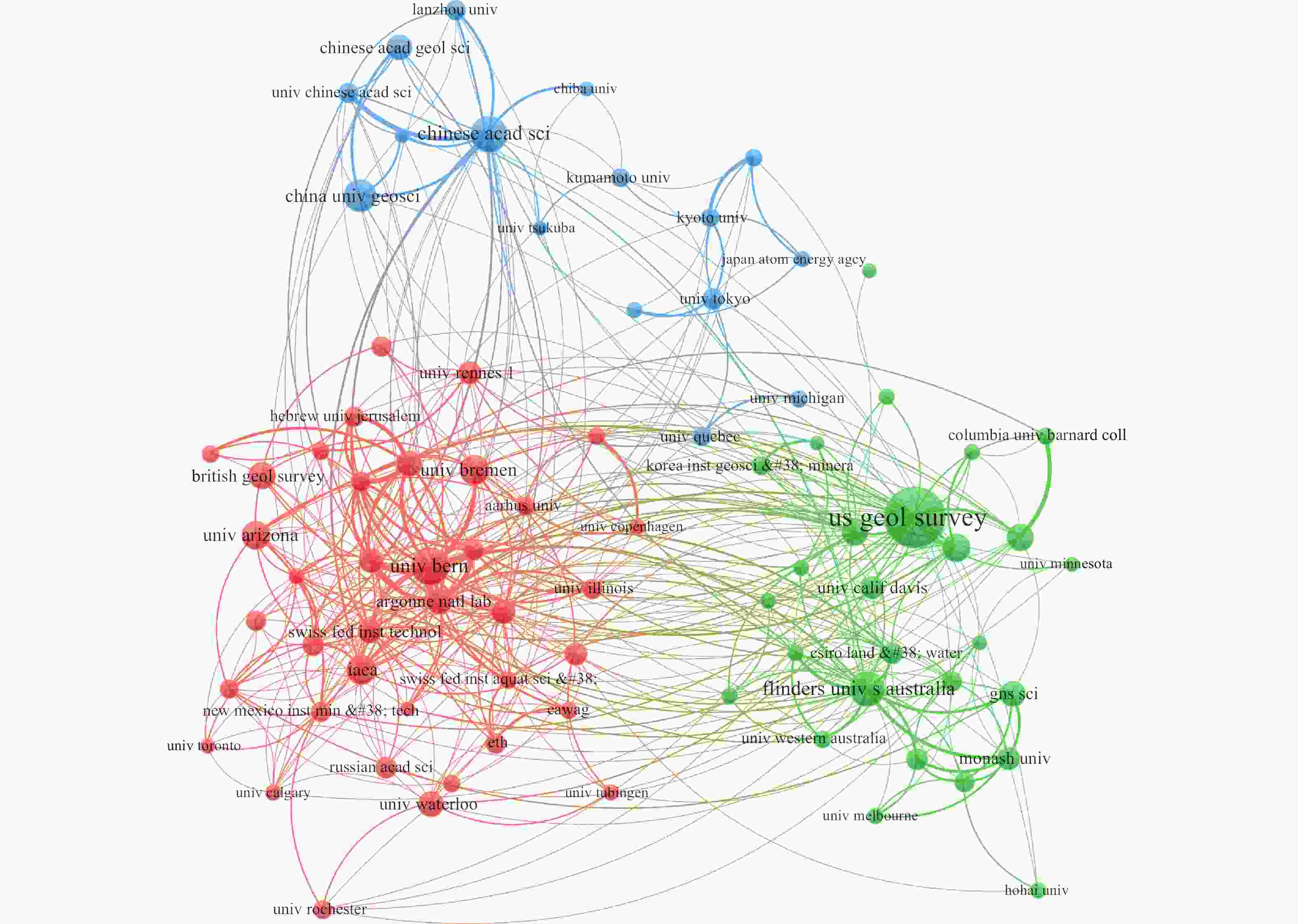
图 5 地下水年龄领域发文量≥10篇的机构的共现网络
圆圈大小代表发文量;连线粗细代表合作强度;红绿蓝3种颜色代表3个研究机构集群
Figure 5. Co-occurrence network of institutions with number of publications ≥10 in the field of groundwater age
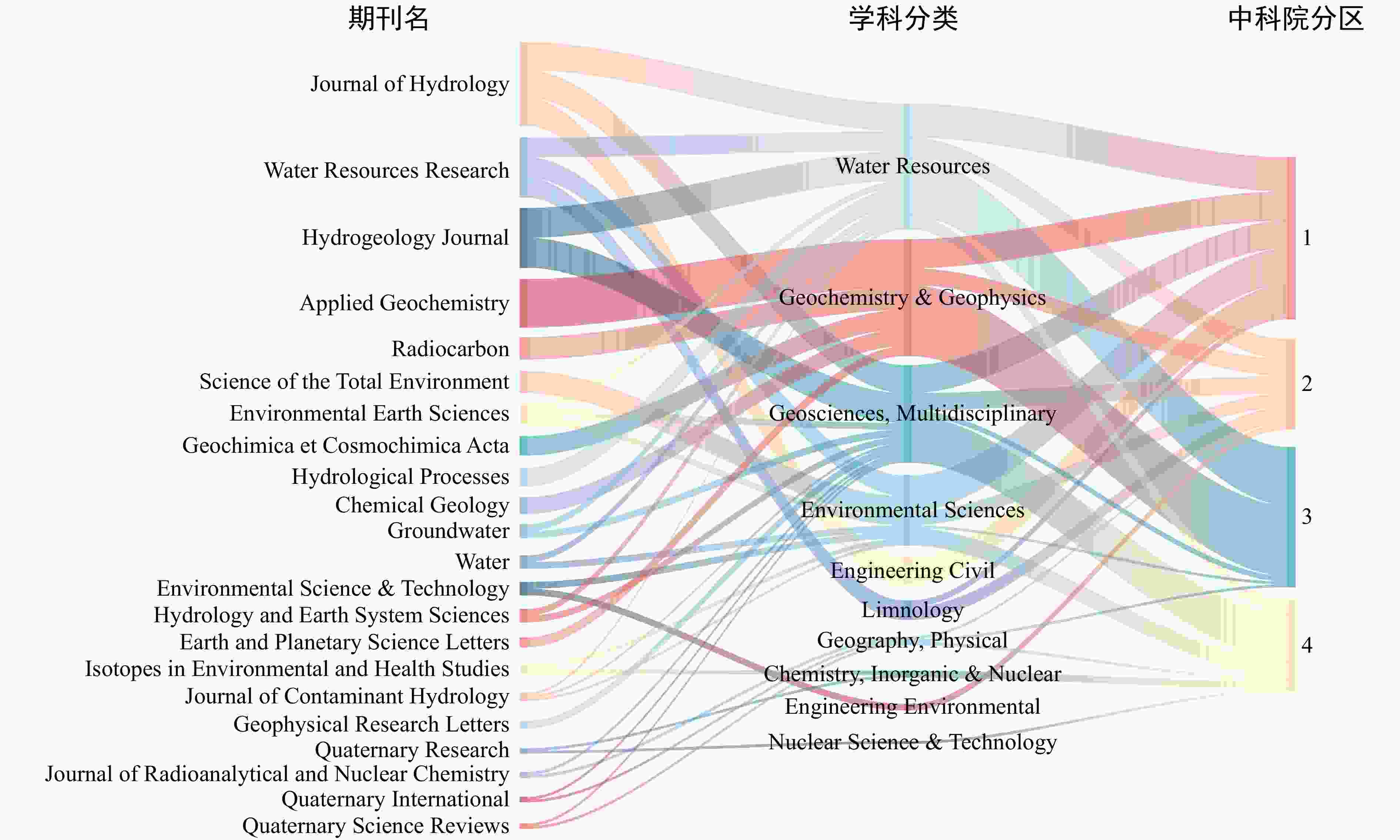
图 6 地下水年龄领域发文量前22期刊、学科及分区
Figure 6. Relationship among top 22 journals, disciplines, and rankings in the field of groundwater age
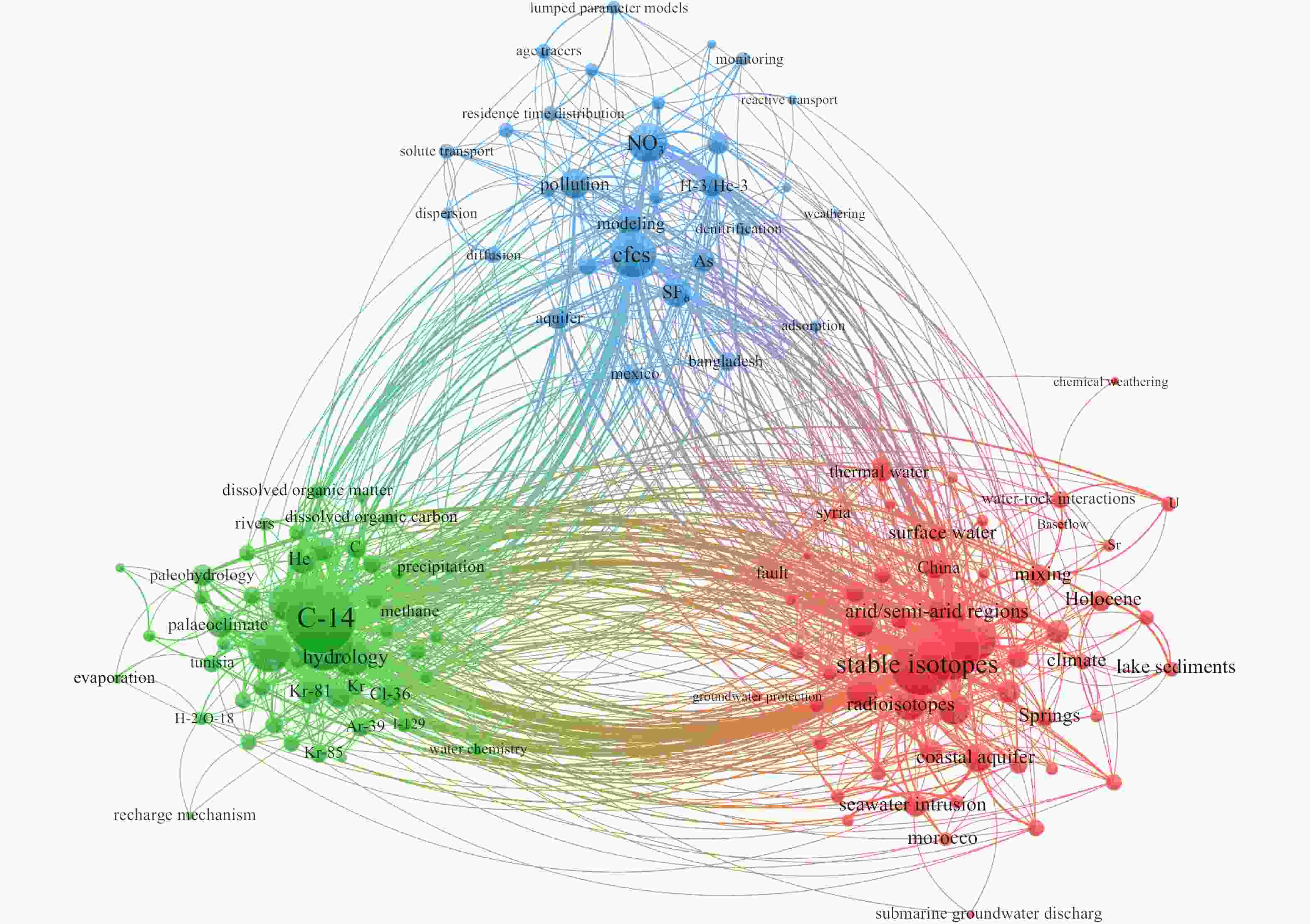
图 7 地下水年龄领域关键词共现网络
绿色集群为古气候研究主题;蓝色集群为地下水质量研究主题;红色集群为地下水水量研究主题;节点大小代表该关键词的出现频次
Figure 7. Keyword co-occurrence network in the field of groundwater age
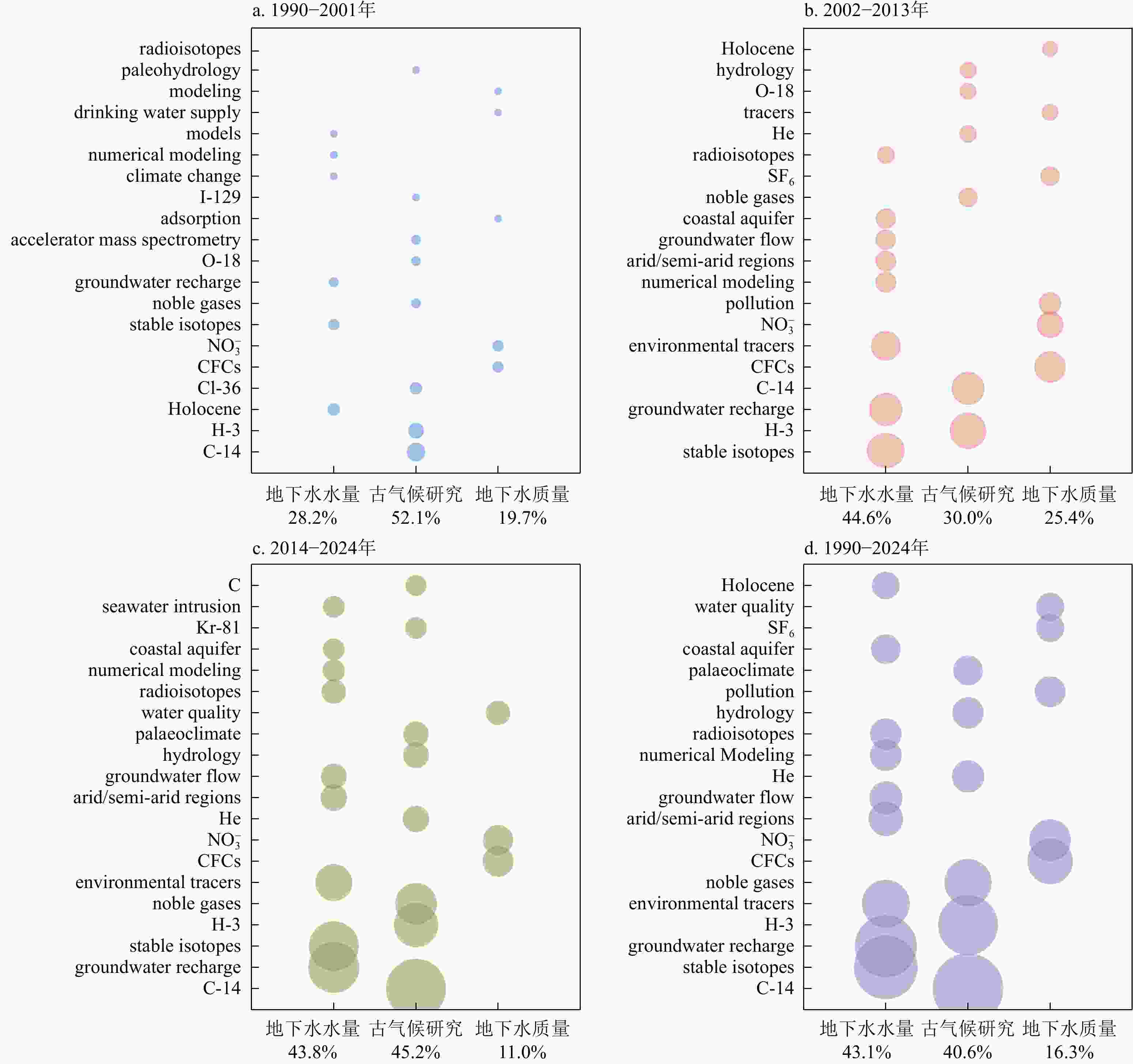
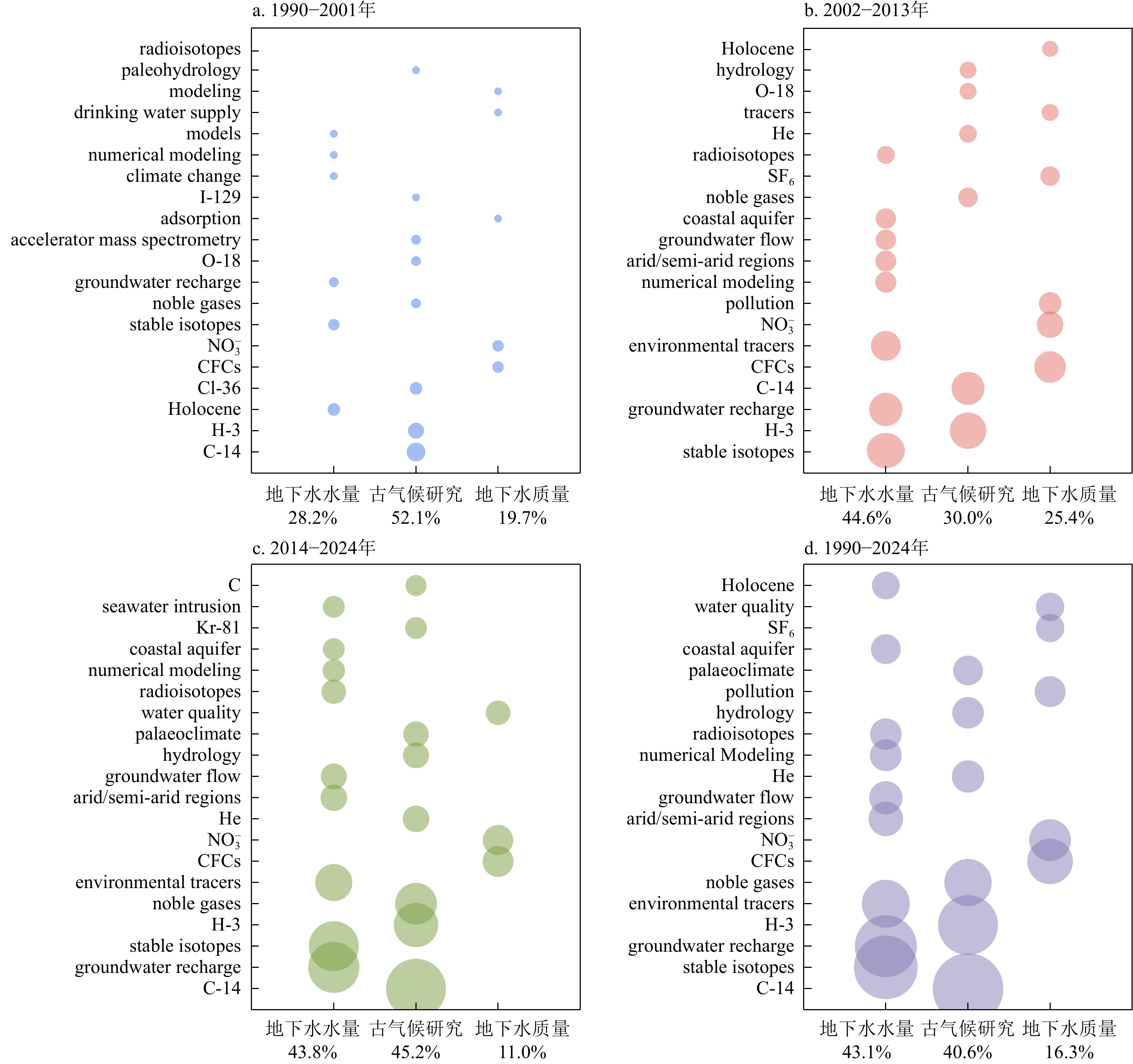
图 8 地下水年龄领域关键词贡献
圆圈面积代表每个关键词在这一阶段出现的频次
Figure 8. Keyword contributions in field of groundwater age
表 1 地下水年龄的主要示踪剂
Table 1. Major groundwater age tracers
示踪剂 半衰期 定年范围 主要来源 主要原理 优点 局限性与挑战 3H 12.43 a <70 a 宇宙射线生成、
人工核试验放射性衰变;根据剖
面浓度曲线上的核爆
峰值位置定年技术成熟,成本较低 输入函数难恢复[79];大气
浓度已近本底[80]3H/3He — 1~60 a 3H衰变产生3He 联合测定3H与其衰变
产物3He的比例不依赖3H输入函数;使核爆峰
增强更容易识别[81]需分离不同来源的3He;
存在3He逸散问题[73]14C 5730 a1~40 ka 宇宙射线生成
(大气中14CO2)放射性衰变 技术成熟,应用最广泛的
古地下水示踪剂初始值确定困难,存在
“死碳”混入,需校正模型[82]CFCs — 1~40 a 工业合成 与大气输入函数对比[83] 大气中混合均匀,输入函数已知[84] 易被微生物降解、与土壤颗粒和
有机质发生吸附和解吸[83-85];
已停产,大气浓度下降[86]SF6 — 1~40 a 工业合成 与大气输入函数对比 大气增长曲线理想,混合均匀[84],
不易受污染,不易降解吸附,
采样测试相对简单受“过量空气”[87]、深部来源影响[88-89] 4He — >100 a 地壳中U/Th系列衰变 积累速率(地壳产率) 定年范围极广 多来源(大气、深部地壳、地幔),定量精度差,需校正[90] 36Cl 301 ka 50 ka~1.3 Ma 宇宙射线生成、中子
活化(大气)[91]放射性衰变 测试相对简单 初始来源不确定,深部来源复杂[92-93] 81Kr 229 ka 50 ka~1.3 Ma 宇宙射线生成(大气) 放射性衰变 解释简单[74-76],是>50 ka古老地下水定年的“金标准”,可率定其他方法[74-75] 成本高,采样和测试门槛高,
个别地区存在深部来源[94]85Kr 10.76 a 1~50 a 核试验与核燃料
后处理释放放射性衰变 大气3H浓度衰减背景下的重要补充 输入函数受人为影响,在大气中分布不均匀,成本高,采样和测试门槛高 39Ar 269 a 50~ 1500 a宇宙射线生成(大气) 放射性衰变 在大气中的分布均匀且稳定,
填补了14C定年无法覆盖的范围存在地下来源干扰[95];成本高,
采样和测试门槛高 下载: 导出CSV
表 2 主要地下水年龄模型比较
Table 2. Comparison of major groundwater age models
模型类型 核心思想 优点 缺点 典型应用 集总参数模型(LPMs) 将系统视为“黑箱”,使用概率
分布函数描述年龄分布[102]无需详细水文地质参数;计算高效;适用于数据有限区域 无法反映地下水系统内部动态;
难以处理强烈瞬态过程[71,103-105] 混合单元模型(MCMs) 将系统划分为一系列离散单元,单元
之间在定义的时间步长内瞬时完全混合概念直观;半解析、半分布式 过度简化,忽略弥散;仅适用于简单或中等复杂系统;使用非保守示踪剂,需了解其浓度变化速率[106] [107-108] 直接年龄模型(DAMs) 直接模拟年龄空间分布的控制方程[109] 能完整刻画年龄时空分布;
适用于复杂非均质系统完全分布式方法,需要高分辨率数据;
计算成本大;校准困难[7][7,110]
下载: 导出CSV
-
[1] KUANG X X, LIU J G, SCANLON B R, et al. The changing nature of groundwater in the global water cycle[J]. Science, 2024, 383(6686): eadf0630. doi: 10.1126/science.adf0630 [2] SIEBERT S, BURKE J, FAURES J M, et al. Groundwater use for irrigation: A global inventory[J]. Hydrology and Earth System Sciences, 2010, 14(10): 1863-1880. doi: 10.5194/hess-14-1863-2010 [3] JASECHKO S, PERRONE D, BEFUS K M, et al. Global aquifers dominated by fossil groundwaters but wells vulnerable to modern contamination[J]. Nature Geoscience, 2017, 10(6): 425-429. doi: 10.1038/ngeo2943 [4] DE GRAAF I E M, GLEESON T, VAN BEEK L P H (RENS), et al. Environmental flow limits to global groundwater pumping[J]. Nature, 2019, 574(7776): 90-94. doi: 10.1038/s41586-019-1594-4 [5] BURRI N M, WEATHERL R, MOECK C, et al. A review of threats to groundwater quality in the anthropocene[J]. Science of the Total Environment, 2019, 684: 136-154. doi: 10.1016/j.scitotenv.2019.05.236 [6] TAYLOR R G, SCANLON B, DÖLL P, et al. Ground water and climate change[J]. Nature Climate Change, 2013, 3(4): 322-329. doi: 10.1038/nclimate1744 [7] 蒋小伟, 万力, 王旭升, 等. 盆地地下水年龄空间分布规律[J]. 水文地质工程地质, 2012, 39(4): 1-6.JIANG X W, WAN L, WANG X S, et al. Distribution of groundwater age in drainage basins[J]. Hydrogeology and Engineering Geology, 2012, 39(4): 1-6. (in Chinese with English abstract) [8] OKUHATA B K, THOMAS D M, DULAI H, et al. Inference of young groundwater ages and modern groundwater proportions using chlorofluorocarbon and tritium/helium-3 tracers from West Hawai'i Island[J]. Journal of Hydrology, 2022, 609: 127755. doi: 10.1016/j.jhydrol.2022.127755 [9] KOZUSKANICH J, SIMMONS C T, COOK P G. Estimating recharge rate from groundwater age using a simplified analytical approach: Applicability and error estimation in heterogeneous porous media[J]. Journal of Hydrology, 2014, 511: 290-294. doi: 10.1016/j.jhydrol.2014.01.058 [10] MCCALLUM J L, DOGRAMACI S, BAI A, et al. Assessing temporal changes in groundwater recharge using spatial variations in groundwater ages[J]. Water Resources Research, 2020, 56(8): e2020WR027240. doi: 10.1029/2020WR027240 [11] ALIKHANI J, DEINHART A L, VISSER A, et al. Nitrate vulnerability projections from Bayesian inference of multiple groundwater age tracers[J]. Journal of Hydrology, 2016, 543: 167-181. doi: 10.1016/j.jhydrol.2016.04.028 [12] MOLSON J W, FRIND E O. On the use of mean groundwater age, life expectancy and capture probability for defining aquifer vulnerability and time-of-travel zones for source water protection[J]. Journal of Contaminant Hydrology, 2012, 127(1/2/3/4): 76-87. doi: 10.1016/j.jconhyd.2011.06.001 [13] THIROS N E, GARDNER W P, KUHLMAN K L. Utilizing environmental tracers to reduce groundwater flow and transport model parameter uncertainties[J]. Water Resources Research, 2021, 57(7): e2020WR028235. doi: 10.1029/2020WR028235 [14] KAUFMAN S, LIBBY W F. The natural distribution of tritium[J]. Physical Review, 1954, 93(6): 1337-1344. doi: 10.1103/PhysRev.93.1337 [15] STARN J J, BELITZ K. Regionalization of groundwater residence time using metamodeling[J]. Water Resources Research, 2018, 54(9): 6357-6373. doi: 10.1029/2017WR021531 [16] ZHU R R, ZHENG H X, JAKEMAN A J, et al. Tracer-aided assessment of catchment groundwater dynamics and residence time[J]. Journal of Hydrology, 2021, 598: 126230. doi: 10.1016/j.jhydrol.2021.126230 [17] WU X K, YANG H, WAUGH D W, et al. Spatial and temporal variability of interhemispheric transport times[J]. Atmospheric Chemistry and Physics, 2018, 18(10): 7439-7452. doi: 10.5194/acp-18-7439-2018 [18] HOLT T, GRESKOWIAK J, SÜLTENFUß J, et al. Groundwater age distribution in a highly dynamic coastal aquifer[J]. Advances in Water Resources, 2021, 149: 103850. doi: 10.1016/j.advwatres.2021.103850 [19] MCCALLUM J L, COOK P G, DOGRAMACI S, et al. Identifying modern and historic recharge events from tracer-derived groundwater age distributions[J]. Water Resources Research, 2017, 53(2): 1039-1056. doi: 10.1002/2016WR019839 [20] BROERS H P, SÜLTENFUß J, AESCHBACH W, et al. Paleoclimate signals and groundwater age distributions from 39 public water works in the Netherlands; insights from noble gases and carbon, hydrogen and oxygen isotope tracers[J]. Water Resources Research, 2021, 57(7): e2020WR029058. doi: 10.1029/2020WR029058 [21] MOECK C, POPP A L, BRENNWALD M S, et al. Combined method of 3H/3He apparent age and on-site helium analysis to identify groundwater flow processes and transport of perchloroethylene (PCE) in an urban area[J]. Journal of Contaminant Hydrology, 2021, 238: 103773. doi: 10.1016/j.jconhyd.2021.103773 [22] MUSGROVE M, JURGENS B C, OPSAHL S P. Karst groundwater vulnerability determined by modeled age and residence time tracers[J]. Geophysical Research Letters, 2023, 50(18): e2023GL102853. doi: 10.1029/2023GL102853 [23] 徐秋娥, 角媛梅, 张兆年, 等. 地下水年龄的概念及其测定方法研究进展[J]. 地球科学进展, 2023, 38(6): 594-609.XU Q E, JIAO Y M, ZHANG Z N, et al. Definitions of groundwater age and dating methods: Progresses and prospects[J]. Advances in Earth Science, 2023, 38(6): 594-609. (in Chinese with English abstract) [24] SPRENGER M, STUMPP C, WEILER M, et al. The demographics of water: A review of water ages in the critical zone[J]. Reviews of Geophysics, 2019, 57(3): 800-834. doi: 10.1029/2018RG000633 [25] COOK P G, SOLOMON D K. Recent advances in dating young groundwater: Chlorofluorocarbons, 3H/3He and 85Kr[J]. Journal of Hydrology, 1997, 191(1/2/3/4): 245-265. doi: 10.1016/s0022-1694(96)03051-x [26] NEWMAN B D, OSENBRÜCK K, AESCHBACH-HERTIG W, et al. Dating of "young" groundwaters using environmental tracers: Advantages, applications, and research needs[J]. Isotopes in Environmental and Health Studies, 2010, 46(3): 259-278. doi: 10.1080/10256016.2010.514339 [27] 韩永, 王广才, 邢立亭, 等. 地下水放射性同位素测年方法研究进展[J]. 煤田地质与勘探, 2009, 37(5): 37-42. doi: 10.3969/j.issn.1001-1986.2009.05.009HAN Y, WANG G C, XING L T, et al. Advances in studying groundwater radioisotope dating methods[J]. Coal Geology & Exploration, 2009, 37(5): 37-42. (in Chinese with English abstract) doi: 10.3969/j.issn.1001-1986.2009.05.009 [28] SUCKOW A. The age of groundwater: Definitions, models and why we do not need this term[J]. Applied Geochemistry, 2014, 50: 222-230. doi: 10.1016/j.apgeochem.2014.04.016 [29] 赵雅静, 黄天明, 昝朝耀, 等. 地下水年龄及其在含水层封闭性评价中的应用[J]. 矿物岩石地球化学通报, 2024, 43(3): 489-501. doi: 10.3724/j.issn.1007-2802.20240058ZHAO Y J, HUANG T M, ZAN Z Y, et al. Groundwater age and its application for evaluating the sealing capability of aquifer[J]. Bulletin of Mineralogy, Petrology and Geochemistry, 2024, 43(3): 489-501. (in Chinese with English abstract) doi: 10.3724/j.issn.1007-2802.20240058 [30] 翟远征, 王金生, 左锐, 等. 地下水年龄在地下水研究中的应用研究进展[J]. 地球与环境, 2011, 39(1): 113-120.ZHAI Y Z, WANG J S, ZUO R, et al. Progress in applications of groundwater ages in groundwater research[J]. Earth and Environment, 2011, 39(1): 113-120. (in Chinese with English abstract) [31] DONTHU N, KUMAR S, MUKHERJEE D, et al. How to conduct a bibliometric analysis: An overview and guidelines[J]. Journal of Business Research, 2021, 133: 285-296. doi: 10.1016/j.jbusres.2021.04.070 [32] NINKOV A, FRANK J R, MAGGIO L A. Bibliometrics: Methods for studying academic publishing[J]. Perspectives on Medical Education, 2022, 11(3): 173-176. [33] CAO T Z, HAN D M, SONG X F. Past, present, and future of global seawater intrusion research: A bibliometric analysis[J]. Journal of Hydrology, 2021, 603: 126844. doi: 10.1016/j.jhydrol.2021.126844 [34] 杨泽森, 林晶晶, 常启昕, 等. 地下水与湖泊交互作用的研究趋势与前沿[J]. 地质科技通报, 2024, 43(6): 306-317. doi: 10.19509/j.cnki.dzkq.tb20240463YANG Z S, LIN J J, CHANG Q X, et al. Research trends and frontiers of groundwater-lake interaction[J]. Bulletin of Geological Science and Technology, 2024, 43(6): 306-317. (in Chinese with English abstract) doi: 10.19509/j.cnki.dzkq.tb20240463 [35] VAN ECK N J, WALTMAN L. Software survey: VOSviewer, a computer program for bibliometric mapping[J]. Scientometrics, 2010, 84(2): 523-538. doi: 10.1007/s11192-009-0146-3 [36] 王广才, 王焰新, 刘菲, 等. 基于文献计量学分析水文地球化学研究进展及趋势[J]. 地学前缘, 2022, 29(3): 25-36. doi: 10.13745/j.esf.sf.2022.1.48WANG G C, WANG Y X, LIU F, et al. Advances and trends in hydrogeochemical studies: Insights from bibliometricanalysis[J]. Earth Science Frontiers, 2022, 29(3): 25-36. (in Chinese with English abstract) doi: 10.13745/j.esf.sf.2022.1.48 [37] 刘玉莲, 李捷, 姜颖, 等. 地下水硝酸盐污染研究热点与趋势分析[J]. 水文地质工程地质, 2024, 51(5): 221-230. doi: 10.16030/j.cnki.issn.1000-3665.202311027LIU Y L, LI J, JIANG Y, et al. Analysis of research hotspots and trends in groundwater nitrate contamination[J]. Hydrogeology and Engineering Geology, 2024, 51(5): 221-230. (in Chinese with English abstract) doi: 10.16030/j.cnki.issn.1000-3665.202311027 [38] 张光辉, 连英立, 刘春华, 等. 华北平原水资源紧缺情势与因源[J]. 地球科学与环境学报, 2011, 33(2): 172-176. doi: 10.3969/j.issn.1672-6561.2011.02.012ZHANG G H, LIAN Y L, LIU C H, et al. Situation and origin of water resources in short supply in North China Plain[J]. Journal of Earth Sciences and Environment, 2011, 33(2): 172-176. (in Chinese with English abstract) doi: 10.3969/j.issn.1672-6561.2011.02.012 [39] WADA Y, VAN BEEK L P H, VAN KEMPEN C M, et al. Global depletion of groundwater resources[J]. Geophysical Research Letters, 2010, 37(20): 2010GL044571. doi: 10.1029/2010GL044571 [40] BRIKOWSKI T H. Doomed reservoirs in Kansas, USA? Climate change and groundwater mining on the Great Plains lead to unsustainable surface water storage[J]. Journal of Hydrology, 2008, 354(1/2/3/4): 90-101. doi: 10.1016/j.jhydrol.2008.02.020 [41] 程中双. 基于地下水年龄与水化学论华北平原地下水开采可持续性[D]. 北京: 中国地质科学院, 2023.CHENG Z S. Using groundwater age and hydrochemistry discuss sustainability of groundwater exploitation in North China Plain[D]. Beijing: Chinese Academy of Geological Sciences, 2023. (in Chinese with English abstract) [42] 陈宗宇, 聂振龙, 张荷生, 等. 从黑河流域地下水年龄论其资源属性[J]. 地质学报, 2004, 78(4): 560-567. doi: 10.3321/j.issn:0001-5717.2004.04.016CHEN Z Y, NIE Z L, ZHANG H S, et al. Groundwater renewability based on groundwater ages in the Heihe valley alluvial basin, northwestern China[J]. Acta Geologica Sinica, 2004, 78(4): 560-567. (in Chinese with English abstract) doi: 10.3321/j.issn:0001-5717.2004.04.016 [43] KAZEMI G A, LEHR J H, PERROCHET P. Groundwater age[M]. Hoboken: John Wiley&Sons, 2005. [44] WILSKE C, SUCKOW A, MALLAST U, et al. A multi-environmental tracer study to determine groundwater residence times and recharge in a structurally complex multi-aquifer system[J]. Hydrology and Earth System Sciences, 2020, 24(1): 249-267. doi: 10.5194/hess-24-249-2020 [45] JASECHKO S. Partitioning young and old groundwater with geochemical tracers[J]. Chemical Geology, 2016, 427: 35-42. doi: 10.1016/j.chemgeo.2016.02.012 [46] COOK P G, BANKS E W, MARSHALL S K, et al. Inferring fault hydrology using groundwater age tracers[J]. Journal of Hydrology, 2022, 610: 127905. doi: 10.1016/j.jhydrol.2022.127905 [47] HOQUE M A, BURGESS W G. 14C dating of deep groundwater in the Bengal Aquifer System, Bangladesh: Implications for aquifer anisotropy, recharge sources and sustainability[J]. Journal of Hydrology, 2012, 444/445: 209-220. [48] TIERNEY J E, POULSEN C J, MONTAÑEZ I P, et al. Past climates inform our future[J]. Science, 2020, 370(6517): eaay3701. doi: 10.1126/science.aay3701 [49] LU Z T, SCHLOSSER P, SMETHIE W M, et al. Tracer applications of noble gas radionuclides in the geosciences[J]. Earth-Science Reviews, 2014, 138: 196-214. doi: 10.1016/j.earscirev.2013.09.002 [50] RITTERBUSCH F, TIAN L D, TONG A M, et al. A Tibetan ice core covering the past 1300 years radiometrically dated with 39Ar[J]. Proceedings of the National Academy of Sciences of the United States of America, 2022, 119(40): e2200835119. doi: 10.1073/pnas.2200835119[51] COOK E R, SEAGER R, KUSHNIR Y, et al. Old world megadroughts and pluvials during the Common Era[J]. Science Advances, 2015, 1(10): e1500561. doi: 10.1126/sciadv.1500561 [52] ZHANG X, ZHENG Z, HUANG K Y, et al. Quantification of Asian monsoon variability from 68 ka BP through pollen-based climate reconstruction[J]. Science Bulletin, 2023, 68(7): 713-722. doi: 10.1016/j.scib.2023.03.013 [53] CAI Y J, FUNG I Y, EDWARDS R L, et al. Variability of stalagmite-inferred Indian Monsoon precipitation over the past 252000 y[J]. PNAS, 2015, 112(10): 2954-2959. doi: 10.1073/pnas.1424035112[54] DIEFENDORF A F, FREIMUTH E J. Extracting the most from terrestrial plant-derived n-alkyl lipids and their carbon isotopes from the sedimentary record: A review[J]. Organic Geochemistry, 2017, 103: 1-21. doi: 10.1016/j.orggeochem.2016.10.016 [55] KONG Y L, DUAN W H, WANG K, et al. Groundwater δ18O distribution pattern and spatial inconsistency over China during the last Glacial-Holocene cycle[J]. Journal of Geophysical Research: Atmospheres, 2025, 130(6): e2024JD042685. doi: 10.1029/2024jd042685 [56] JIANG Y, LI J, ZUO R, et al. The transmission of isotopic signals from precipitation to groundwater and its controls: An experimental study with soil cylinders of various soil textures and burial depths in a monsoon region[J]. Journal of Hydrology, 2024, 631: 130746. doi: 10.1016/j.jhydrol.2024.130746 [57] STUTE M, SCHLOSSER P, CLARK J F, et al. Paleotemperatures in the southwestern United States derived from noble gases in ground water[J]. Science, 1992, 256(5059): 1000-1003. doi: 10.1126/science.256.5059.1000 [58] TÚRI M, SAADI R, MARAH H, et al. Paleotemperature reconstruction using environmental isotopes and noble gases in groundwater in Morocco[J]. Hydrogeology Journal, 2020, 28(3): 973-986. doi: 10.1007/s10040-020-02121-1 [59] MAZOR E. Paleotemperatures and other hydrological parameters deduced from noble gases dissolved in groundwaters: Jordan Rift Valley, Israel[J]. Geochimica et Cosmochimica Acta, 1972, 36(12): 1321-1336. doi: 10.1016/0016-7037(72)90065-8 [60] WINTER T, AESCHBACH W, EINSIEDL F. Reconstruction of the Pleistocene paleoclimate from deep groundwater in southern Germany from noble gas temperatures linked with organic radiocarbon dating[J]. Water Resources Research, 2024, 60: e2023WR035644. doi: 10.1029/2023WR035644 [61] KREUZER A M, VON ROHDEN C, FRIEDRICH R, et al. A record of temperature and monsoon intensity over the past 40 kyr from groundwater in the North China Plain[J]. Chemical Geology, 2009, 259(3/4): 168-180. doi: 10.1016/j.chemgeo.2008.11.001 [62] 王焰新, 邓娅敏, 张婧玮, 等. 地下水质与健康研究进展[J]. 中国科学(地球科学), 2025, 55(9): 2873-2886.WANG Y X, DENG Y M, ZHANG J W, et al. Advances in groundwater quality and health studies: A comprehensive review[J]. Science China Earth Sciences, 2025, 55(9): 2873-2886. (in Chinese with English abstract) [63] 贾卓鹏, 毕俊擘, 原勇, 等. 基于LM-BPNN的高寒地区地下水微生物−毒理指标预测模型[J]. 地质科技通报, 2025, 44(2): 368-377. doi: 10.19509/j.cnki.dzkq.tb20240345JIA Z P, BI J B, YUAN Y, et al. Prediction model of groundwater microbiological toxicological indicators in alpine regions based on LM-BPNN[J]. Bulletin of Geological Science and Technology, 2025, 44(2): 368-377. (in Chinese with English abstract) doi: 10.19509/j.cnki.dzkq.tb20240345 [64] LI P Y, TIAN R, XUE C Y, et al. Progress, opportunities, and key fields for groundwater quality research under the impacts of human activities in China with a special focus on western China[J]. Environmental Science and Pollution Research, 2017, 24(15): 13224-13234. doi: 10.1007/s11356-017-8753-7 [65] 巫政卿, 罗明明, 李宁, 等. 历史遗留锰矿山老窑水来源及水体污染成因解析[J]. 地质科技通报, 2024, 43(5): 225-234. doi: 10.19509/j.cnki.dzkq.tb20230334WU Z Q, LUO M M, LI N, et al. Identification of the sources of old kiln water and the causes of water pollution in the historical manganese mine[J]. Bulletin of Geological Science and Technology, 2024, 43(5): 225-234. (in Chinese with English abstract) doi: 10.19509/j.cnki.dzkq.tb20230334 [66] KATZ B G, BÖHLKE J K, HORNSBY H D. Timescales for nitrate contamination of spring waters, northern Florida, USA[J]. Chemical Geology, 2001, 179(1/2/3/4): 167-186. doi: 10.1016/s0009-2541(01)00321-7 [67] KAOWN D, KOH D C, LEE K K. Effects of groundwater residence time and recharge rate on nitrate contamination deduced from δ18O, δD, 3H/3He and CFCs in a small agricultural area in Chuncheon, Korea[J]. Journal of Hydrology, 2009, 366(1/2/3/4): 101-111. doi: 10.1016/j.jhydrol.2008.12.016 [68] LI C C, GAO X B, ZHANG X, et al. Groundwater fluoride and arsenic mobilization in a typical deep aquifer system within a semi-arid basin[J]. Journal of Hydrology, 2022, 609: 127767. doi: 10.1016/j.jhydrol.2022.127767 [69] DEGNAN J R, LINDSEY B D, LEVITT J P, et al. The relation of geogenic contaminants to groundwater age, aquifer hydrologic position, water type, and redox conditions in Atlantic and Gulf Coastal Plain aquifers, eastern and south-central USA[J]. Science of the Total Environment, 2020, 723: 137835. doi: 10.1016/j.scitotenv.2020.137835 [70] HUANG T M, PANG Z H, YUAN L J. Nitrate in groundwater and the unsaturated zone in (semi)arid northern China: Baseline and factors controlling its transport and fate[J]. Environmental Earth Sciences, 2013, 70(1): 145-156. doi: 10.1007/s12665-012-2111-3 [71] HAGEDORN B, CLARKE N, RUANE M, et al. Assessing aquifer vulnerability from lumped parameter modeling of modern water proportions in groundwater mixtures: Application to California's South Coast Range[J]. Science of the Total Environment, 2018, 624: 1550-1560. doi: 10.1016/j.scitotenv.2017.12.115 [72] ERICKSON M L, ELLIOTT S M, BROWN C J, et al. Machine-learning predictions of high arsenic and high manganese at drinking water depths of the glacial aquifer system, northern continental United States[J]. Environmental Science & Technology, 2021, 55(9): 5791-5805. doi: 10.1021/acs.est.0c06740 [73] 顾慰祖, 庞忠和, 王全九. 同位素水文学[M]. 北京: 科学出版社, 2011.GU W Z , PANG Z H, WANG J Q. Isotope hydrology[M]. Beijing: Science Press, 2011. (in Chinese) [74] LI J, PANG Z H, LIU Y L, et al. Changes in groundwater dynamics and geochemical evolution induced by drainage reorganization: Evidence from 81Kr and 36Cl dating of geothermal water in the Weihe Basin of China[J]. Earth and Planetary Science Letters, 2023, 623: 118425. doi: 10.1016/j.epsl.2023.118425 [75] MATSUMOTO T, CHEN Z Y, WEI W, et al. Application of combined 81Kr and 4He chronometers to the dating of old groundwater in a tectonically active region of the North China Plain[J]. Earth and Planetary Science Letters, 2018, 493: 208-217. doi: 10.1016/j.epsl.2018.04.042 [76] AVRAHAMOV N, YECHIELI Y, PURTSCHERT R, et al. Characterization of a carbonate karstic aquifer flow system using multiple radioactive noble gases (3H/3He, 85Kr, 39Ar) and 14C as environmental tracers[J]. Geochimica et Cosmochimica Acta, 2018, 242: 213-232. [77] 李浩. 华北平原地下水高精度81Kr与14C定年对比[R]. 南京: 第八届地下水科学青年论坛, 2024.LI H. Comparison of high-precision 81Kr and 14C dating of groundwater in the North China Plain[R]. Nanjing: The 8th Young Scholars' Forum in Groundwater Science, 2024. (in Chinese) [78] REZNIK I J, PURTSCHERT R, SÜLTENFUΒ J, et al. Fresh and saline groundwater ages and flow dynamics in a perturbed coastal aquifer[J]. Journal of Hydrology, 2021, 597: 125721. doi: 10.1016/j.jhydrol.2020.125721 [79] 吴秉钧. 我国大气降水中氚的数值推算[J]. 水文地质工程地质, 1986(04): 38-41+49. doi: 10.16030/j.cnki.issn.1000-3665.1986.04.018WU B J. Numerical estimation of tritium in atmospheric precipitation in China[J]. Hydrogeology & Engineering Geology, 1986(04): 38-41+49. ( in Chinese) doi: 10.16030/j.cnki.issn.1000-3665.1986.04.018 [80] TARANCÓN A, BAGÁN H, RAURET G, et al. Comparative study of pre-treatment procedures for 3H monitoring in water samples from environmental protection programs[J]. Science of the Total Environment, 2010, 408(10): 2233-2238. [81] SOLOMON D K, POREDA R J, SCHIFF S L, et al. Tritium and helium: 3He as groundwater age tracers in the Borden Aquifer[J]. Water Resources Research, 1992, 28(3): 741-755. doi: 10.1029/91WR02689 [82] CARTWRIGHT I, CURRELL M J, CENDÓN D I, et al. A review of the use of radiocarbon to estimate groundwater residence times in semi-arid and arid areas[J]. Journal of Hydrology, 2020, 580: 124247. doi: 10.1016/j.jhydrol.2019.124247 [83] 郭永海, 刘志强, 吕川河, 等. 一种新的地下水年龄示踪剂: CFC[J]. 水文地质工程地质, 2003, 30(6): 30-32. doi: 10.3969/j.issn.1000-3665.2003.06.007GUO Y H, LIU Z Q, LYU C H, et al. A new tracer for groundwater age: Chlorofluorocarbons (CFCs)[J]. Hydrogeology & Engineering Geology, 2003, 30(6): 30-32. (in Chinese with English abstract) doi: 10.3969/j.issn.1000-3665.2003.06.007 [84] DARLING W G, GOODDY D C, MACDONALD A M, et al. The practicalities of using CFCs and SF6 for groundwater dating and tracing[J]. Applied Geochemistry, 2012, 27(9): 1688-1697. doi: 10.1016/j.apgeochem.2012.02.005 [85] 雷言, 翟远征, 王金生, 等. 年轻地下水定年研究综述[J]. 地球与环境, 2015, 43(2): 233-242.LEI Y, ZHAI Y Z, WANG J S, et al. A review of young groundwater dating[J]. Earth and Environment, 2015, 43(2): 233-242. (in Chinese with English abstract) [86] 李静, 李发东, 宋帅, 等. CFCs地下水年龄示踪技术的原理、应用及展望[J]. 生态环境学报, 2012, 21(8): 1503-1508.LI J, LI F D, SONG S, et al. Worldwide application and prospective of CFCs groundwater age-dating method[J]. Ecology and Environmental Sciences, 2012, 21(8): 1503-1508. (in Chinese with English abstract) [87] BAUER S, FULDA C, SCHÄFER W. A multi-tracer study in a shallow aquifer using age dating tracers 3H, 85Kr, CFC-113 and SF6: Indication for retarded transport of CFC-113[J]. Journal of Hydrology, 2001, 248(1/2/3/4): 14-34. doi: 10.1016/s0022-1694(01)00381-x [88] BUSENBERG E, PLUMMER L N. Dating young groundwater with sulfur hexafluoride: Natural and anthropogenic sources of sulfur hexafluoride[J]. Water Resources Research, 2000, 36(10): 3011-3030. doi: 10.1029/2000WR900151 [89] KOH D C, PLUMMER L N, BUSENBERG E, et al. Evidence for terrigenic SF6 in groundwater from basaltic aquifers, Jeju Island, Korea: Implications for groundwater dating[J]. Journal of Hydrology, 2007, 339(1/2): 93-104. doi: 10.1016/j.jhydrol.2007.03.011 [90] WEI W, AESCHBACH-HERTIG W, CHEN Z Y. Identification of He sources and estimation of He ages in groundwater of the North China Plain[J]. Applied Geochemistry, 2015, 63: 182-189. doi: 10.1016/j.apgeochem.2015.08.010 [91] PHILLIPS F M. The use of isotopes and environmental tracers in subsurface hydrology[J]. Reviews of Geophysics, 1995, 33: 1029-1033. doi: 10.1029/95RG00247 [92] DAVIS S N, MOYSEY S, CECIL D L, et al. Chlorine-36 in groundwater of the United States: Empirical data[J]. Hydrogeology Journal, 2003, 11(2): 217-227. doi: 10.1007/s10040-002-0232-6 [93] MOYSEY S, DAVIS S N, ZREDA M, et al. The distribution of meteoric 36Cl/Cl in the United States: A comparison of models[J]. Hydrogeology Journal, 2003, 11(6): 615-627. doi: 10.1007/s10040-003-0287-z [94] PURTSCHERT R, YOKOCHI R, JIANG W, et al. Underground production of 81Kr detected in subsurface fluids[J]. Geochimica et Cosmochimica Acta, 2021, 295: 65-79. doi: 10.1016/j.gca.2020.11.024 [95] 姜山, 董克君, 何明. 超灵敏加速器质谱技术进展及应用[J]. 岩矿测试, 2012, 31(1): 7-23. doi: 10.3969/j.issn.0254-5357.2012.01.002JIANG S, DONG K J, HE M. Development and application of ultrasensitive accelerator mass spectrometry[J]. Rock and Mineral Analysis, 2012, 31(1): 7-23. (in Chinese with English abstract) doi: 10.3969/j.issn.0254-5357.2012.01.002 [96] BEYER M, VAN DER RAAIJ R, MORGENSTERN U, et al. Assessment of Halon-1301 as a groundwater age tracer[J]. Hydrology and Earth System Sciences, 2015, 19(6): 2775-2789. doi: 10.5194/hess-19-2775-2015 [97] BEYER M, MORGENSTERN U, VAN DER RAAIJ R, et al. Halon-1301: Further evidence of its performance as an age tracer in New Zealand groundwater[J]. Hydrology and Earth System Sciences, 2017, 21(8): 4213-4231. doi: 10.5194/hess-21-4213-2017 [98] ALBERS C N, SÜLTENFUSS J. A 60-year increase in the ultrashort-chain PFAS trifluoroacetate and its suitability as a tracer for groundwater age[J]. Environmental Science & Technology Letters, 2024, 11(10): 1090-1095. doi: 10.1021/acs.estlett.4c00525 [99] LI Z B, HUANG T M, WANG G, et al. A conceptual model for correcting groundwater 14C age[J]. Applied Geochemistry, 2022, 143: 105360. doi: 10.1016/j.apgeochem.2022.105360 [100] 李捷, 谢宇熙, 田立军, 等. 华北平原第四系地下水14C定年方法及其适用性探讨[J]. 水文地质工程地质, 2025(2): 14-24. doi: 10.16030/j.cnki.issn.1000-3665.202409049LI J, XIE Y X, TIAN L J, et al. Radiocarbon dating of Quaternary groundwater in the North China Plain and its implication to 14 correction[J]. Hydrogeology & Engineering Geology, 2025(2): 14-24. (in Chinese with English abstract) doi: 10.16030/j.cnki.issn.1000-3665.202409049 [101] TURNADGE C, SMERDON B D. A review of methods for modelling environmental tracers in groundwater: Advantages of tracer concentration simulation[J]. Journal of Hydrology, 2014, 519: 3674-3689. doi: 10.1016/j.jhydrol.2014.10.056 [102] COOK P G, BÖHLKE J K. Determining timescales for groundwater flow and solute transport[M]//Environmental tracers in subsurface hydrology. Boston, MA: Springer US, 2000: 1-30. [103] JURGENS B C, BÖHLKE J K, KAUFFMAN L J, et al. A partial exponential lumped parameter model to evaluate groundwater age distributions and nitrate trends in long-screened wells[J]. Journal of Hydrology, 2016, 543: 109-126. doi: 10.1016/j.jhydrol.2016.05.011 [104] VAN ROOYEN J D, WATSON A W, MILLER J A. Using tritium and radiocarbon activities to constrain regional modern and fossil groundwater mixing in southern Africa[J]. Journal of Hydrology, 2022, 614: 128570. doi: 10.1016/j.jhydrol.2022.128570 [105] BOANSI OKOFO L, ADONADAGA M G, MARTIENSSEN M. Groundwater age dating using multi-environmental tracers (SF6, CFC-11, CFC-12, δ18O, and δD) to investigate groundwater residence times and recharge processes in northeastern Ghana[J]. Journal of Hydrology, 2022, 610: 127821. doi: 10.1016/j.jhydrol.2022.127821 [106] KLAUS J, KÜLLS C, DAHAN O. Evaluating the recharge mechanism of the Lower Kuiseb Dune area using mixing cell modeling and residence time data[J]. Journal of Hydrology, 2008, 358(3/4): 304-316. doi: 10.1016/j.jhydrol.2008.06.012 [107] CAMPANA M E, SIMPSON E S. Groundwater residence times and recharge rates using a discrete-state compartment model and 14C data[J]. Journal of Hydrology, 1984, 72(1/2): 171-185. doi: 10.1016/0022-1694(84)90190-2 [108] KIRK S T, CAMPANA M E. A deuterium-calibrated groundwater flow model of a regional carbonate-alluvial system[J]. Journal of Hydrology, 1990, 119(1/2/3/4): 357-388. doi: 10.1016/0022-1694(90)90051-x [109] GOMEZ J D, WILSON J L. Age distributions and dynamically changing hydrologic systems: Exploring topography-driven flow[J]. Water Resources Research, 2013, 49(3): 1503-1522. doi: 10.1002/wrcr.20127 [110] ZINN B A, KONIKOW L F. Potential effects of regional pumpage on groundwater age distribution[J]. Water Resources Research, 2007, 43(6): 2006WR004865. doi: 10.1029/2006WR004865 [111] MAŁOSZEWSKI P, ZUBER A. Determining the turnover time of groundwater systems with the aid of environmental tracers 1. Models and their applicability[J]. Journal of Hydrology, 1982, 57(3/4): 207-231. doi: 10.1016/0022-1694(82)90147-0 [112] SANFORD W E, PLUMMER L N, CASILE G, et al. Using dual-domain advective-transport simulation to reconcile multiple-tracer ages and estimate dual-porosity transport parameters[J]. Water Resources Research, 2017, 53(6): 5002-5016. doi: 10.1002/2016WR019469 [113] TSCHRITTER C, DAUGHNEY C J, KARALLIYADDA S, et al. Estimation of groundwater age distributions from hydrochemistry: Comparison of two metamodelling algorithms in the Heretaunga Plains aquifer system, New Zealand[J]. Hydrology and Earth System Sciences, 2023, 27(23): 4295-4316. doi: 10.5194/hess-27-4295-2023 -

 下载:
下载:




 点击查看大图

计量
- 文章访问数: 157
- PDF下载量: 6
- 被引次数: 0