投审稿入口
投审稿入口


Two episodes of magmatism and mineralization at Yemaquan Fe-polymetallic deposit, Qinghai Province: Evidence from zircon and garnet U-Pb dating and whole-rock geochemistry
-
摘要:
青海省祁漫塔格地处柴达木盆地南缘,隶属东昆仑成矿带,区域广泛发育晚古生代−中生代岩浆活动,产出虎头崖、卡尔却卡、牛苦头等大量铁−铜−铅−锌多金属矿床,已有研究证实多数矿床存在2期成岩成矿作用。野马泉是区内典型矽卡岩型铁多金属矿床,以往研究仅聚焦矿区晚三叠世花岗岩−矽卡岩成矿系统,普遍认为仅三叠纪岩浆活动控制矿化,泥盆纪侵入岩的成矿潜力缺少年代与地球化学约束,野马矿床是否存在2期独立岩浆−成矿事件长期存在争议。以野马泉矿区西部晚三叠世侵入岩、东南部 M13 磁异常区钻孔深部泥盆纪花岗闪长岩及接触带矽卡岩石榴子石为研究对象,开展野外地质填图、岩相学显微鉴定,配套完成锆石与石榴子石 LA-ICP-MS U-Pb 定年、全岩主微量元素测试、锆石原位 Lu-Hf 同位素分析,系统约束2期岩体形成时代、岩浆源区与构造属性。矿区西南部闪长岩、二长花岗岩、正长花岗岩锆石 206Pb/238U 加权平均年龄集中 223.4~225.0 Ma(
MSWD =1.7~2.4),与矿区云母 Ar-Ar 成矿年龄 222±1.3 Ma 高度吻合,限定晚三叠世岩浆及配套矽卡岩成矿时限;M13 深部花岗闪长岩锆石年龄 392.0~392.8 Ma,矽卡岩石榴子石 Tera-Wasserburg 等时线年龄 407.7±5.1 Ma,2组年龄在误差范围内基本吻合,证明早−中泥盆世同步发育岩浆活动与铁多金属矿化。岩石地球化学特征显示两期岩体均属高钾钙碱性系列,晚三叠世岩体为准铝质−弱过铝质,泥盆世花岗闪长岩受成矿流体蚀变钠大量流失,呈强过铝质特征。两期岩浆源区均表现为壳幔混源:原始岩浆来自岩石圈地幔部分熔融,上升运移过程混染地壳物质。2期岩浆分属不同构造阶段:泥盆世岩体形成于原特提斯洋闭合、陆块碰撞后的后碰撞伸展环境,晚三叠世岩体形成于古特提斯洋俯冲结束后的板块内伸展背景。年代学与地球化学数据证实,野马泉铁多金属矿床记录早−中泥盆世、晚三叠世2期岩浆侵入活动,分别诱发2期独立矽卡岩型铁铜铅锌成矿作用。研究成果完善祁漫塔格成矿演化理论,为区域内两期侵入岩相关多金属矿产勘查提供重要理论依据与找矿方向。Abstract:ObjectiveThe Qimantag area in Qinghai Province is located on the southern margin of the Qaidam Basin and belongs to the East Kunlun metallogenic belt. Extensive Late Paleozoic to Mesozoic magmatic activities are developed in this region, producing numerous Fe-Cu-Pb-Zn polymetallic deposits, such as Hutouya, Kaerqueka, and Niukutou. Previous studies have confirmed that most deposits in this belt record two episodes of magmatism and mineralization. The Yemaquan deposit is a typical skarn-type Fe-polymetallic systems in the Qimantag area. Previous studies have focused only on the Late Triassic granite-skarn metallogenic system of this deposit. Triassic magmatism has generally been considered the sole controlling factor for mineralization. The metallogenic potential of Devonian intrusive rocks lacks chronological and geochemical constraints. Whether two independent magmatic-mineralization episodes occurred in the Yemaquan deposit has long remained controversial. To resolve this scientific issue, this study systematically constrains the timing, magma source, and geodynamic setting of two episodes of intrusions and associated skarn mineralization.
MethodsThis study focused on the Late Triassic intrusive rocks in the western Yemaquan deposit, the Devonian granodiorite from deep drill cores in the M13 magnetic anomaly zone in the southeast, and garnet from skarn in the contact zone. Field geological mapping and petrographic microscopic identification were conducted. Zircon and garnet LA-ICP-MS U-Pb dating, whole-rock major- and trace-element analysis, and in situ Lu-Hf isotope analysis of zircon were also conducted to systematically constrain the formation ages, magma sources, and tectonic settings of the two episodes of intrusive rocks.
ResultsZircon 206Pb/238U U-Pb dating yielded consistent weighted average ages of 223.4-225.0 Ma (MSWD=1.7-2.4) for diorite, monzogranite, and K-feldspar granite from the southwestern part of the deposit. The ages were highly consistent with the mica Ar-Ar mineralization age of 222±1.3 Ma from the deposit, constraining the timing of Late Triassic magmatism and associated skarn mineralization. Deep granodiorite samples from the M13 zone yielded zircon ages of 392.0-392.8 Ma, whereas garnet from the skarn yielded a Tera-Wasserburg isochron age of 407.7±5.1 Ma. The two sets of ages were basically consistent within the error range, demonstrating the synchronous development of magmatic activity and Fe-polymetallic mineralization during the Early-Middle Devonian. Whole-rock geochemistry analyses indicate that both intrusive suites belonged to the high-K calc-alkaline series. The Late Triassic rocks were metaluminous to weakly peraluminous, whereas the Devonian granodiorite underwent intense hydrothermal alteration and severe Na loss, resulting in strongly peraluminous characteristics. Both intrusive had crust-mantle mixed magma sources: The primary magmas originated from partial melting of lithospheric mantle and experienced crustal material assimilation during upward migration. The two magmatic episodes formed during different tectonic stages. The Devonian intrusions formed in a post-collisional extensional setting after the closure of Proto-Tethys Ocean and continental block collision, whereas the Late Triassic intrusions formed in an intraplate extensional setting after the termination of Paleo-Tethys Ocean subduction. Integrated geochronological and geochemical data demonstrated that the Yemaquan Fe-polymetallic deposit recorded two episodes of magmatic intrusion in the Early-Middle Devonian and Late Triassic, respectively, which triggered two independent episodes of skarn-type Fe-Cu-Pb-Zn mineralization. This study first identified the Devonian skarn mineralization event in the Yemaquan ore field and revised the conventional understanding that only Triassic mineralization occurred in the deposit.
ConclusionThe findings improve the metallogenic evolution theory of the Qimantag belt, providing important theoretical foundations and exploration directions for targeting two phases of intrusive rock-related polymetallic deposits in this region.
-
Key words:
- economic geology /
- granite /
- U-Pb dating /
- Hf isotope /
- petrogenesis /
- Qimantag
-
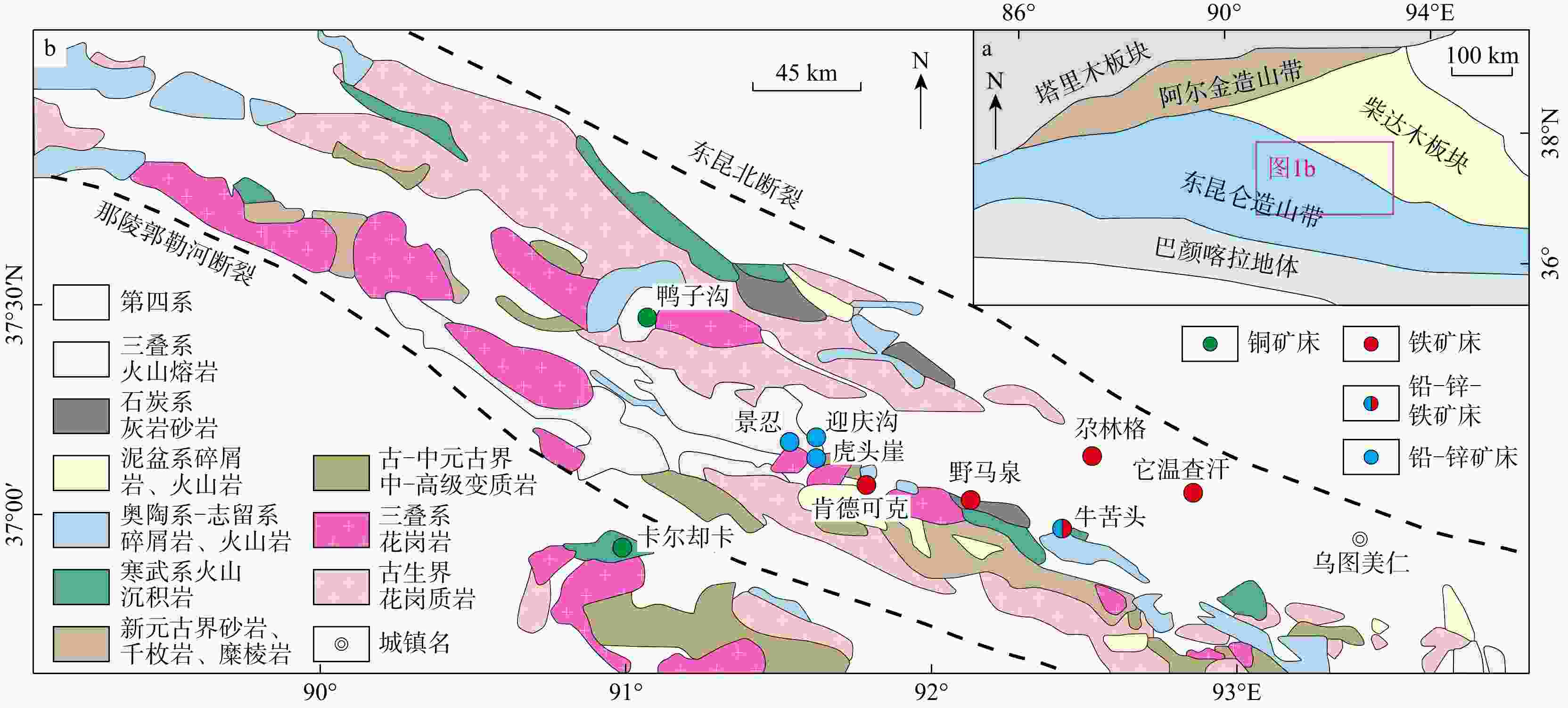
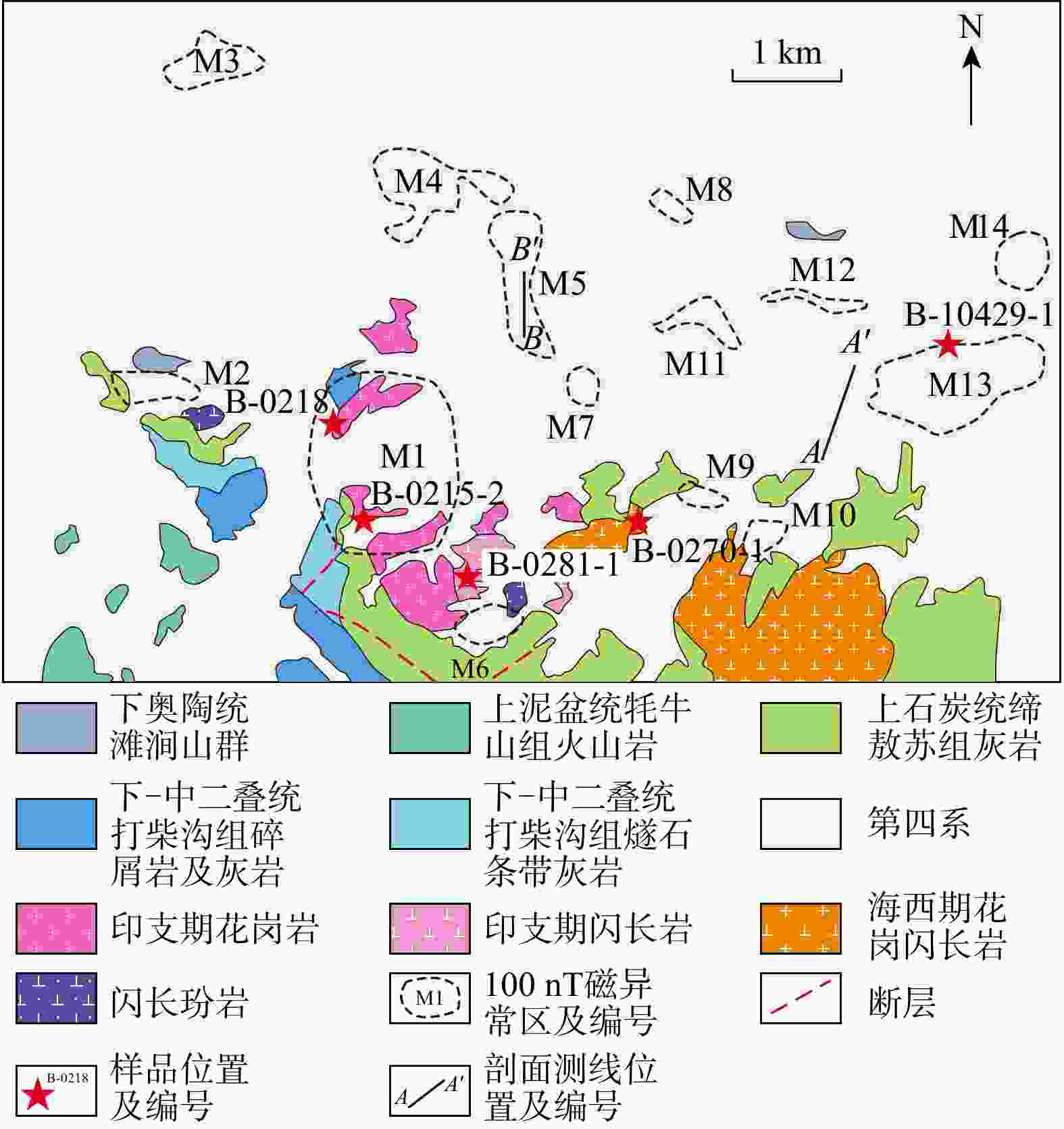
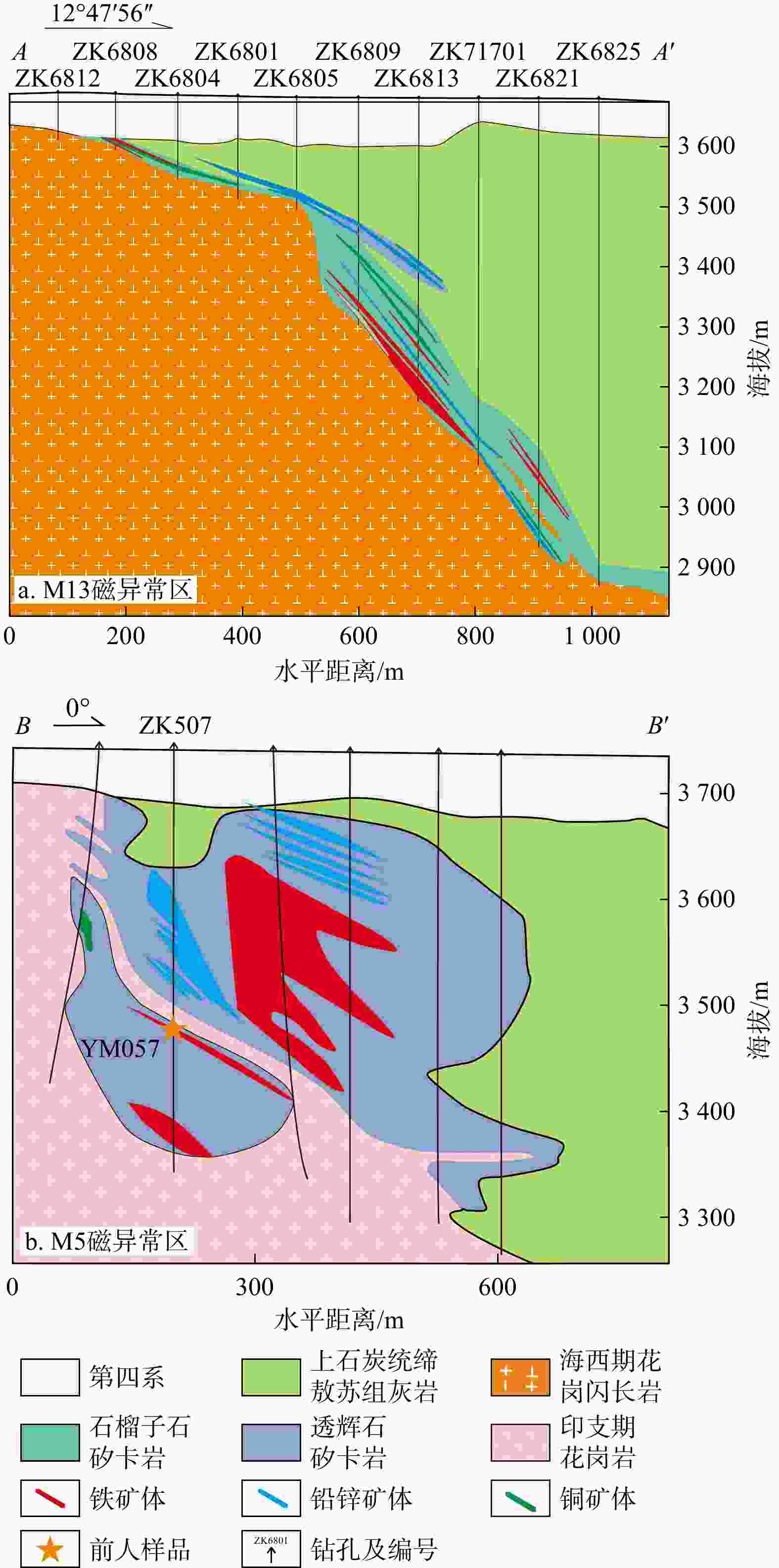
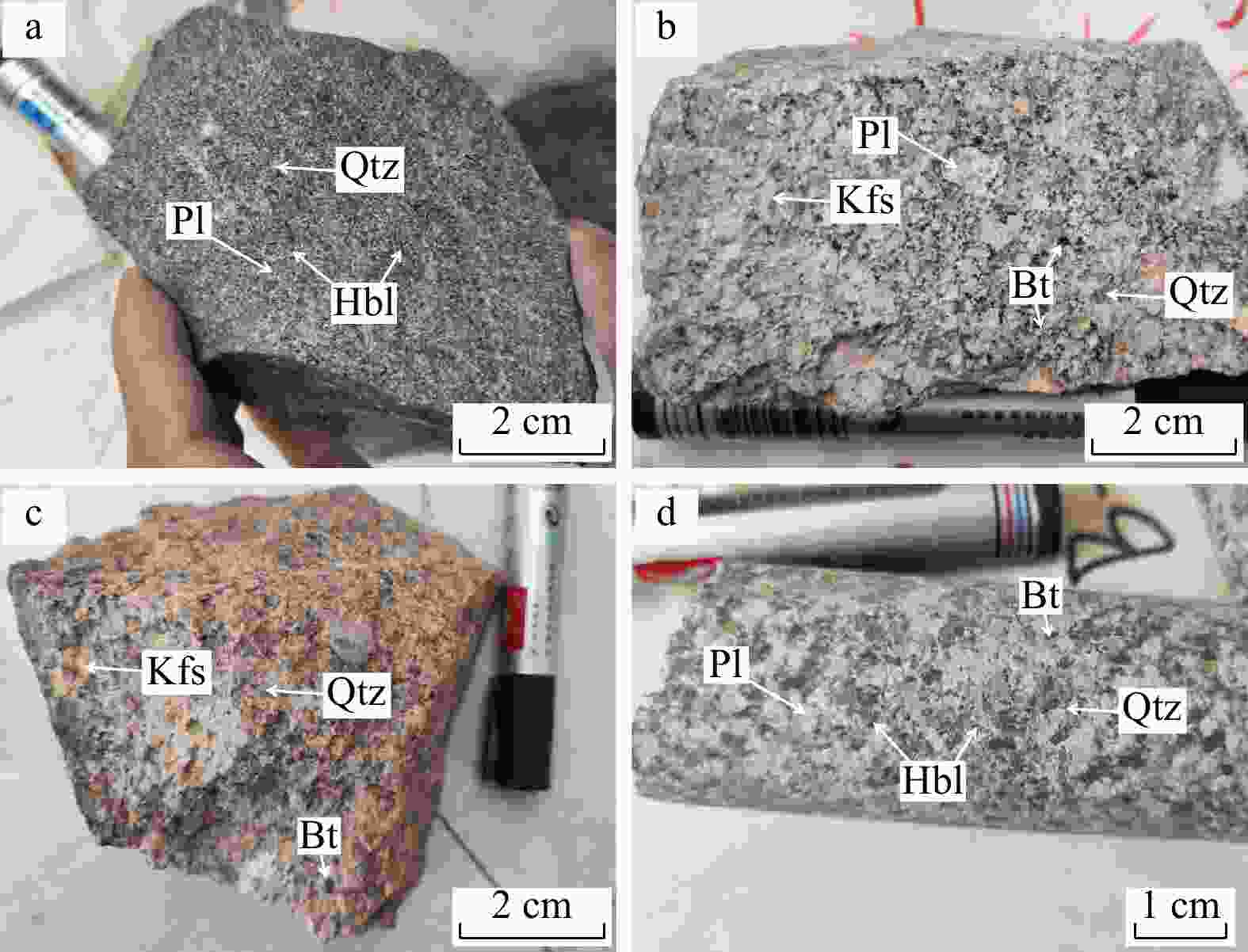
图 4 野马泉矿床侵入岩代表性手标本照片
a. 晚三叠世闪长岩,B-0281-1;b. 晚三叠世黑云母二长花岗岩,B-0218;c. 晚三叠世黑云母正长花岗岩,B-0215-2;d. 早−中泥盆世花岗闪长岩,B-10429-1。Bt. 黑云母;Hbl. 角闪石;Kfs. 钾长石;Pl. 斜长石;Qtz. 石英;下同
Figure 4. Representative hand specimen photographs of intrusive rocks from Yemaquan deposit
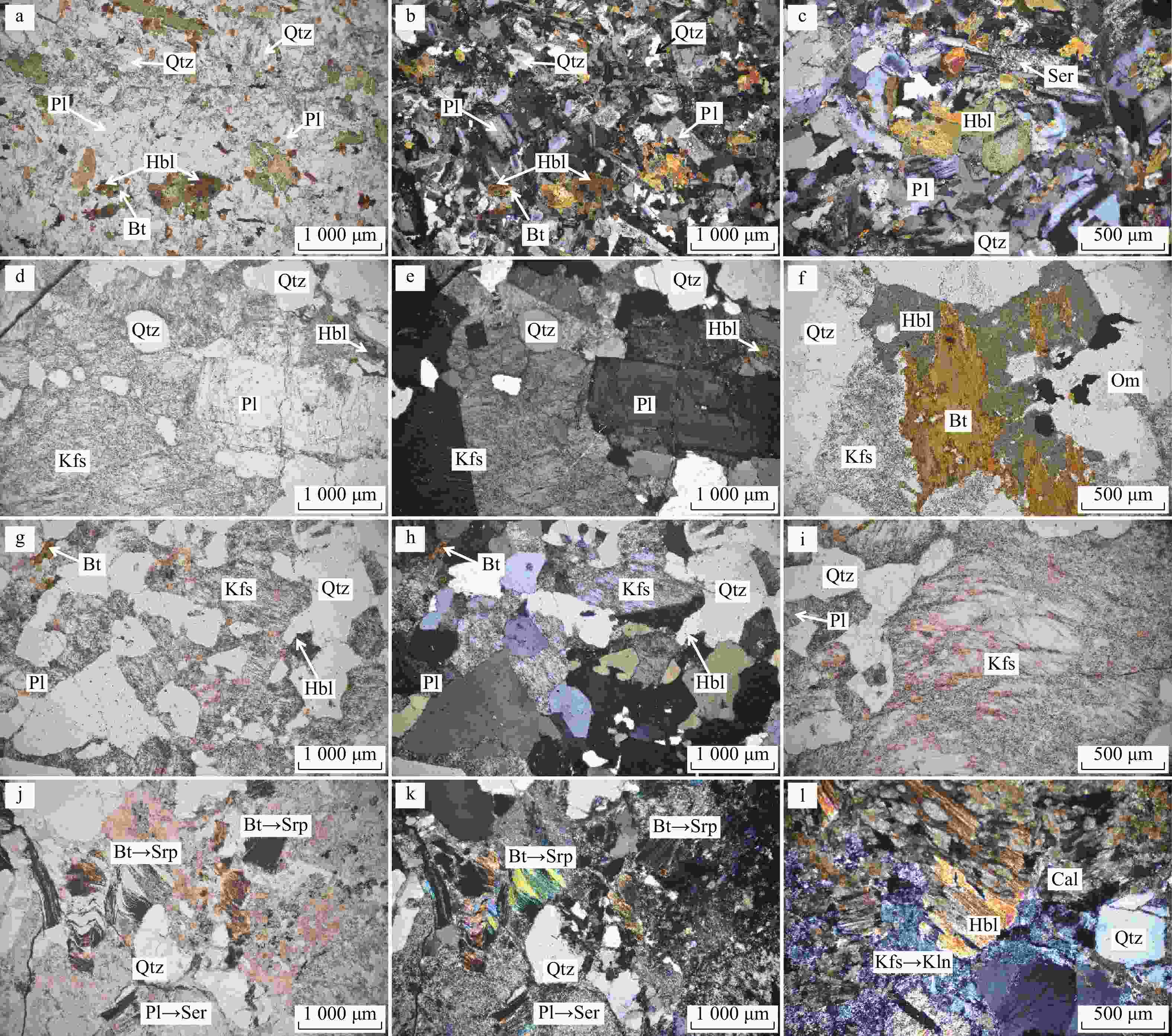
图 5 野马泉矿区侵入岩代表性镜下显微照片
a~c. 晚三叠世细粒闪长岩;d~f. 晚三叠世中细粒黑云母二长花岗岩;g~i. 晚三叠世细粒黑云母正长花岗岩;j~l. 早−中泥盆世蚀变细粒花岗闪长岩。Cal. 方解石;Kln. 高岭石;Ser. 绢云母;Srp. 蛇纹石;Om. 不透明矿物
Figure 5. Representative micrographs of intrusive rocks from Yemaquan deposit
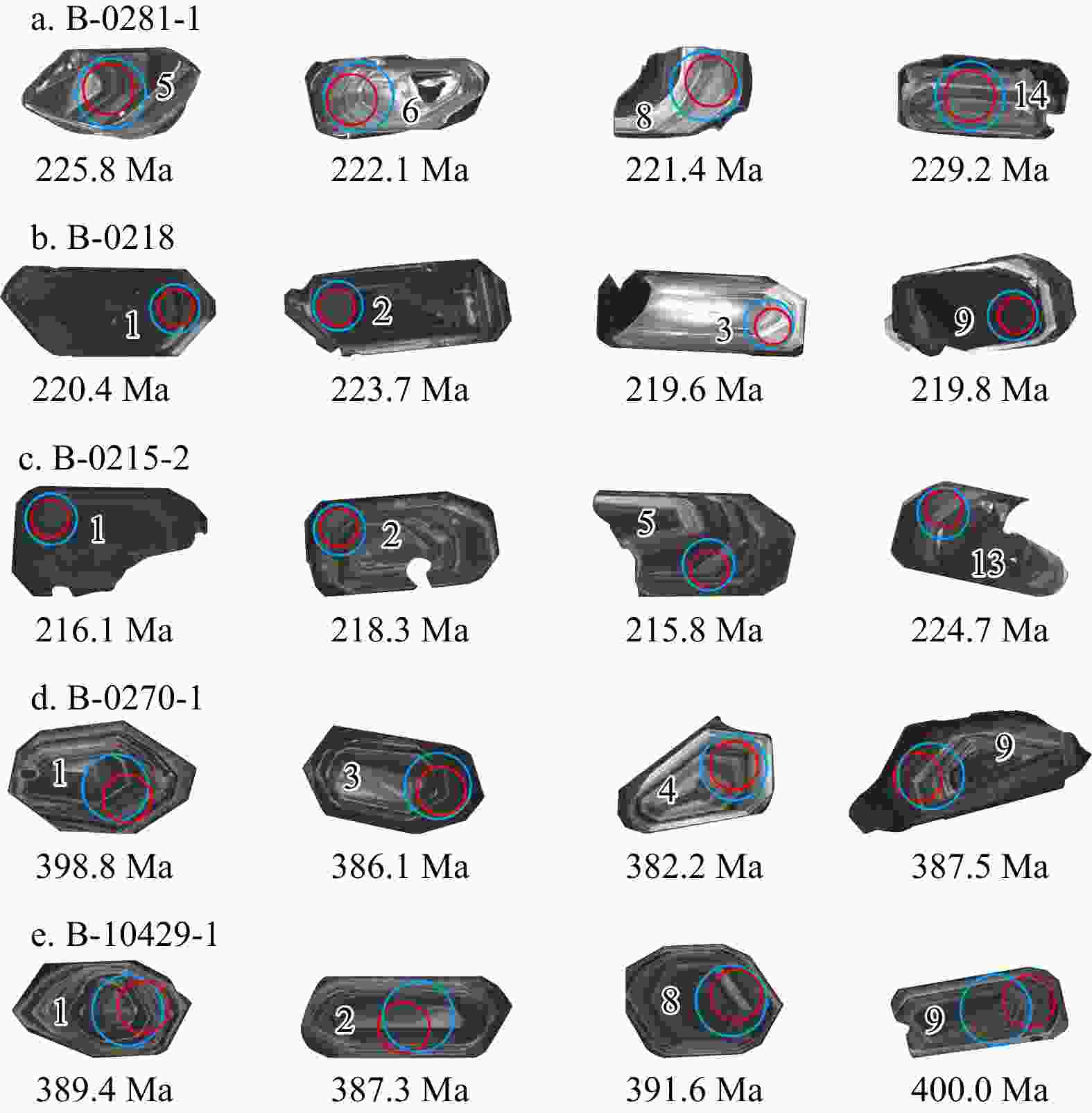
图 6 野马泉矿区侵入岩定年样品典型锆石阴极发光(CL)图像
红色圆圈为 U-Pb 定年测点,激光束斑直径 32 μm;蓝色圆圈为原位 Hf 同位素测点,激光束斑直径 44 μm;数字5,6,8等为锆石测点号;数字225.8 Ma等为单点206Pb/238U年龄
Figure 6. Cathodoluminescence (CL) images of representative zircons from dating samples of intrusive rocks in Yemaquan deposit
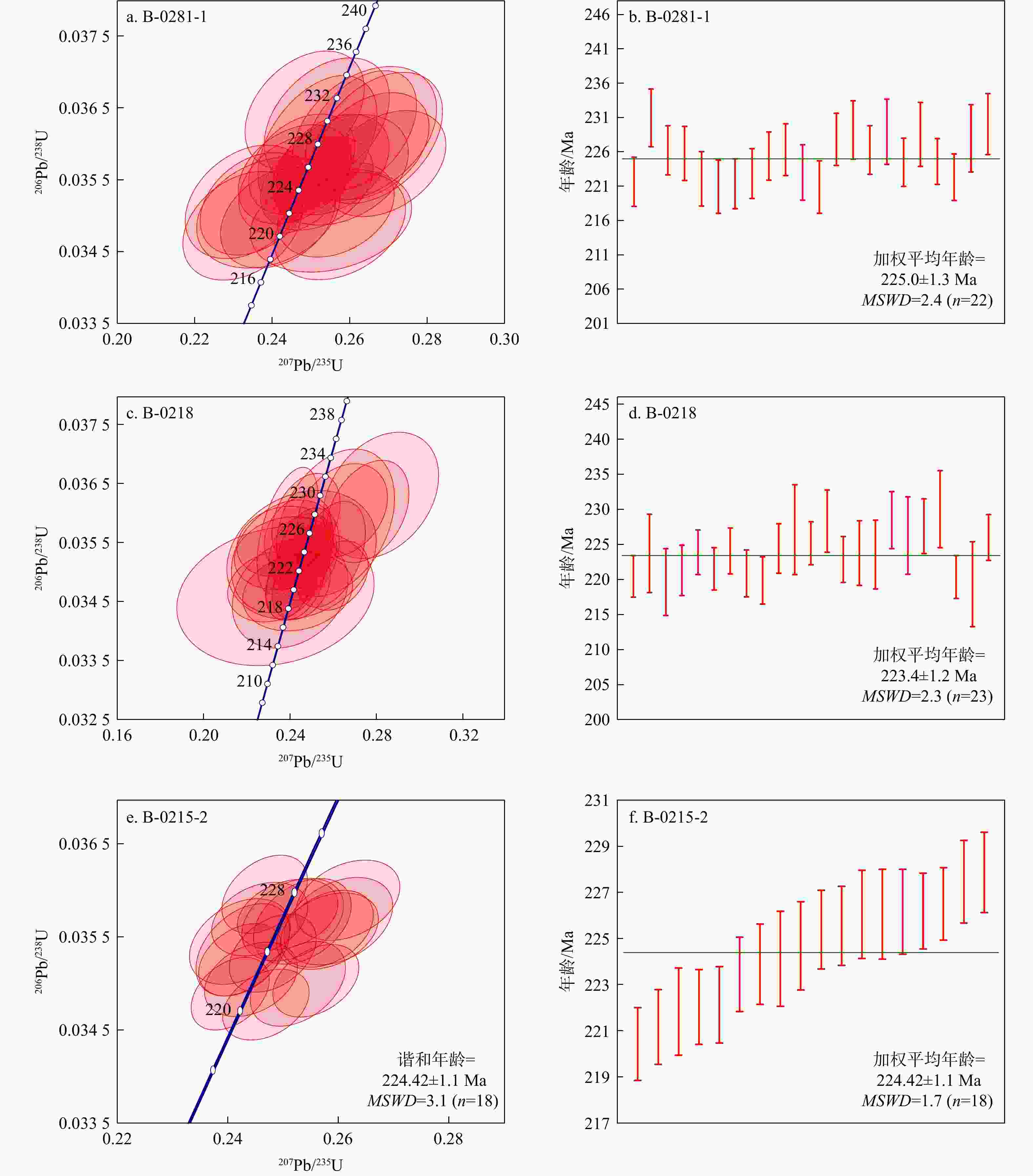
图 7 野马泉矿区晚三叠世侵入岩锆石 LA-ICP-MS U-Pb 谐和年龄图
n为样品数据点数量;MSWD为加权偏差均方;下同
Figure 7. LA-ICP-MS zircon U-Pb concordia diagrams of Late Triassic intrusive rocks from Yemaquan deposit
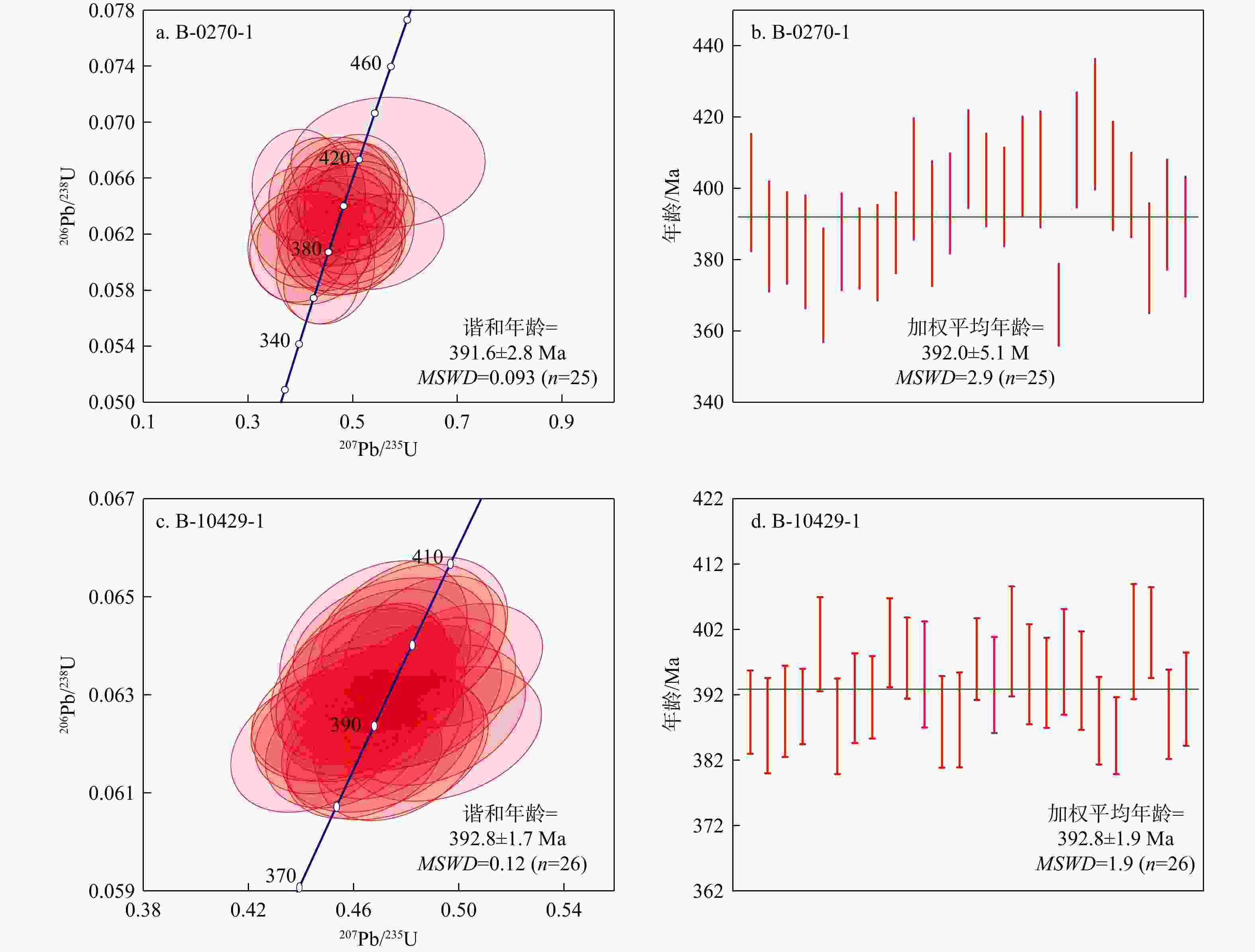
图 8 野马泉矿区早−中泥盆世侵入岩锆石 LA-ICP-MS U-Pb 谐和年龄图
Figure 8. Zircon LA-ICP-MS U-Pb concordia diagrams of Early-Middle Devonian intrusive rocks from Yemaquan deposit

图 9 野马泉矿区石榴子石 Tera-Wasserburg 等时线图解(a)与典型石榴子石阴极发光(CL)图像(b)
图a虚线为数据样品拟合等时线,绿色圆圈为样品数据(含误差);图b红色圆圈为 U-Pb 定年测点,激光束斑直径 20 μm
Figure 9. Tera-Wasserburg isochron diagram (a) and cathodoluminescence (CL) images of representative garnet samples (b) from Yemaquan deposit
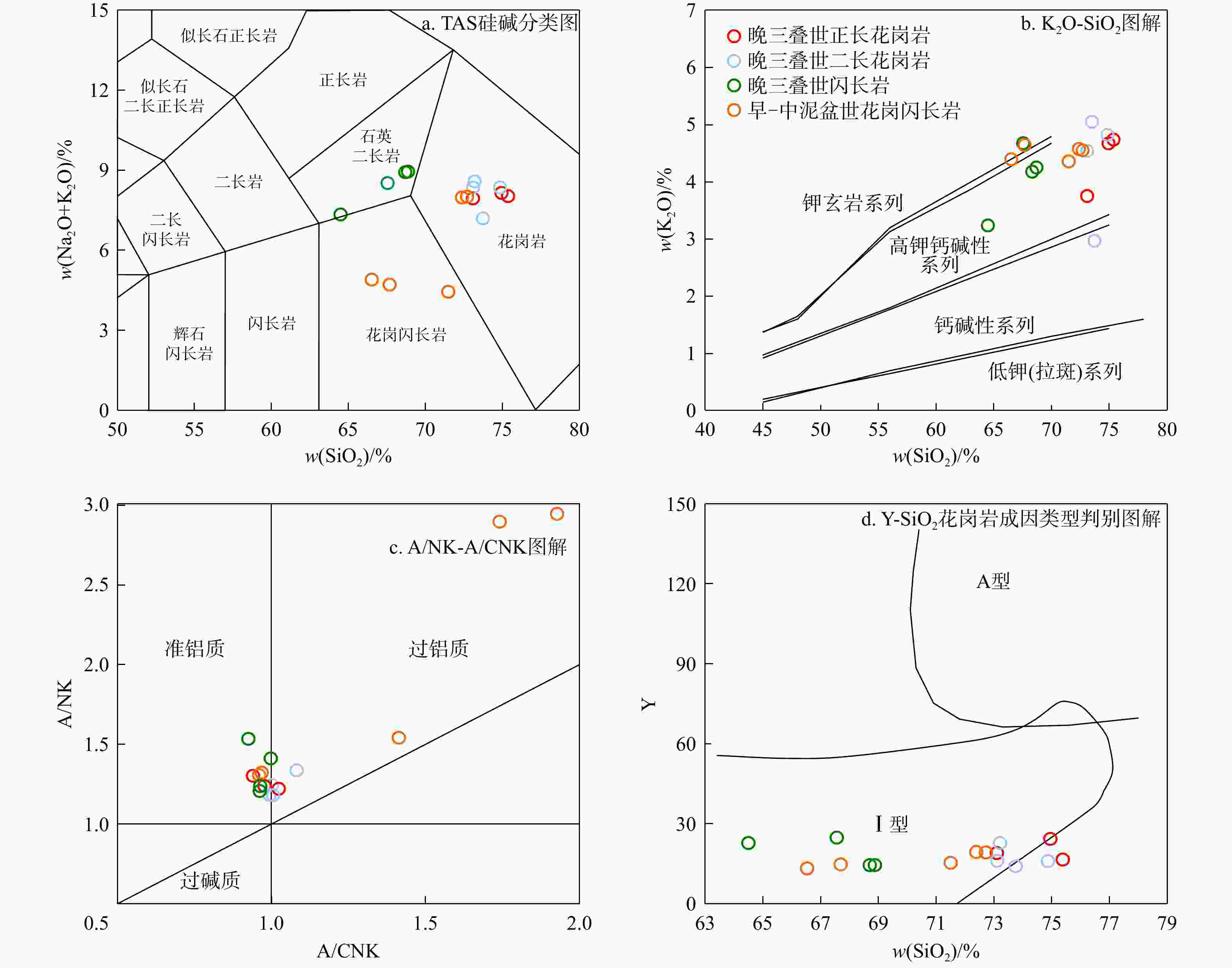
图 10 野马泉矿区侵入岩岩石分类图解(a图修改自文献[26])
Figure 10. Rock classification diagrams of intrusive rocks from Yemaquan deposit
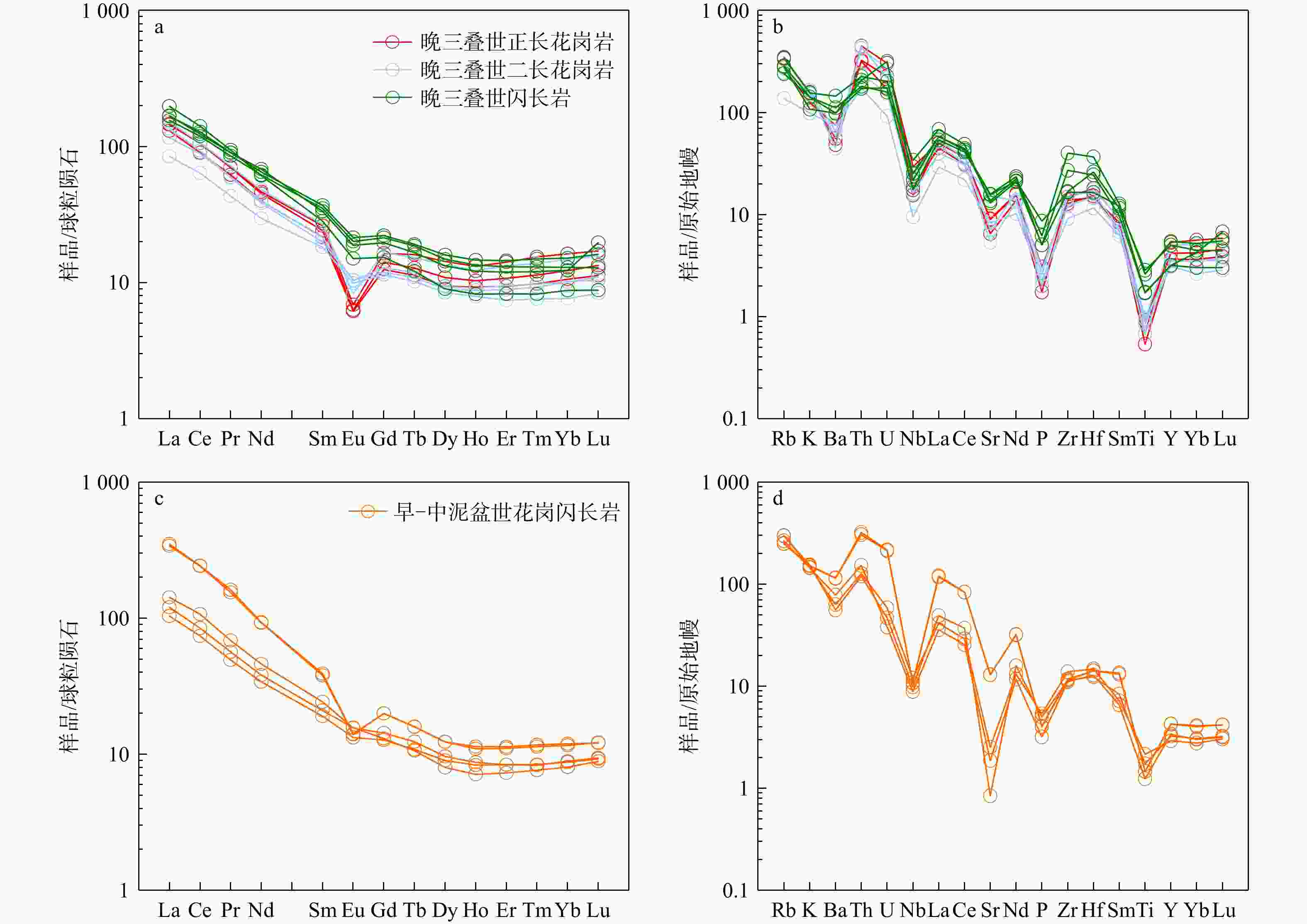
图 11 野马泉矿区侵入岩球粒陨石标准化稀土元素配分图(a, c)及原始地幔标准化微量元素蜘蛛网图(b, d)(标准化值据文献[27])
Figure 11. Chondrite-normalized rare earth element patterns (a, c) and primitive-mantle-normalized variation spidergrams of intrusive rocks from Yemaquan deposit
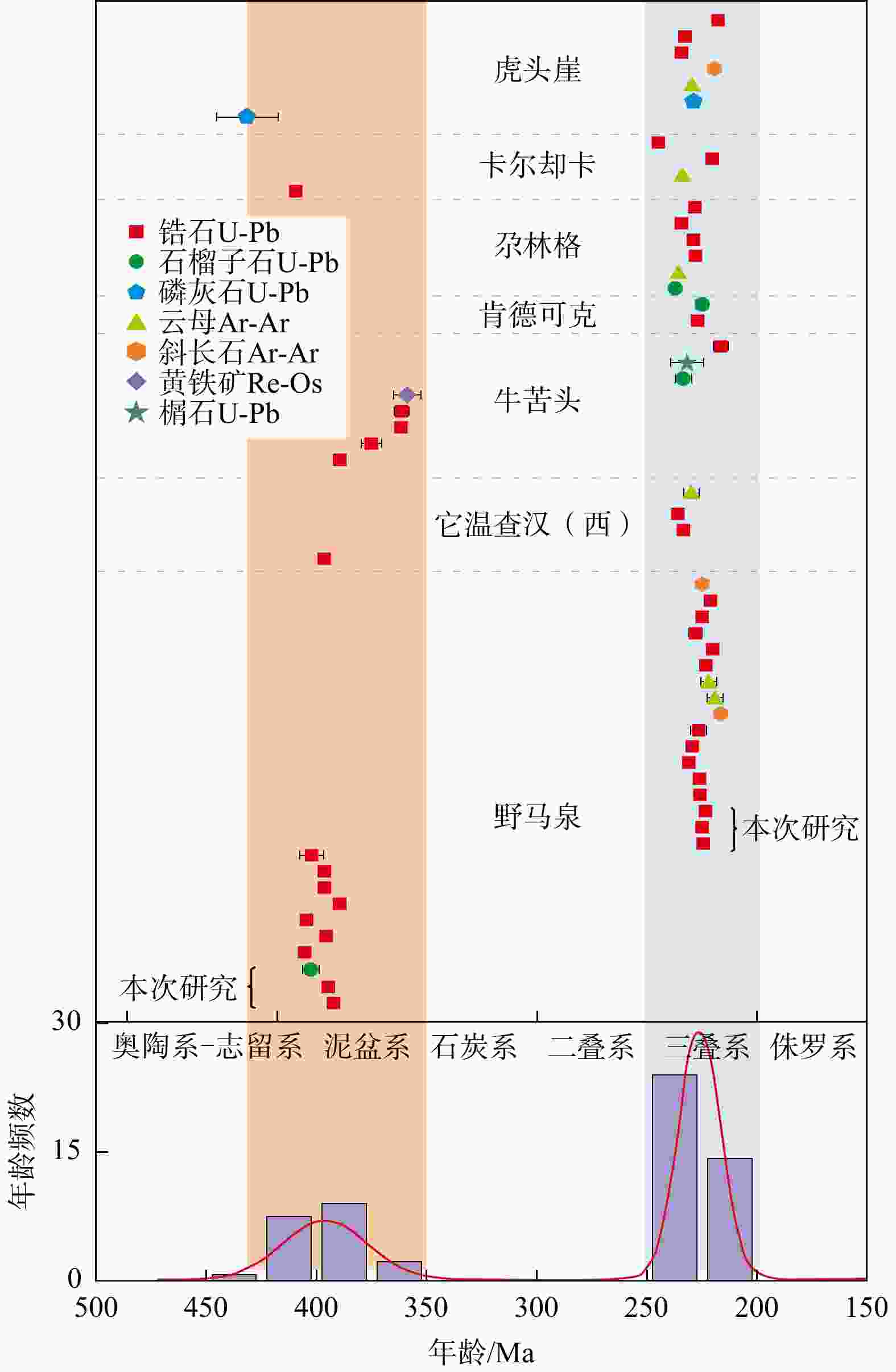
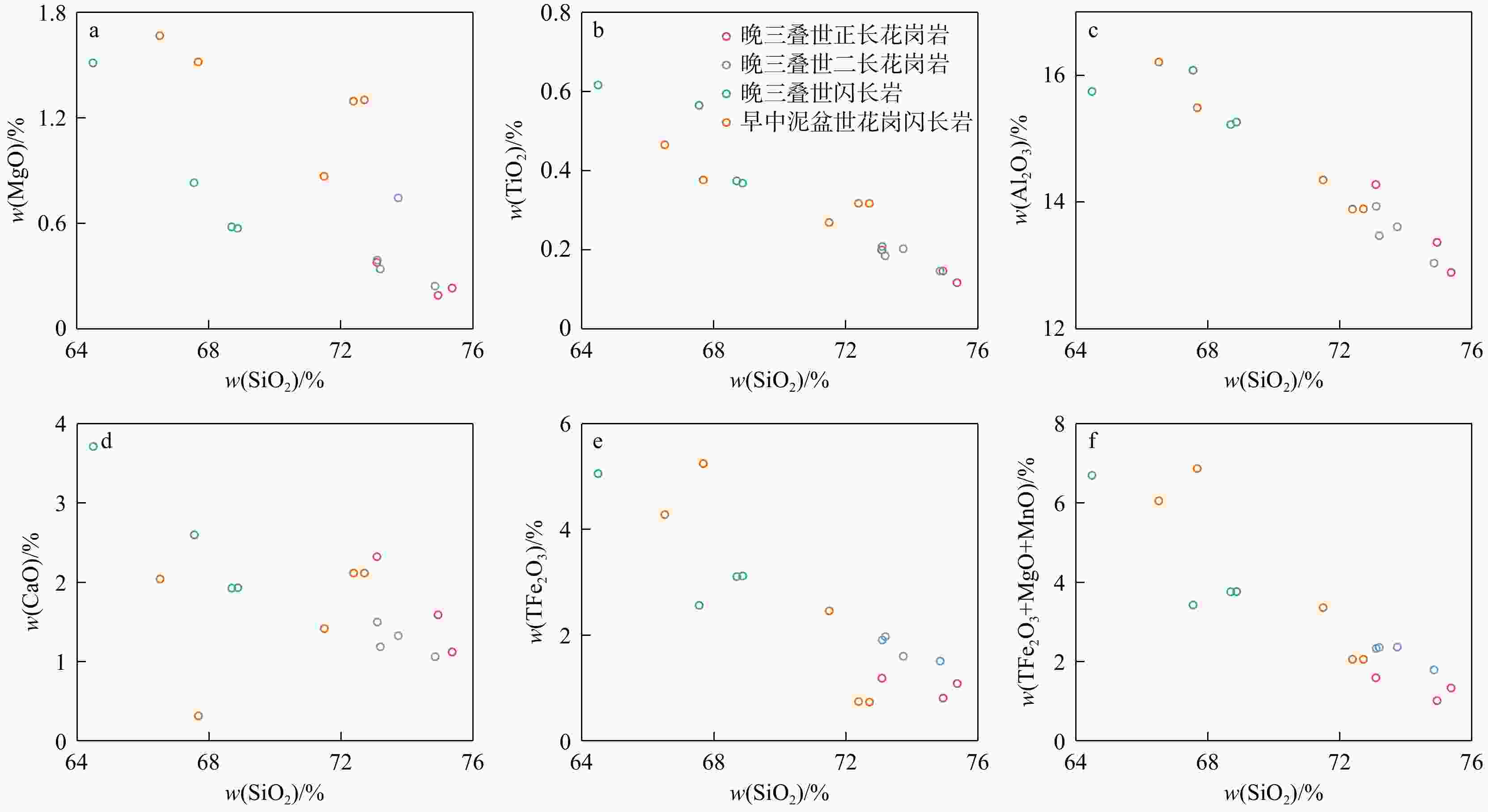
图 13 野马泉矿区侵入岩Harker图解
Figure 13. Harker diagrams of intrusive rocks from Yemaquan deposit
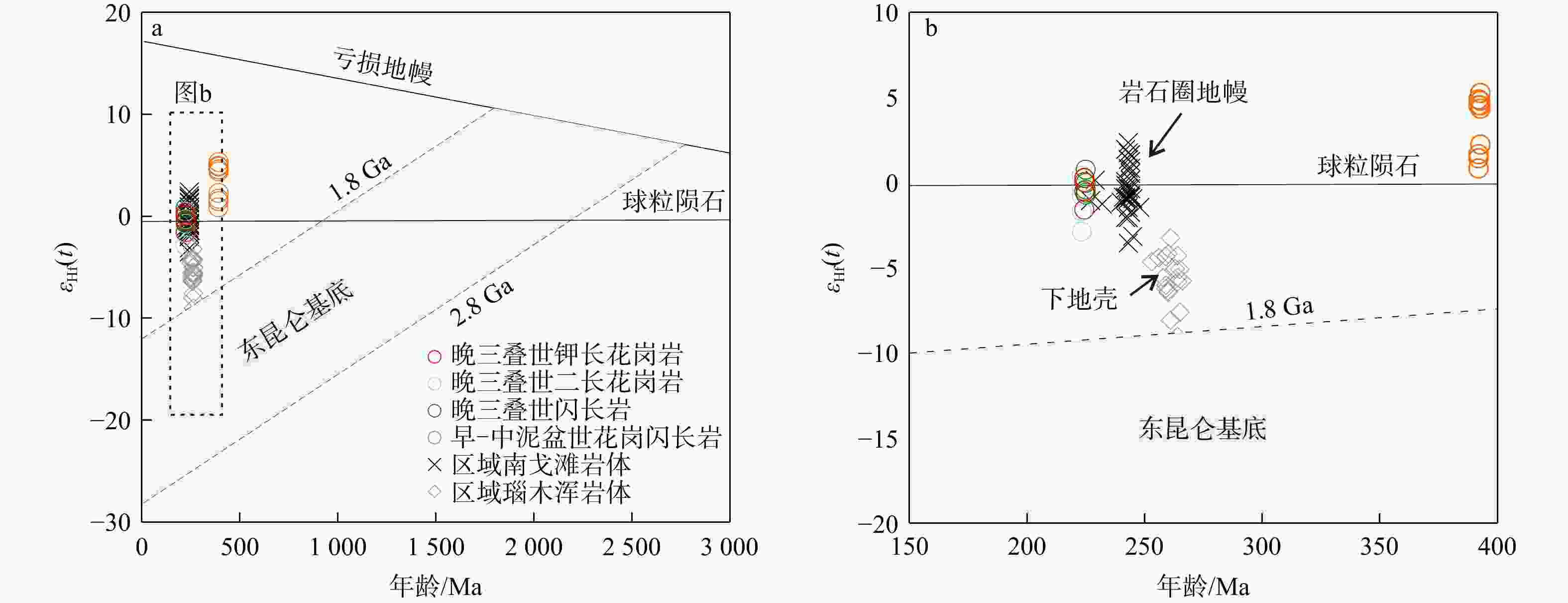
图 14 野马泉矿区侵入岩锆石εHf(t)-年龄图解(底图修改自文献[65])
Figure 14. εHf(t) -age diagrams of intrusive rocks from Yemaquan deposit
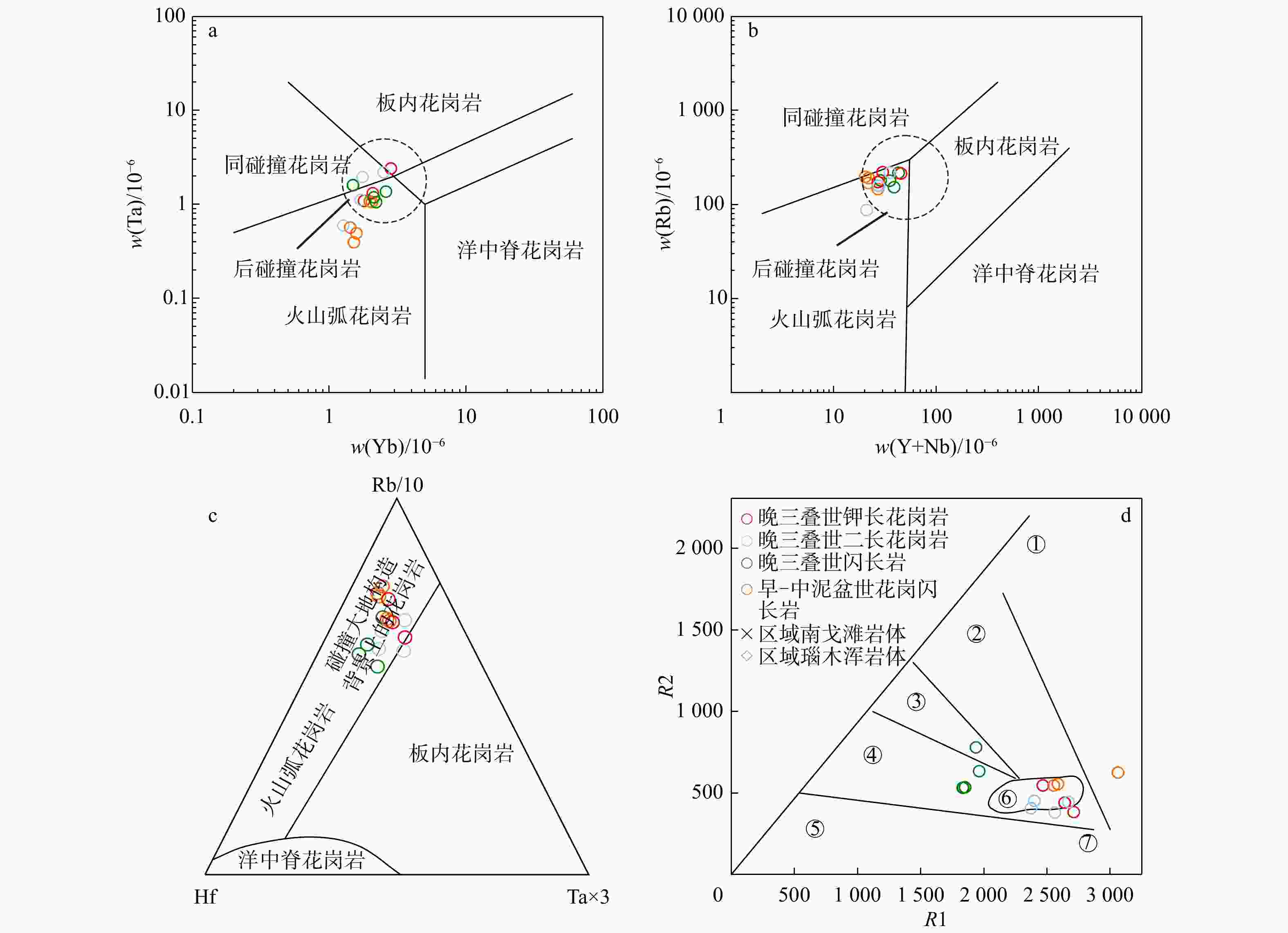
图 15 野马泉矿区侵入岩构造环境判别图
a. 花岗质岩石Ta-Yb构造环境判别图[64];b. Rb-Y+Nb构造环境判别图[64];c. 花岗质岩石Rb/10-Hf-Ta×3判别图[65];d. R2-R1花岗岩构造环境判别图解[66]。R1=4Si−11(Na+K)−2(Fe+Ti),R2=6Ca+2Mg+Al,式中元素符号代表分子中相应元素原子数量;①地幔斜长花岗岩;②破坏性活动板块边缘(板块碰撞前)花岗岩;③板块碰撞后隆起期花岗岩;④晚造期花岗岩;⑤非造山区A型花岗岩;⑥同碰撞(S型)花岗岩;⑦造山期后A型花岗岩
Figure 15. Discrimination diagrams of tectonic settings of intrusive rocks from Yemaquan deposit
表 1 野马泉侵入岩锆石U-Pb数据统计
Table 1. Statistics of zircon U–Pb data for intrusive rocks from Yemaquan deposit
测点号 U Th Th/U 同位素比值 年龄/Ma wB/10−6 207Pb/206Pb 1σ(2σ) 207Pb/235U 1σ(2σ) 206Pb/238U 1σ(2σ) 206Pb/238U 1σ(2σ) B-0281-1 1 886 344 0.39 0.0499 0.0013 0.2415 0.0061 0.0350 0.0003 222 2 2 826 276 0.33 0.0493 0.0012 0.2484 0.0063 0.0365 0.0003 231 2 3 861 305 0.35 0.0518 0.0012 0.2557 0.0059 0.0357 0.0003 226 2 5 635 251 0.40 0.0523 0.0015 0.2576 0.0072 0.0356 0.0003 226 2 6 563 207 0.37 0.0492 0.0015 0.2390 0.0076 0.0350 0.0003 222 2 7 845 290 0.34 0.0481 0.0013 0.2324 0.0063 0.0349 0.0003 221 2 8 524 184 0.35 0.0527 0.0017 0.2552 0.0085 0.0349 0.0003 221 2 9 759 263 0.35 0.0486 0.0013 0.2356 0.0058 0.0352 0.0003 223 2 10 551 233 0.42 0.0499 0.0012 0.2458 0.0060 0.0356 0.0003 225 2 11 1023 457 0.45 0.0543 0.0012 0.2690 0.0065 0.0357 0.0003 226 2 12 703 219 0.31 0.0478 0.0013 0.2333 0.0064 0.0352 0.0003 223 2 13 666 217 0.33 0.0533 0.0014 0.2575 0.0069 0.0349 0.0003 221 2 15 921 344 0.37 0.0533 0.0012 0.2654 0.0061 0.0360 0.0003 228 2 16 768 274 0.36 0.0525 0.0011 0.2629 0.0058 0.0362 0.0003 229 2 17 947 565 0.60 0.0501 0.0011 0.2476 0.0056 0.0357 0.0003 226 2 18 696 202 0.29 0.0527 0.0015 0.2638 0.0076 0.0362 0.0004 229 2 19 953 403 0.42 0.0501 0.0012 0.2456 0.0058 0.0354 0.0003 224 2 20 746 247 0.33 0.0536 0.0013 0.2671 0.0069 0.0361 0.0004 229 2 21 878 307 0.35 0.0513 0.0012 0.2515 0.0059 0.0355 0.0003 225 2 22 1139 485 0.43 0.0528 0.0012 0.2564 0.0061 0.0351 0.0003 222 2 23 993 346 0.35 0.0506 0.0012 0.2517 0.0063 0.0360 0.0004 228 2 24 952 346 0.36 0.0506 0.0013 0.2541 0.0066 0.0363 0.0004 230 2 B-0218 1 762 530 0.70 0.0511 0.0012 0.2454 0.0055 0.0348 0.0002 220 1 2 672 455 0.68 0.0499 0.0028 0.2456 0.0142 0.0353 0.0004 224 3 3 174 72.2 0.42 0.0504 0.0024 0.2403 0.0110 0.0347 0.0004 220 2 4 1034 728 0.70 0.0500 0.0010 0.2411 0.0049 0.0349 0.0003 221 2 5 1143 502 0.44 0.0490 0.0021 0.2382 0.0097 0.0353 0.0003 224 2 6 891 544 0.61 0.0543 0.0013 0.2617 0.0061 0.0350 0.0002 222 2 7 649 221 0.34 0.0501 0.0012 0.2454 0.0061 0.0354 0.0003 224 2 8 708 324 0.46 0.0504 0.0012 0.2426 0.0056 0.0349 0.0003 221 2 9 990 448 0.45 0.0503 0.0020 0.2438 0.0104 0.0347 0.0003 220 2 11 855 463 0.54 0.0506 0.0011 0.2474 0.0052 0.0354 0.0003 224 2 12 210 89.5 0.43 0.0530 0.0023 0.2614 0.0112 0.0359 0.0005 227 3 13 862 542 0.63 0.0482 0.0018 0.2365 0.0086 0.0355 0.0002 225 2 14 504 238 0.47 0.0551 0.0019 0.2763 0.0078 0.0361 0.0004 228 2 15 1064 372 0.35 0.0508 0.0010 0.2475 0.0049 0.0352 0.0003 223 2 17 537 316 0.59 0.0530 0.0013 0.2589 0.0067 0.0353 0.0004 224 2 18 1026 769 0.75 0.0482 0.0019 0.2381 0.0103 0.0353 0.0004 224 2 19 632 310 0.49 0.0530 0.0016 0.2647 0.0085 0.0361 0.0003 228 2 20 1067 682 0.64 0.0485 0.0011 0.2391 0.0058 0.0357 0.0004 226 3 21 900 485 0.54 0.0502 0.0014 0.2476 0.0065 0.0359 0.0003 228 2 22 209 80.5 0.39 0.0566 0.0022 0.2825 0.0110 0.0363 0.0004 230 3 23 1185 437 0.37 0.0483 0.0018 0.2321 0.0085 0.0348 0.0002 220 2 25 565 262 0.46 0.0474 0.0031 0.2335 0.0187 0.0346 0.0005 219 3 26 935 336 0.36 0.0496 0.0013 0.2438 0.0064 0.0357 0.0003 226 2 B-0215-2 6 836 273 0.33 0.0513 0.0011 0.2468 0.0052 0.0348 0.0003 220 2 19 1024 346 0.34 0.0500 0.0010 0.2404 0.0047 0.0349 0.0003 221 2 12 799 264 0.33 0.0521 0.0011 0.2526 0.0057 0.0350 0.0003 222 2 14 1232 380 0.31 0.0528 0.0011 0.2559 0.0051 0.0350 0.0003 222 2 23 990 330 0.33 0.0504 0.0011 0.2442 0.0055 0.0351 0.0003 222 2 21 807 244 0.30 0.0497 0.0010 0.2422 0.0049 0.0353 0.0003 223 2 17 789 238 0.30 0.0507 0.0010 0.2481 0.0052 0.0353 0.0003 224 2 24 934 306 0.33 0.0498 0.0012 0.2427 0.0056 0.0354 0.0003 224 2 13 491 198 0.40 0.0494 0.0013 0.2421 0.0060 0.0355 0.0003 225 2 3 715 214 0.30 0.0524 0.0012 0.2580 0.0061 0.0356 0.0003 225 2 22 1772 434 0.24 0.0523 0.0010 0.2579 0.0056 0.0356 0.0003 226 2 30 750 300 0.40 0.0513 0.0012 0.2534 0.0058 0.0357 0.0003 226 2 26 527 184 0.35 0.0527 0.0013 0.2599 0.0065 0.0357 0.0003 226 2 15 745 216 0.29 0.0509 0.0012 0.2517 0.0061 0.0357 0.0003 226 2 28 724 192 0.27 0.0497 0.0011 0.2457 0.0057 0.0357 0.0003 226 2 8 759 223 0.29 0.0506 0.0012 0.2508 0.0060 0.0358 0.0003 227 2 16 683 178 0.26 0.0526 0.0013 0.2616 0.0062 0.0359 0.0003 227 2 27 1091 469 0.43 0.0495 0.0010 0.2466 0.0051 0.0360 0.0003 228 2 B-0270-1 1 287 153 0.53 0.0516 0.0085 0.4753 0.0809 0.0639 0.0028 399 17 2 399 338 0.84 0.0534 0.0079 0.4506 0.0636 0.0619 0.0026 386 16 3 373 283 0.76 0.0643 0.0096 0.5544 0.0796 0.0615 0.0022 386 13 4 241 121 0.50 0.0509 0.0086 0.3961 0.0635 0.0612 0.0027 382 16 5 304 175 0.59 0.0554 0.0087 0.4476 0.0623 0.0596 0.0027 373 16 6 287 229 0.81 0.0477 0.0076 0.4161 0.0650 0.0616 0.0023 385 14 7 359 222 0.63 0.0543 0.0071 0.5002 0.0663 0.0613 0.0019 383 11 8 244 155 0.63 0.0557 0.0087 0.4852 0.0723 0.0611 0.0022 382 14 9 385 243 0.64 0.0557 0.0069 0.5068 0.0620 0.0620 0.0019 387 12 10 270 202 0.75 0.0482 0.0071 0.4320 0.0610 0.0646 0.0029 403 17 11 222 163 0.70 0.0562 0.0092 0.4960 0.0802 0.0625 0.0029 390 18 12 240 163 0.66 0.0510 0.0081 0.4701 0.0738 0.0634 0.0024 396 14 13 264 195 0.74 0.0508 0.0080 0.4717 0.0685 0.0654 0.0023 408 14 14 520 429 0.82 0.0547 0.0054 0.5069 0.0504 0.0645 0.0022 402 13 15 320 209 0.65 0.0593 0.0086 0.5129 0.0696 0.0637 0.0023 398 14 16 343 235 0.69 0.0513 0.0073 0.4836 0.0711 0.0651 0.0023 406 14 17 292 241 0.81 0.0572 0.0077 0.5063 0.0655 0.0650 0.0027 405 16 18 476 196 0.38 0.0540 0.0060 0.4391 0.0469 0.0584 0.0019 367 12 19 293 173 0.61 0.0452 0.0072 0.3993 0.0604 0.0655 0.0026 411 16 20 148 76 0.52 0.0592 0.0124 0.5679 0.1226 0.0671 0.0031 418 19 21 277 268 0.97 0.0544 0.0072 0.4922 0.0650 0.0647 0.0025 403 15 22 524 315 0.62 0.0514 0.0057 0.4820 0.0557 0.0638 0.0020 398 12 23 257 150 0.57 0.0480 0.0092 0.4191 0.0763 0.0609 0.0026 380 16 24 246 169 0.68 0.0472 0.0078 0.4017 0.0634 0.0629 0.0026 393 16 25 183 108 0.59 0.0589 0.0107 0.4768 0.0781 0.0619 0.0028 386 17 B-10429-1 1 377 280 0.74 0.0527 0.0015 0.4531 0.0125 0.0623 0.0005 389 3 2 380 318 0.84 0.0552 0.0018 0.4732 0.0158 0.0619 0.0006 387 4 3 446 385 0.86 0.0549 0.0013 0.4736 0.0117 0.0623 0.0006 389 3 4 287 187 0.65 0.0525 0.0015 0.4531 0.0130 0.0624 0.0005 390 3 5 324 237 0.73 0.0550 0.0014 0.4874 0.0127 0.0640 0.0006 400 4 6 376 256 0.68 0.0558 0.0015 0.4785 0.0129 0.0619 0.0006 387 4 7 204 145 0.71 0.0533 0.0019 0.4600 0.0158 0.0626 0.0006 392 3 8 336 258 0.77 0.0533 0.0014 0.4628 0.0122 0.0626 0.0005 392 3 9 234 120 0.51 0.0536 0.0017 0.4750 0.0154 0.0640 0.0006 400 3 10 356 224 0.63 0.0533 0.0012 0.4698 0.0105 0.0636 0.0005 398 3 11 270 175 0.65 0.0529 0.0015 0.4638 0.0135 0.0632 0.0007 395 4 13 269 178 0.66 0.0518 0.0015 0.4456 0.0132 0.0620 0.0006 388 4 14 218 134 0.61 0.0545 0.0018 0.4694 0.0149 0.0621 0.0006 388 4 16 381 234 0.61 0.0565 0.0015 0.5002 0.0132 0.0636 0.0005 397 3 17 414 335 0.81 0.0552 0.0016 0.4828 0.0140 0.0629 0.0006 394 4 20 236 121 0.51 0.0528 0.0016 0.4680 0.0146 0.0640 0.0007 400 4 21 232 104 0.45 0.0531 0.0017 0.4641 0.0145 0.0632 0.0006 395 4 22 214 133 0.62 0.0542 0.0016 0.4702 0.0134 0.0630 0.0006 394 3 23 278 157 0.57 0.0537 0.0017 0.4695 0.0145 0.0635 0.0007 397 4 24 396 277 0.70 0.0561 0.0015 0.4892 0.0135 0.0631 0.0006 394 4 25 483 446 0.92 0.0533 0.0014 0.4576 0.0126 0.0620 0.0006 388 3 26 395 277 0.70 0.0546 0.0015 0.4645 0.0121 0.0617 0.0005 386 3 27 192 126 0.66 0.0543 0.0017 0.4810 0.0156 0.0640 0.0007 400 4 28 257 155 0.60 0.0542 0.0016 0.4809 0.0135 0.0643 0.0006 402 3 29 266 151 0.57 0.0573 0.0017 0.4946 0.0154 0.0622 0.0006 389 3 30 309 267 0.86 0.0568 0.0017 0.4915 0.0141 0.0626 0.0006 391 4 注: 除样品 B-0270-1 测试误差为 2σ 外,其余测点同位素比值与年龄误差均为 1σ,其中2σ 为2倍标准偏差,1σ 为1倍标准偏差,下同  下载: 导出CSV
表 2 野马泉矿床石榴子石U-Pb数据统计(B-7609-201)
Table 2. Statistics of garnet U–Pb data from Yemaquan deposit
测点号 U Th Pb Th/U 同位素比值 wB/10−6 207Pb/206Pb 2σ 207Pb/235U 2σ 206Pb/238U 2σ 1 4.57 0.86 0.06 0.19 0.0698 0.0071 0.6920 0.0697 0.0730 0.0028 2 4.51 0.73 0.08 0.15 0.0824 0.0071 0.8552 0.0853 0.0715 0.0028 3 5.08 0.96 0.08 0.18 0.0591 0.0054 0.5885 0.0545 0.0713 0.0027 4 3.50 0.89 0.06 0.24 0.0853 0.0094 0.8922 0.0988 0.0757 0.0035 5 8.95 0.28 0.04 0.03 0.0660 0.0039 0.6353 0.0386 0.0696 0.0023 6 1.06 0.08 0.39 0.10 0.3550 0.0462 12.3033 3.7368 0.1707 0.0334 7 0.91 0.25 0.07 0.25 0.2102 0.0219 2.4746 0.2302 0.0931 0.0061 8 3.49 0.81 0.09 0.23 0.0928 0.0113 0.8686 0.1004 0.0751 0.0033 9 3.88 0.88 0.07 0.22 0.0804 0.0145 0.8420 0.1312 0.0785 0.0047 11 6.88 0.09 0.06 0.01 0.0878 0.0095 0.8958 0.0947 0.0755 0.0025 12 4.64 0.07 0.02 0.02 0.0637 0.0054 0.6458 0.0555 0.0739 0.0027 13 10.08 0.14 0.03 0.01 0.0614 0.0037 0.6553 0.0436 0.0766 0.0028 14 4.31 1.76 0.08 0.41 0.0627 0.0056 0.6046 0.0532 0.0705 0.0031 15 3.98 0.68 0.03 0.16 0.0712 0.0058 0.6770 0.0562 0.0706 0.0026 16 3.75 0.78 0.04 0.20 0.0733 0.0066 0.7433 0.0690 0.0727 0.0032 17 5.70 0.24 0.03 0.04 0.0696 0.0061 0.6334 0.0540 0.0695 0.0026 18 4.26 0.04 0.02 0.02 0.0744 0.0056 0.7345 0.0569 0.0704 0.0028 19 5.32 0.95 0.04 0.17 0.0566 0.0050 0.5536 0.0475 0.0739 0.0027 20 7.40 0.15 0.04 0.02 0.0636 0.0046 0.6050 0.0441 0.0717 0.0025 21 4.28 0.72 0.04 0.16 0.0656 0.0058 0.6632 0.0586 0.0711 0.0028 22 4.53 1.55 0.13 0.33 0.1210 0.0134 1.2015 0.1440 0.0724 0.0027 23 5.61 0.76 0.03 0.13 0.0589 0.0047 0.5540 0.0419 0.0681 0.0025 24 4.83 0.63 0.13 0.13 0.1213 0.0124 1.3053 0.1492 0.0784 0.0033 25 4.65 0.81 0.06 0.17 0.0671 0.0056 0.6591 0.0546 0.0716 0.0026 26 1.81 0.19 0.04 0.10 0.1046 0.0128 1.1564 0.1521 0.0799 0.0044 27 2.45 0.06 0.02 0.03 0.0601 0.0069 0.6279 0.0697 0.0743 0.0034 28 4.88 0.68 0.03 0.14 0.0611 0.0060 0.6022 0.0580 0.0720 0.0027 29 2.93 0.07 0.02 0.03 0.0822 0.0095 0.8045 0.0965 0.0698 0.0036 30 6.36 0.08 0.00 0.01 0.0627 0.0047 0.6266 0.0512 0.0720 0.0025
下载: 导出CSV
表 3 野马泉侵入岩锆石Hf同位素分析结果
Table 3. Results of zircon Hf isotopic analysis of intrusive rocks from Yemaquan deposit
测点号 年龄/Ma 176Yb/177Hf 2σ 176Lu/177Hf 2σ 176Hf/177Hf 2σ εHf(t) TDM/Ma TDM2/Ma fLu/Hf B-0281-1 1 226 0.029772 0.000408 0.000925 0.000009 0.282659 0.000020 +0.81 838 1207 0.97 2 222 0.039331 0.001460 0.001258 0.000051 0.282638 0.000023 +0.03 876 1258 0.96 3 221 0.022691 0.000268 0.000772 0.000015 0.282620 0.000025 −0.54 889 1293 0.98 4 223 0.022405 0.000185 0.000720 0.000004 0.282625 0.000021 −0.36 881 1281 0.98 5 226 0.026285 0.000082 0.000844 0.000003 0.282618 0.000020 −0.65 894 1299 0.97 B-0218 1 220 0.033882 0.000075 0.001011 0.000006 0.282558 0.000022 −2.84 983 1437 0.97 2 224 0.043455 0.000670 0.001248 0.000019 0.282651 0.000021 +0.45 856 1228 0.96 3 220 0.023022 0.000163 0.000696 0.000003 0.282628 0.000024 −0.29 876 1275 0.98 4 221 0.053715 0.000682 0.001613 0.000017 0.282620 0.000023 −0.72 910 1303 0.95 5 220 0.035524 0.000617 0.001199 0.000017 0.282592 0.000019 −1.64 939 1361 0.96 B-0215-2 1 216 0.026951 0.000283 0.000863 0.000005 0.282645 0.000020 +0.30 857 1239 0.97 2 218 0.025873 0.000142 0.000837 0.000005 0.282623 0.000021 −0.45 886 1286 0.97 3 216 0.039589 0.000127 0.001305 0.000002 0.282595 0.000023 −1.54 938 1356 0.96 4 227 0.030633 0.000228 0.000978 0.000001 0.282639 0.000019 +0.08 867 1252 0.97 5 225 0.036501 0.000206 0.001151 0.000003 0.282647 0.000024 +0.33 860 1236 0.97 B-0270-1 1 399 0.043899 0.000694 0.001510 0.000031 0.282669 0.000025 +4.60 837 1094 0.95 2 386 0.033875 0.001317 0.001133 0.000038 0.282585 0.000023 +1.73 947 1276 0.97 3 382 0.048835 0.000266 0.001714 0.000018 0.282681 0.000022 +4.95 824 1069 0.95 4 382 0.065845 0.000565 0.002199 0.000013 0.282569 0.000026 +0.88 998 1330 0.93 5 387 0.058998 0.000219 0.001985 0.000014 0.282584 0.000023 +1.48 970 1291 0.94 B-10429-1 1 389 0.045250 0.000640 0.001510 0.000017 0.282689 0.000022 +5.32 808 1047 0.95 2 387 0.035211 0.000845 0.001197 0.000022 0.282674 0.000024 +4.86 823 1077 0.96 3 389 0.045561 0.000894 0.001512 0.000027 0.282603 0.000020 +2.28 931 1241 0.95 4 392 0.041576 0.000472 0.001371 0.000010 0.282662 0.000027 +4.40 843 1105 0.96 5 392 0.048178 0.001143 0.001614 0.000029 0.282668 0.000022 +4.58 840 1096 0.95 注: εHf(t)为锆石结晶时Hf同位素组成相对于同时代的球粒陨石的偏差程度;t为年龄;TDM为亏损地幔一阶段模式年龄;TDM2为亏损地幔二阶段模式年龄;fLu/Hf为描述岩石或矿物中Lu/Hf比值相对于球粒陨石的偏差程度
下载: 导出CSV
表 4 野马泉矿床侵入岩主量、微量元素
Table 4. Major and trace elements of intrusive rocks from Yemaquan deposit
样品号 B-0215-3 B-0217-2 B-0215-2 B-0281-3 B-0284 B-0218 B-0281-2 B-0281-1 B-0286 B-0286-2 B-0217-1 B-5661-1 B-0270-1 B-11212-1 B-10429-1 B-1009-1 岩性 三叠纪正长花岗岩 三叠纪二长花岗岩 三叠纪闪长岩 泥盆纪花岗闪长岩 SiO2 wB/% 74.94 75.37 73.09 73.10 73.20 73.74 74.86 64.49 68.69 68.87 67.55 72.71 72.38 66.52 71.49 67.68 TiO2 0.15 0.12 0.20 0.21 0.18 0.20 0.15 0.62 0.37 0.37 0.57 0.32 0.32 0.47 0.27 0.38 Al2O3 13.36 12.89 14.28 13.93 13.47 13.61 13.04 15.74 15.22 15.26 16.08 13.89 13.89 16.21 14.35 15.49 TFe2O3 0.81 1.08 1.18 1.91 1.97 1.60 1.51 5.06 3.11 3.12 2.56 0.73 0.74 4.28 2.46 5.25 MnO 0.01 0.02 0.03 0.04 0.04 0.02 0.04 0.13 0.07 0.07 0.03 0.02 0.02 0.11 0.03 0.11 MgO 0.19 0.23 0.38 0.39 0.34 0.74 0.24 1.51 0.58 0.57 0.83 1.30 1.29 1.67 0.87 1.52 CaO 1.59 1.12 2.32 1.50 1.18 1.32 1.06 3.71 1.93 1.93 2.60 2.12 2.11 2.04 1.41 0.31 Na2O 3.47 3.29 4.19 3.81 3.62 4.23 3.53 4.10 4.67 4.69 3.84 3.46 3.40 0.50 0.09 0.07 K2O 4.68 4.75 3.76 4.55 4.97 2.97 4.83 3.25 4.26 4.27 4.68 4.56 4.58 4.40 4.36 4.65 P2O5 0.04 0.04 0.07 0.06 0.06 0.05 0.04 0.19 0.11 0.11 0.13 0.09 0.09 0.12 0.07 0.11 烧失量 0.72 0.55 0.37 0.47 0.38 0.87 0.37 0.60 0.58 0.54 0.67 0.75 0.72 3.07 4.05 4.07 总量 99.97 99.45 99.86 99.95 99.41 99.36 99.65 99.39 99.59 99.80 99.55 99.94 99.55 99.37 99.45 99.63 La wB/10−6 34.7 30.9 34.2 27.5 35.8 20.0 32.0 36.9 39.9 46.8 39.6 80.7 83.1 28.5 24.6 33.7 Ce 64.9 55.2 65.1 54.3 65.4 39.0 57.0 72.8 75.8 86.4 78.6 148 149 51.7 45.3 65.6 Pr 6.67 5.88 6.65 5.67 6.84 4.11 5.63 8.09 8.54 8.95 8.58 14.7 15.4 5.37 4.68 6.51 Nd 21.7 18.6 21.0 18.6 22.5 13.8 18.0 28.9 31.9 28.5 30.3 43.2 43.6 17.8 15.9 21.5 Sm 4.01 3.30 3.69 3.27 4.09 2.78 3.03 5.36 5.11 4.33 5.65 5.82 5.99 3.20 2.92 3.71 Eu 0.40 0.36 0.36 0.60 0.48 0.57 0.60 1.16 1.09 0.87 1.24 0.81 0.82 0.91 0.77 0.90 Gd 3.36 2.56 2.91 2.64 3.43 2.35 2.45 4.39 4.03 3.15 4.55 4.10 4.10 2.68 2.61 2.94 Tb 0.60 0.42 0.48 0.44 0.57 0.38 0.41 0.69 0.62 0.45 0.71 0.59 0.60 0.40 0.40 0.46 Dy 3.63 2.39 2.76 2.37 3.43 2.14 2.28 3.77 3.37 2.28 4.05 3.13 3.13 2.03 2.29 2.45 Ho 0.74 0.52 0.58 0.51 0.70 0.45 0.50 0.76 0.68 0.46 0.83 0.62 0.64 0.40 0.47 0.49 Er 2.34 1.55 1.78 1.57 2.19 1.22 1.47 2.16 1.98 1.36 2.40 1.83 1.88 1.21 1.39 1.39 Tm 0.39 0.25 0.29 0.25 0.35 0.19 0.24 0.33 0.31 0.21 0.38 0.29 0.30 0.19 0.21 0.21 Yb 2.76 1.79 2.08 1.73 2.51 1.30 1.72 2.20 2.09 1.49 2.57 1.98 2.03 1.37 1.49 1.51 Lu 0.43 0.29 0.34 0.26 0.40 0.21 0.28 0.33 0.50 0.22 0.41 0.31 0.31 0.23 0.23 0.24 Y 24.3 16.6 19.0 16.1 22.8 14.1 16.0 22.8 14.5 14.5 24.8 19.3 19.4 13.3 15.4 14.8 ΣREE 146.55 124.08 142.22 119.74 148.69 88.57 125.61 167.82 190.4 185.49 179.99 305.97 310.59 116.03 103.21 141.64 Rb 214 221 173 174 156 87.2 217 179 182 152 217 158 160 191 169 189 Ba 387 338 523 410 465 519 311 689 692 778 1012 796 806 442 547 390 Th 38.1 27.7 26.9 36.0 20.2 14.7 37.7 14.6 18 15.4 19.1 26.0 27.4 10.8 13.0 10.2 U 6.37 4.74 3.58 5.61 3.23 1.93 4.58 3.65 7 3.33 4.24 4.46 4.56 1.23 0.80 0.98 Nb 21.0 13.4 11.1 17.6 11.5 6.78 16.4 12.5 15 24.3 18.0 7.70 7.71 8.56 6.32 7.04 Sr 192 137 189 150 319 176 113 330 333 274 288 274 274 53.3 39.5 17.8 Zr 166 144 155 165 184 102 137 185 188 305 448 128 132 155 124 128 Hf 5.56 4.70 4.54 5.39 4.98 3.59 4.54 5.09 8 7.56 11.4 4.38 4.38 4.56 3.97 3.82
下载: 导出CSV
-
[1] 刘云华, 莫宣学, 喻学惠, 等. 东昆仑野马泉地区景忍花岗岩锆石SHRIMP U-Pb定年及其地质意义[J]. 岩石学报, 2006, 22(10): 2457-2463. doi: 10.3969/j.issn.1000-0569.2006.10.006LIU Y H, MO X X, YU X H, et al. Zircon SHRIMP U-Pb dating of the Jingren granite, Yemaquan region of the East Kunlun and its geological significance[J]. Acta Petrologica Sinica, 2006, 22(10): 2457-2463. (in Chinese with English abstract) doi: 10.3969/j.issn.1000-0569.2006.10.006 [2] 宋忠宝, 张雨莲, 贾群子, 等. 青海祁漫塔格地区野马泉花岗闪长岩LA-ICP-MS锆石U-Pb年龄及其地质意义[J]. 地质通报, 2016, 35(12): 2006-2013. doi: 10.3969/j.issn.1671-2552.2016.12.008SONG Z B, ZHANG Y L, JIA Q Z, et al. LA-ICP-MS zircon U-Pb age of the Yemaquan granodiorite in the Qimantag area, Qinghai Province and its geological implications[J]. Geological Bulletin of China, 2016, 35(12): 2006-2013. (in Chinese with English abstract) doi: 10.3969/j.issn.1671-2552.2016.12.008 [3] 张爱奎. 青海野马泉地区晚古生代−早中生代岩浆作用与成矿研究[D]. 北京: 中国地质大学(北京), 2012.ZHANG A K. Study on Late Paleozoic-Early Mesozoic magmatism and mineralization in Yemaquan area, Qinghai Province[D]. Beijing: China University of Geosciences (Beijing), 2012. (in Chinese with English abstract) [4] 刘建楠. 青海野马泉铁锌矿床多期次构造−岩浆热年代学成矿意义[D]. 北京: 中国地质科学院, 2018.LIU J N. The metallogenic significance of multistage tectonic-magmatic themorchronology of Yemaquan iron-zinc deposit, Qinghai[D]. Beijing: Chinese Academy of Geological Sciences, 2018. (in Chinese with English abstract) [5] 马德成, 席振, 高光明, 等. 新疆祁漫塔格花土沟地区中酸性侵入岩的年代学、地球化学特征及其地质意义[J]. 现代地质, 2023, 37(3): 599-612. doi: 10.19657/j.geoscience.1000-8527.2022.041MA D C, XI Z, GAO G M, et al. Geochronology, geochemistry and geological significance of the Huatugou intermediate-acid intrusions at Qimantag, Xinjiang[J]. Geoscience, 2023, 37(3): 599-612. (in Chinese with English abstract) doi: 10.19657/j.geoscience.1000-8527.2022.041 [6] 席振, 马德成, 李欢, 等. 新疆东昆仑土窑洞地区新元古代早期侵入岩年代学、地球化学及其构造意义[J]. 现代地质, 2023, 37(6): 1609-1623. doi: 10.19657/j.geoscience.1000-8527.2023.010XI Z, MA D C, LI H, et al. Geochronology, geochemistry and tectonic implications of Early Neoproterozoic Tuyaodong intrusive rocks in the East Kunlun orogen in Xinjiang[J]. Geoscience, 2023, 37(6): 1609-1623. (in Chinese with English abstract) doi: 10.19657/j.geoscience.1000-8527.2023.010 [7] ZHONG S H, LI S Z, FENG C Y, et al. Porphyry copper and skarn fertility of the northern Qinghai-Tibet Plateau collisional granitoids[J]. Earth-Science Reviews, 2021, 214: 103524. doi: 10.1016/j.earscirev.2021.103524 [8] 王双, 张声桃, 魏俊浩, 等. 基于地球化学数据的多图幅台阶效应与试验校正的多种方法优选[J]. 地质科技通报, 2023, 42(3): 350-364. doi: 10.19509/j.cnki.dzkq.tb20220010WANG S, ZHANG S T, WEI J H, et al. Multiple-map step effect and optimization of various experimental correction methods based on geochemical data[J]. Bulletin of Geological Science and Technology, 2023, 42(3): 350-364. (in Chinese with English abstract) doi: 10.19509/j.cnki.dzkq.tb20220010 [9] 钟世华, 李三忠, 丰成友, 等. 原特提斯和古特提斯碰撞岩浆与斑岩成矿: 以东昆仑祁漫塔格地区为例[J]. 地质通报, 2025, 44(4): 511-533. doi: 10.12097/gbc.2024.12.011ZHONG S H, LI S Z, FENG C Y, et al. Proto-Tethys and Paleo-Tethys collisional magmas and porphyry mineralization: A case study of the Qimantagh area, East Kunlun Mountains[J]. Geological Bulletin of China, 2025, 44(4): 511-533. (in Chinese with English abstract) doi: 10.12097/gbc.2024.12.011 [10] ZHONG S H, FENG C Y, SELTMANN R, et al. Middle Devonian volcanic rocks in the Weibao Cu-Pb-Zn deposit, East Kunlun Mountains, NW China: Zircon chronology and tectonic implications[J]. Ore Geology Reviews, 2017, 84: 309-327. doi: 10.1016/j.oregeorev.2017.01.020 [11] SU H M, CHE Y Y, LIU T, et al. Multiple generations of garnet and their genetic significance in the Niukutou cobalt-rich Pb-Zn-(Fe) skarn deposit, East Kunlun orogenic belt, western China[J]. Ore Geology Reviews, 2024, 174: 106308. doi: 10.1016/j.oregeorev.2024.106308 [12] 姚磊. 青海祁漫塔格地区三叠纪成岩成矿作用及地球动力学背景[D]. 北京: 中国地质大学(北京), 2015.YAO L. Petrogenesis of the Triassic granitoids and skarn mineralization in the Qimantag area, Qinghai Province, and their geodynamic setting[D]. Beijing: China University of Geosciences (Beijing), 2015. (in Chinese with English abstract) [13] 高永宝, 李文渊, 钱兵, 等. 东昆仑野马泉铁矿相关花岗质岩体年代学、地球化学及Hf同位素特征[J]. 岩石学报, 2014, 30(6): 1647-1665.GAO Y B, LI W Y, QIAN B, et al. Geochronology, geochemistry and Hf isotopic compositions of the granitic rocks related with iron mineralization in Yemaquan deposit, East Kunlun, NW China[J]. Acta Petrologica Sinica, 2014, 30(6): 1647-1665. (in Chinese with English abstract) [14] ZHONG S H, LI S Z, FENG C Y, et al. Geochronology and geochemistry of mineralized and barren intrusive rocks in the Yemaquan polymetallic skarn deposit, northern Qinghai-Tibet Plateau: A zircon perspective[J]. Ore Geology Reviews, 2021, 139: 104560. doi: 10.1016/j.oregeorev.2021.104560 [15] ZONG K Q, KLEMD R, YUAN Y, et al. The assembly of Rodinia: The correlation of Early Neoproterozoic (ca. 900 Ma) high-grade metamorphism and continental arc formation in the southern Beishan orogen, southern Central Asian Orogenic Belt (CAOB)[J]. Precambrian Research, 2017, 290: 32-48. doi: 10.1016/j.precamres.2016.12.010 [16] HU Z C, ZHANG W, LIU Y S, et al. "Wave" signal-smoothing and mercury-removing device for laser ablation quadrupole and multiple collector ICPMS analysis: Application to lead isotope analysis[J]. Analytical Chemistry, 2015, 87(2): 1152-1157. doi: 10.1021/ac503749k [17] HU Z C, LI X H, LUO T, et al. Tanz zircon megacrysts: A new zircon reference material for the microbeam determination of U-Pb ages and Zr-O isotopes[J]. Journal of Analytical Atomic Spectrometry, 2021, 36(12): 2715-2734. doi: 10.1039/D1JA00311A [18] 赵智华, 邵玉宝, 纪旭波, 等. 胶东大柳行地区中生代花岗岩的地球化学、锆石U-Pb年龄、Lu-Hf同位素特征及其构造意义[J]. 地质科技通报, 2025, 44(6): 77-95. doi: 10.19509/j.cnki.dzkq.tb20230693ZHAO Z H, SHAO Y B, JI X B, et al. Geochemistry, zircon U-Pb age and Lu-Hf isotopic characteristics of Mesozoic granites in Daliuhang, Jiaodong area and their tectonic significance[J]. Bulletin of Geological Science and Technology, 2025, 44(6): 77-95. (in Chinese with English abstract) doi: 10.19509/j.cnki.dzkq.tb20230693 [19] 谭富诚, 孔华, 刘飚, 等. 湖南铜山岭层状钨多金属矽卡岩形成时代、成因机制及其找矿启示[J]. 地质科技通报, 2024, 43(2): 123-142. doi: 10.19509/j.cnki.dzkq.tb20220519TAN F C, KONG H, LIU B, et al. Timing and genesis of the Tongshanling stratiform W-Mo skarn deposit in Hunan Province: Implications for exploration[J]. Bulletin of Geological Science and Technology, 2024, 43(2): 123-142. (in Chinese with English abstract) doi: 10.19509/j.cnki.dzkq.tb20220519 [20] WOODHEAD J D, HERGT J M. Strontium, neodymium and lead isotope analyses of NIST glass certified reference materials: SRM 610, 612, 614[J]. Geostandards Newsletter, 2001, 25(2/3): 261-266. doi: 10.1111/j.1751-908x.2001.tb00601.x [21] YAN S, ZHOU R J, NIU H C, et al. LA-MC-ICP-MS U-Pb dating of low-U garnets reveals multiple episodes of skarn formation in the volcanic-hosted iron mineralization system, Awulale belt, Central Asia[J]. GSA Bulletin, 2020, 132(5/6): 1031-1045. doi: 10.1130/b35214.1 [22] DENG X D, LI J W, LUO T, et al. Dating magmatic and hydrothermal processes using andradite-rich garnet U-Pb geochronometry[J]. Contributions to Mineralogy and Petrology, 2017, 172(9): 71. doi: 10.1007/s00410-017-1389-2 [23] LIU Y S, HU Z C, GAO S, et al. In situ analysis of major and trace elements of anhydrous minerals by LA-ICP-MS without applying an internal standard[J]. Chemical Geology, 2008, 257(1/2): 34-43. doi: 10.1016/j.chemgeo.2008.08.004 [24] LIU Y S, GAO S, HU Z C, et al. Continental and oceanic crust recycling-induced melt-peridotite interactions in the Trans-North China Orogen: U-Pb dating, Hf isotopes and trace elements in zircons from mantle xenoliths[J]. Journal of Petrology, 2010, 51(1/2): 537-571. doi: 10.1093/petrology/egp082 [25] LUDWIG K R. User's manual for Isoplot/Ex 3.00: A geochronological toolkit for Microsoft Excel[M]. Berkeley: Berkeley Geochronology Center, 2003: 39. [26] MIDDLEMOST E A K. Naming materials in the magma/igneous rock system[J]. Earth-Science Reviews, 1994, 37(3/4): 215-224. doi: 10.1016/0012-8252(94)90029-9 [27] SUN S S, MCDONOUGH W F. Chemical and isotopic systematics of oceanic basalts: Implications for mantle composition and processes[J]. Geological Society, London, Special Publications, 1989, 42(1): 313-345. doi: 10.1144/GSL.SP.1989.042.01.19 [28] PIRAJNO F, ZHOU T. Intracontinental porphyry and porphyry-skarn mineral systems in eastern China: Scrutiny of a special case "made-in-China"[J]. Economic Geology, 2015, 110(3): 603-629. doi: 10.2113/econgeo.110.3.603 [29] LEE R G, DILLES J H, TOSDAL R M, et al. Magmatic evolution of granodiorite intrusions at the El Salvador porphyry copper deposit, Chile, based on trace element composition and U/Pb age of zircons[J]. Economic Geology, 2017, 112(2): 245-273. doi: 10.2113/econgeo.112.2.245 [30] WANG R, WEINBERG R F, COLLINS W J, et al. Origin of postcollisional magmas and formation of porphyry Cu deposits in southern Tibet[J]. Earth-Science Reviews, 2018, 181: 122-143. doi: 10.1016/j.earscirev.2018.02.019 [31] YANG Z M, COOKE D R. Porphyry copper deposits in China[M]. McLean: Society of Economic Geologists, 2019: 133-187. [32] YIN S, MA C Q, XU J N. Geochronology, geochemical and Sr-Nd-Hf-Pb isotopic compositions of the granitoids in the Yemaquan orefield, East Kunlun orogenic belt, northern Qinghai-Tibet Plateau: Implications for magmatic fractional crystallization and sub-solidus hydrothermal alteration[J]. Lithos, 2017, 294: 339-355. doi: 10.1016/j.lithos.2017.10.012 [33] 杨涛, 赵辛敏, 张洲远, 等. 东昆仑它温查汉西花岗闪长斑岩年代学、岩石学、地球化学特征及其成矿意义[J]. 地质通报, 2017, 36(7): 1147-1157.YANG T, ZHAO X M, ZHANG Z Y, et al. Chronological, petrologic and geochemical characteristics of Tawenchahanxi granitic diorite porphyry in East Kunlun Mountains and its metallogenic significance[J]. Geological Bulletin of China, 2017, 36(7): 1147-1157. (in Chinese with English abstract) [34] 田承盛, 丰成友, 李军红, 等. 青海它温查汉铁多金属矿床40Ar-39Ar年代学研究及意义[J]. 矿床地质, 2013, 32(1): 169-176. doi: 10.3969/j.issn.0258-7106.2013.01.012TIAN C S, FENG C Y, LI J H, et al. 40Ar-39Ar geochronology of Tawenchahan Fe-polymetallic deposit in Qimantag Mountain of Qinghai Province and its geological implications[J]. Mineral Deposits, 2013, 32(1): 169-176. (in Chinese with English abstract) doi: 10.3969/j.issn.0258-7106.2013.01.012 [35] 杨新雨, 王新雨, 王书来, 等. 青海牛苦头铅锌矿床成矿岩体年龄与矽卡岩矿物学特征[J]. 地质通报, 2025, 44(4): 587-600. doi: 10.12097/gbc.2024.05.041YANG X Y, WANG X Y, WANG S L, et al. Study on the age of ore-forming rock mass and mineralogical characteristics of skarn rocks in the Niukutou Pb-Zn deposit, Qinghai Province[J]. Geological Bulletin of China, 2025, 44(4): 587-600. (in Chinese with English abstract) doi: 10.12097/gbc.2024.05.041 [36] 王新雨, 王书来, 吴锦荣, 等. 青海省牛苦头铅锌矿床成矿时代研究: 来自成矿岩体年代学和黄铁矿Re-Os地球化学证据[J]. 西北地质, 2023, 56(6): 71-81. doi: 10.12401/j.nwg.2023191WANG X Y, WANG S L, WU J R, et al. Mineralization age and ore forming-source of Niukutou Pb-Zn deposit, Qinghai: Evidence from geochronology of ore-forming rock bodies and Re-Os geochemistry of pyrite[J]. Northwestern Geology, 2023, 56(6): 71-81. (in Chinese with English abstract) doi: 10.12401/j.nwg.2023191 [37] 王新雨, 祝新友, 李加多, 等. 青海牛苦头矿区两期岩浆岩及其矽卡岩型成矿作用[J]. 岩石学报, 2021, 37(5): 1567-1586. doi: 10.18654/1000-0569/2021.05.14WANG X Y, ZHU X Y, LI J D, et al. Two stage magmatisms and their skarn-type mineralization in the Niukutou ore district, Qinghai Province[J]. Acta Petrologica Sinica, 2021, 37(5): 1567-1586. (in Chinese with English abstract) doi: 10.18654/1000-0569/2021.05.14 [38] 潘晓萍, 李荣社, 于浦生, 等. 祁漫塔格地区肯德可克铁钴多金属矿围岩时代及其意义[J]. 岩石矿物学杂志, 2013, 32(1): 53-62. doi: 10.3969/j.issn.1000-6524.2013.01.004PAN X P, LI R S, YU P S, et al. The age of country rocks of the Kendekeke Fe-Co polymetalic deposit in Qimantag area and its significance[J]. Acta Petrologica et Mineralogica, 2013, 32(1): 53-62. (in Chinese with English abstract) doi: 10.3969/j.issn.1000-6524.2013.01.004 [39] ZHANG R L, YUAN F, DENG Y F, et al. Implications of garnet composition on metallogenic chronology and ore-forming fluid evolution of skarn deposits: A case study of the Kendekeke Fe-polymetallic deposit in East Kunlun[J]. Ore Geology Reviews, 2024, 168: 106020. doi: 10.1016/j.oregeorev.2024.106020 [40] 于淼, 丰成友, 刘洪川, 等. 青海尕林格矽卡岩型铁矿金云母40Ar/39Ar年代学及成矿地质意义[J]. 地质学报, 2015, 89(3): 510-521.YU M, FENG C Y, LIU H C, et al. 40Ar-39Ar geochronology of the Galinge large skarn iron deposit in Qinghai Province and geological significance[J]. Acta Geologica Sinica, 2015, 89(3): 510-521. (in Chinese with English abstract) [41] LIU T, JIANG S Y, CAO S L, et al. Cobalt enrichment and metallogenic mechanism of the Galinge skarn iron deposit in the eastern Kunlun metallogenic belt, western China[J]. Ore Geology Reviews, 2024, 170: 106147. doi: 10.1016/j.oregeorev.2024.106147 [42] 白宜娜, 孙丰月, 钱烨, 等. 青海东昆仑尕林格铁多金属矿床辉石闪长岩U-Pb年代学及地球化学特征[J]. 世界地质, 2016, 35(1): 17-27. doi: 10.3969/j.issn.1004-5589.2016.01.003BAI Y N, SUN F Y, QIAN Y, et al. Zircon U-Pb geochronology and geochemistry of pyroxene diorite in Galinge iron-polymetallic deposit, East Kunlun[J]. Global Geology, 2016, 35(1): 17-27. (in Chinese with English abstract) doi: 10.3969/j.issn.1004-5589.2016.01.003 [43] 于淼. 青海尕林格矽卡岩铁型多金属矿床交代岩分带特征及成矿岩体研究[J]. 矿床地质, 2012, 31(增刊1): 145-146. doi: 10.16111/j.0258-7106.2012.s1.075YU M. Study on zoning characteristics of metasomatic rocks and ore-forming rock bodies in Galinger skarn iron-type polymetallic deposit, Qinghai Province[J]. Mineral Deposits, 2012, 31(S1): 145-146. (in Chinese with English abstract) doi: 10.16111/j.0258-7106.2012.s1.075 [44] 高永宝, 李文渊, 马晓光, 等. 东昆仑尕林格铁矿床成因年代学及Hf同位素制约[J]. 兰州大学学报(自然科学版), 2012, 48(2): 36-47. doi: 10.3969/j.issn.0455-2059.2012.02.006GAO Y B, LI W Y, MA X G, et al. Genesis, geochronology and Hf isotopic compositions of the magmatic rocks in Galinge iron deposit, eastern Kunlun[J]. Journal of Lanzhou University (Natural Sciences), 2012, 48(2): 36-47. (in Chinese with English abstract) doi: 10.3969/j.issn.0455-2059.2012.02.006 [45] 陈博, 张占玉, 耿建珍, 等. 青海西部祁漫塔格山卡尔却卡铜多金属矿床似斑状黑云二长花岗岩LA-ICP-MS锆石U-Pb年龄[J]. 地质通报, 2012, 31(2): 463-468. doi: 10.3969/j.issn.1671-2552.2012.02.032CHEN B, ZHANG Z Y, GENG J Z, et al. Zircon LA-ICP-MS U-Pb age of monzogranites in the Kaerqueka copper-polymetallic deposit of Qimantag, western Qinghai Province[J]. Geological Bulletin of China, 2012, 31(2): 463-468. (in Chinese with English abstract) doi: 10.3969/j.issn.1671-2552.2012.02.032 [46] 高永宝, 李侃, 钱兵, 等. 东昆仑卡而却卡铜钼铁多金属矿床成矿年代学: 辉钼矿Re-Os和金云母Ar-Ar同位素定年约束[J]. 大地构造与成矿学, 2018, 42(1): 96-107. doi: 10.16539/j.ddgzyckx.2018.01.008GAO Y B, LI K, QIAN B, et al. The metallogenic chronology of Kaerqueka deposit in eastern Kunlun: Evidences from molybdenite Re-Os and phlogopite Ar-Ar ages[J]. Geotectonica et Metallogenia, 2018, 42(1): 96-107. (in Chinese with English abstract) doi: 10.16539/j.ddgzyckx.2018.01.008 [47] 李积清, 陈静, 史青瑞, 等. 东昆仑卡尔却卡矿区似斑状二长花岗岩成因: 锆石U-Pb年龄及Sr-Nd同位素制约[J]. 矿物岩石, 2016, 36(3): 87-95.LI J Q, CHEN J, SHI Q R, et al. The genesis of porphyritic monzogranitie of the Kaerqueka deposit in the East Kunlun: Evidence from zircon U-Pb dating and Sr-Nd isotopic compositions[J]. Mineralogy and Petrology, 2016, 36(3): 87-95. (in Chinese with English abstract) [48] 张斌武. 青海祁漫塔格虎头崖铁铜铅锌多金属矿床磷灰石特征及其地质意义[D]. 长沙: 中南大学, 2022.ZHANG B W. Characteristics and geological significance of apatite in the iron-copper-lead-zinc polymetallic deposit in Qimantage Hutouya, Qinghai Province[D]. Changsha: Central South University, 2022. (in Chinese with English abstract) [49] 瞿泓滢, 刘建楠, 裴荣富, 等. 青海祁漫塔格成矿带与虎头崖铜铅锌多金属矿床有关的二长花岗岩体热年代学研究[J]. 中国地质, 2018, 45(3): 511-527. doi: 10.12029/gc20180307QU H Y, LIU J N, PEI R F, et al. Thermochronology of the monzonitic granite related to the Hutouya Cu-Pb-Zn polymetallic deposit in Qimantage, Qinghai Province[J]. Geology in China, 2018, 45(3): 511-527. (in Chinese with English abstract) doi: 10.12029/gc20180307 [50] 时超, 李荣社, 何世平, 等. 东昆仑祁漫塔格虎头崖铅锌多金属矿成矿时代及其地质意义: 黑云二长花岗岩地球化学特征和锆石U-Pb年龄证据[J]. 地质通报, 2017, 36(6): 977-986.SHI C, LI R S, HE S P, et al. A study of the ore-forming age of the Hutouya deposit and its geological significance: Geochemistry and U-Pb zircon ages of biotite monzonitic granite in Qimantag, East Kunlun Mountains[J]. Geological Bulletin of China, 2017, 36(6): 977-986. (in Chinese with English abstract) [51] 张晓飞, 李智明, 贾群子, 等. 青海祁漫塔格虎头崖多金属矿区花岗斑岩地球化学、年代学特征及其地质意义[J]. 吉林大学学报(地球科学版), 2016, 46(3): 749-765. doi: 10.13278/j.cnki.jjuese.201603112ZHANG X F, LI Z M, JIA Q Z, et al. Geochronology, geochemistry and geological significance of granite porphyry in Hutouya polymetallic deposit, Qimantage area, Qinghai Province[J]. Journal of Jilin University (Earth Science Edition), 2016, 46(3): 749-765. (in Chinese with English abstract) doi: 10.13278/j.cnki.jjuese.201603112 [52] 段壮. 山东莱芜地区矽卡岩型铁矿床成矿作用与成矿机制研究[D]. 武汉: 中国地质大学(武汉), 2019.DUAN Z. The mineralization and mechanism of the iron skarn deposits in Laiwu District, Shandong Province[D]. Wuhan: China University of Geosciences (Wuhan), 2019. (in Chinese with English abstract) [53] GRIFFIN W L, WANG X, JACKSON S E, et al. Zircon chemistry and magma mixing, SE China: In-situ analysis of Hf isotopes, Tonglu and Pingtan igneous complexes[J]. Lithos, 2002, 61(3/4): 237-269. doi: 10.1016/s0024-4937(02)00082-8 [54] MARSHALL L A, SPARKS R S J. Origin of some mixed-magma and net-veined ring intrusions[J]. Journal of the Geological Society, 1984, 141(1): 171-182. doi: 10.1144/gsjgs.141.1.0171 [55] GILL J B. Orogenic andesites and plate tectonics[M]. Berlin: Springer-Verlag, 1981. [56] SISSON T W, GROVE T L. Experimental investigations of the role of H2O in calc-alkaline differentiation and subduction zone magmatism[J]. Contributions to Mineralogy and Petrology, 1993, 113(2): 143-166. doi: 10.1007/BF00283225 [57] PETFORD N, GALLAGHER K. Partial melting of mafic (amphibolitic) lower crust by periodic influx of basaltic magma[J]. Earth and Planetary Science Letters, 2001, 193(3/4): 483-499. doi: 10.1016/s0012-821x(01)00481-2 [58] REINERS P W, NELSON B K, GHIORSO M S. Assimilation of felsic crust by basaltic magma: Thermal limits and extents of crustal contamination of mantle-derived magmas[J]. Geology, 1995, 23(6): 563. doi: 10.1130/0091-7613(1995)023<0563:aofcbb>2.3.co;2 [59] 尹烁. 岩浆−热液体系与磁铁矿环带的形成演化及其地质意义: 以东昆仑造山带矽卡岩型铁矿为例[D]. 武汉: 中国地质大学(武汉), 2019.YIN S. The formation and evolution of zonation pattern in magnetite from a magmatic-hydrothermal system: A case study of skarn iron deposits from East Kunlun orogenic belt[D]. Wuhan: China University of Geosciences (Wuhan), 2019. (in Chinese with English abstract) [60] LI R B, PEI X Z, LI Z C, et al. Geological characteristics of Late Palaeozoic-Mesozoic unconformities and their response to some significant tectonic events in eastern part of eastern Kunlun[J]. Earth Science Frontiers., 2012, 19(5): 244-254. [61] XIA R, WANG C M, QING M, et al. Zircon U-Pb dating, geochemistry and Sr-Nd-Pb-Hf-O isotopes for the Nan'getan granodiorites and mafic microgranular enclaves in the East Kunlun orogen: Record of closure of the Paleo-Tethys[J]. Lithos, 2015, 234: 47-60. [62] ANNEN C, BLUNDY J D, SPARKS R S J. The genesis of intermediate and silicic magmas in deep crustal hot zones[J]. Journal of Petrology, 2006, 47(3): 505-539. doi: 10.1093/petrology/egi084 [63] DUNGAN M A, LINDSTROM M M, MCMILLAN N J, et al. Open system magmatic evolution of the Taos Plateau volcanic field, northern New Mexico: 1. The petrology and geochemistry of the Servilleta Basalt[J]. Journal of Geophysical Research: Solid Earth, 1986, 91(6): 5999-6028. doi: 10.1029/jb091ib06p05999 [64] XIONG F H, MA C Q, ZHANG J Y, et al. The origin of mafic microgranular enclaves and their host granodiorites from East Kunlun, northern Qinghai-Tibet Plateau: Implications for magma mixing during subduction of Paleo-Tethyan lithosphere[J]. Mineralogy and Petrology, 2012, 104(3): 211-224. doi: 10.1007/s00710-011-0187-1 [65] 韩玉, 王启林, 谢海林, 等. 东昆仑百吨沟花岗岩岩石地球化学、错石U-Pb年龄与Hf同位素特征及其构造意义[J]. 岩石矿物学杂志, 2024, 43(6): 1448-1464. doi: 10.20086/j.cnki.yskw.2024.0606HAN Y, WANG Q L, XIE H L, et al. Geochemistry, zircon U-Pb chronology and Hf isotopes of the Baidungou granite from the East Kunlun orogen and their implications[J]. Acta Petrologica et Mineralogica, 2024, 43(6): 1448-1464. (in Chinese with English abstract) doi: 10.20086/j.cnki.yskw.2024.0606 [66] 莫宣学, 罗照华, 邓晋福, 等. 东昆仑造山带花岗岩及地壳生长[J]. 高校地质学报, 2007, 13(3): 403-414. doi: 10.3969/j.issn.1006-7493.2007.03.010MO X X, LUO Z H, DENG J F, et al. Granitoids and crustal growth in the East Kunlun orogenic belt[J]. Geological Journal of China Universities, 2007, 13(3): 403-414. (in Chinese with English abstract) doi: 10.3969/j.issn.1006-7493.2007.03.010 [67] 李婷, 李猛, 胡朝斌, 等. 东昆仑祁漫塔格阿确墩地区侵入岩U-Pb年代学、地球化学及其地质意义[J]. 地球科学, 2018, 43(12): 4350-4363.LI T, LI M, HU C B, et al. Zircon U-Pb geochronology, geochemistry and its geological implications of intrusions in Aquedun area from Qimantag, East Kunlun, China[J]. Earth Science, 2018, 43(12): 4350-4363. (in Chinese with English abstract) [68] LI S Z, ZHAO S J, LIU X, et al. Closure of the Proto-Tethys Ocean and Early Paleozoic amalgamation of microcontinental blocks in East Asia[J]. Earth-Science Reviews, 2018, 186: 37-75. doi: 10.1016/j.earscirev.2017.01.011 [69] SONG S G, BI H Z, QI S S, et al. HP-UHP metamorphic belt in the East Kunlun orogen: Final closure of the Proto-Tethys Ocean and formation of the Pan-North-China Continent[J]. Journal of Petrology, 2018, 59(11): 2043-2060. doi: 10.1093/petrology/egy089 [70] 曹世泰, 刘晓康, 马永胜, 等. 祁漫塔格地区早志留世侵入岩的发现及其地质意义[J]. 青海科技, 2011, 18(5): 26-30. doi: 10.3969/j.issn.1005-9393.2011.05.010CAO S T, LIU X K, MA Y S, et al. Discovery of Early Silurian intrusive rocks in Qimantage area and its geological significance[J]. Qinghai Science and Technology, 2011, 18(5): 26-30. (in Chinese with English abstract) doi: 10.3969/j.issn.1005-9393.2011.05.010 [71] 王增振, 韩宝福, 丰成友, 等. 新疆白干湖地区花岗岩年代学、地球化学研究及其构造意义[J]. 岩石矿物学杂志, 2014, 33(4): 597-616. doi: 10.3969/j.issn.1000-6524.2014.04.001WANG Z Z, HAN B F, FENG C Y, et al. Geochronology, geochemistry and tectonic significance of granites in Baiganhu area, Xinjiang[J]. Acta Petrologica et Mineralogica, 2014, 33(4): 597-616. (in Chinese with English abstract) doi: 10.3969/j.issn.1000-6524.2014.04.001 [72] 王涛, 李彬, 陈静, 等. 东昆仑五龙沟地区早志留世花岗岩锆石年代学、地球化学特征及其地质意义[J]. 矿物岩石, 2016, 36(2): 62-70.WANG T, LI B, CHEN J, et al. Characteristics of chronology and geochemistry of the Early Silurian monzagranite in the Wulonggou area, East Kunlun and its geological significance[J]. Journal of Mineralogy and Petrology, 2016, 36(2): 62-70. (in Chinese with English abstract) [73] PEARCE J A, HARRIS N B W, TINDLE A G. Trace element discrimination diagrams for the tectonic interpretation of granitic rocks[J]. Journal of Petrology, 1984, 25(4): 956-983. doi: 10.1093/petrology/25.4.956 [74] HARRIS N B W, PEARCE J A, TINDLE A G. Geochemical characteristics of collision-zone magmatism[J]. Geological Society, London, Special Publications, 1986, 19(1): 67-81. doi: 10.1144/GSL.SP.1986.019.01.04 [75] BATCHELOR R A, BOWDEN P. Petrogenetic interpretation of granitoid rock series using multicationic parameters[J]. Chemical Geology, 1985, 48(1/2/3/4): 43-55. doi: 10.1016/0009-2541(85)90034-8 [76] 毛景文, 周振华, 丰成友, 等. 初论中国三叠纪大规模成矿作用及其动力学背景[J]. 中国地质, 2012, 39(6): 1437-1471. doi: 10.3969/j.issn.1000-3657.2012.06.001MAO J W, ZHOU Z H, FENG C Y, et al. A preliminary study of the Triassic large-scale mineralization in China and its geodynamic setting[J]. Geology in China, 2012, 39(6): 1437-1471. (in Chinese with English abstract) doi: 10.3969/j.issn.1000-3657.2012.06.001 [77] ZHANG J Y, MA C Q, XIONG F H, et al. Petrogenesis and tectonic significance of the Late Permian-Middle Triassic calc-alkaline granites in the Balong region, eastern Kunlun orogen, China[J]. Geological Magazine, 2012, 149(5): 892-908. doi: 10.1017/S0016756811001142 [78] 吴福元, 万博, 赵亮, 等. 特提斯地球动力学[J]. 岩石学报, 2020, 36(6): 1627-1674. doi: 10.18654/1000-0569/2020.06.01WU F Y, WAN B, ZHAO L, et al. Tethyan geodynamics[J]. Acta Petrologica Sinica, 2020, 36(6): 1627-1674. (in Chinese with English abstract) doi: 10.18654/1000-0569/2020.06.01 [79] 吴福元, 李献华, 郑永飞, 等. Lu-Hf同位素体系及其岩石学应用[J]. 岩石学报, 2007, 23(2): 185-220. doi: 10.3969/j.issn.1000-0569.2007.02.001WU F Y, LI X H, ZHENG Y F, et al. Lu-Hf isotopic systematics and their applications in petrology[J]. Acta Petrologica Sinica, 2007, 23(2): 185-220. (in Chinese with English abstract) doi: 10.3969/j.issn.1000-0569.2007.02.001 -

 下载:
下载:


 点击查看大图

计量
- 文章访问数: 250
- PDF下载量: 20
- 被引次数: 0