投审稿入口
投审稿入口


Simulation of disaster evolution process of Outang landslide in Three Gorges Reservoir area under extreme hydraulic conditions using material point method
-
摘要:
库岸滑坡的诱发因素众多,其灾变演化过程和动态响应特征呈现出显著的非线性与时空分异性。为实现库岸滑坡的有效防治,须阐明极端条件下降雨入渗−库水位骤降联合作用对滑坡灾变演化机制和动态响应规律的影响。基于物质点法(material point method,简称MPM),构建了三峡库区藕塘滑坡二维数值模型,模拟其在降雨与库水位波动联合作用下的启动与加速过程。通过分析滑坡不同部位在不同水力条件下的变形和稳定性,揭示了滑坡的演化特征及失稳机制。研究结果表明:①藕塘滑坡的稳定性受降雨和库水位波动的双重控制,水位下降主要影响坡脚一级滑体,而降雨对坡顶三级滑体稳定性的影响最为显著,该发现与监测数据高度吻合。②在降雨−水位波动联合作用下,藕塘滑坡出现坡脚局部崩塌与坡顶整体滑移的特征,中部未见明显失稳迹象。③在水位快速下降和强降雨的极端条件下,仅坡脚和坡顶处出现显著滑移,滑坡体沿基岩面整体滑移的概率较低。④在滑坡体失稳启动阶段,初始应变和初始位移沿主滑方向的分布存在显著差异,因此在布置测点时应予以考虑。本研究通过大变形数值模拟,分析了库岸巨型古滑坡长期稳定性的主控因素,为该类滑坡的预警与防治提供了理论支撑。
Abstract:ObjectiveReservoir bank landslides are triggered by multiple factors, and their disaster evolution process and dynamic response characteristics exhibit significant nonlinearity and spatiotemporal heterogeneity. To achieve effective prevention and control of reservoir bank landslides, it is essential to elucidate the influence of the coupled action of rainfall infiltration and rapid reservoir water level drawdown under extreme conditions on the landslide evolution mechanisms and dynamic response patterns of landslides.
MethodsThis study employed the material point method (MPM) to construct a two-dimensional numerical model of the Outang landslide in the Three Gorges Reservoir area, and simulated its initiation and acceleration processes under the combined action of rainfall and reservoir water level fluctuations. By analyzing the deformation and stability of different parts of the Outang landslide under different hydraulic conditions, this study revealed the evolutionary characteristics and instability mechanisms of the landslide.
ResultsThe results showed that: ① The stability of the Outang landslide was jointly controlled by rainfall and reservoir water level fluctuations. Reservoir water level drawdown mainly affected the primary sliding mass at the toe, while rainfall had the most significant impact on the stability of the tertiary sliding mass at the crest. This finding was highly consistent with monitoring data. ② Under the combined action of rainfall and water level fluctuations, localized collapse occurred at the toe and overall sliding occurred at the crest of the Outang landslide, and no obvious signs of instability were observed in the middle part. ③ Under extreme conditions of rapid water level drawdown and intense rainfall, significant sliding occurred only at the toe and crest, and the probability of overall sliding of the landslide mass along the bedrock interface was low. ④ During the failure initiation stage of the landslide mass, significant differences were observed between the distributions of initial strain and initial displacement along the main sliding direction, and this should be considered when arranging monitoring points.
ConclusionBased on large-deformation numerical simulation, this study analyzes the main controlling factors of the long-term stability of giant paleo-landslides along reservoir banks, providing a theoretical basis for the early warning and prevention of such landslides.
-
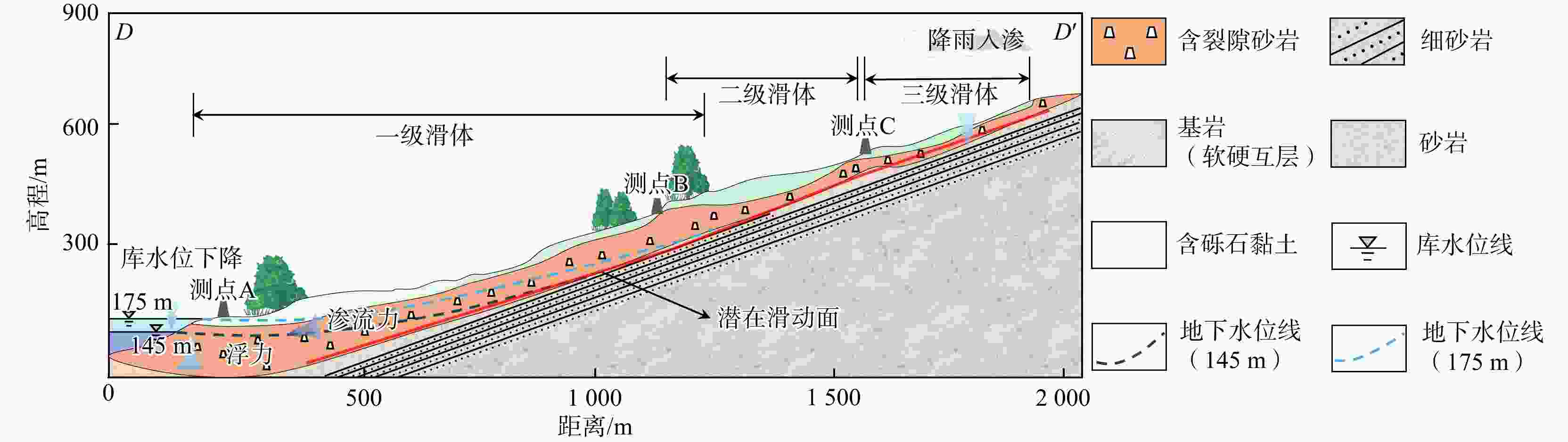
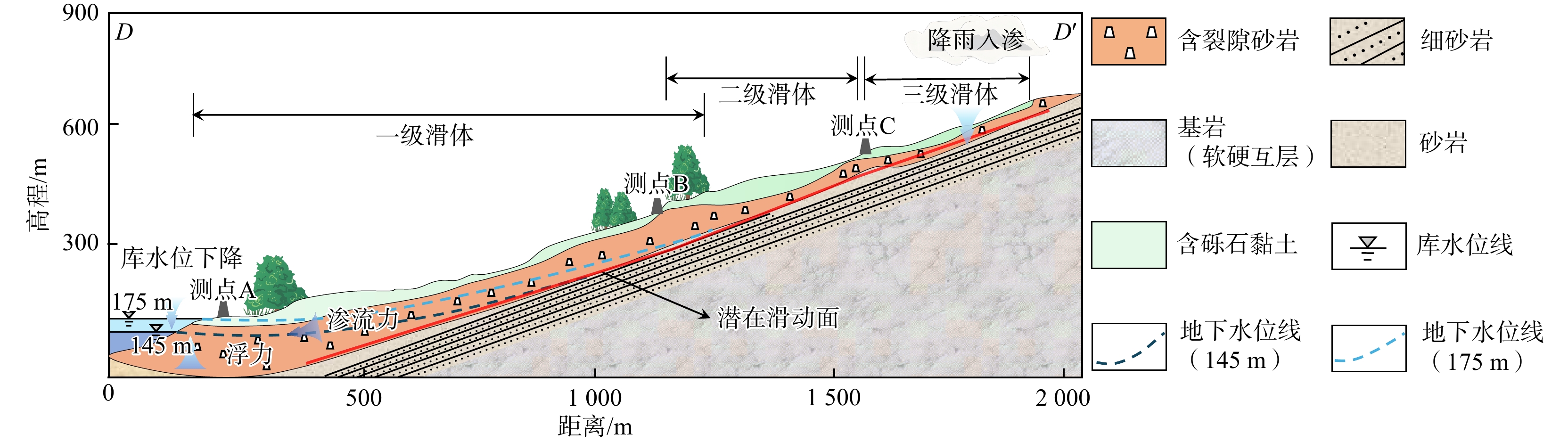
图 3 藕塘滑坡D-D' 剖面与渗流场特征图
Figure 3. D-D' profile and seepage field characteristics of Outang landslide
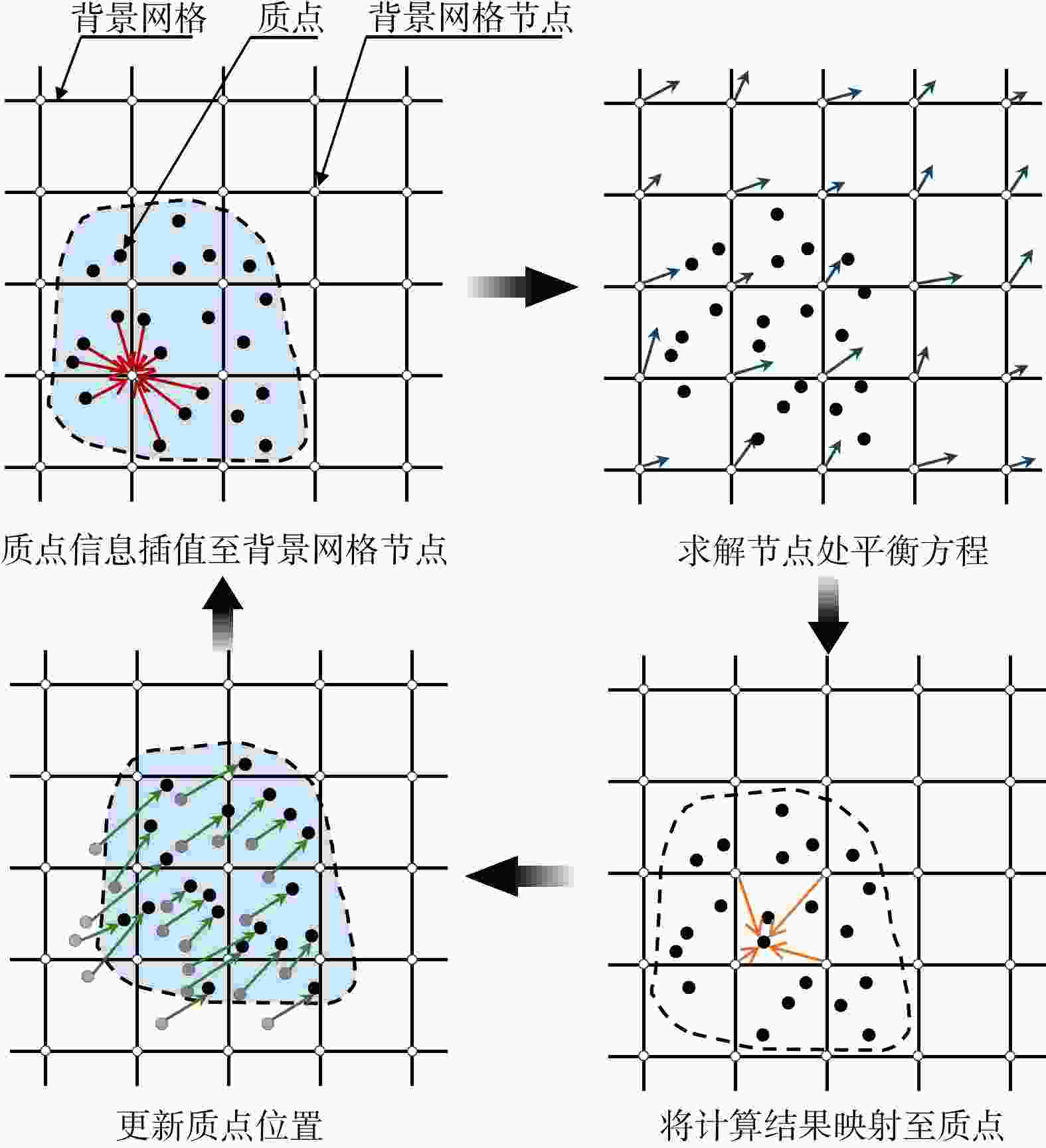
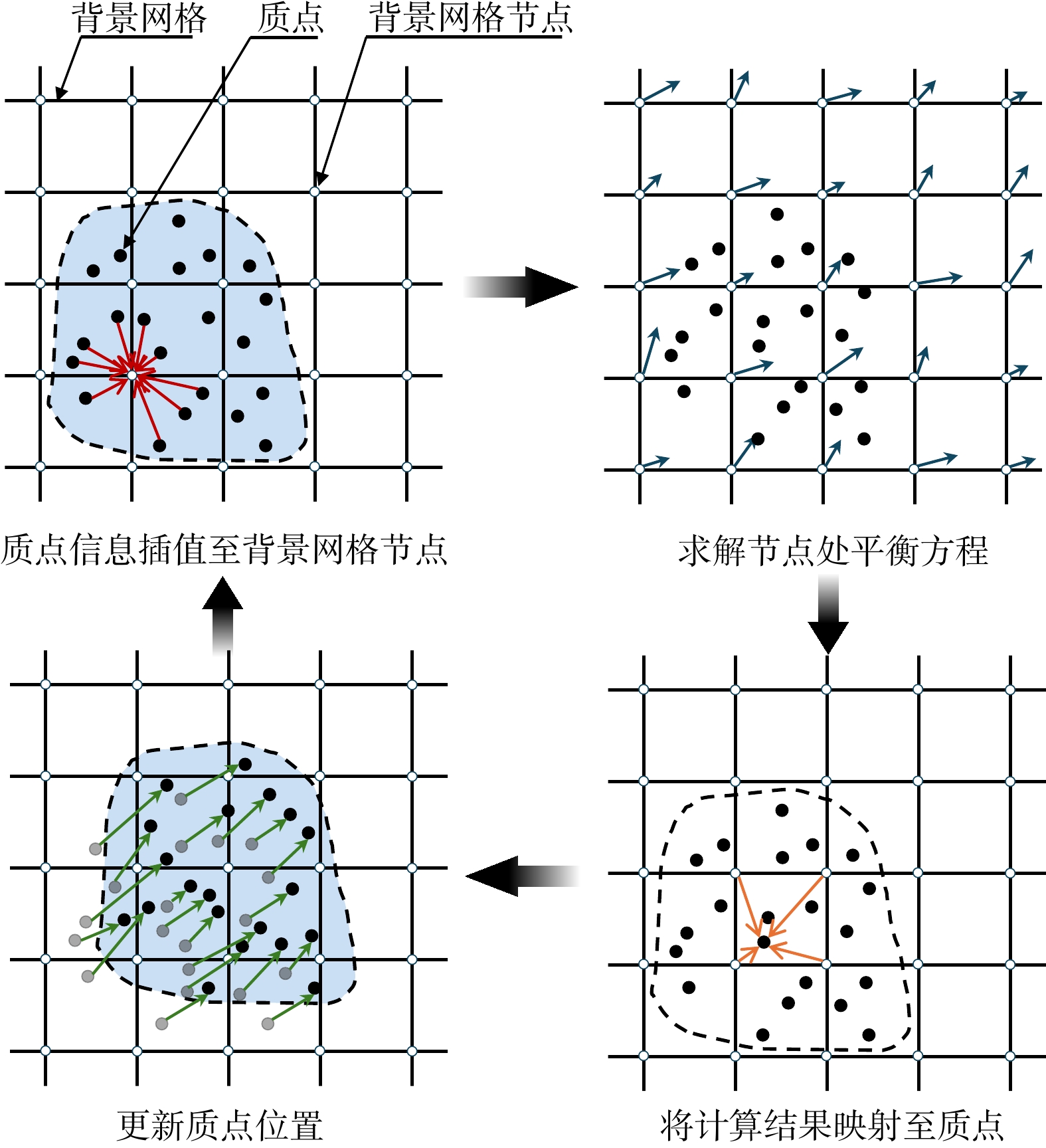
图 4 物质点法计算原理示意图
Figure 4. Schematic diagram of calculation principle of material point method
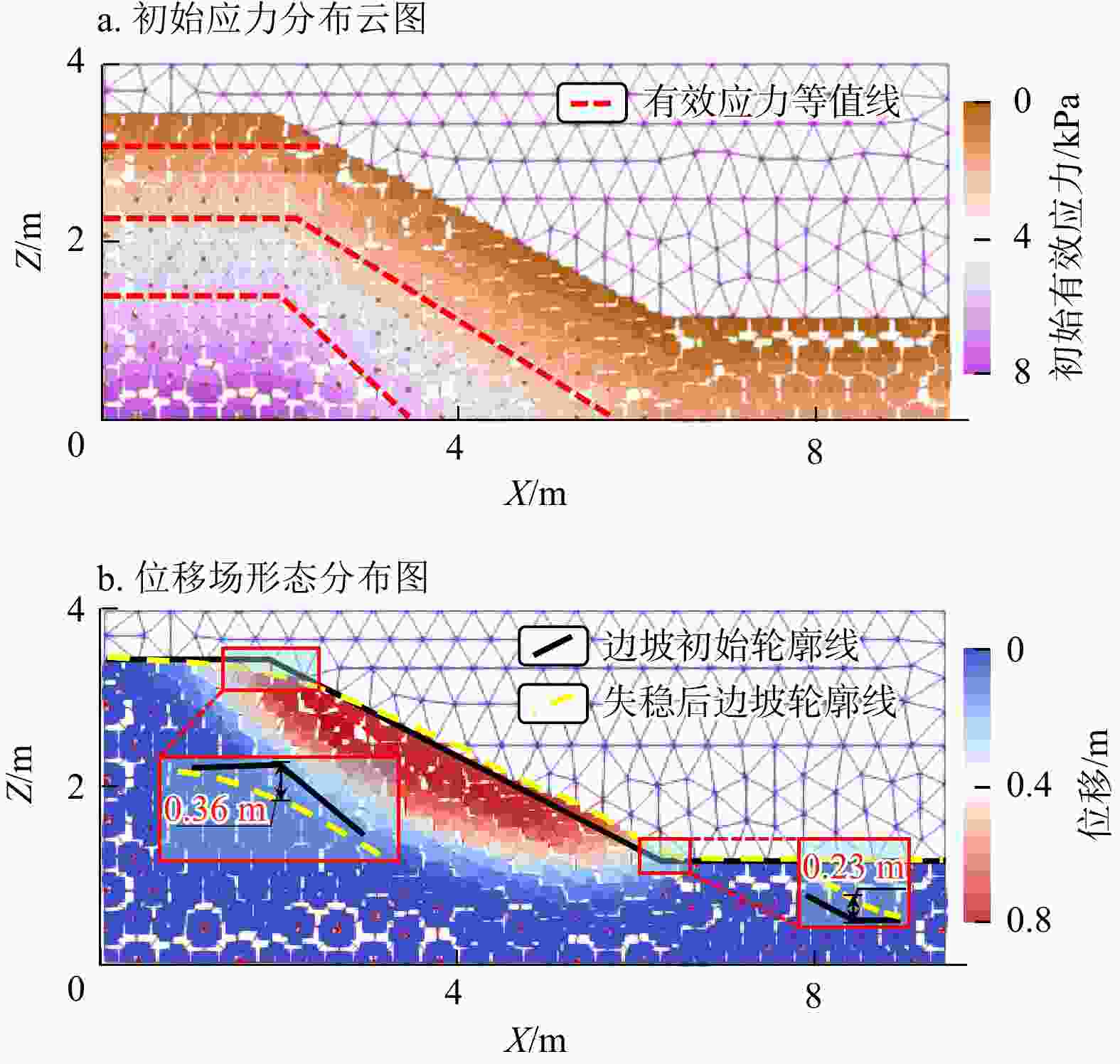
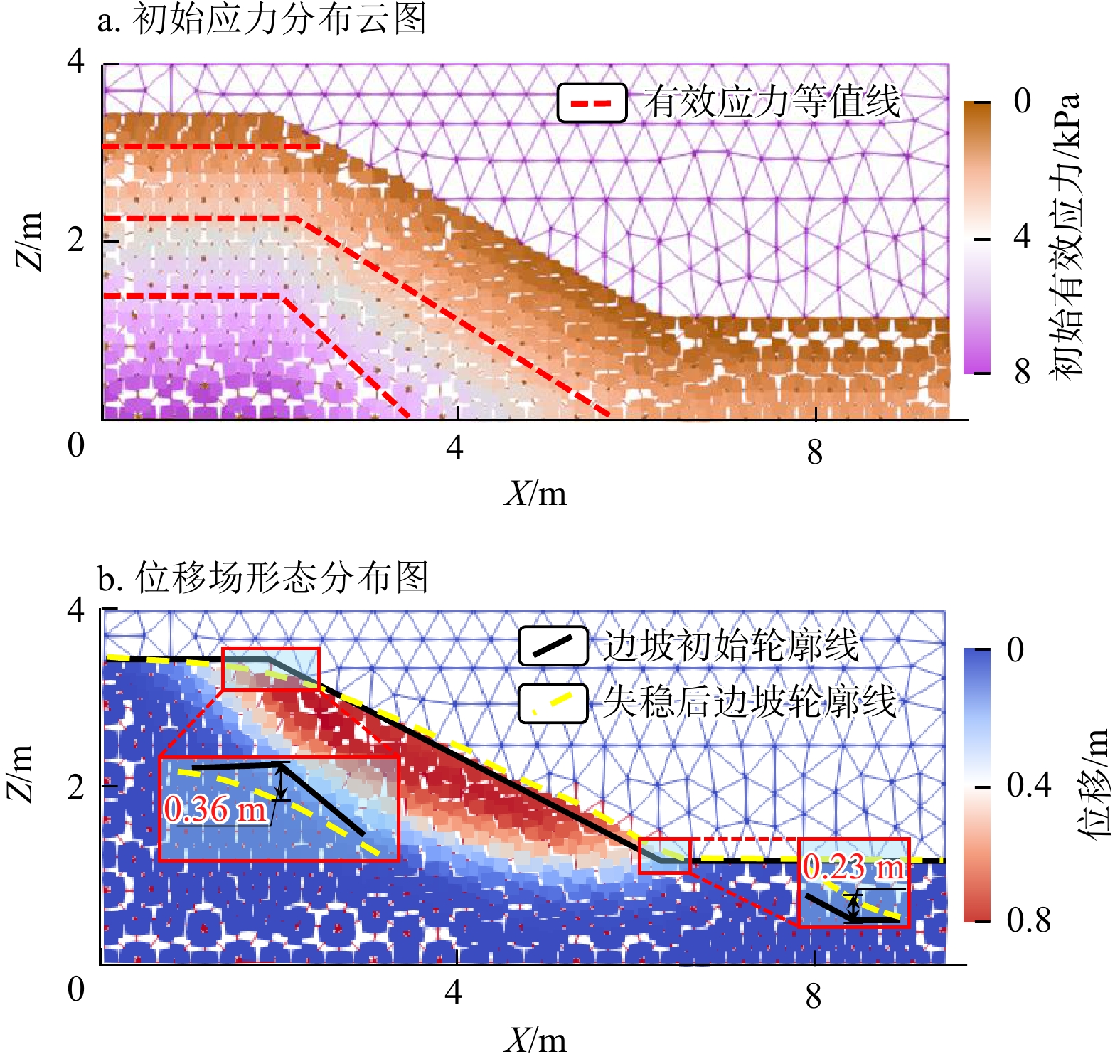
图 6 初始有效应力(a)及位移场(b)数值计算结果
Figure 6. Numerical calculation results of initial effective stress (a) and displacement field (b)
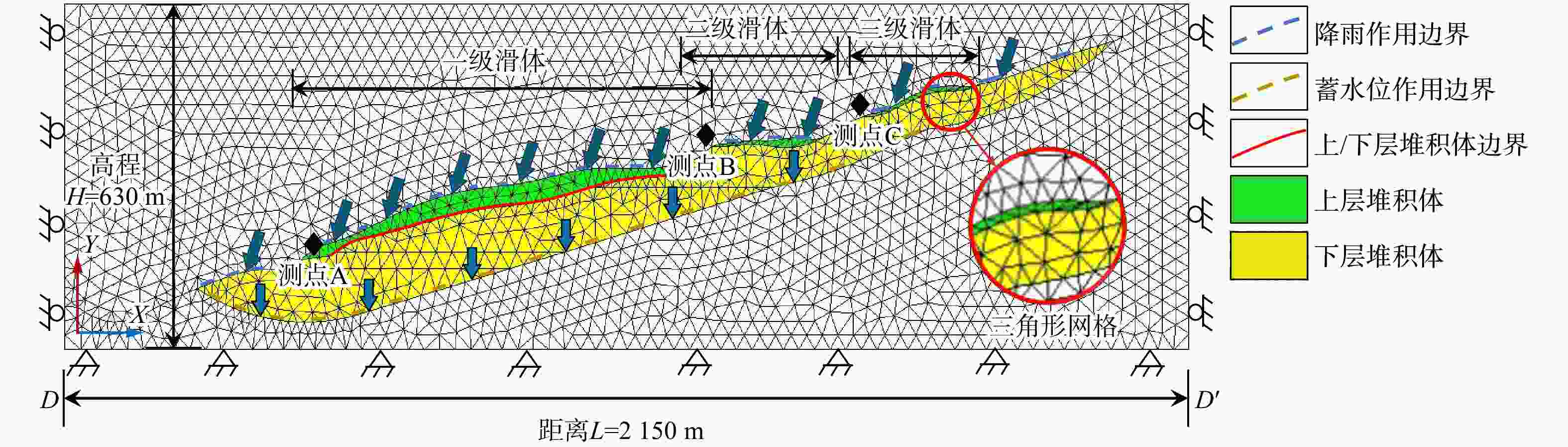
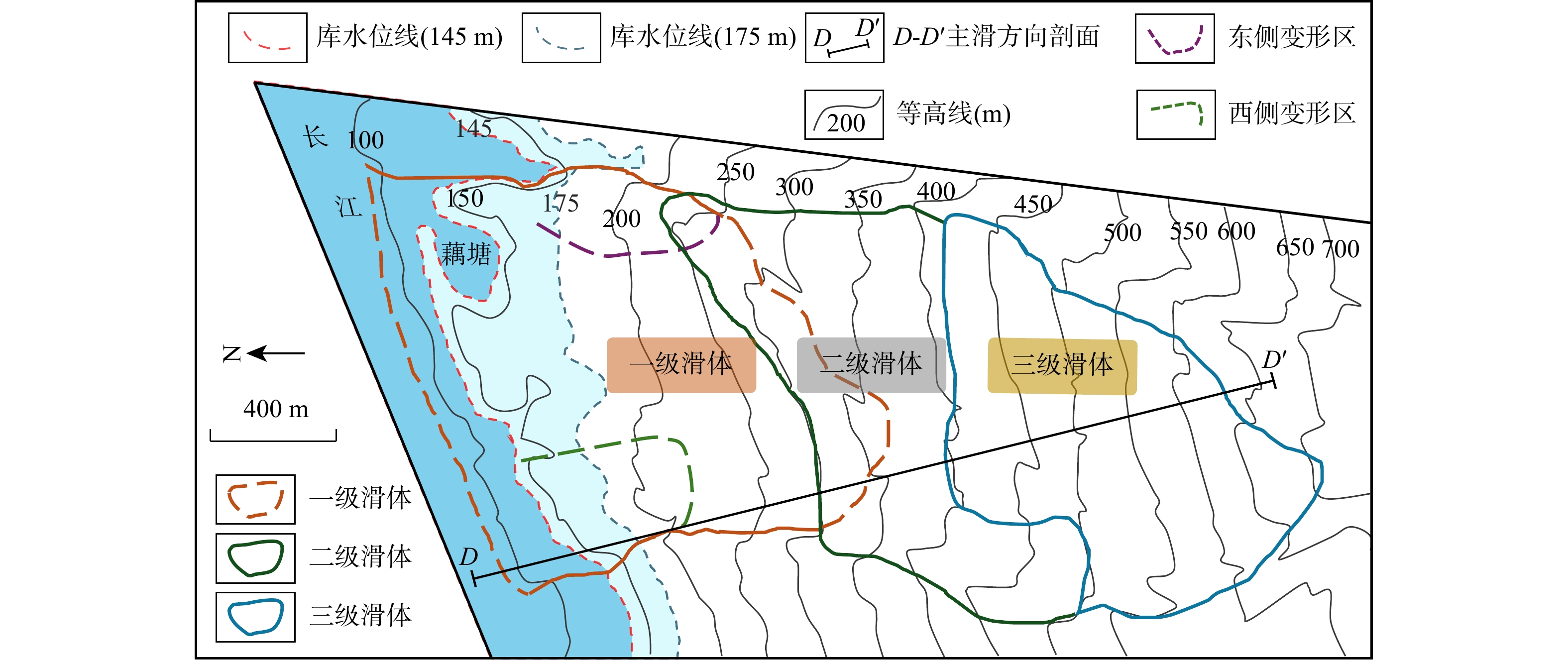
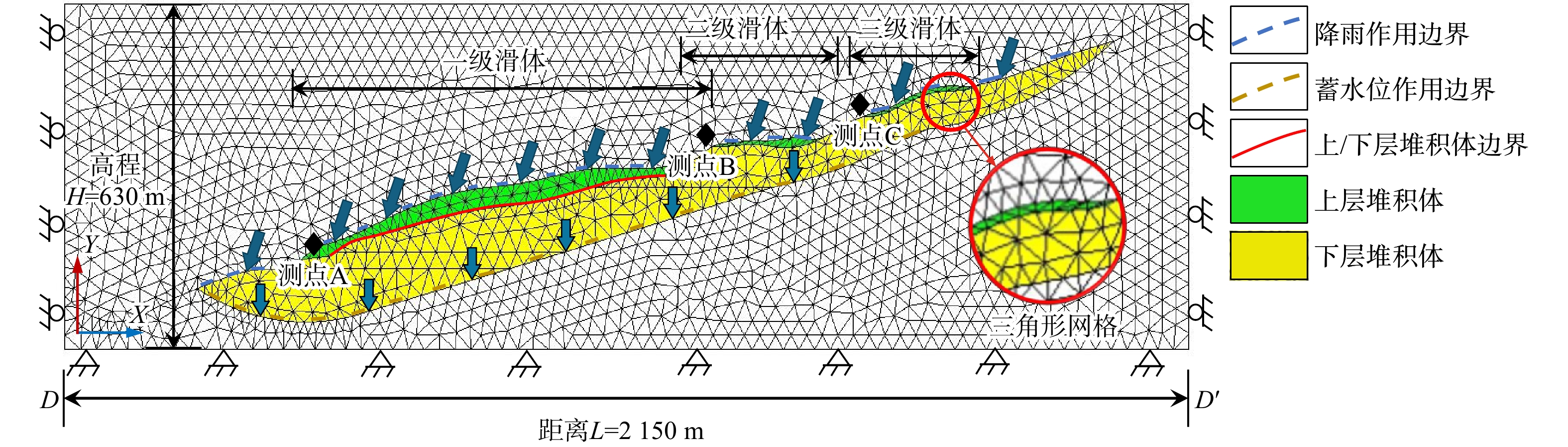
图 7 藕塘滑坡MPM计算模型二维平面图
Figure 7. Two-dimensional plan view of MPM calculation model for Outang landslide
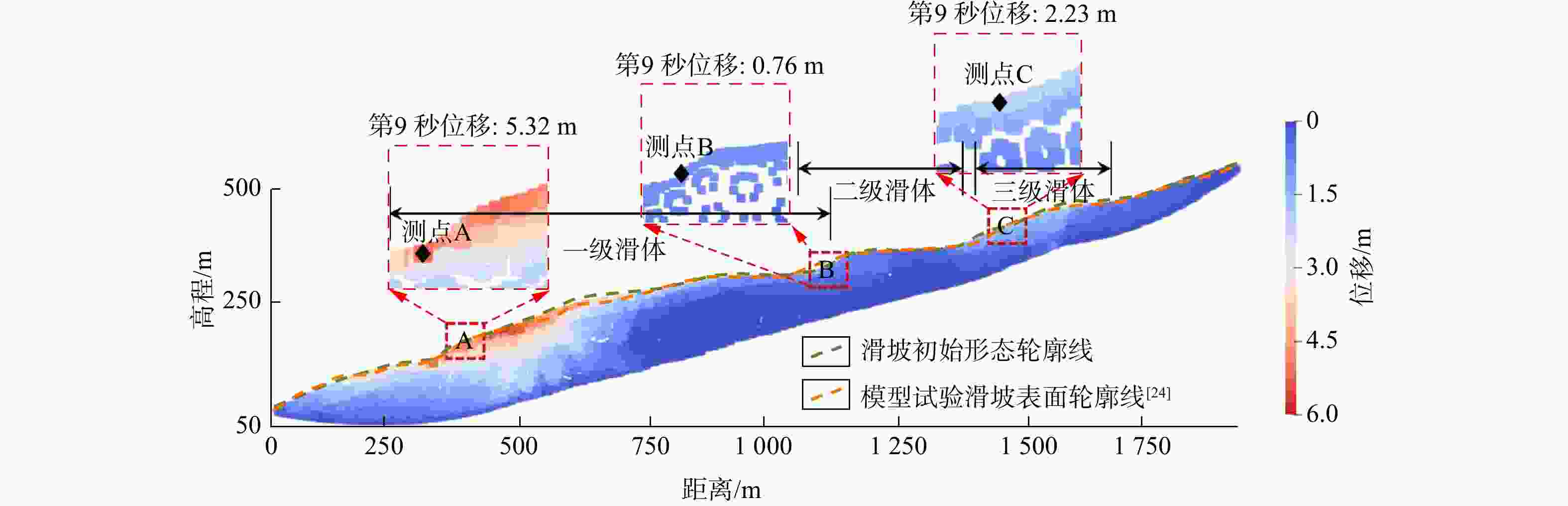
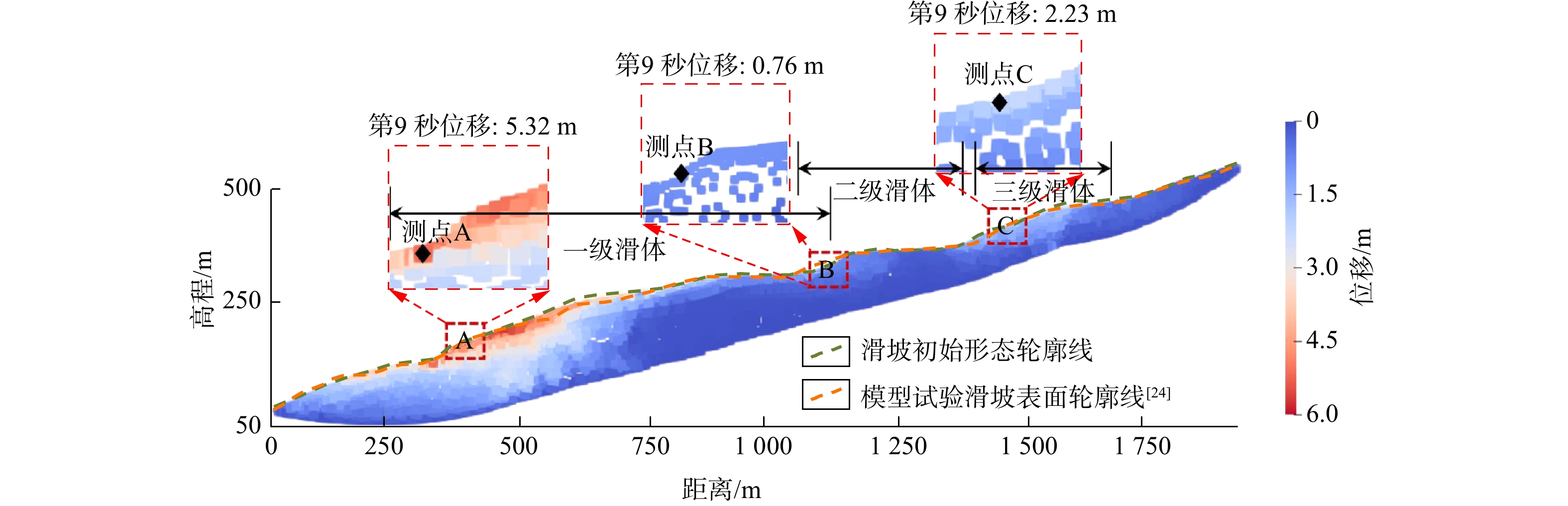
图 8 藕塘滑坡破坏形态及局部细节(第9秒)
Figure 8. Failure patterns and local details of Outang landslide (9th second)
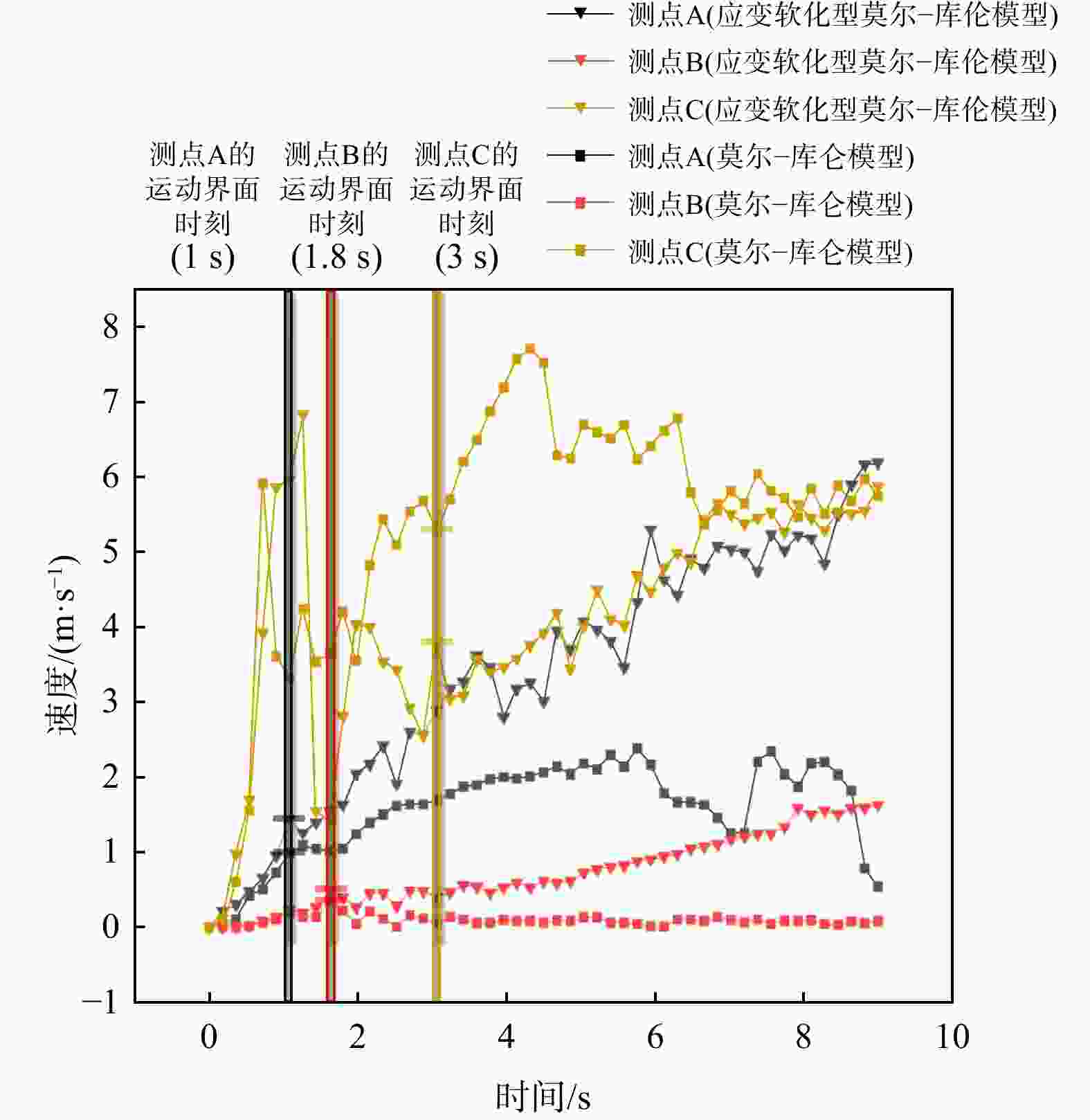
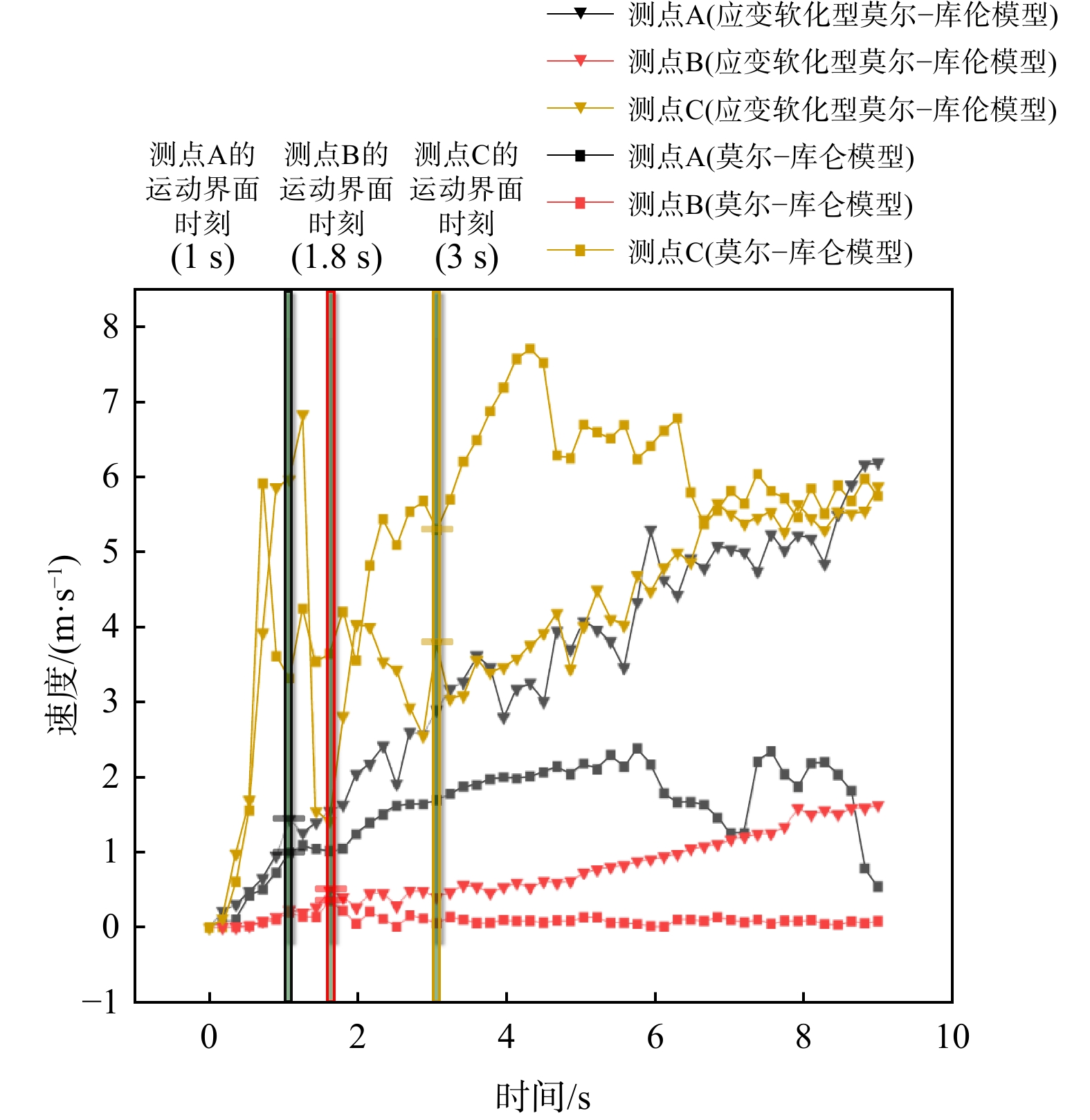
图 10 2种本构模型测点速度特征对比
Figure 10. Comparison of velocity characteristics at monitoring points of two constitutive models
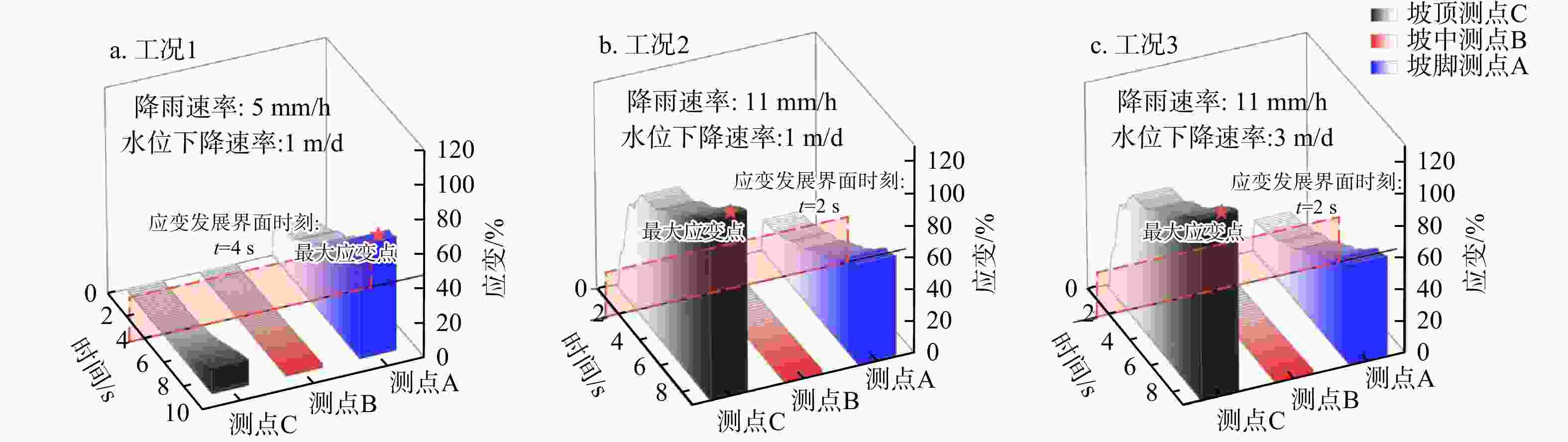
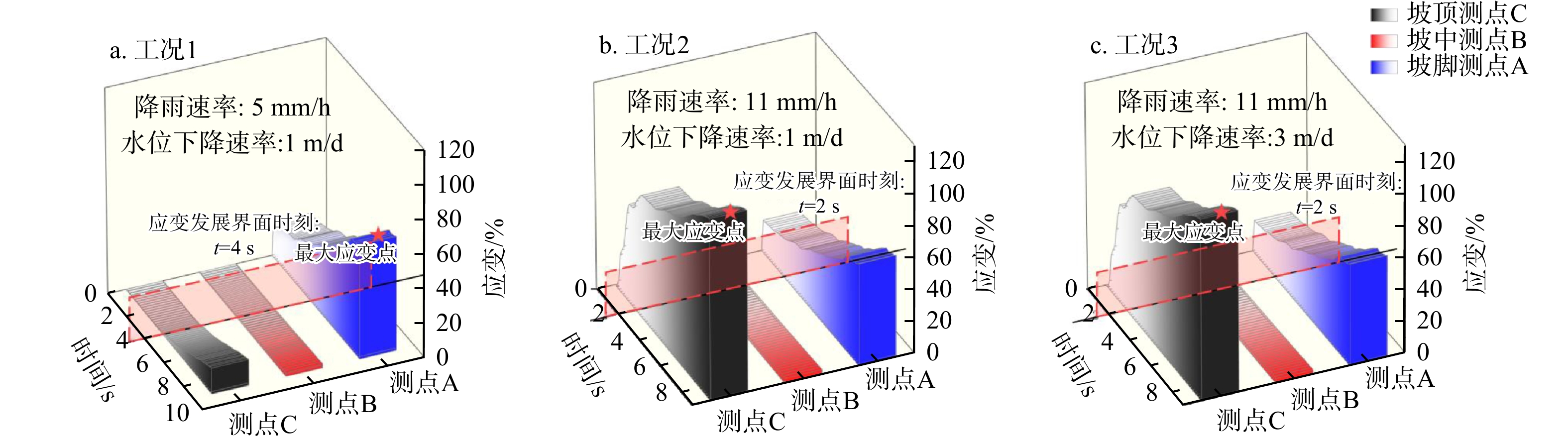
图 11 应变软化型莫尔−库仑模型时间−应变曲线
Figure 11. Time-strain curves of strain-softening Mohr-Coulomb model
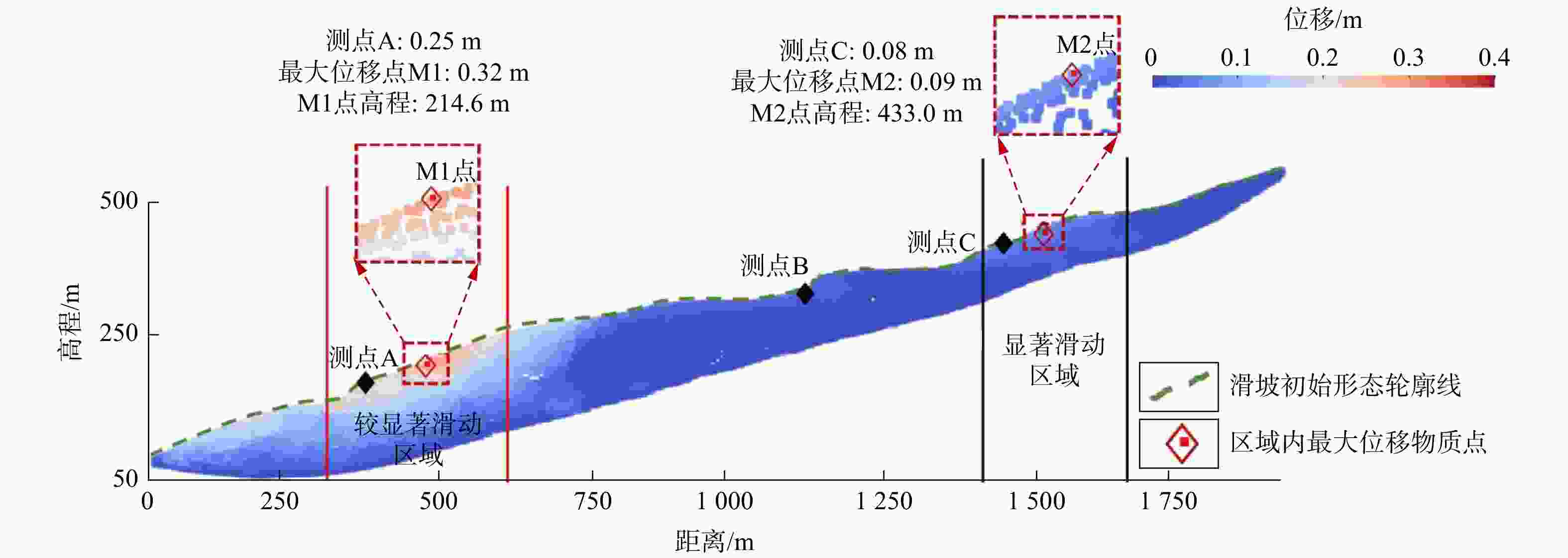
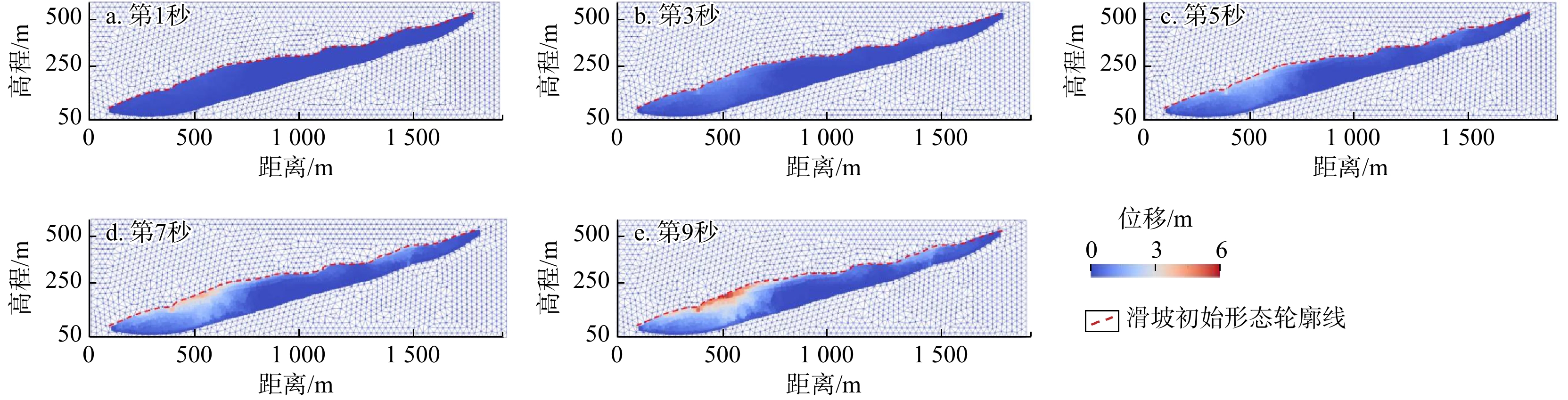
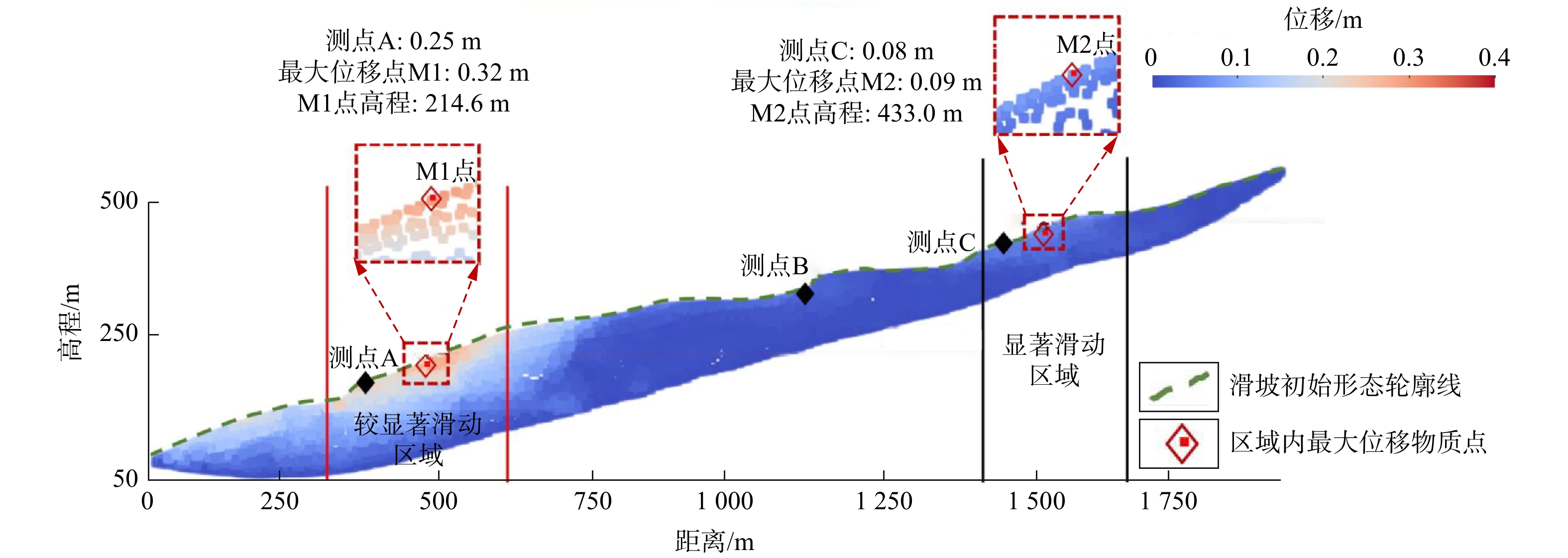
图 12 藕塘滑坡启动−加速分界时刻位移云图(第1秒)
Figure 12. Displacement contour map of Outang landslide at initiation-acceleration transition moment (1st second)
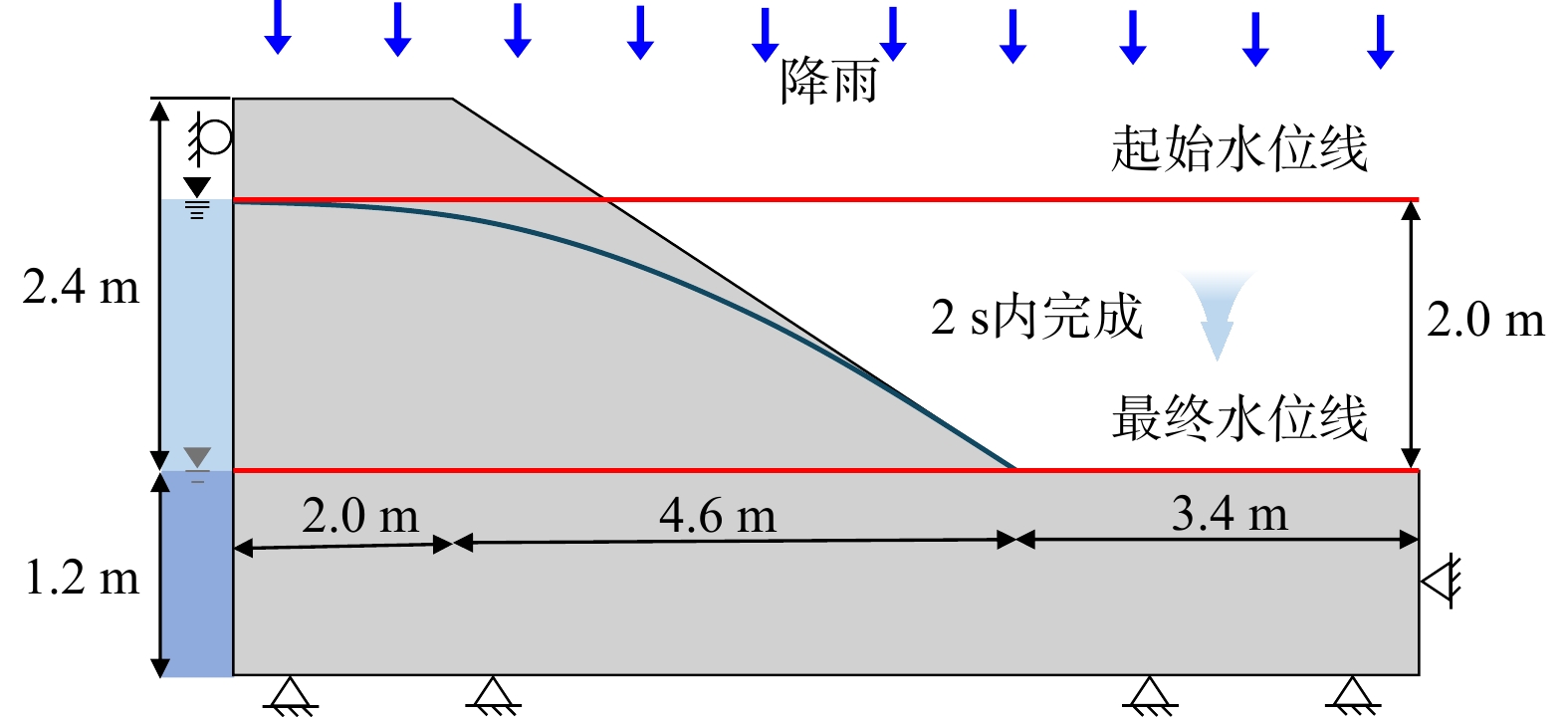
表 1 土质堤坝破坏模拟材料参数设置
Table 1. Material parameter settings of failure simulation of earth dam
参数 取值 参数 取值 初始孔隙比 0.4 固有渗透系数/(m·s−1) 5.9×10⁻⁵ 天然重度/(kN·m−3) 26.5 动态黏度/(kPa·s−1) 1×10⁻⁶ 泊松比 0.3 内摩擦角/(°) 27.0 杨氏模量/MPa 30.0 黏聚力/kPa 1.0 液体体积模量/MPa 60.0 侧压力系数K0值 0.5  下载: 导出CSV
表 2 藕塘滑坡模拟参数
Table 2. Parameter for simulation of Outang landslide
参数 上层堆积体 下层堆积体 初始孔隙比 0.1 0.2 天然重度/(kN·m−3) 20.1 22.0 泊松比 0.33 0.33 杨氏模量/MPa 155 325 液体体积模量/MPa 45 固有渗透系数/(m·s−1) 1.23×10⁻⁵ 动态黏度/(kPa·s−1) 1×10⁻⁶ 峰值内摩擦角/(°) 14.6 峰值黏聚力/kPa 45.9 残余内摩擦角/(°) 11.3 残余黏聚力/kPa 27.0 临界等效塑性应变 0.012
下载: 导出CSV
-
[1] YIN Y P, HUANG B L, WANG W P, et al. Reservoir-induced landslides and risk control in Three Gorges Project on Yangtze River, China[J]. Journal of Rock Mechanics and Geotechnical Engineering, 2016, 8(5): 577-595. doi: 10.1016/j.jrmge.2016.08.001 [2] TANG H M, WASOWSKI J, JUANG C H. Geohazards in the Three Gorges Reservoir area, China: Lessons learned from decades of research[J]. Engineering Geology, 2019, 261: 105267. doi: 10.1016/j.enggeo.2019.105267 [3] 江强强, 焦玉勇, 宋亮, 等. 降雨和库水位联合作用下库岸滑坡模型试验研究[J]. 岩土力学, 2019, 40(11): 4361-4370.JIANG Q Q, JIAO Y Y, SONG L, et al. Experimental study on reservoir landslide under rainfall and water-level fluctuation[J]. Rock and Soil Mechanics, 2019, 40(11): 4361-4370. (in Chinese with English abstract [4] WANG C T, WANG H, QIN W M, et al. Behaviour of pile-anchor reinforced landslides under varying water level, rainfall, and thrust load: Insight from physical modelling[J]. Engineering Geology, 2023, 325: 107293. doi: 10.1016/j.enggeo.2023.107293 [5] ZHU H H, YE X, PEI H F, et al. Probing multi-physical process and deformation mechanism of a large-scale landslide using integrated dual-source monitoring[J]. Geoscience Frontiers, 2024, 15(2): 101773. doi: 10.1016/j.gsf.2023.101773 [6] ZHU Y R, QIU H J, LIU Z J, et al. Rainfall and water level fluctuations dominated the landslide deformation at Baihetan Reservoir, China[J]. Journal of Hydrology, 2024, 642: 131871. doi: 10.1016/j.jhydrol.2024.131871 [7] CUI H Z, MEDINA V, HÜRLIMANN M, et al. Fast physically-based probabilistic modelling of rainfall-induced shallow landslide susceptibility at the regional scale considering geotechnical uncertainties and different hydrological conditions[J]. Computers and Geotechnics, 2024, 172: 106400. doi: 10.1016/j.compgeo.2024.106400 [8] 李松林, 许强, 汤明高, 等. 库水位升降作用下不同滑面形态老滑坡响应规律[J]. 工程地质学报, 2017, 25(3): 841-852.LI S L, XU Q, TANG M G, et al. Response patterns of old landslides with different slipsurface shapes triggered by fluctuation of reservoir water level[J]. Journal of Engineering Geology, 2017, 25(3): 841-852. (in Chinese with English abstract [9] HU W, LI Y, GOU H X, et al. Hydraulic properties of co-seismic landslide deposits around the Wenchuan earthquake epicentre: Large-scale column experiments[J]. Engineering Geology, 2021, 287: 106102. doi: 10.1016/j.enggeo.2021.106102 [10] TANG H M. Identification and mitigation of reservoir landslides: Cases studied in the Three Gorges Reservoir area of China[M]//Progress in Landslide Research and Technology, volume 2 issue 1, 2023. Cham: Springer Nature Switzerland, 2023: 97-131. [11] CUI D S, CHEN Q, HU X L, et al. Investigation of the creep characteristics of sliding zone soils of reservoir landslides under reservoir water level fluctuations: A case study of the Huangtupo landslide[J]. Landslides, 2025, 22(4): 1241-1255. doi: 10.1007/s10346-024-02435-1 [12] 陈世壮, 徐卫亚, 石安池, 等. 高坝大库滑坡涌浪灾害链研究综述[J]. 水利水电科技进展, 2023, 43(3): 83-93. doi: 10.3880/j.issn.1006-7647.2023.03.013CHEN S Z, XU W Y, SHI A C, et al. Review of hazard chain of landslide surge for high dams and large reservoirs[J]. Advances in Science and Technology of Water Resources, 2023, 43(3): 83-93. (in Chinese with English abstract doi: 10.3880/j.issn.1006-7647.2023.03.013 [13] 代贞伟, 殷跃平, 魏云杰, 等. 三峡库区藕塘滑坡变形失稳机制研究[J]. 工程地质学报, 2016, 24(1): 44-55. doi: 10.13544/j.cnki.jeg.2016.01.006DAI Z W, YIN Y P, WEI Y J, et al. Deformation and failure mechanism of Outang landslide in Three Gorges Reservoir area[J]. Journal of Engineering Geology, 2016, 24(1): 44-55. (in Chinese with English abstract doi: 10.13544/j.cnki.jeg.2016.01.006 [14] LUO S L, HUANG D. Deformation characteristics and reactivation mechanisms of the Outang ancient landslide in the Three Gorges Reservoir, China[J]. Bulletin of Engineering Geology and the Environment, 2020, 79(8): 3943-3958. doi: 10.1007/s10064-020-01838-3 [15] 朱赛楠, 殷跃平, 铁永波, 等. 乌蒙山区巨型古滑坡变形特征与复活机理研究: 以大关古滑坡为例[J]. 岩土工程学报, 2025, 47(2): 305-314.ZHU S N, YIN Y P, TIE Y B, et al. Deformation characteristics and reactivation mechanism of giant ancient landslide in Wumeng Mountain area: Case study of Daguan ancient landslide[J]. Chinese Journal of Geotechnical Engineering, 2025, 47(2): 305-314. (in Chinese with English abstract [16] YE X, ZHU H H, CHANG F N, et al. Revisiting spatiotemporal evolution process and mechanism of a giant reservoir landslide during weather extremes[J]. Engineering Geology, 2024, 332: 107480. doi: 10.1016/j.enggeo.2024.107480 [17] YE X, ZHU H H, WANG J, et al. Subsurface multi-physical monitoring of a reservoir landslide with the fiber-optic nerve system[J]. Geophysical Research Letters, 2022, 49(11): e2022GL098211. [18] YE X, ZHU H H, WANG J, et al. Towards hydrometeorological thresholds of reservoir-induced landslide from subsurface strain observations[J]. Science China Technological Sciences, 2024, 67(6): 1907-1922. doi: 10.1007/s11431-023-2657-3 [19] 康亚, 赵超英, 张勤, 等. InSAR滑坡探测技术研究: 以金沙江乌东德水电站段为例[J]. 大地测量与地球动力学, 2018, 38(10): 1053-1057. doi: 10.14075/j.jgg.2018.10.012KANG Y, ZHAO C Y, ZHANG Q, et al. Research on the InSAR technique of landslide detection: A case study of Wudongde hydropower station section, Jinshajiang[J]. Journal of Geodesy and Geodynamics, 2018, 38(10): 1053-1057. (in Chinese with English abstract doi: 10.14075/j.jgg.2018.10.012 [20] CHANG F N, DONG S C, YIN H W, et al. Unravelling long-term spatiotemporal deformation and hydrological triggers of slow-moving reservoir landslides with multi-platform SAR data[J]. International Journal of Applied Earth Observation and Geoinformation, 2024, 135: 104301. doi: 10.1016/j.jag.2024.104301 [21] CHANG F N, DONG S C, YIN H W, et al. Temporal stacking of sub-pixel offset tracking for monitoring slow-moving landslides in vegetated terrain[J]. Landslides, 2024, 21(6): 1255-1271. doi: 10.1007/s10346-024-02227-7 [22] 刘艺梁, 樊西丰, 申高伟, 等. 基于时序InSAR技术的木鱼包滑坡时空变形特征分析[J]. 地质科技通报, 2025, 44(2): 78-93.LIU Y L, FAN X F, SHEN G W, et al. Analysis of spatio-temporal deformation characteristics of the Muyubao landslide via time series InSAR technology[J]. Bulletin of Geological Science and Technology, 2025, 44(2): 78-93. (in Chinese with English abstract [23] 肖捷夫, 李云安, 蔡浚明. 水位涨落作用下藕塘滑坡响应特征模型试验研究[J]. 工程地质学报, 2020, 28(5): 1049-1056. doi: 10.13544/j.cnki.jeg.2020-326XIAO J F, LI Y A, CAI J M. Model test research on response characteristics of Outang landslide under water level fluctuation[J]. Journal of Engineering Geology, 2020, 28(5): 1049-1056. (in Chinese with English abstract doi: 10.13544/j.cnki.jeg.2020-326 [24] 肖捷夫, 李云安, 胡勇, 等. 库水涨落和降雨条件下古滑坡变形特征模型试验研究[J]. 岩土力学, 2021, 42(2): 471-480.XIAO J F, LI Y A, HU Y, et al. Model tests on deformation characteristics of ancient bank landslide under water level fluctuation and rainfall[J]. Rock and Soil Mechanics, 2021, 42(2): 471-480. (in Chinese with English abstract [25] QU J K, ZHU Q Y, QI S C, et al. Instability mechanism of reservoir landslides under combined effects of water level fluctuations and rainfall[J]. Engineering Geology, 2025, 352: 108092. doi: 10.1016/j.enggeo.2025.108092 [26] 许波, 李静, 黄琪嵩, 等. 蠕动型滑坡位移变形规律与失稳判据[J]. 安徽工业大学学报(自然科学版), 2023, 40(4): 449-454.XU B, LI J, HUANG Q S, et al. Deformation evolution law and instability criterion of creeping landslides[J]. Journal of Anhui University of Technology (Natural Science), 2023, 40(4): 449-454. (in Chinese with English abstract [27] 邵晨, 苏爱军, 李川鄂, 等. 库水位和降雨联合作用下藕塘滑坡稳定性研究[J]. 甘肃科学学报, 2021, 33(6): 134-141.SHAO C, SU A J, LI C E, et al. Stability of Outang landslide under the combined effect of reservoir water level and rainfall fluctuations[J]. Journal of Gansu Sciences, 2021, 33(6): 134-141. (in Chinese with English abstract [28] 李长冬, 龙晶晶, 姜茜慧, 等. 水库滑坡成因机制研究进展与展望[J]. 地质科技通报, 2020, 39(1): 67-77.LI C D, LONG J J, JIANG X H, et al. Advance and prospect of formation mechanism for reservoir landslides[J]. Bulletin of Geological Science and Technology, 2020, 39(1): 67-77. (in Chinese with English abstract [29] 马宁, 李韶凯, 田峰, 等. 滑坡光纤神经感测系统: 技术与应用[J]. 地质科技通报, 2024, 43(6): 26-38.MA N, LI S K, TIAN F, et al. Fiber optic nerve sensing system for landslide monitoring: Technology and application[J]. Bulletin of Geological Science and Technology, 2024, 43(6): 26-38. (in Chinese with English abstract [30] ZABALA F, ALONSO E E. Progressive failure of Aznalcóllar dam using the material point method[J]. Géotechnique, 2011, 61(9): 795-808. doi: 10.1680/geot.9.p.134 [31] 孙玉进, 宋二祥. 大位移滑坡形态的物质点法模拟[J]. 岩土工程学报, 2015, 37(7): 1218-1225. doi: 10.11779/CJGE201507007SUN Y J, SONG E X. Simulation of large-displacement landslide by material point method[J]. Chinese Journal of Geotechnical Engineering, 2015, 37(7): 1218-1225. (in Chinese with English abstract doi: 10.11779/CJGE201507007 [32] XIE T C, ZHU H H, DONG Y K, et al. Geo-interface modeling with material point method: A review[J]. Journal of Rock Mechanics and Geotechnical Engineering, 2025, 17(6): 3950-3972. doi: 10.1016/j.jrmge.2025.04.001 [33] 吴方东, 张巍, 史卜涛, 等. 堆载诱发型土质滑坡运动特征物质点法模拟[J]. 水文地质工程地质, 2017, 44(6): 126-134. doi: 10.16030/j.cnki.issn.1000-3665.2017.06.19WU F D, ZHANG W, SHI B T, et al. Run-out characteristic simulation of a surcharge-induced soil landslide using the material point method[J]. Hydrogeology & Engineering Geology, 2017, 44(6): 126-134. (in Chinese with English abstract doi: 10.16030/j.cnki.issn.1000-3665.2017.06.19 [34] 重庆市地质矿产勘察开发局南江水文地质工程地质队. 重庆三峡库区后续地质灾害防治工程治理项目奉节藕塘滑坡勘查报告[R]. 重庆: 南江水文地质工程地质队, 2014.Nanjiang Hydrogeological & Engineering Chongqing Geology Brigade, Bureau of Geology and Minerals Exploration, Chongqing. Subsequent geological disaster prevention and governance project in the Three Gorges Reservoir area: Geological investigation report of Outang landslide in Fengjie County[R]. Chongqing: Nanjiang Hydro-geological & Engineering Geology Brigade, 2014. (in Chinese) [35] 张洪武, 王鲲鹏. 基于物质点方法饱和多孔介质动力学模拟(Ⅲ): 两相物质点方法[J]. 岩土工程学报, 2010, 32(4): 507-513.ZHANG H W, WANG K P. Material point method for dynamic analysis of saturated porous media (Ⅲ): Two-phase material point method[J]. Chinese Journal of Geotechnical Engineering, 2010, 32(4): 507-513. (in Chinese with English abstract [36] JIN Y F, YIN Z Y, YUAN W H. Simulating retrogressive slope failure using two different smoothed particle finite element methods: A comparative study[J]. Engineering Geology, 2020, 279: 105870. doi: 10.1016/j.enggeo.2020.105870 [37] 谢云轩, 汪洋, 王梦瑶, 等. 基于物理模型试验的库岸滑坡水阻力系数研究[J]. 地质科技通报, 2025, 44(2): 59-66. doi: 10.19509/j.cnki.dzkq.tb20240247XIE Y X, WANG Y, WANG M Y, et al. Water resistance coefficient of bank slope landslides via physical model experiments[J]. Bulletin of Geological Science and Technology, 2025, 44(2): 59-66. (in Chinese with English abstract doi: 10.19509/j.cnki.dzkq.tb20240247 [38] GIRARDI V, CECCATO F, ROHE A, et al. Failure of levees induced by toe uplift: Investigation of post-failure behavior using material point method[J]. Journal of Rock Mechanics and Geotechnical Engineering, 2023, 15(4): 970-983. doi: 10.1016/j.jrmge.2022.07.015 [39] 李剑平, 蒋水华, 黄发明, 等. 考虑渗透系数空间变异性的降雨作用下边坡大变形破坏特征[J]. 应用基础与工程科学学报, 2024, 32(1): 72-84. doi: 10.16058/j.issn.1005-0930.2024.01.005LI J P, JIANG S H, HUANG F M, et al. Investigation of large deformation failure characteristics of slopes under rainfalls considering spatial variability of hydraulic conductivity[J]. Journal of Basic Science and Engineering, 2024, 32(1): 72-84. (in Chinese with English abstract doi: 10.16058/j.issn.1005-0930.2024.01.005 [40] CECCATO F, YERRO A, GIRARDI V, et al. Two-phase dynamic MPM formulation for unsaturated soil[J]. Computers and Geotechnics, 2021, 129: 103876. doi: 10.1016/j.compgeo.2020.103876 [41] WANG S H, DEMISA M G, HAN B W, et al. A material point method analysis of failure mechanism and kinematic behavior of rainfall-induced landslide[J]. Natural Hazards, 2024, 120(15): 13875-13897. doi: 10.1007/s11069-024-06770-3 -

 下载:
下载:

 点击查看大图
计量
- 文章访问数: 571
- PDF下载量: 219
- 被引次数: 0