投审稿入口
投审稿入口


Three-dimensional calculation method for sliding stability of unstable rocks with steeply inclined fractures at rear edge
-
摘要:
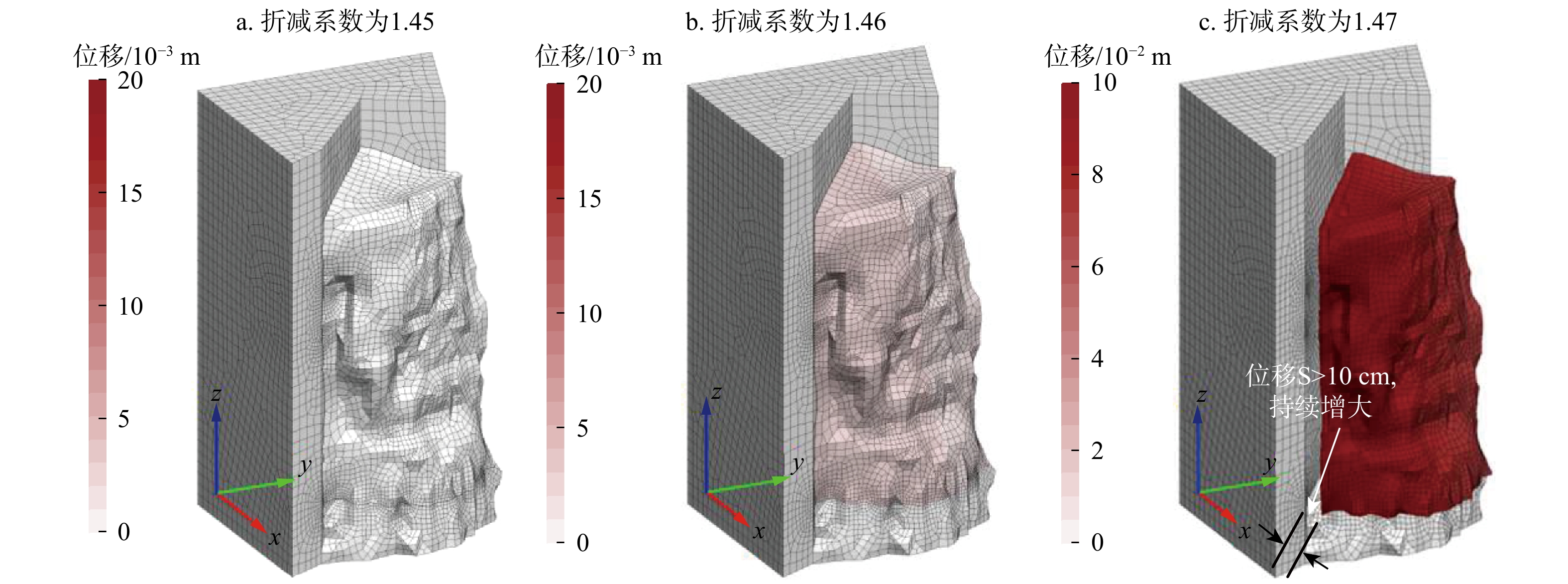
危岩稳定系数是崩塌灾害评估的核心指标,传统二维剖面模型因忽略三维形态特征与多裂隙协同作用,易导致稳定系数计算较大误差。基于极限平衡理论,构建了后缘含陡倾裂隙的滑移式危岩三维稳定性计算模型,提出了危岩在三维空间下多组后缘裂隙充水作用下水压力计算方法,以及三维空间形态下危岩滑面浮托力计算方法,并以重庆市涪陵区大闸口危岩为例开展了应用,对比分析三维与二维模型的计算差异。结果表明:三维模型可精确表征危岩不规则形态及多裂隙水力耦合效应,暴雨工况下双裂隙充水(分析工况⑦)时稳定系数较单裂隙充水(分析工况③)降低5.04%;数值模拟验证显示三维极限平衡法与强度折减法结果偏差约为0.4%;危岩形态对稳定性影响显著,除规则立方体外,多数情形需采用三维分析方法以确保评估精度。研究成果可为复杂条件下滑移式危岩精准稳定性评估提供理论与技术支撑。
Abstract:ObjectiveThe stability coefficient of unstable rocks is a critical metric for assessing rockfall hazards. Traditional two-dimensional (2D) cross-sectional models, which fail to account for three-dimensional (3D) geometric characteristics and the synergistic effects of multiple fractures, often result in substantial errors in the calculation of stability coefficients.
MethodsIn this study, a 3D stability calculation model for sliding unstable rocks with steeply inclined fractures at the rear edge was developed based on the theory of limit equilibrium. Additionally, a calculation method for the water pressure acting on unstable rocks under the influence of multiple groups of rear-edge fractures in 3D space, along with a calculation method for the uplift force on the sliding surface of unstable rocks in 3D spatial configurations, was proposed. The model was applied to the Dazhaokou unstable rocks in Fuling District, Chongqing, and the differences between the 3D and 2D model calculations were compared and analyzed.
ResultsThe results indicate that the 3D model could accurately characterize the irregular geometry of the unstable rocks and the hydro-mechanical coupling effects of multiple fractures. Under heavy rainfall conditions, the stability coefficient calculated for both fractures filled with water (case ⑦) was 5.04% lower than that for single fracture filled with water (case ③). Numerical simulation validation demonstrated that the discrepancy between the 3D limit equilibrium method and the strength reduction method was about 0.4%. The shape of unstable rocks significantly influences stability. Except for regular cubic shapes, 3D analysis methods are required in most cases to ensure assessment accuracy.
ConclusionThis research provides theoretical and technical support for accurate stability assessment of sliding unstable rocks under complex conditions.
-
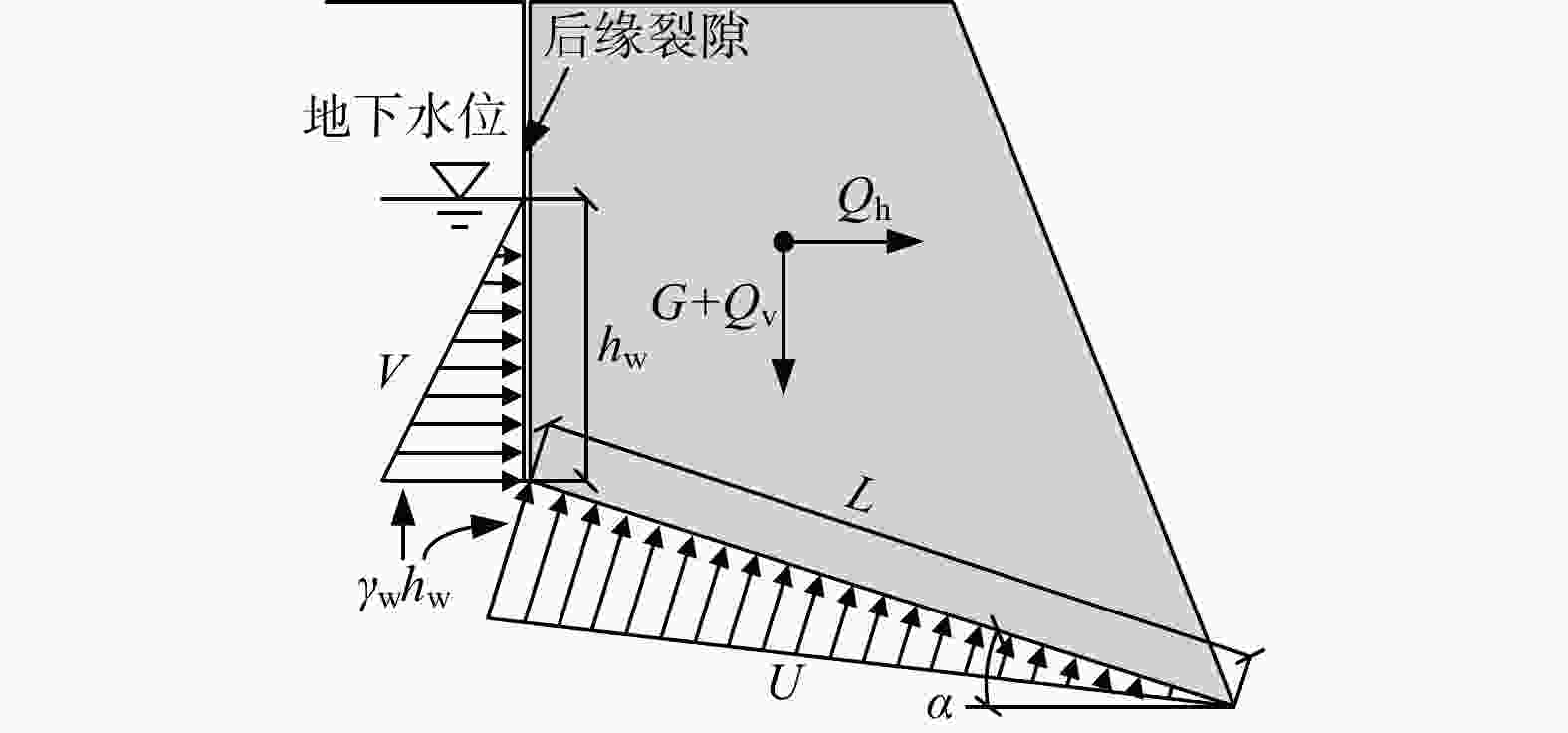
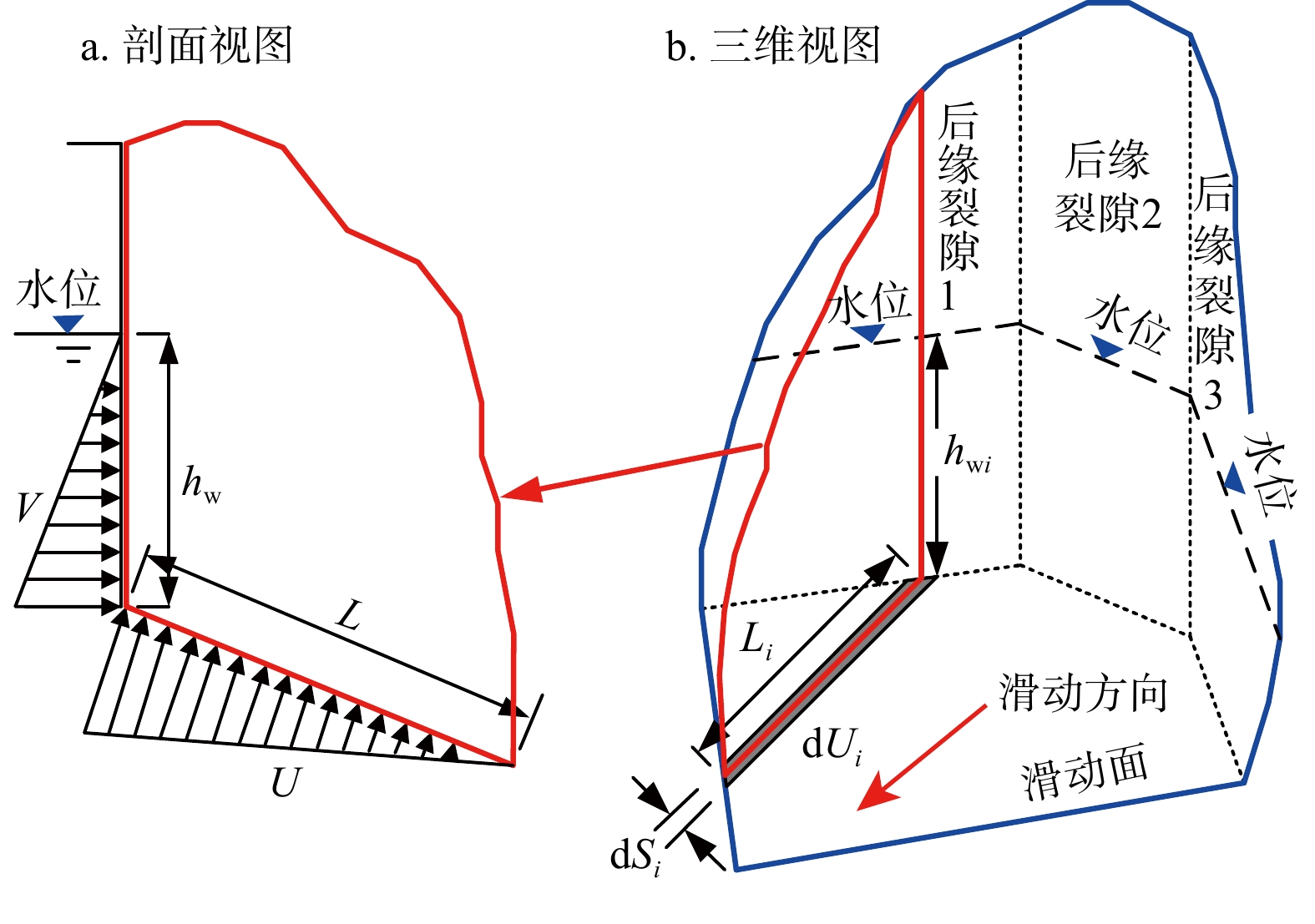
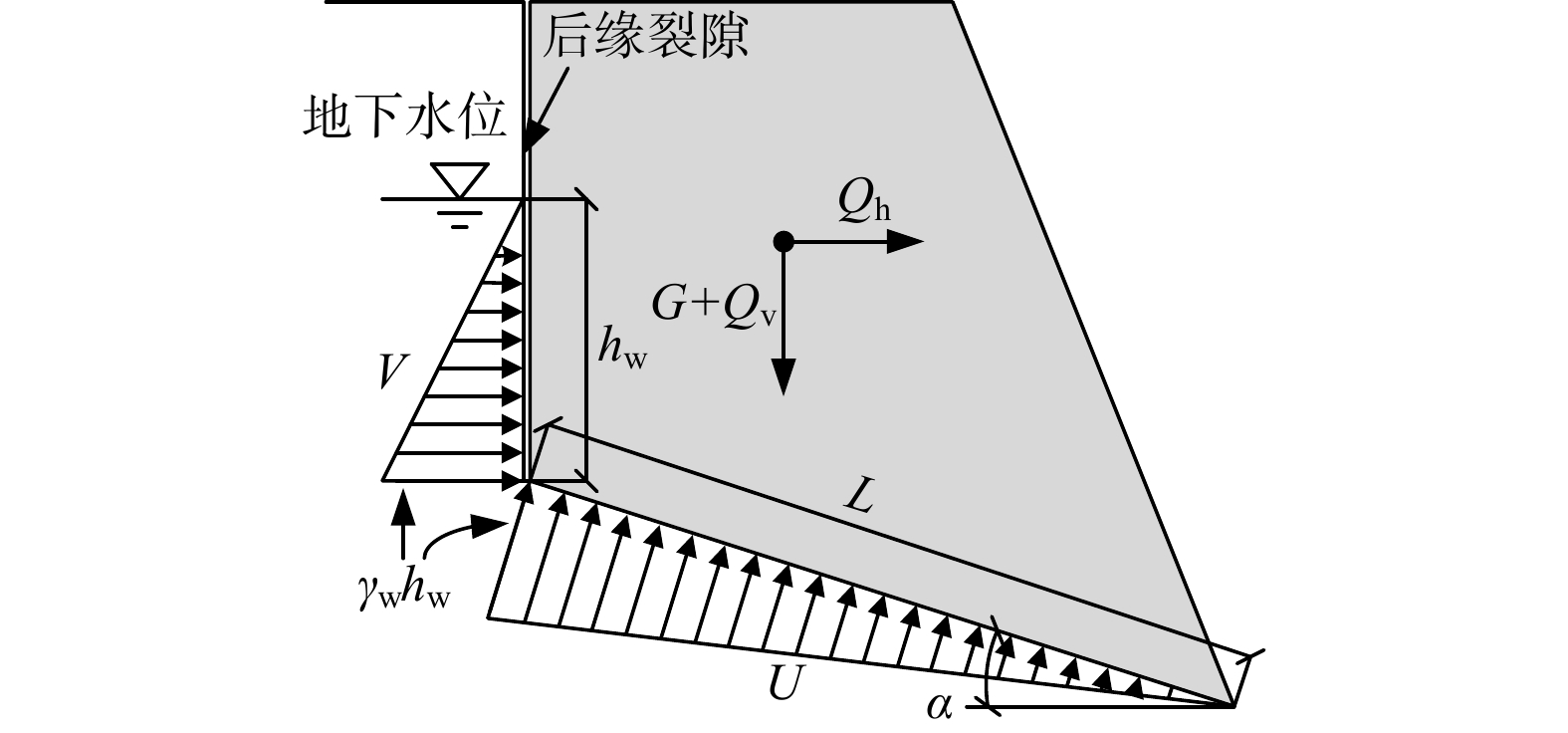
图 1 滑移式危岩稳定性计算简图
$ {Q}_{{\mathrm{h}}} $为地震力水平分量;Qv为地震力竖向分量;$ G $为危岩体自重;$ V $为裂隙水压力;$ {\gamma }_{{\mathrm{w}}} $为水的容重;$ {h}_{{\mathrm{w}}} $为后缘裂隙充水高度;$ U $为滑面处水产生的浮托力;$ \alpha $为危岩体与基座接触面倾角;$ L $为滑移长度;下同
Figure 1. Stability calculation of sliding unstable rocks
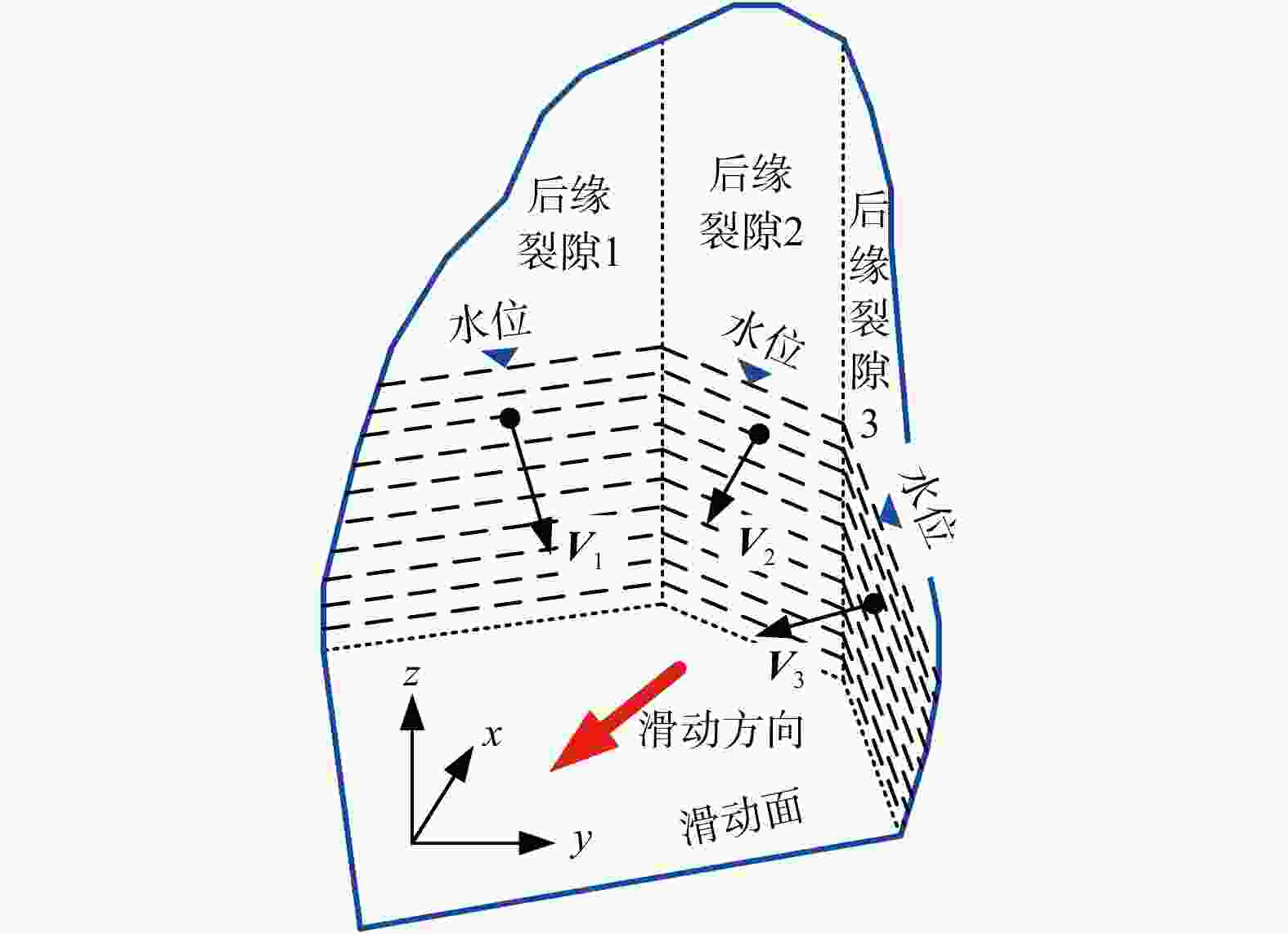
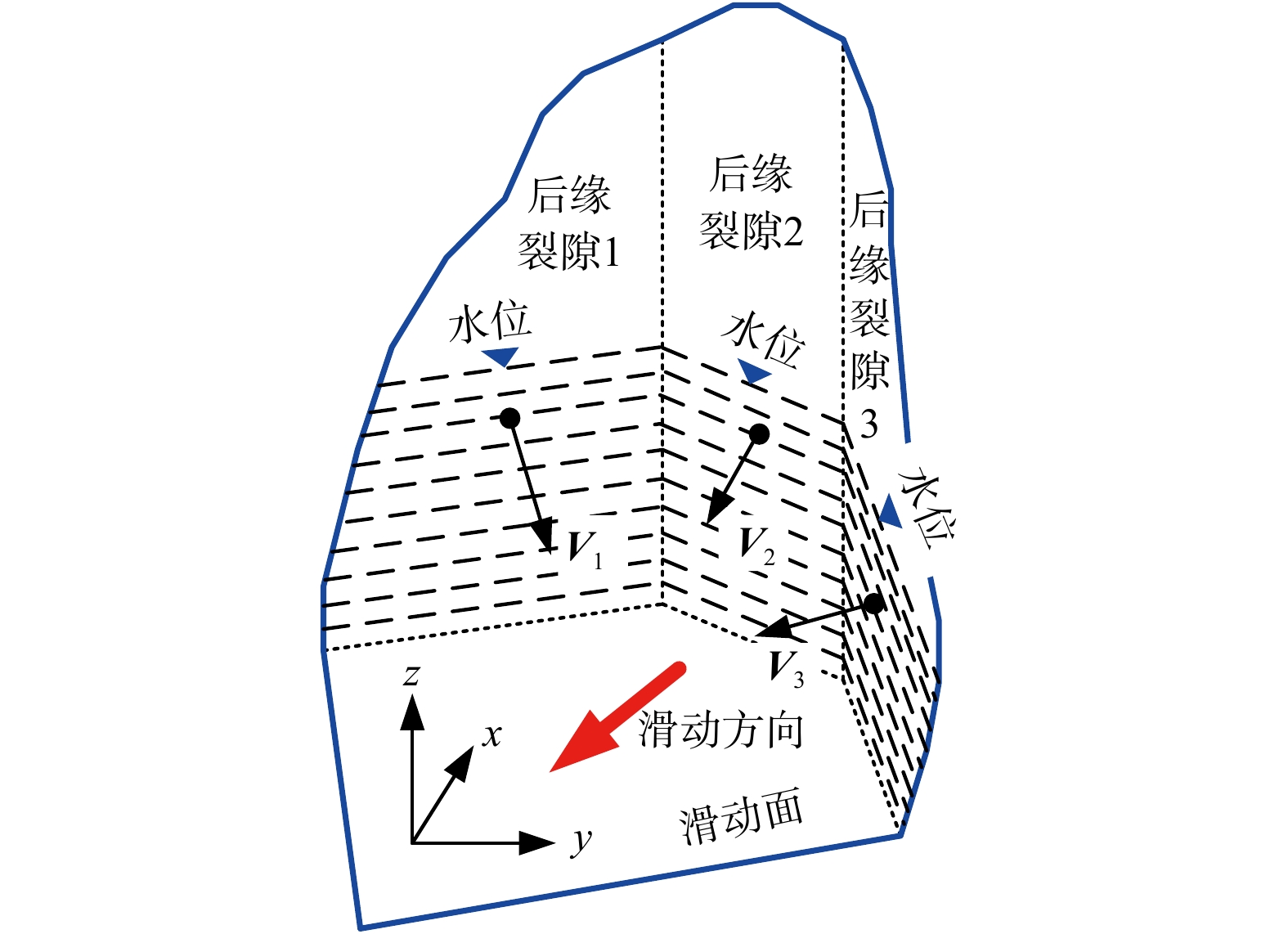
图 2 后缘陡倾裂隙水压力
x,y,z为直角坐标系的3个方向,x轴正方向为北,y轴正方向为东,z轴正方向为垂直向上;V1,V2,V3分别为后缘裂隙1,2,3的水压力;下同
Figure 2. Water pressure in steeply inclined fractures at rear edge
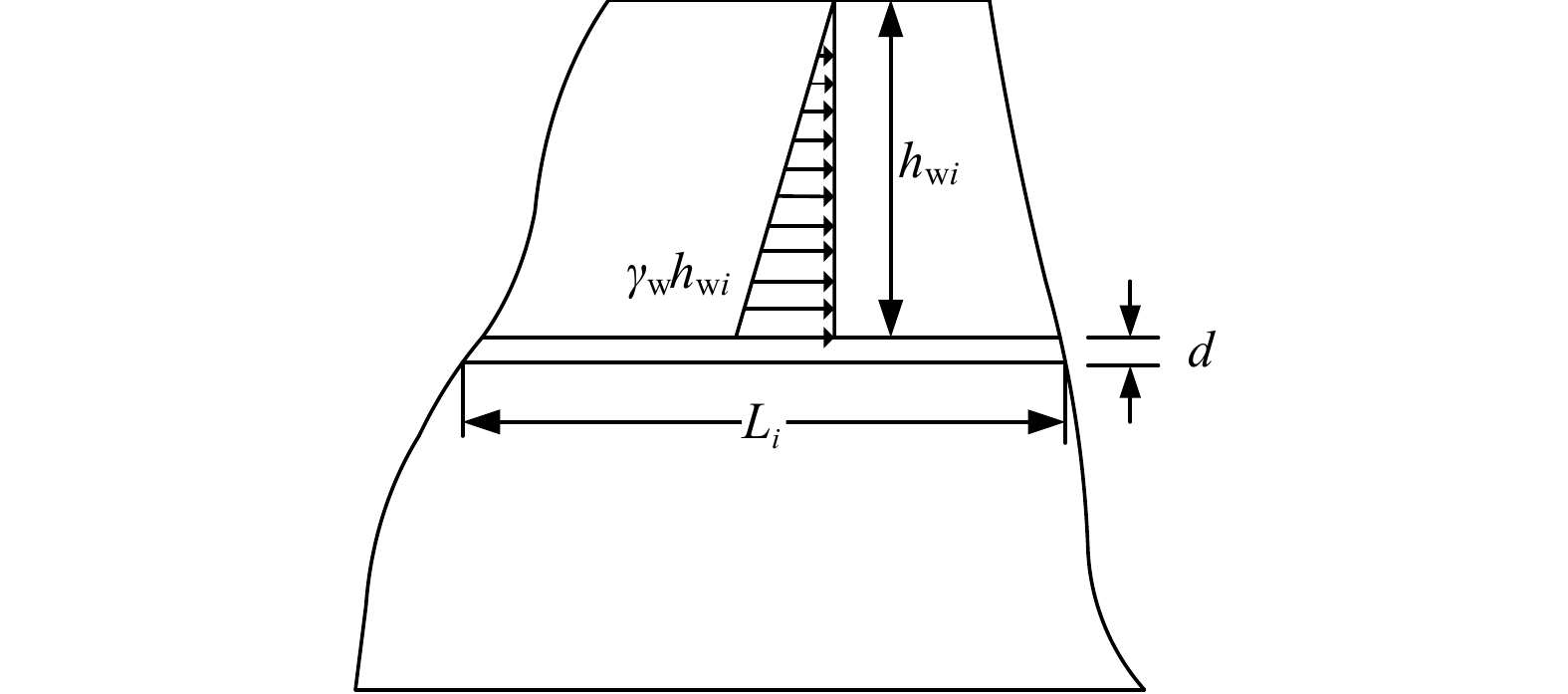
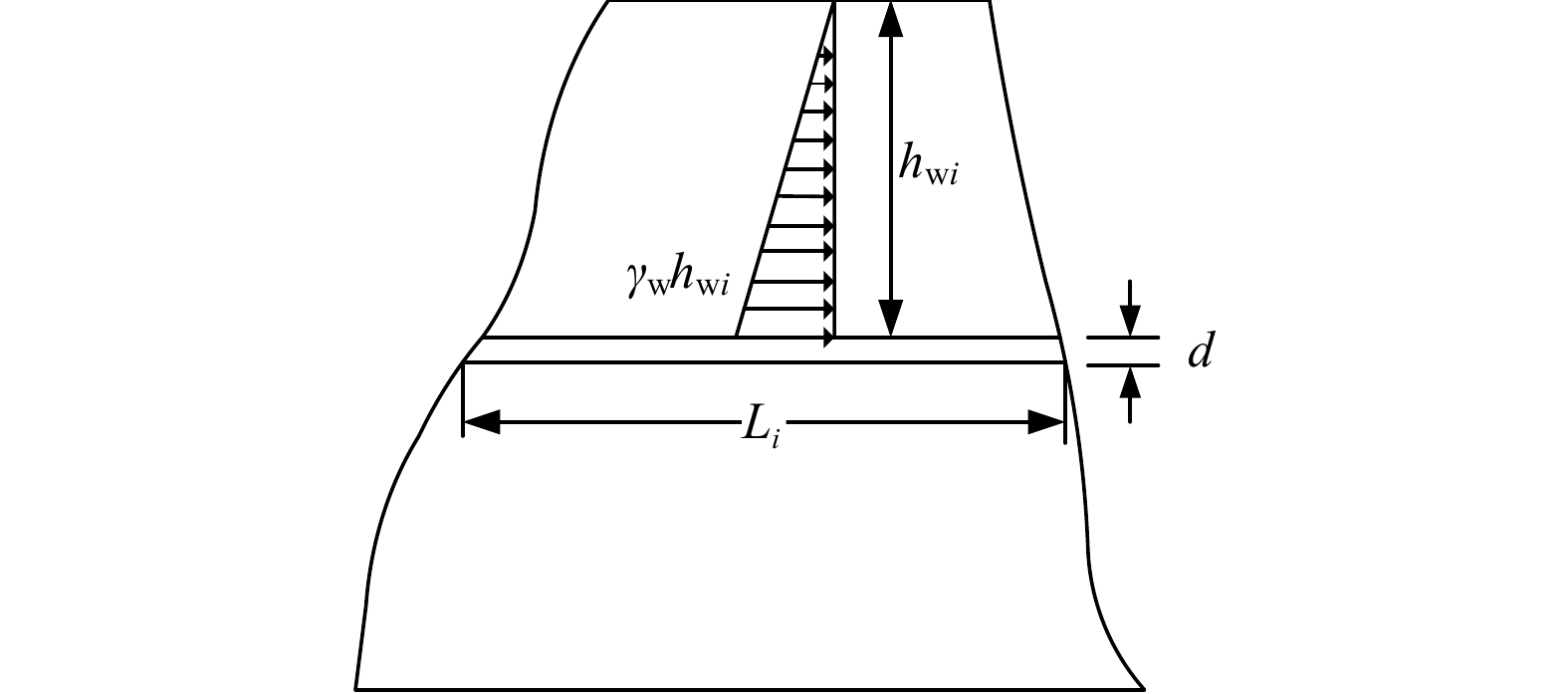
图 3 后缘裂隙水压力计算简图[11]
d为后缘裂隙水竖直方向条带划分高度;$ {h}_{{\mathrm{w}}i} $为后缘裂隙水第i个条带至水位面的距离;$ {L}_{i} $为后缘裂隙水第i个条带水平方向上的宽度;下同
Figure 3. Water pressure calculation of rear-edge fractures
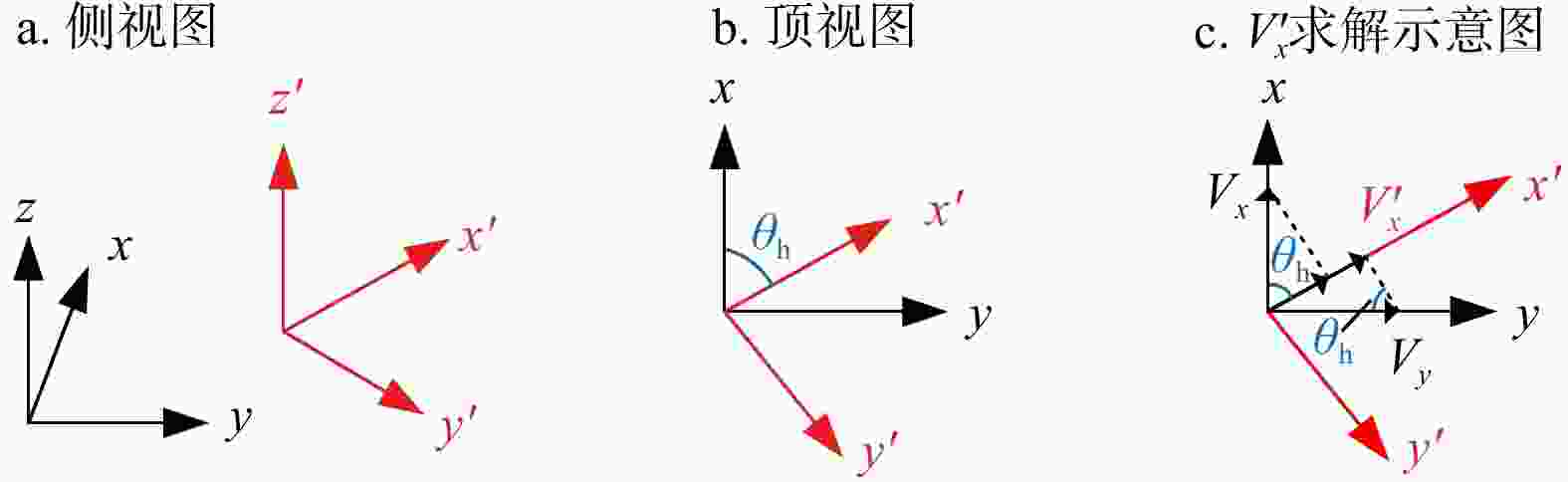
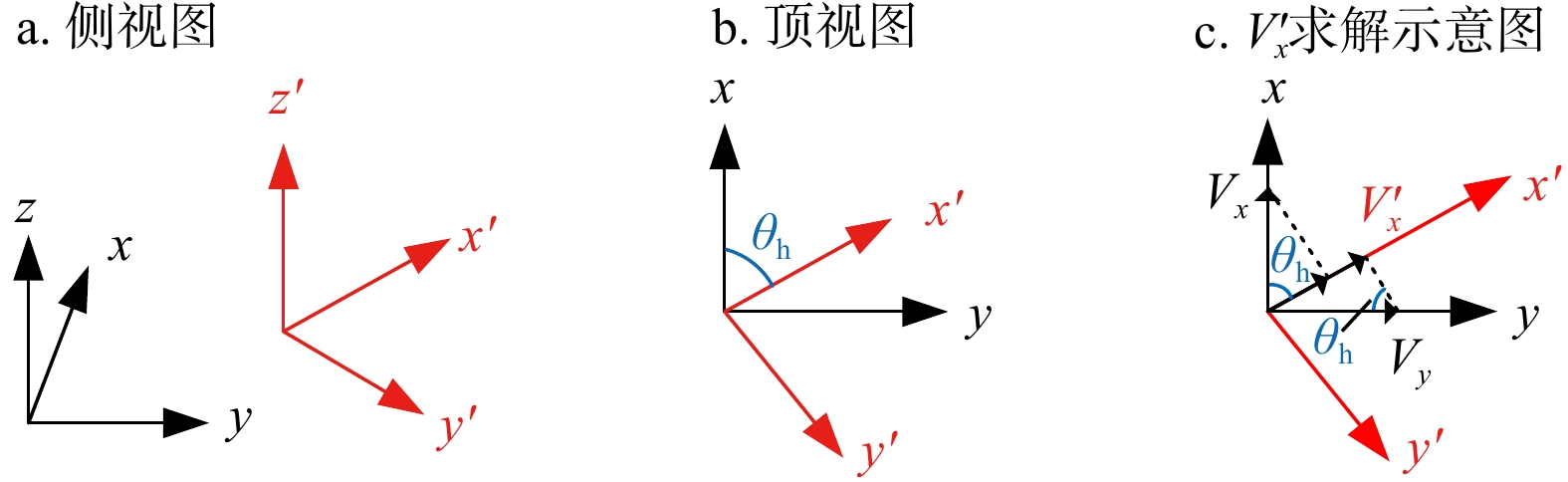
图 4 后缘裂隙水压力坐标变换图示
x',y',z'为滑面所在平面建立的独立坐标系的3个方向,x'轴为沿滑面倾向的水平方向,y'轴为沿滑面走向的水平方向,z'轴正方向为垂直向上方向;θh为直角坐标系x,y,z和滑面所在平面坐标系x',y',z'对应坐标轴之间的夹角,即滑面倾向;Vx, Vy分别为水压力合力在直角坐标系x,y方向上的分量;$V'_x $为水压力合力在滑面所在平面坐标系x'方向上的分量;虚线代表各作用力之间的投影关系
Figure 4. Coordinate transformation of water pressure in steeply inclined fractures
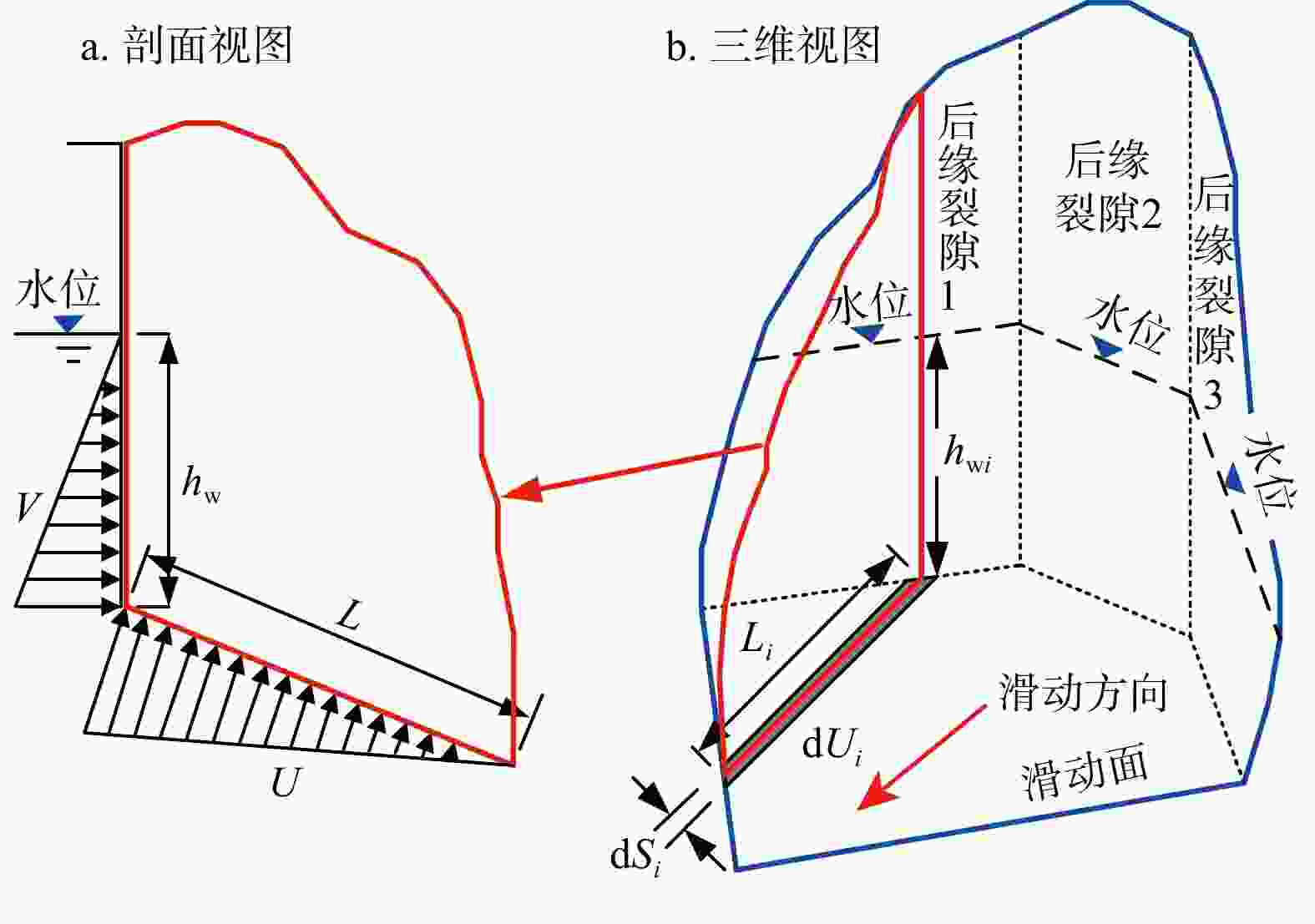
图 5 滑面浮托力计算示意图
dSi为后缘裂隙水第i个条带滑面微断长度
Figure 5. Schematic diagram for calculating uplift force on the sliding surface
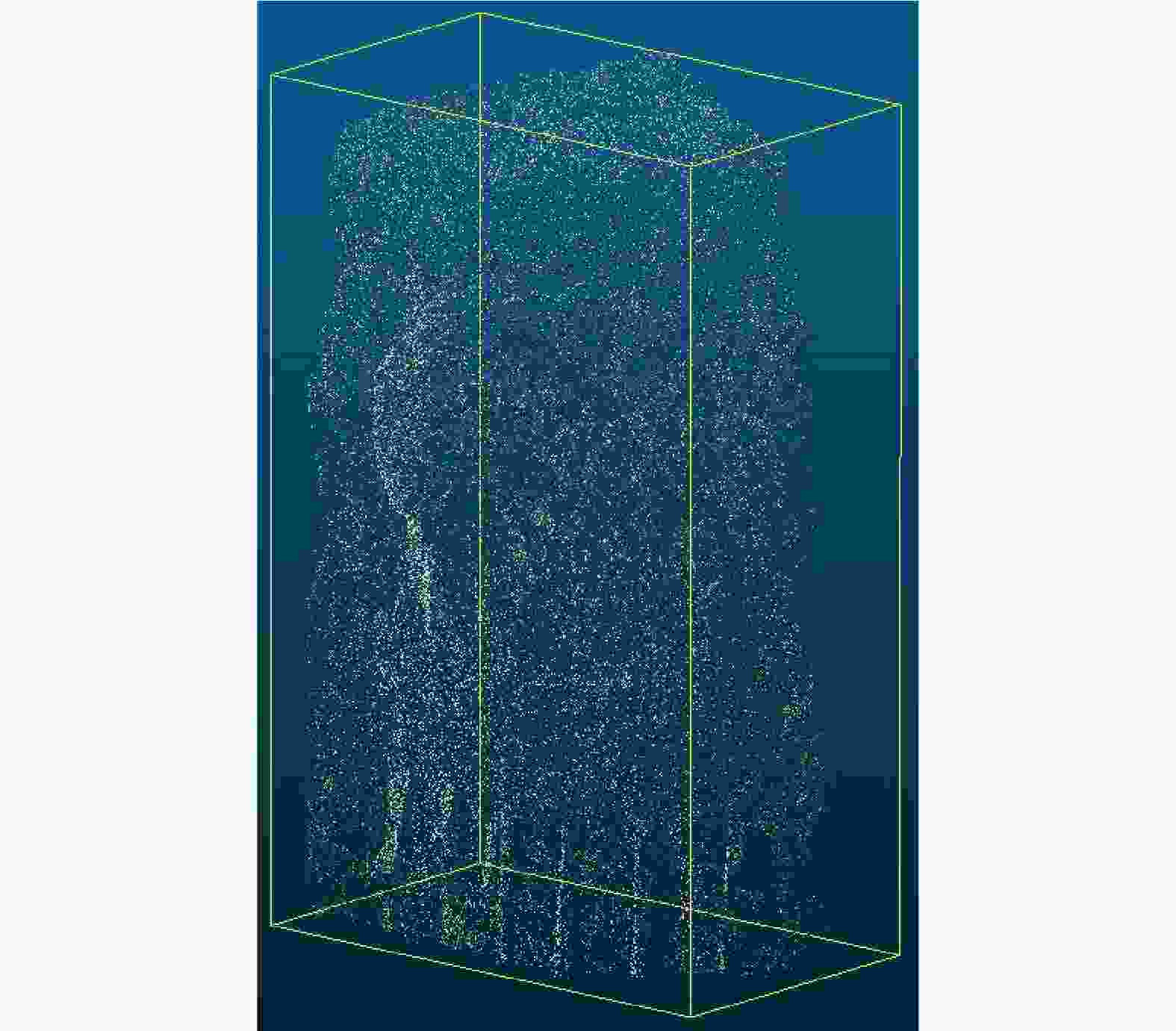
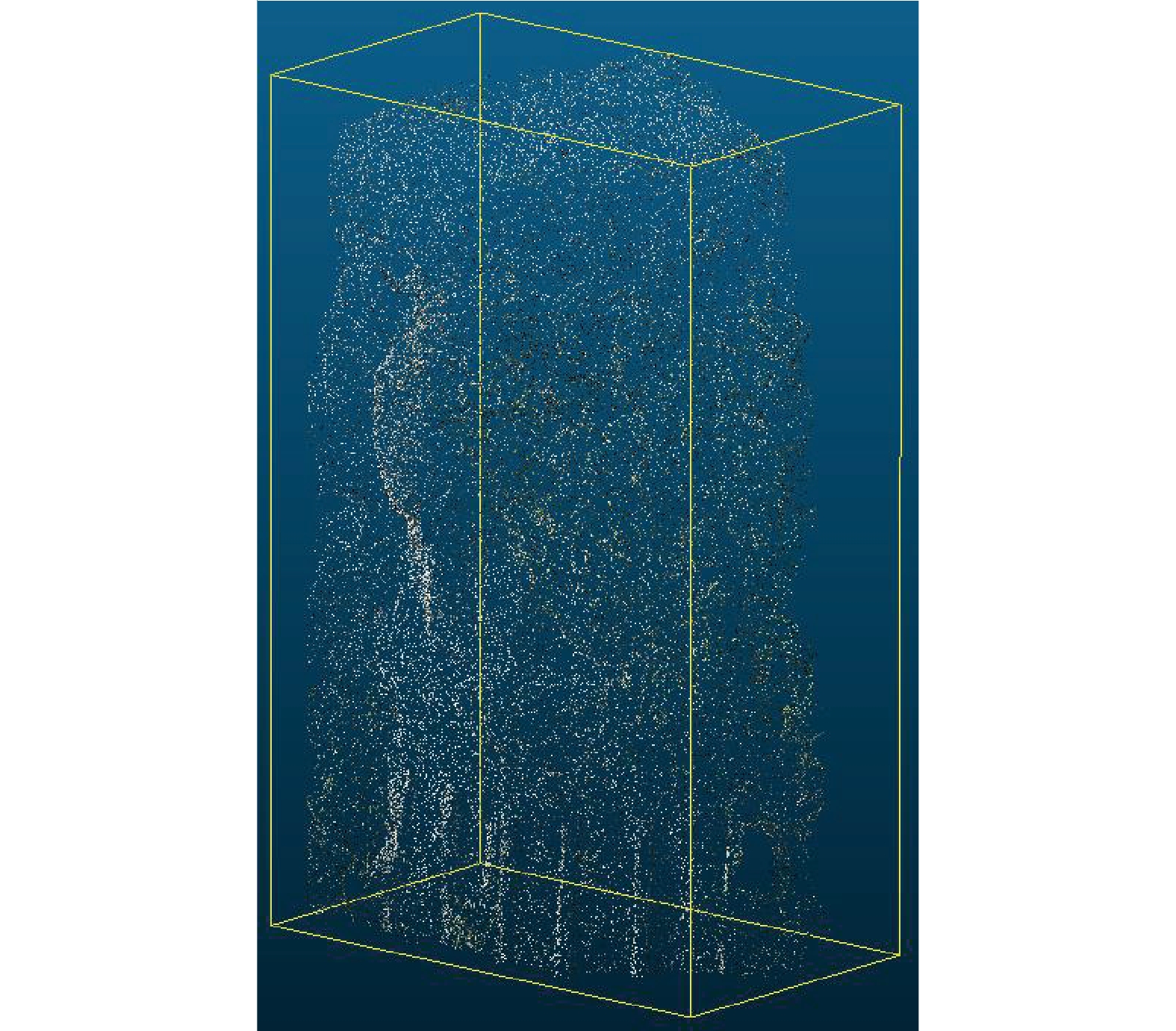
图 7 倾斜摄影危岩表面点云
Figure 7. Point cloud of unstable rock surface derived from oblique photogrammetry
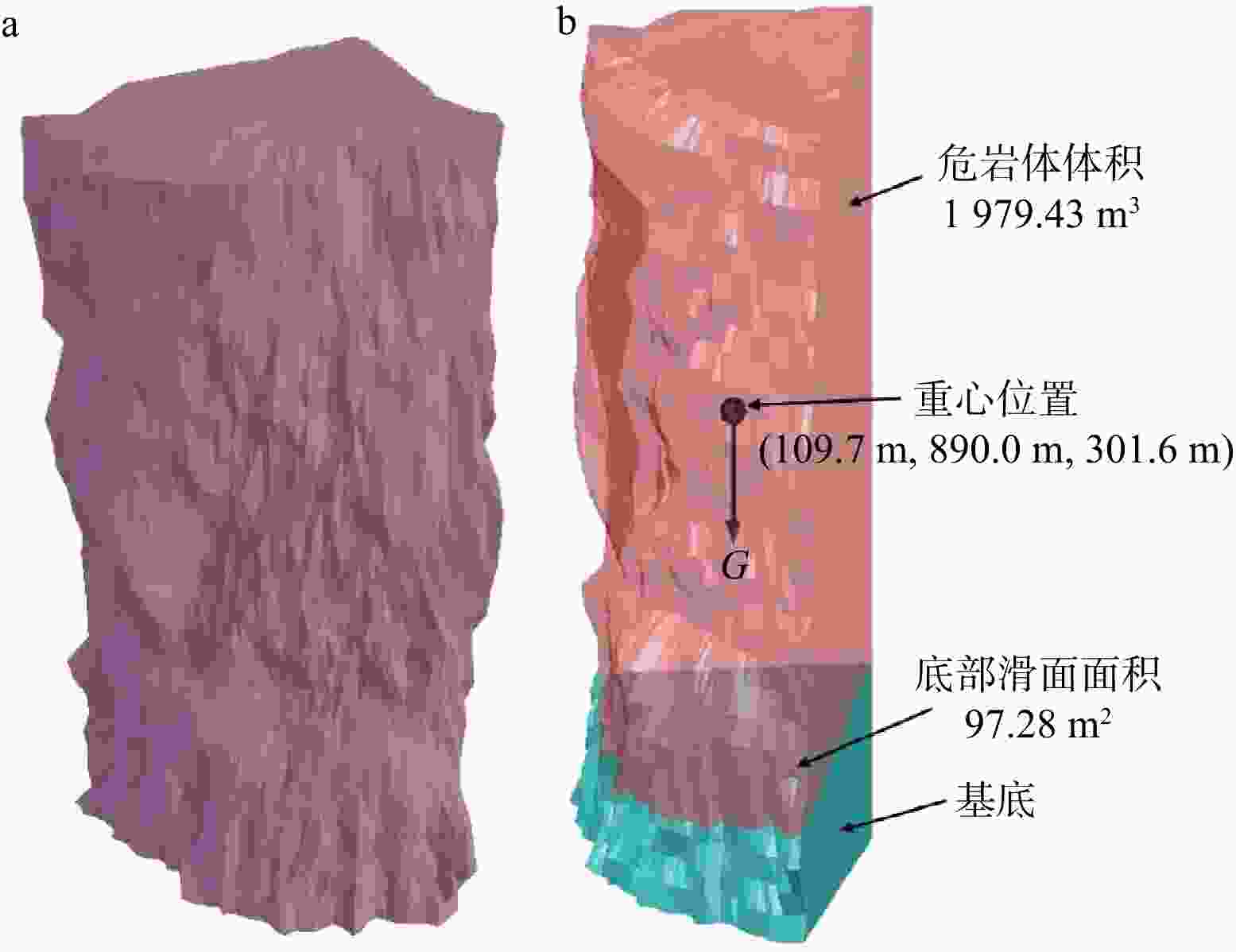
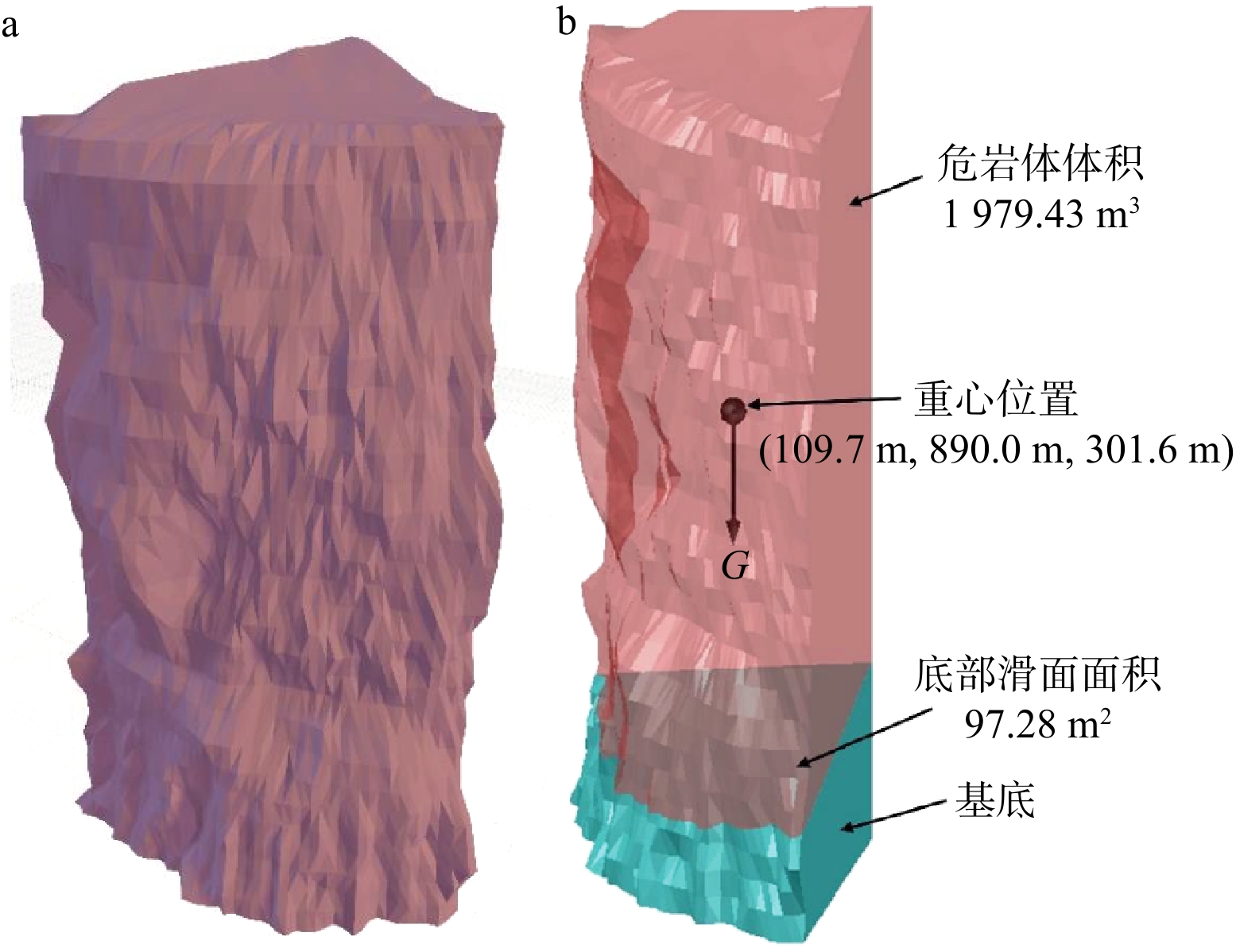
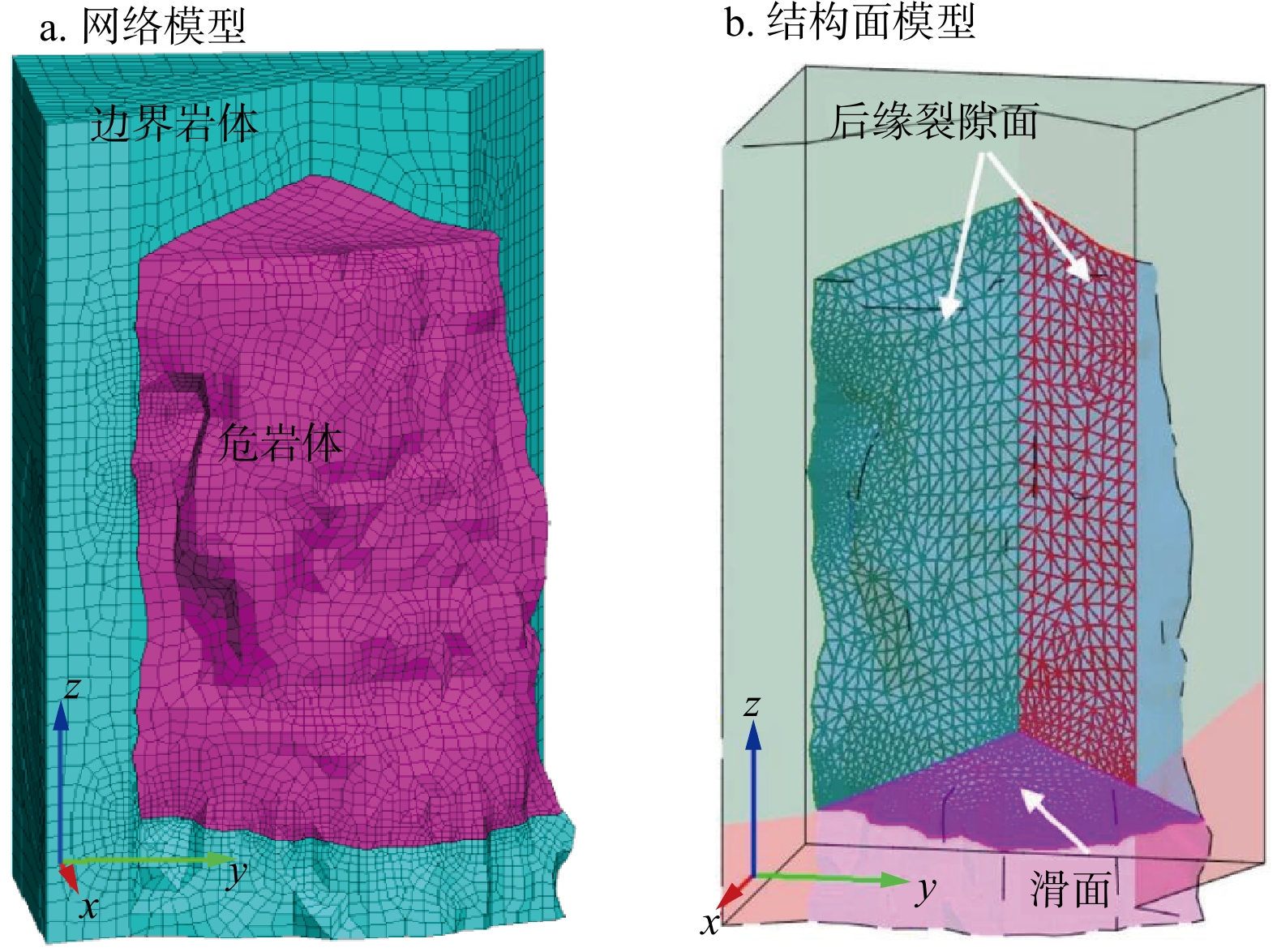
图 9 危岩体三维模型(a)及相关信息(b)
Figure 9. 3D model (a) and related parameters (b) of unstable rock
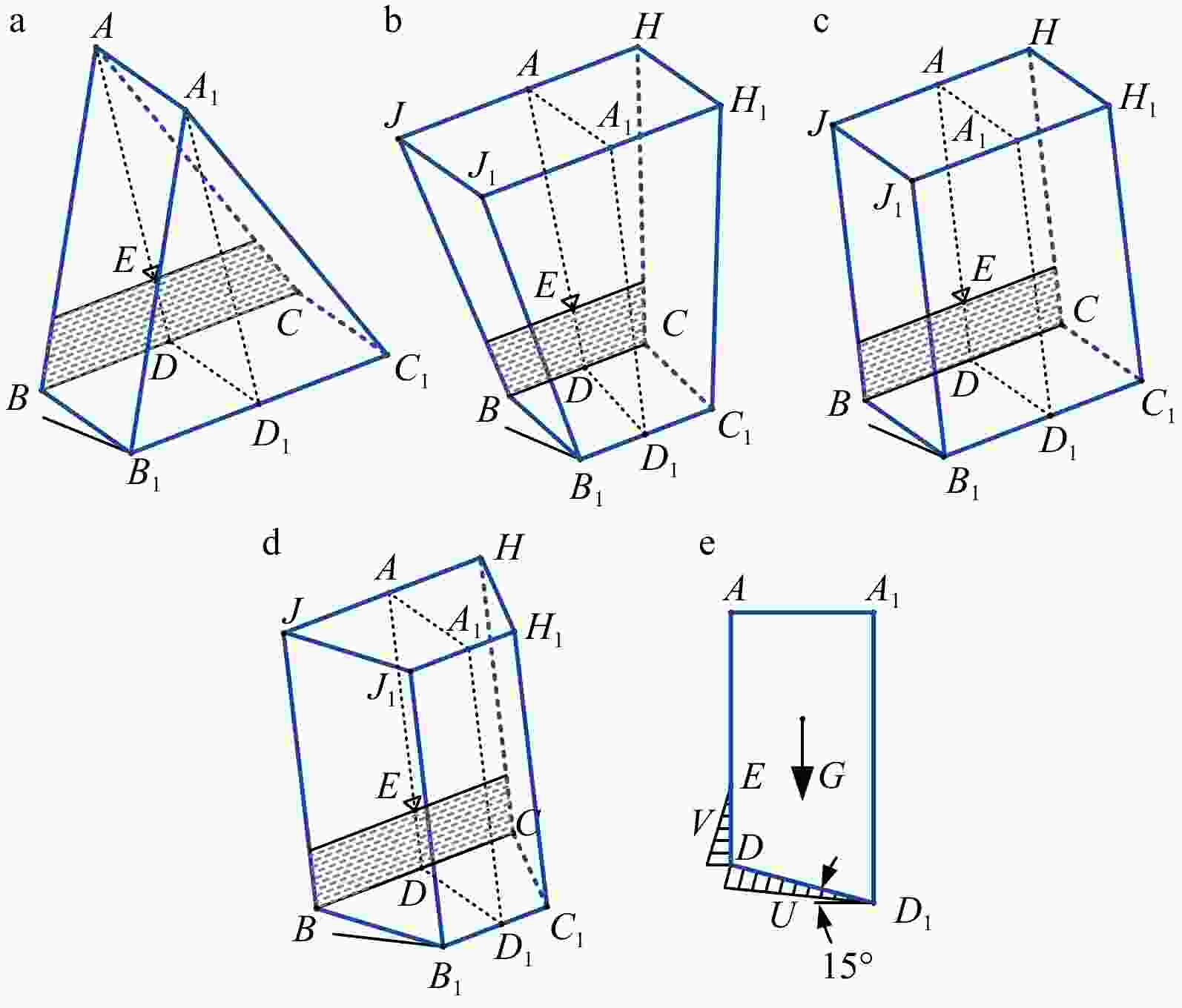
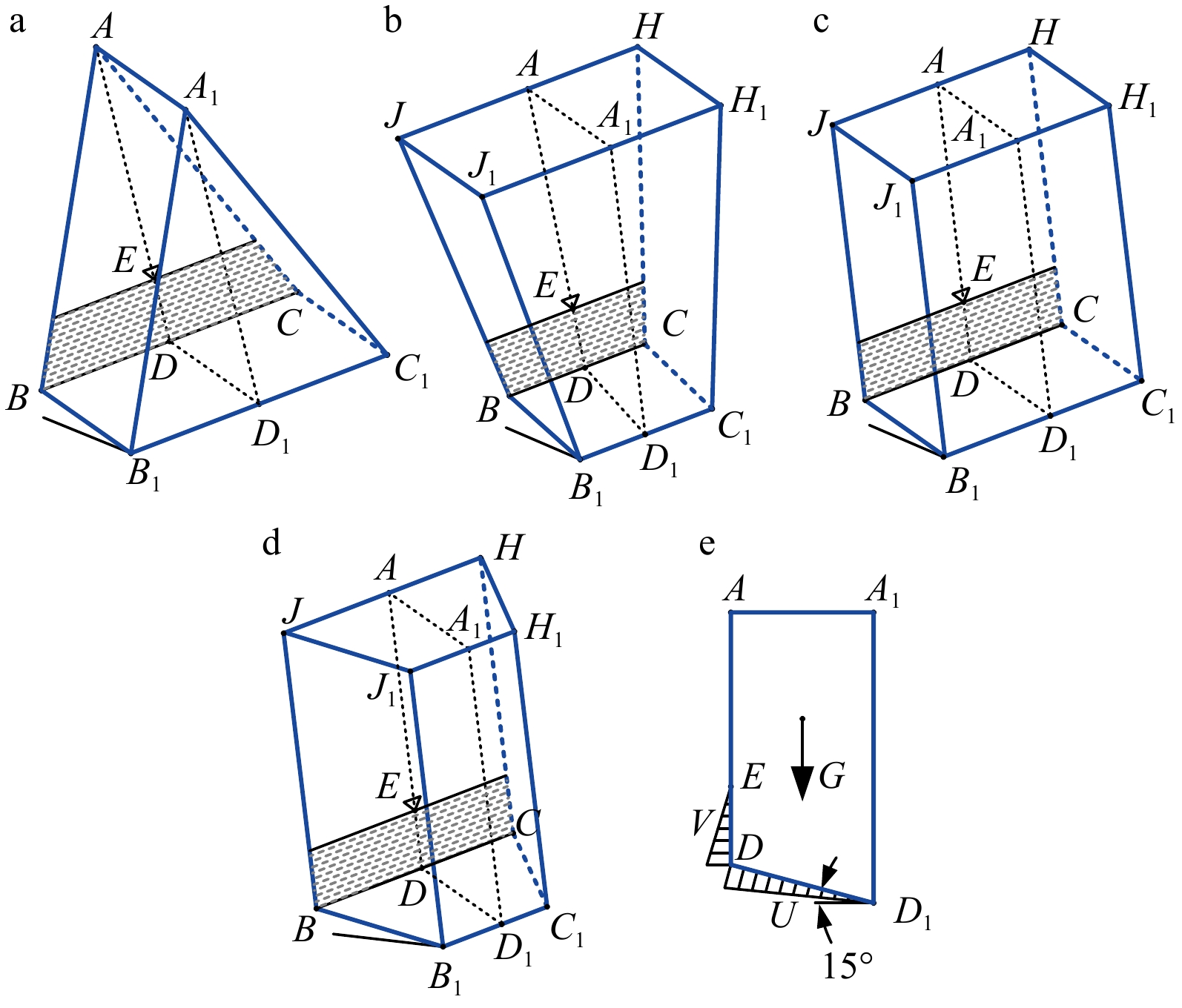
图 12 不同形态危岩计算模型
a. 后缘裂隙面为三角形;b. 后缘裂隙面为梯形;c. 后缘裂隙面为矩形;d. 顶底面为梯形;e. 二维剖面计算模型。除V,G,U外,其余字母均为模型端点编号
Figure 12. Calculation models of unstable rocks of various shapes
表 1 危岩三维稳定性计算
Table 1. 3D stability calculation for unstable rocks
分析工况 危岩容重
γ/(kN·m−3)危岩自
重G/kN滑面内摩
擦角$ \phi $/(°)滑面黏聚
力c/kPa左侧边界面L1
充水高度hw1/m右侧边界面L2
充水高度hw2/m左侧边界面L1
水压力V1/kN右侧边界面L2
水压力V2/kN$ {V}_{{\mathrm{w}}} $/kN $ {N}_{{\mathrm{w}}} $/kN U/kN K ①后缘裂隙未充水 26.6 51801.6 20.0 55.0 0 0 0 0 0 0 0 1.454 ②后缘单裂隙L1充水
高度为3.6 m27.0 52580.6 20.0 55.0 3.6 0 795.0 0 619.3 201.2 1770.5 1.354 ③后缘单裂隙L1充水
高度为5.1 m(暴雨)27.8 54138.6 18.0 50.0 5.1 0 1560.6 0 1215.8 395.0 2480.6 1.151 ④后缘单裂隙L2充水
高度为3.6 m27.0 52580.6 20.0 55.0 0 3.6 0 662.5 445.5 144.8 1770.5 1.369 ⑤后缘单裂隙L2充水
高度为5.1 m(暴雨)27.8 54138.6 18.0 50.0 0 5.1 0 1300.5 874.6 284.2 2480.6 1.176 ⑥后缘双裂隙L1和L2充水
高度均为3.6 m27.0 52580.6 20.0 55.0 3.6 3.6 795.0 662.5 1064.9 346.0 1770.5 1.316 ⑦后缘双裂隙L1和L2充水
高度均为5.1 m(暴雨)27.8 54138.6 18.0 50.0 5.1 5.1 1560.6 1300.5 2090.4 679.2 2480.6 1.093 注:$ {V}_{{\mathrm{w}}} $为水压力合力沿滑面向下分量;$ {N}_{{\mathrm{w}}} $为水压力合力垂直于滑面分量;K为稳定系数;下同  下载: 导出CSV
表 2 危岩数值分析模型物理力学参数
Table 2. Physico-mechanical parameters of numerical analysis model of unstable rock
灰岩 密度/(kg·m–3) 弹性模量/GPa 泊松比 黏聚力/MPa 内摩擦角/(°) 抗拉强度/kPa 26.6 6.8 0.22 2.26 58.9 410.0 结构面 法向刚度/GPa 切向刚度/GPa 黏结力/kPa 摩擦角/(°) 抗拉强度/MPa 19 19 55 20 0
下载: 导出CSV
表 3 不同形态危岩稳定性计算
Table 3. Stability calculation of unstable rocks of various shapes
危岩形态 体积Vr/m3 滑面面积A/m2 自重G/kN 裂隙水压力V/kN 陡倾裂隙倾角$ {\varphi }_{1} $/(°) $ {V}_{{\mathrm{w}}} $/kN $ {N}_{{\mathrm{w}}} $/kN U/kN K 稳定状态 后缘裂隙面为三角形 1744.02 193.19 46390.8 3659.1 90.0 3534.4 947.0 6181.9 1.379 稳定 后缘裂隙面为梯形 2860.04 110.46 76077.1 4232.5 90.0 4088.3 1095.5 3534.8 1.086 欠稳定 后缘裂隙面为矩形 3732.05 207.06 99272.6 4096.0 90.0 3956.4 1060.1 6625.8 1.237 稳定 顶底面为梯形 2776.71 155.29 73860.5 4096.0 90.0 3956.4 1060.1 4969.3 1.182 基本稳定 二维剖面计算模型 186.60 10.35 4963.63 204.8 — — — 331.2896 1.237 稳定
下载: 导出CSV
-
[1] ABU SEIF E S, BAHABRI A A. Rockfall hazards assessment along the Aswan-Cairo Highway, Sohag Governorate, Upper Egypt[J]. Natural Hazards, 2019, 99(2): 991-1005. [2] ANTONIOU A A, LEKKAS E. Rockfall susceptibility map for Athinios Port, Santorini Island, Greece[J]. Geomorphology, 2010, 118(1/2): 152-166. [3] AZZONI A, DE FREITAS M H. Experimentally gained parameters, decisive for rock fall analysis[J]. Rock Mechanics and Rock Engineering, 1995, 28(2): 111-124. doi: 10.1007/BF01020064 [4] HUANG B L, CHEN L D, PENG X M, et al. Assessment of the risk of rockfalls in Wu Gorge, Three Gorges, China[J]. Landslides, 2010, 7(1): 1-11. [5] CONGRESS S S C, PUPPALA A J. Geotechnical slope stability and rockfall debris related safety assessments of rock cuts adjacent to a rail track using aerial photogrammetry data analysis[J]. Transportation Geotechnics, 2021, 30: 100595. doi: 10.1016/j.trgeo.2021.100595 [6] 陈洪凯, 董平, 唐红梅. 危岩崩塌灾害研究现状与趋势[J]. 重庆师范大学学报(自然科学版), 2015, 32(6): 53-60. doi: 10.11721/cqnuj20150603CHEN H K, DONG P, TANG H M. The status quo and trends of perilous rock and collapse disaster[J]. Journal of Chongqing Normal University (Natural Science), 2015, 32(6): 53-60. (in Chinese with English abstract) doi: 10.11721/cqnuj20150603 [7] 陈洪凯, 秦鑫. 危岩稳定性分析研究现状及趋势[J]. 重庆交通大学学报(自然科学版), 2018, 37(10): 49-60. doi: 10.3969/j.issn.1674-0696.2018.10.09CHEN H K, QIN X. Status quo and trend of unstable rock stability analysis[J]. Journal of Chongqing Jiaotong University (Natural Sciences), 2018, 37(10): 49-60. (in Chinese with English abstract) doi: 10.3969/j.issn.1674-0696.2018.10.09 [8] 廖云平, 吴立新, 曾国机, 等. 崩塌滑坡灾害微动监测与超前报警技术[J]. 水文地质工程地质, 2026, 53(2): 85-94.LIAO Y P, WU L X, ZENG G J, et al. Micro-vibration monitoring and pre-warning technology for landslide and rockfall disasters[J]. Hydrogeology & Engineering Geology, 2026, 53(2): 85-94. (in Chinese with English abstract) [9] PENG H Y, XIE Q, CHEN B L, et al. Failure mode of the hazardous Diaozui rock mass of the Qutang Gorge in the Three Gorges Reservoir area based on a three-dimensional numerical analysis[J]. Bulletin of Engineering Geology and the Environment, 2024, 83(4): 100. doi: 10.1007/s10064-024-03590-4 [10] 刘帅, 朱杰勇, 杨得虎, 等. 不同降雨工况条件下的崩滑地质灾害危险性评价[J]. 地质科技通报, 2024, 43(2): 253-267.LIU S, ZHU J Y, YANG D H, et al. Geological hazard risk assessment of collapse and landslide under different rainfall conditions[J]. Bulletin of Geological Science and Technology, 2024, 43(2): 253-267. (in Chinese with English abstract) [11] FENG Z, LI B, YIN Y P, et al. Rockslides on limestone cliffs with subhorizontal bedding in the southwestern calcareous area of China[J]. Natural Hazards and Earth System Sciences, 2014, 14(9): 2627-2635. doi: 10.5194/nhess-14-2627-2014 [12] 自然资源部. 2021 年全国地质灾害灾情及 2022 年地质灾害趋势预测 [DB/OL]. (2022-01-13)[2026-04-23]. https://www.mnr.gov.cn/dt/ywbb/202201/t20220113_2717375.html.Ministry of Natural Resources of the People's Republic of China. 2021 national geological disaster situation and 2022 geological disaster trend forecast[DB/OL]. (2022-01-13)[2026-04-23]. https://www.mnr.gov.cn/dt/ywbb/202201/t20220113_2717375.html. (in Chinese) [13] 中华人民共和国自然资源部. 2023 年中国自然资源公报[R]. 北京: 中华人民共和国自然资源部, 2023Ministry of Natural Resources of the People's Republic of China. 2023 China Natural Resources Bulletin[R]. Beijing: Ministry of Natural Resources of the People's Republic of China, 2023. (in Chinese) [14] 彭海游, 谢强, 陈柏林, 等. 基于极限平衡法的危岩倾覆稳定性三维计算方法[J]. 岩土力学, 2024, 45(2): 552-562. doi: 10.16285/j.rsm.2023.0312PENG H Y, XIE Q, CHEN B L, et al. Three-dimensional calculation method for stability against overturning of overhanging rock based on limit equilibrium method[J]. Rock and Soil Mechanics, 2024, 45(2): 552-562. (in Chinese with English abstract) doi: 10.16285/j.rsm.2023.0312 [15] 陈洪凯, 唐红梅. 危岩主控结构面强度参数计算方法[J]. 工程地质学报, 2008, 16(1): 37-41. doi: 10.3969/j.issn.1004-9665.2008.01.008CHEN H K, TANG H M. Method for calculating strength parameters of structural planes controlling the rock block stablity[J]. Journal of Engineering Geology, 2008, 16(1): 37-41. (in Chinese with English abstract) doi: 10.3969/j.issn.1004-9665.2008.01.008 [16] 王林峰, 陈洪凯, 唐红梅. 基于断裂力学与最优化理论的危岩稳定可靠性时效计算方法[J]. 武汉理工大学学报, 2013, 35(4): 68-72.WANG L F, CHEN H K, TANG H M. The aging calculate method for perilous rock stability reliability based on fracture mechanics and optimization method[J]. Journal of Wuhan University of Technology, 2013, 35(4): 68-72. (in Chinese with English abstract) [17] WANG L Q, YIN Y P, HUANG B L, et al. A study of the treatment of a dangerous thick submerged rock mass in the Three Gorges Reservoir area[J]. Bulletin of Engineering Geology and the Environment, 2020, 79(5): 2579-2590. doi: 10.1007/s10064-020-01724-y [18] MAVROULI O, COROMINAS J. Comparing rockfall scar volumes and kinematically detachable rock masses[J]. Engineering Geology, 2017, 219: 64-73. doi: 10.1016/j.enggeo.2016.08.013 [19] PERERA J S, LAM N. Rockfall protection wall that can withstand multiple strikes without needing to be repaired[J]. International Journal of Impact Engineering, 2023, 173: 104476. doi: 10.1016/j.ijimpeng.2022.104476 [20] 中国地质灾害防治工程行业协会. 危岩落石柔性防护网工程技术规范: T/CAGHP 066—2019[S]. 武汉: 中国地质大学出版社, 2019.China Association of Geological Hazard Prevention Engineering. Technical specification for flexible protection net engineering of dangerous rock and rockfall: T/CAGHP 066—2019[S]. Wuhan: China University of Geosciences Press, 2019. (in Chinese) [21] 中国地质灾害防治工程行业协会. 崩塌防治工程勘查规范: T/CAGHP 011—2018 [S]. 武汉: 中国地质大学出版社, 2018.China Association of Geological Hazard Prevention Engineering. Specification for engineering investigation of collapse prevention: T/CAGHP 011—2018[S]. Wuhan: China University of Geosciences Press, 2018. (in Chinese) [22] 三峡库区地质灾害防治工作指挥部. 三峡库区地质灾害防治工程地质勘查技术要求[M]. 武汉: 中国地质大学出版社, 2017.Headquarters for Geological Disaster Prevention and Control of the Three Gorges Reservoir Area. Technical requirements for engineering geological exploration of geological hazard prevention projects in the Three Gorges Reservoir area[M]. Wuhan: China University of Geosciences Press, 2017. (in Chinese) [23] 庞鑫, 袁明, 卢渊, 等. 基于无人机LiDAR仿地飞行技术的高陡边坡危岩体快速识别方法[J]. 地质科技通报, 2023, 42(6): 21-30.PANG X, YUAN M, LU Y, et al. Rapid identification method for the dangerous rock mass of a high-steep slope based on UAV LiDAR and ground imitation flight[J]. Bulletin of Geological Science and Technology, 2023, 42(6): 21-30. (in Chinese with English abstract) [24] 李虹江, 于昕左, 马佳, 等. 多源遥感数据融合的高陡边坡危岩体信息提取[J]. 地质科技通报, 2025, 44(6): 306-316. doi: 10.19509/j.cnki.dzkq.tb20230695LI H J, YU X Z, MA J, et al. Information extraction of dangerous rock masses on high and steep slopes using multi-source remote sensing data fusion[J]. Bulletin of Geological Science and Technology, 2025, 44(6): 306-316. (in Chinese with English abstract) doi: 10.19509/j.cnki.dzkq.tb20230695 [25] WANG L F, TANG N, JIANG H, et al. Stability evaluation of columnar perilous rock in the Three Gorges Reservoir area based on UAV tilt photography[J]. Bulletin of Engineering Geology and the Environment, 2025, 84(5): 247. doi: 10.1007/s10064-025-04252-9 [26] FARMAKIS I, DIFRANCESCO P M, HUTCHINSON D J, et al. Rockfall detection using LiDAR and deep learning[J]. Engineering Geology, 2022, 309: 106836. doi: 10.1016/j.enggeo.2022.106836 [27] SCHILIRÒ L, ROBIATI C, SMERAGLIA L, et al. An integrated approach for the reconstruction of rockfall scenarios from UAV and satellite-based data in the Sorrento Peninsula (southern Italy)[J]. Engineering Geology, 2022, 308: 106795. doi: 10.1016/j.enggeo.2022.106795 [28] WANG W, ZHAO W B, CHAI B, et al. Discontinuity interpretation and identification of potential rockfalls for high-steep slopes based on UAV nap-of-the-object photogrammetry[J]. Computers & Geosciences, 2022, 166: 105191. doi: 10.1016/j.cageo.2022.105191 [29] DAGHIGH H, TANNANT D D, DAGHIGH V, et al. A critical review of discontinuity plane extraction from 3D point cloud data of rock mass surfaces[J]. Computers & Geosciences, 2022, 169: 105241. doi: 10.1016/j.cageo.2022.105241 [30] UMILI G, FERRERO A, EINSTEIN H H. A new method for automatic discontinuity traces sampling on rock mass 3D model[J]. Computers & Geosciences, 2013, 51: 182-192. doi: 10.1016/j.cageo.2012.07.026 [31] LI X J, CHEN J Q, ZHU H H. A new method for automated discontinuity trace mapping on rock mass 3D surface model[J]. Computers & Geosciences, 2016, 89: 118-131. doi: 10.1016/j.cageo.2015.12.010 [32] MENEGONI N, GIORDAN D, PEROTTI C, et al. Detection and geometric characterization of rock mass discontinuities using a 3D high-resolution digital outcrop model generated from RPAS imagery: Ormea rock slope, Italy[J]. Engineering Geology, 2019, 252: 145-163. doi: 10.1016/j.enggeo.2019.02.028 [33] 汪金才, 陈卫. 基于陈墙岩危岩稳定性计算的三维模型公式推导[J]. 重庆交通大学学报(自然科学版), 2019, 38(7): 78-82.WANG J C, CHEN W. Derivation of 3D model formula based on stability calculation of Chenqiangyan dangerous rock[J]. Journal of Chongqing Jiaotong University (Natural Sciences), 2019, 38(7): 78-82. (in Chinese with English abstract) [34] 邹鹏, 王思奇, 罗刚, 等. 考虑夹持效应的滑移式危岩三维稳定性计算方法[J]. 自然灾害学报, 2022, 31(5): 235-243. doi: 10.13577/j.jnd.2022.0526ZOU P, WANG S Q, LUO G, et al. Three-dimensional stability calculation method of unstable rock with a decided sliding plane considering clamping effect[J]. Journal of Natural Disasters, 2022, 31(5): 235-243. (in Chinese with English abstract) doi: 10.13577/j.jnd.2022.0526 [35] 秦鑫. 危岩三维稳定性分析方法研究[D]. 重庆: 重庆交通大学, 2018.QIN X. Research on calculation method of three-dimensional stability of unstable rock[D]. Chongqing: Chongqing Jiaotong University, 2018. (in Chinese with English abstract) [36] 陈洪凯. 危岩崩塌演化理论及应用[M]. 北京: 科学出版社, 2009.CHEN H K. Theory and application of the evolution of rock mass[M]. Beijing: Science Press, 2009. (in Chinese) [37] 中国地质灾害防治工程行业协会. 崩塌防治工程勘查规范: T/CAGHP 011-2018[S]. 武汉: 中国地质大学出版社, 2018.China Association of Geological Hazard Prevention & Control Engineering. Specification for investigation of collapse prevention and control engineering: T/CAGHP 011-2018[S]. Wuhan: China University of Geosciences Press, 2018. (in Chinese) [38] ZIENKIEWICZ O C, HUMPHESON C, LEWIS R W. Associated and non-associated visco-plasticity and plasticity in soil mechanics[J]. Géotechnique, 1975, 25(4): 671-689. [39] SUN C W, CHAI J R, XU Z G, et al. Stability charts for rock mass slopes based on the Hoek-Brown strength reduction technique[J]. Engineering Geology, 2016, 214: 94-106. doi: 10.1016/j.enggeo.2016.09.017 [40] YANG Y T, XIA Y, ZHENG H, et al. Investigation of rock slope stability using a 3D nonlinear strength-reduction numerical manifold method[J]. Engineering Geology, 2021, 292: 106285. doi: 10.1016/j.enggeo.2021.106285 [41] ZHENG Y R, TANG X S, ZHAO S Y, et al. Strength reduction and step-loading finite element approaches in geotechnical engineering[J]. Journal of Rock Mechanics and Geotechnical Engineering, 2009, 1(1): 21-30. doi: 10.3724/SP.J.1235.2009.00021 [42] YANG Y T, CHEN T, WU W A, et al. Modelling the stability of a soil-rock-mixture slope based on the digital image technology and strength reduction numerical manifold method[J]. Engineering Analysis with Boundary Elements, 2021, 126: 45-54. doi: 10.1016/j.enganabound.2021.02.008 -

 下载:
下载:

 点击查看大图
计量
- 文章访问数: 327
- PDF下载量: 71
- 被引次数: 0