投审稿入口
投审稿入口


Fracture genesis and its control on deep tight sandstone reservoir development in Cretaceous Yageliemu Formation, Kuqa Depression
-
摘要:
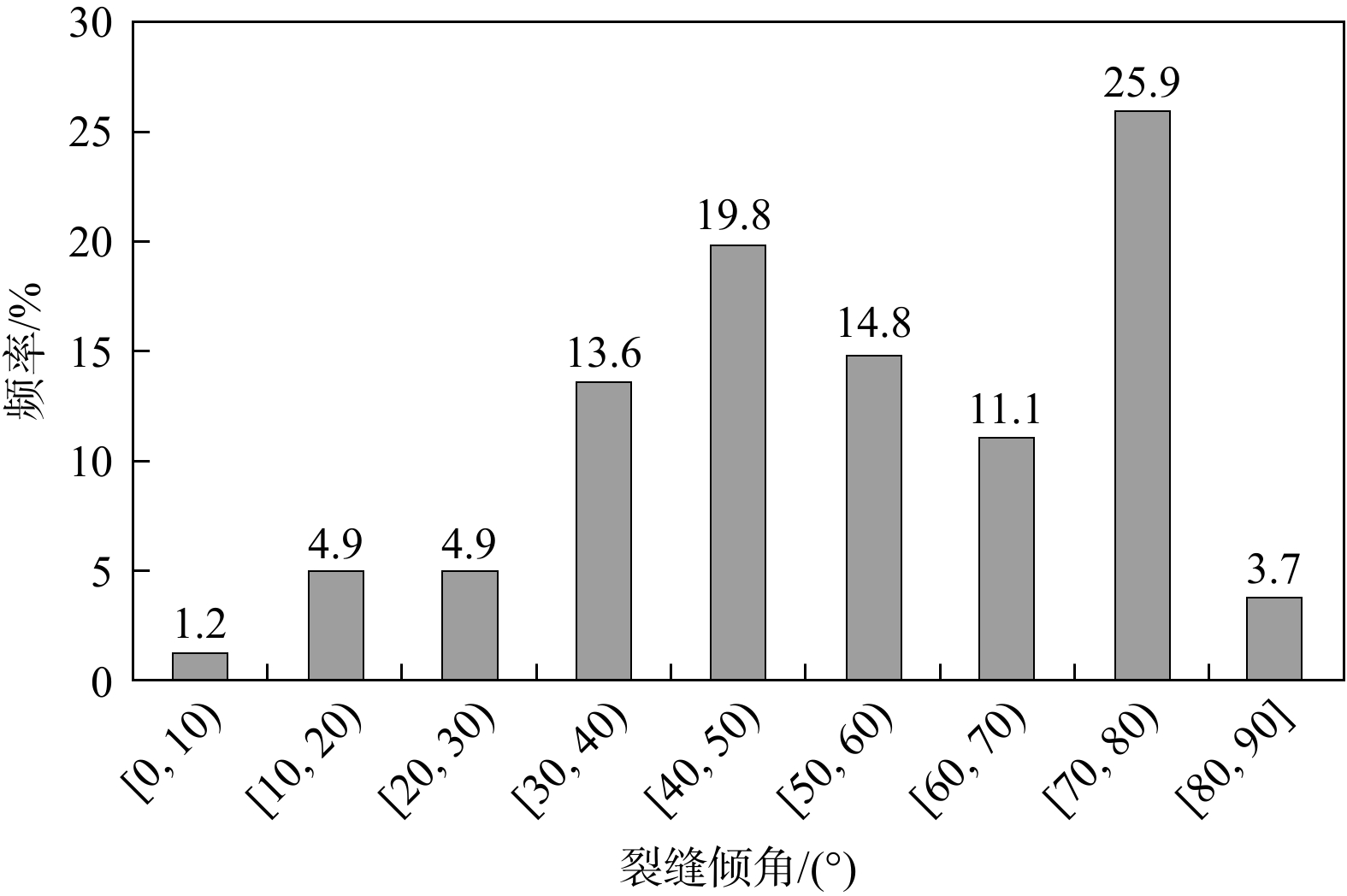
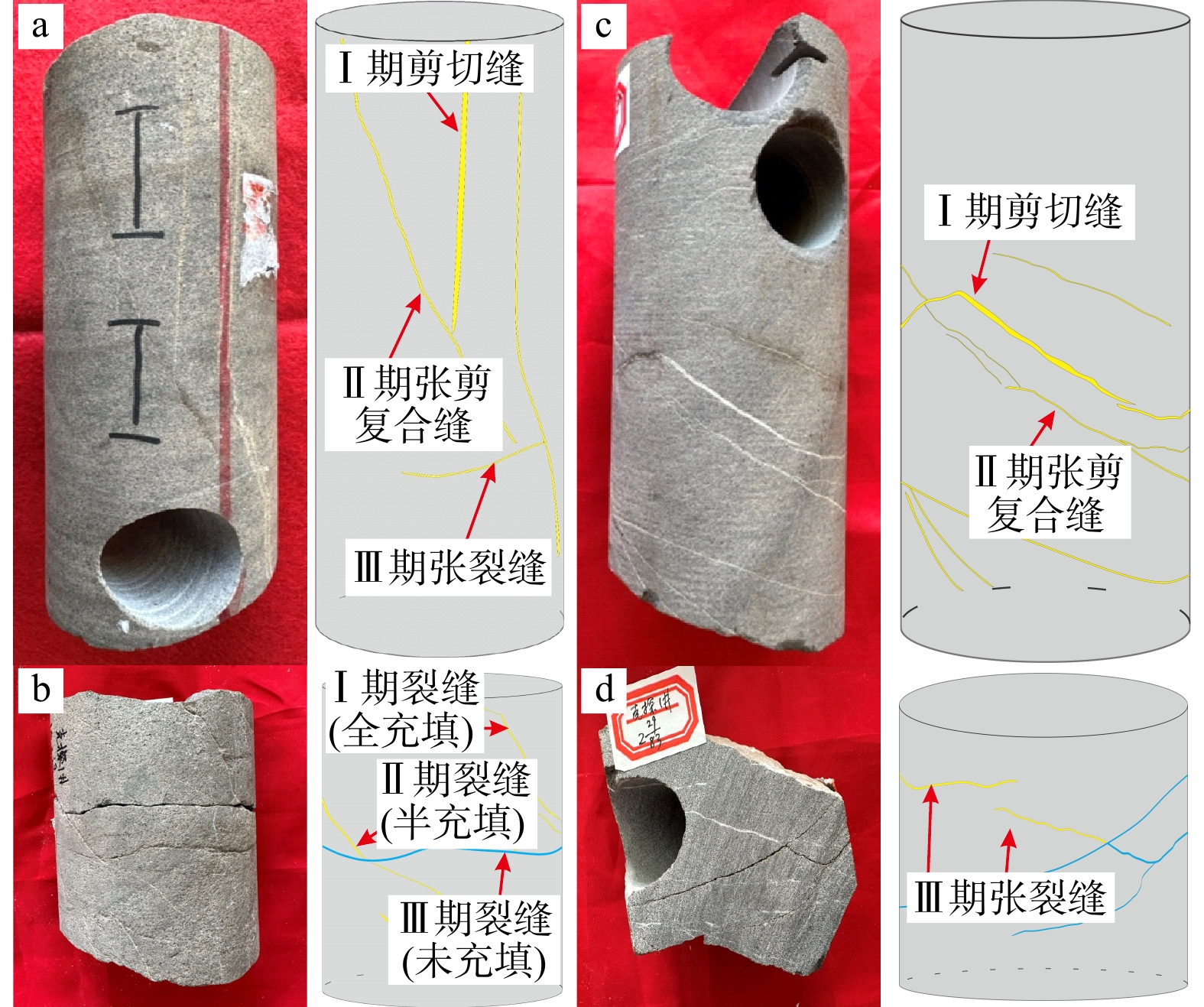
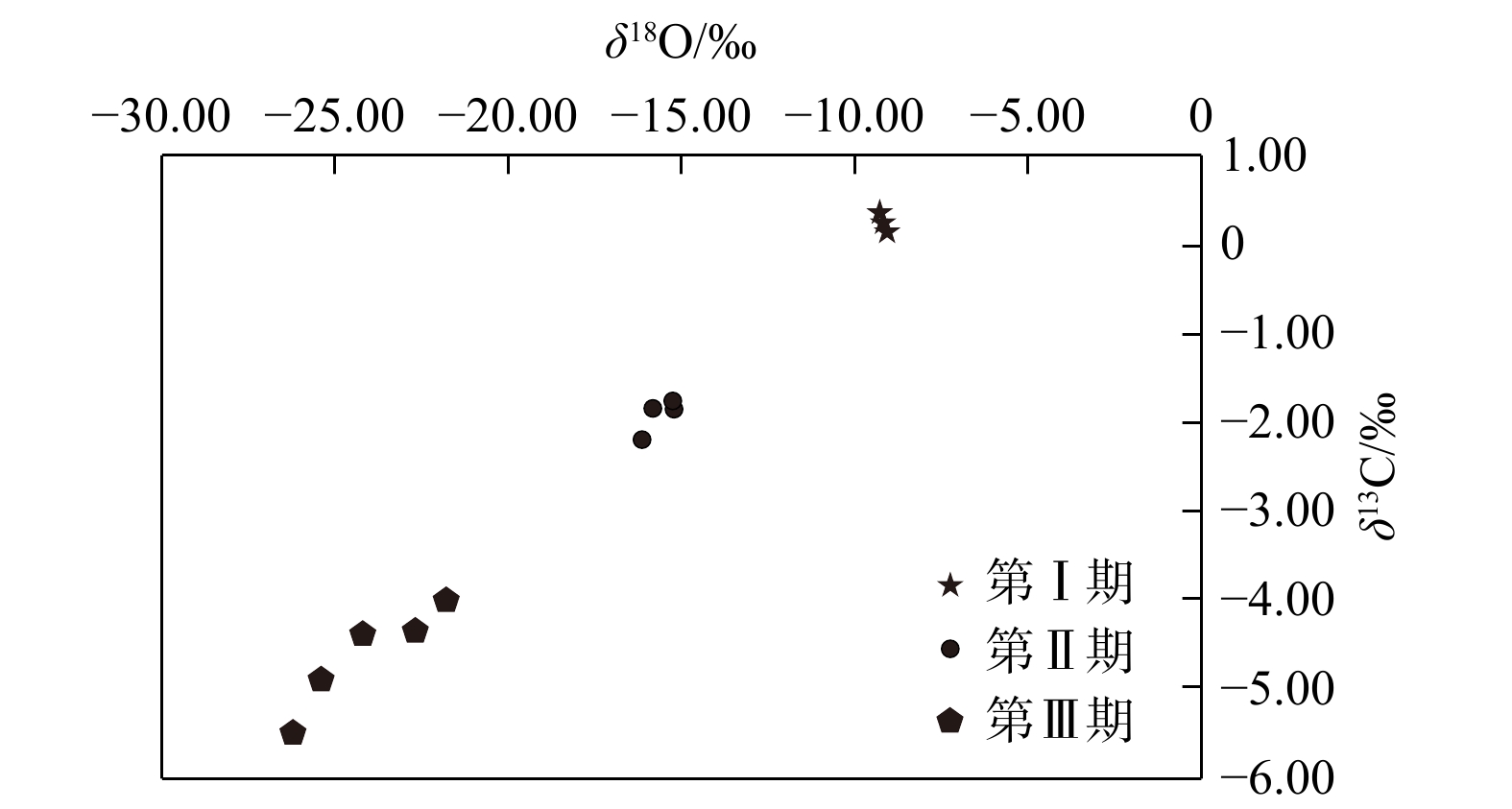
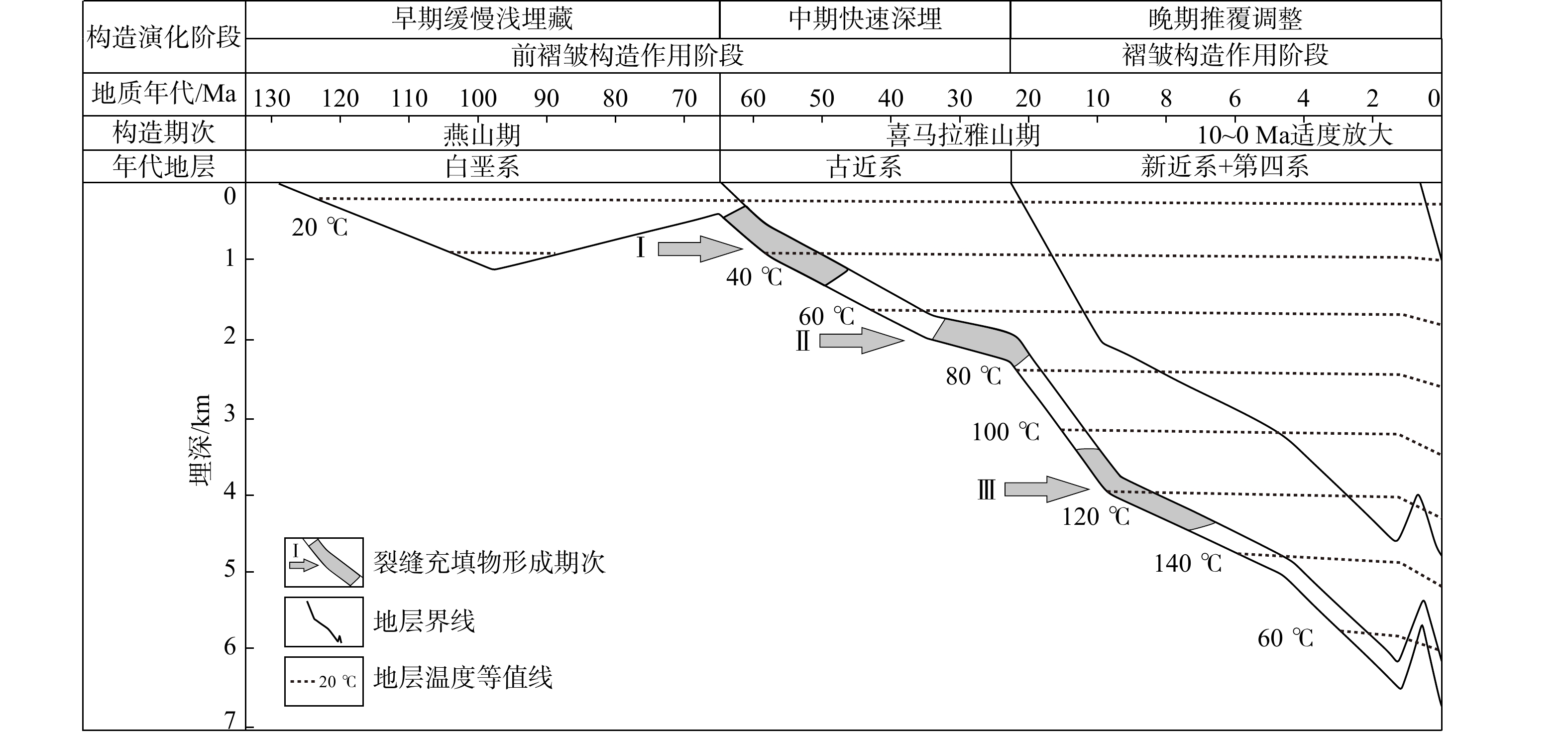
深层−超深层致密砂岩储层具有巨大油气勘探潜力,裂缝的发育与空间分布是深层−超深层致密砂岩储集性能改善的关键因素。为明确致密砂岩裂缝成因与控储意义,以塔里木盆地库车坳陷白垩系亚格列木组为研究对象,综合钻井岩心、铸体薄片、激光共聚焦、扫描电镜、碎屑锆石测年、重矿物组成及碳氧稳定同位素等分析,查明亚格列木组深层致密砂岩裂缝的成因类型与主控因素,建立裂缝控储演化模式。结果表明:A井区岩石类型主要为岩屑砂岩和长石岩屑砂岩,岩屑类型以变质岩为主,B井区岩石类型主要为岩屑砂岩,岩屑类型以沉积岩和岩浆岩为主,B井区岩屑含量更高。研究区主要发育3期构造裂缝:①第Ⅰ期裂缝开度较宽(2~4 mm),为高角度、近垂直缝(70°~90°),裂缝平直光滑,以剪切缝为主,缝内方解石充填,充填时间在65~45 Ma,对应为燕山晚期−喜山早期缓慢浅埋藏阶段;②第Ⅱ期裂缝开度较窄(1~2 mm),为中、高角度缝(40°~60°),裂缝略微弯曲,以张−剪复合缝为主,缝内高岭石胶结物充填,裂缝充填时间在 40~20 Ma,对应为喜山中期快速深埋阶段;③第Ⅲ期裂缝开度最窄(0.2~1 mm),为低角度缝、近水平缝(10°~30°),裂缝弯曲,主要以张性缝为主,缝内铁白云石胶结物充填,充填时间在10~6 Ma,对应为喜山晚期推覆调整阶段。在统一构造挤压背景下,由于不同物源体系和岩石组分,A井区和B井区裂缝控储模型存在差异性:A井区脆性矿物含量高,在强烈构造挤压过程中裂缝的发育程度高,有利于储层后期酸性溶蚀,增孔提渗效应明显。因此,整体上A井区储层质量要好于B井区。研究结果可为库车坳陷深层致密砂岩油气高效勘探开发提供地质依据。
Abstract:Deep- to ultra-deeply buried tight sandstone reservoirs have great potential for oil and gas exploration. The development and spatial distribution patterns of fractures are key factors for the improvement of reservoir performance in such reservoirs.
ObjectiveTo clarify fracture genesis and its control on reservoir development in tight sandstones, the Cretaceous Yageliemu Formation in the Kuqa Depression, Tarim Basin, is selected as the study area.
MethodsIntegrated analyses, including drilling core, thin section, laser confocal microscopy, scanning electron microscopy, detrital zircon geochronology, heavy mineral composition, and carbon and oxygen stable isotopes, were conducted to determine the genetic types and main controlling factors of fractures in deep tight sandstones of the Yageliemu Formation. A fracture-controlled reservoir evolution model was established.
ResultsThe results showed that the rock types in well area A were mainly lithic sandstone and feldspathic lithic sandstone. The rock fragment were mainly sedimentary rock and metamorphic rock. Rock types in well area B were mainly lithic sandstone, and the rock fragments were mainly magmatic rock. Well area B had higher rock fragment content. Three stages of tectonic fractures were identified in the study area: ① In the first stage, fractures were characterized by relatively wide openings (2-4 mm), high-angle to nearly vertical fractures (70°-90°), straight and smooth surfaces, mainly shear fractures filled with calcite. Fracture filling occurred during 65-45 Ma, corresponding to the slow and shallow burial stage from the late Yanshanian to the early Himalayan period; ② In the second stage, fractures exhibited narrow openings (1-2 mm), medium- to high-angle fractures (40°-60°), slightly curved shapes, mainly tension-shear composite fractures filled with kaolinite cement. Fracture filling occurred during 40-20 Ma, corresponding to the rapid deep burial stage of the middle of the Himalayan period; ③ In the third stage, fractures showed the narrowest openings (0.2-1 mm), low-angle to nearly horizontal fractures (10°-30°), curved shapes, and were mainly tensile fractures filled with ankerite cement. The fracture filling occurred during 10-6 Ma, corresponding to the thrust-adjustment stage of the late Himalayan period. Under a uniform tectonic compression settings, differences in provenance systems and rock composition resulted in different fracture-controlled reservoir evolution models between well areas A and B. Well area A had higher contents of brittle minerals, resulting in significant development of fractures during extensive tectonic compression. This facilitated late-stage acidic dissolution, significantly enhancing porosity and permeability. Overall, reservoir quality in well area A was better than in well area B.
ConclusionThese findings provide a geological basis for the efficient exploration and development of deep tight sandstone reservoirs in the Kuqa Depression.
-
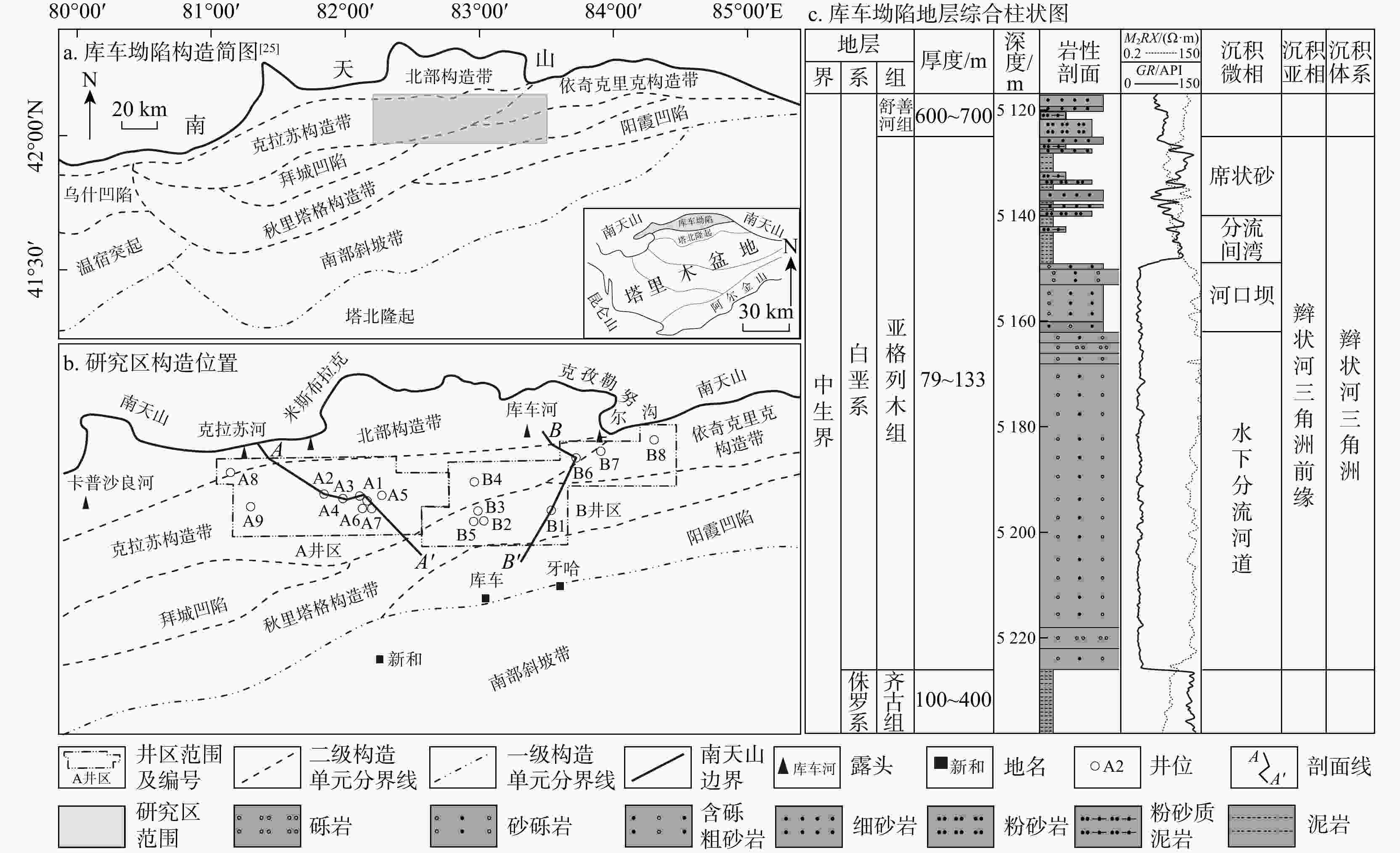
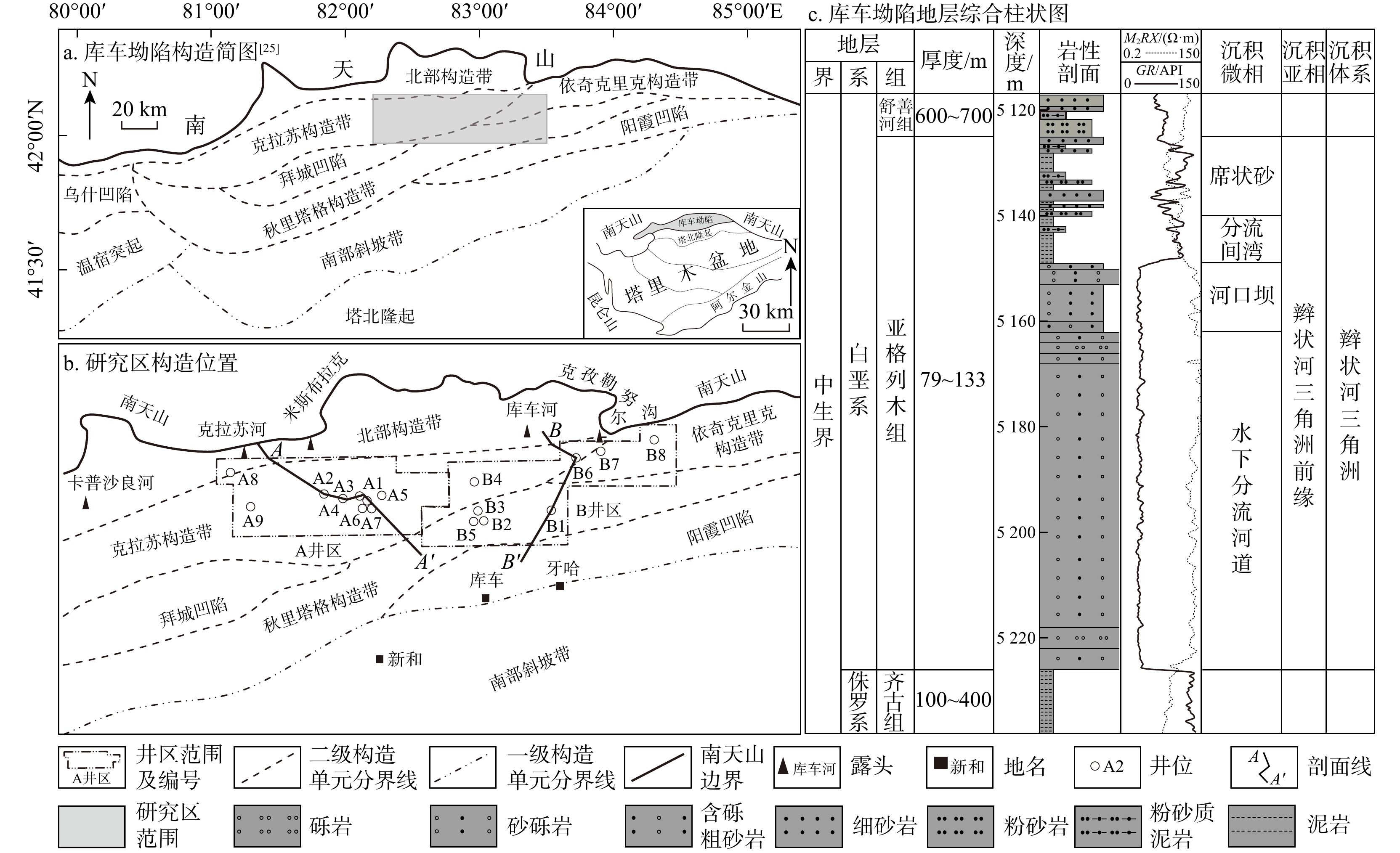
图 1 塔里木盆地库车坳陷区域概况图(M2RX为 2 ft 分辨率、120 in 深探测的阵列感应电阻率;GR为自然伽马;下同)
Figure 1. Regional map of Kuqa Depression, Tarim Basin
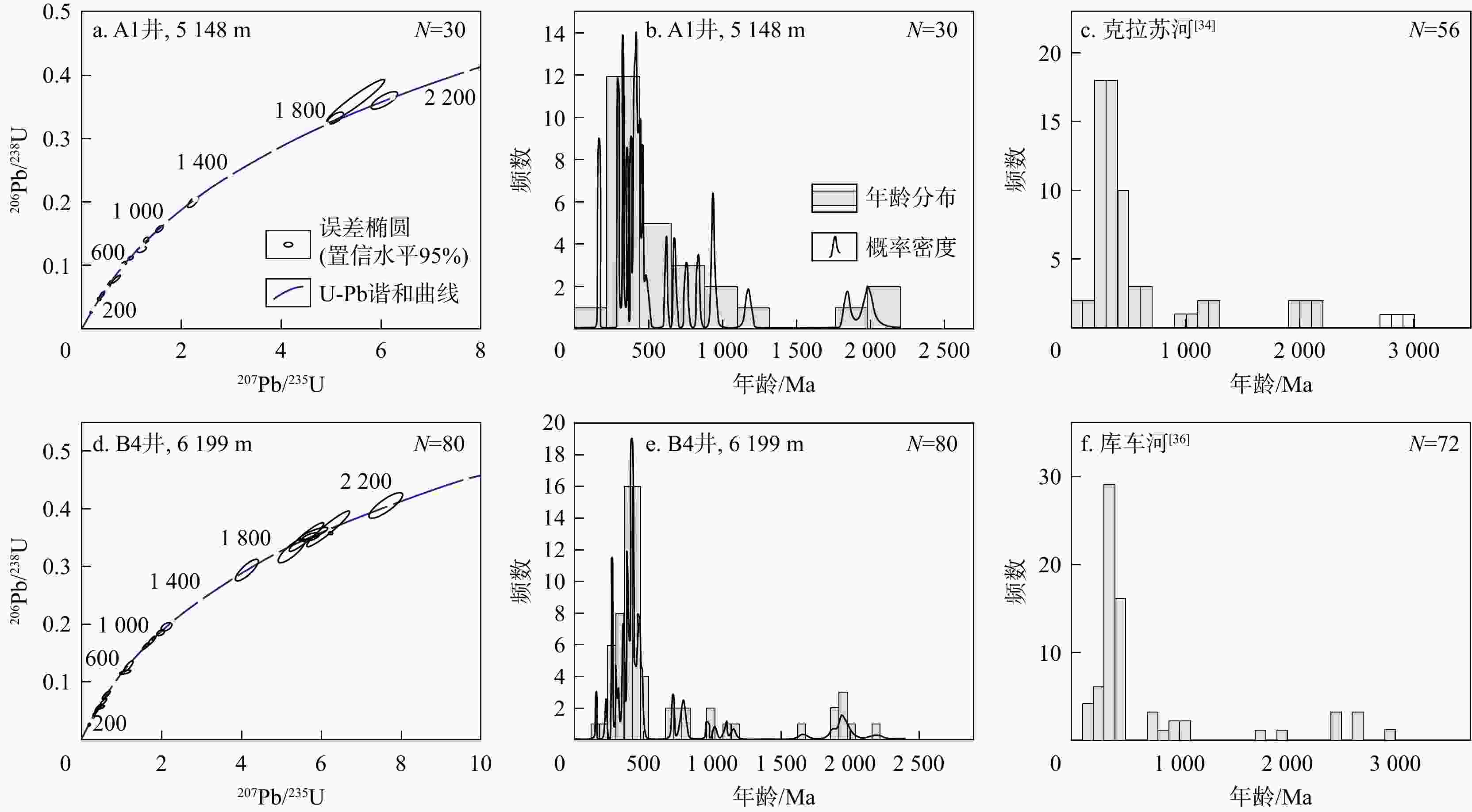
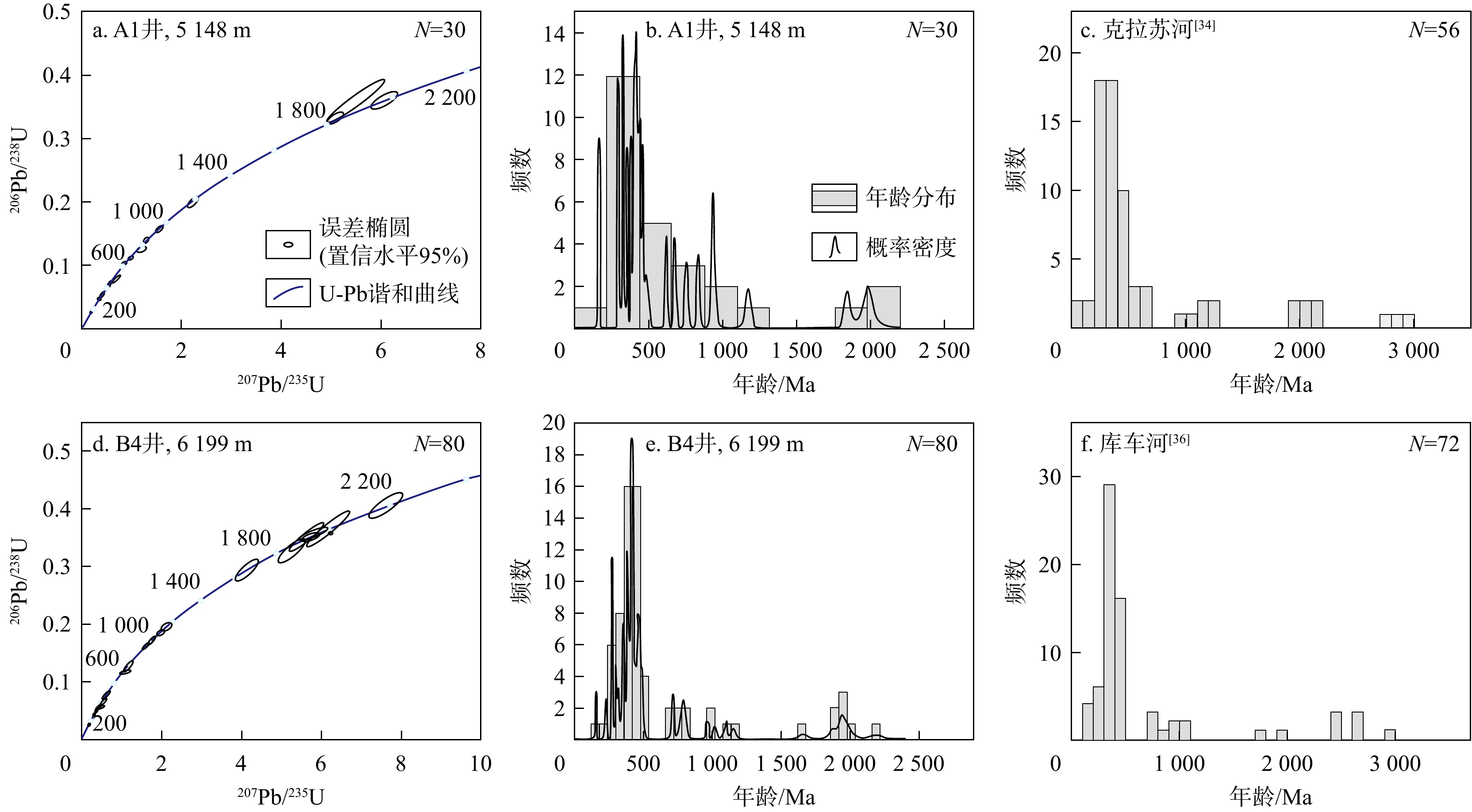
图 2 研究区亚格列木组碎屑锆石 U-Pb 年龄谐和图(a, d)和年龄分布图(b, e)以及周缘地质体碎屑锆石年龄分布图(c, f)(N. 锆石颗数;A1,B4井位置见图1b;下同)
Figure 2. U-Pb concordia diagrams (a, d) and age distribution diagrams (b, e) of detrital zircons from Yageliemu Formation in study area, and age distribution diagrams of detrital zircons from surrounding geological bodies (c, f)
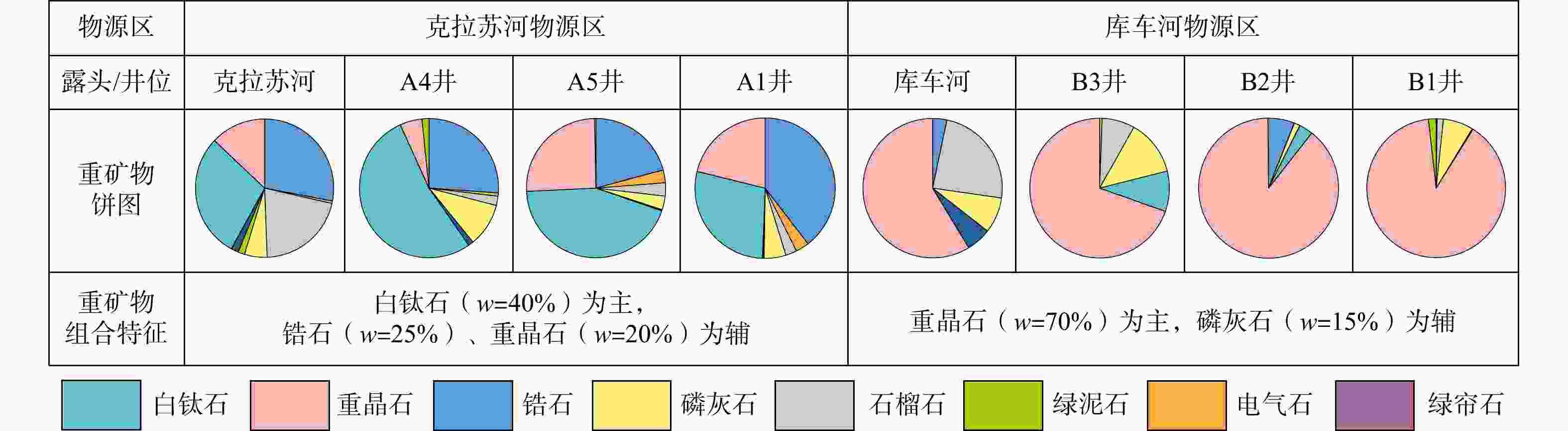
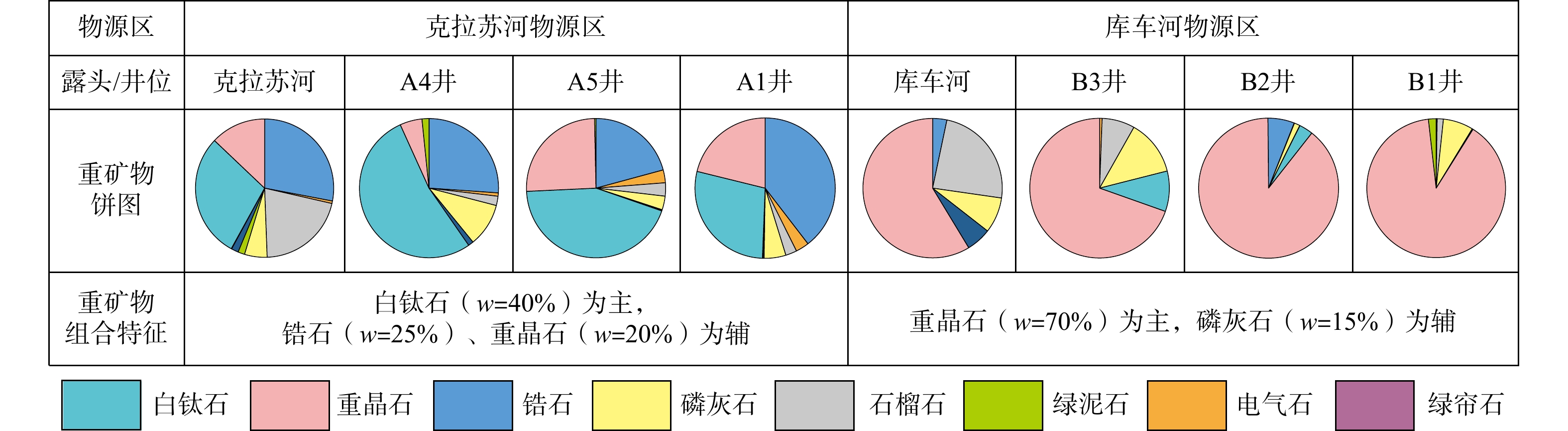
图 3 库车坳陷不同井区亚格列木组重矿物组合特征分析(A4井等位置见图1b)
Figure 3. Characteristics analysis of heavy-mineral assemblages in Yageliemu Formation of different well areas, Kuqa Depression
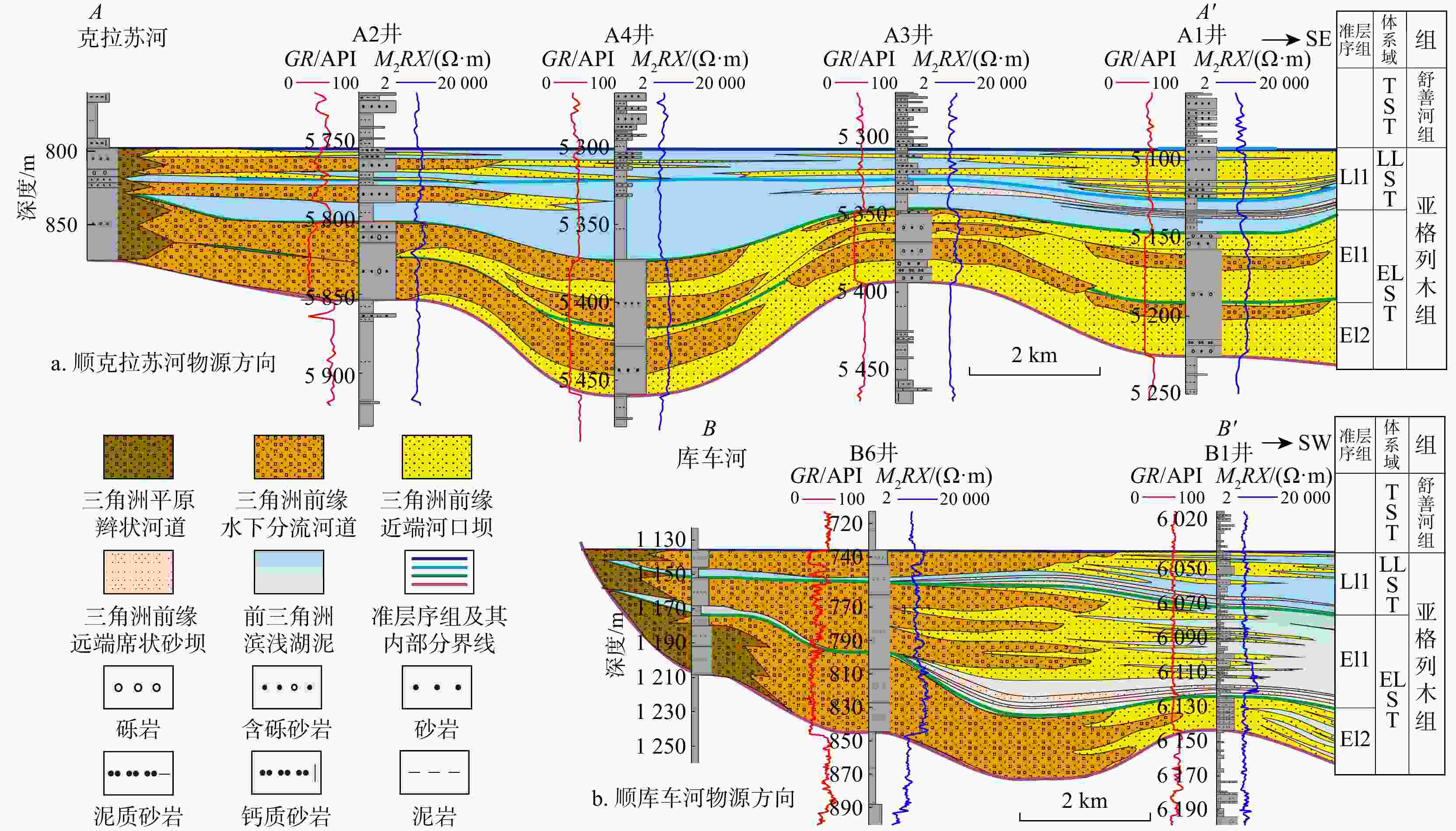
图 4 库车坳陷亚格列木组沉积相连井剖面
A-A'、B-B'剖面位置见图1b;ELST为早期低位体系域,细分为EL1和EL2;LLST指晚期低位体系域,细分为LL1;TST为湖侵体系域
Figure 4. Cross-section of connecting wells in sedimentary facies of Yageliemu Formation, Kuqa Depression
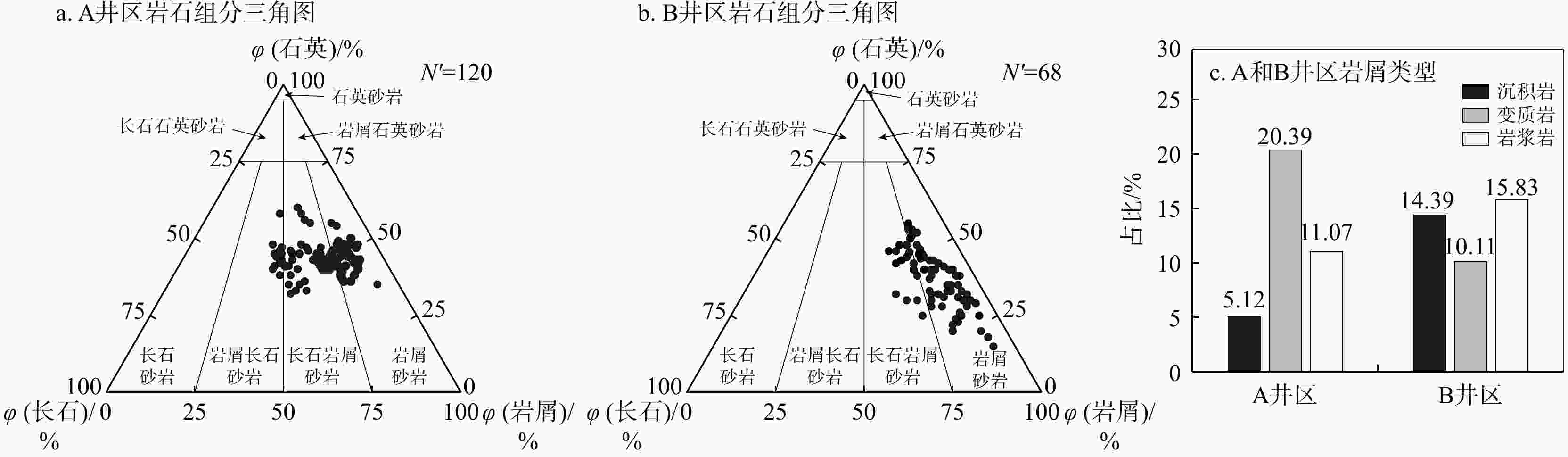
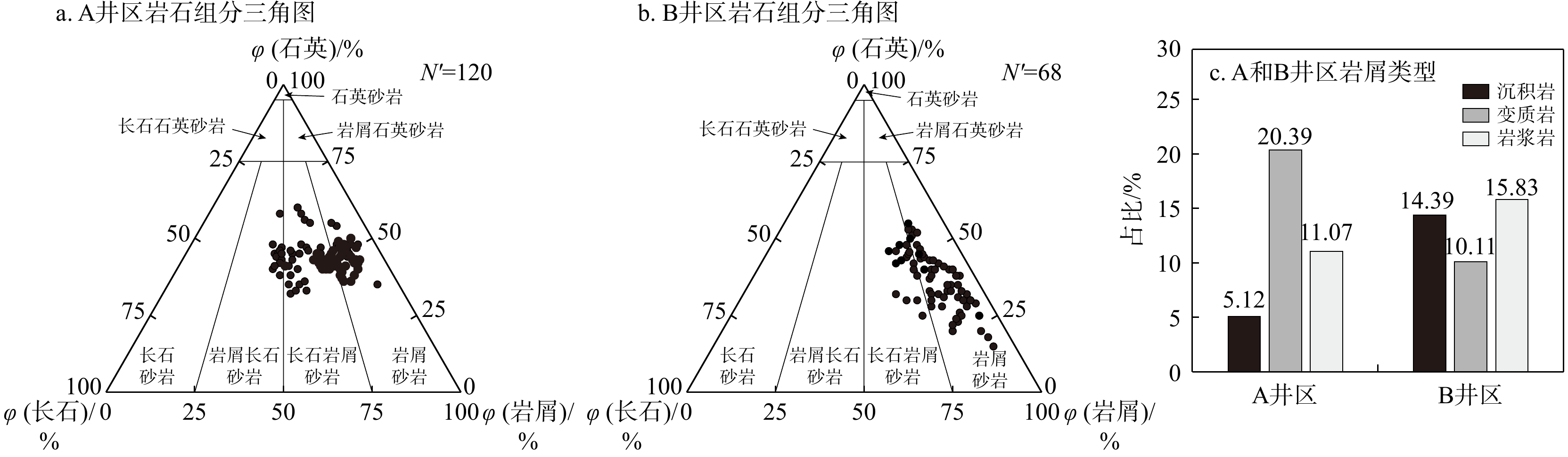
图 5 亚格列木组致密砂岩储层岩石学组分特征(N'为样品个数,下同)
Figure 5. Petrological composition characteristics of tight sandstone reservoirs in Yageliemu Formation
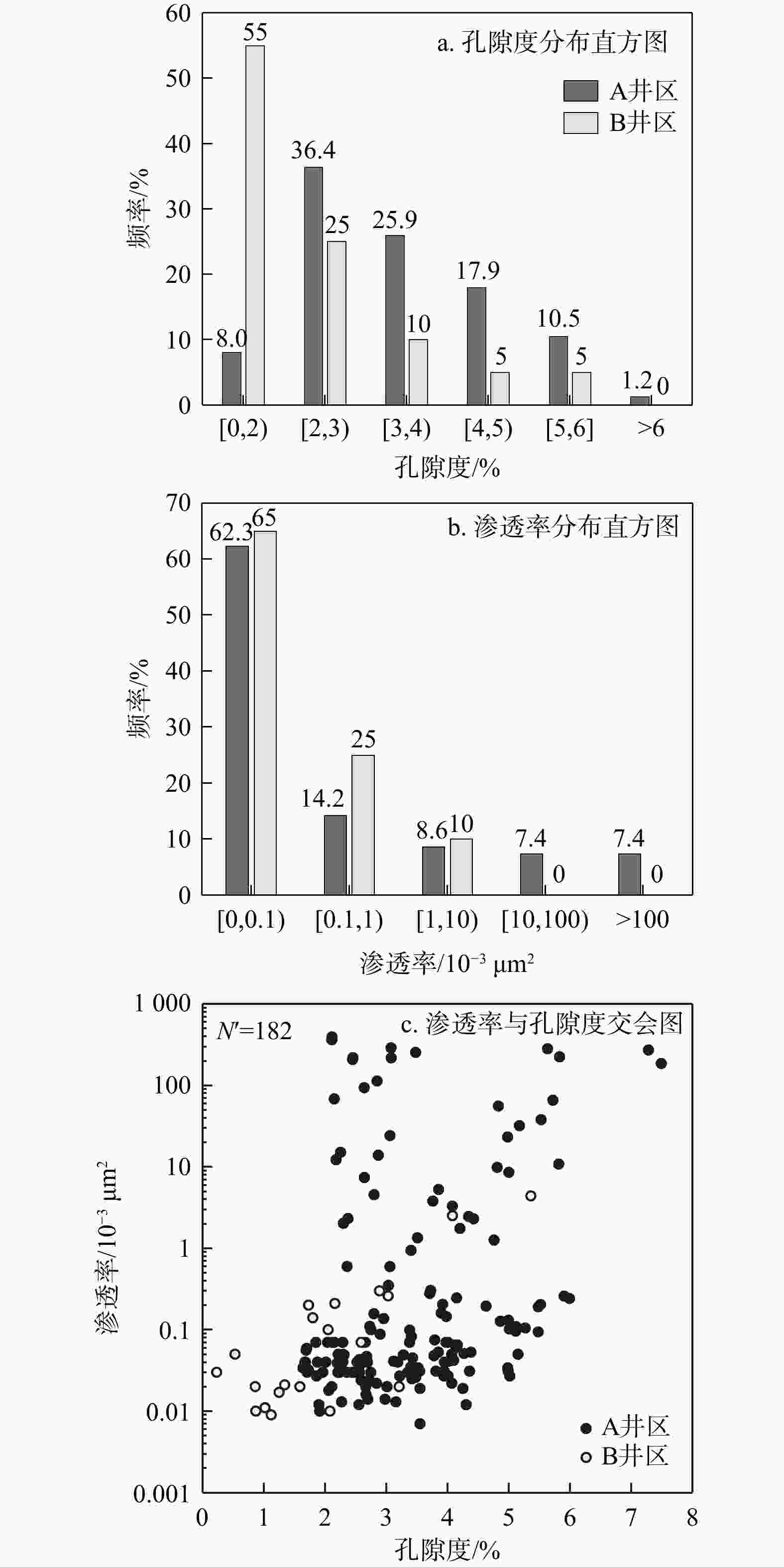
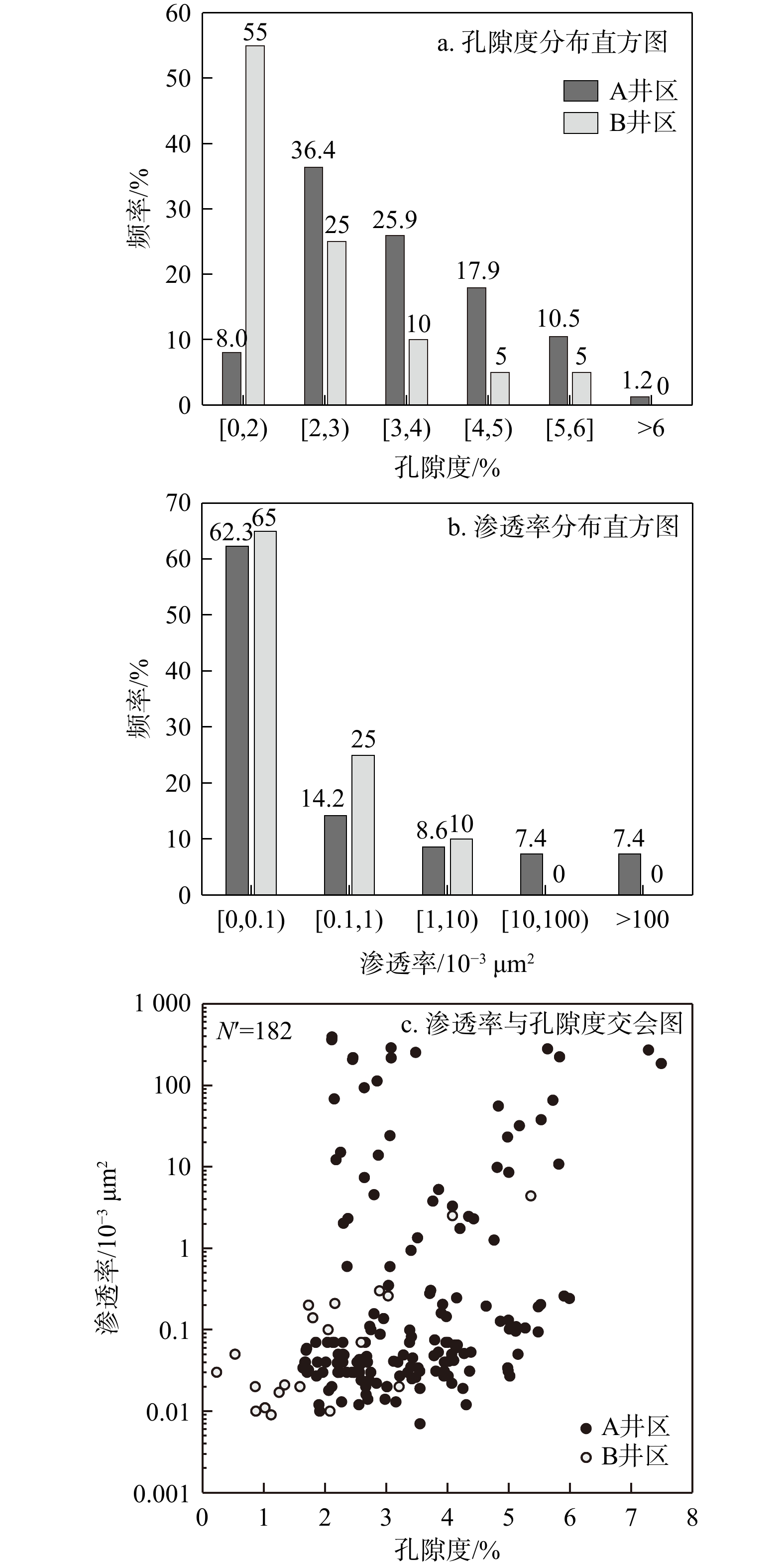
图 6 亚格列木组致密砂岩储层岩心实测孔隙度和渗透率特征
Figure 6. Measured porosity and permeability characteristics of cores from tight sandstone reservoirs in Yageliemu Formation
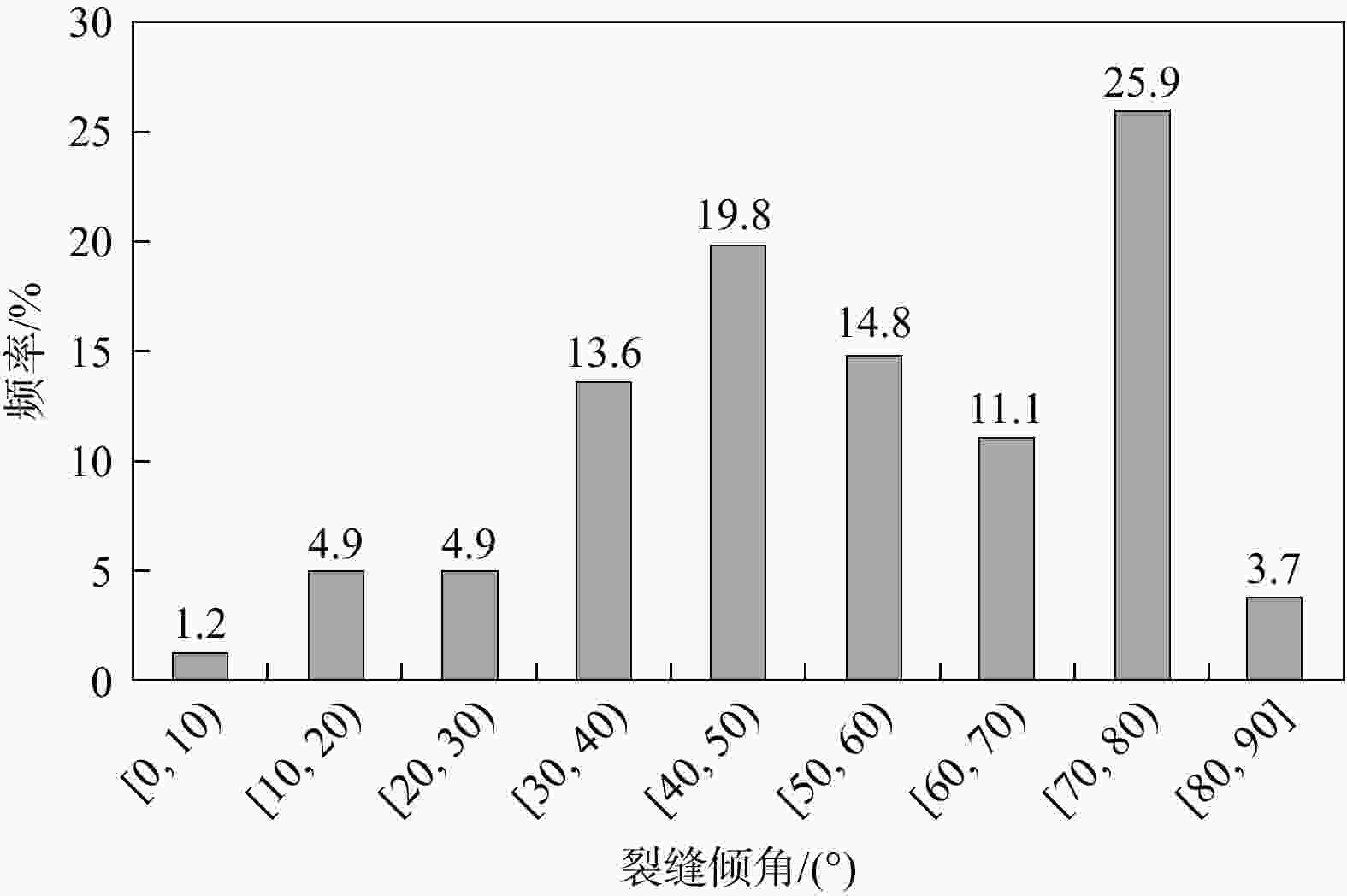
图 7 亚格列木组储层裂缝倾角分布直方图
Figure 7. Histogram of fracture dip distribution in reservoirs of Yageliemu Formation
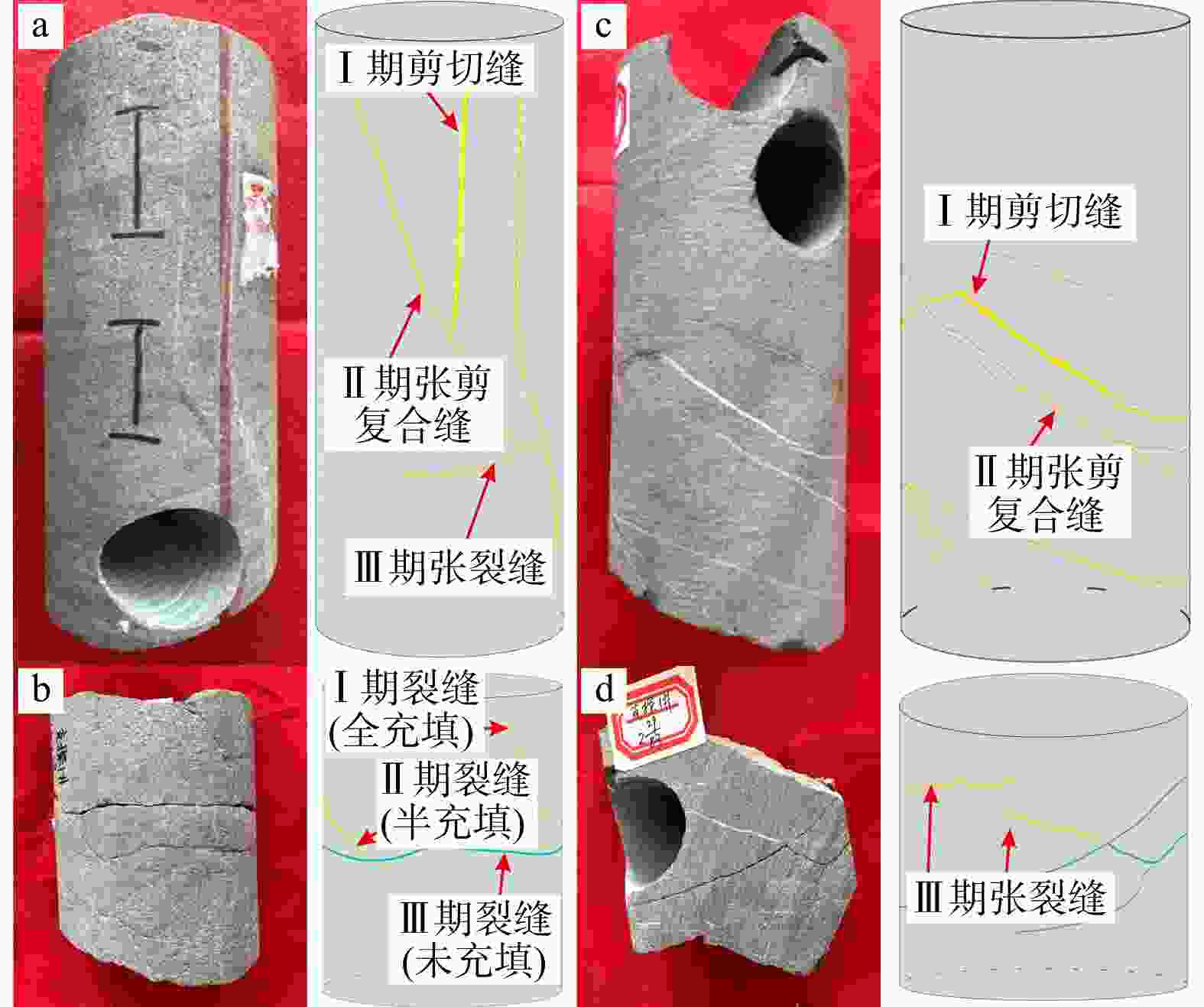
图 8 亚格列木组致密砂岩构造裂缝的宏观岩心特征
a. A5井,
5594.73 m,Ⅰ~Ⅲ期裂缝;b. A1井,5160.29 m,全充填、半充填、未充填裂缝;c. A4井,5161.05 m,Ⅰ,Ⅱ期裂缝;d. A1井,5160.29 m,Ⅲ期裂缝。岩心直径均为10 cmFigure 8. Macroscopic core characteristics of structural fractures in tight sandstones of Yageliemu Formation
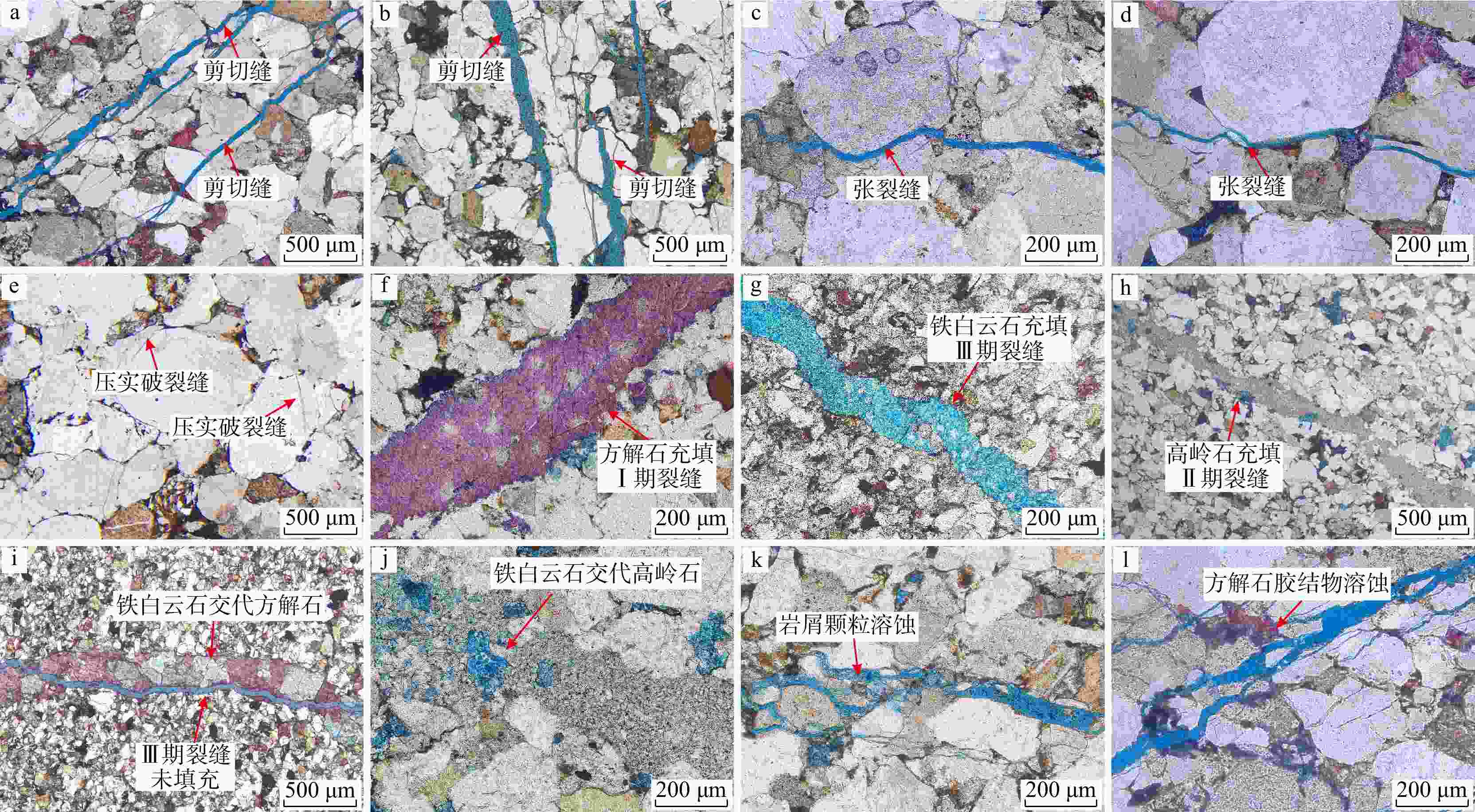
图 9 亚格列木组致密砂岩构造裂缝微观薄片特征
a. A1井,
5162.3 m,剪切缝;b. A5井,5590 m,剪切缝;c. A1井,5161.82 m,张裂缝;d. A1井,5160.74 m,张裂缝;e. A5井,5588.36 m,压实破裂缝;f. A1井,5160.22 m,方解石充填裂缝Ⅰ期裂缝;g. A4井,5162.18 m,铁白云石充填Ⅲ期裂缝;h. A5 井,5595.39 m,高岭石充填Ⅱ期裂缝;i. A4井,5161.37 m,铁白云石交代方解石;j. A5 井,5595.39 m,铁白云石交代高岭石;k. A5井,5590.62 m,岩屑颗粒溶蚀;l. A1井,5162.3 m,方解石胶结物溶蚀Figure 9. Microscopic thin-section characteristics of structural fractures in tight sandstones of Yageliemu Formation
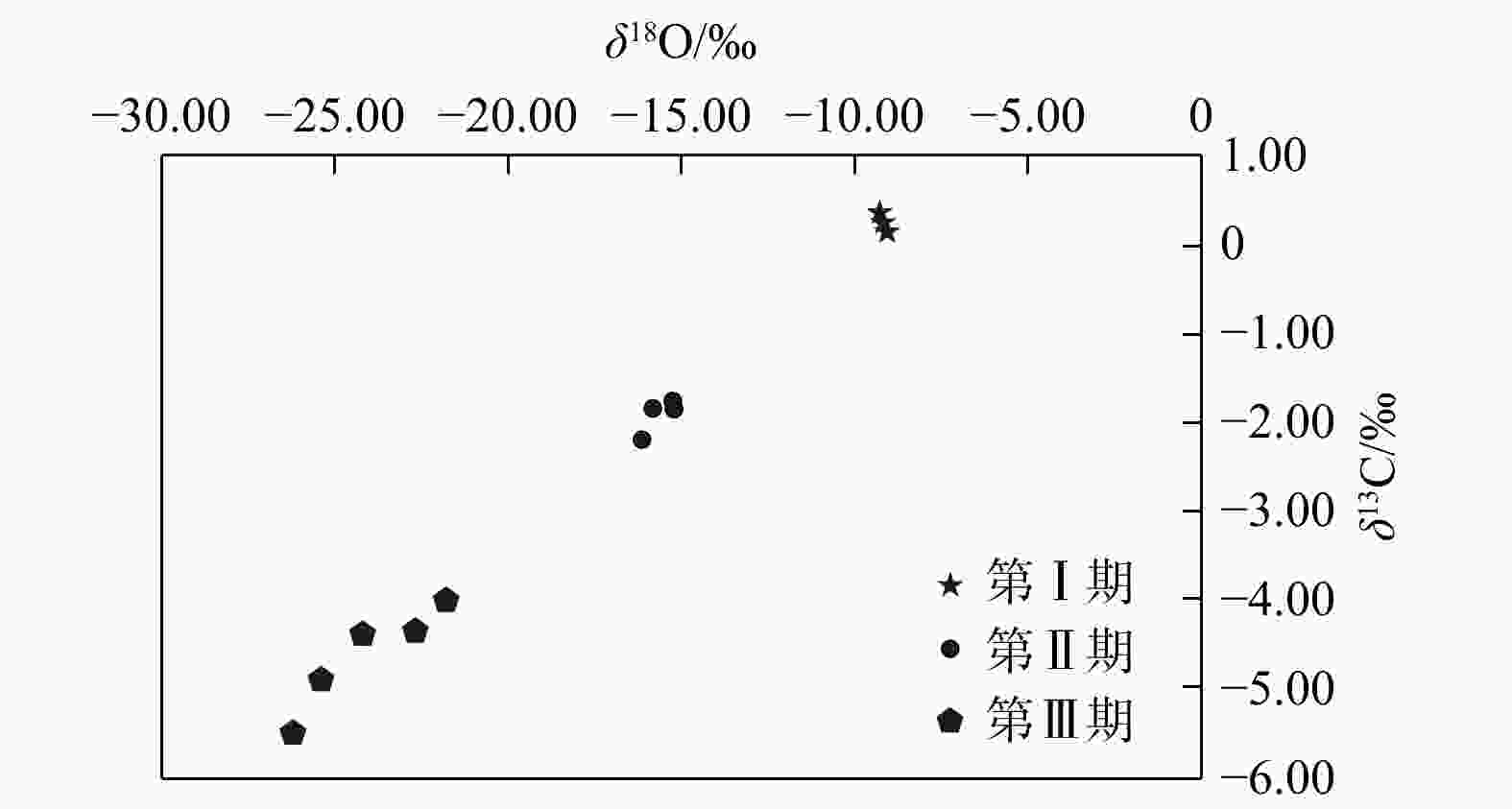
图 10 亚格列木组致密储层裂缝填充碳酸盐胶结物的碳氧同位素特征
Figure 10. Carbon and oxygen isotopic characteristics of carbonate cements within fractures of tight reservoirs of Yageliemu Formation
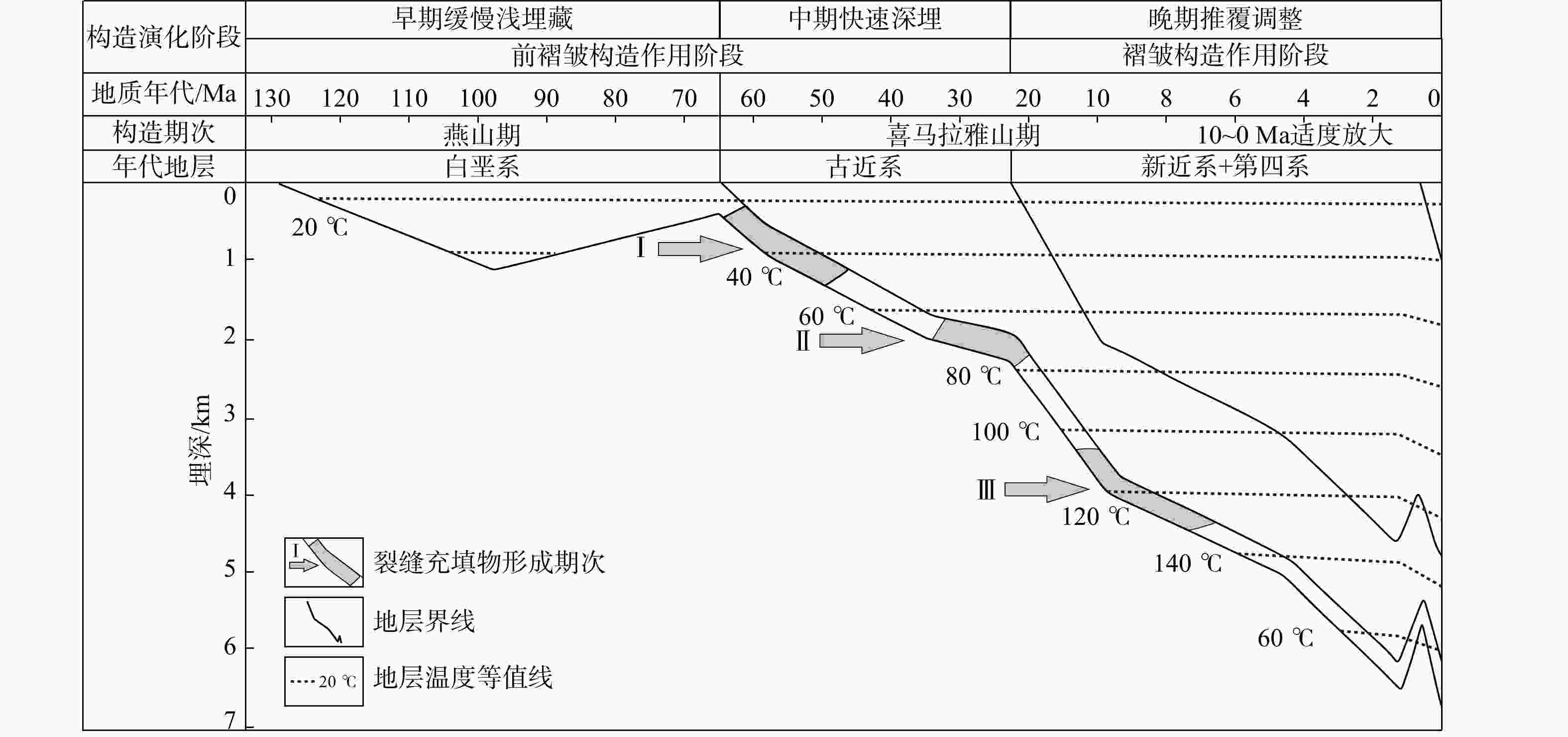
图 11 库车坳陷亚格列木组致密砂岩储层埋藏史与裂缝充填物形成期次综合图
Figure 11. Composite diagram of burial history and fracture-filling stages of tight sandstone reservoirs in Yageliemu Formation, Kuqa Depression
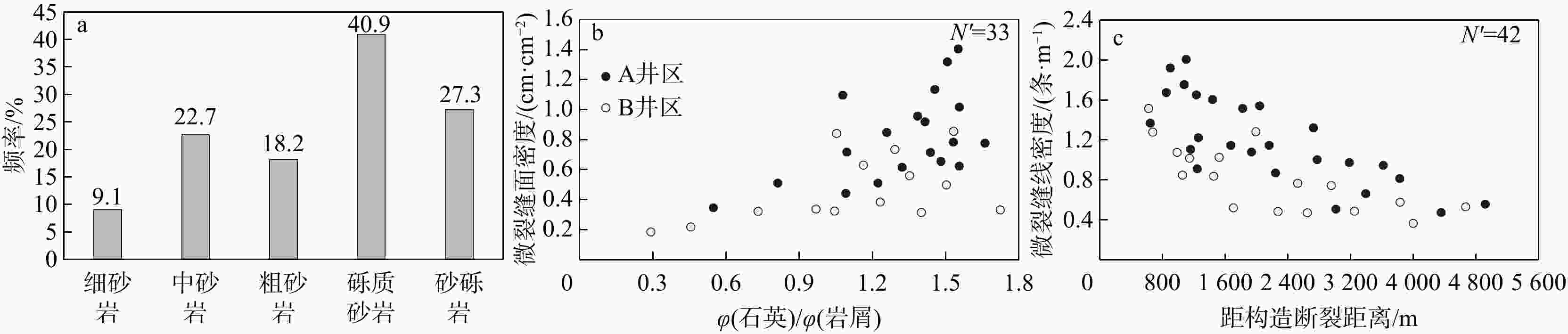
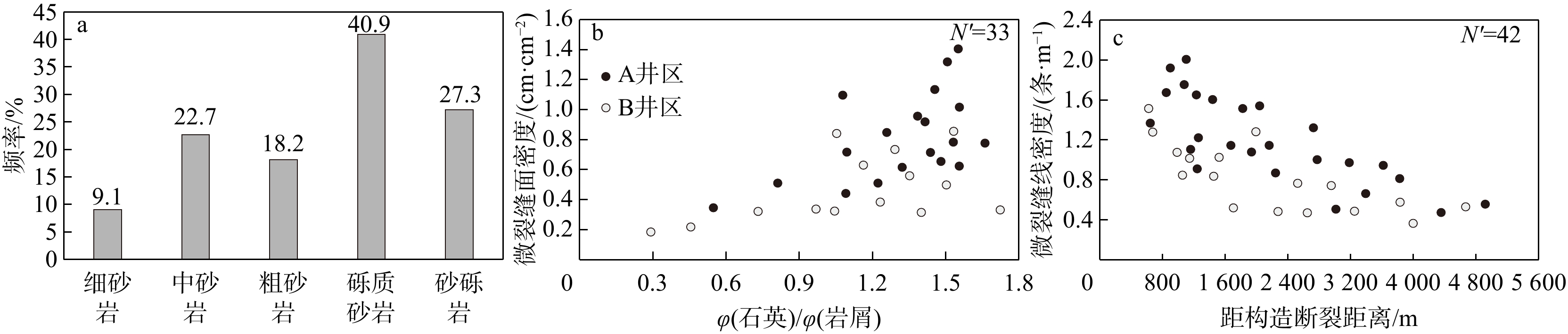
图 12 亚格列木组致密砂岩储层裂缝发育控制因素
a. 不同岩性裂缝发育直方图;b. 裂缝发育面密度和石英/岩屑含量关系图;c. 取心井裂缝线密度与距构造断裂距离关系图
Figure 12. Controlling factors of fracture development in tight sandstone reservoirs of Yageliemu Formation
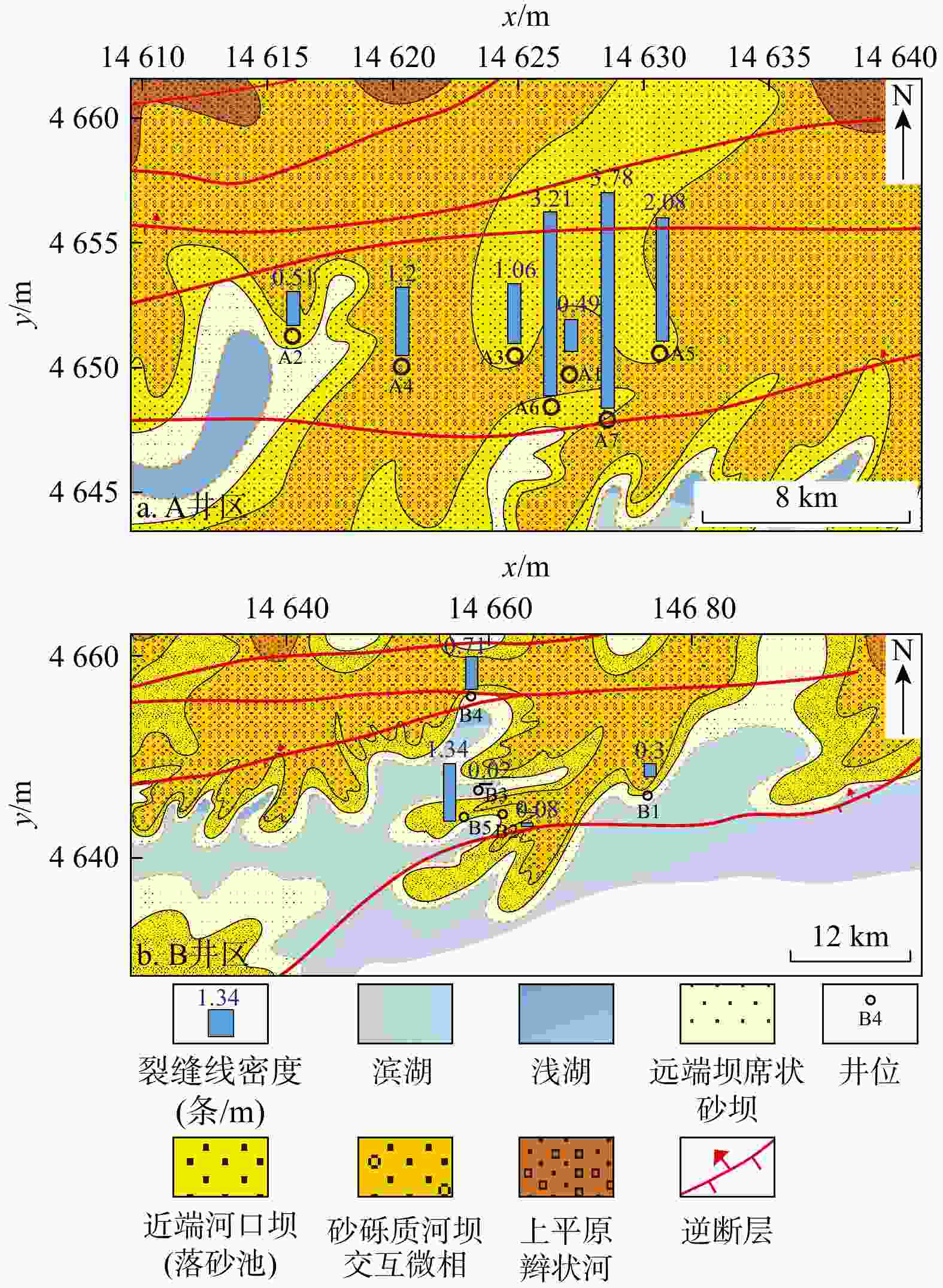
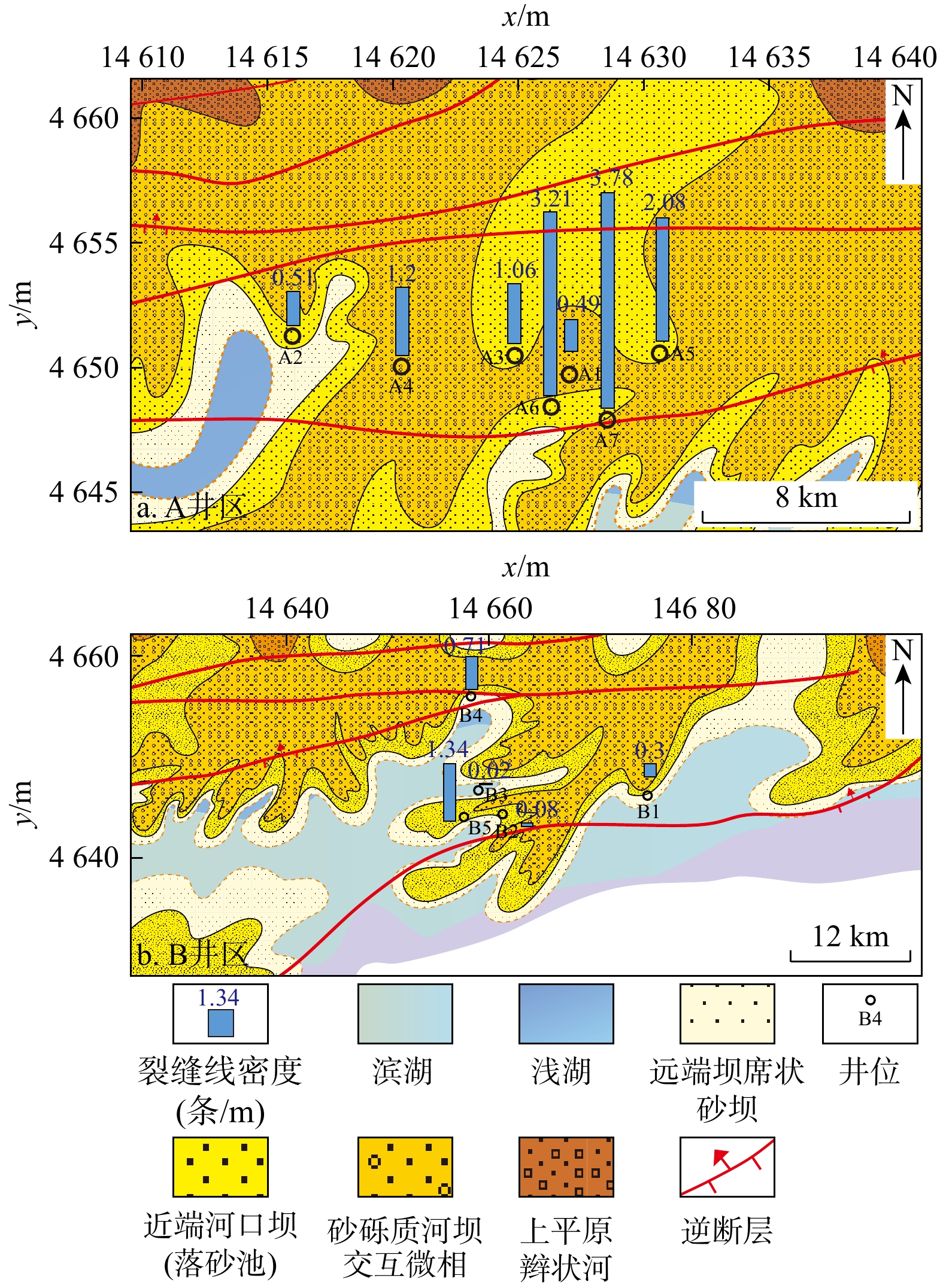
图 13 亚格列木组致密砂岩储层不同井区裂缝发育密度平面分布
Figure 13. Planar distribution of fracture-development density in different well areas of tight sandstone reservoirs of Yageliemu Formation
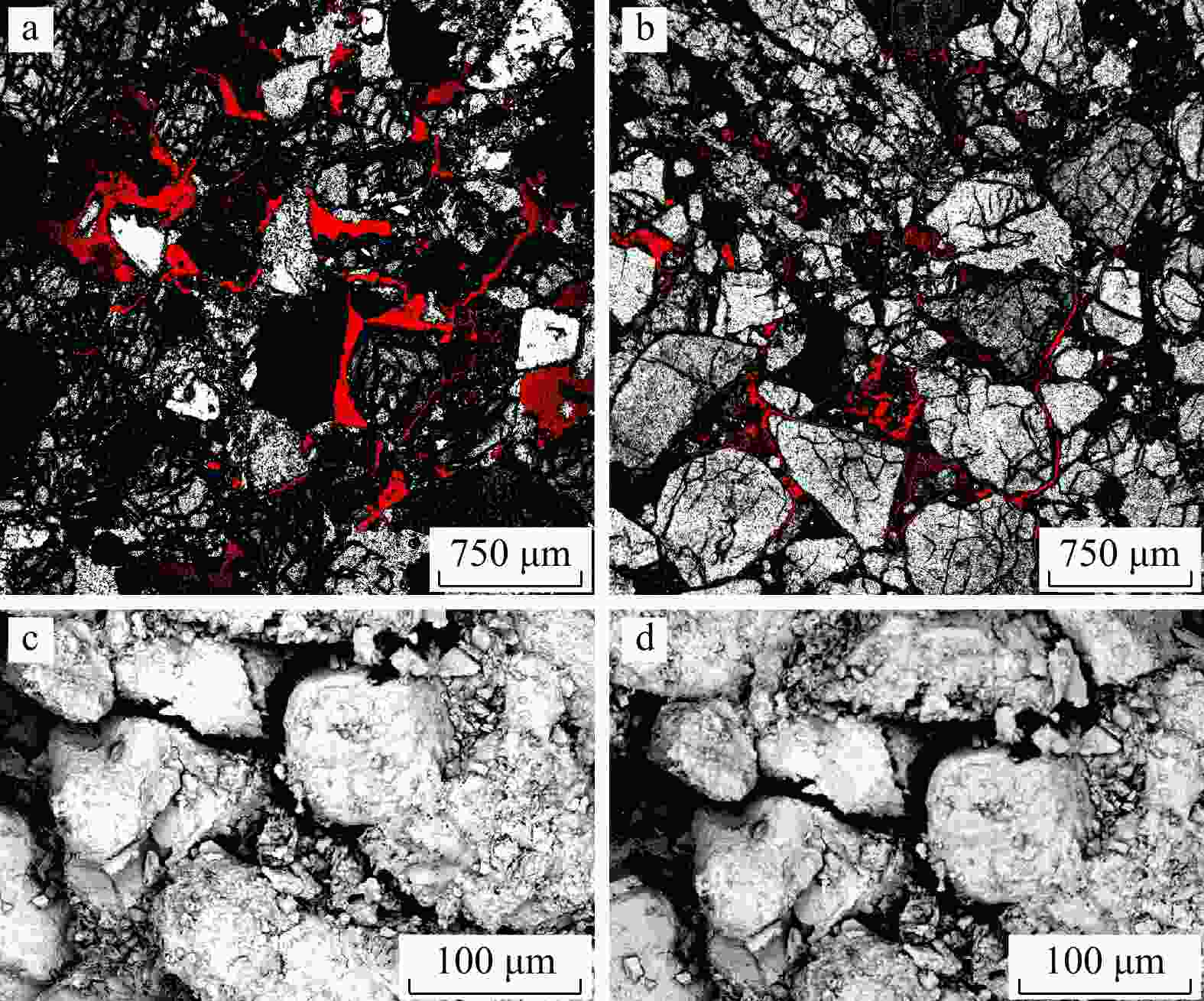
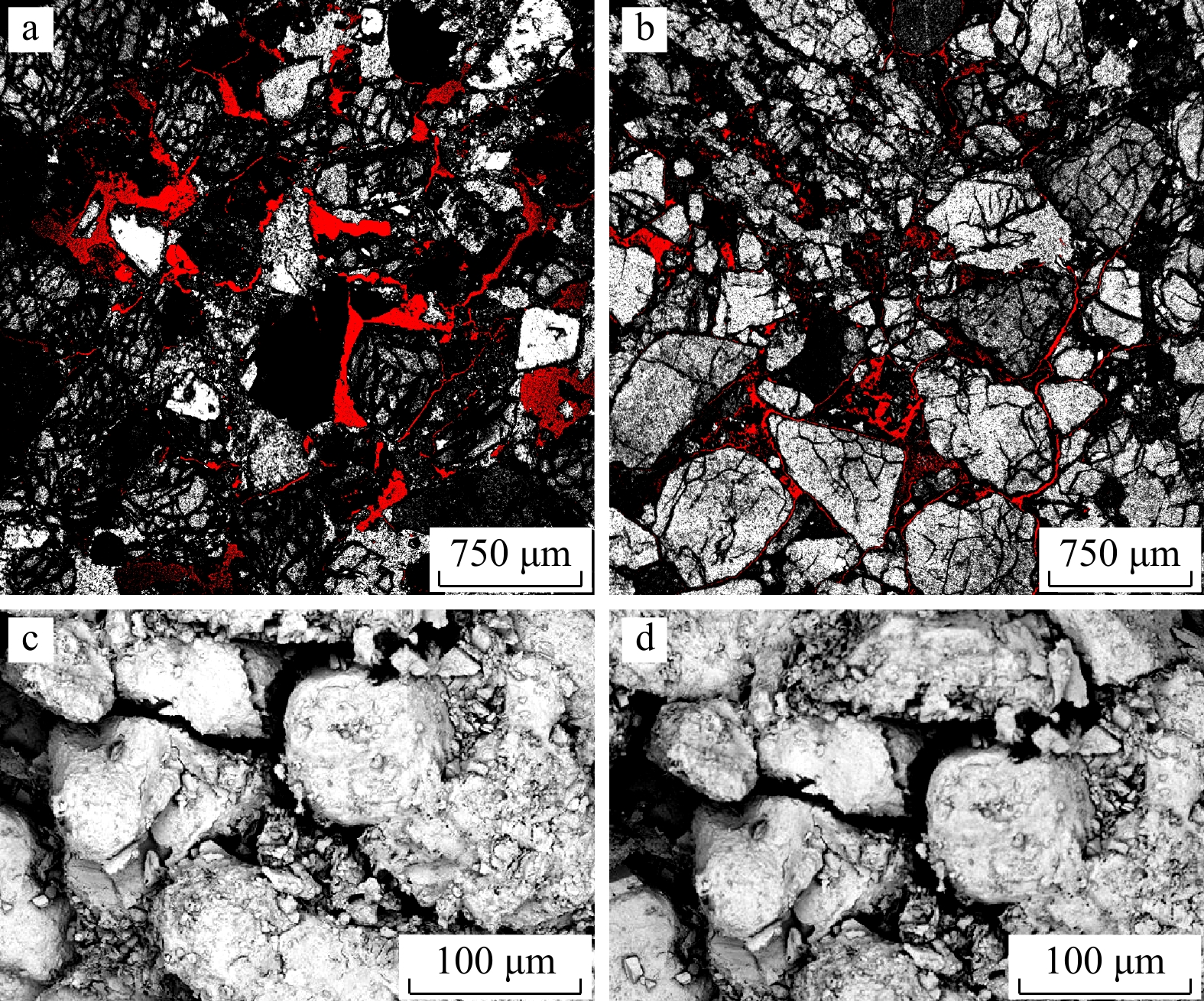
图 14 亚格列木组致密砂岩储层裂缝对孔隙与喉道的连通关系
a. 激光共聚焦图像,A5井,
5588.4 m;b. 激光共聚焦图像,A5井,5588.1 m;c. 扫描电镜图像,A1井,5163.42 m;d. 扫描电镜图像,A1井,5163.57 mFigure 14. Connectivity of fractures with pores and pore throats in tight sandstone reservoirs
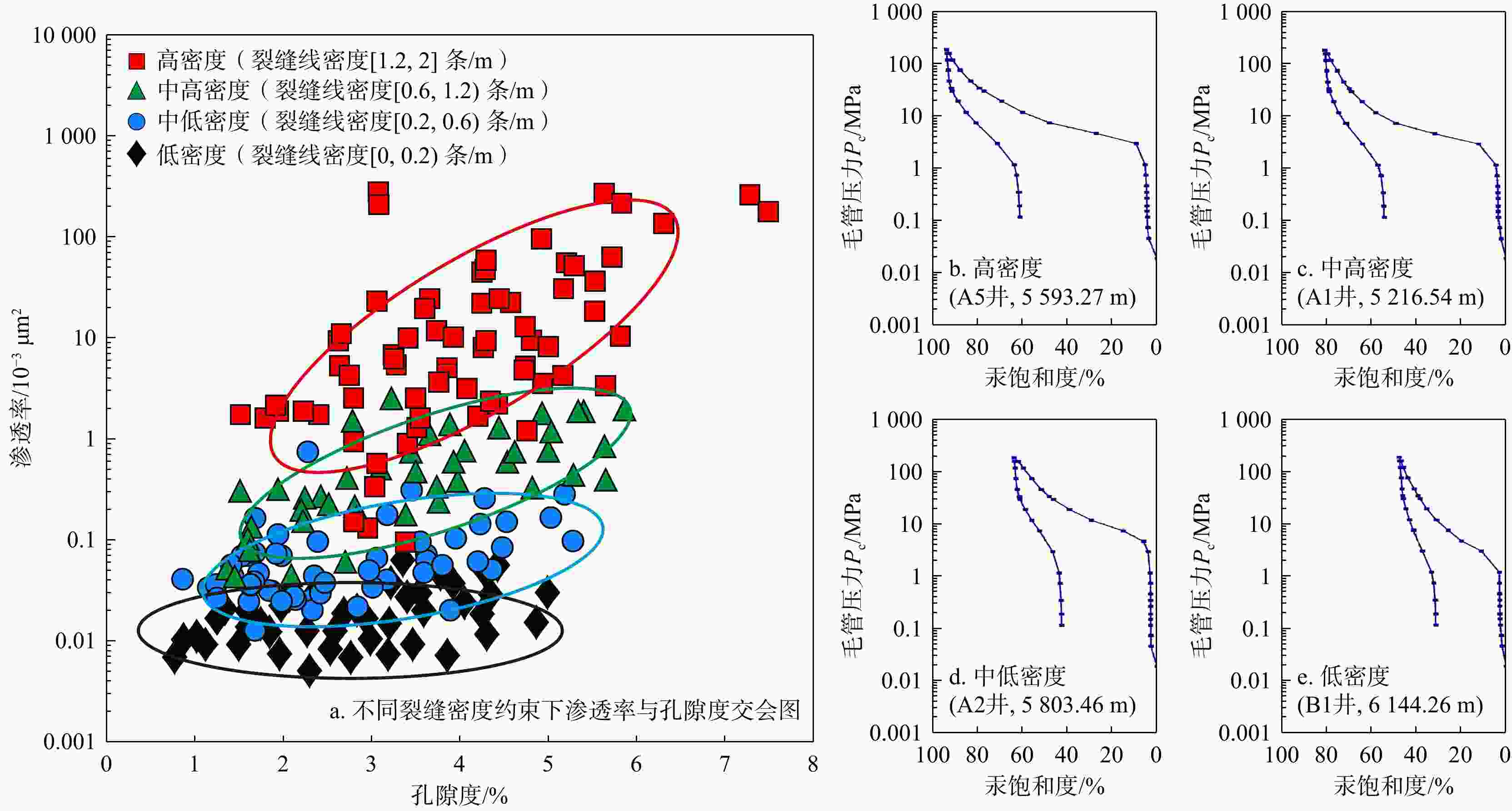
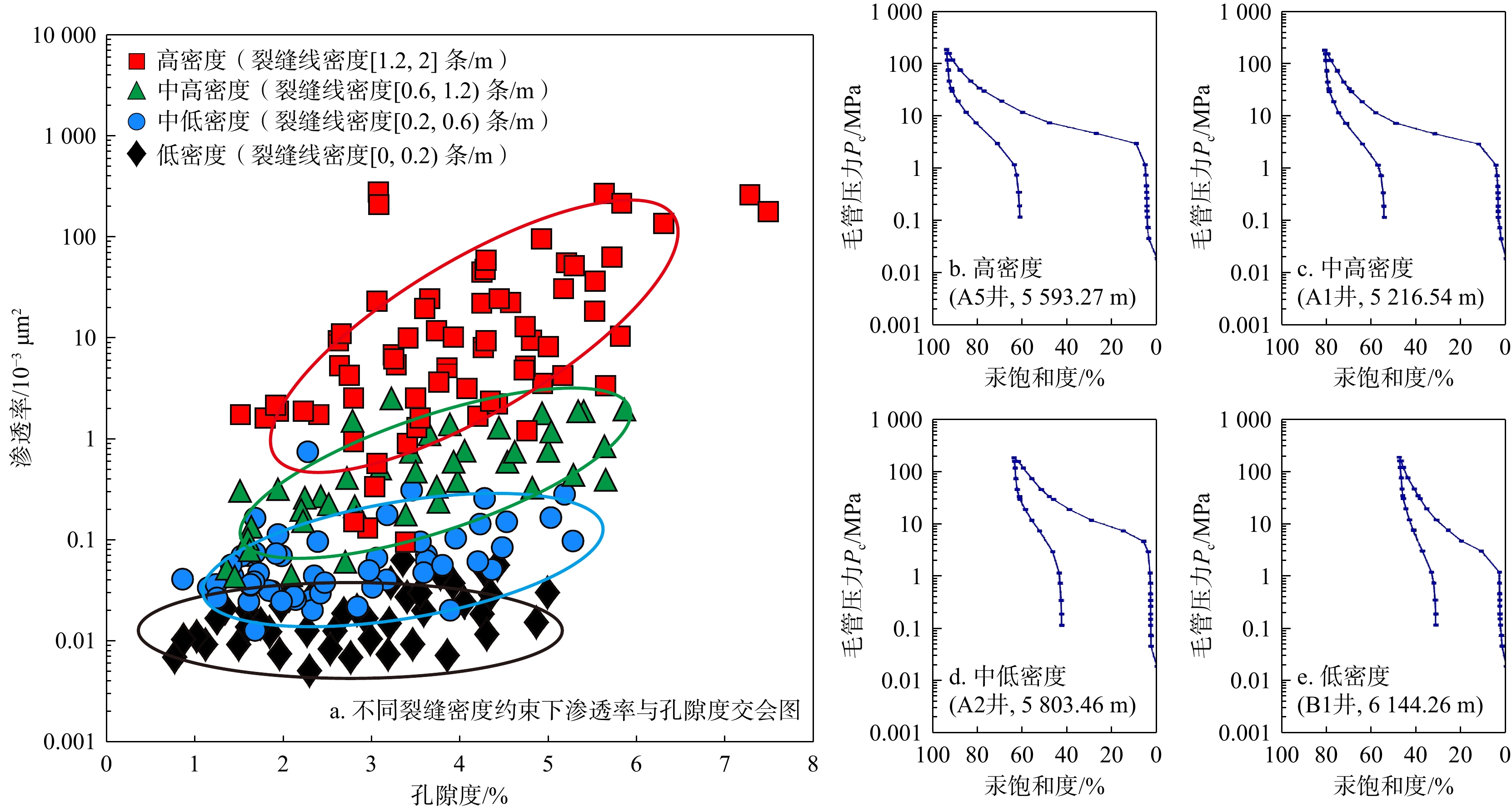
图 15 亚格列木组致密砂岩储层孔隙度、渗透率与裂缝发育密度的关系图
Figure 15. Relationships among porosity, permeability, and fracture-development density in tight sandstone reservoirs of Yageliemu Formation
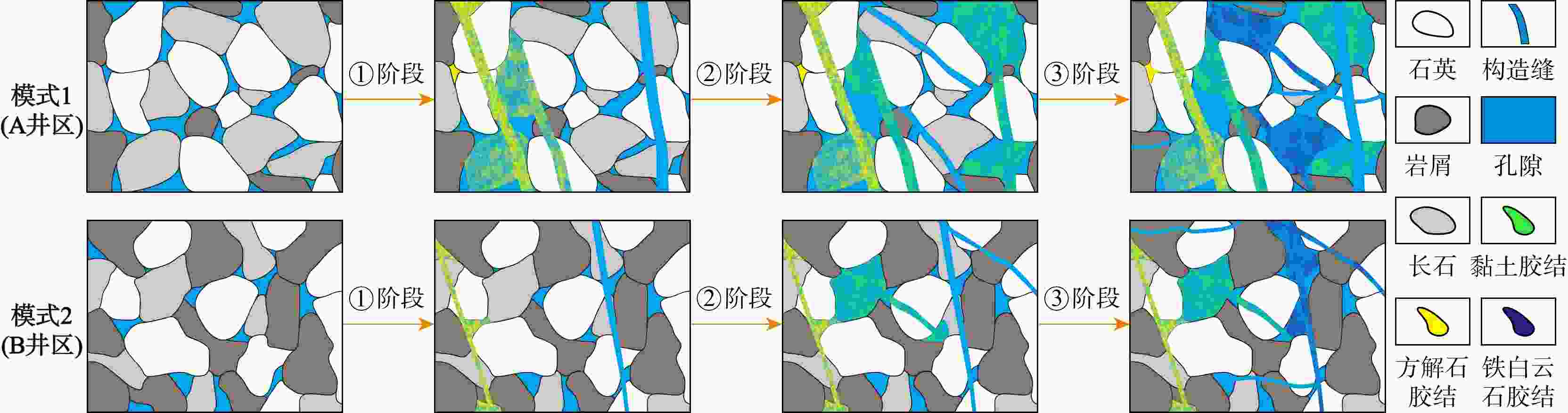
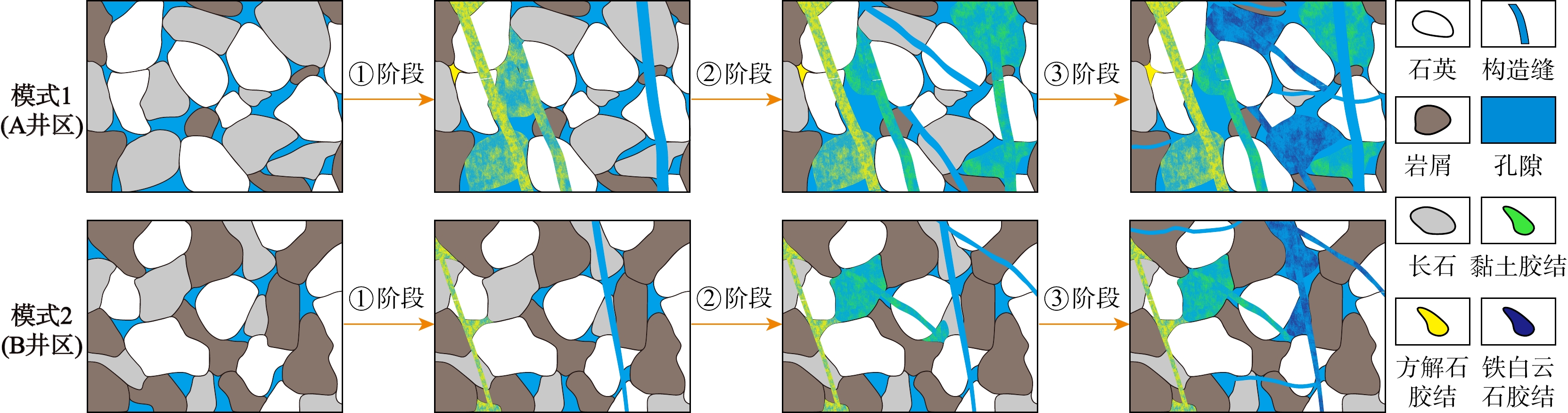
图 16 亚格列木组深层致密砂岩裂缝控储演化模式
①阶段指燕山晚期−喜山早期缓慢浅埋藏阶段;②阶段指喜山中期快速深埋阶段;③阶段指喜山晚期推覆调整阶段
Figure 16. Fracture-controlled reservoir evolution model of deep tight sandstones in Yageliemu Formation
表 1 白垩系亚格列木组砂岩碎屑颗粒成分统计
Table 1. Composition statistics of clastic particles in sandstones of Cretaceous Yageliemu Formation
井区 φ(石英)/% 钾长石 斜长石 总计 φ(岩屑)/% φ(长石)/% A $ \dfrac{39\sim 51}{44} $ $ \dfrac{7\sim 21}{13.2} $ $ \dfrac{2\sim 13}{5.8} $ $ \dfrac{10\sim 31}{19} $ $ \dfrac{26\sim 45}{37} $ B $ \dfrac{31\sim 48}{41} $ $ \dfrac{2\sim 17}{9} $ $ \dfrac{0\sim 8.2}{3} $ $ \dfrac{8\sim 20}{13} $ $ \dfrac{39\sim 51}{44} $ 注:$ \dfrac{39\sim 51}{44}$表示$ \dfrac{最小值-最大值}{平均值} $  下载: 导出CSV
表 2 亚格列木组辫状河三角洲不同沉积微相的裂缝线密度统计
Table 2. Statistics of fracture linear density among different sedimentary microfacies of Yageliemu Formation
沉积亚相 沉积微相 岩性 裂缝线密度/(条·m−1) 辫状河三角洲平原 辫状河道 含砾砂岩为主,中砂岩次之 0.58 辫状河三角洲前缘 水下分流河道 中−细砂岩为主,有少量含砾砂岩 1.34 近端河口坝 中砂岩和细砂岩为主 1.48 远端席状砂坝 细砂岩为主,局部可见泥质薄层 0.73 前三角洲 滨浅湖泥 泥岩为主 0.32
下载: 导出CSV
-
[1] PANG X Q, JIA C Z, ZHANG K, et al. The dead line for oil and gas and implication for fossil resource prediction[J]. Earth System Science Data, 2020, 12(1): 577-590. doi: 10.5194/essd-12-577-2020 [2] 操应长, 远光辉, 杨海军, 等. 含油气盆地深层−超深层碎屑岩油气勘探现状与优质储层成因研究进展[J]. 石油学报, 2022, 43(1): 112-140. doi: 10.7623/syxb202201010CAO Y C, YUAN G H, YANG H J, et al. Current situation of oil and gas exploration and research progress of the origin of high-quality reservoirs in deep-ultra-deep clastic reservoirs of petroliferous basins[J]. Acta Petrolei Sinica, 2022, 43(1): 112-140. (in Chinese with English abstract) doi: 10.7623/syxb202201010 [3] PEI Y W, PATON D A, KNIPE R J, et al. A review of fault sealing behaviour and its evaluation in siliciclastic rocks[J]. Earth-Science Reviews, 2015, 150: 121-138. doi: 10.1016/j.earscirev.2015.07.011 [4] 刘振峰, 刘忠群, 郭元岭, 等. “断缝体”概念、地质模式及其在裂缝预测中的应用: 以四川盆地川西坳陷新场地区须家河组二段致密砂岩气藏为例[J]. 石油与天然气地质, 2021, 42(4): 973-980.LIU Z F, LIU Z Q, GUO Y L, et al. Concept and geological model of fault-fracture reservoir and their application in seismic fracture prediction: A case study on the Xu 2 Member tight sandstone gas pool in Xinchang area, western Sichuan Depression in Sichuan Basin[J]. Oil & Gas Geology, 2021, 42(4): 973-980. (in Chinese with English abstract) [5] 尹帅, 田涛, 李俊鹿, 等. 鄂尔多斯盆地西南缘延长组断缝体特征及对油藏的调控作用[J]. 油气地质与采收率, 2024, 31(1): 1-12. doi: 10.13673/j.pgre.202305040YIN S, TIAN T, LI J L, et al. Fault-fracture body characteristics and their effect on hydrocarbon distribution of Yanchang Formation in southwestern margin of Ordos Basin[J]. Petroleum Geology and Recovery Efficiency, 2024, 31(1): 1-12. (in Chinese with English abstract) doi: 10.13673/j.pgre.202305040 [6] CARLSON E S, MERCER J C. Devonian shale gas production: Mechanisms and simple models[J]. Journal of Petroleum Technology, 1991, 43(4): 476-482. doi: 10.2118/19311-pa [7] ZHANG Z Y, LIU W W, WU X D. Influence of fractures in tight sandstone oil reservoir on hydrocarbon accumulation: A case study of Yanchang Formation in southeastern Ordos Basin[J]. Open Geosciences, 2023, 15: 20220509. doi: 10.1515/geo-2022-0509 [8] LYU W Y, ZENG L B, ZHANG B J, et al. Influence of natural fractures on gas accumulation in the Upper Triassic tight gas sandstones in the northwestern Sichuan Basin, China[J]. Marine and Petroleum Geology, 2017, 83: 60-72. doi: 10.1016/j.marpetgeo.2017.03.004 [9] PALCIAUSKAS V V, DOMENICO P A. Microfracture development in compacting sediments: Relation to hydrocarbon-maturation kinetics[J]. AAPG Bulletin, 1980, 64(6): 927-937. doi: 10.1306/2F9193D7-16CE-11D7-8645000102C1865D [10] GUO R L, XIE Q C, QU X F, et al. Fractal characteristics of pore-throat structure and permeability estimation of tight sandstone reservoirs: A case study of Chang 7 of the Upper Triassic Yanchang Formation in Longdong area, Ordos Basin, China[J]. Journal of Petroleum Science and Engineering, 2020, 184: 106555. doi: 10.1016/j.petrol.2019.106555 [11] ANDERS M H, LAUBACH S E, SCHOLZ C H. Microfractures: A review[J]. Journal of Structural Geology, 2014, 69: 377-394. doi: 10.1016/j.jsg.2014.05.011 [12] 巩磊, 曾联波, 陈树民, 等. 致密砾岩储层微观裂缝特征及对储层的贡献[J]. 大地构造与成矿学, 2016, 40(1): 38-46.GONG L, ZENG L B, CHEN S M, et al. Characteristics of micro-fractures and contribution to the compact conglomerate reservoirs[J]. Geotectonica et Metallogenia, 2016, 40(1): 38-46. (in Chinese with English abstract) [13] 李长海, 赵伦, 刘波, 等. 微裂缝研究进展、意义及发展趋势[J]. 天然气地球科学, 2020, 31(3): 402-416.LI C H, ZHAO L, LIU B, et al. Research status, significance and development trend of microfractures[J]. Natural Gas Geoscience, 2020, 31(3): 402-416. [14] DU S H. Characteristics and the formation mechanism of the heterogeneous microfractures in the tight oil reservoir of Ordos Basin, China[J]. Journal of Petroleum Science and Engineering, 2020, 191: 107176. doi: 10.1016/j.petrol.2020.107176 [15] 吕文雅, 曾联波, 周思宾, 等. 鄂尔多斯盆地西南部致密砂岩储层微观裂缝特征及控制因素: 以红河油田长8储层为例[J]. 天然气地球科学, 2020, 31(1): 37-46.LYU W Y, ZENG L B, ZHOU S B, et al. Microfracture characteristics and its controlling factors in the tight oil sandstones in the Southwest Ordos Basin: Case study of the Eighth Member of the Yanchang Formation in Honghe oilfield[J]. Natural Gas Geoscience, 2020, 31(1): 37-46. (in Chinese with English abstract) [16] 赵兰. 致密砂岩储层微裂缝发育特征及对物性的影响: 以杭锦旗地区十里加汗区带为例[J]. 油气藏评价与开发, 2022, 12(2): 285-291.ZHAO L. Development characteristics of microfractures in tight sandstone reservoir and its influence on physical properties: A case study of Shiligiahan zone in Hangjinqi[J]. Petroleum Reservoir Evaluation and Development, 2022, 12(2): 285-291. (in Chinese with English abstract) [17] KONG X Y, ZENG J H, TAN X F, et al. Genetic types and main control factors of microfractures in tight oil reservoirs of Jimsar Sag[J]. Geofluids, 2021, 2021(1): 5558551. doi: 10.1155/2021/5558551 [18] 王俊鹏, 张惠良, 张荣虎, 等. 裂缝发育对超深层致密砂岩储层的改造作用: 以塔里木盆地库车坳陷克深气田为例[J]. 石油与天然气地质, 2018, 39(1): 77-88. doi: 10.11743/ogg20180108WANG J P, ZHANG H L, ZHANG R H, et al. Enhancement of ultra-deep tight sandstone reservoir quality by fractures: A case study of Keshen gas field in Kuqa Depression, Tarim Basin[J]. Oil & Gas Geology, 2018, 39(1): 77-88. (in Chinese with English abstract) doi: 10.11743/ogg20180108 [19] 徐珂, 鞠玮, 张辉, 等. 塔里木盆地库车坳陷白垩系巴什基奇克组致密砂岩力学性质影响因素及其变化规律[J]. 石油实验地质, 2024, 46(4): 823-832.XU K, JU W, ZHANG H, et al. Factors affecting the mechanical properties of tight sandstone and their patterns of variation in Cretaceous Bashijiqike Formation of Kuqa Depression in Tarim Basin[J]. Petroleum Geology & Experiment, 2024, 46(4): 823-832. (in Chinese with English abstract) [20] 徐小童, 曾联波, 董少群, 等. 塔里木盆地库车坳陷克深气藏超深层致密砂岩储层天然裂缝发育特征及对水侵的影响[J]. 石油实验地质, 2024, 46(4): 812-822.XU X T, ZENG L B, DONG S Q, et al. Fracture development characteristics and their influence on water invasion of ultra-deep tight sandstone reservoirs in Keshen gas reservoir of Kuqa Depression, Tarim Basin[J]. Petroleum Geology and Experiment, 2024, 46(4): 812-822. (in Chinese with English abstract) [21] 张家维, 李瑞雪, 邓虎成, 等. 超深层逆冲推覆构造致密砂岩储层地应力场扰动特征: 以塔里木盆地博孜-大北地区白垩系储层为例[J]. 石油实验地质, 2024, 46(4): 760-774. doi: 10.11781/sysydz202404760ZHANG J W, LI R X, DENG H C, et al. Disturbance characteristics of in-situ stress field within ultra-deep tight sandstone reservoirs in thrust-nappe structures: A case study from Cretaceous reservoirs in Bozi-Dabei area, Tarim Basin[J]. Petroleum Geology & Experiment, 2024, 46(4): 760-774. (in Chinese with English abstract) doi: 10.11781/sysydz202404760 [22] 张月, 韩登林, 杨铖晔, 等. 超深层碎屑岩储层裂缝充填流体迁移规律: 以库车坳陷克深井区白垩系巴什基奇克组为例[J]. 石油学报, 2020, 41(3): 292-300. doi: 10.7623/syxb202003004ZHANG Y, HAN D L, YANG C Y, et al. Migration law of fracture filling fluid in ultra-deep clastic reservoirs: A case study of the Cretaceous Bashijiqike Formation in Keshen well block, Kuqa Depression[J]. Acta Petrolei Sinica, 2020, 41(3): 292-300. (in Chinese with English abstract) doi: 10.7623/syxb202003004 [23] 王珂, 张荣虎, 王俊鹏, 等. 超深层致密砂岩储层构造裂缝分布特征及其成因: 以塔里木盆地库车前陆冲断带克深气田为例[J]. 石油与天然气地质, 2021, 42(2): 338-353. doi: 10.11743/ogg20210207WANG K, ZHANG R H, WANG J P, et al. Distribution and origin of tectonic fractures in ultra-deep tight sandstone reservoirs: A case study of Keshen gas field, Kuqa foreland thrust belt, Tarim Basin[J]. Oil & Gas Geology, 2021, 42(2): 338-353. (in Chinese with English abstract) doi: 10.11743/ogg20210207 [24] 王志民, 王翠丽, 徐珂, 等. 超深层致密砂岩构造裂缝发育特征及控制因素: 以塔里木盆地库车坳陷博孜−大北地区下白垩统储集层为例[J]. 天然气地球科学, 2023, 34(9): 1535-1551.WANG Z M, WANG C L, XU K, et al. Characteristics and controlling factors of tectonic fractures of ultra-deep tight sandstone: Case study of the Lower Cretaceous reservoir in Bozi-Dabei area, Kuqa Depression, Tarim Basin[J]. Natural Gas Geoscience, 2023, 34(9): 1535-1551. (in Chinese with English abstract) [25] 王清华, 杨海军, 徐振平, 等. 塔里木盆地库车坳陷克探1井重大突破与勘探意义[J]. 中国石油勘探, 2023, 28(2): 1-10. doi: 10.3969/j.issn.1672-7703.2023.02.001WANG Q H, YANG H J, XU Z P, et al. Major breakthrough and exploration significance of Well Ketan 1 in Kuqa Depression, Tarim Basin[J]. China Petroleum Exploration, 2023, 28(2): 1-10. (in Chinese with English abstract) doi: 10.3969/j.issn.1672-7703.2023.02.001 [26] 王俊鹏. 库车坳陷超深层砂岩储层差异演化机理及主控因素: 以克苏构造带白垩系巴什基奇克组为例[D]. 北京: 中国石油大学(北京), 2023.WANG J P. Different evolution mechanism and main control factors of ultra-deep sandstone reservoirs in Kuqa Depression: A case study of the Lower Cretaceous Bashijiqike Formation in the Kelasu structural belt[D]. Beijing: China University of Petroleum (Beijing), 2023. (in Chinese with English abstract) [27] JIA C Z, GU J Y, ZHANG G Y. Geological constraints of giant and medium-sized gas fields in Kuqa Depression[J]. Chinese Science Bulletin, 2002, 47(1): 47-54. [28] 易士威, 李明鹏, 范土芝, 等. 塔里木盆地库车坳陷克拉苏和东秋断层上盘勘探突破方向[J]. 石油与天然气地质, 2021, 42(2): 309-324.YI S W, LI M P, FAN T Z, et al. Exploration directions on the Kelasu and East-Qiulitag fault hanging walls, Kuqa Depression, Tarim Basin[J]. Oil & Gas Geology, 2021, 42(2): 309-324. (in Chinese with English abstract) [29] BAHLBURG H, VERVOORT J D, DUFRANE S A. Plate tectonic significance of Middle Cambrian and Ordovician siliciclastic rocks of the Bavarian Facies, Armorican Terrane Assemblage, Germany: U-Pb and Hf isotope evidence from detrital zircons[J]. Gondwana Research, 2010, 17(2/3): 223-235. [30] HOU M C, CHEN A Q, OGG J G, et al. China paleogeography: Current status and future challenges[J]. Earth-Science Reviews, 2019, 189: 177-193. [31] SIRCOMBE K N, BLEEKER W, STERN R A. Detrital zircon geochronology and grain-size analysis of a ~ 2800 Ma Mesoarchean proto-cratonic cover succession, Slave Province, Canada[J]. Earth and Planetary Science Letters, 2001, 189(3/4): 207-220.[32] 李夔洲, 侯明才, 赵子霖, 等. 扬子陆块北缘大洪山地区莲沱组物源分析: 来自沉积学和碎屑锆石U-Pb年代学的证据[J]. 沉积学报, 2024, 42(6): 1958-1970.LI K Z, HOU M C, ZHAO Z L, et al. Provenance analysis of the Liantuo Formation in the Dahongshan area, northern Yangtze block: Evidence from sedimentology and detrital zircon U-Pb chronology[J]. Acta Sedimentologica Sinica, 2024, 42(6): 1958-1970. (in Chinese with English abstract) [33] 刘桂萍, 郭瑞清, 蔡宏明, 等. 新疆南天山克孜尔河沉积物碎屑锆石U-Pb年代学研究及其地质意义[J]. 地质科学, 2021, 56(1): 210-236.LIU G P, GUO R Q, CAI H M, et al. U-Pb geochronology of detrital zircon in sediments from Kizil River (South Tianshan, Xinjiang) and its geological significance[J]. Chinese Journal of Geology (Scientia Geologica Sinica), 2021, 56(1): 210-236. (in Chinese with English abstract) [34] 刘桂萍. 南天山造山带古生代地壳生长与演化[D]. 江苏徐州: 中国矿业大学, 2021.LIU G P. Paleozoic crustal growth and evolution in the South Tianshan orogenic belt[D]. Xuzhou Jiangsu: China University of Mining and Technology, 2021. (in Chinese with English abstract) [35] 彭守涛, 李忠, 许承武. 库车坳陷北缘早白垩世源区特征: 来自盆地碎屑锆石U-Pb年龄的信息[J]. 沉积学报, 2009, 27(5): 956-966.PENG S T, LI Z, XU C W. Provenance of Early Cretaceous deposites in Kuqa subbasin, the southern margin of Tianshan: Implication from detrital zircon LA-ICP-MS age data[J]. Acta Sedimentologica Sinica, 2009, 27(5): 956-966. (in Chinese with English abstract) [36] LI Z, PENG S T. Detrital zircon geochronology and its provenance implications: Responses to Jurassic through Neogene basin-range interactions along northern margin of the Tarim Basin, Northwest China[J]. Basin Research, 2010, 22(1): 126-138. [37] IMBRIE J, VAN ANDEL T H. Vector analysis of heavy-mineral data[J]. Geological Society of America Bulletin, 1964, 75(11): 1131. [38] GHOSAL S, AGRAHARI S, SENGUPTA D. Provenance studies on the heavy mineral placers along the coastal deposits of Odisha, eastern India[J]. Journal of Palaeogeography, 2022, 11(2): 275-285. [39] 罗靓岭. 吉木萨尔凹陷致密油储层微裂缝成因类型及主控因素[D]. 北京: 中国石油大学(北京), 2018.LUO L L. Genetic types and main controlling factors of microcracks in tight oil reservoirs in Jimusar Sag[D]. Beijing: China University of Petroleum (Beijing), 2018. (in Chinese with English abstract) [40] 张云钊. 吉木萨尔凹陷致密储层裂缝类型和成因机制研究[D]. 北京: 中国石油大学(北京), 2017.ZHANG Y Z. Research on types and genetic mechanisms of tight reservoir in the Lucaogou Formation in Jimusar Sag[D]. Beijing: China University of Petroleum (Beijing), 2017. (in Chinese with English abstract) [41] 时光耀. 低渗储层裂缝表征及预测: 以东营凹陷纯41断块沙四段为例[D]. 山东青岛: 中国石油大学(华东), 2020.SHI G Y. Characterization and prediction of fractures in low permeability reservoirs: A case study of the Fourth Member of the Shahejie Formation of Chun-41 fault block in Dongying Sag[D]. Qingdao Shandong: China University of Petroleum (Huadong), 2020. (in Chinese with English abstract) [42] 任丽华, 林承焰, 李辉, 等. 海拉尔盆地苏德尔特构造带布达特群裂缝发育期次研究[J]. 吉林大学学报(地球科学版), 2007, 37(3): 484-490.REN L H, LIN C Y, LI H, et al. Development period of fractures in the budate group in the Sudeerte structural zone, Hailaer Basin[J]. Journal of Jilin University (Earth Science Edition), 2007, 37(3): 484-490. (in Chinese with English abstract) [43] 潘荣, 朱筱敏, 谈明轩, 等. 库车坳陷克拉苏冲断带深部巴什基奇克组致密储层孔隙演化定量研究[J]. 地学前缘, 2018, 25(2): 159-169.PAN R, ZHU X M, TAN M X, et al. Quantitative research on porosity evolution of deep tight reservoir in the Bashijiqike Formation in Kelasu structure zone, Kuqa Depression[J]. Earth Science Frontiers, 2018, 25(2): 159-169. (in Chinese with English abstract) [44] 高计县, 唐俊伟, 张学丰, 等. 塔北哈拉哈塘地区奥陶系一间房组碳酸盐岩岩心裂缝类型及期次[J]. 石油学报, 2012, 33(1): 64-73.GAO J X, TANG J W, ZHANG X F, et al. Types and episodes of fractures in carbonate cores from the Ordovician Yijianfang Formation in the Halahatang area, northern Tarim Basin[J]. Acta Petrolei Sinica, 2012, 33(1): 64-73. (in Chinese with English abstract) [45] 王濡岳, 胡宗全, 赖富强, 等. 川东北地区下侏罗统自流井组大安寨段陆相页岩脆性特征及其控制因素[J]. 石油与天然气地质, 2023, 44(2): 366-378.WANG R Y, HU Z Q, LAI F Q, et al. Brittleness features and controlling factors of continental shale from Da'anzhai Member of the Lower Jurassic Ziliujing Formation, northeastern Sichuan Basin[J]. Oil & Gas Geology, 2023, 44(2): 366-378. (in Chinese with English abstract) [46] 王斌, 邓继新, 刘喜武, 等. 矿物组分对龙马溪组页岩动、静态弹性特征的影响[J]. 地球物理学报, 2019, 62(12): 4833-4845.WANG B, DENG J X, LIU X W, et al. The influence of rock composition on dynamic and static elastic properties of Longmaxi Formation shales[J]. Chinese Journal of Geophysics, 2019, 62(12): 4833-4845. (in Chinese with English abstract) [47] LIU G P, ZENG L B, ZHU R K, et al. Effective fractures and their contribution to the reservoirs in deep tight sandstones in the Kuqa Depression, Tarim Basin, China[J]. Marine and Petroleum Geology, 2021, 124: 104824. [48] WANG Q, TAN M J, XIAO C W, et al. Pore-scale electrical numerical simulation and new saturation model of fractured tight sandstone[J]. AAPG Bulletin, 2022, 106(7): 1479-1497. [49] 张冠杰, 张滨鑫, 徐珂, 等. 塔里木盆地库车坳陷博孜区块超深层致密砂岩储层裂缝特征及其对油气产能的影响[J]. 地质科技通报, 2024, 43(2): 75-86.ZHANG G J, ZHANG B X, XU K, et al. Fracture characteristics of ultra-deep tight sandstone reservoirs in the Bozi block, Kuqa Depression of Tarim Basin, and effects on oil-gas production[J]. Bulletin of Geological Science and Technology, 2024, 43(2): 75-86. (in Chinese with English abstract) [50] 马珂欣, 胡明毅, 史今雄, 等. 川西南自贡地区二叠系茅口组储层裂缝特征及期次演化[J]. 地质科技通报, 2024, 43(3): 180-191.MA K X, HU M Y, SHI J X, et al. Characteristics and formation period of fractures in the reservoirs of Permian Maokou Formation, Zigong area, Southwest Sichuan Basin[J]. Bulletin of Geological Science and Technology, 2024, 43(3): 180-191. (in Chinese with English abstract) [51] 黄彦庆, 肖开华, 金武军, 等. 川东北元坝西部须家河组致密砂岩裂缝发育特征及控制因素[J]. 地质科技通报, 2023, 42(2): 105-114.HUANG Y Q, XIAO K H, JIN W J, et al. Characteristics and controlling factors of tight sandstone reservoir fractures in the Xujiahe Formation of the western Yuanba area, northeastern Sichuan Basin[J]. Bulletin of Geological Science and Technology, 2023, 42(2): 105-114. (in Chinese with English abstract) [52] HOOKER J N, LAUBACH S E, MARRETT R. Microfracture spacing distributions and the evolution of fracture patterns in sandstones[J]. Journal of Structural Geology, 2018, 108: 66-79. -

 下载:
下载:



 点击查看大图
计量
- 文章访问数: 440
- PDF下载量: 83
- 被引次数: 0