投审稿入口
投审稿入口


Damage characteristics and instability mechanisms of the Wanshuitian landslide in the Three Gorges Reservoir area
-
摘要:
2024年7月17日8点40分,位于湖北省宜昌市秭归县归州镇贾家店村的湾水田滑坡失稳破坏,滑坡总方量约80万 m3,导致
1200 m村级公路和60亩农林柑橘园损毁。为系统揭示该滑坡发育特征、运动过程与失稳机理,通过详细的野外地质调查,无人机航拍及监测数据分析等手段,在分析湾水田滑坡运动特征的基础上,结合Geo‑Studio有限元模拟软件,计算强降雨条件下滑坡内部渗流特征及坡体稳定性演变过程,进而揭示其成因机制与破坏模式。结果表明,湾水田滑坡属于高速岩质滑坡,按运动特征可分为启滑区、二次解体区、主堆积区、右侧撒落区和左侧撒落区共5个亚区。砂泥岩互层的地层岩性,槽脊相间的微地貌以及节理发育的岩体结构是湾水田滑坡发生的内在因素,滑前17 d累计降雨量达253.8 mm的2轮持续强降雨是主要外因。持续强降雨引起坡体内部孔隙水压力持续上升,滑坡安全系数由1.2降至0.97,显著降低坡体稳定性。历经2轮强降雨,滑体与滑带岩土体孔隙水压力大幅增加,最高孔压达75.4 kPa,孔压最大增量达303.9 kPa。孔隙水压力的突增最终引发滑坡失稳破坏。湾水田滑坡由于岩层倾向方向滑动受阻,坡体沿临空面滑动,主滑方向10°与岩层倾向282°形成88°的夹角,为近岩层走向滑动的特殊破坏模式,显著区别于顺层滑坡的失稳机制,具有高度的隐蔽性、强烈的突发性。研究成果对我国山区存在类似条件的灾害隐患点的防灾减灾、监测预警与工程防治工作具有重要理论与实践意义。Abstract:ObjectiveAt 8:40 am on July 17, 2024, the Wanshuitian landslide in Jiajiadian Village, Guizhou Town, Zigui County, Yichang City, Hubei Province, underwent instability and failure, with a total displaced volume of approximately
800000 m3. This landslide damaged1200 m of village-level roads and 60 mu (around 9.88 acres) of citrus farmland and forest. This study aims to systematically reveal the development characteristics, movement process, and instability mechanism of the landslide.MethodsBased on the analysis of movement characteristics of the Wanshuitian landslide, detailed field geological surveys, UAV aerial photography, and monitoring data analysis were carried out. Combined with the Geo-Studio finite element simulation software, the internal seepage characteristics and the evolution process of slope stability under heavy rainfall conditions were calculated, thereby revealing its genetic mechanisms and failure modes.
ResultsThe results showed that the Wanshuitian landslide was a high-speed rock landslide, which could be divided into five subzones based on movement characteristics: The initiation zone, secondary disintegration zone, main accumulation zone, right scattering zone, and left scattering zone. The interbedded lithology of sandstone and mudstone, the micro-geomorphology of alternating troughs and ridges, and the jointed rock mass structure were the internal factors for the occurrence of the Wanshuitian landslide. The main external factor was two rounds of continuous heavy rainfall with a cumulative rainfall of 253.8 mm over 17 days before sliding. Continuous heavy rainfall led to a sustained increase in pore water pressure within the slope, and the landslide safety coefficient decreased from 1.2 to 0.97, significantly reducing slope stability. After two rounds of heavy rainfall, the pore water pressure in the rock and soil mass of the landslide body and sliding zone increased significantly, reaching a maximum of 75.4 kPa and a maximum incremental increase of 303.9 kPa. The sudden increase in pore water pressure ultimately triggered slope instability and failure. As the sliding movement was blocked along the layer dip, the slope slid along the free surface. The main sliding direction of 10° formed an angle of 88° with the rock dip direction of 282°, representing a special failure mode of sliding nearly along the rock strike. The mode was significantly different from the instability mechanism of consequent bedding landslides and was characterized by high concealment and strong suddenness.
ConclusionThe research results have important theoretical and practical significance for disaster prevention and mitigation, monitoring and early warning, and engineering prevention at potential disaster sites with similar geological conditions in mountainous areas of China.
-
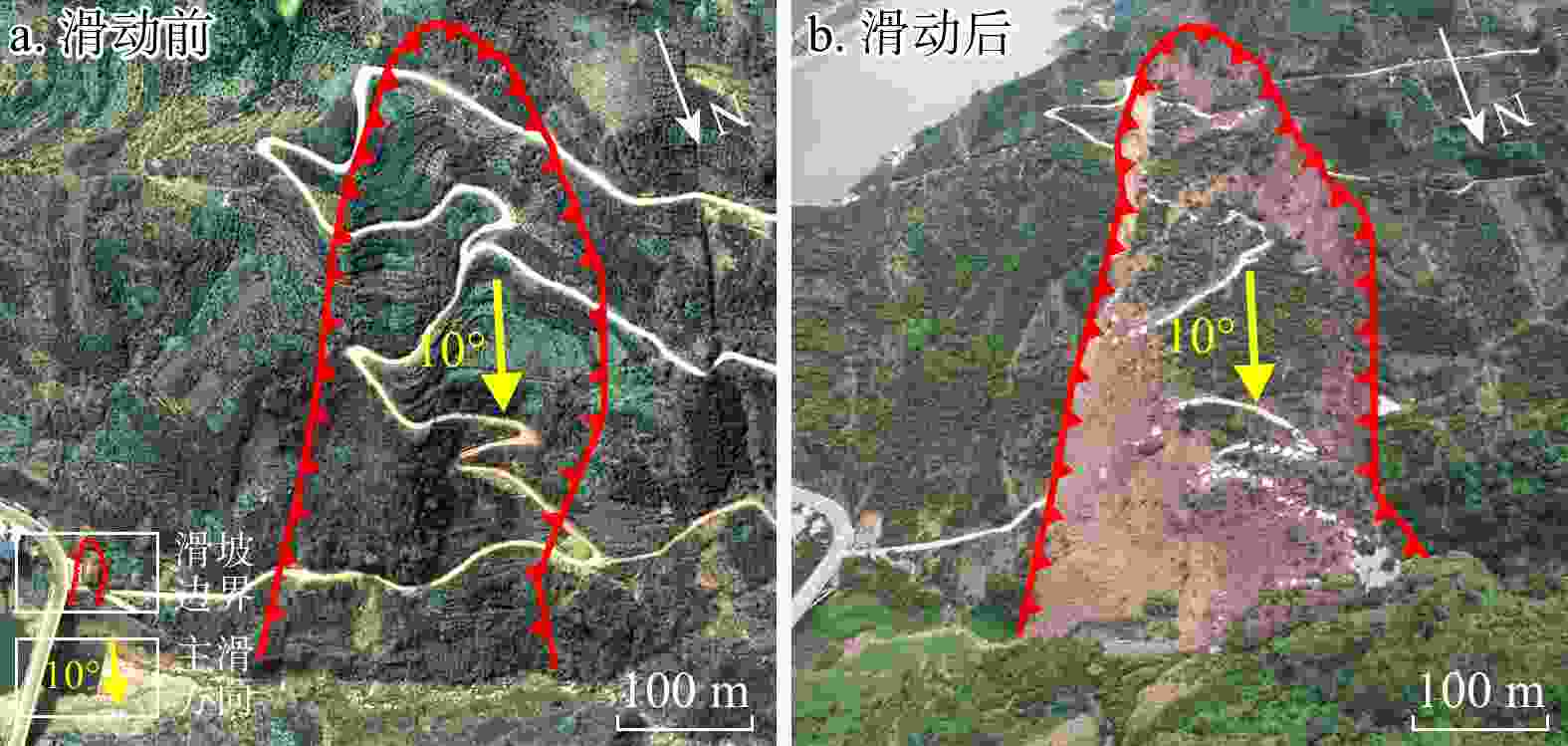
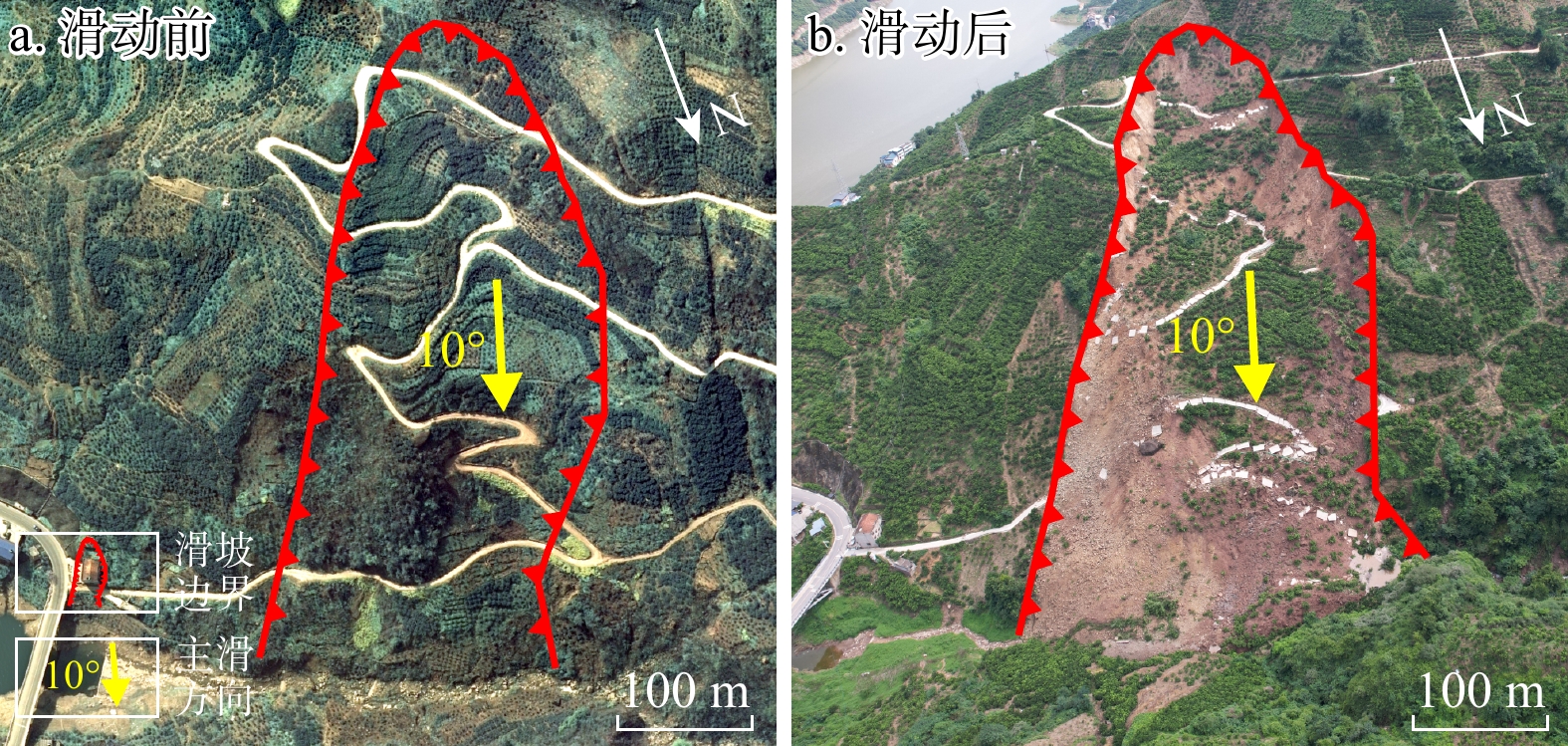
图 1 湾水田滑坡滑动前(a)、后(b)全貌影像对比
Figure 1. Comparison of panoramic images of Wanshuitian landslide before and after slide
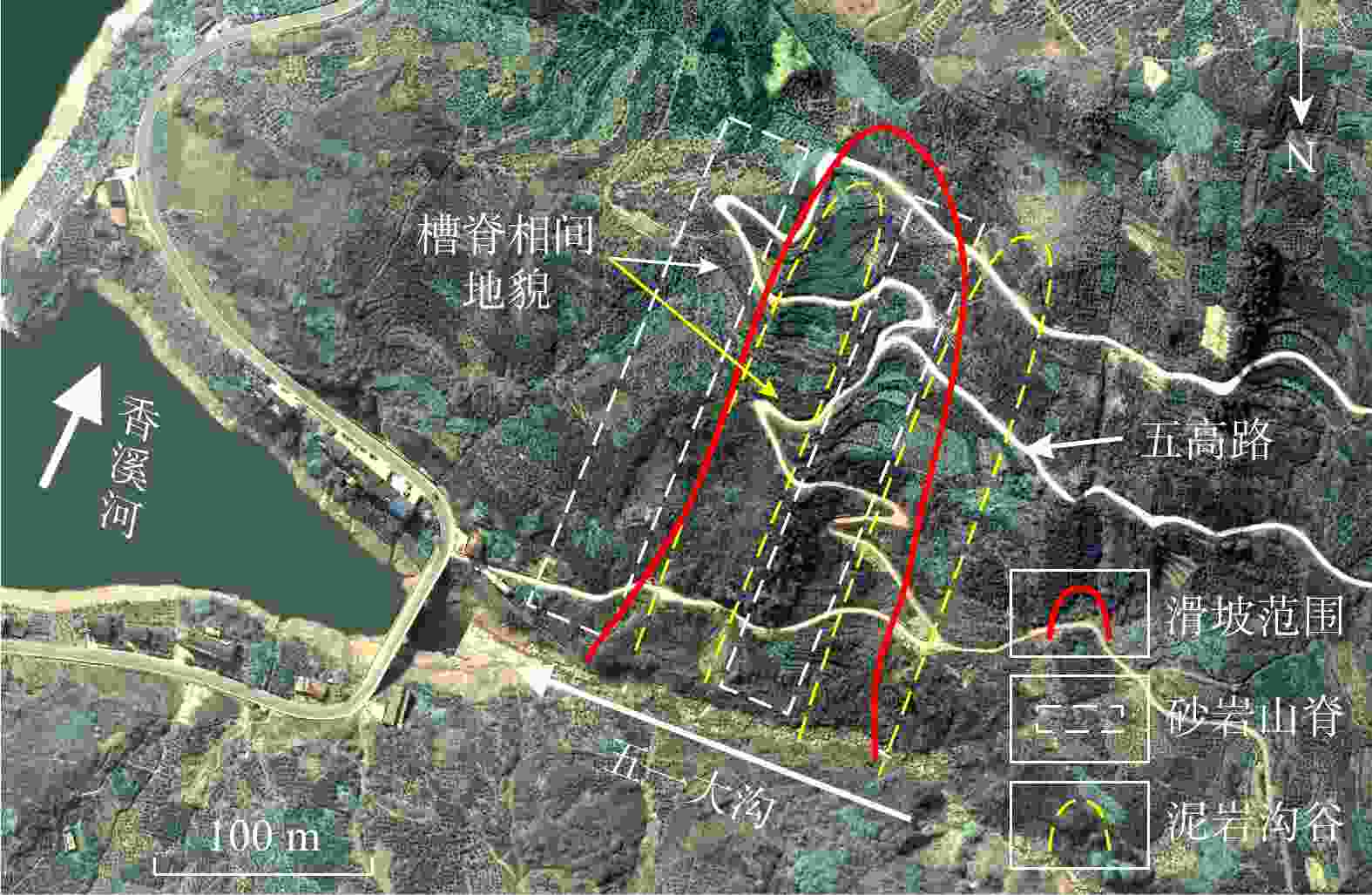
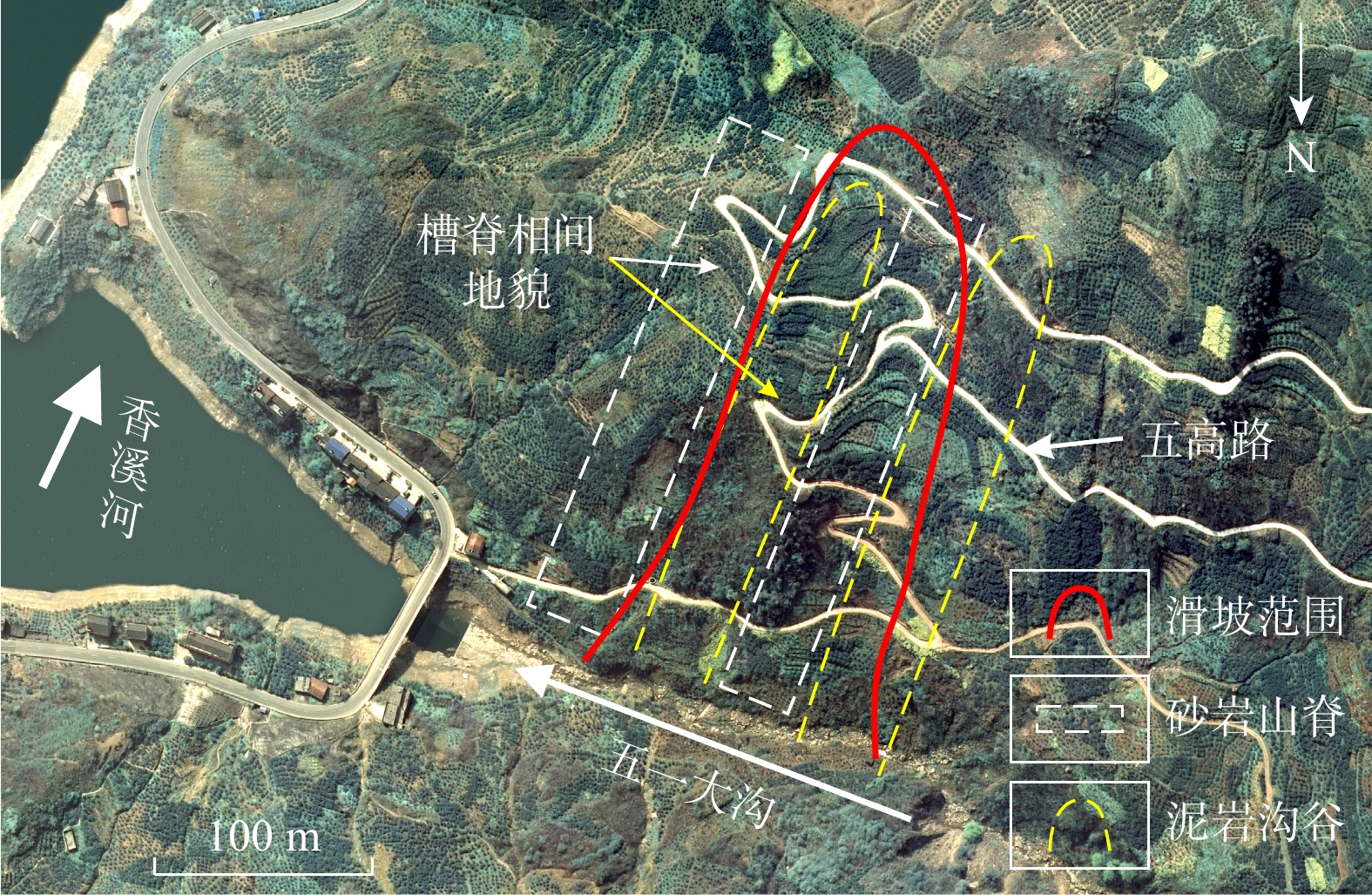
图 3 湾水田滑坡区槽脊相间的地形地貌示意图
Figure 3. Topography and geomorphology of alternating troughs and ridges in Wanshuitian landslide area
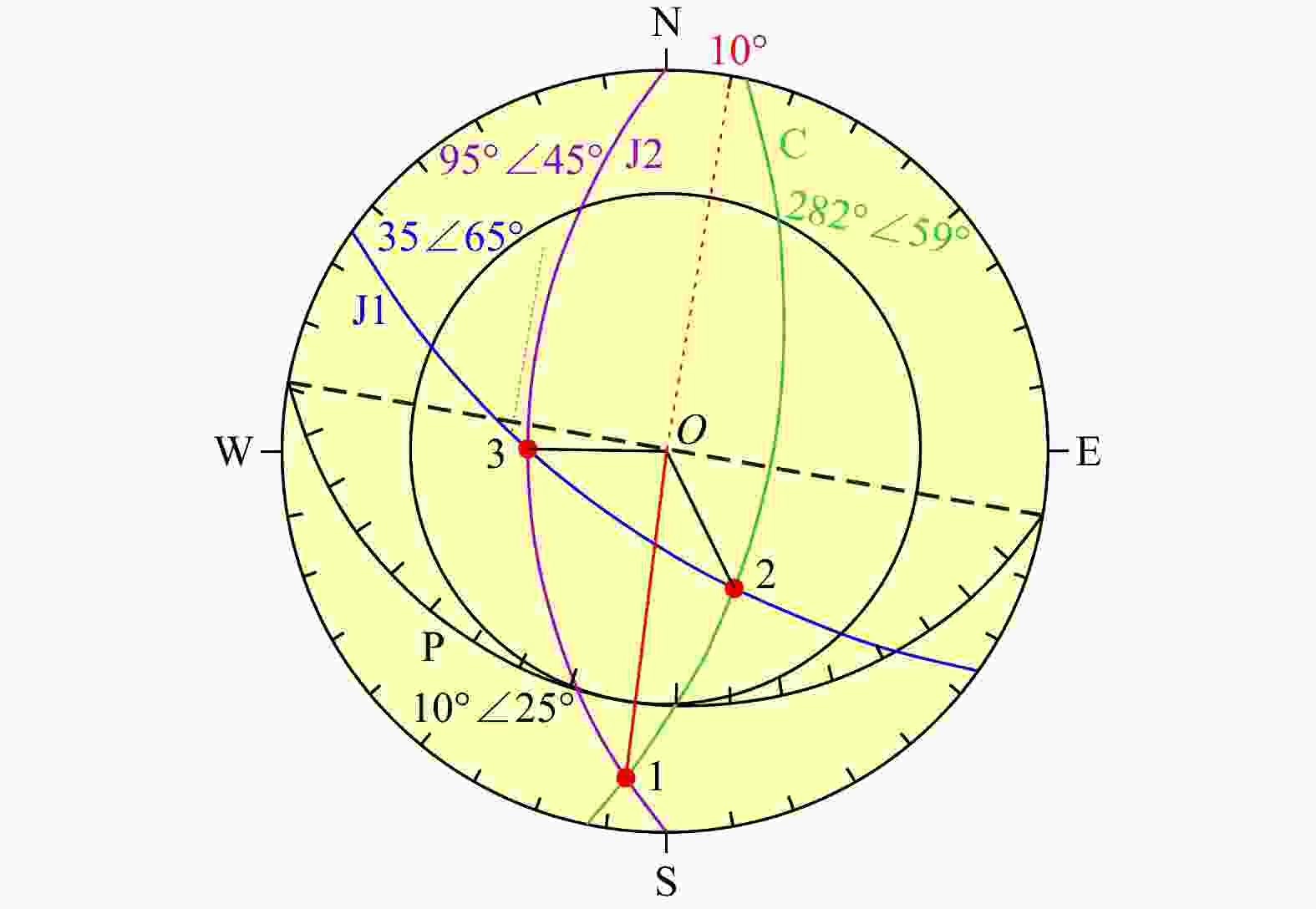
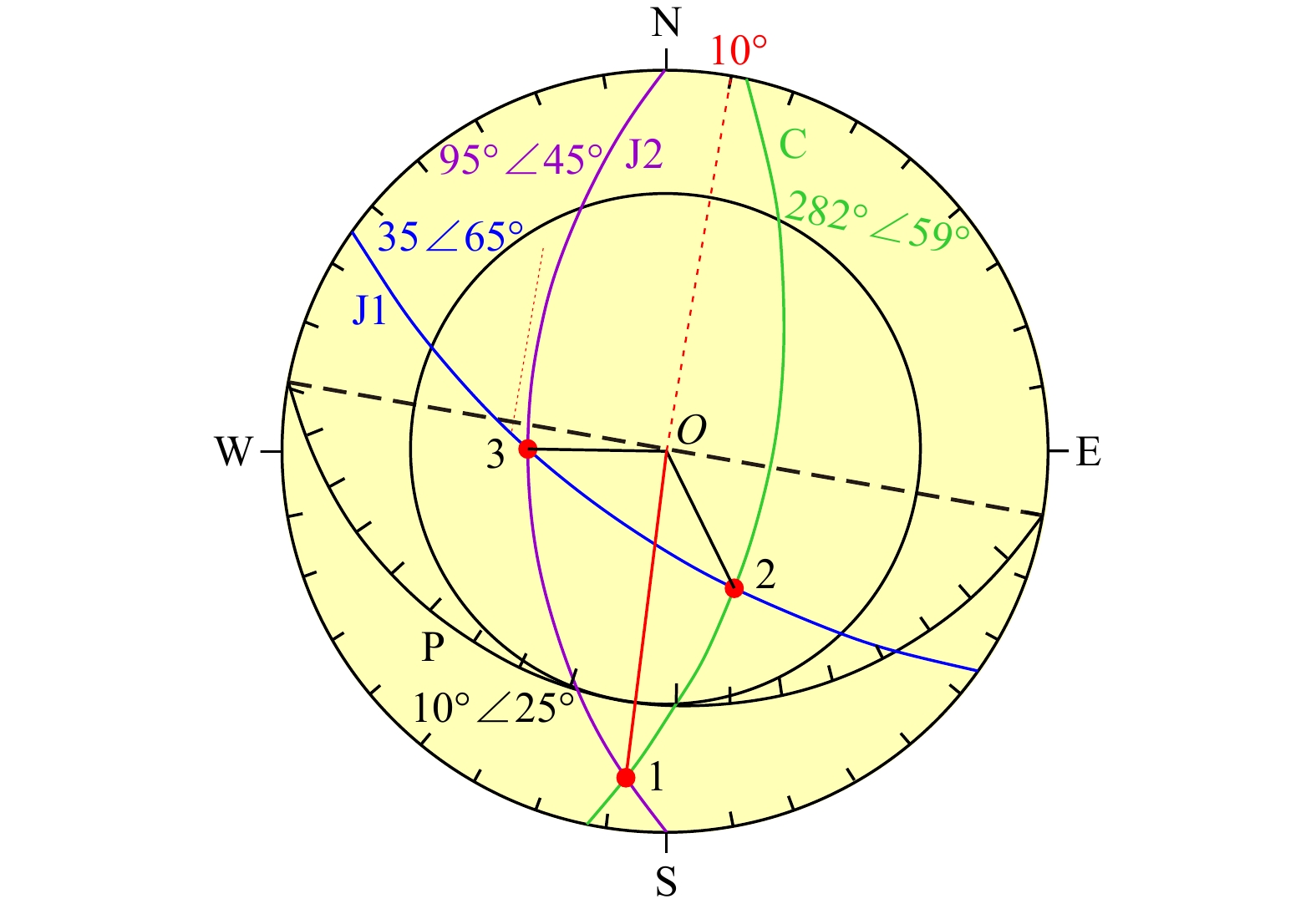
图 4 湾水田滑坡结构面赤平投影图
C. 层面;P. 坡面;J1. 节理面1;J2. 节理面2;1. C-J2结构面;2. C-J1结构面;3. J1-J2结构面
Figure 4. Stereographic projection of structural surface of Wanshuitian landslide
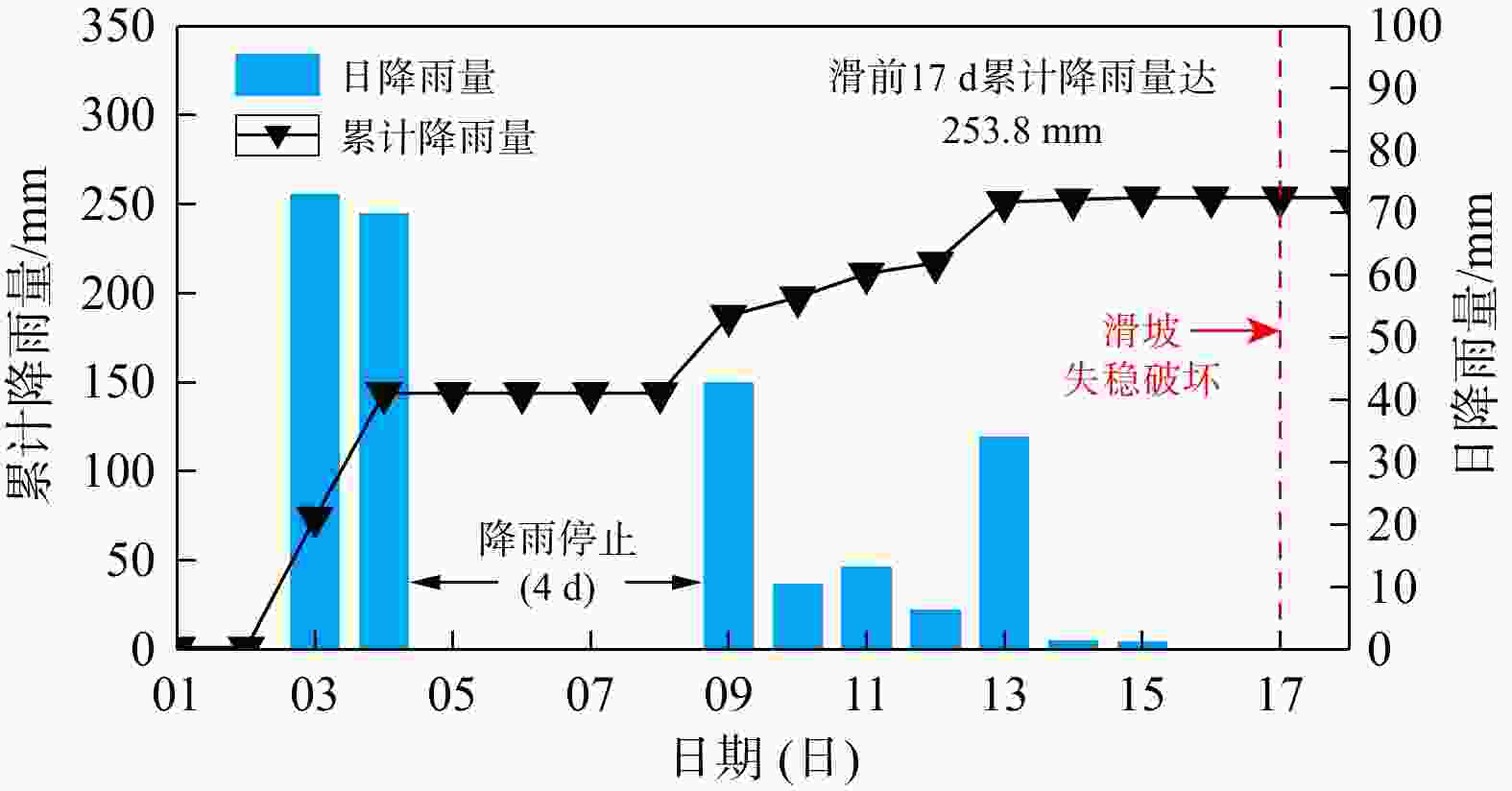
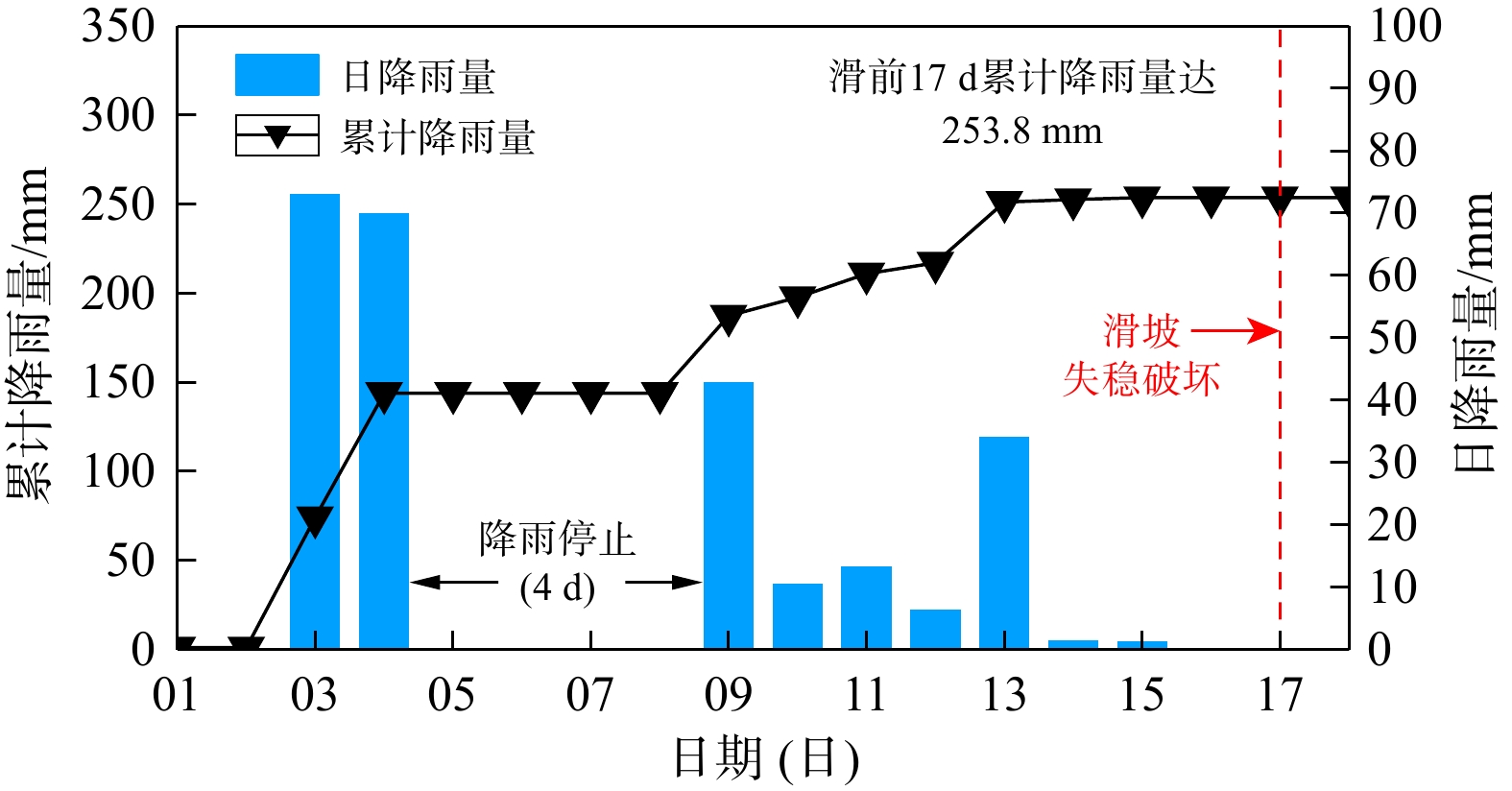
图 5 2024年7月湾水田滑坡失稳前降雨过程
Figure 5. Rainfall process before instability of Wanshuitian landslide at July, 2024
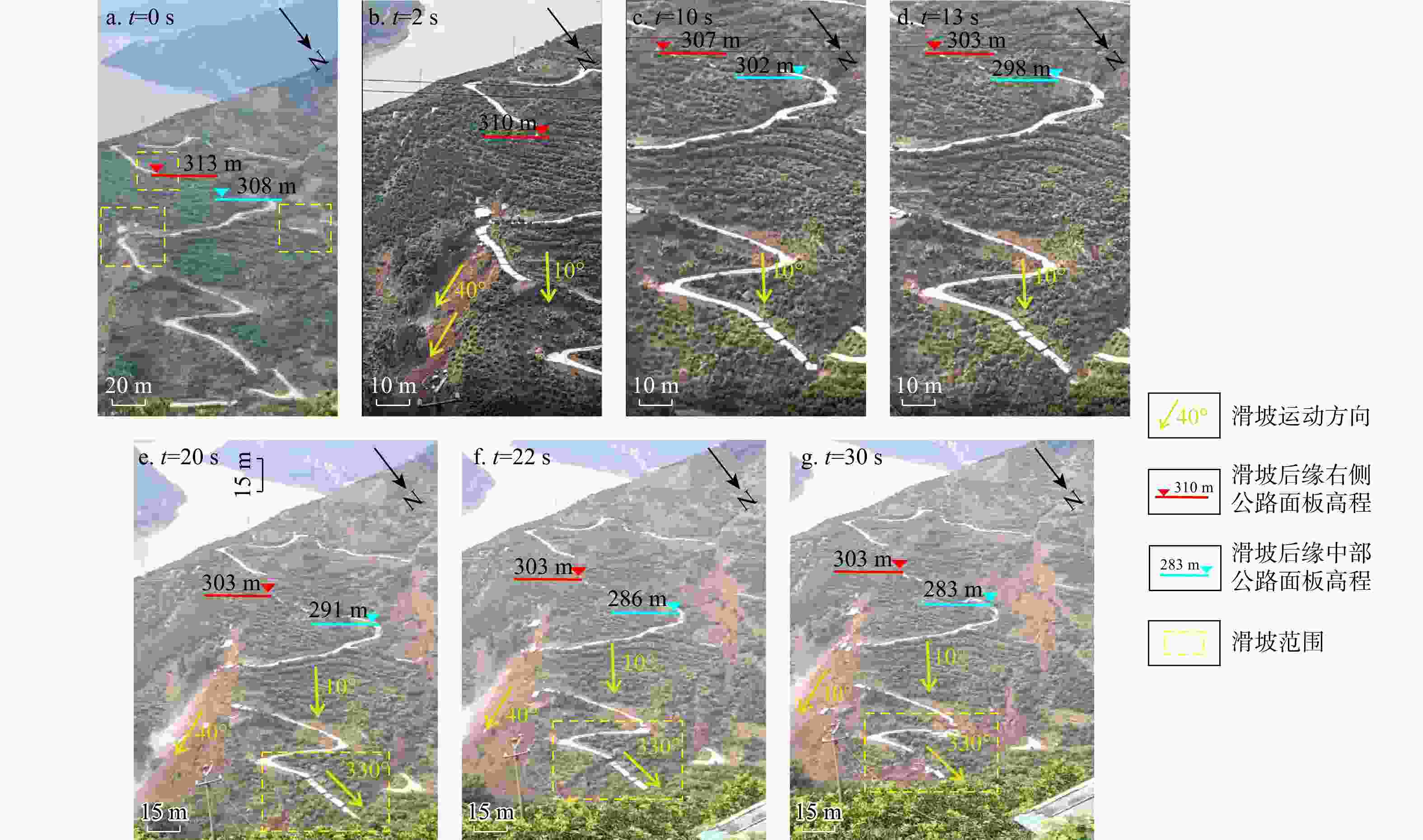
图 6 湾水田滑坡失稳过程录像
Figure 6. Video snapshots during instability process of Wanshuitian landslide
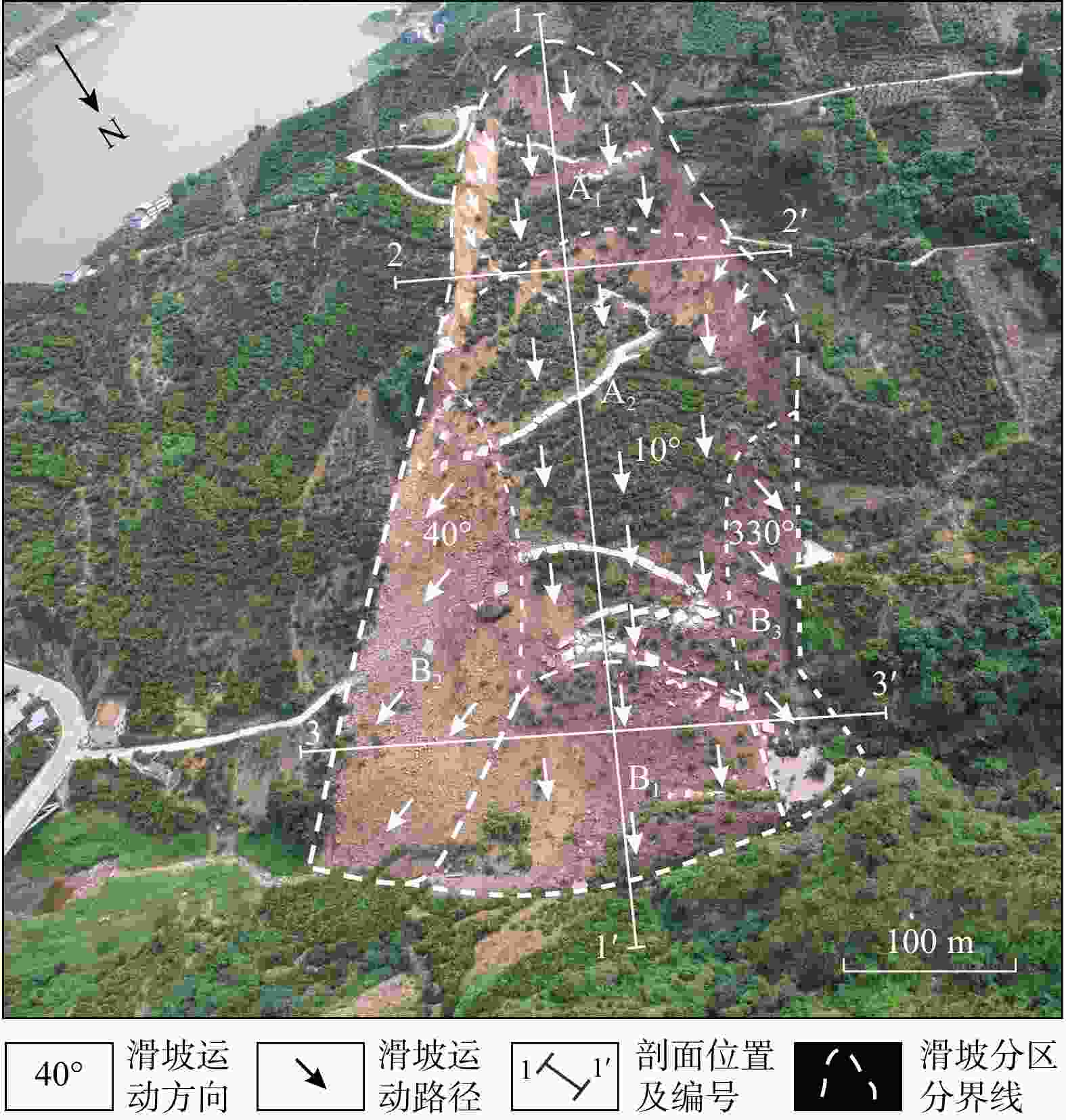
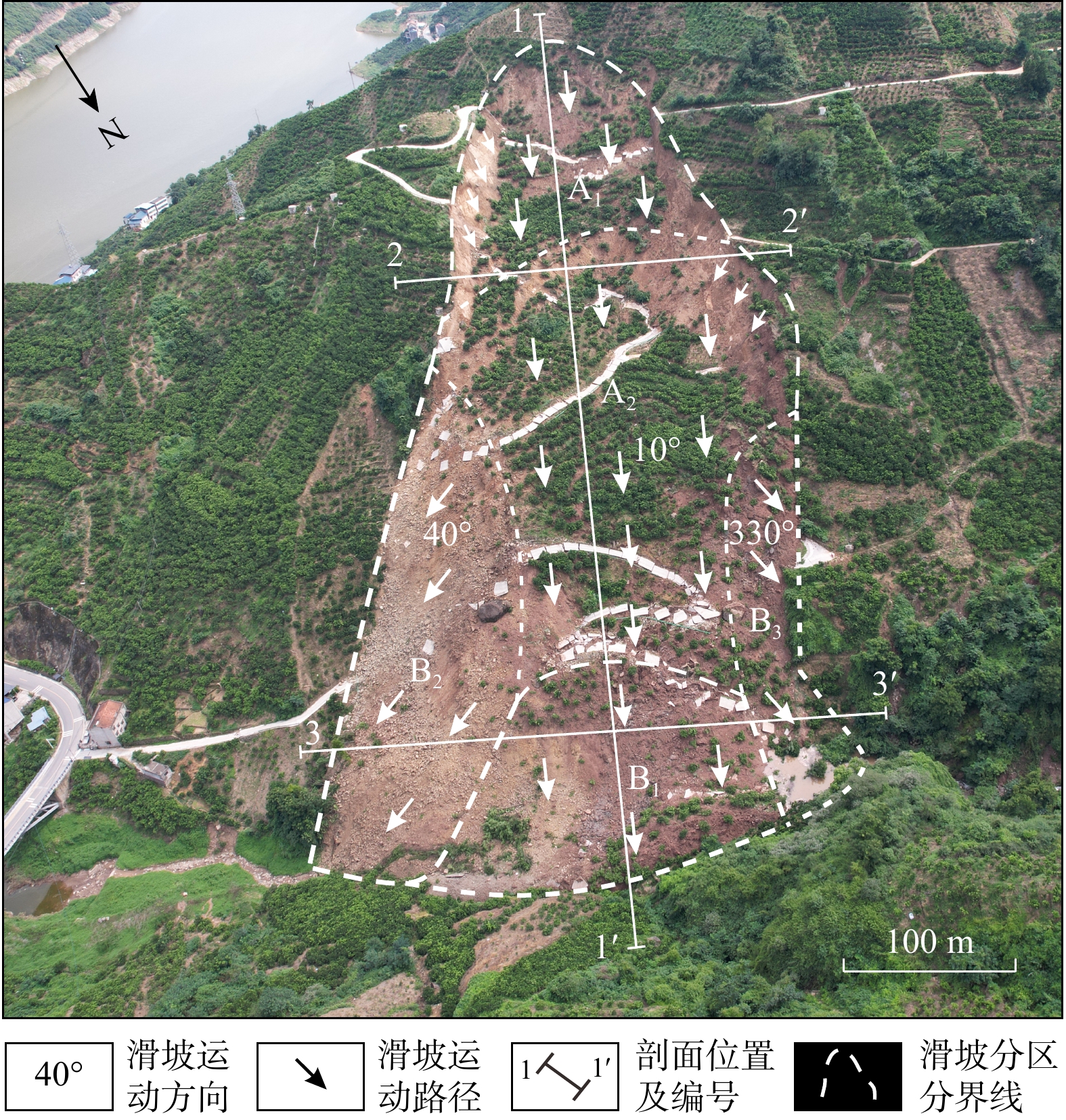
图 7 湾水田滑坡分区特征和运动特征
A1. 滑源区:启滑区;A2. 滑源区:二次解体区;B1. 堆积区:主堆积区;B2. 堆积区:右侧撒落区;B3. 堆积区:左侧撒落区
Figure 7. Zoning and movement characteristics of Wanshuitian landslide
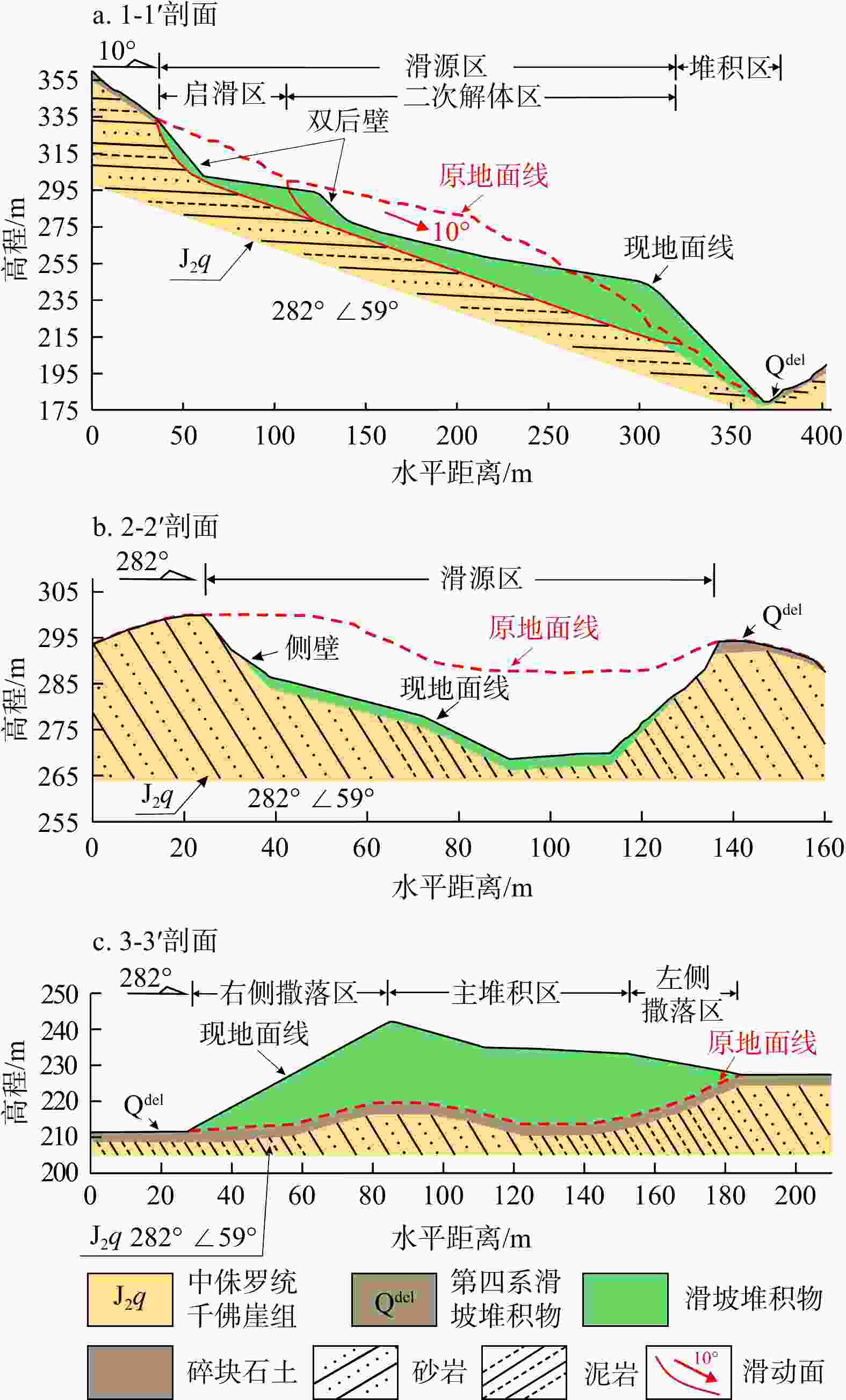
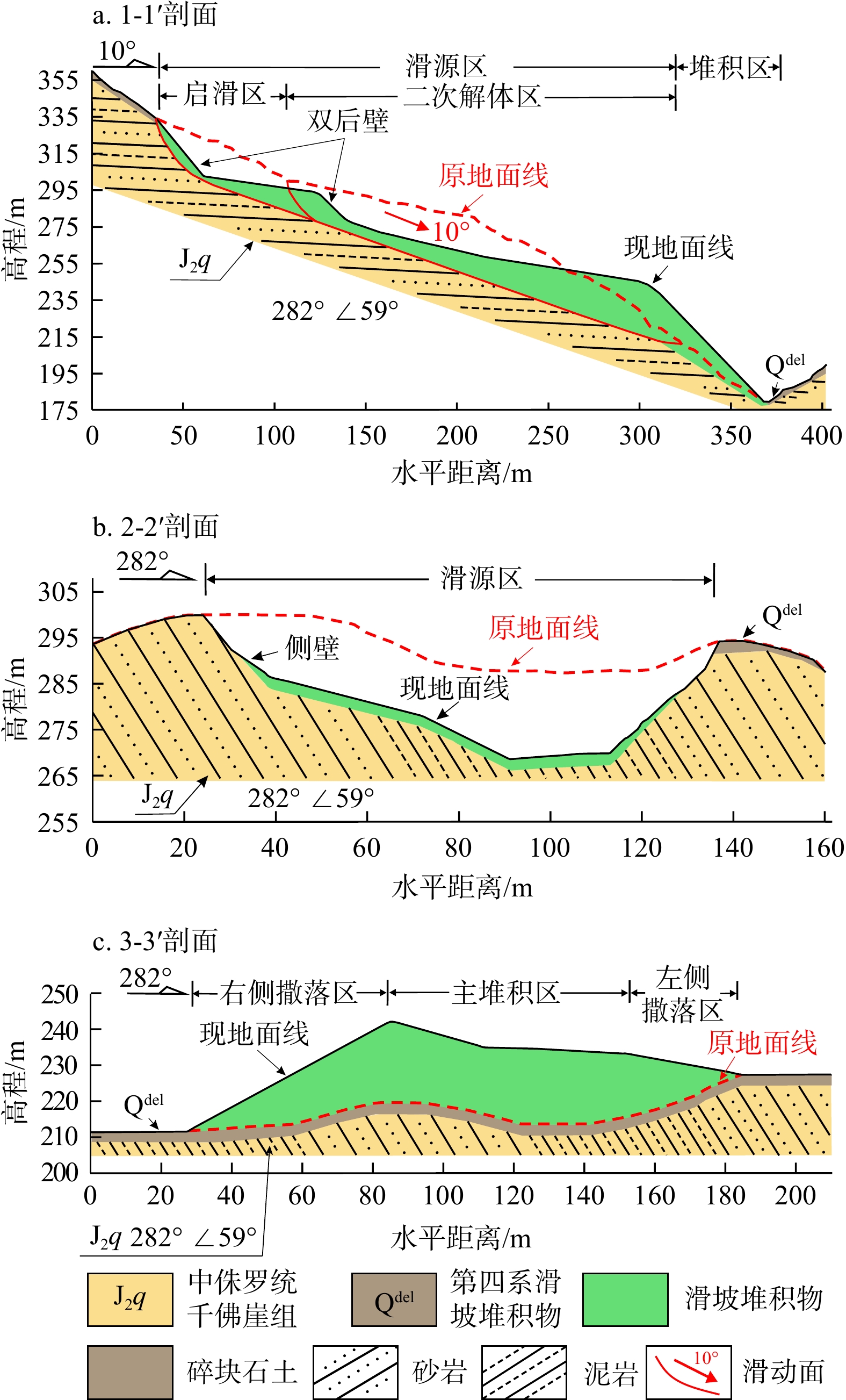
图 8 湾水田滑坡工程地质剖面图(剖面位置见图7)
Figure 8. Engineering geological profiles of Wanshuitian landslide
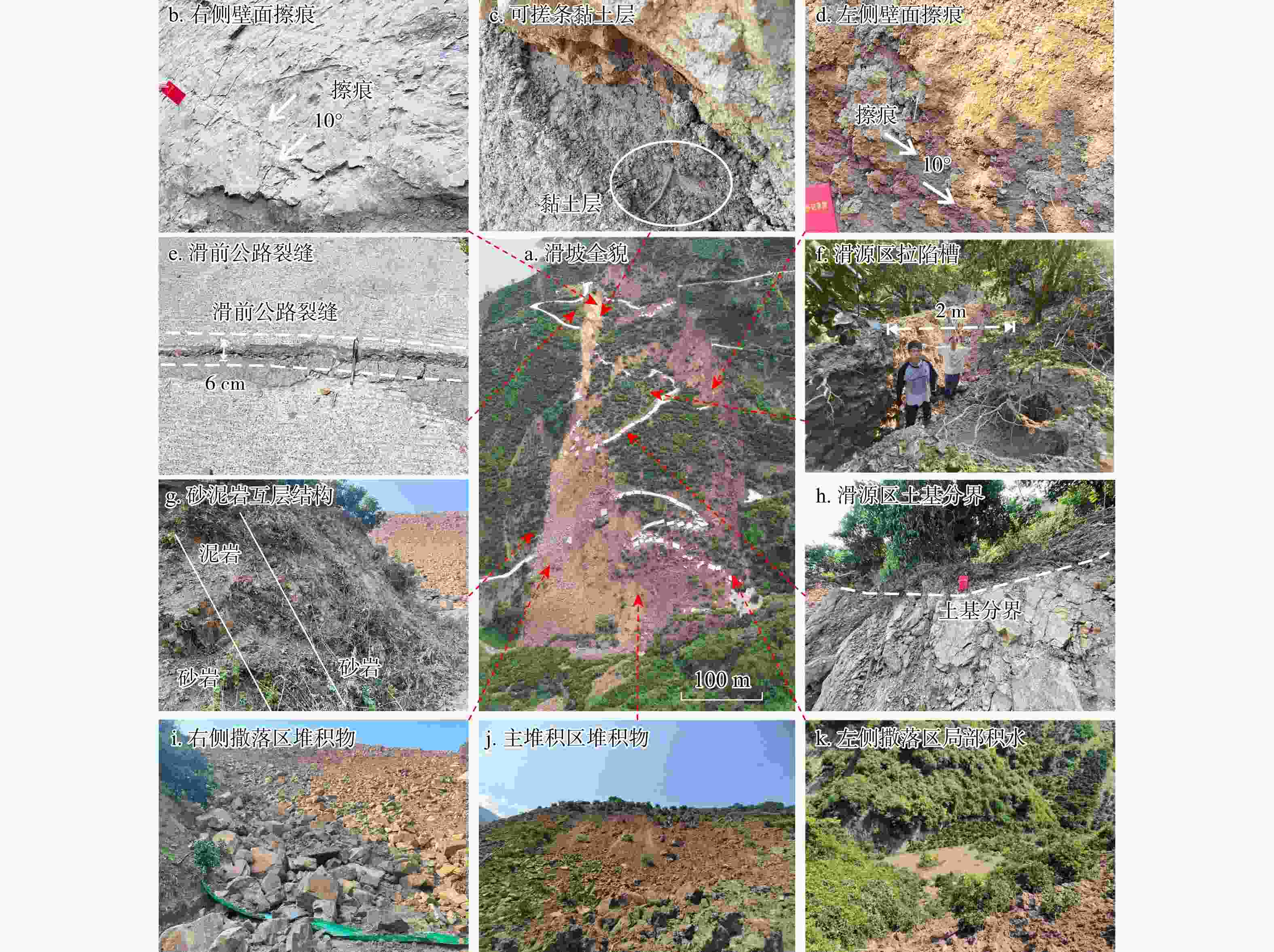
图 9 湾水田滑坡宏观变形特征
Figure 9. Macroscopic deformation characteristics of Wanshuitian landslide
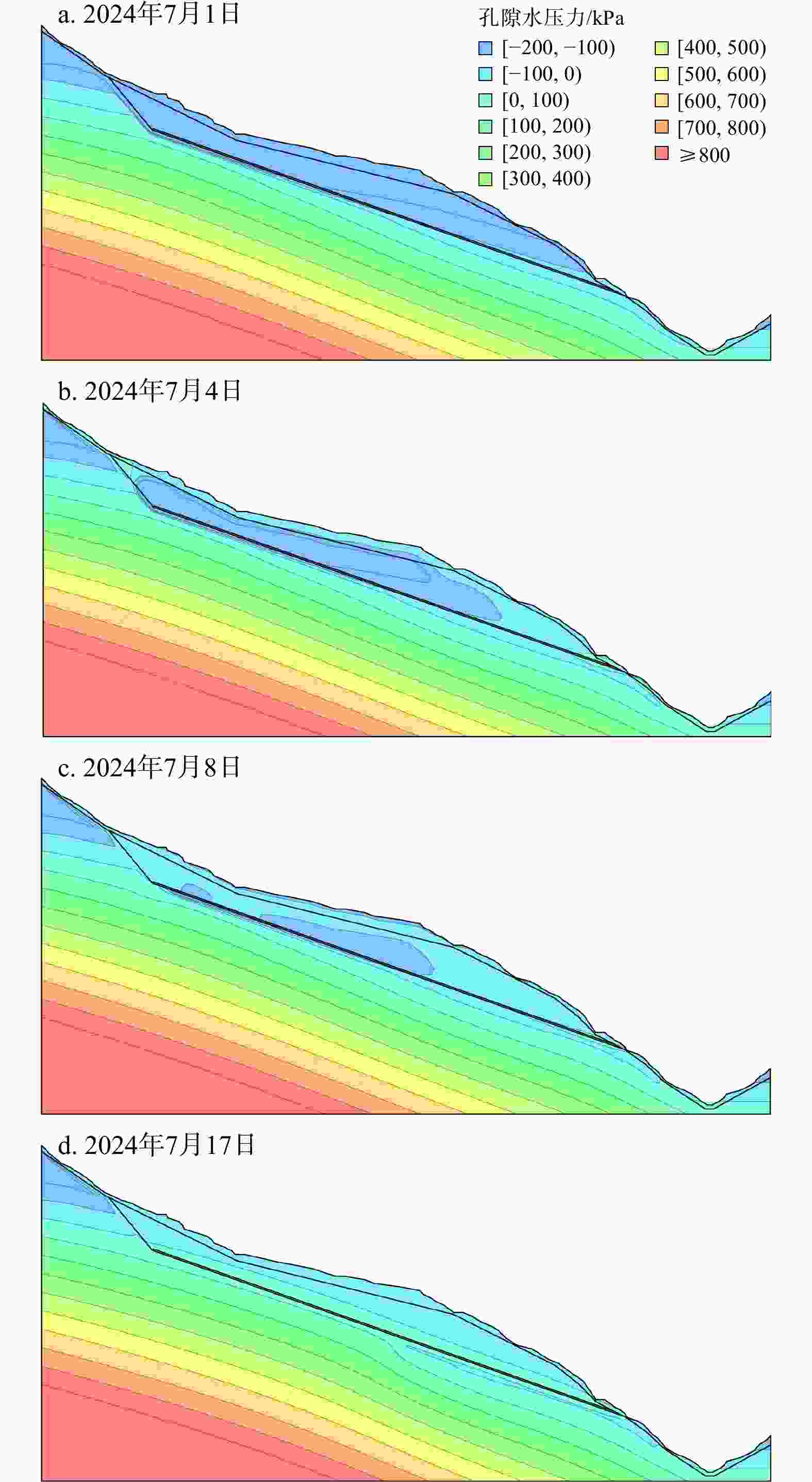
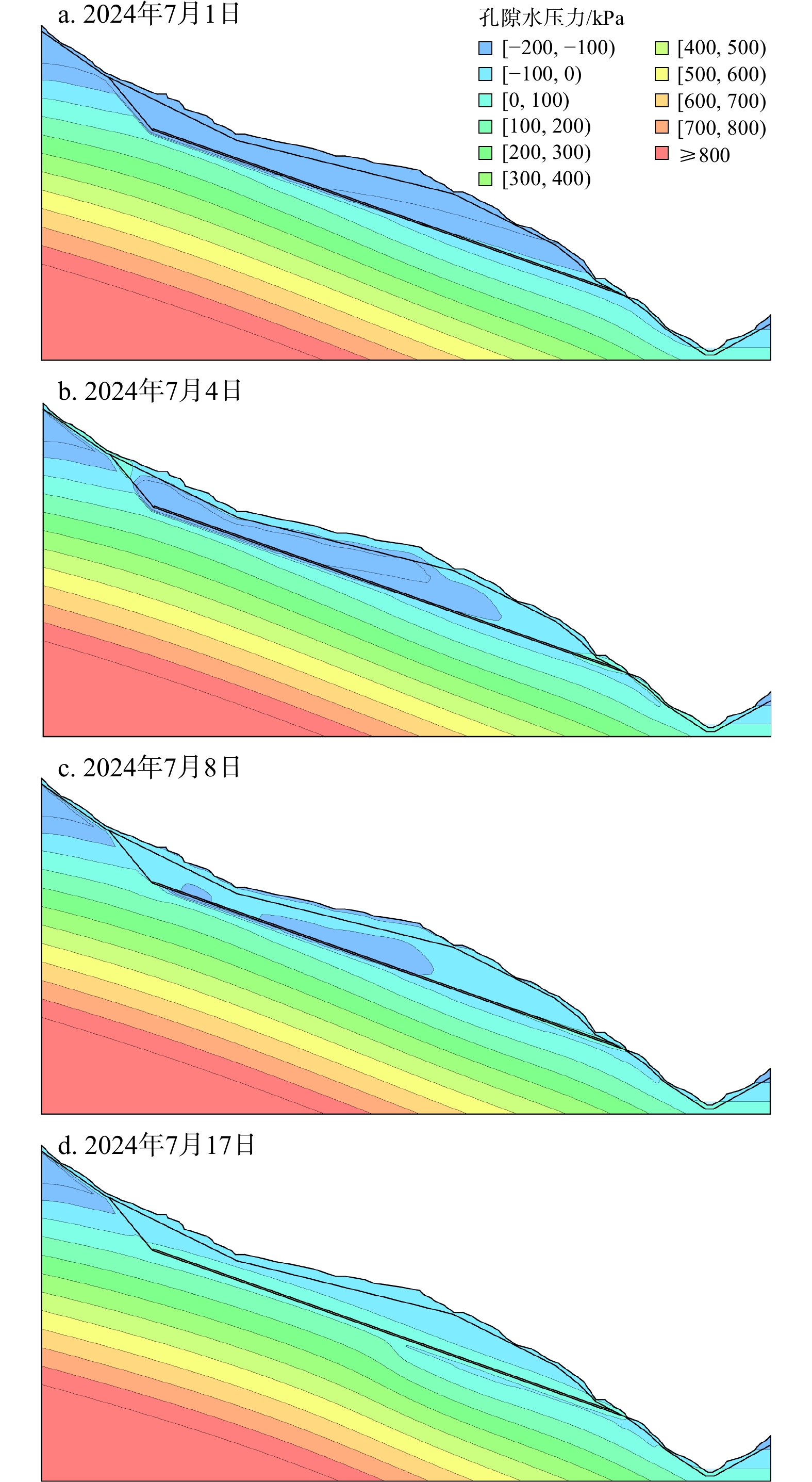
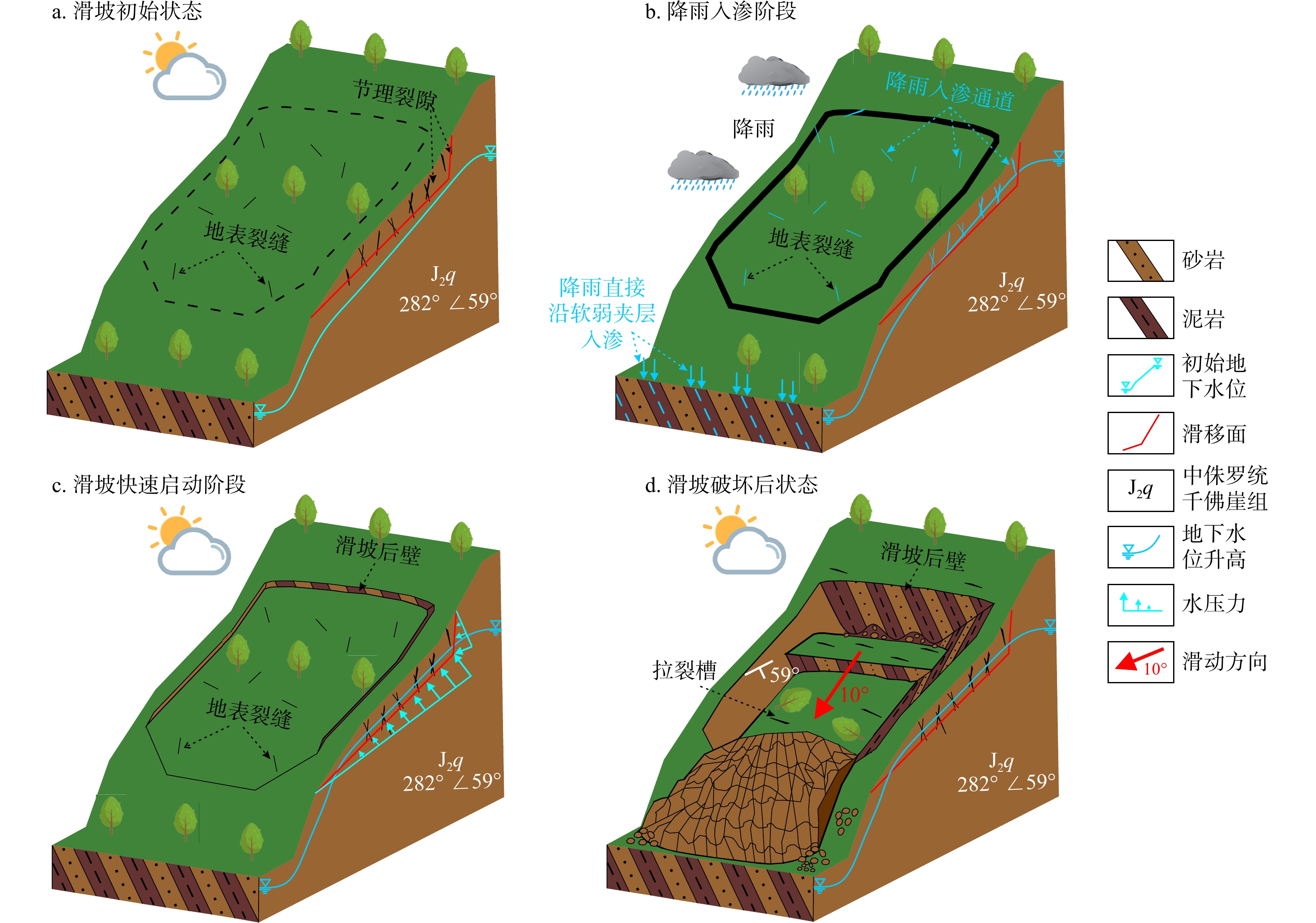
图 11 湾水田滑坡孔隙水压力分布变化过程
Figure 11. Distribution evolution of pore water pressure in Wanshuitian landslide
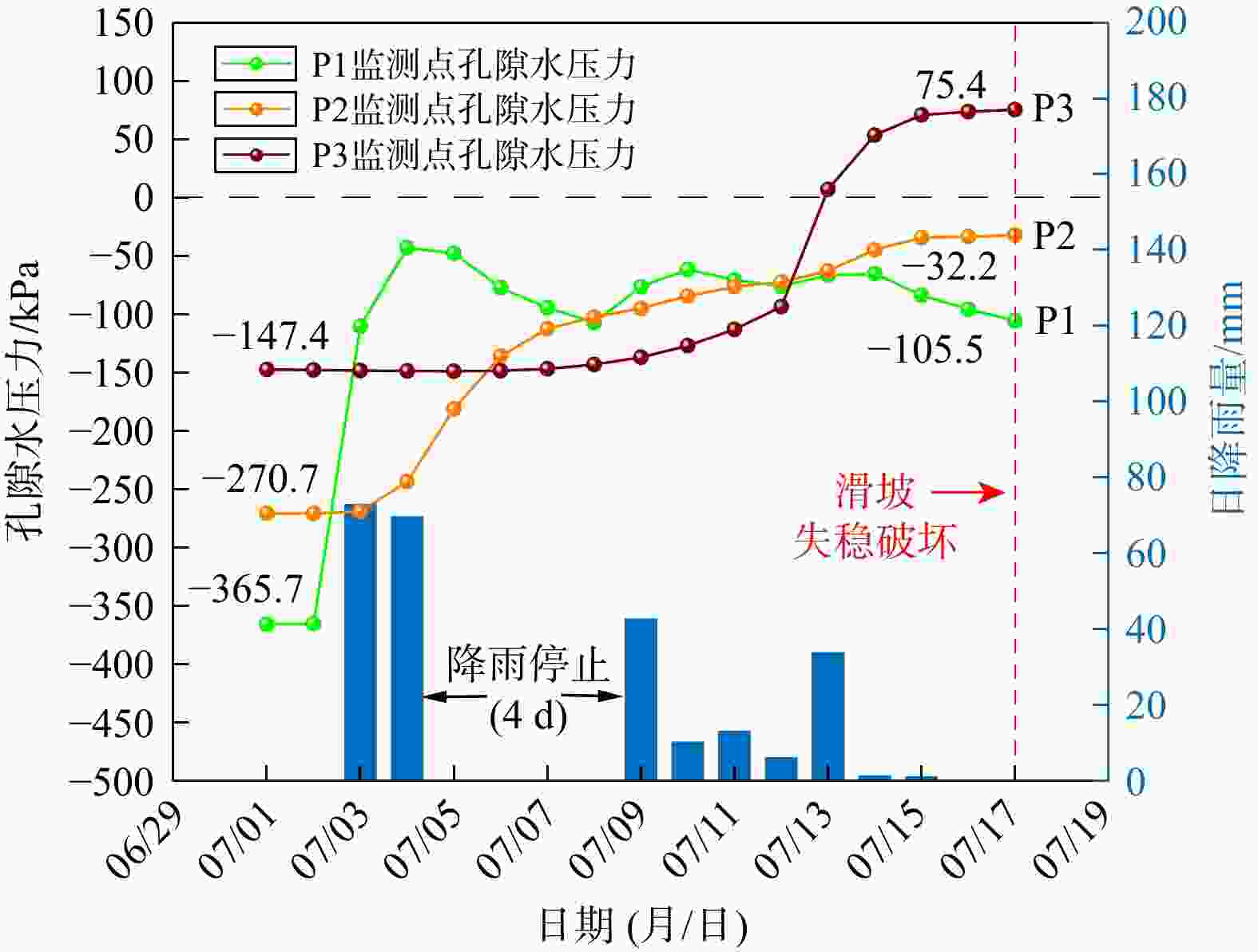
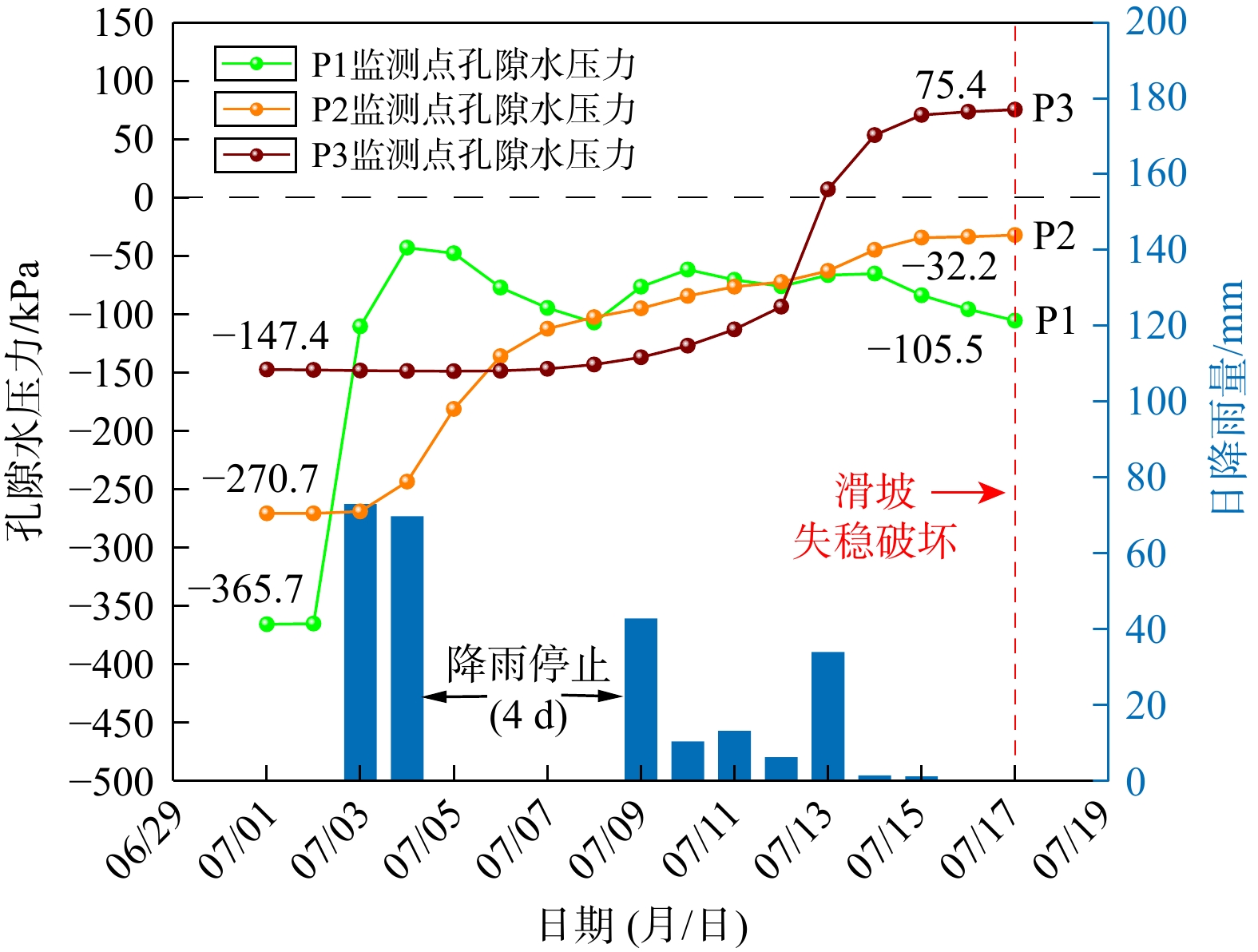
图 12 2024年湾水田滑坡P1~P3号监测点(由浅至深)孔隙水压力变化曲线
Figure 12. Pore water pressure variation curves for monitoring points P1-P3 (from shallow to deep) of Wanshuitian landslide at 2024
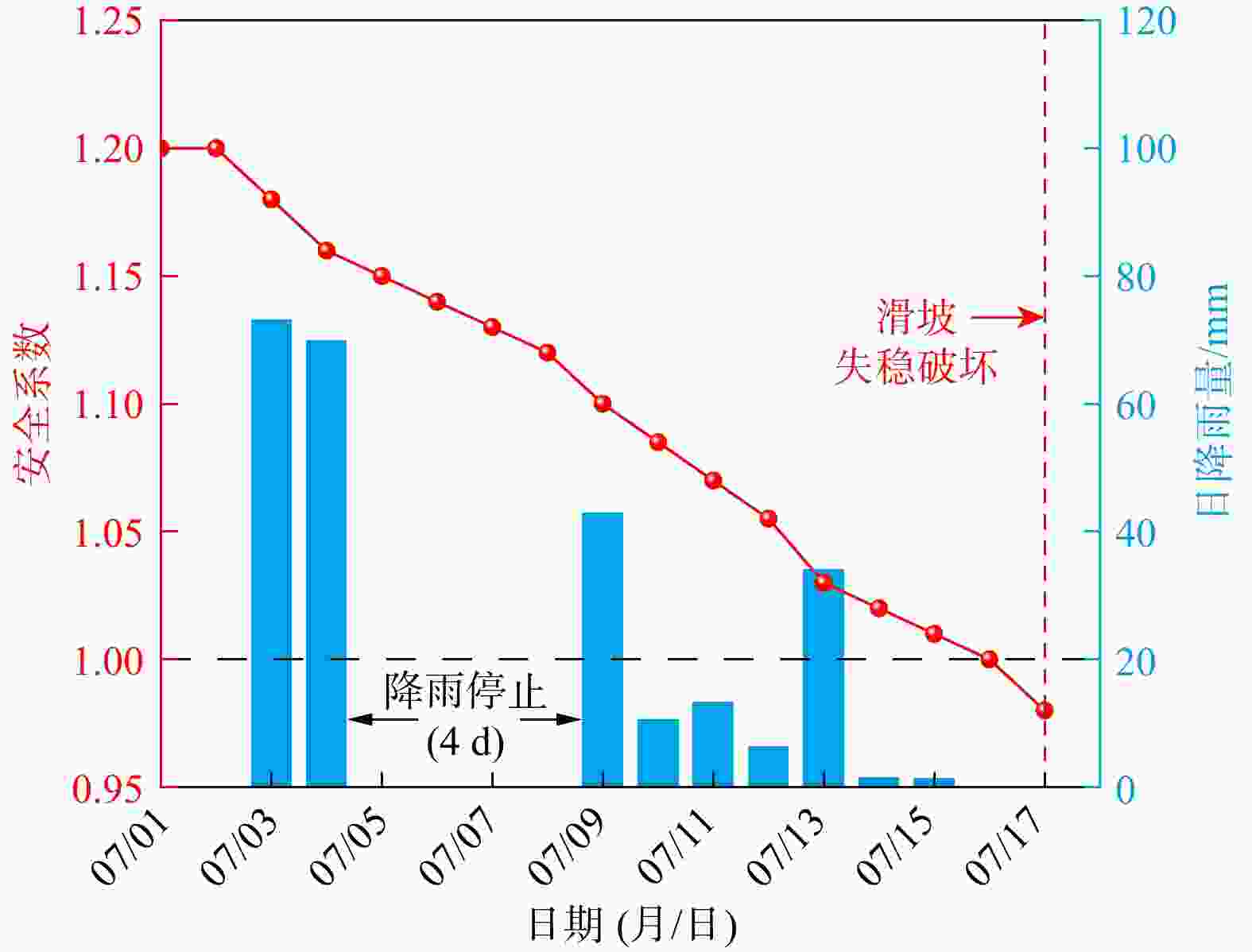
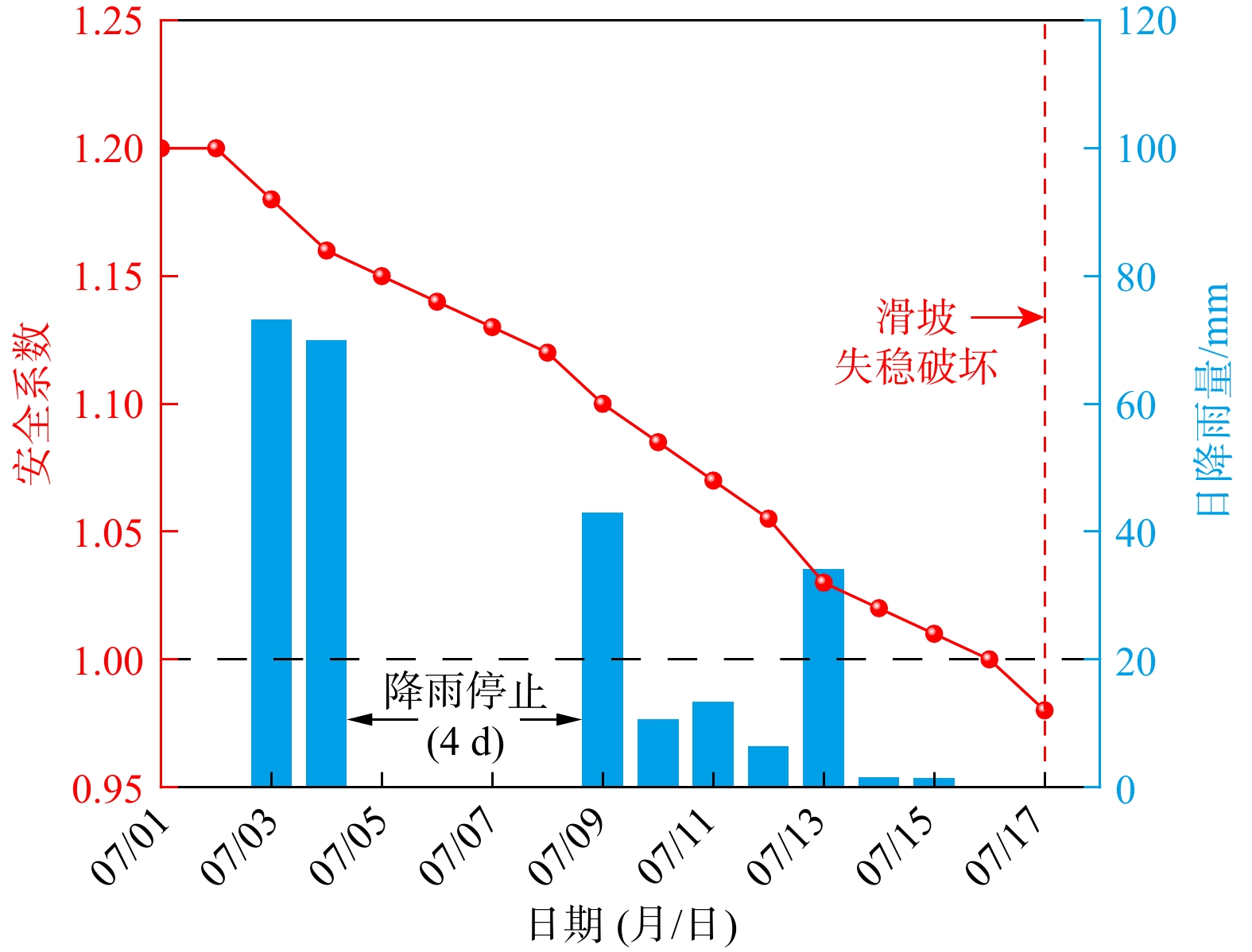
图 13 2024年湾水田滑坡滑前17 d滑坡安全系数变化
Figure 13. Variation of landslide safety coefficient over 17 days before landslide of Wanshuitian landslid at 2024
表 1 湾水田滑坡物理力学参数
Table 1. Physical and mechanical parameters of Wanshuitian landslide
区域 重度γ/
(kN·m−3)黏聚力
C/kPa内摩擦
角φ/(°)饱和体积
含水率wB/%渗透系数
K/(m·d−1)泊松
比μ弹性模
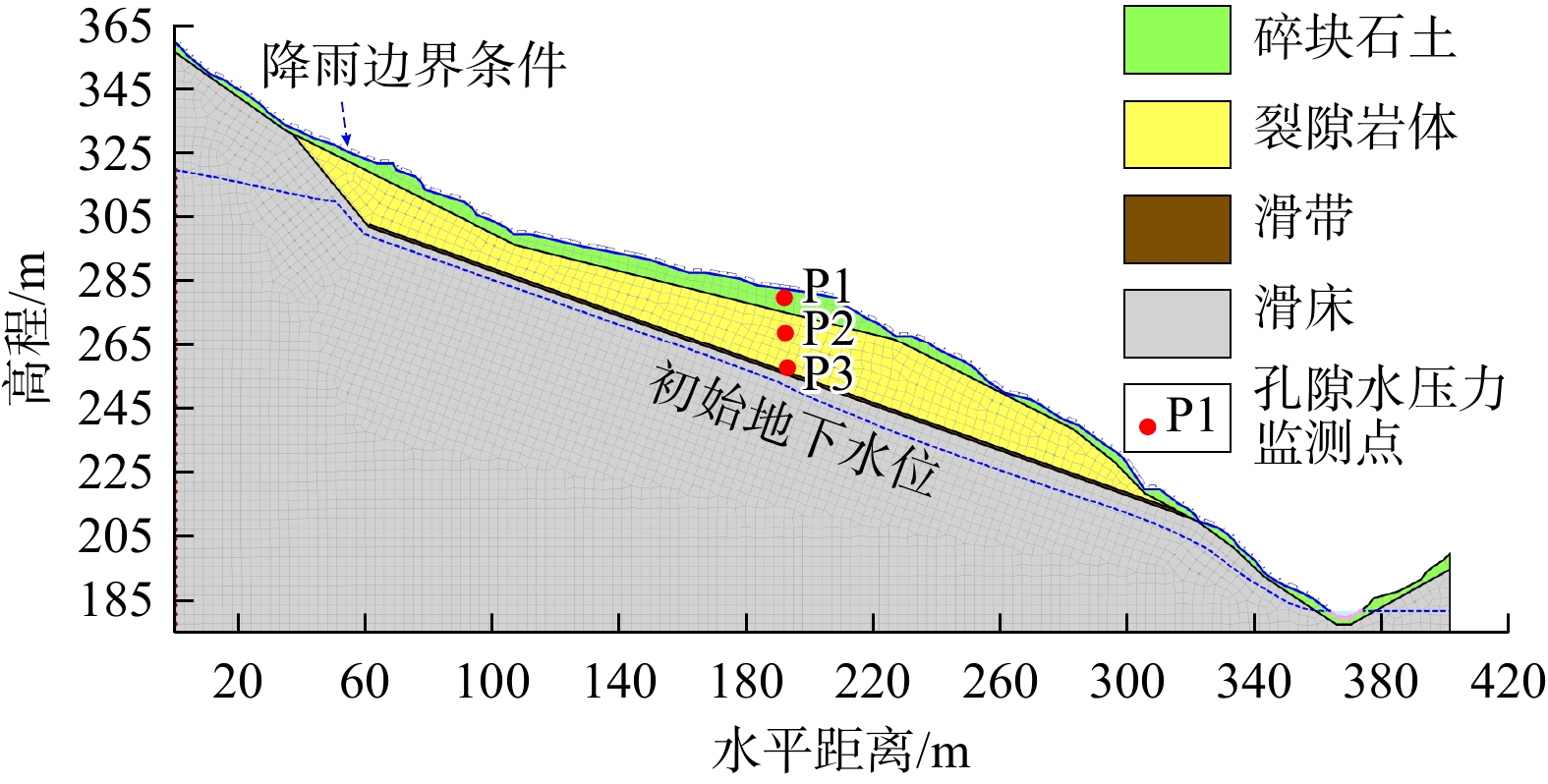
量E/MPa碎块石土 20.6 33 32 27.6 3.7 0.35 17.8 裂隙岩体 22 120 35 22.3 2.9 0.3 20 滑带 21.4 19 21 16 0.05 0.29 12.9 滑床 24.3 1080 38 1 0.001 0.16 1180  下载: 导出CSV
-
[1] 许强. 对滑坡监测预警相关问题的认识与思考[J]. 工程地质学报, 2020, 28(2): 360-374. doi: 10.13544/j.cnki.jeg.2020-025XU Q. Understanding the landslide monitoring and early warning: Consideration to practical issues[J]. Journal of Engineering Geology, 2020, 28(2): 360-374. (in Chinese with English abstract) doi: 10.13544/j.cnki.jeg.2020-025 [2] 谢云轩, 汪洋, 王梦瑶, 等. 基于物理模型试验的库岸滑坡水阻力系数研究[J]. 地质科技通报, 2025, 44(2): 59-66.XIE Y X, WANG Y, WANG M Y, et al. Water resistance coefficient of bank slope landslides via physical model experiments[J]. Bulletin of Geological Science and Technology, 2025, 44(2): 59-66. (in Chinese with English abstract) [3] 饶炜博, 陈刚, 邹崇尧, 等. 基于历史样本增强的滑坡智能识别改进算法[J]. 地质科技通报, 2025, 44(4): 48-61. doi: 10.19509/j.cnki.dzkq.tb20240572RAO W B, CHEN G, ZOU C Y, et al. An improved algorithm for intelligent landslide identification based on historical sample enhancement[J]. Bulletin of Geological Science and Technology, 2025, 44(4): 48-61. (in Chinese with English abstract) doi: 10.19509/j.cnki.dzkq.tb20240572 [4] 杨锟, 叶永, 谢旋. 基于离散元模型的聚合型滑坡碎屑流聚合角度影响研究[J]. 地质科技通报, 2025, 44(2): 116-129. doi: 10.19509/j.cnki.dzkq.tb20230564YANG K, YE Y, XIE X. Influence of aggregation angle of aggregated landslide debris flows based on discrete element model[J]. Bulletin of Geological Science and Technology, 2025, 44(2): 116-129. (in Chinese with English abstract) doi: 10.19509/j.cnki.dzkq.tb20230564 [5] 邓茂林, 周剑, 易庆林, 等. 三峡库区靠椅状土质滑坡变形特征及机制分析[J]. 岩土工程学报, 2020, 42(7): 1296-1303.DENG M L, ZHOU J, YI Q L, et al. Characteristics and mechanism of deformation of chair-shaped soil landslides in Three Gorges Reservoir area[J]. Chinese Journal of Geotechnical Engineering, 2020, 42(7): 1296-1303. (in Chinese with English abstract) [6] 邓茂林, 易庆林, 韩蓓, 等. 长江三峡库区木鱼包滑坡地表变形规律分析[J]. 岩土力学, 2019, 40(8): 3145-3152. doi: 10.16285/j.rsm.2018.0809DENG M L, YI Q L, HAN B, et al. Analysis of surface deformation law of Muyubao landslide in Three Gorges Reservoir area[J]. Rock and Soil Mechanics, 2019, 40(8): 3145-3152. (in Chinese with English abstract) doi: 10.16285/j.rsm.2018.0809 [7] 汪发武, 宋琨. 库水位涨落条件下不同结构边坡的变形破坏机制分析: 以千将坪滑坡和树坪滑坡为例[J]. 工程地质学报, 2021, 29(3): 575-582. doi: 10.13544/j.cnki.jeg.2021-0197WANG F W, SONG K. Analysis of deformation and failure mechanism of bank slopes with different structures under reservoir water level fluctuation: Taking Qianjiangping landslide and Shuping landslide as examples[J]. Journal of Engineering Geology, 2021, 29(3): 575-582. (in Chinese with English abstract) doi: 10.13544/j.cnki.jeg.2021-0197 [8] JIAN W X, XU Q, YANG H F, et al. Mechanism and failure process of Qianjiangping landslide in the Three Gorges Reservoir, China[J]. Environmental Earth Sciences, 2014, 72(8): 2999-3013. doi: 10.1007/s12665-014-3205-x [9] YIN Y P, HUANG B L, CHEN X T, et al. Numerical analysis on wave generated by the Qianjiangping landslide in Three Gorges Reservoir, China[J]. Landslides, 2015, 12(2): 355-364. doi: 10.1007/s10346-015-0564-7 [10] 赵能浩, 易庆林. 泥儿湾滑坡失稳机制及破坏后运动规律研究[J]. 防灾减灾工程学报, 2016, 36(6): 984-993.ZHAO N H, YI Q L. The research on instability mechanism and motion law after the destruction of Nierwan landslide[J]. Journal of Disaster Prevention and Mitigation Engineering, 2016, 36(6): 984-993. (in Chinese with English abstract) [11] 周剑, 邓茂林, 李卓骏, 等. 三峡库区杉树槽滑坡成因及视向滑动机制分析[J]. 防灾减灾工程学报, 2020, 40(6): 860-866. doi: 10.13409/j.cnki.jdpme.2020.06.003ZHOU J, DENG M L, LI Z J, et al. Analysis on the formation and apparent-dip lateral sliding mechanism of Shanshucao landslide in the Three Gorges Reservoir area[J]. Journal of Disaster Prevention and Mitigation Engineering, 2020, 40(6): 860-866. (in Chinese with English abstract) doi: 10.13409/j.cnki.jdpme.2020.06.003 [12] 王鸣, 易武. 三峡库区杉树槽滑坡地质特征与成因机制分析[J]. 三峡大学学报(自然科学版), 2015, 37(5): 44-47. doi: 10.13393/j.cnki.issn.1672-948X.2015.05.011WANG M, YI W. Geological characteristics and formation mechanism of Shanshucao landslide in Three Gorges Reservoir area[J]. Journal of China Three Gorges University (Natural Sciences), 2015, 37(5): 44-47. (in Chinese with English abstract) doi: 10.13393/j.cnki.issn.1672-948X.2015.05.011 [13] XU G L, LI W N, YU Z, et al. The 2 September 2014 Shanshucao landslide, Three Gorges Reservoir, China[J]. Landslides, 2015, 12(6): 1169-1178. [14] 朱宇航, 黄海峰, 殷坤龙, 等. 基于滑坡破坏模式分析的易发性评价: 以三峡库区首段泄滩河左岸为例[J]. 中国地质灾害与防治学报, 2023, 34(2): 156-166. doi: 10.16031/j.cnki.issn.1003-8035.202112035ZHU Y H, HUANG H F, YIN K L, et al. Evaluation of landslide susceptibility based on landslide failure mode analysis: A case study of the left bank of Xietan River in the first section of Three Gorges Reservoir[J]. The Chinese Journal of Geological Hazard and Control, 2023, 34(2): 156-166. (in Chinese with English abstract) doi: 10.16031/j.cnki.issn.1003-8035.202112035 [15] LI B, TANG H M, GONG W P, et al. Numerical study of the runout behavior of the Kamenziwan landslide in the Three Gorges Reservoir region, China[J]. Landslides, 2022, 19(4): 963-976. doi: 10.1007/s10346-021-01804-4 [16] 胡新丽, 孙淼军, 唐辉明, 等. 三峡库区马家沟滑坡滑体粗粒土蠕变试验研究[J]. 岩土力学, 2014, 35(11): 3163-3169.HU X L, SUN M J, TANG H M, et al. Creep tests of gravel-soil of Majiagou landslide in Three Gorges Reservoir area[J]. Rock and Soil Mechanics, 2014, 35(11): 3163-3169. (in Chinese with English abstract) [17] MA J W, TANG H M, HU X L, et al. Identification of causal factors for the Majiagou landslide using modern data mining methods[J]. Landslides, 2017, 14(1): 311-322. doi: 10.1007/s10346-016-0693-7 [18] 朱智杰, 卢书强, 梅军. 基于有效降雨量的滑坡位移−降雨相关性研究[J]. 长江科学院院报, 2023, 40(12): 162-168. doi: 10.11988/ckyyb.20220908ZHU Z J, LU S Q, MEI J. Correlation between landslide displacement and rainfall on account of effective rainfall[J]. Journal of Yangtze River Scientific Research Institute, 2023, 40(12): 162-168. (in Chinese with English abstract) doi: 10.11988/ckyyb.20220908 [19] 文天龙, 童广勤, 张弛, 等. 三峡库区降雨突发型岩质顺层滑坡监测预警分析: 以小岩头滑坡为例[J]. 水利水电技术(中英文), 2022, 53(增刊1): 111-117.WEN T L, TONG G Q, ZHANG C, et al. Monitoring and early warning analysis of bedting rock landlide induced by rainfall in the Three Gorges Reservoir: A case study of Xiaoyantou landslide[J]. Water Resources and Hydropower Engineering, 2022, 53(S1): 111-117. (in Chinese with English abstract) [20] DING Y, XIA Z Y, RAO Y K, et al. Preliminary analysis of Wuyigou landslide on 17 July 2024 in Zigui County, Hubei Province, China[J]. Landslides, 2025, 22(1): 261-266. doi: 10.1007/s10346-024-02395-6 [21] DOU J, XING K, LU Z W, et al. Comprehensive analysis of July 17, 2024, heavy rainfall-induced landslide at Zigui County in the Three Gorges Reservoir area, China[J]. Landslides, 2025, 22(3): 957-965. doi: 10.1007/s10346-024-02442-2 [22] 汪标, 易庆林, 牛岩, 等. 地下水动态作用下大型碎裂顺层岩质滑坡变形响应规律分析[J]. 岩石力学与工程学报, 2023, 42(增刊2): 4140-4151.WANG B, YI Q L, NIU Y, et al. Analysis of deformation response law of large cataclastic bedding rock landslide under dynamic action of groundwater[J]. Chinese Journal of Rock Mechanics and Engineering, 2023, 42(S2): 4140-4151. (in Chinese with English abstract) [23] 邓茂林, 梁之康, 王国法, 等. 顺层碎裂岩质滑坡地下水动态迁移规律及变形机理: 以三峡库区木鱼包滑坡为例[J]. 长江科学院院报, 2025, 42(5): 215-222.DENG M L, LIANG Z K, WANG G F, et al. Dynamic migration pattern of groundwater and deformation mechanism in cataclastic bedding rock landslides: A case study of Muyubao landslide in Three Gorges Reservoir area[J]. Journal of Changjiang River Scientific Research Institute, 2025, 42(5): 215-222. (in Chinese with English abstract) [24] HUANG B L, YIN Y P, LIU G N, et al. Analysis of waves generated by Gongjiafang landslide in Wu Gorge, Three Gorges Reservoir, on November 23, 2008[J]. Landslides, 2012, 9(3): 395-405. [25] HUNGR O, LEROUEIL S, PICARELLI L. The Varnes classification of landslide types, an update[J]. Landslides, 2014, 11(2): 167-194. doi: 10.1007/s10346-013-0436-y [26] BUI X N, NGUYEN H, CHOI Y, et al. Prediction of slope failure in open-pit mines using a novel hybrid artificial intelligence model based on decision tree and evolution algorithm[J]. Scientific Reports, 2020, 10: 9939. doi: 10.1038/s41598-020-66904-y [27] CHENG Y M, LANSIVAARA T, WEI W B. Two-dimensional slope stability analysis by limit equilibrium and strength reduction methods[J]. Computers and Geotechnics, 2007, 34(3): 137-150. doi: 10.1016/j.compgeo.2006.10.011 [28] 朱朋, 卢书强, 薛聪聪, 等. 库水位升降与降雨条件下滑坡的渗流及稳定性分析[J]. 长江科学院院报, 2015, 32(11): 87-92.ZHU P, LU S Q, XUE C C, et al. Seepage flow and stability analysis of a landslide under the conditions of water level fluctuation of reservoir and rainfall[J]. Journal of Yangtze River Scientific Research Institute, 2015, 32(11): 87-92. (in Chinese with English abstract) [29] 尚敏, 刘昱廷, DAVE Chan, 等. 基于孔隙水压力变化的三峡库区盐关滑坡破坏机制分析[J]. 工程地质学报, 2021, 29(3): 734-741.SHANG M, LIU Y T, CHAN D, et al. Analysis of failure mechanism of Yanguan landslide in Three Gorges Reservoir area based on the change of pore pressure[J]. Journal of Engineering Geology, 2021, 29(3): 734-741. (in Chinese with English abstract) [30] 喻章. 杉树槽滑坡滑带土强度衰减特性及失稳机理研究[D]. 武汉: 中国地质大学(武汉), 2018.YU Z. Study on strength attenuation characteristics of slip soil and failure mechanism of Shanshucao landslide[D]. Wuhan: China University of Geosciences (Wuhan), 2018. (in Chinese with English abstract) [31] 李华, 史文兵, 朱要强, 等. 贵州省水城县“7·23”灾难性滑坡形成机制研究[J]. 自然灾害学报, 2020, 29(6): 188-198. doi: 10.13577/j.jnd.2020.0620LI H, SHI W B, ZHU Y Q, et al. Study on the formation mechanism of "7·23" catastrophic landslide in Shuicheng County, Guizhou Province, China[J]. Journal of Natural Disasters, 2020, 29(6): 188-198. (in Chinese with English abstract) doi: 10.13577/j.jnd.2020.0620 [32] CHEN H E, MA W L, YUAN X Q, et al. Influence of stress conditions on shear behavior of slip zone soil in ring shear test: An experimental study and numerical simulation[J]. Natural Hazards, 2022, 111(2): 1179-1197. doi: 10.1007/s11069-021-05090-0 [33] 邓茂林, 许强, 郑光, 等. 基于离心模型试验的武隆鸡尾山滑坡形成机制研究[J]. 岩石力学与工程学报, 2016, 35(增刊1): 3024-3035. doi: 10.13722/j.cnki.jrme.2014.1582DENG M L, XU Q, ZHENG G, et al. Study on the formation mechanism of Jiweishan landslide in Wulong, Chongqing, China-based on centrifugal model test[J]. Chinese Journal of Rock Mechanics and Engineering, 2016, 35(S1): 3024-3035. (in Chinese with English abstract) doi: 10.13722/j.cnki.jrme.2014.1582 [34] 郑光, 许强, 巨袁臻, 等. 2017年8月28日贵州纳雍县张家湾镇普洒村崩塌特征与成因机理研究[J]. 工程地质学报, 2018, 26(1): 223-240.ZHENG G, XU Q, JU Y Z, et al. The pusacun rockavalanche on August 28, 2017 in Zhangjiawan Nayongxian, Guizhou: Characteristics and failure mechanism[J]. Journal of Engineering Geology, 2018, 26(1): 223-240. (in Chinese with English abstract) [35] 黄晓虎, 董雨休, 易武, 等. 降雨型堆积层滑坡中长期预报前期有效降雨量计算方法研究[J]. 应用基础与工程科学学报, 2024, 32(5): 1282-1293. doi: 10.16058/j.issn.1005-0930.2024.05.006HUANG X H, DONG Y X, YI W, et al. Study of an effective rainfall calculation method for early and medium term forecasts of accumulation landslides induced by rainfall[J]. Journal of Basic Science and Encineering, 2024, 32(5): 1282-1293(in Chinese with English abstract) doi: 10.16058/j.issn.1005-0930.2024.05.006 [36] XU Q, FAN X M, HUANG R Q, et al. A catastrophic rockslide-debris flow in Wulong, Chongqing, China in 2009: Background, characterization, and causes[J]. Landslides, 2010, 7(1): 75-87. [37] TANG H M, ZOU Z X, XIONG C R, et al. An evolution model of large consequent bedding rockslides, with particular reference to the Jiweishan rockslide in Southwest China[J]. Engineering Geology, 2015, 186: 17-27. doi: 10.1016/j.enggeo.2014.08.021 [38] YIN Y P, HUANG B L, ZHANG Q, et al. Research on recently occurred reservoir-induced Kamenziwan rockslide in Three Gorges Reservoir, China[J]. Landslides, 2020, 17(8): 1935-1949. doi: 10.1007/s10346-020-01394-7 [39] 陈龙, 李厚芝, 陈欢, 等. 新铺滑坡变形演化特征及成因机制分析[J]. 工程地质学报, 2025, 33(4): 1388-1401. doi: 10.13544/j.cnki.jeg.2023-0248.CHEN L, LI H Z, CHEN H, et al. Analysis of deformation evolution characteristics and formation mechanism of Xinpu landslide[J]. Journal of Engineering Geology, 2025, 33(4): 1388-1401. (in Chinese with English abstract) doi: 10.13544/j.cnki.jeg.2023-0248. [40] 杨龙伟, 徐杨青, 江强强, 等. 基于Web of Science数据库和CiteSpace文献计量的高位滑坡研究综述[J]. 西华师范大学学报(自然科学版), 2024, 45(6): 613-621.YANG L W, XU Y Q, JIANG Q Q, et al. A review of high-locality landslide research based on Web of Science databases and CiteSpace biliometrics[J]. Journal of China West Normal University (Natural Science), 2024, 45(6): 613-621. (in Chinese with English abstract) -

 下载:
下载:



 点击查看大图
计量
- 文章访问数: 485
- PDF下载量: 69
- 被引次数: 0