投审稿入口
投审稿入口


Characterization model for internal erosion evolution of accumulations based on coupled seepage-erosion-stress effects
-
摘要:
堆积体广泛分布于我国山地丘陵区,属于土石混杂的宽级配松散土体,降雨渗流作用下极易出现细颗粒迁移、流失的内侵蚀问题。内侵蚀会同时劣化土体骨架力学性能、改变渗透特性,是诱发堆积体滑坡的核心诱因,因此精准预测细颗粒侵蚀演化量,对地质灾害防控与岩土工程安全运营具有重要现实意义。针对现有侵蚀量预测模型普遍忽略土体应力状态影响的缺陷,本研究以饱和堆积体五相混合介质为基础,结合质量守恒、动量平衡、有效应力原理等理论,建立渗流−侵蚀−应力多场耦合控制方程,并依托 COMSOL 平台完成数值模型开发;采用不同偏应力工况下的三轴侵蚀剪切试验数据,验证该数值方法的精度与可靠性。基于大量耦合模拟结果,将体积应变、含石率、平均渗流流速与时间作为输入参数,通过最小二乘法回归分析,构建适配复杂应力条件的堆积体内侵蚀演化表征模型,实现了内侵蚀过程的定量表征,并系统剖析了含石率、体积应变影响内侵蚀特性的内在作用机理。试验与模拟结果表明,在土骨架未发生侵蚀失稳破坏的前提下,本研究建立的表征模型可精准预测不同应力水平、不同含石率堆积体的细颗粒侵蚀演化规律。含石率提升会延长孔隙水渗流路径、降低平均渗流速度,进而有效抑制土体内部侵蚀;而偏应力作用下堆积体产生剪胀变形,体积应变随之增大,是导致内侵蚀程度加剧的核心内在诱因。本研究所构建的内侵蚀演化表征模型,可定量刻画渗流、侵蚀与应力耦合作用下堆积体的渗透性动态演化特征,弥补了传统侵蚀模型无法适配复杂应力场的不足,拓展了侵蚀方程的应用场景。研究成果可为山地丘陵区堆积体边坡、地基的稳定性评价以及降雨型滑坡灾害防控提供理论支撑与技术参考。
Abstract:ObjectiveSoil-rock accumulations are widely distributed in hilly and mountainous regions across China. As loose geomaterials with widely graded particles and mixed soil-rock components, they are highly prone to internal erosion induced by rainfall infiltration and subsurface seepage. During internal erosion, fine soil particles detach and migrate through intergranular pores, which simultaneously deteriorates the bearing capacity of the soil skeleton and alters the internal permeability of the accumulations. This coupled deterioration is the dominant triggering mechanism for rainfall-induced landslides, posing major threats to geotechnical facilities and geological disaster prevention. Therefore, developing an accurate method to predict the evolution and magnitude of fine particle erosion is of great theoretical significance and practical value for ensuring the safe operation of geotechnical projects and mitigating landslide risks.
MethodsTraditional internal erosion prediction models fail to consider the influence of complex in-situ stress states, limiting their application in practical engineering. To address this research gap, this study first regarded saturated soil-rock accumulations as a five-phase mixed medium and established a set of coupled governing equations for seepage, erosion, and stress fields based on mass conservation, momentum balance, and the effective stress principle. The finite element numerical model was compiled and solved on the COMSOL Multiphysics platform, and Voronoi diagrams were adopted to reconstruct geometric models of accumulations with different rock contents. A series of triaxial erosion-shear tests under three deviatoric stress conditions with a constant confining pressure of 50 kPa were carried out to verify the reliability and calculation accuracy of the proposed numerical method. On the basis of massive numerical simulation results, this study took volumetric strain, rock content, average seepage velocity, and erosion time as four input parameters, and adopted the least squares method for regression fitting. A novel evolution characterization model for internal erosion was further established, realizing the full quantitative characterization of internal erosion under complex stress conditions. Additionally, the intrinsic mechanisms of how rock content and volumetric strain affect internal erosion behaviors were systematically explored.
ResultsThe combined results of physical tests and numerical simulations demonstrated that the proposed characterization model could accurately predict the evolution of eroded fine particles in soil-rock accumulations with different stress levels and rock contents, provided that no erosion-induced instability failure occurs in the soil skeleton. The increase of rock content could extend the seepage path of pore water and reduce the average seepage velocity inside the medium, thereby effectively restraining the development of internal erosion. In contrast, when the accumulation was subjected to deviatoric stress, shear dilatancy occurred, leading to a continuous rise in volumetric strain. The enlarged volumetric strain further increased porosity and permeability, which was the essential internal factor aggravating the degree of internal erosion. This newly developed internal erosion evolution model can quantitatively describe the dynamic evolution of permeability in soil-rock accumulations under the combined action of seepage, internal erosion, and complex stress fields. The major innovations of this study lie in two aspects. First, it introduces volumetric strain to quantitatively characterize the stress effect on internal erosion, compensating for the inherent limitations of traditional models that neglect stress influence. Second, it integrates multiple key parameters to establish a multi-factor coupling model, which greatly expands the applicability of classical erosion equations.
ConclusionThis study not only enriches the theoretical system of coupled seepage-erosion-stress effects for wide-graded soils, but also provides reliable theoretical support and technical references for stability evaluation of accumulation slopes and foundations, as well as the prevention and control of rainfall-triggered landslides in mountainous areas.
-
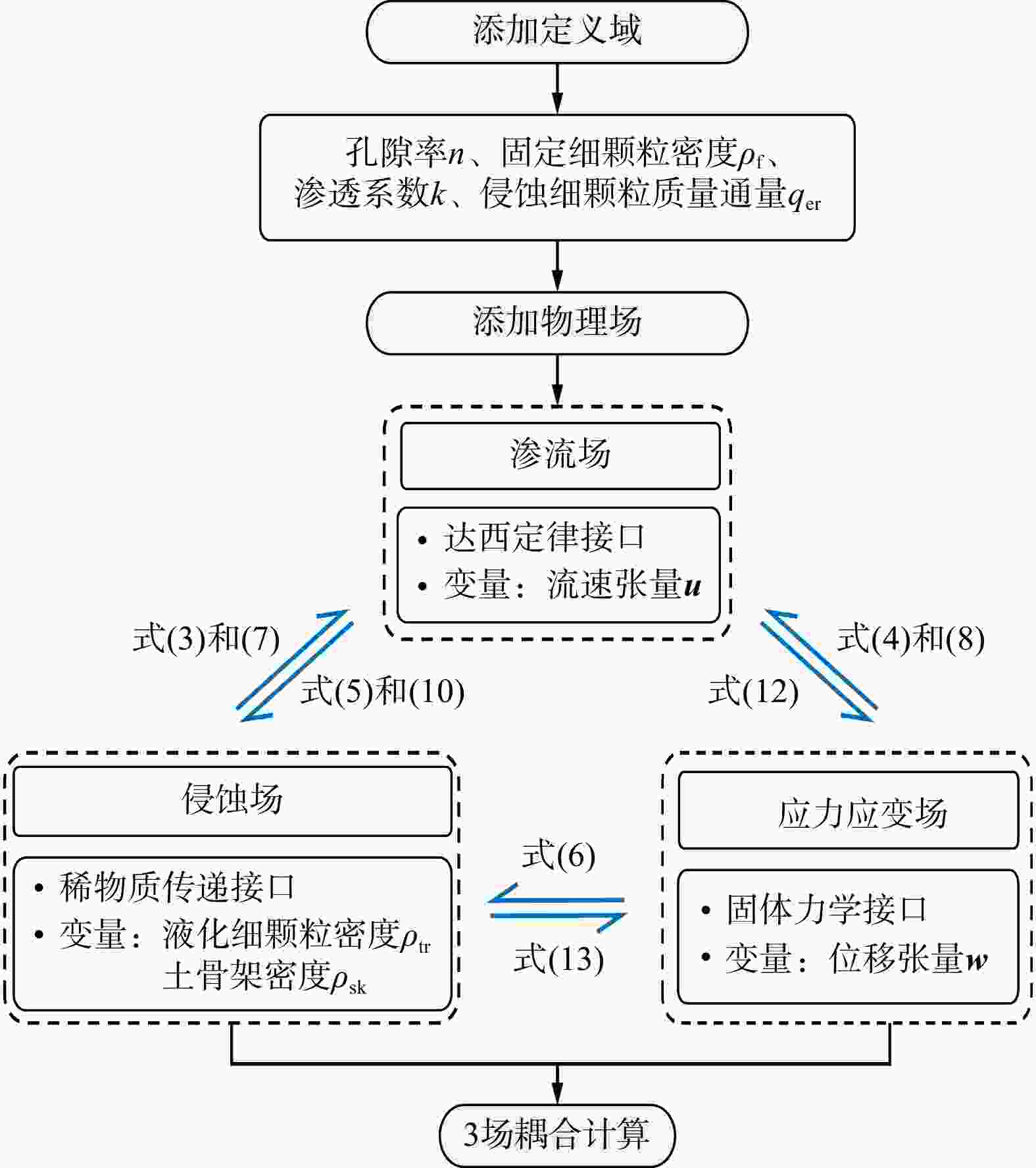
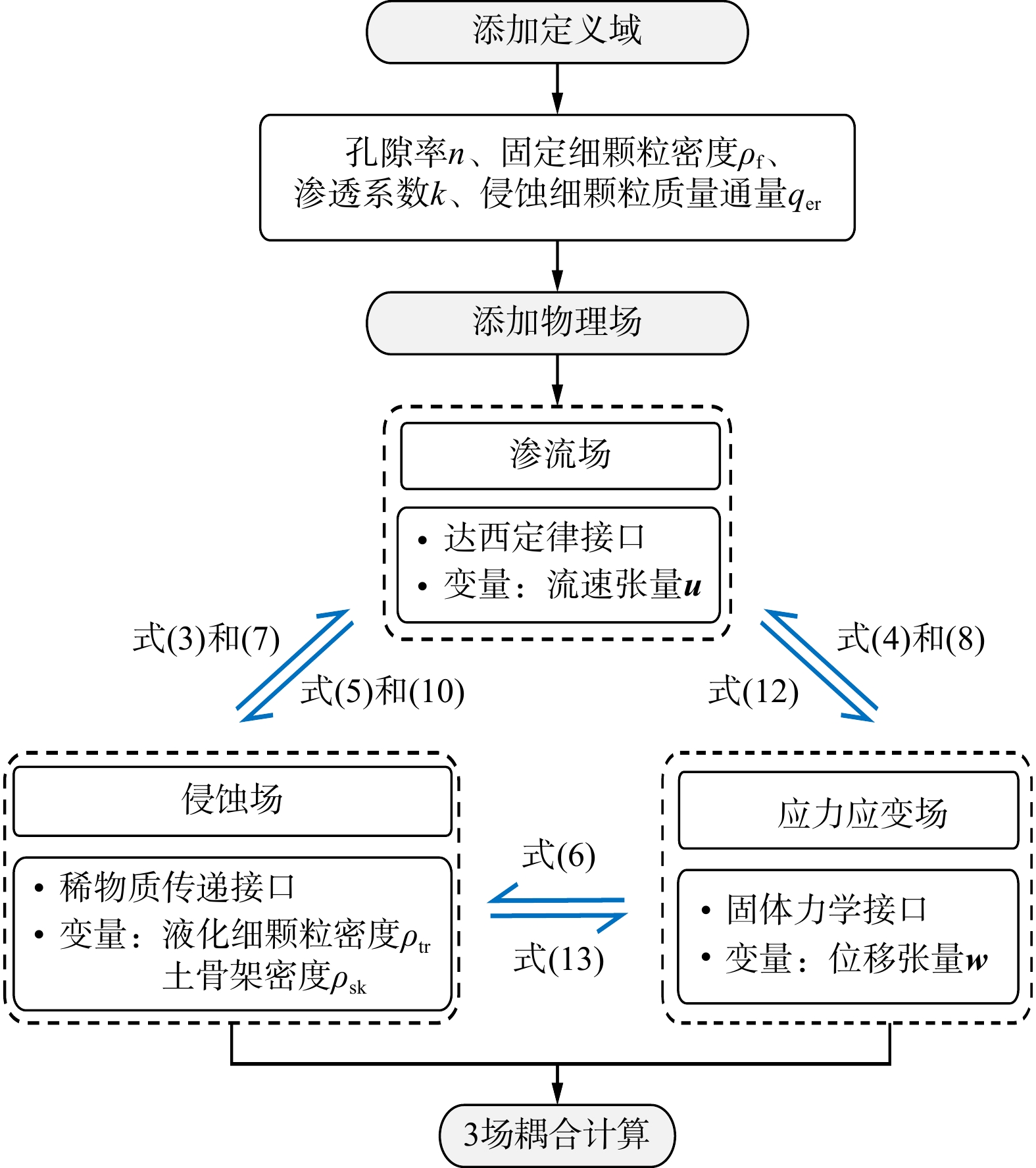
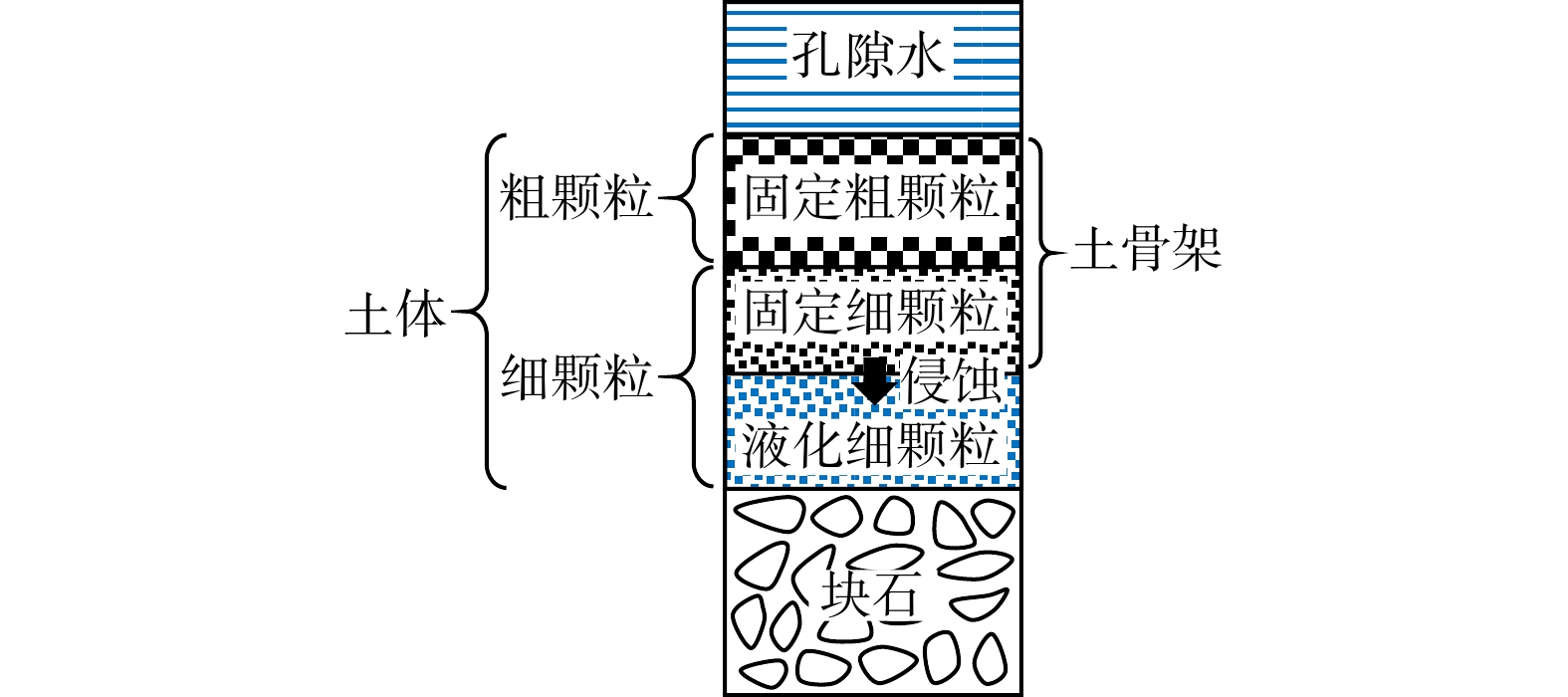
图 2 内侵蚀条件下堆积体数值模型构建流程图
Figure 2. Flowchart of construction of numerical model of accumulation under internal erosion conditions
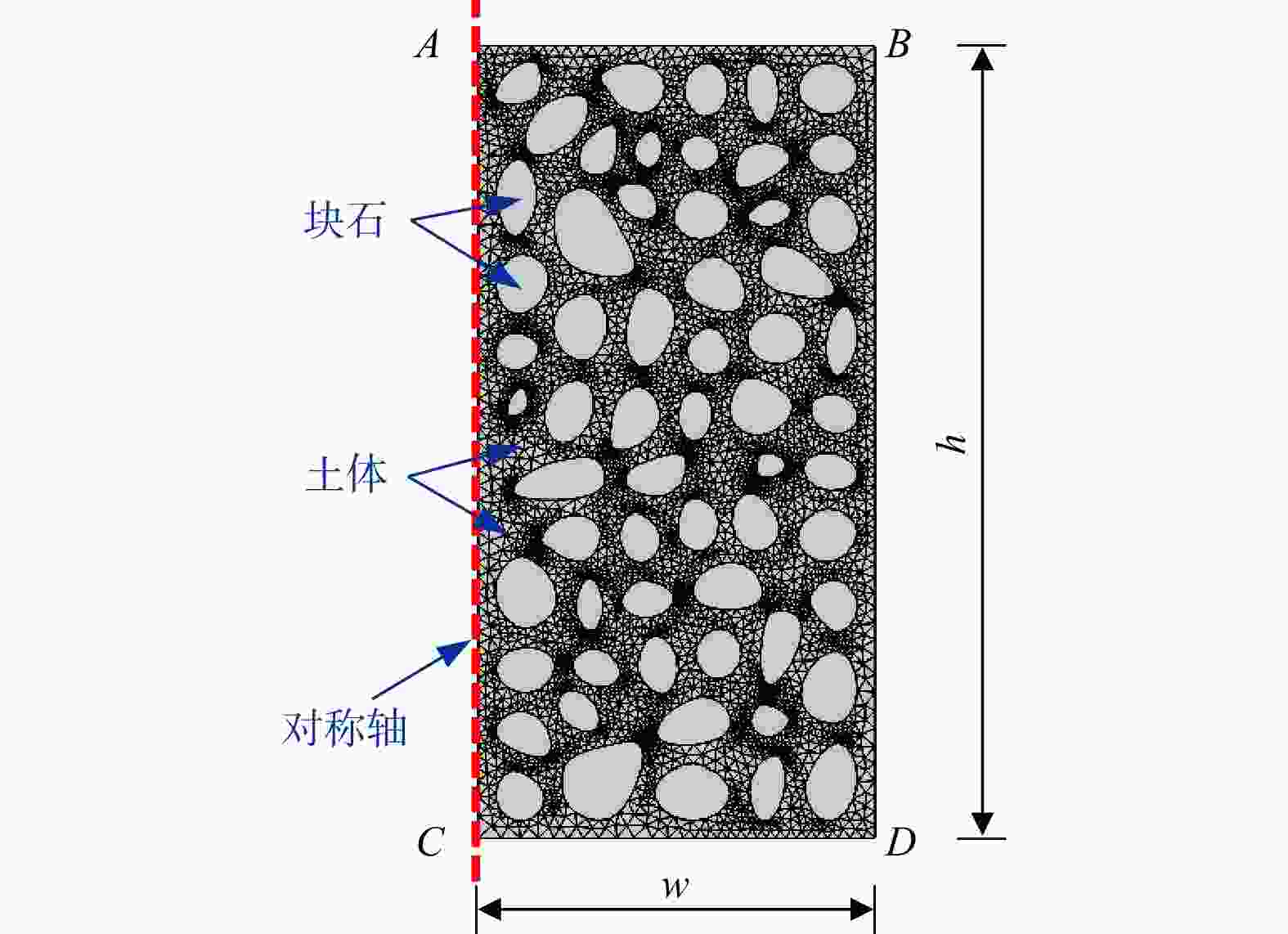
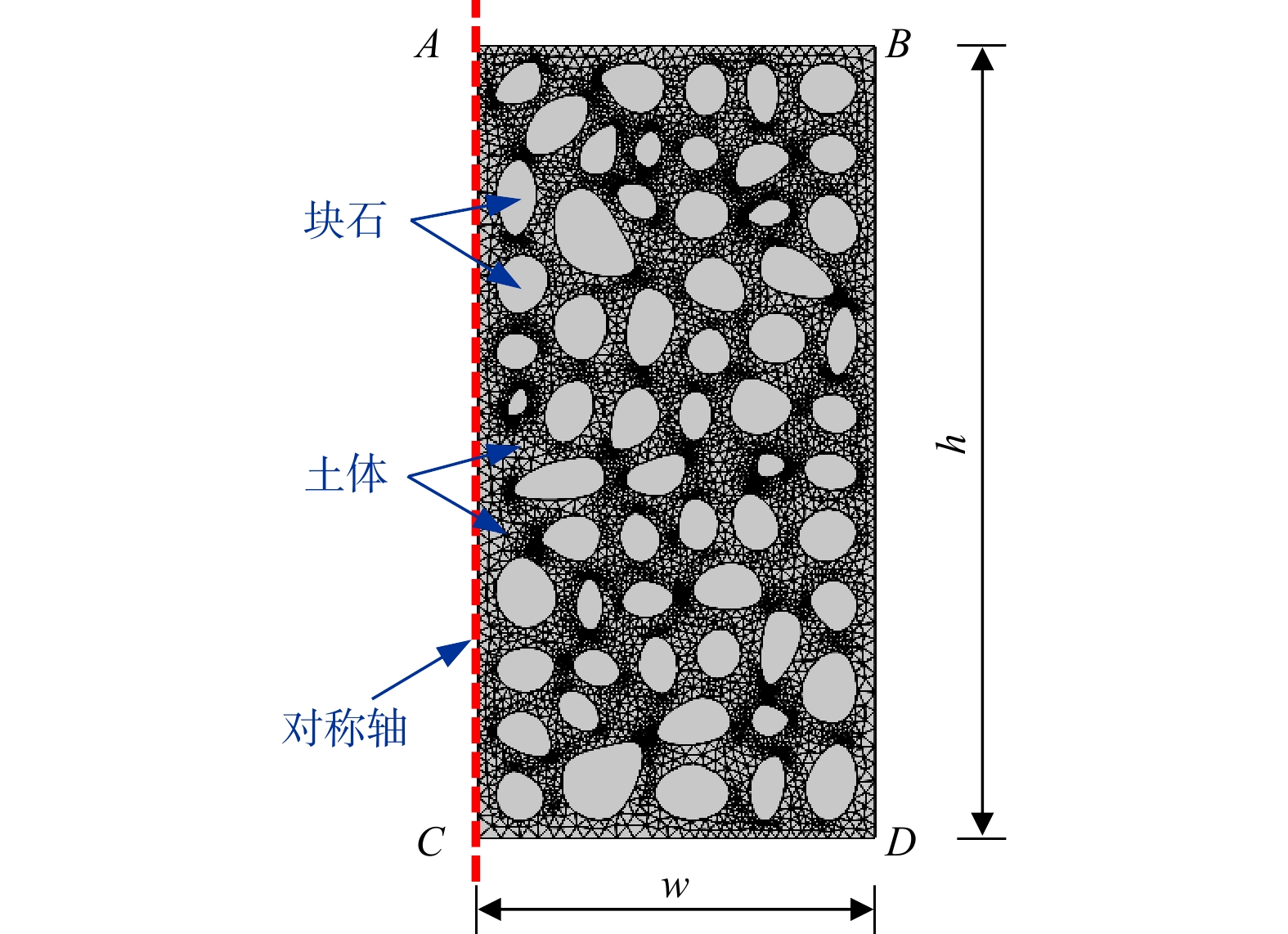
图 3 内侵蚀条件下堆积体数值模型
A,B,C,D为模型端点编号;w,h分别为模型宽度和长度
Figure 3. Numerical model of accumulation under internal erosion conditions
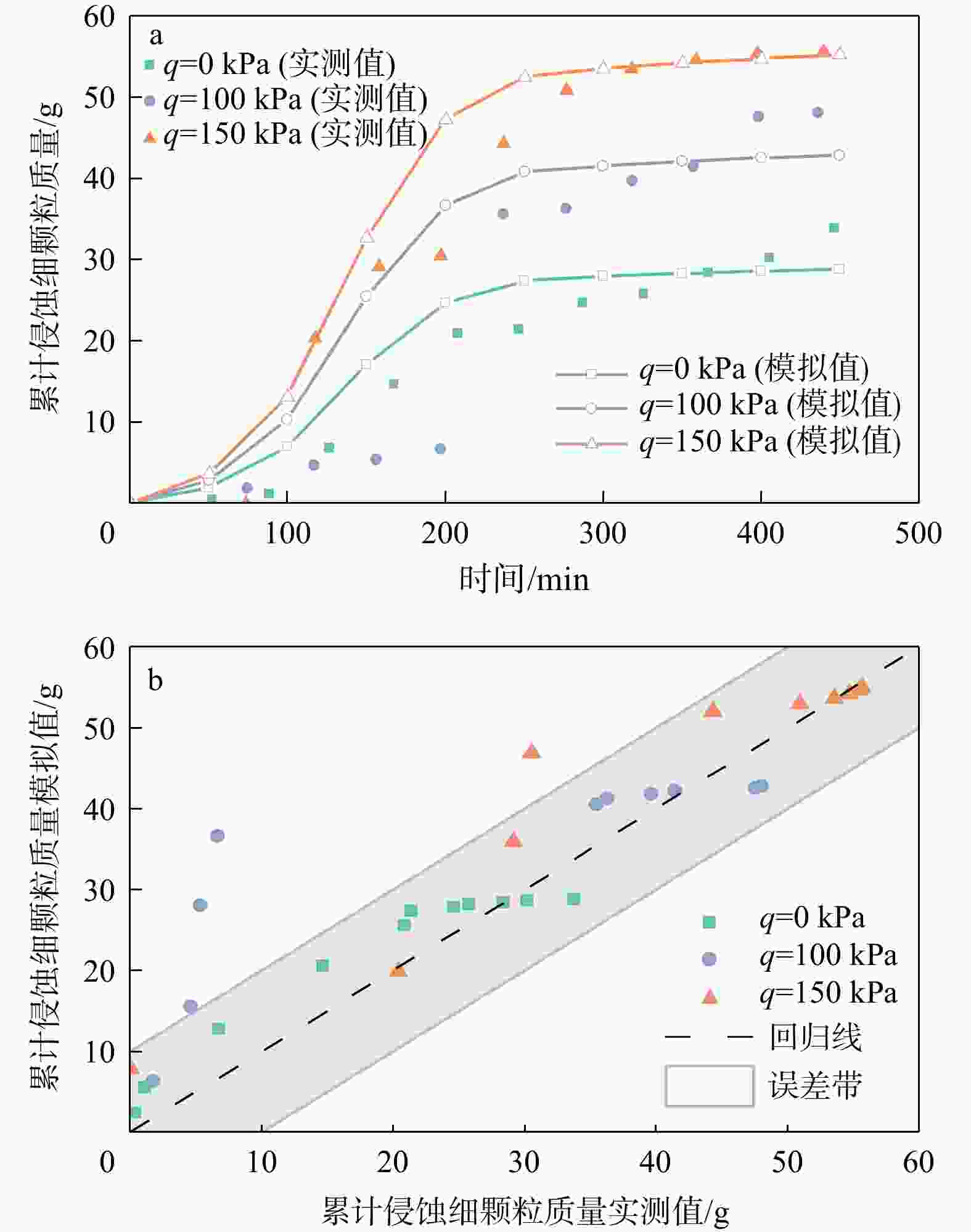
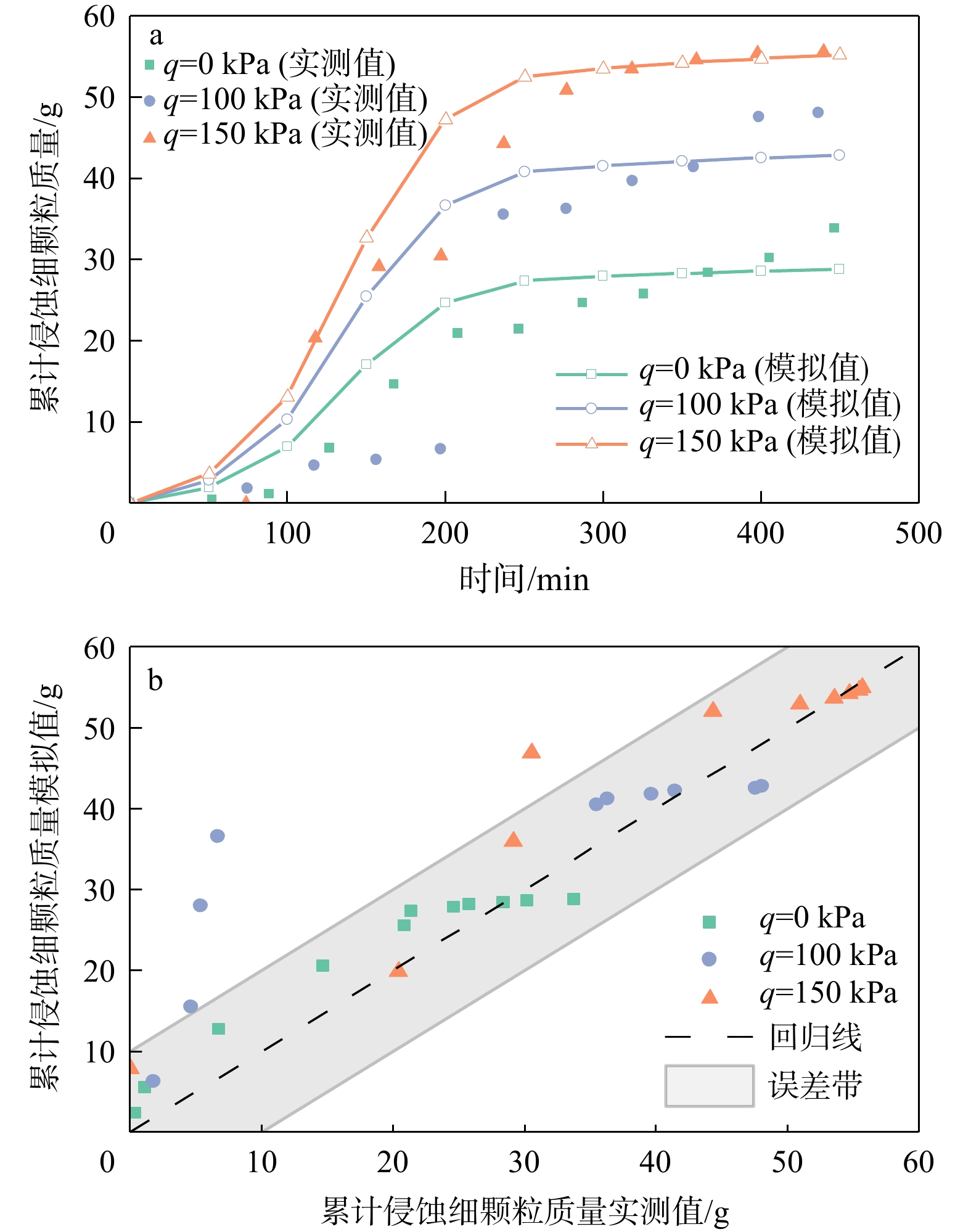
图 5 3组工况下模拟与试验累计侵蚀细颗粒质量对比图(a)和回归图(b)(q为偏应力)
Figure 5. Comparison (a) and regression (b) of cumulative mass of eroded fine particles from simulation and tests under three working conditions
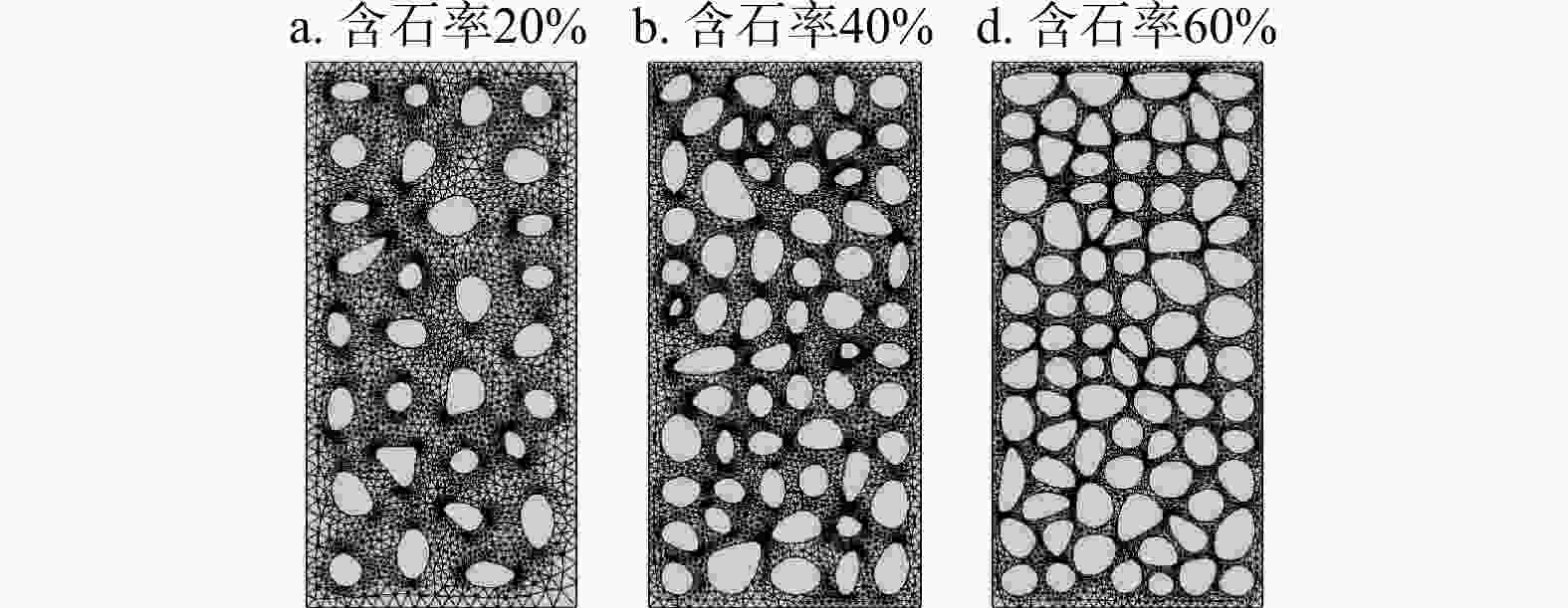
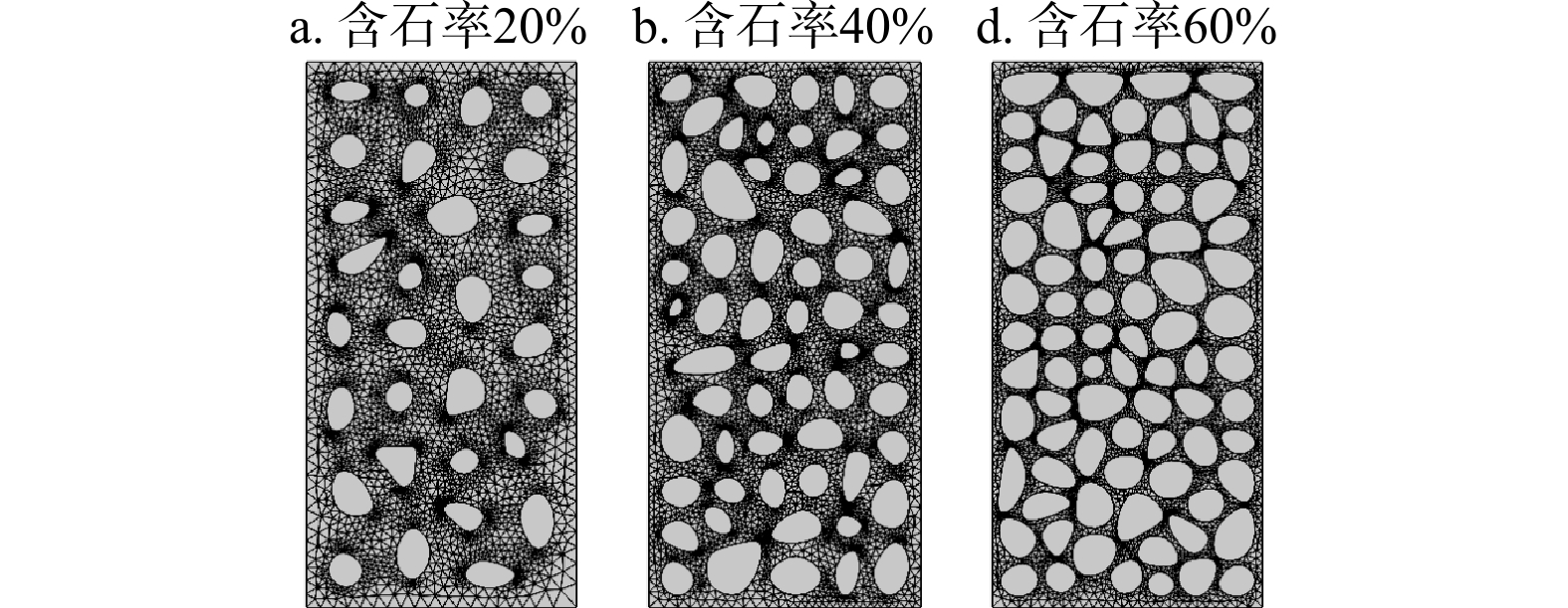
图 6 不同含石率下堆积体有限元计算模型
Figure 6. Finite element calculation models of accumulations with different rock contents
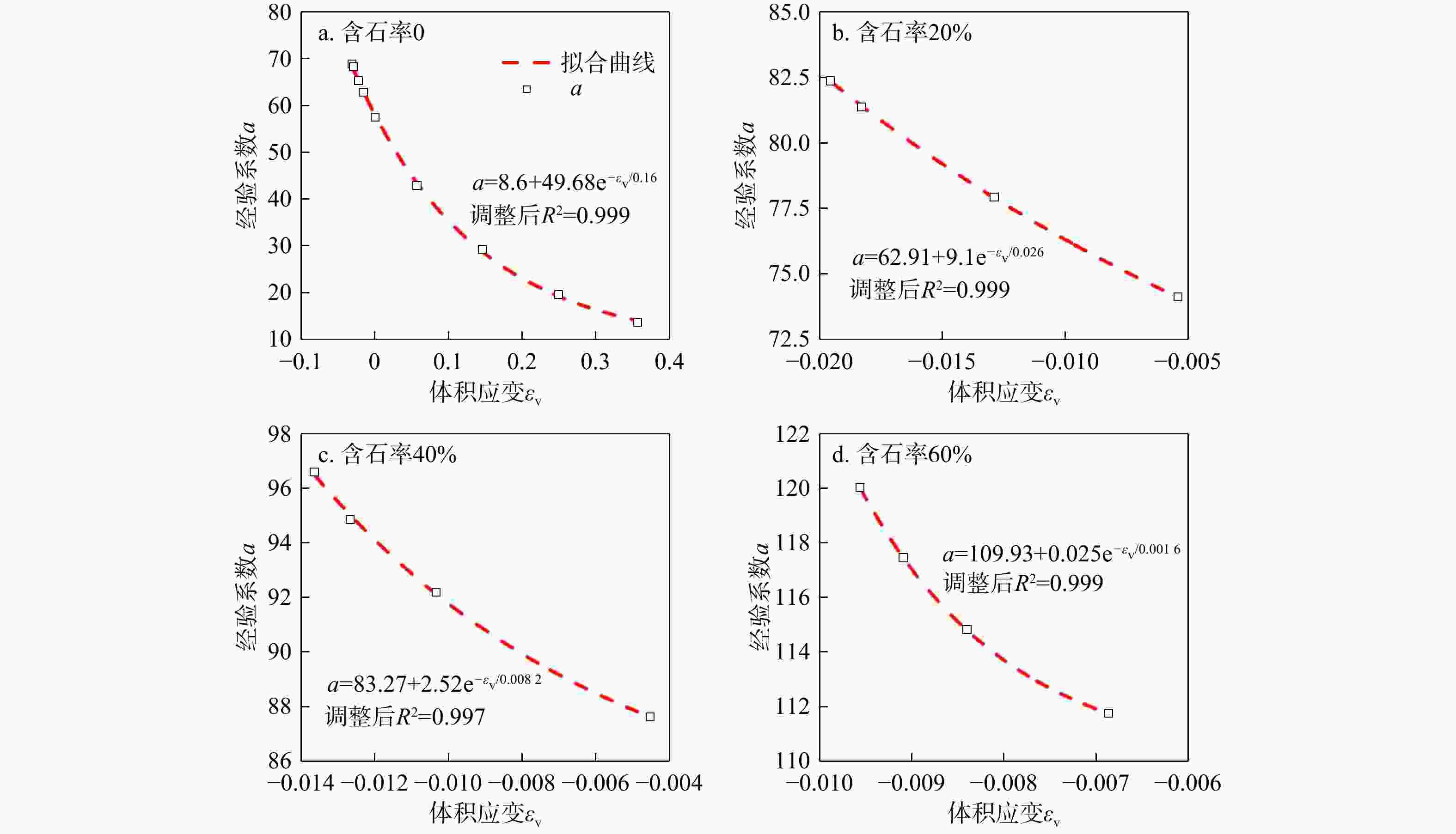
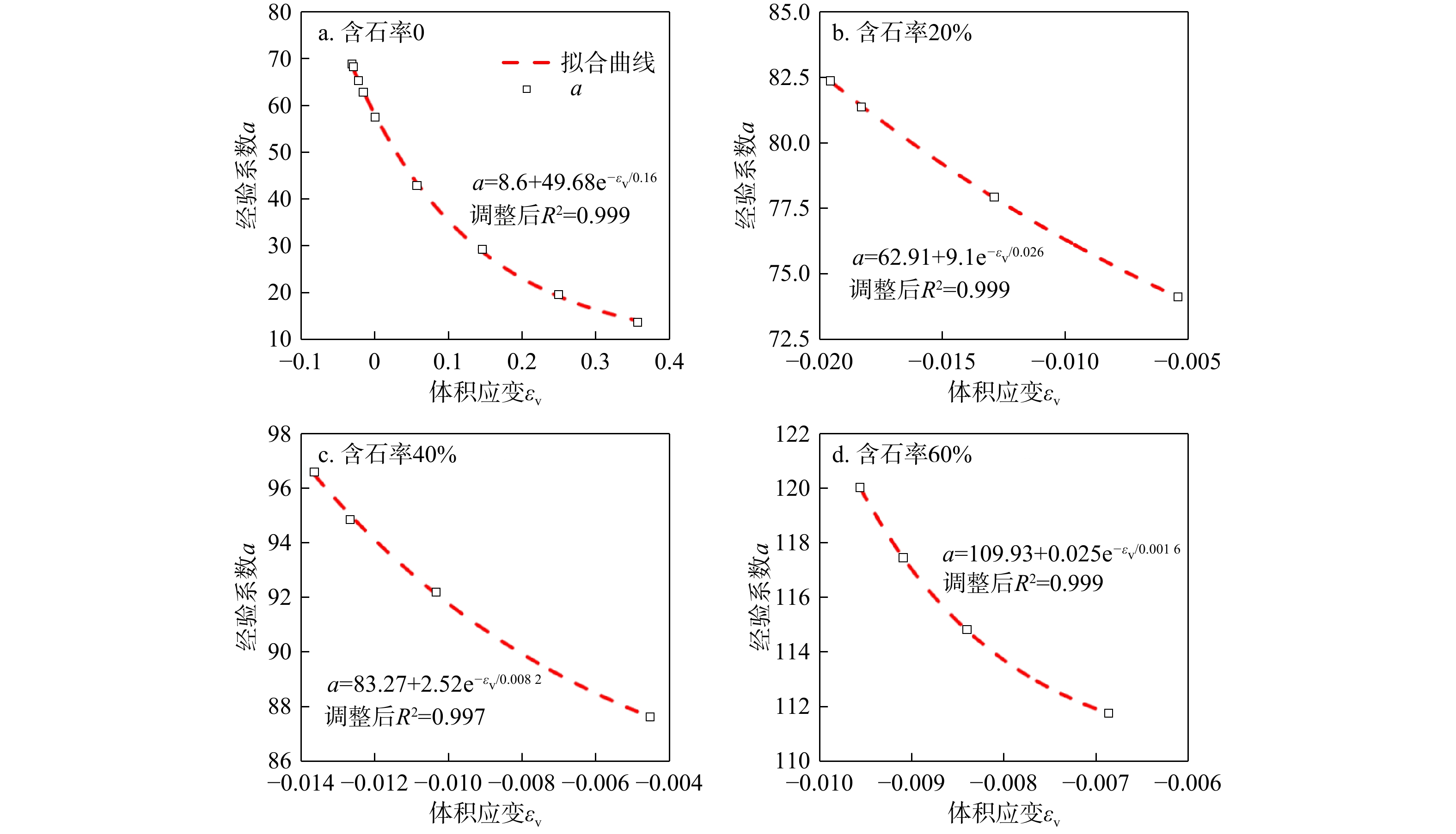
图 7 不同含石率下经验系数a与体积应变εv的关系(R2为决定系数,下同)
Figure 7. Relationship between empirical coefficient a and volumetric strain εv under different rock contents
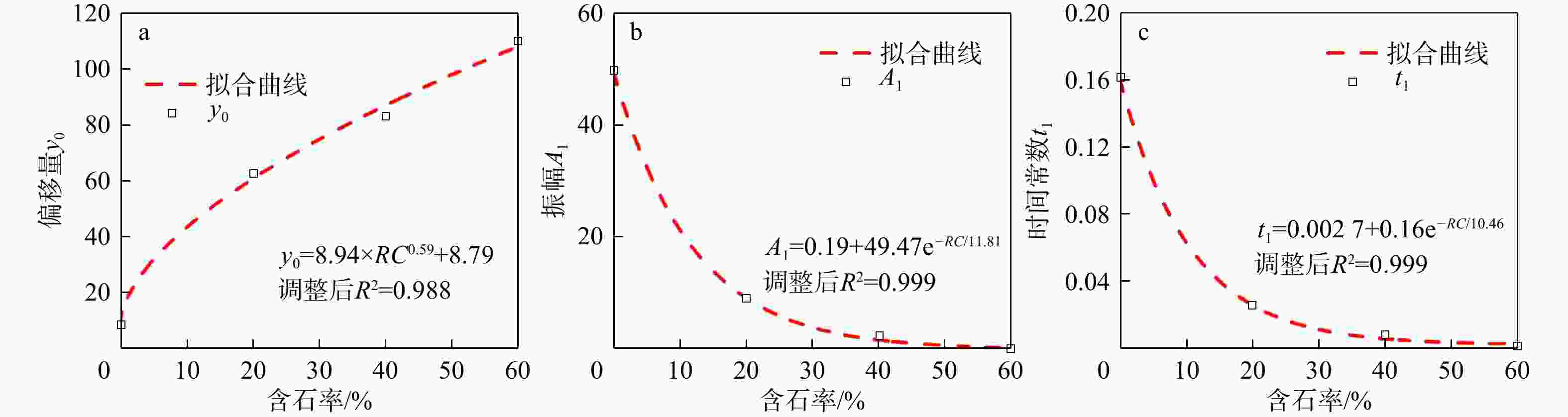
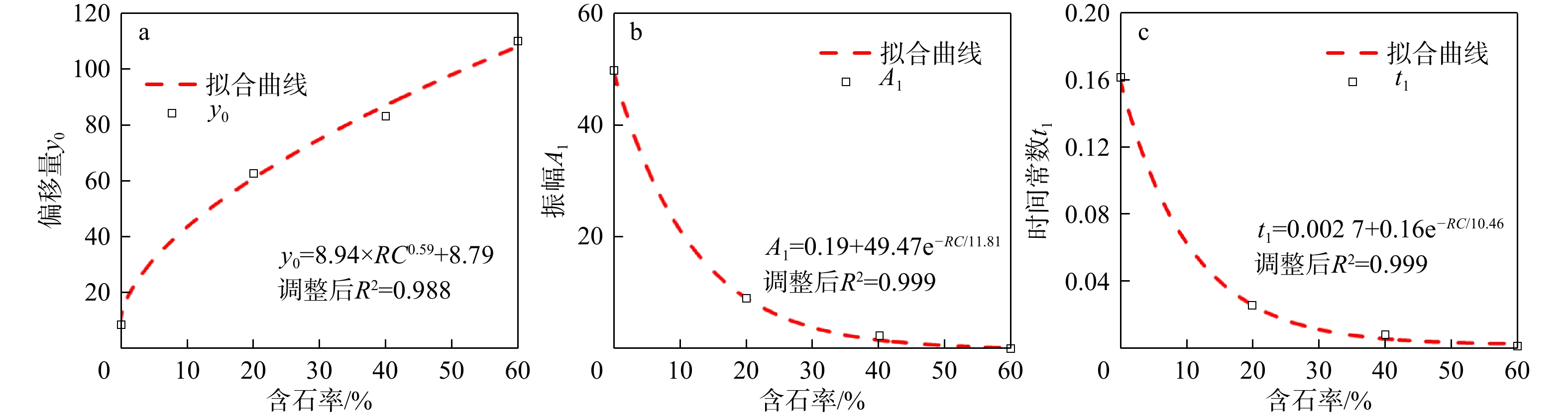
图 8 偏移量y0(a),振幅A1(b),时间常数t1(c)与含石率RC的关系
Figure 8. Relationship of rock content RC with offset y0 (a), amplitude A1 (b), and time constant t1 (c)
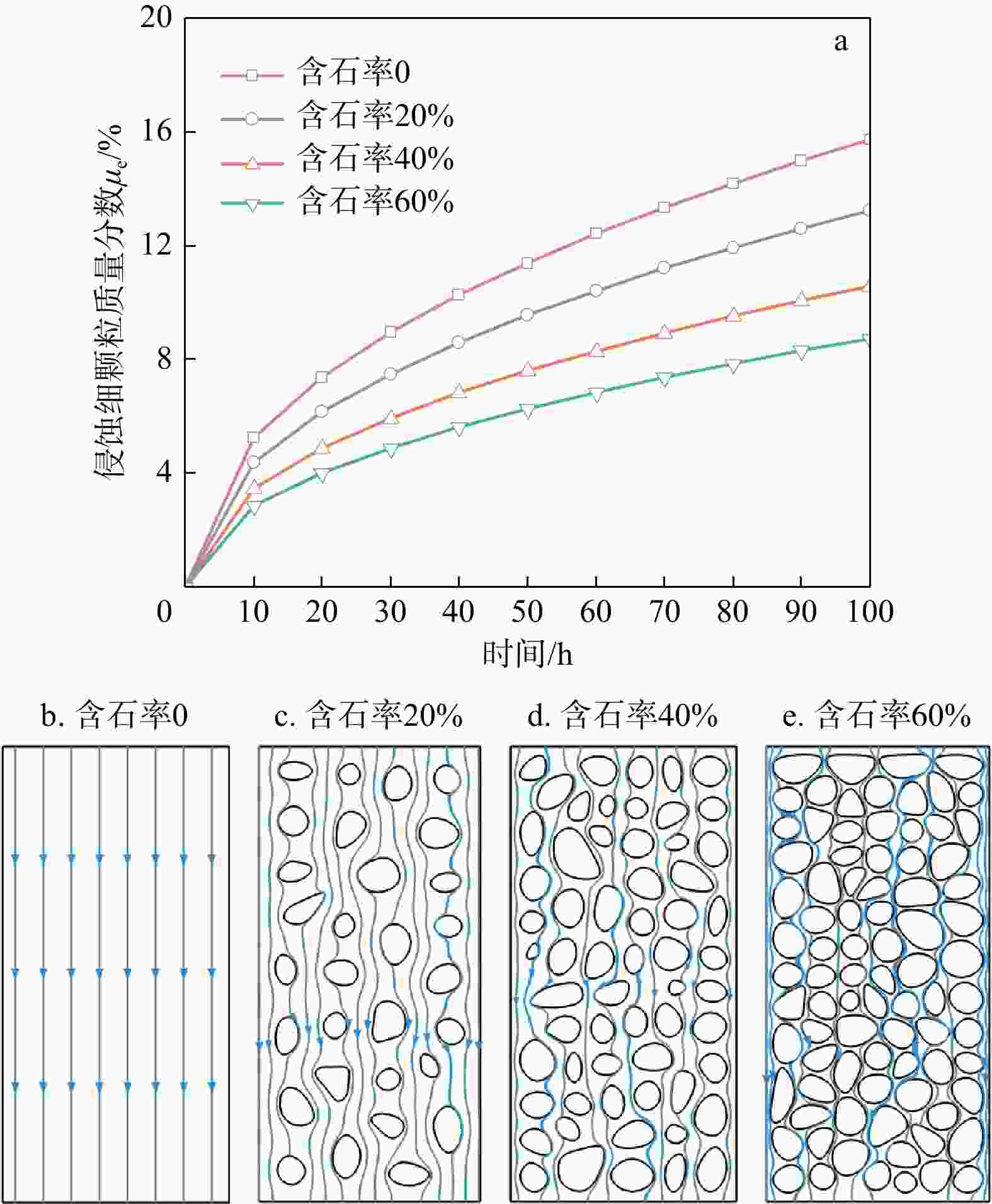
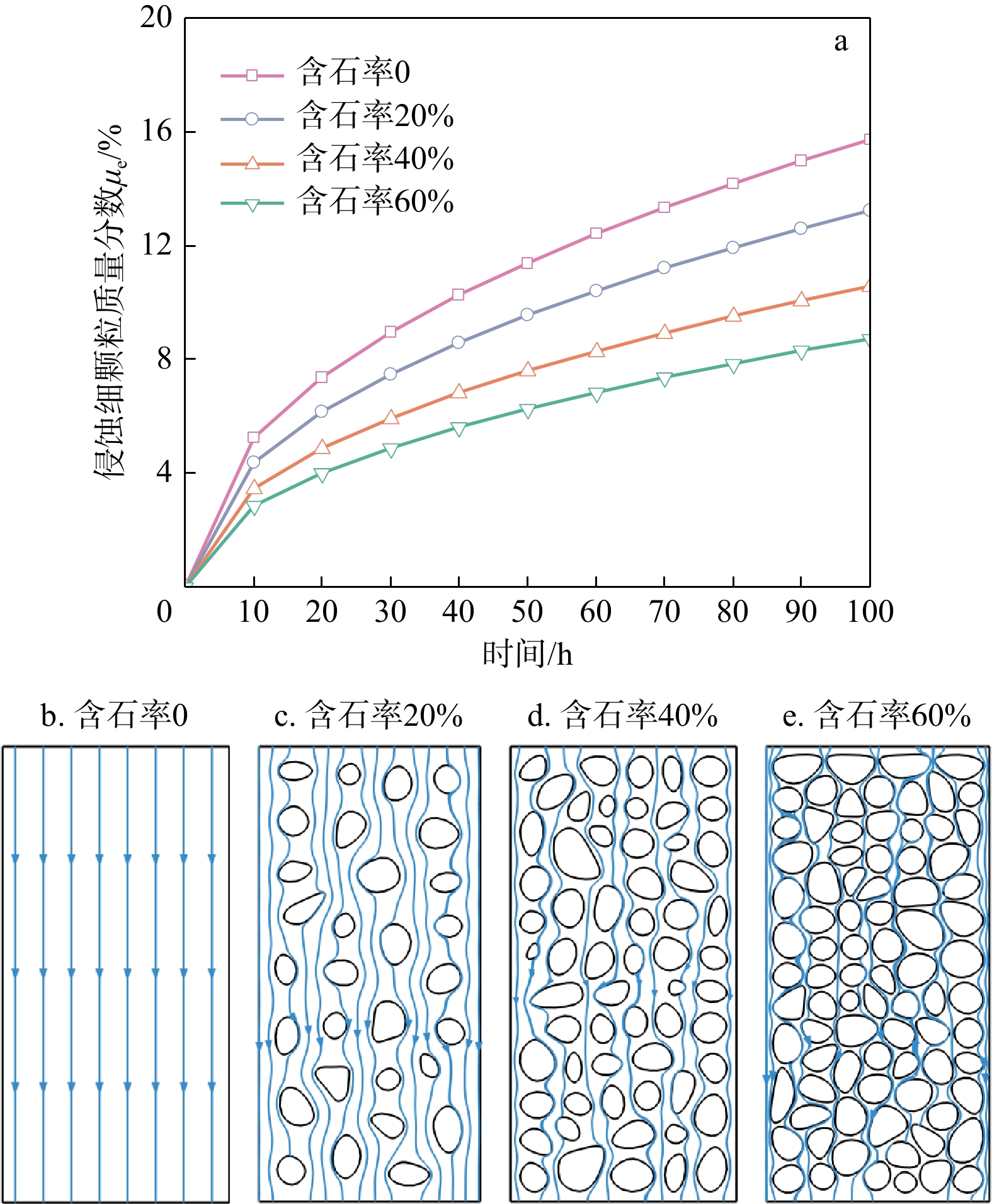
图 9 不同含石率下堆积体侵蚀细颗粒质量分数增长曲线(a)和流线分布(b~e)
Figure 9. Growth curves of mass fraction of eroded fine particles (a) and streamline distribution (b-e) of accumulations with different rock contents
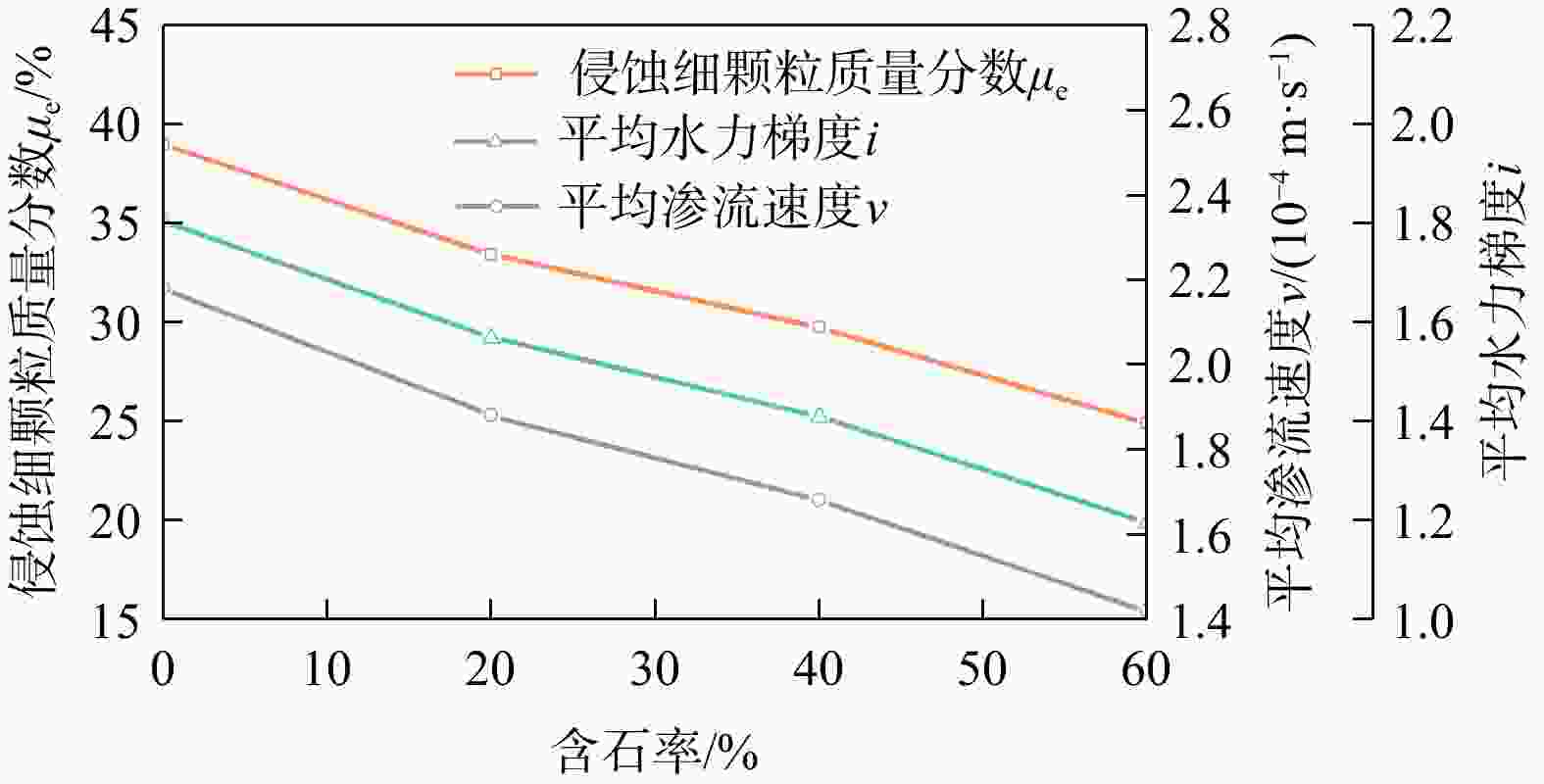
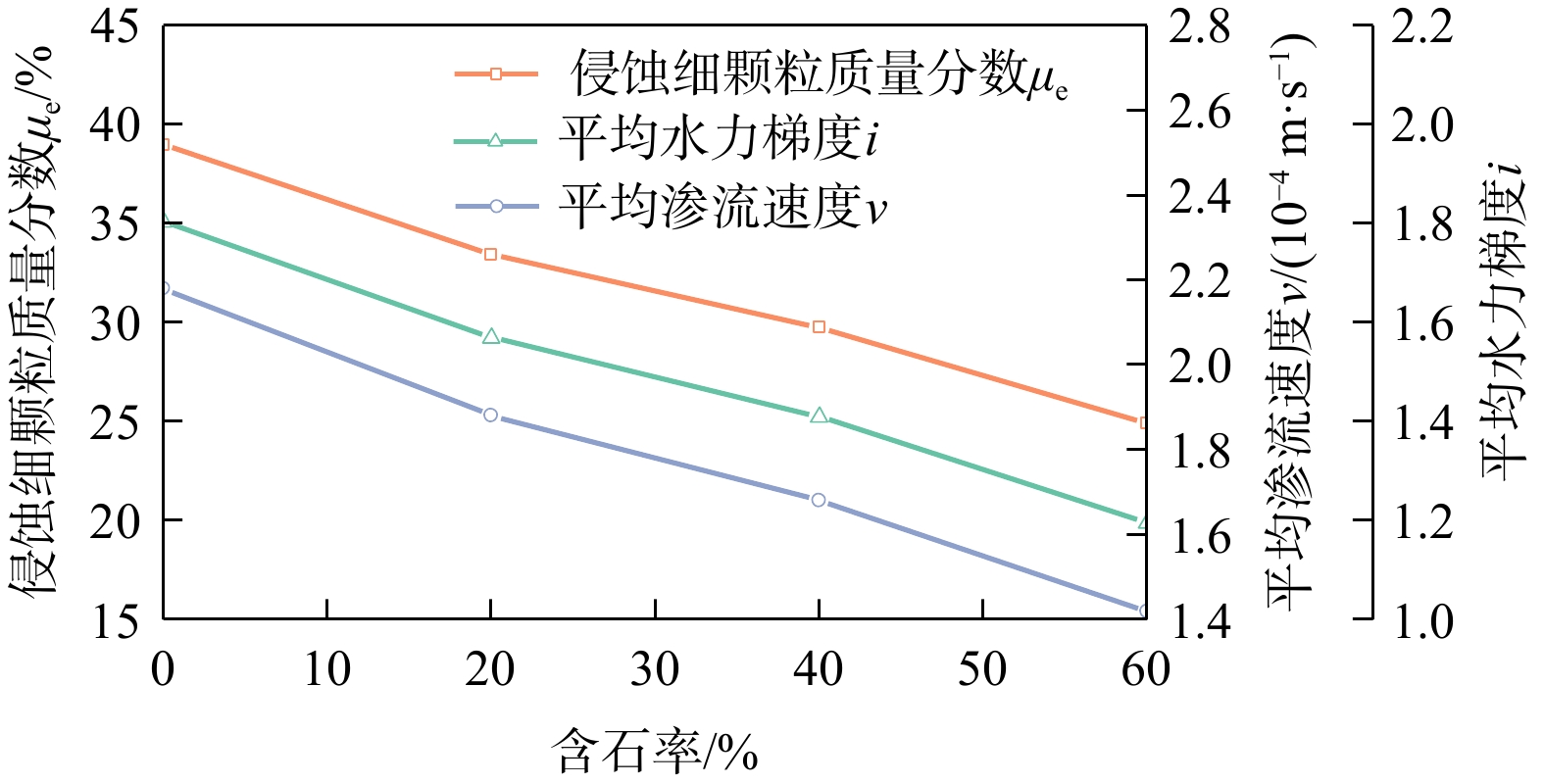
图 10 含石率对侵蚀细颗粒质量分数、平均水力梯度和平均渗流速度的影响
Figure 10. Effects of rock content on mass fraction of eroded fine particles, average hydraulic gradient, and average seepage velocity
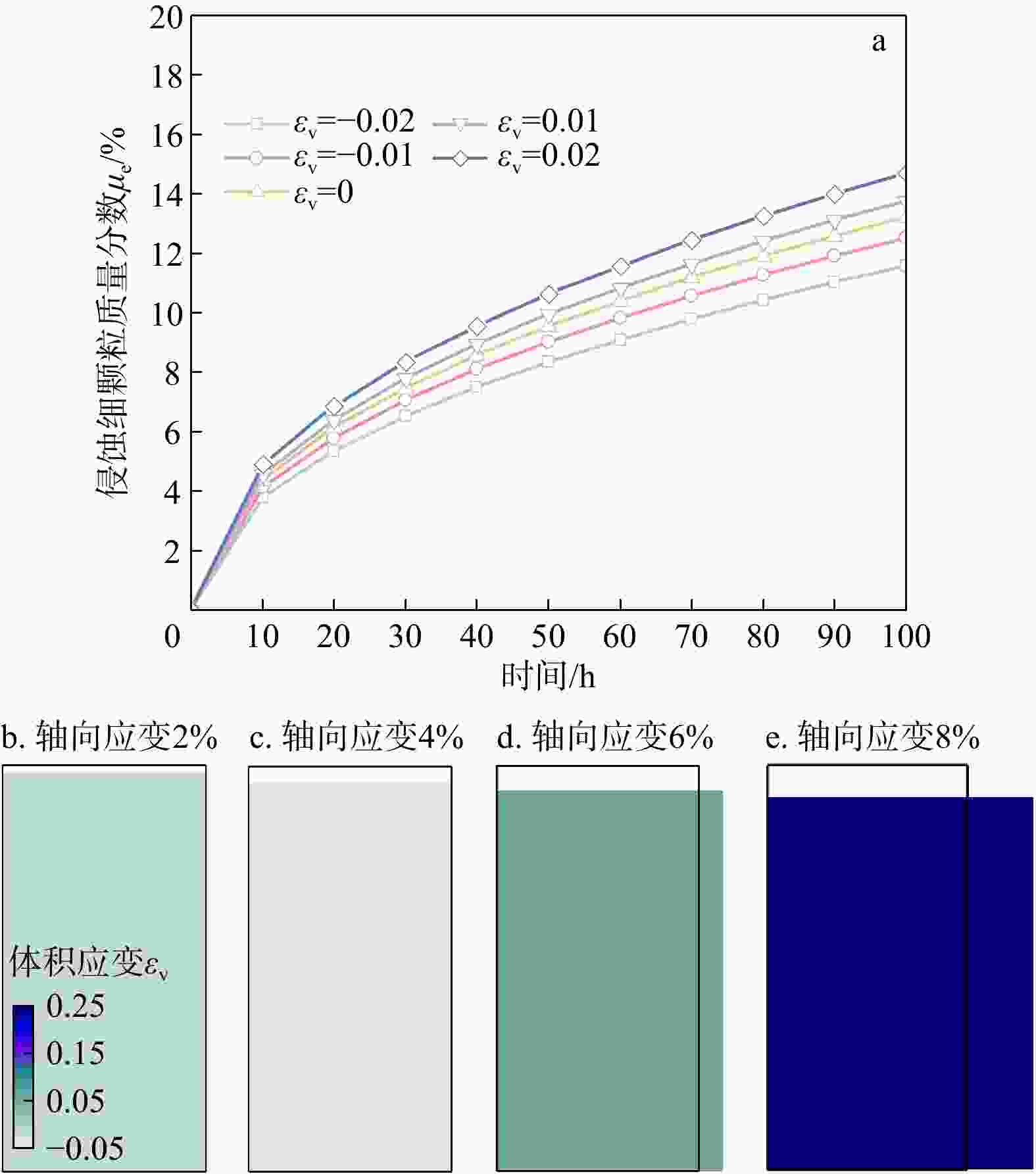
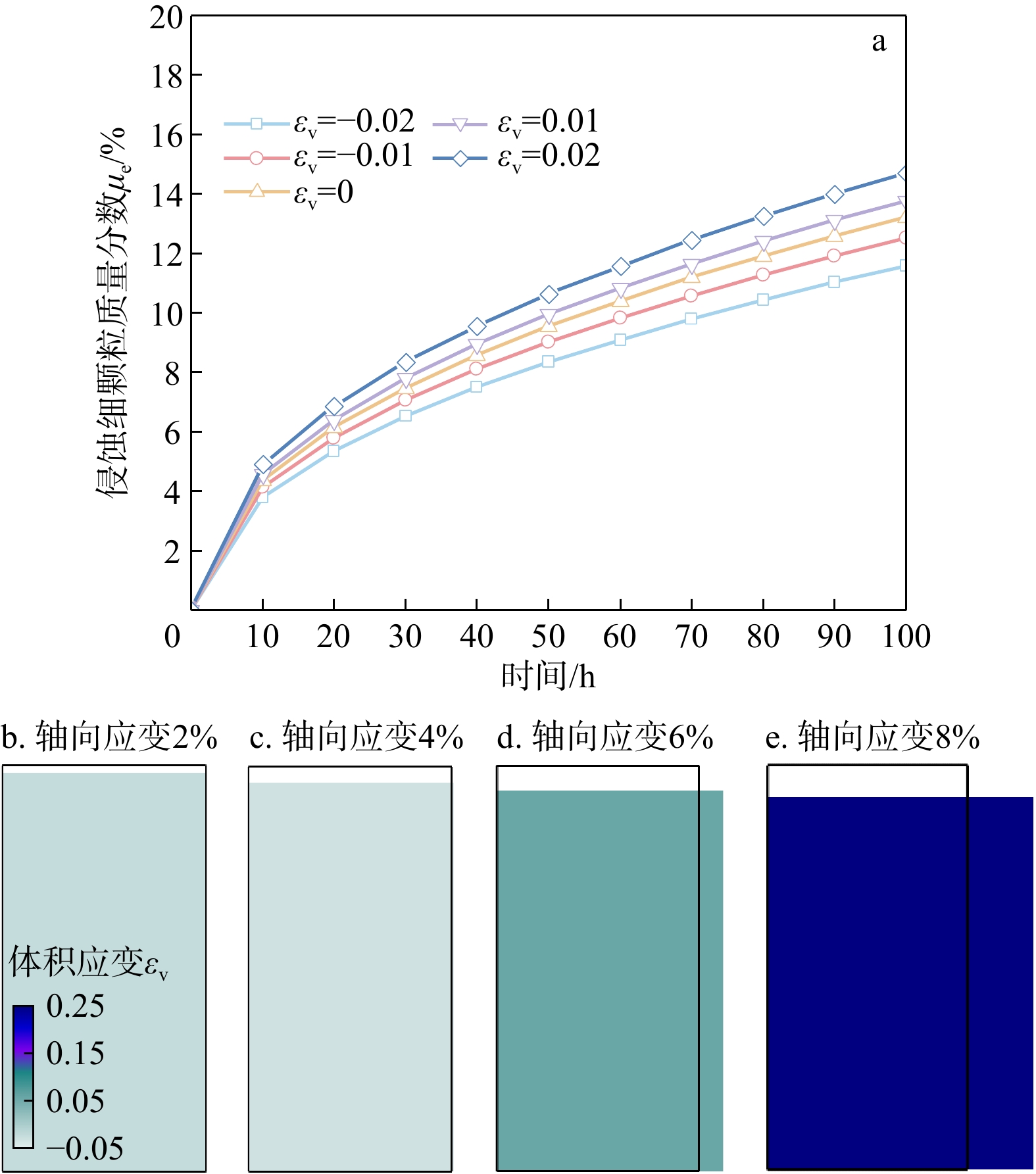
图 11 不同体积应变εv下堆积体侵蚀细颗粒质量分数增长曲线(a)和轴向应变对堆积体变形、体积应变的影响(b~e)
Figure 11. Growth curves of mass fraction of eroded fine particles (a) under different volumetric strains and effects of axial strain on deformation and volumetric strain of accumulation (b-e)
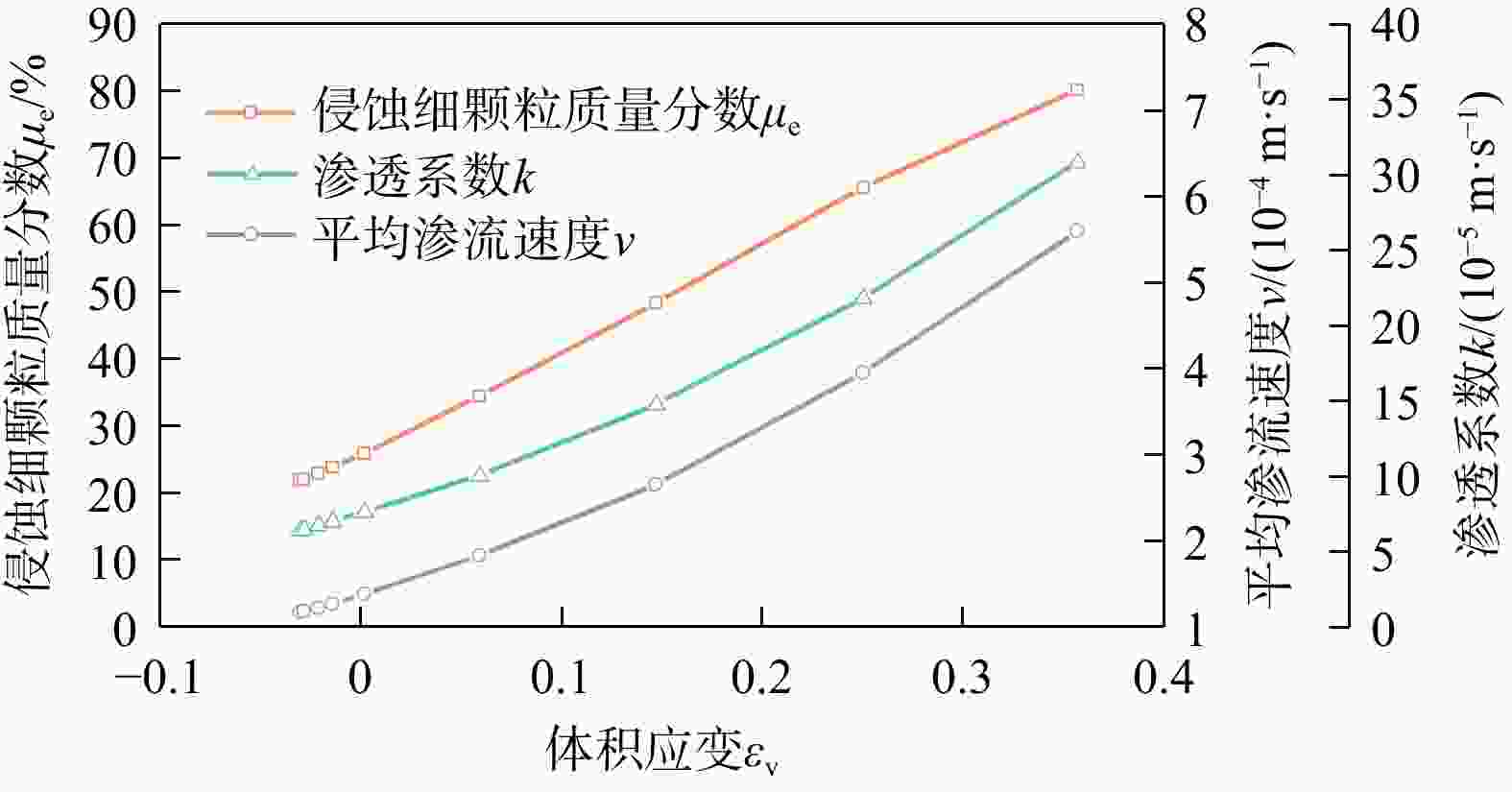
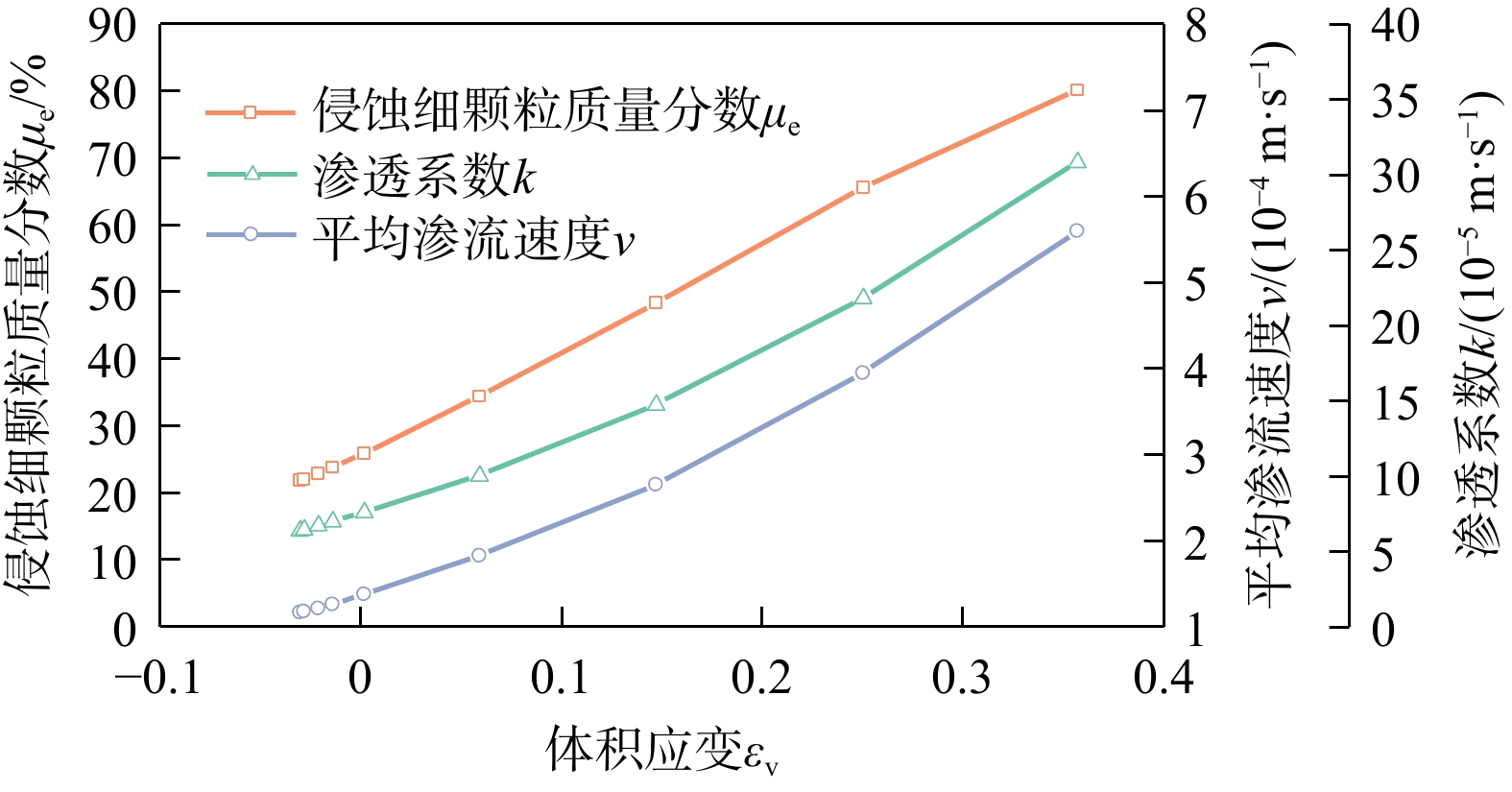
图 12 体积应变对侵蚀细颗粒质量分数、渗透系数和平均渗流速度的影响
Figure 12. Effects of volumetric strain on mass fraction of eroded fine particles, permeability coefficient, and average seepage velocity
表 1 土体力学参数[41]
Table 1. Soil mechanical parameters
计算参数 工况1 工况2 工况3 初始孔隙率n0 0.524 0.522 0.532 土颗粒密度ρs/(kg·m−3) 1895 1895 1895 初始渗透系数k0/(10−5 m·s−1) 7.5 7.3 6.8 土体弹性模量Es/MPa 6 6 6 土体泊松比υs 0.23 0.23 0.23 土体黏聚力cs/kPa 25 25 25 土体内摩擦角φs/(°) 32.6 32.6 32.6 注:工况1~3偏应力q分别为 0,100,150 kPa,下同  下载: 导出CSV
表 2 块石力学参数
Table 2. Rock mechanical parameters
计算参数 值 块石骨架密度ρrk/(kg·m−3) 2700 块石弹性模量Er/MPa 6000 块石泊松比υr 0.25 块石黏聚力cr/kPa 1500 块石内摩擦角φr/(°) 40
下载: 导出CSV
-
[1] 翟淑花, 于家烁, 齐干, 等. 降雨入渗条件下堆积体边坡致灾因子试验分析[J]. 地质科技通报, 2023, 42(3): 9-15. doi: 10.19509/j.cnki.dzkq.tb20220488ZHAI S H, YU J S, QI G, et al. Triggering factor analysis of deposit slope under rainfall infiltration based on laboratory experiments[J]. Bulletin of Geological Science and Technology, 2023, 42(3): 9-15. (in Chinese with English abstract) doi: 10.19509/j.cnki.dzkq.tb20220488 [2] 郭朝旭, 崔鹏. 宽级配弱固结土体内细颗粒迁移规律研究评述[J]. 山地学报, 2017, 35(2): 179-186.GUO C X, CUI P. Fine particle migration in wide grading and poorly consolidated soil: An overview[J]. Mountain Research, 2017, 35(2): 179-186. (in Chinese with English abstract) [3] 杜勇江, 王运生, 邹子南, 等. 动水冲刷作用下堆积体岸坡的渐进破坏过程分析[J]. 地质科技通报, 2024, 43(6): 226-234. doi: 10.19509/j.cnki.dzkq.tb20240213DU Y J, WANG Y S, ZOU Z N, et al. Progressive analysis of the progressive failure process of accumulated bank slope under dynamic water scour[J]. Bulletin of Geological Science and Technology, 2024, 43(6): 226-234. (in Chinese with English abstract) doi: 10.19509/j.cnki.dzkq.tb20240213 [4] 胡大儒, 吴述或, 罗超鹏, 等. 澜沧江某巨型堆积体蓄水失稳诱发涌浪预测[J]. 地质科技通报, 2024, 43(6): 78-88. doi: 10.19509/j.cnki.dzkq.tb20230598HU D R, WU S H, LUO C P, et al. Prediction of the wave induced by a gaint accumulation impoundment instability in Lantsang River[J]. Bulletin of Geological Science and Technology, 2024, 43(6): 78-88. (in Chinese with English abstract) doi: 10.19509/j.cnki.dzkq.tb20230598 [5] ZHANG L L, WU F, ZHANG H, et al. Influences of internal erosion on infiltration and slope stability[J]. Bulletin of Engineering Geology and the Environment, 2019, 78(3): 1815-1827. doi: 10.1007/s10064-017-1185-2 [6] 王平凡. 内侵蚀导致土体损伤情况下的边坡稳定性演化规律研究[D]. 上海: 上海交通大学, 2020.WANG P F. Research on slope stability evolution rule of soil damage caused by internal erosion[D]. Shanghai: Shanghai Jiao Tong University, 2020. (in Chinese with English abstract) [7] STERPI D. Effects of the erosion and transport of fine particles due to seepage flow[J]. International Journal of Geomechanics, 2003, 3(1): 111-122. doi: 10.1061/(ASCE)1532-3641(2003)3:1(111) [8] CIVIDINI A, GIODA G. Finite-element approach to the erosion and transport of fine particles in granular soils[J]. International Journal of Geomechanics, 2004, 4(3): 191-198. doi: 10.1061/(ASCE)1532-3641(2004)4:3(191) [9] 梁莉, 田大浪, 宁越, 等. 宽级配粗粒土的内部侵蚀试验及其稳定性判别[J]. 地下空间与工程学报, 2020, 16(3): 835-843. doi: 10.20174/j.juse.2020.03.023LIANG L, TIAN D L, NING Y, et al. Experimental investigation of internal stability of widely graded coarse granular soil and criteria of internal stability[J]. Chinese Journal of Underground Space and Engineering, 2020, 16(3): 835-843. (in Chinese with English abstract) doi: 10.20174/j.juse.2020.03.023 [10] CHEN C, ZHANG P T, ZHANG L M, et al. Internal erosion in granular soils with different microstructures under cyclically increased hydraulic gradients[J]. Journal of Hydrology, 2024, 639: 131601. doi: 10.1016/j.jhydrol.2024.131601 [11] MAO X S, CAI P C, FU J, et al. Study on internal erosion and structural evolution mechanism of soil-rock mixture[J]. Natural Hazards, 2023, 118(2): 1739-1764. doi: 10.1007/s11069-023-06086-8 [12] ZOU Y H, CHEN C, ZHANG L M. Simulating progression of internal erosion in gap-graded sandy gravels using coupled CFD-DEM[J]. International Journal of Geomechanics, 2020, 20: 04019135. doi: 10.1061/(ASCE)GM.1943-5622.0001520 [13] WANG T, WANG P, YIN Z Y, et al. DEM-DFM modeling of suffusion in calcareous sands considering the effect of double-porosity[J]. Computers and Geotechnics, 2022, 151: 104965. doi: 10.1016/j.compgeo.2022.104965 [14] 张磊, 张璐璐, 程演, 等. 考虑潜蚀影响的降雨入渗边坡稳定性分析[J]. 岩土工程学报, 2014, 36(9): 1680-1687. doi: 10.11779/CJGE201409015ZHANG L, ZHANG L L, CHENG Y, et al. Slope stability under rainfall infiltration considering internal erosion[J]. Chinese Journal of Geotechnical Engineering, 2014, 36(9): 1680-1687. (in Chinese with English abstract) doi: 10.11779/CJGE201409015 [15] LEI X Q, YANG Z J, HE S M, et al. Numerical investigation of rainfall-induced fines migration and its influences on slope stability[J]. Acta Geotechnica, 2017, 12(6): 1431-1446. doi: 10.1007/s11440-017-0600-y [16] LEI X Q, HE S M, CHEN X Q, et al. A generalized interpolation material point method for modelling coupled seepage-erosion-deformation process within unsaturated soils[J]. Advances in Water Resources, 2020, 141: 103578. doi: 10.1016/j.advwatres.2020.103578 [17] YANG J, YIN Z Y, LAOUAFA F, et al. Internal erosion in dike-on-foundation modeled by a coupled hydromechanical approach[J]. International Journal for Numerical and Analytical Methods in Geomechanics, 2019, 43(3): 663-683. doi: 10.1002/nag.2877 [18] WANG P F, ZHANG X Y. Experimental study on seepage characteristics of a soil-rock mixture in a fault zone[J]. Fluid Dynamics & Materials Processing, 2022, 18(2): 271-283. doi: 10.32604/fdmp.2022.017882 [19] 沈辉, 罗先启, 毕金锋. 土石混合体渗透侵蚀特性数值模拟研究[J]. 岩土力学, 2017, 38(5): 1497-1502. doi: 10.16285/j.rsm.2017.05.033SHEN H, LUO X Q, BI J F. Numerical simulation of internal erosion characteristics of block in matrix soil aggregate[J]. Rock and Soil Mechanics, 2017, 38(5): 1497-1502. (in Chinese with English abstract) doi: 10.16285/j.rsm.2017.05.033 [20] 杨忠平, 李勇华, 李诗琪, 等. 不同含石率土石混合体水力侵蚀分异特征及机制[J]. 岩石力学与工程学报, 2024, 43(1): 133-145. doi: 10.13722/j.cnki.jrme.2023.0246YANG Z P, LI Y H, LI S Q, et al. Differentiation characteristics and mechanism of hydraulic erosion of soil-rock mixtures with different rock contents[J]. Chinese Journal of Rock Mechanics and Engineering, 2024, 43(1): 133-145. (in Chinese with English abstract) doi: 10.13722/j.cnki.jrme.2023.0246 [21] 刘汉龙, 钟文涵, 仉文岗, 等. 基于透明土石混合体的水力侵蚀特性研究[J]. 岩土工程学报, 2023, 45(9): 1868-1877. doi: 10.11779/CJGE20220714LIU H L, ZHONG W H, ZHANG W G, et al. Hydraulie erosion characteristics based on transparent soil-rock mixture[J]. Chinese Journal of Geotechnical Engineering, 2023, 45(9): 1868-1877. (in Chinese with English abstract) doi: 10.11779/CJGE20220714 [22] GARNER S J, FANNIN R J. Understanding internal erosion: A decade of research following a sinkhole event[J]. International Journal on Hydropower and Dams, 2010, 17(3): 93-98. [23] NGUYEN T V, BUI H H, TRAN K M, et al. Effects of pre-shearing stress ratio on the mechanical behaviours of gap-graded soils subjected to internal erosion[J]. Computers and Geotechnics, 2024, 166: 105991. doi: 10.1016/j.compgeo.2023.105991 [24] 罗玉龙, 吴强, 詹美礼, 等. 渗流−侵蚀−应力耦合管涌试验装置的研制及初步应用[J]. 岩石力学与工程学报, 2013, 32(10): 2108-2114.LUO Y L, WU Q, ZHAN M L, et al. Development of seepage-erosion-stress coupling piping test apparatus and its primary application[J]. Chinese Journal of Rock Mechanics and Engineering, 2013, 32(10): 2108-2114. (in Chinese with English abstract) [25] 詹美礼, 辛圆心, 唐健, 等. 砾石心墙土复杂应力耦合作用下的渗流特性[J]. 水利水电科技进展, 2016, 36(4): 36-41. doi: 10.3880/j.issn.1006-7647.2016.04.007ZHAN M L, XIN Y X, TANG J, et al. Permeability of gravel soil for core wall under complex stress coupling effect[J]. Advances in Science and Technology of Water Resources, 2016, 36(4): 36-41. (in Chinese with English abstract) doi: 10.3880/j.issn.1006-7647.2016.04.007 [26] 沈辉. 内侵蚀作用下碎石土流−固耦合理论及其工程应用[D]. 上海: 上海交通大学, 2016.SHEN H. Study on fluid-solid coupling theroy of gravelly soil influenced by internal erosion and its engineering application[D]. Shanghai: Shanghai Jiao Tong University, 2016. (in Chinese with English abstract) [27] CARMAN P C. Fluid flow through granular beds[J]. Chemical Engineering Research and Design, 1997, 75: S32-S48. doi: 10.1016/s0263-8762(97)80003-2 [28] KOZENY J. Ueber kapillare leitung des wassers im boden[J]. Sitzungsber Akad Wiss Wien, 1927, 136(2a): 271-306. [29] TORTIKE W S. Numerical simulation of thermal, multiphase fluid flow in an elastoplastic deforming oil reservoir[D]. Edmonton: University of Alberta, 1991. [30] 陈成意, 宋修海. 各向异性弹性孔隙介质中的热−流−变形耦合模型[J]. 兰州理工大学学报, 2009, 35(4): 70-73. doi: 10.3969/j.issn.1673-5196.2009.04.017CHEN C Y, SONG X H. Coupled models of heat-flow-deformation for porous medium with anisotropical elasticity[J]. Journal of Lanzhou University of Technology, 2009, 35(4): 70-73. (in Chinese with English abstract) doi: 10.3969/j.issn.1673-5196.2009.04.017 [31] HU R, CHEN Y F, ZHOU C B. Modeling of coupled deformation, water flow and gas transport in soil slopes subjected to rain infiltration[J]. Science China Technological Sciences, 2011, 54(10): 2561-2575. doi: 10.1007/s11431-011-4504-z [32] 龚晓南, 谢康和. 土力学[M]. 北京: 中国建筑工业出版社, 2014.GONG X N, XIE K H. Soil mechanics[M]. Beijing: China Architecture & Building Press, 2014. (in Chinese) [33] LEWIS R W, SCHREFLER B A. The finite element method in the static and dynamic deformation and consolidation of porous media[M]. New York: John Wiley, 1998. [34] ZIENKIEWICZ O C. Computational geomechanics with special reference to earthquake engineering[M]. New York: John Wiley, 1999. [35] WU W A, YANG Y T, ZHENG H. Hydro-mechanical simulation of the saturated and semi-saturated porous soil-rock mixtures using the numerical manifold method[J]. Computer Methods in Applied Mechanics and Engineering, 2020, 370: 113238. doi: 10.1016/j.cma.2020.113238 [36] 徐芝纶. 弹性力学: 上册[M]. 第5版. 北京: 高等教育出版社, 2016.XU Z L. Elastic mechanics: Volume 1[M]. 5th ed. Beijing: Higher Education Press, 2016. (in Chinese) [37] 黄克智. 高等固体力学: 上册 [M]. 北京: 清华大学出版社, 2013.HUANG K Z. Advanced solid mechanics: Volume 1[M]. Beijing: Tsinghua University Press, 2013. (in Chinese) [38] HINDMARSH A C, BROWN P N, GRANT K E, et al. SUNDIALS: Suite of nonlinear and differential/algebraic equation solvers[J]. ACM Transactions on Mathematical Software, 2005, 31(3): 363-396. doi: 10.1145/1089014.1089020 [39] STAVROPOULOU M, PAPANASTASIOU P, VARDOULAKIS I. Coupled wellbore erosion and stability analysis[J]. International Journal for Numerical and Analytical Methods in Geomechanics, 1998, 22(9): 749-769. doi: 10.1002/(SICI)1096-9853(199809)22:9<749::AID-NAG944>3.0.CO;2-K [40] DEUFLHARD P. A modified Newton method for the solution of ill-conditioned systems of nonlinear equations with application to multiple shooting[J]. Numerische Mathematik, 1974, 22(4): 289-315. doi: 10.1007/BF01406969 [41] CHANG D S, ZHANG L M. A stress-controlled erosion apparatus for studying internal erosion in soils[J]. Geotechnical Testing Journal, 2011, 34(6): 579-589. doi: 10.1520/GTJ103889 [42] LIU Y, SUN S R, WEI J H, et al. Mechanical characteristics of soil-rock mixtures containing macropore structure based on 3D modeling technology[J]. Journal of Mountain Science, 2020, 17(9): 2224-2240. doi: 10.1007/s11629-020-5937-2 -

 下载:
下载:

 点击查看大图
计量
- 文章访问数: 604
- PDF下载量: 62
- 被引次数: 0