投审稿入口
投审稿入口


-
摘要:
热液系统是海洋中典型极端环境,其连接了地球深部与表层的物质与能量交换,并在全球海洋环境中具有广泛的分布,是海洋重要的组成部分。由于深部物质的供应,热液系统向海洋中提供丰富的营养物质,支撑了大量的生物生长,使热液系统成为了海底生命绿洲,同时也成为了有机碳的生产与埋藏的热点区域。热液系统同时是海洋中汞重要的源,在全球海洋汞输入通量中具有较大的占比。汞与有机碳之间具有较强的结合能力,结合的汞随有机碳沉降至热液系统沉积物中,记录了热液与火山环境的变化,同时也给有机碳在火山与热液活动中的变化提供了解释。由于热液系统在海洋有机碳生产的重要作用,对热液沉积物的研究有助于解开热液复杂的有机碳循环,了解热液系统在海洋有机碳循环中的重要性。同时,对汞与有机碳在火山与热液活动中的耦合研究,是解开历史时期火山活动驱动的有机碳埋藏变化的重要手段。初步梳理了热液系统有机碳的生产、埋藏与转化过程,以及碳同位素(
δ 13C与Δ14C)在热液有机碳循环研究中的运用,并分析总结了热液系统中有机碳与汞的耦合研究。分析认为,在重大火山与热液活动事件期间,其影响范围内沉积物汞含量出现明显偏移,火山与热液活动被汞这一指标良好记录。同时,在热液与火山活动期间,沉积物中有机碳的含量与信号特征发生较大变化,表明了火山与热液活动在长时间尺度下对有机碳生产产生显著影响,表现为更多深部源有机碳的生产。基于沉积物中汞对热液与火山活动良好的记录,热液与火山活动对有机碳循环的影响得到更加精确的研究。通过总结热液系统有机碳循环以及地质时间尺度上汞与有机碳耦合相关研究,进一步对海底热液事件与活动中汞与有机碳耦合研究进行展望,以期进一步完善热液这一复杂区域的有机碳循环过程,为全球有机碳循环进一步研究提供理论基础。Abstract:SignificanceHydrothermal systems are typical extreme environments in the ocean. They link the exchange of energy and material between the deep Earth and the surface and are widely distributed in the global ocean, representing an important component of the ocean. Due to the supply of deep-sourced matter, hydrothermal systems provide abundant nutrients to the ocean, supporting the growth of a large number of hydrothermal organisms and making them a hotspot for organic carbon production. Hydrothermal systems are also an important source of mercury in the ocean, contributing significantly to the global ocean mercury flux. Mercury and organic carbon exhibit strong binding ability, and mercury is deposited into sediments of hydrothermal systems together with organic carbon, recording changes in hydrothermal and volcanic environments and providing an explanation for variations in organic carbon during volcanic and hydrothermal activities. Due to the important role of hydrothermal systems in organic carbon production, the study of hydrothermal systems helps unravel the complex organic carbon cycle and understand the significance of hydrothermal systems in this cycle. Moreover, the study of the coupling of mercury and organic carbon in volcanic and hydrothermal activities is an important approach for investigating changes in organic carbon burial driven by volcanic activities over geological timescales.
ProgressThis study reviews the production, burial, and transformation processes of organic carbon in hydrothermal systems, as well as the application of carbon isotopes (
δ 13C and Δ14C) in research on the hydrothermal organic carbon cycle. It also analyzes and summarizes the coupling of organic carbon and mercury in hydrothermal systems. It is concluded that during major volcanic and hydrothermal events in geological history, mercury contents in sediments within the affected areas show significant deviations, and volcanic and hydrothermal activities are well recorded using mercury as an indicator. Meanwhile, during hydrothermal and volcanic activities, the content and signal characteristics of organic carbon in sediments change significantly, indicating the significant influence of such activities on organic carbon production over long timescales. This is manifested as an increased production of deep-sourced organic carbon. Based on the extensive record of mercury in sediments from hydrothermal and volcanic activities, the influence of these activities on the organic carbon cycle has been studied more precisely.Conclusion and ProspectBy summarizing previous studies on the organic carbon cycle of hydrothermal systems and the coupling of mercury and organic carbon over geological timescales, this study further highlights future research directions on the coupling of mercury and organic carbon in submarine hydrothermal events and activities, aiming to further improve the understanding of the organic carbon cycle in this complex hydrothermal region and provide a theoretical basis for further research on the global organic carbon cycle.
-
Key words:
- hydrothermal system /
- organic carbon /
- source-sink analysis /
- mercury
-
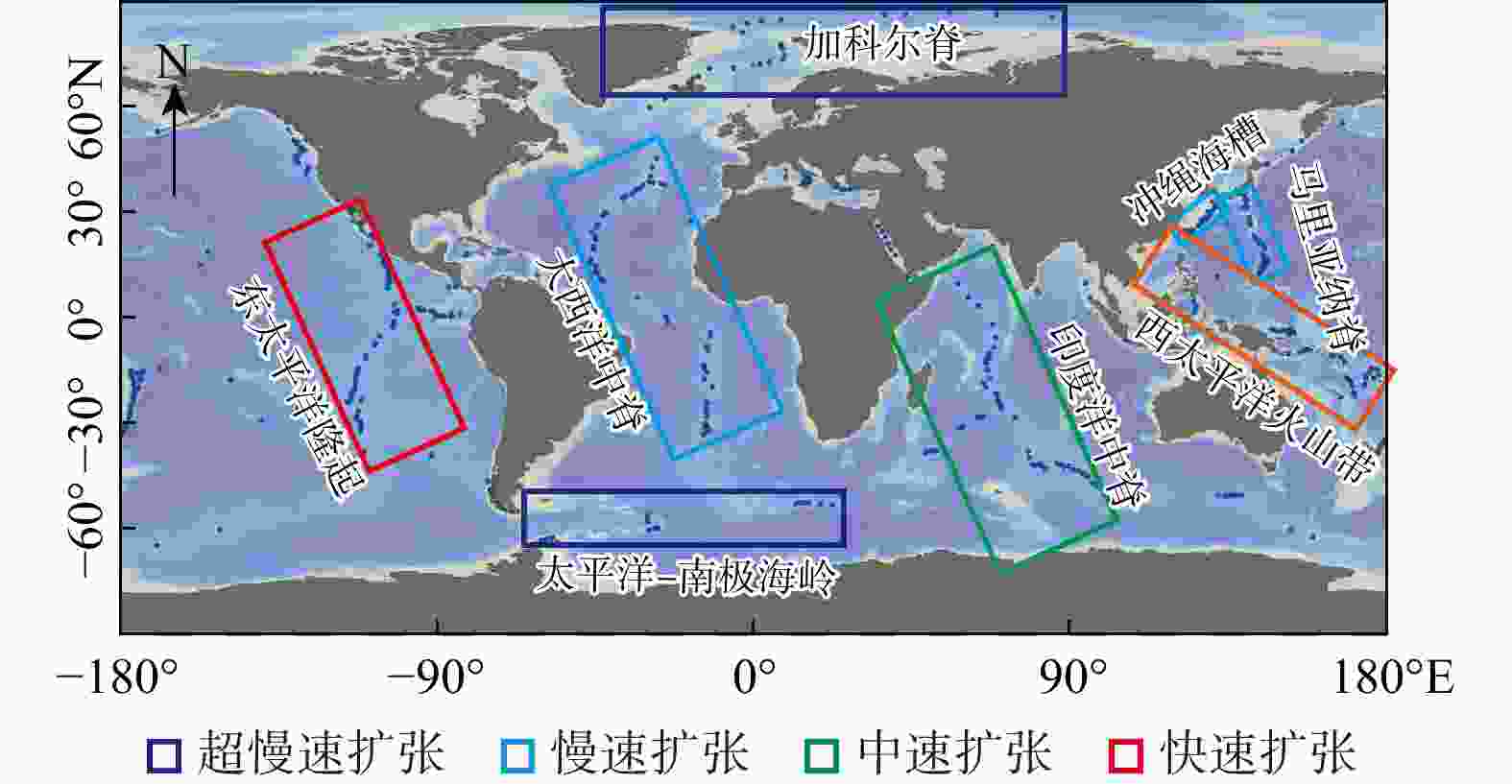
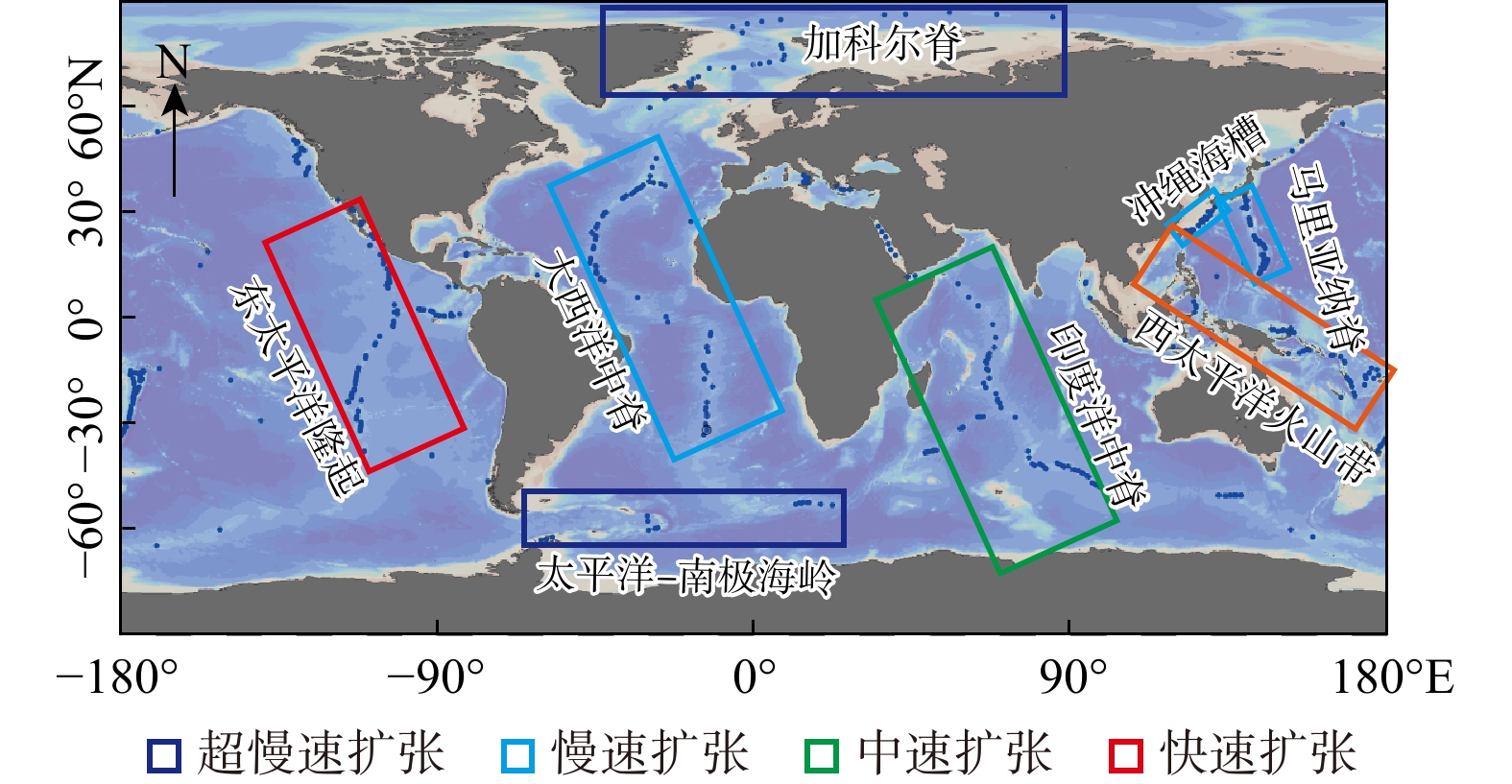
图 1 全球海洋热液烟囱分布以及主要热液区域平均扩张速率
Figure 1. Global distribution of submarine hydrothermal vents and average spreading rates of major hydrothermal fields
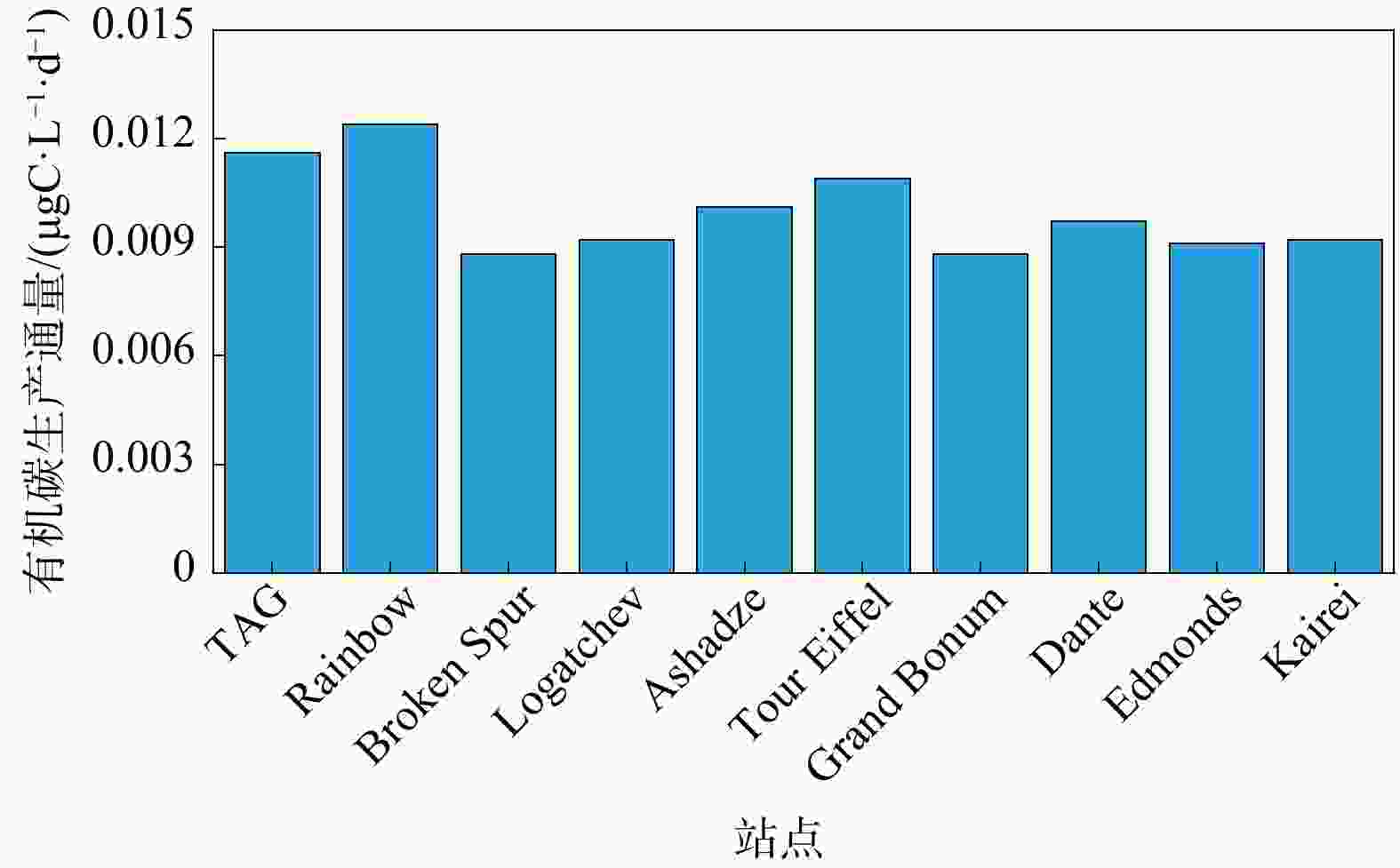
图 2 不同热液系统热液羽流有机碳生产通量[28]
Figure 2. Organic carbon production flux of hydrothermal plumes in different hydrothermal systems
-
[1] BAKER E T. Exploring the ocean for hydrothermal venting: New techniques, new discoveries, new insights[J]. Ore Geology Reviews, 2017, 86: 55-69. [2] EVANS W C, VAN SOEST M C, MARINER R H, et al. Magmatic intrusion west of Three Sisters, central Oregon, USA: The perspective from spring geochemistry[J]. Geology, 2004, 32(1): 69. [3] TIVEY M. Generation of seafloor hydrothermal vent fluids and associated mineral deposits[J]. Oceanography, 2007, 20(1): 50-65. doi: 10.5670/oceanog.2007.80 [4] CHIODINI G, CARDELLINI C, DI LUCCIO F, et al. Correlation between tectonic CO2 Earth degassing and seismicity is revealed by a 10-year record in the Apennines, Italy[J]. Science Advances, 2020, 6(35): eabc2938. doi: 10.1126/sciadv.abc2938 [5] KADKO D C, ROSENBERG N D, LUPTON J E, et al. Chemical reaction rates and entrainment within the Endeavour Ridge hydrothermal plume[J]. Earth and Planetary Science Letters, 1990, 99(4): 315-335. doi: 10.1016/0012-821X(90)90137-M [6] LUTHER III G W. Hydrothermal vents are a source of old refractory organic carbon to the deep ocean[J]. Geophysical Research Letters, 2021, 48(17): e2021GL094869. doi: 10.1029/2021GL094869 [7] LIN H T, BUTTERFIELD D A, BAKER E T, et al. Organic biogeochemistry in West Mata, NE Lau hydrothermal vent fields[J]. Geochemistry, Geophysics, Geosystems, 2021, 22(4): e2020GC009481. doi: 10.1029/2020gc009481 [8] ZENG X, ALAIN K, SHAO Z Z. Microorganisms from deep-sea hydrothermal vents[J]. Marine Life Science & Technology, 2021, 3(2): 204-230. doi: 10.1007/s42995-020-00086-4 [9] RESING J A, LUPTON J E, FEELY R A, et al. CO2 and 3He in hydrothermal plumes: Implications for mid-ocean ridge CO2 flux[J]. Earth and Planetary Science Letters, 2004, 226(3/4): 449-464. doi: 10.1016/j.jpgl.2004.07.028 [10] FITZSIMMONS J N, JOHN S G, MARSAY C M, et al. Iron persistence in a distal hydrothermal plume supported by dissolved-particulate exchange[J]. Nature Geoscience, 2017, 10(3): 195-201. doi: 10.1038/ngeo2900 [11] BURTON M R, SAWYER G M, GRANIERI D. Deep carbon emissions from volcanoes[J]. Reviews in Mineralogy and Geochemistry, 2013, 75(1): 323-354. [12] MOTTL M J, MCCONACHY T F. Chemical processes in buoyant hydrothermal plumes on the East Pacific Rise near 21°N[J]. Geochimica et Cosmochimica Acta, 1990, 54(7): 1911-1927. doi: 10.1016/0016-7037(90)90261-I [13] EDMOND J M. Oceanic vents: Seafloor hydrothermal systems. Physical, chemical, biological, and geological interactions[J]. Science, 1996, 271(5255): 1508. [14] COMITA P B, GAGOSIAN R B, WILLIAMS P M. Suspended particulate organic material from hydrothermal vent waters at 21°N[J]. Nature, 1984, 307(5950): 450-453. doi: 10.1038/307450a0 [15] BENNETT S A, COLEMAN M, HUBER J A, et al. Trophic regions of a hydrothermal plume dispersing away from an ultramafic-hosted vent-system: Von Damm vent-site, Mid-Cayman Rise[J]. Geochemistry, Geophysics, Geosystems, 2013, 14(2): 317-327. [16] MCCARTHY M D, BEAUPRÉ S R, WALKER B D, et al. Chemosynthetic origin of 14C-depleted dissolved organic matter in a ridge-flank hydrothermal system[J]. Nature Geoscience, 2011, 4(1): 32-36. [17] PLANK T, MANNING C E. Subducting carbon[J]. Nature, 2019, 574(7778): 343-352. doi: 10.1038/s41586-019-1643-z [18] WIGNALL P B. Large igneous provinces and mass extinctions[J]. Earth-Science Reviews, 2001, 53(1/2): 1-33. doi: 10.1130/2014.2505(02) [19] HALL-SPENCER J M, RODOLFO-METALPA R, MARTIN S, et al. Volcanic carbon dioxide vents show ecosystem effects of ocean acidification[J]. Nature, 2008, 454(7200): 96-99. doi: 10.1038/nature07051 [20] RASMUSSEN B, MUHLING J R. Organic carbon generation in 3.5-billion-year-old basalt-hosted seafloor hydrothermal vent systems[J]. Science Advances, 2023, 9(5): eadd7925. doi: 10.1126/sciadv.add7925 [21] MCCOLLOM T M, SHOCK E L. Geochemical constraints on chemolithoautotrophic metabolism by microorganisms in seafloor hydrothermal systems[J]. Geochimica et Cosmochimica Acta, 1997, 61(20): 4375-4391. doi: 10.1016/S0016-7037(97)00241-X [22] LANG S Q, BUTTERFIELD D A, SCHULTE M, et al. Elevated concentrations of formate, acetate and dissolved organic carbon found at the Lost City hydrothermal field[J]. Geochimica et Cosmochimica Acta, 2010, 74(3): 941-952. doi: 10.1016/j.gca.2009.10.045 [23] TILLIETTE C, GAZEAU F, CHAVAGNAC V, et al. Significant impact of hydrothermalism on the biogeochemical signature of sinking and sedimented particles in the Lau Basin[J]. Journal of Geophysical Research: Oceans, 2023, 128(12): e2023JC019828. doi: 10.1029/2023jc019828 [24] ROOHI R, HOOGENBOOM R, VAN BOMMEL R, et al. Influence of chemoautotrophic organic carbon on sediment and its infauna in the vicinity of the Rainbow vent field[J]. Frontiers in Marine Science, 2022, 9: 732740. doi: 10.3389/fmars.2022.732740 [25] BEATTY J T, OVERMANN J, LINCE M T, et al. An obligately photosynthetic bacterial anaerobe from a deep-sea hydrothermal vent[J]. Proceedings of the National Academy of Sciences of the United States of America, 2005, 102(26): 9306-9310. [26] PEREZ N, CARDENAS R, MARTIN O, et al. The potential for photosynthesis in hydrothermal vents: A new avenue for life in the Universe?[J]. Astrophysics and Space Science, 2013, 346(2): 327-331. doi: 10.1007/s10509-013-1460-z [27] JANNASCH H W, MOTTL M J. Geomicrobiology of deep-sea hydrothermal vents[J]. Science, 1985, 229(4715): 717-725. doi: 10.1126/science.229.4715.717 [28] CATHALOT C, ROUSSEL E G, PERHIRIN A, et al. Hydrothermal plumes as hotspots for deep-ocean heterotrophic microbial biomass production[J]. Nature Communications, 2021, 12: 6861. doi: 10.1038/s41467-021-26877-6 [29] LI Y N, TASSIA M G, WAITS D S, et al. Genomic adaptations to chemosymbiosis in the deep-sea seep-dwelling tubeworm Lamellibrachia luymesi[J]. BMC Biology, 2019, 17(1): 91. doi: 10.1186/s12915-019-0713-x [30] WATANABE H K, CHEN C, CHAN B K K. A new deep-sea hot vent stalked barnacle from the Mariana Trough with notes on the feeding ecology of Vulcanolepas[J]. Marine Biodiversity, 2021, 51(1): 9. doi: 10.1007/s12526-020-01144-x [31] MASON R P, CHOI A L, FITZGERALD W F, et al. Mercury biogeochemical cycling in the ocean and policy implications[J]. Environmental Research, 2012, 119: 101-117. doi: 10.1016/j.envres.2012.03.013 [32] GERMAN C R, CASCIOTTI K A, DUTAY J C, et al. Hydrothermal impacts on trace element and isotope ocean biogeochemistry[J]. Philosophical Transactions of the Royal Society A: Mathematical, Physical and Engineering Sciences, 2016, 374(2081): 20160035. doi: 10.1098/rsta.2016.0035 [33] KALVODA J, KUMPAN T, QIE W K, et al. Mercury spikes at the Devonian-Carboniferous boundary in the eastern part of the Rhenohercynian Zone (central Europe) and in the South China Block[J]. Palaeogeography, Palaeoclimatology, Palaeoecology, 2019, 531: 109221. doi: 10.1016/j.palaeo.2019.05.043 [34] SHEN J, ALGEO T J, CHEN J B, et al. Mercury in marine Ordovician/Silurian boundary sections of South China is sulfide-hosted and non-volcanic in origin[J]. Earth and Planetary Science Letters, 2019, 511: 130-140. doi: 10.1016/j.jpgl.2019.01.028 [35] JONES M T, PERCIVAL L M E, STOKKE E W, et al. Mercury anomalies across the palaeocene-Eocene thermal maximum[J]. Climate of the Past, 2019, 15(1): 217-236. doi: 10.5194/cp-15-217-2019 [36] SMOLAREK-LACH J, MARYNOWSKI L, TRELA W, et al. Mercury spikes indicate a volcanic trigger for the Late Ordovician mass extinction event: An example from a deep shelf of the peri-Baltic region[J]. Scientific Reports, 2019, 9: 3139. doi: 10.1038/s41598-019-39333-9 [37] WANG Y P, PEI W L, YANG J L, et al. The relationship between volcanism and global climate changes in the Tropical Western Pacific over the mid-Pleistocene transition: Evidence from mercury concentration and isotopic composition[J]. Science of the Total Environment, 2022, 823: 153482. doi: 10.1016/j.scitotenv.2022.153482 [38] XU L, LECHTE M, SHI X Y, et al. Large igneous province emplacement triggered an oxygenation event at ~1.4 Ga: Evidence from mercury and paleo-productivity proxies[J]. Geophysical Research Letters, 2024, 51(2): e2023GL106654. [39] ACHBERGER A M, JONES R, JAMIESON J, et al. Inactive hydrothermal vent microbial communities are important contributors to deep ocean primary productivity[J]. Nature Microbiology, 2024, 9(3): 657-668. doi: 10.1038/s41564-024-01599-9 [40] SIEVERT S, VETRIANI C. Chemoautotrophy at deep-sea vents: Past, present, and future[J]. Oceanography, 2012, 25(1): 218-233. [41] REYSENBACH A L, SHOCK E. Merging genomes with geochemistry in hydrothermal ecosystems[J]. Science, 2002, 296(5570): 1077-1082. doi: 10.1126/science.1072483 [42] LEVIN L A, BACO A R, BOWDEN D A, et al. Hydrothermal vents and methane seeps: Rethinking the sphere of influence[J]. Frontiers in Marine Science, 2016, 3: 72. [43] MINIC Z, THONGBAM P D. The biological deep sea hydrothermal vent as a model to study carbon dioxide capturing enzymes[J]. Marine Drugs, 2011, 9(5): 719-738. doi: 10.3390/md9050719 [44] NUNOURA T, CHIKARAISHI Y, IZAKI R, et al. A primordial and reversible TCA cycle in a facultatively chemolithoautotrophic thermophile[J]. Science, 2018, 359(6375): 559-563. doi: 10.1126/science.aao3407 [45] DICK G J. The microbiomes of deep-sea hydrothermal vents: Distributed globally, shaped locally[J]. Nature Reviews Microbiology, 2019, 17(5): 271-283. [46] ZHONG J, WANG L N, CARACAUSI A, et al. Assessing the deep carbon release in an active volcanic field using hydrochemistry, δ13CDIC and Δ14CDIC[J]. Journal of Geophysical Research: Biogeosciences, 2023, 128(4): e2023JG007435. doi: 10.1029/2023jg007435 [47] VAN DOVER C L. The ecology of deep-sea hydrothermal vents[M]. Princeton: Princeton University Press, 2000. [48] CORLISS J B, DYMOND J, GORDON L I, et al. Submarine thermal springs on the Galapagos rift[J]. Science, 1979, 203(4385): 1073-1083. doi: 10.1126/science.203.4385.1073 [49] BRIGHT M, GOLLNER S, DE OLIVEIRA A L, et al. Animal life in the shallow subseafloor crust at deep-sea hydrothermal vents[J]. Nature Communications, 2024, 15: 8466. doi: 10.1038/s41467-024-52631-9 [50] HOU J L, SIEVERT S M, WANG Y Z, et al. Microbial succession during the transition from active to inactive stages of deep-sea hydrothermal vent sulfide chimneys[J]. Microbiome, 2020, 8(1): 102. doi: 10.1186/s40168-020-00851-8 [51] LUPTON J E, DELANEY J R, JOHNSON H P, et al. Entrainment and vertical transport of deep-ocean water by buoyant hydrothermal plumes[J]. Nature, 1985, 316(6029): 621-623. doi: 10.1038/316621a0 [52] RESING J A, SEDWICK P N, GERMAN C R, et al. Basin-scale transport of hydrothermal dissolved metals across the South Pacific Ocean[J]. Nature, 2015, 523(7559): 200-203. doi: 10.1038/nature14577 [53] MCCOLLOM T M. Geochemical constraints on primary productivity in submarine hydrothermal vent plumes[J]. Deep Sea Research Part Ⅰ: Oceanographic Research Papers, 2000, 47(1): 85-101. doi: 10.1016/S0967-0637(99)00048-5 [54] MCNICHOL J, STRYHANYUK H, SYLVA S P, et al. Primary productivity below the seafloor at deep-sea hot springs[J]. Proceedings of the National Academy of Sciences of the United States of America, 2018, 115(26): 6756-6761. [55] DEL GIORGIO P A, DUARTE C M. Respiration in the open ocean[J]. Nature, 2002, 420(6914): 379-384. doi: 10.1038/nature01165 [56] BENNETT S A, STATHAM P J, GREEN D R H, et al. Dissolved and particulate organic carbon in hydrothermal plumes from the East Pacific Rise, 9°50′N[J]. Deep Sea Research Part Ⅰ: Oceanographic Research Papers, 2011, 58(9): 922-931. doi: 10.1016/j.dsr.2011.06.010 [57] MARSH L, COPLEY J T, HUVENNE V A I, et al. Microdistribution of faunal assemblages at deep-sea hydrothermal vents in the Southern Ocean[J]. PLoS One, 2012, 7(10): e48348. doi: 10.1371/journal.pone.0048348 [58] GOLLNER S, GOVENAR B, FISHER C R, et al. Size matters at deep-sea hydrothermal vents: Different diversity and habitat fidelity patterns of meio- and macrofauna[J]. Marine Ecology Progress Series, 2015, 520: 57-66. doi: 10.3354/meps11078 [59] TIVEY M K, HUMPHRIS S E, THOMPSON G, et al. Deducing patterns of fluid flow and mixing within the TAG active hydrothermal mound using mineralogical and geochemical data[J]. Journal of Geophysical Research: Solid Earth, 1995, 100(B7): 12527-12555. doi: 10.1029/95JB00610 [60] JAMES R H, ELDERFIELD H. Chemistry of ore-forming fluids and mineral formation rates in an active hydrothermal sulfide deposit on the Mid-Atlantic Ridge[J]. Geology, 1996, 24(12): 1147-1150. doi: 10.1130/0091-7613(1996)024<1147:COOFFA>2.3.CO;2 [61] TONER B M, FAKRA S C, MANGANINI S J, et al. Preservation of iron (Ⅱ) by carbon-rich matrices in a hydrothermal plume[J]. Nature Geoscience, 2009, 2(3): 197-201. doi: 10.1038/ngeo433 [62] SANDER S G, KOSCHINSKY A. Metal flux from hydrothermal vents increased by organic complexation[J]. Nature Geoscience, 2011, 4(3): 145-150. doi: 10.1038/ngeo1088 [63] GRELON D, MORINEAUX M, DESROSIERS G, et al. Feeding and territorial behavior of Paralvinella sulfincola, a polychaete worm at deep-sea hydrothermal vents of the Northeast Pacific Ocean[J]. Journal of Experimental Marine Biology and Ecology, 2006, 329(2): 174-186. doi: 10.1016/j.jembe.2005.08.017 [64] YAHAGI T, WATANABE H, ISHIBASHI J, et al. Genetic population structure of four hydrothermal vent shrimp species (Alvinocarididae) in the Okinawa Trough, Northwest Pacific[J]. Marine Ecology Progress Series, 2015, 529: 159-169. doi: 10.3354/meps11267 [65] ZHAO K, ZHU G Y, MENG X H, et al. Enrichment of mercury in the Lower Cambrian sedimentary successions by submarine hydrothermal venting[J]. Journal of Asian Earth Sciences, 2022, 240: 105439. doi: 10.1016/j.jseaes.2022.105439 [66] COALE K H, JOHNSON K S, FITZWATER S E, et al. A massive phytoplankton bloom induced by an ecosystem-scale iron fertilization experiment in the equatorial Pacific Ocean[J]. Nature, 1996, 383(6600): 495-501. doi: 10.1038/383495a0 [67] NOMAKI H, CHEN C, OGAWA N O, et al. Elucidating carbon sources of hydrothermal vent animals using natural 14C abundances and habitat water temperature[J]. Limnology and Oceanography, 2024, 69(5): 1270-1284. doi: 10.1002/lno.12570 [68] PAN A Y, YANG Q H, ZHOU H Y, et al. Geochemical impacts of hydrothermal activity on surface deposits at the Southwest Indian Ridge[J]. Deep Sea Research Part Ⅰ: Oceanographic Research Papers, 2018, 139: 1-13. doi: 10.1016/j.dsr.2018.05.009 [69] LONGMAN J, GERNON T M, PALMER M R, et al. Tephra deposition and bonding with reactive oxides enhances burial of organic carbon in the Bering Sea[J]. Global Biogeochemical Cycles, 2021, 35(11): e2021GB007140. doi: 10.1029/2021GB007140 [70] KENDER S, BOGUS K, PEDERSEN G K, et al. Paleocene/Eocene carbon feedbacks triggered by volcanic activity[J]. Nature Communications, 2021, 12: 5186. doi: 10.1038/s41467-021-25536-0 [71] DRUFFEL E R M, GRIFFIN S, LEWIS C B, et al. Dissolved organic radiocarbon in the eastern Pacific and southern oceans[J]. Geophysical Research Letters, 2021, 48(10): e2021GL092904. doi: 10.1029/2021GL092904 [72] FENDLEY I M, FRIELING J, MATHER T A, et al. Early Jurassic large igneous province carbon emissions constrained by sedimentary mercury[J]. Nature Geoscience, 2024, 17(3): 241-248. doi: 10.1038/s41561-024-01378-5 [73] HOLDAWAY R N, DUFFY B, KENNEDY B. Evidence for magmatic carbon bias in 14C dating of the Taupo and other major eruptions[J]. Nature Communications, 2018, 9: 4110. doi: 10.1038/s41467-018-06357-0 [74] VROON P Z, VAN ZADELHOFF H M, VAN DER VALK B, et al. New radiocarbon age constraints on the eruption history of the Quill volcano, St. Eustatius, Dutch Caribbean[J]. Netherlands Journal of Geosciences, 2024, 103: e4. doi: 10.1017/njg.2023.14 [75] SELIN N E. Global biogeochemical cycling of mercury: A review[J]. Annual Review of Environment and Resources, 2009, 34: 43-63. doi: 10.1146/annurev.environ.051308.084314 [76] MERRITT K A, AMIRBAHMAN A. Mercury methylation dynamics in estuarine and coastal marine environments: A critical review[J]. Earth-Science Reviews, 2009, 96(1/2): 54-66. doi: 10.1016/j.earscirev.2009.06.002 [77] LAMBORG C, BOWMAN K, HAMMERSCHMIDT C, et al. Mercury in the anthropocene ocean[J]. Oceanography, 2014, 27(1): 76-87. doi: 10.5670/oceanog.2014.11 [78] THEM T R II, JAGOE C H, CARUTHERS A H, et al. Terrestrial sources as the primary delivery mechanism of mercury to the oceans across the Toarcian Oceanic Anoxic Event (Early Jurassic)[J]. Earth and Planetary Science Letters, 2019, 507: 62-72. doi: 10.1016/j.jpgl.2018.11.029 [79] SHEN J, YIN R S, ZHANG S, et al. Intensified continental chemical weathering and carbon-cycle perturbations linked to volcanism during the Triassic-Jurassic transition[J]. Nature Communications, 2022, 13: 299. doi: 10.1038/s41467-022-27965-x [80] ERNST R E, YOUBI N. How large igneous provinces affect global climate, sometimes cause mass extinctions, and represent natural markers in the geological record[J]. Palaeogeography, Palaeoclimatology, Palaeoecology, 2017, 478: 30-52. doi: 10.1016/j.palaeo.2017.03.014 [81] SAUNDERS A, REICHOW M. The Siberian Traps and the End-Permian mass extinction: A critical review[J]. Chinese Science Bulletin, 2009, 54(1): 20-37. doi: 10.1007/s11434-008-0543-7 [82] RUBIN K H, SOULE S A, CHADWICK W W JR, et al. Volcanic eruptions in the deep sea[J]. Oceanography, 2012, 25(1): 142-157. doi: 10.5670/oceanog.2012.12 [83] GRASBY S E, THEM T R II, CHEN Z H, et al. Mercury as a proxy for volcanic emissions in the geologic record[J]. Earth-Science Reviews, 2019, 196: 102880. doi: 10.1016/j.earscirev.2019.102880 [84] RAVICHANDRAN M. Interactions between mercury and dissolved organic matter: A review[J]. Chemosphere, 2004, 55(3): 319-331. doi: 10.1016/j.chemosphere.2003.11.011 [85] SHEN J, FENG Q L, ALGEO T J, et al. Sedimentary host phases of mercury (Hg) and implications for use of Hg as a volcanic proxy[J]. Earth and Planetary Science Letters, 2020, 543: 116333. doi: 10.1016/j.jpgl.2020.116333 [86] SANEI H, GRASBY S E, BEAUCHAMP B. Latest Permian mercury anomalies[J]. Geology, 2012, 40(1): 63-66. doi: 10.1130/G32596.1 [87] QU Y, ZHONG H, LIU X T, et al. Coupling and decoupling between sedimentary mercury and organic carbon preservation in the oxygenated marine environment[J]. Geochemistry, Geophysics, Geosystems, 2024, 25(4): e2023GC011201. doi: 10.1029/2023gc011201 [88] OUTRIDGE P M, MASON R P, WANG F, et al. Updated global and oceanic mercury budgets for the united nations global mercury assessment 2018[J]. Environmental Science & Technology, 2018, 52(20): 11466-11477. doi: 10.1021/acs.est.8b01246.s001 [89] TORRES-RODRIGUEZ N, YUAN J J, PETERSEN S, et al. Mercury fluxes from hydrothermal venting at mid-ocean ridges constrained by measurements[J]. Nature Geoscience, 2024, 17(1): 51-57. doi: 10.1038/s41561-023-01341-w [90] RASMUSSEN P E. Current methods of estimating atmospheric mercury fluxes in remote areas[J]. Environmental Science & Technology, 1994, 28(13): 2233-2241. doi: 10.1021/es00062a006 [91] FITZGERALD W F, ENGSTROM D R, MASON R P, et al. The case for atmospheric mercury contamination in remote areas[J]. Environmental Science & Technology, 1998, 32(1): 1-7. [92] GAMBOA RUIZ W L, TOMIYASU T. Distribution of mercury in sediments from Kagoshima Bay, Japan, and its relationship with physical and chemical factors[J]. Environmental Earth Sciences, 2015, 74(2): 1175-1188. doi: 10.1007/s12665-015-4104-5 [93] PYLE D M, MATHER T A. The importance of volcanic emissions for the global atmospheric mercury cycle[J]. Atmospheric Environment, 2003, 37(36): 5115-5124. doi: 10.1016/j.atmosenv.2003.07.011 [94] JIN S M, KEMP D B, YIN R S, et al. Mercury isotope evidence for protracted North Atlantic magmatism during the Paleocene-Eocene Thermal Maximum[J]. Earth and Planetary Science Letters, 2023, 602: 117926. doi: 10.1016/j.jpgl.2022.117926 [95] HAITZER M, AIKEN G R, RYAN J N. Binding of mercury (Ⅱ) to dissolved organic matter: The role of the mercury-to-DOM concentration ratio[J]. Environmental Science & Technology, 2002, 36(16): 3564-3570. doi: 10.1021/es025699i [96] OUTRIDGE P M, SANEI H, STERN G A, et al. Evidence for control of mercury accumulation rates in Canadian high Arctic Lake sediments by variations of aquatic primary productivity[J]. Environmental Science & Technology, 2007, 41(15): 5259-5265. doi: 10.1021/es070408x [97] BOWMAN K L, HAMMERSCHMIDT C R, LAMBORG C H, et al. Distribution of mercury species across a zonal section of the eastern tropical South Pacific Ocean (U. S. GEOTRACES GP16)[J]. Marine Chemistry, 2016, 186: 156-166. doi: 10.1016/j.marchem.2016.09.005 [98] COSSA D, HEIMBÜRGER L E, PÉREZ F F, et al. Mercury distribution and transport in the North Atlantic Ocean along the GEOTRACES-GA01 transect[J]. Biogeosciences, 2018, 15(8): 2309-2323. doi: 10.5194/bg-15-2309-2018 [99] CHARBONNIER G, ADATTE T, FÖLLMI K B, et al. Effect of intense weathering and postdepositional degradation of organic matter on Hg/TOC proxy in organic-rich sediments and its implicationsfor deep-time investigations[J]. Geochemistry, Geophysics, Geosystems, 2020, 21(2): e2019GC008707. doi: 10.1029/2019gc008707 [100] ASTAKHOV A S, IVANOV M V, LI B Y. Hydrochemical and atmochemical mercury dispersion zones over hydrothermal vents of the submarine Piip Volcano in the Bering Sea[J]. Oceanology, 2011, 51(5): 826-835. doi: 10.1134/S0001437011050031 [101] BAGNATO E, OLIVERI E, ACQUAVITA A, et al. Hydrochemical mercury distribution and air-sea exchange over the submarine hydrothermal vents off-shore Panarea Island (Aeolian arc, Tyrrhenian Sea)[J]. Marine Chemistry, 2017, 194: 63-78. doi: 10.1016/j.marchem.2017.04.003 [102] BOWMAN K L, HAMMERSCHMIDT C R, LAMBORG C H, et al. Mercury in the North Atlantic Ocean: The U. S. GEOTRACES zonal and meridional sections[J]. Deep Sea Research Part Ⅱ: Topical Studies in Oceanography, 2015, 116: 251-261. [103] ROBERTS H, PRICE R, BROMBACH C C, et al. Mercury in the hydrothermal fluids and gases in Paleochori Bay, Milos, Greece[J]. Marine Chemistry, 2021, 233: 103984. [104] BOWMAN K L, LAMBORG C H, AGATHER A M. A global perspective on mercury cycling in the ocean[J]. Science of the Total Environment, 2020, 710: 136166. doi: 10.1016/j.scitotenv.2019.136166 [105] WANG Z H, TAN J Q, BOYLE R, et al. Mercury anomalies within the Lower Cambrian (stage 2−3) in South China: Links between volcanic events and paleoecology[J]. Palaeogeography, Palaeoclimatology, Palaeoecology, 2020, 558: 109956. [106] HAYES C T, COSTA K M, ANDERSON R F, et al. Global ocean sediment composition and burial flux in the deep sea[J]. Global Biogeochemical Cycles, 2021, 35(4): e2020GB006769. doi: 10.1029/2020GB006769 -

 下载:
下载:

 点击查看大图
计量
- 文章访问数: 637
- PDF下载量: 189
- 被引次数: 0