投审稿入口
投审稿入口


-
摘要:
海底流滑是发生在河口三角洲、陆架坡折带和深海陆坡的典型海底物质运动形式,其强流动性与长距离运移能力易对海底通信光缆、油气生产设施造成严重破坏,已成为海洋工程安全的主要威胁之一。深入解析海底流滑的形成机制,是实现该灾害精准预测与有效防控的关键,对保障海洋工程安全运营具有重要现实意义。当前海底流滑研究多聚焦于触发因素、形成机制与沉积特征分析,鲜有从研究方法论角度开展系统性综述。本研究在系统梳理国内外相关研究进展的基础上,详细剖析液化流滑和破裂流滑2种典型形成机制,重点综述物理模型试验、数值模拟及现场观测3类核心研究手段的发展历程与适用特性,并探讨当前研究面临的挑战。研究明确了2种典型流滑机制的地质力学特征与适用场景,厘清了物理模型试验、数值模拟、现场观测3类研究手段的技术特点、应用边界及发展现状,发现不同研究手段在技术优势、适用范围上存在显著互补性,需多方法协同方能实现对海底流滑的全方位研究。未来海底流滑研究应聚焦四大方向:开展跨学科合作揭示流滑复合作用机制;研发大尺度精细化物理模型试验技术;融合高性能计算与人工智能发展新型数值模拟方法;完善多尺度、全方位、长周期的现场观测技术与原位监测体系,以期为海底流滑灾害的预测预警与防控提供技术支撑。
Abstract:SignificanceSubmarine landslides are a typical form of submarine mass movement occurring in estuarine deltas, shelf slope breaks, and deep-sea continental slopes. Their remarkable fluidity and long-distance migration capacity can cause severe damage to submarine communication cables, oil and gas production facilities, and other critical marine infrastructures, and it has become one of the major geological hazards threatening the safety of marine engineering activities. With the in-depth advancement of marine resource development and the implementation of marine power strategies in coastal countries, marine engineering is rapidly extending from shallow coastal waters to the deep sea, making the prevention and control of submarine landslide disasters an increasingly urgent practical engineering problem. In-depth analysis of the formation mechanisms of submarine landslides and a systematic summary of their research methodologies are the core steps to achieve accurate prediction and effective prevention of such disasters, which is of great practical significance for ensuring the safe operation of marine engineering and the sustainable development of marine resources.
MethodsAt present, most domestic and foreign studies on submarine landslides focus on the analysis of triggering factors, formation mechanisms, and sedimentary characteristics, while few scholars have conducted a systematic and comprehensive review from the perspective of research methodology. Based on the systematic review and in-depth analysis of the latest research progress at home and abroad, this study firstly elaborates on the geomechanical characteristics, occurrence conditions, and applicable scenarios of two typical formation mechanisms of submarine landslides, namely liquefaction landslide and breach landslide. Then, it focuses on reviewing the development history, technical characteristics, application boundaries, and adaptability of three core research methods for submarine landslide research: Physical model tests (including flume tests, rotating flume tests, and centrifuge tests), numerical simulation (including constitutive models and discrete methods), and field observation and in-situ monitoring (including geophysical surveys and multi-type sensor monitoring). On this basis, the key technical challenges faced by the current research of each method are further analyzed and discussed.
ResultsThe research results clarify the essential differences and occurrence patterns of the two typical formation mechanisms of submarine landslides, and define the geological conditions suitable for the occurrence of liquefaction landslides and breach landslides, respectively. It systematically summarizes the technical advantages, application scope, and existing limitations of physical model tests, numerical simulation, and field observation methods in submarine landslide research, and reveals the significant complementarity of different research methods in terms of technical characteristics and application scenarios. It is found that a single research method is difficult to fully and accurately characterize the entire process of submarine landslide from initiation and evolution to deposition, and that multi-method collaborative research is the only way to realize all-round and in-depth study of submarine landslides. In addition, the study summarizes the technical development trends of various research methods and identifies the key technical bottlenecks restricting in-depth research on submarine landslides at this stage.
ConclusionFuture research on submarine landslides should focus on four key directions: Carrying out interdisciplinary cooperation to reveal the composite mechanisms of multi-factor coupling in submarine landslides; Developing large-scale and refined physical model testing technologies to improve the similarity between model tests and actual engineering conditions; Integrating high-performance computing and artificial intelligence technologies to innovate numerical simulation methods for submarine landslides and improve simulation accuracy and efficiency; Enhancing multi-scale, all-round, and long-term field observation technologies and in-situ monitoring systems, constructing a comprehensive early warning system for submarine landslide disasters. This study systematically organizes the research framework of submarine landslides from a methodological perspective, which not only deepens the understanding of the formation mechanisms and research methods of submarine landslides, but also provides important technical references and research ideas for the prediction, early warning, and prevention of submarine landslide disasters in marine engineering practice.
-
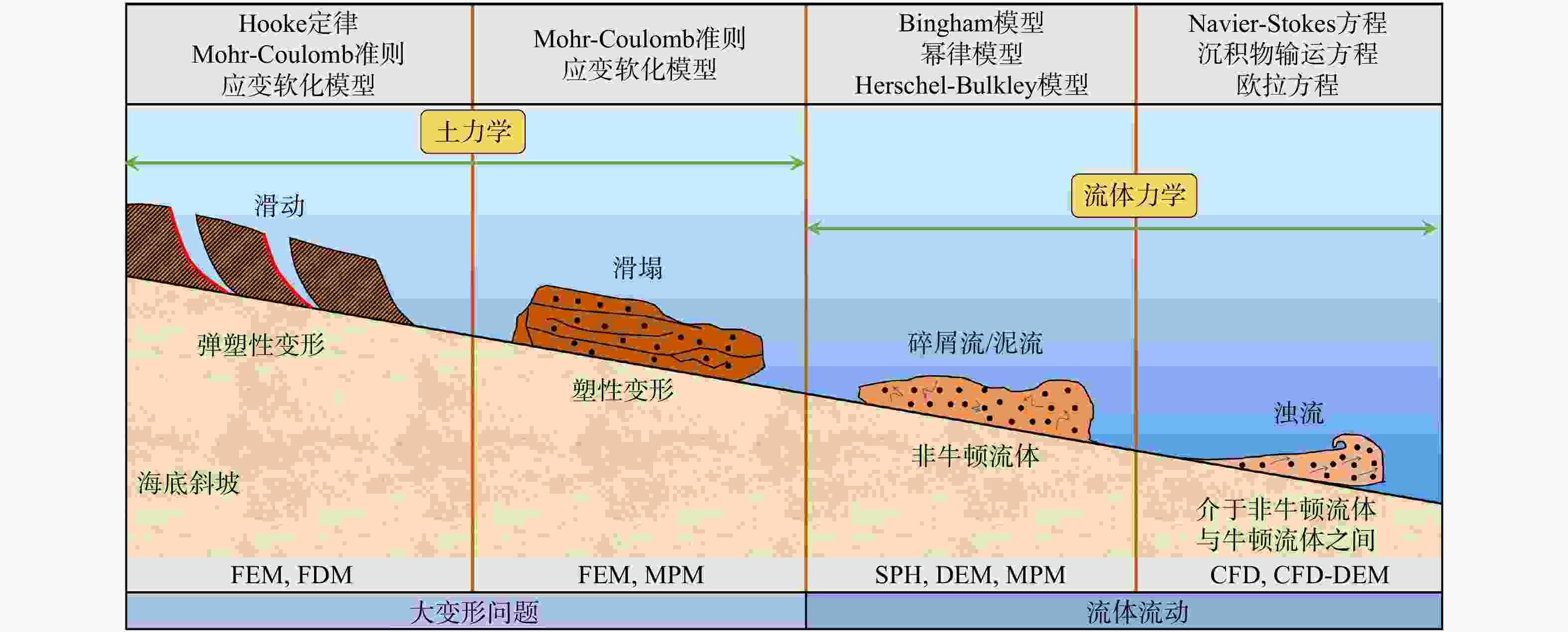
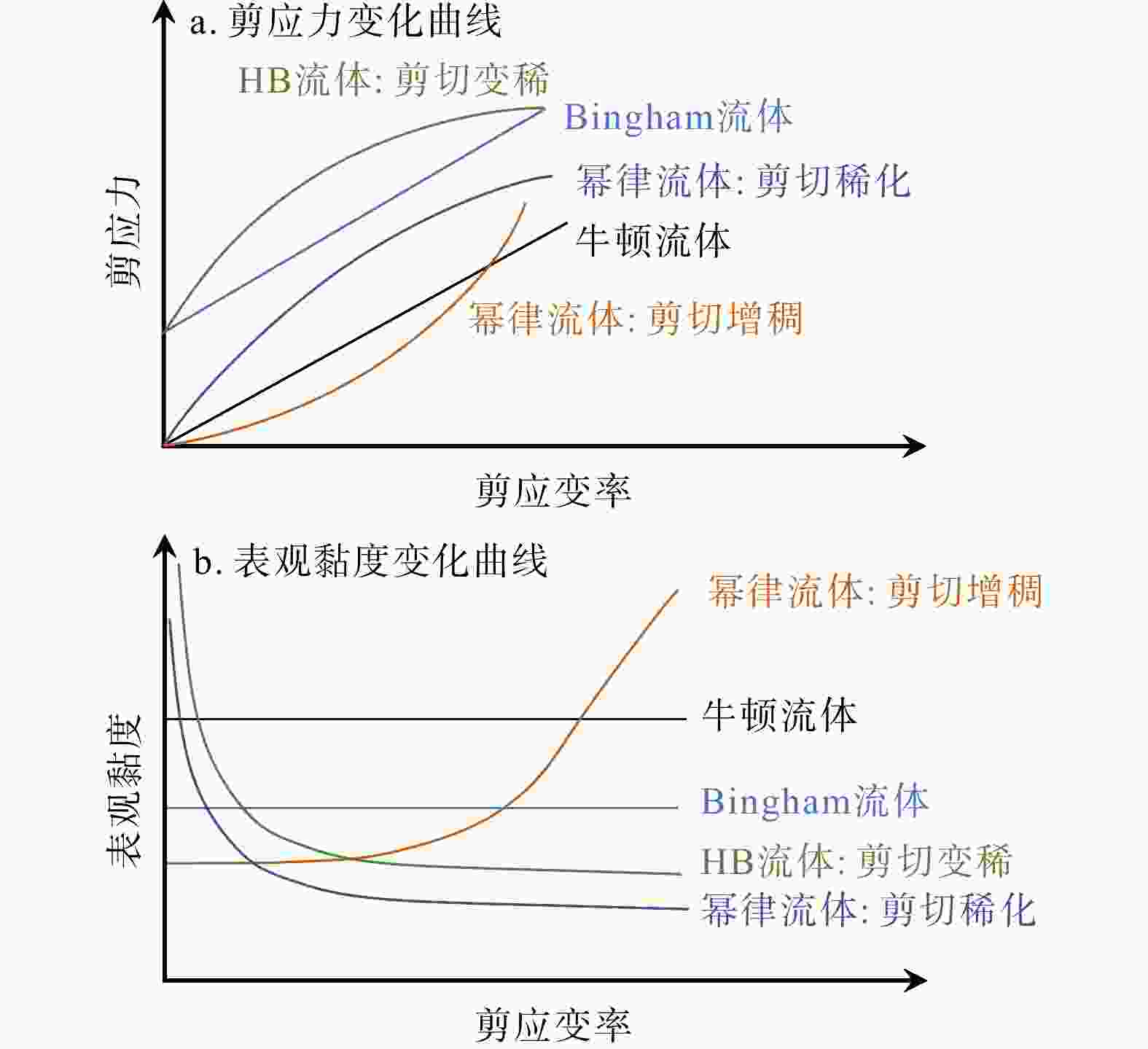
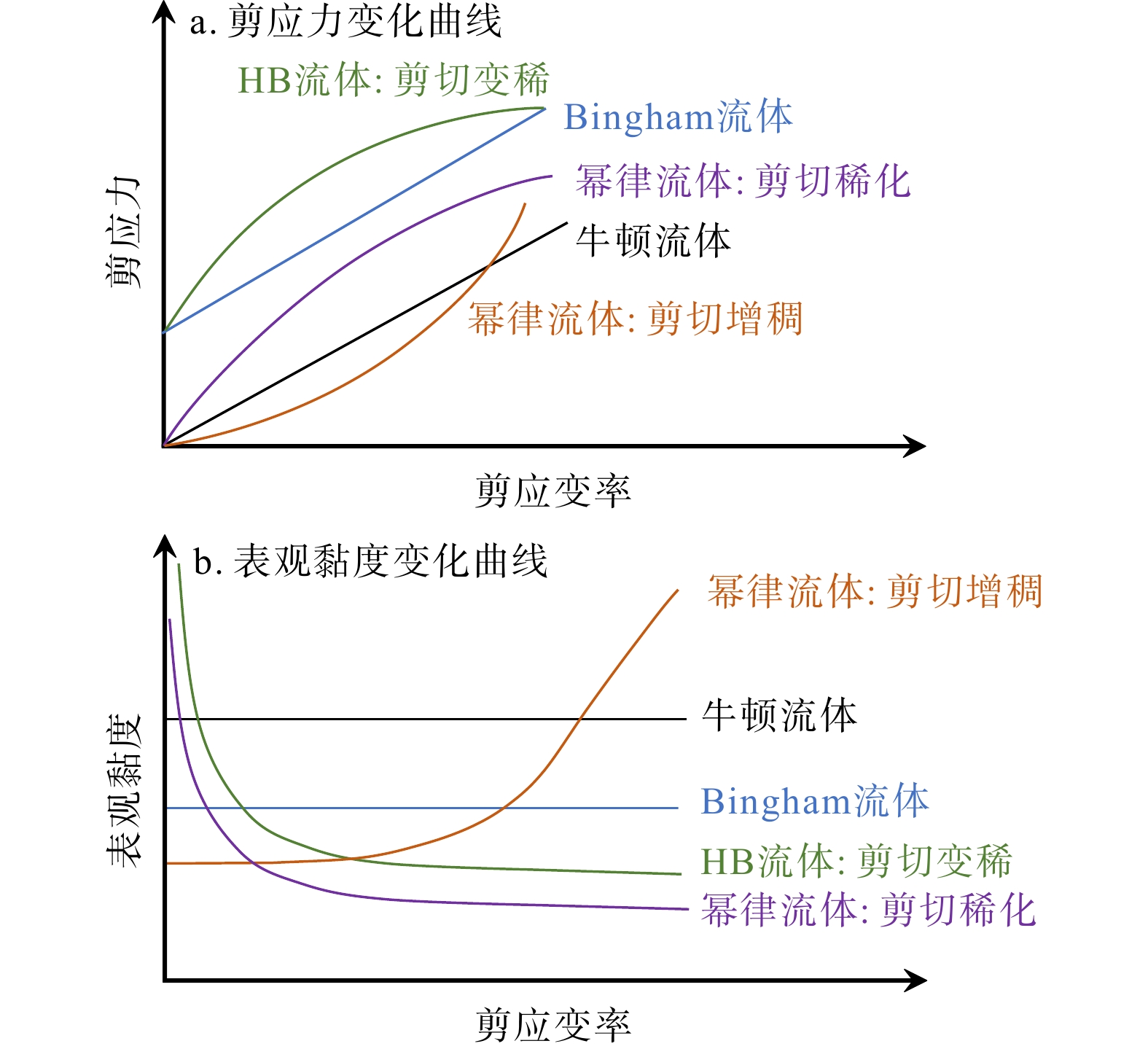
图 6 常用流变模型的应力−应变关系[67]
Figure 6. Stress-strain relationships of common rheological models
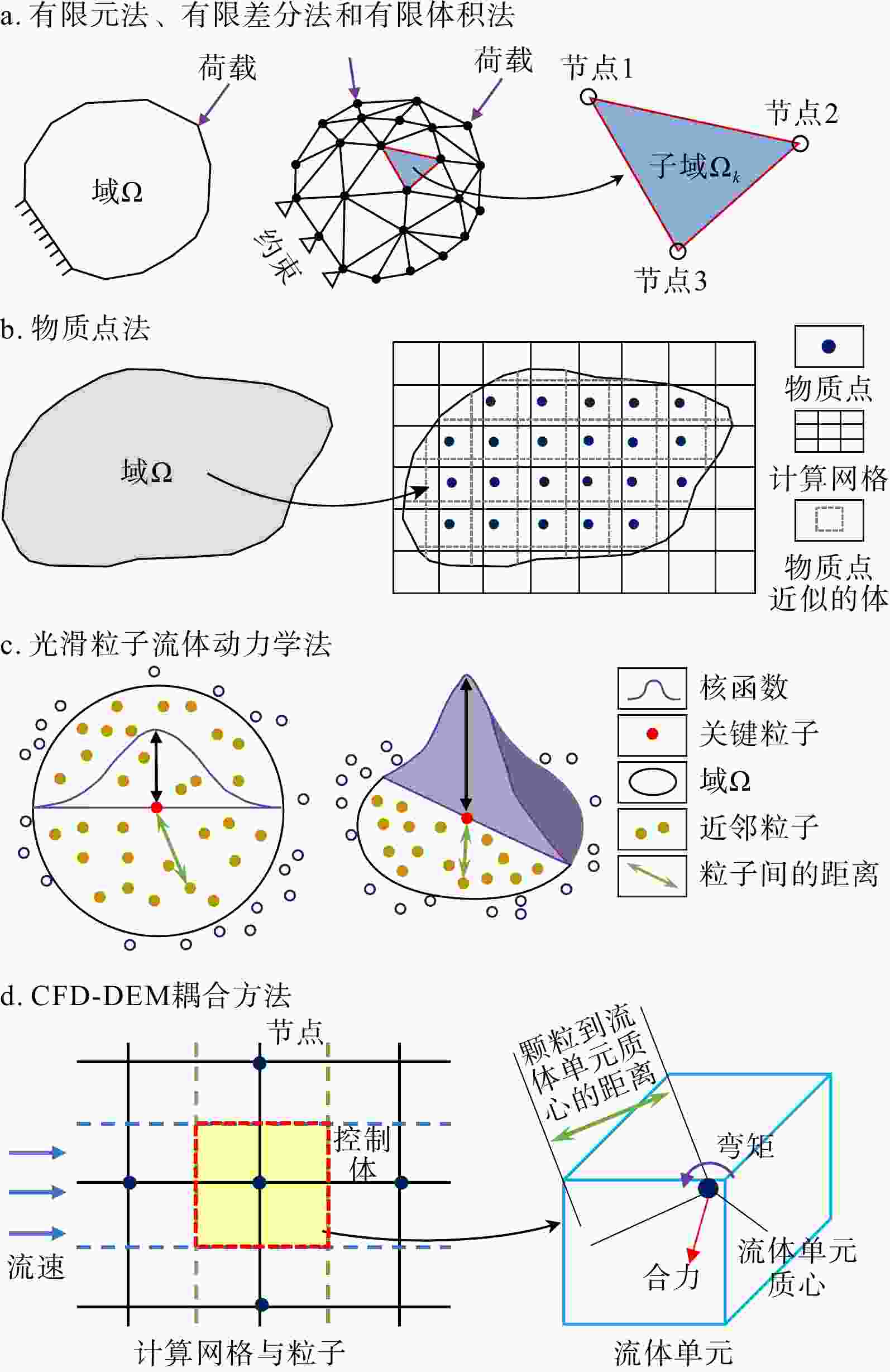
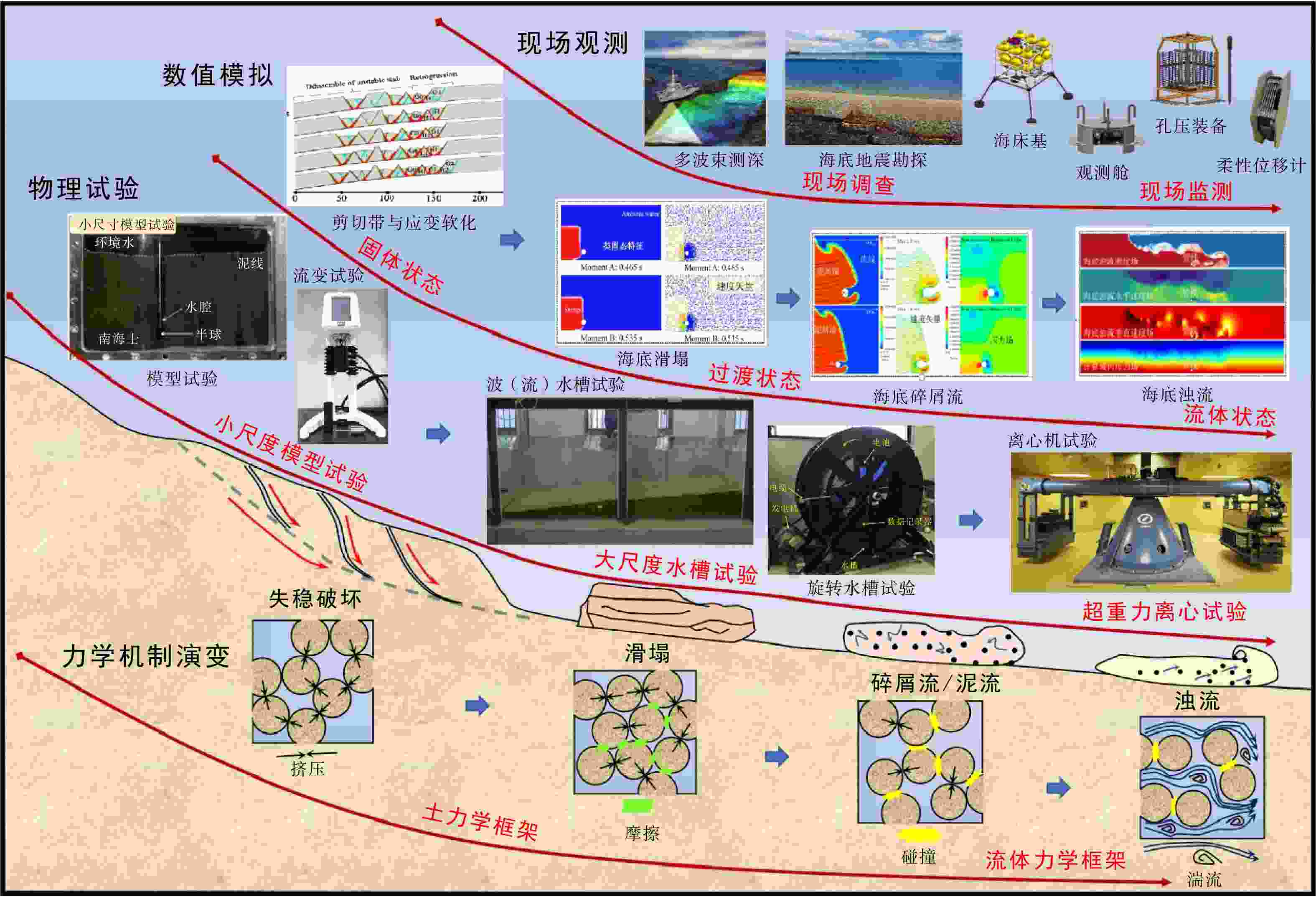
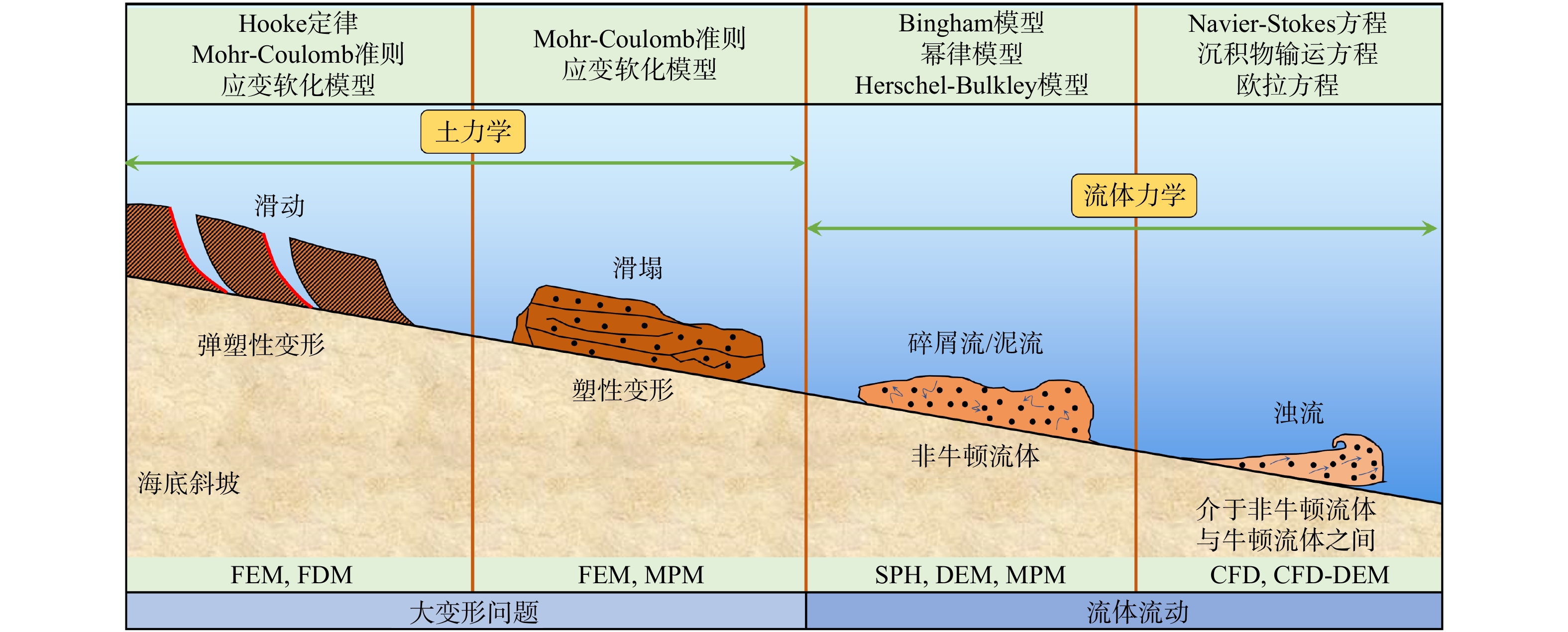
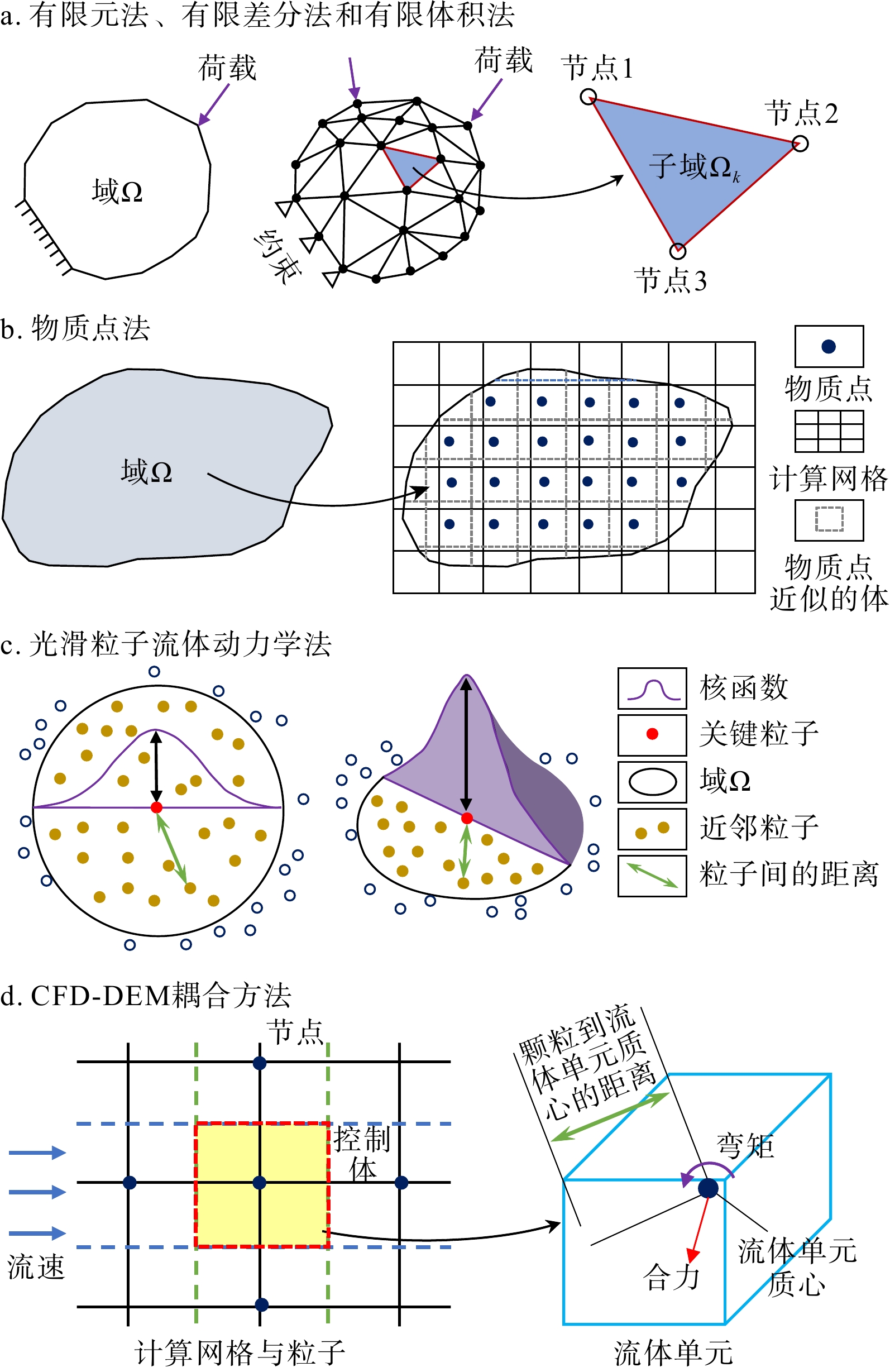
图 8 海底流滑宏微观尺度研究技术体系示意图
Figure 8. Schematic diagram of macro- and micro-scale research framework for submarine landslides
表 1 海底流滑常见物理模型试验手段
Table 1. Common physical model experimental methods for submarine landslides
物理模型试验 原理 示意图 适用性 优点 局限性 水
槽
试
验波(流)水
槽试验[50]通过在水槽中放置
沉积物进而模拟
其在波流作用下的流滑
① 分析波浪荷载与底床作用;② 研究海底流滑触发机制 ① 试验可视化,直观性强;② 可控性强 ① 尺寸效应影响大;② 难以模拟复杂地形 旋转水槽
试验[38]水槽绕1点以恒定角
速度旋转,以此模拟
1个无限长的斜面
进而模拟稳定流滑
① 模拟海底沉积物流动特征;② 低视摩擦角下动态过程 ① 试验可视化,直观性强;② 可模拟无限长斜坡 ① 尺寸效应影响大;② 应力水平较低 离心机试验[46] 通过旋转离心机产生加速度进而放大重力效应模拟深海流滑 
① 高重力加速度下流滑模拟;② 深海沉积物流滑研究 ① 实现高应力模拟;② 试验周期短 ① 试验可视化差;
② 设备成本及维护高 下载: 导出CSV
表 2 常用的海底滑坡数值模拟方法适用性与局限性
Table 2. Applicability and limitations of commonly used numerical simulation methods for submarine landslides
方法 适用性 优点 局限性 FEM[79] 有网格,适用于小变形、结构化网格
(如:海底滑坡引发的管道变形)实现简单,计算精度高,
支持多物理场耦合大变形时网格畸变,
难以处理复杂几何FDM[76] 有网格,适用于小变形、规则网格下的块体运动
和简单流体运动(如:海底滑坡剪切滑移)实现简单,计算效率高 仅适用于结构化网格,
无法直接处理多相流耦合FVM[92-93] 有网格,适用于多相流、质量守恒要求高的场景
(如:沉积物输运)严格守恒,适用于复杂网格 大变形和颗粒相互作用需要额外
模型,存在网格畸变问题MPM[80-81,84] 混合网格−粒子,适用于大变形、流固耦合(如:海
底滑坡体破碎、滑水效应、冲击工程等)无网格畸变、天然处理接触问题 对多相流耦合支持有限,
初始条件和参数依赖性强SPH[88-89] 无网格、纯粒子,适用于大变形、流体动力学问题
(如:海底滑坡体流动、泥流扩散、滑坡涌浪等)无网格、自然处理破碎问题、
适合破碎波和界面追踪难以处理高粘性或小尺度
流动问题CFD-DEM[53,91] 混合网格−粒子,适用于固−液两相流(如:海底
沉积物颗粒与环境水相互作用)显式追踪颗粒运动,捕捉微观
相互作用计算量极大,实际工程尺度
难以全分辨率模拟注:FVM. 有限体积法;下同
下载: 导出CSV
表 3 海底流滑原位监测技术
Table 3. In-situ monitoring techniques for submarine landslides
监测技术 原理 适用条件 优点 局限性 孔隙水压力
监测[103-105]通过孔隙水压力传感器通过测量土体
内部孔隙水压力变化,反映土体应力
状态适用于饱和或含水量较高的
海底沉积物监测数据连续性好;精度高;灵
敏度高,可反映海床内部动
态变化监测范围小;易受土层性质影响,高渗透性土层监测效果不佳;对深层滑坡监测效果有限 海床变形监测 压力传
感器[106]通过监测海床表面或内部的静态和动
态压力变化,反映垂向变形适用于沉积物渗透性高,且
垂向位移明显的流滑监测精度高;灵敏度高;可反映
海床垂向变形数据受环境因素(如:潮汐、海流等)干扰 三轴加速度
传感器[107]通过分析3个轴向的加速度数据,识别
流滑侧向运动适用于具有明显侧向运动倾
向的流滑多维度监测,全面捕捉流滑
动态安装位置和方向对测量结果影响大;微小变形不易捕捉 微机电
系统[108]通过将微型机械结构和电子电路集成
在硅片上,并整合加速度、陀螺仪、
压力等多类型传感器,实现一体化监测适用范围广,深水和浅水环
境中均可应用体积小;功耗低、响应快;
可靠性高;集成化高、可实
现一体化综合监测制造过程复杂、技术成本高 光纤传
感器[109]通过测量光在光纤中传播时间或频率
变化,监测海底地形的微小变形适用于具有明显侧向运动倾
向的流滑监测灵敏度高;分布式测量,覆
盖范围广安装复杂;维护成本高;光纤易受弯曲、断裂风险 其他技术 声学测距
监测[110]通过测量海床多个声学应答器的声信
号传播时间计算距离变化,反映海床
变形适用于水质清澈,声波传播
损耗低的区域覆盖范围广,适用于大尺度
监测;非接触式测量,安全
性高声波传播受水温、盐度影响大;声波信号易衰减;安装维护成本较高 电阻率
监测[111]利用饱和沉积物液化前后电阻率显著
变化的特性,通过监测电阻率变化来
评估海底沉积物的液化状态适用于饱和海床,要求土体
具有良好的导电性,且环境
条件稳定分辨率高;空间覆盖范围广 易受沉积物结构不均匀性影响;电极易发生极化 自然电位法
监测[112-113]基于流体和沉积物电阻率差异,通过
测量海底沉积层电阻率变化,实时监
测流体运移和沉积层稳定性适用于温度、盐度等因素稳
定的海洋环境操作简单,成本较低;无需
外部电源易受温度、盐度等海水环境影响,数据解释较复杂
下载: 导出CSV
-
[1] FAN N, SAHDI F, ZHANG W C, et al. Effect of pipeline-seabed gaps on the vertical forces of a pipeline induced by submarine slide impact[J]. Ocean Engineering, 2021, 221: 108506. doi: 10.1016/j.oceaneng.2020.108506 [2] 孙启良, 解习农, 吴时国. 南海北部海底滑坡的特征、灾害评估和研究展望[J]. 地学前缘, 2021, 28(2): 258-270. doi: 10.13745/j.esf.sf.2020.9.3SUN Q L, XIE X N, WU S G. Submarine landslides in the northern South China Sea: Characteristics, geohazard evaluation and perspectives[J]. Earth Science Frontiers, 2021, 28(2): 258-270. (in Chinese with English abstract doi: 10.13745/j.esf.sf.2020.9.3 [3] 余和雨, 刘晓磊, 陆杨. 海底碎屑流运动特性研究的若干进展[J]. 地质科技情报, 2019, 38(6): 25-32.YU H Y, LIU X L, LU Y. Advances in motion characteristics of submarine debris flow[J]. Geological Science and Technology Information, 2019, 38(6): 25-32. (in Chinese with English abstract [4] 李家钢, 修宗祥, 申宏, 等. 海底滑坡块体运动研究综述[J]. 海岸工程, 2012, 31(4): 67-78.LI J G, XIU Z X, SHEN H, et al. A review of the studies on submarine mass movement[J]. Coastal Engineering, 2012, 31(4): 67-78. (in Chinese with English abstract [5] KIM S, LEE H J, YEON J H. Characteristics of parameters for local scour depth around submarine pipelines in waves[J]. Marine Georesources & Geotechnology, 2011, 29(2): 162-176. doi: 10.1080/1064119X.2011.554967 [6] PEREZ-GRUSZKIEWICZ S E. Reducing underwater-slide impact forces on pipelines by streamlining[J]. Journal of Waterway, Port, Coastal, and Ocean Engineering, 2012, 138(2): 142-148. doi: 10.1061/(asce)ww.1943-5460.0000113 [7] LOCAT J, LEE H J. Submarine landslides: Advances and challenges[J]. Canadian Geotechnical Journal, 2002, 39(1): 193-212. [8] MASSON D G, HARBITZ C B, WYNN R B, et al. Submarine landslides: Processes, triggers and hazard prediction[J]. Philosophical Transactions: Mathematical, Physical and Engineering Sciences, 2006, 364(1845): 2009-2039. [9] NODINE M C, CHEON J Y, WRIGHT S G, et al. Mudslides during hurricane Ivan and an assessment of the potential for future mudslides in the Gulf of Mexico[J]. MMS Project, 2007, 552. [10] VAN RHEE C, BEZUIJEN A. The breaching of sand investigated in large-scale model tests[C]//Proceedings of Coastal Engineering 1998. [S. l]: [S. n.], 1998: 2509-2519. [11] ALHADDAD S, LABEUR R J, UIJTTEWAAL W. Large-scale experiments on breaching flow slides and the associated turbidity current[J]. Journal of Geophysical Research: Earth Surface, 2020, 125(10): e2020JF005582. [12] MASTBERGEN D R, VAN DEN BERG J H. Breaching in fine sands and the generation of sustained turbidity currents in submarine canyons[J]. Sedimentology, 2003, 50(4): 625-637. doi: 10.1046/j.1365-3091.2003.00554.x [13] ALHADDAD S, LABEUR R J, UIJTTEWAAL W. Breaching flow slides and the associated turbidity current[J]. Journal of Marine Science and Engineering, 2020, 8(2): 67. doi: 10.3390/jmse8020067 [14] SCHIERECK G J. Introduction to bed, bank and shore protection[M]. Boca Raton: CRC Press, 2017. [15] VAN RHEE C. Slope failure by unstable breaching[J]. Proceedings of the Institution of Civil Engineers - Maritime Engineering, 2015, 168(2): 84-92. doi: 10.1680/maen.14.00006 [16] ANDRESEN A, BJERRUM L. Slides in subaqueous slopes in loose sand and silt [R]. Oslo: Norwegian Geotechnical Institute, 1968: 1-9. [17] KRAMER S L. Triggering of liquefaction flow slides in coastal soil deposits[J]. Engineering Geology, 1988, 26(1): 17-31. doi: 10.1016/0013-7952(88)90004-X [18] SLADEN J A, D'HOLLANDER R D, KRAHN J. The liquefaction of sands, a collapse surface approach[J]. Canadian Geotechnical Journal, 1985, 22(4): 564-578. doi: 10.1139/t85-076 [19] TORREY V H. Retrogressive failures in sand deposits of the Mississippi River. Report 2. Empirical evidence in support of the hypothesized failure mechanism and development of the levee safety flow slide monitoring system[R]. Vicksburg: US Army Engineer Division, Lower Mississippi Valley, 1988. [20] WEIJ D, KEETELS G H, GOEREE J C, et al. An approach to research of the breaching process[C]//Anon. Proceedings of the WODCON XXI. Miami, FL, USA: [S. n.], 2016: 13-17. [21] VAN DEN BERG J H, VAN GELDER A, MASTBERGEN D R. The importance of breaching as a mechanism of subaqueous slope failure in fine sand[J]. Sedimentology, 2002, 49(1): 81-95. doi: 10.1111/j.1525-139X.2006.00168.x-i1 [22] YOU Y, FLEMINGS P, MOHRIG D. Dynamics of dilative slope failure[J]. Geology, 2012, 40(7): 663-666. doi: 10.1130/G32855.1 [23] LÜTHI S. Some new aspects of two-dimensional turbidity currents[J]. Sedimentology, 1981, 28(1): 97-105. [24] MARR J G, HARFF P A, SHANMUGAM G, et al. Experiments on subaqueous sandy gravity flows: The role of clay and water content in flow dynamics and depositional structures[J]. Geological Society of America Bulletin, 2001, 113(11): 1377-1386. doi: 10.1130/0016-7606(2001)113<1377:eossgf>2.0.co;2 [25] YU H Y, LIU X L, LU Y, et al. Characteristics of the sediment gravity flow triggered by wave-induced liquefaction on a sloping silty seabed: An experimental investigation[J]. Frontiers in Earth Science, 2022, 10: 909605. doi: 10.3389/feart.2022.909605 [26] ELVERHOI A, BREIEN H, DE BLASIO F V, et al. Submarine landslides and the importance of the initial sediment composition for run-out length and final deposit[J]. Ocean Dynamics, 2010, 60(4): 1027-1046. doi: 10.1007/s10236-010-0317-z [27] VENDEVILLE B C, GAULLIER V. Role of pore-fluid pressure and slope angle in triggering submarine mass movements: Natural examples and pilot experimental models[M]//Submarine mass movements and their consequences. Dordrecht: Springer Netherlands, 2003: 137-144. [28] SØRLIE E R, HARTNIK L O, TRAN Q A, et al. Physical model tests of clay-rich submarine landslides and resulting impact forces on offshore foundations[J]. Ocean Engineering, 2023, 273: 113966. doi: 10.1016/j.oceaneng.2023.113966 [29] HAZA Z F, HARAHAP I S H, DAKSSA L M. Experimental studies of the flow-front and drag forces exerted by subaqueous mudflow on inclined base[J]. Natural Hazards, 2013, 68(2): 587-611. doi: 10.1007/s11069-013-0643-9 [30] FAN N, NIAN T K, JIAO H B, et al. Evaluation of the mass transfer flux at interfaces between submarine sliding soils and ambient water[J]. Ocean Engineering, 2020, 216: 108069. doi: 10.1016/j.oceaneng.2020.108069 [31] MAGHSOUDLOO A, ASKARINEJAD A, DE JAGER R R, et al. Large-scale physical modelling of static liquefaction in gentle submarine slopes[J]. Landslides, 2021, 18(10): 3315-3335. doi: 10.1007/s10346-021-01705-6 [32] LIU X L, LI X Y, ZHANG H, et al. An experimental investigation of the effect of interfacial waves on the evolution of sliding zones in a liquefied seabed[J]. Journal of Marine Science and Engineering, 2024, 12(8): 1355. doi: 10.3390/jmse12081355 [33] LIAO C C, HSIAU S S, NIEN H C. Density-driven spontaneous streak segregation patterns in a thin rotating drum[J]. Physical Review E, 2014, 89(6): 062204. doi: 10.1103/PhysRevE.89.062204 [34] LAU Y L, KRISHNAPPAN B G. Does reentrainment occur during cohesive sediment settling[J]. Journal of Hydraulic Engineering, 1994, 120(2): 236-244. doi: 10.1061/(ASCE)0733-9429(1994)120:2(236) [35] ZREIK D A, KRISHNAPPAN B G, GERMAINE J T, et al. Erosional and mechanical strengths of deposited cohesive sediments[J]. Journal of Hydraulic Engineering, 1998, 124(11): 1076-1085. doi: 10.1061/(ASCE)0733-9429(1998)124:11(1076) [36] HUIZINGA R J. Verification of vertically rotating flume using non-Newtonian fluids[J]. Journal of Hydraulic Engineering, 1996, 122(8): 456-459. doi: 10.1061/(ASCE)0733-9429(1996)122:8(456) [37] LEONARDI A, CABRERA M, WITTEL F K, et al. Granular-front formation in free-surface flow of concentrated suspensions[J]. Physical Review E, 2015, 92(5): 052204. doi: 10.1103/PhysRevE.92.052204 [38] WANG F W, DAI Z L, ZHANG S. Experimental study on the motion behavior and mechanism of submarine landslides[J]. Bulletin of Engineering Geology and the Environment, 2018, 77(3): 1117-1126. doi: 10.1007/s10064-017-1143-z [39] FIGUEROA S, SON M. An automatic rotating annular flume for cohesive sediment erosion experiments: Calibration and preliminary results[C]//Proceedings of the Korea Water Resources Association Conference. [S. l.]: [S. n.], 2023. [40] DENG J L, ZHANG X X, SHEN S L, et al. Low friction coefficient (approximately tan1°) of subaqueous debris flow in rotating flume tests and its mechanism[J]. Bulletin of Engineering Geology and the Environment, 2018, 77(3): 931-939. doi: 10.1007/s10064-017-1081-9 [41] PRIOR D B, YANG Z S, BORNHOLD B D, et al. The subaqueous delta of the modern Huanghe (Yellow River)[J]. Geo-Marine Letters, 1986, 6(2): 67-75. [42] PHILLIPS R, BYRNE P. Modelling slope liquefaction due to static loading[C]//Proceedings of the 47th Canadian Geotechnical Conference. Halifax, Canada: [S. n.], 1994. [43] COULTER S E. Seismic initiation of submarine slope failures using physical modelling in a geotechnical centrifuge[D]. Newfoundland: Memorial University of Newfoundland, 2008. [44] TRAN Q A, SØRLIE E, GRIMSTAD G, et al. Influence of sediment permeability in seismic-induced submarine landslide mechanism: CFD-MPM validation with centrifuge tests and analysis[J]. Computers and Geotechnics, 2024, 174: 106588. doi: 10.1016/j.compgeo.2024.106588 [45] GUE C S, SOGA K, BOLTON M D, et al. Centrifuge modelling of submarine landslide flows[C]// Proceedings of the 7th International Conference on Physical Modelling in Geotechnics. Zurich: CRC Press, 2010: 1095-1100. [46] ACOSTA E A, TIBANA S, DE SOUZA SOARES DE ALMEIDA M, et al. Centrifuge modeling of hydroplaning in submarine slopes[J]. Ocean Engineering, 2017, 129: 451-458. doi: 10.1016/j.oceaneng.2016.10.047 [47] YIN M, RUI Y, XUE Y Y. Centrifuge study on the runout distance of submarine debris flows[J]. Marine Georesources & Geotechnology, 2019, 37(3): 301-311. doi: 10.1080/1064119X.2017.1411407 [48] RUI Y, YIN M. Centrifuge study on the submarine mudflows[J]. Marine Geodesy, 2019, 42(1): 85-102. doi: 10.1080/01490419.2018.1561562 [49] ZHOU S, LIU J, WANG B, et al. Centrifugal model test on the stability of underwater slope[C]//Physical Modelling in Geotechnics. [S. l.]: Routledge, 2022: 759-764. [50] ILSTAD T, ELVERHØI A, ISSLER D, et al. Subaqueous debris flow behaviour and its dependence on the sand/clay ratio: A laboratory study using particle tracking[J]. Marine Geology, 2004, 213(1/2/3/4): 415-438. doi: 10.1016/j.margeo.2004.10.017 [51] 郑德凤, 雷得浴, 闫成林, 等. 基于Web of Science数据库的海底滑坡研究趋势文献计量分析[J]. 工程地质学报, 2021, 29(6): 1805-1814.ZHENG D F, LEI D Y, YAN C L, et al. Global research trends in submarine landslides: A bibliometric analysis based on Web of Science publications[J]. Journal of Engineering Geology, 2021, 29(6): 1805-1814. (in Chinese with English abstract [52] 年廷凯, 张放, 郑德凤, 等. 基于计算流体力学−离散元法耦合方法的海底黏性滑坡体运动行为模拟[J]. 岩土力学, 2022, 43(11): 3174-3184. doi: 10.16285/j.rsm.2021.1856NIAN T K, ZHANG F, ZHENG D F, et al. Numerical simulation on the movement behavior of viscous submarine landslide based on coupled computational fluid dynamics-discrete element method[J]. Rock and Soil Mechanics, 2022, 43(11): 3174-3184. (in Chinese with English abstract doi: 10.16285/j.rsm.2021.1856 [53] GUO X S, STOESSER T, ZHENG D F, et al. A methodology to predict the run-out distance of submarine landslides[J]. Computers and Geotechnics, 2023, 153: 105073. doi: 10.1016/j.compgeo.2022.105073 [54] LI W Q, CHEN Y K, LIU Y, et al. Numerical simulation of submarine landslide tsunamis based on the smoothed particle hydrodynamics model[J]. Physics of Fluids, 2024, 36(7): 073117. doi: 10.1063/5.0214221 [55] ZHANG W C, KLEIN B, RANDOLPH M F, et al. Upslope failure mechanisms and criteria in submarine landslides: Shear band propagation, slab failure and retrogression[J]. Journal of Geophysical Research: Solid Earth, 2021, 126(9): e2021JB022041. [56] 年廷凯, 沈月强, 郑德凤, 等. 海底滑坡链式灾害研究进展[J]. 工程地质学报, 2021, 29(6): 1657-1675. doi: 10.13544/j.cnki.jeg.2021-0815NIAN T K, SHEN Y Q, ZHENG D F, et al. Research advances on the chain disasters of submarine landslides[J]. Journal of Engineering Geology, 2021, 29(6): 1657-1675. (in Chinese with English abstract doi: 10.13544/j.cnki.jeg.2021-0815 [57] URMI Z A, SAEIDI A, CHAVALI R V P, et al. Failure mechanism, existing constitutive models and numerical modeling of landslides in sensitive clay: A review[J]. Geoenvironmental Disasters, 2023, 10(1): 14. doi: 10.1186/s40677-023-00242-9 [58] DEY R, HAWLADER B C, PHILLIPS R, et al. Numerical modelling of submarine landslides with sensitive clay layers[J]. Géotechnique, 2016, 66(6): 454-468. doi: 10.1680/jgeot.15.p.111 [59] ZHU Z P, WANG D, ZHANG W C. Catastrophic submarine landslides with non-shallow shear band propagation[J]. Computers and Geotechnics, 2023, 163: 105751. doi: 10.1016/j.compgeo.2023.105751 [60] BERNANDER S. Progressive landslides in long natural slopes: Formation, potential extension and configuration of finished slides in strain-softening soils[D]. Sweden: Luleå University of Technology, 2011. [61] DUTTA S, HAWLADER B. Pipeline-soil-water interaction modelling for submarine landslide impact on suspended offshore pipelines[J]. Géotechnique, 2019, 69(1): 29-41. doi: 10.1680/jgeot.17.p.084 [62] ZHANG W C, PUZRIN A M. Depth integrated modelling of submarine landslide evolution[J]. Landslides, 2021, 18(9): 3063-3084. doi: 10.1007/s10346-021-01655-z [63] XIE Q H, XU Q, XIU Z X, et al. Convenient method for large-deformation finite-element simulation of submarine landslides considering shear softening and rate correlation effects[J]. Journal of Marine Science and Engineering, 2024, 12(1): 81. doi: 10.3390/jmse12010081 [64] SHAN Z G, WU H, NI W D, et al. Recent technological and methodological advances for the investigation of submarine landslides[J]. Journal of Marine Science and Engineering, 2022, 10(11): 1728. doi: 10.3390/jmse10111728 [65] CHHABRA R P. Non-Newtonian fluids: An introduction[M]//Rheology of complex fluids. New York, NY: Springer New York, 2010: 3-34. [66] ZHANG M, HUANG Y, BAO Y J. The mechanism of shallow submarine landslides triggered by storm surge[J]. Natural Hazards, 2016, 81(2): 1373-1383. doi: 10.1007/s11069-015-2112-0 [67] 郭兴森, 年廷凯, 范宁, 等. 低温环境下南海海底泥流的流变试验及模型[J]. 岩土工程学报, 2019, 41(1): 161-167.GUO X S, NIAN T K, FAN N, et al. Rheological tests and model for submarine mud flows in South China Sea under low temperatures[J]. Chinese Journal of Geotechnical Engineering, 2019, 41(1): 161-167. (in Chinese with English abstract [68] SAHA B C. Modeling of complex behaviors of submarine debris flows[D]. Florida: The Florida State University, 2017. [69] GAUER P, KVALSTAD T J, FORSBERG C F, et al. The last phase of the storegga slide: Simulation of retrogressive slide dynamics and comparison with slide-scar morphology[J]. Marine and Petroleum Geology, 2005, 22(1/2): 171-178. [70] IMRAN J, HARFF P, PARKER G. A numerical model of submarine debris flow with graphical user interface[J]. Computers & Geosciences, 2001, 27(6): 717-729. [71] DE BLASIO F V, ENGVIK L, HARBITZ C B, et al. Hydroplaning and submarine debris flows[J]. Journal of Geophysical Research: Oceans, 2004, 109(C1): 2002JC001714. [72] 李宏伟, 王立忠, 国振, 等. 海底泥流冲击悬跨管道拖曳力系数分析[J]. 海洋工程, 2015, 33(6): 10-19.LI H W, WANG L Z, GUO Z, et al. Drag force of submarine landslides mudflow impacting on a suspended pipeline[J]. The Ocean Engineering, 2015, 33(6): 10-19. (in Chinese with English abstract [73] 李阳, 王栋, 董友扣. 有限高度海底流滑体冲击桩基的数值模拟[J]. 中国海洋大学学报(自然科学版), 2022, 52(4): 105-110.LI Y, WANG D, DONG Y K. Numerical simulation of impact on pile foundations by finite-height submarine slide mass[J]. Periodical of Ocean University of China (Natural Science Edition), 2022, 52(4): 105-110. (in Chinese with English abstract [74] CUOMO S. New advances and challenges for numerical modeling of landslides of the flow type[J]. Procedia Earth and Planetary Science, 2014, 9: 91-100. [75] DAI Z L, WANG F W, HUANG Y, et al. SPH-based numerical modeling for the post-failure behavior of the landslides triggered by the 2016 Kumamoto earthquake[J]. Geoenvironmental Disasters, 2016, 3(1): 24. [76] AZIZIAN A, POPESCU R. Finite element simulation of seismically induced retrogressive failure of submarine slopes[J]. Canadian Geotechnical Journal, 2005, 42(6): 1532-1547. [77] RAFIEI A, RAHMAN M S, GABR M A. Coupled analysis for response and instability of sloping seabed under wave action[J]. Applied Ocean Research, 2019, 88: 99-110. [78] XU L Y, ZHANG J, WANG L, et al. Wave-induced liquefaction analysis of mildly sloping sandy seabed[J]. Soil Dynamics and Earthquake Engineering, 2024, 185: 108873. [79] RAFIEI A, RAHMAN M S, GABR M A. Evaluation of wave-induced instability of nearly saturated sandy slopes under partially undrained condition: A case study of landslide in Fraser River delta front[J]. Computers and Geotechnics, 2023, 159: 105496. [80] DONG Y K, WANG D, RANDOLPH M F. Runout of submarine landslide simulated with material point method[J]. Procedia Engineering, 2017, 175: 357-364. [81] DONG Y K, WANG D, CUI L. Assessment of depth-averaged method in analysing runout of submarine landslide[J]. Landslides, 2020, 17(3): 543-555. [82] SUN Z, LI H Q, GAN Y, et al. Material point method and smoothed particle hydrodynamics simulations of fluid flow problems: A comparative study[J]. Progress in Computational Fluid Dynamics, an International Journal, 2018, 18(1): 1. [83] SULSKY D, CHEN Z, SCHREYER H L. A particle method for history-dependent materials[J]. Computer Methods in Applied Mechanics and Engineering, 1994, 118(1/2): 179-196. [84] DONG Y K, WANG D, RANDOLPH M F. Investigation of impact forces on pipeline by submarine landslide using material point method[J]. Ocean Engineering, 2017, 146: 21-28. [85] 单治钢, 廖哲贤, 董友扣, 等. 海底滑坡中滑水效应的危害[J]. 工程地质学报, 2021, 29(6): 1815-1822.SHAN Z G, LIAO Z X, DONG Y K, et al. Investigation of consequence of hydroplaning in submarine landslide[J]. Journal of Engineering Geology, 2021, 29(6): 1815-1822. (in Chinese with English abstract [86] PASTOR M, HADDAD B, SORBINO G, et al. A depth-integrated, coupled SPH model for flow-like landslides and related phenomena[J]. International Journal for Numerical and Analytical Methods in Geomechanics, 2009, 33(2): 143-172. [87] CAPONE T, PANIZZO A, MONAGHAN J J. SPH modelling of water waves generated by submarine landslides[J]. Journal of Hydraulic Research, 2010, 48(sup1): 80-84. [88] 陶言祺. 基于SPH深度积分模型的海底滑坡数值分析[D]. 辽宁 大连: 大连理工大学, 2015.TAO Y Q. The analysis on submarine landslide based on a SPH depth-integrated model[D]. Dalian Liaoning: Dalian University of Technology, 2015. (in Chinese with English abstract [89] WANG Z T, LI X Z, LIU P, et al. Numerical analysis of submarine landslides using a smoothed particle hydrodynamics depth integral model[J]. Acta Oceanologica Sinica, 2016, 35(5): 134-140. [90] ZAKERI A, HØEG K, NADIM F. Submarine debris flow impact on pipelines: Part I: Experimental investigation[J]. Coastal Engineering, 2008, 55(12): 1209-1218. [91] GUO X S, LIU X L, ZHANG C, et al. Impact of high-speed turbidity currents on offshore spanning pipelines[J]. Ocean Engineering, 2023, 287: 115797. [92] KIM J. Finite volume methods for tsunamis generated by submarine landslides[D]. Washington: University of Washington, 2014. [93] YANG F, ZHANG J, YANG J S, et al. Stability analysis of unlined elliptical tunnel using finite element upper-bound method with rigid translatory moving elements[J]. Tunnelling and Underground Space Technology, 2015, 50: 13-22. [94] 常晁瑜. 强震作用下黄土斜坡流滑机理及动态演化[D]. 哈尔滨: 中国地震局工程力学研究所, 2022.CHANG C Y. Mechanism and dynamic evolution of seismic sliding flow on loess slope[D]. Harbin: Institute of Engineering Mechanics, China Earthquake Administration, 2022. (in Chinese with English abstract [95] 杨慧良, 陆凯, 褚宏宪. 海洋地质地球物理调查技术方法发展趋势探讨[J]. 海洋地质前沿, 2019, 35(9): 1-5.YANG H L, LU K, CHU H X. Future development trend of marine geological and geophysical survey techniques and methods[J]. Marine Geology Frontiers, 2019, 35(9): 1-5. (in Chinese with English abstract [96] HUGHES CLARKE J E, MAYER L A, WELLS D E. Shallow-water imaging multibeam sonars: A new tool for investigating seafloor processes in the coastal zone and on the continental shelf[J]. Marine Geophysical Researches, 1996, 18(6): 607-629. [97] 罗深荣. 侧扫声纳和多波束测深系统在海洋调查中的综合应用[J]. 海洋测绘, 2003, 23(1): 22-24.LUO S R. Comprehensive utilization of side scan sonar and multi-beam sounding system in oceanographic research[J]. Hydrographic Surveying and Charting, 2003, 23(1): 22-24. (in Chinese with English abstract [98] SILVA A J, BAXTER C D P, LAROSA P T, et al. Investigation of mass wasting on the continental slope and rise[J]. Marine Geology, 2004, 203(3/4): 355-366. [99] HARDERS R, RANERO C R, WEINREBE W, et al. Submarine slope failures along the convergent continental margin of the Middle America Trench[J]. Geochemistry, Geophysics, Geosystems, 2011, 12(6): Q05S32. [100] 吴德城, 侯方辉, 祁江豪, 等. 中国近海新构造活动断裂调查与地震勘探方法[J]. 海洋地质与第四纪地质, 2020, 40(6): 121-132.WU D C, HOU F H, QI J H, et al. Seismic survey and exploration methods for neotectonic active faults in the area off China continent[J]. Marine Geology & Quaternary Geology, 2020, 40(6): 121-132. (in Chinese with English abstract [101] SGROI T, MONNA S, EMBRIACO D, et al. Geohazards in the western Ionian Sea: Insights from non-earthquake ignals recorded by the NEMO-SN1 seafloor observatory[J]. Oceanography, 2014, 27(2): 154-166. [102] LIN C H, KUMAGAI H, ANDO M, et al. Detection of landslides and submarine slumps using broadband seismic networks[J]. Geophysical Research Letters, 2010, 37(22): 2010GL044685. [103] STEGMANN S, SULTAN N, GARZIGLIA S, et al. A long-term monitoring array for landslide precursors: A case study at the Ligurian slope (western Mediterranean Sea)[C]//The Offshore Technology Conference. Houston, Texas, USA: OTC, 2012: OTC-23271-MS. [104] SULTAN N, CATTANEO A, SIBUET J C, et al. Deep sea in situ excess pore pressure and sediment deformation off NW Sumatra and its relation with the December 26, 2004 Great Sumatra-Andaman earthquake[J]. International ournal of Earth Sciences, 2009, 98(4): 823-837. [105] SULTAN N, COCHONAT P, FOUCHER J P, et al. Effect of gas hydrates melting on seafloor slope instability[J]. Marine Geology, 2004, 213(1/2/3/4): 379-401. [106] WALLACE L M, WEBB S C, ITO Y, et al. Slow slip near the trench at the Hikurangi subduction zone, New Zealand[J]. Science, 2016, 352(6286): 701-704. [107] WANG Z H, SUN Y F, JIA Y G, et al. Wave-induced seafloor instabilities in the subaqueous Yellow River Delta: Nitiation and process of sediment failure[J]. Landslides, 2020, 17(8): 1849-1862. [108] GE Y Q, CHEN J W, CAO C, et al. MEMS sensor network for submarine terrain and strata deformation monitoring: Design and field experiment[J]. IEEE Transactions on Instrumentation and Measurement, 2022, 71: 9512217. [109] YANG Y, CAI W K, WANG Y Y, et al. Omnidirectional optic fiber shape sensor for submarine landslide monitoring[J]. Measurement, 2025, 239: 115429. [110] BLUM J A, CHADWELL C D, DRISCOLL N, et al. Assessing slope stability in the Santa Barbara Basin, California, using seafloor geodesy and CHIRP seismic data[J]. Geophysical Research Letters, 2010, 37(13): 2010GL043293. [111] GIOCOLI A, QUADRIO B, BELLANOVA J, et al. Electrical resistivity tomography for studying liquefaction induced by the May 2012 Emilia-Romagna earthquake (Mw = 6.1, northern Italy)[J]. Natural Hazards and Earth System Sciences, 2014, 14(4): 731-737. [112] LIU X L, JIA Y G, ZHENG J W, et al. Field and laboratory resistivity monitoring of sediment consolidation in China' Yellow River estuary[J]. Engineering Geology, 2013, 164: 77-85. [113] SUN M J, SHAN Z G, WANG W, et al. Development of an underwater adaptive penetration system for in situ monitoring of marine engineering geology[J]. Sensors, 2024, 24(17): 5563. [114] 贾永刚, 王振豪, 刘晓磊, 等. 海底滑坡现场调查及原位观测方法研究进展[J]. 中国海洋大学学报(自然科学版), 2017, 47(10): 61-72.JIA Y G, WANG Z H, LIU X L, et al. The research progress of field investigation and in-situ observation methods for submarine landslide[J]. Periodical of Ocean University of China, 2017, 47(10): 61-72. (in Chinese with English bstract [115] 刘晓磊, 张淑玉, 郑杰文, 等. 黄河三角洲极端风暴诱发地质灾害研究进展及对策[J]. 海洋地质前沿, 2022, 38(11): 28-39.LIU X L, ZHANG S Y, ZHENG J W, et al. Research progress and countermeasures on geological hazards induced by extreme storms in the Yellow River Delta[J]. Marine Geology Frontiers, 2022, 38(11): 28-39. (in Chinese with English bstract [116] PRIOR D B, SUHAYDA J N, LU N Z, et al. Storm wave reactivation of a submarine landslide[J]. Nature, 1989, 341(6237): 47-50. [117] MASTBERGEN D, VAN DEN HAM G, CARTIGNY M, et al. Multiple flow slide experiment in the westerschelde stuary, the Netherlands[M]//Submarine mass movements and their consequences. Cham: Springer International Publishing, 2016: 241-249. [118] HUGHES CLARKE J E. First wide-angle view of channelized turbidity currents links migrating cyclic steps to flow characteristics[J]. Nature Communications, 2016, 7: 11896. [119] SIMMONS S M, AZPIROZ-ZABALA M, CARTIGNY M J B, et al. Novel acoustic method provides first detailed measurements of sediment concentration structure within submarine turbidity currents[J]. Journal of Geophysical Research: Oceans, 2020, 125(5): e2019JC015904. [120] 窦杰, 向子林, 许强, 等. 机器学习在滑坡智能防灾减灾中的应用与发展趋势[J]. 地球科学, 2023, 48(5): 1657-1674.DOU J, XIANG Z L, XU Q, et al. Application and development trend of machine learning in landslide intelligent disaster prevention and mitigation[J]. Earth Science, 2023, 48(5): 1657-1674. (in Chinese with English abstract [121] 豆红强, 刘银, 王浩, 等. 基于异质集成机器学习模型的海岸带滑坡灾害易发性评价与区划[J]. 地质科技通报, 2026, 45(2): 338-350.DOU H Q, LIU Y, WANG H, et al. Susceptibility assessment and zoning of coastal landslides based on heterogeneous ensemble machine learning models[J]. Bulletin of Geological Science and Technology, 2026, 45(2): 338-350. (in Chinese with English abstract [122] 黄玉, 李芳, 任婷. 基于W变换压缩感知框架的崎岖海底信号补偿方法[J]. 地质科技通报, 2026, 45(2): 320-326.HUANG Y, LI F, REN T. A rugged seabed signal compensation method based on W transform compressive sensing framework[J]. Bulletin of Geological Science and Technology, 2026, 45(2): 320-326. (in Chinese with English abstract [123] MERGHADI A, YUNUS A P, DOU J, et al. Machine learning methods for landslide susceptibility studies: A omparative overview of algorithm performance[J]. Earth-Science Reviews, 2020, 207: 103225. [124] 郭衍昊, 窦杰, 向子林, 等. 基于优化负样本采样策略的梯度提升决策树与随机森林的汶川同震滑坡易发性评价[J]. 地质科技通报, 2024, 43(3): 251-265.GUO Y H, DOU J, XIANG Z L, et al. Susceptibility evaluation of Wenchuan coseismic landslides by gradient boosting decision tree and random forest based on optimal negative sample sampling strategies[J]. Bulletin of Geological Science and Technology, 2024, 43(3): 251-265. (in Chinese with English abstract -

 下载:
下载:


 点击查看大图
计量
- 文章访问数: 451
- PDF下载量: 186
- 被引次数: 0