投审稿入口
投审稿入口


Experimental study on inhibition of rainfall infiltration into slopes by different dual-structure capillary barrier layers
-
摘要:
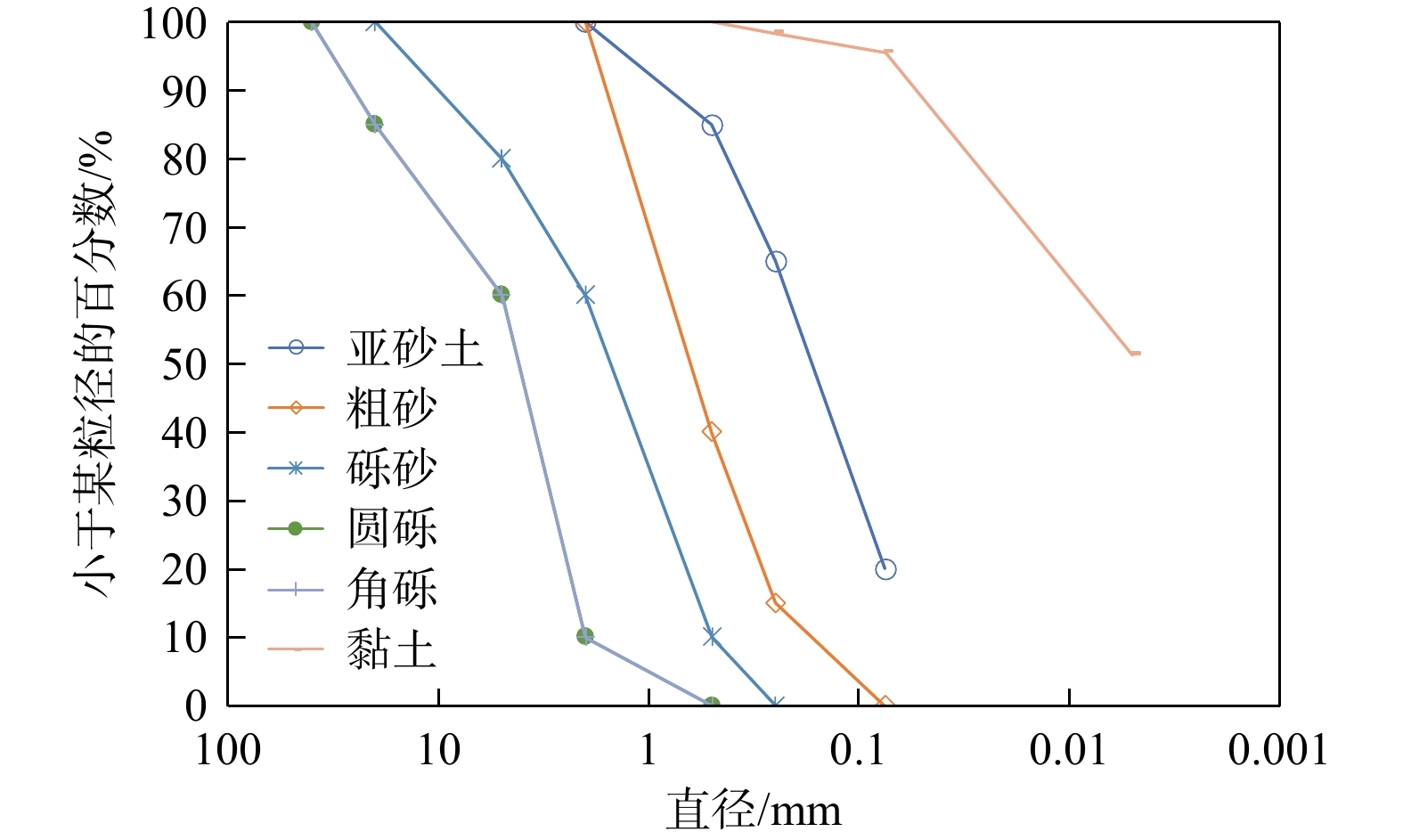
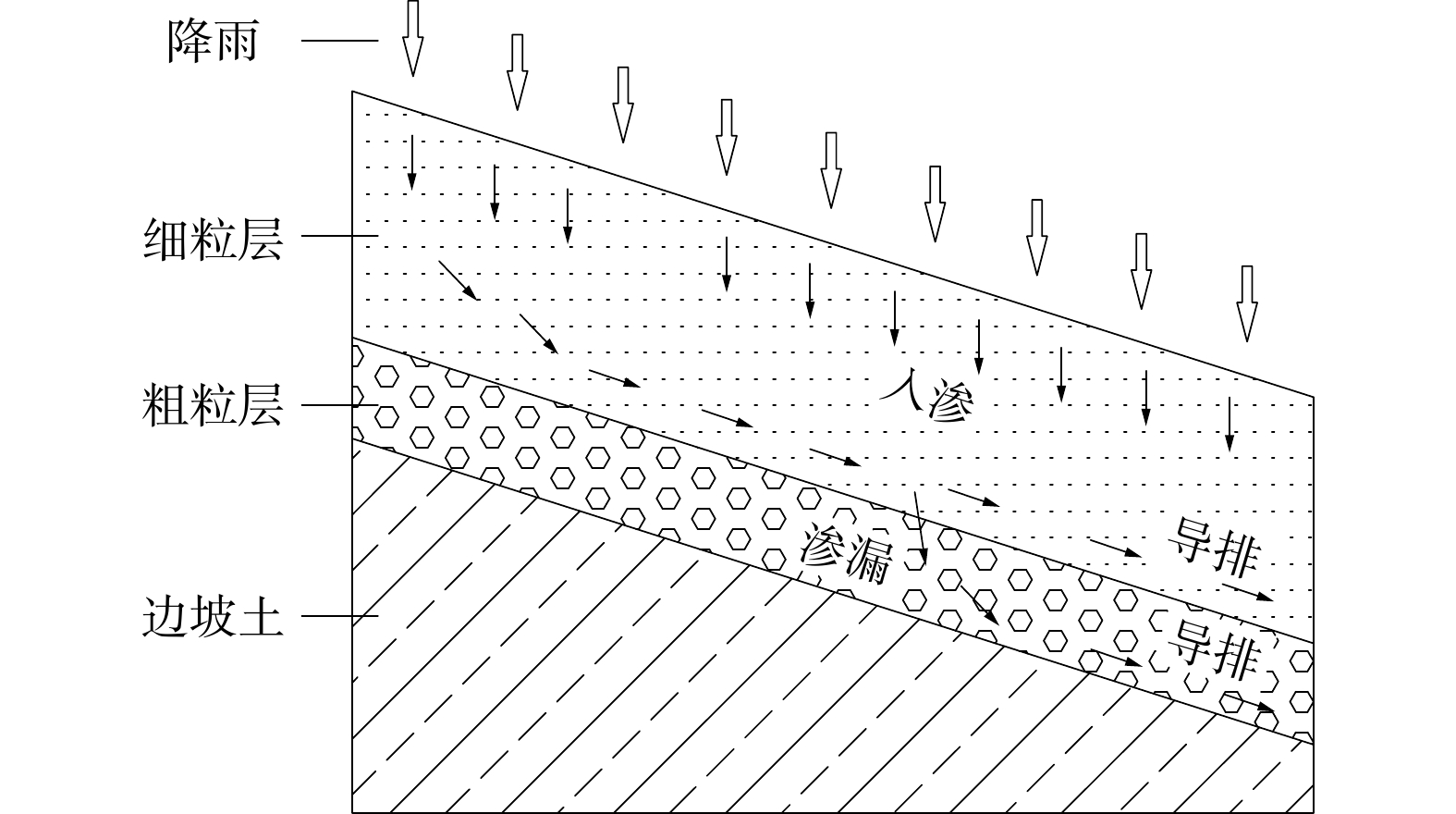
土质边坡在降雨−蒸发循环作用下易形成裂隙,导致降雨入渗土壤,诱发边坡失稳。基于生态优先,提出了具有生态功能的细/粗非饱和阻隔层(CBL)抑制降雨入渗的边坡防护方法,旨在从源头上阻隔降雨入渗,为边坡生态修复与稳定性防治提供技术参考。采用物理模型试验,开展2种降雨强度(1.93×10−4,4.73×10−4 cm/s)和4种 CBL 岩性结构组成(亚砂土 / 粗砂、亚砂土 / 砾砂、亚砂土 / 角砾、亚砂土 / 圆砾)条件下,CBL 对降雨入渗规律及其对边坡防护效果的影响研究,分析粗粒层粒径、颗粒形态及降雨强度对 CBL 水分运移和排水效率的作用规律。研究结果表明:①降雨在细粒层以均匀流为主,运移速度随粗粒层粒径增大而增加并受粗粒层颗粒形态的影响明显;降雨入渗至细 / 粗粒层界面时,水分沿界面向坡脚迁移;降雨突破细 / 粗粒层界面后,在粗砂和砾砂中仍以均匀流运动为主,而在角砾和圆砾中则以优先流方式运动,且优先流程度随粗粒层粒径增大而增强。②CBL 稳定排水效率(稳定排水强度与降雨强度之比)随降雨强度增加而减小,且在高降雨强度时,其随粗粒层粒径增加而小幅增加;CBL 综合排水效率(侧向排水总量与降雨总量之比)随粗粒层粒径和降雨强度增加而增加,且降雨强度越大其增加幅度越显著下降。③粗粒层颗粒形态对 CBL 阻隔降雨效果影响明显,亚砂土 / 角砾 CBL 在试验设定的降雨强度范围内可完全阻隔降雨入渗至边坡黏土层,其阻隔降雨入渗的效果最佳。研究成果揭示了二元结构 CBL 抑制降雨入渗的内在规律,可为土质边坡稳定性防治提供重要参考。
Abstract:ObjectiveSoil slopes are prone to crack development under the cyclic effects of rainfall and evaporation, which causes rainfall to infiltrate into the soil, reduce the mechanical properties of soil mass, and further induce slope instability. Currently, the mainstream slope protection measures mainly rely on surface hardening technologies, which are susceptible to cracking and failure during long-term operation, leading to re-infiltration of rainfall and failing to achieve long-term stable protection of slopes. Under the background of integrating slope disaster prevention with ecological civilization construction and following the principle of ecological priority, this study proposes a slope protection method that inhibits rainfall infiltration by using a fine/coarse-grained unsaturated capillary barrier layer (CBL) with ecological functions, seepage prevention, and drainage capabilities, aiming to block rainfall infiltration from the source and provide a new technical approach for ecological restoration and stability control of soil slopes.
MethodsTo reveal the influence of CBL lithologic structure and rainfall intensity on the regulation of rainfall infiltration patterns and slope protection performance, a series of indoor physical model tests were conducted, with the combination of CBL lithology and rainfall intensity as the key test variables. Specifically, two typical rainfall intensities (1.93×10⁻⁴, 4.73×10⁻⁴ cm/s) were set, and four CBL lithologic structure combinations (sub-sandy soil/coarse sand, sub-sandy soil/gravel sand, sub-sandy soil/breccia, sub-sandy soil/gravel) were designed. The tests systematically monitored the wetting front migration process, drainage initiation time, stable drainage intensity, and cumulative drainage volume of CBL under different working conditions, and quantitatively analyzed the effects of coarse-grained layer particle size, particle morphology, and rainfall intensity on the water migration characteristics and drainage efficiency of CBL.
ResultsThe results showed that: ① Rainfall mainly moved in the form of uniform flow in the fine-grained layer, and the migration velocity increased with the increase of particle size of the coarse-grained layer, which was significantly affected by the particle morphology of the coarse-grained layer. When rainfall infiltrated to the fine/coarse-grained layer interface, the water migrated to the slope toe along the interface driven by both gravity and matrix suction. After the rainfall broke through the fine/coarse-grained layer interface, it continued to move in the form of uniform flow in the coarse sand and gravel sand layers, while it moved in the form of preferential flow in the breccia and gravel layers, and the degree of preferential flow was enhanced with the increase of particle size of the coarse-grained layer. ② The stable drainage efficiency of CBL (the ratio of stable drainage intensity to rainfall intensity) decreased with the increase of rainfall intensity. At high rainfall intensity, it showed a slight increase with the increase of particle size of the coarse-grained layer, but the amplitude of increase was limited. The comprehensive drainage efficiency of CBL (the ratio of total lateral drainage to total rainfall) increased with the increase of both particle size of the coarse-grained layer and rainfall intensity, and the growth rate decreased more significantly with the increase of rainfall intensity. ③ The particle morphology of the coarse-grained layer had a pronounced effect on the rainfall-blocking performance of CBL. The sub-sandy soil/breccia CBL exhibited the optimal performance in inhibiting rainfall infiltration into the slope, effectively preventing rainfall from infiltrating into the slope clay layer within the range of test rainfall intensities, with the stable drainage efficiency reaching 96.74% under low rainfall intensity and 92.81% under high rainfall intensity, and the comprehensive drainage efficiency reaching 82.42% and 98.41% respectively under the two rainfall intensities.
ConclusionThis study reveals the intrinsic mechanism of rainfall infiltration inhibition by dual-structure CBL and clarifies the optimal lithologic combination form of CBL for slope protection. Its innovation lies in the systematic exploration of the coupling effects of coarse-grained layer particle size, particle morphology, and rainfall intensity on the performance of CBL, as well as the verification of the superior seepage prevention and drainage performance of the angular particle breccia-based CBL through quantitative physical model tests. The research findings provide important theoretical reference and technical support for the stability control and ecological protection engineering design of soil slopes, and can also be applied to the fields of energy storage leakage prevention, environmental restoration, and ecological governance.
-
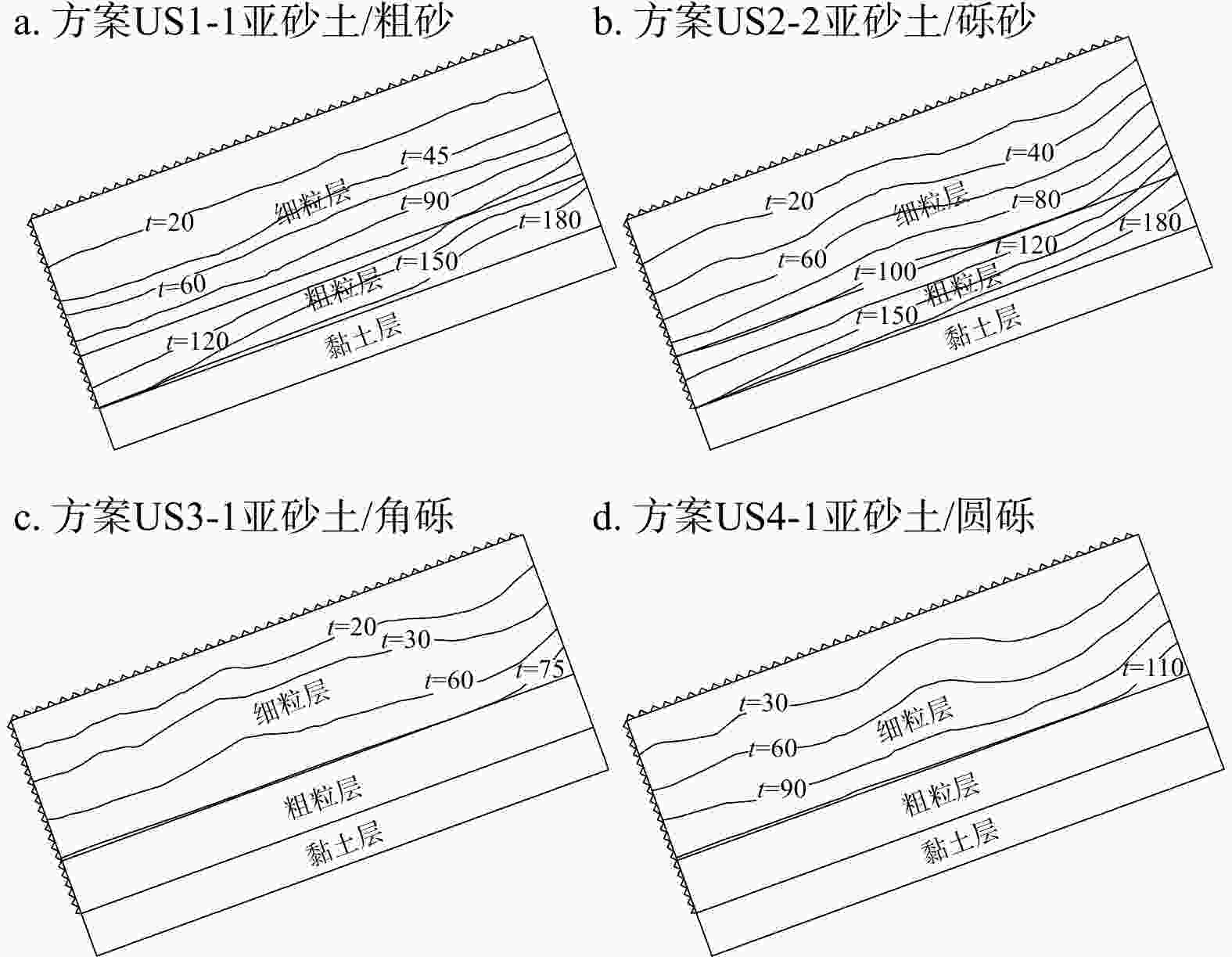
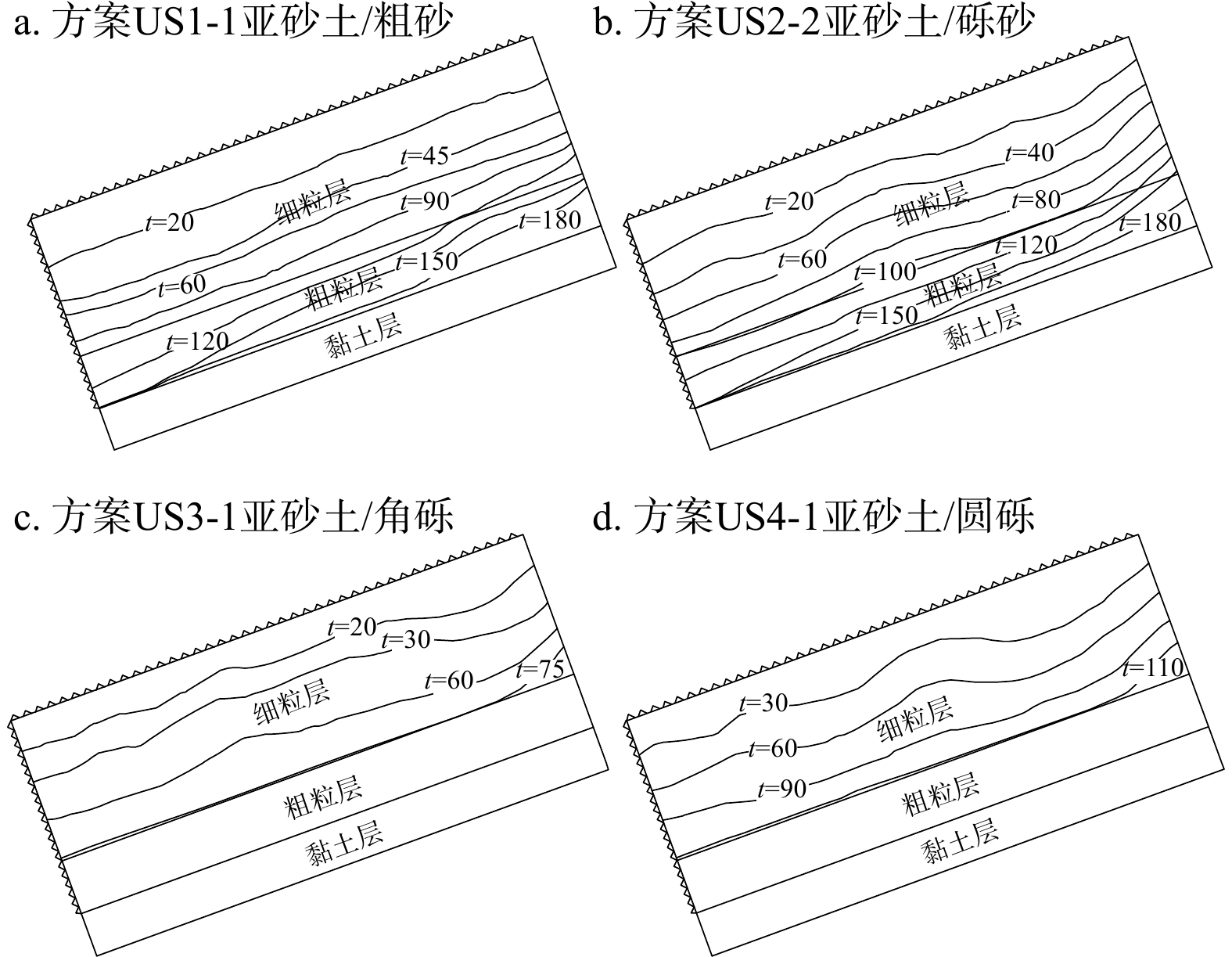
图 4 不同CBL岩性组合湿润锋迁移过程线(t为时间,min)
Figure 4. Migration process lines of wetting front of different CBL lithological combinations
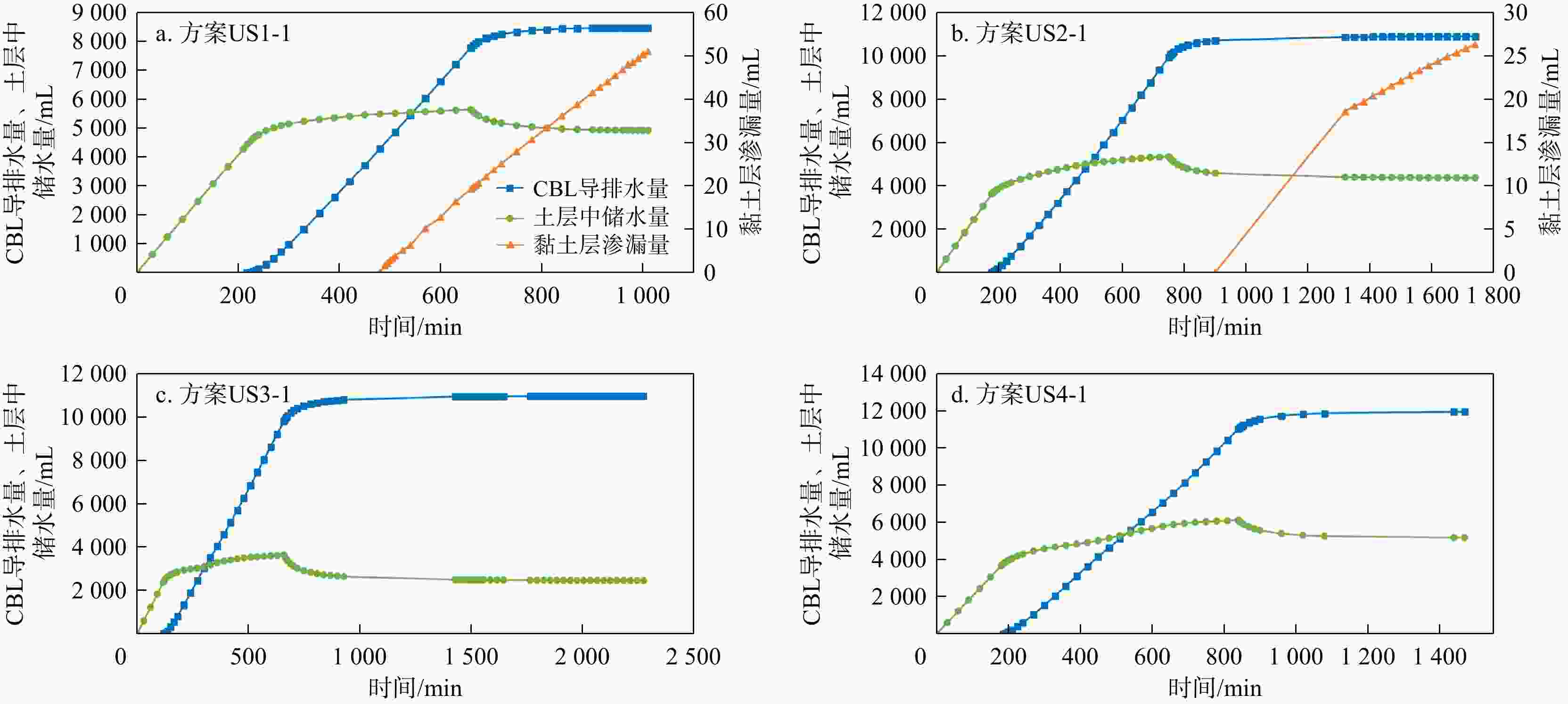
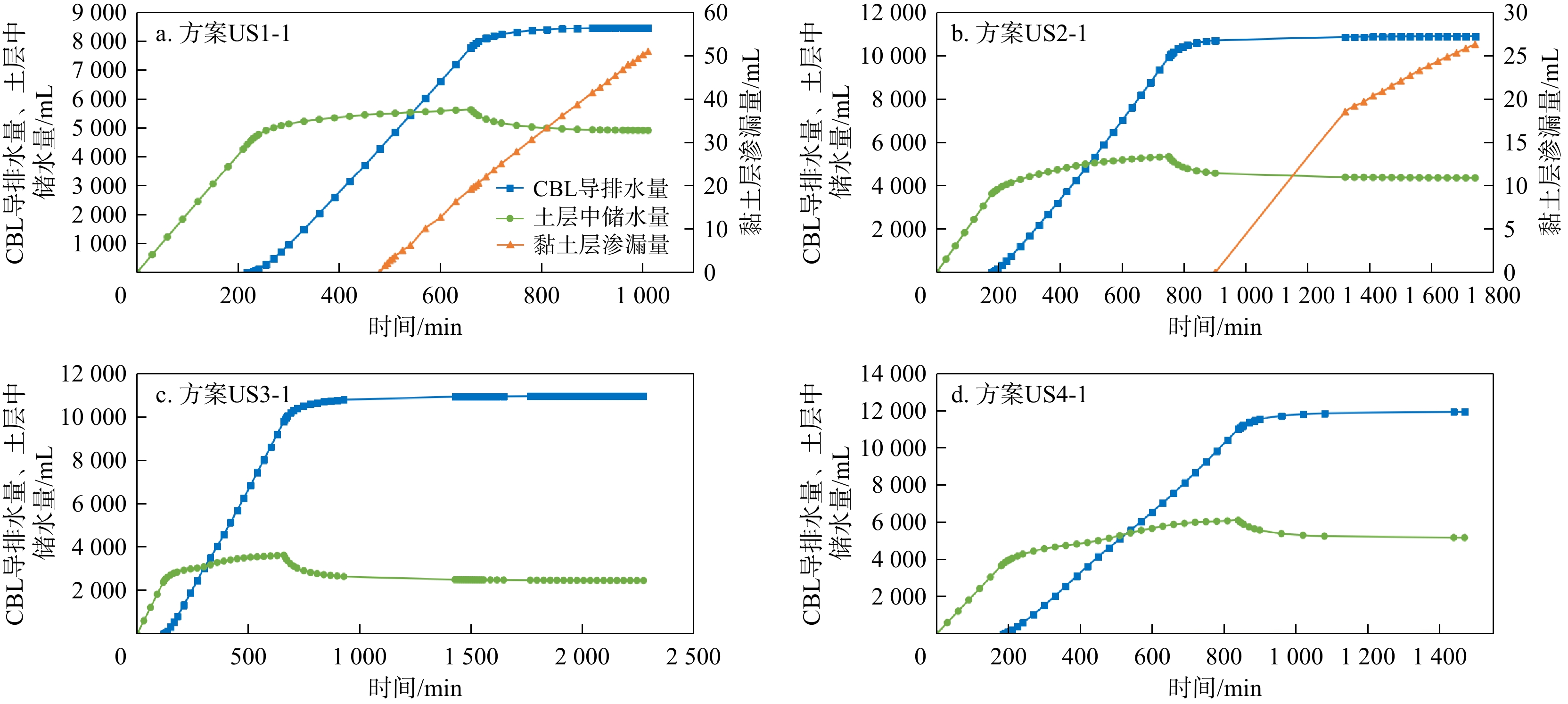
图 6 不同CBL岩性组合的排水随时间变化关系
Figure 6. Temporal variation of drainage for different CBL lithological combinations
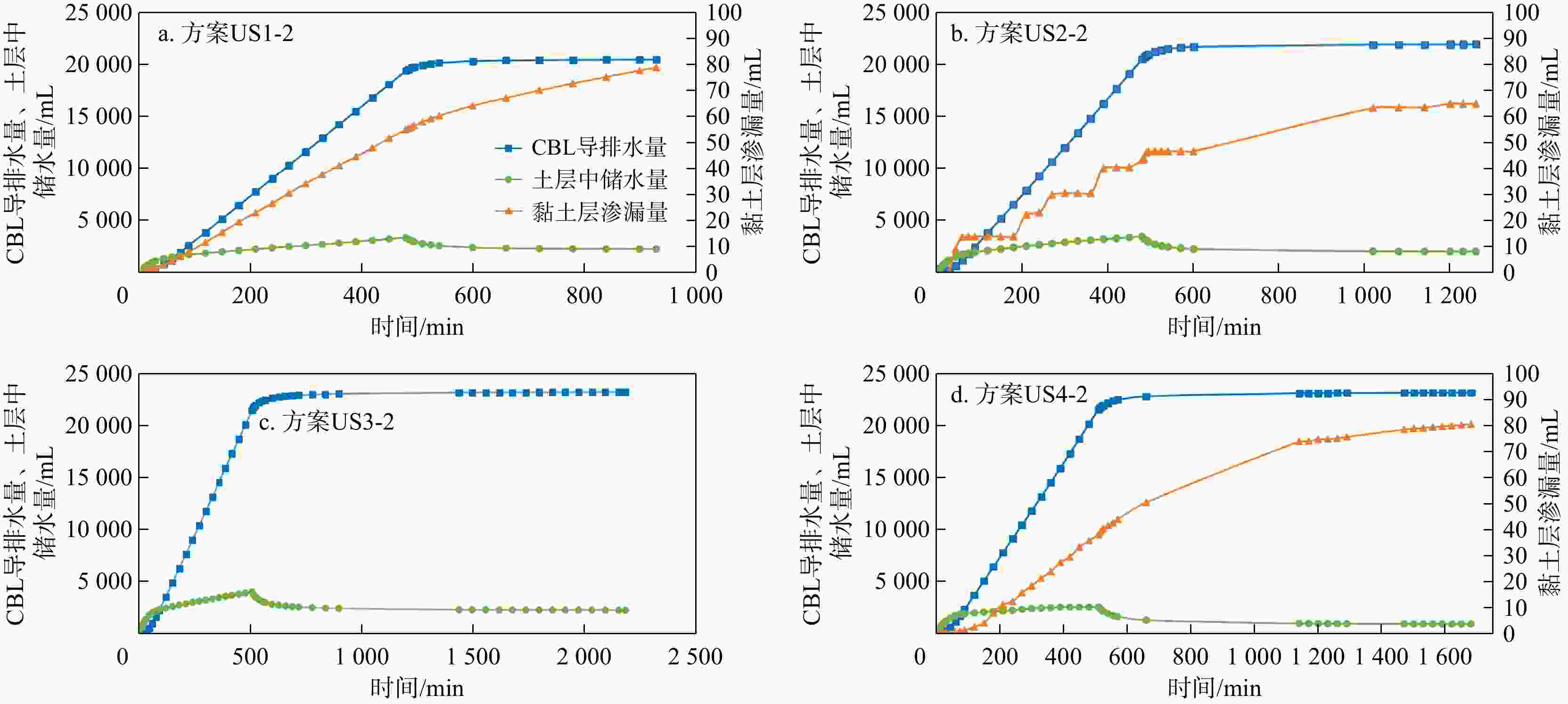
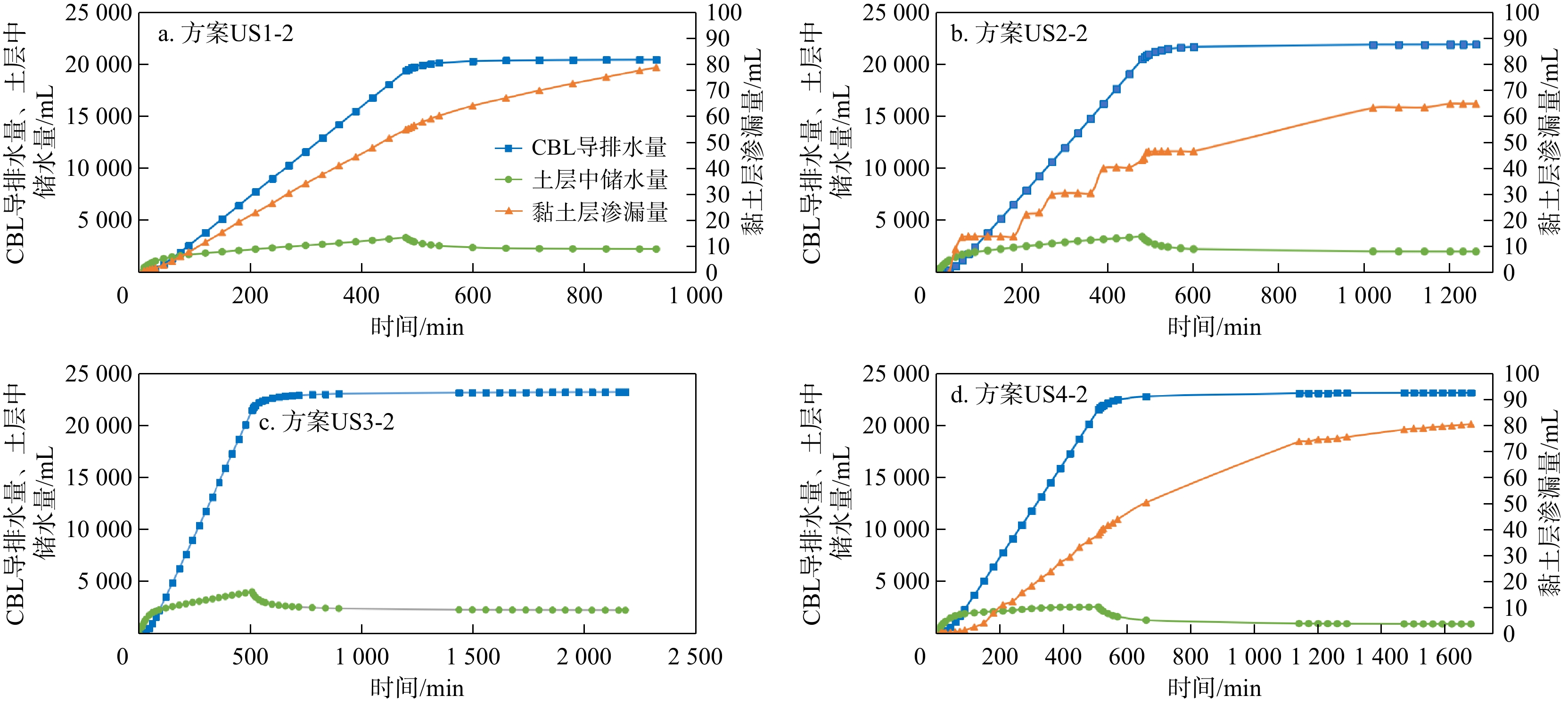
图 7 不同CBL岩性组合强降雨强度试验方案排水体积随时间变化曲线
Figure 7. Temporal variation curves of drainage volume under heavy rainfall intensity test schemes for different CBL lithological combinations
表 1 试验方案
Table 1. Test schemes
方案编号 CBL岩性组合 降雨强度/
(10−4cm·s−1)降雨持续
时间/min初始
含水量US1-1 亚砂土/粗砂 1.93 660 w0 US1-2 4.73 480 w1 US2-1 亚砂土/砾砂 1.93 750 w0 US2-2 4.73 480 w1 US3-1 亚砂土/角砾 1.93 660 w0 US3-2 4.73 510 w1 US4-1 亚砂土/圆砾 1.93 840 w0 US4-2 4.73 510 w1 注:w0为细粒层、粗粒层和边坡层的初始含水量,分别为10%,3%,23.3%;w1为第1次降雨后含水量,亚砂土、粗砂、砾砂、角砾、圆砾、黏土的含水量范围分别为10.0%~23.5%,8.0%~18.0%,3.0%~7.5%,2.0%~4.0%,2.0%~5.5%和25.0%~30.0%。这是由于不同CBL结构(尤其是粗粒层岩性及颗粒形态)导致的水分入渗、侧向排水效率以及水分在边坡层内再分布存在差异所致  下载: 导出CSV
表 2 不同CBL岩性组合的降雨入渗特征参数
Table 2. Characteristic parameters of rainfall infiltration for different CBL lithological combinations
方案 降雨强度/
(10−4cm·s−1)降雨时
间/min开始排水
时间/min降雨结束后
粗粒层持续
排水时间/min稳定排水强度/
(10−4cm·s−1)CBL 黏土层 CBL 黏土层 US1-1 1.93 660 218 480 350 1.84 0.010 US2-1 750 178 900 990 1.85 0.002 US3-1 660 117 — 1620 1.87 — US4-1 840 184 — 630 1.84 —
下载: 导出CSV
表 3 不同CBL岩性组合试验方案的降雨导排特征参数
Table 3. Characteristic parameters of rainfall drainage for test schemes of different CBL lithological combinations
方案 降雨强度/
(10−4cm·s−1)降雨时间/
min稳定排水
效率/%综合排水效率/% 土体残留水量
比例/%CBL 边坡底部 US1-1 1.93 660 95.38 64.19 0.39 35.42 US2-1 750 95.85 77.54 0.19 22.27 US3-1 660 96.74 82.42 0 17.58 US4-1 840 95.37 78.08 0 21.92
下载: 导出CSV
表 4 不同CBL岩性组合强降雨条件下降雨入渗特征参数
Table 4. Characteristic parameters of rainfall infiltration under heavy rainfall conditions for different CBL lithological combinations
方案 降雨强度/
(10−4cm·s−1)降雨时间/
min开始排水
时间/min降雨结束后
持续排水
时间/min稳定排水强度/
(10−4cm·s−1)CBL 边坡 CBL 边坡 US1-2 4.73 480 7 0 450 4.08 0.011 US2-2 480 8 30 780 4.47 0.001 US3-2 510 12 — 1680 4.39 — US4-2 510 10 0 1170 4.45 0.009
下载: 导出CSV
表 5 不同CBL岩性组合强降雨条件下CBL导排特征参数
Table 5. Characteristic parameters of CBL drainage under heavy rainfall conditions for different CBL lithological combinations
方案 降雨强度/
(10−4cm·s−1)降雨时间/
min稳定排水
效率/%综合排水效率/% 土体残留水量
比例/%CBL 边坡底部 US1-2 4.73 480 86.39 95.86 0.37 3.77 US2-2 480 94.54 97.38 0.03 2.59 US3-2 510 92.81 98.41 0 1.59 US4-2 510 94.15 98.37 0.34 1.29
下载: 导出CSV
-
[1] 熊爽, 曾江波, 姚文敏, 等. 降雨干湿循环作用下的渣土边坡稳定性[J]. 地质科技情报, 2018, 37(5): 240-246.XIONG S, ZENG J B, YAO W M, et al. Stability of construction solid waste landfill slope under wetting-drying cycle of rainfall[J]. Geological Science and Technology Information, 2018, 37(5): 240-246. (in Chinese with English abstract [2] 习念念, 童富果, 刘刚, 等. 基于水气二相流的边坡降雨入渗有限元分析[J]. 长江科学院院报, 2017, 34(1): 120-123. doi: 10.11988/ckyyb.20150975XI N N, TONG F G, LIU G, et al. Finite element analysis of water-air two-phase infiltration in slope[J]. Journal of Yangtze River Scientific Research Institute, 2017, 34(1): 120-123. (in Chinese with English abstract doi: 10.11988/ckyyb.20150975 [3] 石振明, 沈丹祎, 彭铭, 等. 考虑多层非饱和土降雨入渗的边坡稳定性分析[J]. 水利学报, 2016, 47(8): 977-985. doi: 10.13243/j.cnki.slxb.20151132SHI Z M, SHEN D Y, PENG M, et al. Slope stability analysis by considering rainfall infiltration in multi-layered unsaturated soils[J]. Journal of Hydraulic Engineering, 2016, 47(8): 977-985. (in Chinese with English abstract doi: 10.13243/j.cnki.slxb.20151132 [4] 张石, 郑东健, 武鑫. 降雨类型对粉土边坡渗流及稳定性的影响[J]. 水力发电, 2022, 48(9): 34-39. doi: 10.3969/j.issn.0559-9342.2022.09.007ZHANG S, ZHENG D J, WU X. Influence of rainfall types on seepage and stability of silt slope[J]. Water Power, 2022, 48(9): 34-39. (in Chinese with English abstract doi: 10.3969/j.issn.0559-9342.2022.09.007 [5] 李智. 降雨条件下非饱和带水−气二相流驱替规律研究[D]. 西安: 长安大学, 2017.LI Z. Regularity of water-air two-phase flow displacement in unsaturated zone under infiltration condition[D]. Xi'an: Chang'an University, 2017. (in Chinese with English abstract [6] 姚茂宏, 陈铁林, 樊容, 等. 强降雨条件下考虑气压和渗流作用的边坡稳定性[J]. 上海交通大学学报, 2022, 56(6): 739-745. doi: 10.16183/j.cnki.jsjtu.2021.302YAO M H, CHEN T L, FAN R, et al. Slope stability considering the effects of air pressure and seepage under heavy rainfall conditions[J]. Journal of Shanghai Jiao Tong University, 2022, 56(6): 739-745. (in Chinese with English abstract doi: 10.16183/j.cnki.jsjtu.2021.302 [7] MIZRAHI G, FURMAN A, WEISBROD N. Infiltration under confined air conditions: Impact of inclined soil surface[J]. Vadose Zone Journal, 2016, 15(9): vzj2016.04. 0034. [8] SIDLE R C, NOGUCHI S, TSUBOYAMA Y, et al. A conceptual model of preferential flow systems in forested hillslopes: Evidence of self-organization[J]. Hydrological Processes, 2001, 15(10): 1675-1692. [9] 赵敏, 何晖. 非饱和黄土水−气渗透性试验研究[J]. 西安科技大学学报, 2005, 25(3): 292-295. doi: 10.3969/j.issn.1672-9315.2005.03.006ZHAO M, HE H. Experiment on water-air permeability of unsaturated loess[J]. Journal of Xi'an University of Science and Technology, 2005, 25(3): 292-295. (in Chinese with English abstract doi: 10.3969/j.issn.1672-9315.2005.03.006 [10] 黄瑞健, 冯文凯, 李双权, 等. 降雨型群发浅层土质滑坡运动距离经验预测模型[J]. 地质科技通报, 2025, 44(3): 255-267. doi: 10.19509/j.cnki.dzkq.tb20240364HUANG R J, FENG W K, LI S Q, et al. Empirical prediction model for the runout distance of rainfall-induced group-occurring shallow soil landslides[J]. Bulletin of Geological Science and Technology, 2025, 44(3): 255-267. (in Chinese with English abstract doi: 10.19509/j.cnki.dzkq.tb20240364 [11] 唐扬, 殷坤龙, 夏辉. 前期含水率对浅层滑坡降雨入渗及稳定性影响研究[J]. 地质科技情报, 2017, 36(5): 204-208. doi: 10.19509/j.cnki.dzkq.2017.0527TANG Y, YIN K L, XIA H. Effects of initial water content on the rainfall infiltration and stability of shallow landslide[J]. Geological Science and Technology Information, 2017, 36(5): 204-208. (in Chinese with English abstract doi: 10.19509/j.cnki.dzkq.2017.0527 [12] 卢操, 晏鄂川, 陈侠廷, 等. 区域滑坡灾害降雨预警的I-D-M阈值模型研究[J]. 地质科技通报, 2025, 44(6): 157-165. doi: 10.19509/j.cnki.dzkq.tb20250216LU C, YAN E C, CHEN X T, et al. Research on the I-D-M threshold model for regional rainfall-induced landslide hazard early warning at a regional scale[J]. Bulletin of Geological Science and Technology, 2025, 44(6): 157-165. (in Chinese with English abstract doi: 10.19509/j.cnki.dzkq.tb20250216 [13] BERNADINER M G. A capillary microstructure of the wetting front[J]. Transport in Porous Media, 1998, 30(3): 251-265. doi: 10.1023/A:1006571720867 [14] 詹良通, 邱清文, 杨益彪, 等. 黄土覆盖层水−气耦合运移土柱试验及数值模拟[J]. 岩土工程学报, 2017, 39(6): 969-977.ZHAN L T, QIU Q W, YANG Y B, et al. Soil column tests and numerical simulations of moisture-gas coupled flow in a loess cover[J]. Chinese Journal of Geotechnical Engineering, 2017, 39(6): 969-977. (in Chinese with English abstract [15] 杨松, 黄剑峰, 罗茂泉, 等. 斥水性砂土水−气形态及其对斥水−亲水转化的影响分析[J]. 农业机械学报, 2017, 48(11): 247-252.YANG S, HUANG J F, LUO M Q, et al. Pore water-air configurations in water repellent sandy soil and its effects on transformation of hydrophilicity to hydrophobicity[J]. Transactions of the Chinese Society for Agricultural Machinery, 2017, 48(11): 247-252. (in Chinese with English abstract [16] 赵旭, 樊军, 付威. 土壤侵蚀与土地利用方式对黑土地土壤水气传输特性的影响[J]. 应用生态学报, 2020, 31(5): 1599-1606. doi: 10.13287/j.1001-9332.202005.017ZHAO X, FAN J, FU W. Effects of soil erosion and land use patterns on the characteristics of soil water and gas transport in the black soil region[J]. Chinese Journal of Applied Ecology, 2020, 31(5): 1599-1606. (in Chinese with English abstract doi: 10.13287/j.1001-9332.202005.017 [17] 韩蕾, 潘雅文, 朱志梅, 等. 水蚀风蚀交错区不同土地利用方式的土壤水气传输特性[J]. 应用生态学报, 2019, 30(4): 1415-1422.HAN L, PAN Y W, ZHU Z M, et al. The characteristics of soil water and gas transport under different land use patterns in the water-wind erosion crisscross region[J]. Chinese Journal of Applied Ecology, 2019, 30(4): 1415-1422. (in Chinese with English abstract [18] 焦卫国, 詹良通, 兰吉武, 等. 黄土−碎石覆盖层毛细阻滞效应及设计厚度分析[J]. 浙江大学学报(工学版), 2016, 50(11): 2128-2134. doi: 10.3785/j.issn.1008-973X.2016.11.013JIAO W G, ZHAN L T, LAN J W, et al. Analysis of capillary barrier effect and design thickness with loess-gravel cover[J]. Journal of Zhejiang University (Engineering Science), 2016, 50(11): 2128-2134. (in Chinese with English abstract doi: 10.3785/j.issn.1008-973X.2016.11.013 [19] 焦卫国, 詹良通, 季永新, 等. 黄土−碎石毛细阻滞覆盖层储水能力实测与分析[J]. 岩土工程学报, 2019, 41(6): 1149-1157. doi: 10.11779/CJGE201906020JIAO W G, ZHAN L T, JI Y X, et al. Field tests on water storage capacity of loess-gravel capillary barrier covers[J]. Chinese Journal of Geotechnical Engineering, 2019, 41(6): 1149-1157. (in Chinese with English abstract doi: 10.11779/CJGE201906020 [20] TAMI D, RAHARDJO H, LEONG E C, et al. A physical model for sloping capillary barriers[J]. Geotechnical Testing Journal, 2004, 27(2): 173-183. doi: 10.1520/GTJ11431 [21] AUBERTIN M, CIFUENTES E, APITHY S A, et al. Analyses of water diversion along inclined covers with capillary barrier effects[J]. Canadian Geotechnical Journal, 2009, 46(10): 1146-1164. doi: 10.1139/T09-050 [22] QIAN T W, HUO L J, ZHAO D Y. Laboratory investigation into factors affecting performance of capillary barrier system in unsaturated soil[J]. Water, Air, and Soil Pollution, 2010, 206(1): 295-306. doi: 10.1007/s11270-009-0106-9 [23] JANSIK D P, WILDENSCHILD D, ROSENBERG N D. Flow processes in the dry regime: The effect on capillary barrier performance[J]. Vadose Zone Journal, 2011, 10(4): 1173-1184. [24] CHEN L, ZHAN L T, NG C W W. Role of particle angularity in the evolution of preferential flow paths in coarse-grained capillary barriers[J]. Géotechnique, 2023, 73(8): 701-715. [25] WANG X, LI J H, JIANG M J. Performance evaluation of dual capillary barriers for landslide prevention under extreme rainfall events[J]. Landslides, 2024, 21(3): 689-704. [26] HARNAS F R, RAHARDJO H, LEONG E C, et al. Experimental study on dual capillary barrier using recycled asphalt pavement materials[J]. Canadian Geotechnical Journal, 2014, 51(10): 1165-1177. doi: 10.1139/cgj-2013-0432 [27] 史文娟, 汪志荣, 沈冰, 等. 夹砂层土体构型毛管水上升的实验研究[J]. 水土保持学报, 2004, 18(6): 167-170.SHI W J, WANG Z R, SHEN B, et al. Soil capillary water upward movement from sand layered soil column[J]. Journal of Soil and Water Conservation, 2004, 18(6): 167-170. (in Chinese with English abstract [28] LI P, GAO Y F, NG C W W. Optimal design of vegetated capillary barriers for slope protection using coupled hydro-mechanical model[J]. Engineering Geology, 2024, 328: 107385. [29] LIU S, FENG S, GAO Y F. Ecological slope protection using vegetation-compatible capillary barriers: Field performance and root reinforcement effects[J]. Ecological Engineering, 2021, 170: 106353. [30] 邓林恒, 詹良通, 陈云敏, 等. 含非饱和导排层的毛细阻滞型覆盖层性能模型试验研究[J]. 岩土工程学报, 2012, 34(1): 75-80.DENG L H, ZHAN L T, CHEN Y M, et al. Model tests on capillary-barrier cover with unsaturated drainage layer[J]. Chinese Journal of Geotechnical Engineering, 2012, 34(1): 75-80. (in Chinese with English abstract [31] XIE W, SHANG Y Q, WU G, et al. Investigation of the formation process of a low-permeability unsaturated zone by air injection method in a slope[J]. Engineering Geology, 2018, 245: 10-19. doi: 10.1016/j.enggeo.2018.08.005 [32] CHEN Y B, GAO Y F, NG C W W. A new capillary barrier system for retaining wall backfilled with fine-grained soil[J]. Computers and Geotechnics, 2020, 118: 103324. doi: 10.1016/j.compgeo.2019.103324 [33] 张家发, 刘晓明, 焦赳赳. 膨胀土渠坡兼有排水功能的双层结构防护方案[J]. 长江科学院院报, 2009, 26(11): 37-41. doi: 10.3969/j.issn.1001-5485.2009.11.009ZHANG J F, LIU X M, JIAO J J. A protection scheme of double layers with drainage function for expansive soil slopes by canal[J]. Journal of Yangtze River Scientific Research Institute, 2009, 26(11): 37-41. (in Chinese with English abstract doi: 10.3969/j.issn.1001-5485.2009.11.009 [34] 吴庆华, 张家发, 武金博, 等. 非饱和导排结构控制降雨入渗的边坡物理模型试验[J]. 岩土工程学报, 2017, 39(1): 154-160. doi: 10.11779/CJGE201701014WU Q H, ZHANG J F, WU J B, et al. Physical model tests on slopes with control of infiltration by unsaturated drainage structures[J]. Chinese Journal of Geotechnical Engineering, 2017, 39(1): 154-160. (in Chinese with English abstract doi: 10.11779/CJGE201701014 [35] 吴庆华, 张家发, 崔皓东, 等. 细/粗粒二元结构边坡的排水防渗效果试验研究[J]. 岩土力学, 2017, 38(2): 392-399. doi: 10.16285/j.rsm.2017.02.012WU Q H, ZHANG J F, CUI H D, et al. Experimental study of drainage control of slopes with fine-coarse grain structure[J]. Rock and Soil Mechanics, 2017, 38(2): 392-399. (in Chinese with English abstract doi: 10.16285/j.rsm.2017.02.012 [36] 吴庆华, 王珂. 细/粗二元结构边坡角度与岩性特征对其阻隔降雨入渗的影响规律[J]. 地球科学, 2025, 50(1): 311-321. doi: 10.3799/dqkx.2023.170WU Q H, WANG K. Effect of angle and lithology on infiltrating to fine/coarse dual-structure slope under rainfall condition[J]. Earth Science, 2025, 50(1): 311-321. (in Chinese with English abstract doi: 10.3799/dqkx.2023.170 [37] FIORENTINO M, STARACE G. Numerical investigations on two-phase flow modes in evaporative condensers[J]. Applied Thermal Engineering, 2016, 94: 777-785. doi: 10.1016/j.applthermaleng.2015.10.099 [38] LU N, LIKOS W J. Suction stress characteristic curve for unsaturated soil[J]. Journal of Geotechnical and Geoenvironmental Engineering, 2006, 132(2): 131-142. doi: 10.1061/(ASCE)1090-0241(2006)132:2(131) [39] STORMONT J C, ANDERSON C E. Capillary barrier effect from underlying coarser soil layer[J]. Journal of Geotechnical and Geoenvironmental Engineering, 1999, 125(8): 641-648. doi: 10.1061/(ASCE)1090-0241(1999)125:8(641) [40] ZHAN L T, NG C W W, Fredlund D G. Field study of water infiltration into a grassed unsaturated expansive soil slope[J]. Géotechnique, 2013, 63(7): 551-564. -

 下载:
下载:
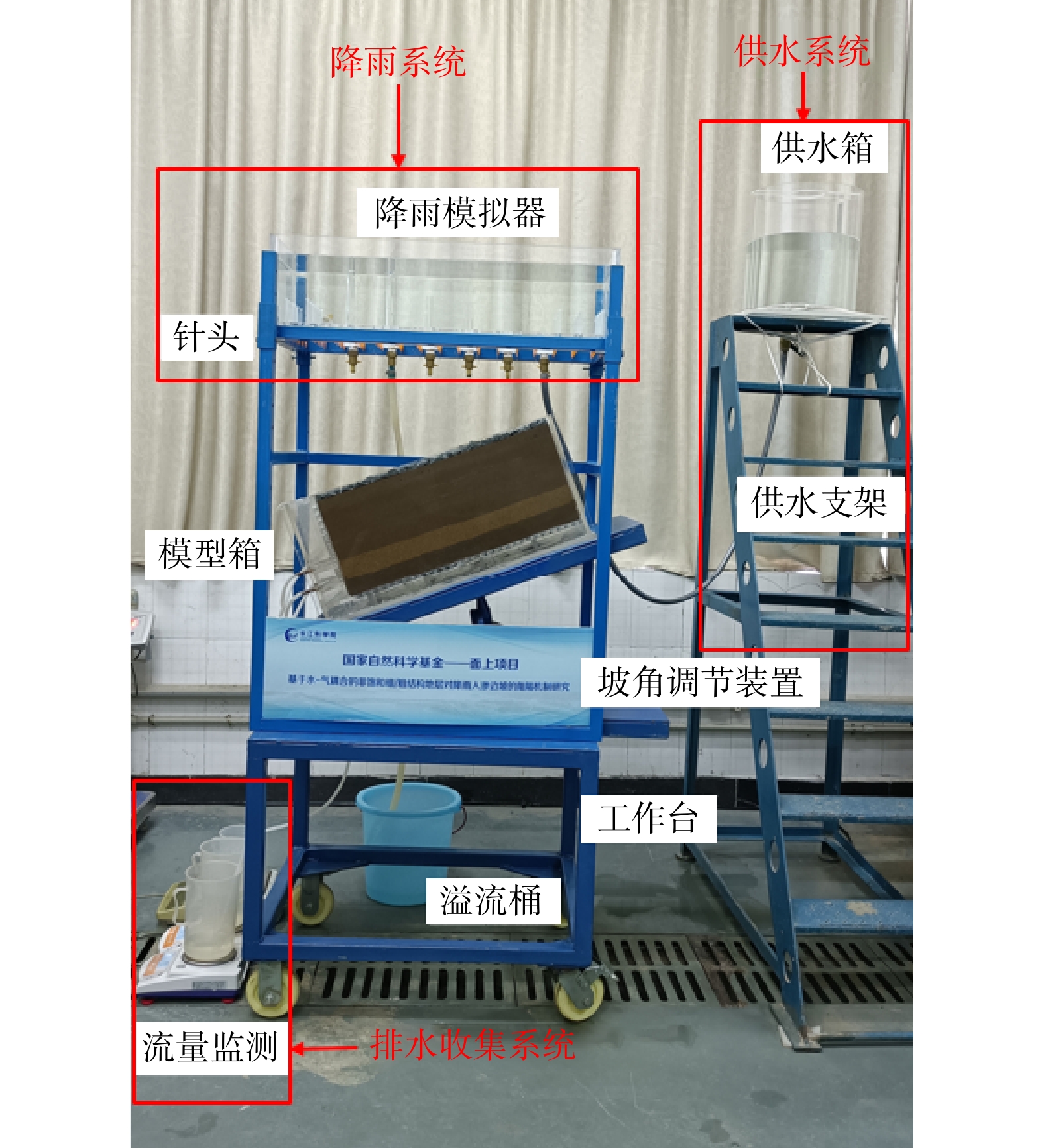

 点击查看大图
计量
- 文章访问数: 441
- PDF下载量: 176
- 被引次数: 0