投审稿入口
投审稿入口


Three-dimensional implicit modeling method for complex ore bodies based on inter-layer contour interpolation and normal optimization
-
摘要:
矿体三维建模是数字矿山和智慧矿山建设的核心基础。针对矿体隐式建模中剖面轮廓线间隔稀疏导致地质约束难以有效提取的关键问题,提出一种基于Hermite径向基函数(HRBF)隐式建模框架的三维重建方法,通过融合轮廓线层间插值与法向优化技术构建矿体模型。首先基于三次样条闭合曲线拟合方法对原始轮廓数据进行均匀化处理,通过矩形包围盒分区建立轮廓映射起始点,依据局部轮廓长度与总长度比例动态调整控制点映射关系,有效解决复杂轮廓线控制点之间的合理对应问题。针对矿体轮廓法向梯度约束难以提取的问题,设计了一种基准法向驱动的局部选点策略与法向二义性消除机制,从而提高边界法向梯度的准确性和拓扑一致性。最后基于移动立方体方法实现隐式曲面可视化,通过实例矿体轮廓数据构建了复杂三维矿体模型,验证了本方法的有效性。研究成果可为复杂矿体精准三维重建、资源储量估算及智慧矿山建设提供可靠技术支撑。
Abstract:ObjectiveThree-dimensional ore body modeling is the core foundation for the construction of digital mines and intelligent mines. To address the key problem in implicit ore body modeling where sparse intervals between contour lines make it difficult to effectively extract geological constraints, a three-dimensional reconstruction method based on an Hermite radial basis function (HRBF) implicit modeling framework was proposed. This method constructed an ore body model by integrating inter-layer contour interpolation and normal optimization techniques.
Methods and ResultsFirst, the original contour data were homogenized based on a cubic spline closed curve fitting method, and contour mapping starting points were established through rectangular bounding box partitioning. The control point mapping relationships were dynamically adjusted according to the ratio of local contour length to total contour length, effectively solving the correspondence problem among control points of complex contour lines. To solve the problem that normal gradient constraints of ore body contours are difficult to extract, a baseline normal-driven local point selection strategy and a normal ambiguity elimination mechanism were developed, thereby improving the accuracy and topological consistency of boundary normal gradients. Finally, implicit surface visualization was achieved based on the marching cubes method, and a complex three-dimensional ore body model was constructed using actual ore body contour data, validating the effectiveness of the proposed method.
ConclusionThe research results can provide reliable technical support for accurate three-dimensional reconstruction of complex ore bodies, resource reserve estimation, and intelligent mine construction.
-
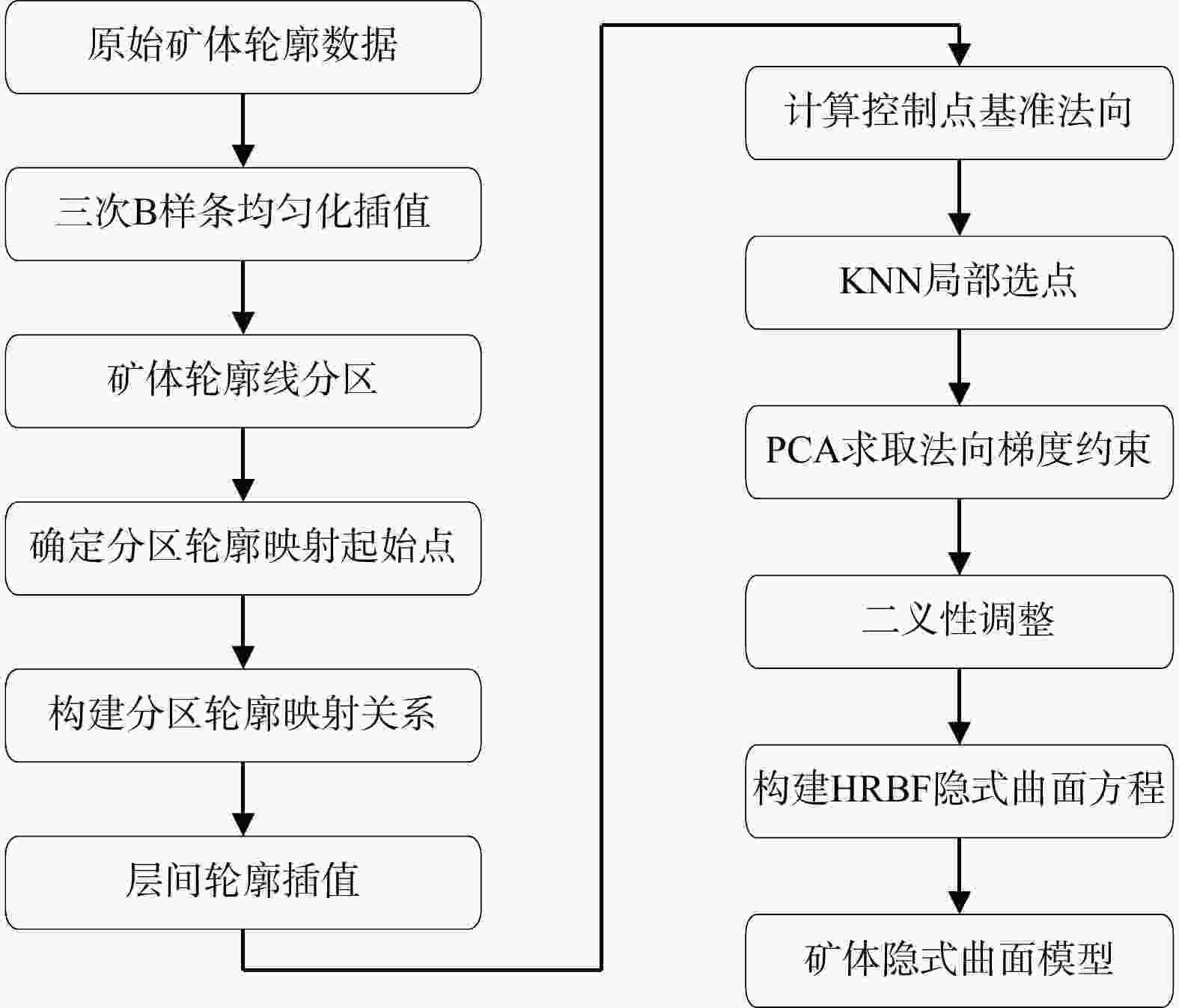
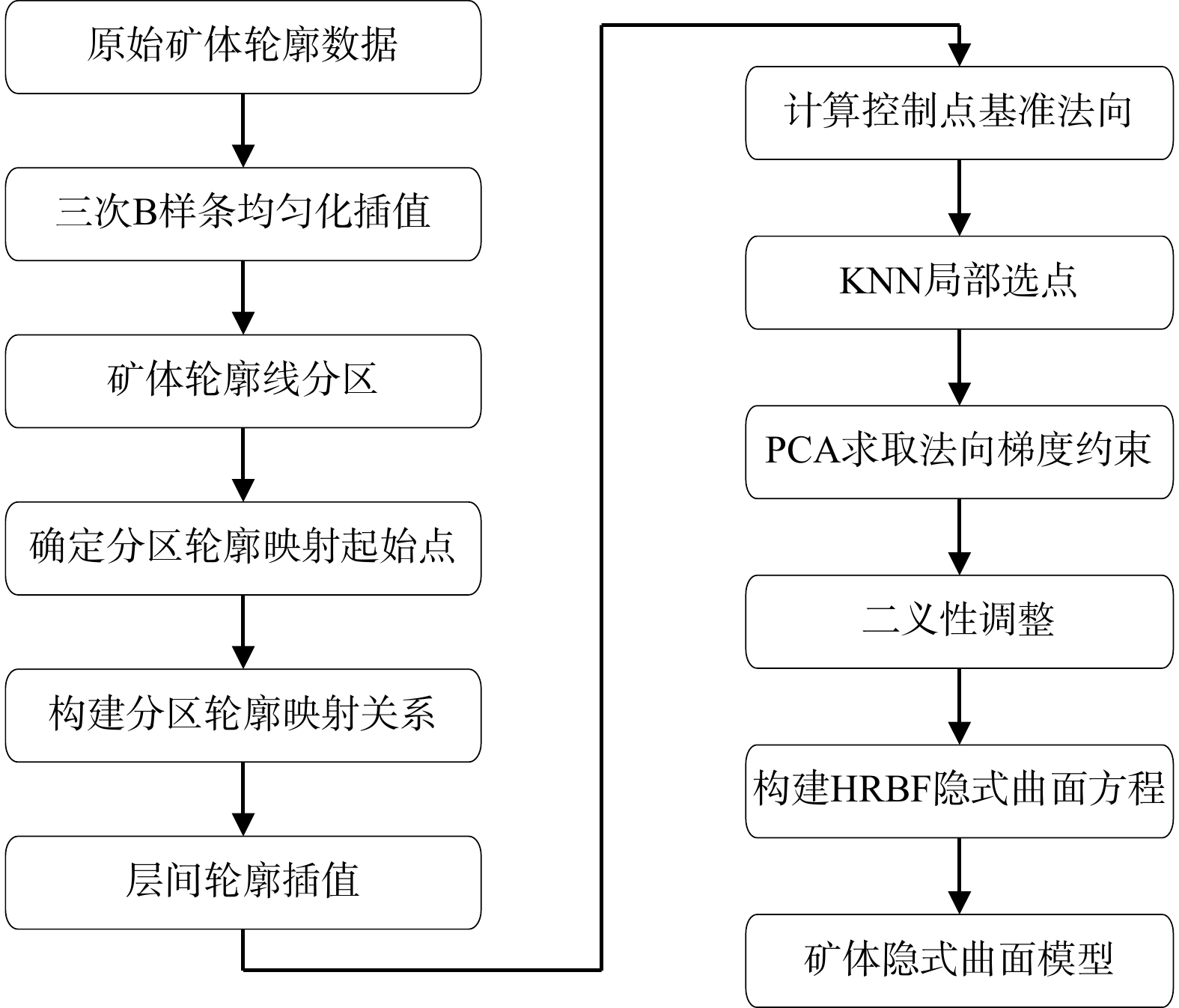
图 1 基于轮廓线层间插值和法向优化的复杂矿体三维隐式建模方法流程图
KNN. K-近邻算法;PCA. 主成分分析;HRBF. Hermite径向基函数
Figure 1. Flowchart of three-dimensional implicit modeling method for complex ore bodies based on inter-layer contour interpolation and normal optimization
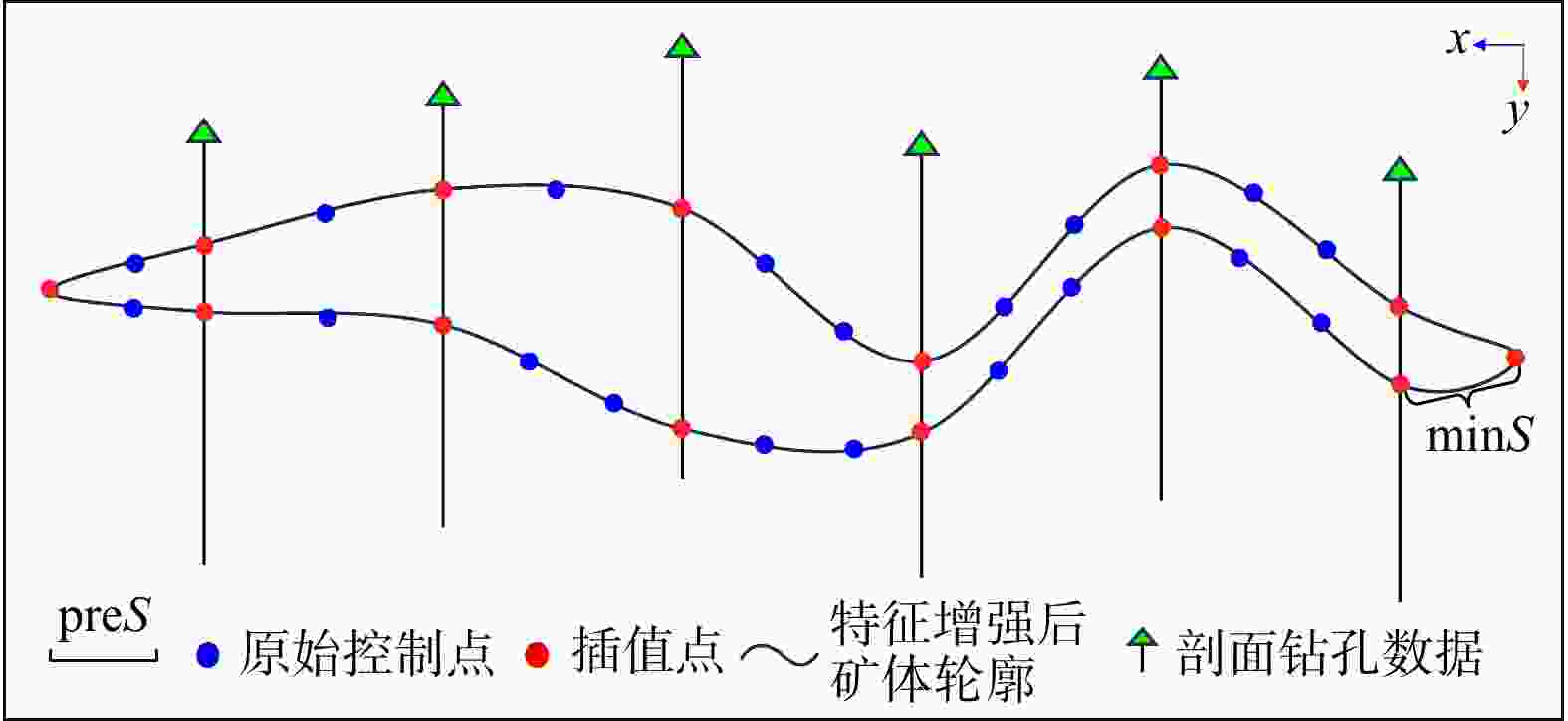
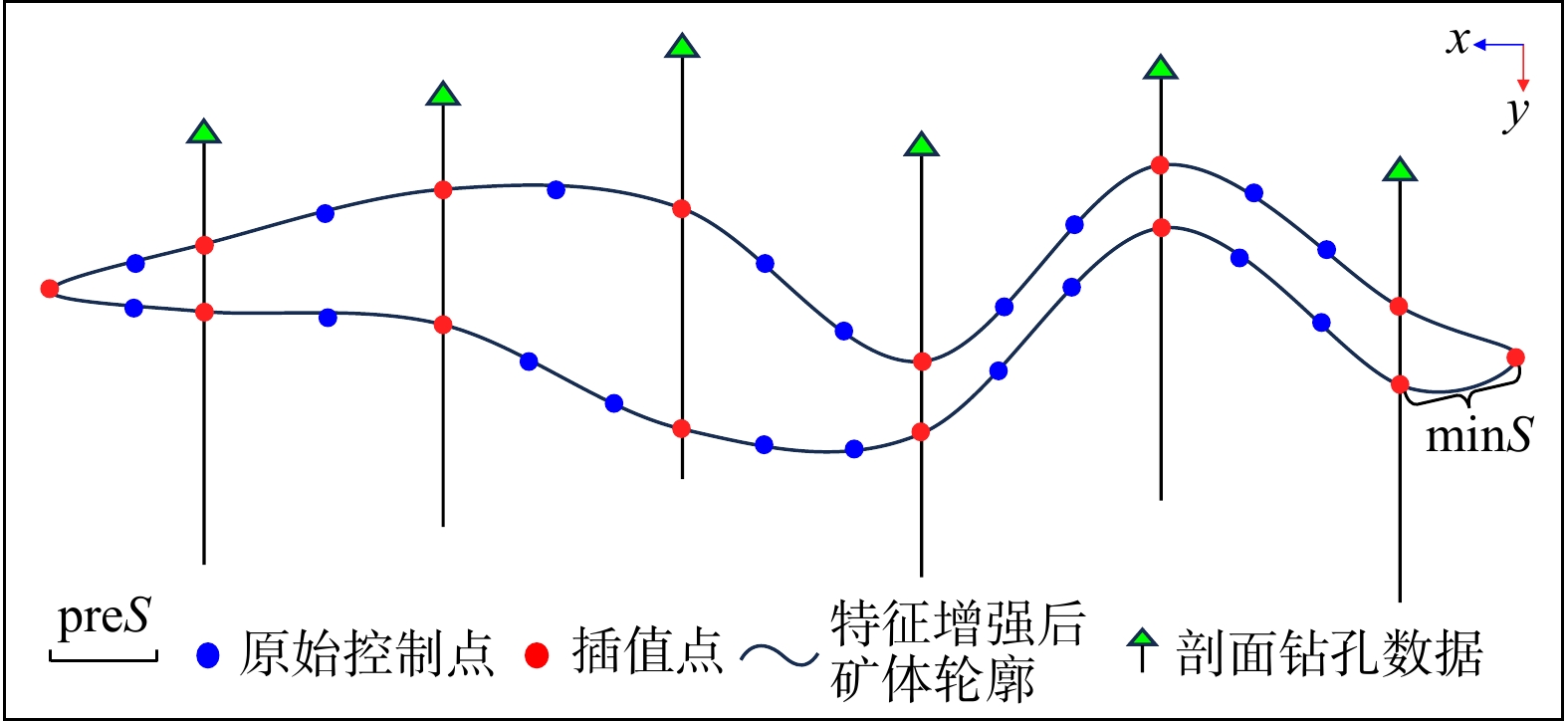
图 2 基于B样条矿体轮廓自适应插值示意图
S. 插值间隔;minS. 最小插值间隔;preS. 预设插值间隔
Figure 2. Schematic diagram of adaptive interpolation of ore body contours based on B-spline
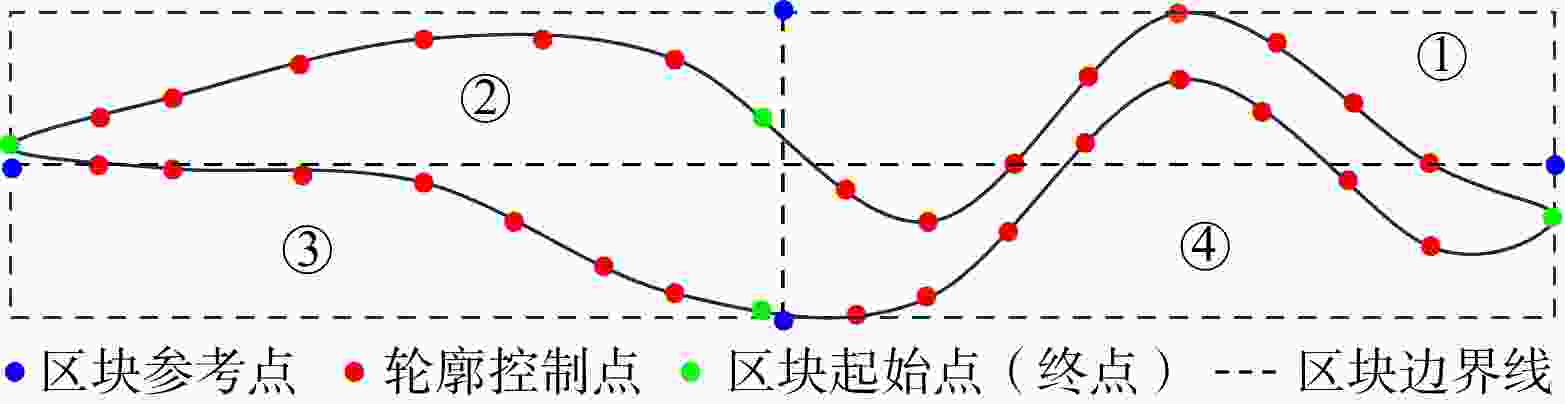
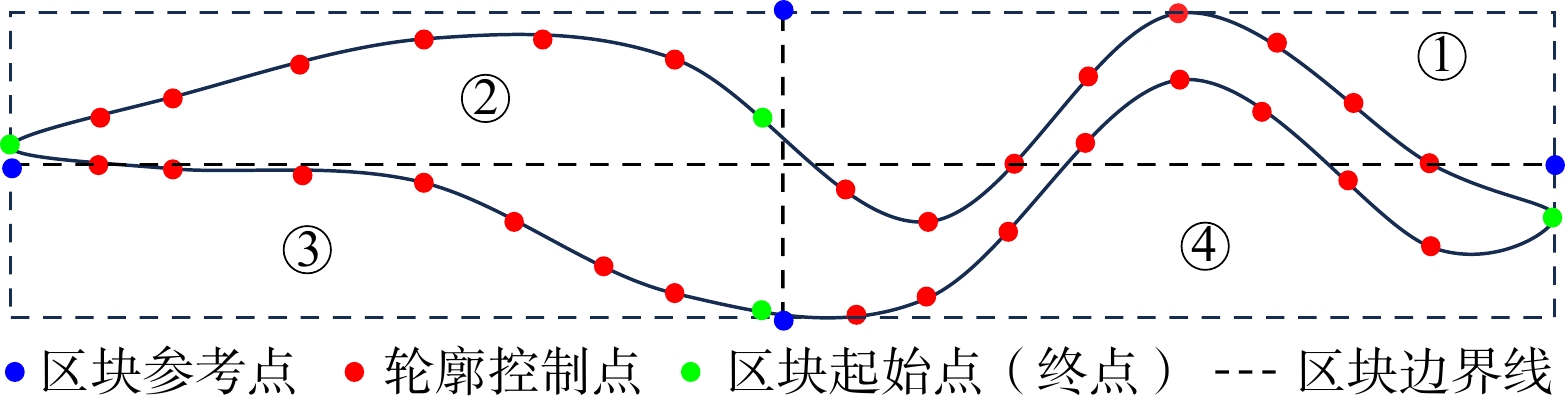
图 3 矿体轮廓分区示意图(①~④. 轮廓分区区块编号)
Figure 3. Schematic diagram of ore body contour partitioning
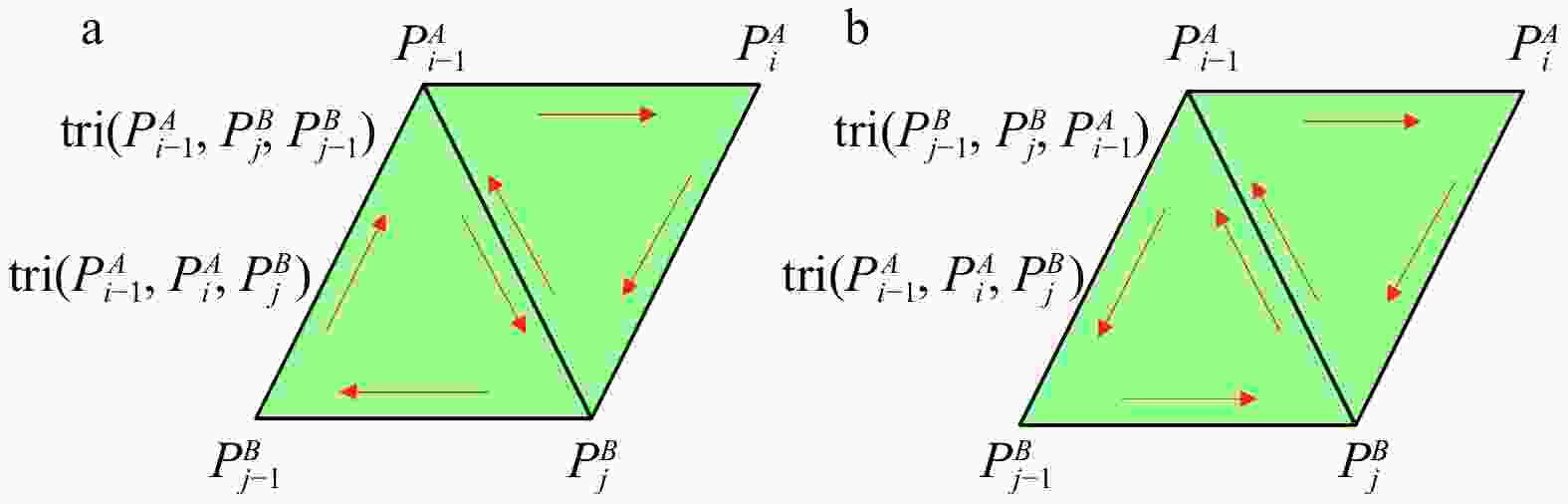
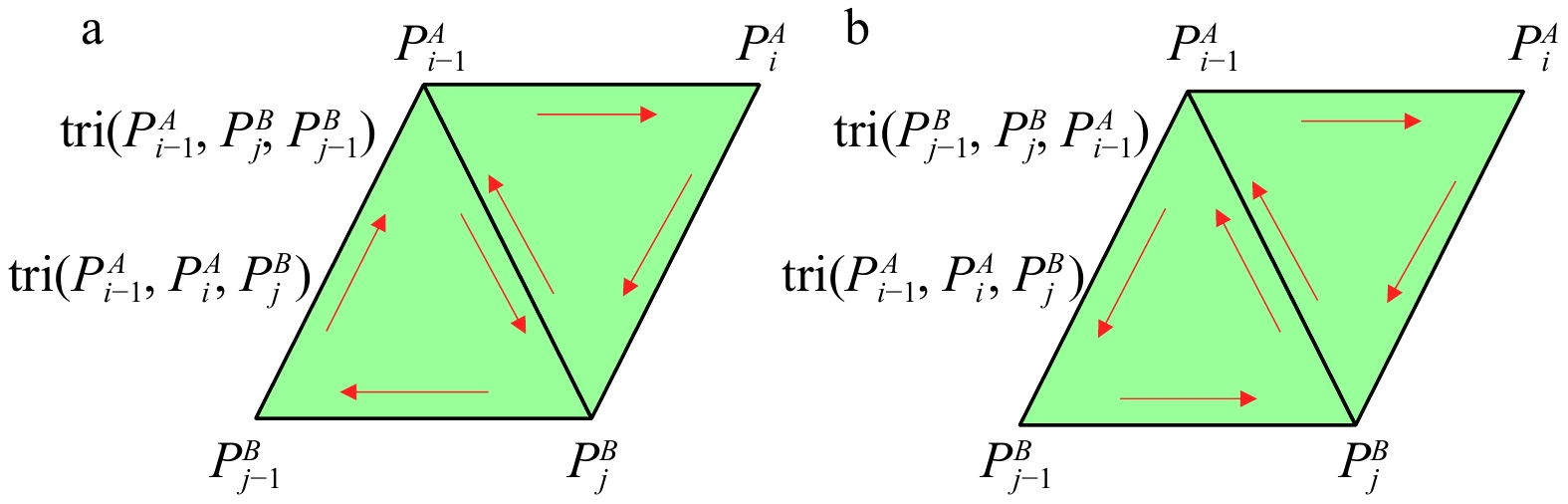
图 4 三角面片索引示意图
a. 绕向一致;b. 绕向不一致。$ {P}_{{i-1}}^{{A}}{,P}_{{i}}^{{A}}{,P}_{{j}}^{{B}}{,P}_{{j-1}}^{{B}} $分别为轮廓集合A的第i−1个控制点、轮廓集合A的第i个控制点、轮廓集合B的第j个控制点、轮廓集合B的第j−1个控制点;红色箭头表示三角面片绕向
Figure 4. Schematic diagram of triangular facet indexing
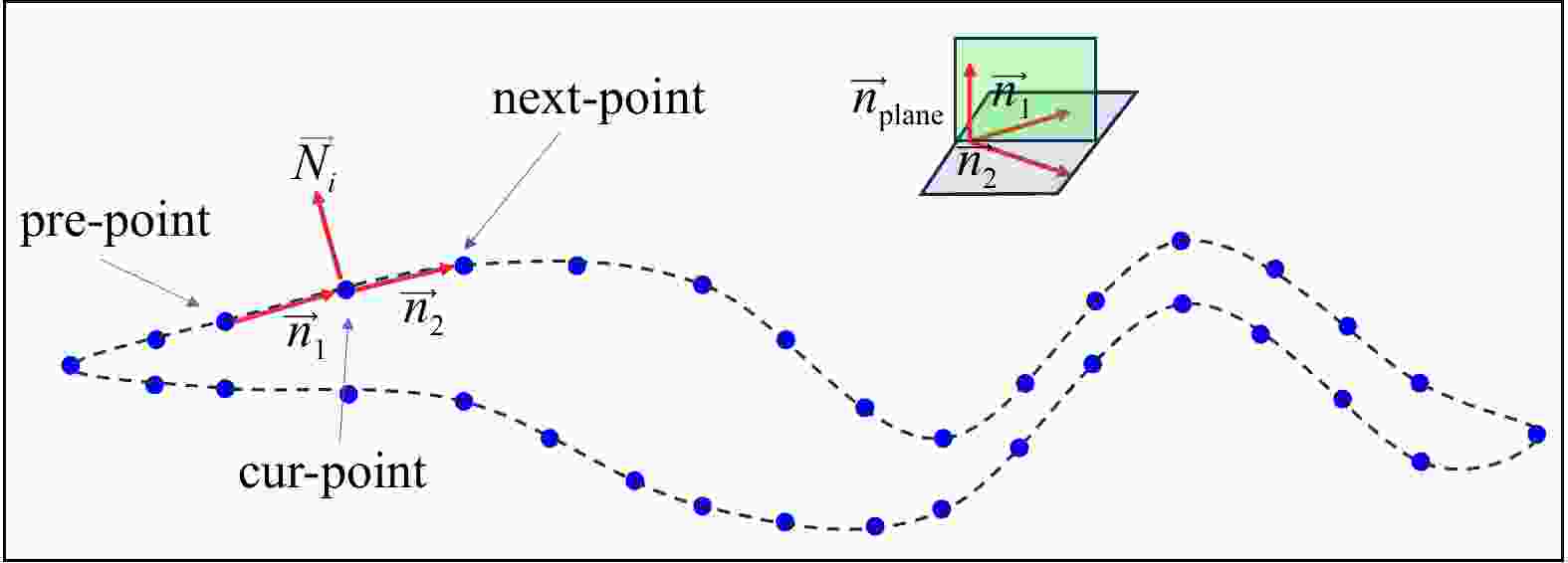
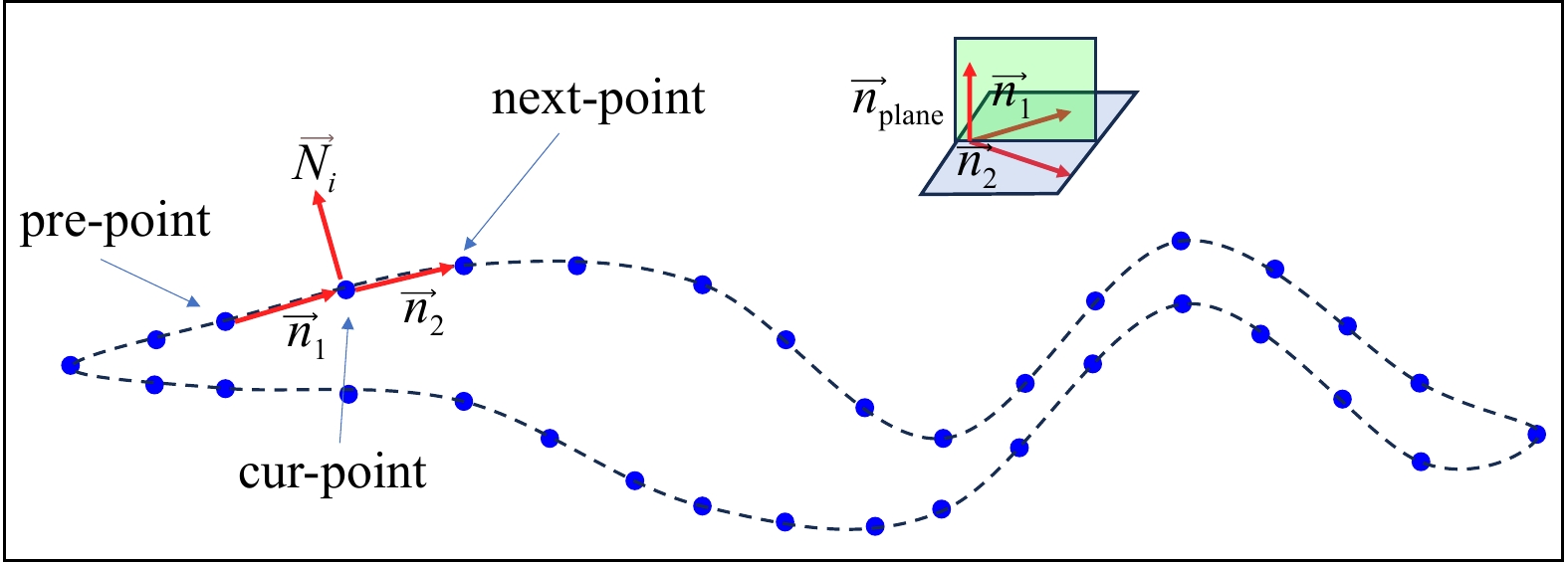
图 5 相邻控制点旋转法向估计示意图
cur-point. 当前控制点;pre-point. 当前控制点的前一个点;next-point. 当前控制点的下一个点;$ \overrightarrow{{{N}}_{{i}}} $. 基准法向量;$ {\overrightarrow{n}}_{{\mathrm{plane}}} $. 平面法向量;$ \overrightarrow{{{n}}_{{1}}} $. 从cur-point到pre-point的向量;$ \overrightarrow{{{n}}_{{2}}} $. 从next-point到pre-point的向量
Figure 5. Schematic diagram of normal estimation via rotation of adjacent control points
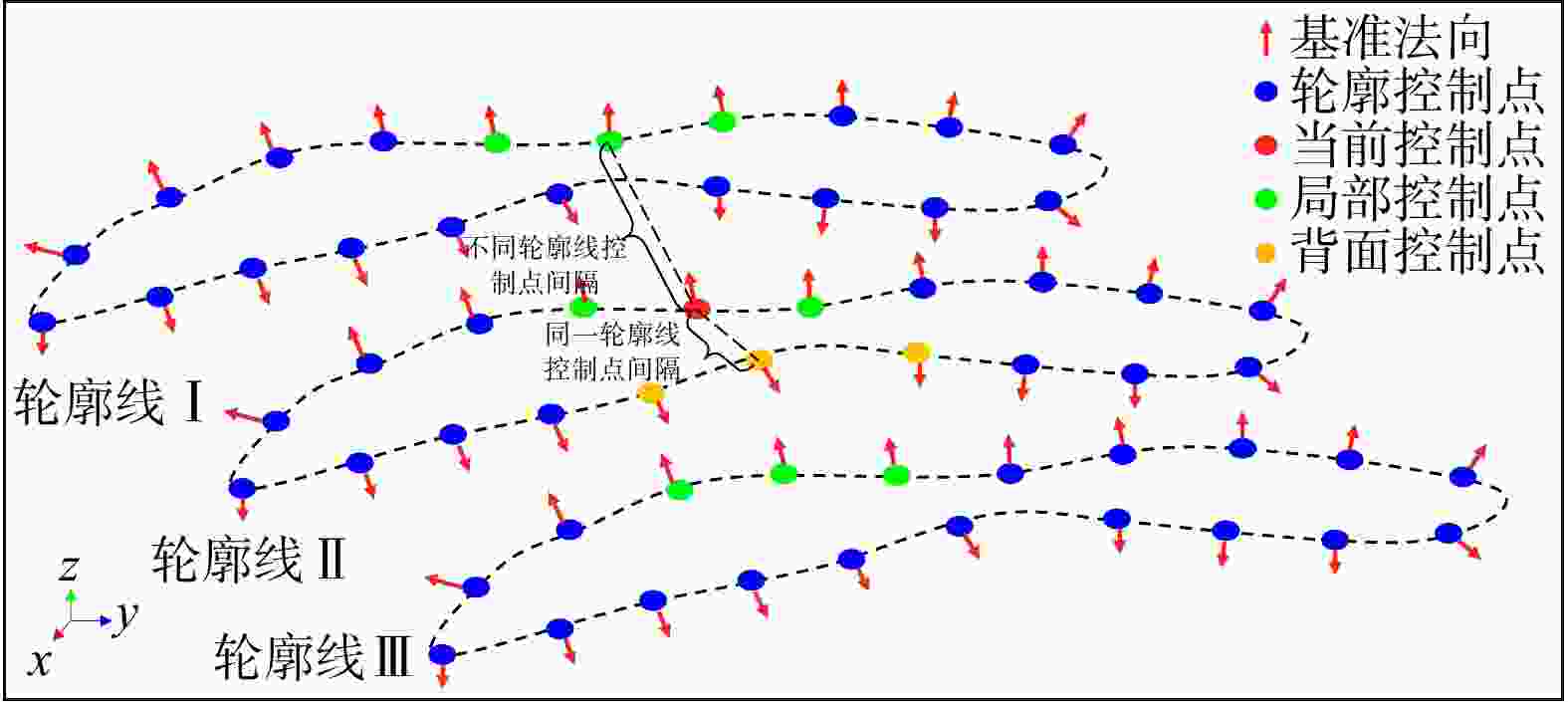
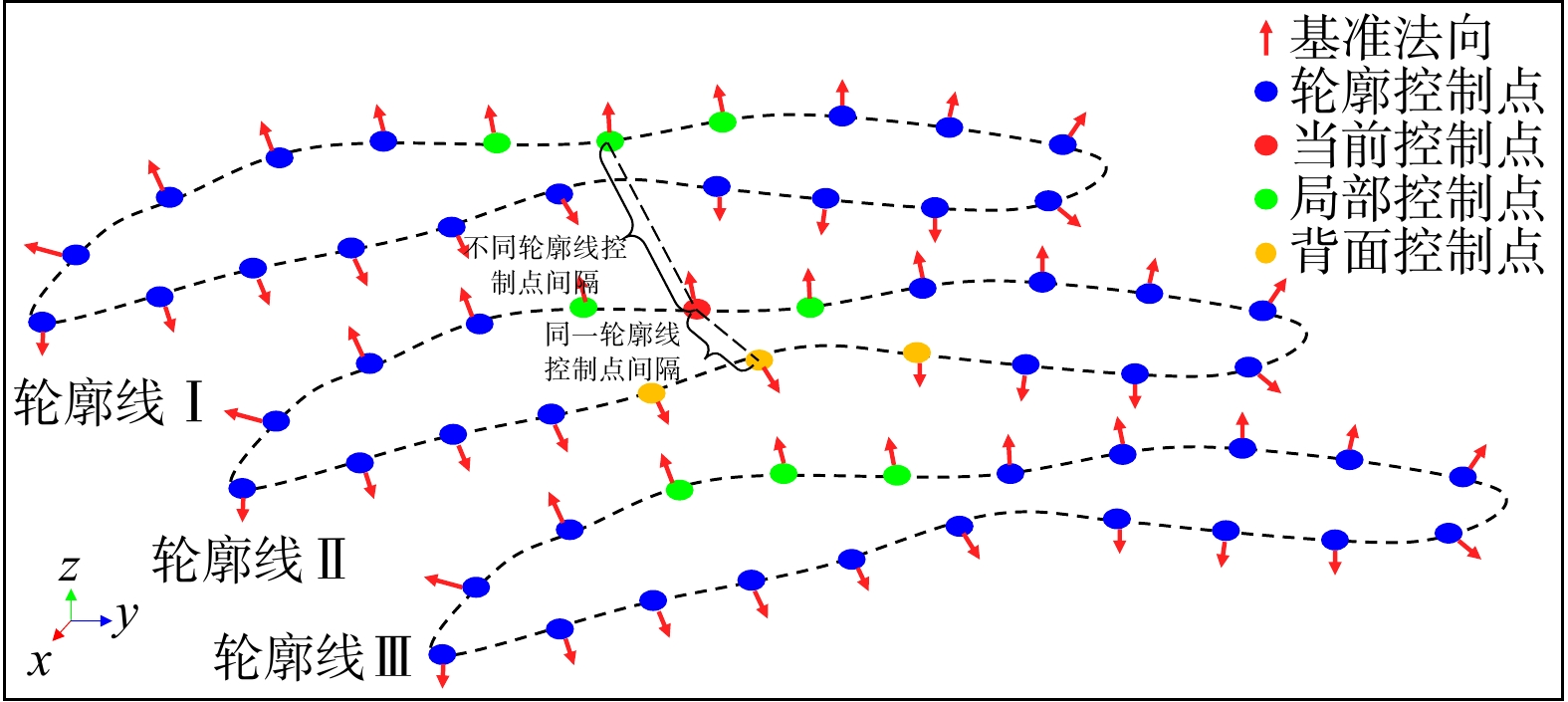
图 6 改进的KNN局部控制点选取策略
Figure 6. Improved KNN-based local control point selection strategy
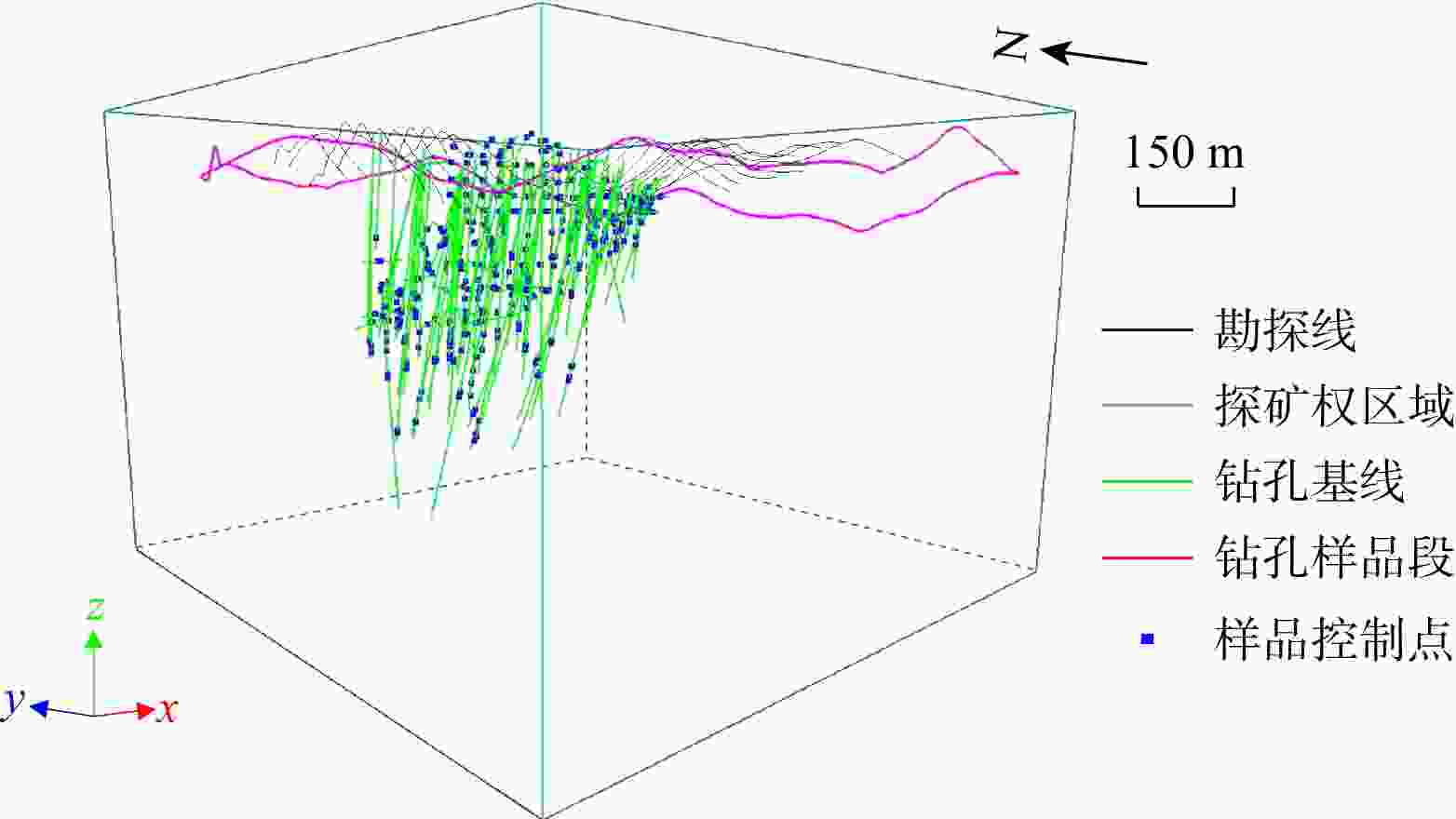
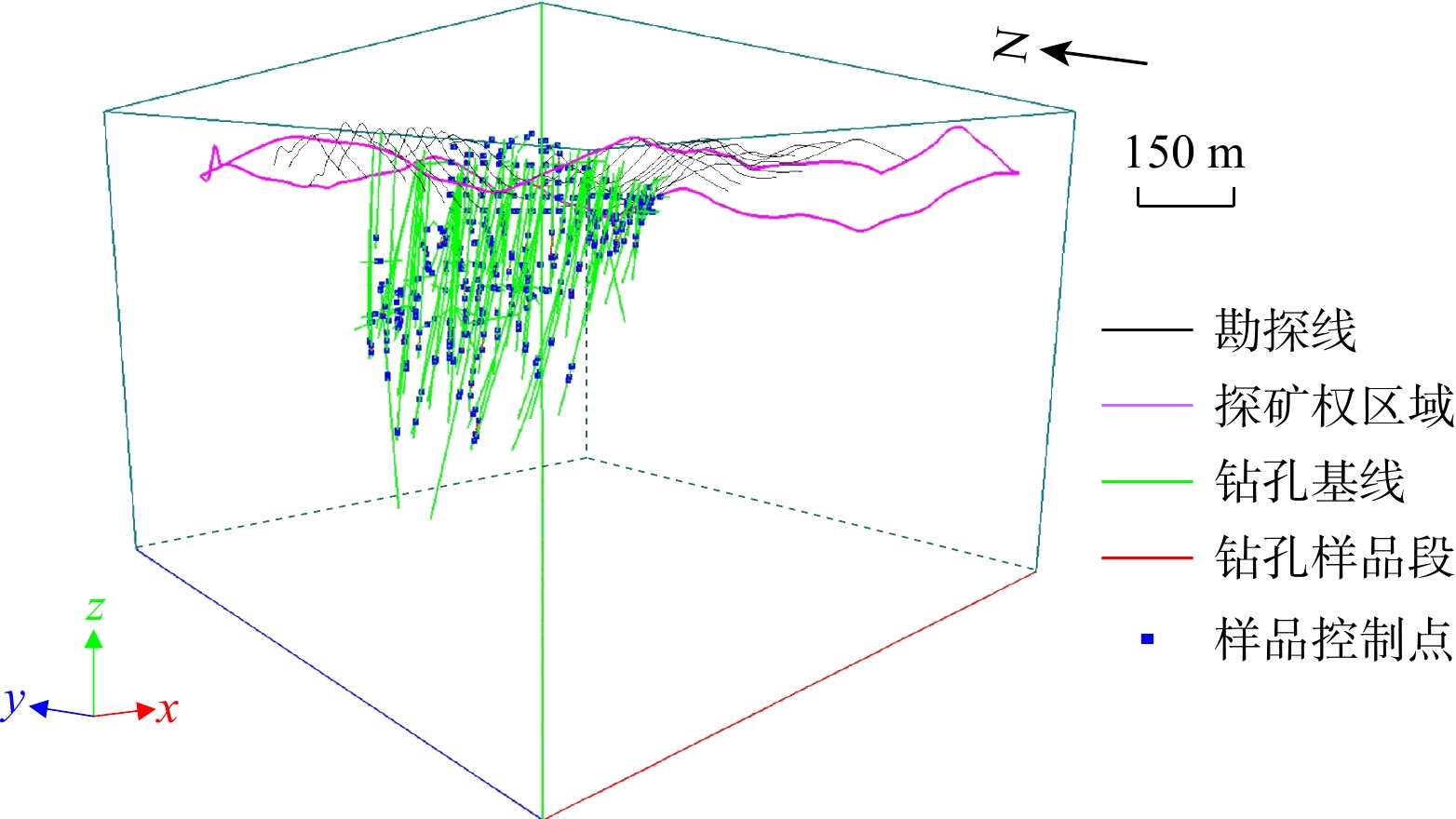
图 7 研究区31号矿体地质概况分布图
Figure 7. Geological overview map of ore body No. 31 in the study area
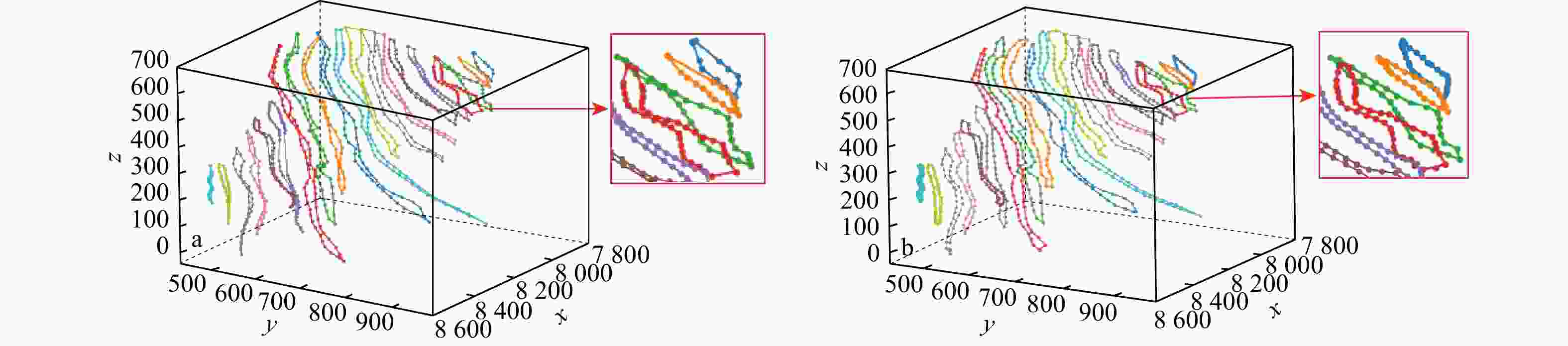
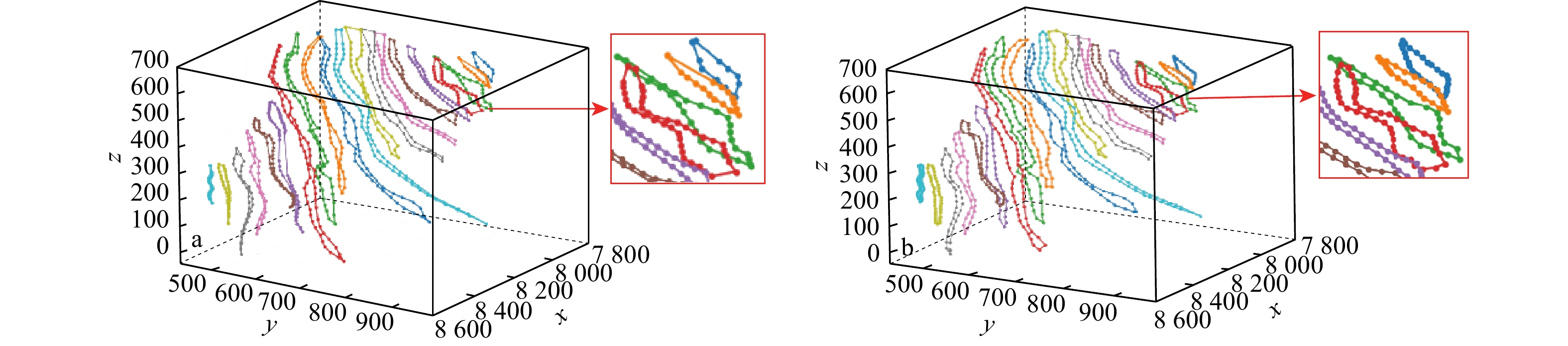
图 8 研究区31号矿体轮廓图(a. 初步圈定矿体轮廓;b. 空间特征増强后矿体轮廓)
Figure 8. Contour maps of ore body No. 31 in the study area
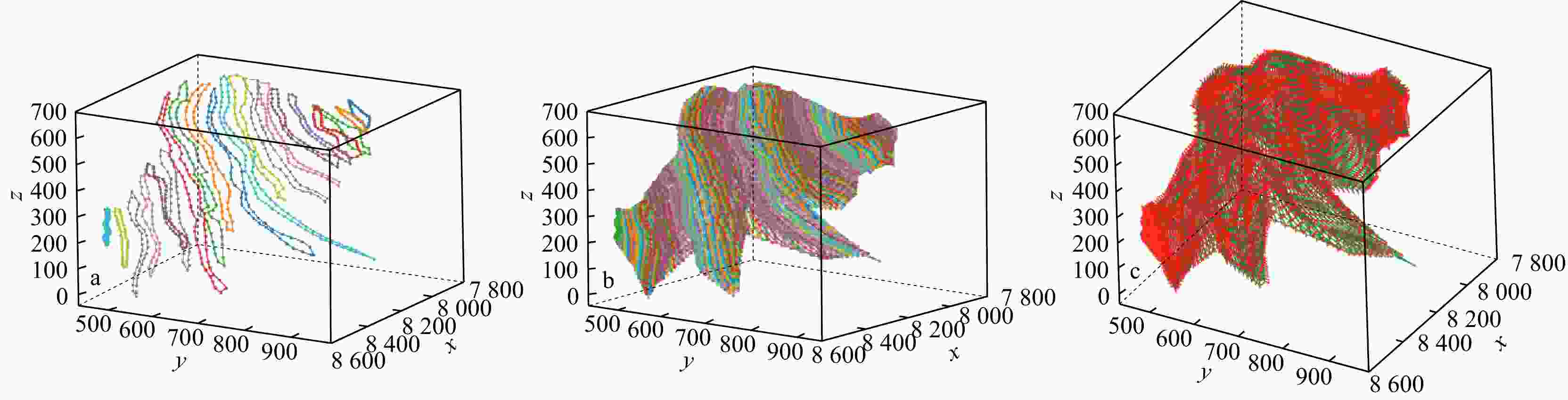
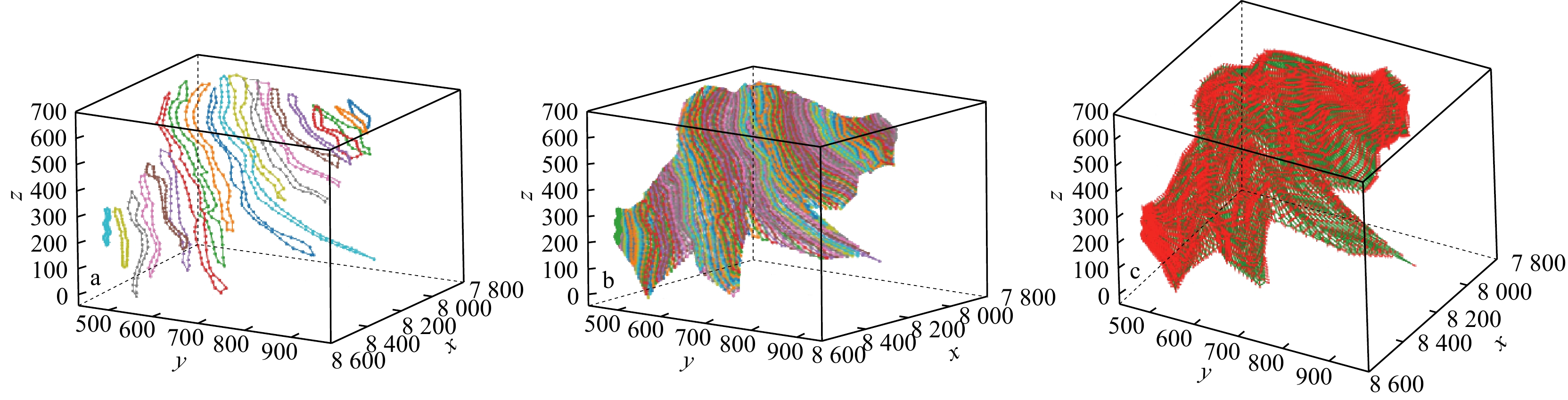
图 9 轮廓插值及其法向(a. 原始矿体轮廓;b. 原始矿体轮廓及层间插值轮廓;c. 所有轮廓控制点及其法向)
Figure 9. Contour interpolation and corresponding normals
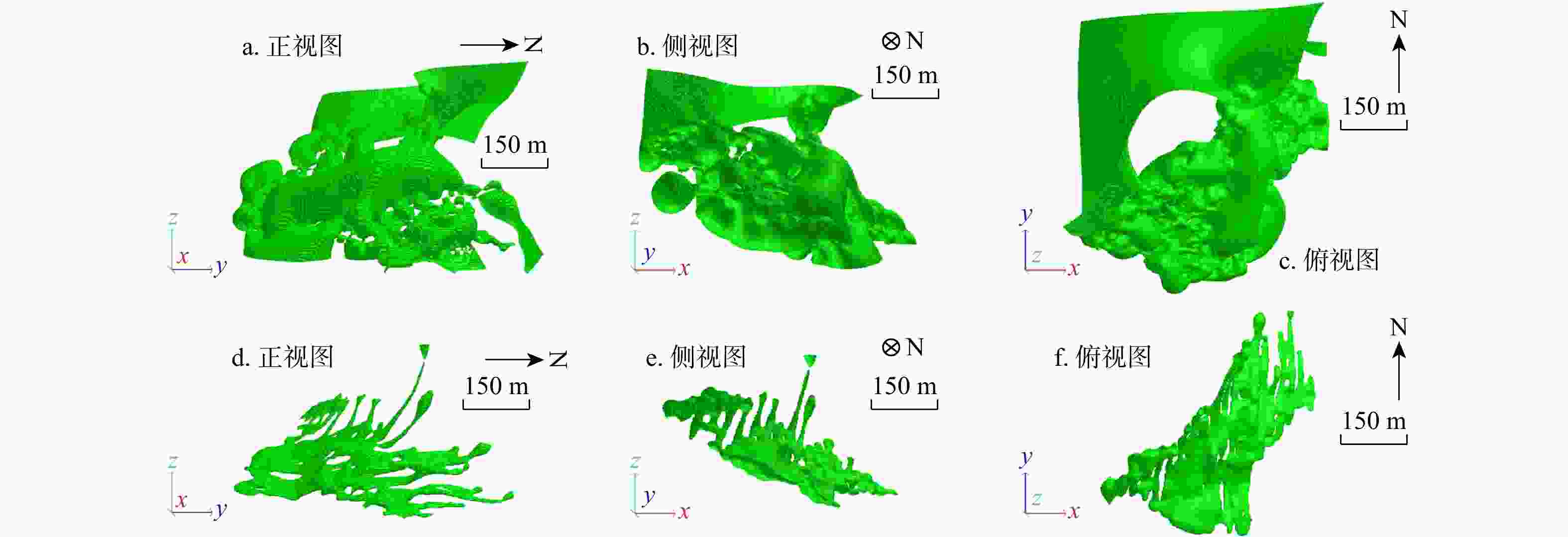
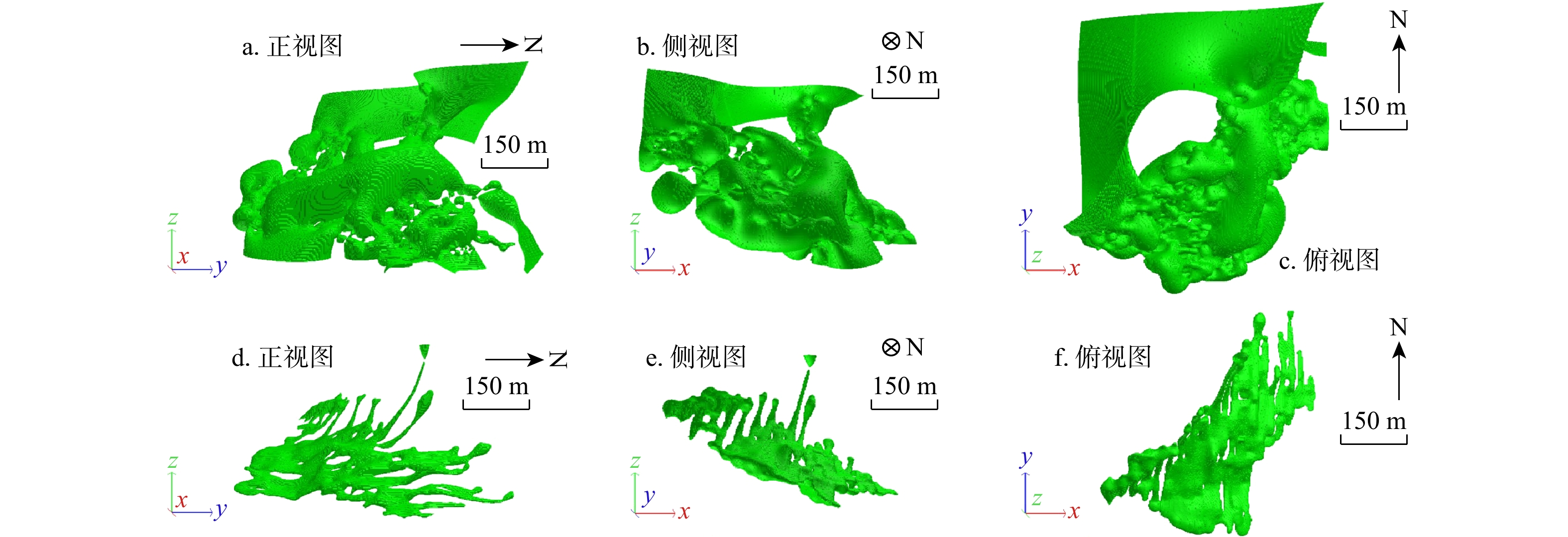
图 10 研究区31号矿体曲面模型三视图(a~c. KNN-PCA方法优化前;d~f. KNN-PCA方法优化后)
Figure 10. Three-view diagrams of surface model of ore body No. 31 in the study area
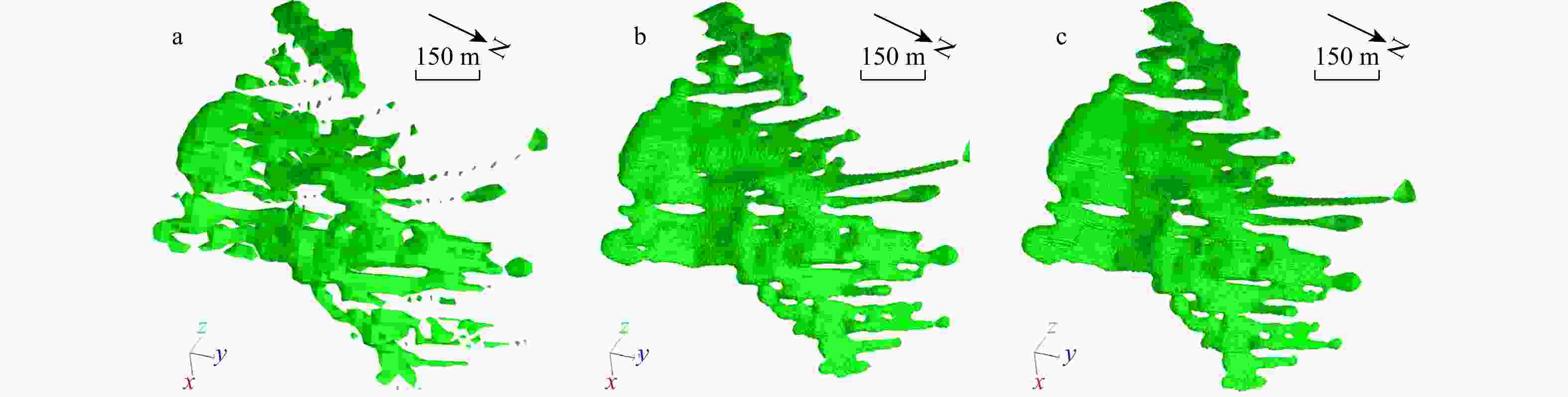
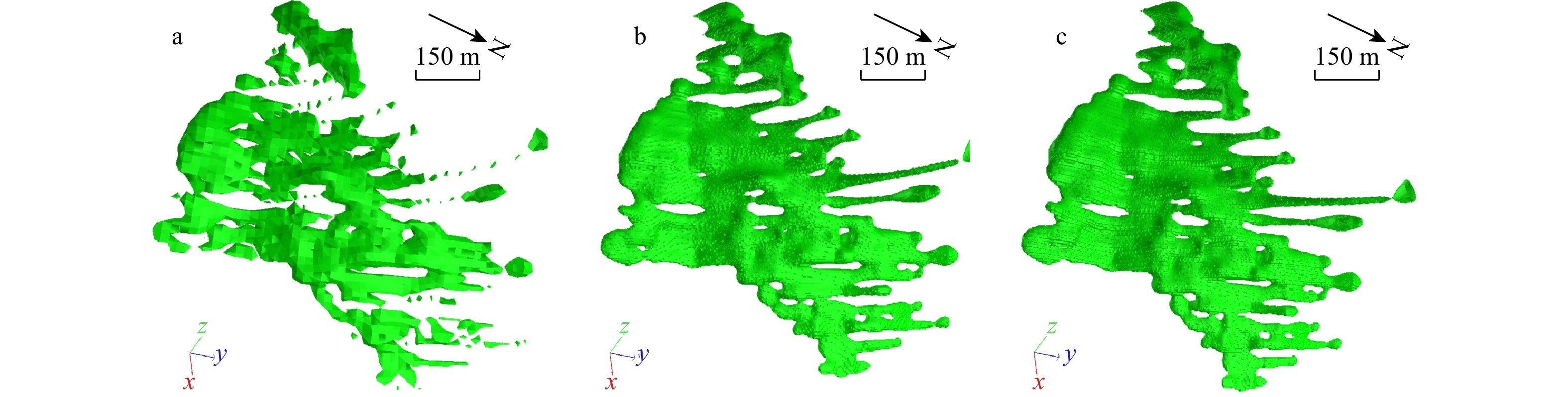
图 11 不同网格划分粒度隐式曲面模型(a. 50×50×50;b. 200×100×300;c. 300×150×300)
Figure 11. Implicit surface models with different mesh resolutions
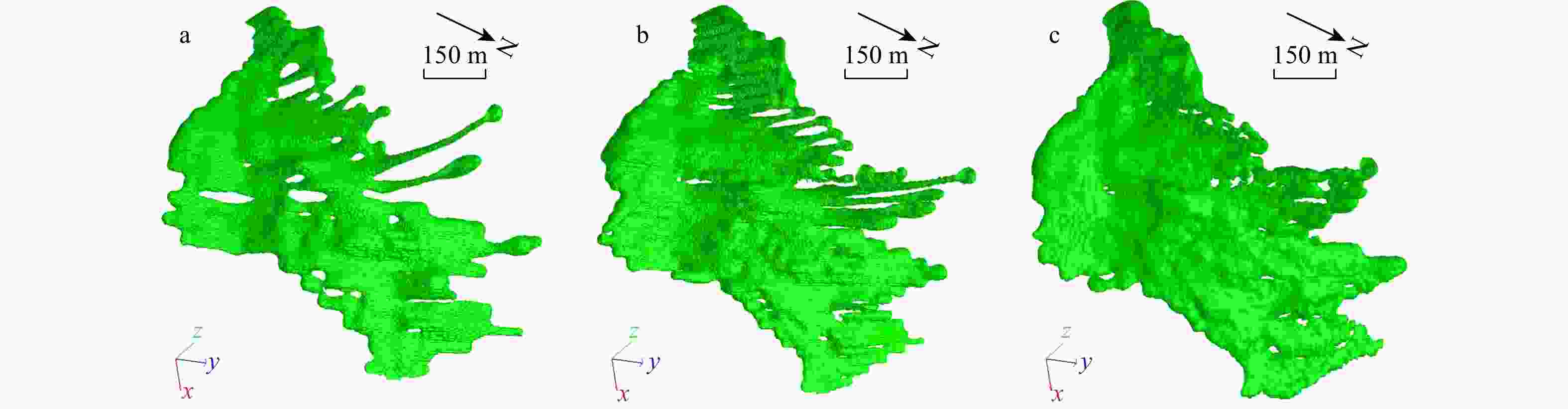
图 12 基于随机采样的隐式曲面模型(a.
1000 个随机采样点;b.1500 个随机采样点;c.2000 个随机采样点)Figure 12. Implicit surface models based on random sampling
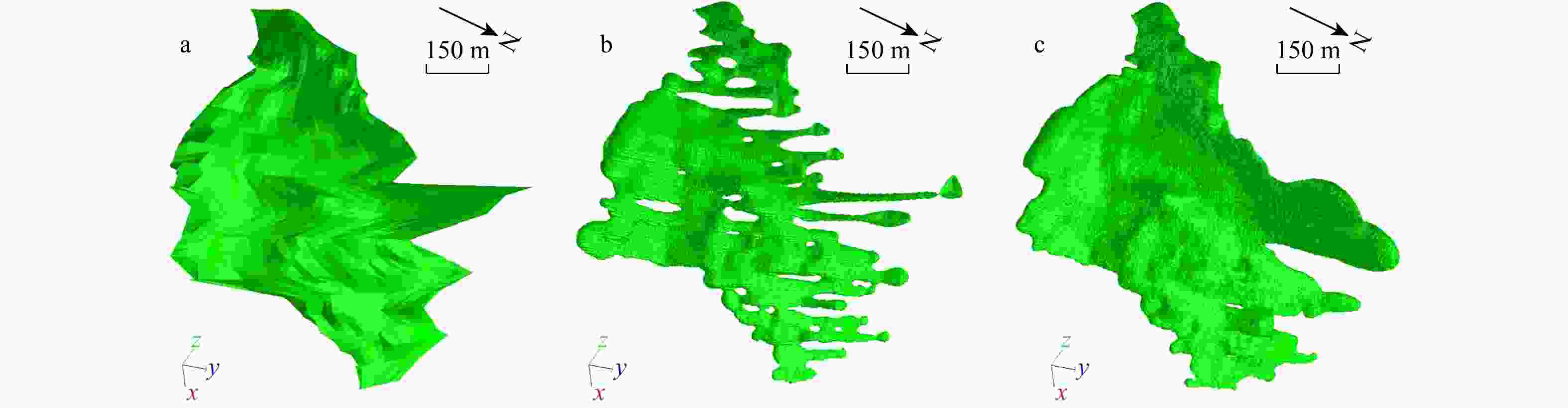
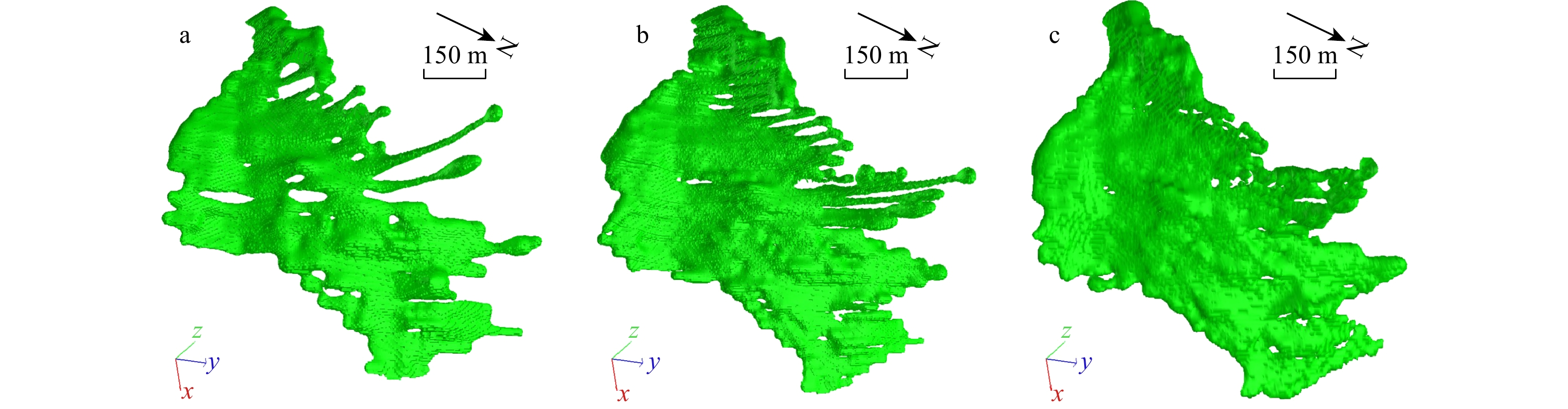
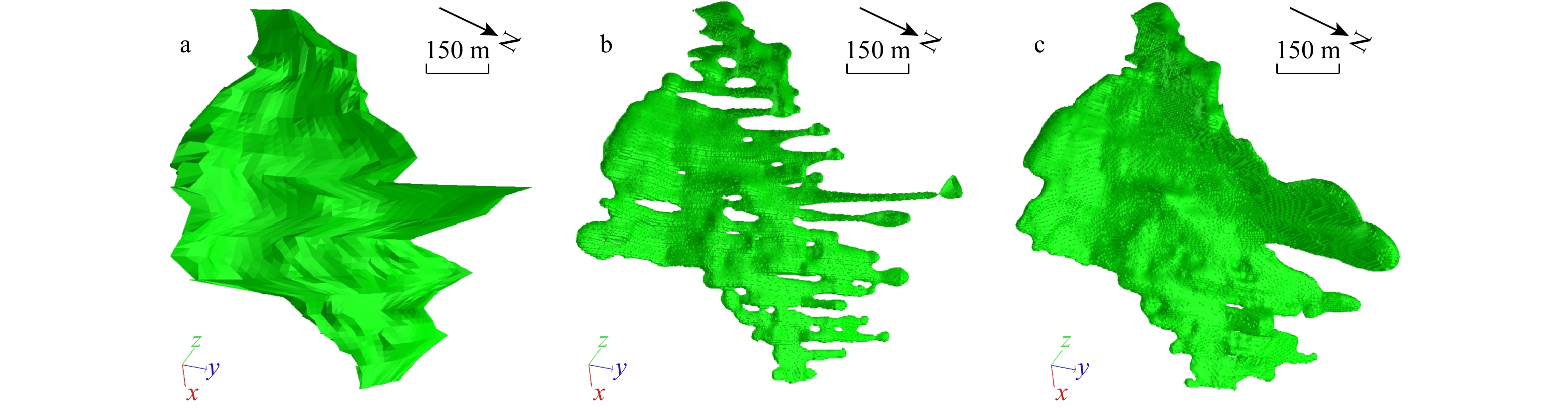
图 13 3种方法构建曲面模型对比图(a. 基于矿体轮廓拼接模型;b. 基于径向基隐式曲面模型;c. 本研究方法所构建的模型)
Figure 13. Comparison of surface models generated by three methods
算法1 矿体轮廓分区长度比同步前进映射算法 输入:插值后的控制点数据集$ {P'} $,矩形包围盒的4个参考点$ R=\{R_{{\mathrm{top}}}, $$ R_{{\mathrm{bottom}}},R_{{\mathrm{left}}}, R_{{\mathrm{right}}}\} $ 算法步骤: 1 初始化映射网络$ {{\mathrm{Map}}} $为空集 2 计算每个矿体轮廓的最小外接矩形,并确定4个区块$ {{\mathrm{Part}}} $的参考点$ {R} $ 3 初始化区块起始点集合$ {S_{\mathrm{start}}} $为空集 4 对于每个参考点$ {{R}}_{{i}}{ \in R} $: 5 遍历$ {P'} $找到距离$ {{R}}_{{i}} $最近的控制点$ {P_{\mathrm{index}}} $ 6 将$ {P_{\mathrm{index}}} $添加到$ {S_{\mathrm{start}}} $ 7 初始化区块终点集合 $ {S_{\mathrm{end}}} $ 为$ {S_{\mathrm{start}}} $的复制 8 形成闭环映射网络: 9 $ {S_{\mathrm{end}}[{\mathrm{Part}}1]=S_{\mathrm{start}}[{\mathrm{Part}}4]} $ 10 $ {S_{\mathrm{end}}[{\mathrm{Part}}2]=S_{\mathrm{start}}[{\mathrm{Part}}1]} $ 11 $ {S_{\mathrm{end}}[{\mathrm{Part}}3]=S_{\mathrm{start}}[{\mathrm{Part}}2]} $ 12 $ {S_{\mathrm{end}}[{\mathrm{Part}}4]=S_{\mathrm{start}}[{\mathrm{Part}}3]} $ 13 对于每个区块$ {i} $: 14 初始化点集合$ {A=P'[{\mathrm{Part}}(i)]} $ 15 初始化点集合$ B=P'[{\mathrm{Part}}(i+1)\% 4] $ 16 计算区块$ {i} $的轮廓总长度$ {{\mathrm{sum}}L_A} $ 17 计算下一个区块的轮廓总长度$ {{\mathrm{sum}}L_B} $ 18 初始化游标$ {{\mathrm{index}}A=0} $,$ {{\mathrm{index}}B=0} $ 19 初始化已遍历的轮廓长度 $ {{\mathrm{cur}}L=0} $ 20 当$ {{\mathrm{index}}A< 1} $且$ {{\mathrm{index}}B< 1} $: 21 计算比例$ {{ \alpha }}_{{A}}={\mathrm{cur}}L/{\mathrm{sum}}L_A $ 22 计算比例$ {{ \alpha }}_{{B}}={\mathrm{cur}}L/{\mathrm{sum}}L_B $ 23 如果$ {{ \alpha }}_{{A}}{>}{{ \alpha }}_{{B}} $: 24 将$ {A[{\mathrm{index}}A]} $与$ {B[{\mathrm{index}}B]} $建立映射关系并添加到$ {{\mathrm{Map}}} $ 25 $ {{\mathrm{index}}B+=1} $ 26 更新$ {{\mathrm{cur}}L} $为$ {B[{\mathrm{index}}B]} $的累计长度 27 否则: 28 将$ {A[{\mathrm{index}}A]} $与$ {B[{\mathrm{index}}B]} $建立映射关系并添加到$ {{\mathrm{Map}}} $ 29 $ {{\mathrm{index}}A+=1} $ 30 更新$ {{\mathrm{cur}}L} $为$ {A[{\mathrm{index}}A]} $的累计长度 31 返回映射网络$ {{\mathrm{Map}}} $ 输出:映射网络$ {{\mathrm{Map}}} $  下载: 导出CSV
算法2 基于轮廓相邻控制点旋转的法向估计法 输入:有序控制点集合$ P=\{{{P}}_{{1}},{{P}}_{{2}}{,…,}{{P}}_{{n}}\} $ 算法步骤: 1 初始化法向量集合Point-Vector-Map为空集 2 对于每个控制点$ {{P}}_{{i}}{ \in P} $,执行以下步骤: 3 确定当前控制点cur-point为Pi 4 获取当前控制点的前一个点pre-point为$ {P}_{{i-1}} $(当$ {i=1} $时, 5 pre-point为$ {{P}}_{{n}} $) 6 获取当前控制点的下一个点next-point为$ {{P}}_{{i+1}} $(当$ {i=n} $时, 7 next-point为$ {{P}}_{{1}} $) 8 计算从cur-point到pre-point的向量: 9 $ \overrightarrow{{{n}}_{{1}}}={\overrightarrow{n}}_{P_{i-1}}-{\overrightarrow{n}}_{P_{i}} $ 10 计算从next-point到pre-point的向量: 11 $ \overrightarrow{{{n}}_{{2}}}={\overrightarrow{n}}_{P_{i-1}}-{\overrightarrow{n}}_{P_{i+1}} $ 12 计算平面法向: 13 $ { \overrightarrow{n}}_{\mathrm{plane}} = \overrightarrow{{{n}}_{{1}}}\times \overrightarrow{{{n}}_{{2}}} $ 14 计算在$ \overrightarrow{{{n}}_{{2}}} $平面$ { \overrightarrow{n}}_{\mathrm{plane}} $上的投影法向量$ \overrightarrow{{np}} $: 15 $ {do}{{t}}_{\rm{product}} = \overrightarrow{{{n}}_{{2}}}{·}{ \overrightarrow{n}}_{\mathrm{plane}} $ 16 $ \overrightarrow{{np}} = \overrightarrow{{{n}}_{{2}}}{-do}{{t}}_{\rm{product}}\times \frac{{ \overrightarrow{n}}_{\mathrm{plane}}}{|{ \overrightarrow{n}}_{\mathrm{plane}}|} $ 17 将投影法向在投影平面上逆时针旋转90°得到基准法向量$ \overrightarrow{{{N}}_{{i}}} $: 18 $ \overrightarrow{{{N}}_{{i}}}{=(}{\overrightarrow{{np}}}_{{x}},{{-}\overrightarrow{{np}}}_{{z}},{\overrightarrow{{np}}}_{{y}}{)} $ 19 将cur-point与其基准法向$ {\overrightarrow{N}}_i $作为一对元组添加到法向量集合 20 Point-Vector-Map中 21 返回法向量集合Point-Vector-Map 输出:控制点及其法向量集合$ {{(}{{P}}_{{i}},\overrightarrow{{{N}}_{{i}}}{)}} $
下载: 导出CSV
表 1 研究区31号矿体基础信息
Table 1. Basic information of ore body No. 31 in the study area
走向/(°) 倾向/(°) 倾角/(°) 平均
品位/10−6厚度/m 钻孔数/个 样品段/个 294 24 71 4.39 12.15 204 3840
下载: 导出CSV
表 2 不同网格划分粒度模型参数对比
Table 2. Comparison of model parameters with different mesh resolutions
网格划分数量/个 插值点数量/个 顶点数量/个 网格面片数量/个 总耗时/s 50×50×50 125000 4416 8556 770 200×100×100 2000000 61489 122889 5351 300×150×300 13500000 117400 234703 7689
下载: 导出CSV
-
[1] HILLIER M, WELLMANN F, DE KEMP E A, et al. GeoINR 1.0: An implicit neural network approach to three-dimensional geological modelling[J]. Geoscientific Model Development, 2023, 16(23): 6987-7012. doi: 10.5194/gmd-16-6987-2023 [2] GUO J T, WANG X L, WANG J M, et al. Three-dimensional geological modeling and spatial analysis from geotechnical borehole data using an implicit surface and marching tetrahedra algorithm[J]. Engineering Geology, 2021, 284: 106047. doi: 10.1016/j.enggeo.2021.106047 [3] 唐骥, 蒋潇, 姜雪莲, 等. 矿体三维可视化建模技术在成矿模式分析中的应用[J]. 地质科技通报, 2023, 42(5): 273-284. doi: 10.19509/j.cnki.dzkq.tb20220581TANG J, JIANG X, JIANG X L, et al. Application of three-dimensional visualization modeling technology of ore bodies in metallogenic mode analysis[J]. Bulletin of Geological Science and Technology, 2023, 42(5): 273-284. (in Chinese with English abstract doi: 10.19509/j.cnki.dzkq.tb20220581 [4] 吴照浩. 基于地质解译线的复杂矿体隐式建模技术研究[D]. 长沙: 中南大学, 2023.WU Z H. Research on implicit modeling technology of complex orebody based on geological interpretation polylines[D]. Changsha: Central South University, 2023. (in Chinese with English abstract [5] 高琼, 刘丹丹, 张伟, 等. 一种基于径向基隐式曲面的地质三维建模方法[J]. 测绘与空间地理信息, 2024, 47(7): 183-186.GAO Q, LIU D D, ZHANG W, et al. A geological 3D modeling method based on radial basis implicit surfaces[J]. Geomatics & Spatial Information Technology, 2024, 47(7): 183-186. (in Chinese with English abstract [6] 邰文星, 周琦, 杨成富, 等. 黔西南者相金矿床三维地质可视化建模及应用[J]. 地球科学, 2023, 48(11): 4017-4033. doi: 10.3799/dqkx.2022.095TAI W X, ZHOU Q, YANG C F, et al. 3D geological visualization modeling and its application in Zhexiang gold deposit, Southwest Guizhou Province[J]. Earth Science, 2023, 48(11): 4017-4033. (in Chinese with English abstract doi: 10.3799/dqkx.2022.095 [7] 王洋, 杨建文, 董京浩, 等. 基于地质统计的矿体三维建模及采矿应用[J]. 中国矿山工程, 2022, 51(1): 17-22. doi: 10.3969/j.issn.1672-609X.2022.01.004WANG Y, YANG J W, DONG J H, et al. 3D modeling and mining application of orebody based on geological statistics[J]. China Mine Engineering, 2022, 51(1): 17-22. (in Chinese with English abstract doi: 10.3969/j.issn.1672-609X.2022.01.004 [8] 张源, 朱俊凤, 刘敬, 等. 基于三维剖面的复杂地质体显式自动建模方法研究[J]. 华南地质, 2023, 39(4): 733-745. doi: 10.3969/j.issn.2097-0013.2023.04.014ZHANG Y, ZHU J F, LIU J, et al. Research on explicit automatic modeling method of complex geological body based on three-dimensional profile[J]. South China Geology, 2023, 39(4): 733-745. (in Chinese with English abstract doi: 10.3969/j.issn.2097-0013.2023.04.014 [9] 李章林, 吴冲龙, 张夏林, 等. 地质科学大数据背景下的矿体动态建模方法探讨[J]. 地质科技通报, 2020, 39(4): 59-68. doi: 10.19509/j.cnki.dzkq.2020.0408LI Z L, WU C L, ZHANG X L, et al. Discussion on dynamic orebody modeling with geological science big data[J]. Bulletin of Geological Science and Technology, 2020, 39(4): 59-68. (in Chinese with English abstract doi: 10.19509/j.cnki.dzkq.2020.0408 [10] 胡长涛. 基于四面体格网的地质体建模方法研究[D]. 兰州: 兰州交通大学, 2023.HU C T. Research on geological body modeling method based on tetrahedral grid[D]. Lanzhou: Lanzhou Jiatong University, 2023. (in Chinese with English abstract [11] 花卫华, 宿紫莹, 朱玉华, 等. 大范围地质体分块建模方法[J]. 地质科技通报, 2023, 42(6): 257-265. doi: 10.19509/j.cnki.dzkq.tb20220217HUA W H, SU Z Y, ZHU Y H, et al. Large-range geological block modeling method[J]. Bulletin of Geological Science and Technology, 2023, 42(6): 257-265. (in Chinese with English abstract doi: 10.19509/j.cnki.dzkq.tb20220217 [12] ZHONG D Y, WANG L G, BI L, et al. Implicit modeling of complex orebody with constraints of geological rules[J]. Transactions of Nonferrous Metals Society of China, 2019, 29(11): 2392-2399. doi: 10.1016/S1003-6326(19)65145-9 [13] HILLIER M J, DE KEMP E A, SCHETSELAAR E M. Implicit 3D modelling of geological surfaces with the generalized radial basis functions (GRBF) algorithm[R]. Ottawa, Canada: Natural Resources Canada, 2017. [14] 邹艳红, 李高智, 毛先成, 等. 基于隐函数曲面的三维断层网络建模与不确定性分析[J]. 地质论评, 2020, 66(5): 1349-1360. doi: 10.16509/j.georeview.2020.05.019ZOU Y H, LI G Z, MAO X C, et al. Three-dimensional fault-network modeling and uncertainty analysis based on implicit function surface[J]. Geological Review, 2020, 66(5): 1349-1360. (in Chinese with English abstract doi: 10.16509/j.georeview.2020.05.019 [15] 姬广军, 张永波, 朱吉祥, 等. 三维地质建模精度影响因素及质量控制[J]. 桂林理工大学学报, 2020, 40(1): 85-94. doi: 10.3969/j.issn.1674-9057.2020.01.010JI G J, ZHANG Y B, ZHU J X, et al. Accuracy factors of 3D geological modeling and quality control[J]. Journal of Guilin University of Technology, 2020, 40(1): 85-94. (in Chinese with English abstract doi: 10.3969/j.issn.1674-9057.2020.01.010 [16] 王博, 贺康, 钟德云. 基于钻孔数据的地质体隐式建模约束规则自动构造方法[J]. 黄金科学技术, 2021, 29(3): 345-354. doi: 10.11872/j.issn.1005-2518.2021.03.189WANG B, HE K, ZHONG D Y. Automatic construction method of constraint rules for implicit modeling of geological bodies based on borehole data[J]. Gold Science and Technology, 2021, 29(3): 345-354. (in Chinese with English abstract doi: 10.11872/j.issn.1005-2518.2021.03.189 [17] 康志军. 基于多源多尺度地质数据的勘查区三维地质建模[J]. 华北自然资源, 2023(2): 60-63.KANG Z J. Three-dimensional geological modeling of exploration area based on multi-source and multi-scale geological data[J]. Huabei Natural Resources, 2023(2): 60-63. (in Chinese with English abstract [18] 马洪滨, 郭甲腾. 一种新的多轮廓线重构三维形体算法: 切开-缝合法[J]. 东北大学学报(自然科学版), 2007, 28(1): 111-114. doi: 10.3321/j.issn:1005-3026.2007.01.028MA H B, GUO J T. Cut-and-sew algorithm: A new multi-contour reconstruction algorithm[J]. Journal of Northeastern University (Natural Science), 2007, 28(1): 111-114. (in Chinese with English abstract doi: 10.3321/j.issn:1005-3026.2007.01.028 [19] 杨洋, 潘懋, 吴耕宇, 等. 一种新的轮廓线三维地质表面重建方法[J]. 地球信息科学学报, 2015, 17(3): 253-259.YANG Y, PAN M, WU G Y, et al. High quality geological surface reconstruction from planar contours[J]. Journal of Geo-Information Science, 2015, 17(3): 253-259. (in Chinese with English abstract [20] 田宜平, 刘维安, 张夏林. 基于等角度变比例投影的矿体轮廓线自动匹配方法研究[J]. 地质科技通报, 2020, 39(1): 175-180. doi: 10.19509/j.cnki.dzkq.2020.0119TIAN Y P, LIU W A, ZHANG X L. Automatic matching of ore body contour line based on equal-angle and variable proportion projection[J]. Bulletin of Geological Science and Technology, 2020, 39(1): 175-180. (in Chinese with English abstract doi: 10.19509/j.cnki.dzkq.2020.0119 [21] 王权, 邹艳红. 基于轮廓线层间形态插值的三维地质隐式曲面重构[J]. 地质科技通报, 2023, 42(5): 293-300.WANG Q, ZOU Y H. Three-dimensional geological implicit surface reconstruction based on intermediate contour morphological interpolation[J]. Bulletin of Geological Science and Technology, 2023, 42(5): 293-300. (in Chinese with English abstract [22] 赵勇, 许国, 卢鹏, 等. 基于GemPy的隐式三维地质建模方法[J]. 人民长江, 2023, 54(10): 98-104. doi: 10.16232/j.cnki.1001-4179.2023.10.014ZHAO Y, XU G, LU P, et al. Implicit 3D geological modeling approach based on GemPy[J]. Yangtze River, 2023, 54(10): 98-104. (in Chinese with English abstract doi: 10.16232/j.cnki.1001-4179.2023.10.014 [23] 吴健辉, 沙仙武, 秦仕文. 基于离散化网格的三维复杂地质体建模方法研究[J]. 采矿技术, 2022, 22(6): 10-13. doi: 10.3969/j.issn.1671-2900.2022.06.003WU J H, SHA X W, QIN S W. Research on modeling method of three-dimensional complex geological body based on discrete grid[J]. Mining Technology, 2022, 22(6): 10-13. (in Chinese with English abstract doi: 10.3969/j.issn.1671-2900.2022.06.003 [24] 吴世平, 李角群, 郭进平, 等. 三维矿体线框模型构建技术研究[J]. 矿业工程, 2020, 18(3): 62-65.WU S P, LI J Q, GUO J P, et al. Study on building technology of three-dimensional ore body wireframe model[J]. Mining Engineering, 2020, 18(3): 62-65. (in Chinese with English abstract [25] GUO J T, WU L X, ZHOU W H, et al. Section-constrained local geological interface dynamic updating method based on the HRBF surface[J]. Journal of Structural Geology, 2018, 107: 64-72. doi: 10.1016/j.jsg.2017.11.017 [26] 佟勇强. 基于广义径向基函数(GRBFs)插值的三维地层位势场建模[D]. 长沙: 中南大学, 2022.TONG Y Q. Three-dimensional stratigraphical potential field modeling by generalized radial basis functions(GRBFs) interpolant[D]. Changsha: Central South University, 2022. (in Chinese with English abstract [27] ZOU M, HOLLOWAY M, CARR N, et al. Topology-constrained surface reconstruction from cross-sections[J]. ACM Transactions on Graphics, 2015, 34(4): 1-10. doi: 10.1145/2766976 [28] STOCH B, BASSON I J, GLOYN-JONES J N, et al. The influence of variable anisotropic search parameters on implicitly-modelled volumes and estimated contained metal in a structurally-complex gold deposit[J]. Ore Geology Reviews, 2022, 142: 104719. doi: 10.1016/j.oregeorev.2022.104719 [29] GROSE L, AILLERES L, LAURENT G, et al. Modelling of faults in LoopStructural 1.0[J]. Geoscientific Model Development, 2021, 14(10): 6197-6213. doi: 10.5194/gmd-14-6197-2021 [30] MACÊDO I, GOIS J P, VELHO L. Hermite interpolation of implicit surfaces with radial basis functions[C]//Anon. 2009 Ⅹ Ⅹ Ⅱ Brazilian Symposium on Computer Graphics and Image Processing. Janeiro, Brazil: IEEE, 2010: 1-8. [31] 郭甲腾, 吴立新, 周文辉. 基于径向基函数曲面的矿体隐式自动三维建模方法[J]. 煤炭学报, 2016, 41(8): 2130-2135. doi: 10.13225/j.cnki.jccs.2016.0688GUO J T, WU L X, ZHOU W H. Automatic ore body implicit 3D modeling based on radial basis function surface[J]. Journal of China Coal Society, 2016, 41(8): 2130-2135. (in Chinese with English abstract doi: 10.13225/j.cnki.jccs.2016.0688 [32] WANG J M, ZHAO H, BI L, et al. Implicit 3D modeling of ore body from geological boreholes data using Hermite radial basis functions[J]. Minerals, 2018, 8(10): 443. doi: 10.3390/min8100443 [33] 扶金铭, 胡茂胜, 方芳, 等. Stacking集成策略下的径向基函数曲面复杂矿体三维建模方法[J]. 地球科学, 2024, 49(3): 1165-1176. doi: 10.3799/dqkx.2022.433FU J M, HU M S, FANG F, et al. Complex orebody 3D modeling using radial basis function surface incorporating Stacking integration strategy[J]. Earth Science, 2024, 49(3): 1165-1176. (in Chinese with English abstract doi: 10.3799/dqkx.2022.433 [34] GONÇALVES Í G, GUADAGNIN F, CORDOVA D P. Variational Gaussian processes for implicit geological modeling[J]. Computers & Geosciences, 2023, 174: 105323. doi: 10.1016/j.cageo.2023.105323 [35] 侯晓琳, 强伟帆. 三维复杂断层建模关键算法研究[J]. 计算机应用与软件, 2023, 40(10): 120-129. doi: 10.3969/j.issn.1000-386x.2023.10.019HOU X L, QIANG W F. The key algorithms research of 3D complex fault modeling[J]. Computer Applications and Software, 2023, 40(10): 120-129. (in Chinese with English abstract doi: 10.3969/j.issn.1000-386x.2023.10.019 [36] 王元昊, 高振记, 宋越. 三维地质模型质量评估方法研究进展综述[J]. 华北地质, 2023, 46(1): 80-86. doi: 10.19948/j.12-1471/P.2023.01.09WANG Y H, GAO Z J, SONG Y. Review of research progress on quality assessment methods of 3D geological models[J]. North China Geology, 2023, 46(1): 80-86. (in Chinese with English abstract doi: 10.19948/j.12-1471/P.2023.01.09 [37] 顾天奇, 张雷, 冀世军, 等. 封闭离散点的曲线拟合方法[J]. 吉林大学学报(工学版), 2015, 45(2): 437-441. doi: 10.13229/j.cnki.jdxbgxb201502015GU T Q, ZHANG L, JI S J, et al. Curve fitting method for closed discrete points[J]. Journal of Jilin University (Engineering and Technology Edition), 2015, 45(2): 437-441. (in Chinese with English abstract doi: 10.13229/j.cnki.jdxbgxb201502015 [38] 封雨鑫, 钟菲, 余强. 连续小线段的高精度B样条曲线拟合方法[J]. 自动化技术与应用, 2022, 41(6): 15-20. doi: 10.20033/j.1003-7241(2022)06-0015-06FENG Y X, ZHONG F, YU Q. High precision B-spline fitting method for continues small line segments[J]. Techniques of Automation and Applications, 2022, 41(6): 15-20. (in Chinese with English abstract doi: 10.20033/j.1003-7241(2022)06-0015-06 [39] 宣伟, 花向红, 邹进贵, 等. 自适应最优邻域尺寸选择的点云法向量估计方法[J]. 测绘科学, 2019, 44(10): 101-108. doi: 10.16251/j.cnki.1009-2307.2019.10.015XUAN W, HUA X H, ZOU J G, et al. A new method of normal estimation for point cloud based on adaptive optimal neighborhoods[J]. Science of Surveying and Mapping, 2019, 44(10): 101-108. (in Chinese with English abstract doi: 10.16251/j.cnki.1009-2307.2019.10.015 [40] 柏春. 面向三维点云隐式曲面重建的法向量估计和等值面提取方法研究[D]. 成都: 西南交通大学, 2022.BAI C. Research on normal estimation and isosurface extraction for implicit surface reconstruction of 3D point cloud[D]. Chengdu: Southwest Jiaotong University, 2022. (in Chinese with English abstract -

 下载:
下载:

 点击查看大图
计量
- 文章访问数: 449
- PDF下载量: 154
- 被引次数: 0