投审稿入口
投审稿入口


-
摘要:
天津市近年来通过跨流域调水、严格管控地下水开采等措施,大幅压缩深层地下水的开采量,平原区地下水位呈现整体回升态势,地面沉降速率减缓。在地下水位修复背景下,探讨人为调控开采与人工回灌对天津市平原区地下水位变化及地面沉降响应的影响,一方面有助于抑制地下水位下降速率,优化水资源利用,另一方面也有助于未来城市地面沉降的管控,降低地面沉降风险。基于GMS软件中的MODFLOW-SUB模块,构建研究区域的地下水流−地面沉降耦合模型,在验证合理后设计不同的开采和人工回灌方案,模拟预测2023—2025年深层地下水位的变化以及地面沉降变化。结果表明,将现状开采量扩大2~4倍,会加剧静海区、滨海新区东北部地下水漏斗区水位降落,水位降幅约为0.02~0.17 m,从而加速地面沉降。当开采量压缩50%时,地下水位相对回升0~0.02 m,对地面沉降缓解不显著。回灌方案对水位回升的影响范围最大可达250.04 km2,抬升地下水位0.14~0.50 m,引起水位漏斗区地面回弹0.25~0.75 mm,回灌方案对地面沉降的缓解效果较好。目前,在研究区的深层漏斗区附近不应增加开采量,可通过适当减少开采量,并逐步结合人工回灌的方式,促进地下水位回升,从而达到恢复地下水资源和缓解平原区深层含水组地层压缩的目的。研究成果可为天津市地面沉降控制提供一定科学依据。
Abstract:ObjectiveIn recent years, Tianjin has significantly reduced deep groundwater extraction through measures such as inter-basin water transfer and strict control of groundwater extraction. As a result, the groundwater levels in the plain area have shown an overall rising trend, and the rates of land subsidence have slowed. Against the backdrop of groundwater level recovery, this study examines the effects of regulated groundwater extraction and artificial recharge on groundwater level changes and land subsidence responses in Tianjin Plain area. It helps control the decline rate of groundwater levels and optimize water resource utilization, and also contributes to future control of urban land subsidence and the reduction of land subsidence risk.
MethodsUsing the MODFLOW-SUB module in Groundwater Modeling System (GMS), a coupled groundwater flow-land subsidence model was established for the study area. After validation, different groundwater extraction and artificial recharge schemes were designed to simulate and predict changes in deep groundwater levels and land subsidence from 2023 to 2025.
ResultsThe results showed that increasing the current groundwater extraction volume by 2-4 times would intensify groundwater level decline in the depression cone areas of Jinghai District and northeastern Binhai New Area, with a decrease of about 0.02-0.17 m, thereby accelerating land subsidence. When extraction was reduced by 50%, groundwater levels increased slightly by 0-0.02 m, demonstrating insignificant mitigation effects on land subsidence. The recharge scheme affected groundwater level recovery over a maximum area of 250.04 km2, raising groundwater levels by 0.14-0.50 m and causing ground rebound of 0.25-0.75 mm in the depression cone areas, showing a relatively good effect on mitigating land subsidence compared with the extraction scheme. At present, groundwater extraction should not be increased near deep groundwater depression cones in the study area. Instead, groundwater extraction should be appropriately reduced, and artificial recharge should be gradually incorporated to promote groundwater level recovery, thereby achieving the goal of restoring groundwater resources and alleviating compression of deep aquifer formations in the plain area.
ConclusionThe findings provide a scientific basis for land subsidence control in Tianjin.
-
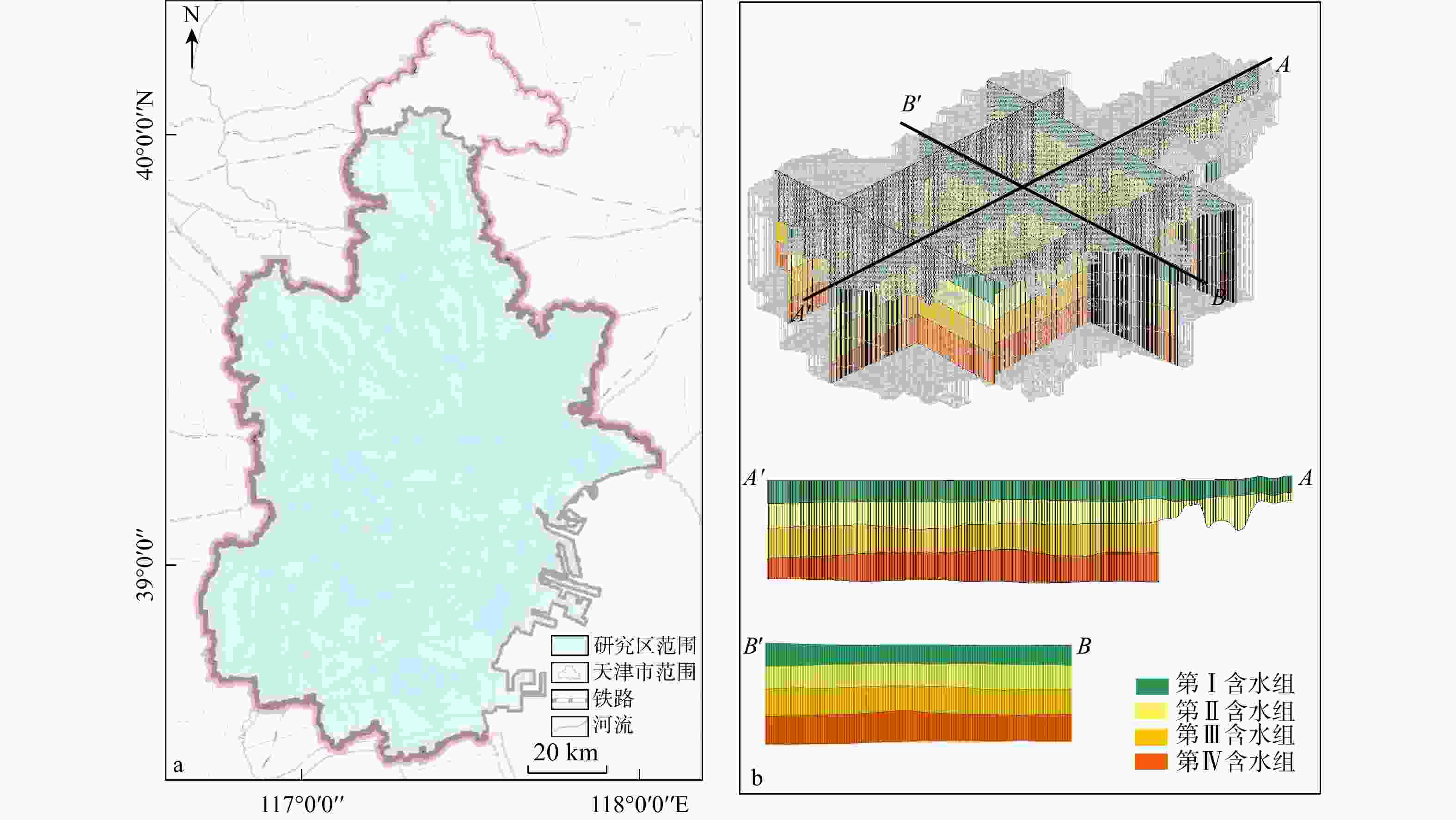
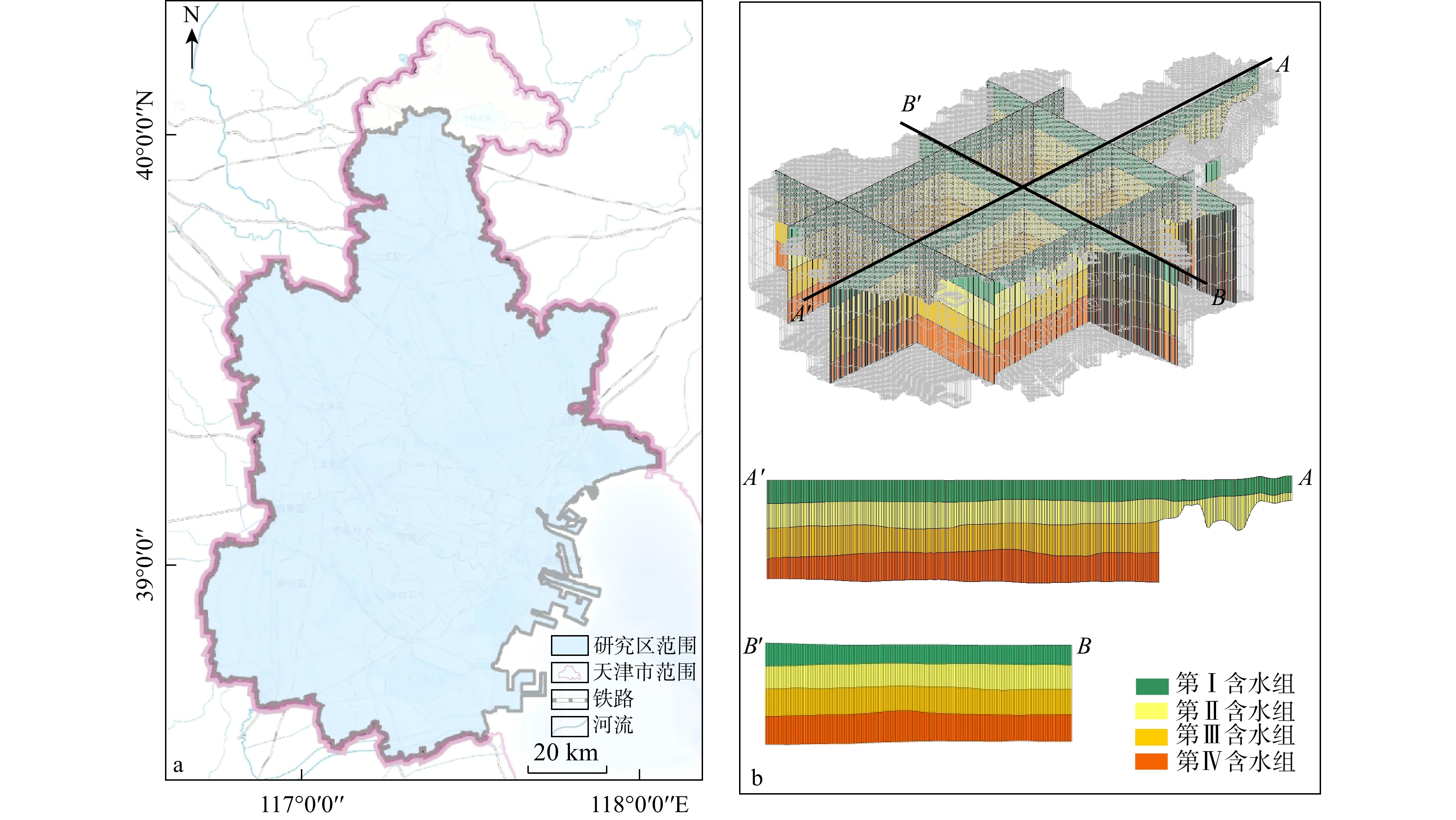
图 1 研究区范围(a)及水文地质模型剖面图(b)
Figure 1. Scope of study area (a) and profiles of hydrogeological model (b)
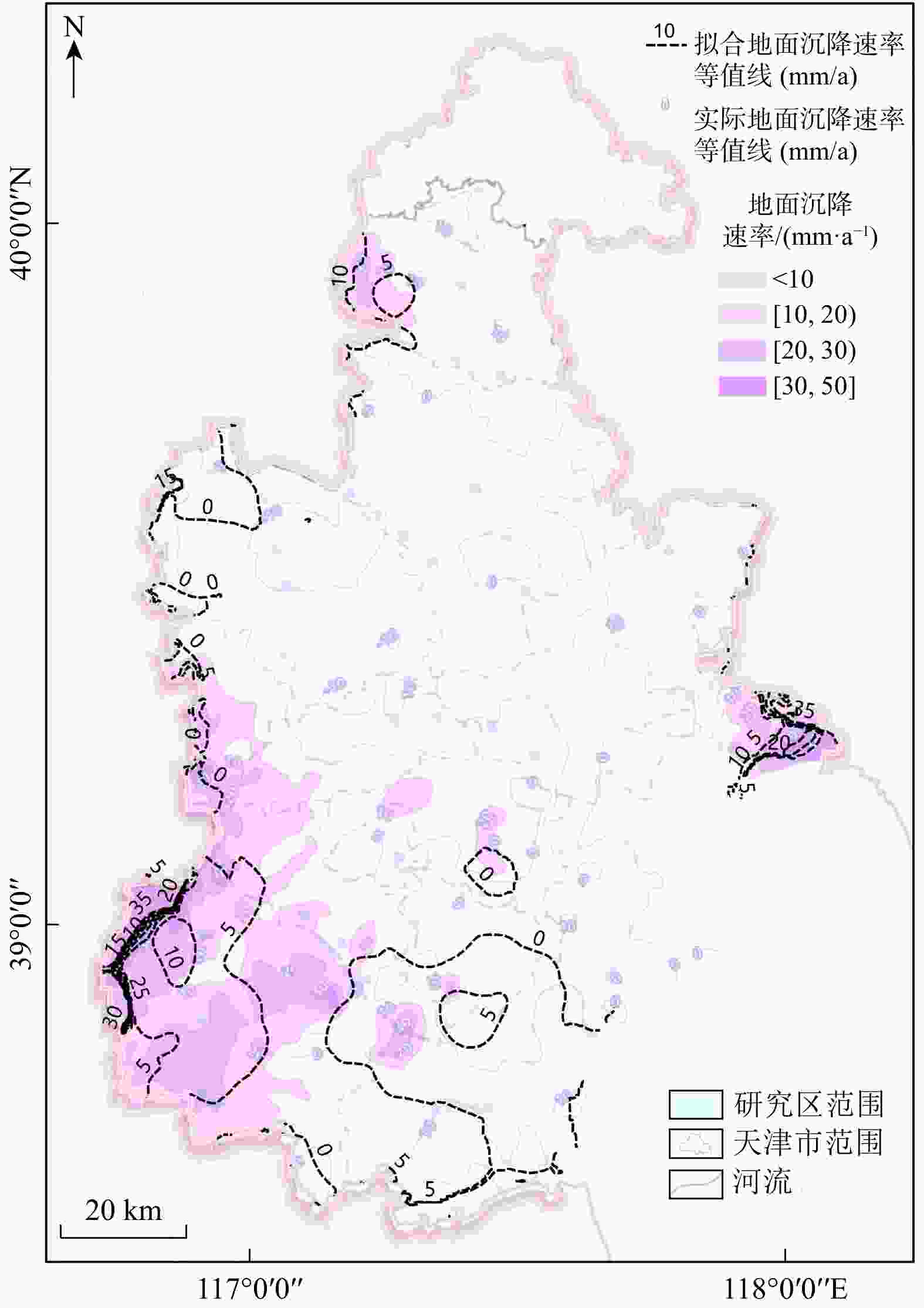
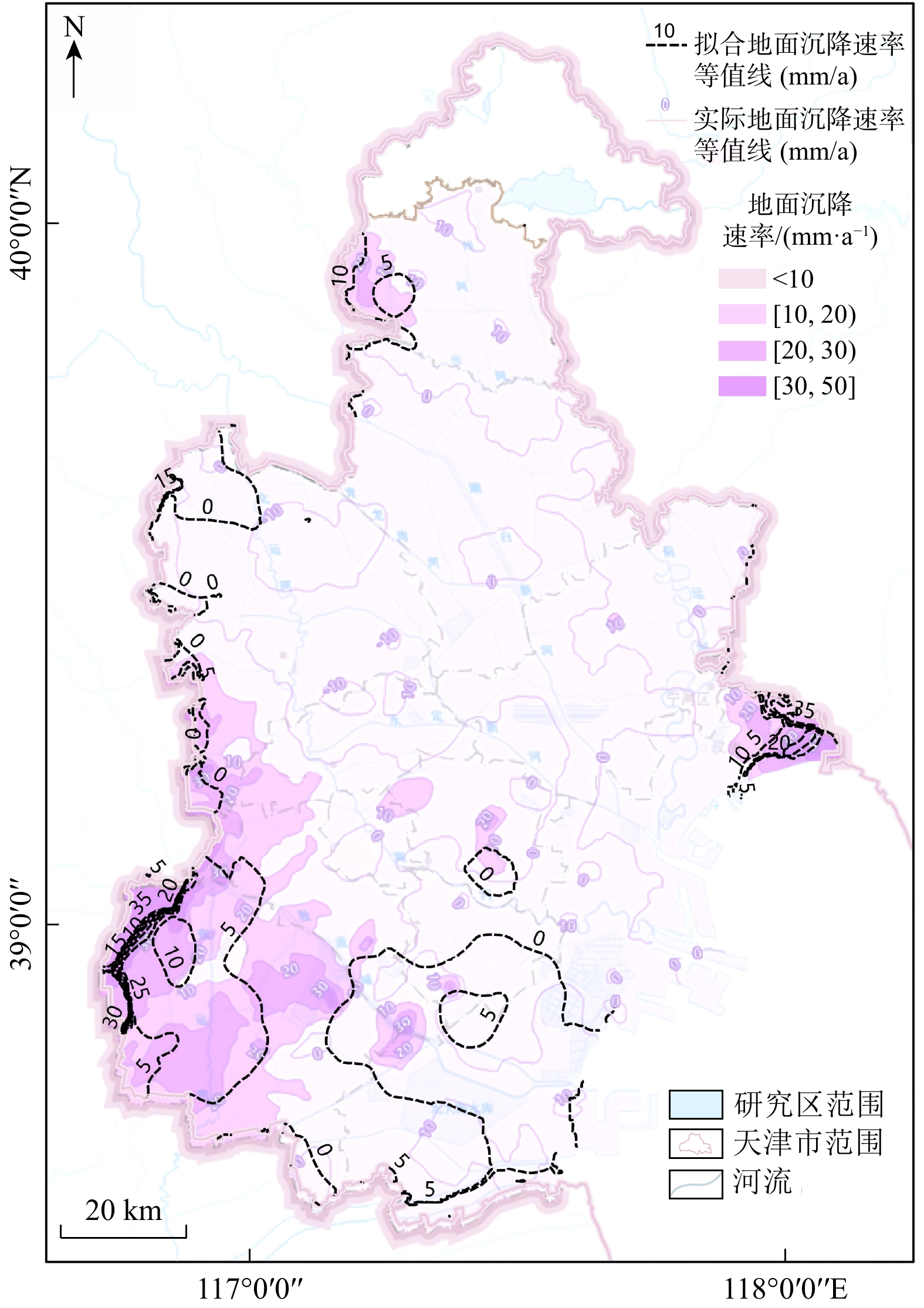
图 3 2023年研究区模拟地面沉降与实际沉降拟合效果图
Figure 3. Fitting results of simulated and observed land subsidence in study area in 2023
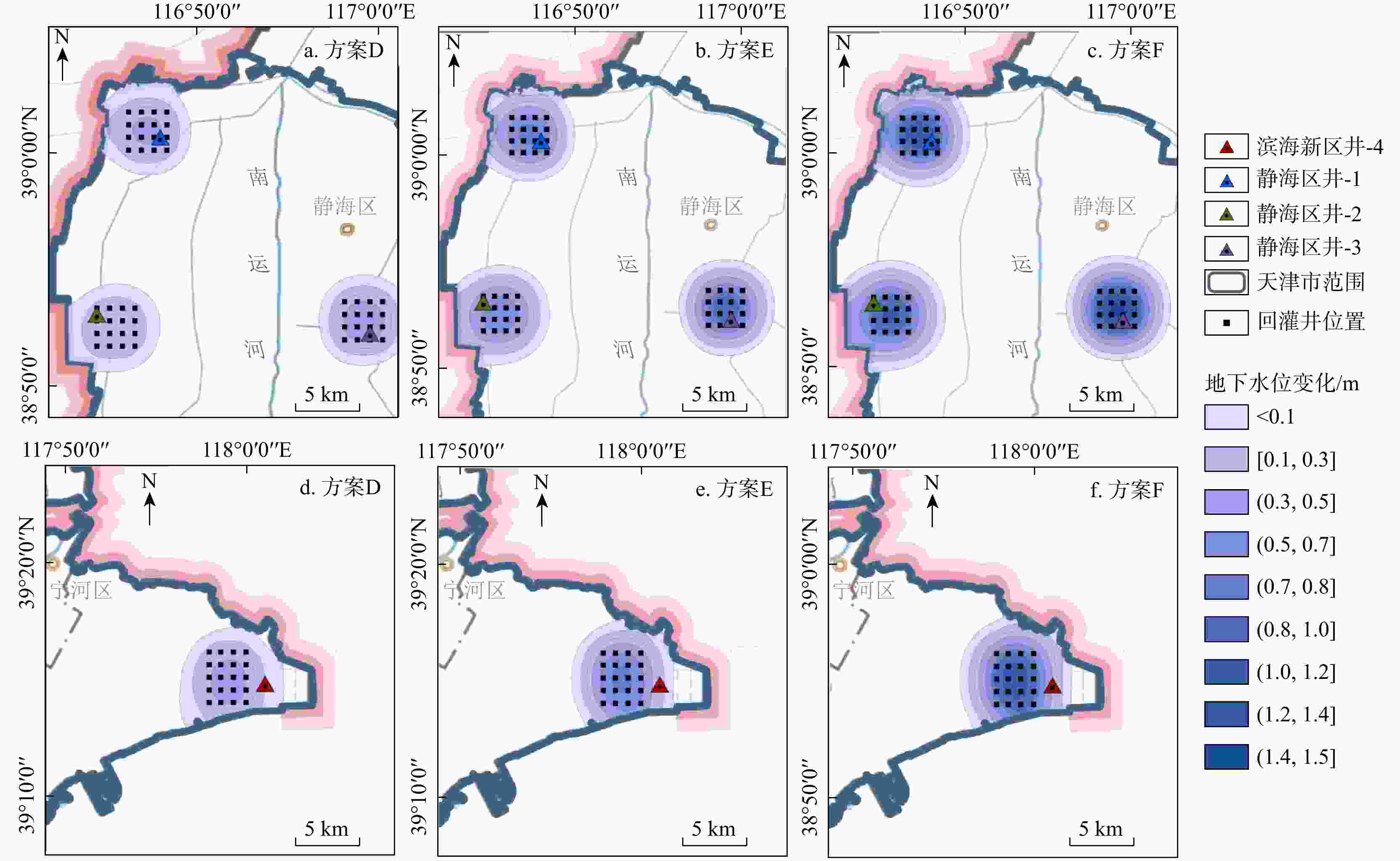
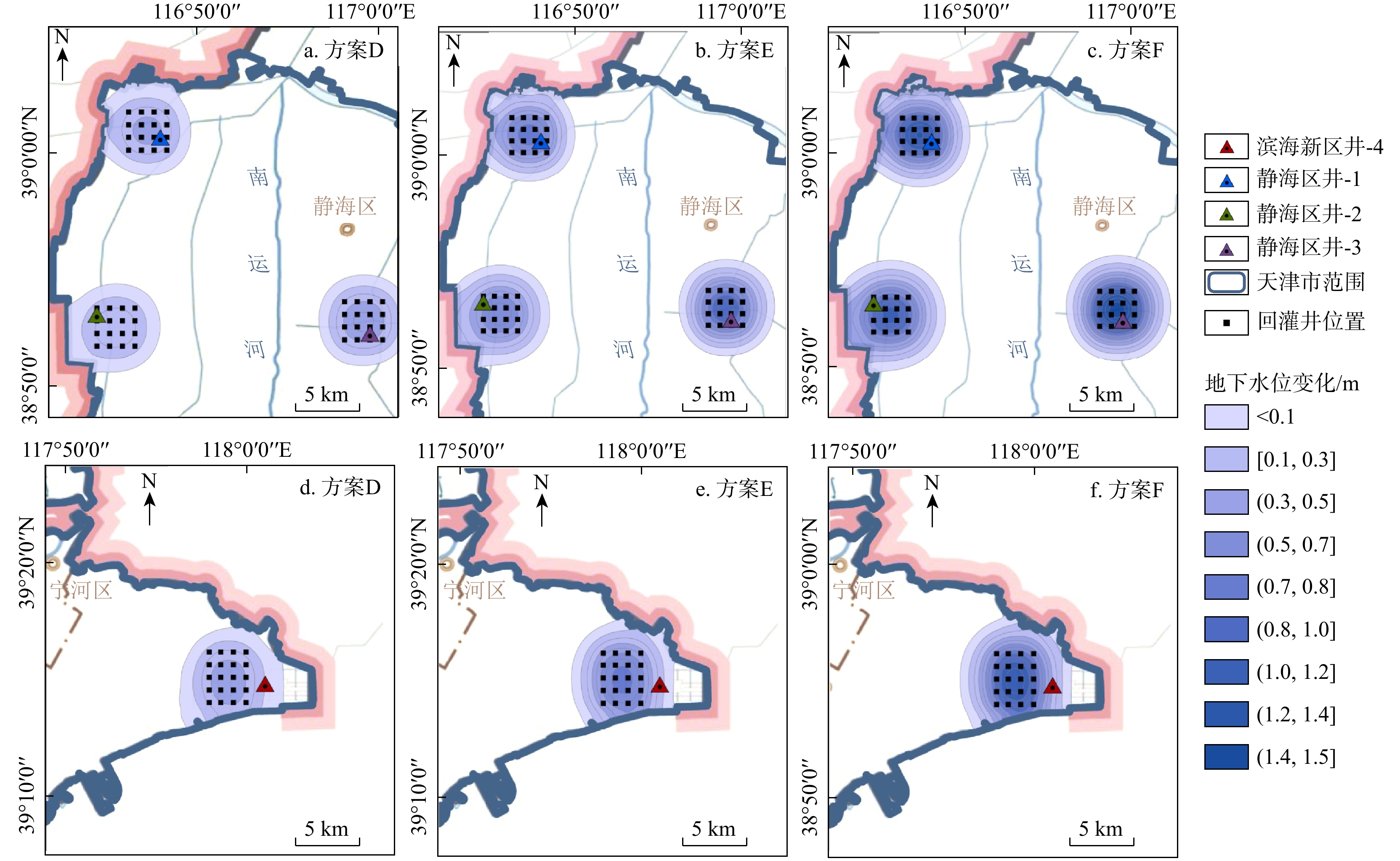
图 4 回灌区地下水位抬升空间示意图(a~c. 静海区;d~f. 滨海新区。方案D~F见表2,下同)
Figure 4. Distribution of groundwater level recovery in recharge area
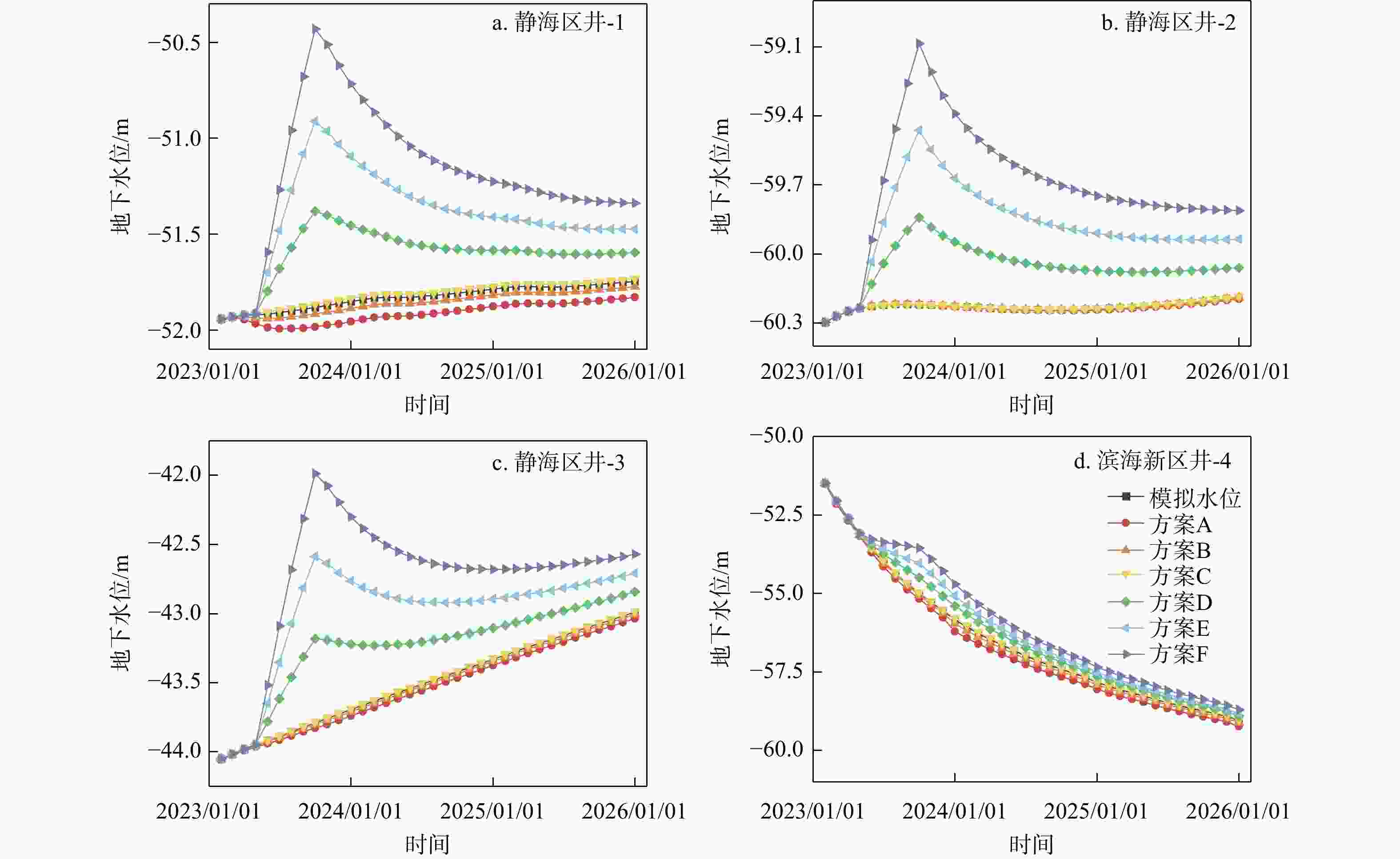
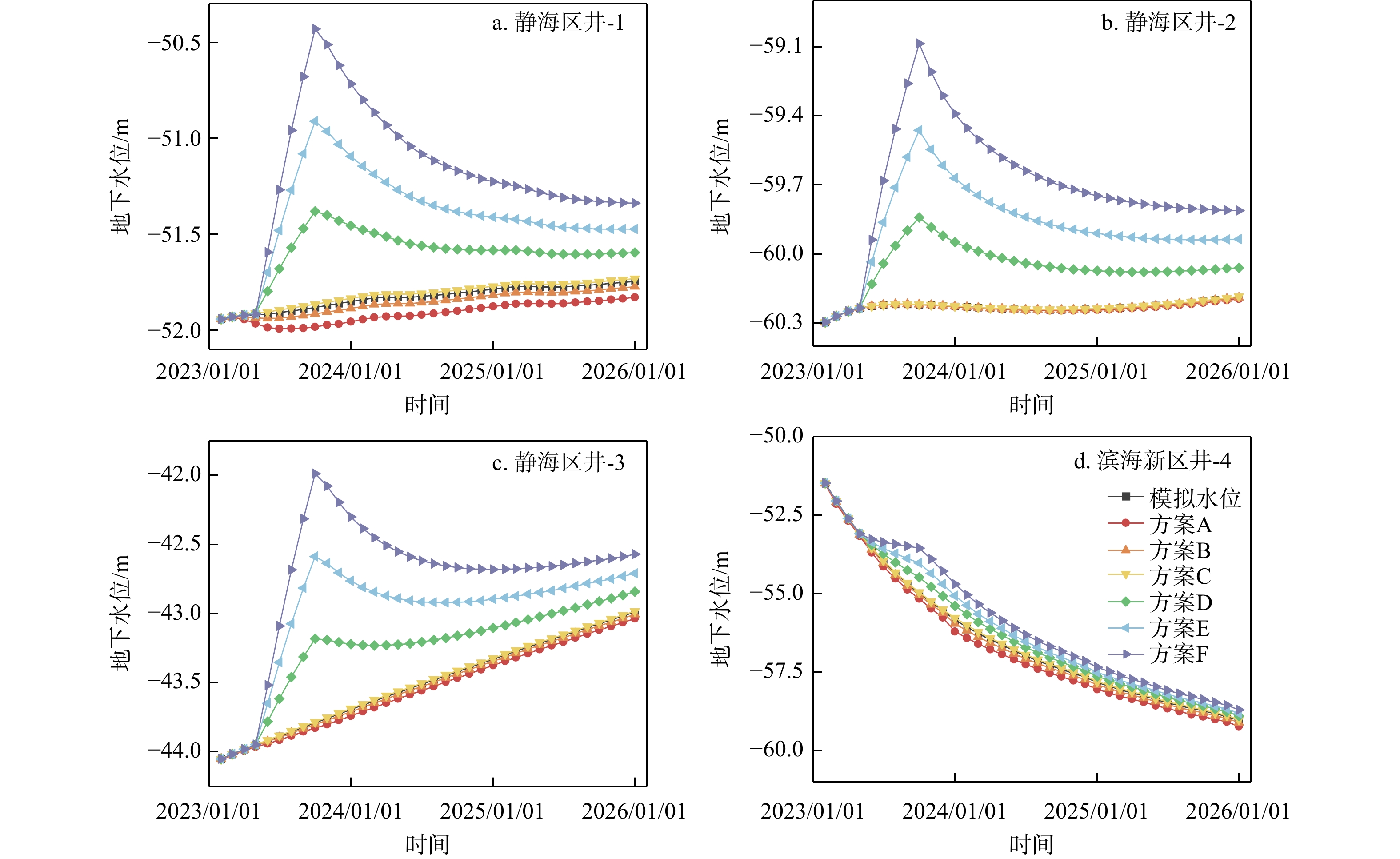
图 5 不同方案下地下水位历时变化(方案A~F见表2)
Figure 5. Temporal variation of groundwater level under different schemes
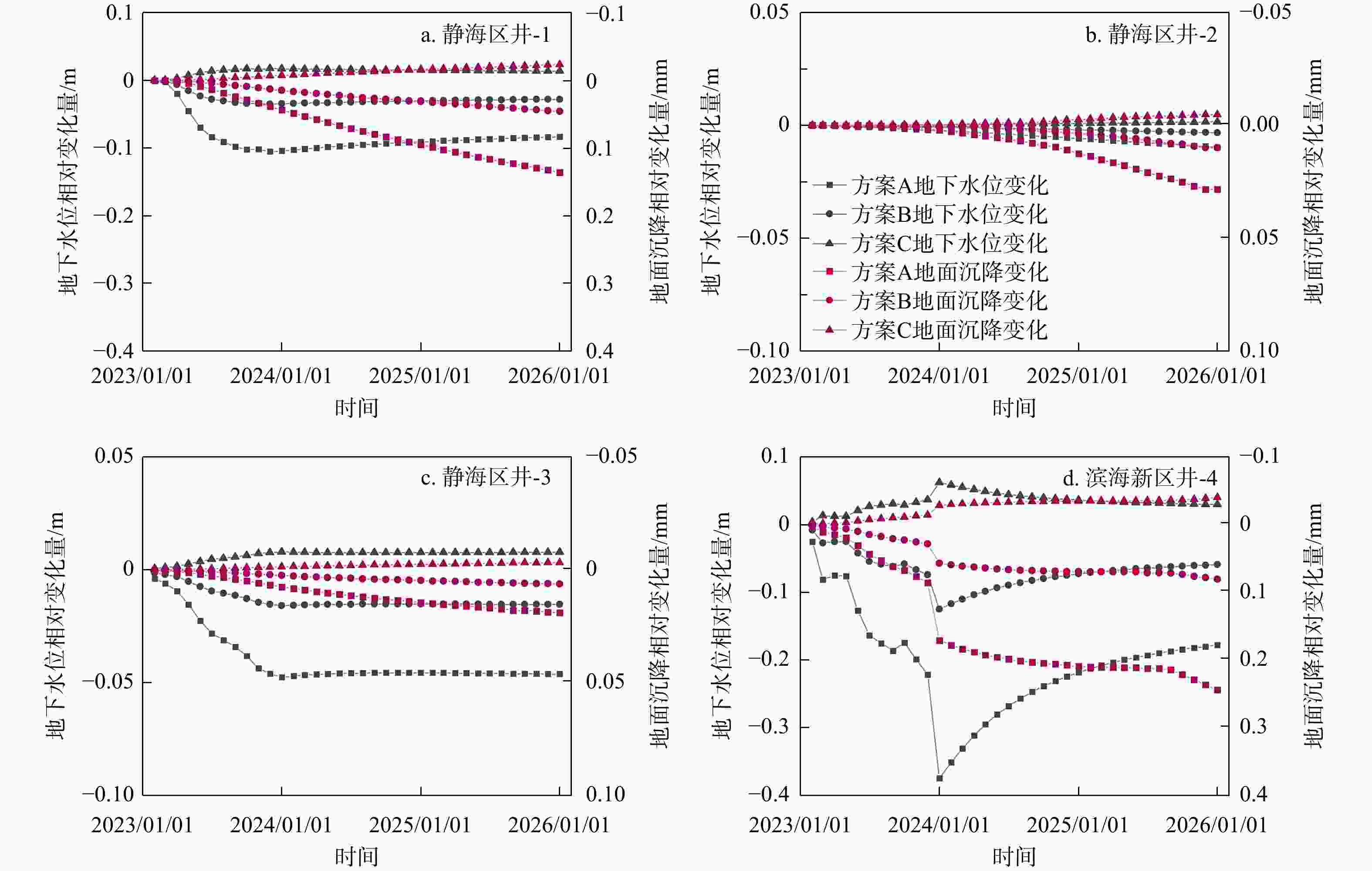
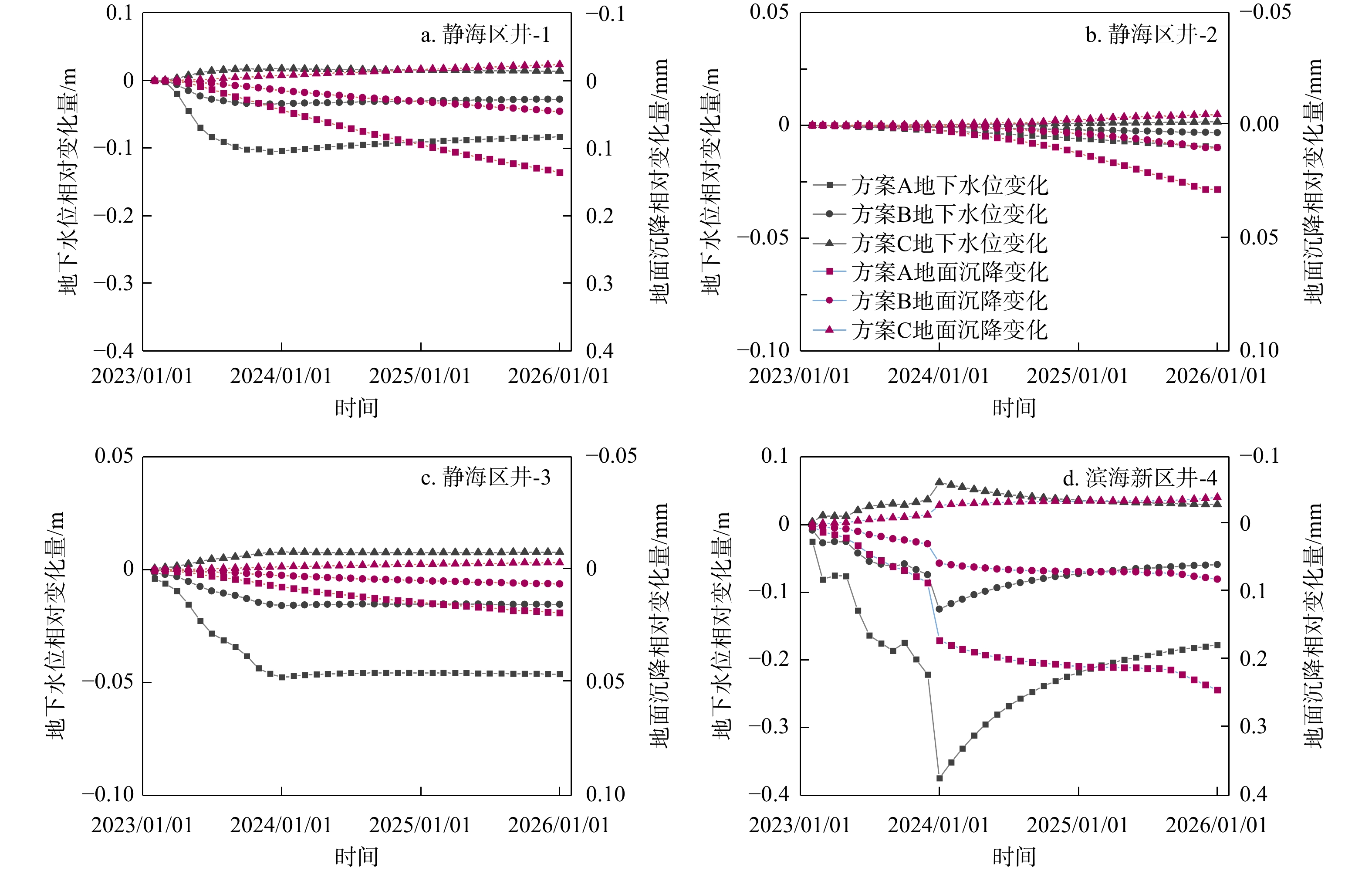
图 6 开采方案下地下水位相对变化量与地面沉降相对变化量折线图
Figure 6. Line charts of relative changes in groundwater levels and land subsidence under extraction schemes
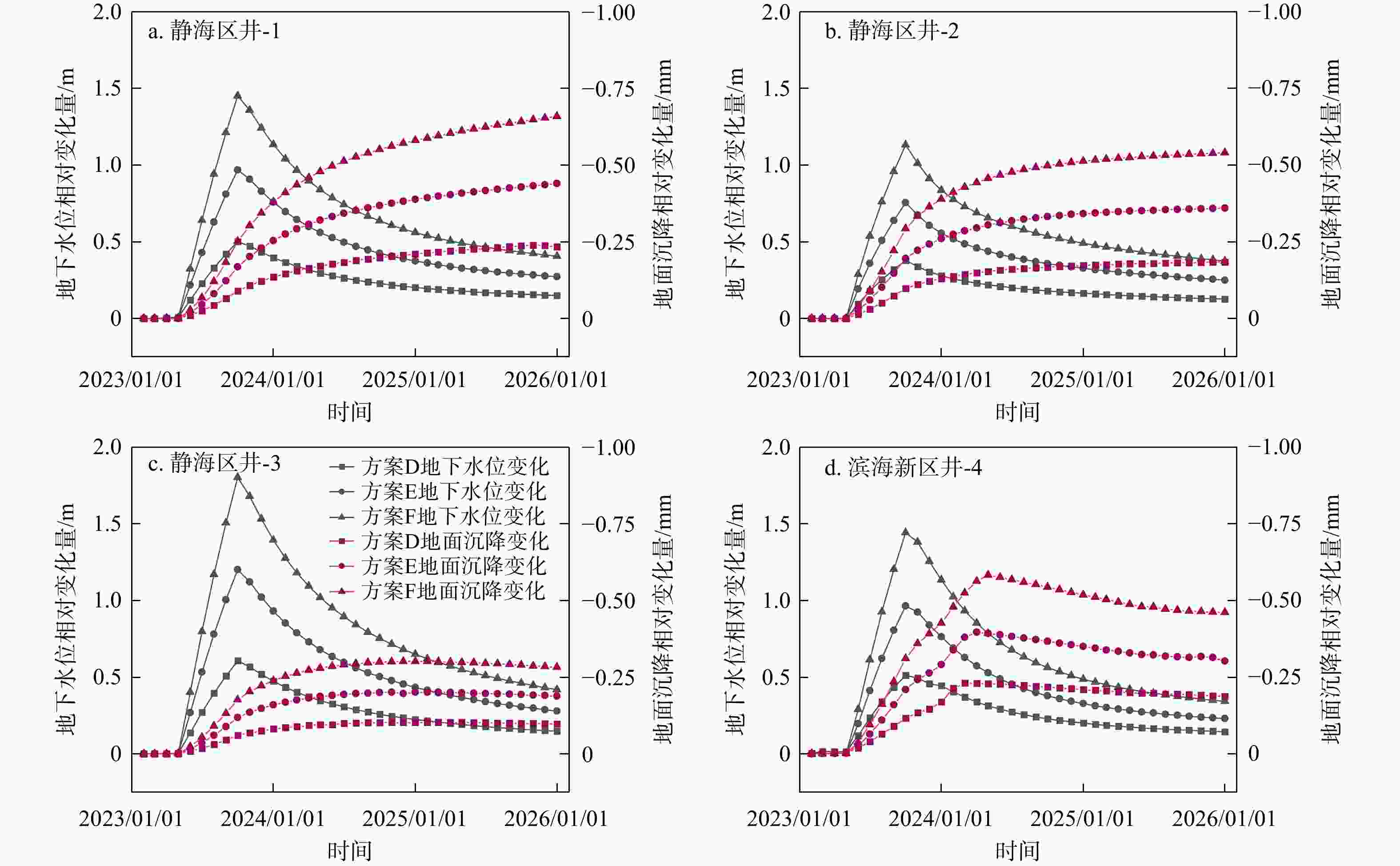
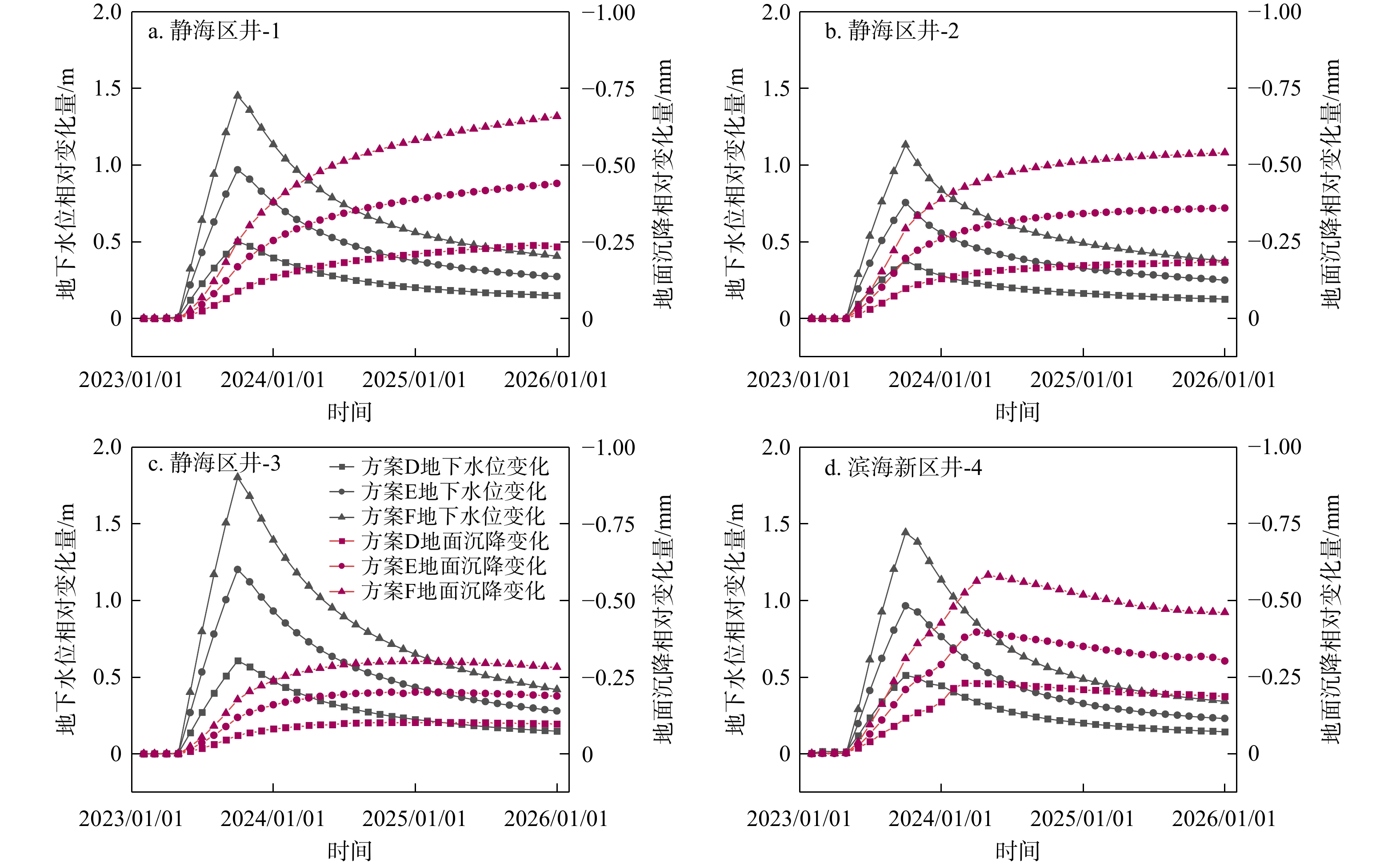
图 7 回灌方案下地下水位相对变化量与地面沉降相对变化量折线图
Figure 7. Line charts of relative changes in groundwater levels and land subsidence under recharge schemes
表 1 天津市平原区松散地层含水组划分[36]
Table 1. Classification of aquifer systems in unconsolidated strata in Tianjin Plain area
含水层组 年代地层 底板埋深/m 岩性特征 第Ⅰ含
水组Qh+Qp3 65~95 山前分布中细砂,中西部为粉细砂、细砂,中东部以粉细砂为主 第Ⅱ含
水组Qp2 165~205 山前分布中砂、中细砂,中南部上段为粉细砂,中南部下段为粉细砂、细砂 第Ⅲ含
水组隆起区Qp1、
坳陷区Qp1中部270~290 武清区、静海区、宁河区北部为中细砂、细砂,中南部以粉细砂为主 第Ⅳ含
水组隆起区N2m、
坳陷区Qp1下部370~410 武清区、静海区、宁河区北部细砂、中细砂,中南部以细粉砂为主 注:Qh. 全新统;Qp3. 上更新统;Qp2. 中更新统;Qp1. 下更新统;N2m. 上新统明化镇组  下载: 导出CSV
表 2 开采与回灌模拟方案
Table 2. Simulation schemes of extraction and recharge
方案 方案设计 增大开采量/(m3·a−1) 方案 方案设计 增加回灌量/(m3·a−1) A 开采量扩大至当前4倍 1.92×10⁶ D 单井回灌量500 m3/d 5.10×10⁶ B 开采量扩大至当前2倍 9.60×10⁵ E 单井回灌量 1000 m3/d1.02×107 C 开采量缩减至当前1/2倍 2.40×10⁵ F 单井回灌量 1500 m3/d1.53×107
下载: 导出CSV
-
[1] 薛禹群. 论地下水超采与地面沉降[J]. 地下水, 2012, 34(6): 1-5.XUE Y Q. Discussion on groundwater overexploitation and ground settlement[J]. Ground Water, 2012, 34(6): 1-5. (in Chinese with English abstract [2] BAGHERI-GAVKOSH M, HOSSEINI S M, ATAIE-ASHTIANI B, et al. Land subsidence: A global challenge[J]. Science of the Total Environment, 2021, 778: 146193. doi: 10.1016/j.scitotenv.2021.146193 [3] KOK S, COSTA A L. Framework for economic cost assessment of land subsidence[J]. Natural Hazards, 2021, 106(3): 1931-1949. doi: 10.1007/s11069-021-04520-3 [4] HERRERA-GARCÍA G, EZQUERRO P, TOMÁS R, et al. Mapping the global threat of land subsidence[J]. Science, 2021, 371: 34-36. doi: 10.1126/science.abb8549 [5] 杜东, 刘宏伟, 周佳慧, 等. 北京市通州区地面沉降特征与影响因素研究[J]. 地质学报, 2022, 96(2): 712-725.DU D, LIU H W, ZHOU J H, et al. Study of the characteristics and influencing factors of land subsidence in the Tongzhou District of Beijing[J]. Acta Geologica Sinica, 2022, 96(2): 712-725. (in Chinese with English abstract [6] 韩红闪, 朱琳, 郭高轩, 等. 新水情背景下北京平原朝阳−通州沉降区地面沉降特征及其影响[J]. 吉林大学学报(地球科学版), 2024, 54(4): 1326-1338.HAN H S, ZHU L, GUO G X, et al. Land subsidence characteristicsand impactin Chaoyang Tongzhou area of Beijing Plain under new hydrological background[J]. Journal of Jilin University (Earth Science Edition), 2024, 54(4): 1326-1338. (in Chinese with English abstract [7] 朱锦旗, 龚绪龙, 于军, 等. 苏州−无锡−常州地区地面沉降及地裂缝防控研究[J]. 地质力学学报, 2024, 30(5): 811-833.ZHU J Q, GONG X L, YU J, et al. Prevention and control of land subsidence and earth fissures in Suzhou-Wuxi-Changzhou region[J]. Journal of Geomechanics, 2024, 30(5): 811-833. (in Chinese with English abstract [8] 刘贺, 罗勇, 雷坤超, 等. 北京新航城地区地面沉降演化规律及多源监测方法对比研究[J]. 地质科技通报, 2023, 42(1): 398-406.LIU H, LUO Y, LEI K C, et al. Evolution of land subsidence and comparative study on multi-source monitoring methods in New Airlines City of Beijing[J]. Bulletin of Geological Science and Technology, 2023, 42(1): 398-406. (in Chinese with English abstract [9] 王琰, 吕航, 谷复光. 多元线性回归方法在地面沉降量预测中的解析及应用[J]. 安全与环境工程, 2021, 28(3): 156-161.WANG Y, LYU H, GU F G. Analysis and application of multiple linear regression method in prediction of land subsidence[J]. Safety and Environmental Engineering, 2021, 28(3): 156-161. (in Chinese with English abstract [10] 罗袆沅, 许强, 蒋亚楠, 等. 基于时序InSAR与机器学习的大范围地面沉降预测方法[J]. 地球科学, 2024, 49(5): 1736-1745.LUO H Y, XU Q, JIANG Y N, et al. The prediction method of large-scale land subsidence based on multi-temporal InSAR and machine learning[J]. Earth Science, 2024, 49(5): 1736-1745. (in Chinese with English abstract [11] 耿芳, 白苏娜, 齐文艳, 等. 基于随机森林算法的天津市滨海地区地面沉降模拟[J]. 地质科技通报, 2024, 43(5): 197-205.GENG F, BAI S N, QI W Y, et al. Investigations into ground subsidence in Tianjin coastal area based on random forest[J]. Bulletin of Geological Science and Technology, 2024, 43(5): 197-205. (in Chinese with English abstract [12] NGUYEN M, LIN Y N, TRAN Q C, et al. Assessment of long-term ground subsidence and groundwater depletion in Hanoi, Vietnam[J]. Engineering Geology, 2022, 299: 106555. doi: 10.1016/j.enggeo.2022.106555 [13] 李凡, 李家科, 马越, 等. 地下水数值模拟研究与应用进展[J]. 水资源与水工程学报, 2018, 29(1): 99-104.LI F, LI J K, MA Y, et al. The research and application progress of numerical simulation on groundwater[J]. Journal of Water Resources and Water Engineering, 2018, 29(1): 99-104. (in Chinese with English abstract [14] EDALAT A, KHODAPARAST M, RAJABI A M. Scenarios to control land subsidence using numerical modeling of groundwater exploitation: Aliabad Plain (in Iran) as a case study[J]. Environmental Earth Sciences, 2020, 79(21): 494. doi: 10.1007/s12665-020-09246-2 [15] 董成志, 江思珉, 夏学敏, 等. 基于MODFLOW-SUB模块的地层压缩与地面沉降模拟研究[J]. 工程勘察, 2017, 45(11): 42-48.DONG C Z, JIANG S M, XIA X M, et al. Simulation of stratigraphic compression and ground subsidence based on MODFLOW-SUB module[J]. Geotechnical Investigation & Surveying, 2017, 45(11): 42-48. (in Chinese with English abstract [16] 孟世豪, 崔亚莉, 田芳, 等. 基于MODFLOW-SUB建立变渗透系数的地下水流-地面沉降模型[J]. 吉林大学学报(地球科学版), 2022, 52(2): 550-559.MENG S H, CUI Y L, TIAN F, et al. Modeling of groundwater flow-land subsidence with variable hydraulic conductivity based on MODFLOW-SUB[J]. Journal of Jilin University (Earth Science Edition), 2022, 52(2): 550-559. (in Chinese with English abstract [17] 邵山, 王浩, 贾毅, 等. 基于GMS的地面沉降模型的研究和实践应用[J]. 城市勘测, 2024(2): 199-203.SHAO S, WANG H, JIA Y, et al. Research and practical application of land subsidence model based on GMS[J]. Urban Geotechnical Investigation & Surveying, 2024(2): 199-203. (in Chinese with English abstract [18] 邵景力, 白国营, 刘翠珠, 等. 我国地下水管理面临的问题与对策: 兼谈地下水“双控”管理[J]. 水文地质工程地质, 2023, 50(5): 1-9.SHAO J L, BAI G Y, LIU C Z, et al. Problems and countermeasures of groundwater management in China: Concurrently talking about groundwater dual-control management[J]. Hydrogeology & Engineering Geology, 2023, 50(5): 1-9. (in Chinese with English abstract [19] TERZAGHI K. Principles of soil mechanics: Ⅳ Settlement and consolidation of clay[J]. Engineering News-Record, 1925, 95: 874-878. [20] CODA S, TESSITORE S, DI MARTIRE D, et al. Coupled ground uplift and groundwater rebound in the metropolitan city of Naples (southern Italy)[J]. Journal of Hydrology, 2019, 569: 470-482. doi: 10.1016/j.jhydrol.2018.11.074 [21] PARKER A L, PIGOIS J P, FILMER M S, et al. Land uplift linked to managed aquifer recharge in the Perth Basin, Australia[J]. International Journal of Applied Earth Observation and Geoinformation, 2021, 105: 102637. doi: 10.1016/j.jag.2021.102637 [22] ZHANG Y, WU J C, XUE Y Q, et al. Land subsidence and uplift due to long-term groundwater extraction and artificial recharge in Shanghai, China[J]. Hydrogeology Journal, 2015, 23(8): 1851-1866. doi: 10.1007/s10040-015-1302-x [23] WANG G Y, ZHU J Q, YOU G, et al. Land rebound after banning deep groundwater extraction in Changzhou, China[J]. Engineering Geology, 2017, 229: 13-20. doi: 10.1016/j.enggeo.2017.09.006 [24] 罗勇, 田芳, 秦欢欢, 等. 地下水人工回灌和停采对地面沉降控制的影响分析[J]. 水资源与水工程学报, 2020, 31(1): 52-57.LUO Y, TIAN F, QIN H H, et al. Effects of groundwater artificial recharge and the termination of ground water exploitation on land subsidence control[J]. Journal of Water Resources and Water Engineering, 2020, 31(1): 52-57. (in Chinese with English abstract [25] 赵龙, 蒋小伟, 李玉梅, 等. 近10年北京平原区地下水水位变化及与地面沉降的关系研究[J]. 地质学报, 2025, 99(5): 1792-1806.ZHAO L, JIANG X W, LI Y M, et al. Groundwater level changes and their impact on land subsidence in the Beijing Plain during the past 10 years[J]. Acta Geologica Sinica, 2025, 99(5): 1792-1806. (in Chinese with English abstract [26] ZHU L, GONG H L, CHEN Y, et al. Effects of water diversion project on groundwater system and land subsidence in Beijing, China[J]. Engineering Geology, 2020, 276: 105763. doi: 10.1016/j.enggeo.2020.105763 [27] LYU M Y, KE Y H, GUO L, et al. Change in regional land subsidence in Beijing after South-to-North Water Diversion Project observed using satellite radar interferometry[J]. GIScience & Remote Sensing, 2020, 57(1): 140-156. doi: 10.1080/15481603.2019.1676973 [28] 田苗壮, 赵龙, 崔文君, 等. 南水北调背景下地下水位上升对地面沉降控制与影响: 以北京潮白河地下水系统为例[J]. 中国地质, 2023, 50(3): 872-886.TIAN M Z, ZHAO L, CUI W J, et al. Control and influence of rising groundwater level on land under the background of South-to-North Water Diversion: A case study of Chaobai River groundwater system in Beijing[J]. Geology in China, 2023, 50(3): 872-886. (in Chinese with English abstract [29] 郭占荣, 曲焕林, 崔小东, 等. 天津市地面沉降数值模拟研究[J]. 地球学报, 1998, 19(4): 415-422.GUO Z R, QU H L, CUI X D, et al. Study of numerical simulation of land subsidence in Tianjin[J]. Acta Geoscientica Sinica, 1998, 19(4): 415-422. (in Chinese with English abstract [30] 王家兵, 李平. 天津平原地面沉降条件下的深层地下水资源组成[J]. 水文地质工程地质, 2004, 31(5): 35-37.WANG J B, LI P. Composition of groundwater resources in deep-seated aquifers under the condition of land subsidence in Tianjin Plain[J]. Hydrogeology & Engineering Geology, 2004, 31(5): 35-37. (in Chinese with English abstract [31] 李文运, 崔亚莉, 苏晨, 等. 天津市地下水流-地面沉降耦合模型[J]. 吉林大学学报(地球科学版), 2012, 42(3): 805-813.LI W Y, CUI Y L, SU C, et al. An integrated numerical groundwater and land subsidence model of Tianjin[J]. Journal of Jilin University (Earth Science Edition), 2012, 42(3): 805-813. (in Chinese with English abstract [32] 王礼春. 天津市深层地下水资源及其地面沉降数值模拟研究[D]. 北京: 中国地质大学(北京), 2010.WANG L C. The study on deep groundwater resources and subsidence caused by withdrawal with method of numerical simulation in Tianjin District[D]. Beijing: China University of Geosciences (Beijing), 2010. (in Chinese with English abstract [33] CUI Y L, SU C, SHAO J L, et al. Development and application of a regional land subsidence model for the plain of Tianjin[J]. Journal of Earth Science, 2014, 25(3): 550-562. doi: 10.1007/s12583-014-0447-1 [34] HA D, ZHENG G, LOÁICIGA H A, et al. Long-term groundwater level changes and land subsidence in Tianjin, China[J]. Acta Geotechnica, 2021, 16(4): 1303-1314. doi: 10.1007/s11440-020-01097-2 [35] YANG J L, CAO G L, HAN D M, et al. Deformation of the aquifer system under groundwater level fluctuations and its implication for land subsidence control in the Tianjin coastal region[J]. Environmental Monitoring and Assessment, 2019, 191(3): 162. [36] 王家兵. 天津地下水研究[M]. 北京: 地质出版社, 2013: 65-99.WANG J B. The study of groundwater in Tianjin[M]. Beijing: Geological Publishing House, 2013: 65-99. (in Chinese) [37] 潘云, 潘建刚, 宫辉力, 等. 天津市区地下水开采与地面沉降关系研究[J]. 地球与环境, 2004, 32(2): 36-39.PAN Y, PAN J G, GONG H L, et al. Research on the relation between groundwater exploitation and subsidence in Tianjin proper[J]. Earth and Environment, 2004, 32(2): 36-39. (in Chinese with English abstract [38] 成建梅, 柳璨, 李敏敏, 等. 城市化进程下北京平原渗流场与地面沉降发展演化模拟[J]. 地质科技通报, 2020, 39(1): 43-52.CHENG J M, LIU C, LI M M, et al. Numerical study on evolution of groundwater hydrodynamics and land subsidence under the process of metropolitan urbanization in Beijing Plain, China[J]. Bulletin of Geological Science and Technology, 2020, 39(1): 43-52. (in Chinese with English abstract [39] 秦欢欢. 北京平原地面沉降数值模拟情景分析[J]. 地质科技情报, 2019, 38(1): 221-227.QIN H H. Numerical simulation and scenario analysis of land subsidence in Beijing Plain[J]. Geological Science and Technology Information, 2019, 38(1): 221-227. (in Chinese with English abstract [40] 李新旺, 马素英, 刘淼, 等. 河北省深层地下水回补研究[J]. 中国水利, 2024(7): 28-33.LI X W, MA S Y, LIU M, et al. Studies on recharge of deep aquifers in Hebei Province[J]. China Water Resources, 2024(7): 28-33. (in Chinese with English abstract [41] 徐佳, 李佳琦, 闫伟, 等. 天津市深层地下水回灌效果预测[J]. 地下水, 2024, 46(3): 74-76.XU J, LI J Q, YAN W, et al. Recharge effect prediction of deep groundwater in Tianjin[J]. Ground Water, 2024, 46(3): 74-76. (in Chinese with English abstract -

 下载:
下载:


 点击查看大图
计量
- 文章访问数: 674
- PDF下载量: 168
- 被引次数: 0