投审稿入口
投审稿入口


-
摘要:
目前对泥石流灾害易发性相关研究尚未考虑泥石流灾害的地理位置关系以及空间依赖性。本研究构建了包含
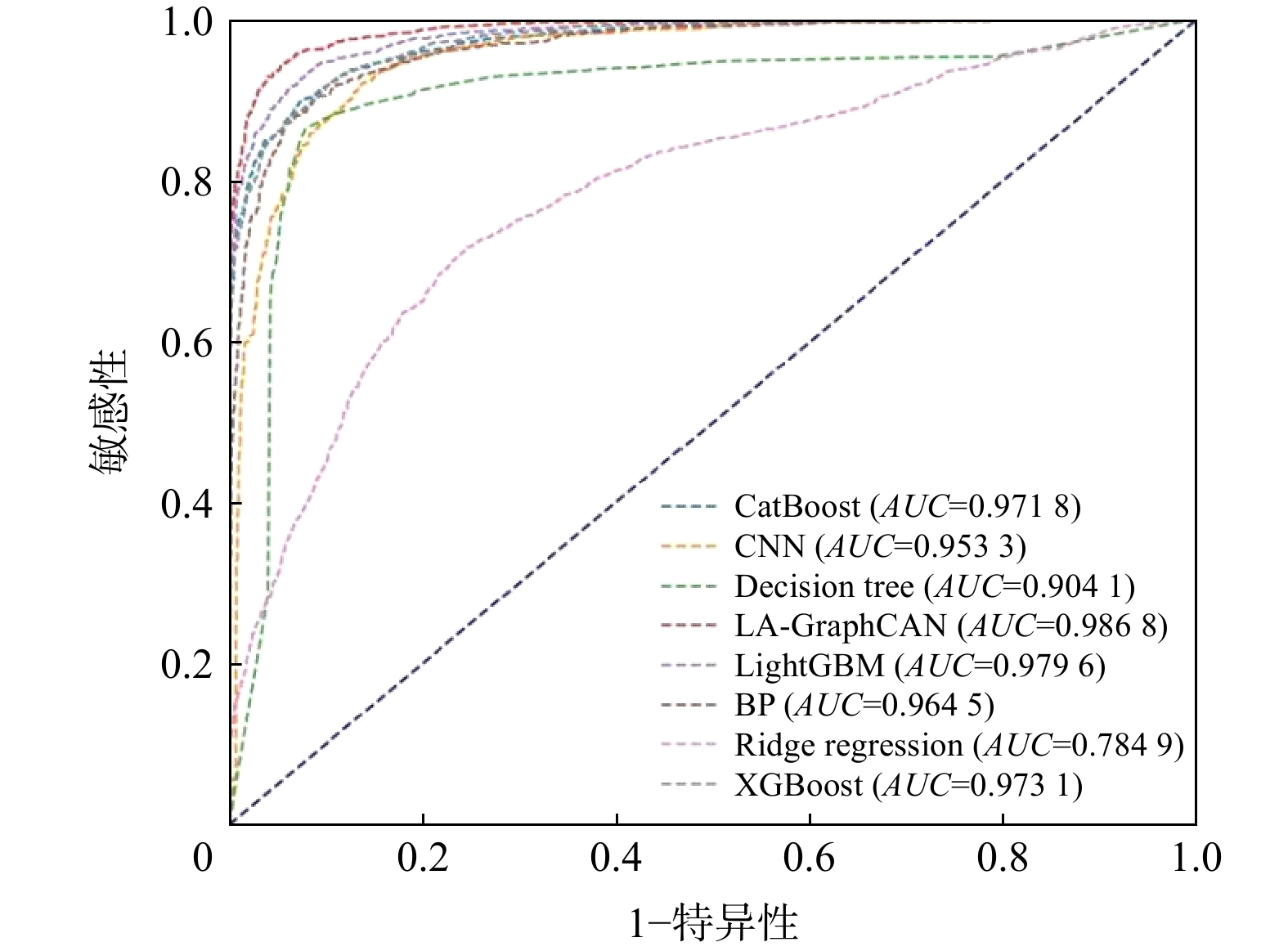
4286 个正样本点和5912 个负样本点的甘肃省泥石流数据集,提出了一种基于LA-GraphCAN(local augmentation graph convolutional and attention network)的泥石流易发性评价方法。首先,以样本点的经纬度投影坐标为基础,利用KNN(K-nearest neighbors)构建最近邻图,捕捉泥石流灾害点之间的复杂地理位置关系;其次,使用GCN(graph convolutional network)高效聚合局部邻域信息,提取关键地理和环境特征,不仅关注单个栅格所包含的信息,还深入探讨了相邻栅格之间空间结构的相互关系,从而使模型能够更精准地识别和理解样本中的局部空间特征。同时,引入GAT(graph attention network)添加动态注意力机制,细化特征表示;再次,验证所提方法的有效性,并从不同角度对比分析;最后,对甘肃省泥石流易发性进行评价。结果表明,考虑了泥石流灾害地理位置关系的LA-GraphCAN的ROC曲线下面积(AUC )、准确率、精确率、召回率以及F 1分数分别为0.9868 ,0.9458 ,0.9436 ,0.9228 和0.9331 ,与主流机器学习模型CNN(convolutional neural networks)、Decision tree等相比最优。基于LA-GraphCAN评价的甘肃省泥石流极高易发区中历史泥石流灾害点数量为4055 个,占甘肃省历史泥石流总数的95%,与历史灾害分布基本一致。性能评估和甘肃省泥石流易发性评价结果均表明考虑泥石流灾害空间依赖性的LA-GraphCAN方法的评价结果更优,在泥石流易发性评价研究中有较好的适用性。-
关键词:
- LA-GraphCAN /
- 泥石流易发性评价 /
- GCN /
- GAT /
- 甘肃省
Abstract:ObjectiveIn the current studies related to the susceptibility of debris flow disasters, the geographical location relationship and spatial dependence of debris flow disasters have hitherto not been taken into account.
MethodsIn response to this problem, this article presents a debris flow susceptibility assessment approach based on LA-GraphCAN (local augmentation graph convolutional and attention network). Firstly, a debris flow dataset for Gansu Province was constructed, encompassing
4286 positive sample points and5912 negative sample points. Based on the projected coordinates of the longitude and latitude of the sample points, a nearest neighbor graph was constructed using KNN to capture the intricate geographical location relationships among debris flow disaster points. Secondly, GCN was employed to effectively aggregate local neighborhood information, extract key geographical and environmental features, and deeply explore the interrelationships of the spatial structures between adjacent grids, thereby enabling the model to more precisely identify and comprehend the local spatial characteristics within the samples. Simultaneously, GAT was introduced to incorporate a dynamic attention mechanism and refine the feature representations. Finally, the validity of the proposed method was verified and compared and analyzed from different perspectives.ResultsThe results demonstrate that the area under the ROC curve, the accuracy rate, the precision rate, the recall rate, and the
F 1score of the LA-GraphCAN model, which considers the geographical location relationship of debris flow disasters, are0.9868 ,0.9458 ,0.9436 ,0.9228 , and0.9331 , respectively, outperforming models such as CNN and Decision tree.ConclusionBoth the performance evaluations and the assessment results of debris flow susceptibility in Gansu Province indicate that the LA-GraphCAN method, which takes into account the spatial dependence of debris flow disasters, yields superior assessment results and exhibits excellent applicability.
-
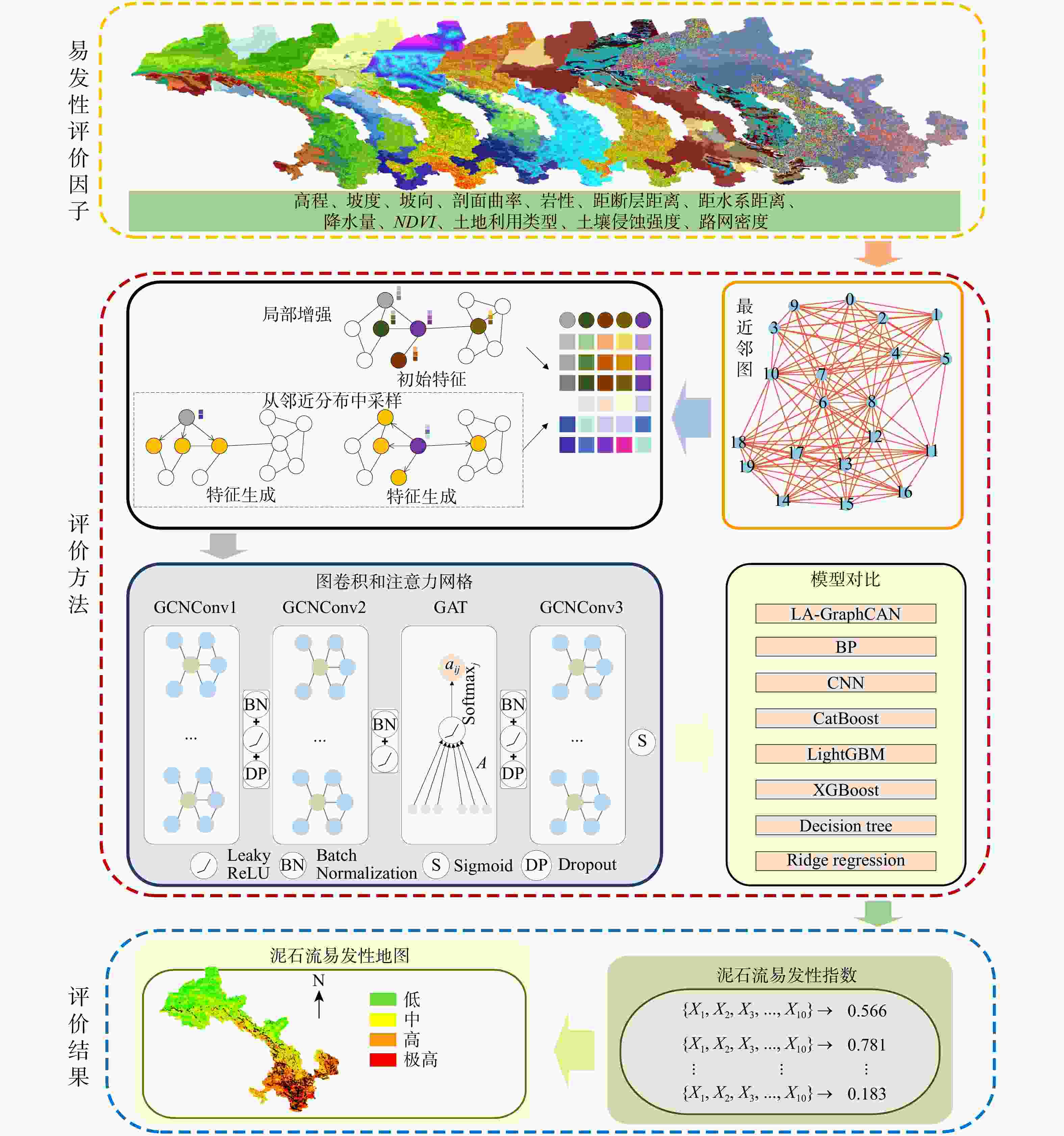
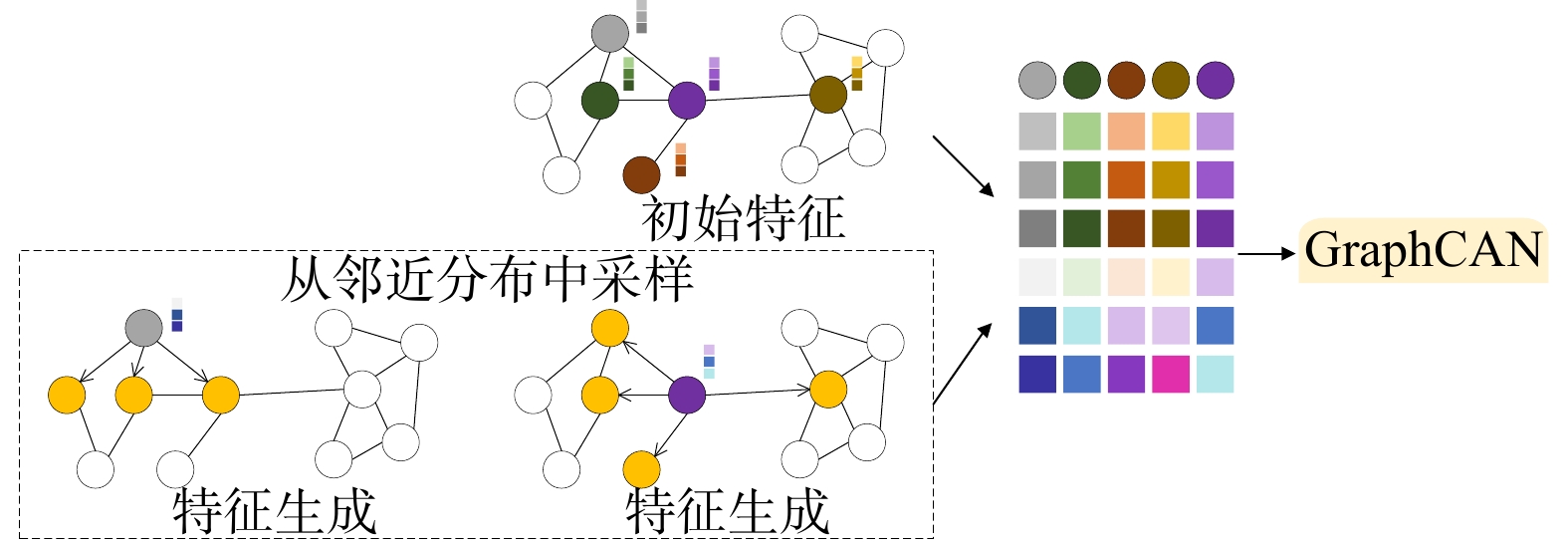
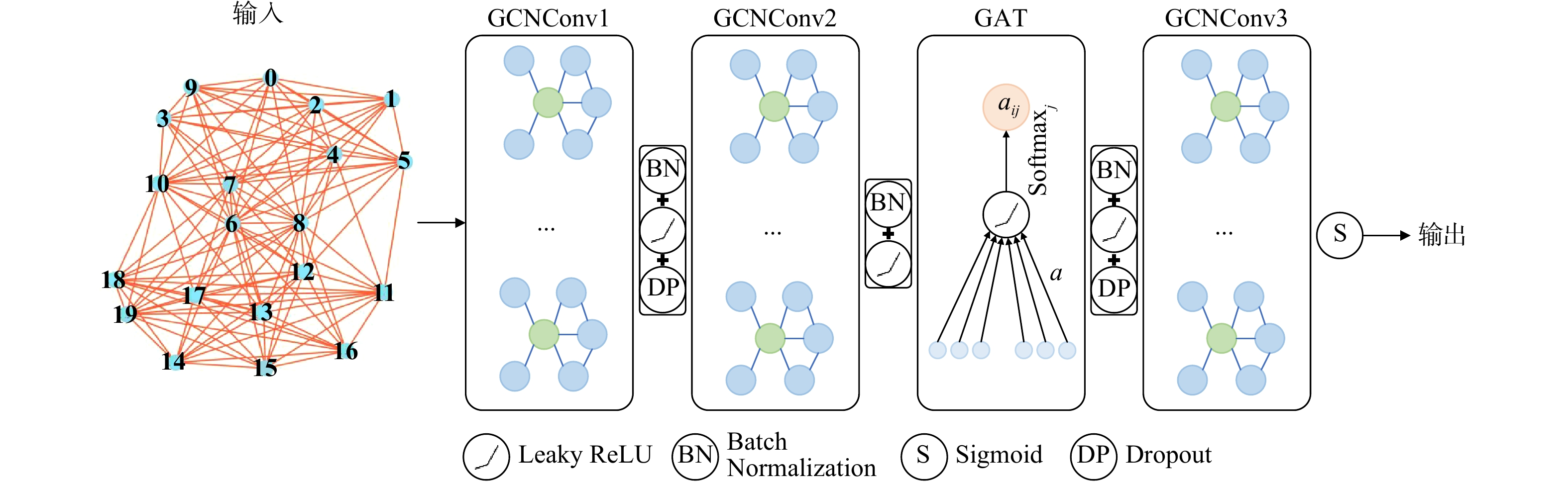
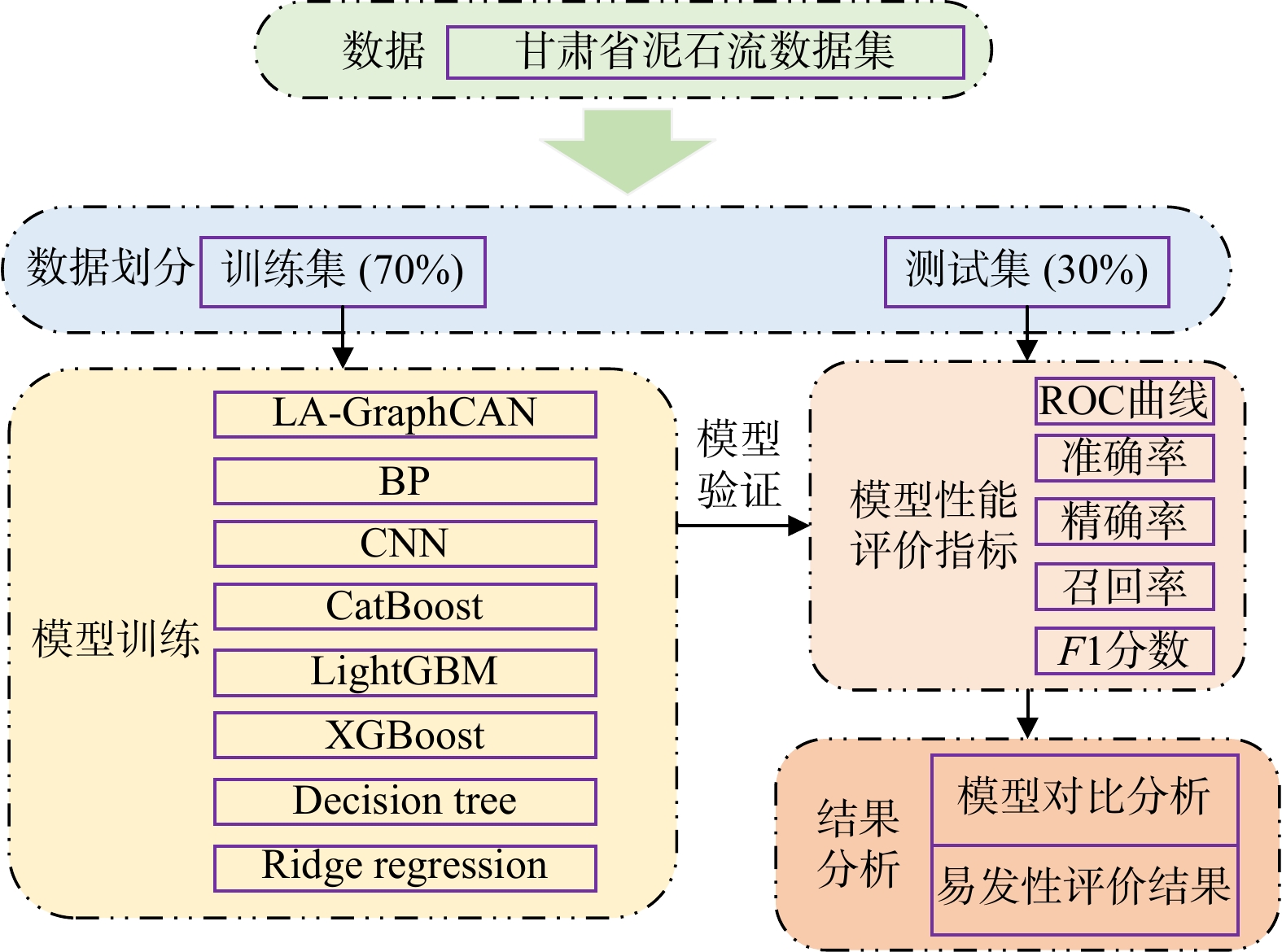
图 1 基于LA-GraphCAN的甘肃省泥石流易发性评价流程
NDVI. 植被归一化指数;GCNConv1. 第1层图卷积;GCNConv2. 第2层图卷积;GAT. 图注意力机制;GCNConv3. 第3层图卷积;Leaky ReLU. 泄漏修正线性单元;Batch Normalization. 批量标准化;Sigmoid. 神经网络中常见的激活函数;Dropout. 神经网络中常用的正则化技术;下同
Figure 1. Debris flow susceptibility assessment process based on LA-GraphCAN
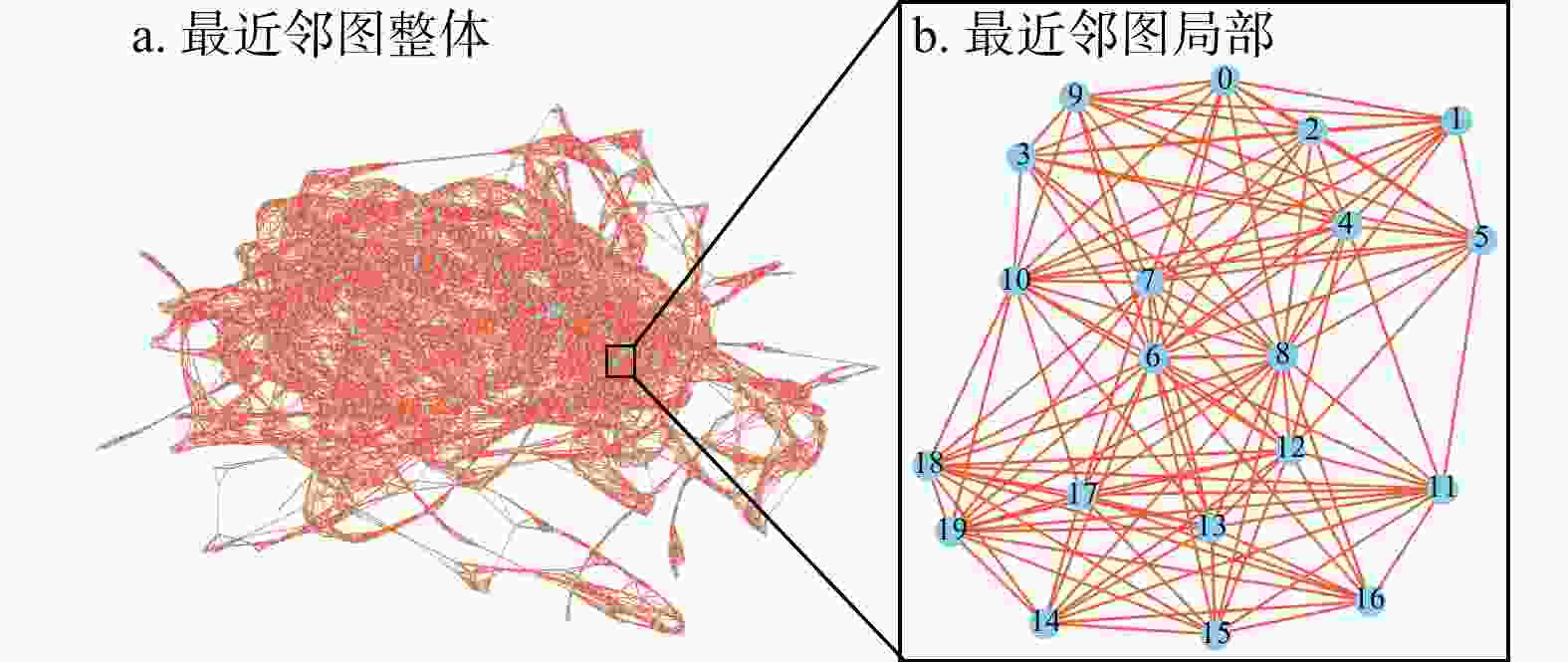
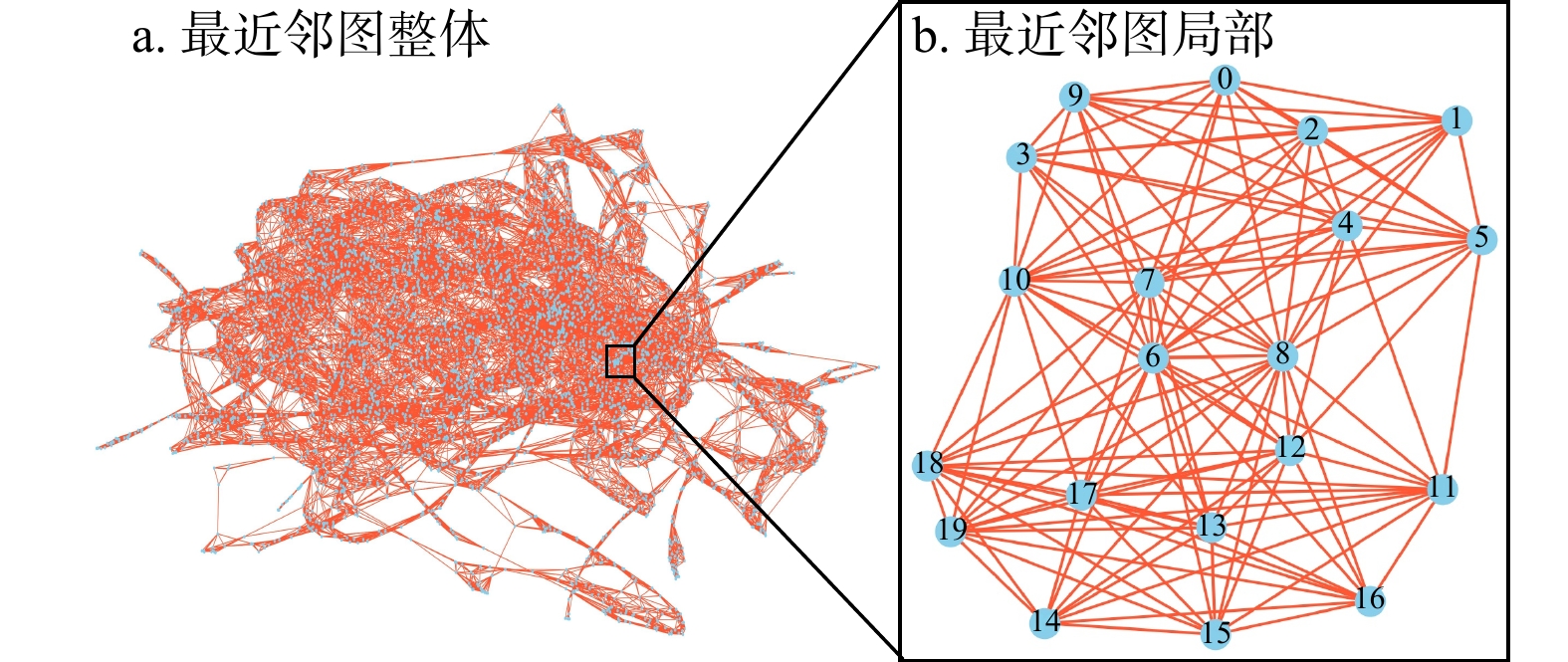
图 2 基于经纬度投影坐标的邻接矩阵
Figure 2. Adjacency matrix based on longitude and latitude projection coordinates
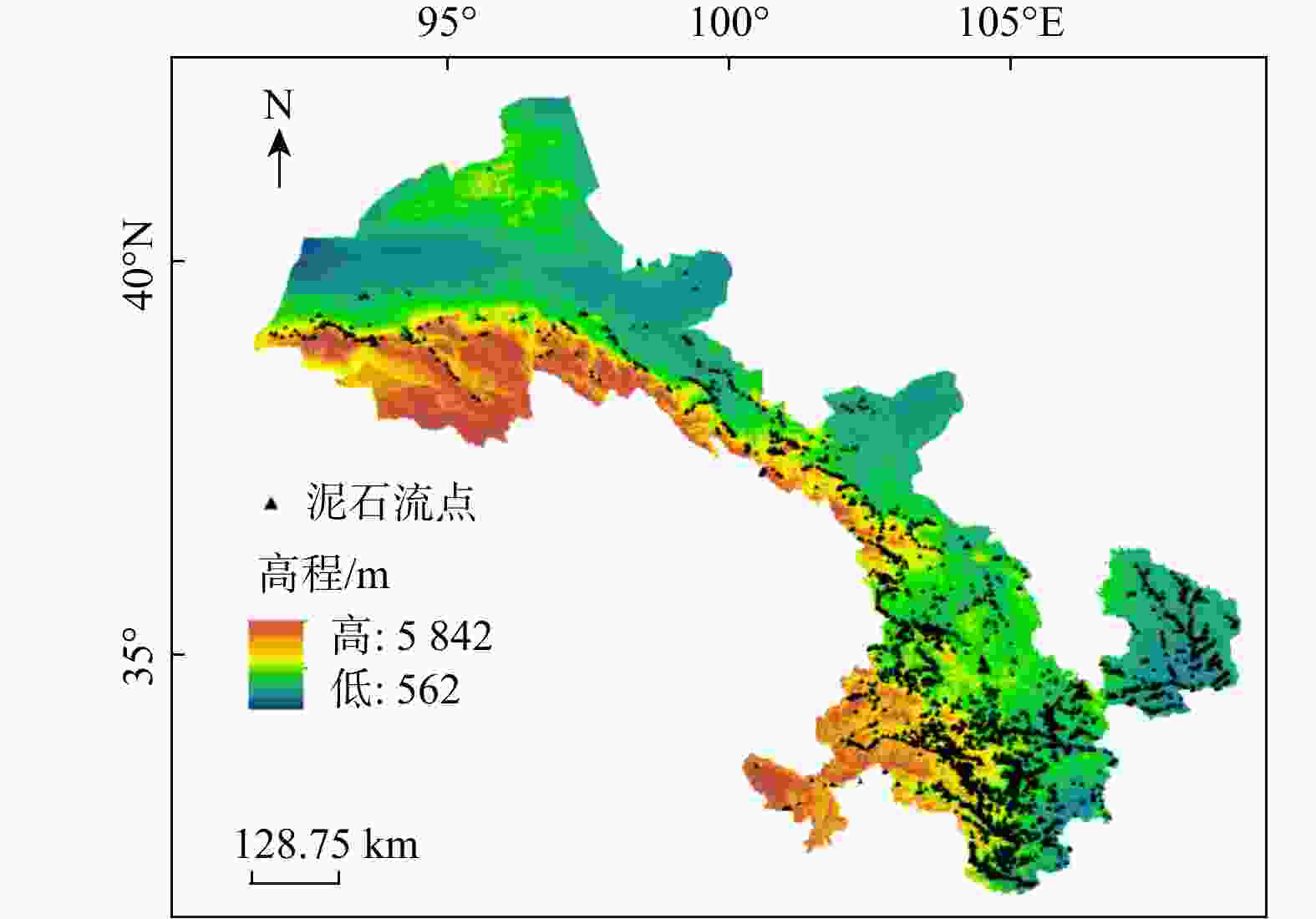
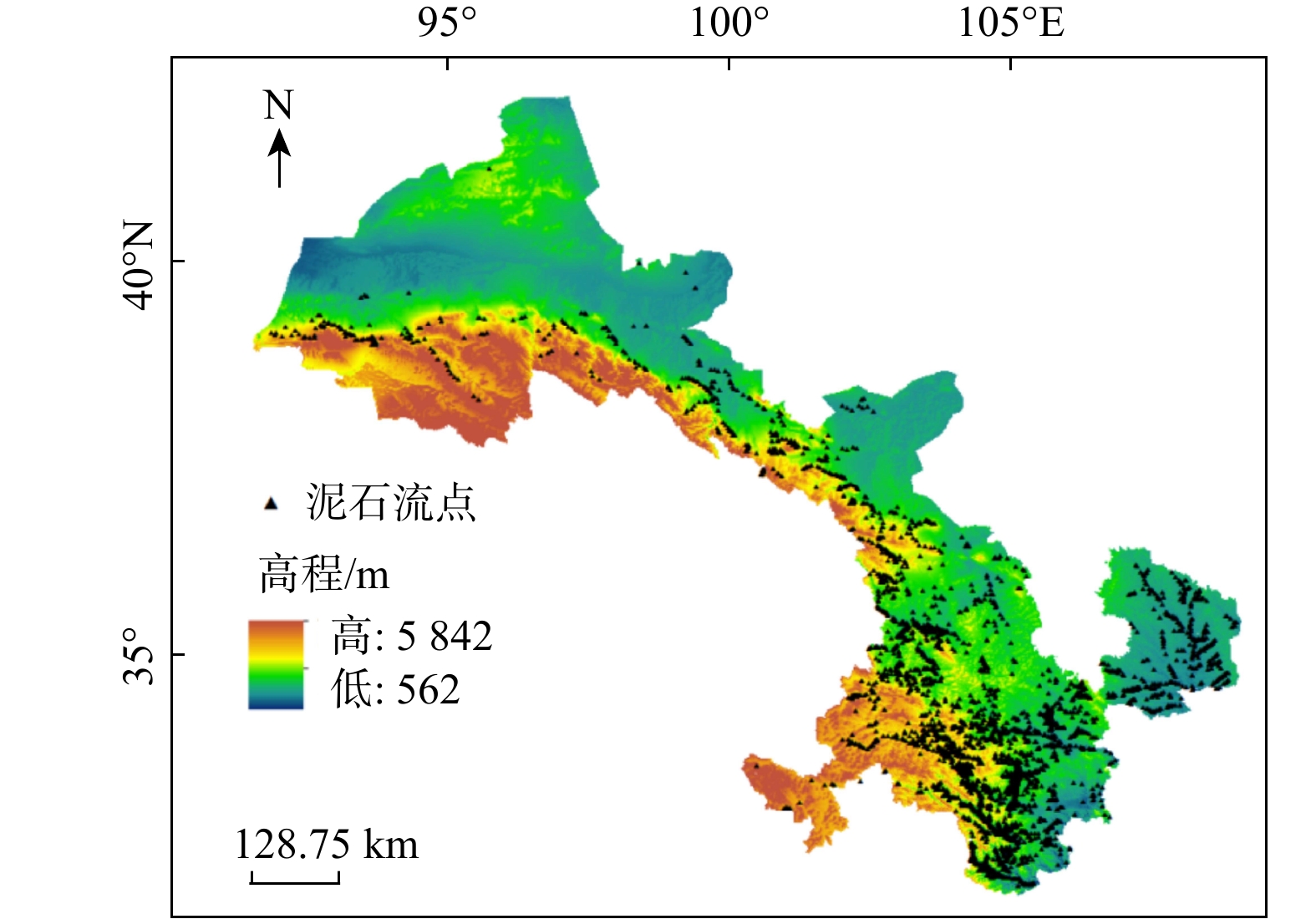
图 5 甘肃省地理位置及泥石流灾害分布
Figure 5. Geological location and debris flow disaster distribution in Gansu Province
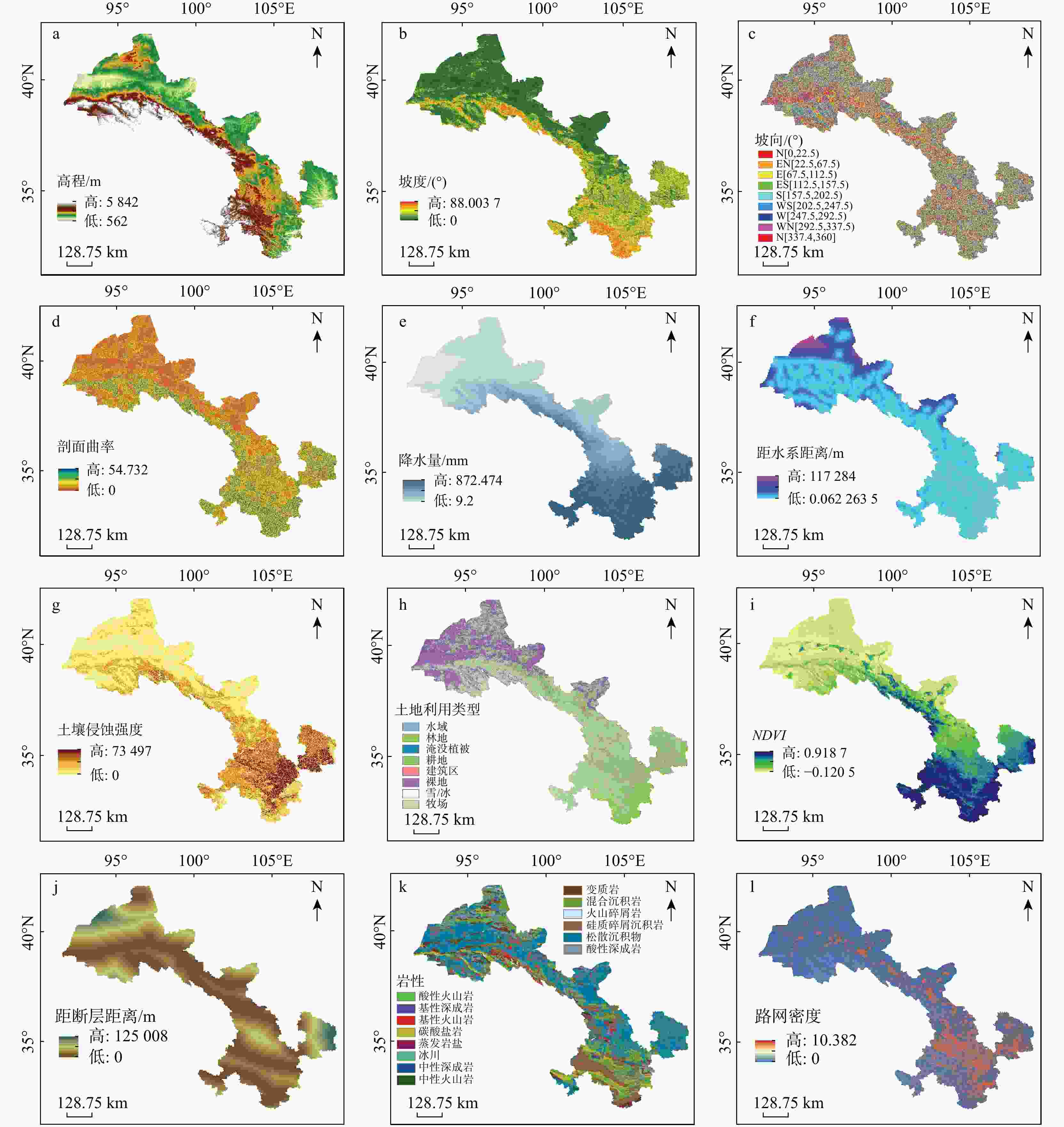
图 6 甘肃省泥石流评价因子分布
Figure 6. Evaluation factor classification of debris flow in Gansu Province
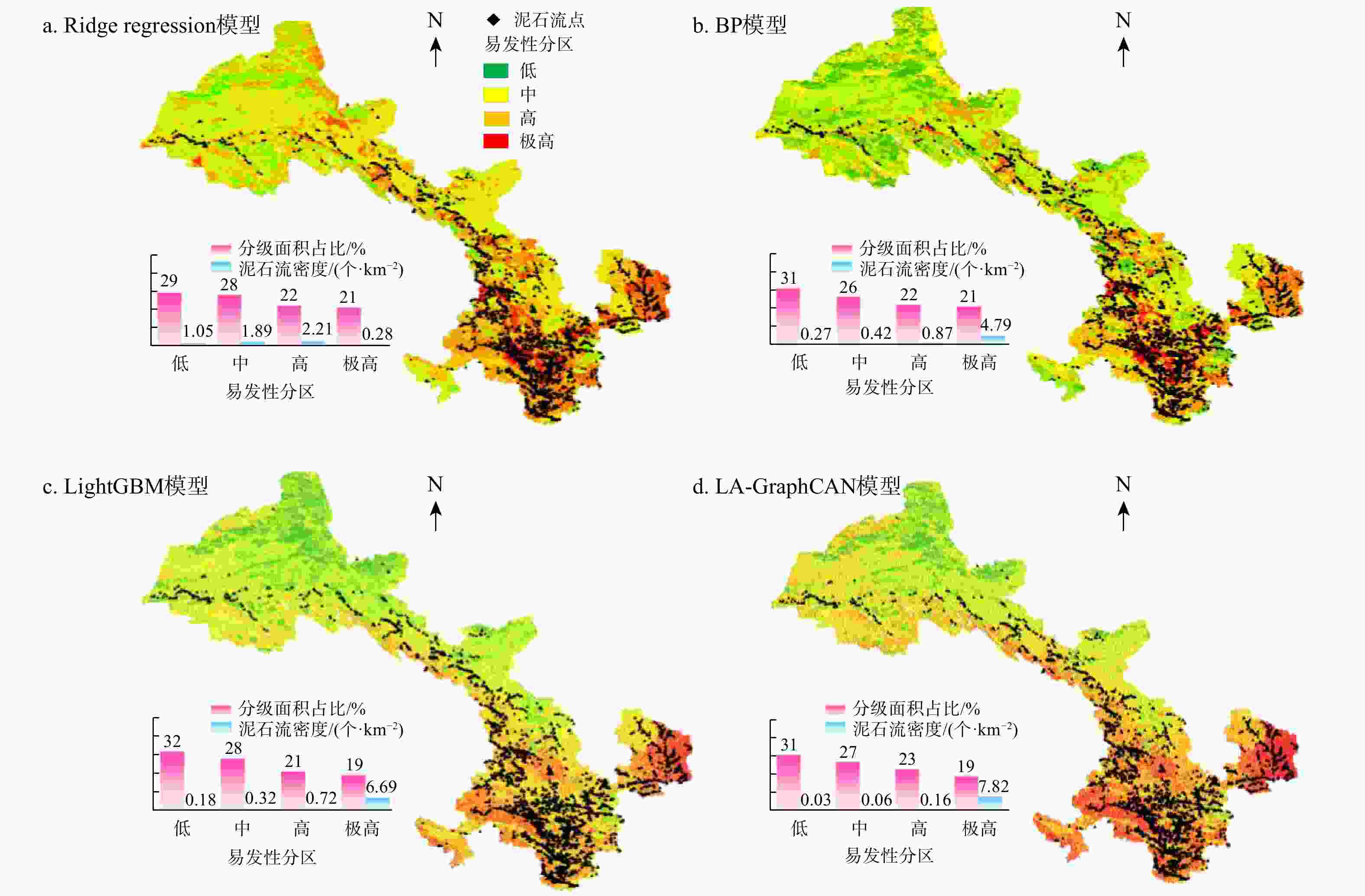
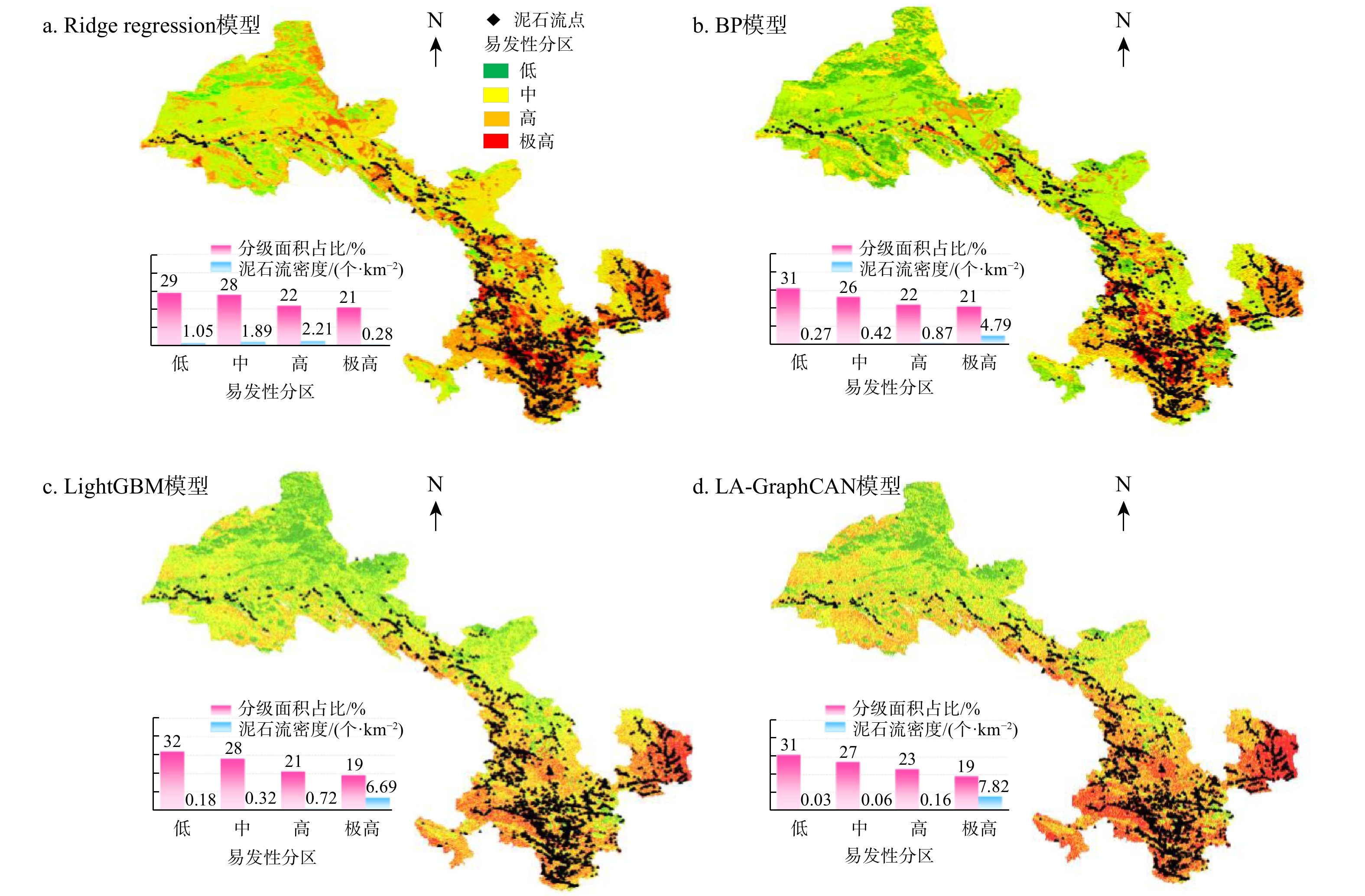
图 9 不同模型的甘肃省泥石流易发性评价
Figure 9. Evaluation of the susceptibility assessment of debris flows in Gansu Province based on different models
表 1 LA-GraphCAN参数设置
Table 1. LA-GraphCAN parameter setting
参数项 参数值 最近邻数 10 GCNConv1 out_channels(第1层图卷积输出通道) 32 GCNConv2 out_channels(第2层图卷积输出通道) 64 GAT out_channels(图注意力机制输出通道) 32 GAT Heads (图注意力机制头数) 4 GCNConv3 out_channels(第3层图卷积输出通道) 1 优化器 Adam 初始化学习率 0.01 Dropout率 0.5 损失函数 二元交叉熵损失 最大迭代次数 5000  下载: 导出CSV
表 2 不同模型对比
Table 2. Comparison of different models
模型 准确率 精确率 召回率 F1 分数 Ridge regression 0.7446 0.7227 0.6102 0.6617 Decision tree 0.8990 0.8762 0.8772 0.8767 XGBoost 0.9380 0.9360 0.9108 0.9232 LightGBM 0.9333 0.9358 0.8988 0.9169 CatBoost 0.9270 0.9277 0.8910 0.9090 CNN 0.9039 0.9151 0.8435 0.8778 BP 0.9114 0.8952 0.8874 0.8913 LA-GraphCAN 0.9458 0.9436 0.9228 0.9331
下载: 导出CSV
表 3 不同GAT头数对比
Table 3. Comparison of different GAT heads
GAT头数 准确率 精确率 召回率 F1分数 1 0.9432 0.9521 0.9123 0.9314 2 0.9425 0.9418 0.9209 0.9303 3 0.9432 0.9392 0.9184 0.9305 4 0.9458 0.9436 0.9228 0.9331 5 0.9400 0.9394 0.9127 0.9245
下载: 导出CSV
表 4 不同最近邻数对比
Table 4. Comparison of different nearest neighbours
最近邻数 准确率 精确率 召回率 F1分数 5 0.9442 0.9460 0.9162 0.9327 10 0.9458 0.9436 0.9228 0.9331 15 0.9406 0.9493 0.9101 0.9275 20 0.9332 0.9326 0.9089 0.9203
下载: 导出CSV
-
[1] 史培军, 刘连友. 北京师范大学灾害风险科学研究回顾与展望[J]. 北京师范大学学报(自然科学版), 2022, 58(3): 458-464. doi: 10.12202/j.0476-0301.2022112SHI P J, LIU L Y. Disaster risk science at Beijing Normal University[J]. Journal of Beijing Normal University (Natural Science), 2022, 58(3): 458-464. (in Chinese with English abstract doi: 10.12202/j.0476-0301.2022112 [2] 陈丹璐, 孙德亮, 文海家, 等. 基于不同因子筛选方法的LightGBM-SHAP滑坡易发性研究[J]. 北京师范大学学报(自然科学版), 2024, 60(1): 148-158. doi: 10.12202/j.0476-0301.2023098CHEN D L, SUN D L, WEN H J, et al. LightGBM-SHAP landslide susceptibility by different factor screening methods[J]. Journal of Beijing Normal University (Natural Science), 2024, 60(1): 148-158. (in Chinese with English abstract doi: 10.12202/j.0476-0301.2023098 [3] 解明礼, 巨能攀, 赵建军, 等. 区域地质灾害易发性分级方法对比分析研究[J]. 武汉大学学报(信息科学版), 2021, 46(7): 1003-1014.XIE M L, JU N P, ZHAO J J, et al. Comparative analysis on classification methods of geological disaster susceptibility assessment[J]. Geomatics and Information Science of Wuhan University, 2021, 46(7): 1003-1014. (in Chinese with English abstract [4] 赵晓燕, 谈树成, 李永平. 基于斜坡单元与组合赋权法的东川区地质灾害危险性评价[J]. 云南大学学报(自然科学版), 2021, 43(2): 299-305.ZHAO X Y, TAN S C, LI Y P. Risk assessment of geological hazards in Dongchuan District based on the methods of slope unit and combination weighting[J]. Journal of Yunnan University (Natural Sciences Edition), 2021, 43(2): 299-305. (in Chinese with English abstract [5] 郭瑞, 马富存, 郭一兵, 等. 基于层次分析法的泥石流易发性评价[J]. 东华理工大学学报(自然科学版), 2016, 39(4): 347-351. doi: 10.3969/j.issn.1674-3504.2016.04.007GUO R, MA F C, GUO Y B, et al. Debris flow evaluation of occurrence easiness based on AHP[J]. Journal of East China University of Technology (Natural Science), 2016, 39(4): 347-351. (in Chinese with English abstract doi: 10.3969/j.issn.1674-3504.2016.04.007 [6] TSAPARAS I, RAHARDJO H, TOLL D G, et al. Controlling parameters for rainfall-induced landslides[J]. Computers and Geotechnics, 2002, 29(1): 1-27. doi: 10.1016/S0266-352X(01)00019-2 [7] 甘建军, 罗昌泰. 中低山冲沟型泥石流运动参数及过程模拟[J]. 自然灾害学报, 2020, 29(2): 97-110.GAN J J, LUO C T. Runout and process simulation of gully debris flow in middle and low mountains[J]. Journal of Natural Disasters, 2020, 29(2): 97-110. (in Chinese with English abstract [8] 郭天颂, 张菊清, 韩煜, 等. 基于粒子群优化支持向量机的延长县滑坡易发性评价[J]. 地质科技情报, 2019, 38(3): 236-243.GUO T S, ZHANG J Q, HAN Y, et al. Evaluation of landslide susceptibility in Yanchang County based on particle swarm optimization-based support vector machine[J]. Geological Science and Technology Information, 2019, 38(3): 236-243.(in Chinese with English abstract [9] 李益敏, 杨蕾, 魏苏杭. 基于小流域单元的怒江州泥石流易发性评价[J]. 长江流域资源与环境, 2019, 28(10): 2419-2428.LI Y M, YANG L, WEI S H. Susceptibility assessment of debris flow in Nujiang Prefecture based on the catchment[J]. Resources and Environment in the Yangtze Basin, 2019, 28(10): 2419-2428. (in Chinese with English abstract [10] DOU Q, QIN S W, ZHANG Y C, et al. A method for improving controlling factors based on information fusion for debris flow susceptibility mapping: A case study in Jilin Province, China[J]. Entropy, 2019, 21(7): 695. doi: 10.3390/e21070695 [11] 田春山, 刘希林, 汪佳. 基于CF和Logistic回归模型的广东省地质灾害易发性评价[J]. 水文地质工程地质, 2016, 43(6): 154-161.TIAN C S, LIU X L, WANG J. Geohazard susceptibility assessment based on CF model and Logistic regression models in Guangdong[J]. Hydrogeology & Engineering Geology, 2016, 43(6): 154-161. (in Chinese with English abstract [12] 黄发明, 陈杰, 杨阳, 等. 滑坡易发性相关致灾环境因子研究的综述与展望[J]. 地质科技通报, 2025, 44(2): 14-37.HUANG F M, CHEN J, YANG Y, et al. A review and prospect of disaster-causing environmental factors related to landslide susceptibility prediction[J]. Bulletin of Geological Science and Technology, 2025, 44(2): 14-37. (in Chinese with English abstract [13] MFONDOUM A H N, NGUET P W, SEUWUI D T, et al. Stepwise integration of analytical hierarchy process with machine learning algorithms for landslide, gully erosion and flash flood susceptibility mapping over the North-Moungo perimeter, Cameroon[J]. Geoenvironmental Disasters, 2023, 10(1): 22. doi: 10.1186/s40677-023-00254-5 [14] 李坤, 赵俊三, 林伊琳, 等. 基于SMOTE和多粒度级联森林的泥石流易发性评价[J]. 农业工程学报, 2022, 38(6): 113-121. doi: 10.11975/j.issn.1002-6819.2022.06.013LI K, ZHAO J S, LIN Y L, et al. Assessment of debris flow susceptibility based on SMOTE and multi-grained cascade forest[J]. Transactions of the Chinese Society of Agricultural Engineering, 2022, 38(6): 113-121. (in Chinese with English abstract doi: 10.11975/j.issn.1002-6819.2022.06.013 [15] 饶姗姗, 冷小鹏. 基于RSIV-RF模型的凉山州泥石流易发性评价[J]. 地质科技通报, 2024, 43(1): 275-287.RAO S S, LENG X P. Debris flow susceptibility evaluation of Liangshan Prefecture based on the RSIV-RF model[J]. Bulletin of Geological Science and Technology, 2024, 43(1): 275-287. (in Chinese with English abstract [16] CHEN Z L, QUAN H C, JIN R, et al. Debris flow susceptibility assessment based on boosting ensemble learning techniques: A case study in the Tumen River Basin, China[J]. Stochastic Environmental Research and Risk Assessment, 2024, 38(6): 2359-2382. doi: 10.1007/s00477-024-02683-6 [17] 谭林, 张璐璐, 魏鑫, 等. 基于U-Net语义分割网络的区域滑坡易发性评价方法和跨地区泛化能力研究[J]. 土木工程学报, 2025, 58(6): 103-116.TAN L, ZHANG L L, WEI X, et al. Study on regional landslide susceptibility assessment method based on U-Net semantic segmentation network and its cross-generalization ability[J]. China Civil Engineering Journal, 2025, 58(6): 103-116. (in Chinese with English abstract [18] 黄发明, 陈彬, 毛达雄, 等. 基于自筛选深度学习的滑坡易发性预测建模及其可解释性[J]. 地球科学, 2023, 48(5): 1696-1710.HUANG F M, CHEN B, MAO D X, et al. Landslide susceptibility prediction modeling and interpretability based on self-screening deep learning model[J]. Earth Science, 2023, 48(5): 1696-1710. (in Chinese with English abstract [19] LI Y, MING D P, ZHANG L, et al. Seismic landslide susceptibility assessment using newmark displacement based on a dual-channel convolutional neural network[J]. Remote Sensing, 2024, 16(3): 566. doi: 10.3390/rs16030566 [20] 王毅, 方志策, 牛瑞卿, 等. 基于深度学习的滑坡灾害易发性分析[J]. 地球信息科学学报, 2021, 23(12): 2244-2260. doi: 10.12082/dqxxkx.2021.210057WANG Y, FANG Z C, NIU R Q, et al. Landslide susceptibility analysis based on deep learning[J]. Journal of Geo-information Science, 2021, 23(12): 2244-2260. (in Chinese with English abstract doi: 10.12082/dqxxkx.2021.210057 [21] YUAN R H, LUO Y M, XU F S, et al. Mudslide susceptibility assessment based on a two-channel residual network[J]. Geomatics, Natural Hazards and Risk, 2024, 15(1): 2300804. doi: 10.1080/19475705.2023.2300804 [22] 孔嘉旭, 庄建琦, 彭建兵, 等. 基于信息量和卷积神经网络的黄土高原滑坡易发性评价[J]. 地球科学, 2023, 48(5): 1711-1729.KONG J X, ZHUANG J Q, PENG J B, et al. Evaluation of landslide susceptibility in Chinese Loess Plateau based on IV-RF and IV-CNN coupling models[J]. Earth Science, 2023, 48(5): 1711-1729. (in Chinese with English abstract [23] 邓日朗, 张庆华, 刘伟, 等. 基于改进两步法采样策略和卷积神经网络的崩塌易发性评价[J]. 地质科技通报, 2024, 43(2): 186-200.DENG R L, ZHANG Q H, LIU W, et al. Collapse susceptibility evaluation based on an improved two-step sampling strategy and a convolutional neural network[J]. Bulletin of Geological Science and Technology, 2024, 43(2): 186-200. (in Chinese with English abstract [24] ADITIAN A, KUBOTA T, SHINOHARA Y. Comparison of GIS-based landslide susceptibility models using frequency ratio, logistic regression, and artificial neural network in a tertiary region of Ambon, Indonesia[J]. Geomorphology, 2018, 318: 101-111. doi: 10.1016/j.geomorph.2018.06.006 [25] 杨延晨, 周超, 施佳湄. 基于卷积神经网络的区域滑坡易发性评价: 以三峡库区万州区为例[J]. 测绘通报, 2023(11): 1-6.YANG Y C, ZHOU C, SHI J M. Evaluation of regional landslide susceptibility based on convolutional neural network: A case study of Wanzhou District of Three Gorges Reservoir area[J]. Bulletin of Surveying and Mapping, 2023(11): 1-6. (in Chinese with English abstract [26] LIU P, WEI Y M, WANG Q J, et al. Research on post-earthquake landslide extraction algorithm based on improved U-net model[J]. Remote Sensing, 2020, 12(5): 894. doi: 10.3390/rs12050894 [27] REBETEZ J, SATIZÁBAL H, MOTA M, et al. Augmenting a convolutional neural network with local histograms: A case study in crop classification from high-resolution UAV imagery[C]//Anon. The European symposium on artificial neural networks. Ciaco: Louvain-la-Neuve, 2016: 27-29. [28] TANG J X, ERICSON L, FOLKESSON J, et al. GCNv2: Efficient correspondence prediction for real-time SLAM[J]. IEEE Robotics and Automation Letters, 2019, 4(4): 3505-3512. [29] BRODY S, ALON U, YAHAV E. How attentive are graph attention networks?[J]. ArXiv e-Prints, 2021, arXiv: 2105.14491. [30] 闫满存, 王光谦. 基于GIS的澜沧江下游区滑坡灾害危险性分析[J]. 地理科学, 2007, 27(3): 365-370. doi: 10.3969/j.issn.1000-0690.2007.03.013YAN M C, WANG G Q. Landslide risk assessment in the lower Lancang River watershed using GIS approach[J]. Scientia Geographica Sinica, 2007, 27(3): 365-370. (in Chinese with English abstract doi: 10.3969/j.issn.1000-0690.2007.03.013 [31] 刘晋文, 杨亚兵, 张磊, 等. 甘肃省1∶5万地质灾害风险调查成果集成[R]. 兰州: 甘肃省地质环境监测院, 2022.LIU J W, YANG Y B, ZHANG L, et al. Integration of 1: 50 000 geological hazard risk survey results in Gansu Province[R]. Lanzhou: Geological Environment Monitoring Institute of Gansu Province, 2022. (in Chinese) [32] 贾强, 窦晓东, 何斌, 等. 自然灾害综合风险普查历史地质灾害调查技术报告[R]. 兰州: 甘肃省地质环境监测院, 2021.JIA Q, DOU X D, HE B, et al. A technical report on the survey of historical geological hazards in the general survey of the comprehensive risk of natural disasters[R]. Lanzhou: Geological Environment Monitoring Institute of Gansu Province, 2021. (in Chinese) [33] 陈秀清, 白福, 于燕燕. 甘肃省泥石流发育特征、成因分析及其危害[J]. 西北地质, 2014, 47(3): 205-210. doi: 10.3969/j.issn.1009-6248.2014.03.027CHEN X Q, BAI F, YU Y Y. Development characteristics, causes and hazard analysis of debris flow in Gansu Province[J]. Northwestern Geology, 2014, 47(3): 205-210. (in Chinese with English abstract doi: 10.3969/j.issn.1009-6248.2014.03.027 [34] 窦杰, 向子林, 许强, 等. 机器学习在滑坡智能防灾减灾中的应用与发展趋势[J]. 地球科学, 2023, 48(5): 1657-1674.DOU J, XIANG Z L, XU Q, et al. Application and development trend of machine learning in landslide intelligent disaster prevention and mitigation[J]. Earth Science, 2023, 48(5)1657-1674. (in Chinese with English abstract [35] DENG H, WU X T, ZHANG W J, et al. Slope-unit scale landslide susceptibility mapping based on the random forest model in deep valley areas[J]. Remote Sensing, 2022, 14(17): 4245. doi: 10.3390/rs14174245 [36] 刘国栋, 秦胜伍, 孟凡奇, 等. 基于地理信息相似度的负样本采样策略在泥石流易发性评价中的应用[J]. 工程地质学报, 2023, 31(2): 526-537.LIU G D, QIN S W, MENG F Q, et al. Application of geographic information similarity based absence sampling method to debris flow susceptibility mapping[J]. Journal of Engineering Geology, 2023, 31(2): 526-537. (in Chinese with English abstract [37] 皋子琪, 吕立群, 马超, 等. 基于MaxEnt模型的怒江大峡谷泥石流易发性评价和成因[J]. 水土保持学报, 2023, 37(6): 34-41.GAO Z Q, LYU L Q, MA C, et al. Assessment and causes of debris flow susceptibility in the Nvjiang grand canyon based on MaxEnt Model[J]. Journal of Soil and Water Conservation, 2023, 37(6): 34-41. (in Chinese with English abstract [38] SWETS J A. Measuring the accuracy of diagnostic systems[J]. Science, 1988, 240: 1285-1293. doi: 10.1126/science.3287615 [39] MULUMBA D M, LIU J K, HAO J, et al. Application of an optimized PSO-BP neural network to the assessment and prediction of underground coal mine safety risk factors[J]. Applied Sciences, 2023, 13(9): 5317. doi: 10.3390/app13095317 [40] SALEHI A W, KHAN S, GUPTA G, et al. A study of CNN and transfer learning in medical imaging: Advantages, challenges, future scope[J]. Sustainability, 2023, 15(7): 5930. doi: 10.3390/su15075930 [41] LIANG W Z, LUO S Z, ZHAO G Y, et al. Predicting hard rock pillar stability using GBDT, XGBoost, and LightGBM algorithms[J]. Mathematics, 2020, 8(5): 765. doi: 10.3390/math8050765 [42] EL BILALI A, ABDESLAM T, AYOUB N, et al. An interpretable machine learning approach based on DNN, SVR, Extra Tree, and XGBoost models for predicting daily pan evaporation[J]. Journal of Environmental Management, 2023, 327: 116890. doi: 10.1016/j.jenvman.2022.116890 [43] DAI X H, ANDANI H T, ALIZADEH A, et al. Using Gaussian Process Regression (GPR) models with the Matérn covariance function to predict the dynamic viscosity and torque of SiO2/Ethylene glycol nanofluid: A machine learning approach[J]. Engineering Applications of Artificial Intelligence, 2023, 122: 106107. doi: 10.1016/j.engappai.2023.106107 [44] HARLOW L L. The essence of multivariate thinking: Basic themes and methods[M]. New York: Routledge, 2023. -

 下载:
下载:



 点击查看大图

计量
- 文章访问数: 886
- PDF下载量: 149
- 被引次数: 0