Stagnation lines and its control of nested groundwater flow systems in three-dimensional Tóthian basins
-
摘要:
Tóth基于二维剖面流场提出的地下水流系统理论已成为研究盆地尺度地下水循环的理论依据。二维剖面上的驻点可以用于精确划分水流系统的空间分布,然而人们对三维盆地中水流系统的形态以及驻点是否存在等认识尚不清楚。针对2种典型的三维盆地,分别是只在单一方向存在波状起伏的类前陆型盆地和2个正交方向同时存在波状起伏的沙丘型盆地,利用余弦函数建立潜水面起伏的数学表达式,推导水头分布的解析解,利用TECPLOT软件实现了水流系统三维空间分布的可视化。研究发现,2种理想三维盆地内都可以发育驻点,其中类前陆型盆地内驻点构成一条水平延伸的驻线,驻线控制了4个水流系统的空间分布;沙丘型盆地内驻点构成一条圆弧状驻线,驻线控制了6个水流系统的空间分布。通过研究驻线在三维盆地中的分布并且提出了利用驻线划分三维盆地水流系统的方法,加深了对三维盆地地下水循环规律的认识。
Abstract:The theory of groundwater flow systems proposed by Tóth, which was based on the two-dimensional profile flow field, has become the theoretical basis for studying basin-scale groundwater circulation.The stagnation points on the two-dimensional profile can be used to accurately divide the spatial distribution of groundwater flow systems.However, the spatial distribution of groundwater flow systems and whether stagnation points exist in the 3D domain remain unknown.In this study, two typical three-dimensional basins, namely foreland-like basins with undulations only in the x direction and dune-type basins with undulations in both x and y directions, are used as typical examples.By using a combination of cosine functions to characterize the undulating water table, analytical solutions of head distribution in the two basins are derived.Moreover, by employing the TECPLOT software, the spatial distribution of the 3D groundwater flow systems is clearly shown.It is found out that stagnation points can develop in two basins.The stagnation points in the foreland-like basin constitute a horizontally extending stagnation line, which controls the spatial distribution of four flow systems in the basin, while the stagnation points in the dune-type basin form an arc-shaped stagnation line, which controls the spatial distribution of six flow systems in the basin.By studying the distribution of stagnation line in 3D basins and successfully dividing flow systems by using the stagnation line, this study leads to a deepened understanding of groundwater circulation in 3D basins.
-

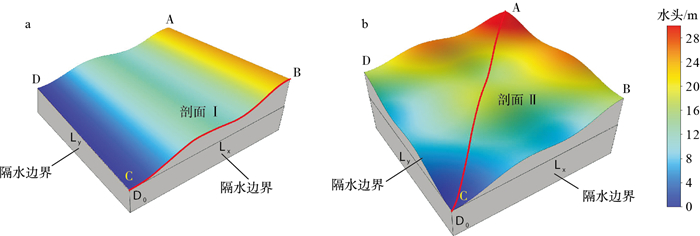
图 1 类前陆型盆地(a)与沙丘型盆地(b)的概念模型示意图
Figure 1. Conceptual model diagram of foreland-like basin (a) and dune-type basin (b)

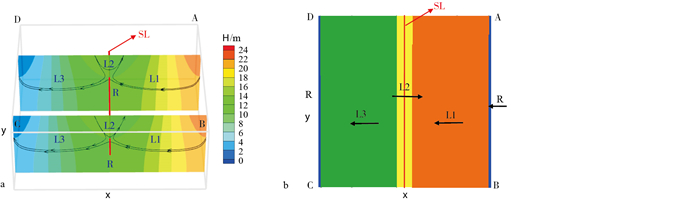
图 2 三维类前陆型盆地驻线及临界流线三维空间分布图(a)、驻线及4个水流系统分布俯视图(b)
Figure 2. Three-dimensional spatial distribution of stagnation line and dividing streamlines (a), top view of the distribution of stagnation line and four flow systems (b) in the three-dimensional foreland-like basins

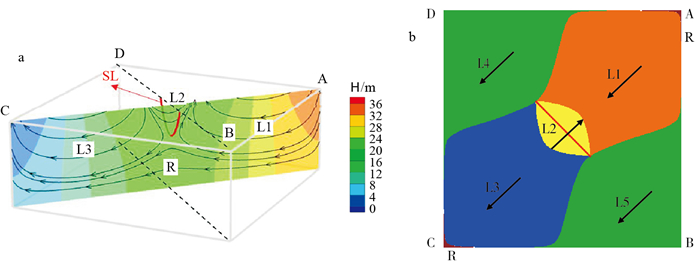
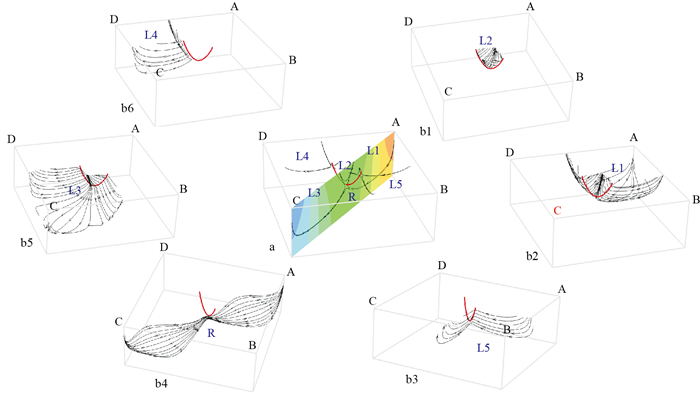
图 3 理想沙丘型三维盆地的驻线及水流系统空间分布图
a.驻线及AC剖面流场图;b.驻线及水流系统分布俯视图
Figure 3. Spatial distribution map of standing line and flow system of ideal dune-shaped three-dimensional basins
-
[1] 张宗祜, 沈照理, 薛禹群, 等. 华北平原地下水环境演化[M]. 北京: 地质出版社, 2000.Zhang Z G, Shen Z L, Xue Y Q, et al. Evolution of groundwater environment in the North China Plain[M]. Beijing: Geological Publishing House, 2000 (in Chinese). [2] 侯光才, 张茂省, 刘方, 等. 鄂尔多斯盆地地下水勘察研究[M]. 北京: 地质出版社, 2008.Hou G C, Zhang M S, Liu F, et al. Research on groundwater survey in Ordos Basin[M]. Beijing: Geological Publishing House, 2008 (in Chinese). [3] Tóth J. A theoretical analysis of groundwater flow in small drainage basins[J]. Journal of Geophysical Research, 1963, 68: 4795-4812. doi: 10.1029/JZ068i016p04795 [4] Tóth J. Gravitational systems of groundwater flow: Theory, evaluation and utilization[M]. Cambridge: Cambridge University Press, 2009. [5] Domenico P A, Palciauskas V V. Theoretical analysis of forced convective heat transfer in regional groundwater flow[J]. Bulletin of the Geological Society of America, 1973, 84(12): 3803-3814. doi: 10.1130/0016-7606(1973)84<3803:TAOFCH>2.0.CO;2 [6] Schwartz F W, Domenico P A. Simulation of hydrochemical patterns in regional groundwater flow[J]. Water Resources Research, 1973, 9: 707-720. doi: 10.1029/WR009i003p00707 [7] Wang H, Jiang X W, Wan L, et al. Hydrogeochemical characterization of groundwater flow systems in the discharge area of a river basin[J]. Journal of Hydrology, 2015, 537: 433-441. [8] An R, Jiang X W, Wang J Z, et al. A theoretical analysis of basin-scale groundwater temprature distribution[J]. Hydrogeology Journal, 2015, 23(2): 397-404. doi: 10.1007/s10040-014-1197-y [9] Tóth J. Cross-formational gravity-flow of groundwater: A mechanism of the transport and accumulation of petroleum (the generalized hydraulic theory of petroleum migration)[J]. Hydraulic Theory of Migration, 1980, 10: 121-167. [10] Tóth J. Groundwater as a geologic agent: An overview of the causes, processes, and manifestations[J]. Hydrogeology Journal, 1999, 7: 1-14. doi: 10.1007/s100400050176 [11] Jiang X W, Wan L, Wang J Z, et al. Field identification of groundwater flow systems and hydraulic traps in drainage basins using a geophysical method[J]. Geophysical Research Letters, 2014, 41: 2812-2819. doi: 10.1002/2014GL059579 [12] 梁杏, 张婧玮, 蓝坤, 等. 江汉平原地下水化学特征及水流系统分析[J]. 地质科技通报, 2020, 39(1): 21-33. doi: 10.19509/j.cnki.dzkq.2020.0103Liang X, Zhang J W, Lan K, et al. Hydrochemical characteristics of groundwater and analysis of groundwater flow systems in Jianghan Plain[J]. Bulletin of Geological Science and Technology, 2020, 39(1): 21-33(in Chinese with English abstract). doi: 10.19509/j.cnki.dzkq.2020.0103 [13] 柳亚清, 谢先军, 皮坤福, 等. 水流场及水化学过程对地下水中砷富集的影响[J]. 地质科技情报, 2015, 34(3): 185-190. doi: 10.3969/j.issn.1009-6248.2015.03.020Liu Y Q, Xie X J, Pi K F, et al. Effects of groundwater flowing and hydrochemical processes on the arsenic enrichmenting groundwater system[J]. Geological Science and Technology Information, 2015, 34(3): 185-190 (in Chinese with English abstract). doi: 10.3969/j.issn.1009-6248.2015.03.020 [14] 张人权, 王恒纯, 许绍倬. 水文地质研究中信息的提取与组织[J]. 水文地质工程地质, 1990, 17(2): 1-2. https://www.cnki.com.cn/Article/CJFDTOTAL-SWDG199002001.htmZhang R Q, Wang H C, Xu S Z. Information extraction and organization in hydrogeological research[J]. Hydrogeology & Engineering Geology, 1990, 17(2): 1-2(in Chinese with English abstract). https://www.cnki.com.cn/Article/CJFDTOTAL-SWDG199002001.htm [15] 张人权, 梁杏, 靳孟贵, 等. 当代水文地质学发展趋势与对策[J]. 水文地质工程地质, 2005, 32(1): 51-56. doi: 10.3969/j.issn.1000-3665.2005.01.013Zhang R Q, Liang X, Jin M G, et al. The trends in contemporary hydrogeology[J]. Hydrogeology & Engineering Geology, 2005, 32(1): 51-56(in Chinese with English abstract). doi: 10.3969/j.issn.1000-3665.2005.01.013 [16] 梁杏, 张人权, 牛宏, 等. 地下水流系统理论与研究方法的发展[J]. 地质科技情报, 2012, 31(5): 143-151. https://www.cnki.com.cn/Article/CJFDTOTAL-DZKQ201205020.htmLiang X, Zhang R Q, Niu H, et al. Development of the theory and research method of groundwater flow system[J]. Geological Science and Technology Information, 2012, 31(5): 143-151(in Chinese with English abstract). https://www.cnki.com.cn/Article/CJFDTOTAL-DZKQ201205020.htm [17] 梁杏, 张人权, 靳孟贵. 地下水流系统: 理论、应用、调查[M]. 北京: 地质出版社, 2015.Liang X, Zhang R Q, Jin M G. Groundwater flow systems: Theory, application and investigation[M]. Beijing: Geological Publishing House, 2015 (in Chinese). [18] Jiang X W, Wang X S, Wan L, et al. An analytical study on stagnant points in nested flow systems in basins with depth-decaying hydraulic conductivity[J]. Water Resources Research, 2012, 4: W01512. [19] Robinson N I, Love A J. Hidden channels of groundwater flow in Tóthian drainage basins[J]. Advances in Water Resources, 2013, 62: 71-78. doi: 10.1016/j.advwatres.2013.10.004 [20] Zhang X L, Jiao J J, Li H L, et al. Effects of downward intrusion of saline water on nested groundwater flow systems[J]. Water Resources Research, 2020, 56(10): W28377. [21] 王大纯, 张人权, 史毅虹. 水文地质学基础[M]. 北京: 地质出版社, 1986.Wang D C, Zhang R Q, Shi Y H. Fundamentals of hydrogeology[M]. Beijing: Geological Publishing House, 1986(in Chinese). [22] 张人权, 梁杏, 靳孟贵. 水文地质学基础[M]. 北京: 地质出版社, 2011.Zhang R Q, Liang X, Jin M G. Fundamentals of hydrogeology[M]. Beijing: Geological Publishing House, 2011(in Chinese). [23] Wang X S, Wan L, Jiang X W, et al. Identifying three-dimensional nested groundwater flow systems in a Tóthian basin[J]. Advances in Water Resources, 2017, 108: 139-156. doi: 10.1016/j.advwatres.2017.07.016 [24] Wang C, Gomez-Velez J D, Wilson J L. Theimportance of capturing topographic features for modeling groundwater flow and transport in mountainous watersheds[J]. Water Resources Research, 2018, 54: 10313-10338. [25] Wang J Z, Jiang X W, Zhang Z Y, et al. An analytical study on three-dimensional versus two-dimensional water table-induced flow patterns in a Tóthian basin[J]. Hydrological Processes, 2017, 31: 4006-4018. doi: 10.1002/hyp.11317 [26] 张志远, 蒋小伟, 王俊智, 等. 基于二维和三维模型的盆地典型剖面流场对比[J]. 水文地质工程地质, 2016, 43(3): 1-6. https://www.cnki.com.cn/Article/CJFDTOTAL-SWDG201603001.htmZhang Z Y, Jiang X W, Wang J Z, et al. Comparison of groundwater flow fields in typical profiles in drainage basins based on 2D and the 3D models[J]. Hydrogeology & Engineering Geology, 2016, 43(3): 1-6 (in Chinese with English abstract). https://www.cnki.com.cn/Article/CJFDTOTAL-SWDG201603001.htm [27] 张蔓菲, 孙蓉琳, 梁杏. 通量上边界渗透系数随埋深增加指数衰减的地下水流系统[J]. 地质科技情报, 2015, 34(4): 189-193. https://www.cnki.com.cn/Article/CJFDTOTAL-DZKQ201504028.htmZhang M F, Sun R L, Liang X. Effect of Decay exponential in hydraulic conductivity with depth on grounwater flow system based on flux upper boundary[J]. Geological Science and Technology Information, 2015, 34(4): 189-193 (in Chinese with English abstract). https://www.cnki.com.cn/Article/CJFDTOTAL-DZKQ201504028.htm -

 下载:
下载:

 点击查看大图
计量
- 文章访问数: 5
- PDF下载量: 0
- 被引次数: 0